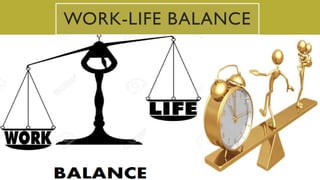
WORK-LIFE BALANCE
Dr.Tondor Cleopatra Uzosike
MBBS, MSc. Occ. Health, FWACP, FMCPH
Department of Community Medicine and Public Health, RSUTH
WORK-LIFE BALANCE
OUTLINE
•History
•What is work?
•What work-life balance is not & what it is
•Statistics on work-life balance
•Reasons for work-life imbalance
•Consequences of work-life imbalance
•How to achieve and improve work-life balance
•Benefits of work-life balance
HISTORY
•The expression "work–life balance“ was first used in the
United Kingdom in the late 1970s to describe the balance
between an individual's work and personal life.
•In the United States, this phrase was first used in1986.
•Over the years, the composition of WLB has changed and
some new phases have been identified.
HISTORY
PHASE TIME PERIOD CHANGES IN WORK AND FAMILY
LIFE SPHERES
PHASE 1 Early years of
communal living.
Entire family engaged in work for
survival or sustenance.
PHASE 2 Pre-
industrialization
period
Partial segregation of workplace and
family life.
More of trade and craftsmanship
PHASE 3 Industrial
revolution in
mid 1800s
A transition from manual production to
use of machines for mass production
necessitated setting up of factories
away from home.
HISTORY
PHASE TIME PERIOD CHANGES IN WORK AND FAMILY LIFE SPHERES
PHASE 4 Between
late 18th
and early
19th
century.
Move from production of goods to
production of services.
More technical/professional workers-such as
engineers, doctors, and teachers.---
strengthened Separation of work and
family domains.
PHASE 5 Between
early 19th
century and
1950..
Separation of work from family was more
consolidated and men took the main role
of bread earners while women took
charge of home and family chores.
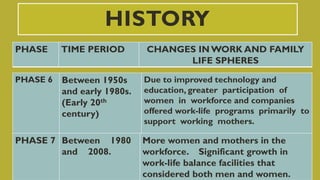
HISTORY
PHASE TIME PERIOD CHANGES IN WORK AND FAMILY
LIFE SPHERES
PHASE 6 Between 1950s
and early 1980s.
(Early 20th
century)
Due to improved technology and
education, greater participation of
women in workforce and companies
offered work-life programs primarily to
support working mothers.
Introduction of work-life balance
facilities.
PHASE 7 Between 1980
and 2008.
More women and mothers in the
workforce. Significant growth in
work-life balance facilities that
considered both men and women.
HISTORY
PHASE TIME PERIOD CHANGES IN WORK AND FAMILY
LIFE SPHERES
PHASE 8 From 2008
onwards
Increased consideration in work-
family related challenges and work-life
balance. E.g. family factors, individual
factors, the work itself, & other socio-
demographic factors.
INTRODUCTION
• Work plays a vital role in the lives of most people.
• Work, whether paid or unpaid, helps to:
Shape our identity
Gives a purpose to our existence
Contributes to our social status
• Allows/Forces us to:
Structure our time
Spend our days usefully
Brings us in contact with different people and diverse places
WHAT IS WORK?
WHAT IS WORK?
“Any activity performed by persons of any sex and age to produce goods or
to provide services for use by others or for own use.” (ILO)
The definition is irrespective of the job being formal or informal
Excludes activities that do not involve producing goods or providing services
(e.g. begging and stealing), self-care (e.g. personal grooming and hygiene)
Excludes activities that cannot be performed by another person on one’s own
behalf (e.g. sleeping, learning and activities for own recreation).
WHAT IS WORK-LIFE BALANCE IS NOT
1. Work-Life Balance does not necessarily mean
an equal balance.
Trying to schedule equal number of hours for each
of your various work and personal activities.
Life should be more flexible than that.
WHAT IS WORK-LIFE BALANCE IS NOT
2. Work-life balance is not a constant.
The right balance for you today may be different tomorrow.
The right balances when single is different married, or if you
have children.
The balance is when you start a new career or when nearing
retirement are different.
WHAT IS WORK-LIFE BALANCE IS NOT
3. Work-life balance is not a ‘one-size fits all
The best work-life balance is different for each
of us because we all have different priorities and
different lives.
WHAT IS WORK-LIFE BALANCE?
•Difficult to provide the right definition of Work-Life
Balance.
•More focus was on Work-Family balance research (66% of
studies conducted) i.e. work-family conflict, then work-
family enrichment.
•The focus was on working women and dual-earner
couples especially those with children.
WHAT IS WORK-LIFE BALANCE?
• A need to expand the second arm of the phrase (LIFE).
• Life is not confined only to the family roles and responsibilities.
• Workplaces are now more heterogeneous:
Increasing female participation in most occupations
Increase in the elderly working population
Single workers
Single workers who are parents
Workers who are married but may not have children
Workers with a long-standing health problems or disability (LSHPD)
WHAT IS WORK-LIFE BALANCE?
• Following research, 8 common domains have been
identified to be included in the second arm of the phrase;
Education
Health
Leisure
Friendships
Romantic relationships
Family
Household management
Community involvement.
WHAT IS WORK-LIFE BALANCE?
•Studies have reported that most workers indicate that the
FAMILY and HEALTH domains are more important than
the other life domains in the WLB process.
(Education, Health, Leisure, Friendships,
Romantic relationships, Family, Household
management, Community involvement.)
•So commonly we can observe the WFB or the WHB
WHAT IS WORK-LIFE BALANCE?
•Work–life balance is a broad concept including
“proper prioritizing between “work activities”
(career and ambition) on one hand and “life
activities” (Health, pleasure, leisure, family and
spiritual development) on the other hand.”
WHAT IS WORK-LIFE BALANCE?
•The goal is to create a “balance” (proper
prioritization)in all areas of life, which in turn
helps individuals achieve their career ambitions
and self-fulfillment.
STATISTICS
STATISTICS
•In a US National study among 35,922 physicians
btw 2011-2014 about burnout and job
satisfaction. (ShanafeltT.D. et al, 2015)
•54.4% of the physicians reported at least one
symptom of burnout in 2014 compared with
45.5% in 2011 (P<.001). Including; high emotional
exhaustion, high depersonalization, and low sense
of personal accomplishment
STATISTICS
• According to specialty, burn-out was
greater in all specialty disciplines in
2014 compared to 2011. Each
experienced more than10% increase
in burnout.
Family medicine (51.3% vs 63.0%)
General pediatrics (35.3% vs 46.3%)
Urology (41.2% vs 63.6%)
Orthopedic surgery (48.3% vs
59.6%)
Dermatology (31.8% vs 56.5%)
Physical medicine and
rehabilitation (47.4% vs 63.3%)
Pathology (37.6% vs 52.5%)
Radiology (47.7% vs 61.4%)
General surgery subspecialties
(42.4% vs 52.7%)
STATISTICS
• Satisfaction with WLB was lower in 2014 for all specialty disciplines
with the exception of obstetrics and gynecology and general surgery.
• No significant difference in WLB among male and female physicians.
• Compared with the US working population, Physicians remained at
an increased risk of burnout (P<.001) and were less likely to be
satisfied with work-life balance (P<.001).
STATISTICS
•A National Korean cross-sectional study was
conducted in 2017 (association btw WLB and health
status) with a sample size of 50,032 workers, the
following results were obtained: (Choi and Kim, 2017)
•Females were more likely to have poor WLB
compared to males
• Those aged 35–49 years more likely than aged 15–34
years to have poorWLB.
STATISTICS
•Poor WLB > for casual employees and unpaid family
workers than for self-employed
•Poor WLB > for those who worked ≥48 hours per
week than for those who worked 35–47 hours per
week.
•Poor WLB > for those doing evening work than for
those not doing evening work, and for those
working on Sundays than for those with no Sunday
work.
STATISTICS
• The prevalence rates of the following adverse health outcomes were
higher in workers with poor WLB than in those with good WLB:
• 39.6% vs. 28.3% for poor general health,
• 48.6% vs. 34.7% for risk to mental health,
• 16.9% vs. 8.6% for work related health and safety risk,
• 13.0% vs. 9.0% for sickness absenteeism,
• 51.8% vs. 37.7%for musculoskeletal disease,
• 21.7% vs. 17.2% for headache/eyestrain,
• 34.0% vs. 20.8% for fatigue.
STATISTICS
•In Osun State, Nigeria (Akinnawo et al, 2019), a study was conducted
to assess WLB, Job Addiction and Mental Health Status of
64 males and 293 female Nurses. (Total of 303nurses)
•30% had satisfactory WLB.
•50.7% were irritable
•39.5% had suffered from general hypochondriasis
•14.8% admitted to having job addiction
•Job addiction was a significant predictor of poor mental
health status .
STATISTICS
•Another multi-center study conducted in 2020 (Nwosu et al), to
determine burnout among physicians in 5 tertiary
hospitals in Nigeria reported a 75.5% prevalence of
burnout (exhaustion, depersonalization, low sense of accomplishment) among
Physicians.
• Physicians’ professional grade, age and years in practice,
were associated with the exhaustion domain of burnout.
•About 74.6% perceive that physician burnout could impact
patient safety.
REASONS FOR WORK-LIFE
IMBALANCE
REASONS FOR WORK-LIFE
IMBALANCE
• FAMILY AND PERSONAL LIFE RELATED FACTORS
Increased participation of women in the work force
Increased women of child bearing age in the workforce
Dual career couples
Single-parent/single person household
Health and well-being considerations
REASONS FOR WORK-LIFE
IMBALANCE
• WORK RELATED FACTORS
Long hour culture and unpaid overtime
Time Squeeze
Work intensification
Changing work time (shift workers)
REASONS FOR WORK-LIFE
IMBALANCE
• OTHER FACTORS
Ageing Population
Rise of service sector industries
Technological complexity of work
Skill Shortages
Loss of social support network
Demographic shift of workforce
REASONS FOR WORK-LIFE IMBALANCE
LIFE TO WORK AND WORKTO LIFE POSITIVE SPILL OVER
 FAMILY SUPPORT
 FINANCES
 SOCIAL INTERACTIONS
 SELF-CARE
 SPIRITUAL
 HEALTH
 HOBBIES
LIFE TO WORK AND WORKTO LIFE NEGATIVE SPILL OVER
LIFE SEGMENT
MALE AND
FEMALE LIFE
ROLES
 ORGANIZATIONAL COMMITTMENT
 EMPLOYEE RETENTION
 CAREER MOTIVATION
 WORK PERFORMANCE
 PRODUCTIVITY
WORK SEGMENT
MALE AND
FEMALE
LIFE ROLES
CONSEQUENCES OF WORK-LIFE IMBALANCE
• Health Risks:
Nutrition problems: No time to exercise or eat well – Obesity -
heart disease and other chronic health risks due to poor nutrition.
Exhaustion: Due to sacrificing sleep for work, stress, etc.
Emotional problems: Due to stress and exhaustion affects
relationships and personal identity.
Fatigue
• Absenteeism: Due poor health, leads to organizational loss
• Lost time with friends and loved ones: You may miss
important family events or milestones
CONSEQUENCES OF WORK-LIFE IMBALANCE
•Burnout: physical and psychological response to
long term stress.
Lack of interest
Lack of emotions
Lack of motivation
Possible depression
Exhaustion
Lack of sleep
CONSEQUENCES OF WORK-LIFE IMBALANCE
•Stress can lead to:
Cardiovascular diseases
Sexual health problems
Weaken immune system
Migraines and headaches
Backaches
Depression
Weight gain
Substance addiction
Restlessness
Trouble concentrating
Irritability/aggression
Mental and physical
fatigue.
Anxiety
Work place accidents
and medical errors
IMPROVING WORK-LIFE BALANCE
COMPONENTS OF WORK-LIFE BALANCE
• The need to look at 6 components of WLB:
Self-Management
Time Management
Stress Management
Change Management
Technology Management
Leisure Management
COMPONENTS OF WORK-LIFE BALANCE
• SELF-MANAGEMENT
Self-awareness plays a vital role managingWLB
Periodically self-evaluate to know your goals, desires, likes, wants,
and needs.
Take care of personal needs such as eating, sleeping, exercising,
etc.
Don’t take on more task than you can carry.
Learn to ask for help, nobody knows it all and no man is an island.
COMPONENTS OF WORK-LIFE BALANCE
• Time Management
Have a list of what you intend to achieve
everyday.
Have a prioritized time schedule for work and
life activities.
COMPONENTS OF WORK-LIFE BALANCE
• Time Management
Identify –
important urgent tasks – e.g. emergencies, exams, unannounced
visitors - Must Do
important non-urgent tasks – wanting to loose weight - Decide
For others – paying bills, household shopping - Delegate
unimportant non-urgent tasks – unimportant tasks (time
wasters). E.g. spending work time on face book and games.
Eliminate.
COMPONENTS OF WORK-LIFE BALANCE
• Stress Management
Limit multitasking as this can lead to stress
Find a way to adapt to life's’ stresses positively;
make room for excesses. (adapting to
uncooperative and unfriendly colleagues, etc.)
COMPONENTS OF WORK-LIFE BALANCE
• Change Management
Change is a constant.
Both work and life activities are subject to
some form of change.
Learn to adapt gradually to change and not let
it overwhelm you.
COMPONENTS OF WORK-LIFE BALANCE
• Technology Management
The technology you use should make your life
easier, not more complicated.
Let technology serve you and not the other way
around.
COMPONENTS OF WORK-LIFE BALANCE
• Leisure Management
Taking time off is a vital element of achieving a
work-life balance.
Spend your leisure time doing various activities, in
order to avoid monotony.
WORK-LIFE BALANCE ARRANGEMENTS
(WLBA)
•WLBA safeguards wellbeing and improves workers
performance
FAMILY FRIENDLY POLICIES - maternity, paternity, sick
leave, well-built crèche, etc.
INCENTIVE PROGRAMS – monetary or non-monetary,
giving rewards for little and big acts of workers’
dedication towards achieving the organizational goals.
WORK-LIFE BALANCE ARRANGEMENTS
(WLBA)
•WORKPLACE HEALTH PROGRAM
A comprehensive set of health promotion and
protection strategies for safety and health of
workers
Fitness programs
Know your numbers programs
Health insurance programs
WORK-LIFE BALANCE ARRANGEMENTS
(WLBA)
CAREER MOTIVATION PROGRAM –
supportive supervision and guidance, subsidizing
for exam fees, etc.
PRODUCTIVITY ENHANCEMENT
PROGRAMS – Training and retraining programs
to improve the skills and confidence of workers.
BENEFITS OF WORK-LIFE BALANCE
BENEFITS FOR EMPLOYERS
•Retains valued employees
•Motivates workforce
•Attracts a wider range of patients and clients
•Creates a reputation of employer of choice
•Reduces recruitment costs
•Maximizes available labour
•Improves service quality
QUANTITATIVE BENEFITS
•Reduces the cost of absenteeism
•Improves productivity
•Reduces staff turnover and
recruitment
•Improves customer satisfaction
BENEFITS FOR EMPLOYEES
•Happier life at work and at home
•Better work place relations
•Improved self-esteem and concentration
•Time for personal and family life
•Greater control of working life
•Better management of home and work.
•Supportive workplace that values staff
CONCLUSION
•Achieving the right work-life balance doesn’t come
instantly.
•Its an on-going process with proper prioritization of
work and life activities.
•WLBA need to be implemented at the management
level.
•Ultimately it is an individual’s responsibility to
maintain his/her ownWLB.
REFERENCES
1. Naithani D. Overview of work-life balance discourse and its relevance in current economic
scenario. 2009; 6(6):148-55.
2. ILO. Glossary of Statistical Terms. https://www.ilo.org/ilostat-
files/Documents/Statistical%20Glossary.pdf
3. Shanafelt TD, West CP, Sinsky C, Trockel M, Tutty M, Satele DV, Carlasare LE, Dyrbye LN.
Changes in burnout and satisfaction with work-life integration in physicians and the general
US working population between 2011 and 2017. Elsevier, 2019; 94(9): 681-1694.
4. Choi, E., & Kim, J. The association between work–life balance and health status among Korean
workers.Work, 2017; 58(4): 509–517. doi:10.3233/wor-172641
5. Akinnawo OE, Onisile DF. Assessment of Work-Life Balance, Job Addiction and Mental Health
Status of Practicing Nigerian Nurses. KIU Journal of Social Sciences. 2019 Oct 23;5(3):151-64.
6. Nwosu AD, Ossai EN, Mba UC, Anikwe I, Ewah R, Obande BO, Achor JU. Physician burnout in
Nigeria: a multicentre, cross-sectional study. BMC Health Services Research. 2020;20(1):1-9.
Work life balance pdf

Work life balance pdf

  • 1.
    WORK-LIFE BALANCE Dr.Tondor CleopatraUzosike MBBS, MSc. Occ. Health, FWACP, FMCPH Department of Community Medicine and Public Health, RSUTH
  • 2.
  • 3.
    OUTLINE •History •What is work? •Whatwork-life balance is not & what it is •Statistics on work-life balance •Reasons for work-life imbalance •Consequences of work-life imbalance •How to achieve and improve work-life balance •Benefits of work-life balance
  • 4.
    HISTORY •The expression "work–lifebalance“ was first used in the United Kingdom in the late 1970s to describe the balance between an individual's work and personal life. •In the United States, this phrase was first used in1986. •Over the years, the composition of WLB has changed and some new phases have been identified.
  • 5.
    HISTORY PHASE TIME PERIODCHANGES IN WORK AND FAMILY LIFE SPHERES PHASE 1 Early years of communal living. Entire family engaged in work for survival or sustenance. PHASE 2 Pre- industrialization period Partial segregation of workplace and family life. More of trade and craftsmanship PHASE 3 Industrial revolution in mid 1800s A transition from manual production to use of machines for mass production necessitated setting up of factories away from home.
  • 6.
    HISTORY PHASE TIME PERIODCHANGES IN WORK AND FAMILY LIFE SPHERES PHASE 4 Between late 18th and early 19th century. Move from production of goods to production of services. More technical/professional workers-such as engineers, doctors, and teachers.--- strengthened Separation of work and family domains. PHASE 5 Between early 19th century and 1950.. Separation of work from family was more consolidated and men took the main role of bread earners while women took charge of home and family chores.
  • 7.
    HISTORY PHASE TIME PERIODCHANGES IN WORK AND FAMILY LIFE SPHERES PHASE 6 Between 1950s and early 1980s. (Early 20th century) Due to improved technology and education, greater participation of women in workforce and companies offered work-life programs primarily to support working mothers. Introduction of work-life balance facilities. PHASE 7 Between 1980 and 2008. More women and mothers in the workforce. Significant growth in work-life balance facilities that considered both men and women.
  • 8.
    HISTORY PHASE TIME PERIODCHANGES IN WORK AND FAMILY LIFE SPHERES PHASE 8 From 2008 onwards Increased consideration in work- family related challenges and work-life balance. E.g. family factors, individual factors, the work itself, & other socio- demographic factors.
  • 9.
    INTRODUCTION • Work playsa vital role in the lives of most people. • Work, whether paid or unpaid, helps to: Shape our identity Gives a purpose to our existence Contributes to our social status • Allows/Forces us to: Structure our time Spend our days usefully Brings us in contact with different people and diverse places
  • 10.
  • 11.
    WHAT IS WORK? “Anyactivity performed by persons of any sex and age to produce goods or to provide services for use by others or for own use.” (ILO) The definition is irrespective of the job being formal or informal Excludes activities that do not involve producing goods or providing services (e.g. begging and stealing), self-care (e.g. personal grooming and hygiene) Excludes activities that cannot be performed by another person on one’s own behalf (e.g. sleeping, learning and activities for own recreation).
  • 12.
    WHAT IS WORK-LIFEBALANCE IS NOT 1. Work-Life Balance does not necessarily mean an equal balance. Trying to schedule equal number of hours for each of your various work and personal activities. Life should be more flexible than that.
  • 13.
    WHAT IS WORK-LIFEBALANCE IS NOT 2. Work-life balance is not a constant. The right balance for you today may be different tomorrow. The right balances when single is different married, or if you have children. The balance is when you start a new career or when nearing retirement are different.
  • 14.
    WHAT IS WORK-LIFEBALANCE IS NOT 3. Work-life balance is not a ‘one-size fits all The best work-life balance is different for each of us because we all have different priorities and different lives.
  • 15.
  • 16.
    WHAT IS WORK-LIFEBALANCE? •Difficult to provide the right definition of Work-Life Balance. •More focus was on Work-Family balance research (66% of studies conducted) i.e. work-family conflict, then work- family enrichment. •The focus was on working women and dual-earner couples especially those with children.
  • 17.
    WHAT IS WORK-LIFEBALANCE? • A need to expand the second arm of the phrase (LIFE). • Life is not confined only to the family roles and responsibilities. • Workplaces are now more heterogeneous: Increasing female participation in most occupations Increase in the elderly working population Single workers Single workers who are parents Workers who are married but may not have children Workers with a long-standing health problems or disability (LSHPD)
  • 18.
    WHAT IS WORK-LIFEBALANCE? • Following research, 8 common domains have been identified to be included in the second arm of the phrase; Education Health Leisure Friendships Romantic relationships Family Household management Community involvement.
  • 19.
    WHAT IS WORK-LIFEBALANCE? •Studies have reported that most workers indicate that the FAMILY and HEALTH domains are more important than the other life domains in the WLB process. (Education, Health, Leisure, Friendships, Romantic relationships, Family, Household management, Community involvement.) •So commonly we can observe the WFB or the WHB
  • 20.
    WHAT IS WORK-LIFEBALANCE? •Work–life balance is a broad concept including “proper prioritizing between “work activities” (career and ambition) on one hand and “life activities” (Health, pleasure, leisure, family and spiritual development) on the other hand.”
  • 21.
    WHAT IS WORK-LIFEBALANCE? •The goal is to create a “balance” (proper prioritization)in all areas of life, which in turn helps individuals achieve their career ambitions and self-fulfillment.
  • 22.
  • 23.
    STATISTICS •In a USNational study among 35,922 physicians btw 2011-2014 about burnout and job satisfaction. (ShanafeltT.D. et al, 2015) •54.4% of the physicians reported at least one symptom of burnout in 2014 compared with 45.5% in 2011 (P<.001). Including; high emotional exhaustion, high depersonalization, and low sense of personal accomplishment
  • 24.
    STATISTICS • According tospecialty, burn-out was greater in all specialty disciplines in 2014 compared to 2011. Each experienced more than10% increase in burnout. Family medicine (51.3% vs 63.0%) General pediatrics (35.3% vs 46.3%) Urology (41.2% vs 63.6%) Orthopedic surgery (48.3% vs 59.6%) Dermatology (31.8% vs 56.5%) Physical medicine and rehabilitation (47.4% vs 63.3%) Pathology (37.6% vs 52.5%) Radiology (47.7% vs 61.4%) General surgery subspecialties (42.4% vs 52.7%)
  • 25.
    STATISTICS • Satisfaction withWLB was lower in 2014 for all specialty disciplines with the exception of obstetrics and gynecology and general surgery. • No significant difference in WLB among male and female physicians. • Compared with the US working population, Physicians remained at an increased risk of burnout (P<.001) and were less likely to be satisfied with work-life balance (P<.001).
  • 26.
    STATISTICS •A National Koreancross-sectional study was conducted in 2017 (association btw WLB and health status) with a sample size of 50,032 workers, the following results were obtained: (Choi and Kim, 2017) •Females were more likely to have poor WLB compared to males • Those aged 35–49 years more likely than aged 15–34 years to have poorWLB.
  • 27.
    STATISTICS •Poor WLB >for casual employees and unpaid family workers than for self-employed •Poor WLB > for those who worked ≥48 hours per week than for those who worked 35–47 hours per week. •Poor WLB > for those doing evening work than for those not doing evening work, and for those working on Sundays than for those with no Sunday work.
  • 28.
    STATISTICS • The prevalencerates of the following adverse health outcomes were higher in workers with poor WLB than in those with good WLB: • 39.6% vs. 28.3% for poor general health, • 48.6% vs. 34.7% for risk to mental health, • 16.9% vs. 8.6% for work related health and safety risk, • 13.0% vs. 9.0% for sickness absenteeism, • 51.8% vs. 37.7%for musculoskeletal disease, • 21.7% vs. 17.2% for headache/eyestrain, • 34.0% vs. 20.8% for fatigue.
  • 29.
    STATISTICS •In Osun State,Nigeria (Akinnawo et al, 2019), a study was conducted to assess WLB, Job Addiction and Mental Health Status of 64 males and 293 female Nurses. (Total of 303nurses) •30% had satisfactory WLB. •50.7% were irritable •39.5% had suffered from general hypochondriasis •14.8% admitted to having job addiction •Job addiction was a significant predictor of poor mental health status .
  • 30.
    STATISTICS •Another multi-center studyconducted in 2020 (Nwosu et al), to determine burnout among physicians in 5 tertiary hospitals in Nigeria reported a 75.5% prevalence of burnout (exhaustion, depersonalization, low sense of accomplishment) among Physicians. • Physicians’ professional grade, age and years in practice, were associated with the exhaustion domain of burnout. •About 74.6% perceive that physician burnout could impact patient safety.
  • 31.
  • 32.
    REASONS FOR WORK-LIFE IMBALANCE •FAMILY AND PERSONAL LIFE RELATED FACTORS Increased participation of women in the work force Increased women of child bearing age in the workforce Dual career couples Single-parent/single person household Health and well-being considerations
  • 33.
    REASONS FOR WORK-LIFE IMBALANCE •WORK RELATED FACTORS Long hour culture and unpaid overtime Time Squeeze Work intensification Changing work time (shift workers)
  • 34.
    REASONS FOR WORK-LIFE IMBALANCE •OTHER FACTORS Ageing Population Rise of service sector industries Technological complexity of work Skill Shortages Loss of social support network Demographic shift of workforce
  • 35.
    REASONS FOR WORK-LIFEIMBALANCE LIFE TO WORK AND WORKTO LIFE POSITIVE SPILL OVER  FAMILY SUPPORT  FINANCES  SOCIAL INTERACTIONS  SELF-CARE  SPIRITUAL  HEALTH  HOBBIES LIFE TO WORK AND WORKTO LIFE NEGATIVE SPILL OVER LIFE SEGMENT MALE AND FEMALE LIFE ROLES  ORGANIZATIONAL COMMITTMENT  EMPLOYEE RETENTION  CAREER MOTIVATION  WORK PERFORMANCE  PRODUCTIVITY WORK SEGMENT MALE AND FEMALE LIFE ROLES
  • 36.
  • 37.
    CONSEQUENCES OF WORK-LIFEIMBALANCE • Health Risks: Nutrition problems: No time to exercise or eat well – Obesity - heart disease and other chronic health risks due to poor nutrition. Exhaustion: Due to sacrificing sleep for work, stress, etc. Emotional problems: Due to stress and exhaustion affects relationships and personal identity. Fatigue • Absenteeism: Due poor health, leads to organizational loss • Lost time with friends and loved ones: You may miss important family events or milestones
  • 38.
    CONSEQUENCES OF WORK-LIFEIMBALANCE •Burnout: physical and psychological response to long term stress. Lack of interest Lack of emotions Lack of motivation Possible depression Exhaustion Lack of sleep
  • 39.
    CONSEQUENCES OF WORK-LIFEIMBALANCE •Stress can lead to: Cardiovascular diseases Sexual health problems Weaken immune system Migraines and headaches Backaches Depression Weight gain Substance addiction Restlessness Trouble concentrating Irritability/aggression Mental and physical fatigue. Anxiety Work place accidents and medical errors
  • 40.
  • 41.
    COMPONENTS OF WORK-LIFEBALANCE • The need to look at 6 components of WLB: Self-Management Time Management Stress Management Change Management Technology Management Leisure Management
  • 42.
    COMPONENTS OF WORK-LIFEBALANCE • SELF-MANAGEMENT Self-awareness plays a vital role managingWLB Periodically self-evaluate to know your goals, desires, likes, wants, and needs. Take care of personal needs such as eating, sleeping, exercising, etc. Don’t take on more task than you can carry. Learn to ask for help, nobody knows it all and no man is an island.
  • 43.
    COMPONENTS OF WORK-LIFEBALANCE • Time Management Have a list of what you intend to achieve everyday. Have a prioritized time schedule for work and life activities.
  • 44.
    COMPONENTS OF WORK-LIFEBALANCE • Time Management Identify – important urgent tasks – e.g. emergencies, exams, unannounced visitors - Must Do important non-urgent tasks – wanting to loose weight - Decide For others – paying bills, household shopping - Delegate unimportant non-urgent tasks – unimportant tasks (time wasters). E.g. spending work time on face book and games. Eliminate.
  • 45.
    COMPONENTS OF WORK-LIFEBALANCE • Stress Management Limit multitasking as this can lead to stress Find a way to adapt to life's’ stresses positively; make room for excesses. (adapting to uncooperative and unfriendly colleagues, etc.)
  • 46.
    COMPONENTS OF WORK-LIFEBALANCE • Change Management Change is a constant. Both work and life activities are subject to some form of change. Learn to adapt gradually to change and not let it overwhelm you.
  • 47.
    COMPONENTS OF WORK-LIFEBALANCE • Technology Management The technology you use should make your life easier, not more complicated. Let technology serve you and not the other way around.
  • 48.
    COMPONENTS OF WORK-LIFEBALANCE • Leisure Management Taking time off is a vital element of achieving a work-life balance. Spend your leisure time doing various activities, in order to avoid monotony.
  • 49.
    WORK-LIFE BALANCE ARRANGEMENTS (WLBA) •WLBAsafeguards wellbeing and improves workers performance FAMILY FRIENDLY POLICIES - maternity, paternity, sick leave, well-built crèche, etc. INCENTIVE PROGRAMS – monetary or non-monetary, giving rewards for little and big acts of workers’ dedication towards achieving the organizational goals.
  • 50.
    WORK-LIFE BALANCE ARRANGEMENTS (WLBA) •WORKPLACEHEALTH PROGRAM A comprehensive set of health promotion and protection strategies for safety and health of workers Fitness programs Know your numbers programs Health insurance programs
  • 51.
    WORK-LIFE BALANCE ARRANGEMENTS (WLBA) CAREERMOTIVATION PROGRAM – supportive supervision and guidance, subsidizing for exam fees, etc. PRODUCTIVITY ENHANCEMENT PROGRAMS – Training and retraining programs to improve the skills and confidence of workers.
  • 52.
  • 53.
    BENEFITS FOR EMPLOYERS •Retainsvalued employees •Motivates workforce •Attracts a wider range of patients and clients •Creates a reputation of employer of choice •Reduces recruitment costs •Maximizes available labour •Improves service quality
  • 54.
    QUANTITATIVE BENEFITS •Reduces thecost of absenteeism •Improves productivity •Reduces staff turnover and recruitment •Improves customer satisfaction
  • 55.
    BENEFITS FOR EMPLOYEES •Happierlife at work and at home •Better work place relations •Improved self-esteem and concentration •Time for personal and family life •Greater control of working life •Better management of home and work. •Supportive workplace that values staff
  • 56.
    CONCLUSION •Achieving the rightwork-life balance doesn’t come instantly. •Its an on-going process with proper prioritization of work and life activities. •WLBA need to be implemented at the management level. •Ultimately it is an individual’s responsibility to maintain his/her ownWLB.
  • 57.
    REFERENCES 1. Naithani D.Overview of work-life balance discourse and its relevance in current economic scenario. 2009; 6(6):148-55. 2. ILO. Glossary of Statistical Terms. https://www.ilo.org/ilostat- files/Documents/Statistical%20Glossary.pdf 3. Shanafelt TD, West CP, Sinsky C, Trockel M, Tutty M, Satele DV, Carlasare LE, Dyrbye LN. Changes in burnout and satisfaction with work-life integration in physicians and the general US working population between 2011 and 2017. Elsevier, 2019; 94(9): 681-1694. 4. Choi, E., & Kim, J. The association between work–life balance and health status among Korean workers.Work, 2017; 58(4): 509–517. doi:10.3233/wor-172641 5. Akinnawo OE, Onisile DF. Assessment of Work-Life Balance, Job Addiction and Mental Health Status of Practicing Nigerian Nurses. KIU Journal of Social Sciences. 2019 Oct 23;5(3):151-64. 6. Nwosu AD, Ossai EN, Mba UC, Anikwe I, Ewah R, Obande BO, Achor JU. Physician burnout in Nigeria: a multicentre, cross-sectional study. BMC Health Services Research. 2020;20(1):1-9.