The Work Life Balance
1. Relationship with Quality of Life
2. Challenges for Woman Physicians / Mothers
3. Future of Work and Work – Life Balance
Definition
 To demonstrate equally positive commitments to different life
roles (i.e hold a balanced orientation to multiple roles)
 Role balance is a tendency to become fully engaged in the
performance of every role in one’s total role system
 Work – Life balance is also expressed as achieving satisfying
experiences in every life domain
Measurement
 Definitions of work – life balance share a common element
Equality or Near Equality
 Equality is balance between : Inputs and Outcomes
Inputs Outcomes
Personal Resources (Attention,
Time, Involvement, Commitment)
Satisfaction
 Based on measurement Work – Life balance is “the extent to
which each individual is equally engaged in and equally
satisfied with in work and family role”
Components
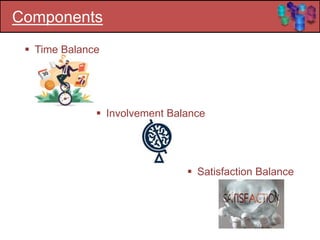
 Time Balance
 Involvement Balance
 Satisfaction Balance
Components
 Positive Balance refers to High levels of Time, Involvement
and Satisfaction
 Negative Balance refers to Low levels of Time, Involvement
and Satisfaction
1. Relationship
Work – Life Balance and Quality of Life
 Multiple role engagement buffers or protects individuals from
the effects of negative experiences in any one role
 Balanced individuals experience less role overload, greater
role ease and less depression
 A balanced involvement in work and family roles may also
reduce chronic work family conflict
 The beneficial effects of balance are based on the assumption
of +ive balance as +ive balance has more substantial impact
on Quality of Life
 The –ive balance on the other hand has very little benefit on
the Quality of Life
Work – Life Balance and Quality of Life
Hypothesis
1. The relation b/w balance and quality of life is stronger for
individuals:
i. who devote a substantial amount of time and involvement
ii. who are highly satisfied with
their combined work and family roles.
2. Interaction b/w:
i. Time balance and total time devoted to
ii Involvement and total involvement in
iii Satisfaction balance and total satisfaction with
work and family predicting quality of life is mediated by work
family conflict and stress
2. Challenges for Woman Physicians / Mothers
In Leadership Positions
Facts
 No of women entering academics are equal
 But there are less promotions
 No of women in leadership position are less
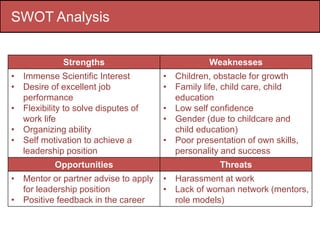
SWOT Analysis
Strengths Weaknesses
• Immense Scientific Interest
• Desire of excellent job
performance
• Flexibility to solve disputes of
work life
• Organizing ability
• Self motivation to achieve a
leadership position
• Children, obstacle for growth
• Family life, child care, child
education
• Low self confidence
• Gender (due to childcare and
child education)
• Poor presentation of own skills,
personality and success
Opportunities Threats
• Mentor or partner advise to apply
for leadership position
• Positive feedback in the career
• Harassment at work
• Lack of woman network (mentors,
role models)
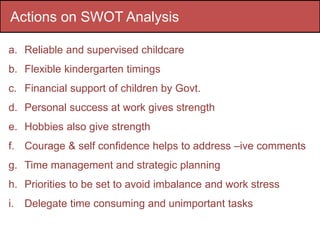
Actions on SWOT Analysis
a. Reliable and supervised childcare
b. Flexible kindergarten timings
c. Financial support of children by Govt.
d. Personal success at work gives strength
e. Hobbies also give strength
f. Courage & self confidence helps to address –ive comments
g. Time management and strategic planning
h. Priorities to be set to avoid imbalance and work stress
i. Delegate time consuming and unimportant tasks
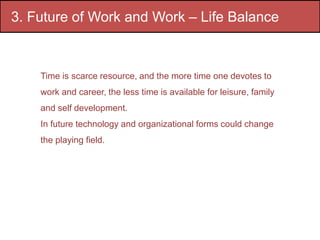
3. Future of Work and Work – Life Balance
Time is scarce resource, and the more time one devotes to
work and career, the less time is available for leisure, family
and self development.
In future technology and organizational forms could change
the playing field.
A6_work life balance.pptx

A6_work life balance.pptx

  • 2.
    The Work LifeBalance 1. Relationship with Quality of Life 2. Challenges for Woman Physicians / Mothers 3. Future of Work and Work – Life Balance
  • 3.
    Definition  To demonstrateequally positive commitments to different life roles (i.e hold a balanced orientation to multiple roles)  Role balance is a tendency to become fully engaged in the performance of every role in one’s total role system  Work – Life balance is also expressed as achieving satisfying experiences in every life domain
  • 4.
    Measurement  Definitions ofwork – life balance share a common element Equality or Near Equality  Equality is balance between : Inputs and Outcomes Inputs Outcomes Personal Resources (Attention, Time, Involvement, Commitment) Satisfaction  Based on measurement Work – Life balance is “the extent to which each individual is equally engaged in and equally satisfied with in work and family role”
  • 5.
    Components  Time Balance Involvement Balance  Satisfaction Balance
  • 6.
    Components  Positive Balancerefers to High levels of Time, Involvement and Satisfaction  Negative Balance refers to Low levels of Time, Involvement and Satisfaction
  • 7.
    1. Relationship Work –Life Balance and Quality of Life  Multiple role engagement buffers or protects individuals from the effects of negative experiences in any one role  Balanced individuals experience less role overload, greater role ease and less depression  A balanced involvement in work and family roles may also reduce chronic work family conflict
  • 8.
     The beneficialeffects of balance are based on the assumption of +ive balance as +ive balance has more substantial impact on Quality of Life  The –ive balance on the other hand has very little benefit on the Quality of Life Work – Life Balance and Quality of Life
  • 9.
    Hypothesis 1. The relationb/w balance and quality of life is stronger for individuals: i. who devote a substantial amount of time and involvement ii. who are highly satisfied with their combined work and family roles. 2. Interaction b/w: i. Time balance and total time devoted to ii Involvement and total involvement in iii Satisfaction balance and total satisfaction with work and family predicting quality of life is mediated by work family conflict and stress
  • 10.
    2. Challenges forWoman Physicians / Mothers In Leadership Positions Facts  No of women entering academics are equal  But there are less promotions  No of women in leadership position are less
  • 11.
    SWOT Analysis Strengths Weaknesses •Immense Scientific Interest • Desire of excellent job performance • Flexibility to solve disputes of work life • Organizing ability • Self motivation to achieve a leadership position • Children, obstacle for growth • Family life, child care, child education • Low self confidence • Gender (due to childcare and child education) • Poor presentation of own skills, personality and success Opportunities Threats • Mentor or partner advise to apply for leadership position • Positive feedback in the career • Harassment at work • Lack of woman network (mentors, role models)
  • 12.
    Actions on SWOTAnalysis a. Reliable and supervised childcare b. Flexible kindergarten timings c. Financial support of children by Govt. d. Personal success at work gives strength e. Hobbies also give strength f. Courage & self confidence helps to address –ive comments g. Time management and strategic planning h. Priorities to be set to avoid imbalance and work stress i. Delegate time consuming and unimportant tasks
  • 13.
    3. Future ofWork and Work – Life Balance Time is scarce resource, and the more time one devotes to work and career, the less time is available for leisure, family and self development. In future technology and organizational forms could change the playing field.