



Shaping How We Teach
Jane Challinor NTU
APT: Connected Learning in an Open World
University of Greenwich: 8 July 2014
https://www.flickr.com/photos/gunes_t/
Open classroom:
Student as teacher/producer
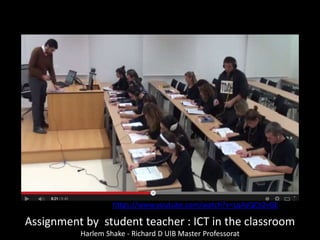
https://www.youtube.com/watch?v=LqAzQCS2vGE
Assignment by student teacher : ICT in the classroom
Harlem Shake - Richard D UIB Master Professorat
https://www.flickr.com/photos/crackdog
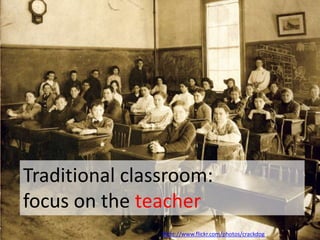
Traditional classroom:
focus on the teacher
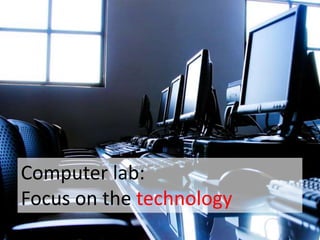
Computer lab:
Focus on the technology
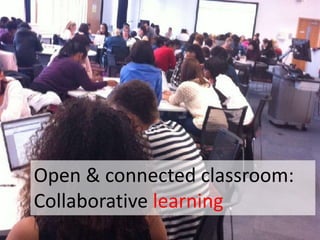
Open & connected classroom:
Collaborative learning
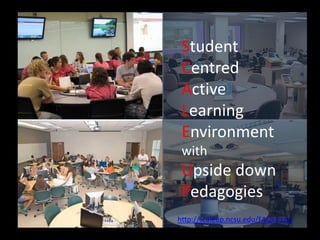
Student
Centred
Active
Learning
Environment
with
Upside down
Pedagogies
http://scaleup.ncsu.edu/FAQs.html
Open & connected:
Teaching differently
http://prezi.com/3aapnuiwby50/facing-up-to-university/
NTU
Murcia
https://www.flickr.com/photos/mkhmarketing/
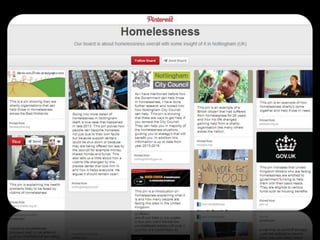
Pinterest: curation project
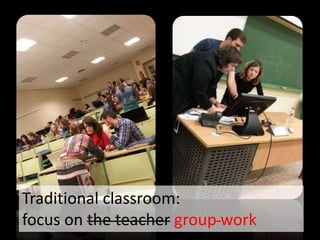
Traditional classroom:
focus on the teacher group work
https://www.flickr.com/photos/marilynjane/
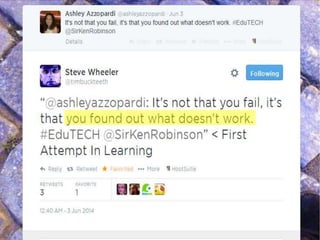
Trust the process?
Read more: The Virtual Leader blog
Seeds of change
Read more: Not to Scale blog
Shaping how we teach: The Connected and Open Classroom

Shaping how we teach: The Connected and Open Classroom

Editor's Notes

  • #2 In this presentation I aim to explain a little bit about how the learning environment has changed behaviours in my module, facilitating more of a problem based learning approach through an innovative classroom design , known as SCALE UP – which we have been piloting at NTU this year. First year study skills module New classroom environment (Scale Up pilot) Has this changed the way I teach? Has it changed student behaviours?
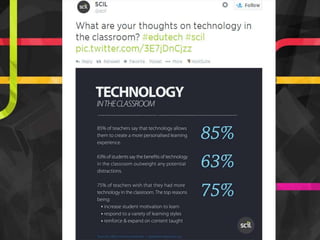
  • #3 Part of this new environment is the presence of technology – apple Mac books - which allows the classroom to be both connected and open; technology allows a far more creative and personal learning experience and one that is more in the hands of the students. New classroom is technology rich – wifi and laptops Permits a more personal and creative learning experience Puts control of the learning into the hands of the students
  • #4 Learners connect with sources of information other than the teacher and can produce their own content - which subverts the usual teacher/student hierarchies In the next slide there is a video produced by a student teacher from the University of the Balearic Islands. It makes use of the Harlem Shake meme and it is playing with the ideas of disruption brought about by technology. Video produced by a trainee teacher in Spain Exploring the impact of technology in the classroom Great example of student as producer of open educational content
  • #6  The traditional classroom enforces certain types of behaviour - Attention is focussed on the teacher. In the second half of the video we just saw, the seating arrangements were very different – students faced each other, not the teacher – and they then start to collaborate
  • #7 This is the sort of classroom in which I used to teach the “techy” bits of my module. these tech sessions were one offs, mainly because these rooms were in high demand - so the message was very much that working with technology was unusual, special, and had to be carefully supervised by the teacher.
  • #8 This is my new classroom – which is now used every week. Technology is an integral part of every workshop, students face each other sitting at round tables which each seat 9 students. Group work, inquiry based learning is the norm Another big difference is the size of the class . The old computer labs held 19 but here up to 108 students at any one time can be accommodated
  • #9 The model for this new classroom is Scale Up which originated at North Carolina State U in an undergraduate physics programme led by Prof Bob Beichner Now adapted for a range of disciplines in Universities across the US “The most important technology is the table”
  • #10 So what I teach - and how I have been able to teach it - has changed significantly from last year when the set up was more traditional It has affected my behaviour in that it has made me think differently about how to teach traditional study skills subjects
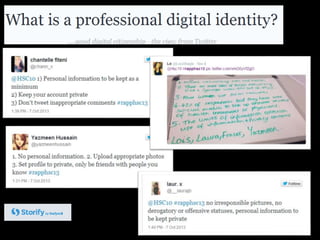
  • #11 Some of the things we have done in class include this storify project about professional online identity we also worked on collaborative documents using Google Docs – once memorably having 100 students on 36 Macs simultaneously editing a PowerPoint presentation ….
  • #12 Another aspect of openness and connectedness is the crossing of temporal boundaries: class discussions amongst students - and between students and tutors - continue outside office hours. You can read the full story on Prezi – just google Prezi/Jane Challinor/Facebook
  • #13 Students’ final assignment involved them in collecting research material using Pinterest and Tumblr – gaining skills in curation, navigating the web and creating their own online content
  • #14 In May I visited the University of Murcia to explore how they teach with technology on an ICT module for trainee teachers The module leader has an international reputation for innovative teaching using technology so I was expecting a set up very like my own….
  • #15 I was invited to run a session on the concept of digital curation and introduce the students to Pinterest, giving them time to work together in small groups to pull together their favourite edtech websites, tools and articles into a shared Pin board.
  • #16 The first surprise was that the class was held in a traditional raked lecture theatre. The second was that, that day, the wifi wasn’t working. But the students simply downloaded the Pinterest App onto their phones and gradually set about the task, helping each other out until everyone had the app and was able to use it
  • #17 What I discovered was that the teacher in Murcia rarely gives her students much help or instruction about the tools she asks them to use. At first they complain, but gradually they do start to trust her - and themselves – to work it out for themselves. So - no round tables, and no wifi, but the right state of mind….. Maybe that’s the most important environmental factor after all
  • #18 SO the Scale Up pilot is very much a beginning – we are sowing the seeds of a really big pedagogical change at NTU However it has had a mixed reception from students. They complain that the class is too big and too noisy and that they don’t get sufficient teaching input.
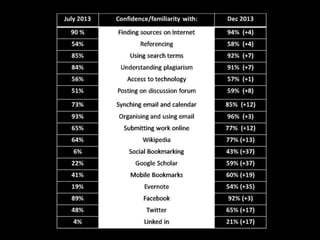
  • #19 It is too early to say whether the students who have been through the Scale Up pilot are better at problem solving or research – these things will become more evident in future years. But I do know however that their familiarity with certain tools and their confidence in using them has increased during the module.
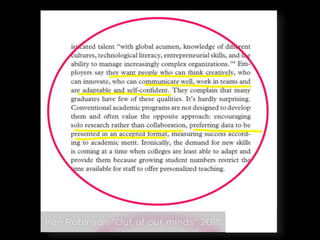
  • #20 We know that employers are looking for people who are technologically adept, creative problem-solvers and good at working in teams. And we know that we need to therefore support learning in new ways in order to develop these skills. I don’t know whether Scale Up provides all the answers, but it has certainly raised osme interesting questions
  • #21 The scale up pilot, has certainly had its challenges but I have signed up to run my modules in the classroom again next year. The thing is, I do now have a better feel for what works and what doesn’t, and I guess that is the point of a pilot after all. Thank you 