Approximate Models for Fast and
Accurate Epipolar Geometry
Estimation
James Pritts
Ondrej Chum and Jiri Matas
Center for Machine Perception (CMP)
Czech Technical University in Prague
Faculty of Electrical Engineering
Department of Cybernetics
28 Nov. IVCNZ 2013 –J. Pritts, O. Chum, J. Matas: Approximate Models for Fast and Accurate Epipolar Geometry Estimation
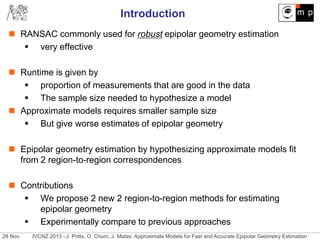
Introduction
 RANSAC commonly used for robust epipolar geometry estimation
 very effective
 Runtime is given by
 proportion of measurements that are good in the data
 The sample size needed to hypothesize a model
 Approximate models requires smaller sample size
 But give worse estimates of epipolar geometry
 Epipolar geometry estimation by hypothesizing approximate models fit
from 2 region-to-region correspondences
 Contributions
 We propose 2 new 2 region-to-region methods for estimating
epipolar geometry
 Experimentally compare to previous approaches
28 Nov. IVCNZ 2013 –J. Pritts, O. Chum, J. Matas: Approximate Models for Fast and Accurate Epipolar Geometry Estimation
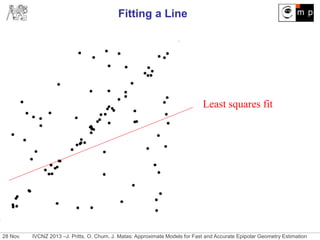
Fitting a Line
Least squares fit
28 Nov. IVCNZ 2013 –J. Pritts, O. Chum, J. Matas: Approximate Models for Fast and Accurate Epipolar Geometry Estimation
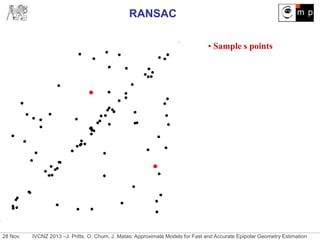
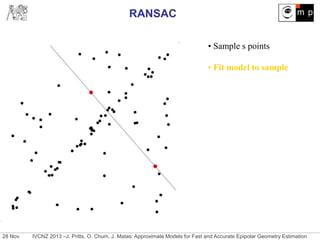
RANSAC
• Sample s points
28 Nov. IVCNZ 2013 –J. Pritts, O. Chum, J. Matas: Approximate Models for Fast and Accurate Epipolar Geometry Estimation
RANSAC
• Sample s points
• Fit model to sample
28 Nov. IVCNZ 2013 –J. Pritts, O. Chum, J. Matas: Approximate Models for Fast and Accurate Epipolar Geometry Estimation
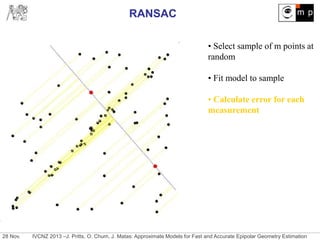
RANSAC
• Select sample of m points at
random
• Fit model to sample
• Calculate error for each
measurement
28 Nov. IVCNZ 2013 –J. Pritts, O. Chum, J. Matas: Approximate Models for Fast and Accurate Epipolar Geometry Estimation
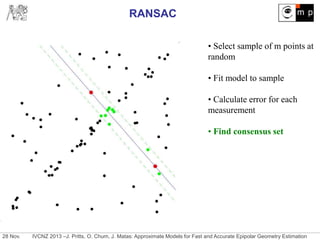
RANSAC
• Select sample of m points at
random
• Fit model to sample
• Calculate error for each
measurement
• Find consensus set
28 Nov. IVCNZ 2013 –J. Pritts, O. Chum, J. Matas: Approximate Models for Fast and Accurate Epipolar Geometry Estimation
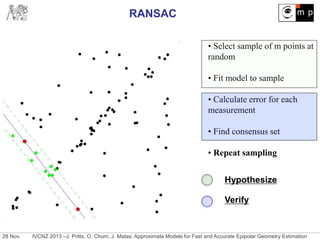
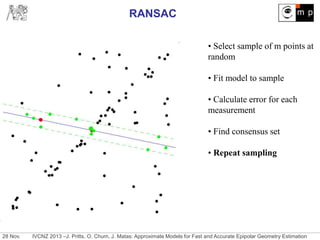
RANSAC
• Select sample of m points at
random
• Fit model to sample
• Calculate error for each
measurement
• Find consensus set
• Repeat sampling
Hypothesize
Verify
28 Nov. IVCNZ 2013 –J. Pritts, O. Chum, J. Matas: Approximate Models for Fast and Accurate Epipolar Geometry Estimation
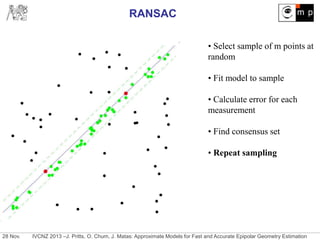
RANSAC
• Select sample of m points at
random
• Fit model to sample
• Calculate error for each
measurement
• Find consensus set
• Repeat sampling
28 Nov. IVCNZ 2013 –J. Pritts, O. Chum, J. Matas: Approximate Models for Fast and Accurate Epipolar Geometry Estimation
RANSAC
• Select sample of m points at
random
• Fit model to sample
• Calculate error for each
measurement
• Find consensus set
• Repeat sampling
28 Nov. IVCNZ 2013 –J. Pritts, O. Chum, J. Matas: Approximate Models for Fast and Accurate Epipolar Geometry Estimation
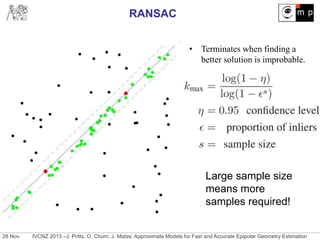
RANSAC
• Terminates when finding a
better solution is improbable.
Large sample size
means more
samples required!
28 Nov. IVCNZ 2013 –J. Pritts, O. Chum, J. Matas: Approximate Models for Fast and Accurate Epipolar Geometry Estimation
How bad is it?
 Reduce sample size for fundamental matrix estimation by hypothesizing
approximate models
I / N [%]
Sizeofthesamplem
Difficult wide baseline stereo matching problems at 95% confidence
28 Nov. IVCNZ 2013 –J. Pritts, O. Chum, J. Matas: Approximate Models for Fast and Accurate Epipolar Geometry Estimation
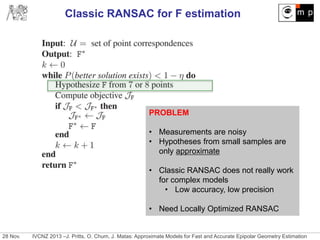
Classic RANSAC for F estimation
PROBLEM
• Measurements are noisy
• Hypotheses from small samples are
only approximate
• Classic RANSAC does not really work
for complex models
• Low accuracy, low precision
• Need Locally Optimized RANSAC
28 Nov. IVCNZ 2013 –J. Pritts, O. Chum, J. Matas: Approximate Models for Fast and Accurate Epipolar Geometry Estimation
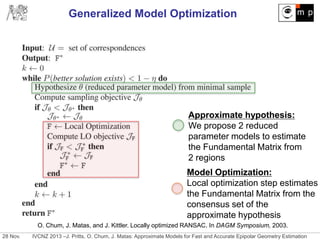
Generalized Model Optimization
Approximate hypothesis:
We propose 2 reduced
parameter models to estimate
the Fundamental Matrix from
2 regions
Model Optimization:
Local optimization step estimates
the Fundamental Matrix from the
consensus set of the
approximate hypothesis
O. Chum, J. Matas, and J. Kittler. Locally optimized RANSAC. In DAGM Symposium, 2003.
28 Nov. IVCNZ 2013 –J. Pritts, O. Chum, J. Matas: Approximate Models for Fast and Accurate Epipolar Geometry Estimation
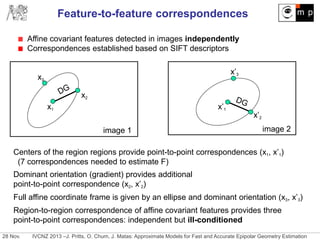
Feature-to-feature correspondences
Affine covariant features detected in images independently
Correspondences established based on SIFT descriptors
Centers of the region regions provide point-to-point correspondences (x1, x’1)
(7 correspondences needed to estimate F)
Dominant orientation (gradient) provides additional
point-to-point correspondence (x2, x’2)
Full affine coordinate frame is given by an ellipse and dominant orientation (x3, x’3)
Region-to-region correspondence of affine covariant features provides three
point-to-point correspondences: independent but ill-conditioned
x1 x’1
x2
x’2
x3
x’3
image 1 image 2
28 Nov. IVCNZ 2013 –J. Pritts, O. Chum, J. Matas: Approximate Models for Fast and Accurate Epipolar Geometry Estimation
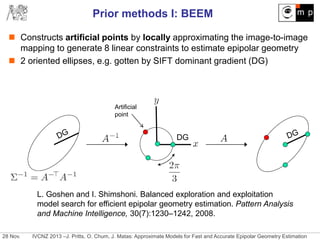
Prior methods I: BEEM
 Constructs artificial points by locally approximating the image-to-image
mapping to generate 8 linear constraints to estimate epipolar geometry
 2 oriented ellipses, e.g. gotten by SIFT dominant gradient (DG)
DG
Artificial
point
L. Goshen and I. Shimshoni. Balanced exploration and exploitation
model search for efficient epipolar geometry estimation. Pattern Analysis
and Machine Intelligence, 30(7):1230–1242, 2008.
28 Nov. IVCNZ 2013 –J. Pritts, O. Chum, J. Matas: Approximate Models for Fast and Accurate Epipolar Geometry Estimation
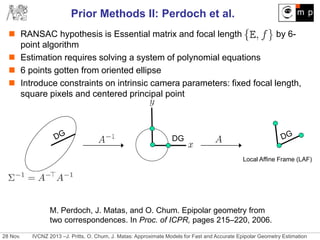
Prior Methods II: Perdoch et al.
 RANSAC hypothesis is Essential matrix and focal length by 6-
point algorithm
 Estimation requires solving a system of polynomial equations
 6 points gotten from oriented ellipse
 Introduce constraints on intrinsic camera parameters: fixed focal length,
square pixels and centered principal point
DG
Local Affine Frame (LAF)
M. Perdoch, J. Matas, and O. Chum. Epipolar geometry from
two correspondences. In Proc. of ICPR, pages 215–220, 2006.
28 Nov. IVCNZ 2013 –J. Pritts, O. Chum, J. Matas: Approximate Models for Fast and Accurate Epipolar Geometry Estimation
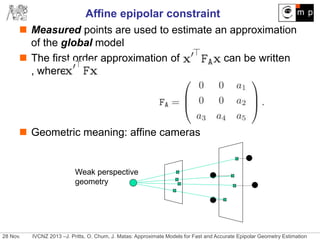
Affine epipolar constraint
 Measured points are used to estimate an approximation
of the global model
 The first order approximation of can be written
, where
 Geometric meaning: affine cameras
Weak perspective
geometry
28 Nov. IVCNZ 2013 –J. Pritts, O. Chum, J. Matas: Approximate Models for Fast and Accurate Epipolar Geometry Estimation
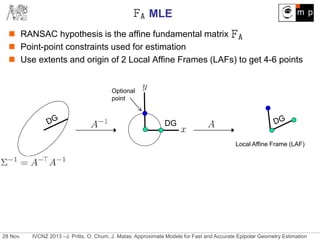
MLE
 RANSAC hypothesis is the affine fundamental matrix
 Point-point constraints used for estimation
 Use extents and origin of 2 Local Affine Frames (LAFs) to get 4-6 points
DG
Local Affine Frame (LAF)
Optional
point
28 Nov. IVCNZ 2013 –J. Pritts, O. Chum, J. Matas: Approximate Models for Fast and Accurate Epipolar Geometry Estimation
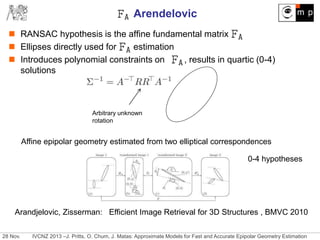
Arendelovic
 RANSAC hypothesis is the affine fundamental matrix
 Ellipses directly used for estimation
 Introduces polynomial constraints on , results in quartic (0-4)
solutions
Arbitrary unknown
rotation
Arandjelovic, Zisserman: Efficient Image Retrieval for 3D Structures , BMVC 2010
Affine epipolar geometry estimated from two elliptical correspondences
0-4 hypotheses
28 Nov. IVCNZ 2013 –J. Pritts, O. Chum, J. Matas: Approximate Models for Fast and Accurate Epipolar Geometry Estimation
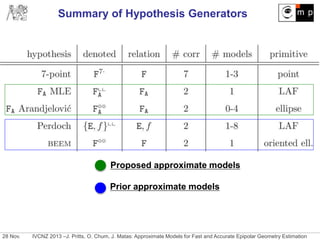
Summary of Hypothesis Generators
Proposed approximate models
Prior approximate models
28 Nov. IVCNZ 2013 –J. Pritts, O. Chum, J. Matas: Approximate Models for Fast and Accurate Epipolar Geometry Estimation
KUSVOD2 dataset
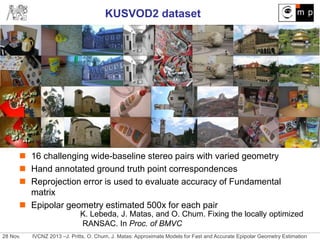
 16 challenging wide-baseline stereo pairs with varied geometry
 Hand annotated ground truth point correspondences
 Reprojection error is used to evaluate accuracy of Fundamental
matrix
 Epipolar geometry estimated 500x for each pair
.K. Lebeda, J. Matas, and O. Chum. Fixing the locally optimized
RANSAC. In Proc. of BMVC
28 Nov. IVCNZ 2013 –J. Pritts, O. Chum, J. Matas: Approximate Models for Fast and Accurate Epipolar Geometry Estimation
CDF reprojection error
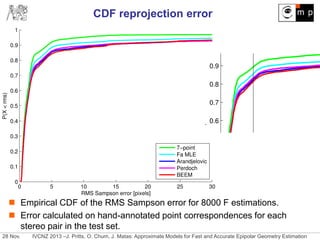
 Empirical CDF of the RMS Sampson error for 8000 F estimations.
 Error calculated on hand-annotated point correspondences for each
stereo pair in the test set.
28 Nov. IVCNZ 2013 –J. Pritts, O. Chum, J. Matas: Approximate Models for Fast and Accurate Epipolar Geometry Estimation
Speedup
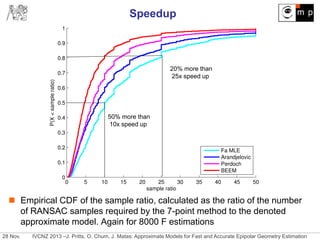
 Empirical CDF of the sample ratio, calculated as the ratio of the number
of RANSAC samples required by the 7-point method to the denoted
approximate model. Again for 8000 F estimations
50% more than
10x speed up
20% more than
25x speed up
28 Nov. IVCNZ 2013 –J. Pritts, O. Chum, J. Matas: Approximate Models for Fast and Accurate Epipolar Geometry Estimation
Conclusions
 Two two-region methods are proposed that reliably estimate F on a large
class of stereo pairs
 Most significant reduction in samples drawn and models evaluated can be
achieved with the use of MLE.
 Using the first order approximation to the global model improves
accuracy and precision of epipolar geometry estimation compared to
using local image approximations or constraining intrinsic camera
calibration
 Hypothesizing the affine fundamental matrix from 2 Local Affine Frames
(LAFs) should be preferred to the previously proposed methods BEEM
and Perdoch et al..
28 Nov. IVCNZ 2013 –J. Pritts, O. Chum, J. Matas: Approximate Models for Fast and Accurate Epipolar Geometry Estimation
Additional material
 Comes after this slide…
28 Nov. IVCNZ 2013 –J. Pritts, O. Chum, J. Matas: Approximate Models for Fast and Accurate Epipolar Geometry Estimation
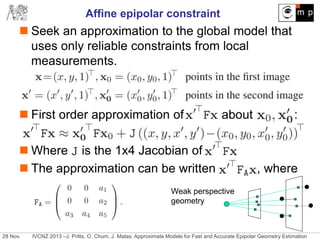
Affine epipolar constraint
 Seek an approximation to the global model that
uses only reliable constraints from local
measurements.
 First order approximation of about :
 Where is the 1x4 Jacobian of
 The approximation can be written , where
Weak perspective
geometry

Ivcvnz13

  • 1.
    Approximate Models forFast and Accurate Epipolar Geometry Estimation James Pritts Ondrej Chum and Jiri Matas Center for Machine Perception (CMP) Czech Technical University in Prague Faculty of Electrical Engineering Department of Cybernetics
  • 2.
    28 Nov. IVCNZ2013 –J. Pritts, O. Chum, J. Matas: Approximate Models for Fast and Accurate Epipolar Geometry Estimation Introduction  RANSAC commonly used for robust epipolar geometry estimation  very effective  Runtime is given by  proportion of measurements that are good in the data  The sample size needed to hypothesize a model  Approximate models requires smaller sample size  But give worse estimates of epipolar geometry  Epipolar geometry estimation by hypothesizing approximate models fit from 2 region-to-region correspondences  Contributions  We propose 2 new 2 region-to-region methods for estimating epipolar geometry  Experimentally compare to previous approaches
  • 3.
    28 Nov. IVCNZ2013 –J. Pritts, O. Chum, J. Matas: Approximate Models for Fast and Accurate Epipolar Geometry Estimation Fitting a Line Least squares fit
  • 4.
    28 Nov. IVCNZ2013 –J. Pritts, O. Chum, J. Matas: Approximate Models for Fast and Accurate Epipolar Geometry Estimation RANSAC • Sample s points
  • 5.
    28 Nov. IVCNZ2013 –J. Pritts, O. Chum, J. Matas: Approximate Models for Fast and Accurate Epipolar Geometry Estimation RANSAC • Sample s points • Fit model to sample
  • 6.
    28 Nov. IVCNZ2013 –J. Pritts, O. Chum, J. Matas: Approximate Models for Fast and Accurate Epipolar Geometry Estimation RANSAC • Select sample of m points at random • Fit model to sample • Calculate error for each measurement
  • 7.
    28 Nov. IVCNZ2013 –J. Pritts, O. Chum, J. Matas: Approximate Models for Fast and Accurate Epipolar Geometry Estimation RANSAC • Select sample of m points at random • Fit model to sample • Calculate error for each measurement • Find consensus set
  • 8.
    28 Nov. IVCNZ2013 –J. Pritts, O. Chum, J. Matas: Approximate Models for Fast and Accurate Epipolar Geometry Estimation RANSAC • Select sample of m points at random • Fit model to sample • Calculate error for each measurement • Find consensus set • Repeat sampling Hypothesize Verify
  • 9.
    28 Nov. IVCNZ2013 –J. Pritts, O. Chum, J. Matas: Approximate Models for Fast and Accurate Epipolar Geometry Estimation RANSAC • Select sample of m points at random • Fit model to sample • Calculate error for each measurement • Find consensus set • Repeat sampling
  • 10.
    28 Nov. IVCNZ2013 –J. Pritts, O. Chum, J. Matas: Approximate Models for Fast and Accurate Epipolar Geometry Estimation RANSAC • Select sample of m points at random • Fit model to sample • Calculate error for each measurement • Find consensus set • Repeat sampling
  • 11.
    28 Nov. IVCNZ2013 –J. Pritts, O. Chum, J. Matas: Approximate Models for Fast and Accurate Epipolar Geometry Estimation RANSAC • Terminates when finding a better solution is improbable. Large sample size means more samples required!
  • 12.
    28 Nov. IVCNZ2013 –J. Pritts, O. Chum, J. Matas: Approximate Models for Fast and Accurate Epipolar Geometry Estimation How bad is it?  Reduce sample size for fundamental matrix estimation by hypothesizing approximate models I / N [%] Sizeofthesamplem Difficult wide baseline stereo matching problems at 95% confidence
  • 13.
    28 Nov. IVCNZ2013 –J. Pritts, O. Chum, J. Matas: Approximate Models for Fast and Accurate Epipolar Geometry Estimation Classic RANSAC for F estimation PROBLEM • Measurements are noisy • Hypotheses from small samples are only approximate • Classic RANSAC does not really work for complex models • Low accuracy, low precision • Need Locally Optimized RANSAC
  • 14.
    28 Nov. IVCNZ2013 –J. Pritts, O. Chum, J. Matas: Approximate Models for Fast and Accurate Epipolar Geometry Estimation Generalized Model Optimization Approximate hypothesis: We propose 2 reduced parameter models to estimate the Fundamental Matrix from 2 regions Model Optimization: Local optimization step estimates the Fundamental Matrix from the consensus set of the approximate hypothesis O. Chum, J. Matas, and J. Kittler. Locally optimized RANSAC. In DAGM Symposium, 2003.
  • 15.
    28 Nov. IVCNZ2013 –J. Pritts, O. Chum, J. Matas: Approximate Models for Fast and Accurate Epipolar Geometry Estimation Feature-to-feature correspondences Affine covariant features detected in images independently Correspondences established based on SIFT descriptors Centers of the region regions provide point-to-point correspondences (x1, x’1) (7 correspondences needed to estimate F) Dominant orientation (gradient) provides additional point-to-point correspondence (x2, x’2) Full affine coordinate frame is given by an ellipse and dominant orientation (x3, x’3) Region-to-region correspondence of affine covariant features provides three point-to-point correspondences: independent but ill-conditioned x1 x’1 x2 x’2 x3 x’3 image 1 image 2
  • 16.
    28 Nov. IVCNZ2013 –J. Pritts, O. Chum, J. Matas: Approximate Models for Fast and Accurate Epipolar Geometry Estimation Prior methods I: BEEM  Constructs artificial points by locally approximating the image-to-image mapping to generate 8 linear constraints to estimate epipolar geometry  2 oriented ellipses, e.g. gotten by SIFT dominant gradient (DG) DG Artificial point L. Goshen and I. Shimshoni. Balanced exploration and exploitation model search for efficient epipolar geometry estimation. Pattern Analysis and Machine Intelligence, 30(7):1230–1242, 2008.
  • 17.
    28 Nov. IVCNZ2013 –J. Pritts, O. Chum, J. Matas: Approximate Models for Fast and Accurate Epipolar Geometry Estimation Prior Methods II: Perdoch et al.  RANSAC hypothesis is Essential matrix and focal length by 6- point algorithm  Estimation requires solving a system of polynomial equations  6 points gotten from oriented ellipse  Introduce constraints on intrinsic camera parameters: fixed focal length, square pixels and centered principal point DG Local Affine Frame (LAF) M. Perdoch, J. Matas, and O. Chum. Epipolar geometry from two correspondences. In Proc. of ICPR, pages 215–220, 2006.
  • 18.
    28 Nov. IVCNZ2013 –J. Pritts, O. Chum, J. Matas: Approximate Models for Fast and Accurate Epipolar Geometry Estimation Affine epipolar constraint  Measured points are used to estimate an approximation of the global model  The first order approximation of can be written , where  Geometric meaning: affine cameras Weak perspective geometry
  • 19.
    28 Nov. IVCNZ2013 –J. Pritts, O. Chum, J. Matas: Approximate Models for Fast and Accurate Epipolar Geometry Estimation MLE  RANSAC hypothesis is the affine fundamental matrix  Point-point constraints used for estimation  Use extents and origin of 2 Local Affine Frames (LAFs) to get 4-6 points DG Local Affine Frame (LAF) Optional point
  • 20.
    28 Nov. IVCNZ2013 –J. Pritts, O. Chum, J. Matas: Approximate Models for Fast and Accurate Epipolar Geometry Estimation Arendelovic  RANSAC hypothesis is the affine fundamental matrix  Ellipses directly used for estimation  Introduces polynomial constraints on , results in quartic (0-4) solutions Arbitrary unknown rotation Arandjelovic, Zisserman: Efficient Image Retrieval for 3D Structures , BMVC 2010 Affine epipolar geometry estimated from two elliptical correspondences 0-4 hypotheses
  • 21.
    28 Nov. IVCNZ2013 –J. Pritts, O. Chum, J. Matas: Approximate Models for Fast and Accurate Epipolar Geometry Estimation Summary of Hypothesis Generators Proposed approximate models Prior approximate models
  • 22.
    28 Nov. IVCNZ2013 –J. Pritts, O. Chum, J. Matas: Approximate Models for Fast and Accurate Epipolar Geometry Estimation KUSVOD2 dataset  16 challenging wide-baseline stereo pairs with varied geometry  Hand annotated ground truth point correspondences  Reprojection error is used to evaluate accuracy of Fundamental matrix  Epipolar geometry estimated 500x for each pair .K. Lebeda, J. Matas, and O. Chum. Fixing the locally optimized RANSAC. In Proc. of BMVC
  • 23.
    28 Nov. IVCNZ2013 –J. Pritts, O. Chum, J. Matas: Approximate Models for Fast and Accurate Epipolar Geometry Estimation CDF reprojection error  Empirical CDF of the RMS Sampson error for 8000 F estimations.  Error calculated on hand-annotated point correspondences for each stereo pair in the test set.
  • 24.
    28 Nov. IVCNZ2013 –J. Pritts, O. Chum, J. Matas: Approximate Models for Fast and Accurate Epipolar Geometry Estimation Speedup  Empirical CDF of the sample ratio, calculated as the ratio of the number of RANSAC samples required by the 7-point method to the denoted approximate model. Again for 8000 F estimations 50% more than 10x speed up 20% more than 25x speed up
  • 25.
    28 Nov. IVCNZ2013 –J. Pritts, O. Chum, J. Matas: Approximate Models for Fast and Accurate Epipolar Geometry Estimation Conclusions  Two two-region methods are proposed that reliably estimate F on a large class of stereo pairs  Most significant reduction in samples drawn and models evaluated can be achieved with the use of MLE.  Using the first order approximation to the global model improves accuracy and precision of epipolar geometry estimation compared to using local image approximations or constraining intrinsic camera calibration  Hypothesizing the affine fundamental matrix from 2 Local Affine Frames (LAFs) should be preferred to the previously proposed methods BEEM and Perdoch et al..
  • 26.
    28 Nov. IVCNZ2013 –J. Pritts, O. Chum, J. Matas: Approximate Models for Fast and Accurate Epipolar Geometry Estimation Additional material  Comes after this slide…
  • 27.
    28 Nov. IVCNZ2013 –J. Pritts, O. Chum, J. Matas: Approximate Models for Fast and Accurate Epipolar Geometry Estimation Affine epipolar constraint  Seek an approximation to the global model that uses only reliable constraints from local measurements.  First order approximation of about :  Where is the 1x4 Jacobian of  The approximation can be written , where Weak perspective geometry