See discussions, stats, and author profiles for this publication at: https://www.researchgate.net/publication/327729743
Process Control & R+D in Metal Additive Manufacturing - An Overview
Conference Paper · December 2016
CITATIONS
0
READS
137
1 author:
Some of the authors of this publication are also working on these related projects:
Study of Condensate Generated During Direct Metal Laser Sintering View project
Jagadish chandra Achinadka
3 PUBLICATIONS   3 CITATIONS   
SEE PROFILE
All content following this page was uploaded by Jagadish chandra Achinadka on 20 September 2018.
The user has requested enhancement of the downloaded file.
1
ADMAT 2017 (SkyMat)
December 14-16, 2017, Thiruvananthapuram, INDIA
Process Control & R+D in Metal Additive Manufacturing - An Overview
Jagadish Chandra Achinadkaa,1,
,
Sr. G.M (Tech. Development), 1
Intech DMLS Pvt. Ltd.
3rd Main Rd, Peenya Industrial Area Phase IV,
Peenya, Bengaluru 560058, India
a jagadish.chandra@qmaxim.com
ABSTRACT
DMLS (Direct Metal Laser Sintering), an additive manufacturing technology, is increasingly finding widespread
usage to build intricate high quality functional parts & rapid prototypes. DMLS technology uses a high intensity
laser to build components layer by layer, directly from metal powder. CAD data is directly converted to part
without the need for tooling. It is possible to build internal features and passages that are not possible in
conventional manufacturing routes.
Due to newness of technology, process control and R & D concepts are still being developed. This paper covers
various process control aspects starting with powder quality, additive manufacture, post processing, testing and
long term monitoring of quality. Following process control aspects are covered : powder chemistry, powder
particle size distribution, powder morphology, powder flow properties, DMLS process control aspects, metal
physical & mechanical properties, and NDT. Applicable international standards are also listed. Paper also
briefly touches research and developmental approach for development of new materials.
Key words
Direct Metal Laser Sintering (DMLS), Process control, CMM, powder properties, metal physical and
mechanical properties, metallurgical properties, development approach.
INTRODUCTION
Additive manufacturing (AM), which is also called 3D printing is a process of making a 3D solid object
of virtually any shape directly from a digital model. Paper [2] gives a overview of various AM processes. The
material is deposited layer by layer, unlike subtractive manufacturing which relies on the removal of material
by methods such as cutting or milling. DMLS (also called SLM process) is one of the leading Powder Bed
Fusion technologies that uses laser for fabricating metal parts directly [3]. Build station is lowered after each
melt layer and new powder layer is dispensed. This process is continued until entire part is built. The main
2
advantages of this technology include freedom of design, elimination of tooling, greatly reduced part
development cycle, light-weighting, part consolidation and elimination of production steps[3]. Various metals
can be manufactured by this process, most common ones being - AlSi10Mg, Ti64, IN718, IN 625, Hastealloy-X,
Co-Cr-Mo F75, 18% Maraging Steel C300,SS316L, 17-4PH [3]. DMLS now finds widespread usage in various
industrial sectors such as aerospace, energy, automotive, medical, oil and gas, tooling and consumer goods.
Process description:
In the DLMS process, a powder layer is first applied on a building platform with a recoater (blade or roller) and
a laser beam selectively melts the layer of powder. Then the platform is lowered by 20 μm to 100 μm and a new
powder layer is applied. The laser beam melting operation is repeated. After a few thousand cycles (depending
on height of the part), the built part is removed from the powder bed. Parts are built using with Nd-YAG laser
under N2/Ar atmosphere. The parts are built on a platform 20-45 mm thick made of Steel or other materials
such as Ti64. Most common build envelop is in 250 x 250 x 300mm range, now machines are available with
one dimension >=500 mm size. Laser power typically varies from 200 W up to 1000 W & with one or more
Lasers in different machines. During laser melting the weld pool is heated very rapidly and some of the
powder is converted into a gaseous condensate of the alloy - a mist of nano-particles. Rapid heating can also
lead to some larger droplets of liquid metal being ejected from the weld pool, whilst trapped gas inside powder
grains may also generate 'splatter'. DMLS machines provide inert gas flow across the bed to carry these by-
products away to prevent them from accumulating in the powder. For collecting this byproduct these machines
come with a recirculating filter system. This consists of particle separator, pre-filter and fine filter. The
byproduct, which is called condensate is collected in the recirculating filter system.
Most of the machine DMLS build parameters which number over 200 are user settable. Commonly changed
build parameters are: power, hatch distance, scan speed, scan strategy, layer thickness, offset distance, etc. The
stripe pattern can also be changed. Making these changes influence porosity level, microstructure, surface
roughness, residual stress and heat build-up in the finished the metal components.
The manufacturing of a metal part starts with 3D modeling. Then data preparation is organized & includes the
definition of part orientation, the positioning of support structures and the slicing of the model. After part
manufacturing by DMLS, post processing operations are done. These includes removal of powder, support
structures and platform. This may be followed by CMM, NDT, heat treatment, Hot isostatic pressing (HIP),
surface finish, polishing, etc.
PROCESS CONTROL
Metal Powder manufacture
Metal powder plays a very important role in the additive manufacturing processes. Powder quality has major
influence on mechanical properties but it can also influence - build-to-build consistency, reproducibility,
production of defect-free components, surface quality. Metal powders are usually produced using the gas
atomization process, where a molten metal stream is atomized due to a high pressure neutral gas jet into small
metal droplets thus forming metal powder particles after rapid solidification. Gas atomization results in
spherical shape of the powder, which is very beneficial for powder flowability. Gas atomization is the preferred
method because it leads to - a good powder density, due to the spherical shape and particle size distribution, a
good reproducibility of particle size distribution. In the VIM gas atomization process, the melting takes place in
a vacuum chamber. This process is recommended for superalloys so as to avoid gas pickup particularly
oxygen which is not desirable for Superalloys or reactive metals such as Ti. Source [1] provides a overview
3
about design and process controls aspects of DMLS.
Metal powder characteristics:
Key metal powder characteristics for additive manufacturing can be sorted in four main categories:
1. Chemical composition, 2. Particle size distribution (PSD), 3. Morphology, 4. Physical properties. There are
several existing standards to determine methods for characterizing metal powders. In addition, following
important parameters have to be considered: storage and aging of powders, reusability of powder after additive
manufacturing cycles, & health, safety and environmental issues.
Chemical analysis:
Alloy elements and chosen measurement techniques (ICP, Spectrometry, combustion, etc.) are very important
but it is also important to take into account: 1. Interstitials, such as O2, N , C & S 2. trace elements and
impurities. These effect: 1. melting temperature 2. mechanical properties 3. weldability 4. thermal properties.
Good manufacturing system calls for determining chemical analysis of each lot of powder and test block built
from the lot. Chemical analysis changes gradually due to reuse of powder. In view of this, fresh powder has to
be mixed with re-used powder in fixed proportion.
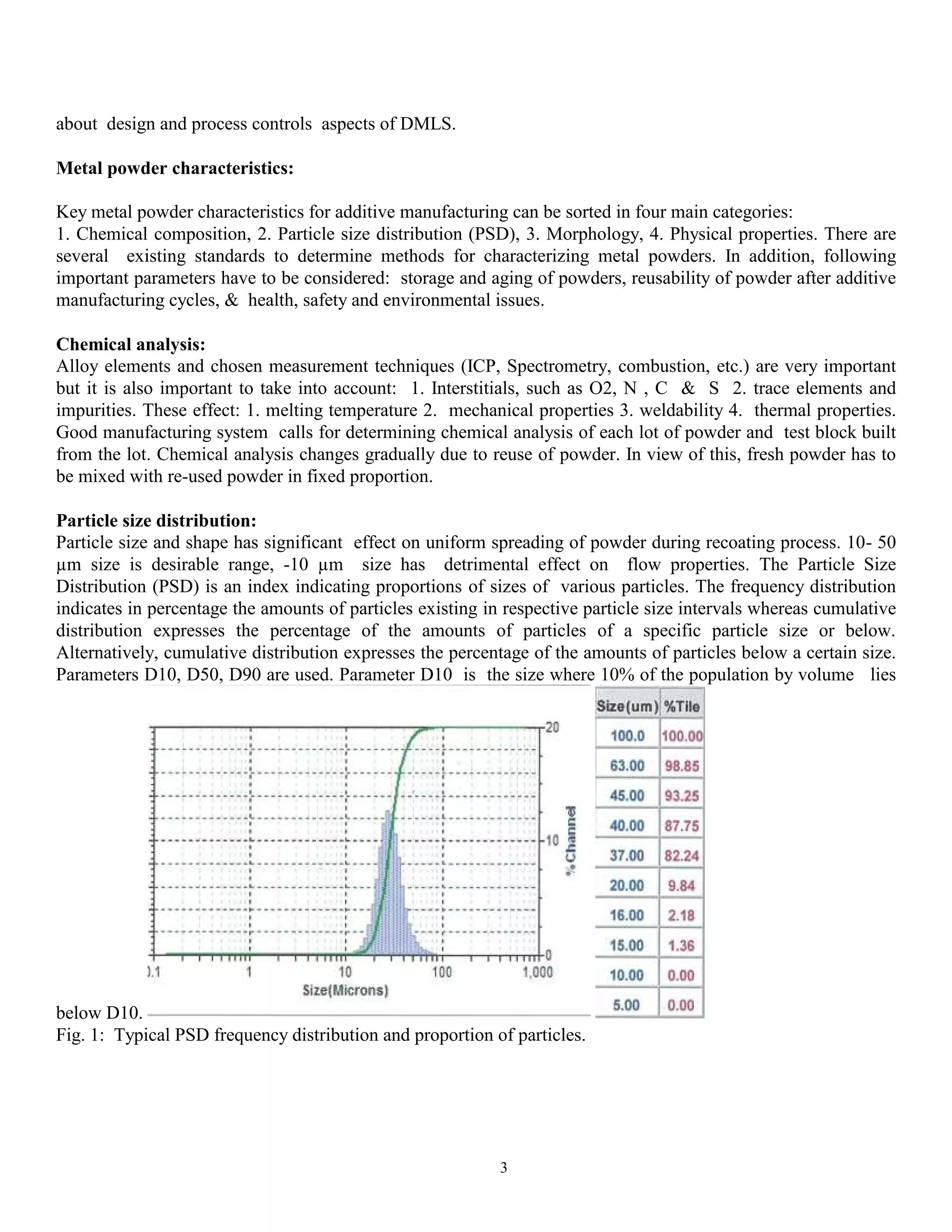
Particle size distribution:
Particle size and shape has significant effect on uniform spreading of powder during recoating process. 10- 50
µm size is desirable range, -10 µm size has detrimental effect on flow properties. The Particle Size
Distribution (PSD) is an index indicating proportions of sizes of various particles. The frequency distribution
indicates in percentage the amounts of particles existing in respective particle size intervals whereas cumulative
distribution expresses the percentage of the amounts of particles of a specific particle size or below.
Alternatively, cumulative distribution expresses the percentage of the amounts of particles below a certain size.
Parameters D10, D50, D90 are used. Parameter D10 is the size where 10% of the population by volume lies
below D10.
Fig. 1: Typical PSD frequency distribution and proportion of particles.
4
Usual methods and standards for particle size distribution measurement are:
1. ASTM B214 Test Method for Sieve Analysis of Metal Powders 2. Laser Diffraction Methods by ASTM
B822 Test Method for Particle Size Distribution of Metal Powders and Related Compounds by Light Scattering.
The readings depend upon the method used. Most common method used is Laser diffraction. Laser diffraction
can be done by dry or wet method depending on accuracy /& size desired. Instrumentation manufactured by
Microtrac and Malvern are popular - these are pictured in fig. 2 and fig. 3 respectively.
FIG. 2: Microtrac PSD analyzer FIG. 3: Malvern PSD analyzer
The particle size distribution is a major point as it influences many aspects such as: 1. Powder followability
and ability to spread evenly; 2. Powder bed density; 3. Energy input needed to melt the powder grains; 4.
surface roughness.
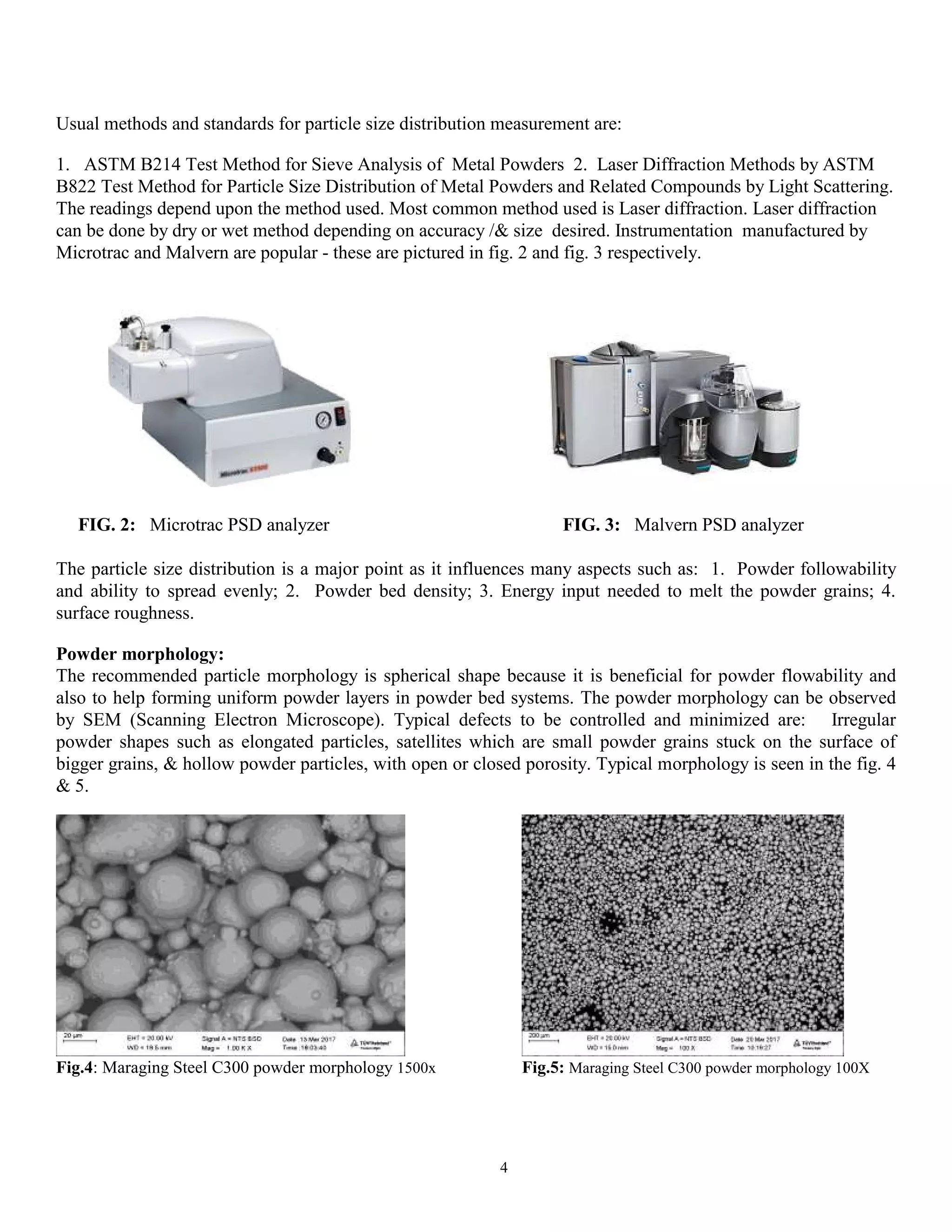
Powder morphology:
The recommended particle morphology is spherical shape because it is beneficial for powder flowability and
also to help forming uniform powder layers in powder bed systems. The powder morphology can be observed
by SEM (Scanning Electron Microscope). Typical defects to be controlled and minimized are: Irregular
powder shapes such as elongated particles, satellites which are small powder grains stuck on the surface of
bigger grains, & hollow powder particles, with open or closed porosity. Typical morphology is seen in the fig. 4
& 5.
Fig.4: Maraging Steel C300 powder morphology 1500x Fig.5: Maraging Steel C300 powder morphology 100X
5
Other methods are available for doing statistical analysis of size and shape of particles.
Other powder physical properties:
Rheological properties are very important for metal powders. Some of the appropriate properties being: density
(apparent and tap density), flow rate (Hall flow). Relevant standards being : ASTM B212 Test Method for
Apparent Density of Free-Flowing Metal Powders; ASTM B527 Test Method for Determination of Tap Density
of Metallic Powders; ASTM B213 Test Methods for Flow Rate of Metal Powders Using the Hall Flowmeter
Funnel as shown in fig.6 .
Fig.6: Hall flowmeter
Other powder characteristics:
Storage, handling and aging of the powder should be carefully controlled. For almost all alloys, shielding gas,
the control of hygrometry and temperature is important. Conditions of re-use of unused powders after
manufacturing cycles should be controlled i.e. sieving of agglomerates, control, number of reuse, etc. Health,
safety and environmental issues are also important. For example, some of the powders form combustible
mixtures.
DMLS PROCESS CONTROL
Most of the DMLS build parameters numbering over 100 are user settable. Some of the important build
parameters are: power, hatch distance, scan speed, scan strategy, layer thickness, offset distance, angle of
rotation between layers, etc. The stripe pattern can also be changed. Making these changes influence porosity
level, microstructure, surface roughness, mechanical properties, residual stress and heat build-up in the
finished the metal components. Other important process variables are: shield gas purity (>=99.999% desired),
build plate flatness, build temperature, etc. For each material one or more build parameter set is developed and
frozen.
During the build process several process parameters such as Oxygen content in the build chamber, build
temperature, system pressure, inert gas pressure are monitored and controlled. Periodic check/calibration of
laser power, position of beam and orientation have to be done.
Nowadays, thermal mapping and imaging tools are available for in situ monitoring of build process.
6
Test artifact to highlight the capabilities of machine & process :
Establishing criteria for identifying and quantifying system errors is complicated mainly because of the
difficulty in separating machine characteristics from process characteristics. For evaluating the machine &
process performance a test artifact has been developed by National Institute of Standards and Technology
(NIST), USA. Paper [4] has detailed information about the artifact. This is shown in fig. 7 .
Fig.7: Test artifact showing a top view (left) and an oblique view (right) (credit: NIST)
The artifact was designed to determine the following : 1. Errors in positioning of the laser beam (resulting from
geometric errors of the two axes of rotation holding the laser beam positioning mirrors or form errors in the f-θ
lens that focuses and shapes the laser beam spot), 2. geometric errors of the axis positioning the build platform,
3. alignment errors between the axes, 4. errors in the laser beam size and shape, 5. variation in the beam power.
The part should be built in the center of the building platform with the 4 mm pins and holes aligned along the
machine x- and y-axes. Part as built is 17 mm tall and has a volume of approximately 101000 mm3
. The
diamond shape was chosen because it minimizes the impact between the recoating blade and each layer of the
part, and it allows simple vertical mounting for various measurements. Periodically this test is done to monitor
state of machine and the process. Machine is adjusted/ recalibrated based on the findings.
Measurements of metal properties:
For good process control it is necessary to periodically measure some of the following metal properties :
dimension, density, hardness, roughness, hardness, tensile properties, microstructure. Depending on application,
mechanical properties such as high temperature tensile, stress rupture, creep test, creep rupture, fatigue are also
measured. Mechanical properties are measured in as built and heat treated condition. Common heat treatments
given are : stress relief, aging, solutionizing + aging treatment. Test cubes or specimens are built along with
build platform. Mechanical properties of the parts built by this process display some amount of anisotropy,
hence properties have to be tested in various orientations, at the least in horizontal and vertical directions.
Physical properties:
Coordinate measuring system (CMM) is used for measuring dimensional accuracy. Measurements are done by
probe. Probes could be mechanical, optical, laser or white light. Measurement could be manual or computer
controlled or combination of the two.
7
Density, hardness and roughness are the most commonly measured parameters. Density is determined by
Archimedes principle by weighing the sample in air and water. Parts produced by this process reach > 99.9% of
the theoretical density. Parts built by this process have some amount of micro-porosity.
Hardness is commonly measured by Rockwell B or C scale depending on material. Roughness is measured in as
built and heat treated condition. ASTM E18 standard is used for measuring hardness at room temperatures.
Surface roughness is commonly measured by probe type equipment. Ra and Rz are commonly reported. Quite
often it is necessary to record roughness on various surfaces as they can vary greatly in additive manufacture.
Mechanical Properties:
Tensile properties are measured in a calibrated UTM by testing test specimens built in vertical and horizontal
orientations. Usually reported properties are Ultimate tensile strength, yield strength (as measure by 0.2% proof
stress), and percent elongation. ASTM E8/E8M is the applicable standard.
For certain applications it is necessary to report elevated temperature mechanical properties. ASTM E21-
Standard Test Methods for Elevated Temperature Tension Tests of Metallic Materials is the applicable standard.
ASTM E139 is the standard used for conducting Creep test, Creep-Rupture, and Stress-Rupture Tests of
Metallic Materials.
Internal soundness:
To detect internal discontinuities, both radiography and tomography by X-Ray inspection can be used. But
radiography can only be used for parts like thin plates. Conventional Radiography is based on the differential
absorption of X-rays by the material. Any lack of material will lead to a weaker absorption and therefore,
locally, to a higher level of grey level on the digital picture or on the silver film according to the detector used.
Tomography makes use of a large quantity of views obtained by rotating the object at different angles and height
positions. The different views allow to determine the absorption of each volume element called “voxel” to
rebuild the object in 3 dimensions. Using a suitable software it is then possible to obtain several representations
of the volume of the object, including visualization in the form of virtual slices that define the word
“tomography”. Tomography is used for measuring porosity level or to measure discontinuities or to measure
internal and external dimensions.
Tracking properties
Various physical and mechanical properties are tracked to monitor long term process variation. For this purpose
standard test block (25x8x19 mm) is built with each build. Test specimens are built at the predetermined
frequency. Following properties are usually tracked : density, surface roughness, dimensional accuracy,
chemistry, hardness, tensile properties, etc. Histogram, box plot and SPC charts are usually used. Slice of a
typical property plot is shown in the figure 8.
8
Fig.8: Slice of tracking plot showing roughness histogram of various alloys
RESEARCH AND DEVELOPMENT
Several materials are certified for production of quality parts by DMLS process – more are being added.
However, quite often it is necessary to tweak operating conditions to improve one or more of the following–
productivity, yield, cost reduction, room temperature mechanical properties, elevated temperature mechanical
properties, surface roughness, microstructure, etc. To achieve this one or more of the following is fine-tuned viz.
machine operating parameters, process conditions, heat treatment, post processing, etc. If the standard operating
conditions do not exist they have to developed from scratch. There are several approaches for doing this. Papers
[5], [6] describe two such approaches. Another approach is use of statistical technique of design of experiment
(DoE) - which is explained in this paper.
Following is a broad approach for process development and parameter optimization. For each material a
specific range of parameters combination exists that result in satisfactory quality such as - high density,
microstructure or surface roughness. Productivity also should be considered. The optimum parameter window is
experimentally determined - most common method being DoE. Taguchi method (TM) and Response surface
methodology (RSM) are most common DoE methodologies. In statistical-based approaches, RSM has been
extensively used for optimization. RSM is a collection of statistical techniques for designing experiments,
building models, evaluating the effects of factors and searching for the optimum conditions. It is a statistically
designed experimental protocol in which several factors are simultaneously varied. In RSM, the experimental
responses of experiments (DoEs) are fitted to quadratic function. Artificial neural network (ANN) has emerged
as an attractive tool for non-linear multivariate modeling. The power of ANN is that it is generic in structure and
possesses the ability to learn from historical data. The main advantage of ANN compared to RSM are: (i) ANN
does not require a prior specification of suitable fitting function and (ii) ANN has universal approximation
capability, i.e. it can approximate almost all kinds of non-linear functions including quadratic functions,
whereas RSM is useful only for quadratic approximations.
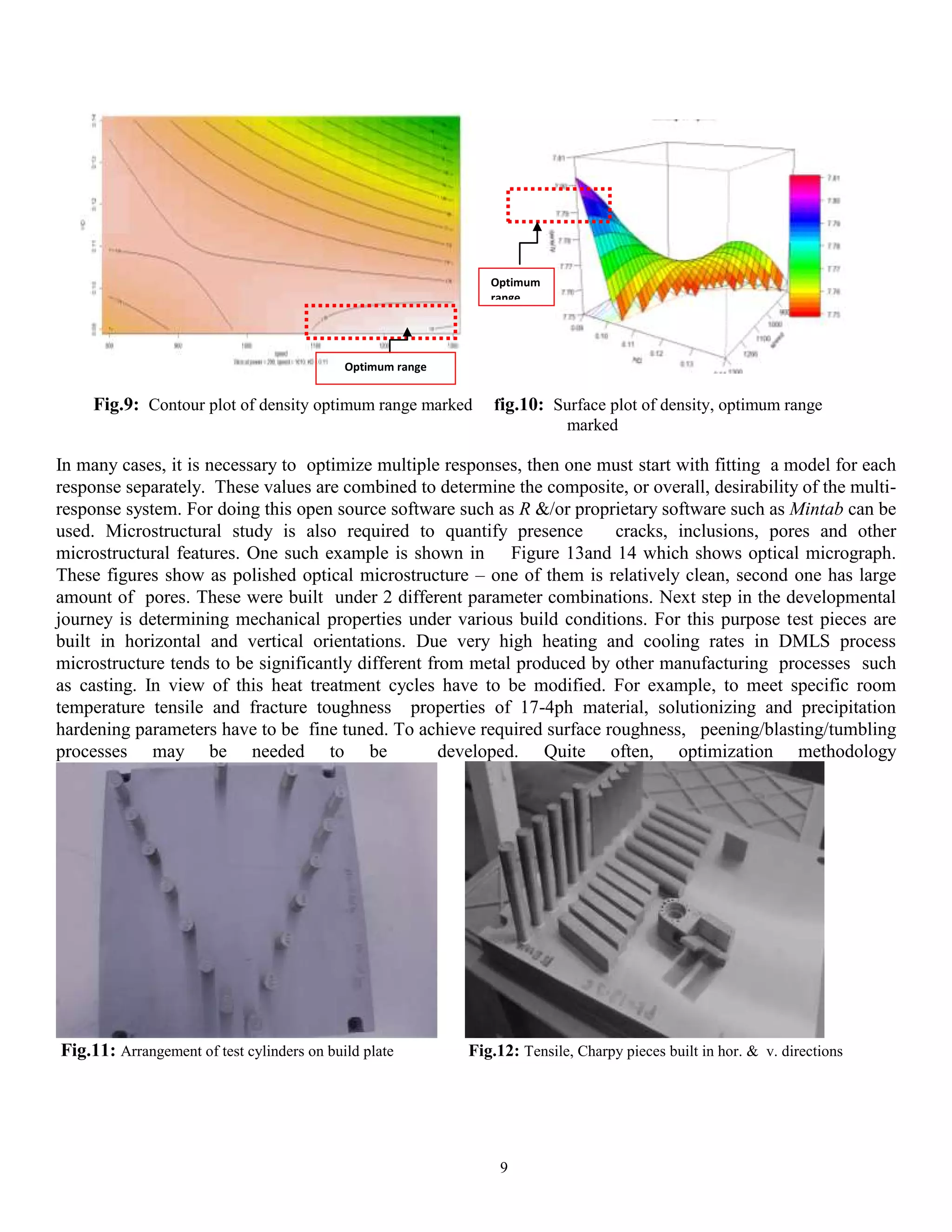
Series of test blocks are built under statistically determined conditions and responses are measured. Examples
are shown in figures 11 and 12. Several builds may be required to arrive at optimum operating window. In
many cases, interactions may exist between factors thus necessitating plotting of contour and surface plots.
Figures 9 and 10 show such an example. From this optimum operating range is extracted.
9
Fig.9: Contour plot of density optimum range marked fig.10: Surface plot of density, optimum range
marked
In many cases, it is necessary to optimize multiple responses, then one must start with fitting a model for each
response separately. These values are combined to determine the composite, or overall, desirability of the multi-
response system. For doing this open source software such as R &/or proprietary software such as Mintab can be
used. Microstructural study is also required to quantify presence cracks, inclusions, pores and other
microstructural features. One such example is shown in Figure 13and 14 which shows optical micrograph.
These figures show as polished optical microstructure – one of them is relatively clean, second one has large
amount of pores. These were built under 2 different parameter combinations. Next step in the developmental
journey is determining mechanical properties under various build conditions. For this purpose test pieces are
built in horizontal and vertical orientations. Due very high heating and cooling rates in DMLS process
microstructure tends to be significantly different from metal produced by other manufacturing processes such
as casting. In view of this heat treatment cycles have to be modified. For example, to meet specific room
temperature tensile and fracture toughness properties of 17-4ph material, solutionizing and precipitation
hardening parameters have to be fine tuned. To achieve required surface roughness, peening/blasting/tumbling
processes may be needed to be developed. Quite often, optimization methodology
Fig.11: Arrangement of test cylinders on build plate Fig.12: Tensile, Charpy pieces built in hor. & v. directions
Optimum range
Optimum
range
10
Fig.13: microstructure as polished 100X, clean Fig.14: microstructure, as polished 100X, more pores
such as DoE has to be used for discovering optimum process conditions.
CONCLUSION
This paper covers various process control aspects of DMLS process starting with powder all the way up to final part
production. A brief overview of research and development aspects of parameter and process optimization are also
covered.
REFERENCES
[1] “Getting the Most Out of Metal 3D Printing: Understanding Design and Process Controls for DMLS”
[2] W. J. Sames, F. A. List, S. Pannala, R. R. Dehoff & S. S. Babu (2016), “The metallurgy and processing
science of metal additive manufacturing”, Second edition , International Materials Reviews Volume 61, 2016 -
Issue 5
[3] Bhavar, V., Kattire, P. and Pawar, P. (2014) “A Review on Powder Bed Fusion Technology
of Additive Manufacturing”, 4th International conference & exhibition on Additive manufacturing
Technologies-AM-2014.
[4] S.P. Moylan, J.A. Slotwinski, A.L. Cooke, K.K. Jurrens, and M.A. Donmez (2012), "Proposal for a
standardized test artifact for additive manufacturing machines and processes," Proceedings of the 23rd
International Solid Free Form Symposium – An Additive Manufacturing Conference, Austin, TX, USA, August
2012, pp. 902-920.
[5] Xuezhi Shi, Shuyuan Ma, Changmeng Liu ,Qianru Wu (2017), “Parameter optimization for Ti-47Al-2Cr-
2Nb in selective laser melting based on geometric characteristics of single scan tracks”, Optics & Laser
Technology Volume 90, 1 May 2017, Pages 71-79
[6] Zhiheng Hu, Haihong Zhun, Hu Zhang, Xiaoyan Zeng (2017), Experimental investigation on selective laser
melting of 17-4PH stainless steel A, Optics & Laser Technology 87 (2017) 17–25
View publication statsView publication stats

Process control and R & D in metal additive manufacturing

  • 1.
    See discussions, stats,and author profiles for this publication at: https://www.researchgate.net/publication/327729743 Process Control & R+D in Metal Additive Manufacturing - An Overview Conference Paper · December 2016 CITATIONS 0 READS 137 1 author: Some of the authors of this publication are also working on these related projects: Study of Condensate Generated During Direct Metal Laser Sintering View project Jagadish chandra Achinadka 3 PUBLICATIONS   3 CITATIONS    SEE PROFILE All content following this page was uploaded by Jagadish chandra Achinadka on 20 September 2018. The user has requested enhancement of the downloaded file.
  • 2.
    1 ADMAT 2017 (SkyMat) December14-16, 2017, Thiruvananthapuram, INDIA Process Control & R+D in Metal Additive Manufacturing - An Overview Jagadish Chandra Achinadkaa,1, , Sr. G.M (Tech. Development), 1 Intech DMLS Pvt. Ltd. 3rd Main Rd, Peenya Industrial Area Phase IV, Peenya, Bengaluru 560058, India a jagadish.chandra@qmaxim.com ABSTRACT DMLS (Direct Metal Laser Sintering), an additive manufacturing technology, is increasingly finding widespread usage to build intricate high quality functional parts & rapid prototypes. DMLS technology uses a high intensity laser to build components layer by layer, directly from metal powder. CAD data is directly converted to part without the need for tooling. It is possible to build internal features and passages that are not possible in conventional manufacturing routes. Due to newness of technology, process control and R & D concepts are still being developed. This paper covers various process control aspects starting with powder quality, additive manufacture, post processing, testing and long term monitoring of quality. Following process control aspects are covered : powder chemistry, powder particle size distribution, powder morphology, powder flow properties, DMLS process control aspects, metal physical & mechanical properties, and NDT. Applicable international standards are also listed. Paper also briefly touches research and developmental approach for development of new materials. Key words Direct Metal Laser Sintering (DMLS), Process control, CMM, powder properties, metal physical and mechanical properties, metallurgical properties, development approach. INTRODUCTION Additive manufacturing (AM), which is also called 3D printing is a process of making a 3D solid object of virtually any shape directly from a digital model. Paper [2] gives a overview of various AM processes. The material is deposited layer by layer, unlike subtractive manufacturing which relies on the removal of material by methods such as cutting or milling. DMLS (also called SLM process) is one of the leading Powder Bed Fusion technologies that uses laser for fabricating metal parts directly [3]. Build station is lowered after each melt layer and new powder layer is dispensed. This process is continued until entire part is built. The main
  • 3.
    2 advantages of thistechnology include freedom of design, elimination of tooling, greatly reduced part development cycle, light-weighting, part consolidation and elimination of production steps[3]. Various metals can be manufactured by this process, most common ones being - AlSi10Mg, Ti64, IN718, IN 625, Hastealloy-X, Co-Cr-Mo F75, 18% Maraging Steel C300,SS316L, 17-4PH [3]. DMLS now finds widespread usage in various industrial sectors such as aerospace, energy, automotive, medical, oil and gas, tooling and consumer goods. Process description: In the DLMS process, a powder layer is first applied on a building platform with a recoater (blade or roller) and a laser beam selectively melts the layer of powder. Then the platform is lowered by 20 μm to 100 μm and a new powder layer is applied. The laser beam melting operation is repeated. After a few thousand cycles (depending on height of the part), the built part is removed from the powder bed. Parts are built using with Nd-YAG laser under N2/Ar atmosphere. The parts are built on a platform 20-45 mm thick made of Steel or other materials such as Ti64. Most common build envelop is in 250 x 250 x 300mm range, now machines are available with one dimension >=500 mm size. Laser power typically varies from 200 W up to 1000 W & with one or more Lasers in different machines. During laser melting the weld pool is heated very rapidly and some of the powder is converted into a gaseous condensate of the alloy - a mist of nano-particles. Rapid heating can also lead to some larger droplets of liquid metal being ejected from the weld pool, whilst trapped gas inside powder grains may also generate 'splatter'. DMLS machines provide inert gas flow across the bed to carry these by- products away to prevent them from accumulating in the powder. For collecting this byproduct these machines come with a recirculating filter system. This consists of particle separator, pre-filter and fine filter. The byproduct, which is called condensate is collected in the recirculating filter system. Most of the machine DMLS build parameters which number over 200 are user settable. Commonly changed build parameters are: power, hatch distance, scan speed, scan strategy, layer thickness, offset distance, etc. The stripe pattern can also be changed. Making these changes influence porosity level, microstructure, surface roughness, residual stress and heat build-up in the finished the metal components. The manufacturing of a metal part starts with 3D modeling. Then data preparation is organized & includes the definition of part orientation, the positioning of support structures and the slicing of the model. After part manufacturing by DMLS, post processing operations are done. These includes removal of powder, support structures and platform. This may be followed by CMM, NDT, heat treatment, Hot isostatic pressing (HIP), surface finish, polishing, etc. PROCESS CONTROL Metal Powder manufacture Metal powder plays a very important role in the additive manufacturing processes. Powder quality has major influence on mechanical properties but it can also influence - build-to-build consistency, reproducibility, production of defect-free components, surface quality. Metal powders are usually produced using the gas atomization process, where a molten metal stream is atomized due to a high pressure neutral gas jet into small metal droplets thus forming metal powder particles after rapid solidification. Gas atomization results in spherical shape of the powder, which is very beneficial for powder flowability. Gas atomization is the preferred method because it leads to - a good powder density, due to the spherical shape and particle size distribution, a good reproducibility of particle size distribution. In the VIM gas atomization process, the melting takes place in a vacuum chamber. This process is recommended for superalloys so as to avoid gas pickup particularly oxygen which is not desirable for Superalloys or reactive metals such as Ti. Source [1] provides a overview
  • 4.
    3 about design andprocess controls aspects of DMLS. Metal powder characteristics: Key metal powder characteristics for additive manufacturing can be sorted in four main categories: 1. Chemical composition, 2. Particle size distribution (PSD), 3. Morphology, 4. Physical properties. There are several existing standards to determine methods for characterizing metal powders. In addition, following important parameters have to be considered: storage and aging of powders, reusability of powder after additive manufacturing cycles, & health, safety and environmental issues. Chemical analysis: Alloy elements and chosen measurement techniques (ICP, Spectrometry, combustion, etc.) are very important but it is also important to take into account: 1. Interstitials, such as O2, N , C & S 2. trace elements and impurities. These effect: 1. melting temperature 2. mechanical properties 3. weldability 4. thermal properties. Good manufacturing system calls for determining chemical analysis of each lot of powder and test block built from the lot. Chemical analysis changes gradually due to reuse of powder. In view of this, fresh powder has to be mixed with re-used powder in fixed proportion. Particle size distribution: Particle size and shape has significant effect on uniform spreading of powder during recoating process. 10- 50 µm size is desirable range, -10 µm size has detrimental effect on flow properties. The Particle Size Distribution (PSD) is an index indicating proportions of sizes of various particles. The frequency distribution indicates in percentage the amounts of particles existing in respective particle size intervals whereas cumulative distribution expresses the percentage of the amounts of particles of a specific particle size or below. Alternatively, cumulative distribution expresses the percentage of the amounts of particles below a certain size. Parameters D10, D50, D90 are used. Parameter D10 is the size where 10% of the population by volume lies below D10. Fig. 1: Typical PSD frequency distribution and proportion of particles.
  • 5.
    4 Usual methods andstandards for particle size distribution measurement are: 1. ASTM B214 Test Method for Sieve Analysis of Metal Powders 2. Laser Diffraction Methods by ASTM B822 Test Method for Particle Size Distribution of Metal Powders and Related Compounds by Light Scattering. The readings depend upon the method used. Most common method used is Laser diffraction. Laser diffraction can be done by dry or wet method depending on accuracy /& size desired. Instrumentation manufactured by Microtrac and Malvern are popular - these are pictured in fig. 2 and fig. 3 respectively. FIG. 2: Microtrac PSD analyzer FIG. 3: Malvern PSD analyzer The particle size distribution is a major point as it influences many aspects such as: 1. Powder followability and ability to spread evenly; 2. Powder bed density; 3. Energy input needed to melt the powder grains; 4. surface roughness. Powder morphology: The recommended particle morphology is spherical shape because it is beneficial for powder flowability and also to help forming uniform powder layers in powder bed systems. The powder morphology can be observed by SEM (Scanning Electron Microscope). Typical defects to be controlled and minimized are: Irregular powder shapes such as elongated particles, satellites which are small powder grains stuck on the surface of bigger grains, & hollow powder particles, with open or closed porosity. Typical morphology is seen in the fig. 4 & 5. Fig.4: Maraging Steel C300 powder morphology 1500x Fig.5: Maraging Steel C300 powder morphology 100X
  • 6.
    5 Other methods areavailable for doing statistical analysis of size and shape of particles. Other powder physical properties: Rheological properties are very important for metal powders. Some of the appropriate properties being: density (apparent and tap density), flow rate (Hall flow). Relevant standards being : ASTM B212 Test Method for Apparent Density of Free-Flowing Metal Powders; ASTM B527 Test Method for Determination of Tap Density of Metallic Powders; ASTM B213 Test Methods for Flow Rate of Metal Powders Using the Hall Flowmeter Funnel as shown in fig.6 . Fig.6: Hall flowmeter Other powder characteristics: Storage, handling and aging of the powder should be carefully controlled. For almost all alloys, shielding gas, the control of hygrometry and temperature is important. Conditions of re-use of unused powders after manufacturing cycles should be controlled i.e. sieving of agglomerates, control, number of reuse, etc. Health, safety and environmental issues are also important. For example, some of the powders form combustible mixtures. DMLS PROCESS CONTROL Most of the DMLS build parameters numbering over 100 are user settable. Some of the important build parameters are: power, hatch distance, scan speed, scan strategy, layer thickness, offset distance, angle of rotation between layers, etc. The stripe pattern can also be changed. Making these changes influence porosity level, microstructure, surface roughness, mechanical properties, residual stress and heat build-up in the finished the metal components. Other important process variables are: shield gas purity (>=99.999% desired), build plate flatness, build temperature, etc. For each material one or more build parameter set is developed and frozen. During the build process several process parameters such as Oxygen content in the build chamber, build temperature, system pressure, inert gas pressure are monitored and controlled. Periodic check/calibration of laser power, position of beam and orientation have to be done. Nowadays, thermal mapping and imaging tools are available for in situ monitoring of build process.
  • 7.
    6 Test artifact tohighlight the capabilities of machine & process : Establishing criteria for identifying and quantifying system errors is complicated mainly because of the difficulty in separating machine characteristics from process characteristics. For evaluating the machine & process performance a test artifact has been developed by National Institute of Standards and Technology (NIST), USA. Paper [4] has detailed information about the artifact. This is shown in fig. 7 . Fig.7: Test artifact showing a top view (left) and an oblique view (right) (credit: NIST) The artifact was designed to determine the following : 1. Errors in positioning of the laser beam (resulting from geometric errors of the two axes of rotation holding the laser beam positioning mirrors or form errors in the f-θ lens that focuses and shapes the laser beam spot), 2. geometric errors of the axis positioning the build platform, 3. alignment errors between the axes, 4. errors in the laser beam size and shape, 5. variation in the beam power. The part should be built in the center of the building platform with the 4 mm pins and holes aligned along the machine x- and y-axes. Part as built is 17 mm tall and has a volume of approximately 101000 mm3 . The diamond shape was chosen because it minimizes the impact between the recoating blade and each layer of the part, and it allows simple vertical mounting for various measurements. Periodically this test is done to monitor state of machine and the process. Machine is adjusted/ recalibrated based on the findings. Measurements of metal properties: For good process control it is necessary to periodically measure some of the following metal properties : dimension, density, hardness, roughness, hardness, tensile properties, microstructure. Depending on application, mechanical properties such as high temperature tensile, stress rupture, creep test, creep rupture, fatigue are also measured. Mechanical properties are measured in as built and heat treated condition. Common heat treatments given are : stress relief, aging, solutionizing + aging treatment. Test cubes or specimens are built along with build platform. Mechanical properties of the parts built by this process display some amount of anisotropy, hence properties have to be tested in various orientations, at the least in horizontal and vertical directions. Physical properties: Coordinate measuring system (CMM) is used for measuring dimensional accuracy. Measurements are done by probe. Probes could be mechanical, optical, laser or white light. Measurement could be manual or computer controlled or combination of the two.
  • 8.
    7 Density, hardness androughness are the most commonly measured parameters. Density is determined by Archimedes principle by weighing the sample in air and water. Parts produced by this process reach > 99.9% of the theoretical density. Parts built by this process have some amount of micro-porosity. Hardness is commonly measured by Rockwell B or C scale depending on material. Roughness is measured in as built and heat treated condition. ASTM E18 standard is used for measuring hardness at room temperatures. Surface roughness is commonly measured by probe type equipment. Ra and Rz are commonly reported. Quite often it is necessary to record roughness on various surfaces as they can vary greatly in additive manufacture. Mechanical Properties: Tensile properties are measured in a calibrated UTM by testing test specimens built in vertical and horizontal orientations. Usually reported properties are Ultimate tensile strength, yield strength (as measure by 0.2% proof stress), and percent elongation. ASTM E8/E8M is the applicable standard. For certain applications it is necessary to report elevated temperature mechanical properties. ASTM E21- Standard Test Methods for Elevated Temperature Tension Tests of Metallic Materials is the applicable standard. ASTM E139 is the standard used for conducting Creep test, Creep-Rupture, and Stress-Rupture Tests of Metallic Materials. Internal soundness: To detect internal discontinuities, both radiography and tomography by X-Ray inspection can be used. But radiography can only be used for parts like thin plates. Conventional Radiography is based on the differential absorption of X-rays by the material. Any lack of material will lead to a weaker absorption and therefore, locally, to a higher level of grey level on the digital picture or on the silver film according to the detector used. Tomography makes use of a large quantity of views obtained by rotating the object at different angles and height positions. The different views allow to determine the absorption of each volume element called “voxel” to rebuild the object in 3 dimensions. Using a suitable software it is then possible to obtain several representations of the volume of the object, including visualization in the form of virtual slices that define the word “tomography”. Tomography is used for measuring porosity level or to measure discontinuities or to measure internal and external dimensions. Tracking properties Various physical and mechanical properties are tracked to monitor long term process variation. For this purpose standard test block (25x8x19 mm) is built with each build. Test specimens are built at the predetermined frequency. Following properties are usually tracked : density, surface roughness, dimensional accuracy, chemistry, hardness, tensile properties, etc. Histogram, box plot and SPC charts are usually used. Slice of a typical property plot is shown in the figure 8.
  • 9.
    8 Fig.8: Slice oftracking plot showing roughness histogram of various alloys RESEARCH AND DEVELOPMENT Several materials are certified for production of quality parts by DMLS process – more are being added. However, quite often it is necessary to tweak operating conditions to improve one or more of the following– productivity, yield, cost reduction, room temperature mechanical properties, elevated temperature mechanical properties, surface roughness, microstructure, etc. To achieve this one or more of the following is fine-tuned viz. machine operating parameters, process conditions, heat treatment, post processing, etc. If the standard operating conditions do not exist they have to developed from scratch. There are several approaches for doing this. Papers [5], [6] describe two such approaches. Another approach is use of statistical technique of design of experiment (DoE) - which is explained in this paper. Following is a broad approach for process development and parameter optimization. For each material a specific range of parameters combination exists that result in satisfactory quality such as - high density, microstructure or surface roughness. Productivity also should be considered. The optimum parameter window is experimentally determined - most common method being DoE. Taguchi method (TM) and Response surface methodology (RSM) are most common DoE methodologies. In statistical-based approaches, RSM has been extensively used for optimization. RSM is a collection of statistical techniques for designing experiments, building models, evaluating the effects of factors and searching for the optimum conditions. It is a statistically designed experimental protocol in which several factors are simultaneously varied. In RSM, the experimental responses of experiments (DoEs) are fitted to quadratic function. Artificial neural network (ANN) has emerged as an attractive tool for non-linear multivariate modeling. The power of ANN is that it is generic in structure and possesses the ability to learn from historical data. The main advantage of ANN compared to RSM are: (i) ANN does not require a prior specification of suitable fitting function and (ii) ANN has universal approximation capability, i.e. it can approximate almost all kinds of non-linear functions including quadratic functions, whereas RSM is useful only for quadratic approximations. Series of test blocks are built under statistically determined conditions and responses are measured. Examples are shown in figures 11 and 12. Several builds may be required to arrive at optimum operating window. In many cases, interactions may exist between factors thus necessitating plotting of contour and surface plots. Figures 9 and 10 show such an example. From this optimum operating range is extracted.
  • 10.
    9 Fig.9: Contour plotof density optimum range marked fig.10: Surface plot of density, optimum range marked In many cases, it is necessary to optimize multiple responses, then one must start with fitting a model for each response separately. These values are combined to determine the composite, or overall, desirability of the multi- response system. For doing this open source software such as R &/or proprietary software such as Mintab can be used. Microstructural study is also required to quantify presence cracks, inclusions, pores and other microstructural features. One such example is shown in Figure 13and 14 which shows optical micrograph. These figures show as polished optical microstructure – one of them is relatively clean, second one has large amount of pores. These were built under 2 different parameter combinations. Next step in the developmental journey is determining mechanical properties under various build conditions. For this purpose test pieces are built in horizontal and vertical orientations. Due very high heating and cooling rates in DMLS process microstructure tends to be significantly different from metal produced by other manufacturing processes such as casting. In view of this heat treatment cycles have to be modified. For example, to meet specific room temperature tensile and fracture toughness properties of 17-4ph material, solutionizing and precipitation hardening parameters have to be fine tuned. To achieve required surface roughness, peening/blasting/tumbling processes may be needed to be developed. Quite often, optimization methodology Fig.11: Arrangement of test cylinders on build plate Fig.12: Tensile, Charpy pieces built in hor. & v. directions Optimum range Optimum range
  • 11.
    10 Fig.13: microstructure aspolished 100X, clean Fig.14: microstructure, as polished 100X, more pores such as DoE has to be used for discovering optimum process conditions. CONCLUSION This paper covers various process control aspects of DMLS process starting with powder all the way up to final part production. A brief overview of research and development aspects of parameter and process optimization are also covered. REFERENCES [1] “Getting the Most Out of Metal 3D Printing: Understanding Design and Process Controls for DMLS” [2] W. J. Sames, F. A. List, S. Pannala, R. R. Dehoff & S. S. Babu (2016), “The metallurgy and processing science of metal additive manufacturing”, Second edition , International Materials Reviews Volume 61, 2016 - Issue 5 [3] Bhavar, V., Kattire, P. and Pawar, P. (2014) “A Review on Powder Bed Fusion Technology of Additive Manufacturing”, 4th International conference & exhibition on Additive manufacturing Technologies-AM-2014. [4] S.P. Moylan, J.A. Slotwinski, A.L. Cooke, K.K. Jurrens, and M.A. Donmez (2012), "Proposal for a standardized test artifact for additive manufacturing machines and processes," Proceedings of the 23rd International Solid Free Form Symposium – An Additive Manufacturing Conference, Austin, TX, USA, August 2012, pp. 902-920. [5] Xuezhi Shi, Shuyuan Ma, Changmeng Liu ,Qianru Wu (2017), “Parameter optimization for Ti-47Al-2Cr- 2Nb in selective laser melting based on geometric characteristics of single scan tracks”, Optics & Laser Technology Volume 90, 1 May 2017, Pages 71-79 [6] Zhiheng Hu, Haihong Zhun, Hu Zhang, Xiaoyan Zeng (2017), Experimental investigation on selective laser melting of 17-4PH stainless steel A, Optics & Laser Technology 87 (2017) 17–25 View publication statsView publication stats