Effective Advocacy Strategies
Ryan Clarke
Advocacy Solutions
Thursday, May 3, 2018
Overview
• Cornerstones of effective advocacy
• How to develop an impactful advocacy plan
• Questions
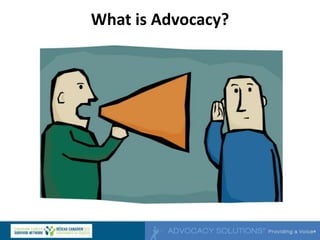
What is Advocacy?
Why is Advocacy Important?
• Key decision makers react to those
credible groups or individuals who
most effectively bring their issues
to the forefront of the public
agenda (or shape the agenda itself)
• Governments have competing interests and concerns
(including their own priorities)
• If you don’t engage, someone else will
• You have the power to affect change around your issues
Why is Patient Advocacy Important?
• Voters who vote in every riding in every province and
the country
• Consumers of health care
• Many groups are well organized
• Can be politically powerful
• History of leaders who will not give up
• Can bring about change
Different Kinds of Advocacy
• Personal vs. issue-based
• Personal – presenting issues to key
decision-makers that are having a
specific impact on you or your loved
ones – tend to be narrowly focused
• Issue-based – presenting issues to key decision-
makers on behalf of a larger group of affected people
– tend to be broadly applicable
The Essence of Good Advocacy
• Identify and be able to explain your issues
(messages) using the tools at your disposal
• Know your issues better than anyone in government
(beware of the Curse of Knowledge)
• Be able to position your issues so that they fit within
the government’s agenda and election cycle, or be
able to set a new agenda
• Build on existing relationships with policy
influencers, or create new relationships
Two Cornerstones of
Effective Advocacy
• The ability to prepare and share your personal story
• Building and sustaining impeccable relationships with
key decision-makers
Knowing Your Issues
• You need to demonstrate that you know your issues
and core facts, in a manner that is ‘consumable’ to
decision-makers
• Be able to discuss your issues in the context of a
story, using examples of real people (like yourselves
or the people you represent) who are being
impacted
• Ideally, if you are advocating to a politician, your
examples will incorporate constituent concerns or
reflect their personal interests
Finding Others Who Know
Your Issues
• People who are impacted by
the issues and can articulate
their stories
• Experts in the field, who can
speak to the complexities of the matter
• People who have dealt with the issues in another
jurisdiction or under similar circumstances previously
• Other people in government i.e. local
MPP/MLA/MNA/MHA
Build on Existing Relationships
• At the heart of effective advocacy is impeccable
relationships with key people in government
• Look for people in your organization or network who
have established relationships with the people you
need to see
• Go beyond your business circles to find connections,
and use these links to secure introductions
When You Have No Relationships?
• Make an appointment to visit your local elected
representatives i.e. on constituency days (Fridays)
• Offer to support them in their work, by building
opportunities for them to get their messages out to
constituents
• Offer to provide them with information or other
resources that may be of assistance
• Ask them to provide you with key introductions to others
in government
• Go to local events where you know policy influencers will
be in attendance
Process for Developing an
Effective Advocacy Plan
• Key message development
• Development of your tools
• Development of your one ‘ask’
Key Message Development
Identification…
– Requires that you be able to take an array of
information and distill it down to its simplest form
– Requires that you separate fact from fiction
– When advocating on behalf of a group, consensus
on the issues is required
Key Message Development
Framing…
– Develop 3 key messages that explain the salient
points of your issue in simple language
– Each one should be 25 words or less
– Must always be clear, compelling, concise and
consistent
– Practice presenting your 3 key messages to
someone who has no knowledge of your issues
A Model For Developing
Key Messages
1. What is the problem?
2. What is the impact of the problem?
3. What would it look like if we solved/didn’t solve
the problem?
When to Advocate?
Timing is everything…
– Know where you are in the election cycle
– Take advantage of the newly elected
– Try to have them come to you vs. meeting them
on their own turf
– Strike while the issue is hot
– Know when to do nothing
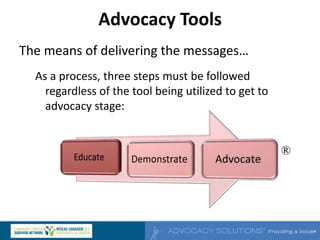
Advocacy Tools
The means of delivering the messages…
As a process, three steps must be followed
regardless of the tool being utilized to get to
advocacy stage:
®
Advocacy Tools
• Web site
• Newsletter
• In person meeting
• Telephone call
• Voice mail information
• Letter/text/e-mail
• Position paper
• Advocacy Day
Advocacy Tools
• Brochure
• Fact sheet
• News release
• Newspaper/periodical article
/op editorial/PSA/advertorial
• Published book
• Information session
• E-advocacy
• Social networking tools
Your One ‘Ask’
The objective or goal of the strategy…
• ONE – because you are going to ask for what you
need, not a list of what you want
• Requires one to make choices and potentially reach a
consensus (just as it does when developing your 3
key messages)
• Sometimes opportunities will present themselves
that will make the ‘ask’ very timely
Implementing an
Effective Advocacy Strategy
• Success will depend in large part on the ability of
people like yourselves to become engaged
• You all live in various ridings throughout the
region/province/country
• You are inherently credible sources of information
and opinion
• You are most effective at the telling of your personal
stories (and the stories of those whom you
represent)
Summary
• Know your core facts as organizations
• Know your key messages
• Deliver your key messages over and over,
using all of your tools
• Ask for the one thing you need, not a list of what you want
• Build impeccable, long-term relationships
• Tell the personal stories of people impacted
• Government wins, when you give up…so never give up
Advocacy Solutions®
Ryan Clarke, LL.B.
t. 416.919.9532
ryan@advocacysolutions.ca
www.advocacysolutions.ca
Canadian Cancer Survivor Network
Contact Info
1750 Courtwood Crescent, Suite 210
Ottawa, ON K2C 2B5
Telephone / Téléphone : 613-898-1871
E-mail: info@survivornet.ca
Web site www.survivornet.ca
Twitter: @survivornetca
Facebook: www.facebook.com/CanadianSurvivorNet
Instagram: @survivornet_ca
Pinterest: http://pinterest.com/survivornetwork/

Effective Advocacy Strategies

  • 1.
    Effective Advocacy Strategies RyanClarke Advocacy Solutions Thursday, May 3, 2018
  • 2.
    Overview • Cornerstones ofeffective advocacy • How to develop an impactful advocacy plan • Questions
  • 3.
  • 4.
    Why is AdvocacyImportant? • Key decision makers react to those credible groups or individuals who most effectively bring their issues to the forefront of the public agenda (or shape the agenda itself) • Governments have competing interests and concerns (including their own priorities) • If you don’t engage, someone else will • You have the power to affect change around your issues
  • 5.
    Why is PatientAdvocacy Important? • Voters who vote in every riding in every province and the country • Consumers of health care • Many groups are well organized • Can be politically powerful • History of leaders who will not give up • Can bring about change
  • 6.
    Different Kinds ofAdvocacy • Personal vs. issue-based • Personal – presenting issues to key decision-makers that are having a specific impact on you or your loved ones – tend to be narrowly focused • Issue-based – presenting issues to key decision- makers on behalf of a larger group of affected people – tend to be broadly applicable
  • 7.
    The Essence ofGood Advocacy • Identify and be able to explain your issues (messages) using the tools at your disposal • Know your issues better than anyone in government (beware of the Curse of Knowledge) • Be able to position your issues so that they fit within the government’s agenda and election cycle, or be able to set a new agenda • Build on existing relationships with policy influencers, or create new relationships
  • 8.
    Two Cornerstones of EffectiveAdvocacy • The ability to prepare and share your personal story • Building and sustaining impeccable relationships with key decision-makers
  • 9.
    Knowing Your Issues •You need to demonstrate that you know your issues and core facts, in a manner that is ‘consumable’ to decision-makers • Be able to discuss your issues in the context of a story, using examples of real people (like yourselves or the people you represent) who are being impacted • Ideally, if you are advocating to a politician, your examples will incorporate constituent concerns or reflect their personal interests
  • 10.
    Finding Others WhoKnow Your Issues • People who are impacted by the issues and can articulate their stories • Experts in the field, who can speak to the complexities of the matter • People who have dealt with the issues in another jurisdiction or under similar circumstances previously • Other people in government i.e. local MPP/MLA/MNA/MHA
  • 11.
    Build on ExistingRelationships • At the heart of effective advocacy is impeccable relationships with key people in government • Look for people in your organization or network who have established relationships with the people you need to see • Go beyond your business circles to find connections, and use these links to secure introductions
  • 12.
    When You HaveNo Relationships? • Make an appointment to visit your local elected representatives i.e. on constituency days (Fridays) • Offer to support them in their work, by building opportunities for them to get their messages out to constituents • Offer to provide them with information or other resources that may be of assistance • Ask them to provide you with key introductions to others in government • Go to local events where you know policy influencers will be in attendance
  • 13.
    Process for Developingan Effective Advocacy Plan • Key message development • Development of your tools • Development of your one ‘ask’
  • 14.
    Key Message Development Identification… –Requires that you be able to take an array of information and distill it down to its simplest form – Requires that you separate fact from fiction – When advocating on behalf of a group, consensus on the issues is required
  • 15.
    Key Message Development Framing… –Develop 3 key messages that explain the salient points of your issue in simple language – Each one should be 25 words or less – Must always be clear, compelling, concise and consistent – Practice presenting your 3 key messages to someone who has no knowledge of your issues
  • 16.
    A Model ForDeveloping Key Messages 1. What is the problem? 2. What is the impact of the problem? 3. What would it look like if we solved/didn’t solve the problem?
  • 17.
    When to Advocate? Timingis everything… – Know where you are in the election cycle – Take advantage of the newly elected – Try to have them come to you vs. meeting them on their own turf – Strike while the issue is hot – Know when to do nothing
  • 18.
    Advocacy Tools The meansof delivering the messages… As a process, three steps must be followed regardless of the tool being utilized to get to advocacy stage: ®
  • 19.
    Advocacy Tools • Website • Newsletter • In person meeting • Telephone call • Voice mail information • Letter/text/e-mail • Position paper • Advocacy Day
  • 20.
    Advocacy Tools • Brochure •Fact sheet • News release • Newspaper/periodical article /op editorial/PSA/advertorial • Published book • Information session • E-advocacy • Social networking tools
  • 21.
    Your One ‘Ask’ Theobjective or goal of the strategy… • ONE – because you are going to ask for what you need, not a list of what you want • Requires one to make choices and potentially reach a consensus (just as it does when developing your 3 key messages) • Sometimes opportunities will present themselves that will make the ‘ask’ very timely
  • 22.
    Implementing an Effective AdvocacyStrategy • Success will depend in large part on the ability of people like yourselves to become engaged • You all live in various ridings throughout the region/province/country • You are inherently credible sources of information and opinion • You are most effective at the telling of your personal stories (and the stories of those whom you represent)
  • 23.
    Summary • Know yourcore facts as organizations • Know your key messages • Deliver your key messages over and over, using all of your tools • Ask for the one thing you need, not a list of what you want • Build impeccable, long-term relationships • Tell the personal stories of people impacted • Government wins, when you give up…so never give up
  • 24.
    Advocacy Solutions® Ryan Clarke,LL.B. t. 416.919.9532 ryan@advocacysolutions.ca www.advocacysolutions.ca
  • 25.
    Canadian Cancer SurvivorNetwork Contact Info 1750 Courtwood Crescent, Suite 210 Ottawa, ON K2C 2B5 Telephone / Téléphone : 613-898-1871 E-mail: info@survivornet.ca Web site www.survivornet.ca Twitter: @survivornetca Facebook: www.facebook.com/CanadianSurvivorNet Instagram: @survivornet_ca Pinterest: http://pinterest.com/survivornetwork/