Personal Protective Equipment (PPE)  
Hazard Assessment Certificate Instructions 
 
Based on the hierarchy of controls, PPE is a last resort.  Personal protective equipment alone should not be relied upon to provide protection 
against hazards but should be used in conjunction with engineering controls, administrative controls, and procedural controls. 
 
This document addresses eye, face, head, hand, foot, torso, respiratory, noise, and fall protection.  It will serve as the Personal Protective 
Equipment (PPE) Certification document required to satisfy the federal requirements of the Occupational Safety and Health Administration 
(OSHA) Standard, 29 CFR 1910.132 Subpart I‐ Personal Protective Equipment.  
 
General Guidelines 
 
The PPE Hazard Assessment can be conducted for an area, a job category or for an individual by selecting and filling in the appropriate box. The 
assigned evaluator shall include their name, department/division being assessed, and the date.    Completed assessments must be accessible to 
employees and inspectors and updated when needed. 
 
PPE HAZARD ASSESSMENT INSTRUCTIONS 
 
STEP 1:  INFORM AFFECTED EMPLOYEES OF THE PROCESS: 
 
Affected employees from each work area that is being assessed should be involved in the process.  Discuss the reasons for the survey and the 
procedures being used for the assessment.  Review the job procedures, potential hazards and the PPE currently in use. 
 
Step 2:  Review data: 
 
Reports of work‐related injuries or illnesses, near‐miss events and reported safety concerns are sources of data that can provide helpful 
information for assessing hazards. 
 
Step 3:  Conduct a walk‐through survey: 
 
The purpose of the survey is to identify sources of hazards to employees.  Observe the following: layout of the workplace, location of the 
employees, work operations, hazards and places where PPE is currently used including the device and reason for use.  Using the form, check the 
type of hazard(s) present within each section (organized by body part). Further descriptions can be provided in the adjacent box. 
Consideration should be given to the following basic hazard categories: 
9/2/2009 
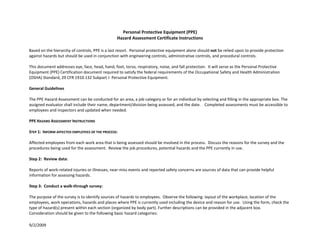
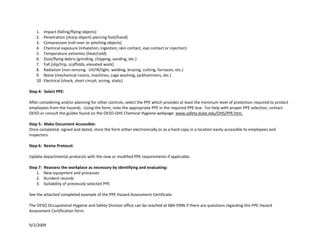
1. Impact (falling/flying objects) 
2. Penetration (sharp objects piercing foot/hand) 
3. Compression (roll‐over or pinching objects) 
4. Chemical exposure (inhalation, ingestion, skin contact, eye contact or injection) 
5. Temperature extremes (heat/cold) 
6. Dust/flying debris (grinding, chipping, sanding, etc.) 
7. Fall (slip/trip, scaffolds, elevated work) 
8. Radiation (non‐ionizing:  UV/IR/light, welding, brazing, cutting, furnaces, etc.) 
9. Noise (mechanical rooms, machines, cage washing, jackhammers, etc.) 
10. Electrical (shock, short circuit, arcing, static) 
 
Step 4:  Select PPE: 
 
After considering and/or planning for other controls, select the PPE which provides at least the minimum level of protection required to protect 
employees from the hazards.  Using the form, note the appropriate PPE in the required PPE box.  For help with proper PPE selection, contact 
OESO or consult the guides found on the OESO‐OHS Chemical Hygiene webpage: www.safety.duke.edu/OHS/PPE.htm.   
 
Step 5:  Make Document Accessible:   
Once completed, signed and dated, store the form either electronically or as a hard copy in a location easily accessible to employees and 
inspectors. 
 
Step 6:  Revise Protocol: 
 
Update departmental protocols with the new or modified PPE requirements if applicable. 
 
Step 7:  Reassess the workplace as necessary by identifying and evaluating: 
1. New equipment and processes 
2. Accident records 
3. Suitability of previously selected PPE 
 
See the attached completed example of the PPE Hazard Assessment Certificate. 
 
The OESO Occupational Hygiene and Safety Division office can be reached at 684‐5996 if there are questions regarding this PPE Hazard 
Assessment Certification form. 
9/2/2009 
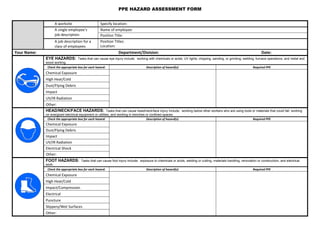
PPE HAZARD ASSESSMENT FORM
(check t
reviewing
  A worksite  Specify location:  
  A single employee’s 
job description 
Name of employee:  
Position Title:  
  A job description for a 
class of employees 
Position Titles:
Location:
 
Your Name:    Department/Division:   Date:   
  EYE HAZARDS: Tasks that can cause eye injury include: working with chemicals or acids; UV lights; chipping, sanding, or grinding; welding; furnace operations; and metal and
wood working. 
Check the appropriate box for each hazard: Description of hazard(s): Required PPE
Chemical Exposure       
High Heat/Cold     
Dust/Flying Debris   
Impact   
UV/IR Radiation   
Other:   
  HEAD/NECK/FACE HAZARDS: Tasks that can cause head/neck/face injury include: working below other workers who are using tools or materials that could fall, working
on energized electrical equipment or utilities, and working in trenches or confined spaces.
Check the appropriate box for each hazard: Description of hazard(s):
 
Required PPE
Chemical Exposure    
Dust/Flying Debris   
Impact   
UV/IR Radiation   
Electrical Shock   
Other:   
  FOOT HAZARDS: Tasks that can cause foot injury include: exposure to chemicals or acids, welding or cutting, materials handling, renovation or construction, and electrical
work. 
Check the appropriate box for each hazard: Description of hazard(s): Required PPE
Chemical Exposure       
High Heat/Cold      
Impact/Compression   
Electrical   
Puncture    
Slippery/Wet Surfaces   
Other:   
sI am
reviewing
(check the
appropriate
box):
PPE HAZARD ASSESSMENT CERTIFICATE
  HAND HAZARDS: Hand injury can be caused by: work with chemicals or acids, exposure to cut or abrasion hazards (for example, during demolition, renovation,
woodworking, or food service preparation), work with very hot or cold objects or materials, and exposure to sharps.
Check the appropriate box for each hazard: Description of hazard(s): Required PPE
Chemical Exposure       
High Heat/Cold   
UV/IR Radiation   
Electrical Shock   
Puncture   
Cuts/Abrasion   
Other:   
  BODY HAZARDS: Injury of the body (torso, arms, or legs) can occur during: exposure to chemicals, acids, or other hazardous materials; abrasive blasting; welding,
cutting, or brazing; chipping, sanding, or grinding; use of chainsaws or similar equipment; and work around electrical arcs.
Check the appropriate box for each hazard: Description of hazard(s): Required PPE
Chemical Exposure       
High Heat/Cold    
Impact/Compression   
Electrical Arc   
Cuts/Abrasion   
Other:   
 
FALL HAZARDS: Personnel may be exposed to fall hazards when performing work on a surface with an unprotected side or edge that is 4 feet or more above a lower level, or
10 feet or more on scaffolds. Fall protection may also be required when using vehicle man lifts, elevated platforms, tree trimming, performing work on poles, roofs, or fixed ladders.
Check the appropriate box for each hazard:
 
Description of hazard(s): Required PPE
Fall hazard 


NOISE HAZARDS: Personnel may be exposed to noise hazards when working in mechanical rooms; machining; grinding; sanding; cage washing; dish washing; working
around pneumatic equipment, grounds equipment, generators, chillers, motors, saws, jackhammers, or similar equipment.
Check the appropriate box for each hazard:
 
Description of hazard(s): Required PPE
Noise hazard 
 
   
  RESPIRATORY HAZARDS: Personnel may be exposed to respiratory hazards that require the use of respirators: during emergency response, when using certain
chemicals outside of a chemical fume hood; when working with hazardous powders; when entering fume hood plenums, when working with animals; when applying paints or
chemicals in confined spaces; when welding, cutting, or brazing on certain metals; and when disturbing asbestos, lead, silica, or other particulate hazards.
Check the appropriate box for each hazard:
 
Description of hazard(s): Required PPE
Chemical exposure     
Particulate exposure   
Other:   
I certify that the above hazard assessment was performed to the best of my knowledge and ability, based on the hazards present on this date. 
(signature)______________________________________ 
 
PPE HAZARD ASSESSMENT FORM
(check t
reviewing
I am
box):
appropriate
A worksite Specify location:
A single employee’s
job description
Name of employee:
Position Title:
A job description for a
class of employees
Position Titles:
Location:
Your Name: Department/Division: Date:
EYE HAZARDS: Tasks that can cause eye injury include: working with chemicals or acids; UV lights; chipping, sanding, or grinding; welding; furnace operations; and metal and
wood working.
Check the appropriate box for each hazard: Description of hazard(s): Required PPE
Chemical Exposure
High Heat/Cold
Dust/Flying Debris
Impact
UV/IR Radiation
Other:
HEAD/NECK/FACE HAZARDS: Tasks that can cause head/neck/face injury include: working below other workers who are using tools or materials that could fall, working
on energized electrical equipment or utilities, and working in trenches or confined spaces.
Check the appropriate box for each hazard: Description of hazard(s): Required PPE
Chemical Exposure
Dust/Flying Debris
Impact
UV/IR Radiation
Electrical Shock
Other:
FOOT HAZARDS: Tasks that can cause foot injury include: exposure to chemicals or acids, welding or cutting, materials handling, renovation or construction, and electrical
work.
Check the appropriate box for each hazard: Description of hazard(s): Required PPE
Chemical Exposure
High Heat/Cold
Impact/Compression
Electrical
Puncture
Slippery/Wet Surfaces
Other:
✔
Pharmacy Tech, all levels
John Doe Central Pharmacy, IV Sterile Room 10/09/09
Exposure to hazardous and non-hazardous drugs during handling and
preparation, spill clean-up. Safety hoods/glove boxes in separate clean
room used for hazardous drug preparation.
Safety glasses w/ side shields for non-liquids, goggles for
liquids, surgical mask with shield, face shields (disposable,
reusable). In this case, a surgical mask/face shield is
designed to prevent exposure from splashing below eye
level. A safety shield in lieu of safety eyewear may be
sufficient since the splash hazard is not corrosive.
✔
Surgical mask with face shield, face shield (disposable or
reusable). Re-use of equipment depends on departmental
protocol.
✔
✔
Exposure to hazardous and non-hazardous drugs during handling and
preparation, spill clean-up. Safety hoods/glove boxes in separate clean
room used for hazardous drug preparation.
reviewing
(check the
✔
Central Pharmacy IV Sterile Room, DHN 0-level
PPE HAZARD ASSESSMENT CERTIFICATE
HAND HAZARDS: Hand injury can be caused by: work with chemicals or acids, exposure to cut or abrasion hazards (for example, during demolition, renovation,
woodworking, or food service preparation), work with very hot or cold objects or materials, and exposure to sharps.
Check the appropriate box for each hazard: Description of hazard(s): Required PPE
Chemical Exposure
High Heat/Cold
UV/IR Radiation
Electrical Shock
Puncture
Cuts/Abrasion
Other:
BODY HAZARDS: Injury of the body (torso, arms, or legs) can occur during: exposure to chemicals, acids, or other hazardous materials; abrasive blasting; welding,
cutting, or brazing; chipping, sanding, or grinding; use of chainsaws or similar equipment; and work around electrical arcs.
Check the appropriate box for each hazard: Description of hazard(s): Required PPE
Chemical Exposure
High Heat/Cold
Impact/Compression
Electrical Arc
Cuts/Abrasion
Other:
FALL HAZARDS: Personnel may be exposed to fall hazards when performing work on a surface with an unprotected side or edge that is 4 feet or more above a lower level, or
10 feet or more on scaffolds. Fall protection may also be required when using vehicle man lifts, elevated platforms, tree trimming, performing work on poles, roofs, or fixed ladders.
Check the appropriate box for each hazard: Description of hazard(s): Required PPE
Fall hazard
NOISE HAZARDS: Personnel may be exposed to noise hazards when working in mechanical rooms; machining; grinding; sanding; cage washing; dish washing; working
around pneumatic equipment, grounds equipment, generators, chillers, motors, saws, jackhammers, or similar equipment.
Check the appropriate box for each hazard: Description of hazard(s): Required PPE
Noise hazard
RESPIRATORY HAZARDS: Personnel may be exposed to respiratory hazards that require the use of respirators: during emergency response, when using certain
chemicals outside of a chemical fume hood; when working with hazardous powders; when entering fume hood plenums, when working with animals; when applying paints or
chemicals in confined spaces; when welding, cutting, or brazing on certain metals; and when disturbing asbestos, lead, silica, or other particulate hazards.
Check the appropriate box for each hazard: Description of hazard(s): Required PPE
Chemical exposure
Particulate exposure
Other:
I certify that the above hazard assessment was performed to the best of my knowledge and ability, based on the hazards present on this date.
(signature)______________________________________ )e)
Exposure to hazardous and non-hazardous drugs during handling
and preparation, spill clean-up.
Punctures from syringe needles that may contain hazardous and
non-hazardous drugs during preparation and handling activities
such as: dilution/reconstitution, pulling and transferring, recapping
and removing needle from syringe for pharmacist review,
recapping syringe for medication dispensing. Size of needles
used range from 16 to 19 gauge.
Cuts from breaking drug containing ampules.
Double gloving with chemo gloves for hazardous drug handling,
double gloving with approved gloves for non-hazardous drug
handling.
Exposure to drugs during handling and preparation. Tyvek body suits.✔
✔
✔
Spill clean up of hazardous drugs.
Clean up of powdered drugs.
Powered Air Purifying Respirator (PAPR)
✔
✔
✔

PPE HAZARD ASSESSMENT FORM

  • 1.
    Personal Protective Equipment (PPE)   Hazard Assessment Certificate Instructions    Based on the hierarchy of controls, PPE is a last resort.  Personal protective equipment alone should not be relied upon to provide protection  against hazards but should be used in conjunction with engineering controls, administrative controls, and procedural controls.    This document addresses eye, face, head, hand, foot, torso, respiratory, noise, and fall protection.  It will serve as the Personal Protective  Equipment (PPE) Certification document required to satisfy the federal requirements of the Occupational Safety and Health Administration  (OSHA) Standard, 29 CFR 1910.132 Subpart I‐ Personal Protective Equipment.     General Guidelines    The PPE Hazard Assessment can be conducted for an area, a job category or for an individual by selecting and filling in the appropriate box. The  assigned evaluator shall include their name, department/division being assessed, and the date.    Completed assessments must be accessible to  employees and inspectors and updated when needed.    PPE HAZARD ASSESSMENT INSTRUCTIONS    STEP 1:  INFORM AFFECTED EMPLOYEES OF THE PROCESS:    Affected employees from each work area that is being assessed should be involved in the process.  Discuss the reasons for the survey and the  procedures being used for the assessment.  Review the job procedures, potential hazards and the PPE currently in use.    Step 2:  Review data:    Reports of work‐related injuries or illnesses, near‐miss events and reported safety concerns are sources of data that can provide helpful  information for assessing hazards.    Step 3:  Conduct a walk‐through survey:    The purpose of the survey is to identify sources of hazards to employees.  Observe the following: layout of the workplace, location of the  employees, work operations, hazards and places where PPE is currently used including the device and reason for use.  Using the form, check the  type of hazard(s) present within each section (organized by body part). Further descriptions can be provided in the adjacent box.  Consideration should be given to the following basic hazard categories:  9/2/2009 
  • 2.
    1. Impact (falling/flying objects)  2. Penetration (sharp objects piercing foot/hand)  3.Compression (roll‐over or pinching objects)  4. Chemical exposure (inhalation, ingestion, skin contact, eye contact or injection)  5. Temperature extremes (heat/cold)  6. Dust/flying debris (grinding, chipping, sanding, etc.)  7. Fall (slip/trip, scaffolds, elevated work)  8. Radiation (non‐ionizing:  UV/IR/light, welding, brazing, cutting, furnaces, etc.)  9. Noise (mechanical rooms, machines, cage washing, jackhammers, etc.)  10. Electrical (shock, short circuit, arcing, static)    Step 4:  Select PPE:    After considering and/or planning for other controls, select the PPE which provides at least the minimum level of protection required to protect  employees from the hazards.  Using the form, note the appropriate PPE in the required PPE box.  For help with proper PPE selection, contact  OESO or consult the guides found on the OESO‐OHS Chemical Hygiene webpage: www.safety.duke.edu/OHS/PPE.htm.      Step 5:  Make Document Accessible:    Once completed, signed and dated, store the form either electronically or as a hard copy in a location easily accessible to employees and  inspectors.    Step 6:  Revise Protocol:    Update departmental protocols with the new or modified PPE requirements if applicable.    Step 7:  Reassess the workplace as necessary by identifying and evaluating:  1. New equipment and processes  2. Accident records  3. Suitability of previously selected PPE    See the attached completed example of the PPE Hazard Assessment Certificate.    The OESO Occupational Hygiene and Safety Division office can be reached at 684‐5996 if there are questions regarding this PPE Hazard  Assessment Certification form.  9/2/2009 
  • 3.
    PPE HAZARD ASSESSMENTFORM (check t reviewing   A worksite  Specify location:     A single employee’s  job description  Name of employee:   Position Title:     A job description for a  class of employees  Position Titles: Location:   Your Name:    Department/Division:   Date:      EYE HAZARDS: Tasks that can cause eye injury include: working with chemicals or acids; UV lights; chipping, sanding, or grinding; welding; furnace operations; and metal and wood working.  Check the appropriate box for each hazard: Description of hazard(s): Required PPE Chemical Exposure        High Heat/Cold      Dust/Flying Debris    Impact    UV/IR Radiation    Other:      HEAD/NECK/FACE HAZARDS: Tasks that can cause head/neck/face injury include: working below other workers who are using tools or materials that could fall, working on energized electrical equipment or utilities, and working in trenches or confined spaces. Check the appropriate box for each hazard: Description of hazard(s):   Required PPE Chemical Exposure     Dust/Flying Debris    Impact    UV/IR Radiation    Electrical Shock    Other:      FOOT HAZARDS: Tasks that can cause foot injury include: exposure to chemicals or acids, welding or cutting, materials handling, renovation or construction, and electrical work.  Check the appropriate box for each hazard: Description of hazard(s): Required PPE Chemical Exposure        High Heat/Cold       Impact/Compression    Electrical    Puncture     Slippery/Wet Surfaces    Other:    sI am reviewing (check the appropriate box):
  • 4.
    PPE HAZARD ASSESSMENTCERTIFICATE   HAND HAZARDS: Hand injury can be caused by: work with chemicals or acids, exposure to cut or abrasion hazards (for example, during demolition, renovation, woodworking, or food service preparation), work with very hot or cold objects or materials, and exposure to sharps. Check the appropriate box for each hazard: Description of hazard(s): Required PPE Chemical Exposure        High Heat/Cold    UV/IR Radiation    Electrical Shock    Puncture    Cuts/Abrasion    Other:      BODY HAZARDS: Injury of the body (torso, arms, or legs) can occur during: exposure to chemicals, acids, or other hazardous materials; abrasive blasting; welding, cutting, or brazing; chipping, sanding, or grinding; use of chainsaws or similar equipment; and work around electrical arcs. Check the appropriate box for each hazard: Description of hazard(s): Required PPE Chemical Exposure        High Heat/Cold     Impact/Compression    Electrical Arc    Cuts/Abrasion    Other:      FALL HAZARDS: Personnel may be exposed to fall hazards when performing work on a surface with an unprotected side or edge that is 4 feet or more above a lower level, or 10 feet or more on scaffolds. Fall protection may also be required when using vehicle man lifts, elevated platforms, tree trimming, performing work on poles, roofs, or fixed ladders. Check the appropriate box for each hazard:   Description of hazard(s): Required PPE Fall hazard          NOISE HAZARDS: Personnel may be exposed to noise hazards when working in mechanical rooms; machining; grinding; sanding; cage washing; dish washing; working around pneumatic equipment, grounds equipment, generators, chillers, motors, saws, jackhammers, or similar equipment. Check the appropriate box for each hazard:   Description of hazard(s): Required PPE Noise hazard          RESPIRATORY HAZARDS: Personnel may be exposed to respiratory hazards that require the use of respirators: during emergency response, when using certain chemicals outside of a chemical fume hood; when working with hazardous powders; when entering fume hood plenums, when working with animals; when applying paints or chemicals in confined spaces; when welding, cutting, or brazing on certain metals; and when disturbing asbestos, lead, silica, or other particulate hazards. Check the appropriate box for each hazard:   Description of hazard(s): Required PPE Chemical exposure      Particulate exposure    Other:    I certify that the above hazard assessment was performed to the best of my knowledge and ability, based on the hazards present on this date.  (signature)______________________________________   
  • 5.
    PPE HAZARD ASSESSMENTFORM (check t reviewing I am box): appropriate A worksite Specify location: A single employee’s job description Name of employee: Position Title: A job description for a class of employees Position Titles: Location: Your Name: Department/Division: Date: EYE HAZARDS: Tasks that can cause eye injury include: working with chemicals or acids; UV lights; chipping, sanding, or grinding; welding; furnace operations; and metal and wood working. Check the appropriate box for each hazard: Description of hazard(s): Required PPE Chemical Exposure High Heat/Cold Dust/Flying Debris Impact UV/IR Radiation Other: HEAD/NECK/FACE HAZARDS: Tasks that can cause head/neck/face injury include: working below other workers who are using tools or materials that could fall, working on energized electrical equipment or utilities, and working in trenches or confined spaces. Check the appropriate box for each hazard: Description of hazard(s): Required PPE Chemical Exposure Dust/Flying Debris Impact UV/IR Radiation Electrical Shock Other: FOOT HAZARDS: Tasks that can cause foot injury include: exposure to chemicals or acids, welding or cutting, materials handling, renovation or construction, and electrical work. Check the appropriate box for each hazard: Description of hazard(s): Required PPE Chemical Exposure High Heat/Cold Impact/Compression Electrical Puncture Slippery/Wet Surfaces Other: ✔ Pharmacy Tech, all levels John Doe Central Pharmacy, IV Sterile Room 10/09/09 Exposure to hazardous and non-hazardous drugs during handling and preparation, spill clean-up. Safety hoods/glove boxes in separate clean room used for hazardous drug preparation. Safety glasses w/ side shields for non-liquids, goggles for liquids, surgical mask with shield, face shields (disposable, reusable). In this case, a surgical mask/face shield is designed to prevent exposure from splashing below eye level. A safety shield in lieu of safety eyewear may be sufficient since the splash hazard is not corrosive. ✔ Surgical mask with face shield, face shield (disposable or reusable). Re-use of equipment depends on departmental protocol. ✔ ✔ Exposure to hazardous and non-hazardous drugs during handling and preparation, spill clean-up. Safety hoods/glove boxes in separate clean room used for hazardous drug preparation. reviewing (check the ✔ Central Pharmacy IV Sterile Room, DHN 0-level
  • 6.
    PPE HAZARD ASSESSMENTCERTIFICATE HAND HAZARDS: Hand injury can be caused by: work with chemicals or acids, exposure to cut or abrasion hazards (for example, during demolition, renovation, woodworking, or food service preparation), work with very hot or cold objects or materials, and exposure to sharps. Check the appropriate box for each hazard: Description of hazard(s): Required PPE Chemical Exposure High Heat/Cold UV/IR Radiation Electrical Shock Puncture Cuts/Abrasion Other: BODY HAZARDS: Injury of the body (torso, arms, or legs) can occur during: exposure to chemicals, acids, or other hazardous materials; abrasive blasting; welding, cutting, or brazing; chipping, sanding, or grinding; use of chainsaws or similar equipment; and work around electrical arcs. Check the appropriate box for each hazard: Description of hazard(s): Required PPE Chemical Exposure High Heat/Cold Impact/Compression Electrical Arc Cuts/Abrasion Other: FALL HAZARDS: Personnel may be exposed to fall hazards when performing work on a surface with an unprotected side or edge that is 4 feet or more above a lower level, or 10 feet or more on scaffolds. Fall protection may also be required when using vehicle man lifts, elevated platforms, tree trimming, performing work on poles, roofs, or fixed ladders. Check the appropriate box for each hazard: Description of hazard(s): Required PPE Fall hazard NOISE HAZARDS: Personnel may be exposed to noise hazards when working in mechanical rooms; machining; grinding; sanding; cage washing; dish washing; working around pneumatic equipment, grounds equipment, generators, chillers, motors, saws, jackhammers, or similar equipment. Check the appropriate box for each hazard: Description of hazard(s): Required PPE Noise hazard RESPIRATORY HAZARDS: Personnel may be exposed to respiratory hazards that require the use of respirators: during emergency response, when using certain chemicals outside of a chemical fume hood; when working with hazardous powders; when entering fume hood plenums, when working with animals; when applying paints or chemicals in confined spaces; when welding, cutting, or brazing on certain metals; and when disturbing asbestos, lead, silica, or other particulate hazards. Check the appropriate box for each hazard: Description of hazard(s): Required PPE Chemical exposure Particulate exposure Other: I certify that the above hazard assessment was performed to the best of my knowledge and ability, based on the hazards present on this date. (signature)______________________________________ )e) Exposure to hazardous and non-hazardous drugs during handling and preparation, spill clean-up. Punctures from syringe needles that may contain hazardous and non-hazardous drugs during preparation and handling activities such as: dilution/reconstitution, pulling and transferring, recapping and removing needle from syringe for pharmacist review, recapping syringe for medication dispensing. Size of needles used range from 16 to 19 gauge. Cuts from breaking drug containing ampules. Double gloving with chemo gloves for hazardous drug handling, double gloving with approved gloves for non-hazardous drug handling. Exposure to drugs during handling and preparation. Tyvek body suits.✔ ✔ ✔ Spill clean up of hazardous drugs. Clean up of powdered drugs. Powered Air Purifying Respirator (PAPR) ✔ ✔ ✔