The Need for Confined Space
Training and Requirements
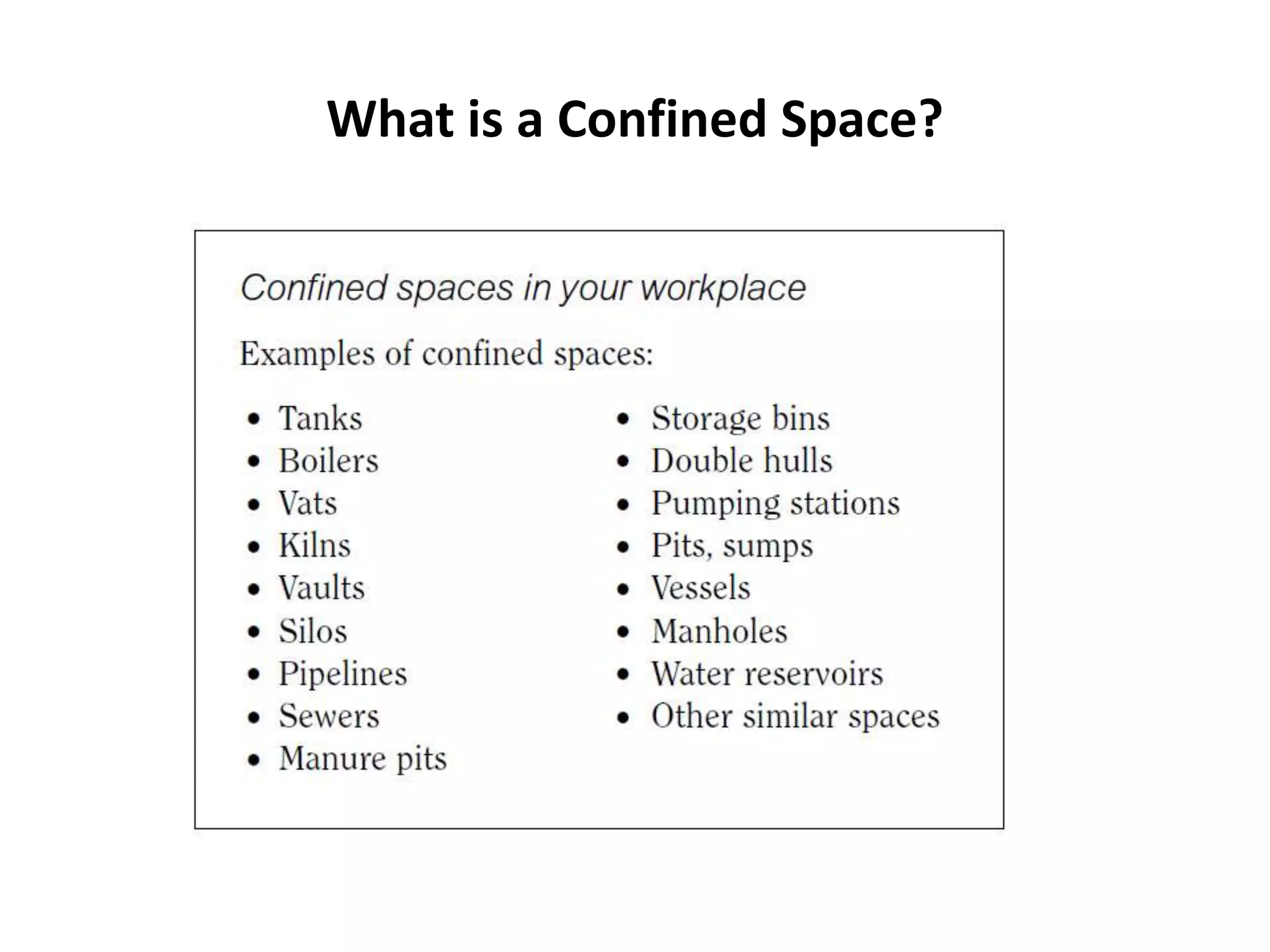
What is a Confined Space?
A confined space must fulfill two conditions:
A. A confined space means a space which;
- Is not intended as a regular workplace; or for continuous occupancy
- Has restricted means of entry or exit
- Is large enough for workers to bodily enter and perform assigned work
- Is at atmospheric pressure during occupancy
B. In addition the space must at least;
- Have the potential to contain a hazardous atmosphere
- Contain material (solid or fluid) that can engulf an entrant
- Contain any other recognized serious safety or health hazards for
example moving parts, piping carrying high pressure steam, etc.
IN SHORT:
A CONFINED SPACE IS ANY SPACE THAT WILL HAVE A CONFINED ATMOSPHERE!
What is a Confined Space?
Why Do You Have To Enter Confined Spaces?
• Because you are given a job involving work in confined spaces
such as:
- Cleaning, inspection, painting, maintenance
- Modification involving hot works, repairs, etc.
• Because you are the Authorized Gas Tester, and it is your job
to test the atmosphere and ensure it is safe for others to
enter.
• Because you are with the emergency rescue team:
- to rescue people in trouble in confined spaces.
• A person whose head is within a confined space is considered
to have entered the confined space!
Why Do We NEED Confined Space Training?
• Many people have died in confined spaces. Number of cases are
alarming.
• Training is designed to make the workers aware that accidents are
predictable and can be prevented.
• Training in Confined Space will help workers to identify and control
hazards in any confined space.
US Statistics, 1980-1989
• 585 separate fatal confined space accidents, 670 victims.
• 72 of the accidents involved multiple victims, 513 cases involved
single victims.
• Average of 67 deaths/year
Accidents are PREDICTABLE & PREVENTABLE
TWO WORKERS FOUND DEAD IN MANHOLE
(The Malay Mail, 27th October, 2003)
PREDICTABILITY
• The manhole is recognized as a confined space
• Manholes will ALWAYS HAVE HAZARDOUS ATMOSPHERES
- oxygen deficiency
- presence of toxic gases
• There has been many cases of accidents in manholes
PREVENTABILITY
• The accident could be prevented if management had a proper confined
space entry program:
- Carrying out gas detection
• Proper ventilation is assured
• Ensuring availability of standby person and a rescue team
Causes of Incidents
Worker
• Not recognizing space as a confined space
• Not educated on potential hazards in confined space
• Trusting their senses, and underestimating the danger
• Failure to use, or unavailability of respiratory equipment
• Trying to rescue other people
Management
• No confined space program
• Not equipped to manage the emergency situation
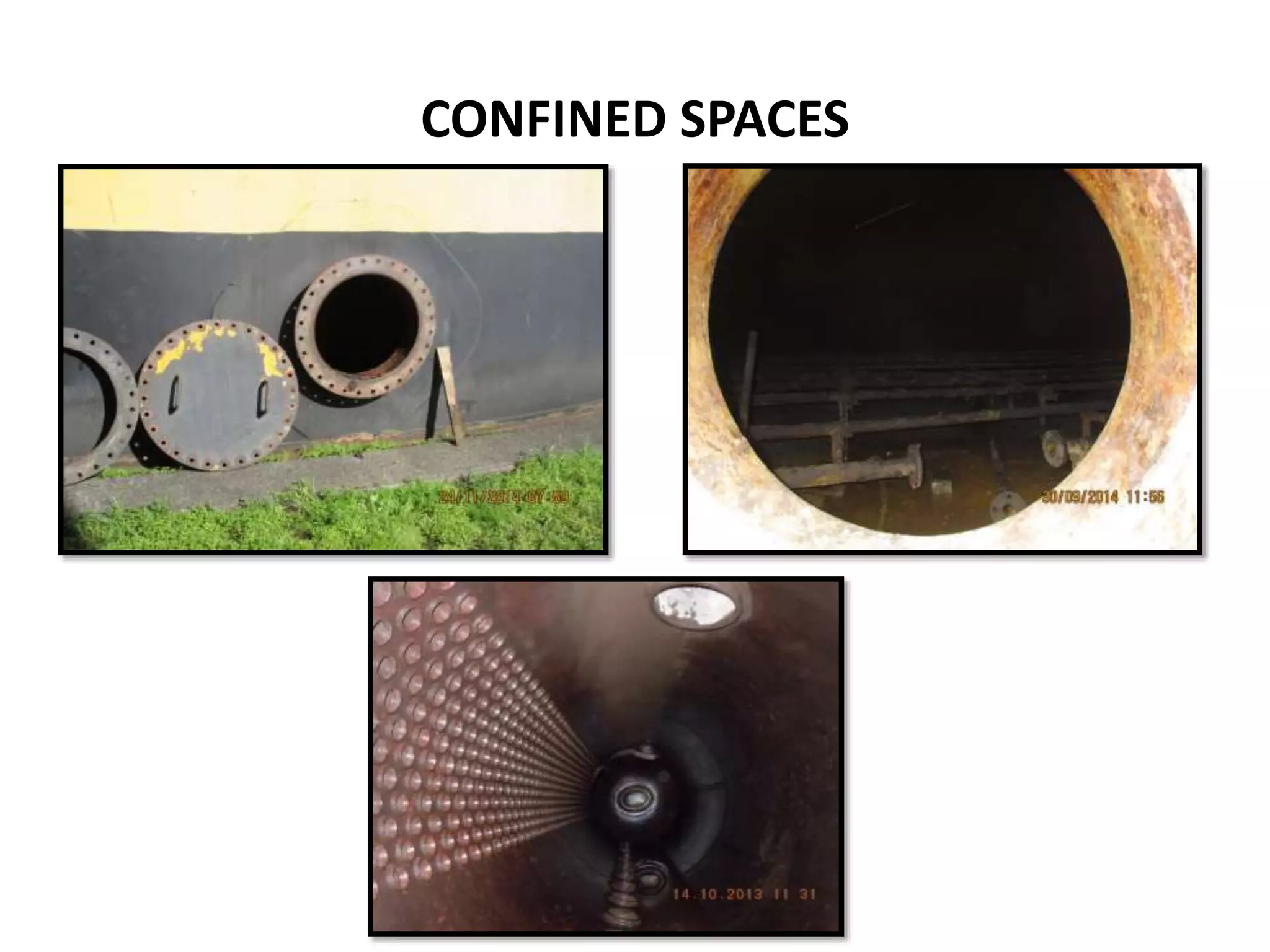
CONFINED SPACES
EVERYDAY WE ENCOUNTER CONFINED SPACES
STORAGE TANKS AND PROCESS VESSELS
CODE OF PRACTICE
General Requirements
• To develop and implement a written confined space program
• To take measures to prevent unauthorized persons from entering the
confined space
Confined Space Program
• Risk control should be based on risk assessment
• Permit To Work System
• Stand-By Person
• Identification of Duties
• Employee Training
• Equipment to be provided
• Coordination of entry operations
CODE OF PRACTICE
Permit To Work System
• To prepare permit to work based on risks identified
• Permit to be issued after ensuring that :
– All hazards have been identified and controlled
– Isolations have been carried out including LOTO
– Gas testing has been done
• The duration should be just sufficient to complete the work
• Authorized person MUST CANCEL THE WORK if a change in condition arises.
• Permit to be closed by authorized person after completion of work
CODE OF PRACTICE
Isolation Requirements
• Prevent accidental introduction of hazardous material or substances into
Confined space
• De-energize and lock out/tag out all machinery
• Isolate all external energy sources
CODE OF PRACTICE
Ensure Safety of Atmosphere
• Precautions have to be taken to establish and maintain a safe atmosphere
within the confined space, for duration of the occupancy.
• There are two types of entry :
1. Initial Cleaning/preparation for entry ; Isolation of hazards, purging,
initial cleaning and testing and evaluation of the atmosphere
2. Actual Work ; Retesting of atmosphere and issuance of permit to
work.
CODE OF PRACTICE
Training
• Employees who are involved in confined space work, serving as stand-by
persons or issue permits must undergo training of confined space safety
program.
• Initial training and retraining at appropriate intervals must be provided for
these workers
CODE OF PRACTICE
Health Requirements
• Employees should be proven to be certified physically and mentally fit
• Fits, blackout and fainting
• History of heart disease and heart disorder
• High blood pressure
• Asthma, bronchitis and shortness of breath
• Sensory problems : eyesight problems, hearing problems, defective smell
etc.
• Back pain or joint trouble that limits mobility
CODE OF PRACTICE
Employer Duties
• To inform his employees/contractor
– Entry is allowed only if requirements of COP are complied
– Hazards are identified and controlled
– Precautionary measures and procedures
• Coordinate entry operation with contractors
• Conduct debriefing and end of entry
• Ensure all persons involved in entry operation carryout their duties.
CODE OF PRACTICE
Authorized Gas Tester (AGT) Duties
• To have knowledge of hazards in confined space
• To identify and recommend control measures to ensure safe entry
• Familiar with all equipment used in confined space entry
• Test and interpret the reading from gas detector
CODE OF PRACTICE
Entry Supervisor Duties
• Have knowledge of hazards that may be faced during entry operation
• Ensure the permit to work has been filled, tests specified, procedures and
equipment specified in the permit are in place before endorsing the permit
and allowing the entry
• Terminate the entry and cancel the permit
• Ensure that unauthorized persons do not enter the confined space
• To ensure that entry operation remains consistent with terms in the permit
• Brief entry team on the emergency procedures.
CODE OF PRACTICE
Authorized Entrants Duties
• To have knowledge of hazards in the confined space
• To use equipment required to perform the tasks assigned correctly
• To communicate with stand-by person regularly
• To evacuate, if required, as quickly and safely as possible.
CODE OF PRACTICE
Stand-By Person Duties
• To have knowledge of the hazards in the confined space
• Aware of possible behavioral changes due to exposure to hazards in the
confined space
• To ensure accurate count and identification of entrants in the confined
space
• Stationed outside the confined space during entry operation
• Communicate with entrants regularly and to alert of the need to evacate.
• To monitor the activities inside and outside the confined space
• To summon rescue if required ; Do not attempt rescue
• Perform non-entry rescue if required
• Not to perform any duties that may interfere with stand-by person duties.
CODE OF PRACTICE
Rescue and Emergency Duties
• The employer has to establish a rescue and first aid procedure and provide
rescue equipment.
• Rescue procedures should consider :
– The shape and size of the confined space
– The nature of the task to be performed
– Obstacles within the confined space
– Size and position of access points
– Number of persons in the confined space
SO WHICH IS A CONFINED SPACE ENTRY CASE
AND WHICH IS NOT?
1. WELDER REPAIRING DAMAGED S/STEEL PLATE INSIDE FFB TIPPING RAMP?
2. SUPERVISORS RECORDING PROCESS EVENTS IN CONTROL ROOM?
3. CLEANING OUT OF CONDENSATE PITS DURING WEEKEND CLEANING?
4. FITTER REPLACING A DEFECTIVE GEAR BOX ON THE DIGESTER VERTICAL
DRIVE?
5. OPERATORS RETRIEVING FALLEN METAL FROM THE AUTO-FEEDER?
END OF PRESENTATION
THANK YOU FOR PARTICIPATING
Next Presentation:
Hazards in Confined Spaces

CONFINED SPACE TRAINING

  • 1.
    The Need forConfined Space Training and Requirements
  • 2.
    What is aConfined Space? A confined space must fulfill two conditions: A. A confined space means a space which; - Is not intended as a regular workplace; or for continuous occupancy - Has restricted means of entry or exit - Is large enough for workers to bodily enter and perform assigned work - Is at atmospheric pressure during occupancy B. In addition the space must at least; - Have the potential to contain a hazardous atmosphere - Contain material (solid or fluid) that can engulf an entrant - Contain any other recognized serious safety or health hazards for example moving parts, piping carrying high pressure steam, etc. IN SHORT: A CONFINED SPACE IS ANY SPACE THAT WILL HAVE A CONFINED ATMOSPHERE!
  • 3.
    What is aConfined Space?
  • 4.
    Why Do YouHave To Enter Confined Spaces? • Because you are given a job involving work in confined spaces such as: - Cleaning, inspection, painting, maintenance - Modification involving hot works, repairs, etc. • Because you are the Authorized Gas Tester, and it is your job to test the atmosphere and ensure it is safe for others to enter. • Because you are with the emergency rescue team: - to rescue people in trouble in confined spaces. • A person whose head is within a confined space is considered to have entered the confined space!
  • 5.
    Why Do WeNEED Confined Space Training? • Many people have died in confined spaces. Number of cases are alarming. • Training is designed to make the workers aware that accidents are predictable and can be prevented. • Training in Confined Space will help workers to identify and control hazards in any confined space. US Statistics, 1980-1989 • 585 separate fatal confined space accidents, 670 victims. • 72 of the accidents involved multiple victims, 513 cases involved single victims. • Average of 67 deaths/year
  • 6.
    Accidents are PREDICTABLE& PREVENTABLE TWO WORKERS FOUND DEAD IN MANHOLE (The Malay Mail, 27th October, 2003) PREDICTABILITY • The manhole is recognized as a confined space • Manholes will ALWAYS HAVE HAZARDOUS ATMOSPHERES - oxygen deficiency - presence of toxic gases • There has been many cases of accidents in manholes PREVENTABILITY • The accident could be prevented if management had a proper confined space entry program: - Carrying out gas detection • Proper ventilation is assured • Ensuring availability of standby person and a rescue team
  • 7.
    Causes of Incidents Worker •Not recognizing space as a confined space • Not educated on potential hazards in confined space • Trusting their senses, and underestimating the danger • Failure to use, or unavailability of respiratory equipment • Trying to rescue other people Management • No confined space program • Not equipped to manage the emergency situation
  • 8.
  • 9.
    EVERYDAY WE ENCOUNTERCONFINED SPACES
  • 10.
    STORAGE TANKS ANDPROCESS VESSELS
  • 11.
    CODE OF PRACTICE GeneralRequirements • To develop and implement a written confined space program • To take measures to prevent unauthorized persons from entering the confined space Confined Space Program • Risk control should be based on risk assessment • Permit To Work System • Stand-By Person • Identification of Duties • Employee Training • Equipment to be provided • Coordination of entry operations
  • 12.
    CODE OF PRACTICE PermitTo Work System • To prepare permit to work based on risks identified • Permit to be issued after ensuring that : – All hazards have been identified and controlled – Isolations have been carried out including LOTO – Gas testing has been done • The duration should be just sufficient to complete the work • Authorized person MUST CANCEL THE WORK if a change in condition arises. • Permit to be closed by authorized person after completion of work
  • 13.
    CODE OF PRACTICE IsolationRequirements • Prevent accidental introduction of hazardous material or substances into Confined space • De-energize and lock out/tag out all machinery • Isolate all external energy sources
  • 14.
    CODE OF PRACTICE EnsureSafety of Atmosphere • Precautions have to be taken to establish and maintain a safe atmosphere within the confined space, for duration of the occupancy. • There are two types of entry : 1. Initial Cleaning/preparation for entry ; Isolation of hazards, purging, initial cleaning and testing and evaluation of the atmosphere 2. Actual Work ; Retesting of atmosphere and issuance of permit to work.
  • 15.
    CODE OF PRACTICE Training •Employees who are involved in confined space work, serving as stand-by persons or issue permits must undergo training of confined space safety program. • Initial training and retraining at appropriate intervals must be provided for these workers
  • 16.
    CODE OF PRACTICE HealthRequirements • Employees should be proven to be certified physically and mentally fit • Fits, blackout and fainting • History of heart disease and heart disorder • High blood pressure • Asthma, bronchitis and shortness of breath • Sensory problems : eyesight problems, hearing problems, defective smell etc. • Back pain or joint trouble that limits mobility
  • 17.
    CODE OF PRACTICE EmployerDuties • To inform his employees/contractor – Entry is allowed only if requirements of COP are complied – Hazards are identified and controlled – Precautionary measures and procedures • Coordinate entry operation with contractors • Conduct debriefing and end of entry • Ensure all persons involved in entry operation carryout their duties.
  • 18.
    CODE OF PRACTICE AuthorizedGas Tester (AGT) Duties • To have knowledge of hazards in confined space • To identify and recommend control measures to ensure safe entry • Familiar with all equipment used in confined space entry • Test and interpret the reading from gas detector
  • 19.
    CODE OF PRACTICE EntrySupervisor Duties • Have knowledge of hazards that may be faced during entry operation • Ensure the permit to work has been filled, tests specified, procedures and equipment specified in the permit are in place before endorsing the permit and allowing the entry • Terminate the entry and cancel the permit • Ensure that unauthorized persons do not enter the confined space • To ensure that entry operation remains consistent with terms in the permit • Brief entry team on the emergency procedures.
  • 20.
    CODE OF PRACTICE AuthorizedEntrants Duties • To have knowledge of hazards in the confined space • To use equipment required to perform the tasks assigned correctly • To communicate with stand-by person regularly • To evacuate, if required, as quickly and safely as possible.
  • 21.
    CODE OF PRACTICE Stand-ByPerson Duties • To have knowledge of the hazards in the confined space • Aware of possible behavioral changes due to exposure to hazards in the confined space • To ensure accurate count and identification of entrants in the confined space • Stationed outside the confined space during entry operation • Communicate with entrants regularly and to alert of the need to evacate. • To monitor the activities inside and outside the confined space • To summon rescue if required ; Do not attempt rescue • Perform non-entry rescue if required • Not to perform any duties that may interfere with stand-by person duties.
  • 22.
    CODE OF PRACTICE Rescueand Emergency Duties • The employer has to establish a rescue and first aid procedure and provide rescue equipment. • Rescue procedures should consider : – The shape and size of the confined space – The nature of the task to be performed – Obstacles within the confined space – Size and position of access points – Number of persons in the confined space
  • 23.
    SO WHICH ISA CONFINED SPACE ENTRY CASE AND WHICH IS NOT? 1. WELDER REPAIRING DAMAGED S/STEEL PLATE INSIDE FFB TIPPING RAMP? 2. SUPERVISORS RECORDING PROCESS EVENTS IN CONTROL ROOM? 3. CLEANING OUT OF CONDENSATE PITS DURING WEEKEND CLEANING? 4. FITTER REPLACING A DEFECTIVE GEAR BOX ON THE DIGESTER VERTICAL DRIVE? 5. OPERATORS RETRIEVING FALLEN METAL FROM THE AUTO-FEEDER?
  • 24.
    END OF PRESENTATION THANKYOU FOR PARTICIPATING Next Presentation: Hazards in Confined Spaces