Eliminating Bias in Workplace
Investigations
With Amy Oppenheimer, Attorney at Law
Amy Oppenheimer
Amy Oppenheimer is an attorney with more than 30 years
of experience in the field of employment law. An expert in
investigations of workplace discrimination, harassment and
misconduct, Amy is the co-author of Investigating
Workplace Harassment, How to be Fair, Thorough and
Legal, published in 2003 by Society of Human Resource
Practice (SHRM). She is also a retired Administrative Law
Judge.
Amy is the founder and past-president of the board of the
Association of Workplace Investigators (AWI) and is on the
executive committee of the Labor and Employment
Section of the State Bar of California.
Program Outline
• Introduction to AWI
• What is a bias and what is a stereotype?
• The difference between bias and attention, the impact of attention and the
interaction between the two
• How we ask questions can demonstrate a bias and impact the answer
• Implicit Bias, the IAT’s and studies
• Different types of unconscious biases
- Confirmation bias
- Observer effects
- Priming
- Anchoring effects
- How we make decisions: Intuition or Deliberation
• How to eliminate biases
What is AWI?
AWI is a professional organization for workplace investigators –
attorneys, private investigators, human resource, loss prevention,
security, audit and other professionals – who perform, seek training in,
or are currently launching workplace investigations.
AWI’s Mission
The mission of the Association of Workplace Investigators is to
promote and support workplace investigations as a distinct area of
expertise and to enhance the quality of workplace investigations
AWI Upcoming Programs
• October 24-26, 2013
• Annual Conference, Glendale, California
• February 24-28, 2014
• Training Institute, Oxnard, California
AWI Member Benefits
• AWI Quarterly Journal
• Local Circles of Colleagues
• Listservs
• Endorsed Professional Liability Insurance Program
• Forms
• Bibliography
• Committees
• AWI Program Discounts
• Professional Networking
As investigators, we want to make fair and unbiased decisions.
Assuming good intentions, what might prevent this?
Perspective
Attention
Bias: Implicit and cognitive
Confirmation bias and justification
How we make decisions
What is a Bias?
• A preference
• Could be a “stereotype”
• Could be based in some reality
• But might not be
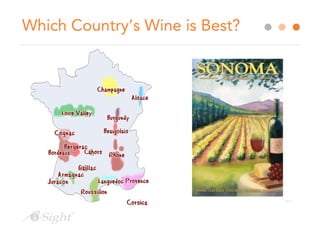
Which Country’s Wine is Best?
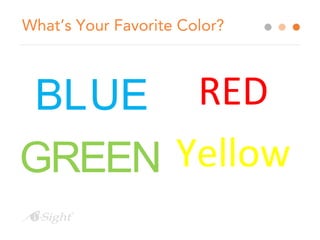
What’s Your Favorite Color?
BLUE
GREEN
RED
Yellow
These are Preferences
What is the difference
between a bias and a
preference and how do
biases come about?
The Origin of a Bias
• Stereotypes from the media
• Our own experiences
• The experiences of people around us
• Observations
• Assumptions
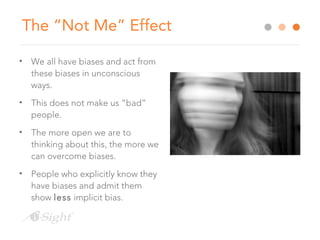
The “Not Me” Effect
• We all have biases and act from
these biases in unconscious
ways.
• This does not make us “bad”
people.
• The more open we are to
thinking about this, the more we
can overcome biases.
• People who explicitly know they
have biases and admit them
show less implicit bias.
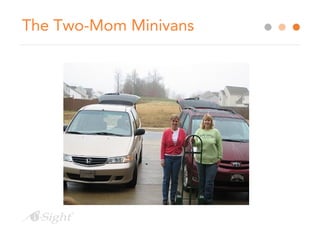
The Two-Mom Minivans
Stereotypes
• Two moms and minivans is a stereotype.
• What stereotypes do we maintain, at times without realizing it?
• The riddle of the father and son who are in a car accident where the
father is killed and the son is injured. Who’s the surgeon who can’t
operate because the son is the surgeon’s son?
• There is a difference between holding a bias and acting on that
bias.
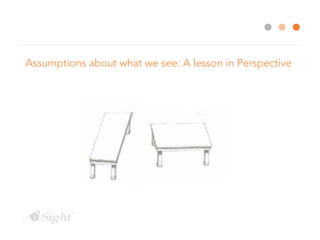
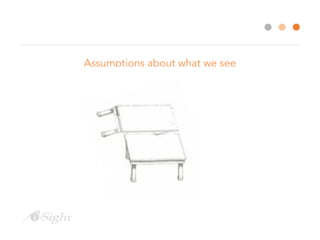
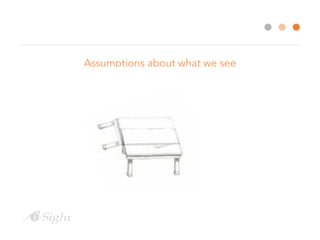
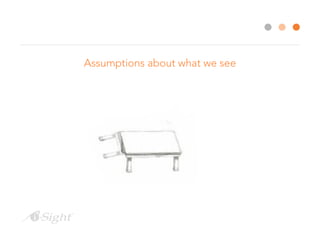
Assumptions about what we see: A lesson in Perspective
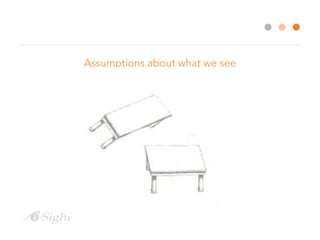
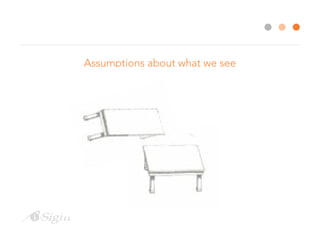
Assumptions about what we see
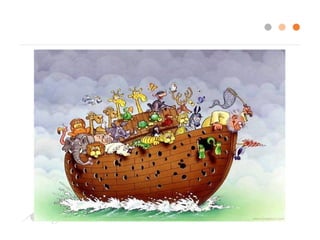
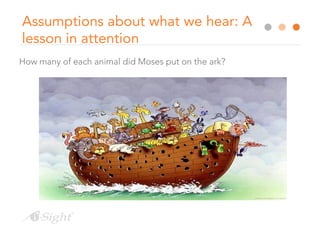
Assumptions about what we hear: A
lesson in attention
How many of each animal did Moses put on the ark?
Poll Question # 1
How many of each animal did Moses put on the ark?
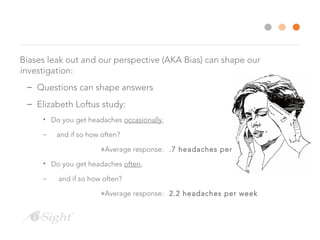
Biases leak out and our perspective (AKA Bias) can shape our
investigation:
– Questions can shape answers
– Elizabeth Loftus study:
• Do you get headaches occasionally,
– and if so how often?
»Average response: .7 headaches per week
• Do you get headaches often,
– and if so how often?
»Average response: 2.2 headaches per week
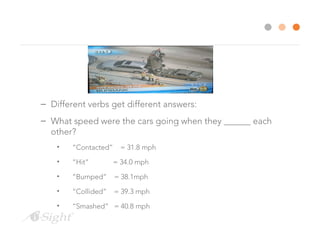
– Different verbs get different answers:
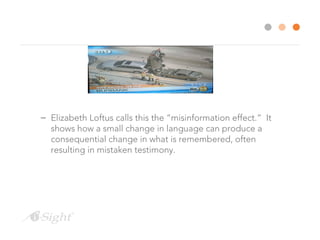
– What speed were the cars going when they ______ each
other?
• “Contacted” = 31.8 mph
• “Hit” = 34.0 mph
• “Bumped” = 38.1mph
• “Collided” = 39.3 mph
• “Smashed” = 40.8 mph
– Elizabeth Loftus calls this the “misinformation effect.” It
shows how a small change in language can produce a
consequential change in what is remembered, often
resulting in mistaken testimony.
Judging Others
• In multiple experiments researchers Mahzarin R. Banaji and Anthony
Greenwald (the creators of the IAT) have asked people to make
conclusions about people based on a picture, such as whether they
like to ski more than reading a book. “Using whatever they can eke
out from even the most trivial information, people make
assessments within a few seconds or fractions of a second.”
• Blindspot: Hidden Biases of Good People
The human mind must think with the aid of categories. . . .Once
formed, categories are the basis for normal prejudgment. We cannot
possibly avoid this process. Orderly living depends on it.
- Gordon Allport
•Stereotyping is the unfortunate by-product of the otherwise
immensely useful human ability to conceive the world in terms of
categories.
•Stereotyping achieves the desirable effect of allowing us to rapidly
perceive total strangers as distinctive individuals.
•But stereotypes are not distributed equally. People are no
stereotyped by the members of their own in-group.
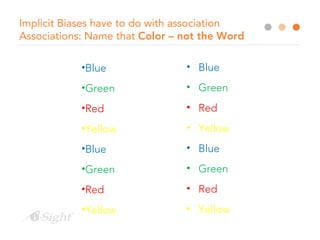
Implicit Biases have to do with association
Associations: Name that Color – not the Word
•Blue
•Green
•Red
•Yellow
•Blue
•Green
•Red
•Yellow
• Blue
• Green
• Red
• Yellow
• Blue
• Green
• Red
• Yellow
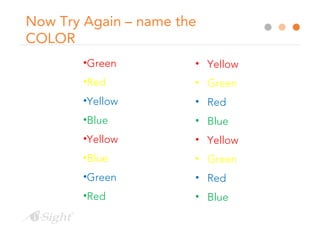
Now Try Again – name the
COLOR
•Green
•Red
•Yellow
•Blue
•Yellow
•Blue
•Green
•Red
• Yellow
• Green
• Red
• Blue
• Yellow
• Green
• Red
• Blue
Why is it harder the second time?
Different parts of your brain are in conflict with each other.
Poll Question # 2
How biased do you think you are?
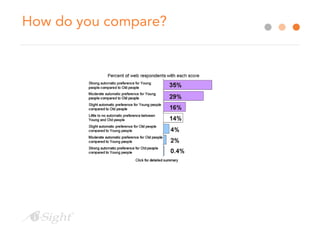
How do you compare?
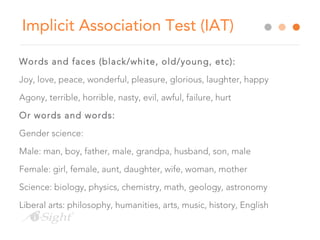
Implicit Association Test (IAT)
Words and faces (black/white, old/young, etc):
Joy, love, peace, wonderful, pleasure, glorious, laughter, happy
Agony, terrible, horrible, nasty, evil, awful, failure, hurt
Or words and words:
Gender science:
Male: man, boy, father, male, grandpa, husband, son, male
Female: girl, female, aunt, daughter, wife, woman, mother
Science: biology, physics, chemistry, math, geology, astronomy
Liberal arts: philosophy, humanities, arts, music, history, English
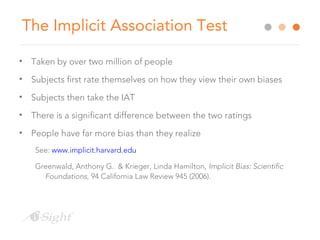
The Implicit Association Test
• Taken by over two million of people
• Subjects first rate themselves on how they view their own biases
• Subjects then take the IAT
• There is a significant difference between the two ratings
• People have far more bias than they realize
See: www.implicit.harvard.edu
Greenwald, Anthony G. & Krieger, Linda Hamilton, Implicit Bias: Scientific
Foundations, 94 California Law Review 945 (2006).
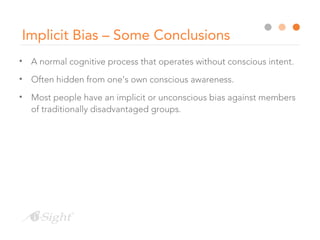
Implicit Bias – Some Conclusions
• A normal cognitive process that operates without conscious intent.
• Often hidden from one’s own conscious awareness.
• Most people have an implicit or unconscious bias against members
of traditionally disadvantaged groups.
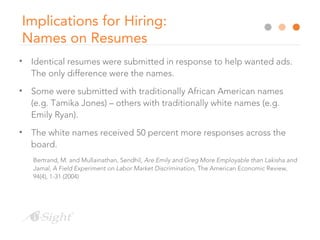
Implications for Hiring:
Names on Resumes
• Identical resumes were submitted in response to help wanted ads.
The only difference were the names.
• Some were submitted with traditionally African American names
(e.g. Tamika Jones) – others with traditionally white names (e.g.
Emily Ryan).
• The white names received 50 percent more responses across the
board.
Bertrand, M. and Mullainathan, Sendhil, Are Emily and Greg More Employable than Lakisha and
Jamal, A Field Experiment on Labor Market Discrimination, The American Economic Review,
94(4), 1-31 (2004)
Implications for Hiring:
Names on Resumes
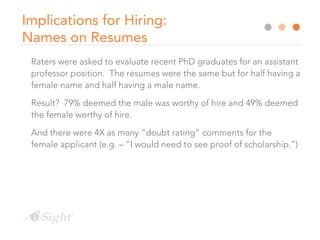
Raters were asked to evaluate recent PhD graduates for an assistant
professor position. The resumes were the same but for half having a
female name and half having a male name.
Result? 79% deemed the male was worthy of hire and 49% deemed
the female worthy of hire.
And there were 4X as many “doubt rating” comments for the
female applicant (e.g. – “I would need to see proof of scholarship.”)
Implications for Hiring:
Blind Orchestra Selection
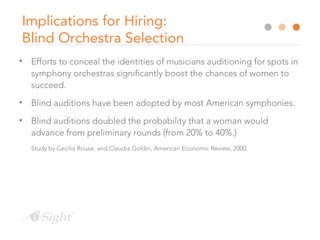
• Efforts to conceal the identities of musicians auditioning for spots in
symphony orchestras significantly boost the chances of women to
succeed.
• Blind auditions have been adopted by most American symphonies.
• Blind auditions doubled the probability that a woman would
advance from preliminary rounds (from 20% to 40%.)
Study by Cecilia Rouse, and Claudia Goldin, American Economic Review, 2000.
Impact on Compensation:
Studies on Bias – Tipping
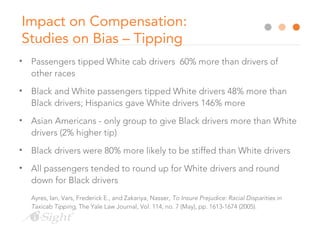
• Passengers tipped White cab drivers 60% more than drivers of
other races
• Black and White passengers tipped White drivers 48% more than
Black drivers; Hispanics gave White drivers 146% more
• Asian Americans - only group to give Black drivers more than White
drivers (2% higher tip)
• Black drivers were 80% more likely to be stiffed than White drivers
• All passengers tended to round up for White drivers and round
down for Black drivers
Ayres, Ian, Vars, Frederick E., and Zakariya, Nasser, To Insure Prejudice: Racial Disparities in
Taxicab Tipping, The Yale Law Journal, Vol. 114, no. 7 (May), pp. 1613-1674 (2005).
Implications for Hiring:
Nonverbal Behavior and Race
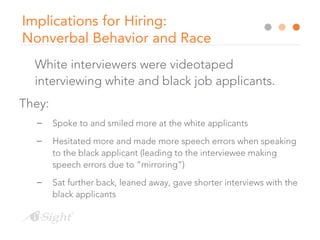
White interviewers were videotaped
interviewing white and black job applicants.
They:
– Spoke to and smiled more at the white applicants
– Hesitated more and made more speech errors when speaking
to the black applicant (leading to the interviewee making
speech errors due to “mirroring”)
– Sat further back, leaned away, gave shorter interviews with the
black applicants
Nonverbal Behavior and Race
When white interviewers were trained to act towards the white
applicants the way they had towards the black applicants, the white
applicants performed worse, were more uncomfortable and judged
the white interviewer to be less friendly.
Word, Carl O., Zanna, Mark P. and Cooper, Joel, The Nonverbal Mediation of Self-Fulfilling
Prophecies in Interracial Interaction, 10 J. Experimental Soc. Psychol. 109 (1974).
McConnell, A. R., & Leibold, J. M. (2001). Relations Between the Implicit Association Test, Explicit
Racial Attitudes, and Discriminatory Behavior, Journal of Experimental Social Psychology, 37,
435–442.
Other Ways We are Biased
• Not all biases are due to preferences and stereotypes
• Other forms of cognitive bias include:
– Confirmation Bias
– Observer Effects and Priming
– Anchoring Effects
– Deciding by Intuition vs. Deliberation
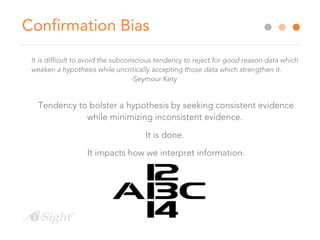
Confirmation Bias
It is difficult to avoid the subconscious tendency to reject for good reason data which
weaken a hypothesis while uncritically accepting those data which strengthen it.
-Seymour Kety
Tendency to bolster a hypothesis by seeking consistent evidence
while minimizing inconsistent evidence.
It is done.
It impacts how we interpret information.
Confirmation Bias
I will look at any additional evidence to confirm the opinion to which I have
already come.
-Lord Molson, British politician (1903 – 1991)
Justification and confirmation bias are a deadly combination. The
mind that comes to a quick decision will want to justify (confirm) that
decision. MRI studies show that the reasoning areas of the brain
shut down when people are confronted with dissonant information
and the emotion circuits light up when consonance is restored.
Further reading: Mistakes Were Made (But not by me) by Carol Tavris and Elliot Aronson.
Confirmation Bias
Fingerprint experts were less likely to find a match when facts
provided about the case made a match seem less probable.
Dror, I. E., Charlton, D., & Person, A. E., Contextual Information Renders Experts
Vulnerable to Making Erroneous Identifications, Forensic Science International (2006)
Confirmation Bias
• Participants were asked to form a hypothesis of guilt before
reviewing all the evidence in a case.
• Doing so caused them to look for reasons to find this person guilty,
even when evidence tending to exonerate the individual was
introduced
• Some participants were then asked to explain why the initial
hypothesis might be wrong.
• Others were asked to generate additional suspects.
• Those who named a suspect and considered why he might be
innocent showed less confirmation bias than those asked to name
two additional suspects .
Reducing Confirmation Bias
• Thus, those who were asked early in the case to name a suspect and
state why he might be guilty showed a greater tendency to confirm
that hypothesis. However this was counteracted by explaining why
this might be wrong.
O’Brien, Barbara, Prime Suspect: An Examination of Factors That Aggravate and
Counteract Confirmation Bias in Criminal Investigations, Psychology, Public Policy,
and Law (2009).
Memory Bias
Memory is reconstructive. People confuse events that happened to
someone else with one that happened to themselves and cannot
distinguish actual memory from subsequent information. Elizabeth
Loftus has shown “imagination inflation”, that the more you imagine
something the more likely you are to inflate it to an actual memory.
As investigators we can check our notes but how do we factor in the
witnesses imperfect memory.
Observer Effects and Priming
How a “neutral” observer is impacted by extraneous information
and/or attitudes.
The “Creativity” Study
How “nice” was the assistant?
• Those not told the negative things: 9.33
• Those who were told negative information: 6.58.
• Those told the information and then told to disregard it - it was
actually someone else they were thinking about: 8.09
Golding & Hauselt, When Instruction to Forget Become Instructions to Remember, 20
Personality & Soc. Psychol. Bull. 178 (1994).
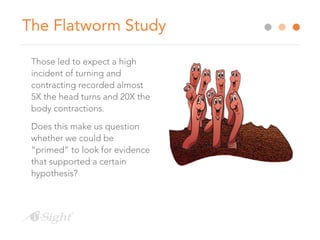
The Flatworm Study
Those led to expect a high
incident of turning and
contracting recorded almost
5X the head turns and 20X the
body contractions.
Does this make us question
whether we could be
“primed” to look for evidence
that supported a certain
hypothesis?
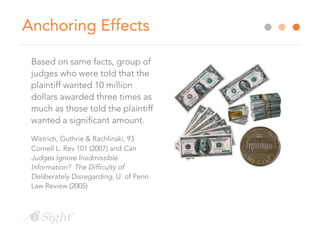
Anchoring Effects
Based on same facts, group of
judges who were told that the
plaintiff wanted 10 million
dollars awarded three times as
much as those told the plaintiff
wanted a significant amount.
Wistrich, Guthrie & Rachlinski, 93
Cornell L. Rev 101 (2007) and Can
Judges Ignore Inadmissible
Information? The Difficulty of
Deliberately Disregarding, U. of Penn
Law Review (2005)
How Do We Decide?
Deliberation or Intuition?
Answer This Question
• A bat and a ball cost $1.10 in
total. The bat costs $1.00 more
than the ball. How much does
the ball cost?
Poll Question # 3
How much does the ball cost?
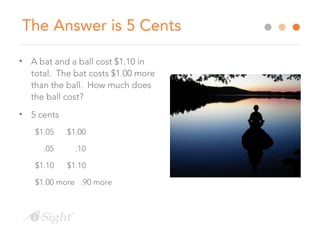
The Answer is 5 Cents
• A bat and a ball cost $1.10 in
total. The bat costs $1.00 more
than the ball. How much does
the ball cost?
• 5 cents
$1.05 $1.00
.05 .10
$1.10 $1.10
$1.00 more .90 more
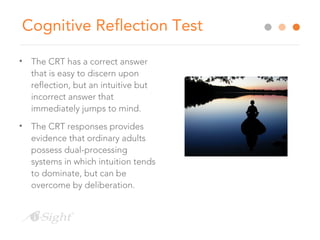
Cognitive Reflection Test
• The CRT has a correct answer
that is easy to discern upon
reflection, but an intuitive but
incorrect answer that
immediately jumps to mind.
• The CRT responses provides
evidence that ordinary adults
possess dual-processing
systems in which intuition tends
to dominate, but can be
overcome by deliberation.
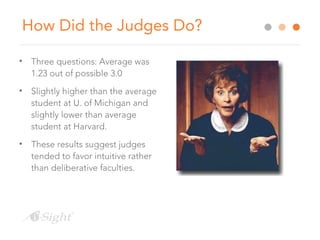
How Did the Judges Do?
• Three questions: Average was
1.23 out of possible 3.0
• Slightly higher than the average
student at U. of Michigan and
slightly lower than average
student at Harvard.
• These results suggest judges
tended to favor intuitive rather
than deliberative faculties.
The Impact for Investigations
• Inability to establish rapport prevents obtaining complete
information.
• Confirmation bias and priming may be hard at work under the
surface, leading to predetermined outcomes.
• Implicit biases may prevent digging deeper to understand facts and
motives.
The Impact on Decision Makers
• Intuition without deliberation leads to errors.
• Confirmation bias and priming impact not just “lay people”.
• Heavy workloads necessitate quick decisions that may be made
making mental shortcuts.
Reducing Bias –
Exposure to Difference
Studies show that infants prefer familiar faces and sounds and
that exposing infants to different faces and accents extends
there ability to process different faces and expands their
repertory of preferences.
Another study showed that if college age individuals do a brief
imagination exercises, asking them to take a few minutes to
imagine what a strong woman is like, why she is considered
strong and what she is capable of and enjoys doing the
male=strong stereotype is reduced.
Reducing the Impact of Bias
In-group favoritism – Carla’s story (aka the quilter vs. the Yale
University Professor).
Counteracting by helping those who look different and come from
different backgrounds.
Reducing the Impact of Bias
Determine criteria before making a decision.
In one study resumes were created for the position of police
chief. One applicant had more education and other more
experience. When there was no name on the resume raters
favored the one with more education. When names were
attached raters preferred the males – whether they had more
education or experience – and justified their decision both ways.
Reducing Bias
• Ask open-ended questions and listen to the response
• Find something that places the person in the same category as you
• Surround yourself with images that defy stereotypes
• Actively pursue relationships with different types of people
• Make connections and focus on the positive!
– Working with someone who is a member of a group you harbor
biases against reduces bias
Thank You for Participating in this Webinar!
Thank You to i-Sight for your
commitment to enhancing the quality
of workplace investigations.
Amy Oppenheimer, Attorney at Law
amy@amyopp.com
www.amyopp.com

Eliminating Bias in Investigations

  • 1.
    Eliminating Bias inWorkplace Investigations With Amy Oppenheimer, Attorney at Law
  • 2.
    Amy Oppenheimer Amy Oppenheimeris an attorney with more than 30 years of experience in the field of employment law. An expert in investigations of workplace discrimination, harassment and misconduct, Amy is the co-author of Investigating Workplace Harassment, How to be Fair, Thorough and Legal, published in 2003 by Society of Human Resource Practice (SHRM). She is also a retired Administrative Law Judge. Amy is the founder and past-president of the board of the Association of Workplace Investigators (AWI) and is on the executive committee of the Labor and Employment Section of the State Bar of California.
  • 3.
    Program Outline • Introductionto AWI • What is a bias and what is a stereotype? • The difference between bias and attention, the impact of attention and the interaction between the two • How we ask questions can demonstrate a bias and impact the answer • Implicit Bias, the IAT’s and studies • Different types of unconscious biases - Confirmation bias - Observer effects - Priming - Anchoring effects - How we make decisions: Intuition or Deliberation • How to eliminate biases
  • 4.
    What is AWI? AWIis a professional organization for workplace investigators – attorneys, private investigators, human resource, loss prevention, security, audit and other professionals – who perform, seek training in, or are currently launching workplace investigations.
  • 5.
    AWI’s Mission The missionof the Association of Workplace Investigators is to promote and support workplace investigations as a distinct area of expertise and to enhance the quality of workplace investigations
  • 6.
    AWI Upcoming Programs •October 24-26, 2013 • Annual Conference, Glendale, California • February 24-28, 2014 • Training Institute, Oxnard, California
  • 7.
    AWI Member Benefits •AWI Quarterly Journal • Local Circles of Colleagues • Listservs • Endorsed Professional Liability Insurance Program • Forms • Bibliography • Committees • AWI Program Discounts • Professional Networking
  • 8.
    As investigators, wewant to make fair and unbiased decisions. Assuming good intentions, what might prevent this? Perspective Attention Bias: Implicit and cognitive Confirmation bias and justification How we make decisions
  • 9.
    What is aBias? • A preference • Could be a “stereotype” • Could be based in some reality • But might not be
  • 10.
  • 11.
    What’s Your FavoriteColor? BLUE GREEN RED Yellow
  • 12.
    These are Preferences Whatis the difference between a bias and a preference and how do biases come about?
  • 13.
    The Origin ofa Bias • Stereotypes from the media • Our own experiences • The experiences of people around us • Observations • Assumptions
  • 14.
    The “Not Me”Effect • We all have biases and act from these biases in unconscious ways. • This does not make us “bad” people. • The more open we are to thinking about this, the more we can overcome biases. • People who explicitly know they have biases and admit them show less implicit bias.
  • 15.
  • 16.
    Stereotypes • Two momsand minivans is a stereotype. • What stereotypes do we maintain, at times without realizing it? • The riddle of the father and son who are in a car accident where the father is killed and the son is injured. Who’s the surgeon who can’t operate because the son is the surgeon’s son? • There is a difference between holding a bias and acting on that bias.
  • 17.
    Assumptions about whatwe see: A lesson in Perspective
  • 18.
  • 19.
  • 20.
  • 21.
  • 22.
  • 24.
    Assumptions about whatwe hear: A lesson in attention How many of each animal did Moses put on the ark?
  • 25.
    Poll Question #1 How many of each animal did Moses put on the ark?
  • 26.
    Biases leak outand our perspective (AKA Bias) can shape our investigation: – Questions can shape answers – Elizabeth Loftus study: • Do you get headaches occasionally, – and if so how often? »Average response: .7 headaches per week • Do you get headaches often, – and if so how often? »Average response: 2.2 headaches per week
  • 27.
    – Different verbsget different answers: – What speed were the cars going when they ______ each other? • “Contacted” = 31.8 mph • “Hit” = 34.0 mph • “Bumped” = 38.1mph • “Collided” = 39.3 mph • “Smashed” = 40.8 mph
  • 28.
    – Elizabeth Loftuscalls this the “misinformation effect.” It shows how a small change in language can produce a consequential change in what is remembered, often resulting in mistaken testimony.
  • 29.
    Judging Others • Inmultiple experiments researchers Mahzarin R. Banaji and Anthony Greenwald (the creators of the IAT) have asked people to make conclusions about people based on a picture, such as whether they like to ski more than reading a book. “Using whatever they can eke out from even the most trivial information, people make assessments within a few seconds or fractions of a second.” • Blindspot: Hidden Biases of Good People
  • 30.
    The human mindmust think with the aid of categories. . . .Once formed, categories are the basis for normal prejudgment. We cannot possibly avoid this process. Orderly living depends on it. - Gordon Allport •Stereotyping is the unfortunate by-product of the otherwise immensely useful human ability to conceive the world in terms of categories. •Stereotyping achieves the desirable effect of allowing us to rapidly perceive total strangers as distinctive individuals. •But stereotypes are not distributed equally. People are no stereotyped by the members of their own in-group.
  • 31.
    Implicit Biases haveto do with association Associations: Name that Color – not the Word •Blue •Green •Red •Yellow •Blue •Green •Red •Yellow • Blue • Green • Red • Yellow • Blue • Green • Red • Yellow
  • 32.
    Now Try Again– name the COLOR •Green •Red •Yellow •Blue •Yellow •Blue •Green •Red • Yellow • Green • Red • Blue • Yellow • Green • Red • Blue
  • 33.
    Why is itharder the second time? Different parts of your brain are in conflict with each other.
  • 34.
    Poll Question #2 How biased do you think you are?
  • 35.
    How do youcompare?
  • 36.
    Implicit Association Test(IAT) Words and faces (black/white, old/young, etc): Joy, love, peace, wonderful, pleasure, glorious, laughter, happy Agony, terrible, horrible, nasty, evil, awful, failure, hurt Or words and words: Gender science: Male: man, boy, father, male, grandpa, husband, son, male Female: girl, female, aunt, daughter, wife, woman, mother Science: biology, physics, chemistry, math, geology, astronomy Liberal arts: philosophy, humanities, arts, music, history, English
  • 37.
    The Implicit AssociationTest • Taken by over two million of people • Subjects first rate themselves on how they view their own biases • Subjects then take the IAT • There is a significant difference between the two ratings • People have far more bias than they realize See: www.implicit.harvard.edu Greenwald, Anthony G. & Krieger, Linda Hamilton, Implicit Bias: Scientific Foundations, 94 California Law Review 945 (2006).
  • 38.
    Implicit Bias –Some Conclusions • A normal cognitive process that operates without conscious intent. • Often hidden from one’s own conscious awareness. • Most people have an implicit or unconscious bias against members of traditionally disadvantaged groups.
  • 39.
    Implications for Hiring: Nameson Resumes • Identical resumes were submitted in response to help wanted ads. The only difference were the names. • Some were submitted with traditionally African American names (e.g. Tamika Jones) – others with traditionally white names (e.g. Emily Ryan). • The white names received 50 percent more responses across the board. Bertrand, M. and Mullainathan, Sendhil, Are Emily and Greg More Employable than Lakisha and Jamal, A Field Experiment on Labor Market Discrimination, The American Economic Review, 94(4), 1-31 (2004)
  • 40.
    Implications for Hiring: Nameson Resumes Raters were asked to evaluate recent PhD graduates for an assistant professor position. The resumes were the same but for half having a female name and half having a male name. Result? 79% deemed the male was worthy of hire and 49% deemed the female worthy of hire. And there were 4X as many “doubt rating” comments for the female applicant (e.g. – “I would need to see proof of scholarship.”)
  • 41.
    Implications for Hiring: BlindOrchestra Selection • Efforts to conceal the identities of musicians auditioning for spots in symphony orchestras significantly boost the chances of women to succeed. • Blind auditions have been adopted by most American symphonies. • Blind auditions doubled the probability that a woman would advance from preliminary rounds (from 20% to 40%.) Study by Cecilia Rouse, and Claudia Goldin, American Economic Review, 2000.
  • 42.
    Impact on Compensation: Studieson Bias – Tipping • Passengers tipped White cab drivers 60% more than drivers of other races • Black and White passengers tipped White drivers 48% more than Black drivers; Hispanics gave White drivers 146% more • Asian Americans - only group to give Black drivers more than White drivers (2% higher tip) • Black drivers were 80% more likely to be stiffed than White drivers • All passengers tended to round up for White drivers and round down for Black drivers Ayres, Ian, Vars, Frederick E., and Zakariya, Nasser, To Insure Prejudice: Racial Disparities in Taxicab Tipping, The Yale Law Journal, Vol. 114, no. 7 (May), pp. 1613-1674 (2005).
  • 43.
    Implications for Hiring: NonverbalBehavior and Race White interviewers were videotaped interviewing white and black job applicants. They: – Spoke to and smiled more at the white applicants – Hesitated more and made more speech errors when speaking to the black applicant (leading to the interviewee making speech errors due to “mirroring”) – Sat further back, leaned away, gave shorter interviews with the black applicants
  • 44.
    Nonverbal Behavior andRace When white interviewers were trained to act towards the white applicants the way they had towards the black applicants, the white applicants performed worse, were more uncomfortable and judged the white interviewer to be less friendly. Word, Carl O., Zanna, Mark P. and Cooper, Joel, The Nonverbal Mediation of Self-Fulfilling Prophecies in Interracial Interaction, 10 J. Experimental Soc. Psychol. 109 (1974). McConnell, A. R., & Leibold, J. M. (2001). Relations Between the Implicit Association Test, Explicit Racial Attitudes, and Discriminatory Behavior, Journal of Experimental Social Psychology, 37, 435–442.
  • 45.
    Other Ways Weare Biased • Not all biases are due to preferences and stereotypes • Other forms of cognitive bias include: – Confirmation Bias – Observer Effects and Priming – Anchoring Effects – Deciding by Intuition vs. Deliberation
  • 46.
    Confirmation Bias It isdifficult to avoid the subconscious tendency to reject for good reason data which weaken a hypothesis while uncritically accepting those data which strengthen it. -Seymour Kety Tendency to bolster a hypothesis by seeking consistent evidence while minimizing inconsistent evidence. It is done. It impacts how we interpret information.
  • 47.
    Confirmation Bias I willlook at any additional evidence to confirm the opinion to which I have already come. -Lord Molson, British politician (1903 – 1991) Justification and confirmation bias are a deadly combination. The mind that comes to a quick decision will want to justify (confirm) that decision. MRI studies show that the reasoning areas of the brain shut down when people are confronted with dissonant information and the emotion circuits light up when consonance is restored. Further reading: Mistakes Were Made (But not by me) by Carol Tavris and Elliot Aronson.
  • 48.
    Confirmation Bias Fingerprint expertswere less likely to find a match when facts provided about the case made a match seem less probable. Dror, I. E., Charlton, D., & Person, A. E., Contextual Information Renders Experts Vulnerable to Making Erroneous Identifications, Forensic Science International (2006)
  • 49.
    Confirmation Bias • Participantswere asked to form a hypothesis of guilt before reviewing all the evidence in a case. • Doing so caused them to look for reasons to find this person guilty, even when evidence tending to exonerate the individual was introduced • Some participants were then asked to explain why the initial hypothesis might be wrong. • Others were asked to generate additional suspects. • Those who named a suspect and considered why he might be innocent showed less confirmation bias than those asked to name two additional suspects .
  • 50.
    Reducing Confirmation Bias •Thus, those who were asked early in the case to name a suspect and state why he might be guilty showed a greater tendency to confirm that hypothesis. However this was counteracted by explaining why this might be wrong. O’Brien, Barbara, Prime Suspect: An Examination of Factors That Aggravate and Counteract Confirmation Bias in Criminal Investigations, Psychology, Public Policy, and Law (2009).
  • 51.
    Memory Bias Memory isreconstructive. People confuse events that happened to someone else with one that happened to themselves and cannot distinguish actual memory from subsequent information. Elizabeth Loftus has shown “imagination inflation”, that the more you imagine something the more likely you are to inflate it to an actual memory. As investigators we can check our notes but how do we factor in the witnesses imperfect memory.
  • 52.
    Observer Effects andPriming How a “neutral” observer is impacted by extraneous information and/or attitudes.
  • 53.
    The “Creativity” Study How“nice” was the assistant? • Those not told the negative things: 9.33 • Those who were told negative information: 6.58. • Those told the information and then told to disregard it - it was actually someone else they were thinking about: 8.09 Golding & Hauselt, When Instruction to Forget Become Instructions to Remember, 20 Personality & Soc. Psychol. Bull. 178 (1994).
  • 54.
    The Flatworm Study Thoseled to expect a high incident of turning and contracting recorded almost 5X the head turns and 20X the body contractions. Does this make us question whether we could be “primed” to look for evidence that supported a certain hypothesis?
  • 55.
    Anchoring Effects Based onsame facts, group of judges who were told that the plaintiff wanted 10 million dollars awarded three times as much as those told the plaintiff wanted a significant amount. Wistrich, Guthrie & Rachlinski, 93 Cornell L. Rev 101 (2007) and Can Judges Ignore Inadmissible Information? The Difficulty of Deliberately Disregarding, U. of Penn Law Review (2005)
  • 56.
    How Do WeDecide? Deliberation or Intuition?
  • 57.
    Answer This Question •A bat and a ball cost $1.10 in total. The bat costs $1.00 more than the ball. How much does the ball cost?
  • 58.
    Poll Question #3 How much does the ball cost?
  • 59.
    The Answer is5 Cents • A bat and a ball cost $1.10 in total. The bat costs $1.00 more than the ball. How much does the ball cost? • 5 cents $1.05 $1.00 .05 .10 $1.10 $1.10 $1.00 more .90 more
  • 60.
    Cognitive Reflection Test •The CRT has a correct answer that is easy to discern upon reflection, but an intuitive but incorrect answer that immediately jumps to mind. • The CRT responses provides evidence that ordinary adults possess dual-processing systems in which intuition tends to dominate, but can be overcome by deliberation.
  • 61.
    How Did theJudges Do? • Three questions: Average was 1.23 out of possible 3.0 • Slightly higher than the average student at U. of Michigan and slightly lower than average student at Harvard. • These results suggest judges tended to favor intuitive rather than deliberative faculties.
  • 62.
    The Impact forInvestigations • Inability to establish rapport prevents obtaining complete information. • Confirmation bias and priming may be hard at work under the surface, leading to predetermined outcomes. • Implicit biases may prevent digging deeper to understand facts and motives.
  • 63.
    The Impact onDecision Makers • Intuition without deliberation leads to errors. • Confirmation bias and priming impact not just “lay people”. • Heavy workloads necessitate quick decisions that may be made making mental shortcuts.
  • 64.
    Reducing Bias – Exposureto Difference Studies show that infants prefer familiar faces and sounds and that exposing infants to different faces and accents extends there ability to process different faces and expands their repertory of preferences. Another study showed that if college age individuals do a brief imagination exercises, asking them to take a few minutes to imagine what a strong woman is like, why she is considered strong and what she is capable of and enjoys doing the male=strong stereotype is reduced.
  • 65.
    Reducing the Impactof Bias In-group favoritism – Carla’s story (aka the quilter vs. the Yale University Professor). Counteracting by helping those who look different and come from different backgrounds.
  • 66.
    Reducing the Impactof Bias Determine criteria before making a decision. In one study resumes were created for the position of police chief. One applicant had more education and other more experience. When there was no name on the resume raters favored the one with more education. When names were attached raters preferred the males – whether they had more education or experience – and justified their decision both ways.
  • 67.
    Reducing Bias • Askopen-ended questions and listen to the response • Find something that places the person in the same category as you • Surround yourself with images that defy stereotypes • Actively pursue relationships with different types of people • Make connections and focus on the positive! – Working with someone who is a member of a group you harbor biases against reduces bias
  • 68.
    Thank You forParticipating in this Webinar! Thank You to i-Sight for your commitment to enhancing the quality of workplace investigations. Amy Oppenheimer, Attorney at Law amy@amyopp.com www.amyopp.com