This paper presents a hybrid segmentation approach for handwritten numeral strings in form documents, utilizing foreground, background, and recognition analyses to achieve high accuracy. The algorithm effectively extracts features, constructs segmentation paths, and employs a two-stage classifier, achieving a correct segmentation rate of 96.2% on a dataset of 14,875 numeral strings. Future improvements include addressing multi-touching strings and potentially utilizing SVM classifiers for enhanced performance.
![International Journal of Engineering Science Invention
ISSN (Online): 2319 – 6734, ISSN (Print): 2319 – 6726
www.ijesi.org ||Volume 5 Issue 2|| February 2016 || PP.15-23
www.ijesi.org 15 | Page
Study on a Hybrid Segmentation Approach for Handwritten Numeral
Strings in Form Document
Tianxiang Zheng
(Shenzhen Tourism College/Jinan University, China)
ABSTRACT : This paper presents a hybrid approach to segment single- or multiple-touching handwritten
numeral strings in form document, the core of which is the combined use of foreground, background and
recognition analysis. The algorithm first located some feature points on both the foreground and background
skeleton images containing connected numeral strings in form document. Possible segmentation paths were then
constructed by matching these feature points, with an unexpected benefit of removing useless strokes.
Subsequently, all these segmentation paths were validated and ranked by a recognition-based analysis, where a
well-trained two-stage classifier was applied to each separated digit image to obtain its reliability. Finally, by
introducing a locally optimal strategy to accelerate the recognition process, the top ranked segmentation path
survived to help make a decision on whether to accept or not. Experimental results show that the proposed
method can achieve a correct segmentation rate of 96.2 percent on a large dataset collected by our own.
KEYWORDS
- character recognition, character segmentation, form document, handwritten numeral strings,
single- or multiple-touching
I. INTRODUCTION
Optical Character Recognition (OCR) has received considerable attention in recent decades and form
document recognition has become an important field of OCR research and application. There are two crucial
problems in the development of form document: integrated character extraction and segmentation of touching
characters. The main focus of this work is dedicated to the segmentation of grades on handwritten numeral
strings(two-digits) in form document.
Segmentation of handwritten numerals is a key step for automatic recognition system since the
segmentation results have great effect on the recognition rate. So far, a large number of methods for
segmentation of handwritten numerals have been proposed in the literature. Casey[1], Lu[2], Ribas[3] and
Saba[4] presented respectively a survey or an overview on various techniques for segmenting handwritten
characters. It is well recognized that the difficulties of segmentation stem not only from variations existing in
shape, but also from various ways of touching. There are two major categories of types of touching numeral
strings: single-touching and multiple-touching, which can be further grouped into five subtypes[5].
To segment the touching numeral strings, the literature shows that there are commonly three families:
the foreground-based method(FBM), the background-based method(BBM) and the recognition-based
method(RBM). The FBM focuses on foreground pixels, and features like contour tracing[6, 7], highest
curvature[6], corner points[8], stroke analysis[9-11], abstractive primitives[12], etc., are examples of this](https://image.slidesharecdn.com/c052015023-160912041816/75/Study-on-a-Hybrid-Segmentation-Approach-for-Handwritten-Numeral-Strings-in-Form-Document-1-2048.jpg)
![Study on a Hybrid Segmentation Approach…
www.ijesi.org 16 | Page
category. On the contrary, the BBM works on background pixels and utilizes the feature points on the
background regions (such as face-up valley, face-down valley, loop region)[13, 14] or those on the background
skeletons(such as upper segment, lower segment, hole segment)[15]. The RBM, however, involves a recognizer
to help separate the connected strings[16-19].
All the three methods are very useful in different situations under the property of the actual data. But
there are some formidable limitations when they are put into practical applications. For example, most of the
connected numeral strings of Type 1 and Type 2 in Chen’s work can be successfully segmented by the FBM or
BBM, but they tend to become less powerful to get precise identification in separating those of Type 2-5[5]. The
RBMs, with the correct rate of segmentation depending too much on the robustness of recognizer and at the cost
of more computation time, usually fail to separate those of Type 2, 4 or 5. Some other RBM suggests the whole
entity of numeral string to be recognized without segmentation[20]. Although it offers an opportunity to
minimize the risk of making errors caused by incorrect segmentation, the approach needs a rather complex
classifier to solve all kinds of touching styles, which appears to be impractical.
Apparently, the combined use of existing approaches, if possible, will enhance the segmentation results.
This idea has been developed and investigated since last decade, in which the foreground and background
analysis were utilized[6, 21, 22]. But either a lack of rigor by the absence of ligatures or the unstable rule on the
selected features is a major limitation when put into practical use. In form documents, due to the large
variability of handwriting, different writing styles of characters and all kinds of ligatures, a more robust rule-
based technique is needed. A recognizer might be helpful in such a complicated situation, because in many cases,
the segmentation and the recognition could not be considered independently when touching between
characters/digits is present[23]. Previous studies also attempted to mingle segmentation with recognition, but
some of them required large number of segmentation cuts[24] or aimed at multi-oriented touching[25], others
may fail to achieve a high accuracy[26]. In this paper, we propose a hybrid segmentation algorithm to segment
touching numeral strings in form document, which combines the foreground, background and recognition
analysis to get the best segmentation path. In the rest of the paper, a brief introduction of the extraction of
characters in form document is presented, followed by the methodology underlying the new segmentation
approach. Experimental results and conclusion are included in the end.
II. METHODOLOGY
The flowchart of the algorithm is shown in Fig. 1 and more details can be found in Fig. 2.
Figure 1 Flowchart of the proposed approach](https://image.slidesharecdn.com/c052015023-160912041816/75/Study-on-a-Hybrid-Segmentation-Approach-for-Handwritten-Numeral-Strings-in-Form-Document-2-2048.jpg)
![Study on a Hybrid Segmentation Approach…
www.ijesi.org 17 | Page
Figure 2 Outspread of the last module “choosing the best segmentation path using a classifier” in Fig. 1
2.1 Integrated extraction of characters
The prerequisite for character segmentation is the extraction of characters from form document where,
in reality, the input characters(numeral strings) are intermixed with structured line patterns. In order to extract
the characters, elimination of the structured line patterns is crucial. With the method documented in previous
study[27], we manage to remove these line patterns and mend successfully the broken strokes. Fig. 3 gives some
resultant examples, from which one can see that the characters are accurately extracted and the broken strokes
are perfectly repaired.
Figure 3 Results of character extraction from form document. For each column, the top image is the original cell
unit filled with the character, the middle image is the character extracted by simply removing the structured line,
and the bottom image is the character extracted by the method documented in previous study[27]
2.2 Strings segmentation
Based on our observation, large majority of touching in the simulation belong to single-touching, most
of which are ligatures. Maybe this is because the cell unit in form document is wide enough to input a numeral.
As a result, multi-touching seldom occurs. In other words, Type 1-4 in Chen’s study[5] cover most cases of
touching. For the time being, we omit multi-touching numeral strings from our simplified study to alleviate the
computation burden.
2.2.1 Extraction of feature points from foreground and background skeleton
An input form image is thinned to obtain its thin-line representation. The purpose of thinning is to
reduce the width of the form image to just one single pixel to facilitate the extraction of feature points from the
digitized pattern. To find all of the feature points on the foreground and background of the image, a thinning
algorithm[28] is first applied to foreground and background regions. Then the fork points, end points and corner
points[5] are calculated and marked from the skeleton of the foreground and background regions. To illustrate
the process, we give here some examples of foreground and background thinning results, as shown in Fig. 4.](https://image.slidesharecdn.com/c052015023-160912041816/75/Study-on-a-Hybrid-Segmentation-Approach-for-Handwritten-Numeral-Strings-in-Form-Document-3-2048.jpg)
![Study on a Hybrid Segmentation Approach…
www.ijesi.org 18 | Page
2.2.2 Construction of possible segmentation paths with the removal of useless strokes
According to the assumption, the touching style of the numeral strings is limited to single-touching
during the construction. The details of constructing single-touching segmentation paths can be found in Chen’s
work[5], and the troublesome ligatures are removed in this stage, an unexpected bonus. All of the possible
segmentations are recorded for further analysis.
2.2.3 Decision of the best segmentation path using a recognizer
(1) System architecture
We utilize a classifier to recognize the single digit images separated by each segmentation path to
decide whether it is the best. The neural network classifier we opt for here is a Multi-Layer Perceptron (MLP)
trained by the traditional Back-Propagation(BP) algorithm with the scaled conjugate gradient applied to a sum-
of-squares performance function. The transfer function employed is the familiar sigmoid function.
Note that a single Neural Network(NN) often exhibits the overfitting behavior which results in a poor
generalization performance when trained on a limited set of training data[29]. Considering this, we use two NNs
for the classification instead. The first NN is designed to perform fast classification and provide a low
misclassification rate using a strong rejection criterion. Rejected patterns are forwarded to the second NN that
uses additional, more complex features, with a well-balanced rejection criterion.
The first set of features contains 103 easy-to-extract features that are inputs for the first NN
classifier(103-40-10). From the patterns that are rejected from this network, additional 64 more robust features
are extracted. All 167 features are used in the second classification stage where difficult-to-classify patterns are
forwarded to the second NN (167-40-10).
(2) Feature extraction on single digit
Previous study pointed out that features that offer better discriminative power are usually more
complicated and harder to extract regarding processing time that can not be neglected when building a fast
recognition system[29]. For this reason, we use a two-stage classification strategy instead to make a compromise
between accuracy and complexity.
The first 103 features used in the first classification stage are simply horizontal, vertical and diagonal
projections. Since the character images are of different size, the projection vectors are linearly rescaled to get 20
features from the horizontal projections, 15 from the vertical, and 34 from each of the two diagonal projections.
Figure 4 Some examples of thinning results on foreground and background regions. For each
column, the first one is the original image, and the second one is the result after thinning](https://image.slidesharecdn.com/c052015023-160912041816/75/Study-on-a-Hybrid-Segmentation-Approach-for-Handwritten-Numeral-Strings-in-Form-Document-4-2048.jpg)
![Study on a Hybrid Segmentation Approach…
www.ijesi.org 19 | Page
The second 64 features we choose are invariant contour curvature[30] due to its capability of
discriminating similar handwritten numerals(such as ’4’ and ’9’).
(3) Classification based on a locally optimal strategy
Classification is performed in two stages where the first stage classifier sends rejected patterns to the
second one.
In the first stage, our goal is to perform fast classification of easy-to-classify patterns and keep low
misclassification rate. The input feature set is the global characteristic containing features extracted from pattern
projections described above. The rejection criterion is based on the “top 2” NN outputs. Each sample for which
the highest NN output 1O was smaller than a certain threshold 1T ( 11 TO < ) or for which the difference
between the “top 2” classifier outputs was smaller than a certain threshold 2T ( 221 TOO <− ) are rejected. The
rejection criterion is set to 1T = 0.95 and 2T = 0.6 to obtain low misclassification rate. In the second stage, the
NN uses 64 additional features(contour curvature) extracted from the digit image. Varying the thresholds we
have found suitable values 1T = 0.95 and 2T = 0.6, a relatively high level since misclassification carries a
higher risk than rejection.
To accelerate the classification, we introduce a locally optimal strategy. The classification terminates
until one of the candidates(segmentation path) satisfies the locally dominate criterion: the reliability of the
image with connected digits, which is defined as the minimal outputs of the two single digit images, is no less
than 0.98 within a certain scope of testing. By introducing a container B(of size N) similar to that in Support
Vector Machine(SVM) as working set[31], the strategy works by the following rule, as depicted in Table 1.
Table 1 Algorithm of Locally Optimal Strategy
Algorithm 1 Locally Optimal Strategy
While the locally dominate criterion is violated do
Select N segmentation paths for the container B
Find the maximal reliability of the image with connected digits from B
end while
III. EXPERIMENTAL RESULTS
After training the classifier, 14875 numeral strings (two digits) are used to test the performance of the
reported algorithm. In an inside test of 14875 images, 207 are rejected (rejected rate = 1.4 percent) and 14668
are accepted. Among the 14668 accepted images, 14109 test images are successfully segmented (correct rate =
96.2 percent) and 559 fail (error rate = 3.8 percent).
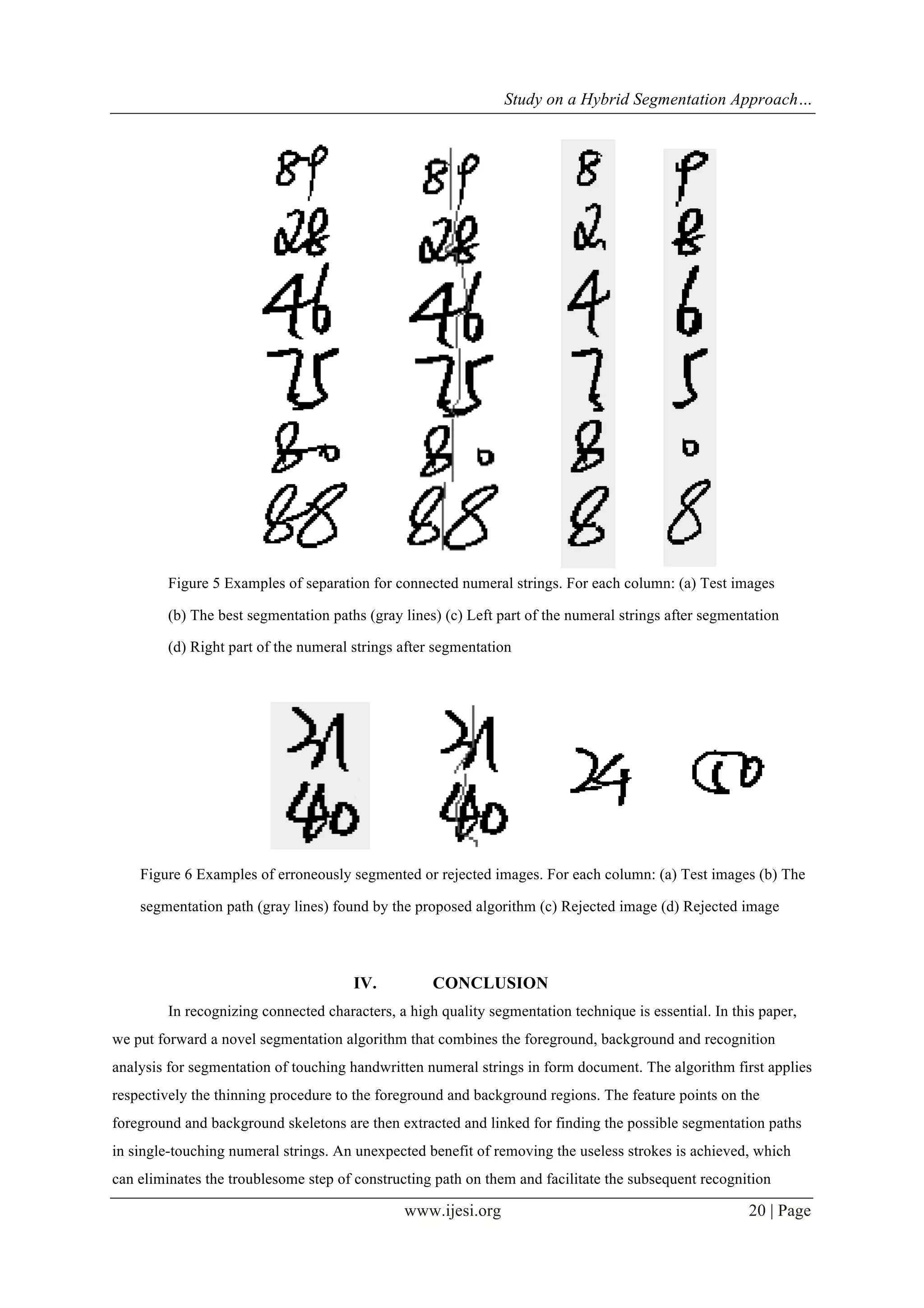
Fig. 5 shows some numeral strings that are correctly segmented, from which one can see that our
algorithm can successfully segment the strings in many difficult cases, especially those with ligatures. In Fig. 6,
we illustrate two examples that are erroneously segmented, together with two rejected patterns. The ligatures
caused by scratchy handwriting are the major reason for the error segmentation, while the rejection is induced
by the large overlapping part of the two connected digits and the insufficient amount of training samples.](https://image.slidesharecdn.com/c052015023-160912041816/75/Study-on-a-Hybrid-Segmentation-Approach-for-Handwritten-Numeral-Strings-in-Form-Document-5-2048.jpg)
![Study on a Hybrid Segmentation Approach…
www.ijesi.org 21 | Page
process. Finally, a recognizer with a two-stage classification is employed to rank all possible segmentation paths
and decide the best one, with a fast strategy developed by our own.
The proposed algorithm is validated on 14875 images of connected numeral strings. Experimental
results demonstrate that the hybrid system reaches a correct segmentation rate of 96.2 percent. This efficiency is
beneficial from a locally optimal strategy as well as carefully optimized classifiers and elaborate choice of
features, a clear win between accuracy and computational overhead.
The major limitation that arises in connection with this novel approach is that we haven’t taken into
account the multi-touching strings in the process of segmentation. Though it rarely happens, it should be noted
that an accidental touching caused by scratchy handwriting or preprocessing (such as binaryzation and broken-
stroke mending) might lead to multi-touching. Segmentation on multi-touching strings is necessary when a
higher correct rate is imposed. Another way to improve the overall performance of segmentation is to use a
SVM classifier[32] instead of Neural Network or to introduce verification strategy[24] in the recognition-based
procedure to avoid over-segmentation or under-segmentation. All these will be part of our future work.
V. Acknowledgements
The author would like to thank Professor Lihua Yang of School of Mathematics and Computational Science,
Sun Yat-sen University, for his technical assistance, valuable suggestions and critical comments without which
the research could not have proceeded to its present form.
This work was supported in part by: Special Funds of Undergraduate Course Center of Educational Reform
Research Project of Jinan University in 2015, Grant No. JG2015094.
REFERENCES
[1] R. G. Casey and E. Lecolinet. Strategies in character segmentation: a survey, 3rd International Conference on Document Analysis
and Recognition, Montreal, Que., Canada, IEEE, 1995, 1028-1033.
[2] Y. Lu and M. Shridhar, Character segmentation in handwritten words - an overview. Pattern Recognition, 29(1), 1996, 77-96.
[3] F. C. Ribas, et al., Handwritten digit segmentation: a comparative study. International Journal on Document Analysis and
Recognition, 16(2), 2013, 127-137.
[4] T. Saba, A. Rehman, and M. Elarbi-Boudihir, Methods and strategies on off-line cursive touched characters segmentation: a
directional review. Artificial Intelligence Review, 42(4), 2014, 1047-1066.
[5] Y.-K. Chen and J.-F. Wang, Segmentation of single-or multiple-touching handwritten numeral string using background and
foreground analysis. IEEE Transactions on Pattern Analysis and Machine Intelligence, 22(11), 2000, 1304-1317.
[6] N. W. Strathy, C. Y. Suen, and A. Krzyzak. Segmentation of handwritten digits using contour features, 2nd International
Conference on Document Analysis and Recognition, Tsukuba Science City, Japan, IEEE, 1993, 577-580.
[7] J. M. Hu, D. G. Yu, and H. Yan. Algorithms for partitioning path construction of handwritten numeral strings, 14th International
Conference on Pattern Recognition, Brisbane, Australia, Ieee Computer Soc, 1998, 372-374.
[8] Y. Lei, et al., Recognition-based system for segmentation of handwritten numeral strings. Journal of Tsinghua University, 45(4),
2005, 433-436.
[9] J. Ding, Z. Lou, and J.-y. Yang, Segmentation of numeral strings using stroke grouping. Journal of Image and Graphic, 14(8),
1993, 1609-1614.
[10] Z. Shi, et al. A system for segmentation and recognition of totally unconstrained handwritten numeral strings, 4th International](https://image.slidesharecdn.com/c052015023-160912041816/75/Study-on-a-Hybrid-Segmentation-Approach-for-Handwritten-Numeral-Strings-in-Form-Document-7-2048.jpg)
![Study on a Hybrid Segmentation Approach…
www.ijesi.org 22 | Page
Conference on Document Analysis and Recognition, ULM, GERMANY, IEEE COMP SOC, 1997, 455-458.
[11] J. Ding and J.-Y. Yang. Biomimetic segmentation of unconstrained touching numeral strings, 2nd International Conference on
Information Science and Engineering, IEEE, 2010, 1073-1076.
[12] D. K. You and G. Kim. An approach for locating segmentation points of handwritten digit strings using a neural network, 7th
International Conference on Document Analysis and Recognition, Edinburgh, Scotland, Ieee Computer, Society, 2003, 142-146.
[13] M. Cheriet, Y. S. Huang, and C. Y. Suen. Background region-based algorithm for the segmentation of connected digits, 11th
International Conference on Pattern Recognition, Hague, Netherlands, 1992, 619-622.
[14] J. Luo and L. Wang, A new segmentation method of unconstrained handwritten connected numeral string based on concave-and-
convex feature. Microcomputer Information, 23(25), 2007, 275 276.
[15] Z. Lu, et al., A Background-thinning-based Approach for Separating and Recognizing Connected Handwritten Digit Strings.
Pattern Recognition, 32(6), 1999, 921 933.
[16] G. Congedo, et al. Segmentation of numeric strings, 3rd International Conference on Document Analysis and Recognition,
Montreal, Que., Canada, IEEE, 1995, 1038-1041.
[17] T. M. Ha, M. Zimmermann, and H. Bunke, Off-line handwritten numeral string recognition by combining segmentation-based
and segmentation-free methods. Pattern Recognition, 31(3), 1998, 257-272.
[18] S. W. Lee and S. Y. Kim, Integrated Segmentation and Recognition of Handwritten Numerals with Cascade Neural Network.
IEEE Transactions on Systems, Man and Cybernetics, 29(2), 1999, 285 - 290.
[19] W. J. Song, et al., Method for handwritten numeral string segmentation based on recognition. Computer Engineering and Design,
28(21), 2007, 5198 5200.
[20] X. Wang, V. Govindaraju, and S. Srihari. Holistic recognition of touching digits, 6th International Workshop on Frontiers
Handwriting Recognition, Taejon, South Korea, 1998, 295 303.
[21] H. Fujisawa, Y. Nakano, and K. Kurino. Segmentation methods for character recognition: from segmentation to document
structure analysis, Proceedings of the IEEE, Hitachi Ltd., Tokyo, Japan, IEEE, 1992, 1079-1092.
[22] J. Sadri, C. Y. Suen, and T. D. Bui. Automatic Segmentation of Unconstrained Handwritten Numeral Strings, 9th International
Workshop on Frontiers in Handwriting Recognition, Kokubunji, Tokyo, Japan, IEEE, 2004, 317-322.
[23] G. L. Martin, M. Rashid, and J. A. Pittman, Integrated segmentation and recognition through exhaustive scans or learned
saccadic jumps. International Journal of Pattern Recognition and Artificial Intelligence, 7(4), 1993, 831-847.
[24] L. S. Oliveira, et al., Automatic recognition of handwritten numerical strings: a recognition and verification strategy. IEEE
Transactions on Pattern Analysis and Machine Intelligence, 24(11), 2002, 1438-1454.
[25] P. P. Roy, et al., Multi-oriented touching text character segmentation in graphical documents using dynamic programming.
Pattern Recognition, 45(5), 2012, 1972-1983.
[26] X. Zhao, Z. Chi, and D. Feng. An improved algorithm for segmenting and recognizing connected handwritten characters, 11th
International Conference on Control, Automation, Robotics and Vision, Singapore, 2010, 1611 - 1615.
[27] T. X. Zheng, L. Xie, and L. H. Yang, Integrated extraction of handwritten numeral strings in form document based on hybrid
binarization. Pattern Recognition and Artificial Intelligence, 21(3), 2008, 369 375.
[28] T. Y. Zhang and C. Y. Suen, A fast parallel algorithm for thinning digital patterns. Communications of the Acm, 27(3), 1984, 236-
239.
[29] D. Gorgevik and D. Cakmakov. An Efficient Three-Stage Classifier for Handwritten Digit Recognition, 17th International](https://image.slidesharecdn.com/c052015023-160912041816/75/Study-on-a-Hybrid-Segmentation-Approach-for-Handwritten-Numeral-Strings-in-Form-Document-8-2048.jpg)
![Study on a Hybrid Segmentation Approach…
www.ijesi.org 23 | Page
Conference on Pattern Recognition, IEEE Computer Society, 2004, 507-510.
[30] L. Yang, et al., Discrimination of similar handwritten numerals based on invariant curvature features. Pattern Recognition, 38(7),
2005, 947-963.
[31] T. Joachims, Making large-scale svm learning practical, in B. Scho lkopf, C.J.C. Burges, and A.J. Smola (Ed.) Advances in
kernel methods : support vector learning, 3(Cambridge, USA: MIT Press, 1999) 169-184.
[32] Z. Jian and S. Wan-Juan. Handwritten numerical string recognition based on SVM verifier, 3rd International Conference on
Intelligent Human-Machine Systems and Cybernetics, Hangzhou, China, IEEE Computer Society, 2011, 186-188.](https://image.slidesharecdn.com/c052015023-160912041816/75/Study-on-a-Hybrid-Segmentation-Approach-for-Handwritten-Numeral-Strings-in-Form-Document-9-2048.jpg)


