Carbon intensity of electricity:
towards more realistic numbers

    Professor Gareth Harrison
   Institute for Energy Systems
     University of Edinburgh
Institute for Energy Systems
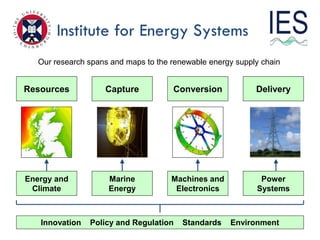
   Our research spans and maps to the renewable energy supply chain


Resources           Capture           Conversion            Delivery


Energy and           Marine           Machines and           Power
 Climate             Energy            Electronics          Systems


   Innovation   Policy and Regulation    Standards   Environment
What are we trying to do?
•   Gain an understanding of the carbon chain now and
    in the future
•   Estimate the carbon impact of intervention strategies
•   Reward technologies that reduce carbon


•   All of these require credible estimates of the carbon
    intensity of electricity
How do we calculate carbon
          intensity?
•   The carbon intensity of electricity produced by a
    given generation technology is given by
         Emissions factor = fuel use / generation

•   The DECC emissions factors are based on total fuel
    use and total energy production per fuel type
    •   simple cross-industry measure
    •   reflect differences between fuels
    •   widely exploited for estimating carbon footprints, impacts
        and payback
How good are these simple
          estimates?
•   Several areas where these values fall down

    •   Consumption patterns and production are not flat profiles

    •   Emissions vary within same fuel type

    •   System and generator operation ultimately dictates intensity
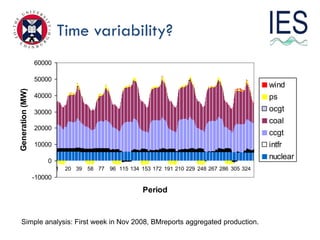
Time variability?
                  60000

                  50000
                                                                                                wind
Generation (MW)


                  40000                                                                         ps
                  30000                                                                         ocgt
                                                                                                coal
                  20000
                                                                                                ccgt
                  10000                                                                         intfr
                      0
                                                                                                nuclear
                           1   20 39 58 77 96 115 134 153 172 191 210 229 248 267 286 305 324
                  -10000

                                                        Period


 Simple analysis: First week in Nov 2008, BMreports aggregated production.
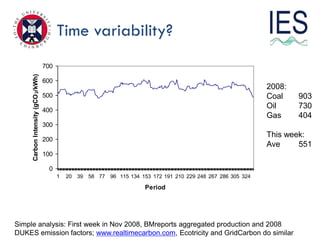
Time variability?
                                    700
     Carbon Intensity (gCO 2/kWh)


                                    600
                                                                                                               2008:
                                    500                                                                        Coal    903
                                    400
                                                                                                               Oil     730
                                                                                                               Gas     404
                                    300
                                                                                                               This week:
                                    200
                                                                                                               Ave     551
                                    100

                                     0
                                          1   20 39 58 77 96 115 134 153 172 191 210 229 248 267 286 305 324

                                                                        Period


Simple analysis: First week in Nov 2008, BMreports aggregated production and 2008
DUKES emission factors; www.realtimecarbon.com, Ecotricity and GridCarbon do similar
Technology Considerations
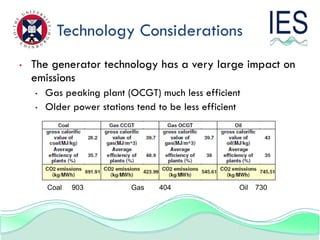
•   The generator technology has a very large impact on
    emissions
    •   Gas peaking plant (OCGT) much less efficient
    •   Older power stations tend to be less efficient


        Coal   903          Gas   404                Oil   730
Technology Considerations
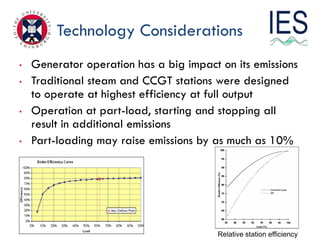
•   Generator operation has a big impact on its emissions
•   Traditional steam and CCGT stations were designed
    to operate at highest efficiency at full output
•   Operation at part-load, starting and stopping all
    result in additional emissions
•   Part-loading may raise emissions by as much as 10%


                                         Relative station efficiency
Technology Considerations
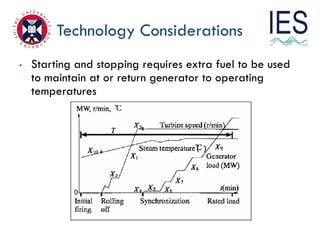
•   Starting and stopping requires extra fuel to be used
    to maintain at or return generator to operating
    temperatures
Technology Considerations
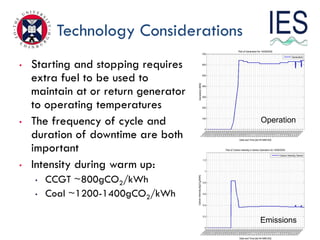
•   Starting and stopping requires
    extra fuel to be used to
    maintain at or return generator
    to operating temperatures
•   The frequency of cycle and        Operation
    duration of downtime are both
    important
•   Intensity during warm up:
    •   CCGT ~800gCO2/kWh
    •   Coal ~1200-1400gCO2/kWh

                                      Emissions
Towards better estimates?
•   Highly complex problem
•   Emissions are largely market-driven and increasingly
    reflect non-dispatchable renewable generation
•   Simple emissions factors not sufficient to inform important
    choices
•   Estimating historic carbon intensity conceptually simpler
    •   We can measure production and fuel burn
    •   The small extent of changes (wind etc) means simple marginal
        assumptions (dCO2/dP) can be credible
    •   We still need to reflect operational characteristics in estimates
Towards better estimates?
•   Estimating future intensity is much harder…

•   Substantial uncertainty over fuel types, technology
    and operational characteristics
•   Large injections of wind will see more flexible use of
    thermal plant: more cycling and greater reserve
    holding
    •   Lower emissions due to energy substitution but more
        emissions per kWh of thermal generation

•   We need to fully understand this…

Carbon Intensity of Electricity: Towards More Realistic Numbers | Professor Gareth Harrison

  • 1.
    Carbon intensity ofelectricity: towards more realistic numbers Professor Gareth Harrison Institute for Energy Systems University of Edinburgh
  • 2.
    Institute for EnergySystems Our research spans and maps to the renewable energy supply chain Resources Capture Conversion Delivery Energy and Marine Machines and Power Climate Energy Electronics Systems Innovation Policy and Regulation Standards Environment
  • 3.
    What are wetrying to do? • Gain an understanding of the carbon chain now and in the future • Estimate the carbon impact of intervention strategies • Reward technologies that reduce carbon • All of these require credible estimates of the carbon intensity of electricity
  • 4.
    How do wecalculate carbon intensity? • The carbon intensity of electricity produced by a given generation technology is given by Emissions factor = fuel use / generation • The DECC emissions factors are based on total fuel use and total energy production per fuel type • simple cross-industry measure • reflect differences between fuels • widely exploited for estimating carbon footprints, impacts and payback
  • 5.
    How good arethese simple estimates? • Several areas where these values fall down • Consumption patterns and production are not flat profiles • Emissions vary within same fuel type • System and generator operation ultimately dictates intensity
  • 6.
    Time variability? 60000 50000 wind Generation (MW) 40000 ps 30000 ocgt coal 20000 ccgt 10000 intfr 0 nuclear 1 20 39 58 77 96 115 134 153 172 191 210 229 248 267 286 305 324 -10000 Period Simple analysis: First week in Nov 2008, BMreports aggregated production.
  • 7.
    Time variability? 700 Carbon Intensity (gCO 2/kWh) 600 2008: 500 Coal 903 400 Oil 730 Gas 404 300 This week: 200 Ave 551 100 0 1 20 39 58 77 96 115 134 153 172 191 210 229 248 267 286 305 324 Period Simple analysis: First week in Nov 2008, BMreports aggregated production and 2008 DUKES emission factors; www.realtimecarbon.com, Ecotricity and GridCarbon do similar
  • 8.
    Technology Considerations • The generator technology has a very large impact on emissions • Gas peaking plant (OCGT) much less efficient • Older power stations tend to be less efficient Coal 903 Gas 404 Oil 730
  • 9.
    Technology Considerations • Generator operation has a big impact on its emissions • Traditional steam and CCGT stations were designed to operate at highest efficiency at full output • Operation at part-load, starting and stopping all result in additional emissions • Part-loading may raise emissions by as much as 10% Relative station efficiency
  • 10.
    Technology Considerations • Starting and stopping requires extra fuel to be used to maintain at or return generator to operating temperatures
  • 11.
    Technology Considerations • Starting and stopping requires extra fuel to be used to maintain at or return generator to operating temperatures • The frequency of cycle and Operation duration of downtime are both important • Intensity during warm up: • CCGT ~800gCO2/kWh • Coal ~1200-1400gCO2/kWh Emissions
  • 12.
    Towards better estimates? • Highly complex problem • Emissions are largely market-driven and increasingly reflect non-dispatchable renewable generation • Simple emissions factors not sufficient to inform important choices • Estimating historic carbon intensity conceptually simpler • We can measure production and fuel burn • The small extent of changes (wind etc) means simple marginal assumptions (dCO2/dP) can be credible • We still need to reflect operational characteristics in estimates
  • 13.
    Towards better estimates? • Estimating future intensity is much harder… • Substantial uncertainty over fuel types, technology and operational characteristics • Large injections of wind will see more flexible use of thermal plant: more cycling and greater reserve holding • Lower emissions due to energy substitution but more emissions per kWh of thermal generation • We need to fully understand this…