Six years of operating
experience with DryFiningTM
fuel enhancement process
Sandra Broekema, Una Nowling, and Nenad Sarunac
14 December 2016
1
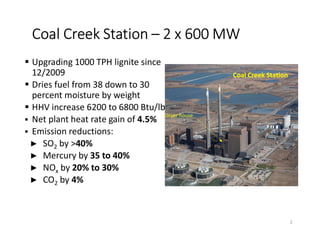
 Upgrading 1000 TPH lignite since
12/2009
 Dries fuel from 38 down to 30
percent moisture by weight
 HHV increase 6200 to 6800 Btu/lb
 Net plant heat rate gain of 4.5%
 Emission reductions:
► SO2 by >40%
► Mercury by 35 to 40%
► NOx by 20% to 30%
► CO2 by 4%
Coal Creek Station – 2 x 600 MW
Dryer house
Coal Creek Station
2
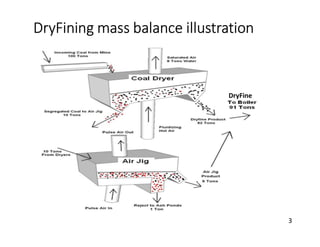
DryFining mass balance illustration
DryFine
3 3
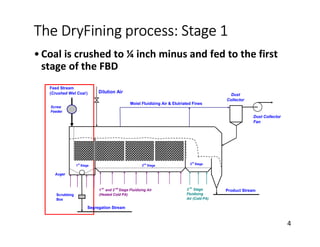
•Coal is crushed to ¼ inch minus and fed to the first
stage of the FBD
The DryFining process: Stage 1
4 4
1
st
Stage
Dust
Collector
Dust Collector
Fan
Scrubbing
Box
2
nd
Stage
Feed Stream
(Crushed Wet Coal ) Dilution Air
Product Stream
Auger
Segregation Stream
3
rd
Stage
3 rd
Stage
Fluidizing
Air (Cold PA)
1 st
and 2 nd
Stage Fluidizing Air
(Heated Cold PA)
Moist Fluidizing Air & Elutriated Fines
Screw
Feeder
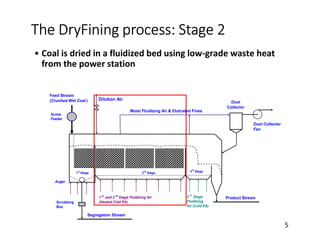
• Coal is dried in a fluidized bed using low-grade waste heat
from the power station
The DryFining process: Stage 2
5
5
1
st
Stage
Dust
Collector
Dust Collector
Fan
Scrubbing
Box
2
nd
Stage
Feed Stream
(Crushed Wet Coal ) Dilution Air
Product Stream
Auger
Segregation Stream
3
rd
Stage
3 rd
Stage
Fluidizing
Air (Cold PA)
1 st
and 2 nd
Stage Fluidizing Air
(Heated Cold PA)
Moist Fluidizing Air & Elutriated Fines
Screw
Feeder
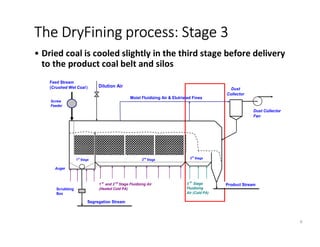
• Dried coal is cooled slightly in the third stage before delivery
to the product coal belt and silos
The DryFining process: Stage 3
6
1
st
Stage
Dust
Collector
Dust Collector
Fan
Scrubbing
Box
2
nd
Stage
Feed Stream
(Crushed Wet Coal ) Dilution Air
Product Stream
Auger
Segregation Stream
3
rd
Stage
3 rd
Stage
Fluidizing
Air (Cold PA)
1 st
and 2 nd
Stage Fluidizing Air
(Heated Cold PA)
Moist Fluidizing Air & Elutriated Fines
Screw
Feeder
-600
-500
-400
-300
-200
-100
0
100
Y0 Y1 Y2 Y3 Y4 Y5 Y6 Y7 Y8 Y9 Y10Y11Y12Y13Y14Y15
CAPEX+OPEX
(US$Million)
Competitive technology CAPEX/OPEX side-by-side
Conventional
DryFining
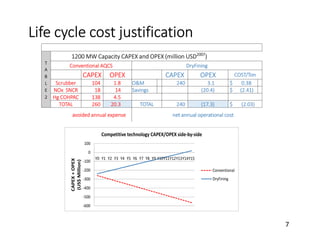
Life cycle cost justification
7
T
A
B
L
E
2
1200 MW Capacity CAPEX and OPEX (million USD2007
)
Conventional AQCS DryFining
CAPEX OPEX CAPEX OPEX COST/Ton
Scrubber 104 1.8 O&M 240 3.1 $ 0.38
NOx SNCR 18 14 Savings (20.4) $ (2.41)
Hg COHPAC 138 4.5
TOTAL 260 20.3 TOTAL 240 (17.3) $ (2.03)
avoided annual expense net annual operational cost
7
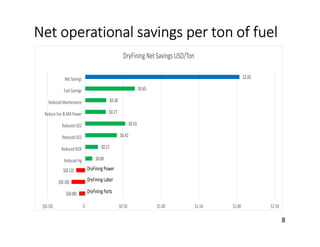
Net operational savings per ton of fuel
$(0.08)
$(0.18)
$(0.12)
$0.09
$0.17
$0.42
$0.53
$0.27
$0.28
$0.65
$2.03
$(0.50) $- $0.50 $1.00 $1.50 $2.00 $2.50
Reduced Hg
Reduced NOX
Reduced SO2
Reduced CO2
Reduce Fan & Mill Power
Reduced Maintenance
FuelSavings
Net Savings
DryFiningNet SavingsUSD/Ton
DryFining Power
DryFining Labor
DryFining Parts
8 8
•Reduced coal flow through the power block
•Reduced flue gas production
•Increased boiler efficiency
•Reduced auxiliary power consumption
•Improved net plant heat rate
•Improved emissions control performance
•Reduced carbon intensity
Benefits of advanced beneficiation
9
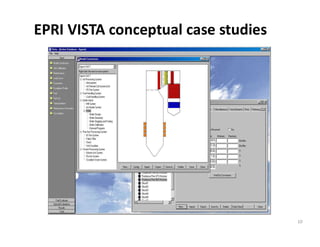
EPRI VISTA conceptual case studies
10
• A 665 MW (gross) sub-critical boiler, designed for NAPP/CAPP
coal, currently burning 30 percent PRB coal
• Estimated 180 MW derate if 100 percent PRB was burned
• Due to mill grinding and mill drying capability, both directly impacted by
the coal moisture content
• Modeled PRB coal moisture reduction from 23.9 percent to
15.9 percent via DryFining
• Result: 59 MW derate with 100 percent PRB, gain 121 MW
• Goals:
• Estimate O&M cost differences
• Estimate maximum PRB coal use potential
Case study 1: 665 MW PRB retrofit
11
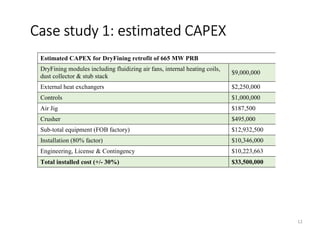
Case study 1: estimated CAPEX
12
Estimated CAPEX for DryFining retrofit of 665 MW PRB
DryFining modules including fluidizing air fans, internal heating coils,
dust collector & stub stack
$9,000,000
External heat exchangers $2,250,000
Controls $1,000,000
Air Jig $187,500
Crusher $495,000
Sub-total equipment (FOB factory) $12,932,500
Installation (80% factor) $10,346,000
Engineering, License & Contingency $10,223,663
Total installed cost (+/- 30%) $33,500,000
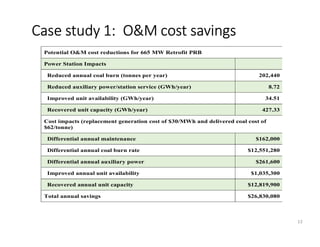
Case study 1: O&M cost savings
13
Potential O&M cost reductions for 665 MW Retrofit PRB
Power Station Impacts
Reduced annual coal burn (tonnes per year) 202,440
Reduced auxiliary power/station service (GWh/year) 8.72
Improved unit availability (GWh/year) 34.51
Recovered unit capacity (GWh/year) 427.33
Cost impacts (replacement generation cost of $30/MWh and delivered coal cost of
$62/tonne)
Differential annual maintenance $162,000
Differential annual coal burn rate $12,551,280
Differential annual auxiliary power $261,600
Improved annual unit availability $1,035,300
Recovered annual unit capacity $12,819,900
Total annual savings $26,830,080
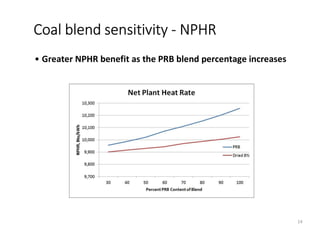
• Greater NPHR benefit as the PRB blend percentage increases
Coal blend sensitivity - NPHR
14
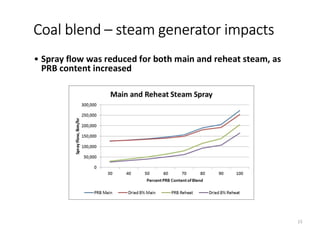
• Spray flow was reduced for both main and reheat steam, as
PRB content increased
Coal blend – steam generator impacts
15
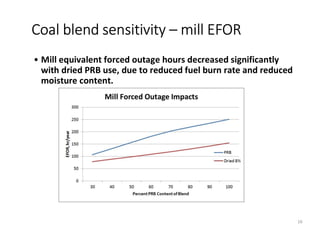
• Mill equivalent forced outage hours decreased significantly
with dried PRB use, due to reduced fuel burn rate and reduced
moisture content.
Coal blend sensitivity – mill EFOR
16
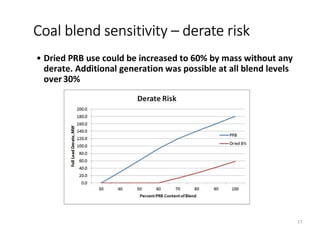
• Dried PRB use could be increased to 60% by mass without any
derate. Additional generation was possible at all blend levels
over30%
Coal blend sensitivity – derate risk
17
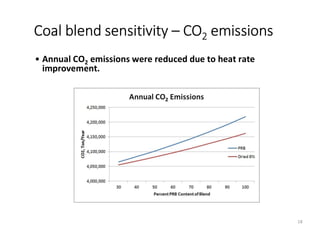
• Annual CO2 emissions were reduced due to heat rate
improvement.
Coal blend sensitivity – CO2 emissions
18
• A 860 MW (gross) reference plant operating on Indonesian
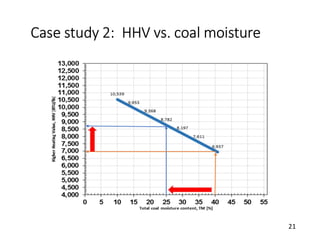
WARA
• Modelled Indonesian WARA coal moisture reduction from 40
percent to 25 percent using using Proates (boiler) and Ebsilon
Professional (steam turbine cycle)
• Goals:
• Thermal integration to estimate moisture removal achievable
• Calculate net unit efficiency across various power cycles
• Estimate impact on new build CAPEX with and without DryFining
Case study 2: 860 MW reference plant
19
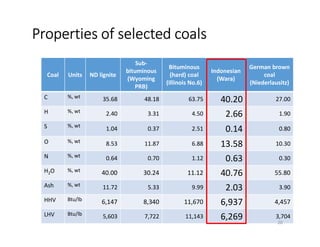
Properties of selected coals
Coal Units ND lignite
Sub-
bituminous
(Wyoming
PRB)
Bituminous
(hard) coal
(Illinois No.6)
Indonesian
(Wara)
German brown
coal
(Niederlausitz)
C %, wt 35.68 48.18 63.75 40.20 27.00
H %, wt 2.40 3.31 4.50 2.66 1.90
S %, wt
1.04 0.37 2.51 0.14 0.80
O %, wt 8.53 11.87 6.88 13.58 10.30
N %, wt 0.64 0.70 1.12 0.63 0.30
H2O %, wt
40.00 30.24 11.12 40.76 55.80
Ash %, wt 11.72 5.33 9.99 2.03 3.90
HHV Btu/lb
6,147 8,340 11,670 6,937 4,457
LHV Btu/lb 5,603 7,722 11,143 6,269 3,704
20
21
Case study 2: HHV vs. coal moisture
Case study 2: Net unit efficiency
33.8
35.6
38.8
41.9
36.6
38.6
41.9
45.3
36.4
38.4
41.8
45.1
32
33
34
35
36
37
38
39
40
41
42
43
44
45
46
47
48
Subcritical Supercritical USC A-USC
NetUnitEfficiency[%-HHV]
Indonesian Coal: Wara
Indonesian, TM=41%
Indonesian, TM=35%
Indonesian, TM=30%
Indonesian, TM=25%
Indonesian, TM=20%
Indonesian, TM=15%
Indonesian, TM=10%
Bituminous (Hard), TM=11%
Reference Plant
22
Case study 2: Net unit efficiency
0
1
2
3
4
5
6
7
8
9
10
11
12
13
14
15
5 10 15 20 25 30 35 40
NetUnitEfficiencyImprovement[%-point,HHV]
Total Coal Moisture Content, TM [%]
Indonesian Coal: Wara Subcritical
SC
USC
A-USC
SUBC with ICDS
SC with ICDS
USC with ICDS
A-USC
ICDS = LT Integrated Coal Drying System
Waste HeatWaste + Process Heat
Reference Plant
23
300
350
400
450
500
550
600
650
5 10 15 20 25 30 35 40
CoalFlowRate[g/kWh-gross]
Total Coal Moisture Content, TM [%]
Supercritical unit using dried Indonesian Wara
Case study 2: Coal flow rate change
ICDS = LT Integrated Coal Drying System
Efficiency improvement
Evaporated Coal
Moisture
24
1
3
2
4
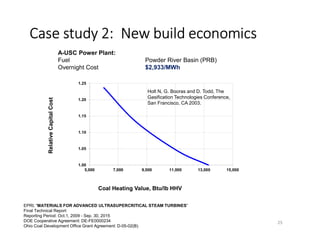
Case study 2: New build economics
A-USC Power Plant:
Fuel Powder River Basin (PRB)
Overnight Cost $2,933/MWh
1.00
1.05
1.10
1.15
1.20
1.25
5,000 7,000 9,000 11,000 13,000 15,000
RelativeCapitalCost
Coal Heating Value, Btu/lb HHV
EPRI, “MATERIALS FOR ADVANCED ULTRASUPERCRITICAL STEAM TURBINES”
Final Technical Report
Reporting Period: Oct.1, 2009 - Sep. 30, 2015
DOE Cooperative Agreement: DE-FE0000234
Ohio Coal Development Office Grant Agreement: D-05-02(B)
Holt N, G. Booras and D. Todd, The
Gasification Technologies Conference,
San Francisco, CA 2003.
25
Case study 2: Capital costs and savings
0
50
100
150
200
250
300
350
400
5 10 15 20 25 30
CapitalCostsandSavings[$/kW]
Reduction in Total Coal Moisture Content, DTM [%-point]
Indonesian: WaraCore System Cost, A-USC
Core System Cost, USC
Reduction in Plant Cost, A-USC
Reduction in Plant Cost, USC
CAPEX Savings, A-USC
CAPEX Savings, USC
NET CAPEX
Savings
A-USC
USC
Core System Cost
Reduction in
Plant Cost
USC
A-USC
A-USC
USC
Reference Plant
26
Water recovery potential at 60 percent
50
100
150
200
250
300
350
400
5 10 15 20 25 30 35
EvaporatedCoalMoisture[klb/hr]
Total Coal Moisture Content, TM [%]
Indonesian: Wara
Subcritical
SC
USC
A-USC
Condensed, Subcritical
Condensed, SC
Condensed, USC
Condensed, A-USC
27
860 MW Reference Plant
60% Recovery
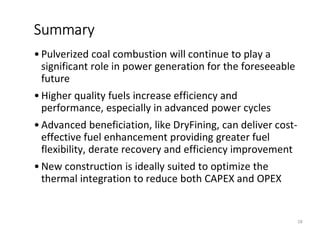
• Pulverized coal combustion will continue to play a
significant role in power generation for the foreseeable
future
• Higher quality fuels increase efficiency and
performance, especially in advanced power cycles
• Advanced beneficiation, like DryFining, can deliver cost-
effective fuel enhancement providing greater fuel
flexibility, derate recovery and efficiency improvement
• New construction is ideally suited to optimize the
thermal integration to reduce both CAPEX and OPEX
Summary
28
 TECHNICAL CONTACTS
Una Nowling
Black & Veatch
Overland Park, KS USA
NowlingUC@bv.com
Nenad Sarunac
University of North Carolina
Charlotte, NC USA
nsarunac@uncc.edu
 BUSINESS CONTACT
Sandra Broekema
Great River Energy
Minneapolis, MN USA
(612) 280-8689
sbroekema@GREnergy.com
29

2016.12.14 DryFining Coal Gen presentation FINAL

  • 1.
    Six years ofoperating experience with DryFiningTM fuel enhancement process Sandra Broekema, Una Nowling, and Nenad Sarunac 14 December 2016 1
  • 2.
     Upgrading 1000TPH lignite since 12/2009  Dries fuel from 38 down to 30 percent moisture by weight  HHV increase 6200 to 6800 Btu/lb  Net plant heat rate gain of 4.5%  Emission reductions: ► SO2 by >40% ► Mercury by 35 to 40% ► NOx by 20% to 30% ► CO2 by 4% Coal Creek Station – 2 x 600 MW Dryer house Coal Creek Station 2
  • 3.
    DryFining mass balanceillustration DryFine 3 3
  • 4.
    •Coal is crushedto ¼ inch minus and fed to the first stage of the FBD The DryFining process: Stage 1 4 4 1 st Stage Dust Collector Dust Collector Fan Scrubbing Box 2 nd Stage Feed Stream (Crushed Wet Coal ) Dilution Air Product Stream Auger Segregation Stream 3 rd Stage 3 rd Stage Fluidizing Air (Cold PA) 1 st and 2 nd Stage Fluidizing Air (Heated Cold PA) Moist Fluidizing Air & Elutriated Fines Screw Feeder
  • 5.
    • Coal isdried in a fluidized bed using low-grade waste heat from the power station The DryFining process: Stage 2 5 5 1 st Stage Dust Collector Dust Collector Fan Scrubbing Box 2 nd Stage Feed Stream (Crushed Wet Coal ) Dilution Air Product Stream Auger Segregation Stream 3 rd Stage 3 rd Stage Fluidizing Air (Cold PA) 1 st and 2 nd Stage Fluidizing Air (Heated Cold PA) Moist Fluidizing Air & Elutriated Fines Screw Feeder
  • 6.
    • Dried coalis cooled slightly in the third stage before delivery to the product coal belt and silos The DryFining process: Stage 3 6 1 st Stage Dust Collector Dust Collector Fan Scrubbing Box 2 nd Stage Feed Stream (Crushed Wet Coal ) Dilution Air Product Stream Auger Segregation Stream 3 rd Stage 3 rd Stage Fluidizing Air (Cold PA) 1 st and 2 nd Stage Fluidizing Air (Heated Cold PA) Moist Fluidizing Air & Elutriated Fines Screw Feeder
  • 7.
    -600 -500 -400 -300 -200 -100 0 100 Y0 Y1 Y2Y3 Y4 Y5 Y6 Y7 Y8 Y9 Y10Y11Y12Y13Y14Y15 CAPEX+OPEX (US$Million) Competitive technology CAPEX/OPEX side-by-side Conventional DryFining Life cycle cost justification 7 T A B L E 2 1200 MW Capacity CAPEX and OPEX (million USD2007 ) Conventional AQCS DryFining CAPEX OPEX CAPEX OPEX COST/Ton Scrubber 104 1.8 O&M 240 3.1 $ 0.38 NOx SNCR 18 14 Savings (20.4) $ (2.41) Hg COHPAC 138 4.5 TOTAL 260 20.3 TOTAL 240 (17.3) $ (2.03) avoided annual expense net annual operational cost 7
  • 8.
    Net operational savingsper ton of fuel $(0.08) $(0.18) $(0.12) $0.09 $0.17 $0.42 $0.53 $0.27 $0.28 $0.65 $2.03 $(0.50) $- $0.50 $1.00 $1.50 $2.00 $2.50 Reduced Hg Reduced NOX Reduced SO2 Reduced CO2 Reduce Fan & Mill Power Reduced Maintenance FuelSavings Net Savings DryFiningNet SavingsUSD/Ton DryFining Power DryFining Labor DryFining Parts 8 8
  • 9.
    •Reduced coal flowthrough the power block •Reduced flue gas production •Increased boiler efficiency •Reduced auxiliary power consumption •Improved net plant heat rate •Improved emissions control performance •Reduced carbon intensity Benefits of advanced beneficiation 9
  • 10.
    EPRI VISTA conceptualcase studies 10
  • 11.
    • A 665MW (gross) sub-critical boiler, designed for NAPP/CAPP coal, currently burning 30 percent PRB coal • Estimated 180 MW derate if 100 percent PRB was burned • Due to mill grinding and mill drying capability, both directly impacted by the coal moisture content • Modeled PRB coal moisture reduction from 23.9 percent to 15.9 percent via DryFining • Result: 59 MW derate with 100 percent PRB, gain 121 MW • Goals: • Estimate O&M cost differences • Estimate maximum PRB coal use potential Case study 1: 665 MW PRB retrofit 11
  • 12.
    Case study 1:estimated CAPEX 12 Estimated CAPEX for DryFining retrofit of 665 MW PRB DryFining modules including fluidizing air fans, internal heating coils, dust collector & stub stack $9,000,000 External heat exchangers $2,250,000 Controls $1,000,000 Air Jig $187,500 Crusher $495,000 Sub-total equipment (FOB factory) $12,932,500 Installation (80% factor) $10,346,000 Engineering, License & Contingency $10,223,663 Total installed cost (+/- 30%) $33,500,000
  • 13.
    Case study 1:O&M cost savings 13 Potential O&M cost reductions for 665 MW Retrofit PRB Power Station Impacts Reduced annual coal burn (tonnes per year) 202,440 Reduced auxiliary power/station service (GWh/year) 8.72 Improved unit availability (GWh/year) 34.51 Recovered unit capacity (GWh/year) 427.33 Cost impacts (replacement generation cost of $30/MWh and delivered coal cost of $62/tonne) Differential annual maintenance $162,000 Differential annual coal burn rate $12,551,280 Differential annual auxiliary power $261,600 Improved annual unit availability $1,035,300 Recovered annual unit capacity $12,819,900 Total annual savings $26,830,080
  • 14.
    • Greater NPHRbenefit as the PRB blend percentage increases Coal blend sensitivity - NPHR 14
  • 15.
    • Spray flowwas reduced for both main and reheat steam, as PRB content increased Coal blend – steam generator impacts 15
  • 16.
    • Mill equivalentforced outage hours decreased significantly with dried PRB use, due to reduced fuel burn rate and reduced moisture content. Coal blend sensitivity – mill EFOR 16
  • 17.
    • Dried PRBuse could be increased to 60% by mass without any derate. Additional generation was possible at all blend levels over30% Coal blend sensitivity – derate risk 17
  • 18.
    • Annual CO2emissions were reduced due to heat rate improvement. Coal blend sensitivity – CO2 emissions 18
  • 19.
    • A 860MW (gross) reference plant operating on Indonesian WARA • Modelled Indonesian WARA coal moisture reduction from 40 percent to 25 percent using using Proates (boiler) and Ebsilon Professional (steam turbine cycle) • Goals: • Thermal integration to estimate moisture removal achievable • Calculate net unit efficiency across various power cycles • Estimate impact on new build CAPEX with and without DryFining Case study 2: 860 MW reference plant 19
  • 20.
    Properties of selectedcoals Coal Units ND lignite Sub- bituminous (Wyoming PRB) Bituminous (hard) coal (Illinois No.6) Indonesian (Wara) German brown coal (Niederlausitz) C %, wt 35.68 48.18 63.75 40.20 27.00 H %, wt 2.40 3.31 4.50 2.66 1.90 S %, wt 1.04 0.37 2.51 0.14 0.80 O %, wt 8.53 11.87 6.88 13.58 10.30 N %, wt 0.64 0.70 1.12 0.63 0.30 H2O %, wt 40.00 30.24 11.12 40.76 55.80 Ash %, wt 11.72 5.33 9.99 2.03 3.90 HHV Btu/lb 6,147 8,340 11,670 6,937 4,457 LHV Btu/lb 5,603 7,722 11,143 6,269 3,704 20
  • 21.
    21 Case study 2:HHV vs. coal moisture
  • 22.
    Case study 2:Net unit efficiency 33.8 35.6 38.8 41.9 36.6 38.6 41.9 45.3 36.4 38.4 41.8 45.1 32 33 34 35 36 37 38 39 40 41 42 43 44 45 46 47 48 Subcritical Supercritical USC A-USC NetUnitEfficiency[%-HHV] Indonesian Coal: Wara Indonesian, TM=41% Indonesian, TM=35% Indonesian, TM=30% Indonesian, TM=25% Indonesian, TM=20% Indonesian, TM=15% Indonesian, TM=10% Bituminous (Hard), TM=11% Reference Plant 22
  • 23.
    Case study 2:Net unit efficiency 0 1 2 3 4 5 6 7 8 9 10 11 12 13 14 15 5 10 15 20 25 30 35 40 NetUnitEfficiencyImprovement[%-point,HHV] Total Coal Moisture Content, TM [%] Indonesian Coal: Wara Subcritical SC USC A-USC SUBC with ICDS SC with ICDS USC with ICDS A-USC ICDS = LT Integrated Coal Drying System Waste HeatWaste + Process Heat Reference Plant 23
  • 24.
    300 350 400 450 500 550 600 650 5 10 1520 25 30 35 40 CoalFlowRate[g/kWh-gross] Total Coal Moisture Content, TM [%] Supercritical unit using dried Indonesian Wara Case study 2: Coal flow rate change ICDS = LT Integrated Coal Drying System Efficiency improvement Evaporated Coal Moisture 24 1 3 2 4
  • 25.
    Case study 2:New build economics A-USC Power Plant: Fuel Powder River Basin (PRB) Overnight Cost $2,933/MWh 1.00 1.05 1.10 1.15 1.20 1.25 5,000 7,000 9,000 11,000 13,000 15,000 RelativeCapitalCost Coal Heating Value, Btu/lb HHV EPRI, “MATERIALS FOR ADVANCED ULTRASUPERCRITICAL STEAM TURBINES” Final Technical Report Reporting Period: Oct.1, 2009 - Sep. 30, 2015 DOE Cooperative Agreement: DE-FE0000234 Ohio Coal Development Office Grant Agreement: D-05-02(B) Holt N, G. Booras and D. Todd, The Gasification Technologies Conference, San Francisco, CA 2003. 25
  • 26.
    Case study 2:Capital costs and savings 0 50 100 150 200 250 300 350 400 5 10 15 20 25 30 CapitalCostsandSavings[$/kW] Reduction in Total Coal Moisture Content, DTM [%-point] Indonesian: WaraCore System Cost, A-USC Core System Cost, USC Reduction in Plant Cost, A-USC Reduction in Plant Cost, USC CAPEX Savings, A-USC CAPEX Savings, USC NET CAPEX Savings A-USC USC Core System Cost Reduction in Plant Cost USC A-USC A-USC USC Reference Plant 26
  • 27.
    Water recovery potentialat 60 percent 50 100 150 200 250 300 350 400 5 10 15 20 25 30 35 EvaporatedCoalMoisture[klb/hr] Total Coal Moisture Content, TM [%] Indonesian: Wara Subcritical SC USC A-USC Condensed, Subcritical Condensed, SC Condensed, USC Condensed, A-USC 27 860 MW Reference Plant 60% Recovery
  • 28.
    • Pulverized coalcombustion will continue to play a significant role in power generation for the foreseeable future • Higher quality fuels increase efficiency and performance, especially in advanced power cycles • Advanced beneficiation, like DryFining, can deliver cost- effective fuel enhancement providing greater fuel flexibility, derate recovery and efficiency improvement • New construction is ideally suited to optimize the thermal integration to reduce both CAPEX and OPEX Summary 28
  • 29.
     TECHNICAL CONTACTS UnaNowling Black & Veatch Overland Park, KS USA NowlingUC@bv.com Nenad Sarunac University of North Carolina Charlotte, NC USA nsarunac@uncc.edu  BUSINESS CONTACT Sandra Broekema Great River Energy Minneapolis, MN USA (612) 280-8689 sbroekema@GREnergy.com 29