Developing a rigorous building and transparent methodology for carbon counting   John Stocks Manager - Scotland
Requirements for Carbon Accounting To provide a clear and unambiguous statement of impact; Numerical Recognised methodology Clear statement of boundaries Verifiable
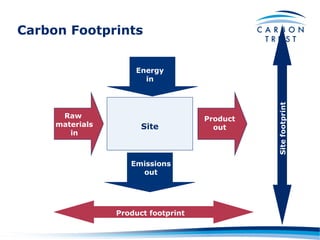
Carbon Footprints Site Energy in Emissions out Raw  materials in Product out Product footprint Site footprint
Carbon Trust activity Site and company footprinting Carbon Trust Standard Product footprinting PAS 2050 Carbon Label Company
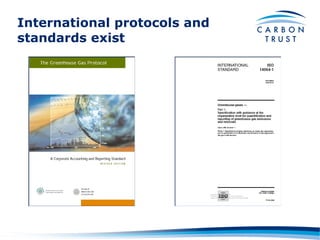
International protocols and standards exist
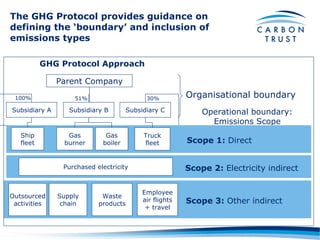
The GHG Protocol provides guidance on defining the ‘boundary’ and inclusion of emissions types Operational boundary: Emissions Scope Parent Company Subsidiary A Subsidiary C 100% 51% 30% Employee air flights + travel Outsourced activities Supply chain Scope 2:  Electricity indirect Scope 3:  Other indirect Purchased electricity Waste products Ship fleet Gas burner Gas boiler Truck fleet Scope 1:  Direct Organisational boundary Subsidiary B GHG Protocol Approach
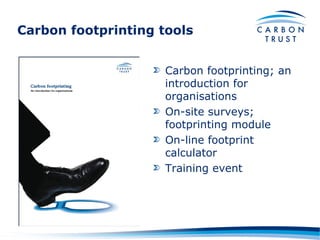
Carbon footprinting tools Carbon footprinting; an introduction for organisations On-site surveys; footprinting module On-line footprint calculator Training event
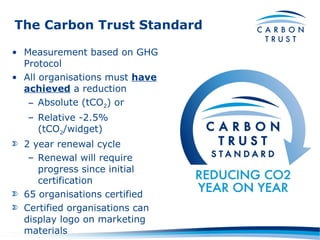
Measurement based on GHG Protocol All organisations must  have achieved  a reduction Absolute (tCO 2 ) or Relative -2.5% (tCO 2 /widget) 2 year renewal cycle Renewal will require progress since initial certification 65 organisations certified Certified organisations can display logo on marketing materials  The Carbon Trust Standard
Carbon Trust activity Site and company footprinting Carbon Trust Standard Product footprinting PAS 2050 Carbon Label Company
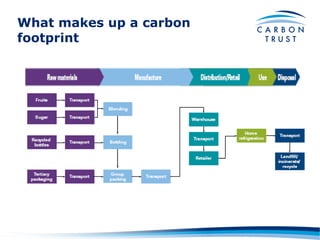
What makes up a carbon footprint
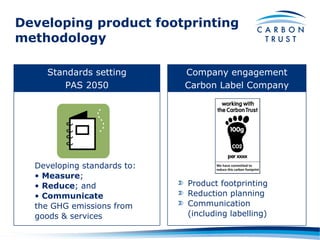
Developing product footprinting methodology Developing standards to: Measure ; Reduce ; and Communicate the GHG emissions from goods & services Product footprinting Reduction planning Communication (including labelling) Standards setting PAS 2050 Company engagement Carbon Label Company
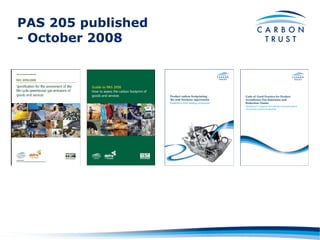
PAS 205 published  - October 2008
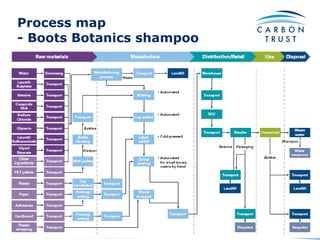
Process map - Boots Botanics shampoo
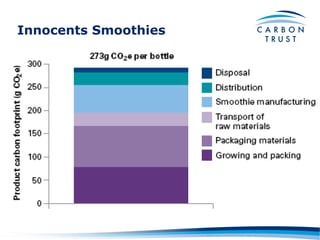
Innocents Smoothies
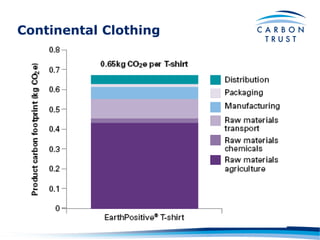
Continental Clothing
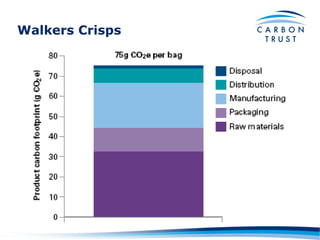
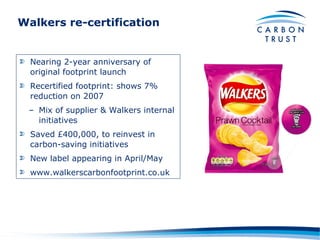
Walkers Crisps
Walkers re-certification Nearing 2-year anniversary of original footprint launch Recertified footprint: shows 7% reduction on 2007 Mix of supplier & Walkers internal initiatives Saved £400,000, to reinvest in carbon-saving initiatives New label appearing in April/May www.walkerscarbonfootprint.co.uk
International Update: Standards We are closely involved in the ongoing international work WRI/WBCSD ISO Building on existing GHG Protocol Developing guidance/requirements for product carbon footprinting The Carbon Trust on Steering Group Likely 2-3 year process CT agreed to feed in results from  projects in UK, US and other countries ISO Committee agreed to develop standard in November PAS2050 only product footprinting standard in review Attending meetings e.g. Malaysia But Likely 3-5 year process Highly consensus-driven: likely to be very high-level - important for “air cover” but still need product-specific guidance
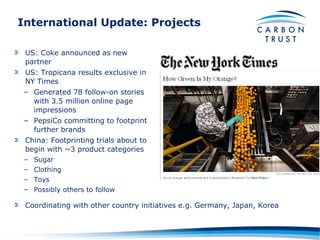
International Update: Projects US: Coke announced as new partner US: Tropicana results exclusive in NY Times Generated 78 follow-on stories with 3.5 million online page impressions PepsiCo committing to footprint further brands China: Footprinting trials about to begin with ~3 product categories Sugar Clothing Toys Possibly others to follow Coordinating with other country initiatives e.g. Germany, Japan, Korea
Requirements for Carbon Accounting To provide a clear and unambiguous statement of impact; Numerical Recognised methodology Clear statement of boundaries Verifiable Allows; Progress to be assessed Comparisons to be made Efforts to be accurately focused Myths to be uncovered
Making Business Sense of Climate Change www.carbontrust.co.uk www.carbontruststandard.co.uk   www.carbon-label.co.uk

Buildings | John Stocks

  • 1.
    Developing a rigorousbuilding and transparent methodology for carbon counting John Stocks Manager - Scotland
  • 2.
    Requirements for CarbonAccounting To provide a clear and unambiguous statement of impact; Numerical Recognised methodology Clear statement of boundaries Verifiable
  • 3.
    Carbon Footprints SiteEnergy in Emissions out Raw materials in Product out Product footprint Site footprint
  • 4.
    Carbon Trust activitySite and company footprinting Carbon Trust Standard Product footprinting PAS 2050 Carbon Label Company
  • 5.
  • 6.
    The GHG Protocolprovides guidance on defining the ‘boundary’ and inclusion of emissions types Operational boundary: Emissions Scope Parent Company Subsidiary A Subsidiary C 100% 51% 30% Employee air flights + travel Outsourced activities Supply chain Scope 2: Electricity indirect Scope 3: Other indirect Purchased electricity Waste products Ship fleet Gas burner Gas boiler Truck fleet Scope 1: Direct Organisational boundary Subsidiary B GHG Protocol Approach
  • 7.
    Carbon footprinting toolsCarbon footprinting; an introduction for organisations On-site surveys; footprinting module On-line footprint calculator Training event
  • 8.
    Measurement based onGHG Protocol All organisations must have achieved a reduction Absolute (tCO 2 ) or Relative -2.5% (tCO 2 /widget) 2 year renewal cycle Renewal will require progress since initial certification 65 organisations certified Certified organisations can display logo on marketing materials The Carbon Trust Standard
  • 9.
    Carbon Trust activitySite and company footprinting Carbon Trust Standard Product footprinting PAS 2050 Carbon Label Company
  • 10.
    What makes upa carbon footprint
  • 11.
    Developing product footprintingmethodology Developing standards to: Measure ; Reduce ; and Communicate the GHG emissions from goods & services Product footprinting Reduction planning Communication (including labelling) Standards setting PAS 2050 Company engagement Carbon Label Company
  • 12.
    PAS 205 published - October 2008
  • 13.
    Process map -Boots Botanics shampoo
  • 14.
  • 15.
  • 16.
  • 17.
    Walkers re-certification Nearing2-year anniversary of original footprint launch Recertified footprint: shows 7% reduction on 2007 Mix of supplier & Walkers internal initiatives Saved £400,000, to reinvest in carbon-saving initiatives New label appearing in April/May www.walkerscarbonfootprint.co.uk
  • 18.
    International Update: StandardsWe are closely involved in the ongoing international work WRI/WBCSD ISO Building on existing GHG Protocol Developing guidance/requirements for product carbon footprinting The Carbon Trust on Steering Group Likely 2-3 year process CT agreed to feed in results from projects in UK, US and other countries ISO Committee agreed to develop standard in November PAS2050 only product footprinting standard in review Attending meetings e.g. Malaysia But Likely 3-5 year process Highly consensus-driven: likely to be very high-level - important for “air cover” but still need product-specific guidance
  • 19.
    International Update: ProjectsUS: Coke announced as new partner US: Tropicana results exclusive in NY Times Generated 78 follow-on stories with 3.5 million online page impressions PepsiCo committing to footprint further brands China: Footprinting trials about to begin with ~3 product categories Sugar Clothing Toys Possibly others to follow Coordinating with other country initiatives e.g. Germany, Japan, Korea
  • 20.
    Requirements for CarbonAccounting To provide a clear and unambiguous statement of impact; Numerical Recognised methodology Clear statement of boundaries Verifiable Allows; Progress to be assessed Comparisons to be made Efforts to be accurately focused Myths to be uncovered
  • 21.
    Making Business Senseof Climate Change www.carbontrust.co.uk www.carbontruststandard.co.uk www.carbon-label.co.uk

Editor's Notes

  • #8 Objectives To deliver a basic carbon footprint for an organisation/site To provide an approach that meets the needs of the mass market of smaller and less advanced companies To provide practical guidance on key issues (e.g. emissions factors) To ensure footprinting data is presented in a credible, consistent format To include all GHGs – not just CO2 from fuel consumption To act as a stepping stone towards accepted standards and methodologies, e.g. GHG Protocol, ISO14064