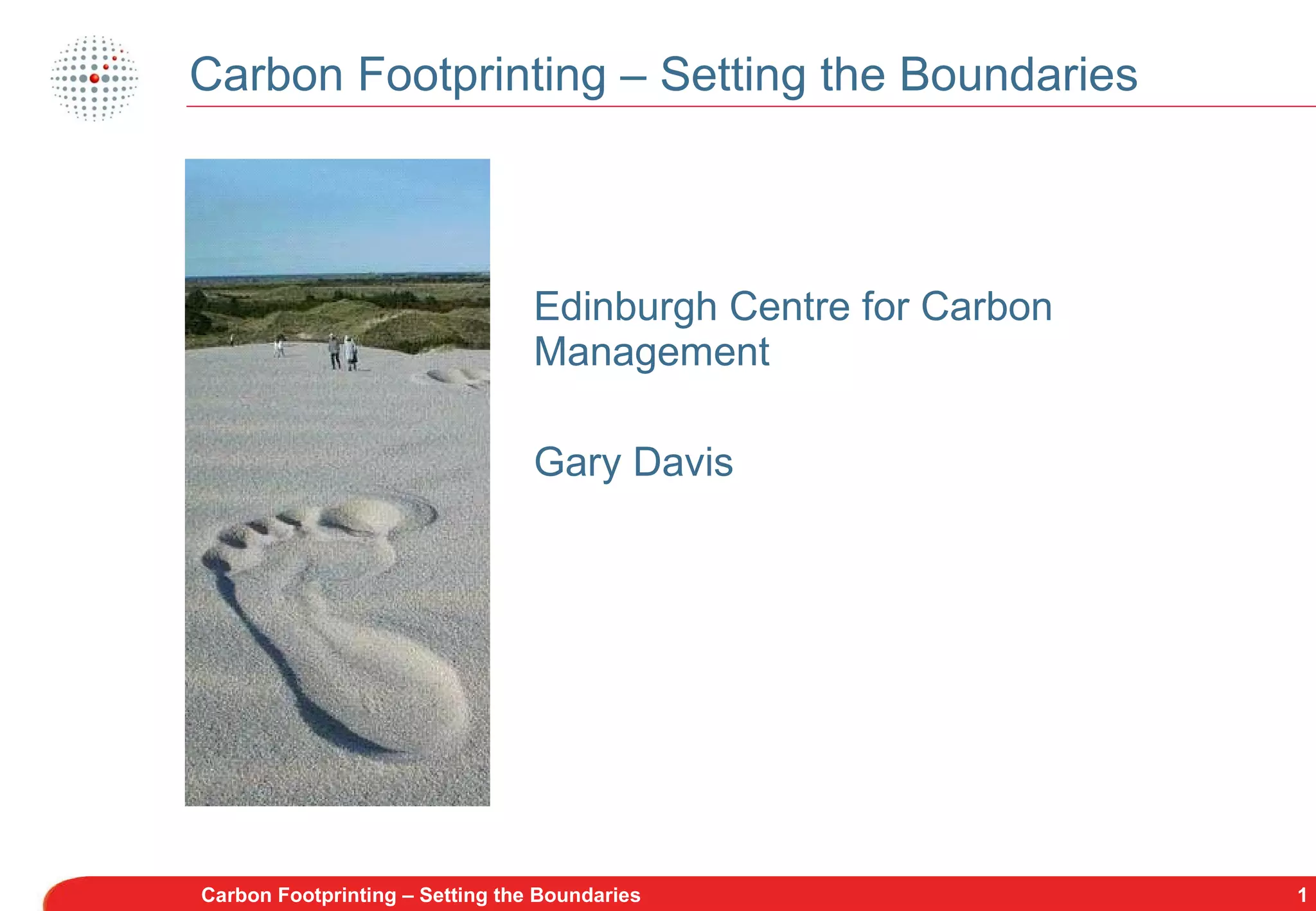
Carbon Footprinting – Setting the Boundaries Edinburgh Centre for Carbon Management Gary Davis Carbon Footprinting – Setting the Boundaries
Presentation outline About the Edinburgh Centre for Carbon Management (ECCM) Why do we set boundaries? How do we set boundaries? Should we care about boundaries? Carbon Footprinting – Setting the Boundaries
About ECCM Originally a spin-off company from University of Edinburgh Part of a group of companies (Camco Group), specialising in different areas of climate change mitigation, e.g. sustainable buildings, renewables, energy efficiency, offset projects, and carbon trading. ECCM specialises in GHG emissions assessments or “carbon footprinting” (as well as other areas, e.g. land-use based emissions reductions, academic research) Track record in carbon footprinting: Over 800 UK and International emissions assessments Clients include: Scottish and Newcastle, Scottish Executive, BP, BOC Carbon Footprinting – Setting the Boundaries
Why do we need set boundaries? Four main reasons for calculating a carbon footprint: To manage the footprint and  reduce emissions over time To accurately report emissions to a third-party (e.g. the public.) To compare your results with your peers To offset emissions (to go “carbon neutral”) Carbon Footprinting – Setting the Boundaries
Why do we need set boundaries? Common problems with Carbon Footprint results: Lack of transparency – what emissions sources are included in the scope? Doubling counting – two organisations reporting the same emissions Same organisations reporting a different scope from one year to the next Grey areas – long term leased vehicles, leased office space Carbon Footprinting – Setting the Boundaries
Why do we need set boundaries? Therefore setting boundaries is important because it allows us to achieve the following on a like for like basis: Define what an organisation will report/manage/reduce/offset Measure emissions and associated reductions from year to year Compare emissions between organisations Measuring and reporting consistently and transparently helps avoids accusations of “Greenwash” Carbon Footprinting – Setting the Boundaries
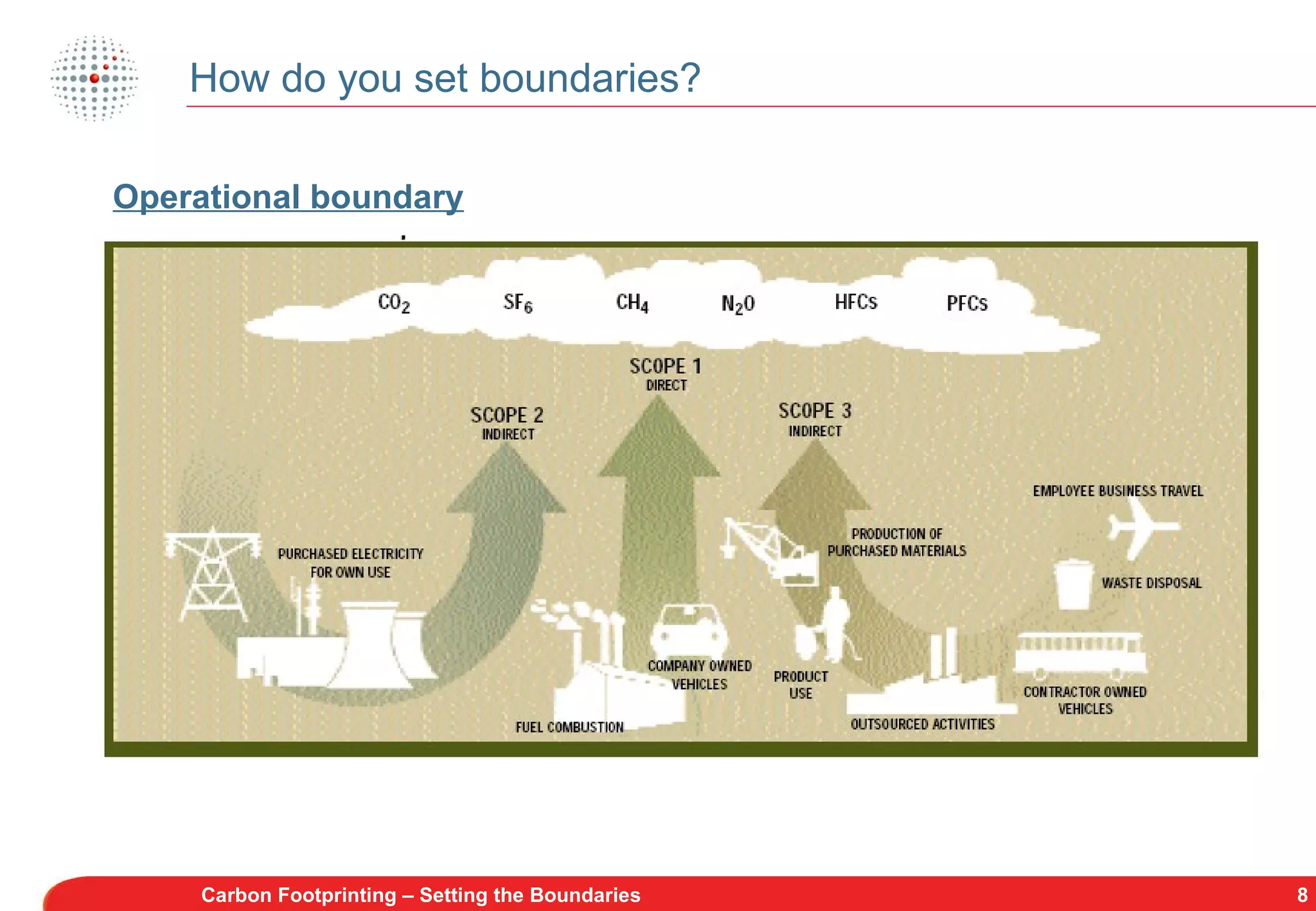
How do you set boundaries? 3 main types of boundary 1. Organisational boundary (based on WBCSD/WRI GHG Protocol): Control  Equity share 2. Operational boundary (based on WBCSD/WRI GHG Protocol): Scope One  emissions  Scope Two  emissions  Scope Three  emissions 3. GHG Emissions included: CO2 only or all Kyoto gases (CH4, N2O, HFCs, PFCs, SF6) Carbon Footprinting – Setting the Boundaries
How do you set boundaries? Carbon Footprinting – Setting the Boundaries Operational boundary
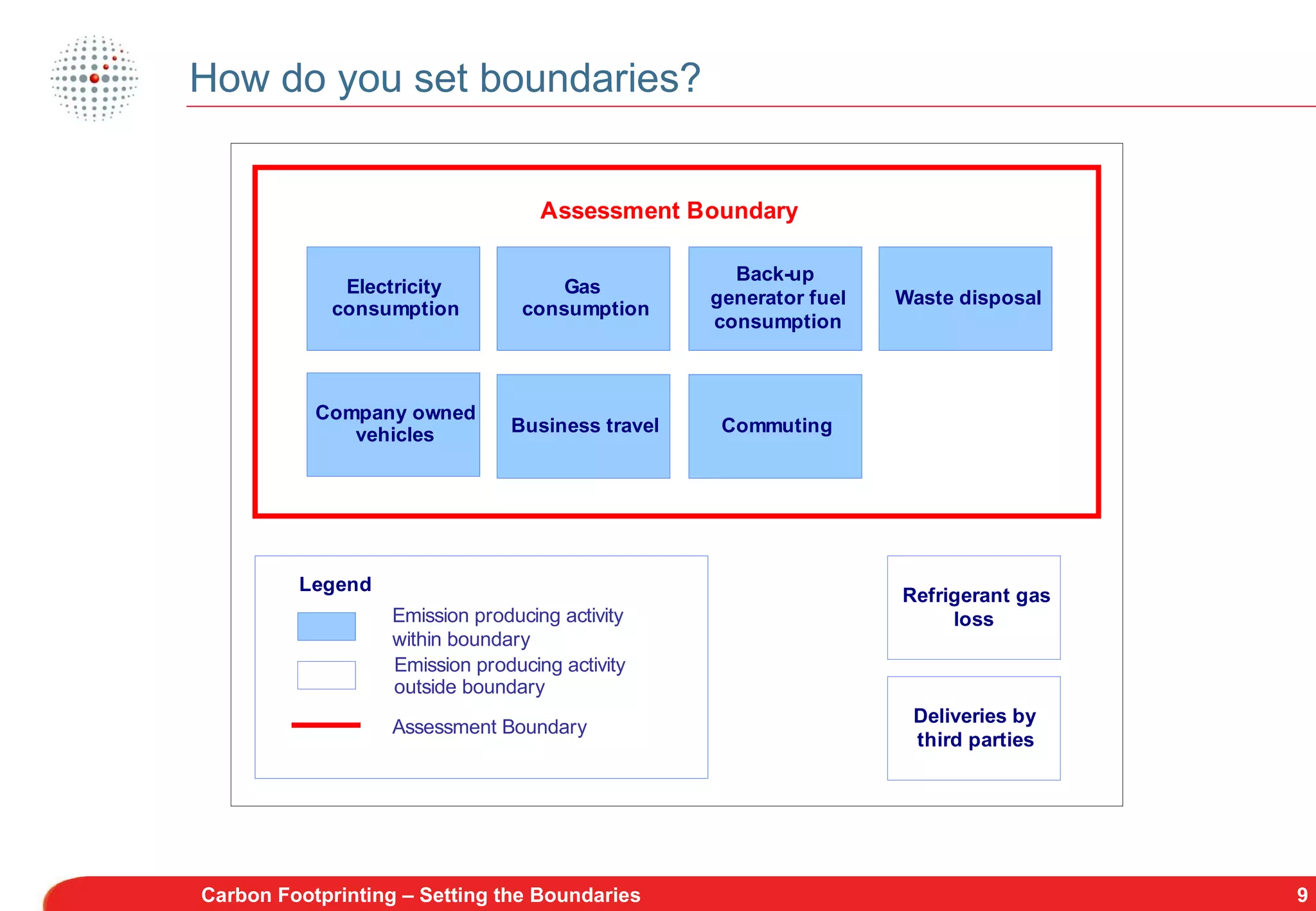
How do you set boundaries? Carbon Footprinting – Setting the Boundaries
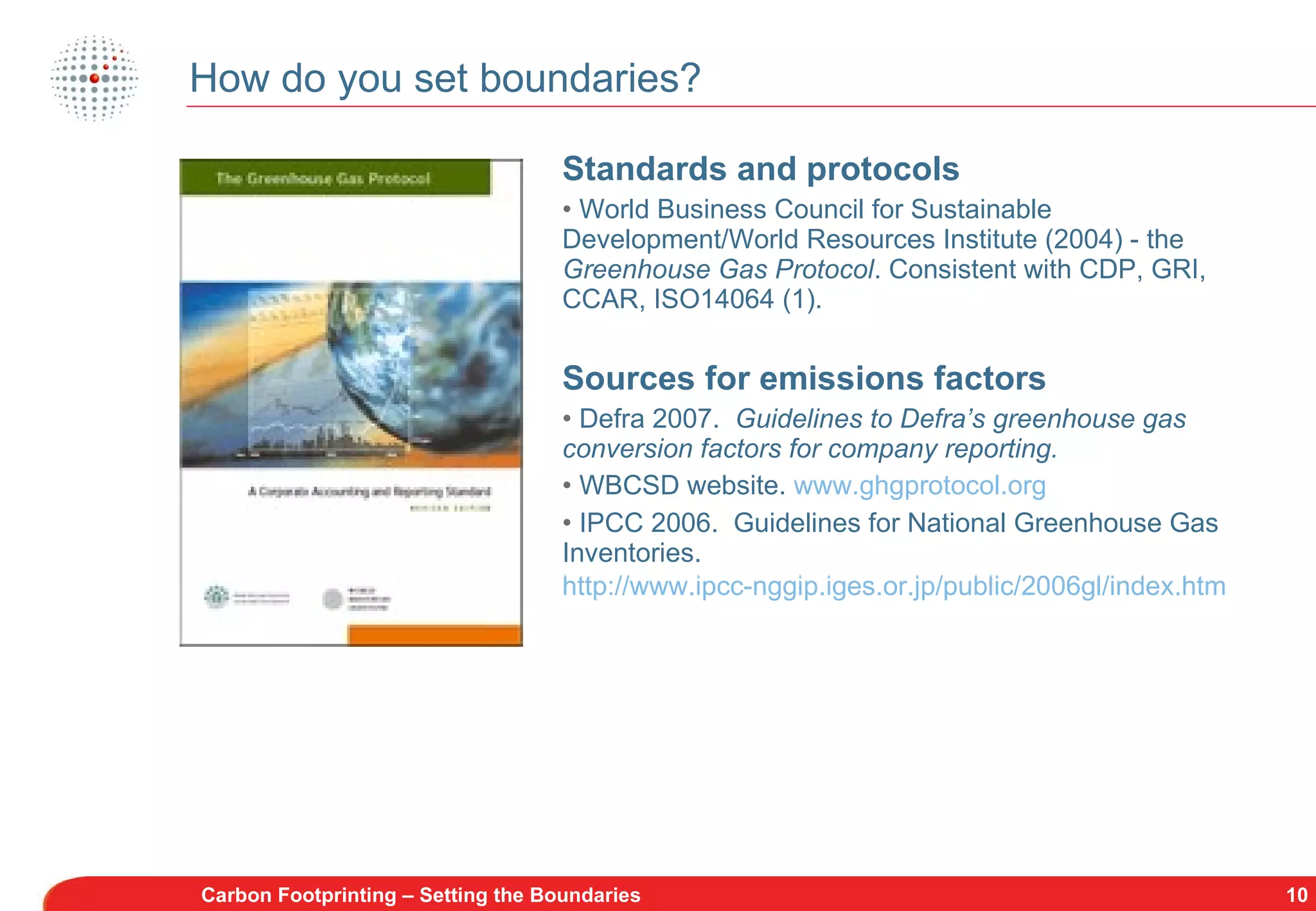
How do you set boundaries? Standards and protocols World Business Council for Sustainable Development/World Resources Institute (2004) - the  Greenhouse Gas Protocol . Consistent with CDP, GRI, CCAR, ISO14064 (1). Sources for emissions factors Defra 2007.   Guidelines to Defra’s greenhouse gas conversion factors for company reporting. WBCSD website.  www.ghgprotocol.org IPCC 2006.  Guidelines for National Greenhouse Gas Inventories.  http://www.ipcc-nggip.iges.or.jp/public/2006gl/index.htm   Carbon Footprinting – Setting the Boundaries
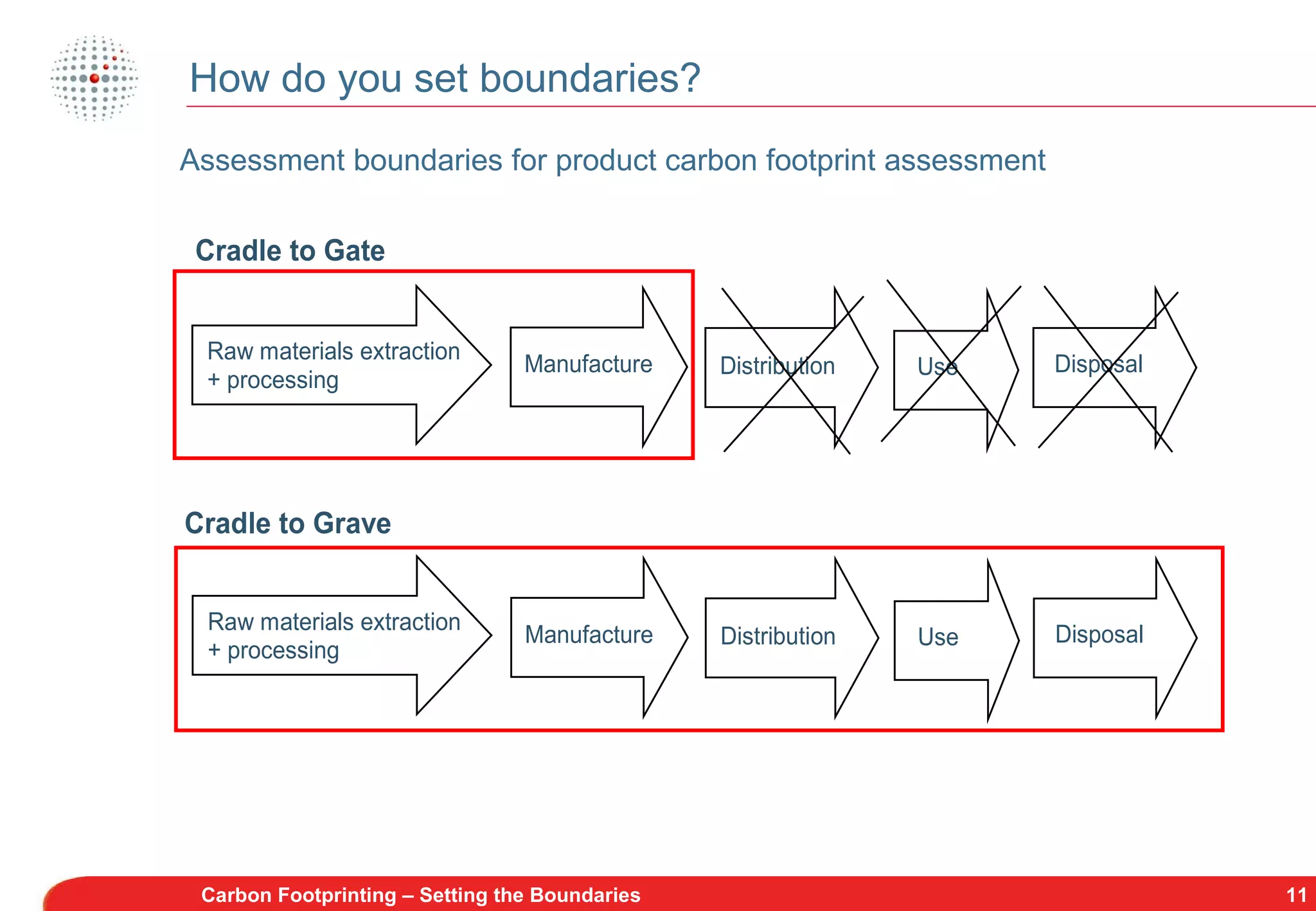
How do you set boundaries? Carbon Footprinting – Setting the Boundaries Assessment boundaries for product carbon footprint assessment
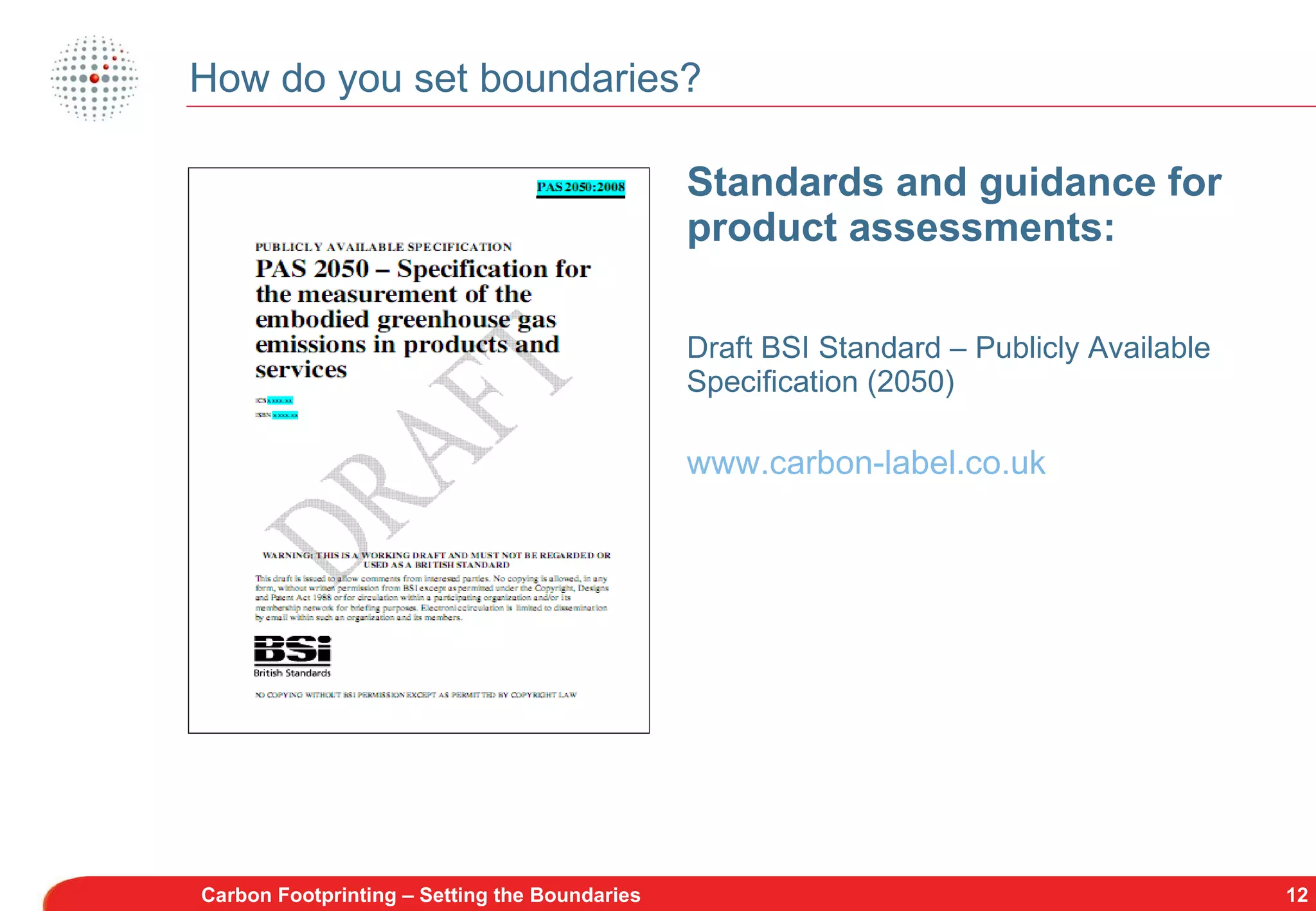
How do you set boundaries? Standards and guidance for product assessments: Draft BSI Standard – Publicly Available Specification (2050) www.carbon-label.co.uk Carbon Footprinting – Setting the Boundaries
Should we care about boundaries? Carbon Footprinting – Setting the Boundaries Does having a consistent set of boundaries for every organisation really matter? NO:  Emissions reductions are what we are trying to achieve, whether they are calculated correctly or not. The climate does not care if our sums are correct, it is only affected by receiving less CO2e. Waiting to start a reduction strategy until we have a globally agreed way forward is a waste of precious time that could be better spent making reductions now. YES:  If we charge on claiming reductions and communicating our emissions without a consistent methodology mistakes will be made and stakeholders will lose confidence in GHG reporting, management and reduction seeing it only as “Greenwash”.
Final Thoughts Carbon Footprinting – Setting the Boundaries GET ON WITH IT! The most valuable reductions are those made now – a tonne of avoided CO2 stays avoided so is not causing further warming each year. Setting boundaries is important for the sake of consistency and transparency but should not be a barrier to starting a reduction strategy.
Contact details: Email:  [email_address] Tel: 0131 666 5060 Web:  www.eccm.uk.com   Carbon Footprinting – Setting the Boundaries

Boundaries | Gary Davis

  • 1.
    Carbon Footprinting –Setting the Boundaries Edinburgh Centre for Carbon Management Gary Davis Carbon Footprinting – Setting the Boundaries
  • 2.
    Presentation outline Aboutthe Edinburgh Centre for Carbon Management (ECCM) Why do we set boundaries? How do we set boundaries? Should we care about boundaries? Carbon Footprinting – Setting the Boundaries
  • 3.
    About ECCM Originallya spin-off company from University of Edinburgh Part of a group of companies (Camco Group), specialising in different areas of climate change mitigation, e.g. sustainable buildings, renewables, energy efficiency, offset projects, and carbon trading. ECCM specialises in GHG emissions assessments or “carbon footprinting” (as well as other areas, e.g. land-use based emissions reductions, academic research) Track record in carbon footprinting: Over 800 UK and International emissions assessments Clients include: Scottish and Newcastle, Scottish Executive, BP, BOC Carbon Footprinting – Setting the Boundaries
  • 4.
    Why do weneed set boundaries? Four main reasons for calculating a carbon footprint: To manage the footprint and reduce emissions over time To accurately report emissions to a third-party (e.g. the public.) To compare your results with your peers To offset emissions (to go “carbon neutral”) Carbon Footprinting – Setting the Boundaries
  • 5.
    Why do weneed set boundaries? Common problems with Carbon Footprint results: Lack of transparency – what emissions sources are included in the scope? Doubling counting – two organisations reporting the same emissions Same organisations reporting a different scope from one year to the next Grey areas – long term leased vehicles, leased office space Carbon Footprinting – Setting the Boundaries
  • 6.
    Why do weneed set boundaries? Therefore setting boundaries is important because it allows us to achieve the following on a like for like basis: Define what an organisation will report/manage/reduce/offset Measure emissions and associated reductions from year to year Compare emissions between organisations Measuring and reporting consistently and transparently helps avoids accusations of “Greenwash” Carbon Footprinting – Setting the Boundaries
  • 7.
    How do youset boundaries? 3 main types of boundary 1. Organisational boundary (based on WBCSD/WRI GHG Protocol): Control Equity share 2. Operational boundary (based on WBCSD/WRI GHG Protocol): Scope One emissions Scope Two emissions Scope Three emissions 3. GHG Emissions included: CO2 only or all Kyoto gases (CH4, N2O, HFCs, PFCs, SF6) Carbon Footprinting – Setting the Boundaries
  • 8.
    How do youset boundaries? Carbon Footprinting – Setting the Boundaries Operational boundary
  • 9.
    How do youset boundaries? Carbon Footprinting – Setting the Boundaries
  • 10.
    How do youset boundaries? Standards and protocols World Business Council for Sustainable Development/World Resources Institute (2004) - the Greenhouse Gas Protocol . Consistent with CDP, GRI, CCAR, ISO14064 (1). Sources for emissions factors Defra 2007. Guidelines to Defra’s greenhouse gas conversion factors for company reporting. WBCSD website. www.ghgprotocol.org IPCC 2006. Guidelines for National Greenhouse Gas Inventories. http://www.ipcc-nggip.iges.or.jp/public/2006gl/index.htm Carbon Footprinting – Setting the Boundaries
  • 11.
    How do youset boundaries? Carbon Footprinting – Setting the Boundaries Assessment boundaries for product carbon footprint assessment
  • 12.
    How do youset boundaries? Standards and guidance for product assessments: Draft BSI Standard – Publicly Available Specification (2050) www.carbon-label.co.uk Carbon Footprinting – Setting the Boundaries
  • 13.
    Should we careabout boundaries? Carbon Footprinting – Setting the Boundaries Does having a consistent set of boundaries for every organisation really matter? NO: Emissions reductions are what we are trying to achieve, whether they are calculated correctly or not. The climate does not care if our sums are correct, it is only affected by receiving less CO2e. Waiting to start a reduction strategy until we have a globally agreed way forward is a waste of precious time that could be better spent making reductions now. YES: If we charge on claiming reductions and communicating our emissions without a consistent methodology mistakes will be made and stakeholders will lose confidence in GHG reporting, management and reduction seeing it only as “Greenwash”.
  • 14.
    Final Thoughts CarbonFootprinting – Setting the Boundaries GET ON WITH IT! The most valuable reductions are those made now – a tonne of avoided CO2 stays avoided so is not causing further warming each year. Setting boundaries is important for the sake of consistency and transparency but should not be a barrier to starting a reduction strategy.
  • 15.
    Contact details: Email: [email_address] Tel: 0131 666 5060 Web: www.eccm.uk.com Carbon Footprinting – Setting the Boundaries