Maintaining Rain-Gardens 
Lessons Learned from the 
Kansas State University 
Stormwater Management Project 
Lee R. Skabelund, Kansas State University 
Landscape Architecture / Regional & Community Planning 
Principal Investigator / Project Manager 
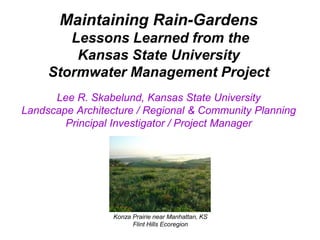
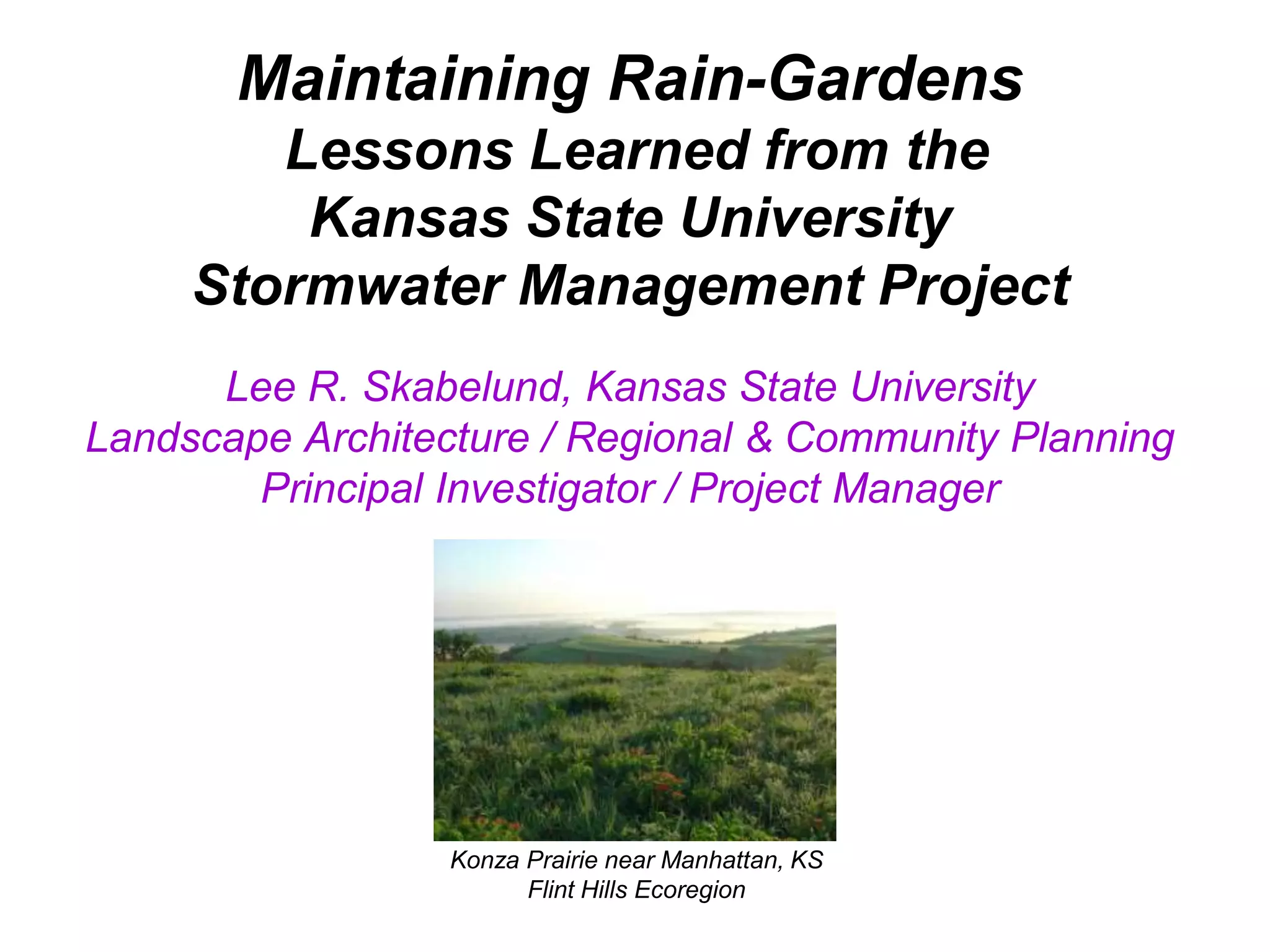
Konza Prairie near Manhattan, KS 
Flint Hills Ecoregion
Urban Stormwater Concerns 
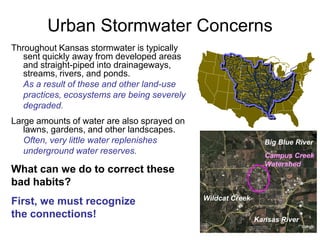
Throughout Kansas stormwater is typically 
sent quickly away from developed areas 
and straight-piped into drainageways, 
streams, rivers, and ponds. 
As a result of these and other land-use 
practices, ecosystems are being severely 
degraded. 
Large amounts of water are also sprayed on 
lawns, gardens, and other landscapes. 
Often, very little water replenishes 
underground water reserves. 
What can we do to correct these 
bad habits? 
First, we must recognize 
the connections! 
Big Blue River 
Campus Creek 
Watershed 
Wildcat Creek 
Kansas River
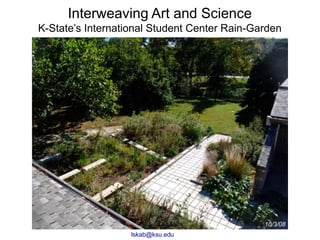
Interweaving Art and Science 
K-State’s International Student Center Rain-Garden 
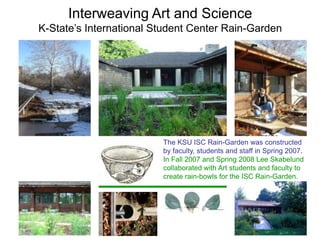
The KSU ISC Rain-Garden was constructed 
by faculty, students and staff in Spring 2007. 
In Fall 2007 and Spring 2008 Lee Skabelund 
collaborated with Art students and faculty to 
create rain-bowls for the ISC Rain-Garden.
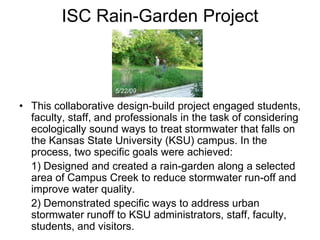
ISC Rain-Garden Project 
5/22/09 
• This collaborative design-build project engaged students, 
faculty, staff, and professionals in the task of considering 
ecologically sound ways to treat stormwater that falls on 
the Kansas State University (KSU) campus. In the 
process, two specific goals were achieved: 
1) Designed and created a rain-garden along a selected 
area of Campus Creek to reduce stormwater run-off and 
improve water quality. 
2) Demonstrated specific ways to address urban 
stormwater runoff to KSU administrators, staff, faculty, 
students, and visitors.
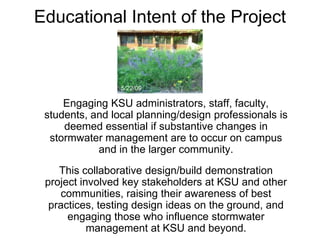
Educational Intent of the Project 
5/22/09 
Engaging KSU administrators, staff, faculty, 
students, and local planning/design professionals is 
deemed essential if substantive changes in 
stormwater management are to occur on campus 
and in the larger community. 
This collaborative design/build demonstration 
project involved key stakeholders at KSU and other 
communities, raising their awareness of best 
practices, testing design ideas on the ground, and 
engaging those who influence stormwater 
management at KSU and beyond.
Rain-Garden Maintenance: 
Key Ideas to Remember: 
1) Rain-Gardens need to be maintained (there is no free 
lunch when it comes to maintaining gardens and created or 
disrupted landscapes). 
2) Weeding is essential (although a good hardwood mulch 
can reduce the number of weeds and make weeding easier). 
Fertilizing is not needed if you use plants adapted to the 
region and site. Pruning is rarely needed, though you will 
likely want to clip back perennials before spring (you may 
wish to transplant and water in seedlings and/or remove more 
aggressive perennials if they begin to dominate your garden). 
3) Watering during the first growing season is vital (try to 
strike a balance between providing too much and too little 
water). If you choose plants well-adapted to your eco-region 
and specific site, no watering should be needed 
once the plants are established. Check for exposed soil and 
erosion, and add an organic weed-free mulch. If too much 
sediment is flowing into the garden find the source and 
stabilize the area (if needed, you may need to reduce the 
volume or intensity of stormwater flowing into the garden). 
4) Draw upon the experience of others, including folks on 
the east coast, mid-west, Rocky Mountains & west coast.
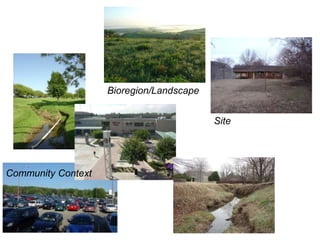
Bioregion/Landscape 
Community Context 
Site
Integrate Your Rain-Garden 
into your eco-region and site 
Key Ideas to Remember: 
1) Create a rain-garden that makes sense for your site (size of 
property, structures and impermeable surfaces; location; soil and 
sun/shade conditions; etc.) and your maintenance capabilities. 
2) Learn what the “weeds” and invasive species are in your area 
and prepare to remove them from your garden as soon as possible. 
3) Choose plants that can handle water and drought. In Kansas 
our native prairie species are typically best and many these perennial 
plants of these can be obtained from nurseries such as Kaw River 
Restoration Nurseries in Lawrence (http://www.appliedeco.com/krrn/) 
and the Prairie & Wetland Center (http://www.critsite.com/). 
For more native plant nursery/supplier options refer to: 
http://www.kansasnativeplantsociety.org/plant_resources.htm 
4) Learn from others and from your own experiences (think big, 
think small; be practical, be ambitious, be creative; know your budget 
and institutional capacity; have a lot of fun working with soil, water and 
plants; save water and energy; learn a bunch along the way).
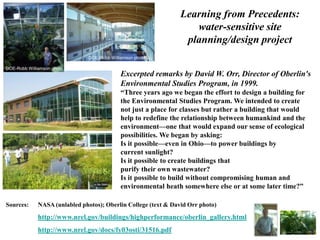
DOE-Robb Williamson photo 
Excerpted remarks by David W. Orr, Director of Oberlin's 
Environmental Studies Program, in 1999. 
“Three years ago we began the effort to design a building for 
the Environmental Studies Program. We intended to create 
not just a place for classes but rather a building that would 
help to redefine the relationship between humankind and the 
environment—one that would expand our sense of ecological 
possibilities. We began by asking: 
Is it possible—even in Ohio—to power buildings by 
current sunlight? 
Is it possible to create buildings that 
purify their own wastewater? 
Is it possible to build without compromising human and 
environmental heath somewhere else or at some later time?” 
DOE-Robb Williamson photo 
Sources: NASA (unlabled photos); Oberlin College (text & David Orr photo) 
http://www.nrel.gov/buildings/highperformance/oberlin_gallery.html 
http://www.nrel.gov/docs/fy03osti/31516.pdf 
Learning from Precedents: 
water-sensitive site 
planning/design project
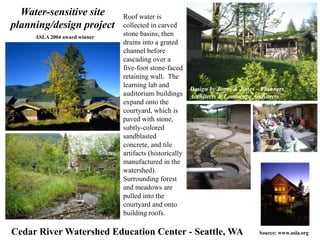
Roof water is 
collected in carved 
stone basins, then 
drains into a grated 
channel before 
cascading over a 
five-foot stone-faced 
retaining wall. The 
learning lab and 
auditorium buildings 
expand onto the 
courtyard, which is 
paved with stone, 
subtly-colored 
sandblasted 
concrete, and tile 
artifacts (historically 
manufactured in the 
watershed). 
Surrounding forest 
and meadows are 
pulled into the 
courtyard and onto 
building roofs. 
Water-sensitive site 
planning/design project 
Design by Jones & Jones – Planners, 
Architects & Landscape Architects 
ASLA 2004 award winner 
Cedar River Watershed Education Center - Seattle, WA Source: www.asla.org
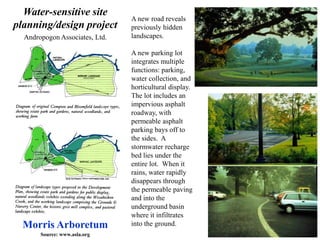
A new road reveals 
previously hidden 
landscapes. 
A new parking lot 
integrates multiple 
functions: parking, 
water collection, and 
horticultural display. 
The lot includes an 
impervious asphalt 
roadway, with 
permeable asphalt 
parking bays off to 
the sides. A 
stormwater recharge 
bed lies under the 
entire lot. When it 
rains, water rapidly 
disappears through 
the permeable paving 
and into the 
underground basin 
where it infiltrates 
into the ground. 
Water-sensitive site 
planning/design project 
Andropogon Associates, Ltd. 
Morris Arboretum 
Source: www.asla.org
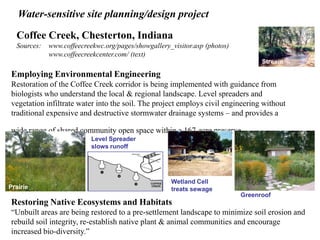
Water-sensitive site planning/design project 
Coffee Creek, Chesterton, Indiana 
Sources: www.coffeecreekwc.org/pages/showgallery_visitor.asp (photos) 
www.coffeecreekcenter.com/ (text) 
Stream 
Employing Environmental Engineering 
Restoration of the Coffee Creek corridor is being implemented with guidance from 
biologists who understand the local & regional landscape. Level spreaders and 
vegetation infiltrate water into the soil. The project employs civil engineering without 
traditional expensive and destructive stormwater drainage systems – and provides a 
wide range of shared community open space within a 167-acre preserve. 
Level Spreader 
slows runoff 
Wetland Cell 
treats sewage 
Greenroof 
Prairie 
Restoring Native Ecosystems and Habitats 
“Unbuilt areas are being restored to a pre-settlement landscape to minimize soil erosion and 
rebuild soil integrity, re-establish native plant & animal communities and encourage 
increased bio-diversity.”
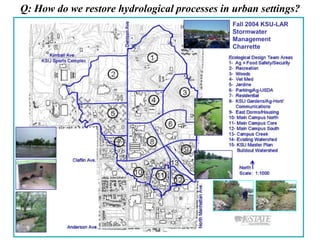
Q: How do we restore hydrological processes in urban settings? 
Fall 2004 KSU-LAR 
Stormwater 
Management 
Charrette
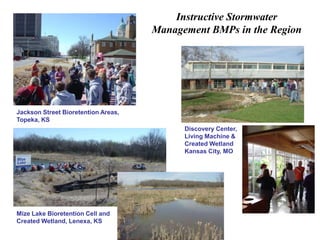
Instructive Stormwater 
Management BMPs in the Region 
Jackson Street Bioretention Areas, 
Topeka, KS 
Mize Lake Bioretention Cell and 
Created Wetland, Lenexa, KS 
Discovery Center, 
Living Machine & 
Created Wetland 
Kansas City, MO
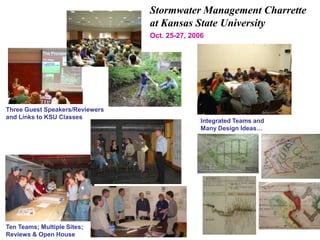
Three Guest Speakers/Reviewers 
and Links to KSU Classes 
Stormwater Management Charrette 
at Kansas State University 
Oct. 25-27, 2006 
Ten Teams; Multiple Sites; 
Reviews & Open House 
Integrated Teams and 
Many Design Ideas…
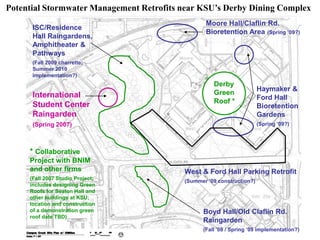
Potential Stormwater Management Retrofits near KSU’s Derby Dining Complex 
Moore Hall/Claflin Rd. 
Bioretention Area (Spring ’09?) 
Haymaker & 
Ford Hall 
Bioretention 
Gardens 
(Spring ’09?) 
Derby 
Green 
Roof * 
International 
Student Center 
Raingarden 
(Spring 2007) 
West & Ford Hall Parking Retrofit 
(Summer ’09 construction?) 
Boyd Hall/Old Claflin Rd. 
Raingarden 
(Fall ’08 / Spring ’09 implementation?) 
ISC/Residence 
Hall Raingardens, 
Amphitheater & 
Pathways 
(Fall 2009 charrette; 
Summer 2010 
implementation?) 
* Collaborative 
Project with BNIM 
and other firms 
(Fall 2007 Studio Project; 
includes designing Green 
Roofs for Seaton Hall and 
other buildings at KSU; 
location and construction 
of a demonstration green 
roof date TBD)
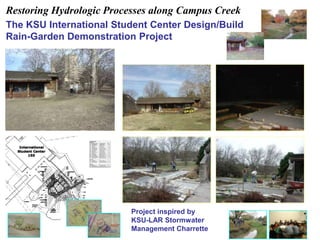
Restoring Hydrologic Processes along Campus Creek 
The KSU International Student Center Design/Build 
Rain-Garden Demonstration Project 
Project inspired by 
KSU-LAR Stormwater 
Management Charrette
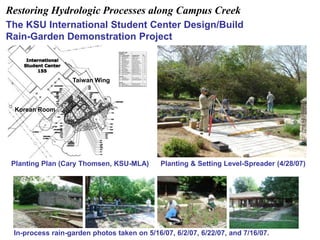
Restoring Hydrologic Processes along Campus Creek 
The KSU International Student Center Design/Build 
Rain-Garden Demonstration Project 
Taiwan Wing 
Korean Room 
Planting Plan (Cary Thomsen, KSU-MLA) Planting & Setting Level-Spreader (4/28/07) 
In-process rain-garden photos taken on 5/16/07, 6/2/07, 6/22/07, and 7/16/07.
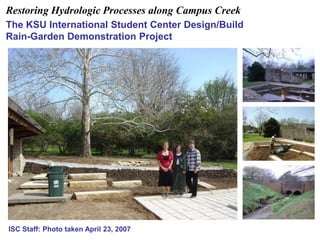
Restoring Hydrologic Processes along Campus Creek 
The KSU International Student Center Design/Build 
Rain-Garden Demonstration Project 
ISC Staff: Photo taken April 23, 2007
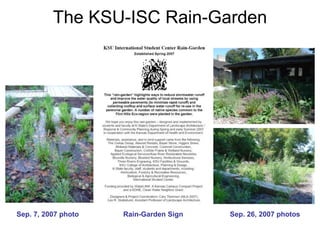
The KSU-ISC Rain-Garden 
Sep. 7, 2007 photo Rain-Garden Sign Sep. 26, 2007 photos
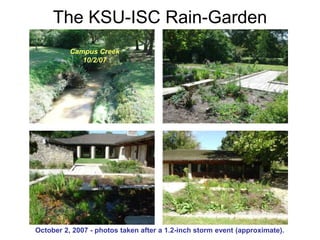
The KSU-ISC Rain-Garden 
Campus Creek 
10/2/07 
October 2, 2007 - photos taken after a 1.2-inch storm event (approximate).
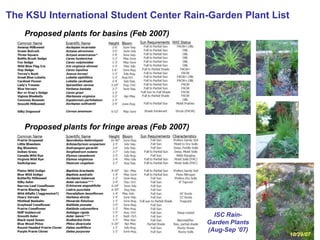
The KSU International Student Center Rain-Garden Plant List 
Proposed plants for basins (Feb 2007) 
Proposed plants for fringe areas (Feb 2007) 
ISC Rain- 
Garden Plants 
(Aug-Sep ’07) 
10/29/07
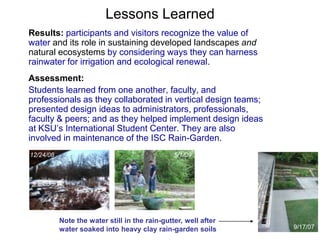
Lessons Learned 
Results: participants and visitors recognize the value of 
water and its role in sustaining developed landscapes and 
natural ecosystems by considering ways they can harness 
rainwater for irrigation and ecological renewal. 
Assessment: 
Students learned from one another, faculty, and 
professionals as they collaborated in vertical design teams; 
presented design ideas to administrators, professionals, 
faculty & peers; and as they helped implement design ideas 
at KSU’s International Student Center. They are also 
involved in maintenance of the ISC Rain-Garden. 
9/17/07 
12/24/08 5/1/09 
Note the water still in the rain-gutter, well after 
water soaked into heavy clay rain-garden soils
KSU Green Roof Design – Fall 2007 
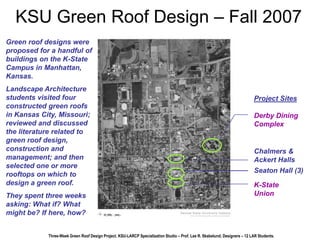
Green roof designs were 
proposed for a handful of 
buildings on the K-State 
Campus in Manhattan, 
Kansas. 
Landscape Architecture 
students visited four 
constructed green roofs 
in Kansas City, Missouri; 
reviewed and discussed 
the literature related to 
green roof design, 
construction and 
management; and then 
selected one or more 
rooftops on which to 
design a green roof. 
They spent three weeks 
asking: What if? What 
might be? If here, how? 
Project Sites 
Derby Dining 
Complex 
Chalmers & 
Ackert Halls 
Seaton Hall (3) 
K-State 
Union 
Three-Week Green Roof Design Project, KSU-LARCP Specialization Studio – Prof. Lee R. Skabelund; Designers – 12 LAR Students.
KSU Green Roof Design – Fall 2007 
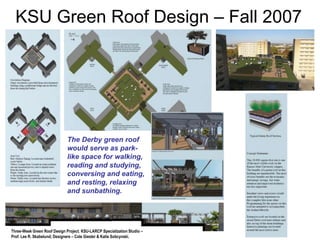
The Derby green roof 
would serve as park-like 
space for walking, 
reading and studying, 
conversing and eating, 
and resting, relaxing 
and sunbathing. 
Three-Week Green Roof Design Project, KSU-LARCP Specialization Studio – 
Prof. Lee R. Skabelund; Designers – Cole Giesler & Katie Sobcynski.
KSU Green Roof Design – Fall 2007 
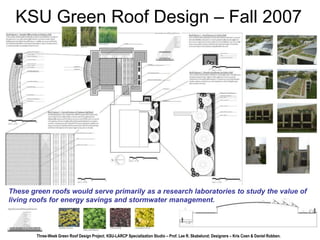
These green roofs would serve primarily as a research laboratories to study the value of 
living roofs for energy savings and stormwater management. 
Three-Week Green Roof Design Project, KSU-LARCP Specialization Studio – Prof. Lee R. Skabelund; Designers – Kris Coen & Daniel Robben.
KSU Green Roof Design – Fall 2007 
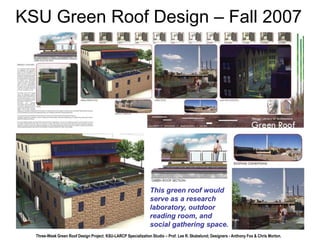
This green roof would 
serve as a research 
laboratory, outdoor 
reading room, and 
social gathering space. 
Three-Week Green Roof Design Project, KSU-LARCP Specialization Studio – Prof. Lee R. Skabelund; Designers - Anthony Fox & Chris Morton.
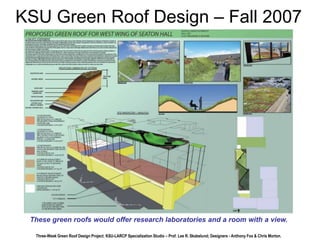
KSU Green Roof Design – Fall 2007 
These green roofs would offer research laboratories and a room with a view. 
Three-Week Green Roof Design Project, KSU-LARCP Specialization Studio – Prof. Lee R. Skabelund; Designers - Anthony Fox & Chris Morton.
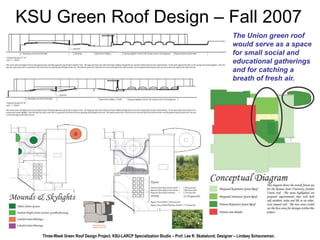
KSU Green Roof Design – Fall 2007 
The Union green roof 
would serve as a space 
for small social and 
educational gatherings 
and for catching a 
breath of fresh air. 
Three-Week Green Roof Design Project, KSU-LARCP Specialization Studio – Prof. Lee R. Skabelund; Designer – Lindsey Scheuneman.
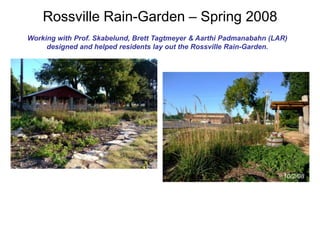
Rossville Rain-Garden – Spring 2008 
Working with Prof. Skabelund, Brett Tagtmeyer & Aarthi Padmanabahn (LAR) 
designed and helped residents lay out the Rossville Rain-Garden. 
10/2/08
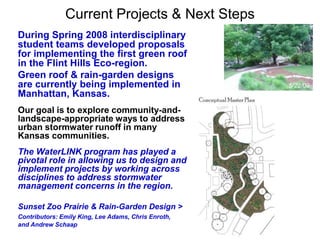
Current Projects & Next Steps 
During Spring 2008 interdisciplinary 
student teams developed proposals 
for implementing the first green roof 
in the Flint Hills Eco-region. 
Green roof & rain-garden designs 
are currently being implemented in 
Manhattan, Kansas. 
Our goal is to explore community-and-landscape- 
appropriate ways to address 
urban stormwater runoff in many 
Kansas communities. 
The WaterLINK program has played a 
pivotal role in allowing us to design and 
implement projects by working across 
disciplines to address stormwater 
management concerns in the region. 
Sunset Zoo Prairie & Rain-Garden Design > 
Contributors: Emily King, Lee Adams, Chris Enroth, 
and Andrew Schaap 
5/22/09
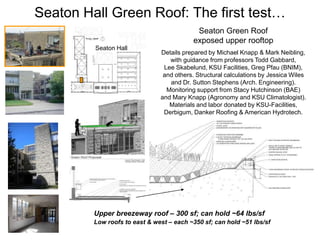
Seaton Hall Green Roof: The first test… 
Seaton Hall 
Seaton Green Roof 
exposed upper rooftop 
Details prepared by Michael Knapp & Mark Neibling, 
with guidance from professors Todd Gabbard, 
Lee Skabelund, KSU Facilities, Greg Pfau (BNIM), 
and others. Structural calculations by Jessica Wiles 
and Dr. Sutton Stephens (Arch. Engineering). 
Monitoring support from Stacy Hutchinson (BAE) 
and Mary Knapp (Agronomy and KSU Climatologist). 
Materials and labor donated by KSU-Facilities, 
Derbigum, Danker Roofing & American Hydrotech. 
Upper breezeway roof – 300 sf; can hold ~64 lbs/sf 
Low roofs to east & west – each ~350 sf; can hold ~51 lbs/sf
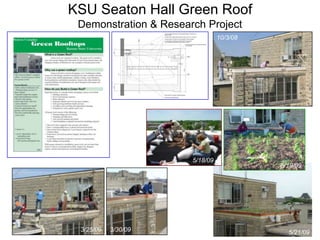
KSU Seaton Hall Green Roof 
Demonstration & Research Project 
10/3/08 
5/18/09 
5/19/09 
3/25/09 3/30/09 5/21/09
Interweaving Art and Science 
K-State’s International Student Center Rain-Garden 
10/3/08 
lskab@ksu.edu

Maintaining Rain Gardens: Lessons Learned from Kansas State University

  • 1.
    Maintaining Rain-Gardens LessonsLearned from the Kansas State University Stormwater Management Project Lee R. Skabelund, Kansas State University Landscape Architecture / Regional & Community Planning Principal Investigator / Project Manager Konza Prairie near Manhattan, KS Flint Hills Ecoregion
  • 2.
    Urban Stormwater Concerns Throughout Kansas stormwater is typically sent quickly away from developed areas and straight-piped into drainageways, streams, rivers, and ponds. As a result of these and other land-use practices, ecosystems are being severely degraded. Large amounts of water are also sprayed on lawns, gardens, and other landscapes. Often, very little water replenishes underground water reserves. What can we do to correct these bad habits? First, we must recognize the connections! Big Blue River Campus Creek Watershed Wildcat Creek Kansas River
  • 3.
    Interweaving Art andScience K-State’s International Student Center Rain-Garden The KSU ISC Rain-Garden was constructed by faculty, students and staff in Spring 2007. In Fall 2007 and Spring 2008 Lee Skabelund collaborated with Art students and faculty to create rain-bowls for the ISC Rain-Garden.
  • 4.
    ISC Rain-Garden Project 5/22/09 • This collaborative design-build project engaged students, faculty, staff, and professionals in the task of considering ecologically sound ways to treat stormwater that falls on the Kansas State University (KSU) campus. In the process, two specific goals were achieved: 1) Designed and created a rain-garden along a selected area of Campus Creek to reduce stormwater run-off and improve water quality. 2) Demonstrated specific ways to address urban stormwater runoff to KSU administrators, staff, faculty, students, and visitors.
  • 5.
    Educational Intent ofthe Project 5/22/09 Engaging KSU administrators, staff, faculty, students, and local planning/design professionals is deemed essential if substantive changes in stormwater management are to occur on campus and in the larger community. This collaborative design/build demonstration project involved key stakeholders at KSU and other communities, raising their awareness of best practices, testing design ideas on the ground, and engaging those who influence stormwater management at KSU and beyond.
  • 6.
    Rain-Garden Maintenance: KeyIdeas to Remember: 1) Rain-Gardens need to be maintained (there is no free lunch when it comes to maintaining gardens and created or disrupted landscapes). 2) Weeding is essential (although a good hardwood mulch can reduce the number of weeds and make weeding easier). Fertilizing is not needed if you use plants adapted to the region and site. Pruning is rarely needed, though you will likely want to clip back perennials before spring (you may wish to transplant and water in seedlings and/or remove more aggressive perennials if they begin to dominate your garden). 3) Watering during the first growing season is vital (try to strike a balance between providing too much and too little water). If you choose plants well-adapted to your eco-region and specific site, no watering should be needed once the plants are established. Check for exposed soil and erosion, and add an organic weed-free mulch. If too much sediment is flowing into the garden find the source and stabilize the area (if needed, you may need to reduce the volume or intensity of stormwater flowing into the garden). 4) Draw upon the experience of others, including folks on the east coast, mid-west, Rocky Mountains & west coast.
  • 7.
  • 8.
    Integrate Your Rain-Garden into your eco-region and site Key Ideas to Remember: 1) Create a rain-garden that makes sense for your site (size of property, structures and impermeable surfaces; location; soil and sun/shade conditions; etc.) and your maintenance capabilities. 2) Learn what the “weeds” and invasive species are in your area and prepare to remove them from your garden as soon as possible. 3) Choose plants that can handle water and drought. In Kansas our native prairie species are typically best and many these perennial plants of these can be obtained from nurseries such as Kaw River Restoration Nurseries in Lawrence (http://www.appliedeco.com/krrn/) and the Prairie & Wetland Center (http://www.critsite.com/). For more native plant nursery/supplier options refer to: http://www.kansasnativeplantsociety.org/plant_resources.htm 4) Learn from others and from your own experiences (think big, think small; be practical, be ambitious, be creative; know your budget and institutional capacity; have a lot of fun working with soil, water and plants; save water and energy; learn a bunch along the way).
  • 9.
    DOE-Robb Williamson photo Excerpted remarks by David W. Orr, Director of Oberlin's Environmental Studies Program, in 1999. “Three years ago we began the effort to design a building for the Environmental Studies Program. We intended to create not just a place for classes but rather a building that would help to redefine the relationship between humankind and the environment—one that would expand our sense of ecological possibilities. We began by asking: Is it possible—even in Ohio—to power buildings by current sunlight? Is it possible to create buildings that purify their own wastewater? Is it possible to build without compromising human and environmental heath somewhere else or at some later time?” DOE-Robb Williamson photo Sources: NASA (unlabled photos); Oberlin College (text & David Orr photo) http://www.nrel.gov/buildings/highperformance/oberlin_gallery.html http://www.nrel.gov/docs/fy03osti/31516.pdf Learning from Precedents: water-sensitive site planning/design project
  • 10.
    Roof water is collected in carved stone basins, then drains into a grated channel before cascading over a five-foot stone-faced retaining wall. The learning lab and auditorium buildings expand onto the courtyard, which is paved with stone, subtly-colored sandblasted concrete, and tile artifacts (historically manufactured in the watershed). Surrounding forest and meadows are pulled into the courtyard and onto building roofs. Water-sensitive site planning/design project Design by Jones & Jones – Planners, Architects & Landscape Architects ASLA 2004 award winner Cedar River Watershed Education Center - Seattle, WA Source: www.asla.org
  • 11.
    A new roadreveals previously hidden landscapes. A new parking lot integrates multiple functions: parking, water collection, and horticultural display. The lot includes an impervious asphalt roadway, with permeable asphalt parking bays off to the sides. A stormwater recharge bed lies under the entire lot. When it rains, water rapidly disappears through the permeable paving and into the underground basin where it infiltrates into the ground. Water-sensitive site planning/design project Andropogon Associates, Ltd. Morris Arboretum Source: www.asla.org
  • 12.
    Water-sensitive site planning/designproject Coffee Creek, Chesterton, Indiana Sources: www.coffeecreekwc.org/pages/showgallery_visitor.asp (photos) www.coffeecreekcenter.com/ (text) Stream Employing Environmental Engineering Restoration of the Coffee Creek corridor is being implemented with guidance from biologists who understand the local & regional landscape. Level spreaders and vegetation infiltrate water into the soil. The project employs civil engineering without traditional expensive and destructive stormwater drainage systems – and provides a wide range of shared community open space within a 167-acre preserve. Level Spreader slows runoff Wetland Cell treats sewage Greenroof Prairie Restoring Native Ecosystems and Habitats “Unbuilt areas are being restored to a pre-settlement landscape to minimize soil erosion and rebuild soil integrity, re-establish native plant & animal communities and encourage increased bio-diversity.”
  • 13.
    Q: How dowe restore hydrological processes in urban settings? Fall 2004 KSU-LAR Stormwater Management Charrette
  • 14.
    Instructive Stormwater ManagementBMPs in the Region Jackson Street Bioretention Areas, Topeka, KS Mize Lake Bioretention Cell and Created Wetland, Lenexa, KS Discovery Center, Living Machine & Created Wetland Kansas City, MO
  • 15.
    Three Guest Speakers/Reviewers and Links to KSU Classes Stormwater Management Charrette at Kansas State University Oct. 25-27, 2006 Ten Teams; Multiple Sites; Reviews & Open House Integrated Teams and Many Design Ideas…
  • 16.
    Potential Stormwater ManagementRetrofits near KSU’s Derby Dining Complex Moore Hall/Claflin Rd. Bioretention Area (Spring ’09?) Haymaker & Ford Hall Bioretention Gardens (Spring ’09?) Derby Green Roof * International Student Center Raingarden (Spring 2007) West & Ford Hall Parking Retrofit (Summer ’09 construction?) Boyd Hall/Old Claflin Rd. Raingarden (Fall ’08 / Spring ’09 implementation?) ISC/Residence Hall Raingardens, Amphitheater & Pathways (Fall 2009 charrette; Summer 2010 implementation?) * Collaborative Project with BNIM and other firms (Fall 2007 Studio Project; includes designing Green Roofs for Seaton Hall and other buildings at KSU; location and construction of a demonstration green roof date TBD)
  • 17.
    Restoring Hydrologic Processesalong Campus Creek The KSU International Student Center Design/Build Rain-Garden Demonstration Project Project inspired by KSU-LAR Stormwater Management Charrette
  • 18.
    Restoring Hydrologic Processesalong Campus Creek The KSU International Student Center Design/Build Rain-Garden Demonstration Project Taiwan Wing Korean Room Planting Plan (Cary Thomsen, KSU-MLA) Planting & Setting Level-Spreader (4/28/07) In-process rain-garden photos taken on 5/16/07, 6/2/07, 6/22/07, and 7/16/07.
  • 19.
    Restoring Hydrologic Processesalong Campus Creek The KSU International Student Center Design/Build Rain-Garden Demonstration Project ISC Staff: Photo taken April 23, 2007
  • 20.
    The KSU-ISC Rain-Garden Sep. 7, 2007 photo Rain-Garden Sign Sep. 26, 2007 photos
  • 21.
    The KSU-ISC Rain-Garden Campus Creek 10/2/07 October 2, 2007 - photos taken after a 1.2-inch storm event (approximate).
  • 22.
    The KSU InternationalStudent Center Rain-Garden Plant List Proposed plants for basins (Feb 2007) Proposed plants for fringe areas (Feb 2007) ISC Rain- Garden Plants (Aug-Sep ’07) 10/29/07
  • 23.
    Lessons Learned Results:participants and visitors recognize the value of water and its role in sustaining developed landscapes and natural ecosystems by considering ways they can harness rainwater for irrigation and ecological renewal. Assessment: Students learned from one another, faculty, and professionals as they collaborated in vertical design teams; presented design ideas to administrators, professionals, faculty & peers; and as they helped implement design ideas at KSU’s International Student Center. They are also involved in maintenance of the ISC Rain-Garden. 9/17/07 12/24/08 5/1/09 Note the water still in the rain-gutter, well after water soaked into heavy clay rain-garden soils
  • 24.
    KSU Green RoofDesign – Fall 2007 Green roof designs were proposed for a handful of buildings on the K-State Campus in Manhattan, Kansas. Landscape Architecture students visited four constructed green roofs in Kansas City, Missouri; reviewed and discussed the literature related to green roof design, construction and management; and then selected one or more rooftops on which to design a green roof. They spent three weeks asking: What if? What might be? If here, how? Project Sites Derby Dining Complex Chalmers & Ackert Halls Seaton Hall (3) K-State Union Three-Week Green Roof Design Project, KSU-LARCP Specialization Studio – Prof. Lee R. Skabelund; Designers – 12 LAR Students.
  • 25.
    KSU Green RoofDesign – Fall 2007 The Derby green roof would serve as park-like space for walking, reading and studying, conversing and eating, and resting, relaxing and sunbathing. Three-Week Green Roof Design Project, KSU-LARCP Specialization Studio – Prof. Lee R. Skabelund; Designers – Cole Giesler & Katie Sobcynski.
  • 26.
    KSU Green RoofDesign – Fall 2007 These green roofs would serve primarily as a research laboratories to study the value of living roofs for energy savings and stormwater management. Three-Week Green Roof Design Project, KSU-LARCP Specialization Studio – Prof. Lee R. Skabelund; Designers – Kris Coen & Daniel Robben.
  • 27.
    KSU Green RoofDesign – Fall 2007 This green roof would serve as a research laboratory, outdoor reading room, and social gathering space. Three-Week Green Roof Design Project, KSU-LARCP Specialization Studio – Prof. Lee R. Skabelund; Designers - Anthony Fox & Chris Morton.
  • 28.
    KSU Green RoofDesign – Fall 2007 These green roofs would offer research laboratories and a room with a view. Three-Week Green Roof Design Project, KSU-LARCP Specialization Studio – Prof. Lee R. Skabelund; Designers - Anthony Fox & Chris Morton.
  • 29.
    KSU Green RoofDesign – Fall 2007 The Union green roof would serve as a space for small social and educational gatherings and for catching a breath of fresh air. Three-Week Green Roof Design Project, KSU-LARCP Specialization Studio – Prof. Lee R. Skabelund; Designer – Lindsey Scheuneman.
  • 30.
    Rossville Rain-Garden –Spring 2008 Working with Prof. Skabelund, Brett Tagtmeyer & Aarthi Padmanabahn (LAR) designed and helped residents lay out the Rossville Rain-Garden. 10/2/08
  • 31.
    Current Projects &Next Steps During Spring 2008 interdisciplinary student teams developed proposals for implementing the first green roof in the Flint Hills Eco-region. Green roof & rain-garden designs are currently being implemented in Manhattan, Kansas. Our goal is to explore community-and-landscape- appropriate ways to address urban stormwater runoff in many Kansas communities. The WaterLINK program has played a pivotal role in allowing us to design and implement projects by working across disciplines to address stormwater management concerns in the region. Sunset Zoo Prairie & Rain-Garden Design > Contributors: Emily King, Lee Adams, Chris Enroth, and Andrew Schaap 5/22/09
  • 32.
    Seaton Hall GreenRoof: The first test… Seaton Hall Seaton Green Roof exposed upper rooftop Details prepared by Michael Knapp & Mark Neibling, with guidance from professors Todd Gabbard, Lee Skabelund, KSU Facilities, Greg Pfau (BNIM), and others. Structural calculations by Jessica Wiles and Dr. Sutton Stephens (Arch. Engineering). Monitoring support from Stacy Hutchinson (BAE) and Mary Knapp (Agronomy and KSU Climatologist). Materials and labor donated by KSU-Facilities, Derbigum, Danker Roofing & American Hydrotech. Upper breezeway roof – 300 sf; can hold ~64 lbs/sf Low roofs to east & west – each ~350 sf; can hold ~51 lbs/sf
  • 33.
    KSU Seaton HallGreen Roof Demonstration & Research Project 10/3/08 5/18/09 5/19/09 3/25/09 3/30/09 5/21/09
  • 34.
    Interweaving Art andScience K-State’s International Student Center Rain-Garden 10/3/08 lskab@ksu.edu