LEARNING STYLES: 
RESEARCH AND EXPERT 
OPINION 
Charles B. Hodges, Ph.D.
PURPOSE 
The purpose of this collection of slides is to 
provide a reference for individuals who want 
a quick glimpse into the research base 
regarding learning styles.
CHARGE 
There are many opinions and beliefs regarding 
learning styles in Education. I urge you to move 
away from beliefs and opinions that are not 
formed from a careful exploration of the 
scholarly works on the topic. The information 
in these slides is a starting point for your 
exploration.
MORRISON, ROSS, KALMAN, & KEMP 
“Despite the extensive literature on learning styles, 
questions remain regarding the degree to which such 
styles can be matched to teaching methods with any 
benefits to learning (Knight, Halpin & Halpin, 1992; 
Park & Lee, 2004; Snow 1992). ” (p. 59) 
Morrison, G.R., Ross, S.M., Kalman, H.K., & Kemp, J.E. (2011). Designing effective 
instruction (6th ed.). Hoboken, NJ: John Wiley & Sons, Inc.
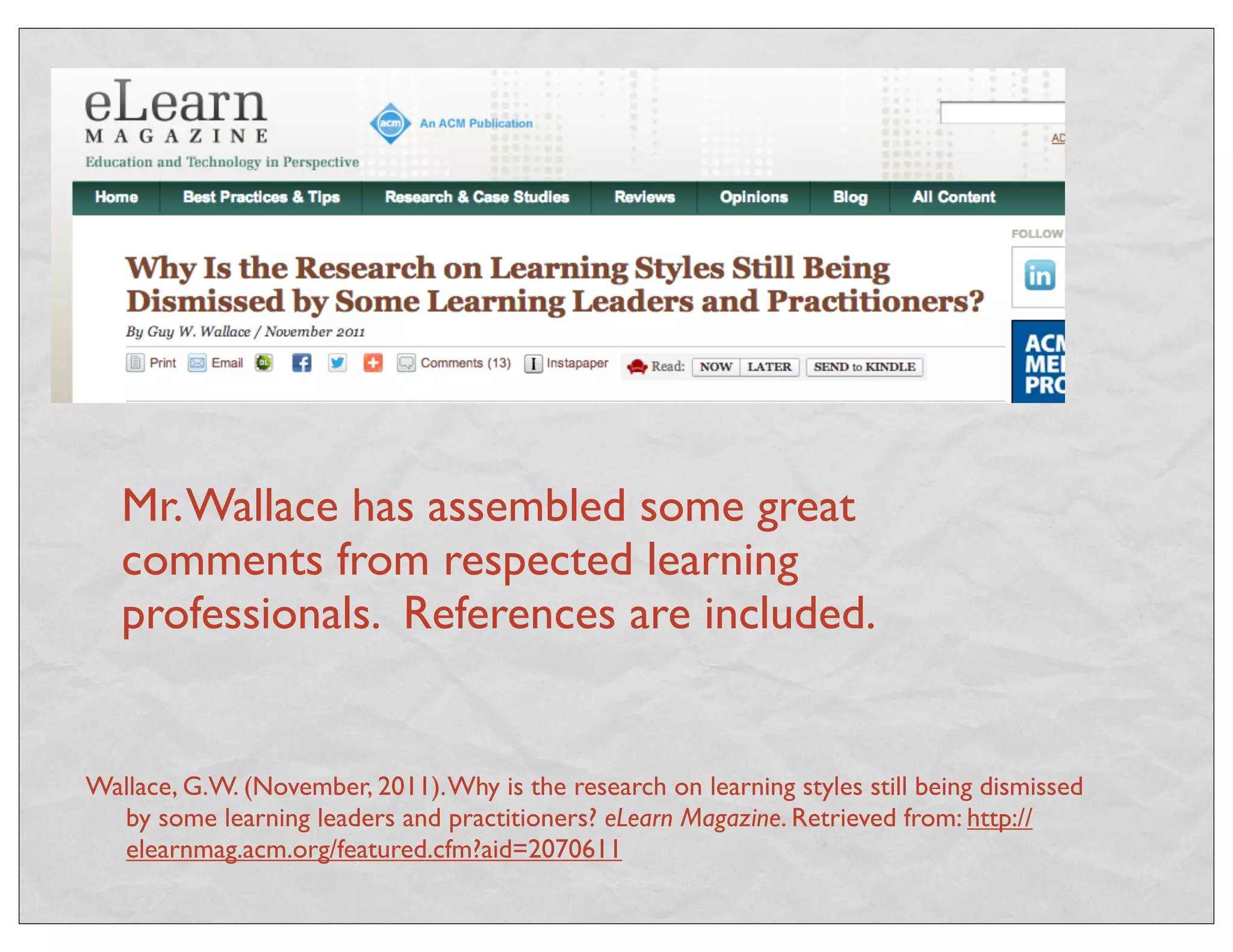
Mr. Wallace has assembled some great 
comments from respected learning 
professionals. References are included. 
Wallace, G.W. (November, 2011). Why is the research on learning styles still being dismissed 
by some learning leaders and practitioners? eLearn Magazine. Retrieved from: http:// 
elearnmag.acm.org/featured.cfm?aid=2070611
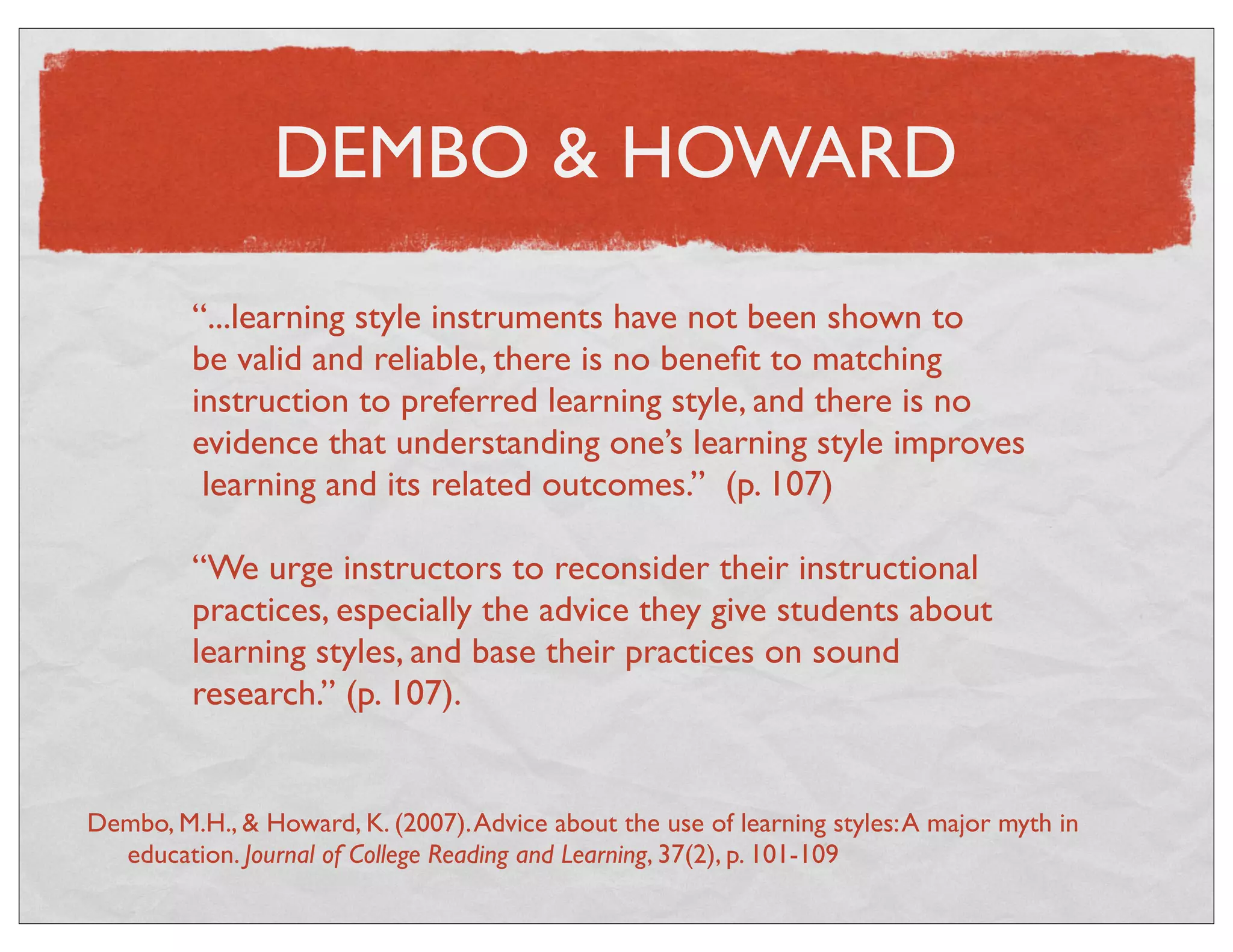
DEMBO & HOWARD 
“...learning style instruments have not been shown to 
be valid and reliable, there is no benefit to matching 
instruction to preferred learning style, and there is no 
evidence that understanding one’s learning style improves 
learning and its related outcomes.” (p. 107) 
“We urge instructors to reconsider their instructional 
practices, especially the advice they give students about 
learning styles, and base their practices on sound 
research.” (p. 107). 
Dembo, M.H., & Howard, K. (2007). Advice about the use of learning styles: A major myth in 
education. Journal of College Reading and Learning, 37(2), p. 101-109
KIRSCHNER & VAN MERRIËNBOER 
“The second legend is the widespread belief that learners 
have specific learning styles and that education should be 
individualized to the extent that the pedagogy of teaching/ 
learning is matched to the preferred style of the learner.” 
Kirschner, P.A., & van Merriënboer, J.G. (2013). Do learners really know best? 
Urban legends in Education. Educational Psychologist 48(3), 169-183. 
doi:10.1080/00461520.2013.804395
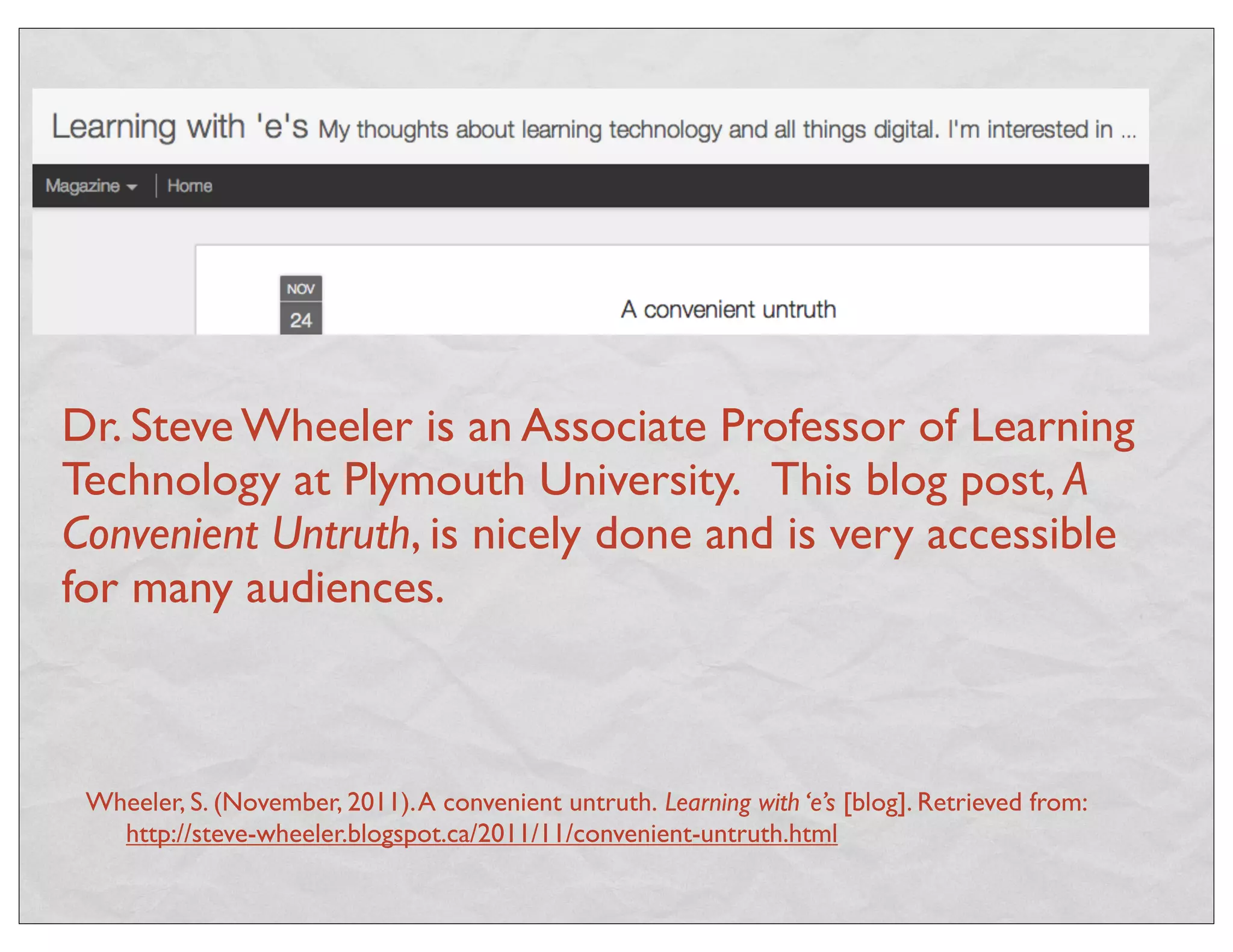
Dr. Steve Wheeler is an Associate Professor of Learning 
Technology at Plymouth University. This blog post, A 
Convenient Untruth, is nicely done and is very accessible 
for many audiences. 
Wheeler, S. (November, 2011). A convenient untruth. Learning with ‘e’s [blog]. Retrieved from: 
http://steve-wheeler.blogspot.ca/2011/11/convenient-untruth.html
PASHLER, MCDANIEL, ROHRER, & BJORK 
“We conclude therefore, that at present, there is no 
adequate evidence base to justify incorporating learning-styles 
assessments into general educational practice. Thus, 
limited education resources would better be devoted to 
adopting other educational practices that have a strong 
evidence base, of which there are an increasing 
number...Further research on the use of learning-styles 
assessment in instruction may in some cases be warranted, 
but such research needs to be performed appropriately.” 
(p. 105) 
Pashler, H., McDaniel, M., Rohrer, D., & Bjork, R. (2009). Learning styles: Concepts and 
evidence. Psychological Science in the Public Interest, 9(3), 105-119. doi: 10.1111/j. 
1539-6053.2009.01038.x
DANIEL T. WILLINGHAM, PH.D. 
Dr. Willingham is a Professor of Cognitive Psychology at the 
University of Virginia. He authored a popular YouTube movie on 
learning styles, and he has assembled an FAQ on learning styles. 
http://www.danielwillingham.com/learning-styles-faq.html 
http://www.youtube.com/watch?v=sIv9rz2NTUk
FINAL CHARGE 
You will find many resources promoting learning styles as an 
essential element of teaching and learning. For example, they 
are referenced by NCATE (standard 4) and by ISTE (NETS-T). 
Review the resources provided in this set of slides. You 
can find more. Do not accept learning styles as a truth 
because it feels right, because you read about it in a book, or 
because you have seen them in your classroom. Consider the 
scholarly evidence. Think critically.
The information in this set of slides has been 
compiled over time with help from friends and 
colleagues. My thanks to those of you who have 
pointed me to these resources, especially: Michael 
M. Grant and Michael K. Barbour. 
Charles B. Hodges, Ph.D. 
2014

Learning styles: Research and Expert Opinion

  • 1.
    LEARNING STYLES: RESEARCHAND EXPERT OPINION Charles B. Hodges, Ph.D.
  • 2.
    PURPOSE The purposeof this collection of slides is to provide a reference for individuals who want a quick glimpse into the research base regarding learning styles.
  • 3.
    CHARGE There aremany opinions and beliefs regarding learning styles in Education. I urge you to move away from beliefs and opinions that are not formed from a careful exploration of the scholarly works on the topic. The information in these slides is a starting point for your exploration.
  • 4.
    MORRISON, ROSS, KALMAN,& KEMP “Despite the extensive literature on learning styles, questions remain regarding the degree to which such styles can be matched to teaching methods with any benefits to learning (Knight, Halpin & Halpin, 1992; Park & Lee, 2004; Snow 1992). ” (p. 59) Morrison, G.R., Ross, S.M., Kalman, H.K., & Kemp, J.E. (2011). Designing effective instruction (6th ed.). Hoboken, NJ: John Wiley & Sons, Inc.
  • 5.
    Mr. Wallace hasassembled some great comments from respected learning professionals. References are included. Wallace, G.W. (November, 2011). Why is the research on learning styles still being dismissed by some learning leaders and practitioners? eLearn Magazine. Retrieved from: http:// elearnmag.acm.org/featured.cfm?aid=2070611
  • 6.
    DEMBO & HOWARD “...learning style instruments have not been shown to be valid and reliable, there is no benefit to matching instruction to preferred learning style, and there is no evidence that understanding one’s learning style improves learning and its related outcomes.” (p. 107) “We urge instructors to reconsider their instructional practices, especially the advice they give students about learning styles, and base their practices on sound research.” (p. 107). Dembo, M.H., & Howard, K. (2007). Advice about the use of learning styles: A major myth in education. Journal of College Reading and Learning, 37(2), p. 101-109
  • 7.
    KIRSCHNER & VANMERRIËNBOER “The second legend is the widespread belief that learners have specific learning styles and that education should be individualized to the extent that the pedagogy of teaching/ learning is matched to the preferred style of the learner.” Kirschner, P.A., & van Merriënboer, J.G. (2013). Do learners really know best? Urban legends in Education. Educational Psychologist 48(3), 169-183. doi:10.1080/00461520.2013.804395
  • 8.
    Dr. Steve Wheeleris an Associate Professor of Learning Technology at Plymouth University. This blog post, A Convenient Untruth, is nicely done and is very accessible for many audiences. Wheeler, S. (November, 2011). A convenient untruth. Learning with ‘e’s [blog]. Retrieved from: http://steve-wheeler.blogspot.ca/2011/11/convenient-untruth.html
  • 9.
    PASHLER, MCDANIEL, ROHRER,& BJORK “We conclude therefore, that at present, there is no adequate evidence base to justify incorporating learning-styles assessments into general educational practice. Thus, limited education resources would better be devoted to adopting other educational practices that have a strong evidence base, of which there are an increasing number...Further research on the use of learning-styles assessment in instruction may in some cases be warranted, but such research needs to be performed appropriately.” (p. 105) Pashler, H., McDaniel, M., Rohrer, D., & Bjork, R. (2009). Learning styles: Concepts and evidence. Psychological Science in the Public Interest, 9(3), 105-119. doi: 10.1111/j. 1539-6053.2009.01038.x
  • 10.
    DANIEL T. WILLINGHAM,PH.D. Dr. Willingham is a Professor of Cognitive Psychology at the University of Virginia. He authored a popular YouTube movie on learning styles, and he has assembled an FAQ on learning styles. http://www.danielwillingham.com/learning-styles-faq.html http://www.youtube.com/watch?v=sIv9rz2NTUk
  • 11.
    FINAL CHARGE Youwill find many resources promoting learning styles as an essential element of teaching and learning. For example, they are referenced by NCATE (standard 4) and by ISTE (NETS-T). Review the resources provided in this set of slides. You can find more. Do not accept learning styles as a truth because it feels right, because you read about it in a book, or because you have seen them in your classroom. Consider the scholarly evidence. Think critically.
  • 12.
    The information inthis set of slides has been compiled over time with help from friends and colleagues. My thanks to those of you who have pointed me to these resources, especially: Michael M. Grant and Michael K. Barbour. Charles B. Hodges, Ph.D. 2014