Streaming
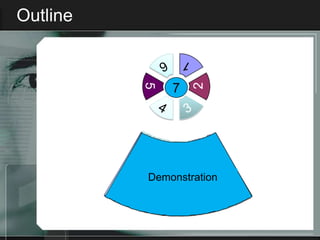
Outline


                       2
            5
                   7


               Services &
                Streaming
            Conclusions
              Introduction
              Demonstration
                 Protocols
                Definition
          architectures & types
              applications
Introduction

    • The first generation of web pages was only made with text.


                      Solution
    • Nowadays multimedias take an important part in most web
      application.
             Streaming is set to transform the World Wide Web:
    • There video and audio are accepted as the most natural by
             was a problem in the quality of multimedia transfer
      the internet. communicate.
             way to


                                                                   1
What’s Streaming ?


     • streaming : transmit audio & video and other
       multimedia over the internet without making
       viewer waiting.


                                                      2
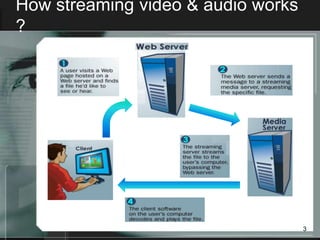
How streaming video & audio works
?


                                    3
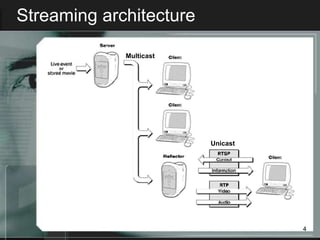
Streaming architecture

             Multicast


                         Unicast


                                   4
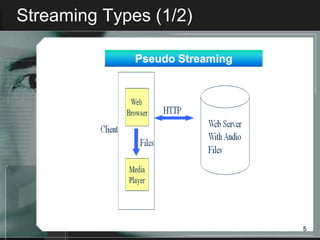
Streaming Types (1/2)


                        5
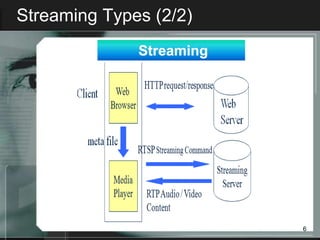
Streaming Types (2/2)


                        6
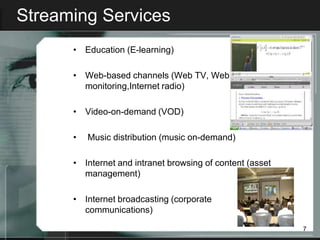
Streaming Services
      • Education (E-learning)

      • Web-based channels (Web TV, Web
        monitoring,Internet radio)

      • Video-on-demand (VOD)

      •   Music distribution (music on-demand)

      • Internet and intranet browsing of content (asset
        management)

      • Internet broadcasting (corporate
        communications)

                                                           7
Principle Streaming

      Streaming is based primarily on:

         • Broadcast a video of a server to a client.


         • Segmentation of the video.


         • Assemble packets.


         • The video is played on as the packets arrive.


         • At the end these packets are then destroyed.


                                                           8
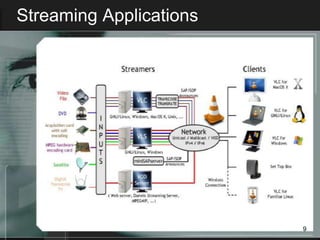
Streaming Applications


                         9
Streaming Protocols :
     There are currently three protocols that allow for
       streaming:

        • HTTP.

        • FTP.

        • RTP.


                                                   10
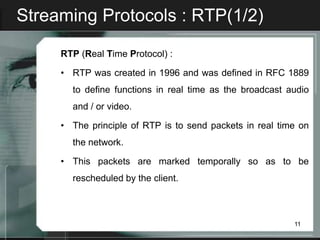
Streaming Protocols : RTP(1/2)

     RTP (Real Time Protocol) :

     • RTP was created in 1996 and was defined in RFC 1889
       to define functions in real time as the broadcast audio
       and / or video.

     • The principle of RTP is to send packets in real time on
       the network.

     • This packets are marked temporally so as to be
       rescheduled by the client.


                                                          11
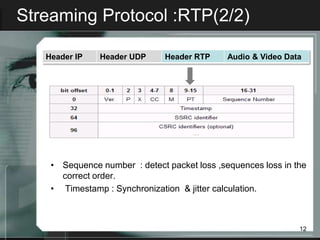
Streaming Protocol :RTP(2/2)

   Header IP   Header UDP      Header RTP     Audio & Video Data


    • Sequence number : detect packet loss ,sequences loss in the
      correct order.
    • Timestamp : Synchronization & jitter calculation.


                                                               12
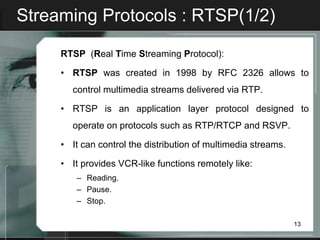
Streaming Protocols : RTSP(1/2)

     RTSP (Real Time Streaming Protocol):

     • RTSP was created in 1998 by RFC 2326 allows to
       control multimedia streams delivered via RTP.

     • RTSP is an application layer protocol designed to
       operate on protocols such as RTP/RTCP and RSVP.

     • It can control the distribution of multimedia streams.

     • It provides VCR-like functions remotely like:
        – Reading.
        – Pause.
        – Stop.

                                                                13
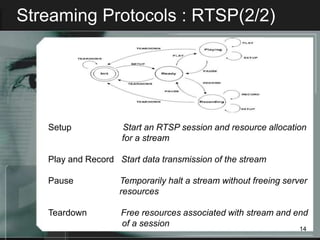
Streaming Protocols : RTSP(2/2)


   Setup            Start an RTSP session and resource allocation
                    for a stream

   Play and Record Start data transmission of the stream

   Pause            Temporarily halt a stream without freeing server
                    resources

   Teardown         Free resources associated with stream and end
                    of a session
                                                                  14
Streaming Protocols :RTCP

     • RTCP : Real time Control Protocol

     • RTCP is used in conjunction with RTP.

     • Feed back on the quality of service (reports : nbre packets
       , lost , statistics)

     • The feedback messages include reports, such as number
       of packets lost and jitter statistics (early or late arrivals).

                              Recognition of flaws.


                                                                     15
Conclusion


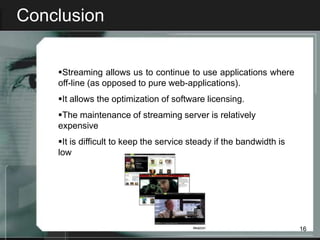
    Streaming allows us to continue to use applications where
    off-line (as opposed to pure web-applications).
    It allows the optimization of software licensing.
    The maintenance of streaming server is relatively
    expensive
    It is difficult to keep the service steady if the bandwidth is
    low


                                                                      16
Demonstration
Thank you for your
attention

Streaming

  • 1.
  • 2.
    Outline 2 5 7 Services & Streaming Conclusions Introduction Demonstration Protocols Definition architectures & types applications
  • 3.
    Introduction • The first generation of web pages was only made with text. Solution • Nowadays multimedias take an important part in most web application. Streaming is set to transform the World Wide Web: • There video and audio are accepted as the most natural by was a problem in the quality of multimedia transfer the internet. communicate. way to 1
  • 4.
    What’s Streaming ? • streaming : transmit audio & video and other multimedia over the internet without making viewer waiting. 2
  • 5.
    How streaming video& audio works ? 3
  • 6.
    Streaming architecture Multicast Unicast 4
  • 7.
  • 8.
  • 9.
    Streaming Services • Education (E-learning) • Web-based channels (Web TV, Web monitoring,Internet radio) • Video-on-demand (VOD) • Music distribution (music on-demand) • Internet and intranet browsing of content (asset management) • Internet broadcasting (corporate communications) 7
  • 10.
    Principle Streaming Streaming is based primarily on: • Broadcast a video of a server to a client. • Segmentation of the video. • Assemble packets. • The video is played on as the packets arrive. • At the end these packets are then destroyed. 8
  • 11.
  • 12.
    Streaming Protocols : There are currently three protocols that allow for streaming: • HTTP. • FTP. • RTP. 10
  • 13.
    Streaming Protocols :RTP(1/2) RTP (Real Time Protocol) : • RTP was created in 1996 and was defined in RFC 1889 to define functions in real time as the broadcast audio and / or video. • The principle of RTP is to send packets in real time on the network. • This packets are marked temporally so as to be rescheduled by the client. 11
  • 14.
    Streaming Protocol :RTP(2/2) Header IP Header UDP Header RTP Audio & Video Data • Sequence number : detect packet loss ,sequences loss in the correct order. • Timestamp : Synchronization & jitter calculation. 12
  • 15.
    Streaming Protocols :RTSP(1/2) RTSP (Real Time Streaming Protocol): • RTSP was created in 1998 by RFC 2326 allows to control multimedia streams delivered via RTP. • RTSP is an application layer protocol designed to operate on protocols such as RTP/RTCP and RSVP. • It can control the distribution of multimedia streams. • It provides VCR-like functions remotely like: – Reading. – Pause. – Stop. 13
  • 16.
    Streaming Protocols :RTSP(2/2) Setup Start an RTSP session and resource allocation for a stream Play and Record Start data transmission of the stream Pause Temporarily halt a stream without freeing server resources Teardown Free resources associated with stream and end of a session 14
  • 17.
    Streaming Protocols :RTCP • RTCP : Real time Control Protocol • RTCP is used in conjunction with RTP. • Feed back on the quality of service (reports : nbre packets , lost , statistics) • The feedback messages include reports, such as number of packets lost and jitter statistics (early or late arrivals). Recognition of flaws. 15
  • 18.
    Conclusion Streaming allows us to continue to use applications where off-line (as opposed to pure web-applications). It allows the optimization of software licensing. The maintenance of streaming server is relatively expensive It is difficult to keep the service steady if the bandwidth is low 16
  • 19.
  • 20.
    Thank you foryour attention