
Welcome to our Bible Study
19th
Sunday in the Ordinary Time B
9 August 2015
In preparation for this Sunday’s liturgy
As aid in focusing our homilies and sharing
Prepared by Fr. Cielo R. Almazan, OFM
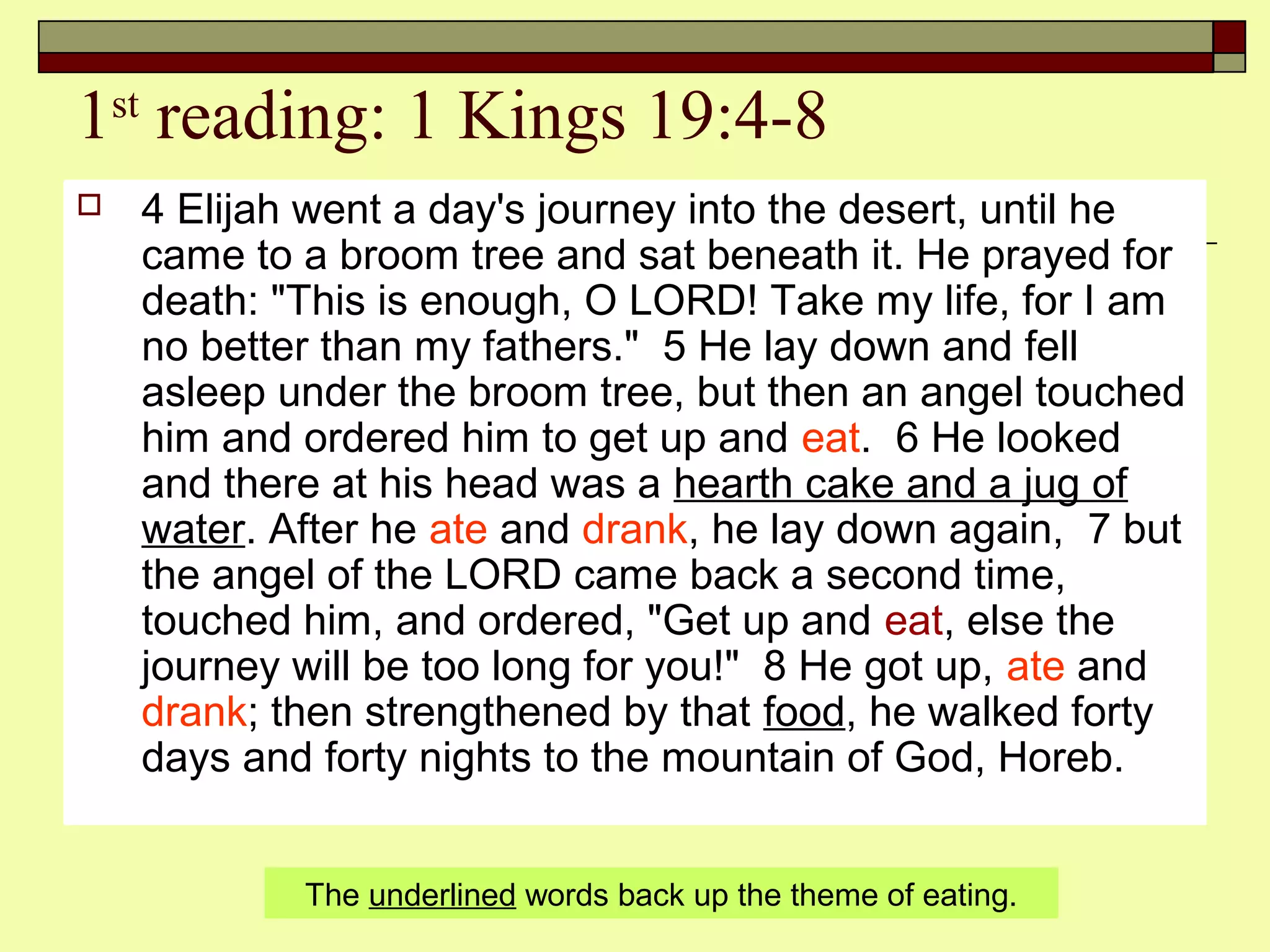
1st
reading: 1 Kings 19:4-8
 4 Elijah went a day's journey into the desert, until he
came to a broom tree and sat beneath it. He prayed for
death: "This is enough, O LORD! Take my life, for I am
no better than my fathers." 5 He lay down and fell
asleep under the broom tree, but then an angel touched
him and ordered him to get up and eat. 6 He looked
and there at his head was a hearth cake and a jug of
water. After he ate and drank, he lay down again, 7 but
the angel of the LORD came back a second time,
touched him, and ordered, "Get up and eat, else the
journey will be too long for you!" 8 He got up, ate and
drank; then strengthened by that food, he walked forty
days and forty nights to the mountain of God, Horeb.
The focus is on eating, in order to reach destination.
1st
reading: 1 Kings 19:4-8
 4 Elijah went a day's journey into the desert, until he
came to a broom tree and sat beneath it. He prayed for
death: "This is enough, O LORD! Take my life, for I am
no better than my fathers." 5 He lay down and fell
asleep under the broom tree, but then an angel touched
him and ordered him to get up and eat. 6 He looked
and there at his head was a hearth cake and a jug of
water. After he ate and drank, he lay down again, 7 but
the angel of the LORD came back a second time,
touched him, and ordered, "Get up and eat, else the
journey will be too long for you!" 8 He got up, ate and
drank; then strengthened by that food, he walked forty
days and forty nights to the mountain of God, Horeb.
The underlined words back up the theme of eating.
1st
reading: 1 Kings 19:4-8
Elijah runs for his life and wants to die.
 4 Elijah went a day's journey into the desert, until he came to a
broom tree and sat beneath it. He prayed for death: "This is
enough, O LORD! Take my life, for I am no better than my fathers."
5 He lay down and fell asleep under the broom tree,
An angel comes and makes him eat (so that he won’t die)
 but then an angel touched him and ordered him to get up and
eat. 6 He looked and there at his head was a hearth cake and
a jug of water.
Elijah repeats lying down (hoping to die)
 After he ate and drank, he lay down again,
The angel insists that he eat for the long journey.
 7 but the angel of the LORD came back a second time, touched
him, and ordered, "Get up and eat, else the journey will be too long
for you!"
Elijah obeys.
8 He got up, ate and drank; then strengthened by that food, he walked
forty days and forty nights to the mountain of God, Horeb.
Just a simple outline!
Textual Context of 1 Kings 19:4-8
 Part I Reign of Solomon (1 Kgs1,1—11,43)
 Part II Judah and Israel to Ahab (1 Kgs 12,1—16,34)
 Part III Stories of the Prophets (1 Kgs 17,1-22,54)
 Part IV The Kingdoms of Israel and Judah (2 Kgs
1,1—17,41)
 Part V The Kingdom of Judah after 721 BC (2 Kgs
18,1--25,30)
Text without context is pretext.
Elijah runs for his life to Mt. Horeb (1 Kgs 19,1-3) after being threatened by Jezebel,
the wife of King Ahab. Elijah, after the contest with the prophets of Baal (of
Jezebel), puts them to death (1 Kgs 18). Our reading is followed by God’s consoling
presence in the form of a tiny whispering sound, in a cave in Mt. Horeb, and
commissioning him to anoint Hazael, King of Aram (1 Kgs 9-18).
1st
reading: 1 Kings 19:4-8
Elijah runs for his life (and wants to die.
 4 Elijah went a day's journey into the
desert, until he came to a broom tree
and sat beneath it.
 He prayed for death: "This is enough,
O LORD! Take my life, for I am no
better than my fathers."
 5 He lay down and fell asleep under
the broom tree, (a shrub)
An angel comes and makes him eat (so
that he won’t die)
 but then an angel touched him and
ordered him to get up and eat. 6 He
looked and there at his head was a
hearth cake and a jug of water.
Elijah repeats lying down (hoping to die)
 After he ate and drank, he lay down
again,
The angel insists that he eat more for the
long journey.
 7 but the angel of the LORD came
back a second time, touched him, and
ordered, "Get up and eat, else the
journey will be too long for you!"
Elijah obeys. Things happen as planned.
 8 He got up, ate and drank; then
strengthened by that food, he walked
forty days and forty nights to the
mountain of God, Horeb.
Commentary:
 In desperation, Elijah prays for
his death. V.4
 In v.5, Elijah sleeps (hoping to
sleep to death) but an angel
wakes him up and feeds him
(God’s intervention) with two
imperatives: get up and eat.
 In v. 6, he finds bread and water.
But after he eats and drinks, he
again lies down (to die).
 In v.7, the angel comes back,
touches him and commands for
the second time: get up and eat.
 The angel gives a reason: his
journey is long.
 In v.8, Elijah eats and drinks, he
regains his strength, is able to
reach his destination.
Reflection on the 1st
reading
 When we experience success, amidst euphoria, we may
also feel depressed.
 Not everyone is happy for us, because of envy, or, we
might have stepped on someone else’s shoe. We tend to
give up. We run away because of threats.
 In our depression (wanting to die), God comes to intervene
in our lives.
 We must cooperate with him.
 God provides for our survival. God sees we still have a
long way to go.
 God does not give up on us until we reach our destiny.
Responsorial Ps 34:2-3, 4-5, 6-7, 8-9
 R. (9a) Taste and see the goodness of the Lord.
 2 I will bless the LORD at all times;
his praise shall be ever in my mouth.
3 Let my soul glory in the LORD;
the lowly will hear me and be glad.
 4 Glorify the LORD with me,
Let us together extol his name.
4 I sought the LORD, and he answered me
And delivered me from all my fears.
 6 Look to him that you may be radiant with joy.
And your faces may not blush with shame.
7 When the afflicted man called out, the LORD heard,
And from all his distress he saved him.
 8 The angel of the LORD encamps
around those who fear him and delivers them.
9 Taste and see how good the LORD is;
blessed the man who takes refuge in him.
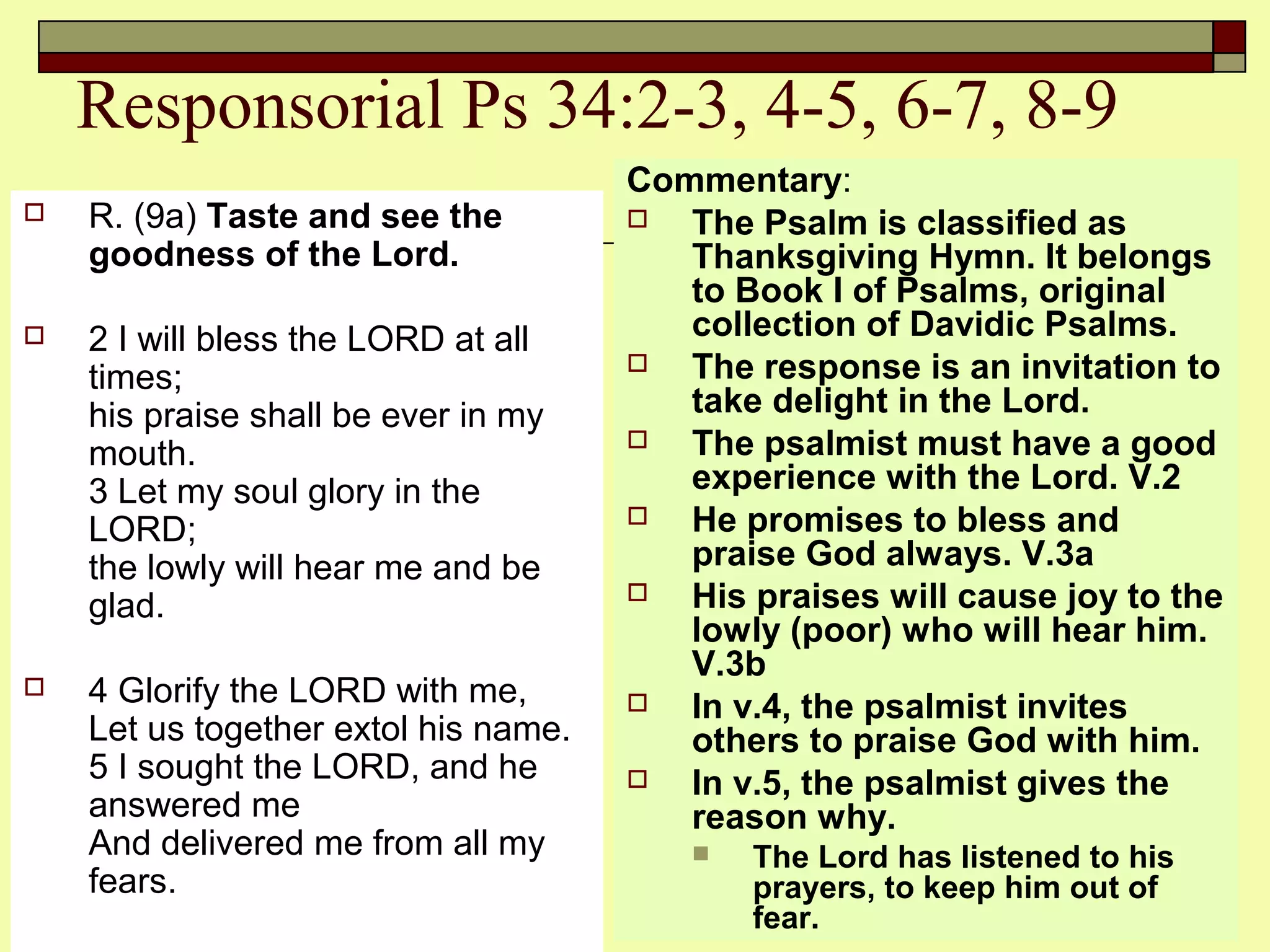
Responsorial Ps 34:2-3, 4-5, 6-7, 8-9
 R. (9a) Taste and see the
goodness of the Lord.
 2 I will bless the LORD at all
times;
his praise shall be ever in my
mouth.
3 Let my soul glory in the
LORD;
the lowly will hear me and be
glad.
 4 Glorify the LORD with me,
Let us together extol his name.
5 I sought the LORD, and he
answered me
And delivered me from all my
fears.
Commentary:
 The Psalm is classified as
Thanksgiving Hymn. It belongs
to Book I of Psalms, original
collection of Davidic Psalms.
 The response is an invitation to
take delight in the Lord.
 The psalmist must have a good
experience with the Lord. V.2
 He promises to bless and
praise God always. V.3a
 His praises will cause joy to the
lowly (poor) who will hear him.
V.3b
 In v.4, the psalmist invites
others to praise God with him.
 In v.5, the psalmist gives the
reason why.
 The Lord has listened to his
prayers, to keep him out of
fear.
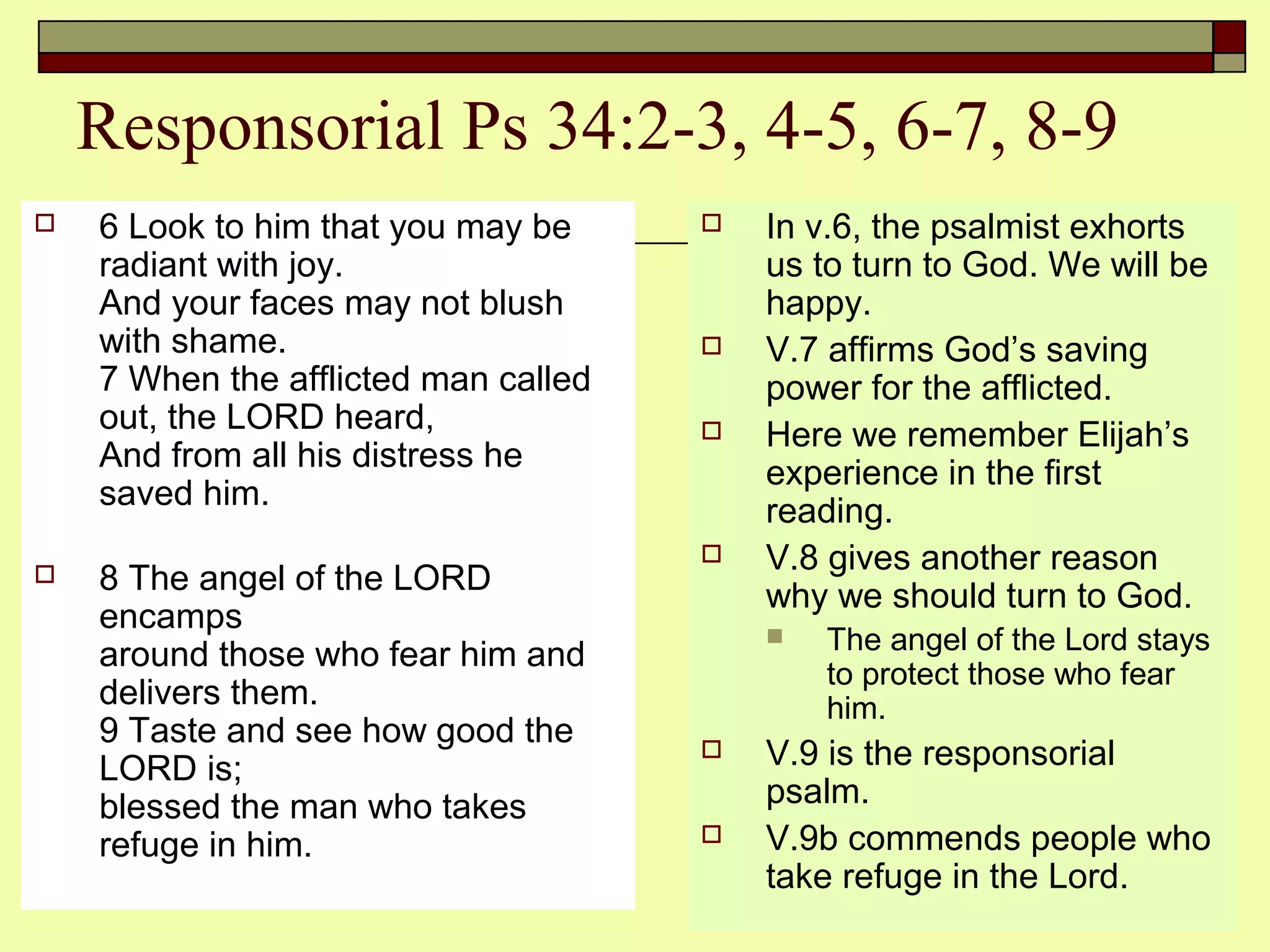
Responsorial Ps 34:2-3, 4-5, 6-7, 8-9
 6 Look to him that you may be
radiant with joy.
And your faces may not blush
with shame.
7 When the afflicted man called
out, the LORD heard,
And from all his distress he
saved him.
 8 The angel of the LORD
encamps
around those who fear him and
delivers them.
9 Taste and see how good the
LORD is;
blessed the man who takes
refuge in him.
 In v.6, the psalmist exhorts
us to turn to God. We will be
happy.
 V.7 affirms God’s saving
power for the afflicted.
 Here we remember Elijah’s
experience in the first
reading.
 V.8 gives another reason
why we should turn to God.
 The angel of the Lord stays
to protect those who fear
him.
 V.9 is the responsorial
psalm.
 V.9b commends people who
take refuge in the Lord.
Reflections on the Psalm
 Whom do we approach when we are in trouble?
 Happy are we if we run to God every time we
are in crisis.
 We will not be sorry.
 Unhappy is the man who does not know whom
to cling to.
 Clinging to God is concretized in prayer and in
listening to his words.
2nd
Reading: Ephesians 4:30—5:2
 30 Do not grieve the holy Spirit of God, with
which you were sealed for the day of
redemption. 31 All bitterness, fury, anger,
shouting, and reviling must be removed from
you, along with all malice. 32 (And) be kind to
one another, compassionate, forgiving one
another as God has forgiven you in Christ. 5:1
So be imitators of God, as beloved children, 2
and live in love, as Christ loved us and handed
himself over for us as a sacrificial offering to
God for a fragrant aroma.
The focus is on Christian living.
2nd
Reading: Ephesians 4:30—5:2
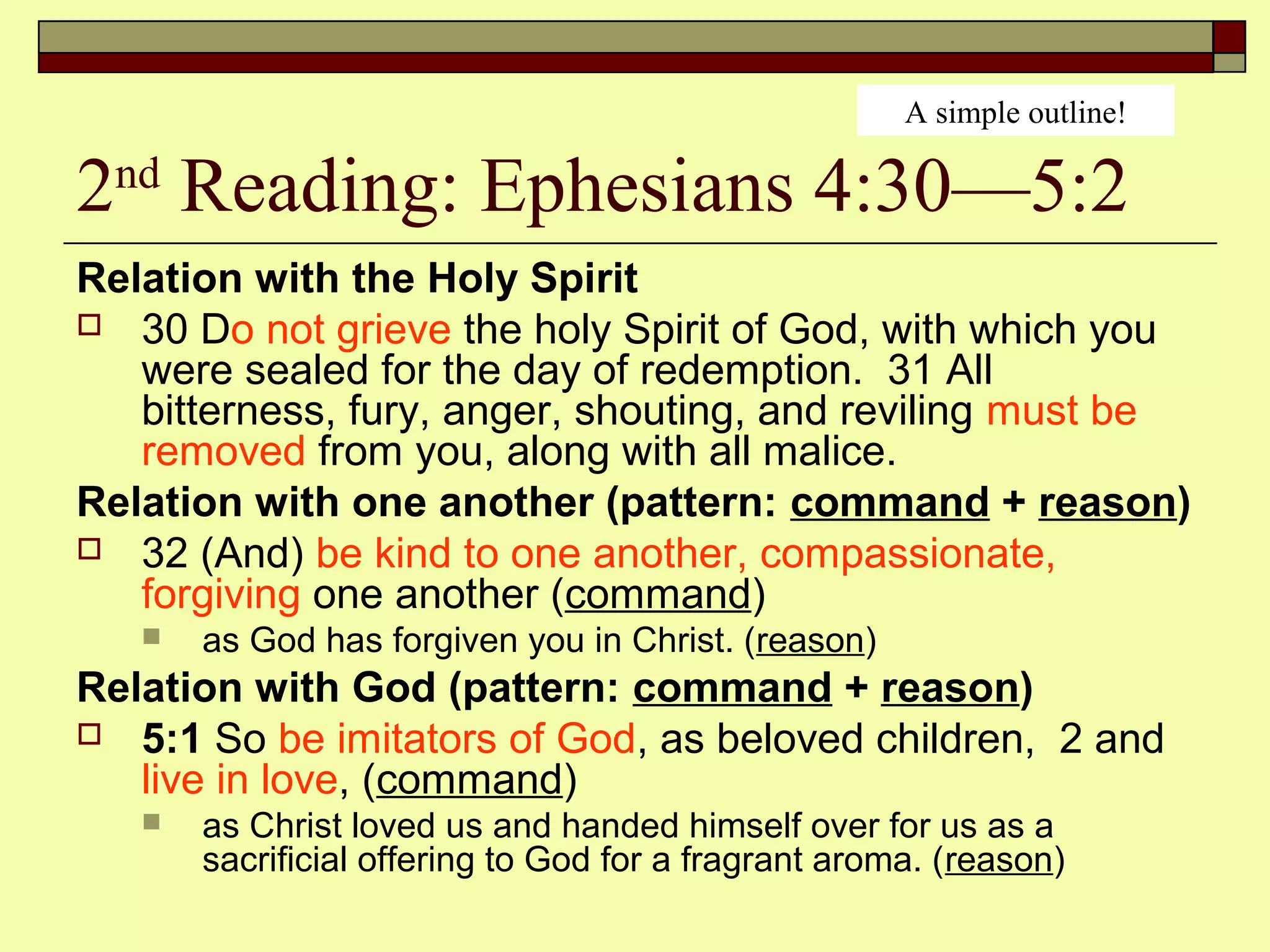
Relation with the Holy Spirit
 30 Do not grieve the holy Spirit of God, with which you
were sealed for the day of redemption. 31 All
bitterness, fury, anger, shouting, and reviling must be
removed from you, along with all malice.
Relation with one another (pattern: command + reason)
 32 (And) be kind to one another, compassionate,
forgiving one another (command)
 as God has forgiven you in Christ. (reason)
Relation with God (pattern: command + reason)
 5:1 So be imitators of God, as beloved children, 2 and
live in love, (command)
 as Christ loved us and handed himself over for us as a
sacrificial offering to God for a fragrant aroma. (reason)
A simple outline!
Textual Context of Ephesians 4:30—5:2
OUTLINE
1. Opening Address (1:1-2)
2. Doctrinal Exposition (1:3-3:21)
A. Divine Origin of the Church (1:3-14)
B. Prayer for the Church (1:15-23)
C. Building Up the Church (2:1-22)
D. Mystery of the Church (3:1-13)
E. Prayer for the Church (3:14-21)
3. Moral Exhortation (4:1-6:20)
A. Unity of the Church (4:1-16)
B. Moral Maturity in the Church (4:17-5:20)
C. Household Life in the Church (5:21-6:9)
D. Spiritual Warfare in the Church (6:10-20)
4. Closing Farewell (6:21-24)
2nd
Reading: Ephesians 4:30—5:2
Relation with the
Holy Spirit
 30 Do not
grieve the holy
Spirit of God,
with which you
were sealed for
the day of
redemption. 31
All bitterness,
fury, anger,
shouting, and
reviling must be
removed from
you, along with
all malice.
Commentary:
 In v.30, the author (Paul!) exhorts
Christians not to sadden the Holy
Spirit, because it is the Holy Spirit
Who assures us of our redemption.
 V.31 enumerates how to avoid
grieving the Holy Spirit: Get rid of the
following:
 Bitterness (rancor, sama ng loob)
 Fury (too much anger)
 Anger (clouds good judgment)
 Shouting (raising one’s voice against
another)
 Reviling (slandering, talking ill against
another)
 Malice (bad motivation)
2nd
Reading: Ephesians 4:30—5:2
Relation with one another
(pattern: command +
reason)
 32 (And) be kind to one
another,
compassionate,
forgiving one another
(command)
 as God has forgiven
you in Christ.
(reason)
Relation with God (pattern:
command + reason)
 5:1 So be imitators of
God, as beloved
children, 2 and live in
love, (command)
 as Christ loved us
and handed himself
over for us as a
sacrificial offering to
God for a fragrant
aroma. (reason)
 V.32 continues enumerating how
to avoid grieving the Holy Spirit in
a positive way:
 Be kind
 Be compassionate
 Forgiving one another, for we are
forgiven by God
 In 5,1, Paul invites us Christians
to imitate God (who is forgiving
and kind to all of us).
 V.2 exhorts us to live in love (devoid of
anger, malice, etc.)
 We are asked to imitate God this way:
 To be like Christ who loves, who willingly
gives himself to us as a sacrificial
offering.
Reflections on the 2nd
reading
 Christians are supposed to be pleasers of the
Holy Spirit.
 We, Christians, should do what he inspires us
to do.
 We please the Holy Spirit,
 when we exercise self-control or we are in control of
our emotions.
 when we overcome negative feelings which lead us
to negative behavior.
 when we imitate God, who is forgiving, loving and
merciful.
Gospel: John 6:41-51
 41 The Jews murmured about him because he said, "I am
the bread that came down from heaven," 42 and they said,
"Is this not Jesus, the son of Joseph? Do we not know his
father and mother? Then how can he say, 'I have come
down from heaven'?" 43 Jesus answered and said to them,
"Stop murmuring among yourselves. 44 No one can come
to me unless the Father who sent me draw him, and I will
raise him on the last day. 45 It is written in the prophets:
'They shall all be taught by God.' Everyone who listens to
my Father and learns from him comes to me. 46 Not that
anyone has seen the Father except the one who is from
God; he has seen the Father. 47 Amen, amen, I say to
you, whoever believes has eternal life. 48 I am the bread of
life. 49 Your ancestors ate the manna in the desert, but
they died; 50 this is the bread that comes down from
heaven so that one may eat it and not die. 51 I am the
living bread that came down from heaven; whoever eats
this bread will live forever; and the bread that I will give is
my flesh for the life of the world."
The focus is Jesus as the bread.
Gospel: John 6:41-51
The Jews to Jesus
 41 The Jews murmured (complain, mutter) about him because he
said, "I am the bread that came down from heaven," 42 and they said,
"Is this not Jesus, the son of Joseph? Do we not know his father and
mother? Then how can he say, 'I have come down from heaven'?“
Jesus to the Jews
 43 Jesus answered and said to them, "Stop murmuring among
yourselves. 44 No one can come to me unless the Father who sent me
draw him (To accept Jesus and his claims is a gift from the Father),
 and I will raise him on the last day. (salvation)
 45 It is written in the prophets: 'They shall all be taught by God.'
Everyone who listens to my Father and learns from him comes to me.
46 Not that anyone has seen the Father except the one who is from
God; he has seen the Father.
 47 Amen, amen, I say to you, whoever believes has eternal life.
(salvation)
 48 I am the bread of life. 49 Your ancestors ate the manna in the
desert, but they died; 50 this is the bread that comes down from
heaven so that one may eat it and not die. 51 I am the living bread that
came down from heaven; whoever eats this bread will live forever; and
the bread that I will give is my flesh for the life of the world." (salvation)
The focus is on the bread of life.
Textual Context of John 6:41-51 (Dodd)
 Part One – Book of Signs (Jn 2-12)
 Part Two – Book of Glory (Jn 13-20)
Our passage is within the Discourse of the Bread of Life
(6,22-58). It comes after the “Bread from Heaven.”
What comes next is about the “Eucharistic Bread”
(6,51-58).
The gospel was written in between 90-100 AD for the
Johannine community.
Gospel: John 6:41-51
The Jews to Jesus
 41 The Jews murmured
(complain, mutter) about
him because he said, "I am
the bread that came down
from heaven," 42 and they
said, "Is this not Jesus, the
son of Joseph? Do we not
know his father and
mother? Then how can he
say, 'I have come down
from heaven'?“
Jesus to the Jews
 43 Jesus answered and
said to them, "Stop
murmuring among
yourselves. 44 No one can
come to me unless the
Father who sent me draw
him (To accept Jesus and
his claims is a gift from the
Father),
 and I will raise him on
the last day. (salvation)
Commentary
 V.41 Jesus’ claim is totally
unacceptable to the Jews.
Outrageous claim. Jesus
speaks metaphorically, “I am
the bread….”, “from
heaven…”
 In v.42, the Jews downgrade
Him by looking at His humble
human origins.
 In vv.43-44 Jesus clarifies:
The Jews do not accept Him
because they are not drawn
by the Father.
 Those who are drawn and,
who believe, are assured of
salvation (life after death)
Gospel: John 6:41-51
 45 It is written in the
prophets: 'They shall
all be taught by God.'
Everyone who listens
to my Father and
learns from him
comes to me. 46 Not
that anyone has seen
the Father except the
one who is from God;
he has seen the
Father.
 47 Amen, amen, I
say to you,
whoever believes
has eternal life.
(salvation)
 Those who listen to His
Father must necessarily go
to Jesus. v.45
 Maybe the Jews are not
listening at all to the Father,
that’s why, they can’t accept
Him. V.46
 Belief (faith) is the response
to the claim of Jesus. It has
a reward (eternal life). v.47
Gospel: John 6:41-51
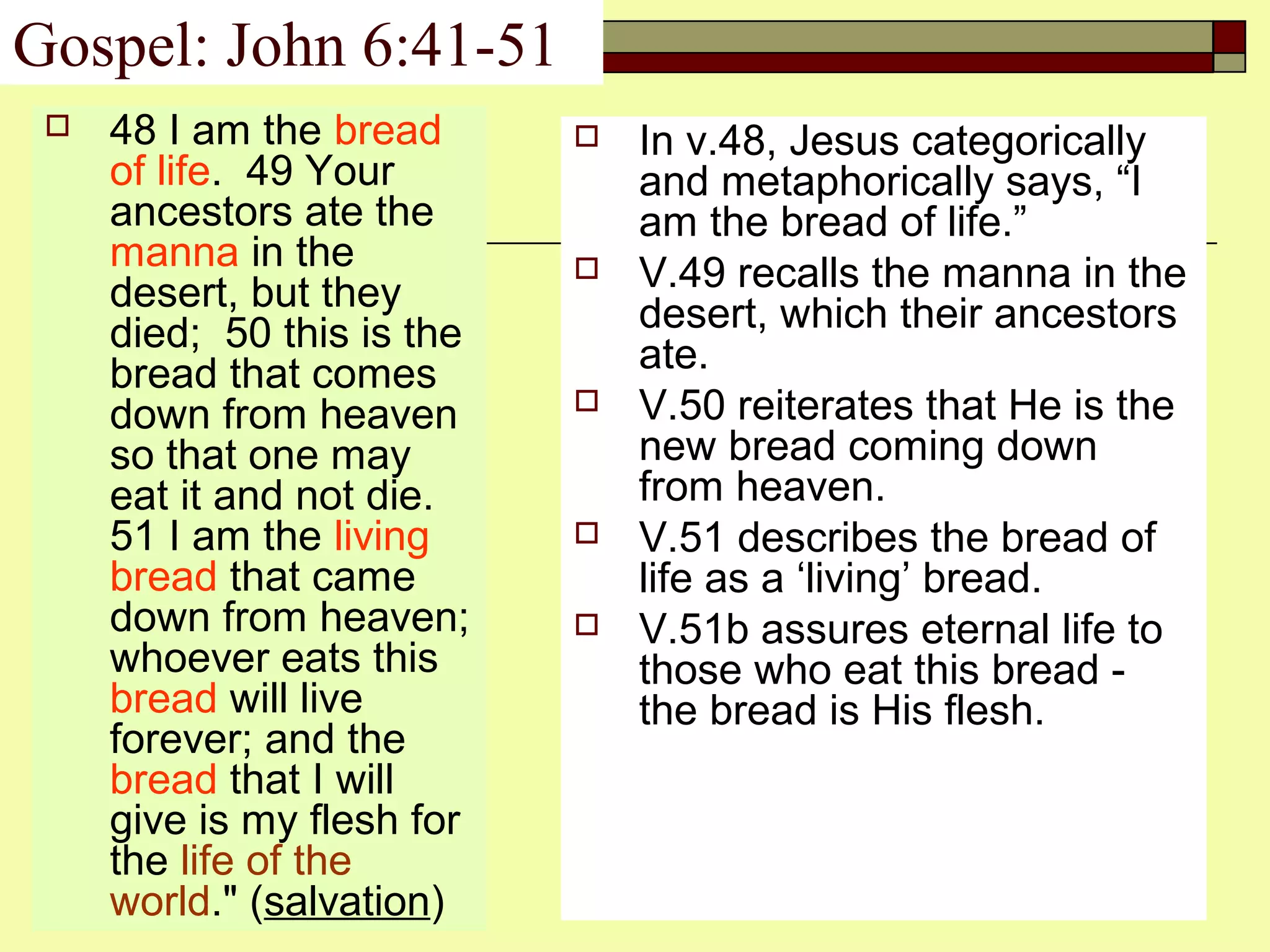
 48 I am the bread
of life. 49 Your
ancestors ate the
manna in the
desert, but they
died; 50 this is the
bread that comes
down from heaven
so that one may
eat it and not die.
51 I am the living
bread that came
down from heaven;
whoever eats this
bread will live
forever; and the
bread that I will
give is my flesh for
the life of the
world." (salvation)
 In v.48, Jesus categorically
and metaphorically says, “I
am the bread of life.”
 V.49 recalls the manna in the
desert, which their ancestors
ate.
 V.50 reiterates that He is the
new bread coming down
from heaven.
 V.51 describes the bread of
life as a ‘living’ bread.
 V.51b assures eternal life to
those who eat this bread -
the bread is His flesh.
Reflections on the gospel reading
 Our catechism teaches us that we are called
to receive Jesus in the Holy Communion.
 When we receive Jesus, we allow him to
come to us.
 To receive Jesus truly, we must be properly
disposed.
 What holds us back from receiving Jesus?
Tying the 3 readings and the Psalm
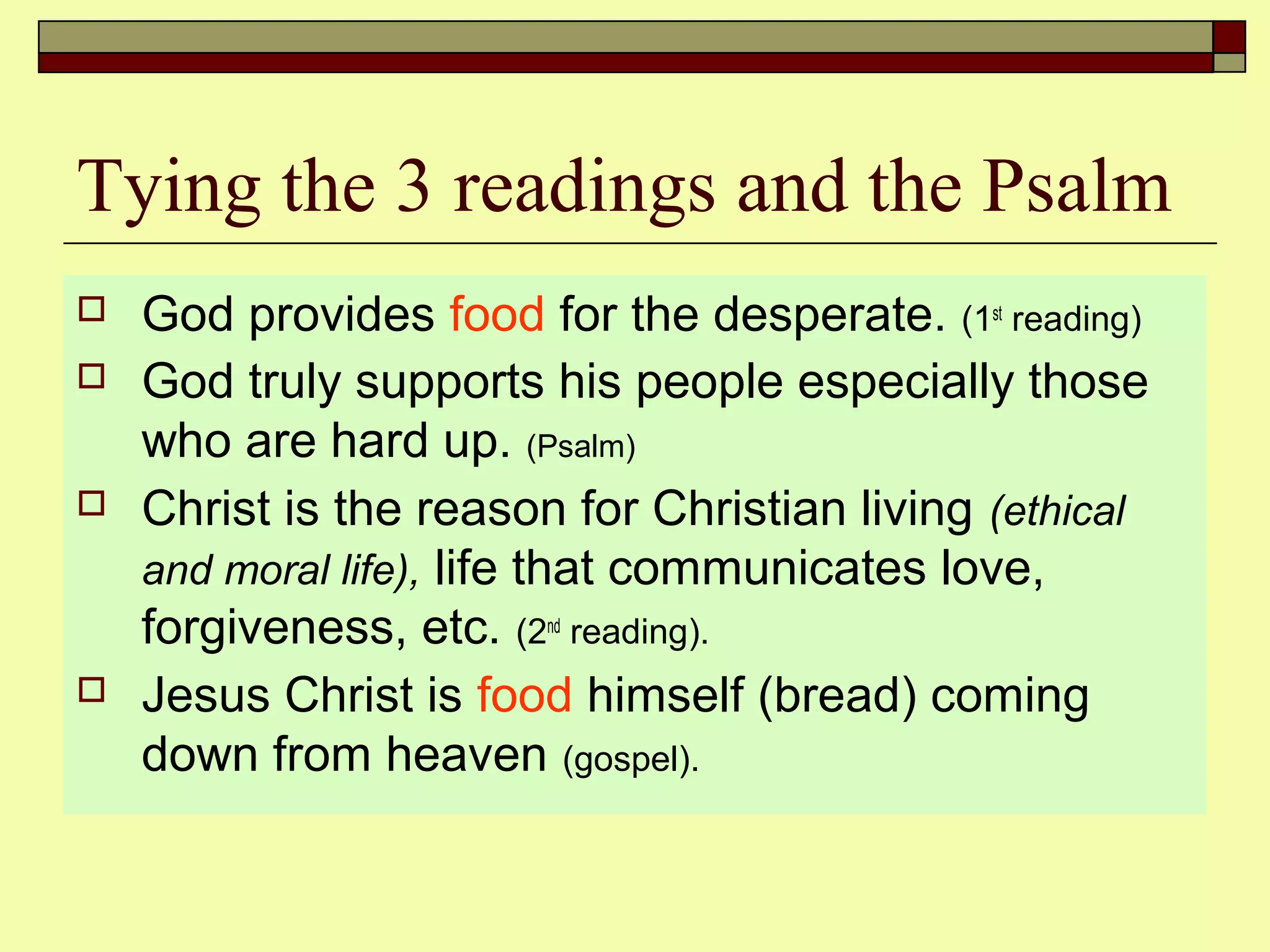
 God provides food for the desperate. (1st
reading)
 God truly supports his people especially those
who are hard up. (Psalm)
 Christ is the reason for Christian living (ethical
and moral life), life that communicates love,
forgiveness, etc. (2nd
reading).
 Jesus Christ is food himself (bread) coming
down from heaven (gospel).
How to develop your homily and sharing
 Tell your own story when you were broken,
defeated, demoralized, in spite of your victories
and accomplishments.
 Like Elijah, we tend to run away (to give up).
 The first reading tries to console us.
 We must keep our fighting spirit alive.
 We continue listening to God’s instructions
(Arise and eat for you have a long journey yet).
 For our tasks and successes are not over yet.
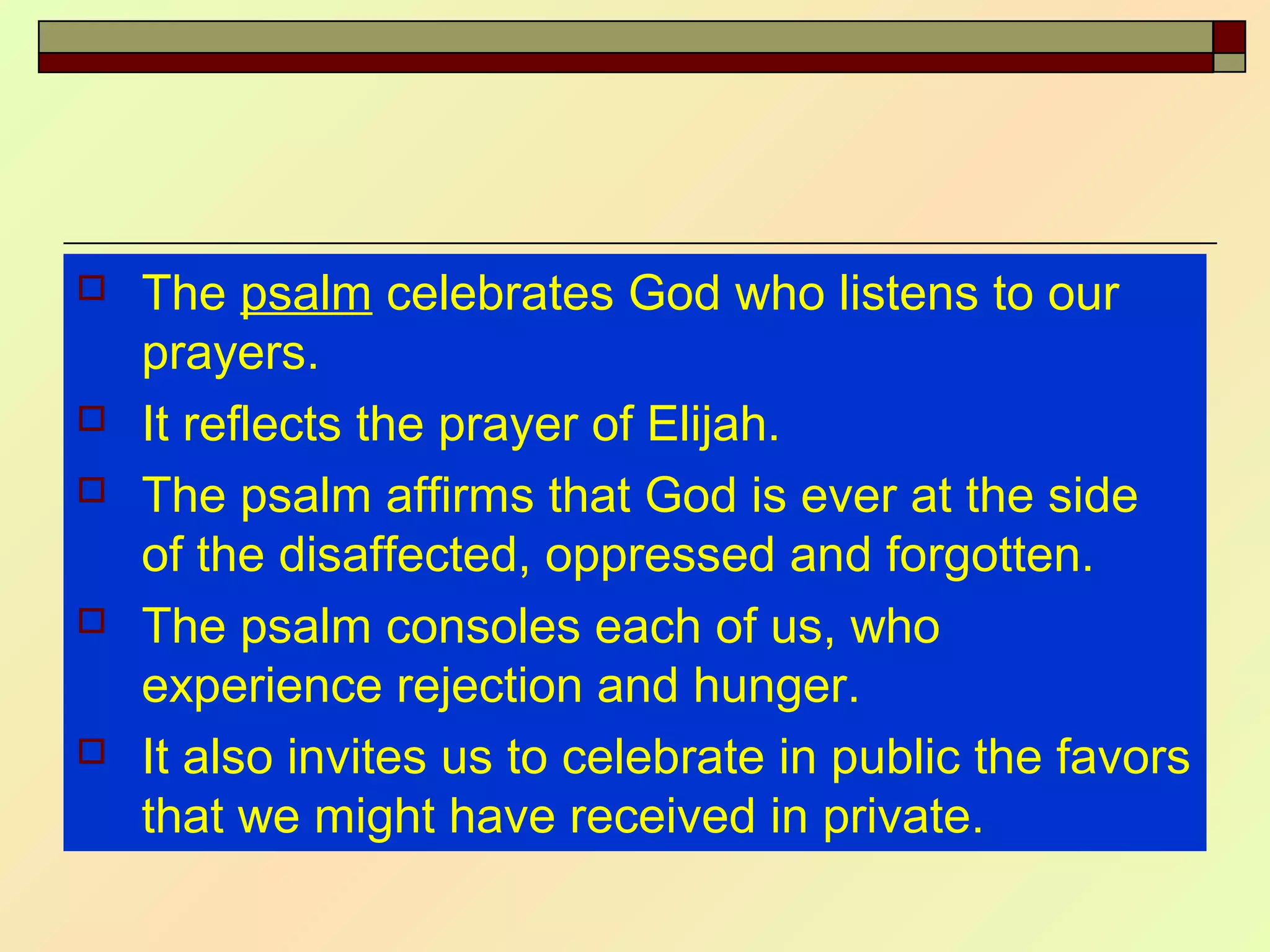
 The psalm celebrates God who listens to our
prayers.
 It reflects the prayer of Elijah.
 The psalm affirms that God is ever at the side
of the disaffected, oppressed and forgotten.
 The psalm consoles each of us, who
experience rejection and hunger.
 It also invites us to celebrate in public the favors
that we might have received in private.
 Now, if we have a strong character, we may not
be able to identify ourselves with Elijah.
 We won’t allow ourselves to be violated or
crucified, in the name of human rights.
 When people hit us hard, we might want to hit
them hard too.
 The second reading helps us to temper our
strong emotions and belligerent and vindictive
behaviors.
 The gospel reading encourages all Christians to
eat the bread of life, from heaven.
 It is a great disservice to Jesus and to the
Church if we refuse to receive holy communion.
 It is not a futile exercise of piety, it is the highest
expression of our assent to the will of God, to
be in communion with him.
 It is an active and dignified practice of our
religion.
 We should not be ashamed to come forward to
receive Jesus.
 While we are encouraged to receive holy
communion regularly, catechism teaches us
that we must receive it worthily.
 We must confess our grave sins, otherwise, we
commit sacrilege.
 We also observe the one-hour eucharistic fast.
 We must receive it reverently, observing proper
dress code.
 The eucharist is a sacrament of God’s
intervention in our lives.
 The eucharist is the food for our spiritual
journey.
 Like the manna in the desert, it is available to
everyone, who wants to come closer to Jesus.
 With Jesus, there is no shortage of spiritual
food.
 That little consecrated host is Jesus.
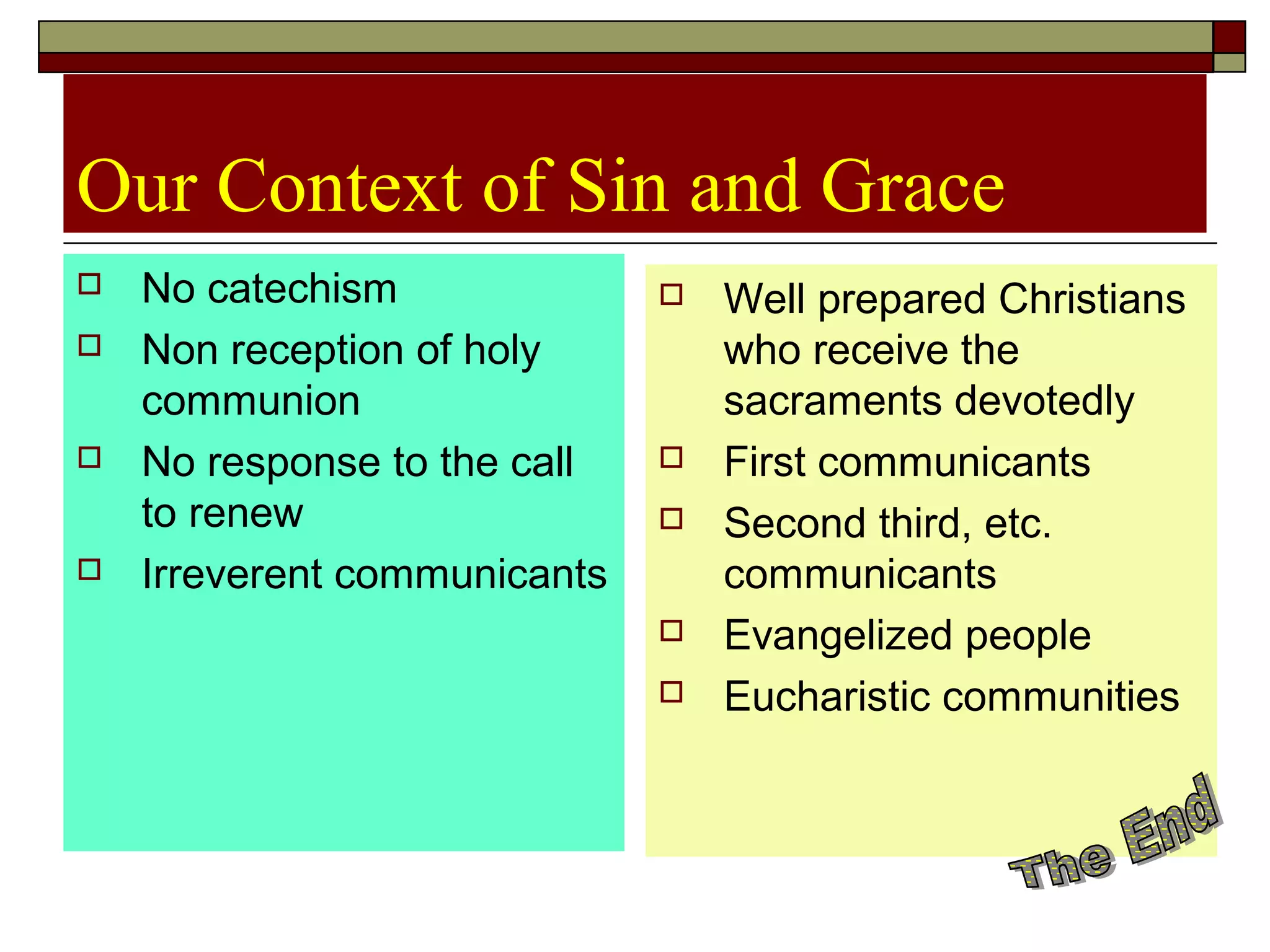
Our Context of Sin and Grace
 No catechism
 Non reception of holy
communion
 No response to the call
to renew
 Irreverent communicants
 Well prepared Christians
who receive the
sacraments devotedly
 First communicants
 Second third, etc.
communicants
 Evangelized people
 Eucharistic communities
Suggested Songs
 It’s Time to Prepare, offertory
 http://www.youtube.com/watch?v=SIandBaBMck
 Mukha ng Panginoon, communion
 http://www.youtube.com/watch?v=yZadzbLaRJ8
For August 15, 2009 Assumption
 Mary Was Once an Ordinary Girl
 http://www.youtube.com/watch?v=d_jXXuivfJA

19th Sunday B

  • 1.
    Welcome to ourBible Study 19th Sunday in the Ordinary Time B 9 August 2015 In preparation for this Sunday’s liturgy As aid in focusing our homilies and sharing Prepared by Fr. Cielo R. Almazan, OFM
  • 2.
    1st reading: 1 Kings19:4-8  4 Elijah went a day's journey into the desert, until he came to a broom tree and sat beneath it. He prayed for death: "This is enough, O LORD! Take my life, for I am no better than my fathers." 5 He lay down and fell asleep under the broom tree, but then an angel touched him and ordered him to get up and eat. 6 He looked and there at his head was a hearth cake and a jug of water. After he ate and drank, he lay down again, 7 but the angel of the LORD came back a second time, touched him, and ordered, "Get up and eat, else the journey will be too long for you!" 8 He got up, ate and drank; then strengthened by that food, he walked forty days and forty nights to the mountain of God, Horeb. The focus is on eating, in order to reach destination.
  • 3.
    1st reading: 1 Kings19:4-8  4 Elijah went a day's journey into the desert, until he came to a broom tree and sat beneath it. He prayed for death: "This is enough, O LORD! Take my life, for I am no better than my fathers." 5 He lay down and fell asleep under the broom tree, but then an angel touched him and ordered him to get up and eat. 6 He looked and there at his head was a hearth cake and a jug of water. After he ate and drank, he lay down again, 7 but the angel of the LORD came back a second time, touched him, and ordered, "Get up and eat, else the journey will be too long for you!" 8 He got up, ate and drank; then strengthened by that food, he walked forty days and forty nights to the mountain of God, Horeb. The underlined words back up the theme of eating.
  • 4.
    1st reading: 1 Kings19:4-8 Elijah runs for his life and wants to die.  4 Elijah went a day's journey into the desert, until he came to a broom tree and sat beneath it. He prayed for death: "This is enough, O LORD! Take my life, for I am no better than my fathers." 5 He lay down and fell asleep under the broom tree, An angel comes and makes him eat (so that he won’t die)  but then an angel touched him and ordered him to get up and eat. 6 He looked and there at his head was a hearth cake and a jug of water. Elijah repeats lying down (hoping to die)  After he ate and drank, he lay down again, The angel insists that he eat for the long journey.  7 but the angel of the LORD came back a second time, touched him, and ordered, "Get up and eat, else the journey will be too long for you!" Elijah obeys. 8 He got up, ate and drank; then strengthened by that food, he walked forty days and forty nights to the mountain of God, Horeb. Just a simple outline!
  • 5.
    Textual Context of1 Kings 19:4-8  Part I Reign of Solomon (1 Kgs1,1—11,43)  Part II Judah and Israel to Ahab (1 Kgs 12,1—16,34)  Part III Stories of the Prophets (1 Kgs 17,1-22,54)  Part IV The Kingdoms of Israel and Judah (2 Kgs 1,1—17,41)  Part V The Kingdom of Judah after 721 BC (2 Kgs 18,1--25,30) Text without context is pretext. Elijah runs for his life to Mt. Horeb (1 Kgs 19,1-3) after being threatened by Jezebel, the wife of King Ahab. Elijah, after the contest with the prophets of Baal (of Jezebel), puts them to death (1 Kgs 18). Our reading is followed by God’s consoling presence in the form of a tiny whispering sound, in a cave in Mt. Horeb, and commissioning him to anoint Hazael, King of Aram (1 Kgs 9-18).
  • 6.
    1st reading: 1 Kings19:4-8 Elijah runs for his life (and wants to die.  4 Elijah went a day's journey into the desert, until he came to a broom tree and sat beneath it.  He prayed for death: "This is enough, O LORD! Take my life, for I am no better than my fathers."  5 He lay down and fell asleep under the broom tree, (a shrub) An angel comes and makes him eat (so that he won’t die)  but then an angel touched him and ordered him to get up and eat. 6 He looked and there at his head was a hearth cake and a jug of water. Elijah repeats lying down (hoping to die)  After he ate and drank, he lay down again, The angel insists that he eat more for the long journey.  7 but the angel of the LORD came back a second time, touched him, and ordered, "Get up and eat, else the journey will be too long for you!" Elijah obeys. Things happen as planned.  8 He got up, ate and drank; then strengthened by that food, he walked forty days and forty nights to the mountain of God, Horeb. Commentary:  In desperation, Elijah prays for his death. V.4  In v.5, Elijah sleeps (hoping to sleep to death) but an angel wakes him up and feeds him (God’s intervention) with two imperatives: get up and eat.  In v. 6, he finds bread and water. But after he eats and drinks, he again lies down (to die).  In v.7, the angel comes back, touches him and commands for the second time: get up and eat.  The angel gives a reason: his journey is long.  In v.8, Elijah eats and drinks, he regains his strength, is able to reach his destination.
  • 7.
    Reflection on the1st reading  When we experience success, amidst euphoria, we may also feel depressed.  Not everyone is happy for us, because of envy, or, we might have stepped on someone else’s shoe. We tend to give up. We run away because of threats.  In our depression (wanting to die), God comes to intervene in our lives.  We must cooperate with him.  God provides for our survival. God sees we still have a long way to go.  God does not give up on us until we reach our destiny.
  • 8.
    Responsorial Ps 34:2-3,4-5, 6-7, 8-9  R. (9a) Taste and see the goodness of the Lord.  2 I will bless the LORD at all times; his praise shall be ever in my mouth. 3 Let my soul glory in the LORD; the lowly will hear me and be glad.  4 Glorify the LORD with me, Let us together extol his name. 4 I sought the LORD, and he answered me And delivered me from all my fears.  6 Look to him that you may be radiant with joy. And your faces may not blush with shame. 7 When the afflicted man called out, the LORD heard, And from all his distress he saved him.  8 The angel of the LORD encamps around those who fear him and delivers them. 9 Taste and see how good the LORD is; blessed the man who takes refuge in him.
  • 9.
    Responsorial Ps 34:2-3,4-5, 6-7, 8-9  R. (9a) Taste and see the goodness of the Lord.  2 I will bless the LORD at all times; his praise shall be ever in my mouth. 3 Let my soul glory in the LORD; the lowly will hear me and be glad.  4 Glorify the LORD with me, Let us together extol his name. 5 I sought the LORD, and he answered me And delivered me from all my fears. Commentary:  The Psalm is classified as Thanksgiving Hymn. It belongs to Book I of Psalms, original collection of Davidic Psalms.  The response is an invitation to take delight in the Lord.  The psalmist must have a good experience with the Lord. V.2  He promises to bless and praise God always. V.3a  His praises will cause joy to the lowly (poor) who will hear him. V.3b  In v.4, the psalmist invites others to praise God with him.  In v.5, the psalmist gives the reason why.  The Lord has listened to his prayers, to keep him out of fear.
  • 10.
    Responsorial Ps 34:2-3,4-5, 6-7, 8-9  6 Look to him that you may be radiant with joy. And your faces may not blush with shame. 7 When the afflicted man called out, the LORD heard, And from all his distress he saved him.  8 The angel of the LORD encamps around those who fear him and delivers them. 9 Taste and see how good the LORD is; blessed the man who takes refuge in him.  In v.6, the psalmist exhorts us to turn to God. We will be happy.  V.7 affirms God’s saving power for the afflicted.  Here we remember Elijah’s experience in the first reading.  V.8 gives another reason why we should turn to God.  The angel of the Lord stays to protect those who fear him.  V.9 is the responsorial psalm.  V.9b commends people who take refuge in the Lord.
  • 11.
    Reflections on thePsalm  Whom do we approach when we are in trouble?  Happy are we if we run to God every time we are in crisis.  We will not be sorry.  Unhappy is the man who does not know whom to cling to.  Clinging to God is concretized in prayer and in listening to his words.
  • 12.
    2nd Reading: Ephesians 4:30—5:2 30 Do not grieve the holy Spirit of God, with which you were sealed for the day of redemption. 31 All bitterness, fury, anger, shouting, and reviling must be removed from you, along with all malice. 32 (And) be kind to one another, compassionate, forgiving one another as God has forgiven you in Christ. 5:1 So be imitators of God, as beloved children, 2 and live in love, as Christ loved us and handed himself over for us as a sacrificial offering to God for a fragrant aroma. The focus is on Christian living.
  • 13.
    2nd Reading: Ephesians 4:30—5:2 Relationwith the Holy Spirit  30 Do not grieve the holy Spirit of God, with which you were sealed for the day of redemption. 31 All bitterness, fury, anger, shouting, and reviling must be removed from you, along with all malice. Relation with one another (pattern: command + reason)  32 (And) be kind to one another, compassionate, forgiving one another (command)  as God has forgiven you in Christ. (reason) Relation with God (pattern: command + reason)  5:1 So be imitators of God, as beloved children, 2 and live in love, (command)  as Christ loved us and handed himself over for us as a sacrificial offering to God for a fragrant aroma. (reason) A simple outline!
  • 14.
    Textual Context ofEphesians 4:30—5:2 OUTLINE 1. Opening Address (1:1-2) 2. Doctrinal Exposition (1:3-3:21) A. Divine Origin of the Church (1:3-14) B. Prayer for the Church (1:15-23) C. Building Up the Church (2:1-22) D. Mystery of the Church (3:1-13) E. Prayer for the Church (3:14-21) 3. Moral Exhortation (4:1-6:20) A. Unity of the Church (4:1-16) B. Moral Maturity in the Church (4:17-5:20) C. Household Life in the Church (5:21-6:9) D. Spiritual Warfare in the Church (6:10-20) 4. Closing Farewell (6:21-24)
  • 15.
    2nd Reading: Ephesians 4:30—5:2 Relationwith the Holy Spirit  30 Do not grieve the holy Spirit of God, with which you were sealed for the day of redemption. 31 All bitterness, fury, anger, shouting, and reviling must be removed from you, along with all malice. Commentary:  In v.30, the author (Paul!) exhorts Christians not to sadden the Holy Spirit, because it is the Holy Spirit Who assures us of our redemption.  V.31 enumerates how to avoid grieving the Holy Spirit: Get rid of the following:  Bitterness (rancor, sama ng loob)  Fury (too much anger)  Anger (clouds good judgment)  Shouting (raising one’s voice against another)  Reviling (slandering, talking ill against another)  Malice (bad motivation)
  • 16.
    2nd Reading: Ephesians 4:30—5:2 Relationwith one another (pattern: command + reason)  32 (And) be kind to one another, compassionate, forgiving one another (command)  as God has forgiven you in Christ. (reason) Relation with God (pattern: command + reason)  5:1 So be imitators of God, as beloved children, 2 and live in love, (command)  as Christ loved us and handed himself over for us as a sacrificial offering to God for a fragrant aroma. (reason)  V.32 continues enumerating how to avoid grieving the Holy Spirit in a positive way:  Be kind  Be compassionate  Forgiving one another, for we are forgiven by God  In 5,1, Paul invites us Christians to imitate God (who is forgiving and kind to all of us).  V.2 exhorts us to live in love (devoid of anger, malice, etc.)  We are asked to imitate God this way:  To be like Christ who loves, who willingly gives himself to us as a sacrificial offering.
  • 17.
    Reflections on the2nd reading  Christians are supposed to be pleasers of the Holy Spirit.  We, Christians, should do what he inspires us to do.  We please the Holy Spirit,  when we exercise self-control or we are in control of our emotions.  when we overcome negative feelings which lead us to negative behavior.  when we imitate God, who is forgiving, loving and merciful.
  • 18.
    Gospel: John 6:41-51 41 The Jews murmured about him because he said, "I am the bread that came down from heaven," 42 and they said, "Is this not Jesus, the son of Joseph? Do we not know his father and mother? Then how can he say, 'I have come down from heaven'?" 43 Jesus answered and said to them, "Stop murmuring among yourselves. 44 No one can come to me unless the Father who sent me draw him, and I will raise him on the last day. 45 It is written in the prophets: 'They shall all be taught by God.' Everyone who listens to my Father and learns from him comes to me. 46 Not that anyone has seen the Father except the one who is from God; he has seen the Father. 47 Amen, amen, I say to you, whoever believes has eternal life. 48 I am the bread of life. 49 Your ancestors ate the manna in the desert, but they died; 50 this is the bread that comes down from heaven so that one may eat it and not die. 51 I am the living bread that came down from heaven; whoever eats this bread will live forever; and the bread that I will give is my flesh for the life of the world." The focus is Jesus as the bread.
  • 19.
    Gospel: John 6:41-51 TheJews to Jesus  41 The Jews murmured (complain, mutter) about him because he said, "I am the bread that came down from heaven," 42 and they said, "Is this not Jesus, the son of Joseph? Do we not know his father and mother? Then how can he say, 'I have come down from heaven'?“ Jesus to the Jews  43 Jesus answered and said to them, "Stop murmuring among yourselves. 44 No one can come to me unless the Father who sent me draw him (To accept Jesus and his claims is a gift from the Father),  and I will raise him on the last day. (salvation)  45 It is written in the prophets: 'They shall all be taught by God.' Everyone who listens to my Father and learns from him comes to me. 46 Not that anyone has seen the Father except the one who is from God; he has seen the Father.  47 Amen, amen, I say to you, whoever believes has eternal life. (salvation)  48 I am the bread of life. 49 Your ancestors ate the manna in the desert, but they died; 50 this is the bread that comes down from heaven so that one may eat it and not die. 51 I am the living bread that came down from heaven; whoever eats this bread will live forever; and the bread that I will give is my flesh for the life of the world." (salvation) The focus is on the bread of life.
  • 20.
    Textual Context ofJohn 6:41-51 (Dodd)  Part One – Book of Signs (Jn 2-12)  Part Two – Book of Glory (Jn 13-20) Our passage is within the Discourse of the Bread of Life (6,22-58). It comes after the “Bread from Heaven.” What comes next is about the “Eucharistic Bread” (6,51-58). The gospel was written in between 90-100 AD for the Johannine community.
  • 21.
    Gospel: John 6:41-51 TheJews to Jesus  41 The Jews murmured (complain, mutter) about him because he said, "I am the bread that came down from heaven," 42 and they said, "Is this not Jesus, the son of Joseph? Do we not know his father and mother? Then how can he say, 'I have come down from heaven'?“ Jesus to the Jews  43 Jesus answered and said to them, "Stop murmuring among yourselves. 44 No one can come to me unless the Father who sent me draw him (To accept Jesus and his claims is a gift from the Father),  and I will raise him on the last day. (salvation) Commentary  V.41 Jesus’ claim is totally unacceptable to the Jews. Outrageous claim. Jesus speaks metaphorically, “I am the bread….”, “from heaven…”  In v.42, the Jews downgrade Him by looking at His humble human origins.  In vv.43-44 Jesus clarifies: The Jews do not accept Him because they are not drawn by the Father.  Those who are drawn and, who believe, are assured of salvation (life after death)
  • 22.
    Gospel: John 6:41-51 45 It is written in the prophets: 'They shall all be taught by God.' Everyone who listens to my Father and learns from him comes to me. 46 Not that anyone has seen the Father except the one who is from God; he has seen the Father.  47 Amen, amen, I say to you, whoever believes has eternal life. (salvation)  Those who listen to His Father must necessarily go to Jesus. v.45  Maybe the Jews are not listening at all to the Father, that’s why, they can’t accept Him. V.46  Belief (faith) is the response to the claim of Jesus. It has a reward (eternal life). v.47
  • 23.
    Gospel: John 6:41-51 48 I am the bread of life. 49 Your ancestors ate the manna in the desert, but they died; 50 this is the bread that comes down from heaven so that one may eat it and not die. 51 I am the living bread that came down from heaven; whoever eats this bread will live forever; and the bread that I will give is my flesh for the life of the world." (salvation)  In v.48, Jesus categorically and metaphorically says, “I am the bread of life.”  V.49 recalls the manna in the desert, which their ancestors ate.  V.50 reiterates that He is the new bread coming down from heaven.  V.51 describes the bread of life as a ‘living’ bread.  V.51b assures eternal life to those who eat this bread - the bread is His flesh.
  • 24.
    Reflections on thegospel reading  Our catechism teaches us that we are called to receive Jesus in the Holy Communion.  When we receive Jesus, we allow him to come to us.  To receive Jesus truly, we must be properly disposed.  What holds us back from receiving Jesus?
  • 25.
    Tying the 3readings and the Psalm  God provides food for the desperate. (1st reading)  God truly supports his people especially those who are hard up. (Psalm)  Christ is the reason for Christian living (ethical and moral life), life that communicates love, forgiveness, etc. (2nd reading).  Jesus Christ is food himself (bread) coming down from heaven (gospel).
  • 26.
    How to developyour homily and sharing  Tell your own story when you were broken, defeated, demoralized, in spite of your victories and accomplishments.  Like Elijah, we tend to run away (to give up).  The first reading tries to console us.  We must keep our fighting spirit alive.  We continue listening to God’s instructions (Arise and eat for you have a long journey yet).  For our tasks and successes are not over yet.
  • 27.
     The psalmcelebrates God who listens to our prayers.  It reflects the prayer of Elijah.  The psalm affirms that God is ever at the side of the disaffected, oppressed and forgotten.  The psalm consoles each of us, who experience rejection and hunger.  It also invites us to celebrate in public the favors that we might have received in private.
  • 28.
     Now, ifwe have a strong character, we may not be able to identify ourselves with Elijah.  We won’t allow ourselves to be violated or crucified, in the name of human rights.  When people hit us hard, we might want to hit them hard too.  The second reading helps us to temper our strong emotions and belligerent and vindictive behaviors.
  • 29.
     The gospelreading encourages all Christians to eat the bread of life, from heaven.  It is a great disservice to Jesus and to the Church if we refuse to receive holy communion.  It is not a futile exercise of piety, it is the highest expression of our assent to the will of God, to be in communion with him.  It is an active and dignified practice of our religion.  We should not be ashamed to come forward to receive Jesus.
  • 30.
     While weare encouraged to receive holy communion regularly, catechism teaches us that we must receive it worthily.  We must confess our grave sins, otherwise, we commit sacrilege.  We also observe the one-hour eucharistic fast.  We must receive it reverently, observing proper dress code.
  • 31.
     The eucharistis a sacrament of God’s intervention in our lives.  The eucharist is the food for our spiritual journey.  Like the manna in the desert, it is available to everyone, who wants to come closer to Jesus.  With Jesus, there is no shortage of spiritual food.  That little consecrated host is Jesus.
  • 32.
    Our Context ofSin and Grace  No catechism  Non reception of holy communion  No response to the call to renew  Irreverent communicants  Well prepared Christians who receive the sacraments devotedly  First communicants  Second third, etc. communicants  Evangelized people  Eucharistic communities
  • 33.
    Suggested Songs  It’sTime to Prepare, offertory  http://www.youtube.com/watch?v=SIandBaBMck  Mukha ng Panginoon, communion  http://www.youtube.com/watch?v=yZadzbLaRJ8 For August 15, 2009 Assumption  Mary Was Once an Ordinary Girl  http://www.youtube.com/watch?v=d_jXXuivfJA