



MECHANICS OF MATERIAL II
Represented To:
Sir USMAN
Represented by
HAAD AHMAD MUGHAL Mech-26
USMAN SHAKEEL Mech-23
HASSAN IDREES Mech-19
ALI TARAR Mech-07
Department of mechanical engineering
CCET GRW
RADIANT ENERGY
AGENDA
Introduction
HISTORY
WORKNG PRINCIPLE
How it works
Sources and applications
Advantages and Disadvantages
INTRODUCTION
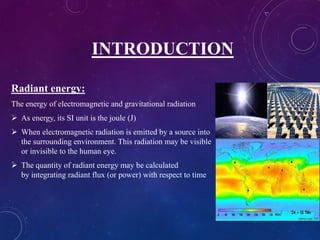
Radiant energy:
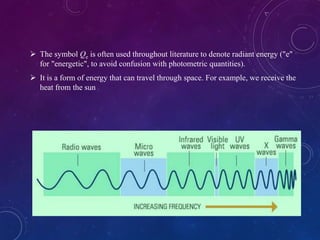
The energy of electromagnetic and gravitational radiation
 As energy, its SI unit is the joule (J)
 When electromagnetic radiation is emitted by a source into
the surrounding environment. This radiation may be visible
or invisible to the human eye.
 The quantity of radiant energy may be calculated
by integrating radiant flux (or power) with respect to time
 The symbol Qe is often used throughout literature to denote radiant energy ("e"
for "energetic", to avoid confusion with photometric quantities).
 It is a form of energy that can travel through space. For example, we receive the
heat from the sun
HISTORY
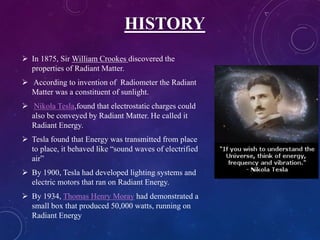
 In 1875, Sir William Crookes discovered the
properties of Radiant Matter.
 According to invention of Radiometer the Radiant
Matter was a constituent of sunlight.
 Nikola Tesla,found that electrostatic charges could
also be conveyed by Radiant Matter. He called it
Radiant Energy.
 Tesla found that Energy was transmitted from place
to place, it behaved like “sound waves of electrified
air”
 By 1900, Tesla had developed lighting systems and
electric motors that ran on Radiant Energy.
 By 1934, Thomas Henry Moray had demonstrated a
small box that produced 50,000 watts, running on
Radiant Energy
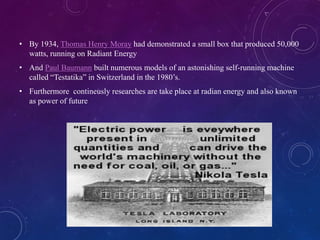
• By 1934, Thomas Henry Moray had demonstrated a small box that produced 50,000
watts, running on Radiant Energy
• And Paul Baumann built numerous models of an astonishing self-running machine
called “Testatika” in Switzerland in the 1980’s.
• Furthermore contineusly researches are take place at radian energy and also known
as power of future
IMPORTANCE OF RADIANT
ENERGY IN YOUR DAILY LIFE
 Now these days radiant energy is an important part of life
 Well today, our radio airways are related with derivations of Tesla’s inventions
Satellites, Cell phones, gpS systems
 air craft navigation and even garage door openers, all require that unwanted
radio waves
 the Sun or sunlight is our primary source of radiant energy without it life on
Earth would pretty much cease to exist.
 Radiant energy is given off by space heaters, toasters, stove burners, light bulbs
(give radiant energy as heat and as light, etc..
 All electromagnetic energy from gamma rays, x-rays, thru radio waves are types
of radiant energy.
WORKING PRINCIPLE
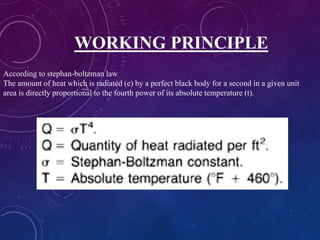
According to stephan-boltzman law
The amount of heat which is radiated (e) by a perfect black body for a second in a given unit
area is directly proportional to the fourth power of its absolute temperature (t).
HOW TO WORK RADIANT
ENERGY
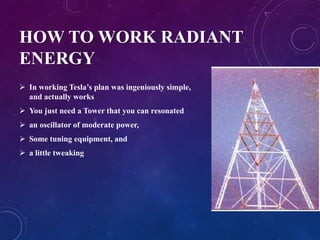
 In working Tesla’s plan was ingeniously simple,
and actually works
 You just need a Tower that you can resonated
 an oscillator of moderate power,
 Some tuning equipment, and
 a little tweaking
SENDING OF SIGNALS
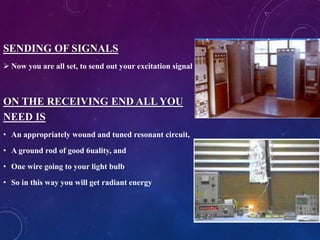
 Now you are all set, to send out your excitation signal
ON THE RECEIVING END ALL YOU
NEED IS
• An appropriately wound and tuned resonant circuit,
• A ground rod of good 6uality, and
• One wire going to your light bulb
• So in this way you will get radiant energy
SOURCES OF RADIANT
ENERGY
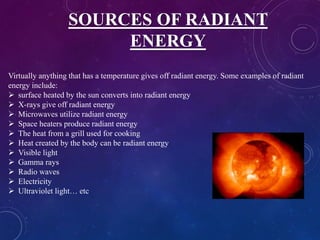
Virtually anything that has a temperature gives off radiant energy. Some examples of radiant
energy include:
 surface heated by the sun converts into radiant energy
 X-rays give off radiant energy
 Microwaves utilize radiant energy
 Space heaters produce radiant energy
 The heat from a grill used for cooking
 Heat created by the body can be radiant energy
 Visible light
 Gamma rays
 Radio waves
 Electricity
 Ultraviolet light… etc
APPLICATIONS OF RADIANT
ENERGY
As radiant energy is used in many application as
 The branch of medical science that deals with diagnosis and treatment of diseases with
the help of different types of radiant energy is known as Radiology
 Radiant energy is used to heat things up (an oven or a baseboard heating system)
 Radiant energy is used to produce light in many application like a light bulb or laser
pointer etc..
 Radiant energy is used to carry information from one place to another as a radio
broadcast or cell phone.
Advantages and Dis-advantages
Advantages of Radiant energy
 Radiant energy systems is relatively cheap to set up,
 That energy system need just an antenna, some wires and basic capacitors.
 it is easy to use radiant energy on a small scale.
 Such systems already exist in water heating devices which make direct use the
Sun’s rays and even photographic development equipment.
 That system can qucikly installed
 Radiant energy system can easily expand or upgrade
 Don’t have pollution factors like CO2 emission
Disadvantages of Radiant energy:
 Radiant energy is not useful in terms of producing large amounts of energy.
 Radiant energy system required high amount of sun or sun light
 That system required electrical system to storage and backup of radiant energy
 That radiant energy system has low efficiency
 Large space is required for setup
Advantages and Dis-advantages
Radiant energy
Radiant energy

Radiant energy

  • 2.
    MECHANICS OF MATERIALII Represented To: Sir USMAN Represented by HAAD AHMAD MUGHAL Mech-26 USMAN SHAKEEL Mech-23 HASSAN IDREES Mech-19 ALI TARAR Mech-07 Department of mechanical engineering CCET GRW
  • 3.
  • 4.
    AGENDA Introduction HISTORY WORKNG PRINCIPLE How itworks Sources and applications Advantages and Disadvantages
  • 5.
    INTRODUCTION Radiant energy: The energyof electromagnetic and gravitational radiation  As energy, its SI unit is the joule (J)  When electromagnetic radiation is emitted by a source into the surrounding environment. This radiation may be visible or invisible to the human eye.  The quantity of radiant energy may be calculated by integrating radiant flux (or power) with respect to time
  • 6.
     The symbolQe is often used throughout literature to denote radiant energy ("e" for "energetic", to avoid confusion with photometric quantities).  It is a form of energy that can travel through space. For example, we receive the heat from the sun
  • 7.
    HISTORY  In 1875,Sir William Crookes discovered the properties of Radiant Matter.  According to invention of Radiometer the Radiant Matter was a constituent of sunlight.  Nikola Tesla,found that electrostatic charges could also be conveyed by Radiant Matter. He called it Radiant Energy.  Tesla found that Energy was transmitted from place to place, it behaved like “sound waves of electrified air”  By 1900, Tesla had developed lighting systems and electric motors that ran on Radiant Energy.  By 1934, Thomas Henry Moray had demonstrated a small box that produced 50,000 watts, running on Radiant Energy
  • 8.
    • By 1934,Thomas Henry Moray had demonstrated a small box that produced 50,000 watts, running on Radiant Energy • And Paul Baumann built numerous models of an astonishing self-running machine called “Testatika” in Switzerland in the 1980’s. • Furthermore contineusly researches are take place at radian energy and also known as power of future
  • 9.
    IMPORTANCE OF RADIANT ENERGYIN YOUR DAILY LIFE  Now these days radiant energy is an important part of life  Well today, our radio airways are related with derivations of Tesla’s inventions Satellites, Cell phones, gpS systems  air craft navigation and even garage door openers, all require that unwanted radio waves  the Sun or sunlight is our primary source of radiant energy without it life on Earth would pretty much cease to exist.  Radiant energy is given off by space heaters, toasters, stove burners, light bulbs (give radiant energy as heat and as light, etc..  All electromagnetic energy from gamma rays, x-rays, thru radio waves are types of radiant energy.
  • 10.
    WORKING PRINCIPLE According tostephan-boltzman law The amount of heat which is radiated (e) by a perfect black body for a second in a given unit area is directly proportional to the fourth power of its absolute temperature (t).
  • 11.
    HOW TO WORKRADIANT ENERGY  In working Tesla’s plan was ingeniously simple, and actually works  You just need a Tower that you can resonated  an oscillator of moderate power,  Some tuning equipment, and  a little tweaking
  • 12.
    SENDING OF SIGNALS Now you are all set, to send out your excitation signal ON THE RECEIVING END ALL YOU NEED IS • An appropriately wound and tuned resonant circuit, • A ground rod of good 6uality, and • One wire going to your light bulb • So in this way you will get radiant energy
  • 13.
    SOURCES OF RADIANT ENERGY Virtuallyanything that has a temperature gives off radiant energy. Some examples of radiant energy include:  surface heated by the sun converts into radiant energy  X-rays give off radiant energy  Microwaves utilize radiant energy  Space heaters produce radiant energy  The heat from a grill used for cooking  Heat created by the body can be radiant energy  Visible light  Gamma rays  Radio waves  Electricity  Ultraviolet light… etc
  • 14.
    APPLICATIONS OF RADIANT ENERGY Asradiant energy is used in many application as  The branch of medical science that deals with diagnosis and treatment of diseases with the help of different types of radiant energy is known as Radiology  Radiant energy is used to heat things up (an oven or a baseboard heating system)  Radiant energy is used to produce light in many application like a light bulb or laser pointer etc..  Radiant energy is used to carry information from one place to another as a radio broadcast or cell phone.
  • 15.
    Advantages and Dis-advantages Advantagesof Radiant energy  Radiant energy systems is relatively cheap to set up,  That energy system need just an antenna, some wires and basic capacitors.  it is easy to use radiant energy on a small scale.  Such systems already exist in water heating devices which make direct use the Sun’s rays and even photographic development equipment.  That system can qucikly installed  Radiant energy system can easily expand or upgrade  Don’t have pollution factors like CO2 emission
  • 16.
    Disadvantages of Radiantenergy:  Radiant energy is not useful in terms of producing large amounts of energy.  Radiant energy system required high amount of sun or sun light  That system required electrical system to storage and backup of radiant energy  That radiant energy system has low efficiency  Large space is required for setup Advantages and Dis-advantages