The Flow of Energy
The Flow of Energy
Where it comes from; where it goes
Spring 2006
UCSD: Physics 8; 2006
2
Energy as a tool in physics
• Energy is a very abstract notion, but it is a very useful
Energy is a very abstract notion, but it is a very useful
and quantifiable notion
• We use the
We use the conservation of energy
conservation of energy to predict
to predict
behavior
behavior
– by setting E = mgh + ½mv2
= constant we can elucidate the
value of the velocity at any height:
v2
= 2g(height fallen from rest)
– We rely on the fact that energy is not created out of nowhere
• Where did the energy we see around us
Where did the energy we see around us come from
come from?
?
– most of what we use derives from the sun
– some derives from other, exploded stars (nuclear fission)
– ultimately, all of it was donated in the Big Bang
• but surprisingly, the net energy of the universe can be (and
looks to be) zero!
Spring 2006
UCSD: Physics 8; 2006
3
Energy is Conserved
Energy is Conserved
• Conservation of Energy
Conservation of Energy is different from Energy
is different from Energy
Conservation, the latter being about using energy
wisely
wisely
• Conservation of Energy means energy is
Conservation of Energy means energy is neither
neither
created nor destroyed
created nor destroyed. The total amount of energy in
. The total amount of energy in
the Universe is
the Universe is constant
constant!!
!!
• Don’t we
Don’t we create
create energy at a power plant?
energy at a power plant?
– No, we simply transform energy at our power plants
• Doesn’t the sun
Doesn’t the sun create
create energy?
energy?
– Nope—it exchanges mass for energy
Spring 2006
UCSD: Physics 8; 2006
4
height reference
h
Energy Exchange
Energy Exchange
• Though the total energy of a system is constant, the
Though the total energy of a system is constant, the
form
form of the energy can change
of the energy can change
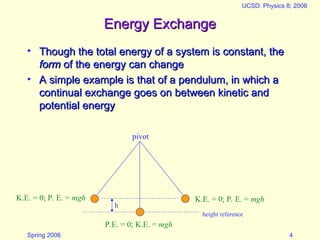
• A simple example is that of a pendulum, in which a
A simple example is that of a pendulum, in which a
continual exchange goes on between kinetic and
potential energy
potential energy
pivot
K.E. = 0; P. E. = mgh K.E. = 0; P. E. = mgh
P.E. = 0; K.E. = mgh
Spring 2006
UCSD: Physics 8; 2006
5
Perpetual Motion
Perpetual Motion
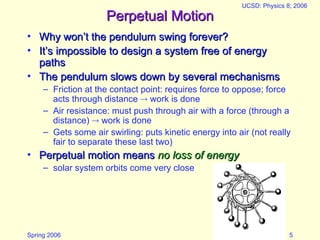
• Why won’t the pendulum swing forever?
Why won’t the pendulum swing forever?
• It’s impossible to design a system free of energy
It’s impossible to design a system free of energy
paths
paths
• The pendulum slows down by several mechanisms
The pendulum slows down by several mechanisms
– Friction at the contact point: requires force to oppose; force
acts through distance  work is done
– Air resistance: must push through air with a force (through a
distance)  work is done
– Gets some air swirling: puts kinetic energy into air (not really
fair to separate these last two)
• Perpetual motion means
Perpetual motion means no loss of energy
no loss of energy
– solar system orbits come very close
Spring 2006
UCSD: Physics 8; 2006
6
Some Energy Chains:
Some Energy Chains:
• A toilet bowl with some gravitational potential energy
A toilet bowl with some gravitational potential energy
is dropped
is dropped
• potential energy turns into kinetic energy
potential energy turns into kinetic energy
• kinetic energy of the toilet bowl goes into:
kinetic energy of the toilet bowl goes into:
– ripping the toilet bowl apart (chemical: breaking bonds)
– sending the pieces flying (kinetic)
– into sound
– into heating the ground and pieces through friction as the
pieces slide to a stop
• In the end, the local environment is slightly warmer
In the end, the local environment is slightly warmer
Spring 2006
UCSD: Physics 8; 2006
7
How Much Warmer?
How Much Warmer?
• A 20 kg toilet bowl held 1 meter off the ground has
A 20 kg toilet bowl held 1 meter off the ground has 200 J
200 J of
of
gravitetional potential energy
– mgh = (20 kg)(10 m/s2
)(1 m) = 200 kg·m2
/s2
= 200 J
• A typical heat capacity is
A typical heat capacity is 1000 J/kg/
1000 J/kg/
C
C (a property of the material)
(a property of the material)
• So
So 200 J
200 J can heat 0.2 kg of material by 1
can heat 0.2 kg of material by 1
C or 1 kg by 0.2
C or 1 kg by 0.2
C or 20
C or 20
kg by 0.01
kg by 0.01
C
C
– heat capacity follows intuitive logic:
• to get same T, need more energy or less mass
• given fixed energy input, get smaller T for larger mass
• for a given mass, get larger T for more energy input
• So how much mass is effectively involved?
So how much mass is effectively involved?
– initially not much (just contact surfaces): so hot at first
– but heat diffuses into surrounding bulk: cools down
– so answer is ill-defined: depends on when
• But on the whole, the temperature rise is hardly noticeable
But on the whole, the temperature rise is hardly noticeable
Spring 2006
UCSD: Physics 8; 2006
8
Gasoline Example
Gasoline Example
• Put gas in your car
• Combust gas, turning chemical energy into kinetic energy of the
explosion (motion of gas particles)
• Transfer kinetic energy of gas to piston to crankshaft to drive
shaft to wheel to car as a whole
• That which doesn’t go into kinetic energy of the car goes into
heating the engine block (and radiator water and surrounding
air), and friction of transmission system (heat)
• Much of energy goes into stirring the air (ends up as heat)
• Apply the brakes and convert kinetic energy into heat
• It all ends up as waste heat, ultimately
Spring 2006
UCSD: Physics 8; 2006
9
Bouncing Ball
Bouncing Ball
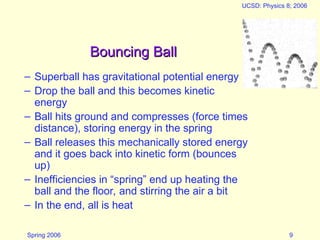
– Superball has gravitational potential energy
– Drop the ball and this becomes kinetic
energy
– Ball hits ground and compresses (force times
distance), storing energy in the spring
– Ball releases this mechanically stored energy
and it goes back into kinetic form (bounces
up)
– Inefficiencies in “spring” end up heating the
ball and the floor, and stirring the air a bit
– In the end, all is heat
Spring 2006
UCSD: Physics 8; 2006
10
Why don’t we get hotter and hotter
• If all these processes end up as heat, why aren’t we
If all these processes end up as heat, why aren’t we
continually getting hotter?
• If earth retained all its heat, we
If earth retained all its heat, we would
would get hotter
get hotter
• All of earth’s heat is
All of earth’s heat is radiated
radiated away as
away as infrared
infrared light
light
– hotter things radiate more heat
• If we dump more power, the temperature goes up,
If we dump more power, the temperature goes up,
the radiated power increases dramatically
– comes to equilibrium: power dumped = power radiated
– stable against perturbation: T tracks power budget
Spring 2006
UCSD: Physics 8; 2006
11
Another Piece of the Energy Zoo: Light
• The
The power
power given off of a surface in the form of light is
given off of a surface in the form of light is
proportional to the
proportional to the fourth power
fourth power of that surface’s temperature!
of that surface’s temperature!
P = A
P = A
T
T4
4
in Watts
in Watts
– the constant, , is numerically 5.6710-8
W/ºK4
/m2
– easy to remember constant: 5678
– A is surface area of hot thing, in square meters
– temperature must be in Kelvin:
• ºK = ºC + 273
• ºC = (5/9)(ºF –32)
• Example: radiation from your body:
Example: radiation from your body:
(1 m2
)(5.67 10-8
) (310)4
= 523 Watts
(if naked in the cold of space: don’t let this happen to you!)
Spring 2006
UCSD: Physics 8; 2006
12
Radiant Energy, continued
• Example: The sun is
Example: The sun is 5800
5800ºK
ºK on its surface, so:
on its surface, so:
P/A = T4
= (5.6710-8
)(5800)4
= 6.4107
W/m2
Summing over entire surface area of sun gives
3.91026
W
• Compare to total capacity of human energy
Compare to total capacity of human energy
“production” on earth: 3.3
“production” on earth: 3.3
10
1012
12
W
W
– Single power plant is typically 0.5–1.0 GW (109
W)
• In earthly situations, radiated power out is partially
In earthly situations, radiated power out is partially
balanced
balanced by radiated power in from other sources
by radiated power in from other sources
– Not 523 W/m2
in 70ºF room, more like 100 W/m2
• goes like Th
4
– Tc
4
Spring 2006
UCSD: Physics 8; 2006
13
Rough numbers
Rough numbers
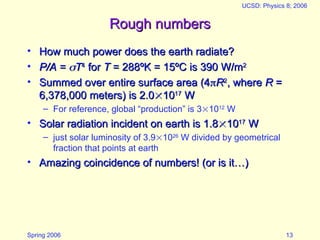
• How much power does the earth radiate?
How much power does the earth radiate?
• P/A =
P/A = 
T
T4
4
for
for T
T = 288
= 288ºK = 15ºC is 390 W/m
ºK = 15ºC is 390 W/m2
2
• Summed over entire surface area (4
Summed over entire surface area (4
R
R2
2
, where
, where R
R =
=
6,378,000 meters) is 2.0
6,378,000 meters) is 2.0
10
1017
17
W
W
– For reference, global “production” is 31012
W
• Solar radiation incident on earth is 1.8
Solar radiation incident on earth is 1.8
10
1017
17
W
W
– just solar luminosity of 3.91026
W divided by geometrical
fraction that points at earth
• Amazing coincidence of numbers! (or is it…)
Amazing coincidence of numbers! (or is it…)
Spring 2006
UCSD: Physics 8; 2006
14
No Energy for Free
No Energy for Free
• No matter what, you can’t create energy out of
No matter what, you can’t create energy out of
nothing: it has to come from somewhere
• We can
We can transform
transform energy from one form to another;
energy from one form to another;
we can
we can store
store energy, we can
energy, we can utilize
utilize energy being
energy being
conveyed from natural sources
• The net energy of the entire Universe is constant
The net energy of the entire Universe is constant
• The best we can do is scrape up some useful crumbs
The best we can do is scrape up some useful crumbs
Spring 2006
UCSD: Physics 8; 2006
15
Energy and Calories
Energy and Calories
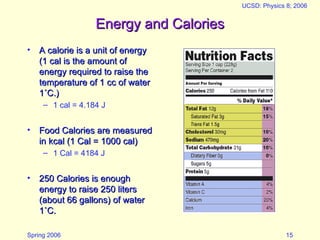
• A calorie is a unit of energy
A calorie is a unit of energy
(1 cal is the amount of
energy required to raise the
temperature of 1 cc of water
1
1˚C.)
˚C.)
– 1 cal = 4.184 J
• Food Calories are measured
Food Calories are measured
in kcal (1 Cal = 1000 cal)
– 1 Cal = 4184 J
• 250 Calories is enough
250 Calories is enough
energy to raise 250 liters
(about 66 gallons) of water
1
1˚C.
˚C.
Spring 2006
UCSD: Physics 8; 2006
16
Human Energy Requirements
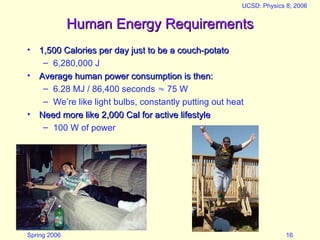
• 1,500 Calories per day just to be a couch-potato
1,500 Calories per day just to be a couch-potato
– 6,280,000 J
• Average human power consumption is then:
Average human power consumption is then:
– 6.28 MJ / 86,400 seconds  75 W
– We’re like light bulbs, constantly putting out heat
• Need more like 2,000 Cal for active lifestyle
Need more like 2,000 Cal for active lifestyle
– 100 W of power
Spring 2006
UCSD: Physics 8; 2006
17
Energy from Food
Energy from Food
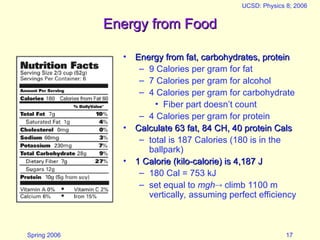
• Energy from fat, carbohydrates, protein
Energy from fat, carbohydrates, protein
– 9 Calories per gram for fat
– 7 Calories per gram for alcohol
– 4 Calories per gram for carbohydrate
• Fiber part doesn’t count
– 4 Calories per gram for protein
• Calculate 63 fat, 84 CH, 40 protein Cals
Calculate 63 fat, 84 CH, 40 protein Cals
– total is 187 Calories (180 is in the
ballpark)
• 1 Calorie (kilo-calorie) is 4,187 J
1 Calorie (kilo-calorie) is 4,187 J
– 180 Cal = 753 kJ
– set equal to mgh climb 1100 m
vertically, assuming perfect efficiency
Spring 2006
UCSD: Physics 8; 2006
18
Not So Fast…
Not So Fast…
• Human body isn’t 100% efficient: more like
Human body isn’t 100% efficient: more like 25%
25%
– To put out 100 J of mechanical work, must eat 400 J
– 180 Calorie candy bar only gets us 275 m, not 1100 m
• Maximum sustained power output (rowing, cycling) is about
Maximum sustained power output (rowing, cycling) is about
150-200 W (for 70 kg person)
– Consuming 600-800 W total, mostly as wasted heat
– For 30 minutes  800 J/s 1800 s = 1.44 MJ = 343 Cal
• Can burst 700 W to 1000 W for < 30 sec
Can burst 700 W to 1000 W for < 30 sec
– put out a full horsepower momentarily!
Spring 2006
UCSD: Physics 8; 2006
19
Most impressive display of human power
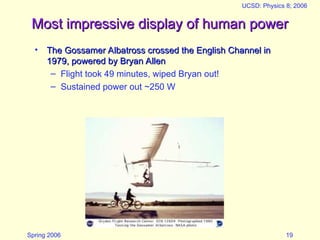
• The Gossamer Albatross crossed the English Channel in
The Gossamer Albatross crossed the English Channel in
1979, powered by Bryan Allen
– Flight took 49 minutes, wiped Bryan out!
– Sustained power out ~250 W
Spring 2006
UCSD: Physics 8; 2006
20
Human Energy Requirements Summarized
• We need chemical energy from food to run
We need chemical energy from food to run
– Ultimate source is sun, long chain of events to twinkies
– Constantly burn energy at rate of 75-100W
– We spend energy at about 25% efficiency
– Maximum sustained power is 150-200 W
• actually burn 4 times this due to inefficiencies
Spring 2006
UCSD: Physics 8; 2006
21
Exercise
Exercise
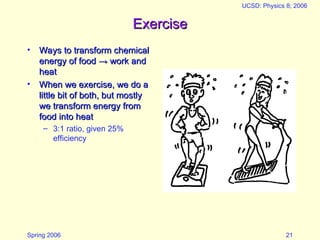
• Ways to transform chemical
Ways to transform chemical
energy of food
energy of food →
→ work and
work and
heat
heat
• When we exercise, we do a
When we exercise, we do a
little bit of both, but mostly
we transform energy from
food into heat
food into heat
– 3:1 ratio, given 25%
efficiency
Spring 2006
UCSD: Physics 8; 2006
22
Air Resistance
Air Resistance
• We’re always “neglecting air resistance” in physics
We’re always “neglecting air resistance” in physics
– Can be difficult to deal with
• Affects projectile motion
Affects projectile motion
– Friction force opposes velocity through medium
– Imposes horizontal force, additional vertical forces
– Terminal velocity for falling objects
• Dominant energy drain on cars, bicyclists, planes
Dominant energy drain on cars, bicyclists, planes
Spring 2006
UCSD: Physics 8; 2006
23
Drag Force Quantified
• With a cross sectional area,
With a cross sectional area, A
A (in m
(in m2
2
), coefficient of
), coefficient of
drag of 1.0 (most objects), sea-level density of air,
and velocity,
and velocity, v
v (m/s), the drag force is:
(m/s), the drag force is:
F
Fdrag
drag =
= ½
½ c
cD
D·
·
·
·A
A·
·v
v2
2
Newtons
Newtons
– cD is drag coefficient: ~1.0 for most things, 0.35 for car
–  is density of medium: 1.3 kg/m3
for air, 1000 kg/m3
water
– typical object in air is then Fdrag  0.65·A·v2
• Example: Bicycling at 10 m/s (22 m.p.h.), with
Example: Bicycling at 10 m/s (22 m.p.h.), with
projected area of 0.5 m
projected area of 0.5 m2
2
exerts 32.5 Newtons
exerts 32.5 Newtons
– requires F·v of power  325 Watts to maintain
speed
Spring 2006
UCSD: Physics 8; 2006
24
“
“Free” Fall
Free” Fall
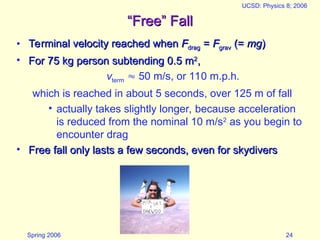
• Terminal velocity reached when
Terminal velocity reached when F
Fdrag
drag =
= F
Fgrav
grav (=
(= mg
mg)
)
• For 75 kg person subtending 0.5 m
For 75 kg person subtending 0.5 m2
2
,
,
vterm  50 m/s, or 110 m.p.h.
which is reached in about 5 seconds, over 125 m of fall
• actually takes slightly longer, because acceleration
is reduced from the nominal 10 m/s2
as you begin to
encounter drag
• Free fall only lasts a few seconds, even for skydivers
Free fall only lasts a few seconds, even for skydivers
Spring 2006
UCSD: Physics 8; 2006
25
Announcements/Assignments
• Next up:
Next up:
– a simple model for molecules/lattices
– electrons, charge, current, electric fields
• Assignments:
Assignments:
– read chapter 7, pp. 212–214, 225–228
– read chapter 3, 83–87; chapter 9 265–269, 278–279
– HW1: 1.E.4, 1.E.7, 1.E.8, 1.E.20, 1.E.25, 1.E.34, 1.P.1,
1.P.8, 1.P.10 (in Newtons), 1.P.14, 1.P.16, 1.P.18, 1.P.22,
2.E.28, 2.P.10, 2.P.11: due 4/13
– First Q/O due Friday, 4/14 by 6PM via WebCT

Energy flow in usefulquantifiable notion

  • 1.
    The Flow ofEnergy The Flow of Energy Where it comes from; where it goes Where it comes from; where it goes
  • 2.
    Spring 2006 UCSD: Physics8; 2006 2 Energy as a tool in physics Energy as a tool in physics • Energy is a very abstract notion, but it is a very useful Energy is a very abstract notion, but it is a very useful and quantifiable notion and quantifiable notion • We use the We use the conservation of energy conservation of energy to predict to predict behavior behavior – by setting E = mgh + ½mv2 = constant we can elucidate the value of the velocity at any height: v2 = 2g(height fallen from rest) – We rely on the fact that energy is not created out of nowhere • Where did the energy we see around us Where did the energy we see around us come from come from? ? – most of what we use derives from the sun – some derives from other, exploded stars (nuclear fission) – ultimately, all of it was donated in the Big Bang • but surprisingly, the net energy of the universe can be (and looks to be) zero!
  • 3.
    Spring 2006 UCSD: Physics8; 2006 3 Energy is Conserved Energy is Conserved • Conservation of Energy Conservation of Energy is different from Energy is different from Energy Conservation, the latter being about using energy Conservation, the latter being about using energy wisely wisely • Conservation of Energy means energy is Conservation of Energy means energy is neither neither created nor destroyed created nor destroyed. The total amount of energy in . The total amount of energy in the Universe is the Universe is constant constant!! !! • Don’t we Don’t we create create energy at a power plant? energy at a power plant? – No, we simply transform energy at our power plants • Doesn’t the sun Doesn’t the sun create create energy? energy? – Nope—it exchanges mass for energy
  • 4.
    Spring 2006 UCSD: Physics8; 2006 4 height reference h Energy Exchange Energy Exchange • Though the total energy of a system is constant, the Though the total energy of a system is constant, the form form of the energy can change of the energy can change • A simple example is that of a pendulum, in which a A simple example is that of a pendulum, in which a continual exchange goes on between kinetic and continual exchange goes on between kinetic and potential energy potential energy pivot K.E. = 0; P. E. = mgh K.E. = 0; P. E. = mgh P.E. = 0; K.E. = mgh
  • 5.
    Spring 2006 UCSD: Physics8; 2006 5 Perpetual Motion Perpetual Motion • Why won’t the pendulum swing forever? Why won’t the pendulum swing forever? • It’s impossible to design a system free of energy It’s impossible to design a system free of energy paths paths • The pendulum slows down by several mechanisms The pendulum slows down by several mechanisms – Friction at the contact point: requires force to oppose; force acts through distance  work is done – Air resistance: must push through air with a force (through a distance)  work is done – Gets some air swirling: puts kinetic energy into air (not really fair to separate these last two) • Perpetual motion means Perpetual motion means no loss of energy no loss of energy – solar system orbits come very close
  • 6.
    Spring 2006 UCSD: Physics8; 2006 6 Some Energy Chains: Some Energy Chains: • A toilet bowl with some gravitational potential energy A toilet bowl with some gravitational potential energy is dropped is dropped • potential energy turns into kinetic energy potential energy turns into kinetic energy • kinetic energy of the toilet bowl goes into: kinetic energy of the toilet bowl goes into: – ripping the toilet bowl apart (chemical: breaking bonds) – sending the pieces flying (kinetic) – into sound – into heating the ground and pieces through friction as the pieces slide to a stop • In the end, the local environment is slightly warmer In the end, the local environment is slightly warmer
  • 7.
    Spring 2006 UCSD: Physics8; 2006 7 How Much Warmer? How Much Warmer? • A 20 kg toilet bowl held 1 meter off the ground has A 20 kg toilet bowl held 1 meter off the ground has 200 J 200 J of of gravitetional potential energy gravitetional potential energy – mgh = (20 kg)(10 m/s2 )(1 m) = 200 kg·m2 /s2 = 200 J • A typical heat capacity is A typical heat capacity is 1000 J/kg/ 1000 J/kg/ C C (a property of the material) (a property of the material) • So So 200 J 200 J can heat 0.2 kg of material by 1 can heat 0.2 kg of material by 1 C or 1 kg by 0.2 C or 1 kg by 0.2 C or 20 C or 20 kg by 0.01 kg by 0.01 C C – heat capacity follows intuitive logic: • to get same T, need more energy or less mass • given fixed energy input, get smaller T for larger mass • for a given mass, get larger T for more energy input • So how much mass is effectively involved? So how much mass is effectively involved? – initially not much (just contact surfaces): so hot at first – but heat diffuses into surrounding bulk: cools down – so answer is ill-defined: depends on when • But on the whole, the temperature rise is hardly noticeable But on the whole, the temperature rise is hardly noticeable
  • 8.
    Spring 2006 UCSD: Physics8; 2006 8 Gasoline Example Gasoline Example • Put gas in your car • Combust gas, turning chemical energy into kinetic energy of the explosion (motion of gas particles) • Transfer kinetic energy of gas to piston to crankshaft to drive shaft to wheel to car as a whole • That which doesn’t go into kinetic energy of the car goes into heating the engine block (and radiator water and surrounding air), and friction of transmission system (heat) • Much of energy goes into stirring the air (ends up as heat) • Apply the brakes and convert kinetic energy into heat • It all ends up as waste heat, ultimately
  • 9.
    Spring 2006 UCSD: Physics8; 2006 9 Bouncing Ball Bouncing Ball – Superball has gravitational potential energy – Drop the ball and this becomes kinetic energy – Ball hits ground and compresses (force times distance), storing energy in the spring – Ball releases this mechanically stored energy and it goes back into kinetic form (bounces up) – Inefficiencies in “spring” end up heating the ball and the floor, and stirring the air a bit – In the end, all is heat
  • 10.
    Spring 2006 UCSD: Physics8; 2006 10 Why don’t we get hotter and hotter Why don’t we get hotter and hotter • If all these processes end up as heat, why aren’t we If all these processes end up as heat, why aren’t we continually getting hotter? continually getting hotter? • If earth retained all its heat, we If earth retained all its heat, we would would get hotter get hotter • All of earth’s heat is All of earth’s heat is radiated radiated away as away as infrared infrared light light – hotter things radiate more heat • If we dump more power, the temperature goes up, If we dump more power, the temperature goes up, the radiated power increases dramatically the radiated power increases dramatically – comes to equilibrium: power dumped = power radiated – stable against perturbation: T tracks power budget
  • 11.
    Spring 2006 UCSD: Physics8; 2006 11 Another Piece of the Energy Zoo: Light Another Piece of the Energy Zoo: Light • The The power power given off of a surface in the form of light is given off of a surface in the form of light is proportional to the proportional to the fourth power fourth power of that surface’s temperature! of that surface’s temperature! P = A P = A T T4 4 in Watts in Watts – the constant, , is numerically 5.6710-8 W/ºK4 /m2 – easy to remember constant: 5678 – A is surface area of hot thing, in square meters – temperature must be in Kelvin: • ºK = ºC + 273 • ºC = (5/9)(ºF –32) • Example: radiation from your body: Example: radiation from your body: (1 m2 )(5.67 10-8 ) (310)4 = 523 Watts (if naked in the cold of space: don’t let this happen to you!)
  • 12.
    Spring 2006 UCSD: Physics8; 2006 12 Radiant Energy, continued Radiant Energy, continued • Example: The sun is Example: The sun is 5800 5800ºK ºK on its surface, so: on its surface, so: P/A = T4 = (5.6710-8 )(5800)4 = 6.4107 W/m2 Summing over entire surface area of sun gives 3.91026 W • Compare to total capacity of human energy Compare to total capacity of human energy “production” on earth: 3.3 “production” on earth: 3.3 10 1012 12 W W – Single power plant is typically 0.5–1.0 GW (109 W) • In earthly situations, radiated power out is partially In earthly situations, radiated power out is partially balanced balanced by radiated power in from other sources by radiated power in from other sources – Not 523 W/m2 in 70ºF room, more like 100 W/m2 • goes like Th 4 – Tc 4
  • 13.
    Spring 2006 UCSD: Physics8; 2006 13 Rough numbers Rough numbers • How much power does the earth radiate? How much power does the earth radiate? • P/A = P/A =  T T4 4 for for T T = 288 = 288ºK = 15ºC is 390 W/m ºK = 15ºC is 390 W/m2 2 • Summed over entire surface area (4 Summed over entire surface area (4 R R2 2 , where , where R R = = 6,378,000 meters) is 2.0 6,378,000 meters) is 2.0 10 1017 17 W W – For reference, global “production” is 31012 W • Solar radiation incident on earth is 1.8 Solar radiation incident on earth is 1.8 10 1017 17 W W – just solar luminosity of 3.91026 W divided by geometrical fraction that points at earth • Amazing coincidence of numbers! (or is it…) Amazing coincidence of numbers! (or is it…)
  • 14.
    Spring 2006 UCSD: Physics8; 2006 14 No Energy for Free No Energy for Free • No matter what, you can’t create energy out of No matter what, you can’t create energy out of nothing: it has to come from somewhere nothing: it has to come from somewhere • We can We can transform transform energy from one form to another; energy from one form to another; we can we can store store energy, we can energy, we can utilize utilize energy being energy being conveyed from natural sources conveyed from natural sources • The net energy of the entire Universe is constant The net energy of the entire Universe is constant • The best we can do is scrape up some useful crumbs The best we can do is scrape up some useful crumbs
  • 15.
    Spring 2006 UCSD: Physics8; 2006 15 Energy and Calories Energy and Calories • A calorie is a unit of energy A calorie is a unit of energy (1 cal is the amount of (1 cal is the amount of energy required to raise the energy required to raise the temperature of 1 cc of water temperature of 1 cc of water 1 1˚C.) ˚C.) – 1 cal = 4.184 J • Food Calories are measured Food Calories are measured in kcal (1 Cal = 1000 cal) in kcal (1 Cal = 1000 cal) – 1 Cal = 4184 J • 250 Calories is enough 250 Calories is enough energy to raise 250 liters energy to raise 250 liters (about 66 gallons) of water (about 66 gallons) of water 1 1˚C. ˚C.
  • 16.
    Spring 2006 UCSD: Physics8; 2006 16 Human Energy Requirements Human Energy Requirements • 1,500 Calories per day just to be a couch-potato 1,500 Calories per day just to be a couch-potato – 6,280,000 J • Average human power consumption is then: Average human power consumption is then: – 6.28 MJ / 86,400 seconds  75 W – We’re like light bulbs, constantly putting out heat • Need more like 2,000 Cal for active lifestyle Need more like 2,000 Cal for active lifestyle – 100 W of power
  • 17.
    Spring 2006 UCSD: Physics8; 2006 17 Energy from Food Energy from Food • Energy from fat, carbohydrates, protein Energy from fat, carbohydrates, protein – 9 Calories per gram for fat – 7 Calories per gram for alcohol – 4 Calories per gram for carbohydrate • Fiber part doesn’t count – 4 Calories per gram for protein • Calculate 63 fat, 84 CH, 40 protein Cals Calculate 63 fat, 84 CH, 40 protein Cals – total is 187 Calories (180 is in the ballpark) • 1 Calorie (kilo-calorie) is 4,187 J 1 Calorie (kilo-calorie) is 4,187 J – 180 Cal = 753 kJ – set equal to mgh climb 1100 m vertically, assuming perfect efficiency
  • 18.
    Spring 2006 UCSD: Physics8; 2006 18 Not So Fast… Not So Fast… • Human body isn’t 100% efficient: more like Human body isn’t 100% efficient: more like 25% 25% – To put out 100 J of mechanical work, must eat 400 J – 180 Calorie candy bar only gets us 275 m, not 1100 m • Maximum sustained power output (rowing, cycling) is about Maximum sustained power output (rowing, cycling) is about 150-200 W (for 70 kg person) 150-200 W (for 70 kg person) – Consuming 600-800 W total, mostly as wasted heat – For 30 minutes  800 J/s 1800 s = 1.44 MJ = 343 Cal • Can burst 700 W to 1000 W for < 30 sec Can burst 700 W to 1000 W for < 30 sec – put out a full horsepower momentarily!
  • 19.
    Spring 2006 UCSD: Physics8; 2006 19 Most impressive display of human power Most impressive display of human power • The Gossamer Albatross crossed the English Channel in The Gossamer Albatross crossed the English Channel in 1979, powered by Bryan Allen 1979, powered by Bryan Allen – Flight took 49 minutes, wiped Bryan out! – Sustained power out ~250 W
  • 20.
    Spring 2006 UCSD: Physics8; 2006 20 Human Energy Requirements Summarized Human Energy Requirements Summarized • We need chemical energy from food to run We need chemical energy from food to run – Ultimate source is sun, long chain of events to twinkies – Constantly burn energy at rate of 75-100W – We spend energy at about 25% efficiency – Maximum sustained power is 150-200 W • actually burn 4 times this due to inefficiencies
  • 21.
    Spring 2006 UCSD: Physics8; 2006 21 Exercise Exercise • Ways to transform chemical Ways to transform chemical energy of food energy of food → → work and work and heat heat • When we exercise, we do a When we exercise, we do a little bit of both, but mostly little bit of both, but mostly we transform energy from we transform energy from food into heat food into heat – 3:1 ratio, given 25% efficiency
  • 22.
    Spring 2006 UCSD: Physics8; 2006 22 Air Resistance Air Resistance • We’re always “neglecting air resistance” in physics We’re always “neglecting air resistance” in physics – Can be difficult to deal with • Affects projectile motion Affects projectile motion – Friction force opposes velocity through medium – Imposes horizontal force, additional vertical forces – Terminal velocity for falling objects • Dominant energy drain on cars, bicyclists, planes Dominant energy drain on cars, bicyclists, planes
  • 23.
    Spring 2006 UCSD: Physics8; 2006 23 Drag Force Quantified Drag Force Quantified • With a cross sectional area, With a cross sectional area, A A (in m (in m2 2 ), coefficient of ), coefficient of drag of 1.0 (most objects), sea-level density of air, drag of 1.0 (most objects), sea-level density of air, and velocity, and velocity, v v (m/s), the drag force is: (m/s), the drag force is: F Fdrag drag = = ½ ½ c cD D· · · ·A A· ·v v2 2 Newtons Newtons – cD is drag coefficient: ~1.0 for most things, 0.35 for car –  is density of medium: 1.3 kg/m3 for air, 1000 kg/m3 water – typical object in air is then Fdrag  0.65·A·v2 • Example: Bicycling at 10 m/s (22 m.p.h.), with Example: Bicycling at 10 m/s (22 m.p.h.), with projected area of 0.5 m projected area of 0.5 m2 2 exerts 32.5 Newtons exerts 32.5 Newtons – requires F·v of power  325 Watts to maintain speed
  • 24.
    Spring 2006 UCSD: Physics8; 2006 24 “ “Free” Fall Free” Fall • Terminal velocity reached when Terminal velocity reached when F Fdrag drag = = F Fgrav grav (= (= mg mg) ) • For 75 kg person subtending 0.5 m For 75 kg person subtending 0.5 m2 2 , , vterm  50 m/s, or 110 m.p.h. which is reached in about 5 seconds, over 125 m of fall • actually takes slightly longer, because acceleration is reduced from the nominal 10 m/s2 as you begin to encounter drag • Free fall only lasts a few seconds, even for skydivers Free fall only lasts a few seconds, even for skydivers
  • 25.
    Spring 2006 UCSD: Physics8; 2006 25 Announcements/Assignments Announcements/Assignments • Next up: Next up: – a simple model for molecules/lattices – electrons, charge, current, electric fields • Assignments: Assignments: – read chapter 7, pp. 212–214, 225–228 – read chapter 3, 83–87; chapter 9 265–269, 278–279 – HW1: 1.E.4, 1.E.7, 1.E.8, 1.E.20, 1.E.25, 1.E.34, 1.P.1, 1.P.8, 1.P.10 (in Newtons), 1.P.14, 1.P.16, 1.P.18, 1.P.22, 2.E.28, 2.P.10, 2.P.11: due 4/13 – First Q/O due Friday, 4/14 by 6PM via WebCT

Editor's Notes

  • #17 A Calorie (with a capital C) is a kilo-calorie (small c). A calorie is how much energy it takes to heat 1 mL (1 cubic centimeter) of water 1 degree Celsius (1.8 degrees F). From this we can actually figure out how much a superball warms up when it gives up its kinetic energy to heat energy (over the course of a few bounces), assuming the superball and water have roughly the same heating-up characteristics/requirements. If we drop a 0.2 kg ball from 10 meters (mgh = 20 J  5 calories), the 200 mL ball (assuming density of water) heats up 5/200 = 1/40 = 0.025 degrees Celsius. Not much. Would never notice, would you?