Social Media
for Academics
2015-04-16
Hugo Guyader

doctoral candidate
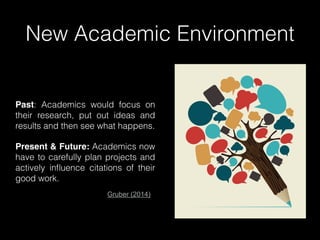
New Academic Environment
Past: Academics would focus on
their research, put out ideas and
results and then see what happens.
Present & Future: Academics now
have to carefully plan projects and
actively influence citations of their
good work.
Gruber (2014)
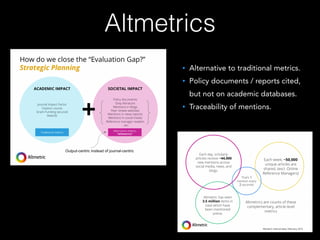
Altmetrics
• Alternative to traditional metrics.
• Policy documents / reports cited,
but not on academic databases.
• Traceability of mentions.
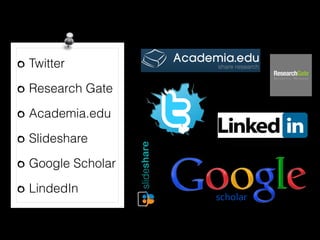
Twitter
Research Gate
Academia.edu
Slideshare
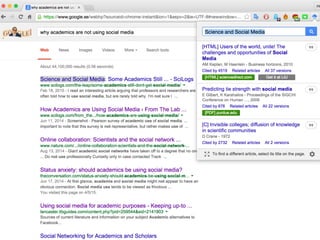
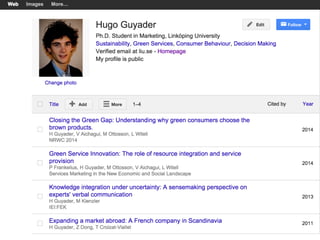
Google Scholar
LindedIn
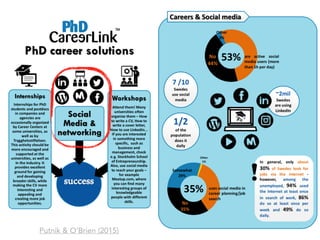
Putnik & O’Brien (2015)
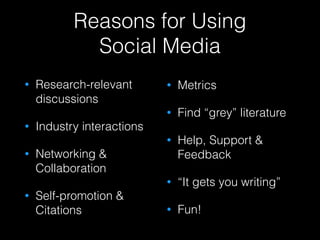
Reasons for Using
Social Media
• Research-relevant
discussions
• Industry interactions
• Networking &
Collaboration
• Self-promotion &
Citations
• Metrics
• Find “grey” literature
• Help, Support &
Feedback
• “It gets you writing”
• Fun!
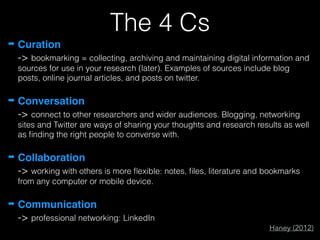
The 4 Cs
➡ Curation

-> bookmarking = collecting, archiving and maintaining digital information and
sources for use in your research (later). Examples of sources include blog
posts, online journal articles, and posts on twitter.
➡ Conversation

-> connect to other researchers and wider audiences. Blogging, networking
sites and Twitter are ways of sharing your thoughts and research results as well
as finding the right people to converse with.
➡ Collaboration

-> working with others is more flexible: notes, files, literature and bookmarks
from any computer or mobile device.
➡ Communication

-> professional networking: LinkedIn
Haney (2012)
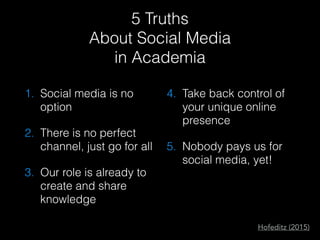
5 Truths
About Social Media
in Academia
1. Social media is no
option
2. There is no perfect
channel, just go for all
3. Our role is already to
create and share
knowledge
4. Take back control of
your unique online
presence
5. Nobody pays us for
social media, yet!
Hofeditz (2015)
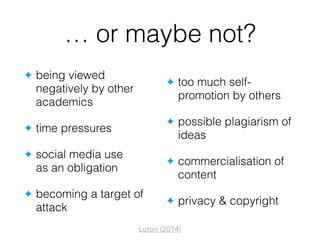
… or maybe not?
✦ being viewed
negatively by other
academics
✦ time pressures
✦ social media use 

as an obligation
✦ becoming a target of
attack
✦ too much self-
promotion by others
✦ possible plagiarism of
ideas
✦ commercialisation of
content
✦ privacy & copyright
Luton (2014)
“You can’t compete so grab some
popcorn and enjoy the show.”
✴ Lack audience to
start intelligent
conversations about
niche topics.
✴ No promise that
anyone is to reading.
✴ Search “marketing”
on LinkedIn and you’ll
find 68K groups.
✴ Serve the algorithm,
rather than the editor.
The Next Web (2015)
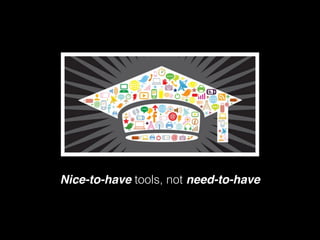
Nice-to-have tools, not need-to-have
Social Media Strategy
On the one hand, social media lends
itself to exploration and experimentation.

On the other hand, there is a danger of
being too scattergun.
✓ For whom are you writing?
✓ Why are you writing?
✓ How do you want to present yourself?
✓ What do you not want to show about yourself online?
(e.g. restrictions on who can access your pages)
Haynes (2012)
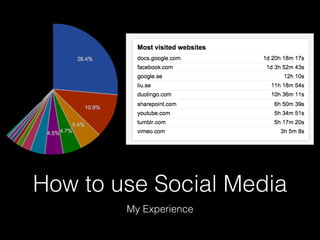
How to use Social Media
My Experience
Twitter
• fast & responsive
• news — a window to the world
• discover articles & researchers
• no barrier of entry, no hierarchy
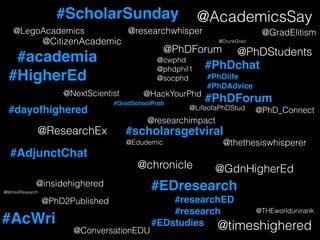
#academia
#HigherEd
#dayofhighered
@GdnHigherEd
@Edudemic
@PhD2Published
@PhDStudents@PhDForum
@cwphd
@phdphil1
@socphd
#PhDchat
#PhDlife
#PhDAdvice
#PhDForum
@researchimpact
@timeshighered
@THEworldunirank
@insidehighered #EDresearch
#researchED
#research
#EDstudies
#AdjunctChat
#ScholarSunday
#scholarsgetviral
#AcWri
@chronicle
@PhD_Connect
@LegoAcademics
@CitizenAcademic
@HackYourPhd
@ConversationEDU
@AcademicsSay
@Write4Research
@researchwhisper
@thethesiswhisperer
@NextScientist
@ResearchEx
@GradElitism
@DrunkGrad
#GradSchoolProb
@LifeofaPhDStud
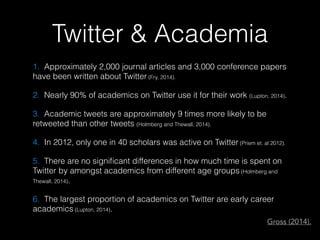
Twitter & Academia
1. Approximately 2,000 journal articles and 3,000 conference papers
have been written about Twitter (Fry, 2014).
2. Nearly 90% of academics on Twitter use it for their work (Lupton, 2014).
3. Academic tweets are approximately 9 times more likely to be
retweeted than other tweets (Holmberg and Thewall, 2014).
4. In 2012, only one in 40 scholars was active on Twitter (Priem et. al 2012).
5. There are no significant differences in how much time is spent on
Twitter by amongst academics from different age groups (Holmberg and
Thewall, 2014).
6. The largest proportion of academics on Twitter are early career
academics (Lupton, 2014).
Gross (2014).
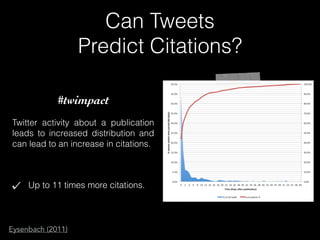
Can Tweets
Predict Citations?
#twimpact
Twitter activity about a publication
leads to increased distribution and
can lead to an increase in citations.
Up to 11 times more citations.
Eysenbach (2011)
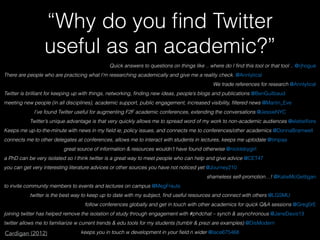
Quick answers to questions on things like .. where do I find this tool or that tool .. @rjhogue
There are people who are practicing what I’m researching academically and give me a reality check. @Annlytical
We trade references for research @Annlytical
Twitter is brilliant for keeping up with things, networking, finding new ideas, people’s blogs and publications @BenGuilbaud
meeting new people (in all disciplines), academic support, public engagement, increased visibility, filtered news @Martin_Eve
I’ve found Twitter useful for augmenting F2F academic conferences, extending the conversations @JessieNYC
Twitter’s unique advantage is that very quickly allows me to spread word of my work to non-academic audiences @elebelfiore
Keeps me up-to-the-minute with news in my field ie; policy issues, and connects me to conferences/other academics @DonnaBramwell
connects me to other delegates at conferences, allows me to interact with students in lectures, keeps me uptodate @timpaa
great source of information & resources wouldn’t have found otherwise @nicklebygirl
a PhD can be very isolated so I think twitter is a great way to meet people who can help and give advice @CET47
you can get very interesting literature advices or other sources you have not noticed yet @Journey210
shameless self-promotion…! @KatieMcGettigan
to invite community members to events and lectures on campus @MegFrauts
twitter is the best way to keep up to date with my subject, find useful resources and connect with others @LGSMU
follow conferences globally and get in touch with other academics for quick Q&A sessions @Greg0rE
joining twitter has helped remove the isolation of study through engagement with #phdchat – synch & asynchronous @JaneDavis13
twitter allows me to familiarize w current trends & edu tools for my students (tumblr & prezi are examples) @DisModern
keeps you in touch w development in your field n wider @lace675468
“Why do you find Twitter
useful as an academic?”
Cardigan (2012)
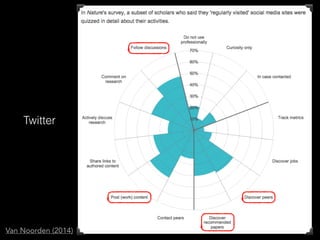
Twitter
Van Noorden (2014)
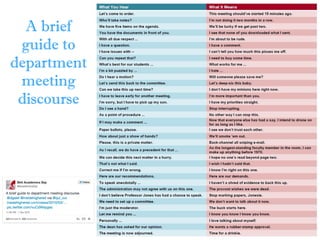
A brief
guide to
department
meeting
discourse
3 tweeting styles:
• Informational: links to articles, blogposts,
announcements, and funding sources that might be of
interest to others. Usually with a bit of explanation or
commentary.
• Interactive: engage the Twitter community, usually by
posing a question or topic of discussion or responding to
something someone else has posted. Such exchanges
lead to simple advices, or philosophical conversations.
• Personal: a window into your life. Probably an entirely
worthless activity, at least professionally; but it does
provide personal connections and a sense of community.
DIY Ivory Tower (2012)
1. Put up an avatar. It doesn't
really matter what the picture is,
but the "egg picture" (the
default avatar for new accounts)
makes you look like a spammer.
2. Don't pick a Twitter name that
is difficult to spell or remember.
3. Tweet regularly.
4. Don't ignore people who
tweet at you. Set Twitter to send
you an e-mail notification when
you get a mention or a private
message. If you don't do that,
then check your account
frequently.
5. Engage in conversation.
Don't just drop in to post your
own update and disappear.
Twitter is not a "broadcast-only"
mechanism; it's CB radio.
6. Learn the hashtags for your
subject field or topics of
interest, and use them.
7. Don't just make statements.
Ask questions.
8. Don't just post links to news
articles. I don't need you to be
my aggregator.
9. Do show your personality.
Crack some jokes.
10. Have fun.
10 Commandments:
Gulliver (2012)
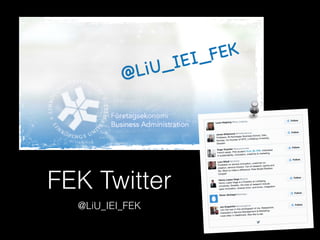
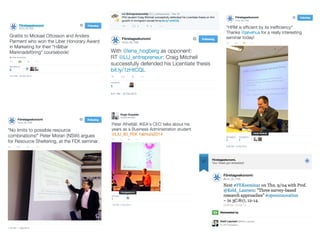
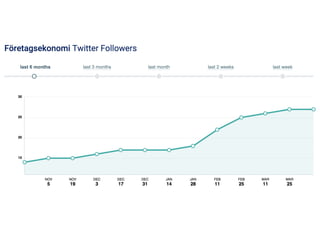
FEK Twitter
@LiU_IEI_FEK
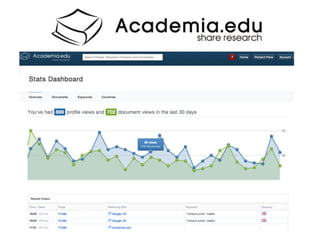
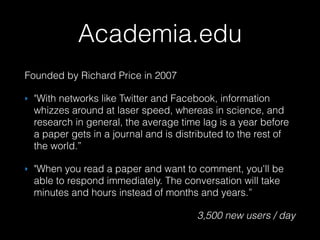
Founded by Richard Price in 2007
‣ "With networks like Twitter and Facebook, information
whizzes around at laser speed, whereas in science, and
research in general, the average time lag is a year before
a paper gets in a journal and is distributed to the rest of
the world.”
‣ "When you read a paper and want to comment, you'll be
able to respond immediately. The conversation will take
minutes and hours instead of months and years.”
3,500 new users / day
Academia.edu
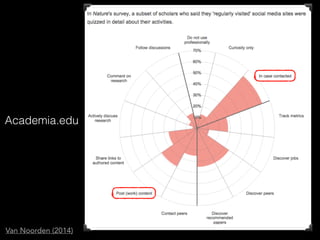
Academia.edu
Van Noorden (2014)
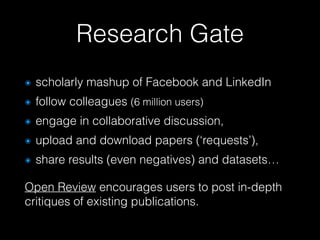
Research Gate
๏ scholarly mashup of Facebook and LinkedIn
๏ follow colleagues (6 million users)
๏ engage in collaborative discussion,
๏ upload and download papers (‘requests’),
๏ share results (even negatives) and datasets…
Open Review encourages users to post in-depth
critiques of existing publications.
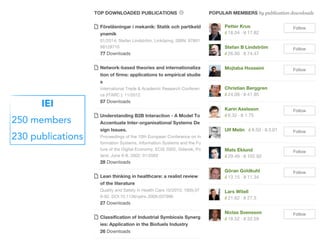
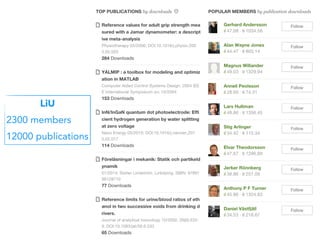
IEI
250 members
230 publications
LiU
2300 members
12000 publications
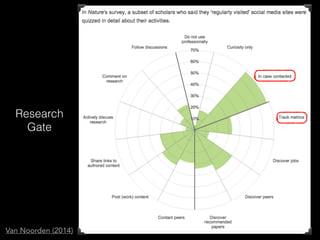
Research
Gate
Van Noorden (2014)
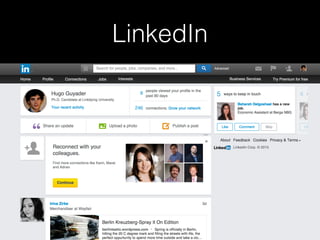
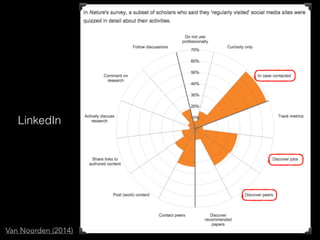
LinkedIn
LinkedIn
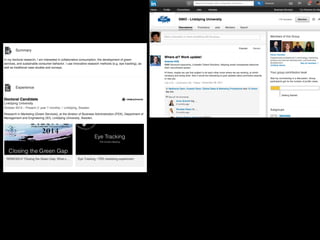
Van Noorden (2014)
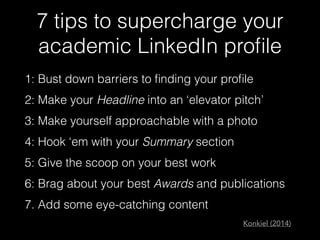
7 tips to supercharge your
academic LinkedIn profile
1: Bust down barriers to finding your profile
2: Make your Headline into an ‘elevator pitch’
3: Make yourself approachable with a photo
4: Hook ‘em with your Summary section
5: Give the scoop on your best work
6: Brag about your best Awards and publications
7. Add some eye-catching content
Konkiel (2014)
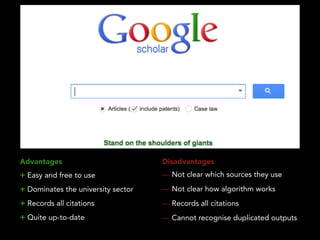
Advantages
+ Easy and free to use
+ Dominates the university sector
+ Records all citations
+ Quite up-to-date
Disadvantages
— Not clear which sources they use
— Not clear how algorithm works
— Records all citations
— Cannot recognise duplicated outputs
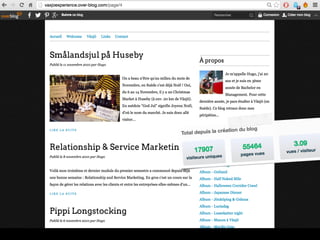
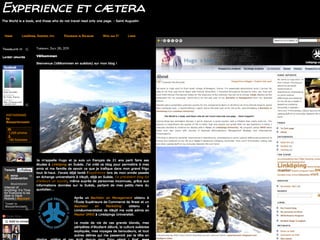
Blogging
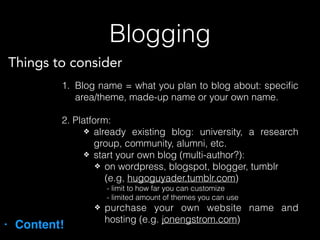
• Content!
1. Blog name = what you plan to blog about: specific
area/theme, made-up name or your own name.
2. Platform:
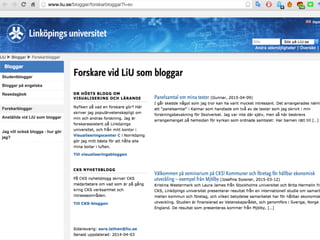
❖ already existing blog: university, a research
group, community, alumni, etc.
❖ start your own blog (multi-author?):
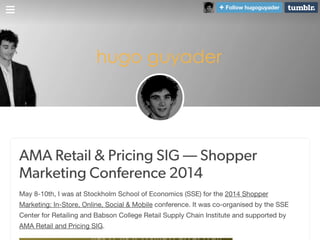
❖ on wordpress, blogspot, blogger, tumblr
(e.g, hugoguyader.tumblr.com)
- limit to how far you can customize
- limited amount of themes you can use
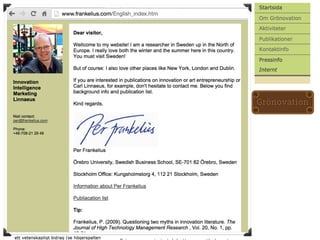
❖ purchase your own website name and
hosting (e.g. jonengstrom.com)
Things to consider
“Blogging is quite simply, one of 

the most important things that an
academic should be doing right now”.
• Make sure your titles tell a story, and your
findings are communicated early on.
• Remember the Web is a network, post your
links to Twitter and Facebook. Let people
subscribe by RSS or email.
• Talk to your readers. Encourage people to
comment. Respond on Twitter and Facebook. 

And be reciprocal, open-minded and fair in
sharing your content with others and linking to
their work.
Dunleavy & Gilson (2012)
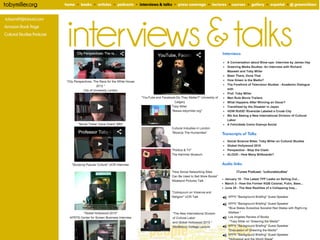
Videos
• Source of information and discussion
• Channels: Youtube, Vimeo, Dailymotion, Google,
(e.g. HBR, TEDtalks)
➡ Transmission of live webinars
➡ Films
➡ Lectures — M.O.O.C.
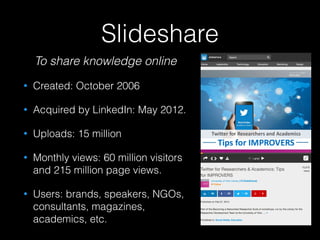
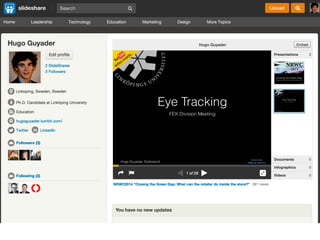
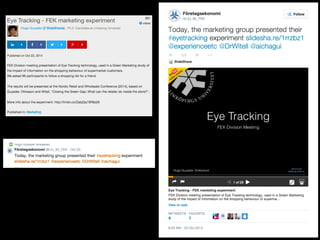
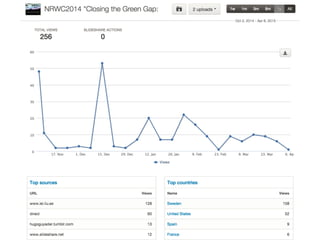
Slideshare
To share knowledge online
• Created: October 2006
• Acquired by LinkedIn: May 2012.
• Uploads: 15 million
• Monthly views: 60 million visitors
and 215 million page views.
• Users: brands, speakers, NGOs,
consultants, magazines,
academics, etc.
Slideshare
Email list
Podcast
One of our highest aims is to
bring academia online, and in
turn, broaden access to the
social sciences. Audio is integral
to this process. By giving
narrative to the full breadth of
academic research, we hope to
stretch the understanding and
impact of research beyond the
confines of universities.
“
”Cheryl Brumley, LSE Podcast Digital Editor
• LiU: Social media for researchers

http://www.bibl.liu.se/publicera-och-sprida/sociala-medier?l=en
• London School of Economics: Maximising the impact of academic research

http://blogs.lse.ac.uk/impactofsocialsciences/
• Social media: A guide for researchers

http://www.rin.ac.uk/our-work/communicating-and-disseminating-research/social-media-guide-
researchers
• Online collaboration: Scientists and the social network

http://www.nature.com/news/online-collaboration-scientists-and-the-social-network-1.15711
• Social Media for Academics

http://www.sciencedirect.com/science/book/9781843346814
• Boost Your Career with Social Media: Tips for the Uninitiated

https://hbr.org/2011/12/boost-your-career-with-social.html
• Handbook of social media for researchers and supervisors

https://www.vitae.ac.uk/vitae-publications/reports/innovate-open-university-social-media-handbook-
vitae-2012.pdf/view
• Using Twitter in university research, teaching and impact activities 

http://blogs.lse.ac.uk/impactofsocialsciences/files/2011/11/Published-Twitter_Guide_Sept_2011.pdf
• Tweet your Science

http://www.tweetyourscience.com/
Advices & Guides
• Academic blogging, a personal experience

http://freakonometrics.hypotheses.org/12660
• Fortune: From Justin Bieber to data scientists, how Twitter got hot in the academy

http://fortune.com/2014/08/22/contagion-justin-bieber-data-scientists-twitter/
• Chronicle of Higher Education: The Academic Twitterazi

https://www.insidehighered.com/news/2012/10/02/scholars-debate-etiquette-live-tweeting-
academic-conferences
• Is blogging and tweeting about research?

http://melissaterras.blogspot.co.uk/2012/04/is-blogging-and-tweeting-about-research.html
• Practical Advice for Teaching with Twitter 

http://chronicle.com/blogs/profhacker/practical-advice-for-teaching-with-twitter/26416
• 12 things every business blogger should know how to do

http://www.getinfrontcommunications.com/12-things-every-business-blogger-should-know-how-to-
do.php
• From Tweet to Blog Post to Peer-Reviewed Article: How to be a Scholar Now

http://blogs.lse.ac.uk/impactofsocialsciences/2013/09/25/how-to-be-a-scholar-daniels/
• CUNY Academic Commons: The Importance of Audio and Podcasts

http://justpublics365.commons.gc.cuny.edu/2014/07/02/podcasting/
• Everything You Want to Know About How to Create an Amazing #LinkedIn Profile

http://www.kokasexton.com/create-amazing-linkedin-profile/
Other Interesting Articles

Social media for Academics

  • 1.
    Social Media for Academics 2015-04-16 HugoGuyader
 doctoral candidate
  • 3.
    New Academic Environment Past:Academics would focus on their research, put out ideas and results and then see what happens. Present & Future: Academics now have to carefully plan projects and actively influence citations of their good work. Gruber (2014)
  • 4.
    Altmetrics • Alternative totraditional metrics. • Policy documents / reports cited, but not on academic databases. • Traceability of mentions.
  • 5.
  • 7.
  • 8.
    Reasons for Using SocialMedia • Research-relevant discussions • Industry interactions • Networking & Collaboration • Self-promotion & Citations • Metrics • Find “grey” literature • Help, Support & Feedback • “It gets you writing” • Fun!
  • 9.
    The 4 Cs ➡Curation
 -> bookmarking = collecting, archiving and maintaining digital information and sources for use in your research (later). Examples of sources include blog posts, online journal articles, and posts on twitter. ➡ Conversation
 -> connect to other researchers and wider audiences. Blogging, networking sites and Twitter are ways of sharing your thoughts and research results as well as finding the right people to converse with. ➡ Collaboration
 -> working with others is more flexible: notes, files, literature and bookmarks from any computer or mobile device. ➡ Communication
 -> professional networking: LinkedIn Haney (2012)
  • 10.
    5 Truths About SocialMedia in Academia 1. Social media is no option 2. There is no perfect channel, just go for all 3. Our role is already to create and share knowledge 4. Take back control of your unique online presence 5. Nobody pays us for social media, yet! Hofeditz (2015)
  • 11.
    … or maybenot? ✦ being viewed negatively by other academics ✦ time pressures ✦ social media use 
 as an obligation ✦ becoming a target of attack ✦ too much self- promotion by others ✦ possible plagiarism of ideas ✦ commercialisation of content ✦ privacy & copyright Luton (2014)
  • 12.
    “You can’t competeso grab some popcorn and enjoy the show.” ✴ Lack audience to start intelligent conversations about niche topics. ✴ No promise that anyone is to reading. ✴ Search “marketing” on LinkedIn and you’ll find 68K groups. ✴ Serve the algorithm, rather than the editor. The Next Web (2015)
  • 13.
  • 14.
    Social Media Strategy Onthe one hand, social media lends itself to exploration and experimentation.
 On the other hand, there is a danger of being too scattergun. ✓ For whom are you writing? ✓ Why are you writing? ✓ How do you want to present yourself? ✓ What do you not want to show about yourself online? (e.g. restrictions on who can access your pages) Haynes (2012)
  • 15.
    How to useSocial Media My Experience
  • 16.
    Twitter • fast &responsive • news — a window to the world • discover articles & researchers • no barrier of entry, no hierarchy
  • 17.
  • 18.
    Twitter & Academia 1.Approximately 2,000 journal articles and 3,000 conference papers have been written about Twitter (Fry, 2014). 2. Nearly 90% of academics on Twitter use it for their work (Lupton, 2014). 3. Academic tweets are approximately 9 times more likely to be retweeted than other tweets (Holmberg and Thewall, 2014). 4. In 2012, only one in 40 scholars was active on Twitter (Priem et. al 2012). 5. There are no significant differences in how much time is spent on Twitter by amongst academics from different age groups (Holmberg and Thewall, 2014). 6. The largest proportion of academics on Twitter are early career academics (Lupton, 2014). Gross (2014).
  • 19.
    Can Tweets Predict Citations? #twimpact Twitteractivity about a publication leads to increased distribution and can lead to an increase in citations. Up to 11 times more citations. Eysenbach (2011)
  • 20.
    Quick answers toquestions on things like .. where do I find this tool or that tool .. @rjhogue There are people who are practicing what I’m researching academically and give me a reality check. @Annlytical We trade references for research @Annlytical Twitter is brilliant for keeping up with things, networking, finding new ideas, people’s blogs and publications @BenGuilbaud meeting new people (in all disciplines), academic support, public engagement, increased visibility, filtered news @Martin_Eve I’ve found Twitter useful for augmenting F2F academic conferences, extending the conversations @JessieNYC Twitter’s unique advantage is that very quickly allows me to spread word of my work to non-academic audiences @elebelfiore Keeps me up-to-the-minute with news in my field ie; policy issues, and connects me to conferences/other academics @DonnaBramwell connects me to other delegates at conferences, allows me to interact with students in lectures, keeps me uptodate @timpaa great source of information & resources wouldn’t have found otherwise @nicklebygirl a PhD can be very isolated so I think twitter is a great way to meet people who can help and give advice @CET47 you can get very interesting literature advices or other sources you have not noticed yet @Journey210 shameless self-promotion…! @KatieMcGettigan to invite community members to events and lectures on campus @MegFrauts twitter is the best way to keep up to date with my subject, find useful resources and connect with others @LGSMU follow conferences globally and get in touch with other academics for quick Q&A sessions @Greg0rE joining twitter has helped remove the isolation of study through engagement with #phdchat – synch & asynchronous @JaneDavis13 twitter allows me to familiarize w current trends & edu tools for my students (tumblr & prezi are examples) @DisModern keeps you in touch w development in your field n wider @lace675468 “Why do you find Twitter useful as an academic?” Cardigan (2012)
  • 21.
  • 23.
  • 24.
    3 tweeting styles: •Informational: links to articles, blogposts, announcements, and funding sources that might be of interest to others. Usually with a bit of explanation or commentary. • Interactive: engage the Twitter community, usually by posing a question or topic of discussion or responding to something someone else has posted. Such exchanges lead to simple advices, or philosophical conversations. • Personal: a window into your life. Probably an entirely worthless activity, at least professionally; but it does provide personal connections and a sense of community. DIY Ivory Tower (2012)
  • 25.
    1. Put upan avatar. It doesn't really matter what the picture is, but the "egg picture" (the default avatar for new accounts) makes you look like a spammer. 2. Don't pick a Twitter name that is difficult to spell or remember. 3. Tweet regularly. 4. Don't ignore people who tweet at you. Set Twitter to send you an e-mail notification when you get a mention or a private message. If you don't do that, then check your account frequently. 5. Engage in conversation. Don't just drop in to post your own update and disappear. Twitter is not a "broadcast-only" mechanism; it's CB radio. 6. Learn the hashtags for your subject field or topics of interest, and use them. 7. Don't just make statements. Ask questions. 8. Don't just post links to news articles. I don't need you to be my aggregator. 9. Do show your personality. Crack some jokes. 10. Have fun. 10 Commandments: Gulliver (2012)
  • 28.
  • 32.
    Founded by RichardPrice in 2007 ‣ "With networks like Twitter and Facebook, information whizzes around at laser speed, whereas in science, and research in general, the average time lag is a year before a paper gets in a journal and is distributed to the rest of the world.” ‣ "When you read a paper and want to comment, you'll be able to respond immediately. The conversation will take minutes and hours instead of months and years.” 3,500 new users / day Academia.edu
  • 33.
  • 34.
    Research Gate ๏ scholarlymashup of Facebook and LinkedIn ๏ follow colleagues (6 million users) ๏ engage in collaborative discussion, ๏ upload and download papers (‘requests’), ๏ share results (even negatives) and datasets… Open Review encourages users to post in-depth critiques of existing publications.
  • 35.
  • 36.
  • 37.
  • 38.
  • 40.
  • 41.
    7 tips tosupercharge your academic LinkedIn profile 1: Bust down barriers to finding your profile 2: Make your Headline into an ‘elevator pitch’ 3: Make yourself approachable with a photo 4: Hook ‘em with your Summary section 5: Give the scoop on your best work 6: Brag about your best Awards and publications 7. Add some eye-catching content Konkiel (2014)
  • 42.
    Advantages + Easy andfree to use + Dominates the university sector + Records all citations + Quite up-to-date Disadvantages — Not clear which sources they use — Not clear how algorithm works — Records all citations — Cannot recognise duplicated outputs
  • 45.
    Blogging • Content! 1. Blogname = what you plan to blog about: specific area/theme, made-up name or your own name. 2. Platform: ❖ already existing blog: university, a research group, community, alumni, etc. ❖ start your own blog (multi-author?): ❖ on wordpress, blogspot, blogger, tumblr (e.g, hugoguyader.tumblr.com) - limit to how far you can customize - limited amount of themes you can use ❖ purchase your own website name and hosting (e.g. jonengstrom.com) Things to consider
  • 52.
    “Blogging is quitesimply, one of 
 the most important things that an academic should be doing right now”. • Make sure your titles tell a story, and your findings are communicated early on. • Remember the Web is a network, post your links to Twitter and Facebook. Let people subscribe by RSS or email. • Talk to your readers. Encourage people to comment. Respond on Twitter and Facebook. 
 And be reciprocal, open-minded and fair in sharing your content with others and linking to their work. Dunleavy & Gilson (2012)
  • 53.
    Videos • Source ofinformation and discussion • Channels: Youtube, Vimeo, Dailymotion, Google, (e.g. HBR, TEDtalks) ➡ Transmission of live webinars ➡ Films ➡ Lectures — M.O.O.C.
  • 55.
    Slideshare To share knowledgeonline • Created: October 2006 • Acquired by LinkedIn: May 2012. • Uploads: 15 million • Monthly views: 60 million visitors and 215 million page views. • Users: brands, speakers, NGOs, consultants, magazines, academics, etc.
  • 56.
  • 59.
    Podcast One of ourhighest aims is to bring academia online, and in turn, broaden access to the social sciences. Audio is integral to this process. By giving narrative to the full breadth of academic research, we hope to stretch the understanding and impact of research beyond the confines of universities. “ ”Cheryl Brumley, LSE Podcast Digital Editor
  • 63.
    • LiU: Socialmedia for researchers
 http://www.bibl.liu.se/publicera-och-sprida/sociala-medier?l=en • London School of Economics: Maximising the impact of academic research
 http://blogs.lse.ac.uk/impactofsocialsciences/ • Social media: A guide for researchers
 http://www.rin.ac.uk/our-work/communicating-and-disseminating-research/social-media-guide- researchers • Online collaboration: Scientists and the social network
 http://www.nature.com/news/online-collaboration-scientists-and-the-social-network-1.15711 • Social Media for Academics
 http://www.sciencedirect.com/science/book/9781843346814 • Boost Your Career with Social Media: Tips for the Uninitiated
 https://hbr.org/2011/12/boost-your-career-with-social.html • Handbook of social media for researchers and supervisors
 https://www.vitae.ac.uk/vitae-publications/reports/innovate-open-university-social-media-handbook- vitae-2012.pdf/view • Using Twitter in university research, teaching and impact activities 
 http://blogs.lse.ac.uk/impactofsocialsciences/files/2011/11/Published-Twitter_Guide_Sept_2011.pdf • Tweet your Science
 http://www.tweetyourscience.com/ Advices & Guides
  • 64.
    • Academic blogging,a personal experience
 http://freakonometrics.hypotheses.org/12660 • Fortune: From Justin Bieber to data scientists, how Twitter got hot in the academy
 http://fortune.com/2014/08/22/contagion-justin-bieber-data-scientists-twitter/ • Chronicle of Higher Education: The Academic Twitterazi
 https://www.insidehighered.com/news/2012/10/02/scholars-debate-etiquette-live-tweeting- academic-conferences • Is blogging and tweeting about research?
 http://melissaterras.blogspot.co.uk/2012/04/is-blogging-and-tweeting-about-research.html • Practical Advice for Teaching with Twitter 
 http://chronicle.com/blogs/profhacker/practical-advice-for-teaching-with-twitter/26416 • 12 things every business blogger should know how to do
 http://www.getinfrontcommunications.com/12-things-every-business-blogger-should-know-how-to- do.php • From Tweet to Blog Post to Peer-Reviewed Article: How to be a Scholar Now
 http://blogs.lse.ac.uk/impactofsocialsciences/2013/09/25/how-to-be-a-scholar-daniels/ • CUNY Academic Commons: The Importance of Audio and Podcasts
 http://justpublics365.commons.gc.cuny.edu/2014/07/02/podcasting/ • Everything You Want to Know About How to Create an Amazing #LinkedIn Profile
 http://www.kokasexton.com/create-amazing-linkedin-profile/ Other Interesting Articles