Design, Development & Delivery of an Innovative Blended MSc in KMS Dr Simon J. Shurville MBCS Martin P. Lee FBCS Dr Bernard Scott AFBPS, FCybS Dr Alan Harrison MBCS Department of Information Systems (DoIS), Cranfield University (CU), Royal Military College of Science (RMCS), Defence Academy of the UK, Shrivenham, Wiltshire, SN6 8LA, UK MailTo:M.P.Lee@Cranfield.Ac.UK
Agenda Introduction KMS MSc course Syllabus Design 10 modules & project Learning Design Course Development Course Evaluation Conclusions Questions?
Introduction Cranfield (postgraduate) University: Cranfield (aerospace, management etc) Silsoe (agriculture, biosciences etc) Shrivenham (Defence Academy of the UK): Three Technology Departments Dept. of Defence Management Dept. of Information Systems: Design of Information Systems (DIS) Full-time MSc Knowledge Management Systems (KMS) Part-time MSc
Knowledge Management Systems (KMS) MSc Three to five years duration Blended learning: core text(s) & VLE Hybrid: Knowledge Management (4 compulsory modules) Knowledge Engineering (4 from 6 optional modules) Project (counts as 2 modules)
Knowledge Management Systems (KMS) MSc One three day residential school per semester Two modules per semester One final written examination per module One or two core texts per module Two tutor assessments (TAs) per module
Residential School Day 1: Introductions & compulsory modules Day 2: Compulsory and optional modules Day 3: Optional modules and guest lectures
Syllabus Design ‘Designing for teaching’: “A University-based approach to the diffusion of Knowledge Management concepts & practice” (Ruth et al., 1999) “Knowledge Management Techniques: teaching and dissemination concepts” (Macintosh et al., 1999)
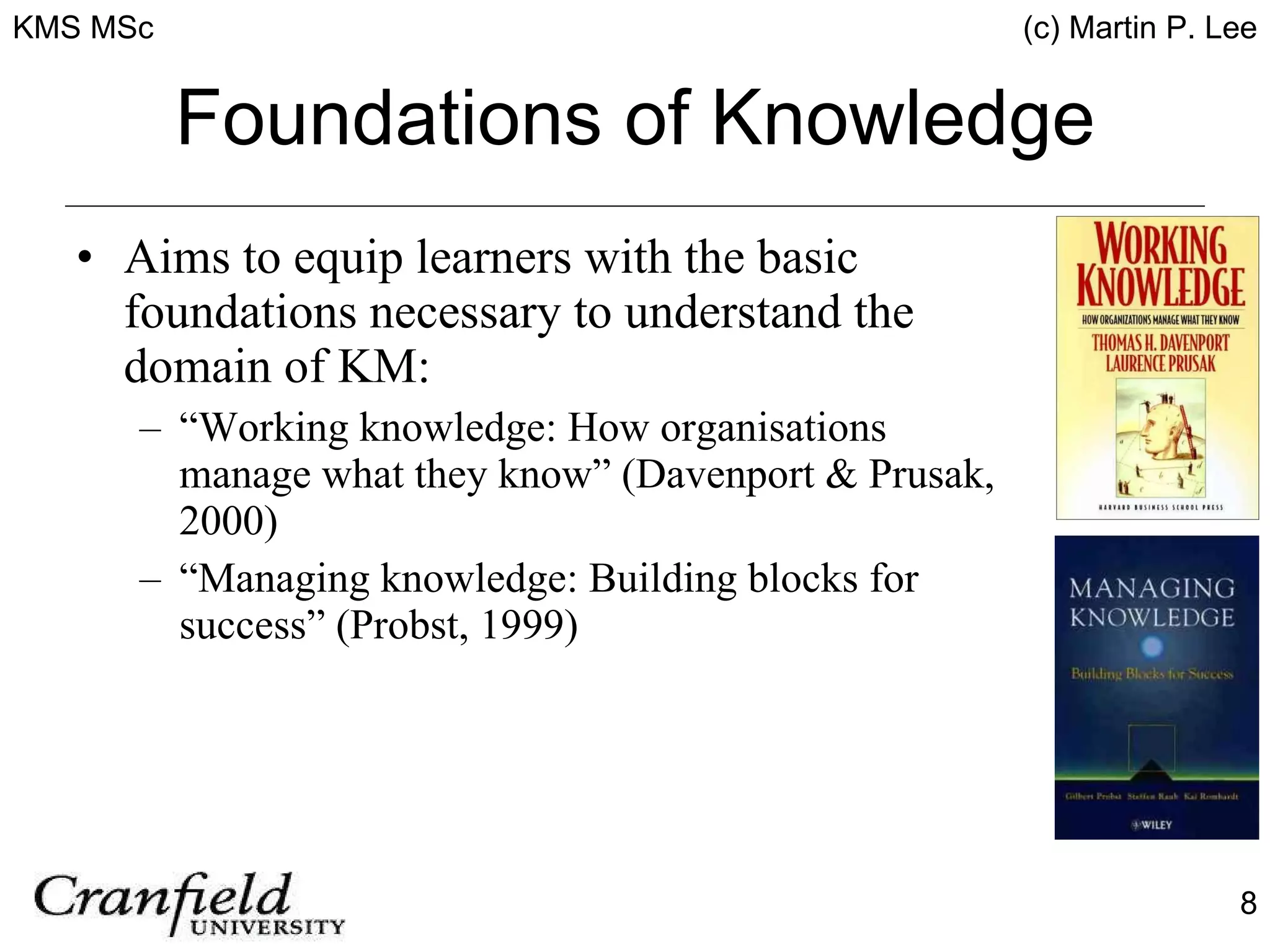
Foundations of Knowledge Aims to equip learners with the basic foundations necessary to understand the domain of KM: “ Working knowledge: How organisations manage what they know” (Davenport & Prusak, 2000) “ Managing knowledge: Building blocks for success” (Probst, 1999)
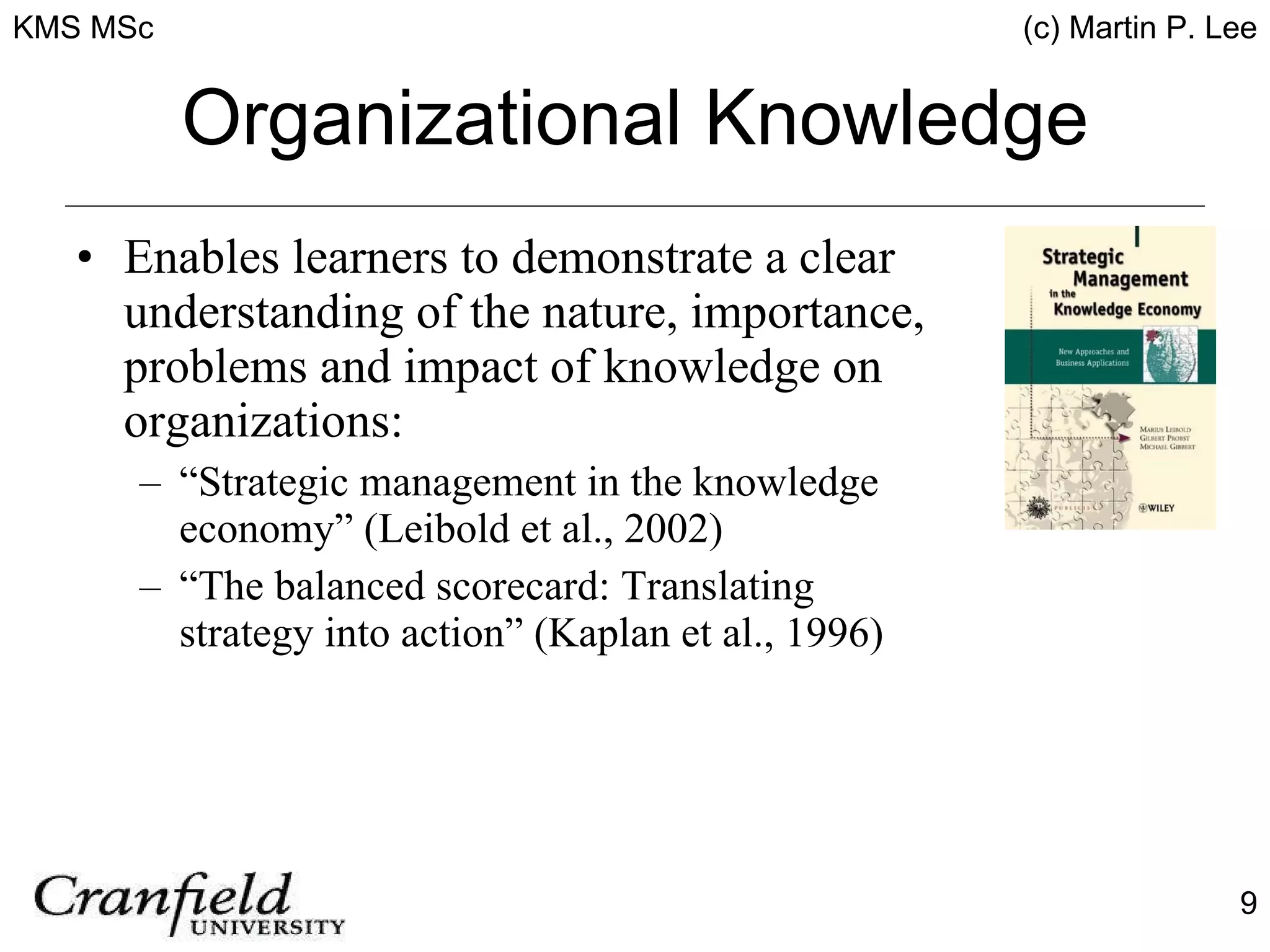
Organizational Knowledge Enables learners to demonstrate a clear understanding of the nature, importance, problems and impact of knowledge on organizations: “ Strategic management in the knowledge economy” (Leibold et al., 2002) “ The balanced scorecard: Translating strategy into action” (Kaplan et al., 1996)
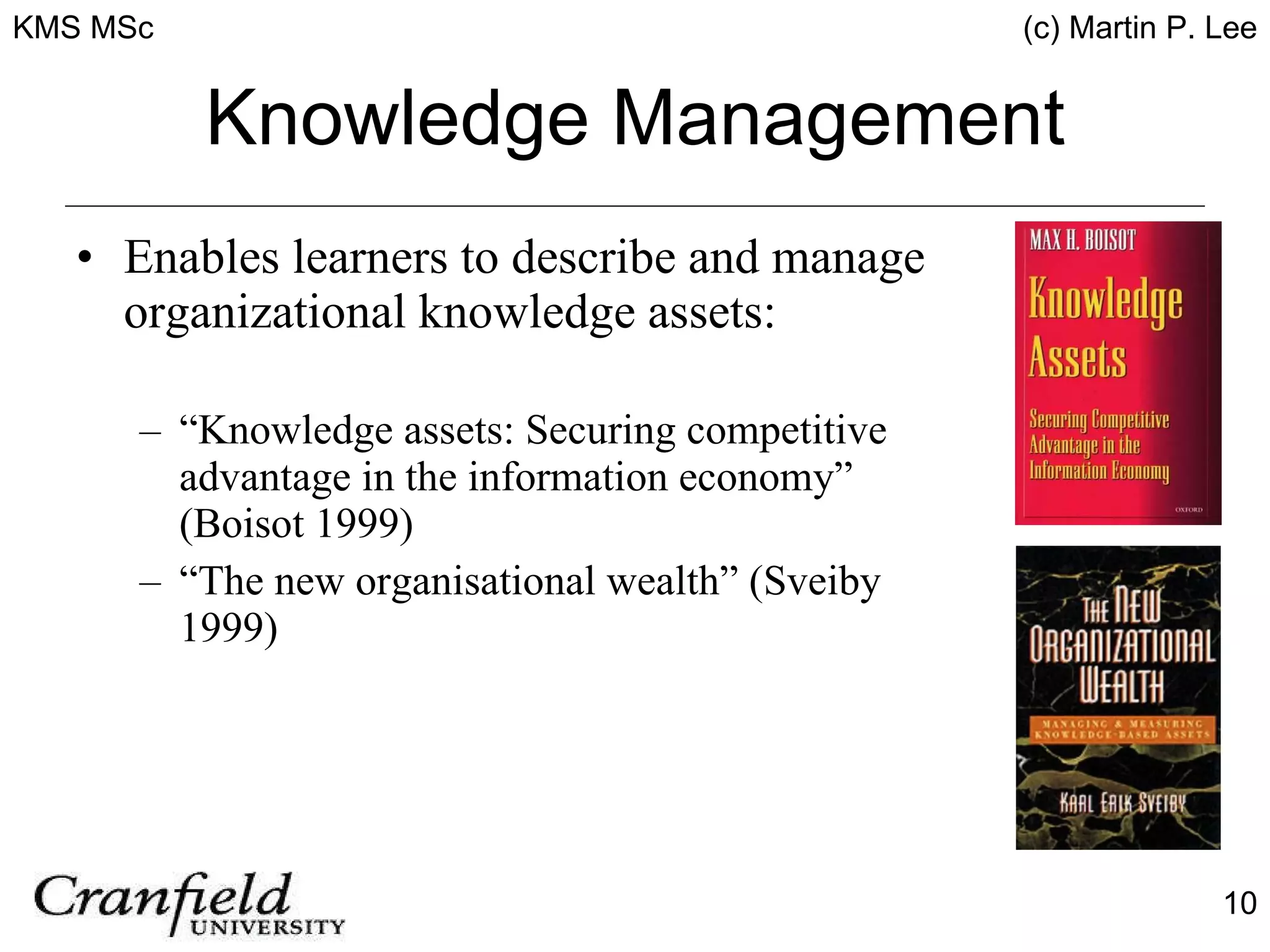
Knowledge Management Enables learners to describe and manage organizational knowledge assets: “ Knowledge assets: Securing competitive advantage in the information economy” (Boisot 1999) “ The new organisational wealth” (Sveiby 1999)
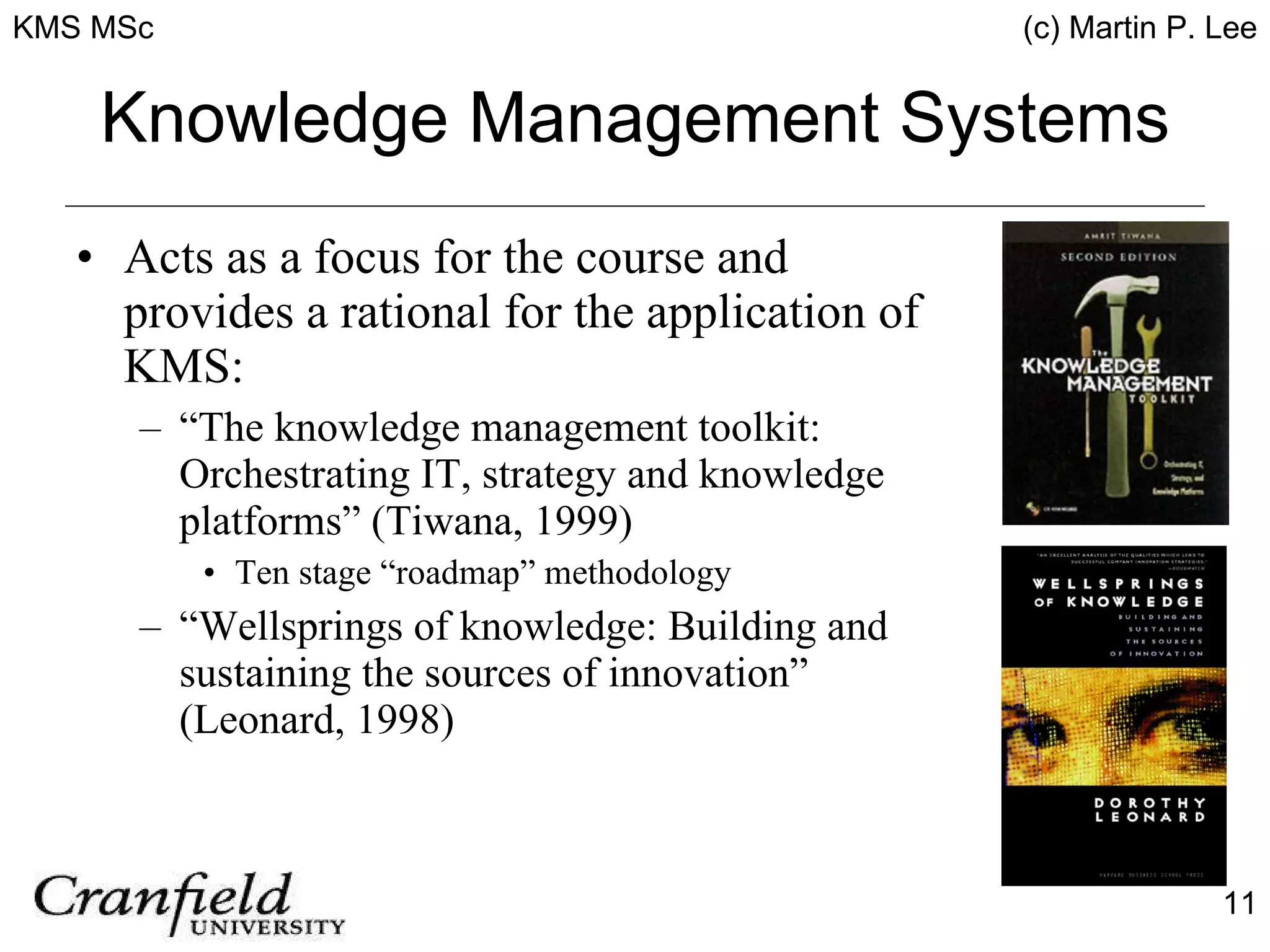
Knowledge Management Systems Acts as a focus for the course and provides a rational for the application of KMS: “ The knowledge management toolkit: Orchestrating IT, strategy and knowledge platforms” (Tiwana, 1999) Ten stage “roadmap” methodology “ Wellsprings of knowledge: Building and sustaining the sources of innovation” (Leonard, 1998)
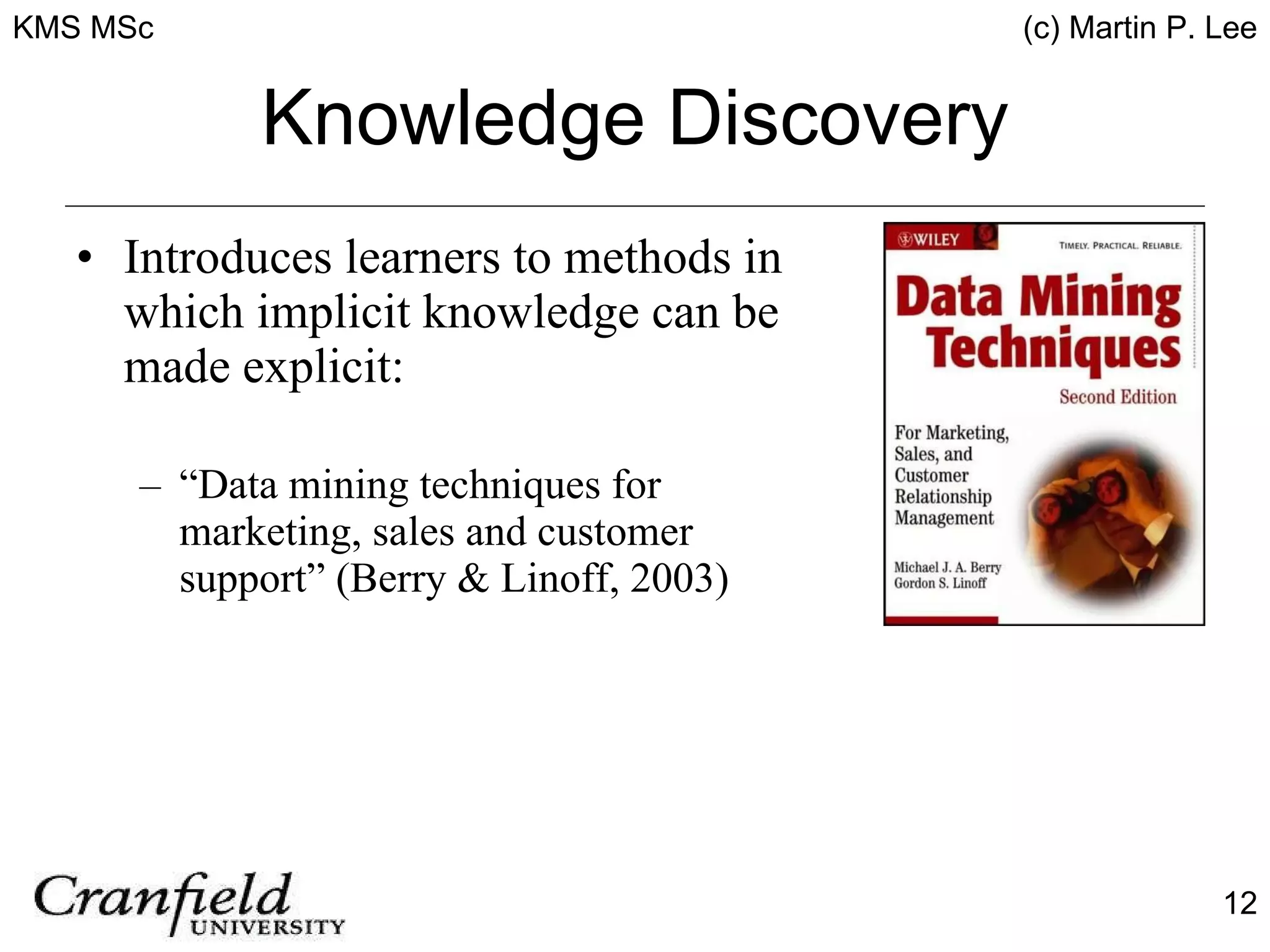
Knowledge Discovery Introduces learners to methods in which implicit knowledge can be made explicit: “ Data mining techniques for marketing, sales and customer support” (Berry & Linoff, 2003)
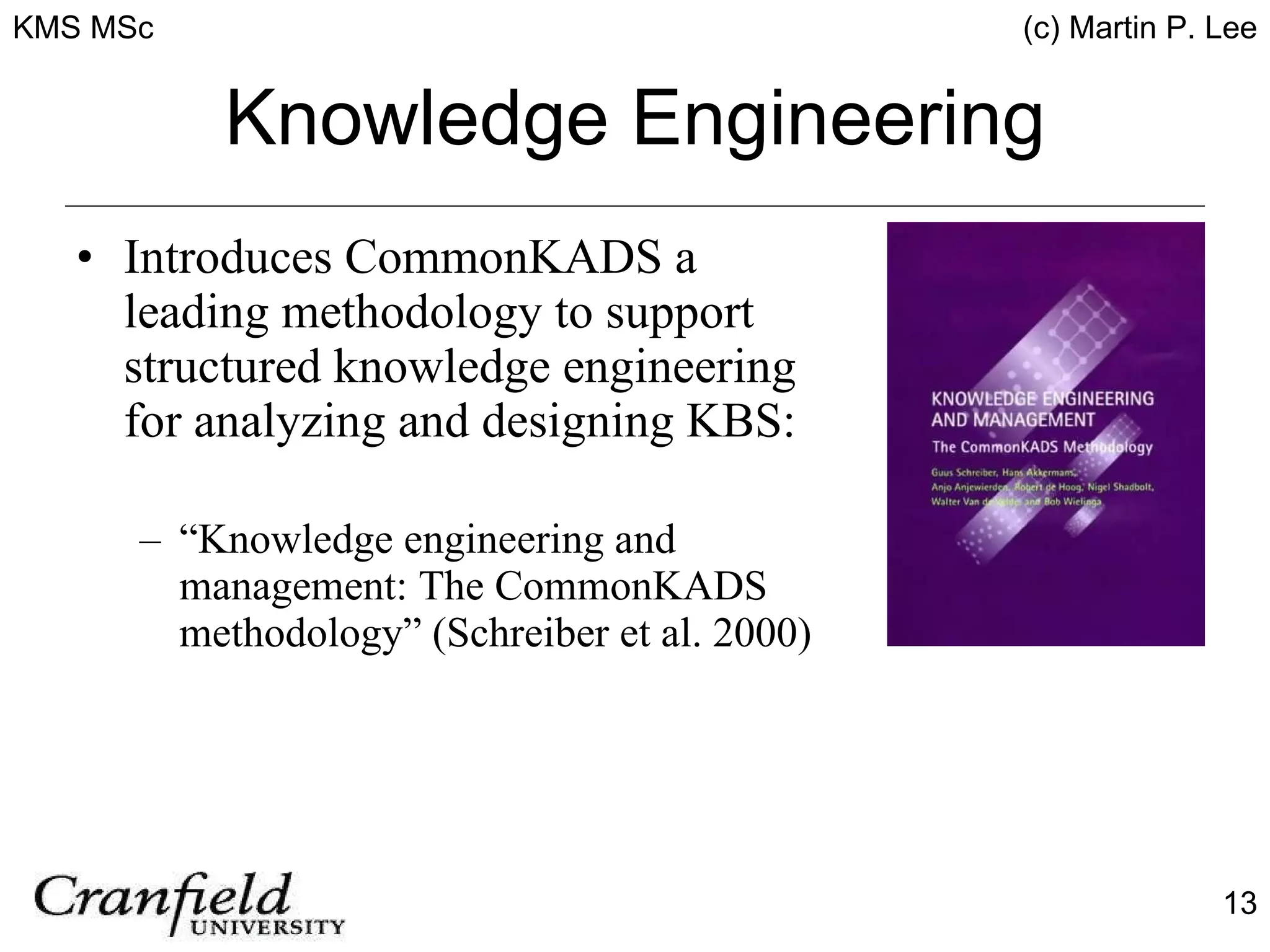
Knowledge Engineering Introduces CommonKADS a leading methodology to support structured knowledge engineering for analyzing and designing KBS: “ Knowledge engineering and management: The CommonKADS methodology” (Schreiber et al. 2000)
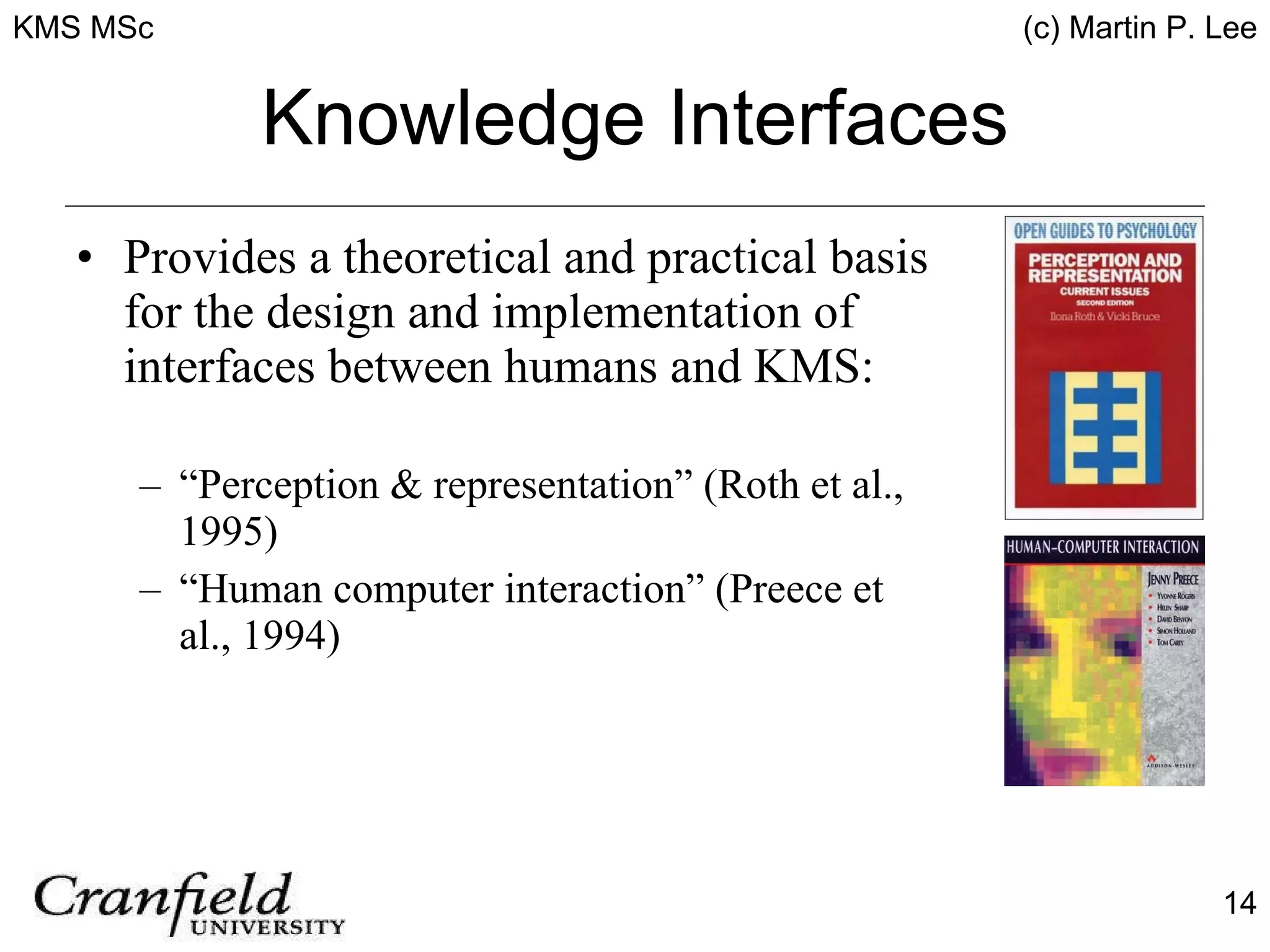
Knowledge Interfaces Provides a theoretical and practical basis for the design and implementation of interfaces between humans and KMS: “ Perception & representation” (Roth et al., 1995) “ Human computer interaction” (Preece et al., 1994)
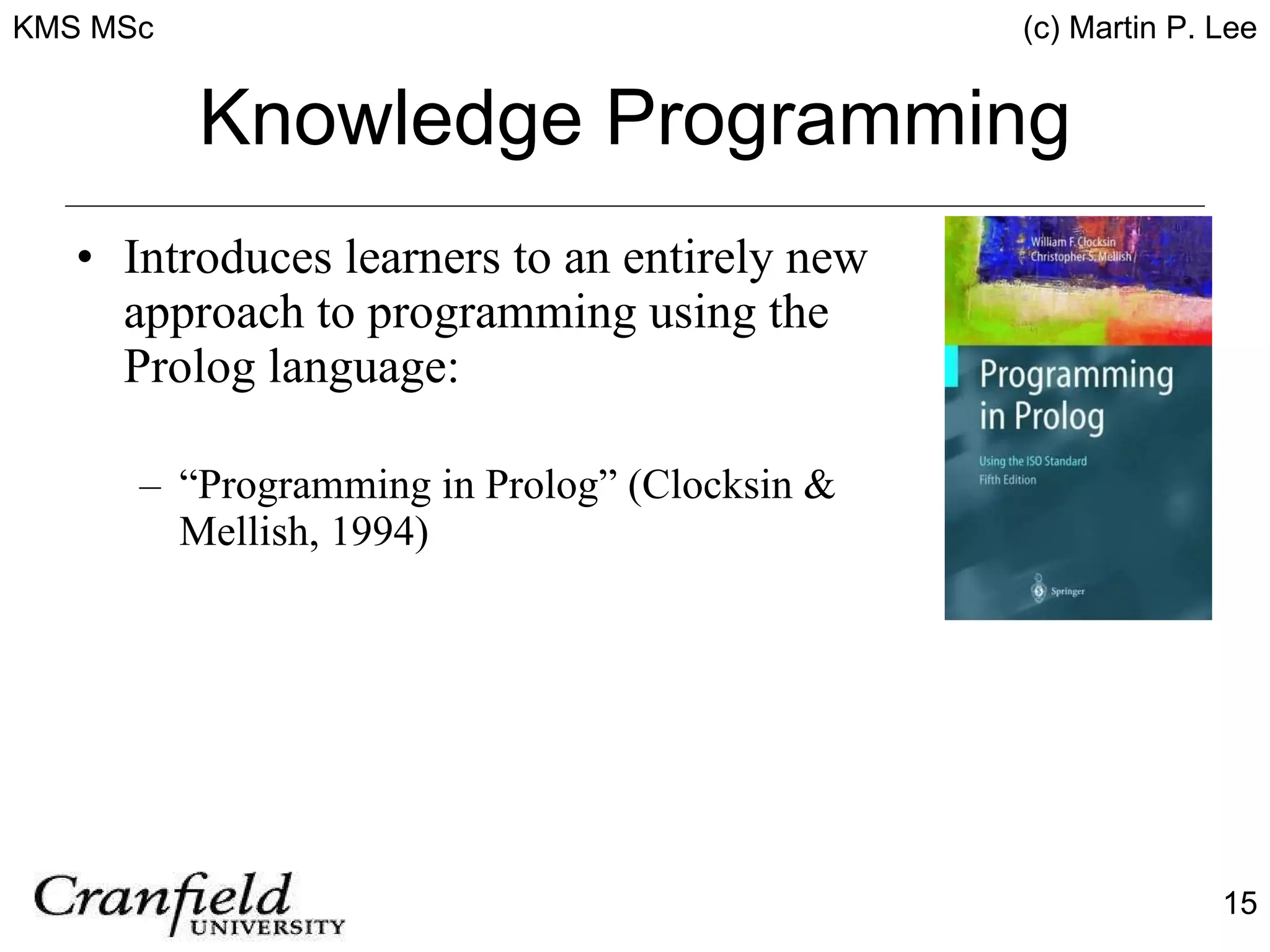
Knowledge Programming Introduces learners to an entirely new approach to programming using the Prolog language: “ Programming in Prolog” (Clocksin & Mellish, 1994)
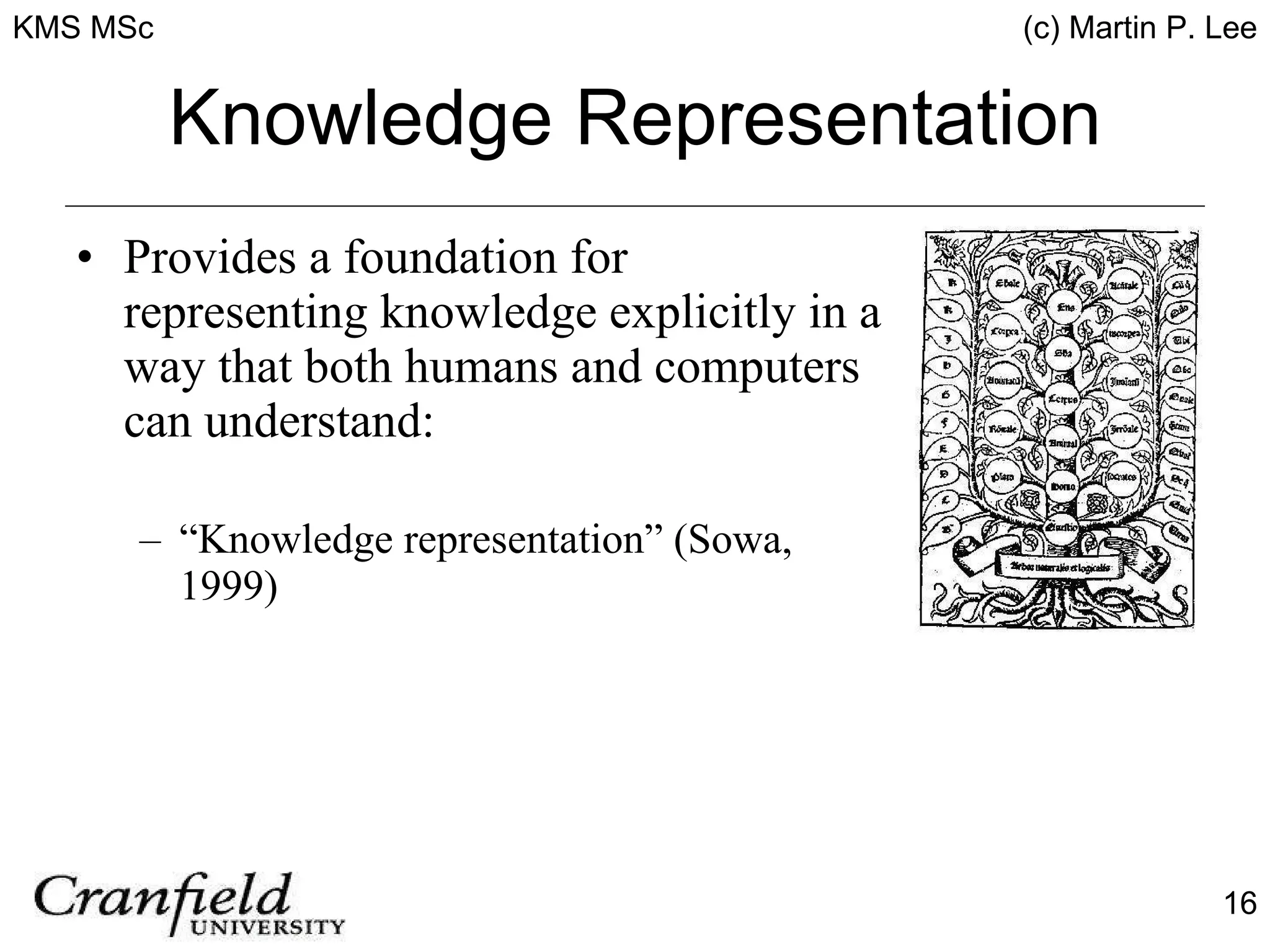
Knowledge Representation Provides a foundation for representing knowledge explicitly in a way that both humans and computers can understand: “ Knowledge representation” (Sowa, 1999)
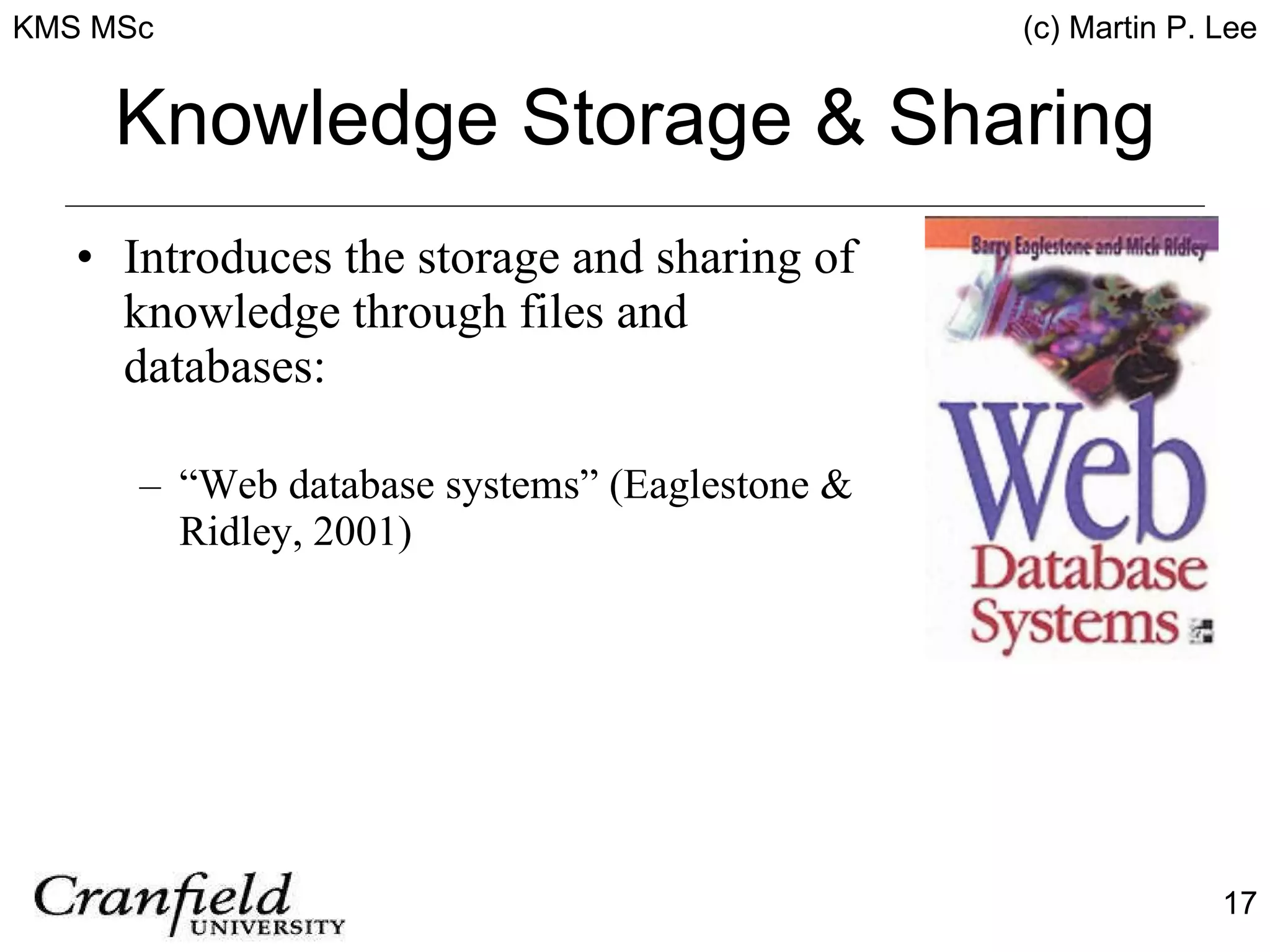
Knowledge Storage & Sharing Introduces the storage and sharing of knowledge through files and databases: “ Web database systems” (Eaglestone & Ridley, 2001)
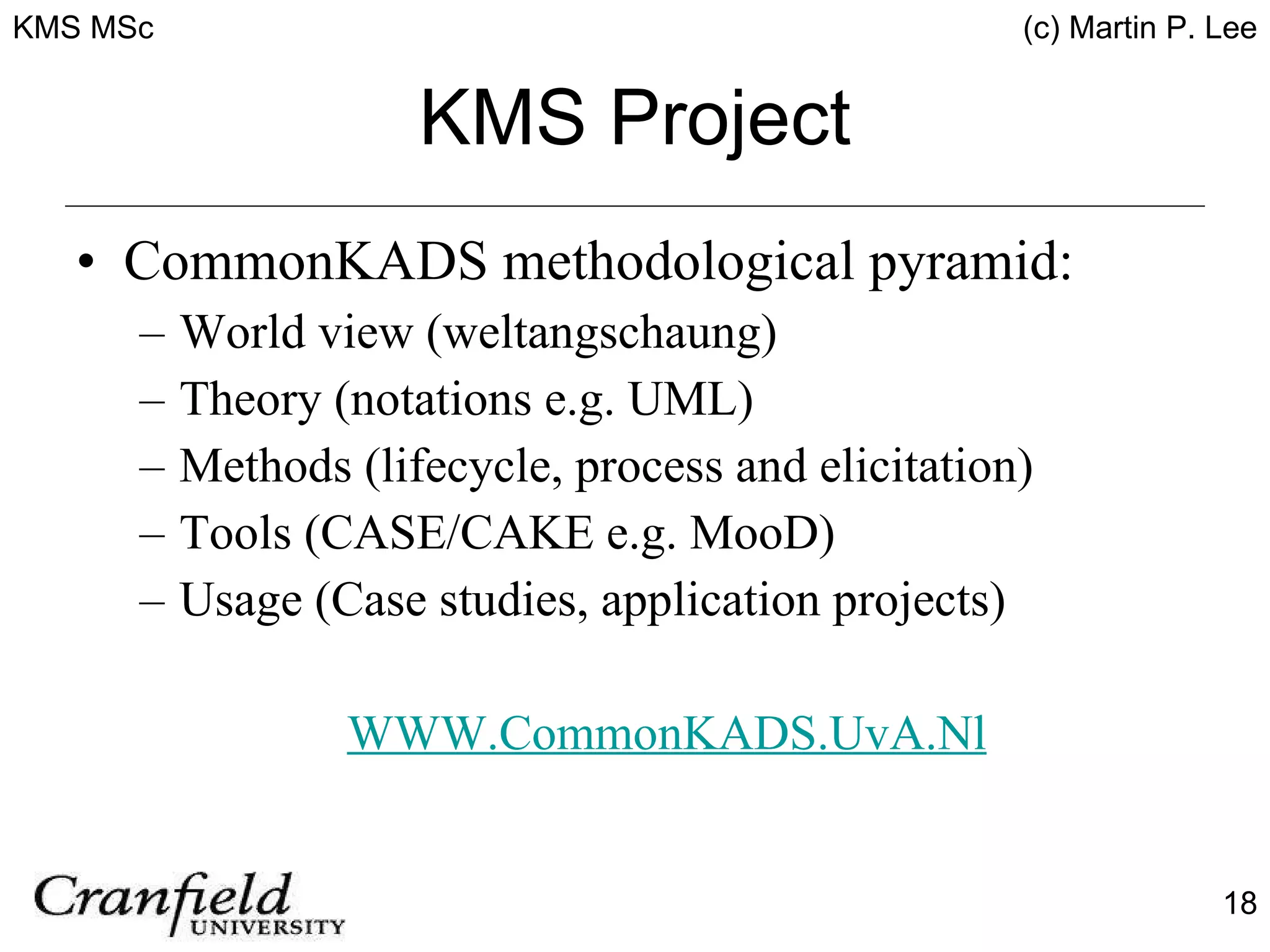
KMS Project CommonKADS methodological pyramid: World view (weltangschaung) Theory (notations e.g. UML) Methods (lifecycle, process and elicitation) Tools (CASE/CAKE e.g. MooD) Usage (Case studies, application projects) WWW.CommonKADS.UvA.Nl
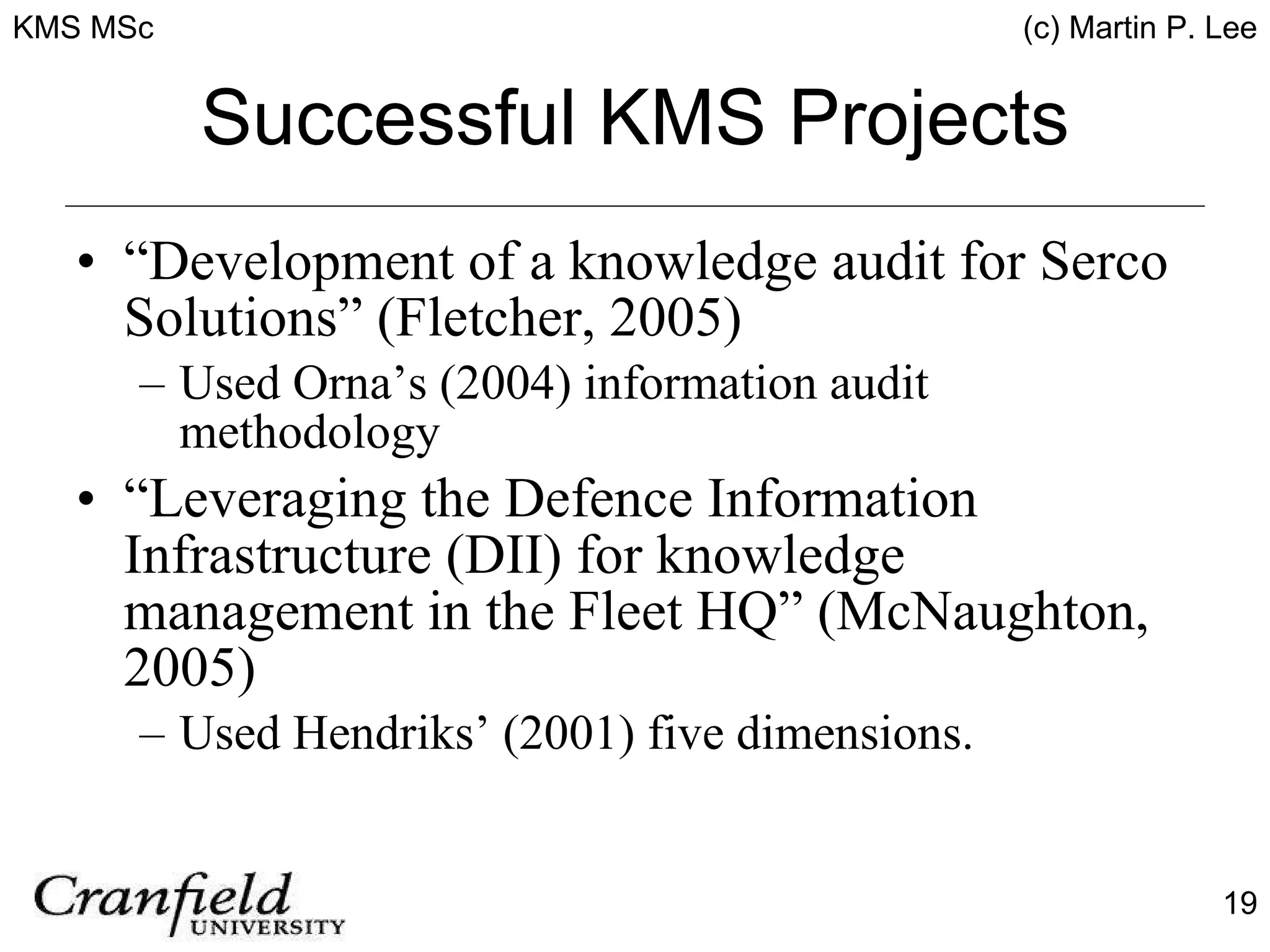
Successful KMS Projects “Development of a knowledge audit for Serco Solutions” (Fletcher, 2005) Used Orna’s (2004) information audit methodology “Leveraging the Defence Information Infrastructure (DII) for knowledge management in the Fleet HQ” (McNaughton, 2005) Used Hendriks’ (2001) five dimensions.
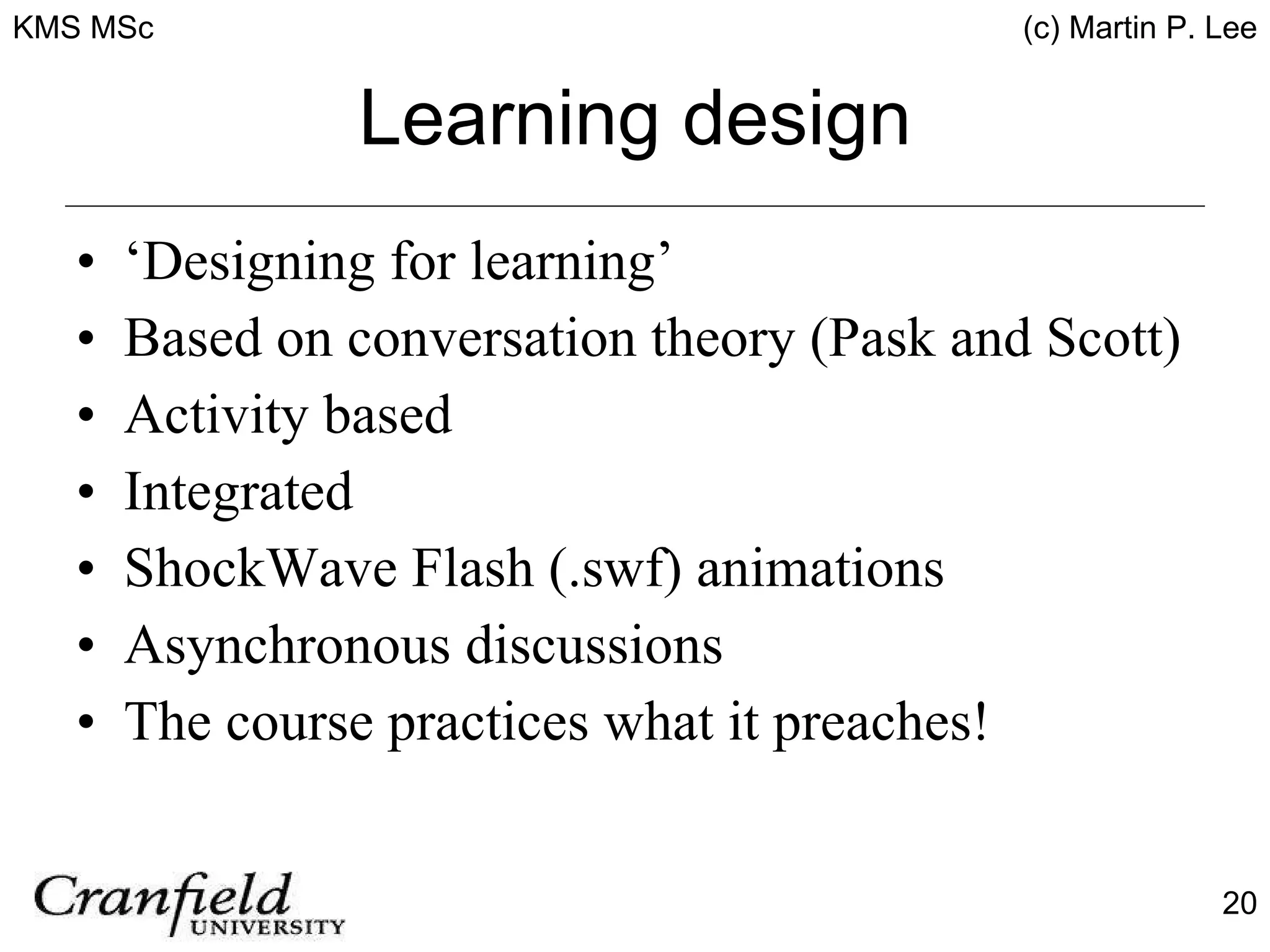
Learning design ‘Designing for learning’ Based on conversation theory (Pask and Scott) Activity based Integrated ShockWave Flash (.swf) animations Asynchronous discussions The course practices what it preaches!
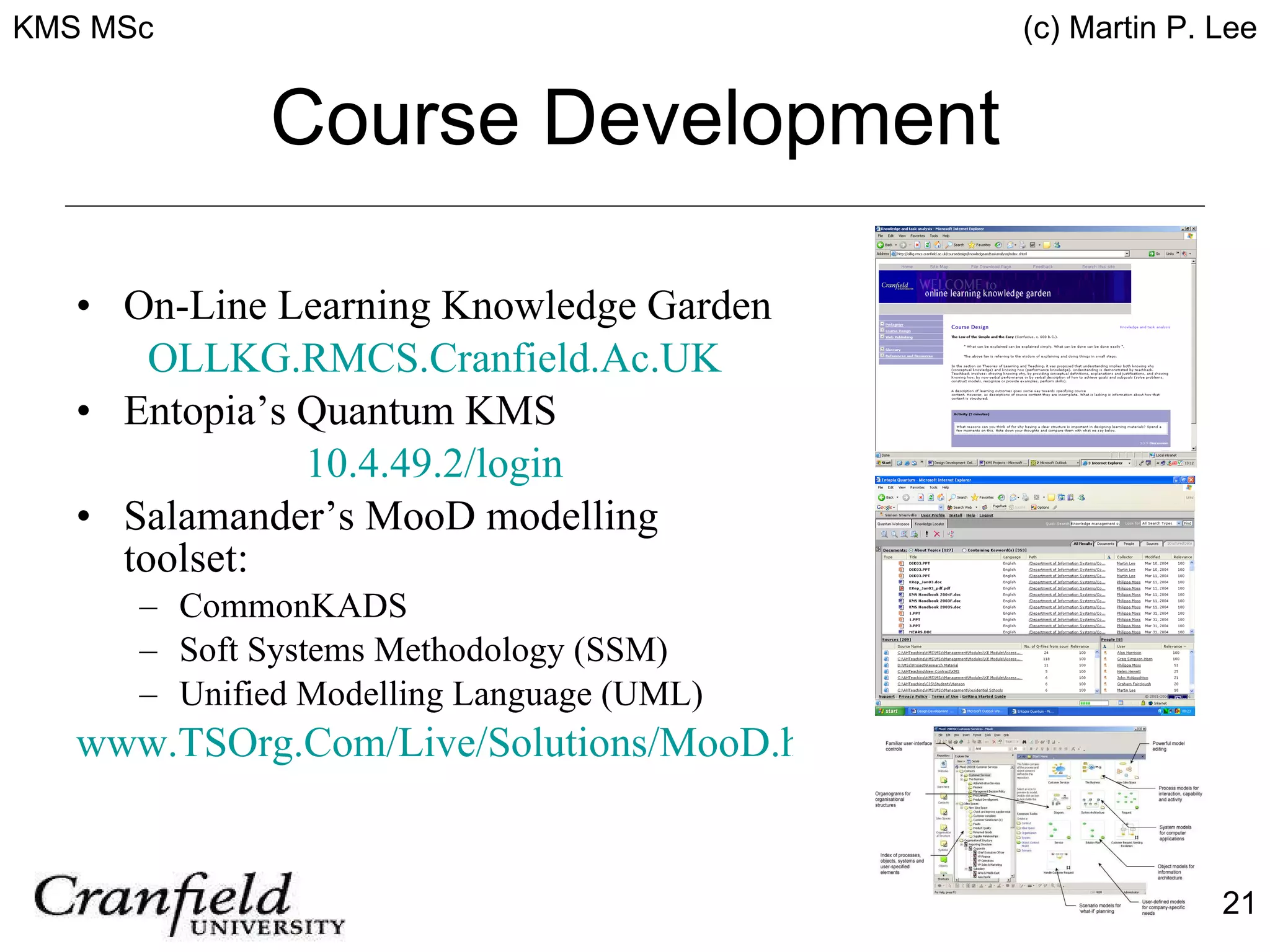
Course Development On-Line Learning Knowledge Garden OLLKG.RMCS.Cranfield.Ac.UK Entopia’s Quantum KMS 10.4.49.2/login Salamander’s MooD modelling toolset: CommonKADS Soft Systems Methodology (SSM) Unified Modelling Language (UML) www.TSOrg.Com/Live/Solutions/MooD.htm
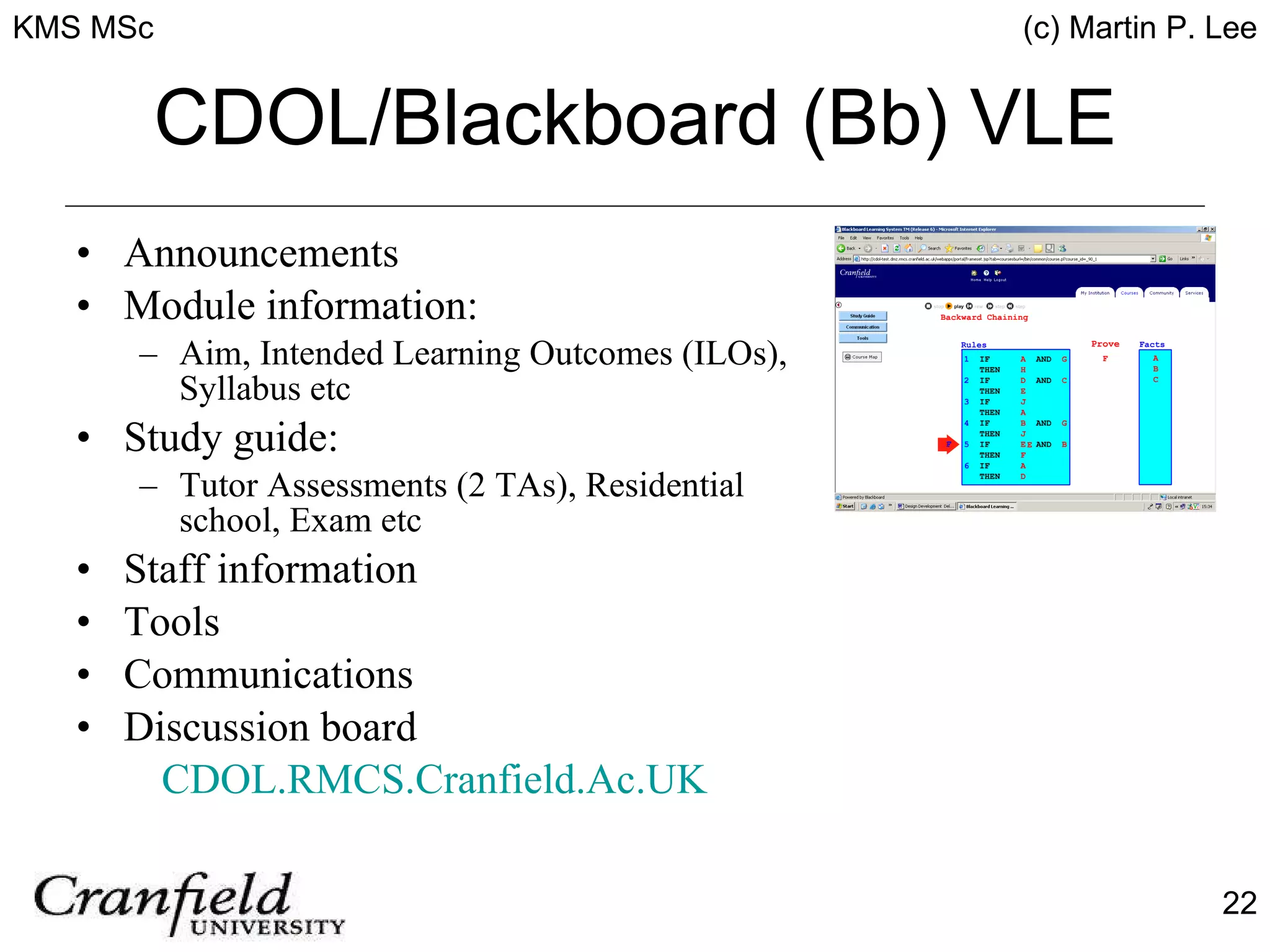
CDOL/Blackboard (Bb) VLE Announcements Module information: Aim, Intended Learning Outcomes (ILOs), Syllabus etc Study guide: Tutor Assessments (2 TAs), Residential school, Exam etc Staff information Tools Communications Discussion board CDOL.RMCS.Cranfield.Ac.UK
Course Evaluation Learner questionnaires External examiners: Prof Frank Ritter, Penn State University Dr John Carney & Dr J. Holland-Smith UK Defence Science & Technology Labs (dstl) Periodic course review
Conclusions Innovative work-based MSc Blended conversational approach Systemic & holistic Adopted by the British Army as an option on their modular masters by distance learning www.RMCS.Cranfield.Ac.UK/DoIS/PostgraduateCourses/KMS Any Questions?

Design, Development & Delivery Of An Innovative Blended M Sc In KMS

  • 1.
    Design, Development &Delivery of an Innovative Blended MSc in KMS Dr Simon J. Shurville MBCS Martin P. Lee FBCS Dr Bernard Scott AFBPS, FCybS Dr Alan Harrison MBCS Department of Information Systems (DoIS), Cranfield University (CU), Royal Military College of Science (RMCS), Defence Academy of the UK, Shrivenham, Wiltshire, SN6 8LA, UK MailTo:M.P.Lee@Cranfield.Ac.UK
  • 2.
    Agenda Introduction KMSMSc course Syllabus Design 10 modules & project Learning Design Course Development Course Evaluation Conclusions Questions?
  • 3.
    Introduction Cranfield (postgraduate)University: Cranfield (aerospace, management etc) Silsoe (agriculture, biosciences etc) Shrivenham (Defence Academy of the UK): Three Technology Departments Dept. of Defence Management Dept. of Information Systems: Design of Information Systems (DIS) Full-time MSc Knowledge Management Systems (KMS) Part-time MSc
  • 4.
    Knowledge Management Systems(KMS) MSc Three to five years duration Blended learning: core text(s) & VLE Hybrid: Knowledge Management (4 compulsory modules) Knowledge Engineering (4 from 6 optional modules) Project (counts as 2 modules)
  • 5.
    Knowledge Management Systems(KMS) MSc One three day residential school per semester Two modules per semester One final written examination per module One or two core texts per module Two tutor assessments (TAs) per module
  • 6.
    Residential School Day1: Introductions & compulsory modules Day 2: Compulsory and optional modules Day 3: Optional modules and guest lectures
  • 7.
    Syllabus Design ‘Designingfor teaching’: “A University-based approach to the diffusion of Knowledge Management concepts & practice” (Ruth et al., 1999) “Knowledge Management Techniques: teaching and dissemination concepts” (Macintosh et al., 1999)
  • 8.
    Foundations of KnowledgeAims to equip learners with the basic foundations necessary to understand the domain of KM: “ Working knowledge: How organisations manage what they know” (Davenport & Prusak, 2000) “ Managing knowledge: Building blocks for success” (Probst, 1999)
  • 9.
    Organizational Knowledge Enableslearners to demonstrate a clear understanding of the nature, importance, problems and impact of knowledge on organizations: “ Strategic management in the knowledge economy” (Leibold et al., 2002) “ The balanced scorecard: Translating strategy into action” (Kaplan et al., 1996)
  • 10.
    Knowledge Management Enableslearners to describe and manage organizational knowledge assets: “ Knowledge assets: Securing competitive advantage in the information economy” (Boisot 1999) “ The new organisational wealth” (Sveiby 1999)
  • 11.
    Knowledge Management SystemsActs as a focus for the course and provides a rational for the application of KMS: “ The knowledge management toolkit: Orchestrating IT, strategy and knowledge platforms” (Tiwana, 1999) Ten stage “roadmap” methodology “ Wellsprings of knowledge: Building and sustaining the sources of innovation” (Leonard, 1998)
  • 12.
    Knowledge Discovery Introduceslearners to methods in which implicit knowledge can be made explicit: “ Data mining techniques for marketing, sales and customer support” (Berry & Linoff, 2003)
  • 13.
    Knowledge Engineering IntroducesCommonKADS a leading methodology to support structured knowledge engineering for analyzing and designing KBS: “ Knowledge engineering and management: The CommonKADS methodology” (Schreiber et al. 2000)
  • 14.
    Knowledge Interfaces Providesa theoretical and practical basis for the design and implementation of interfaces between humans and KMS: “ Perception & representation” (Roth et al., 1995) “ Human computer interaction” (Preece et al., 1994)
  • 15.
    Knowledge Programming Introduceslearners to an entirely new approach to programming using the Prolog language: “ Programming in Prolog” (Clocksin & Mellish, 1994)
  • 16.
    Knowledge Representation Providesa foundation for representing knowledge explicitly in a way that both humans and computers can understand: “ Knowledge representation” (Sowa, 1999)
  • 17.
    Knowledge Storage &Sharing Introduces the storage and sharing of knowledge through files and databases: “ Web database systems” (Eaglestone & Ridley, 2001)
  • 18.
    KMS Project CommonKADSmethodological pyramid: World view (weltangschaung) Theory (notations e.g. UML) Methods (lifecycle, process and elicitation) Tools (CASE/CAKE e.g. MooD) Usage (Case studies, application projects) WWW.CommonKADS.UvA.Nl
  • 19.
    Successful KMS Projects“Development of a knowledge audit for Serco Solutions” (Fletcher, 2005) Used Orna’s (2004) information audit methodology “Leveraging the Defence Information Infrastructure (DII) for knowledge management in the Fleet HQ” (McNaughton, 2005) Used Hendriks’ (2001) five dimensions.
  • 20.
    Learning design ‘Designingfor learning’ Based on conversation theory (Pask and Scott) Activity based Integrated ShockWave Flash (.swf) animations Asynchronous discussions The course practices what it preaches!
  • 21.
    Course Development On-LineLearning Knowledge Garden OLLKG.RMCS.Cranfield.Ac.UK Entopia’s Quantum KMS 10.4.49.2/login Salamander’s MooD modelling toolset: CommonKADS Soft Systems Methodology (SSM) Unified Modelling Language (UML) www.TSOrg.Com/Live/Solutions/MooD.htm
  • 22.
    CDOL/Blackboard (Bb) VLEAnnouncements Module information: Aim, Intended Learning Outcomes (ILOs), Syllabus etc Study guide: Tutor Assessments (2 TAs), Residential school, Exam etc Staff information Tools Communications Discussion board CDOL.RMCS.Cranfield.Ac.UK
  • 23.
    Course Evaluation Learnerquestionnaires External examiners: Prof Frank Ritter, Penn State University Dr John Carney & Dr J. Holland-Smith UK Defence Science & Technology Labs (dstl) Periodic course review
  • 24.
    Conclusions Innovative work-basedMSc Blended conversational approach Systemic & holistic Adopted by the British Army as an option on their modular masters by distance learning www.RMCS.Cranfield.Ac.UK/DoIS/PostgraduateCourses/KMS Any Questions?