GAME THEORY
History
   1928 –
Game theory did not really exist as a unique field until John von Neumann &
  Morgenstern published a paper.
   1950 -
John Nash developed a criterion for mutual consistency of players' strategies, known as
   Nash equilibrium, applicable to a wider variety of games than the criterion proposed
   by von Neumann and Morgenstern.
   1965 –
Reinhard Selten introduced his solution concept of subgame perfect equilibria, which
   further refined the Nash equilibrium.
   1970 –
Game theory was extensively applied in biology, largely as a result of the work of John
  Maynard Smith and his evolutionarily stable strategy.
   2007 –
Leonid Hurwicz, together with Eric Maskin and Roger Myerson, was awarded the
   Nobel Prize in Economics "for having laid the foundations of mechanism
   design theory


                                                                                          2
What's IT??
Game theory is a method of
studying strategic decision
making. More formally, it is "the
study of mathematical models of
conflict and cooperation
between intelligent rational
decision-makers.

 Strategic- It is a setting where
the outcomes that affect you
depends on actions not just on
your own actions but on actions
of others.                          3
Why game theory ???
Because the press tells us to …
 ―Managers have much to learn from game theory —provided they use it
  to clarify their thinking, not as a substitute for business experience.‖
           The Economist, 15 June 2007
 ―Game Theory, long an intellectual pastime, came into its own as a
  business tool.‖
           Forbes, 3 July 2009
 ―Game theory is hot.‖
           The Wall Street Journal, 13 February 2011
Because recruiters tell us to …
   ―Game theory forces you to see a business situation over many
 periods from two perspectives: yours and your competitor’s.‖
  Judy Lewent – CFO, Merck
  ―Game theory can explain why oligopolies tend to be unprofitable,
     the cycle of over capacity and overbuilding, and the tendency to
     execute real options earlier than optimal.‖
  Tom Copeland – Director of Corporate Finance, McKinsey
                                                                             4
Terminology
 Players
 Strategies
    ◦ Choices available to each of the players
      Might be conditioned on history
   Payoffs
    ◦ Some numerical representation of the
      objectives of each player
      Could take account fairness/reputation, etc.
      Does not mean players are narrowly selfish

                                                      5
Standard Assumptions
   Rationality
    ◦ Players are perfect calculators and
      implementers of their desired strategy
   Common knowledge of rules
    ◦ All players know the game being played
   Equilibrium
    ◦ Players play strategies that are mutual best
      responses


                                                     6
Strategies for Studying Games of
Strategy
   Two general approaches
    ◦ Case-based
       Pro: Relevance, connection of theory to application
       Con: Generality
    ◦ Theory
       Pro: General principle is clear
       Con: Applying it may not be
 Types of firms :
  1)Perfect competition
  2)Monopolistic or Imperfect competition.
  ex- Motor car industry , mobile markets etcetera.
                                                              7
Where It Exists?
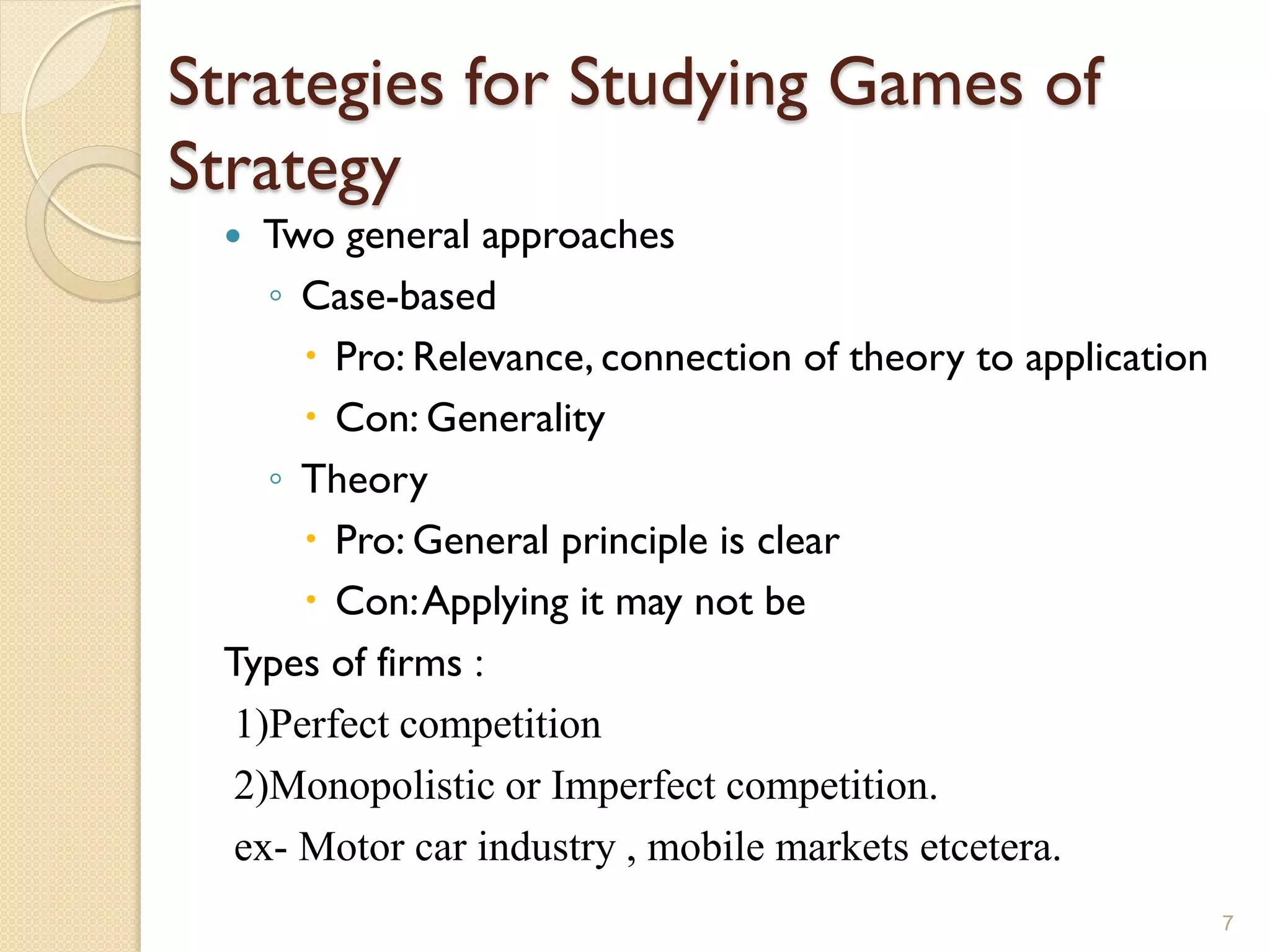
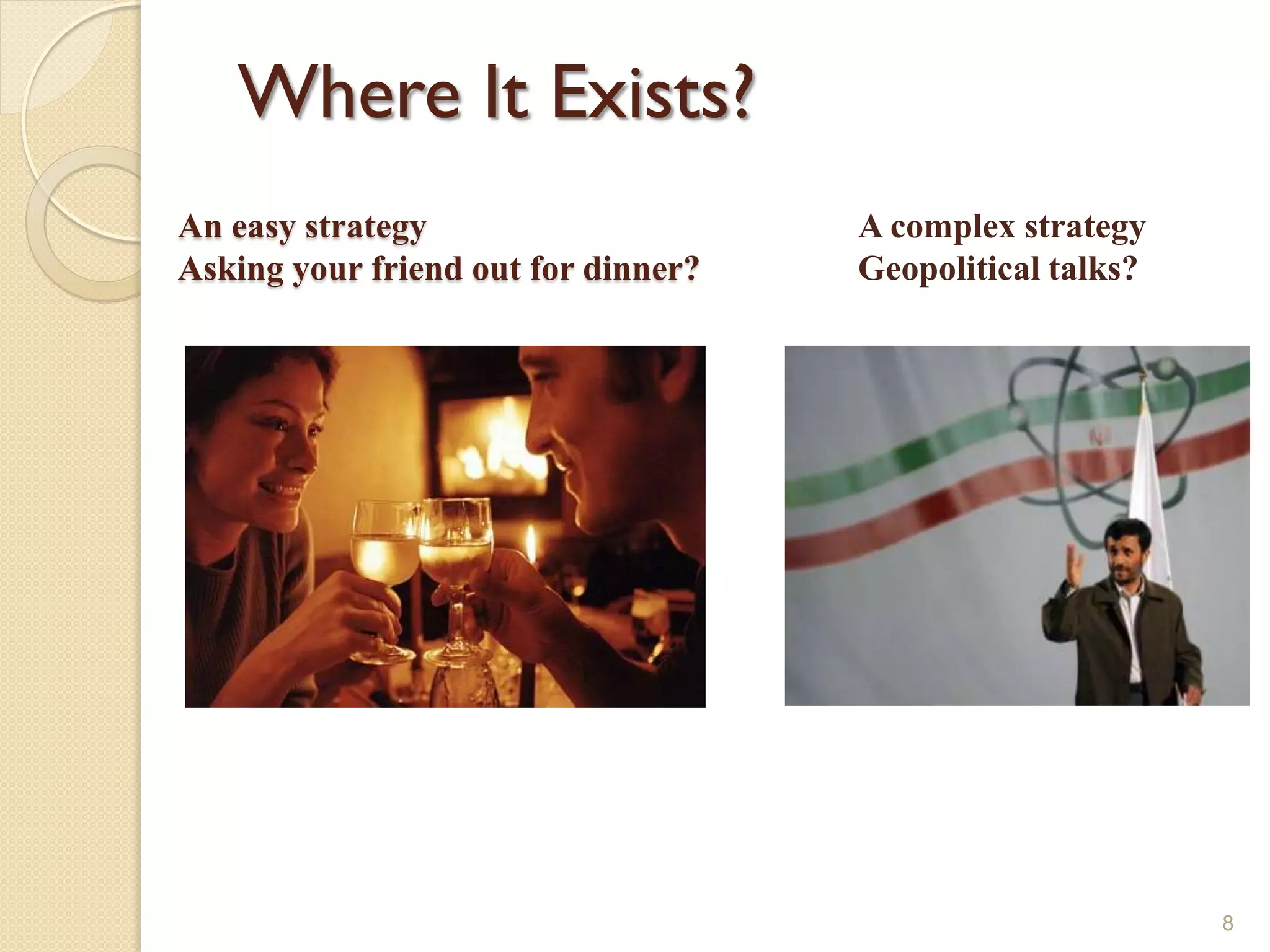
An easy strategy                     A complex strategy
Asking your friend out for dinner?   Geopolitical talks?


                                                           8
Representation of Games
   The games studied in game theory are well-defined
    mathematical objects. A game consists of a set of players, a
    set of moves (or strategies) available to those players, and
    a specification of payoffs for each combination of
    strategies.

 Categories :
Extensive form
Normal form
Characteristic function form
Partition function form

                                                               9
Extensive form


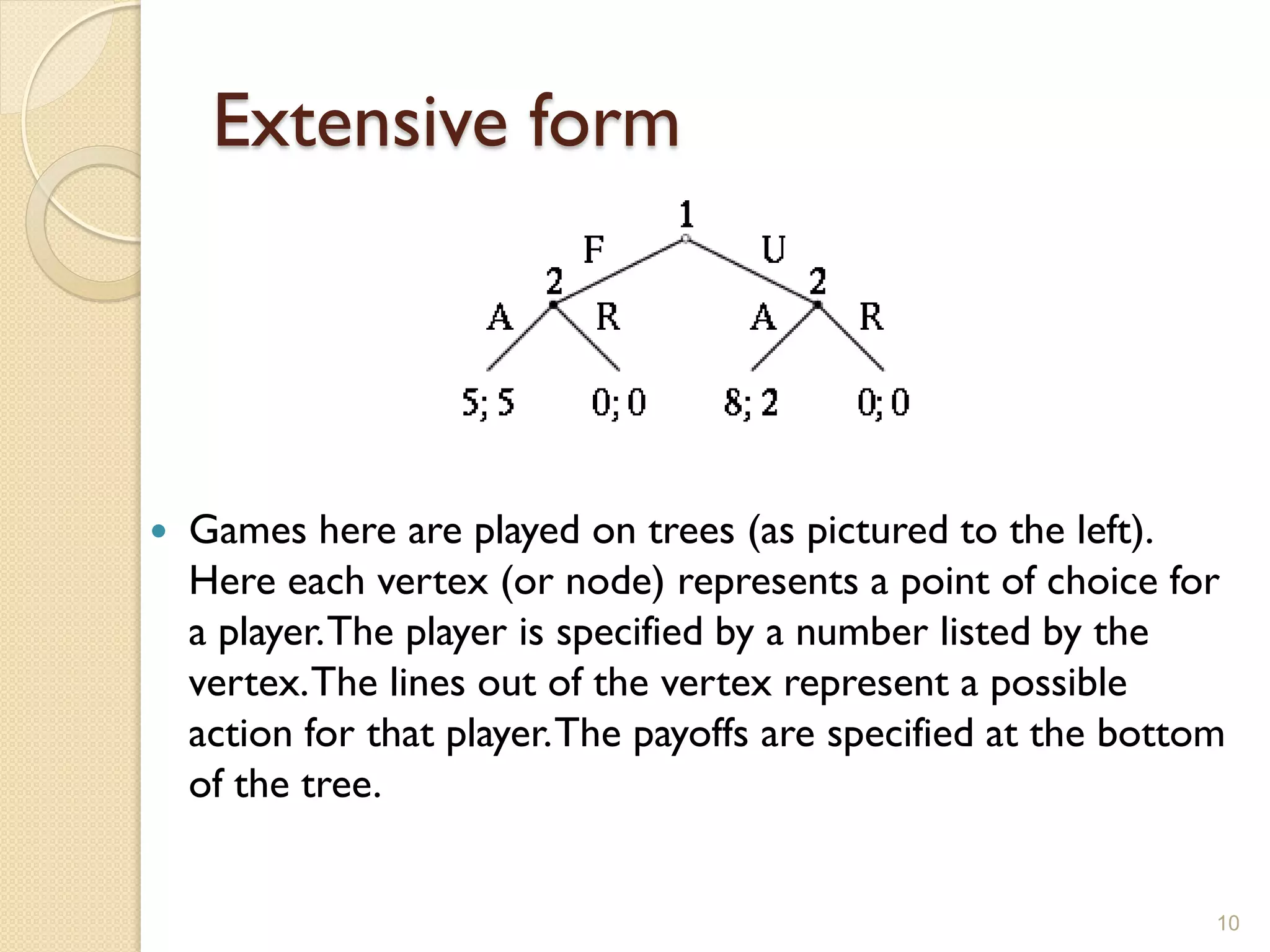
   Games here are played on trees (as pictured to the left).
    Here each vertex (or node) represents a point of choice for
    a player. The player is specified by a number listed by the
    vertex. The lines out of the vertex represent a possible
    action for that player. The payoffs are specified at the bottom
    of the tree.


                                                                  10
Normal/Strategic Form


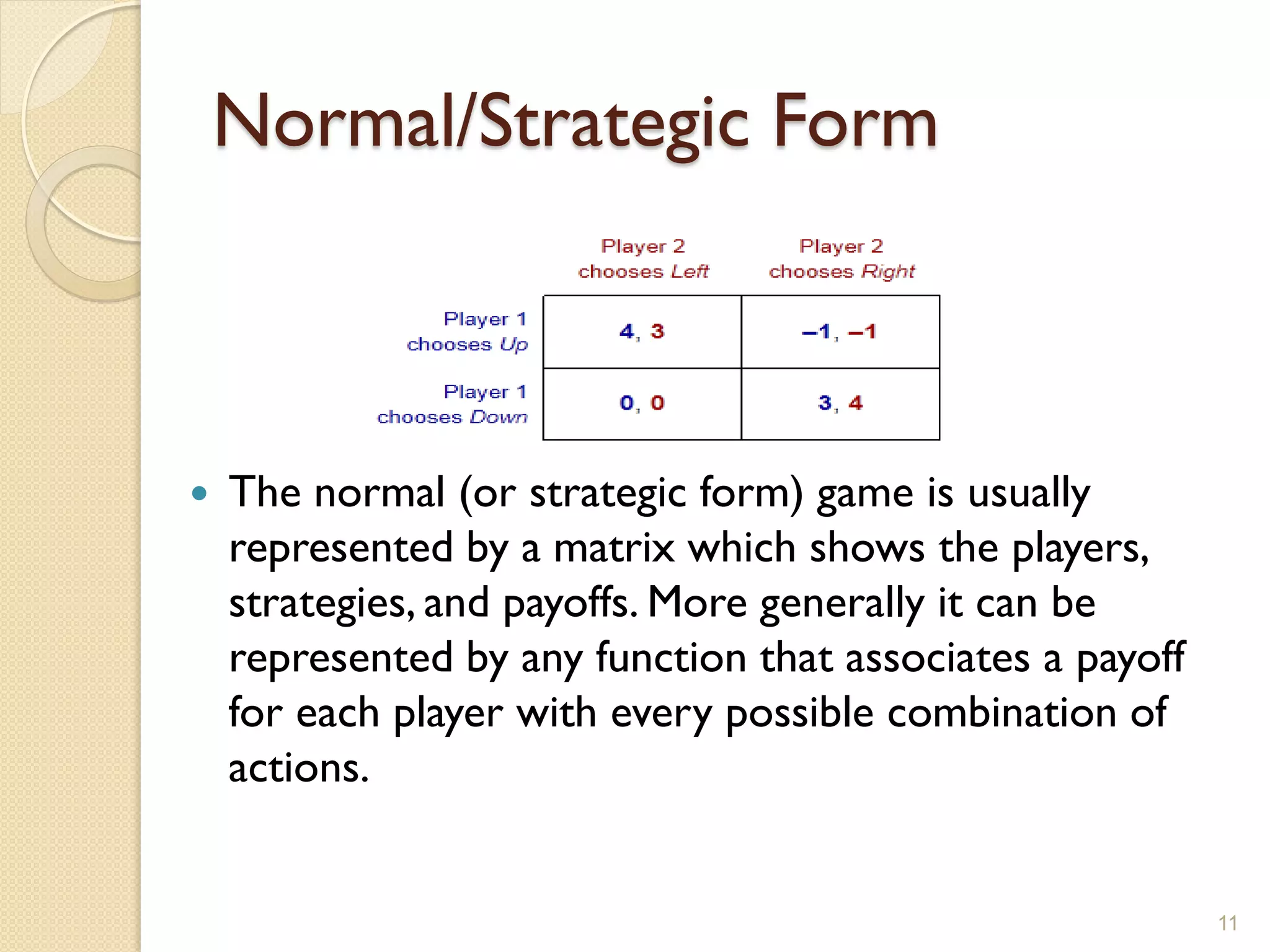
   The normal (or strategic form) game is usually
    represented by a matrix which shows the players,
    strategies, and payoffs. More generally it can be
    represented by any function that associates a payoff
    for each player with every possible combination of
    actions.

                                                           11
Types of Games
Cooperative :
   A game is cooperative if the players are able to form binding
  commitments. For instance the legal system requires them to adhere
  to their promises. Often it is assumed that communication among
  players is allowed in cooperative games. Cooperative games focus
  on the game at large.

Non-cooperative :
  In game theory, a non-cooperative game is one in which players
  make decisions independently. Non-Cooperative games are able to
  model situations to the finest details, producing accurate results.

Hybrid games :
  contain cooperative and non-cooperative elements.

                                                                        12
Symmetric :
  A symmetric game is a game where the payoffs for playing a particular
  strategy depend only on the other strategies employed, not on who is
  playing them. Prisoner's dilemma, and the stag hunt are all symmetric
  games.
Asymmetric :
  Most commonly studied asymmetric games are games where there
  are not identical strategy sets for both players.


Zero-sum games :
  In zero-sum games the total benefit to all players in the game, for
  every combination of strategies, always adds to zero (more informally,
  a player benefits only at the equal expense of others).
Non Zero-sum games :
These type of games have outcomes whose net results are greater or less
  than zero
                                                                           13
Simultaneous games :
  Are games where both players move simultaneously, or if they do not
  move simultaneously, the later players are unaware of the earlier
  players' actions (making them effectively simultaneous).
Sequential games (or dynamic games) :
  They are games where later players have some knowledge about
  earlier actions. This need not be perfect information about every
  action of earlier players; it might be very little knowledge. For
  instance, a player may know that an earlier player did not perform
  one particular action.

Perfect information and Imperfect information :
  A game is one of perfect information if all players know the moves
  previously made by all other players. Thus, only sequential games
  can be games of perfect information, since in simultaneous games not
  every player knows the actions of the others.
  Many card games are games of imperfect information, for instance
  poker.
                                                                         14
   Combinatorial games :
    Games in which the difficulty of finding an optimal strategy stems
    from the multiplicity of possible moves are called combinatorial
    games. Examples include chess and go. Games that involve imperfect
    or incomplete information may also have a strong combinatorial
    character. A related field of study, drawing from computational
    complexity theory, is game complexity, which is concerned with
    estimating the computational difficulty of finding optimal strategies.


   Discrete and continuous games :
    Continuous games includes changing strategy set.
    Much of game theory is concerned with finite, discrete games, that
    have a finite number of players, moves, events, outcomes, etc.


                                                                             15
   Infinitely long games :
    Pure mathematicians are not so constrained, and set theorists in
    particular study games that last for infinitely many moves, with the
    winner (or other payoff) not known until after all those moves are
    completed. The focus of attention is usually not so much on what is the
    best way to play such a game, but simply on whether one or the other
    player has a winning strategy.


   Meta-games :
    These are games the play of which is the development of the rules for
    another game, the target or subject game. Metagames seek to maximize
    the utility value of the rule set developed.


                                                                              16
Lesson 1
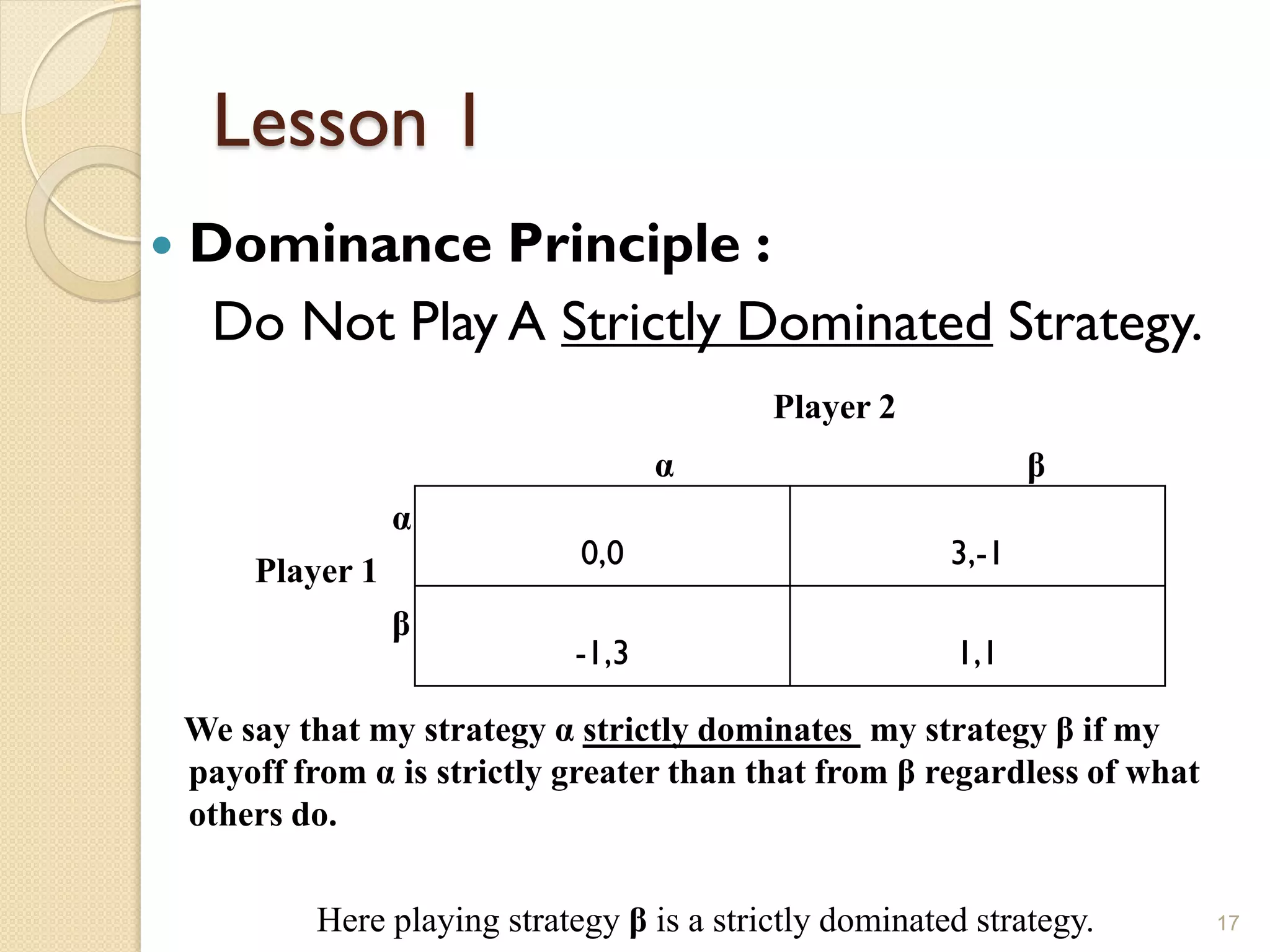
   Dominance Principle :
     Do Not Play A Strictly Dominated Strategy.
                                              Player 2
                                      α                           β
                   α
                                0,0                        3,-1
        Player 1
                   β
                               -1,3                        1,1

    We say that my strategy α strictly dominates my strategy β if my
    payoff from α is strictly greater than that from β regardless of what
    others do.

             Here playing strategy β is a strictly dominated strategy.      17
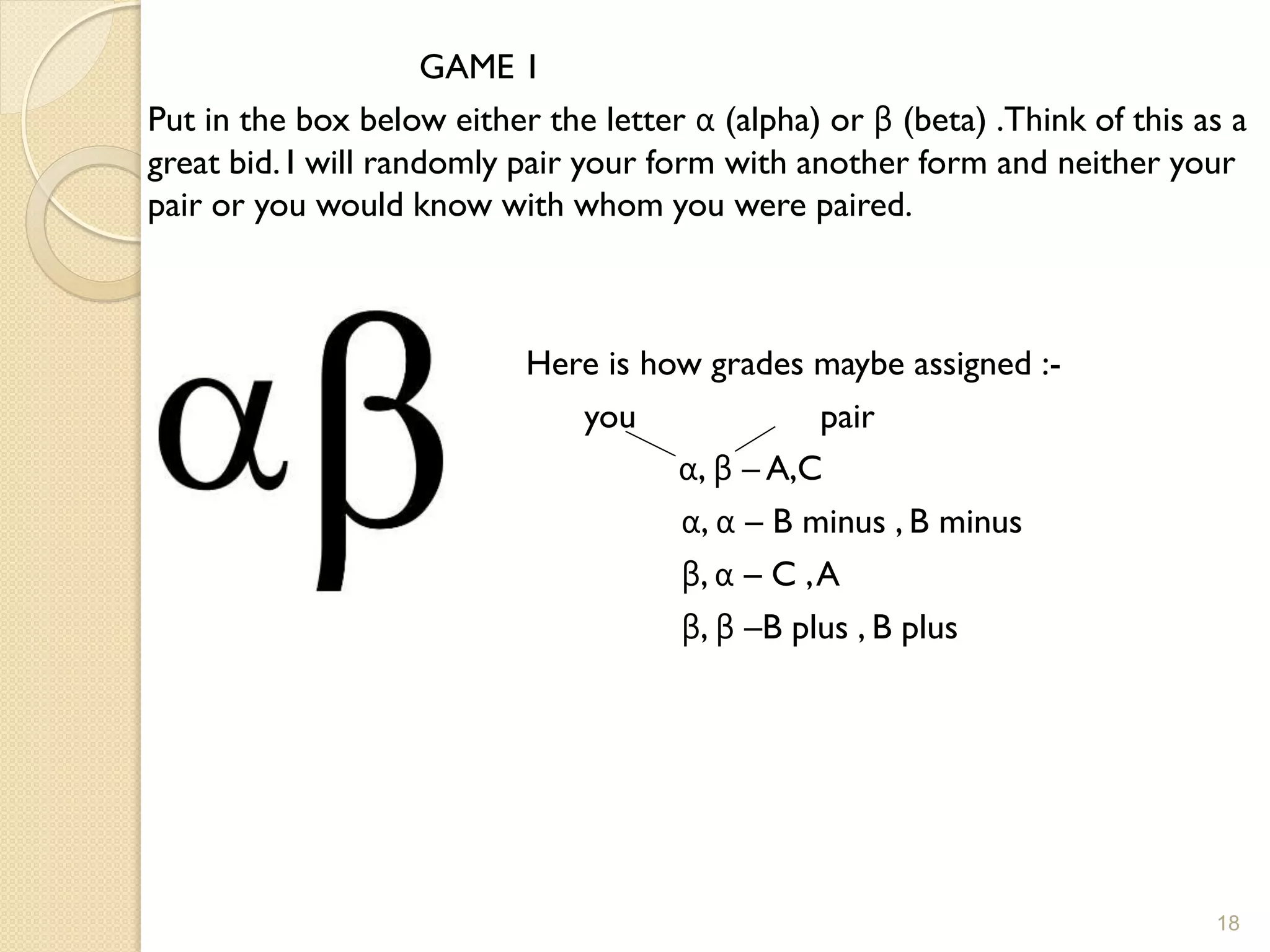
GAME 1
Put in the box below either the letter α (alpha) or β (beta) .Think of this as a
great bid. I will randomly pair your form with another form and neither your
pair or you would know with whom you were paired.


                           Here is how grades maybe assigned :-
                              you               pair
                                     α, β – A,C
                                     α, α – B minus , B minus
                                     β, α – C , A
                                     β, β –B plus , B plus


                                                                             18
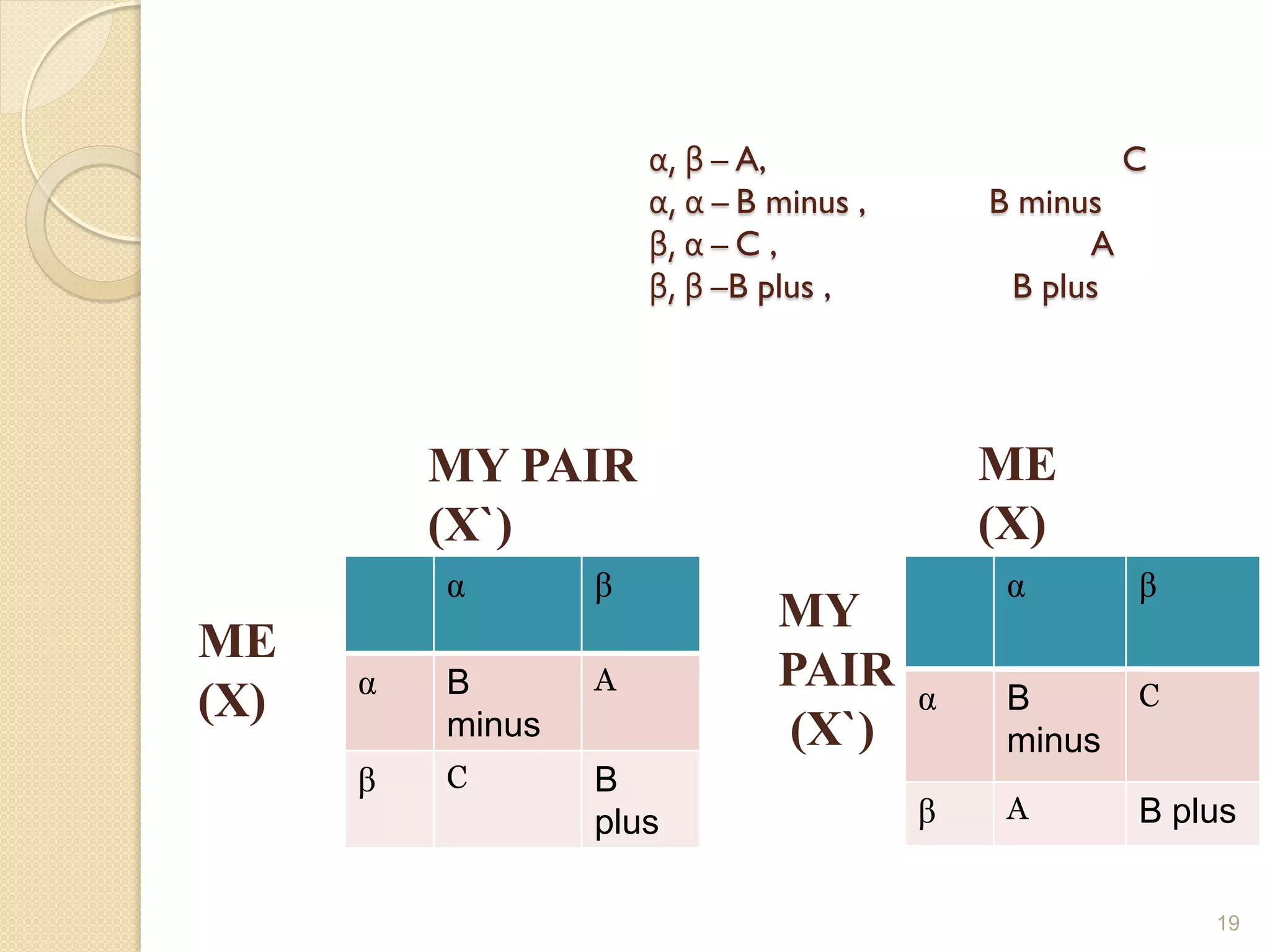
α, β – A,                        C
                      α, α – B minus ,       B minus
                      β, α – C ,                   A
                      β, β –B plus ,          B plus


          MY PAIR                            ME
          (X`)                               (X)
          α       β                           α        β
                               MY
ME
      α   B       A            PAIR      α             C
(X)       minus
                                              B
                               (X`)           minus
      β   C       B
                  plus                   β    A        B plus


                                                           19
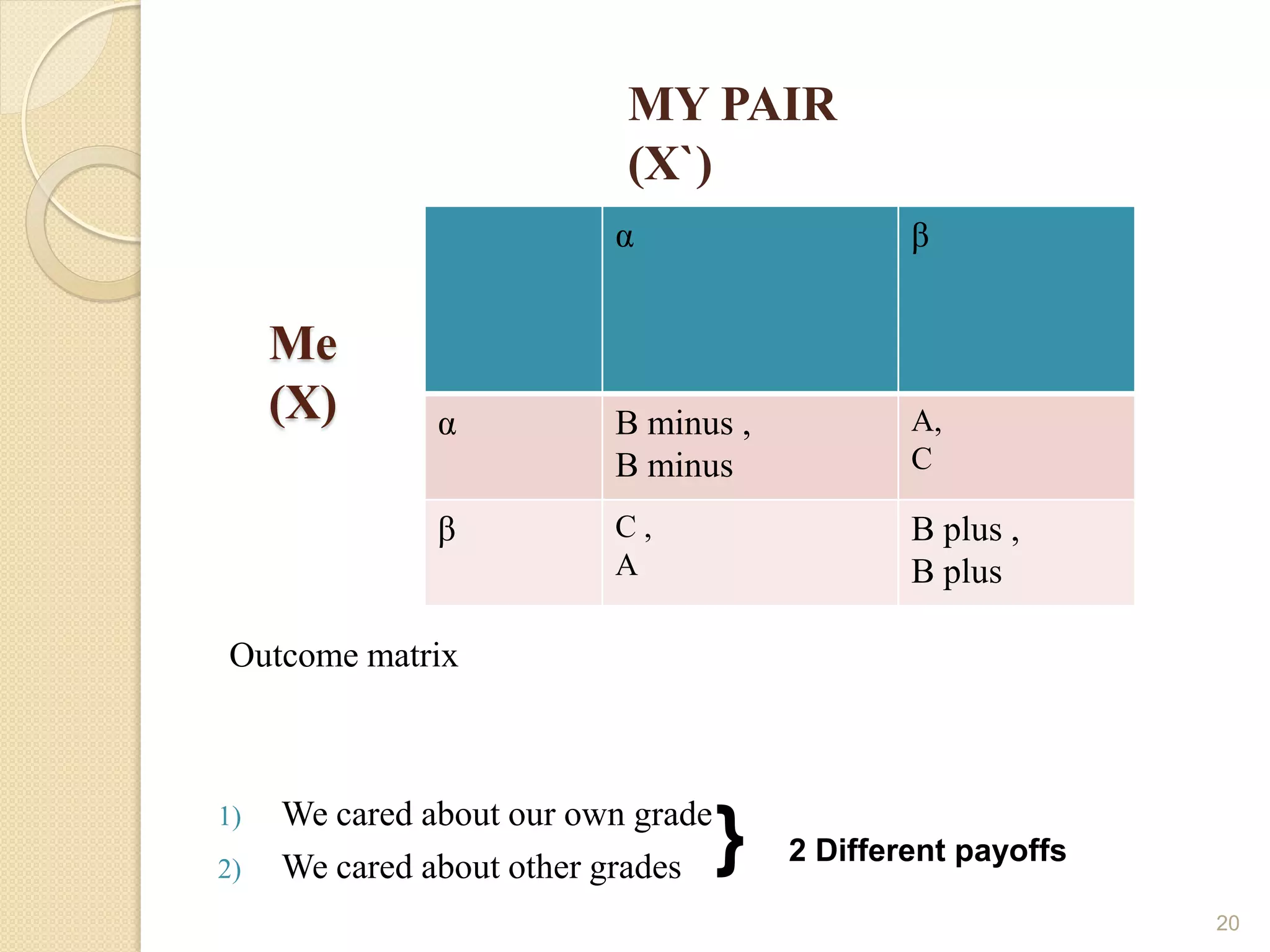
MY PAIR
                           (X`)
                          α                     β


     Me
     (X)       α          B minus ,             A,
                          B minus               C

               β          C,                    B plus ,
                          A                     B plus

Outcome matrix


     We cared about our own grade
1)
2)   We cared about other grades    }   2 Different payoffs

                                                              20
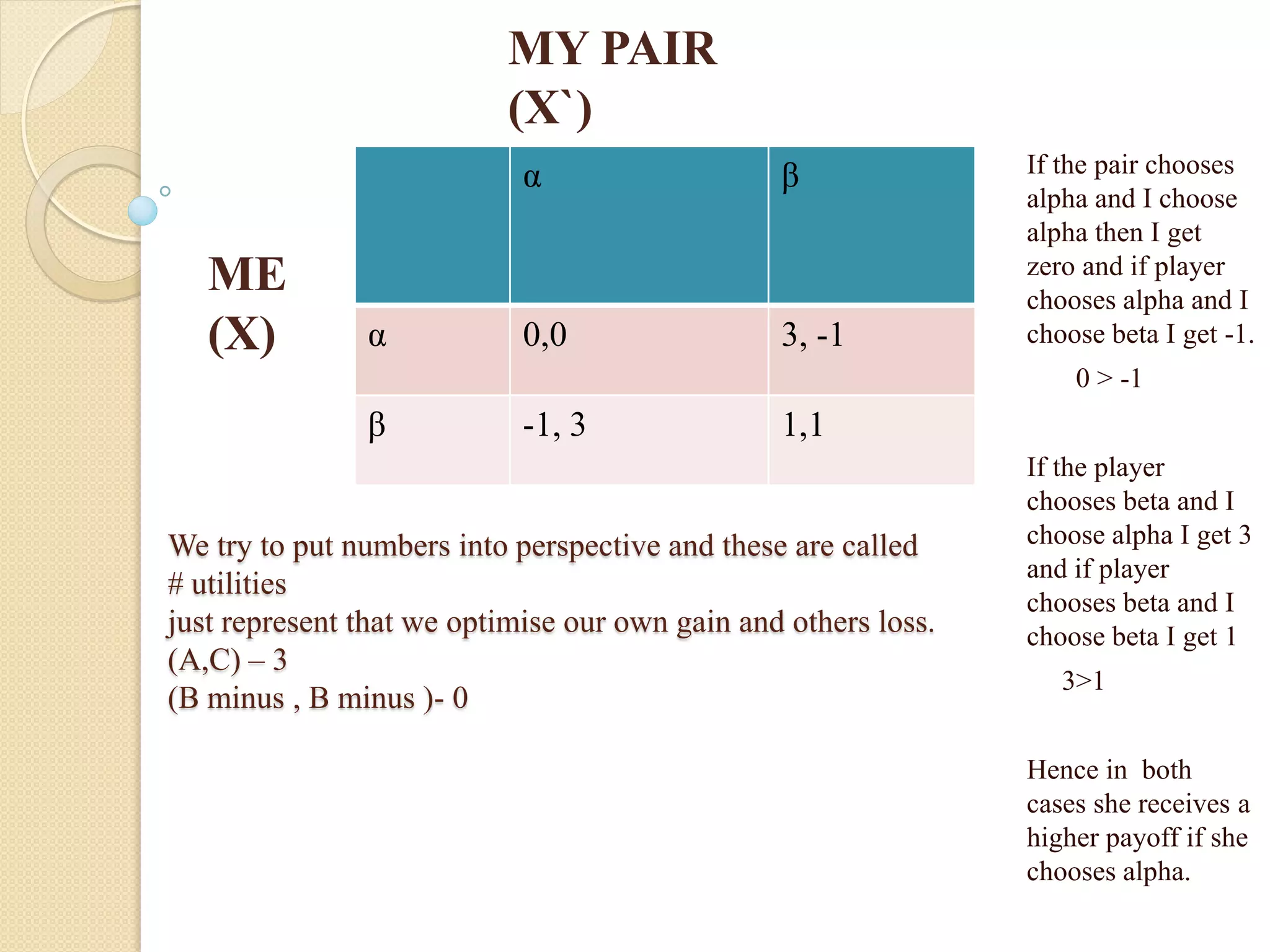
MY PAIR
                           (X`)
                            α                   β               If the pair chooses
                                                                alpha and I choose
                                                                alpha then I get
                                                                zero and if player
   ME                                                           chooses alpha and I
   (X)         α            0,0                 3, -1           choose beta I get -1.
                                                                    0 > -1
               β            -1, 3               1,1
                                                                If the player
                                                                chooses beta and I
We try to put numbers into perspective and these are called     choose alpha I get 3
                                                                and if player
# utilities
                                                                chooses beta and I
just represent that we optimise our own gain and others loss.   choose beta I get 1
(A,C) – 3
                                                                   3>1
(B minus , B minus )- 0

                                                                Hence in both
                                                                cases she receives a
                                                                higher payoff if she
                                                                chooses alpha.
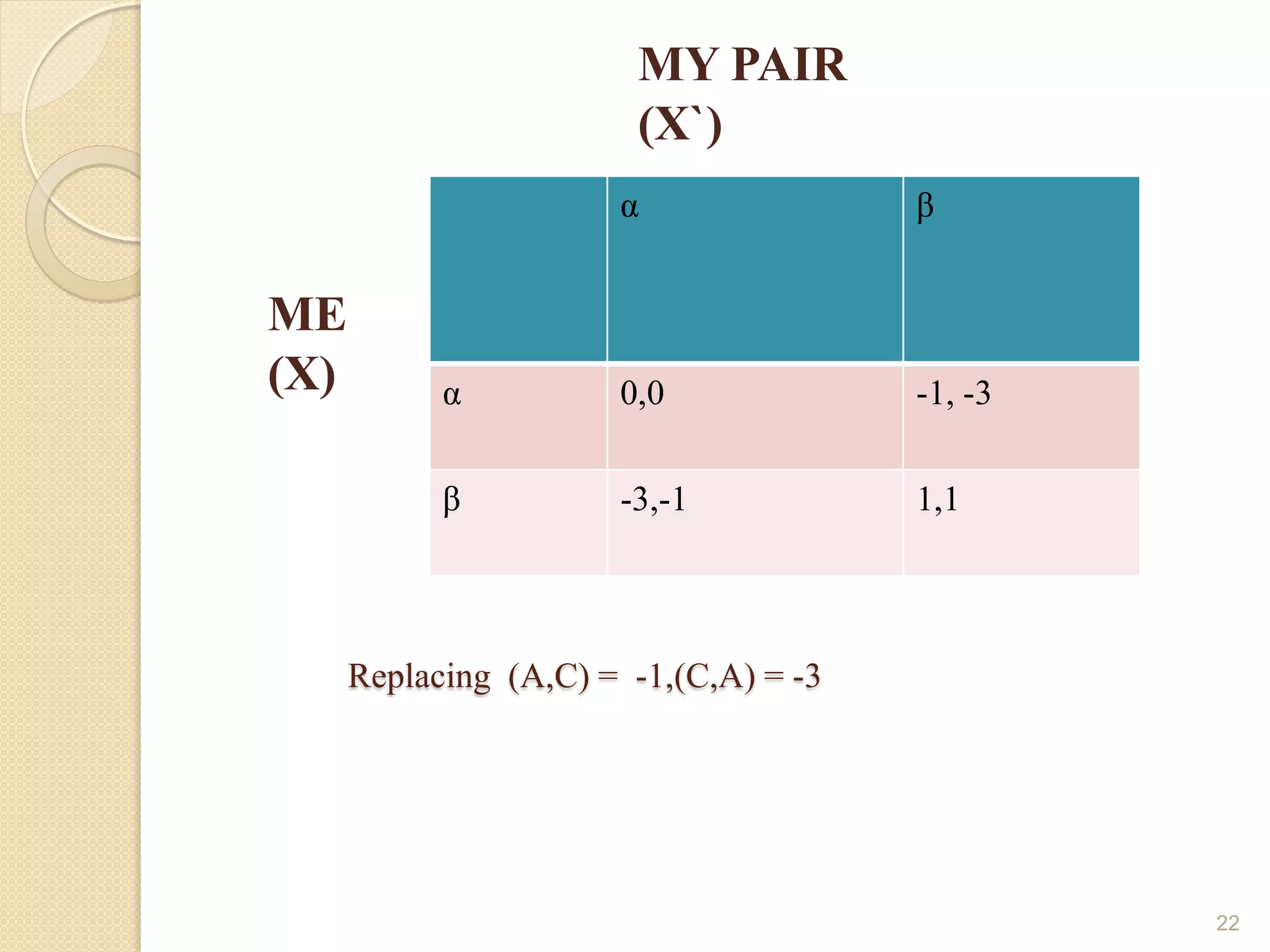
MY PAIR
                        (X`)
                       α                β


ME
(X)         α          0,0              -1, -3


            β          -3,-1            1,1


      Replacing (A,C) = -1,(C,A) = -3


                                                 22
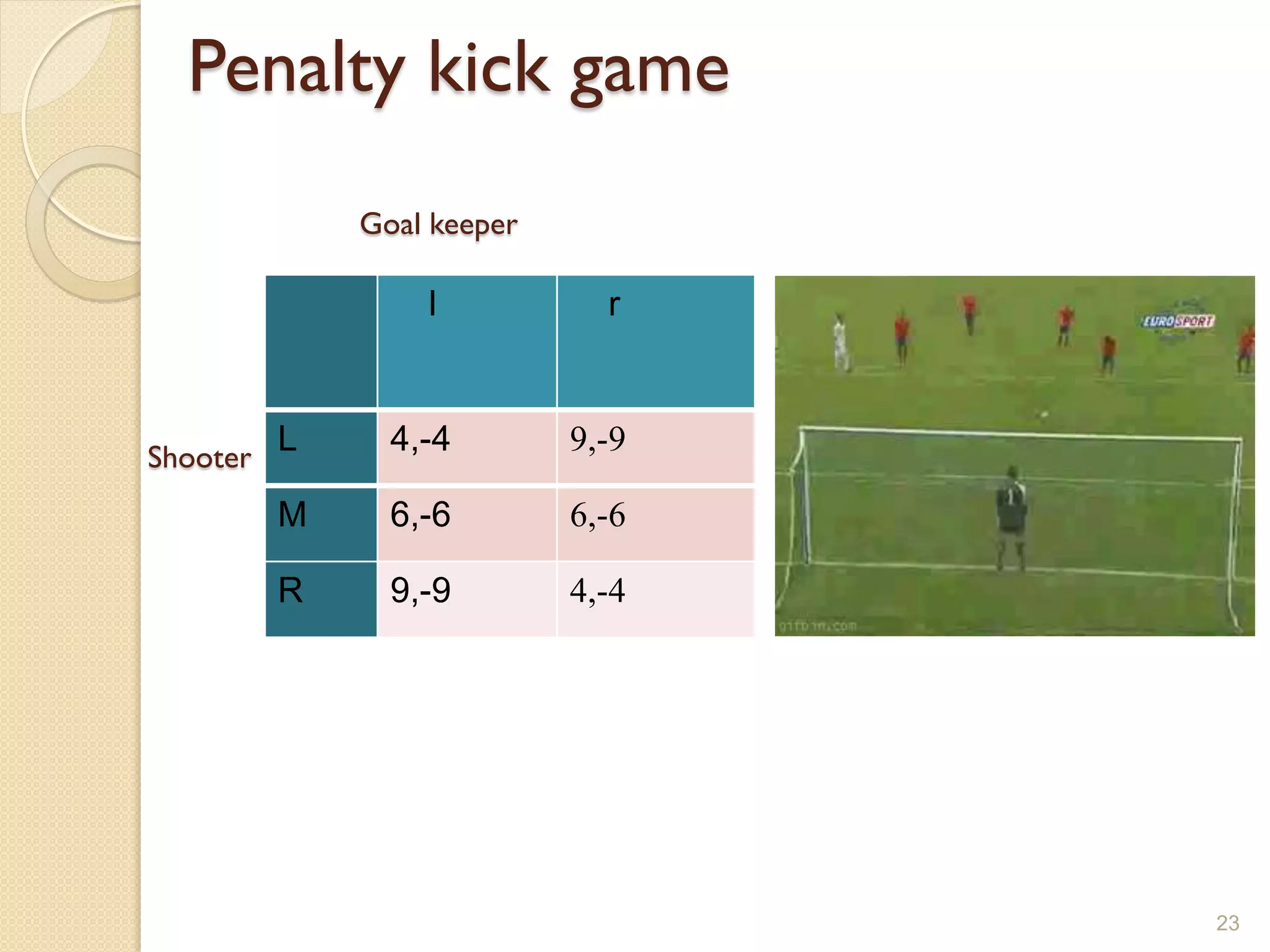
Penalty kick game
              Goal keeper

                  l           r


Shooter
          L     4,-4        9,-9

          M     6,-6        6,-6

          R     9,-9        4,-4


                                   23
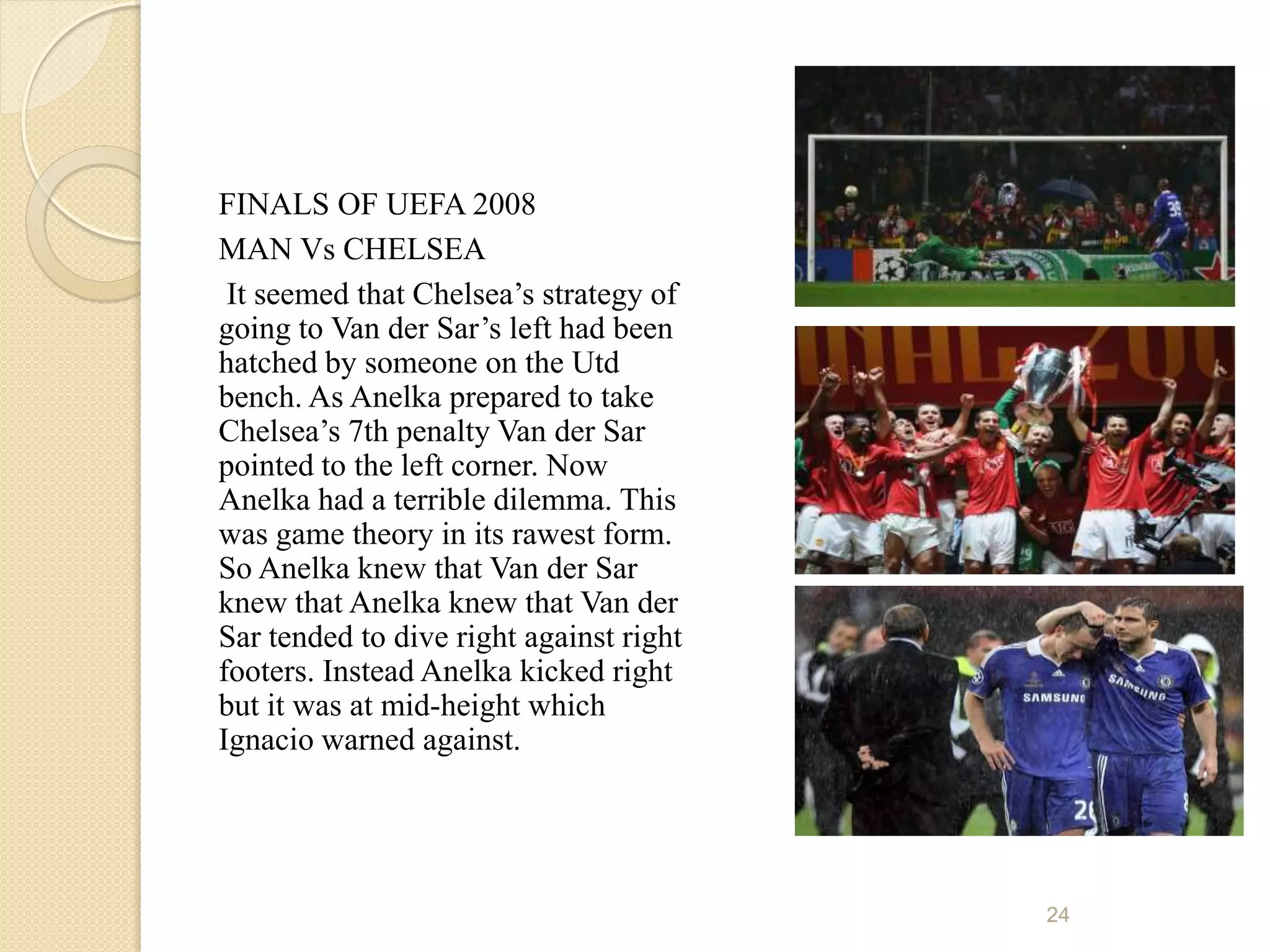
FINALS OF UEFA 2008
MAN Vs CHELSEA
 It seemed that Chelsea’s strategy of
going to Van der Sar’s left had been
hatched by someone on the Utd
bench. As Anelka prepared to take
Chelsea’s 7th penalty Van der Sar
pointed to the left corner. Now
Anelka had a terrible dilemma. This
was game theory in its rawest form.
So Anelka knew that Van der Sar
knew that Anelka knew that Van der
Sar tended to dive right against right
footers. Instead Anelka kicked right
but it was at mid-height which
Ignacio warned against.


                                         24
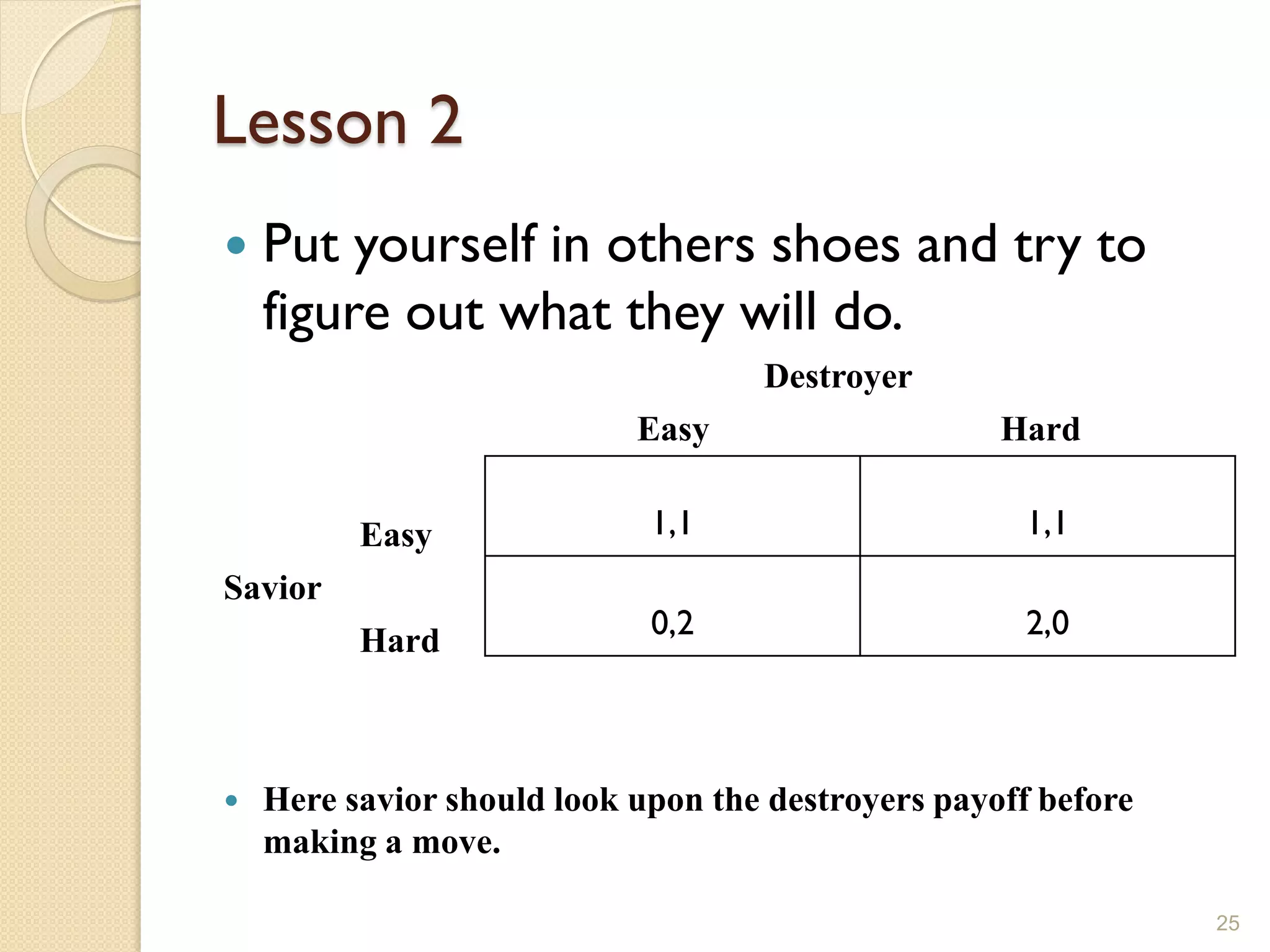
Lesson 2
   Put yourself in others shoes and try to
    figure out what they will do.
                                    Destroyer
                            Easy                    Hard

          Easy               1,1                     1,1
Savior
          Hard               0,2                     2,0


   Here savior should look upon the destroyers payoff before
    making a move.

                                                                25
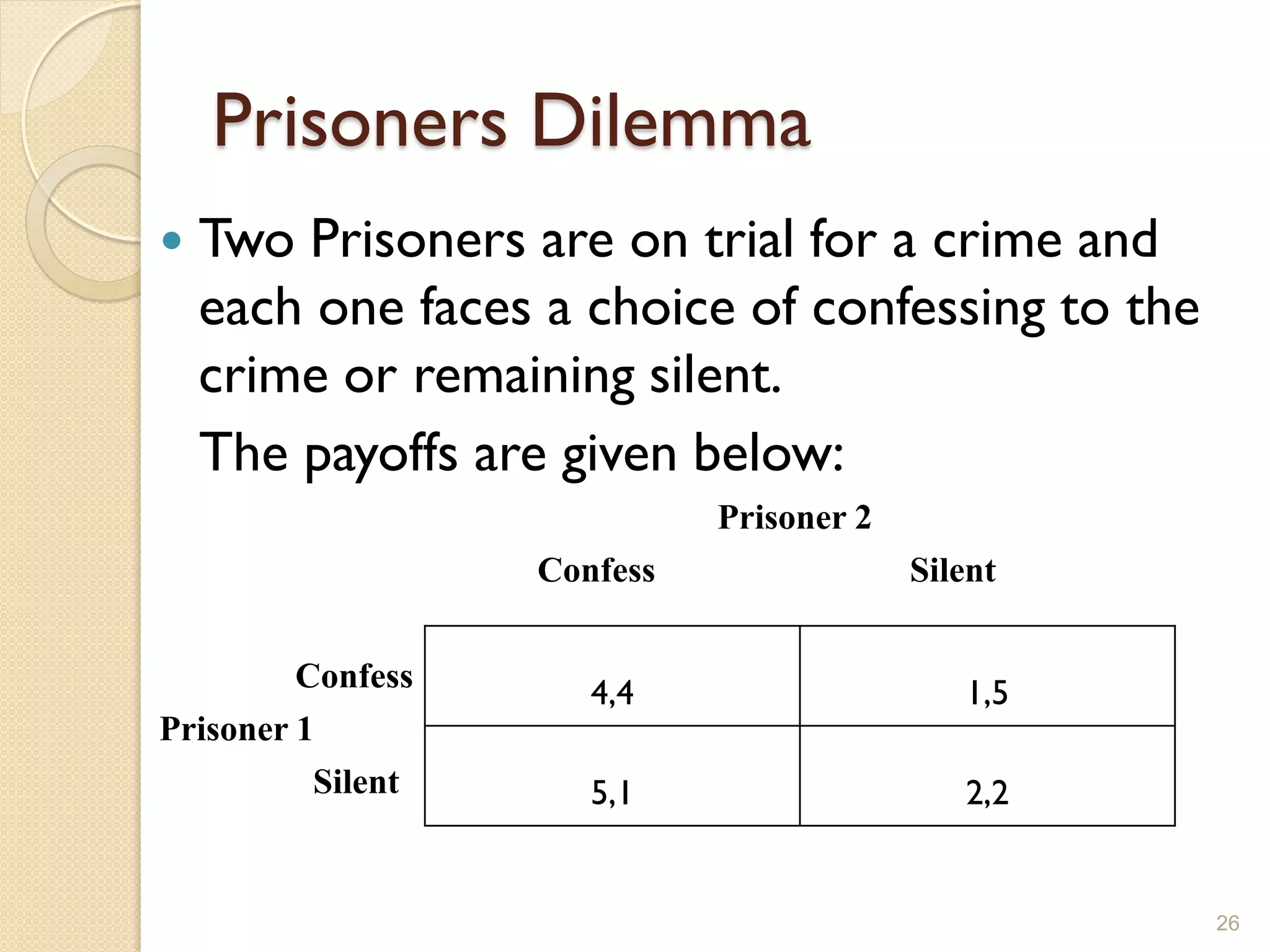
Prisoners Dilemma
   Two Prisoners are on trial for a crime and
    each one faces a choice of confessing to the
    crime or remaining silent.
    The payoffs are given below:
                             Prisoner 2
                   Confess                Silent

         Confess      4,4                    1,5
Prisoner 1
          Silent      5,1                    2,2


                                                   26
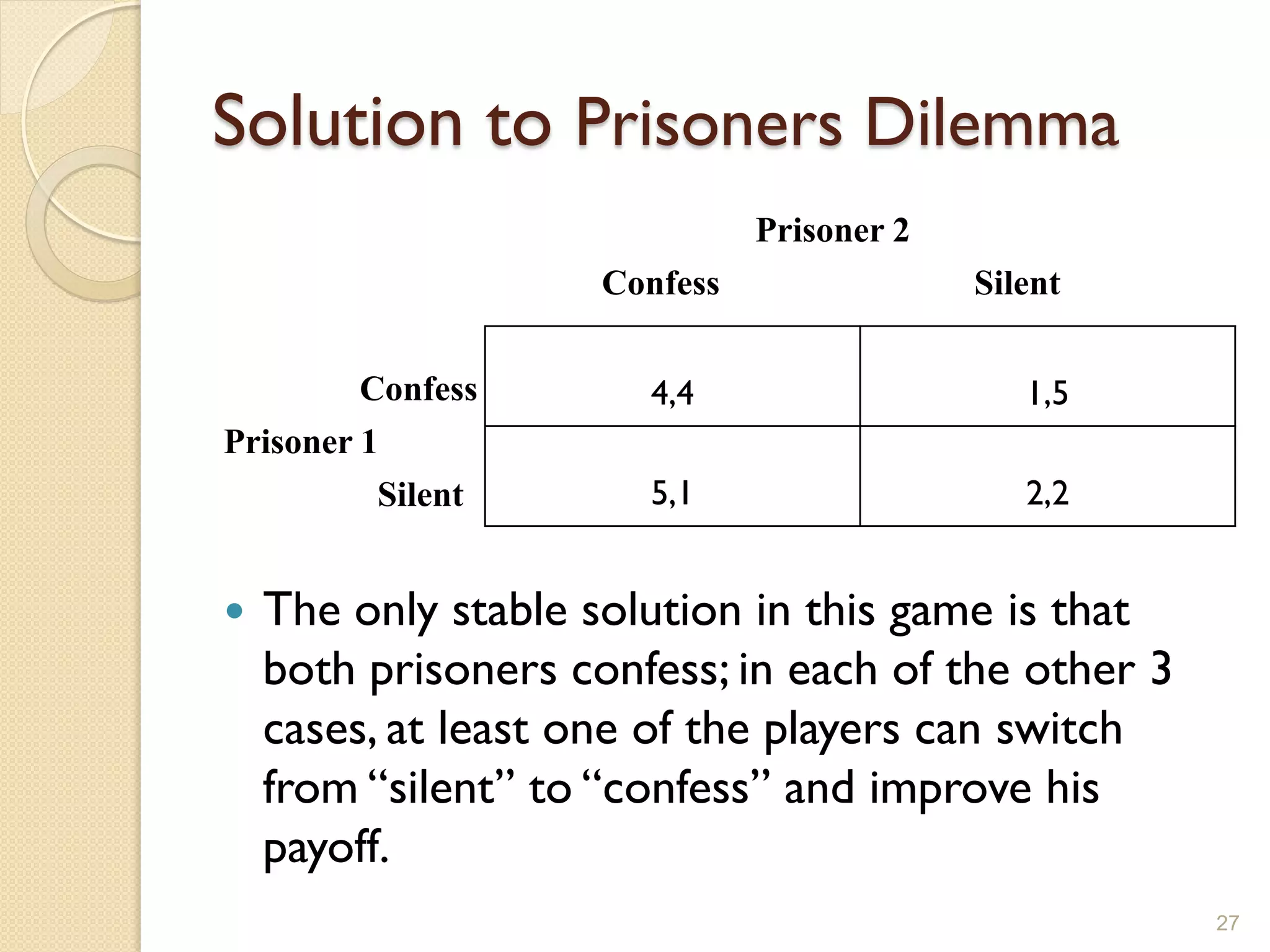
Solution to Prisoners Dilemma
                               Prisoner 2
                     Confess                Silent

         Confess       4,4                     1,5
Prisoner 1
          Silent       5,1                     2,2


   The only stable solution in this game is that
    both prisoners confess; in each of the other 3
    cases, at least one of the players can switch
    from ―silent‖ to ―confess‖ and improve his
    payoff.
                                                     27
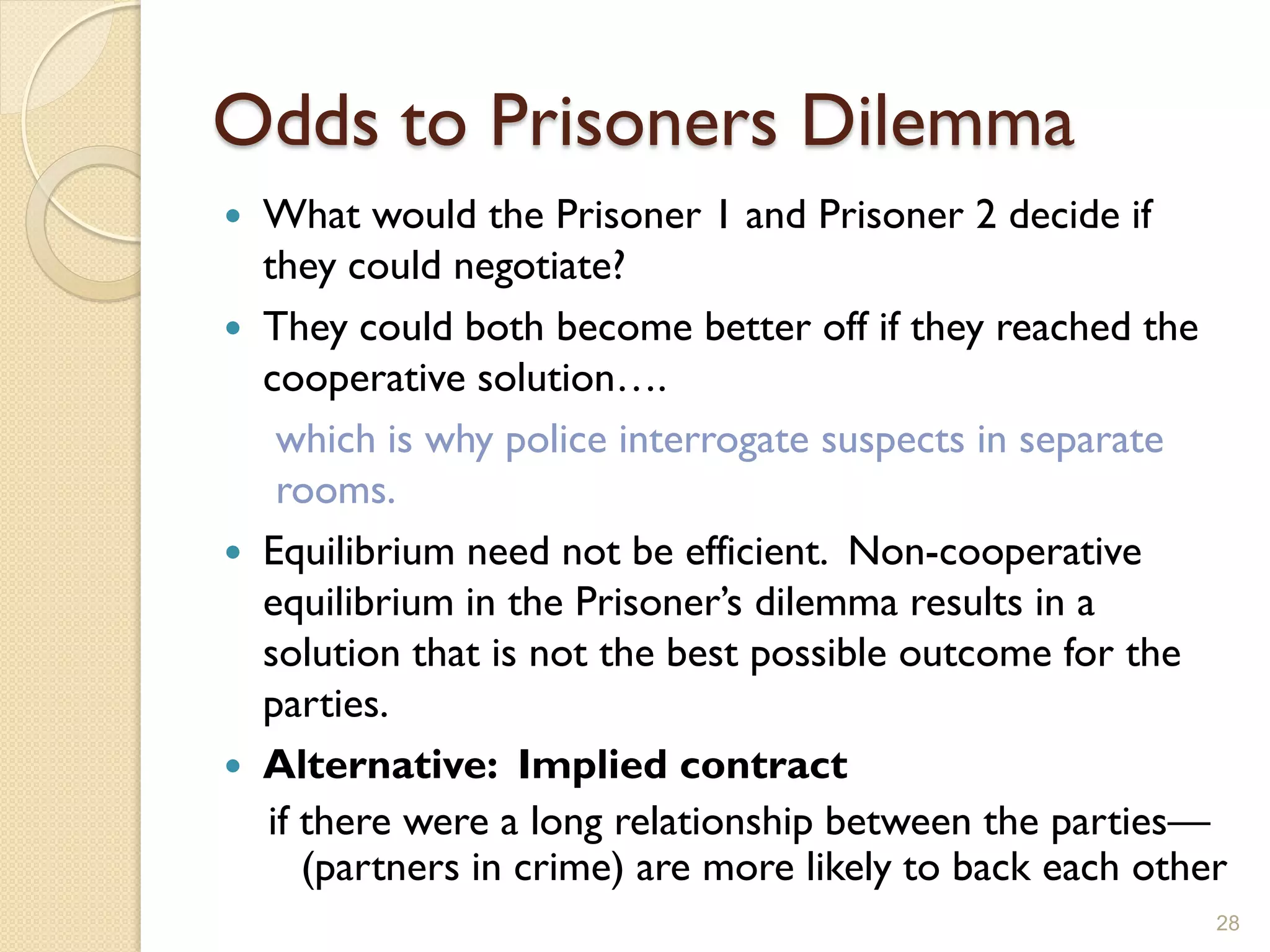
Odds to Prisoners Dilemma
 What would the Prisoner 1 and Prisoner 2 decide if
  they could negotiate?
 They could both become better off if they reached the
  cooperative solution….
   which is why police interrogate suspects in separate
   rooms.
 Equilibrium need not be efficient. Non-cooperative
  equilibrium in the Prisoner’s dilemma results in a
  solution that is not the best possible outcome for the
  parties.
 Alternative: Implied contract
  if there were a long relationship between the parties—
     (partners in crime) are more likely to back each other
                                                          28
CPU Competition
 Intel and AMD compete fiercely to develop innovations
  in CPUs for PCs
 As a result of this, CPU speeds have increased
  dramatically, but there are few differences between the
  products of the two companies
 Even though both companies expended huge amounts
  of money to gain a competitive advantage, their relative
  competitive position ends up unchanged.
 Both companies are worse off than if they had each
  slackened the pace of innovation
 This is an example of a prisoner’s dilemma


                                                             29
Sale Price Guarantees
   Globus and many other stores like
    Pantaloons offer sale price guarantees
    ◦ If an item comes on sale in the time period
      after you bought it, they will match the
      difference in prices
    ◦ Thus, consumers wishing to buy now are
      ―protected‖ against regrets from future price
      reductions


                                                      30
Walking Down the Demand Curve
  Globus would like to sell goods at high prices
   to those with high willingness to pay for them
   and then lower prices to capture those with
   lower willingness to pay.
  They might do this by running sales after new
   items have been out for a while
  But high value consumers will anticipate this
   and wait for the sale to occur.


                                                    31
The Power of Commitment
 By offering to rebate back the difference
  in prices, Globus makes the sale strategy
  less profitable for its ―future‖ self.
 This commits it to less discounting in the
  future
 In fact It enables it to charge higher prices
  today…and tomorrow.


                                              32
Coordination Game
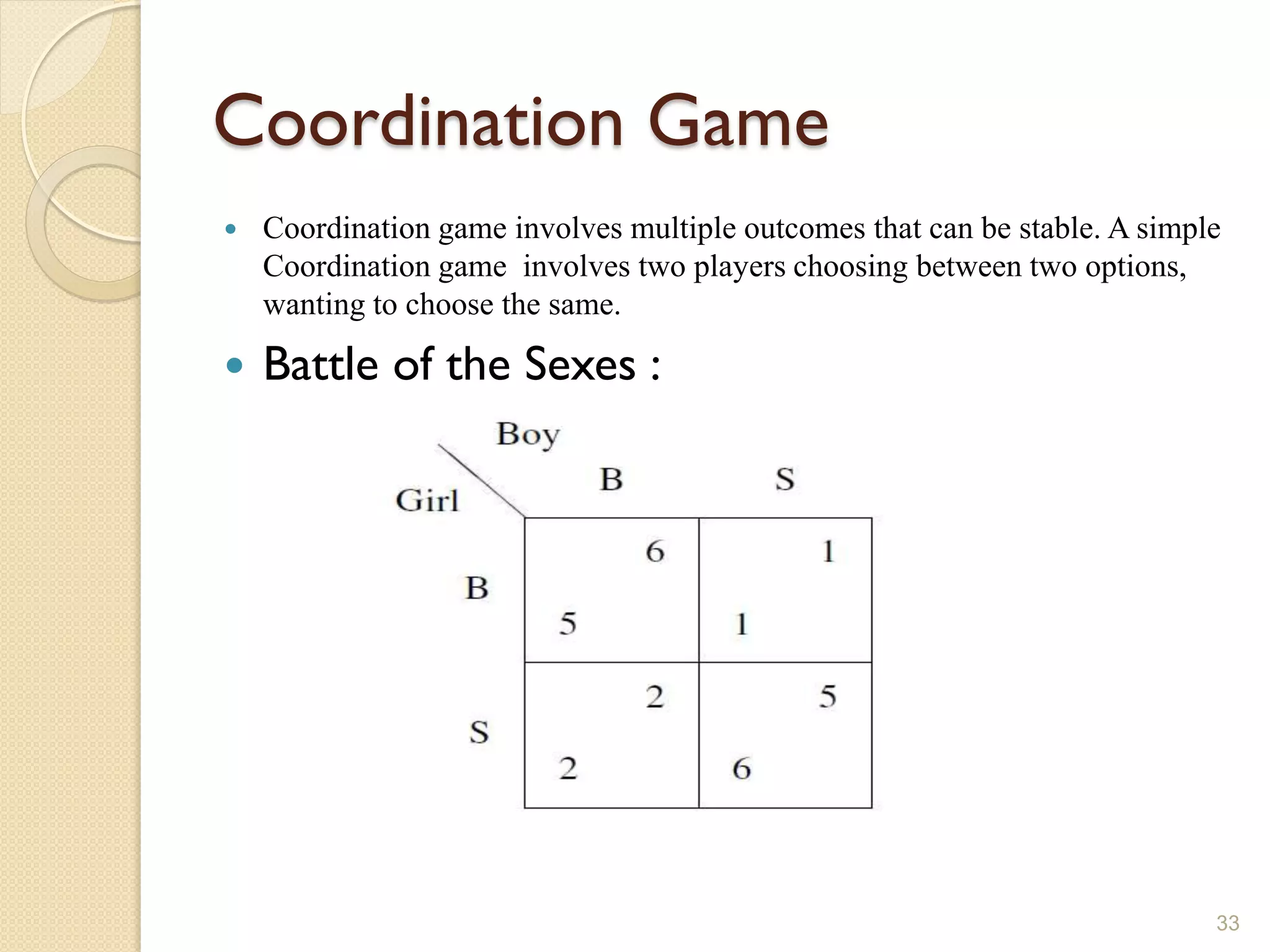
   Coordination game involves multiple outcomes that can be stable. A simple
    Coordination game involves two players choosing between two options,
    wanting to choose the same.

   Battle of the Sexes :


                                                                            33
Solution to Battle Of the Sexes
 Solution: Both should play the same game.
 Everyone benefits from being in
  cooperative group, but each can do better
  by exploiting cooperative efforts of
  others.


                                          34
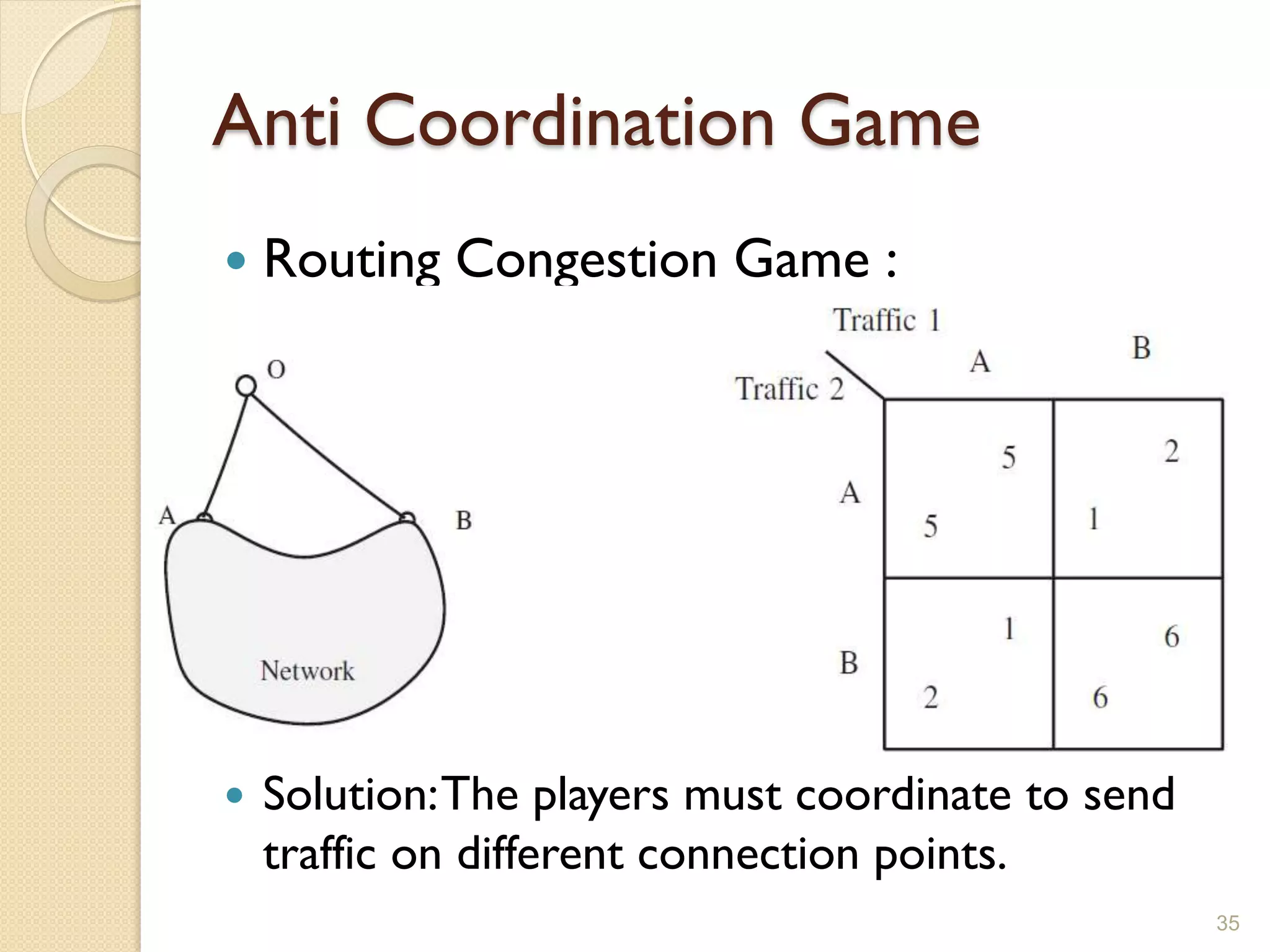
Anti Coordination Game
   Routing Congestion Game :


   Solution: The players must coordinate to send
    traffic on different connection points.
                                                    35
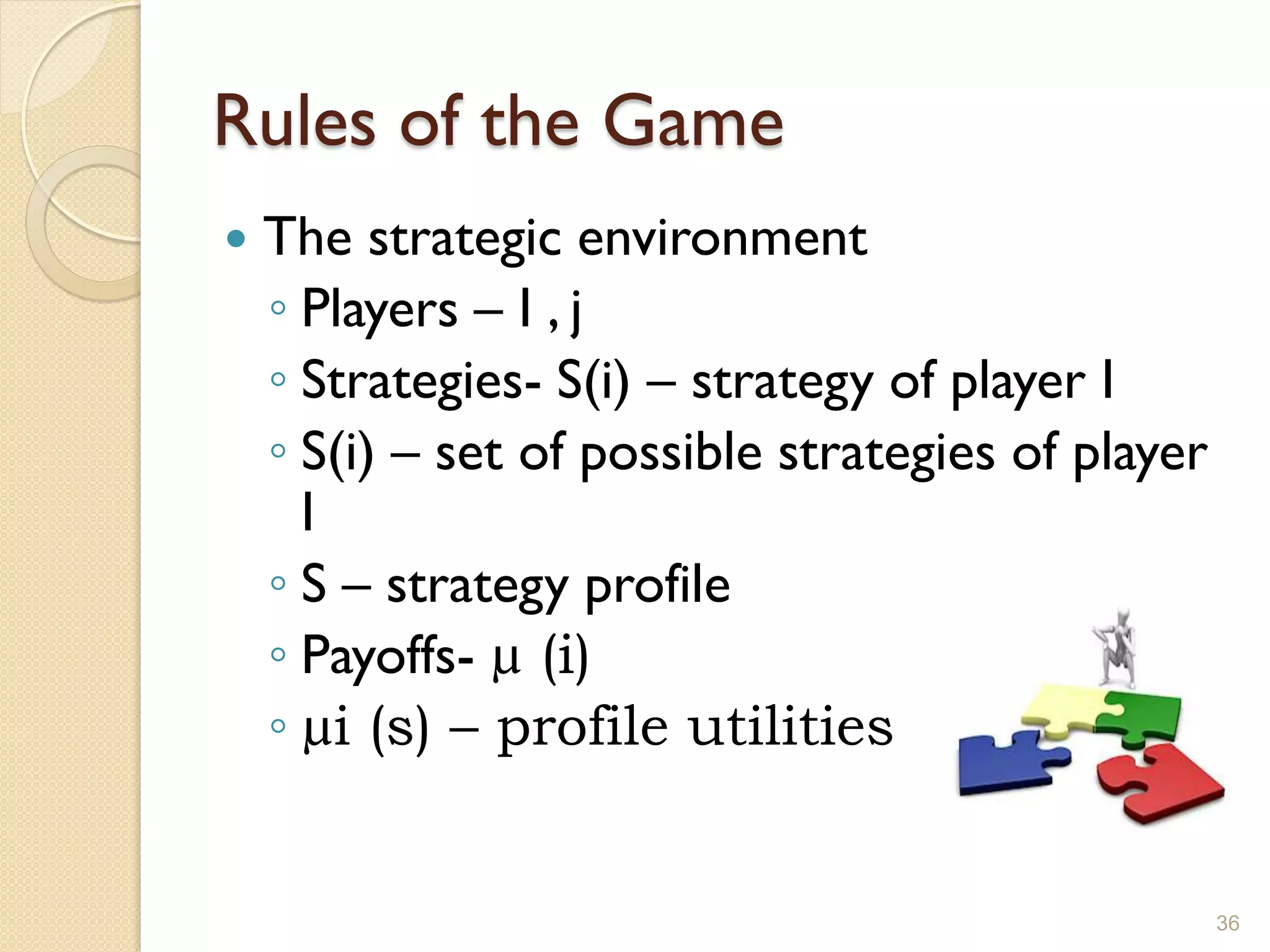
Rules of the Game
   The strategic environment
    ◦ Players – I , j
    ◦ Strategies- S(i) – strategy of player I
    ◦ S(i) – set of possible strategies of player
      I
    ◦ S – strategy profile
    ◦ Payoffs- µ (i)
    ◦ µi (s) – profile utilities


                                                    36
 The rules
  ◦ Timing of moves
  ◦ Nature of conflict and interaction
  ◦ Informational conditions
  ◦ Enforceability of agreements or
    contracts
 The assumptions
  ◦ Rationality
  ◦ Common knowledge

                                         37
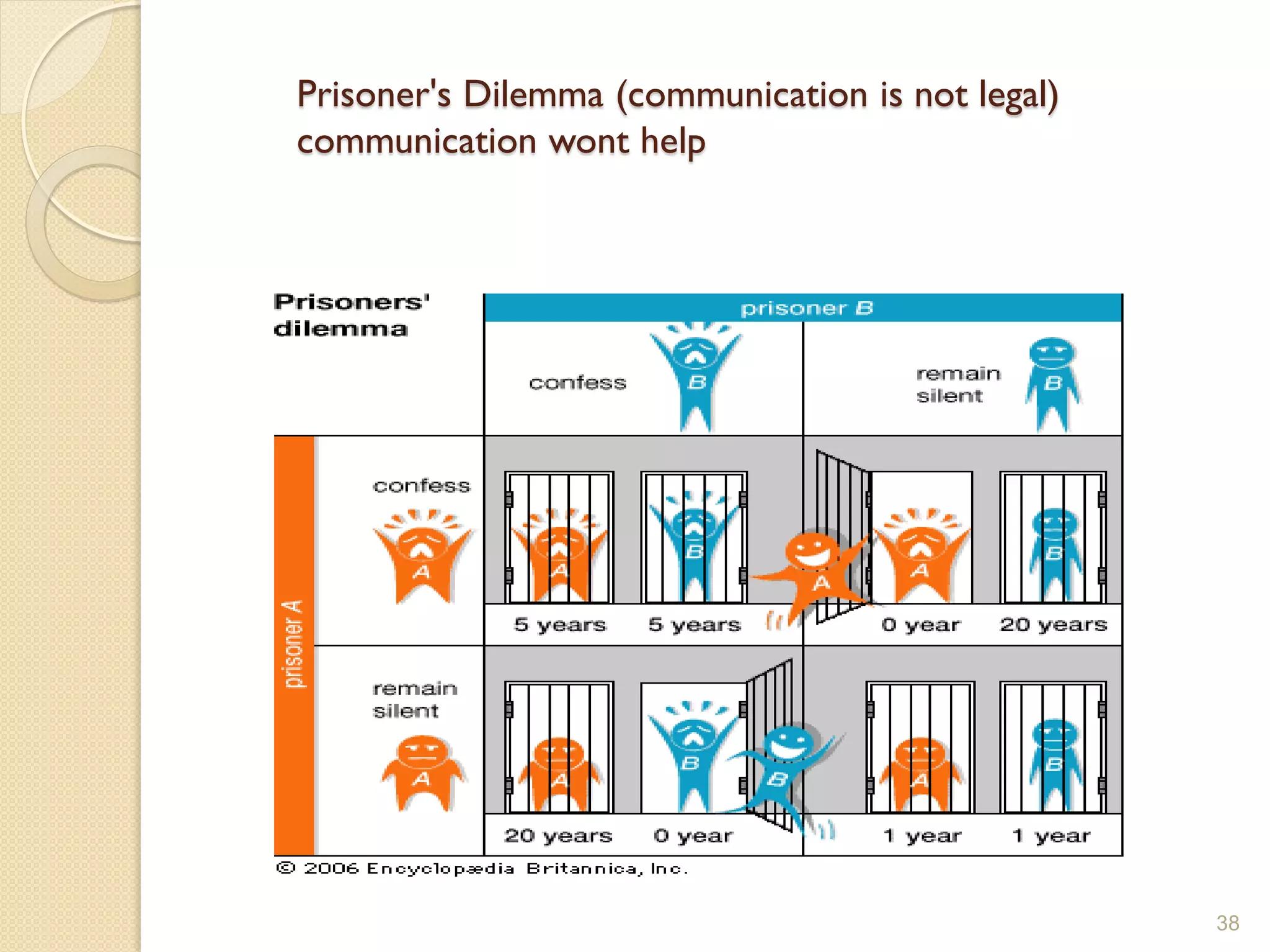
Prisoner's Dilemma (communication is not legal)
communication wont help


                                                  38
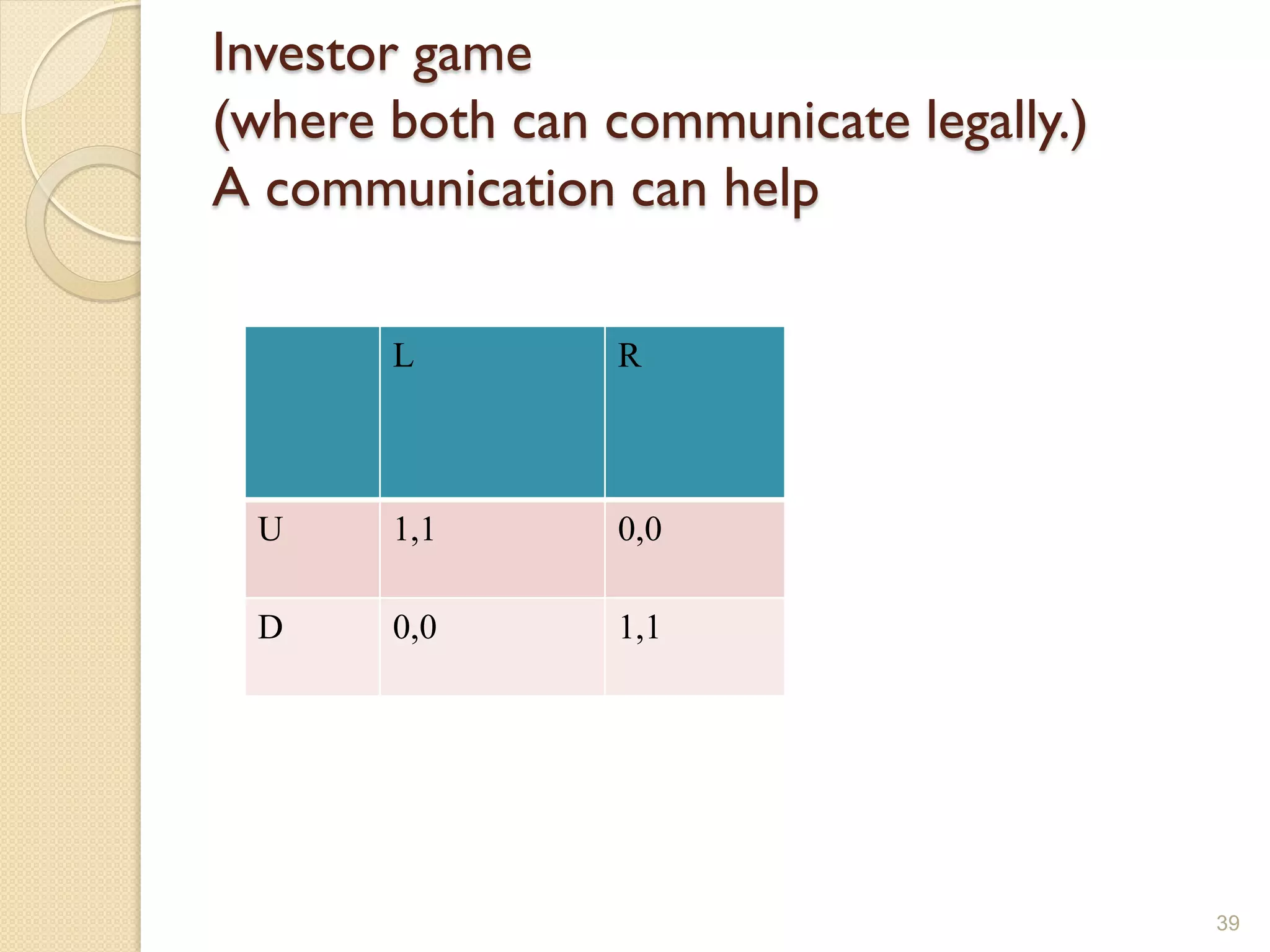
Investor game
(where both can communicate legally.)
A communication can help

       L         R


 U     1,1       0,0

 D     0,0       1,1


                                        39
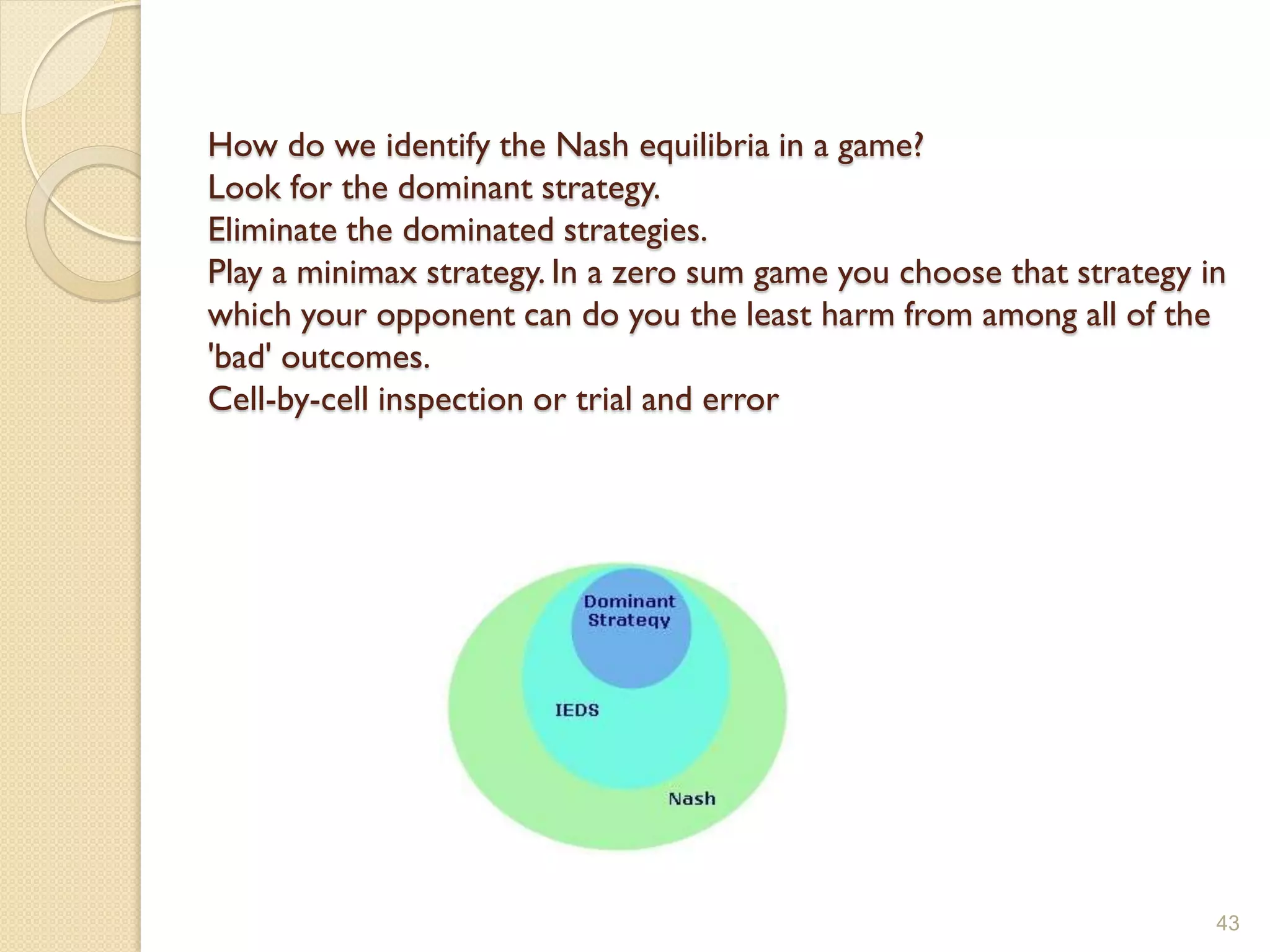
So far we have used the dominant strategy solution and iterative
elimination of dominated strategy (IEDS) solution concepts to solve
strategic form games. A third approach is to use the Nash equilibrium
concept.


                                                                        40
Nash Equilibrium- Necessary requirements
for a Nash equilibrium are that each player
play a best response against a conjecture,
and the conjecture must be correct.


                                              41
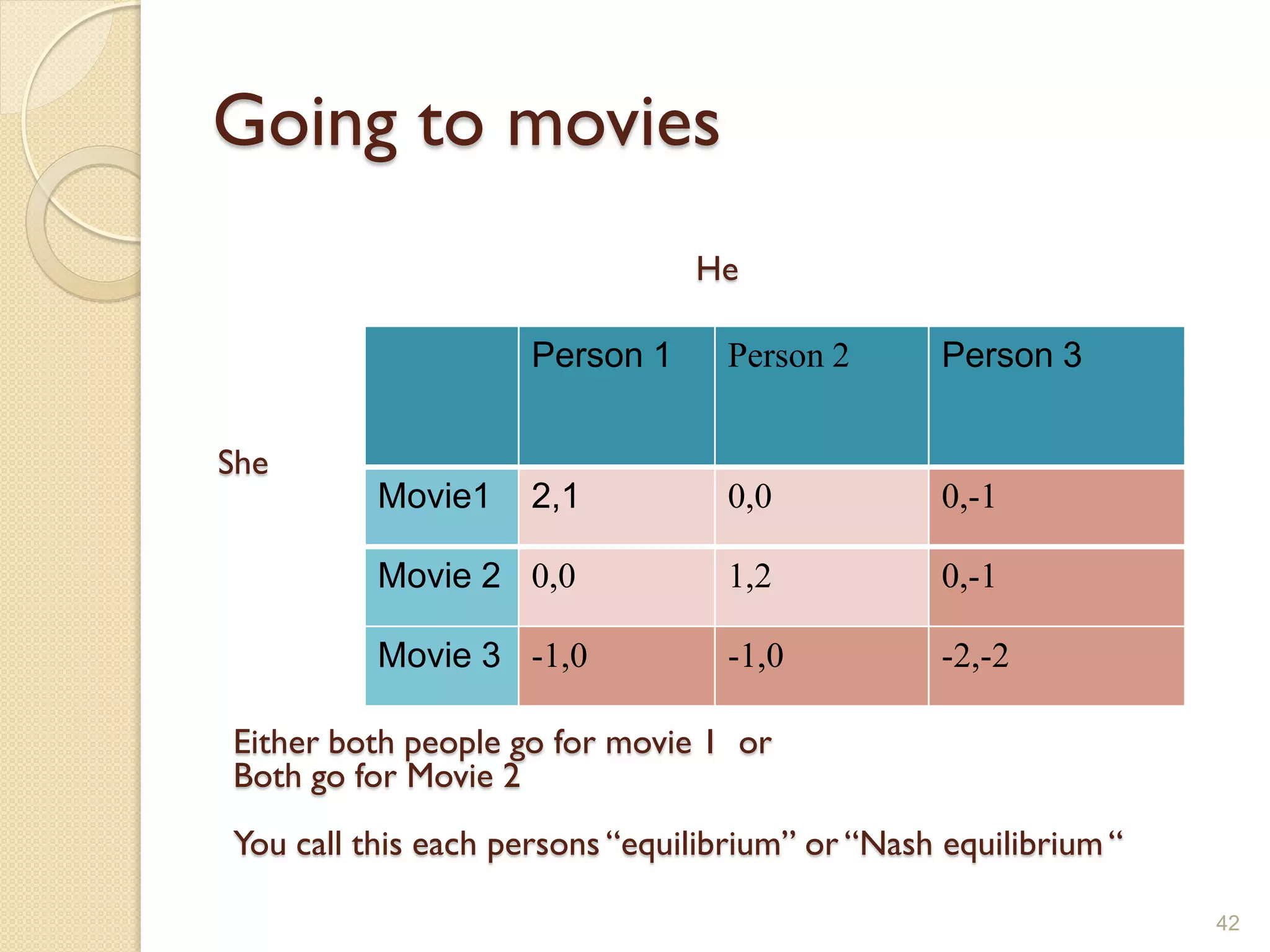
Going to movies
                                He

                     Person 1     Person 2        Person 3


She
          Movie1     2,1          0,0             0,-1

          Movie 2 0,0             1,2             0,-1

          Movie 3 -1,0            -1,0            -2,-2

Either both people go for movie 1 or
Both go for Movie 2
You call this each persons ―equilibrium‖ or ―Nash equilibrium ―

                                                                  42
How do we identify the Nash equilibria in a game?
Look for the dominant strategy.
Eliminate the dominated strategies.
Play a minimax strategy. In a zero sum game you choose that strategy in
which your opponent can do you the least harm from among all of the
'bad' outcomes.
Cell-by-cell inspection or trial and error


                                                                      43
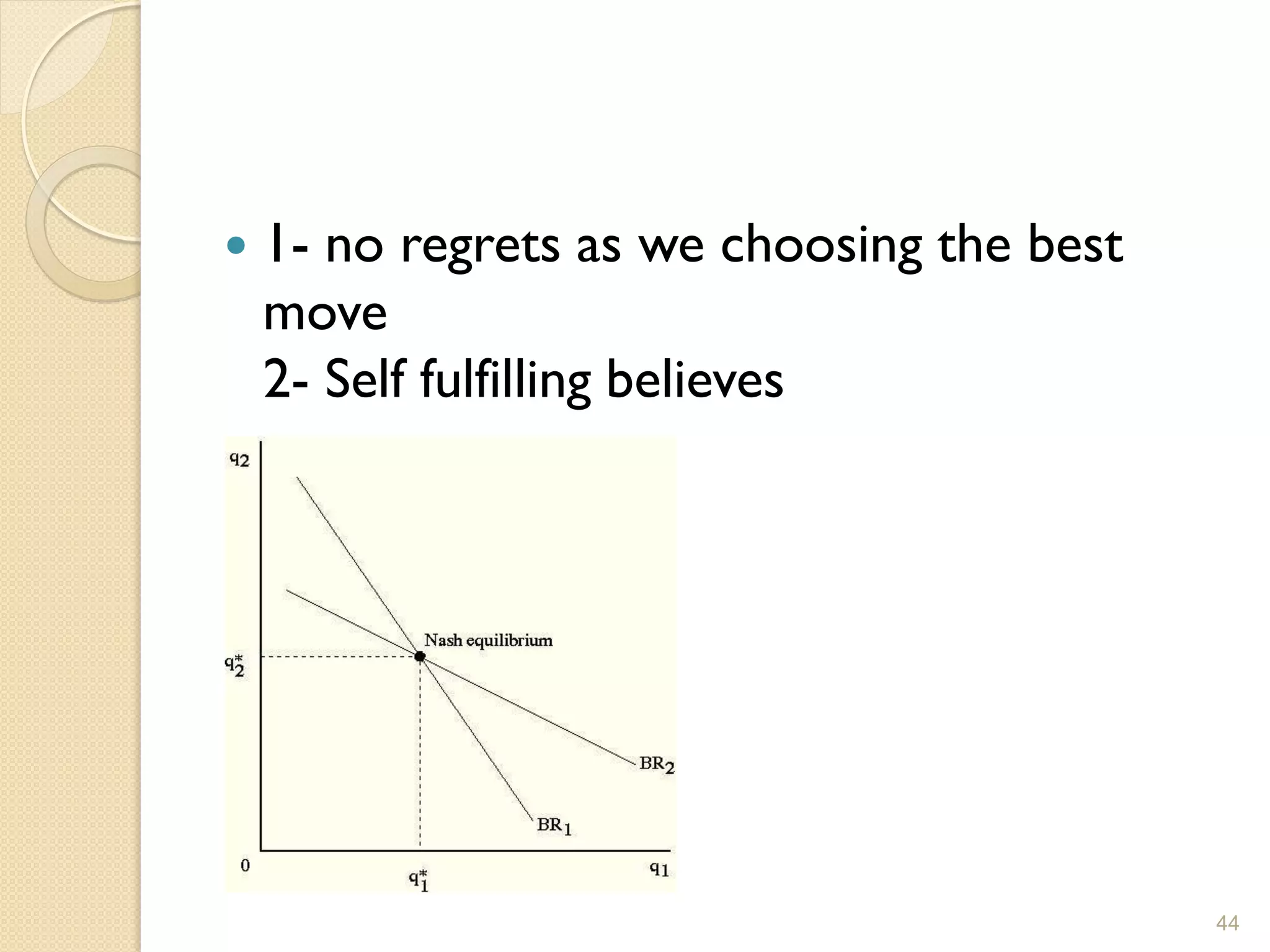
   1- no regrets as we choosing the best
    move
    2- Self fulfilling believes


                                            44
Coordination game –
1) Your farewell party
2) LED technology
3) Tv shows
4) Software platforms coordination


                                     45
   selfish routing in large networks like the Internet
   theoretical basis to the field of multi-agent systems.
   Use of NLP for optimizing results.


                                                             46
Diverse applications

1)Economics and business
2) Political science
  -game-theoretic models in which the players are often voters, states, special
   interest groups, and politicians.
3) Biology
 -Evolutionary game theory (EGT) is the application of game theory to
   evolving populations of lifeforms in biology.
4) Computer science and logic
-Algorithmic game theory and within it algorithmic mechanism design
   combine computational algorithm design and analysis of complex systems
   with economic theory.
5) Philosophy-common beliefs or knowledge
6) Legal problems and behavioral economics.


                                                                                  47

Game theory

  • 1.
  • 2.
    History  1928 – Game theory did not really exist as a unique field until John von Neumann & Morgenstern published a paper.  1950 - John Nash developed a criterion for mutual consistency of players' strategies, known as Nash equilibrium, applicable to a wider variety of games than the criterion proposed by von Neumann and Morgenstern.  1965 – Reinhard Selten introduced his solution concept of subgame perfect equilibria, which further refined the Nash equilibrium.  1970 – Game theory was extensively applied in biology, largely as a result of the work of John Maynard Smith and his evolutionarily stable strategy.  2007 – Leonid Hurwicz, together with Eric Maskin and Roger Myerson, was awarded the Nobel Prize in Economics "for having laid the foundations of mechanism design theory 2
  • 3.
    What's IT?? Game theoryis a method of studying strategic decision making. More formally, it is "the study of mathematical models of conflict and cooperation between intelligent rational decision-makers. Strategic- It is a setting where the outcomes that affect you depends on actions not just on your own actions but on actions of others. 3
  • 4.
    Why game theory??? Because the press tells us to … ―Managers have much to learn from game theory —provided they use it to clarify their thinking, not as a substitute for business experience.‖ The Economist, 15 June 2007 ―Game Theory, long an intellectual pastime, came into its own as a business tool.‖ Forbes, 3 July 2009 ―Game theory is hot.‖ The Wall Street Journal, 13 February 2011 Because recruiters tell us to … ―Game theory forces you to see a business situation over many periods from two perspectives: yours and your competitor’s.‖ Judy Lewent – CFO, Merck ―Game theory can explain why oligopolies tend to be unprofitable, the cycle of over capacity and overbuilding, and the tendency to execute real options earlier than optimal.‖ Tom Copeland – Director of Corporate Finance, McKinsey 4
  • 5.
    Terminology  Players  Strategies ◦ Choices available to each of the players  Might be conditioned on history  Payoffs ◦ Some numerical representation of the objectives of each player  Could take account fairness/reputation, etc.  Does not mean players are narrowly selfish 5
  • 6.
    Standard Assumptions  Rationality ◦ Players are perfect calculators and implementers of their desired strategy  Common knowledge of rules ◦ All players know the game being played  Equilibrium ◦ Players play strategies that are mutual best responses 6
  • 7.
    Strategies for StudyingGames of Strategy  Two general approaches ◦ Case-based  Pro: Relevance, connection of theory to application  Con: Generality ◦ Theory  Pro: General principle is clear  Con: Applying it may not be Types of firms : 1)Perfect competition 2)Monopolistic or Imperfect competition. ex- Motor car industry , mobile markets etcetera. 7
  • 8.
    Where It Exists? Aneasy strategy A complex strategy Asking your friend out for dinner? Geopolitical talks? 8
  • 9.
    Representation of Games  The games studied in game theory are well-defined mathematical objects. A game consists of a set of players, a set of moves (or strategies) available to those players, and a specification of payoffs for each combination of strategies.  Categories : Extensive form Normal form Characteristic function form Partition function form 9
  • 10.
    Extensive form  Games here are played on trees (as pictured to the left). Here each vertex (or node) represents a point of choice for a player. The player is specified by a number listed by the vertex. The lines out of the vertex represent a possible action for that player. The payoffs are specified at the bottom of the tree. 10
  • 11.
    Normal/Strategic Form  The normal (or strategic form) game is usually represented by a matrix which shows the players, strategies, and payoffs. More generally it can be represented by any function that associates a payoff for each player with every possible combination of actions. 11
  • 12.
    Types of Games Cooperative: A game is cooperative if the players are able to form binding commitments. For instance the legal system requires them to adhere to their promises. Often it is assumed that communication among players is allowed in cooperative games. Cooperative games focus on the game at large. Non-cooperative : In game theory, a non-cooperative game is one in which players make decisions independently. Non-Cooperative games are able to model situations to the finest details, producing accurate results. Hybrid games : contain cooperative and non-cooperative elements. 12
  • 13.
    Symmetric : A symmetric game is a game where the payoffs for playing a particular strategy depend only on the other strategies employed, not on who is playing them. Prisoner's dilemma, and the stag hunt are all symmetric games. Asymmetric : Most commonly studied asymmetric games are games where there are not identical strategy sets for both players. Zero-sum games : In zero-sum games the total benefit to all players in the game, for every combination of strategies, always adds to zero (more informally, a player benefits only at the equal expense of others). Non Zero-sum games : These type of games have outcomes whose net results are greater or less than zero 13
  • 14.
    Simultaneous games : Are games where both players move simultaneously, or if they do not move simultaneously, the later players are unaware of the earlier players' actions (making them effectively simultaneous). Sequential games (or dynamic games) : They are games where later players have some knowledge about earlier actions. This need not be perfect information about every action of earlier players; it might be very little knowledge. For instance, a player may know that an earlier player did not perform one particular action. Perfect information and Imperfect information : A game is one of perfect information if all players know the moves previously made by all other players. Thus, only sequential games can be games of perfect information, since in simultaneous games not every player knows the actions of the others. Many card games are games of imperfect information, for instance poker. 14
  • 15.
    Combinatorial games : Games in which the difficulty of finding an optimal strategy stems from the multiplicity of possible moves are called combinatorial games. Examples include chess and go. Games that involve imperfect or incomplete information may also have a strong combinatorial character. A related field of study, drawing from computational complexity theory, is game complexity, which is concerned with estimating the computational difficulty of finding optimal strategies.  Discrete and continuous games : Continuous games includes changing strategy set. Much of game theory is concerned with finite, discrete games, that have a finite number of players, moves, events, outcomes, etc. 15
  • 16.
    Infinitely long games : Pure mathematicians are not so constrained, and set theorists in particular study games that last for infinitely many moves, with the winner (or other payoff) not known until after all those moves are completed. The focus of attention is usually not so much on what is the best way to play such a game, but simply on whether one or the other player has a winning strategy.  Meta-games : These are games the play of which is the development of the rules for another game, the target or subject game. Metagames seek to maximize the utility value of the rule set developed. 16
  • 17.
    Lesson 1  Dominance Principle : Do Not Play A Strictly Dominated Strategy. Player 2 α β α 0,0 3,-1 Player 1 β -1,3 1,1 We say that my strategy α strictly dominates my strategy β if my payoff from α is strictly greater than that from β regardless of what others do. Here playing strategy β is a strictly dominated strategy. 17
  • 18.
    GAME 1 Put inthe box below either the letter α (alpha) or β (beta) .Think of this as a great bid. I will randomly pair your form with another form and neither your pair or you would know with whom you were paired. Here is how grades maybe assigned :- you pair α, β – A,C α, α – B minus , B minus β, α – C , A β, β –B plus , B plus 18
  • 19.
    α, β –A, C α, α – B minus , B minus β, α – C , A β, β –B plus , B plus MY PAIR ME (X`) (X) α β α β MY ME α B A PAIR α C (X) minus B (X`) minus β C B plus β A B plus 19
  • 20.
    MY PAIR (X`) α β Me (X) α B minus , A, B minus C β C, B plus , A B plus Outcome matrix We cared about our own grade 1) 2) We cared about other grades } 2 Different payoffs 20
  • 21.
    MY PAIR (X`) α β If the pair chooses alpha and I choose alpha then I get zero and if player ME chooses alpha and I (X) α 0,0 3, -1 choose beta I get -1. 0 > -1 β -1, 3 1,1 If the player chooses beta and I We try to put numbers into perspective and these are called choose alpha I get 3 and if player # utilities chooses beta and I just represent that we optimise our own gain and others loss. choose beta I get 1 (A,C) – 3 3>1 (B minus , B minus )- 0 Hence in both cases she receives a higher payoff if she chooses alpha.
  • 22.
    MY PAIR (X`) α β ME (X) α 0,0 -1, -3 β -3,-1 1,1 Replacing (A,C) = -1,(C,A) = -3 22
  • 23.
    Penalty kick game Goal keeper l r Shooter L 4,-4 9,-9 M 6,-6 6,-6 R 9,-9 4,-4 23
  • 24.
    FINALS OF UEFA2008 MAN Vs CHELSEA It seemed that Chelsea’s strategy of going to Van der Sar’s left had been hatched by someone on the Utd bench. As Anelka prepared to take Chelsea’s 7th penalty Van der Sar pointed to the left corner. Now Anelka had a terrible dilemma. This was game theory in its rawest form. So Anelka knew that Van der Sar knew that Anelka knew that Van der Sar tended to dive right against right footers. Instead Anelka kicked right but it was at mid-height which Ignacio warned against. 24
  • 25.
    Lesson 2  Put yourself in others shoes and try to figure out what they will do. Destroyer Easy Hard Easy 1,1 1,1 Savior Hard 0,2 2,0  Here savior should look upon the destroyers payoff before making a move. 25
  • 26.
    Prisoners Dilemma  Two Prisoners are on trial for a crime and each one faces a choice of confessing to the crime or remaining silent. The payoffs are given below: Prisoner 2 Confess Silent Confess 4,4 1,5 Prisoner 1 Silent 5,1 2,2 26
  • 27.
    Solution to PrisonersDilemma Prisoner 2 Confess Silent Confess 4,4 1,5 Prisoner 1 Silent 5,1 2,2  The only stable solution in this game is that both prisoners confess; in each of the other 3 cases, at least one of the players can switch from ―silent‖ to ―confess‖ and improve his payoff. 27
  • 28.
    Odds to PrisonersDilemma  What would the Prisoner 1 and Prisoner 2 decide if they could negotiate?  They could both become better off if they reached the cooperative solution…. which is why police interrogate suspects in separate rooms.  Equilibrium need not be efficient. Non-cooperative equilibrium in the Prisoner’s dilemma results in a solution that is not the best possible outcome for the parties.  Alternative: Implied contract if there were a long relationship between the parties— (partners in crime) are more likely to back each other 28
  • 29.
    CPU Competition  Inteland AMD compete fiercely to develop innovations in CPUs for PCs  As a result of this, CPU speeds have increased dramatically, but there are few differences between the products of the two companies  Even though both companies expended huge amounts of money to gain a competitive advantage, their relative competitive position ends up unchanged.  Both companies are worse off than if they had each slackened the pace of innovation  This is an example of a prisoner’s dilemma 29
  • 30.
    Sale Price Guarantees  Globus and many other stores like Pantaloons offer sale price guarantees ◦ If an item comes on sale in the time period after you bought it, they will match the difference in prices ◦ Thus, consumers wishing to buy now are ―protected‖ against regrets from future price reductions 30
  • 31.
    Walking Down theDemand Curve  Globus would like to sell goods at high prices to those with high willingness to pay for them and then lower prices to capture those with lower willingness to pay.  They might do this by running sales after new items have been out for a while  But high value consumers will anticipate this and wait for the sale to occur. 31
  • 32.
    The Power ofCommitment  By offering to rebate back the difference in prices, Globus makes the sale strategy less profitable for its ―future‖ self.  This commits it to less discounting in the future  In fact It enables it to charge higher prices today…and tomorrow. 32
  • 33.
    Coordination Game  Coordination game involves multiple outcomes that can be stable. A simple Coordination game involves two players choosing between two options, wanting to choose the same.  Battle of the Sexes : 33
  • 34.
    Solution to BattleOf the Sexes  Solution: Both should play the same game.  Everyone benefits from being in cooperative group, but each can do better by exploiting cooperative efforts of others. 34
  • 35.
    Anti Coordination Game  Routing Congestion Game :  Solution: The players must coordinate to send traffic on different connection points. 35
  • 36.
    Rules of theGame  The strategic environment ◦ Players – I , j ◦ Strategies- S(i) – strategy of player I ◦ S(i) – set of possible strategies of player I ◦ S – strategy profile ◦ Payoffs- µ (i) ◦ µi (s) – profile utilities 36
  • 37.
     The rules ◦ Timing of moves ◦ Nature of conflict and interaction ◦ Informational conditions ◦ Enforceability of agreements or contracts  The assumptions ◦ Rationality ◦ Common knowledge 37
  • 38.
    Prisoner's Dilemma (communicationis not legal) communication wont help 38
  • 39.
    Investor game (where bothcan communicate legally.) A communication can help L R U 1,1 0,0 D 0,0 1,1 39
  • 40.
    So far wehave used the dominant strategy solution and iterative elimination of dominated strategy (IEDS) solution concepts to solve strategic form games. A third approach is to use the Nash equilibrium concept. 40
  • 41.
    Nash Equilibrium- Necessaryrequirements for a Nash equilibrium are that each player play a best response against a conjecture, and the conjecture must be correct. 41
  • 42.
    Going to movies He Person 1 Person 2 Person 3 She Movie1 2,1 0,0 0,-1 Movie 2 0,0 1,2 0,-1 Movie 3 -1,0 -1,0 -2,-2 Either both people go for movie 1 or Both go for Movie 2 You call this each persons ―equilibrium‖ or ―Nash equilibrium ― 42
  • 43.
    How do weidentify the Nash equilibria in a game? Look for the dominant strategy. Eliminate the dominated strategies. Play a minimax strategy. In a zero sum game you choose that strategy in which your opponent can do you the least harm from among all of the 'bad' outcomes. Cell-by-cell inspection or trial and error 43
  • 44.
    1- no regrets as we choosing the best move 2- Self fulfilling believes 44
  • 45.
    Coordination game – 1)Your farewell party 2) LED technology 3) Tv shows 4) Software platforms coordination 45
  • 46.
    selfish routing in large networks like the Internet  theoretical basis to the field of multi-agent systems.  Use of NLP for optimizing results. 46
  • 47.
    Diverse applications 1)Economics andbusiness 2) Political science -game-theoretic models in which the players are often voters, states, special interest groups, and politicians. 3) Biology -Evolutionary game theory (EGT) is the application of game theory to evolving populations of lifeforms in biology. 4) Computer science and logic -Algorithmic game theory and within it algorithmic mechanism design combine computational algorithm design and analysis of complex systems with economic theory. 5) Philosophy-common beliefs or knowledge 6) Legal problems and behavioral economics. 47