A Commitment to Freedom
• The listing of the general rights of the people can be found in the first ten
amendments in the Constitution, also known as the Bill of Rights.
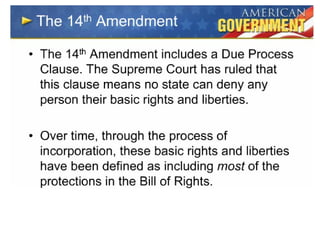
• The 13th and 14th amendments have also added to the Constitution’s
guarantees of personal freedom.
In general, civil liberties are
protections against government.
They are guarantees of the safety of
persons, opinions, and property
from arbitrary acts of government.
The term civil rights is
sometimes reserved for those
positive acts of government
that seek to make
constitutional guarantees a
reality for all people.
Limited Government
Throughout the Constitution, the extent of governmental authority is strictly limited.
The rights that the Constitution guarantees to citizens are also limited.
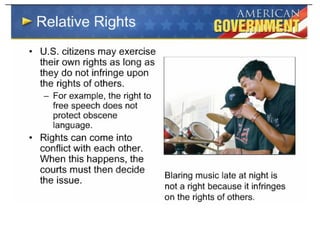
People in the United States are free to do as they please as long as they do not infringe upon the rights of others. Rights are relative.
Sometimes, different rights conflict with one another, such as the freedom of the press and the right to a fair trial.
Not all rights are guaranteed to aliens, who are foreign-born residents or non-citizens. For instance, their right to travel is often restricted.
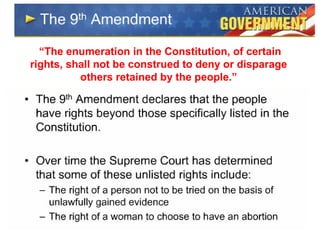
“The enumeration in the Constitution, of certain
rights, shall not be construed to deny or disparage
others retained by the people.”
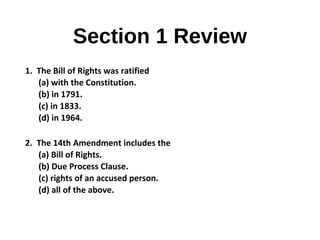
Section 1 Review
1. The Bill of Rights was ratified
(a) with the Constitution.
(b) in 1791.
(c) in 1833.
(d) in 1964.
2. The 14th Amendment includes the
(a) Bill of Rights.
(b) Due Process Clause.
(c) rights of an accused person.
(d) all of the above.
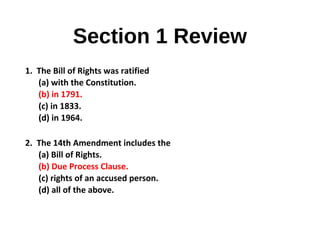
Section 1 Review
1. The Bill of Rights was ratified
(a) with the Constitution.
(b) in 1791.
(c) in 1833.
(d) in 1964.
2. The 14th Amendment includes the
(a) Bill of Rights.
(b) Due Process Clause.
(c) rights of an accused person.
(d) all of the above.
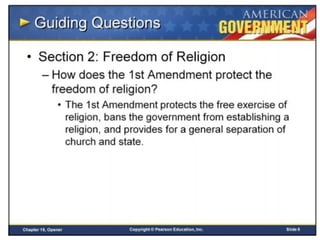
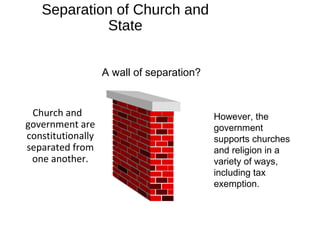
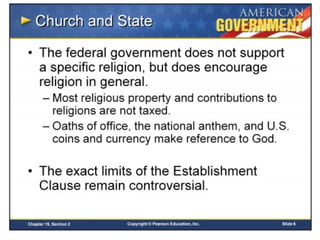
Separation of Church and
State
Church and
government are
constitutionally
separated from
one another.
However, the
government
supports churches
and religion in a
variety of ways,
including tax
exemption.
A wall of separation?
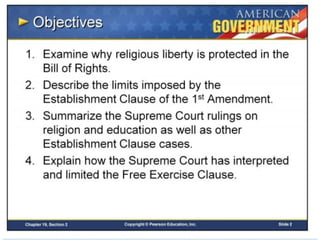
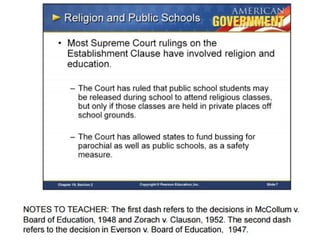
Religion and Education
The Supreme Court has had to consider
many Establishment Clause cases that
involve religion and education.
Released Time—students can be released during school hours to
attend religious classes, as long as the classes do not take place in a
public facility
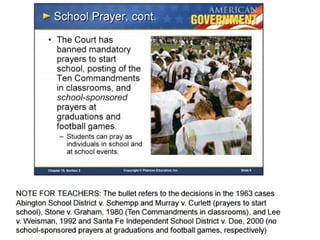
Prayers and the Bible—the use of prayer and the Bible in a religious
way is not allowed in school or at school functions
Student Religious Groups—are allowed to meet in the school on
the same basis as other student organizations
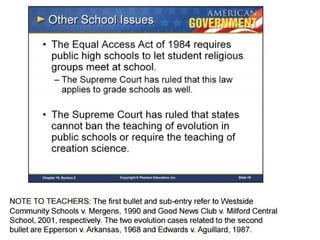
Evolution—a doctrine can not be preferred or prohibited according to its
relation to a religious theory
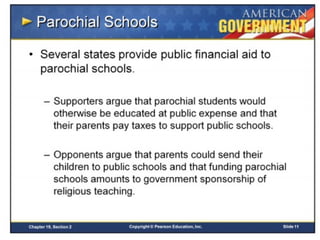
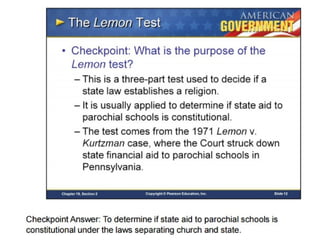
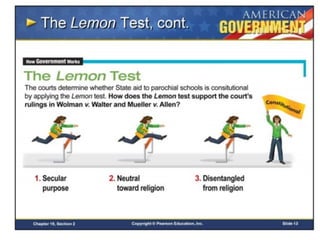
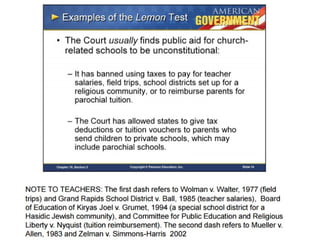
Aid to Parochial Schools—the Supreme Court uses the Lemon test
to determine what public funding of church-related schools is acceptable
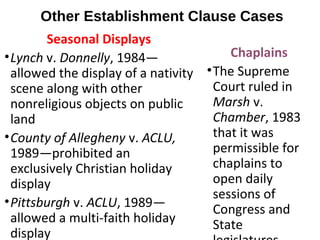
Other Establishment Clause Cases
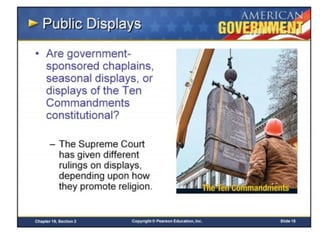
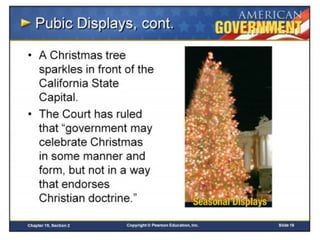
Seasonal Displays
•Lynch v. Donnelly, 1984—
allowed the display of a nativity
scene along with other
nonreligious objects on public
land
•County of Allegheny v. ACLU,
1989—prohibited an
exclusively Christian holiday
display
•Pittsburgh v. ACLU, 1989—
allowed a multi-faith holiday
display
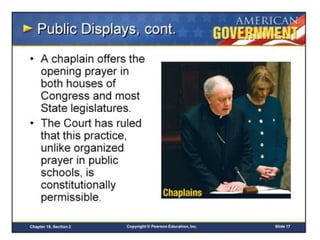
Chaplains
•The Supreme
Court ruled in
Marsh v.
Chamber, 1983
that it was
permissible for
chaplains to
open daily
sessions of
Congress and
State
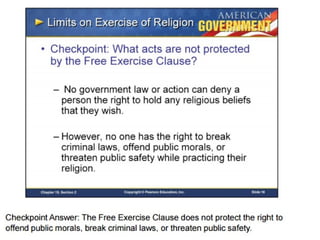
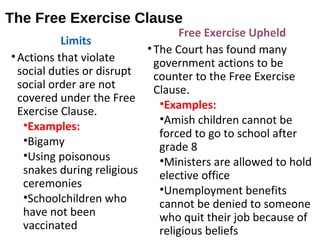
The Free Exercise Clause
Limits
•Actions that violate
social duties or disrupt
social order are not
covered under the Free
Exercise Clause.
•Examples:
•Bigamy
•Using poisonous
snakes during religious
ceremonies
•Schoolchildren who
have not been
vaccinated
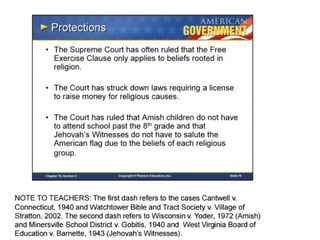
Free Exercise Upheld
•The Court has found many
government actions to be
counter to the Free Exercise
Clause.
•Examples:
•Amish children cannot be
forced to go to school after
grade 8
•Ministers are allowed to hold
elective office
•Unemployment benefits
cannot be denied to someone
who quit their job because of
religious beliefs
Section 2 Review
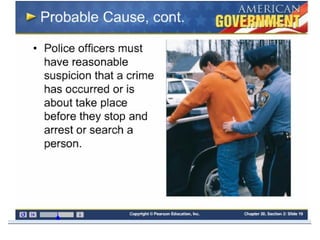
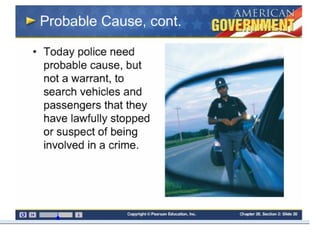
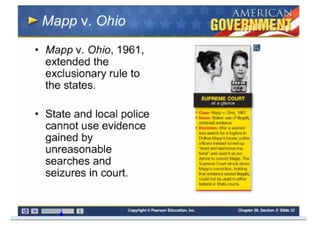
1. The Establishment Clause and the Free Exercise Clause
protect
(a) freedom of petition.
(b) freedom of assembly.
(c) freedom of religion.
(d) all of the above.
2. The Lemon Test evaluates
(a) if a car has manufacturer’s defects.
(b) what aid is appropriate to give parochial schools.
(c) when it is appropriate to salute the flag.
(d) all of the above.
Section 2 Review
1. The Establishment Clause and the Free Exercise Clause
protect
(a) freedom of petition.
(b) freedom of assembly.
(c) freedom of religion.
(d) all of the above.
2. The Lemon Test evaluates
(a) if a car has manufacturer’s defects.
(b) what aid is appropriate to give parochial schools.
(c) when it is appropriate to salute the flag.
(d) all of the above.
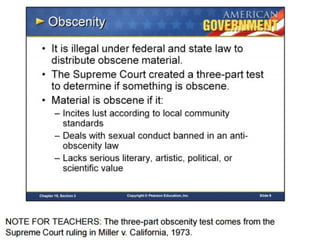
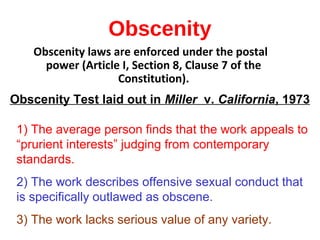
Obscenity
Obscenity laws are enforced under the postal
power (Article I, Section 8, Clause 7 of the
Constitution).
Obscenity Test laid out in Miller v. California, 1973
1) The average person finds that the work appeals to
“prurient interests” judging from contemporary
standards.
2) The work describes offensive sexual conduct that
is specifically outlawed as obscene.
3) The work lacks serious value of any variety.
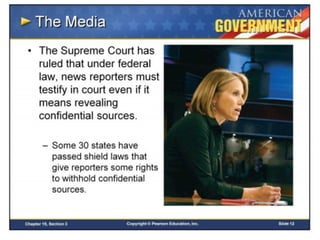
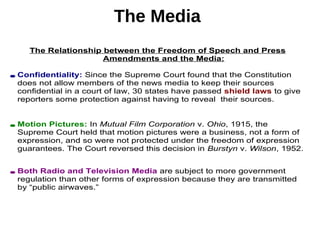
The Media
The Relationship between the Freedom of Speech and Press
Amendments and the Media:
• Confidentiality: Since the Supreme Court found that the Constitution
does not allow members of the news media to keep their sources
confidential in a court of law, 30 states have passed shield laws to give
reporters some protection against having to reveal their sources.
• Motion Pictures: In Mutual Film Corporation v. Ohio, 1915, the
Supreme Court held that motion pictures were a business, not a form of
expression, and so were not protected under the freedom of expression
guarantees. The Court reversed this decision in Burstyn v. Wilson, 1952.
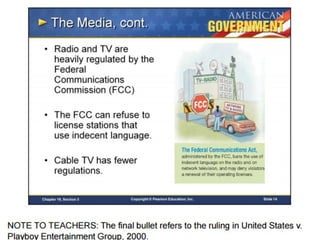
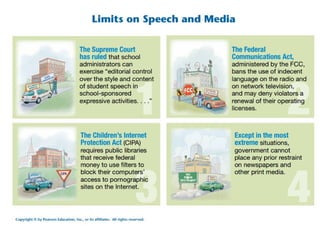
• Both Radio and Television Media are subject to more government
regulation than other forms of expression because they are transmitted
by “public airwaves.”
Copyright © by Pearson Education, Inc., or its affiliates. All rights reserved
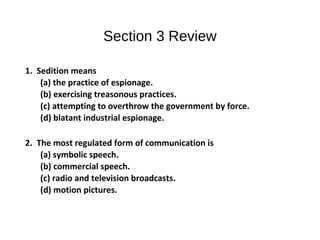
Section 3 Review
1. Sedition means
(a) the practice of espionage.
(b) exercising treasonous practices.
(c) attempting to overthrow the government by force.
(d) blatant industrial espionage.
2. The most regulated form of communication is
(a) symbolic speech.
(b) commercial speech.
(c) radio and television broadcasts.
(d) motion pictures.
Section 3 Review
1. Sedition means
(a) the practice of espionage.
(b) exercising treasonous practices.
(c) attempting to overthrow the government by force.
(d) blatant industrial espionage.
2. The most regulated form of communication is
(a) symbolic speech.
(b) commercial speech.
(c) radio and television broadcasts.
(d) motion pictures.
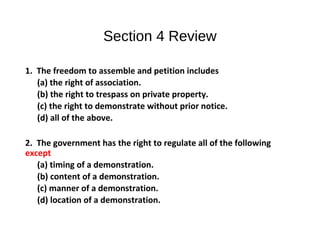
Section 4 Review
1. The freedom to assemble and petition includes
(a) the right of association.
(b) the right to trespass on private property.
(c) the right to demonstrate without prior notice.
(d) all of the above.
2. The government has the right to regulate all of the following
except
(a) timing of a demonstration.
(b) content of a demonstration.
(c) manner of a demonstration.
(d) location of a demonstration.
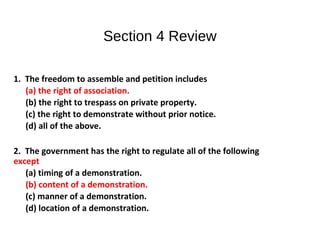
Section 4 Review
1. The freedom to assemble and petition includes
(a) the right of association.
(b) the right to trespass on private property.
(c) the right to demonstrate without prior notice.
(d) all of the above.
2. The government has the right to regulate all of the following
except
(a) timing of a demonstration.
(b) content of a demonstration.
(c) manner of a demonstration.
(d) location of a demonstration.
Chapter 20: Civil Liberties: Protecting
Individual Rights
Opener
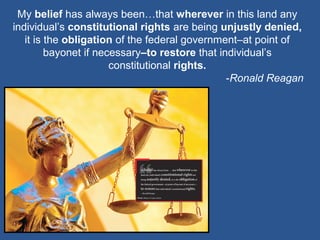
My belief has always been…that wherever in this land any
individual’s constitutional rights are being unjustly denied,
it is the obligation of the federal government–at point of
bayonet if necessary–to restore that individual’s
constitutional rights.
-Ronald Reagan
Copyright © Pearson Education, Inc. Slide 97Chapter 20, Opener
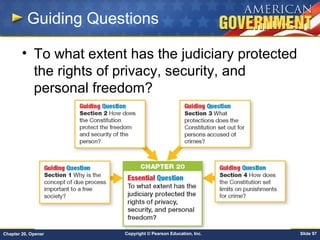
Guiding Questions
• To what extent has the judiciary protected
the rights of privacy, security, and
personal freedom?
Copyright © Pearson Education, Inc. Slide 98Chapter 20, Opener
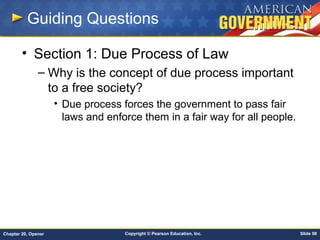
Guiding Questions
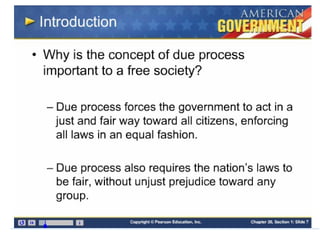
• Section 1: Due Process of Law
– Why is the concept of due process important
to a free society?
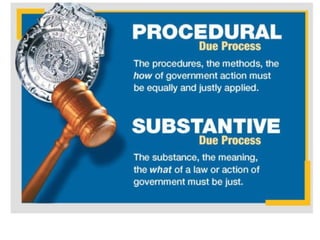
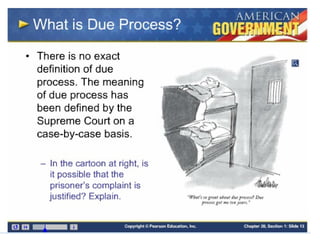
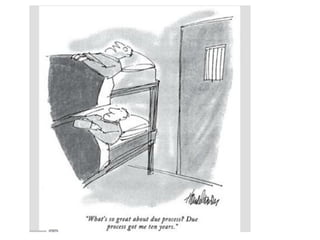
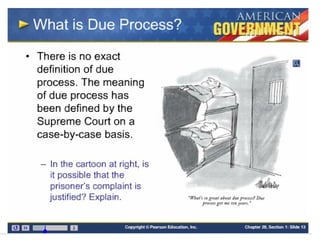
• Due process forces the government to pass fair
laws and enforce them in a fair way for all people.
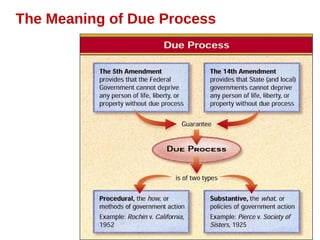
The Meaning of Due Process
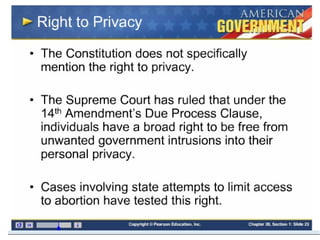
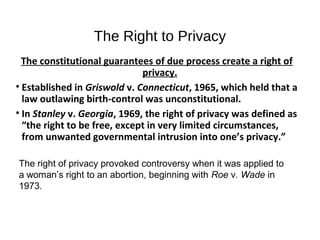
The Right to Privacy
The constitutional guarantees of due process create a right of
privacy.
• Established in Griswold v. Connecticut, 1965, which held that a
law outlawing birth-control was unconstitutional.
• In Stanley v. Georgia, 1969, the right of privacy was defined as
“the right to be free, except in very limited circumstances,
from unwanted governmental intrusion into one’s privacy.”
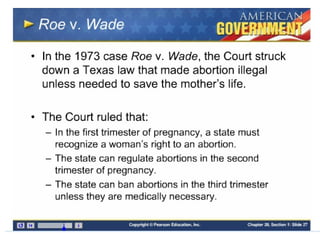
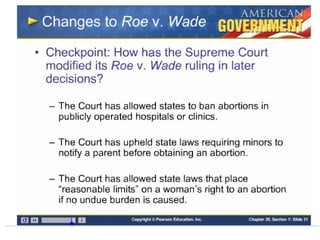
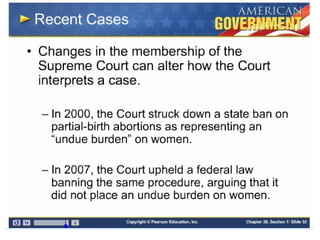
The right of privacy provoked controversy when it was applied to
a woman’s right to an abortion, beginning with Roe v. Wade in
1973.
Copyright © Pearson Education, Inc. Slide 125Chapter 20, Opener
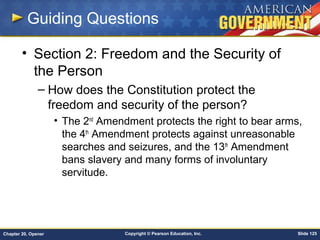
Guiding Questions
• Section 2: Freedom and the Security of
the Person
– How does the Constitution protect the
freedom and security of the person?
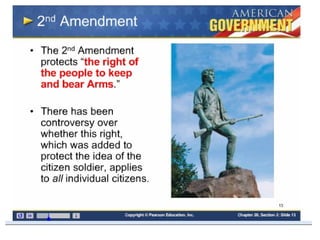
• The 2nd
Amendment protects the right to bear arms,
the 4th
Amendment protects against unreasonable
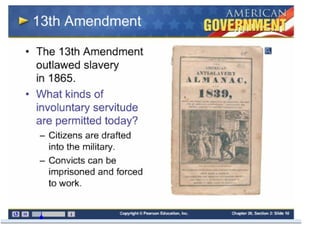
searches and seizures, and the 13th
Amendment
bans slavery and many forms of involuntary
servitude.
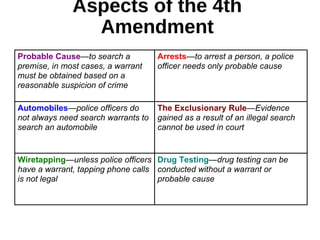
Aspects of the 4th
Amendment
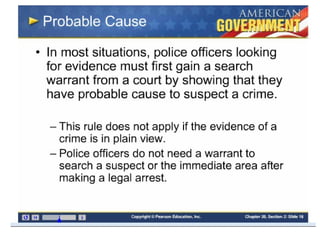
Probable Cause—to search a
premise, in most cases, a warrant
must be obtained based on a
reasonable suspicion of crime
Arrests—to arrest a person, a police
officer needs only probable cause
Automobiles—police officers do
not always need search warrants to
search an automobile
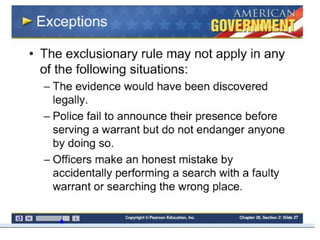
The Exclusionary Rule—Evidence
gained as a result of an illegal search
cannot be used in court
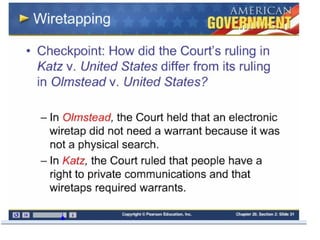
Wiretapping—unless police officers
have a warrant, tapping phone calls
is not legal
Drug Testing—drug testing can be
conducted without a warrant or
probable cause
Copyright © Pearson Education, Inc. Slide 142Chapter 20, Opener
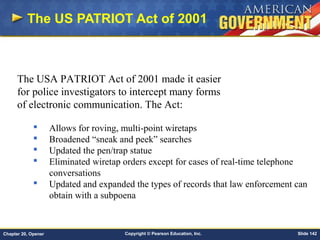
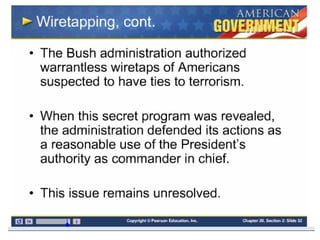
The US PATRIOT Act of 2001
The USA PATRIOT Act of 2001 made it easier
for police investigators to intercept many forms
of electronic communication. The Act:
 Allows for roving, multi-point wiretaps
 Broadened “sneak and peek” searches
 Updated the pen/trap statue
 Eliminated wiretap orders except for cases of real-time telephone
conversations
 Updated and expanded the types of records that law enforcement can
obtain with a subpoena
Copyright © Pearson Education, Inc. Slide 143Chapter 20, Opener
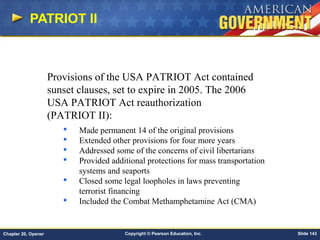
PATRIOT II
Provisions of the USA PATRIOT Act contained
sunset clauses, set to expire in 2005. The 2006
USA PATRIOT Act reauthorization
(PATRIOT II):
 Made permanent 14 of the original provisions
 Extended other provisions for four more years
 Addressed some of the concerns of civil libertarians
 Provided additional protections for mass transportation
systems and seaports
 Closed some legal loopholes in laws preventing
terrorist financing
 Included the Combat Methamphetamine Act (CMA)
Copyright © Pearson Education, Inc. Slide 148Chapter 20, Opener
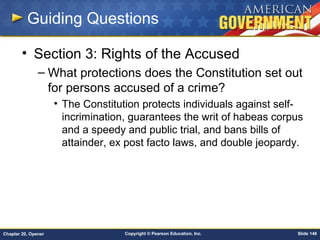
Guiding Questions
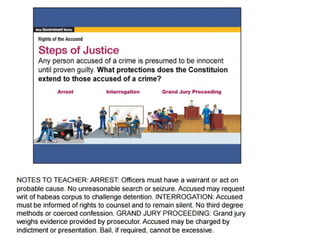
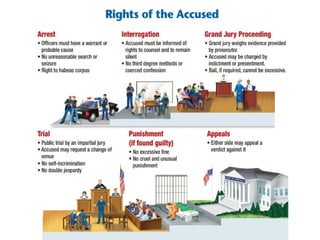
• Section 3: Rights of the Accused
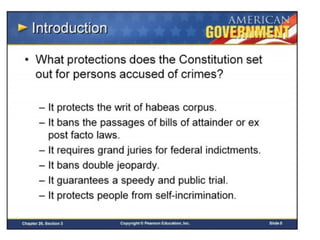
– What protections does the Constitution set out
for persons accused of a crime?
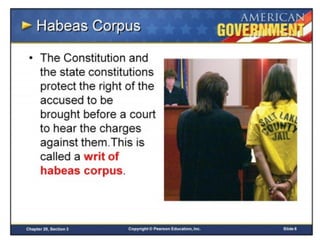
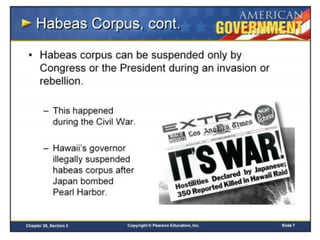
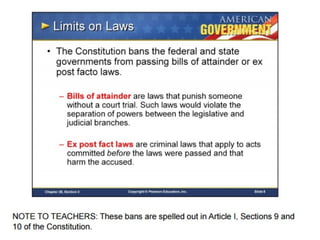
• The Constitution protects individuals against self-
incrimination, guarantees the writ of habeas corpus
and a speedy and public trial, and bans bills of
attainder, ex post facto laws, and double jeopardy.
Copyright © Pearson Education, Inc. Slide 171Chapter 20, Opener
Guiding Questions
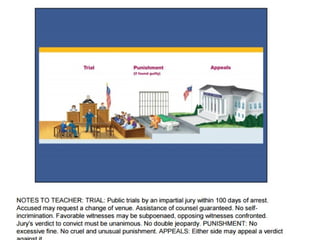
• Section 4: Punishment
– How does the Constitution set limits on
punishments for crime?
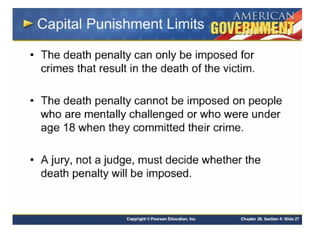
• The Constitution bans excessive bail and cruel and
unusual punishment.
Ch19 & 20 Am Gov
Ch19 & 20 Am Gov
Ch19 & 20 Am Gov
Ch19 & 20 Am Gov
Ch19 & 20 Am Gov
Ch19 & 20 Am Gov
Ch19 & 20 Am Gov
Ch19 & 20 Am Gov
Ch19 & 20 Am Gov
Ch19 & 20 Am Gov
Ch19 & 20 Am Gov
Ch19 & 20 Am Gov
Ch19 & 20 Am Gov
Ch19 & 20 Am Gov
Ch19 & 20 Am Gov
Ch19 & 20 Am Gov
Ch19 & 20 Am Gov
Ch19 & 20 Am Gov

Ch19 & 20 Am Gov

  • 13.
    A Commitment toFreedom • The listing of the general rights of the people can be found in the first ten amendments in the Constitution, also known as the Bill of Rights. • The 13th and 14th amendments have also added to the Constitution’s guarantees of personal freedom. In general, civil liberties are protections against government. They are guarantees of the safety of persons, opinions, and property from arbitrary acts of government. The term civil rights is sometimes reserved for those positive acts of government that seek to make constitutional guarantees a reality for all people.
  • 15.
    Limited Government Throughout theConstitution, the extent of governmental authority is strictly limited. The rights that the Constitution guarantees to citizens are also limited. People in the United States are free to do as they please as long as they do not infringe upon the rights of others. Rights are relative. Sometimes, different rights conflict with one another, such as the freedom of the press and the right to a fair trial. Not all rights are guaranteed to aliens, who are foreign-born residents or non-citizens. For instance, their right to travel is often restricted.
  • 21.
    “The enumeration inthe Constitution, of certain rights, shall not be construed to deny or disparage others retained by the people.”
  • 23.
    Section 1 Review 1.The Bill of Rights was ratified (a) with the Constitution. (b) in 1791. (c) in 1833. (d) in 1964. 2. The 14th Amendment includes the (a) Bill of Rights. (b) Due Process Clause. (c) rights of an accused person. (d) all of the above.
  • 24.
    Section 1 Review 1.The Bill of Rights was ratified (a) with the Constitution. (b) in 1791. (c) in 1833. (d) in 1964. 2. The 14th Amendment includes the (a) Bill of Rights. (b) Due Process Clause. (c) rights of an accused person. (d) all of the above.
  • 29.
    Separation of Churchand State Church and government are constitutionally separated from one another. However, the government supports churches and religion in a variety of ways, including tax exemption. A wall of separation?
  • 34.
    Religion and Education TheSupreme Court has had to consider many Establishment Clause cases that involve religion and education. Released Time—students can be released during school hours to attend religious classes, as long as the classes do not take place in a public facility Prayers and the Bible—the use of prayer and the Bible in a religious way is not allowed in school or at school functions Student Religious Groups—are allowed to meet in the school on the same basis as other student organizations Evolution—a doctrine can not be preferred or prohibited according to its relation to a religious theory Aid to Parochial Schools—the Supreme Court uses the Lemon test to determine what public funding of church-related schools is acceptable
  • 44.
    Other Establishment ClauseCases Seasonal Displays •Lynch v. Donnelly, 1984— allowed the display of a nativity scene along with other nonreligious objects on public land •County of Allegheny v. ACLU, 1989—prohibited an exclusively Christian holiday display •Pittsburgh v. ACLU, 1989— allowed a multi-faith holiday display Chaplains •The Supreme Court ruled in Marsh v. Chamber, 1983 that it was permissible for chaplains to open daily sessions of Congress and State
  • 47.
    The Free ExerciseClause Limits •Actions that violate social duties or disrupt social order are not covered under the Free Exercise Clause. •Examples: •Bigamy •Using poisonous snakes during religious ceremonies •Schoolchildren who have not been vaccinated Free Exercise Upheld •The Court has found many government actions to be counter to the Free Exercise Clause. •Examples: •Amish children cannot be forced to go to school after grade 8 •Ministers are allowed to hold elective office •Unemployment benefits cannot be denied to someone who quit their job because of religious beliefs
  • 49.
    Section 2 Review 1.The Establishment Clause and the Free Exercise Clause protect (a) freedom of petition. (b) freedom of assembly. (c) freedom of religion. (d) all of the above. 2. The Lemon Test evaluates (a) if a car has manufacturer’s defects. (b) what aid is appropriate to give parochial schools. (c) when it is appropriate to salute the flag. (d) all of the above.
  • 50.
    Section 2 Review 1.The Establishment Clause and the Free Exercise Clause protect (a) freedom of petition. (b) freedom of assembly. (c) freedom of religion. (d) all of the above. 2. The Lemon Test evaluates (a) if a car has manufacturer’s defects. (b) what aid is appropriate to give parochial schools. (c) when it is appropriate to salute the flag. (d) all of the above.
  • 60.
    Obscenity Obscenity laws areenforced under the postal power (Article I, Section 8, Clause 7 of the Constitution). Obscenity Test laid out in Miller v. California, 1973 1) The average person finds that the work appeals to “prurient interests” judging from contemporary standards. 2) The work describes offensive sexual conduct that is specifically outlawed as obscene. 3) The work lacks serious value of any variety.
  • 64.
    The Media The Relationshipbetween the Freedom of Speech and Press Amendments and the Media: • Confidentiality: Since the Supreme Court found that the Constitution does not allow members of the news media to keep their sources confidential in a court of law, 30 states have passed shield laws to give reporters some protection against having to reveal their sources. • Motion Pictures: In Mutual Film Corporation v. Ohio, 1915, the Supreme Court held that motion pictures were a business, not a form of expression, and so were not protected under the freedom of expression guarantees. The Court reversed this decision in Burstyn v. Wilson, 1952. • Both Radio and Television Media are subject to more government regulation than other forms of expression because they are transmitted by “public airwaves.”
  • 70.
    Copyright © byPearson Education, Inc., or its affiliates. All rights reserved
  • 71.
    Copyright © byPearson Education, Inc., or its affiliates. All rights reserved
  • 75.
    Section 3 Review 1.Sedition means (a) the practice of espionage. (b) exercising treasonous practices. (c) attempting to overthrow the government by force. (d) blatant industrial espionage. 2. The most regulated form of communication is (a) symbolic speech. (b) commercial speech. (c) radio and television broadcasts. (d) motion pictures.
  • 76.
    Section 3 Review 1.Sedition means (a) the practice of espionage. (b) exercising treasonous practices. (c) attempting to overthrow the government by force. (d) blatant industrial espionage. 2. The most regulated form of communication is (a) symbolic speech. (b) commercial speech. (c) radio and television broadcasts. (d) motion pictures.
  • 93.
    Section 4 Review 1.The freedom to assemble and petition includes (a) the right of association. (b) the right to trespass on private property. (c) the right to demonstrate without prior notice. (d) all of the above. 2. The government has the right to regulate all of the following except (a) timing of a demonstration. (b) content of a demonstration. (c) manner of a demonstration. (d) location of a demonstration.
  • 94.
    Section 4 Review 1.The freedom to assemble and petition includes (a) the right of association. (b) the right to trespass on private property. (c) the right to demonstrate without prior notice. (d) all of the above. 2. The government has the right to regulate all of the following except (a) timing of a demonstration. (b) content of a demonstration. (c) manner of a demonstration. (d) location of a demonstration.
  • 95.
    Chapter 20: CivilLiberties: Protecting Individual Rights Opener
  • 96.
    My belief hasalways been…that wherever in this land any individual’s constitutional rights are being unjustly denied, it is the obligation of the federal government–at point of bayonet if necessary–to restore that individual’s constitutional rights. -Ronald Reagan
  • 97.
    Copyright © PearsonEducation, Inc. Slide 97Chapter 20, Opener Guiding Questions • To what extent has the judiciary protected the rights of privacy, security, and personal freedom?
  • 98.
    Copyright © PearsonEducation, Inc. Slide 98Chapter 20, Opener Guiding Questions • Section 1: Due Process of Law – Why is the concept of due process important to a free society? • Due process forces the government to pass fair laws and enforce them in a fair way for all people.
  • 106.
    The Meaning ofDue Process
  • 119.
    The Right toPrivacy The constitutional guarantees of due process create a right of privacy. • Established in Griswold v. Connecticut, 1965, which held that a law outlawing birth-control was unconstitutional. • In Stanley v. Georgia, 1969, the right of privacy was defined as “the right to be free, except in very limited circumstances, from unwanted governmental intrusion into one’s privacy.” The right of privacy provoked controversy when it was applied to a woman’s right to an abortion, beginning with Roe v. Wade in 1973.
  • 125.
    Copyright © PearsonEducation, Inc. Slide 125Chapter 20, Opener Guiding Questions • Section 2: Freedom and the Security of the Person – How does the Constitution protect the freedom and security of the person? • The 2nd Amendment protects the right to bear arms, the 4th Amendment protects against unreasonable searches and seizures, and the 13th Amendment bans slavery and many forms of involuntary servitude.
  • 134.
    Aspects of the4th Amendment Probable Cause—to search a premise, in most cases, a warrant must be obtained based on a reasonable suspicion of crime Arrests—to arrest a person, a police officer needs only probable cause Automobiles—police officers do not always need search warrants to search an automobile The Exclusionary Rule—Evidence gained as a result of an illegal search cannot be used in court Wiretapping—unless police officers have a warrant, tapping phone calls is not legal Drug Testing—drug testing can be conducted without a warrant or probable cause
  • 142.
    Copyright © PearsonEducation, Inc. Slide 142Chapter 20, Opener The US PATRIOT Act of 2001 The USA PATRIOT Act of 2001 made it easier for police investigators to intercept many forms of electronic communication. The Act:  Allows for roving, multi-point wiretaps  Broadened “sneak and peek” searches  Updated the pen/trap statue  Eliminated wiretap orders except for cases of real-time telephone conversations  Updated and expanded the types of records that law enforcement can obtain with a subpoena
  • 143.
    Copyright © PearsonEducation, Inc. Slide 143Chapter 20, Opener PATRIOT II Provisions of the USA PATRIOT Act contained sunset clauses, set to expire in 2005. The 2006 USA PATRIOT Act reauthorization (PATRIOT II):  Made permanent 14 of the original provisions  Extended other provisions for four more years  Addressed some of the concerns of civil libertarians  Provided additional protections for mass transportation systems and seaports  Closed some legal loopholes in laws preventing terrorist financing  Included the Combat Methamphetamine Act (CMA)
  • 148.
    Copyright © PearsonEducation, Inc. Slide 148Chapter 20, Opener Guiding Questions • Section 3: Rights of the Accused – What protections does the Constitution set out for persons accused of a crime? • The Constitution protects individuals against self- incrimination, guarantees the writ of habeas corpus and a speedy and public trial, and bans bills of attainder, ex post facto laws, and double jeopardy.
  • 171.
    Copyright © PearsonEducation, Inc. Slide 171Chapter 20, Opener Guiding Questions • Section 4: Punishment – How does the Constitution set limits on punishments for crime? • The Constitution bans excessive bail and cruel and unusual punishment.