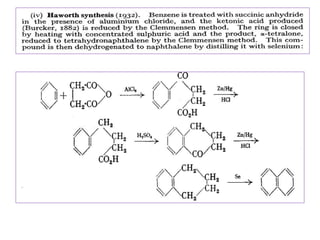
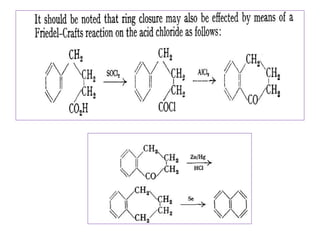
Polynuclear hydrocarbon
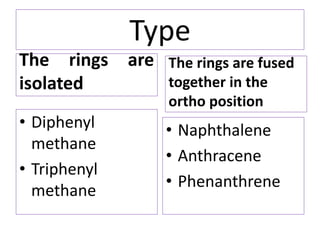
Type
The rings are
isolated
• Diphenyl
methane
• Triphenyl
methane
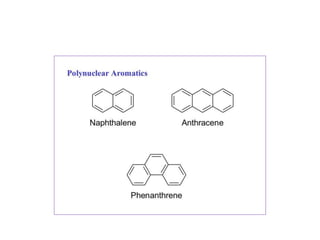
The rings are fused
together in the
ortho position
• Naphthalene
• Anthracene
• Phenanthrene
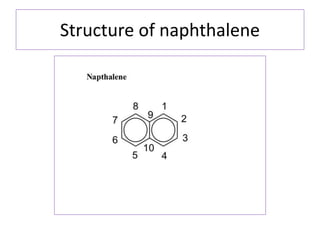
Structure of naphthalene
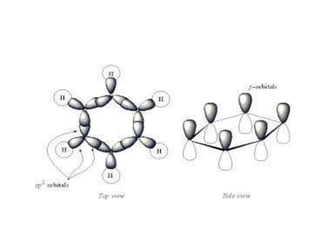
• All ten carbons are sp2 hybridized
• Overlap of Sp2 With s orbital's of 8 hydrogen
atom.
• All carbon and hydrogen lying in one plane.
• It is confirmed by X ray diffraction studies.
• It is aromatic satisfies the Huckle’s rule
• It is less aromatic than benzene.
Naphthalene
• It is the largest constituent of Coal tar
• It is obtained by cooling middle and Heavy oil
• The crude naphthalene is melted and treated
with sulphuric aicid to remove basic impurities.
• Washed with water.
• Treated with aqueous sodium hydroxide to
remove acidic impurities.
• Finally naphthalene is distilled to give pure
product.
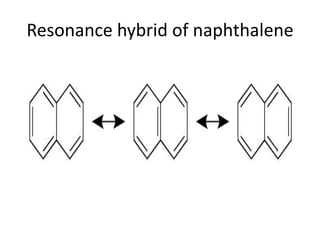
Resonance hybrid of naphthalene
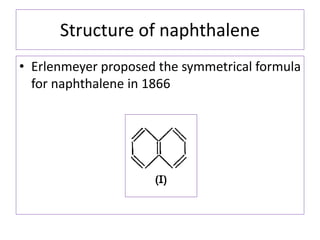
Structure of naphthalene
• Erlenmeyer proposed the symmetrical formula
for naphthalene in 1866
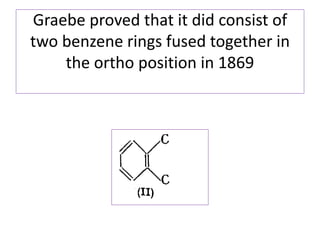
Graebe proved that it did consist of
two benzene rings fused together in
the ortho position in 1869
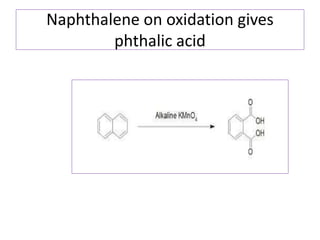
Naphthalene on oxidation gives
phthalic acid
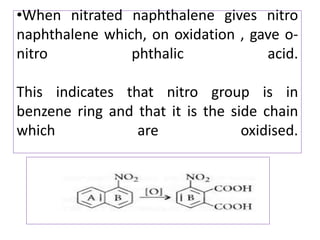
•When nitrated naphthalene gives nitro
naphthalene which, on oxidation , gave o-
nitro phthalic acid.
This indicates that nitro group is in
benzene ring and that it is the side chain
which are oxidised.
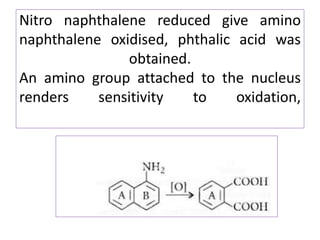
Nitro naphthalene reduced give amino
naphthalene oxidised, phthalic acid was
obtained.
An amino group attached to the nucleus
renders sensitivity to oxidation,
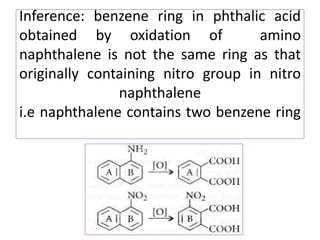
Inference: benzene ring in phthalic acid
obtained by oxidation of amino
naphthalene is not the same ring as that
originally containing nitro group in nitro
naphthalene
i.e naphthalene contains two benzene ring
Synthesis of Naphthalene
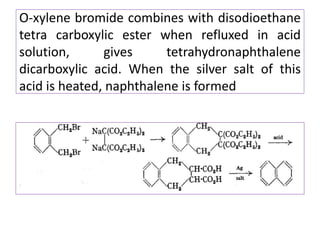
O-xylene bromide combines with disodioethane
tetra carboxylic ester when refluxed in acid
solution, gives tetrahydronaphthalene
dicarboxylic acid. When the silver salt of this
acid is heated, naphthalene is formed
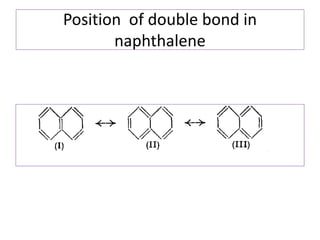
Position of double bond in
naphthalene
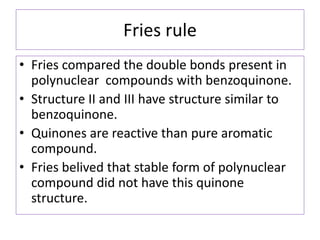
Fries rule
• Fries compared the double bonds present in
polynuclear compounds with benzoquinone.
• Structure II and III have structure similar to
benzoquinone.
• Quinones are reactive than pure aromatic
compound.
• Fries belived that stable form of polynuclear
compound did not have this quinone
structure.
Fries rule
• The most stable form of polynuclear aromatic
compound is that form which has maximum
number of benzenoid ring i.e three double
bonds in each individual ring.
• According to fries naphthalene has structure I
[ has two benzenoid ring] and not the
structure of II and III [ has one benzenoid ring]
Reaction of naphthalene
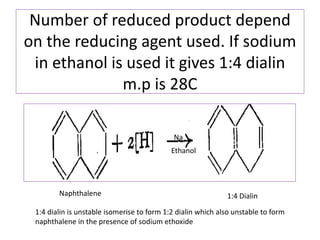
Number of reduced product depend
on the reducing agent used. If sodium
in ethanol is used it gives 1:4 dialin
m.p is 28C
Naphthalene
Na
Ethanol
1:4 Dialin
1:4 dialin is unstable isomerise to form 1:2 dialin which also unstable to form
naphthalene in the presence of sodium ethoxide
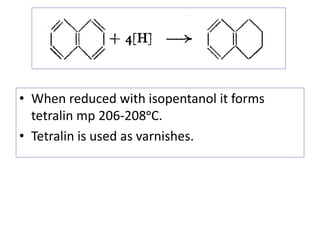
• When reduced with isopentanol it forms
tetralin mp 206-208ᵒC.
• Tetralin is used as varnishes.
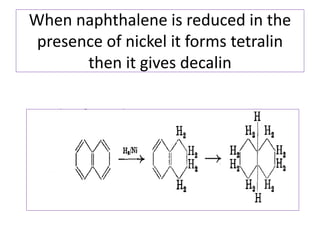
When naphthalene is reduced in the
presence of nickel it forms tetralin
then it gives decalin
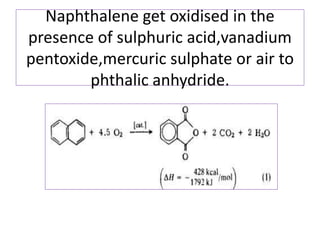
Naphthalene get oxidised in the
presence of sulphuric acid,vanadium
pentoxide,mercuric sulphate or air to
phthalic anhydride.
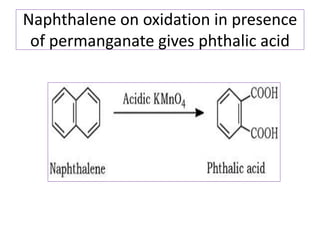
Naphthalene on oxidation in presence
of permanganate gives phthalic acid
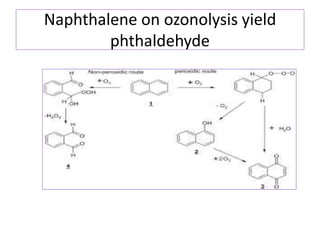
Naphthalene on ozonolysis yield
phthaldehyde
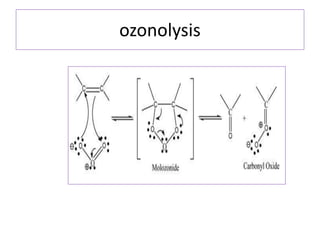
ozonolysis
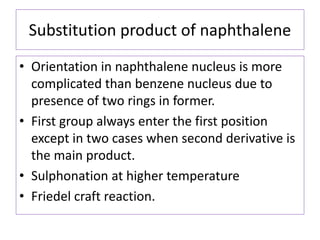
Substitution product of naphthalene
• Orientation in naphthalene nucleus is more
complicated than benzene nucleus due to
presence of two rings in former.
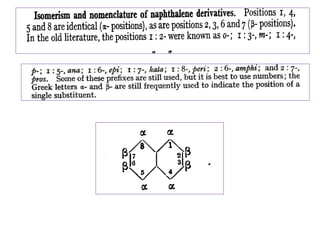
• First group always enter the first position
except in two cases when second derivative is
the main product.
• Sulphonation at higher temperature
• Friedel craft reaction.
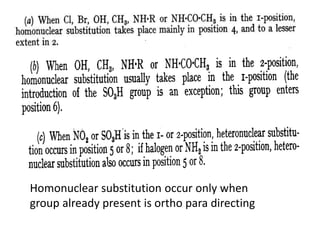
• Introduction of second substituent can give
rise to homonuclear substitution [ substitution
in the same ring] or heteronuclear
substitution [ second substitution in another
ring]
Homonuclear substitution occur only when
group already present is ortho para directing
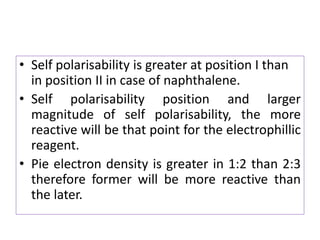
• Self polarisability is greater at position I than
in position II in case of naphthalene.
• Self polarisability position and larger
magnitude of self polarisability, the more
reactive will be that point for the electrophillic
reagent.
• Pie electron density is greater in 1:2 than 2:3
therefore former will be more reactive than
the later.
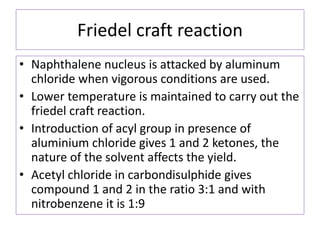
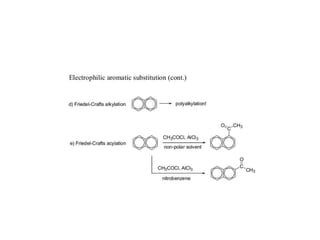
Friedel craft reaction
• Naphthalene nucleus is attacked by aluminum
chloride when vigorous conditions are used.
• Lower temperature is maintained to carry out the
friedel craft reaction.
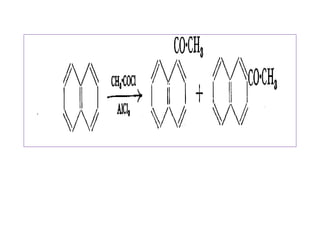
• Introduction of acyl group in presence of
aluminium chloride gives 1 and 2 ketones, the
nature of the solvent affects the yield.
• Acetyl chloride in carbondisulphide gives
compound 1 and 2 in the ratio 3:1 and with
nitrobenzene it is 1:9
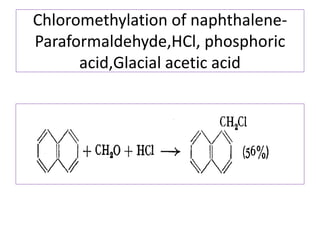
Chloromethylation of naphthalene-
Paraformaldehyde,HCl, phosphoric
acid,Glacial acetic acid
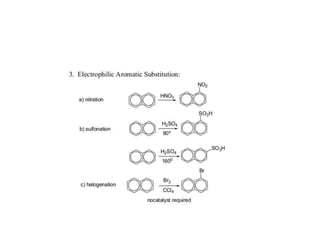
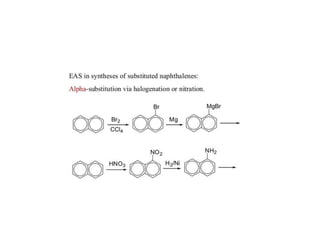
Nitro naphthalene
• Nitric acid attacks naphthalene at room
temperature to form 1 nitro naphthalene.
• Nitration of naphthalene at higher
temperature give a mixture of 1:5 and 1:8
dinitro derivative.
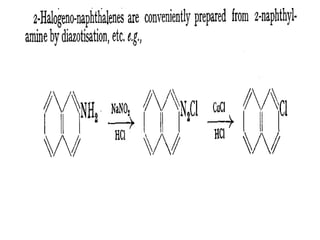
• 2 nitro naphthalene is prepared by heating 2
naphthalene diazonium boro fluoride with
sodium nitrite and copper powder.
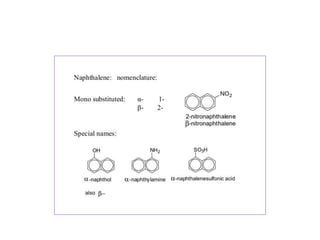
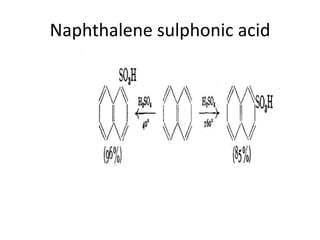
Naphthalene sulphonic acid
• When naphthalene is treated with
concentrated sulphuric acid at 40C gives the I
derivative and at 160C it yields II derivative.
• Βeta naphthalene sulphonic acid is the
starting material for all beta naphthalene
derivatives
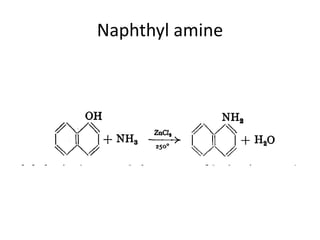
Naphthyl amine
Reaction of naphthalene
• Colourless cyrstal
• Mp 82 C
• Boil at 217 C
Naphthalene
Naphthalene
Naphthalene

Naphthalene

  • 1.
  • 2.
    Type The rings are isolated •Diphenyl methane • Triphenyl methane The rings are fused together in the ortho position • Naphthalene • Anthracene • Phenanthrene
  • 4.
  • 7.
    • All tencarbons are sp2 hybridized • Overlap of Sp2 With s orbital's of 8 hydrogen atom. • All carbon and hydrogen lying in one plane. • It is confirmed by X ray diffraction studies. • It is aromatic satisfies the Huckle’s rule • It is less aromatic than benzene.
  • 9.
    Naphthalene • It isthe largest constituent of Coal tar • It is obtained by cooling middle and Heavy oil • The crude naphthalene is melted and treated with sulphuric aicid to remove basic impurities. • Washed with water. • Treated with aqueous sodium hydroxide to remove acidic impurities. • Finally naphthalene is distilled to give pure product.
  • 10.
  • 11.
    Structure of naphthalene •Erlenmeyer proposed the symmetrical formula for naphthalene in 1866
  • 12.
    Graebe proved thatit did consist of two benzene rings fused together in the ortho position in 1869
  • 13.
    Naphthalene on oxidationgives phthalic acid
  • 14.
    •When nitrated naphthalenegives nitro naphthalene which, on oxidation , gave o- nitro phthalic acid. This indicates that nitro group is in benzene ring and that it is the side chain which are oxidised.
  • 15.
    Nitro naphthalene reducedgive amino naphthalene oxidised, phthalic acid was obtained. An amino group attached to the nucleus renders sensitivity to oxidation,
  • 16.
    Inference: benzene ringin phthalic acid obtained by oxidation of amino naphthalene is not the same ring as that originally containing nitro group in nitro naphthalene i.e naphthalene contains two benzene ring
  • 17.
  • 20.
    O-xylene bromide combineswith disodioethane tetra carboxylic ester when refluxed in acid solution, gives tetrahydronaphthalene dicarboxylic acid. When the silver salt of this acid is heated, naphthalene is formed
  • 23.
    Position of doublebond in naphthalene
  • 24.
    Fries rule • Friescompared the double bonds present in polynuclear compounds with benzoquinone. • Structure II and III have structure similar to benzoquinone. • Quinones are reactive than pure aromatic compound. • Fries belived that stable form of polynuclear compound did not have this quinone structure.
  • 25.
    Fries rule • Themost stable form of polynuclear aromatic compound is that form which has maximum number of benzenoid ring i.e three double bonds in each individual ring. • According to fries naphthalene has structure I [ has two benzenoid ring] and not the structure of II and III [ has one benzenoid ring]
  • 27.
  • 28.
    Number of reducedproduct depend on the reducing agent used. If sodium in ethanol is used it gives 1:4 dialin m.p is 28C Naphthalene Na Ethanol 1:4 Dialin 1:4 dialin is unstable isomerise to form 1:2 dialin which also unstable to form naphthalene in the presence of sodium ethoxide
  • 29.
    • When reducedwith isopentanol it forms tetralin mp 206-208ᵒC. • Tetralin is used as varnishes.
  • 30.
    When naphthalene isreduced in the presence of nickel it forms tetralin then it gives decalin
  • 31.
    Naphthalene get oxidisedin the presence of sulphuric acid,vanadium pentoxide,mercuric sulphate or air to phthalic anhydride.
  • 32.
    Naphthalene on oxidationin presence of permanganate gives phthalic acid
  • 33.
    Naphthalene on ozonolysisyield phthaldehyde
  • 34.
  • 35.
    Substitution product ofnaphthalene • Orientation in naphthalene nucleus is more complicated than benzene nucleus due to presence of two rings in former. • First group always enter the first position except in two cases when second derivative is the main product. • Sulphonation at higher temperature • Friedel craft reaction.
  • 36.
    • Introduction ofsecond substituent can give rise to homonuclear substitution [ substitution in the same ring] or heteronuclear substitution [ second substitution in another ring]
  • 37.
    Homonuclear substitution occuronly when group already present is ortho para directing
  • 38.
    • Self polarisabilityis greater at position I than in position II in case of naphthalene. • Self polarisability position and larger magnitude of self polarisability, the more reactive will be that point for the electrophillic reagent. • Pie electron density is greater in 1:2 than 2:3 therefore former will be more reactive than the later.
  • 39.
    Friedel craft reaction •Naphthalene nucleus is attacked by aluminum chloride when vigorous conditions are used. • Lower temperature is maintained to carry out the friedel craft reaction. • Introduction of acyl group in presence of aluminium chloride gives 1 and 2 ketones, the nature of the solvent affects the yield. • Acetyl chloride in carbondisulphide gives compound 1 and 2 in the ratio 3:1 and with nitrobenzene it is 1:9
  • 41.
  • 43.
    Nitro naphthalene • Nitricacid attacks naphthalene at room temperature to form 1 nitro naphthalene. • Nitration of naphthalene at higher temperature give a mixture of 1:5 and 1:8 dinitro derivative. • 2 nitro naphthalene is prepared by heating 2 naphthalene diazonium boro fluoride with sodium nitrite and copper powder.
  • 44.
  • 45.
    • When naphthaleneis treated with concentrated sulphuric acid at 40C gives the I derivative and at 160C it yields II derivative. • Βeta naphthalene sulphonic acid is the starting material for all beta naphthalene derivatives
  • 46.
  • 49.
  • 50.
    • Colourless cyrstal •Mp 82 C • Boil at 217 C