The document provides examples of dialogue writing and basic rules for formatting dialogue in a story. It discusses starting a new paragraph for each new speaker, making it clear who is speaking, balancing dialogue with action, and resolving discussions by the end of the page. It also covers punctuation usage within dialogue, including using quotation marks, dashes, ellipses and ending sentences with periods, exclamation points or question marks.
Some basic rules
•Start a new paragraph each time a new person
speaks.
• Make sure readers know who is talking.
• Give a balanced mix of action and talking.
• Let all characters have equal say.
• Try and resolve the discussion by the end of
the page.
3.
Some basic rules
•Phrases like he said and she said are part of the
quote and part of the same sentence.
– “Bring me a spoon,” he said.
• If character action isn’t tied to the quote, then
the quote is a sentence and the action is a new
sentence.
– She brought the spoon. “Here you go.”
• If you show who’s talking in the middle of a
quote, the whole statement is one sentence.
– “If you’re going to sleep,” Mary said, “then I’m
leaving.”
4.
Some basic punctuation
•There are several ways to end a sentence:
– A period .
– An exclamation mark !
– A question mark ?
• It is permitted in dialogue to use ! and ? marks
as part of your quote in the middle of a
complete sentence
– “Look out!” shouted Marjory. “It’s still alive.”
– “Say what?” asked Brenden as he was eaten.
5.
Some basic punctuation
•Another frequently used mark in dialogue is the
dash –
• Type the dash by using two hyphens
• Use the dash to show a character got cut off
while speaking.
– “Don’t you dare try to—”
– “I will if I want to, and I’m –”
– “No you’re not. You’re going to—”
– “You do it. I’m leaving for—”
– “If you leave, you’re grounded,” said mom.
6.
Some basic punctuation
•Another popular punctuation is the
ellipsis, which is three periods.
• The ellipsis means the person stopped
voluntarily in the middle of a sentence.
– “You know, Lenny, I’ve been thinking…”
– “Whatcha thinkin’ ‘bout, George?” Lennie asked.
– “If we hitchhiked to Salinas, we could…”
– Lennie looked at George. “We could what?”
7.
Two folks ina boat
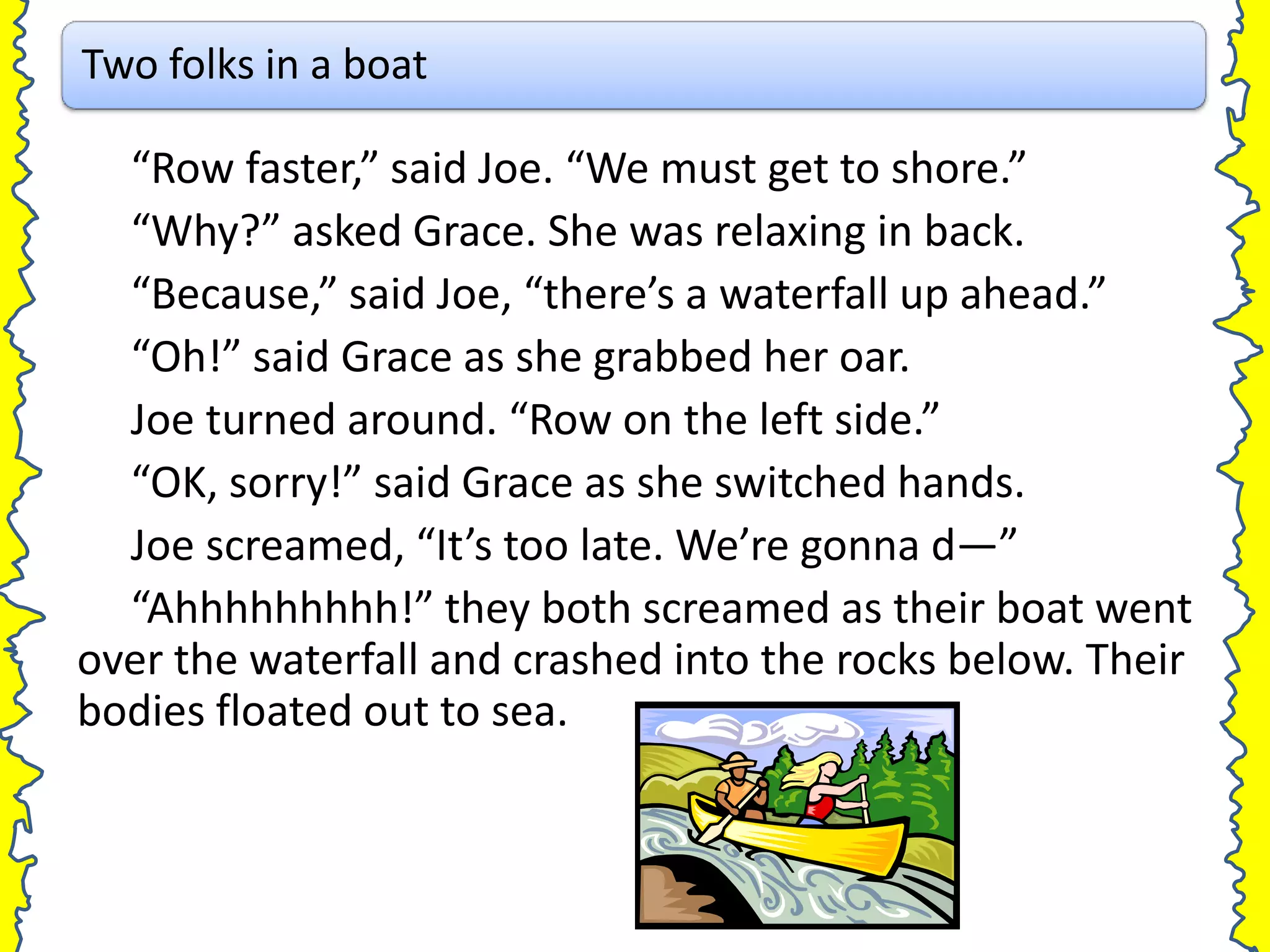
“Row faster,” said Joe. “We must get to shore.”
“Why?” asked Grace. She was relaxing in back.
“Because,” said Joe, “there’s a waterfall up ahead.”
“Oh!” said Grace as she grabbed her oar.
Joe turned around. “Row on the left side.”
“OK, sorry!” said Grace as she switched hands.
Joe screamed, “It’s too late. We’re gonna d—”
“Ahhhhhhhhh!” they both screamed as their boat went
over the waterfall and crashed into the rocks below. Their
bodies floated out to sea.
8.
Friends eating lunch
“This pizza is good,” said Wendy with her
mouth full.
“I have no lunch money,” said Sue.
“You can have a bite of mine.” Wendy tore off
the crust and handed it to Sue.
Sue backed away. “Yuck. I don’t want to eat
crust. “
“Here you go,” said Wendy. She added a slice
of pepperoni.
“Thanks,” said Sue. “It taste better now.”
“If you want,” said Wendy, “you can have half
of my juice.”
9.
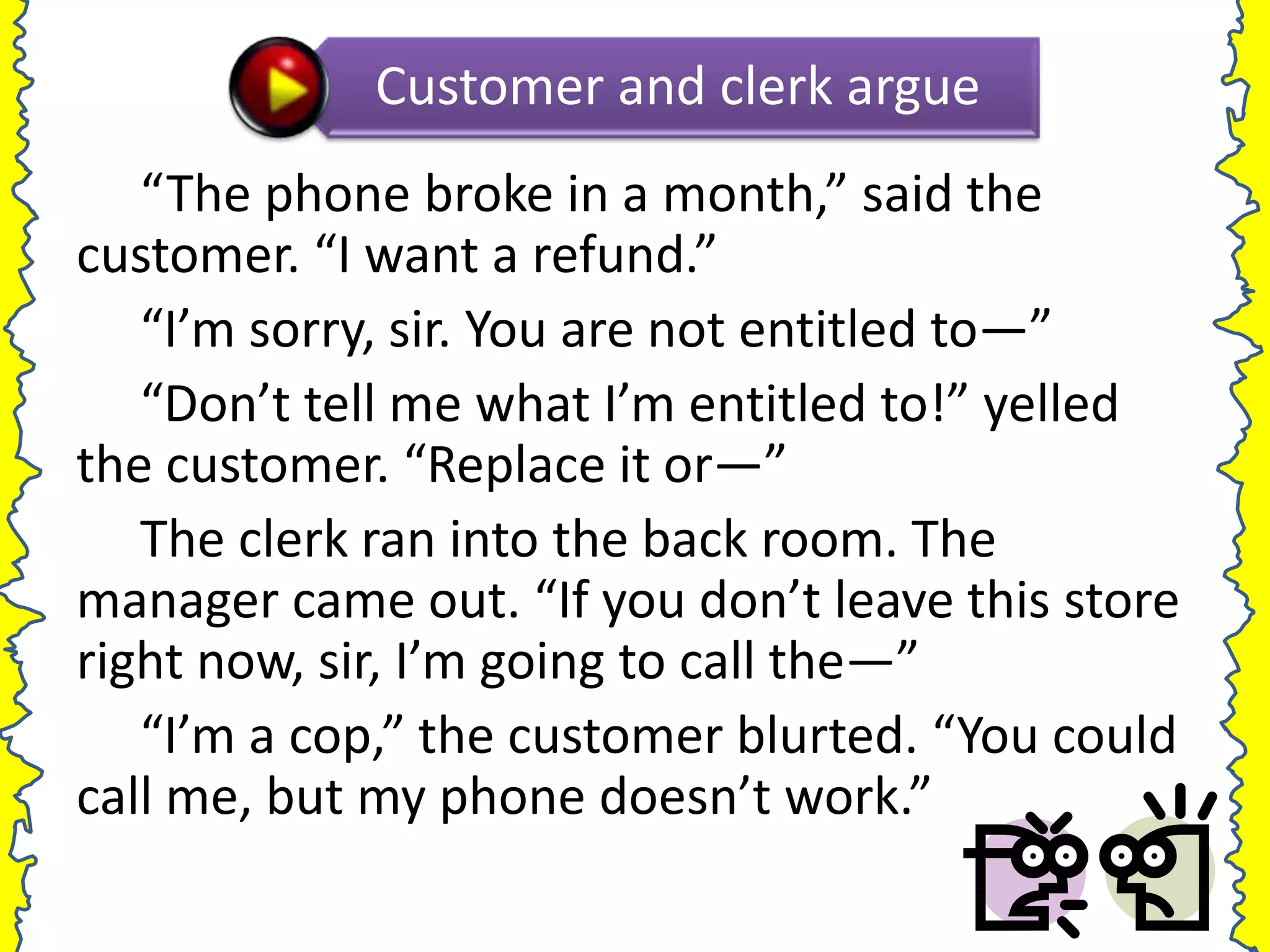
Customer and clerkargue
“The phone broke in a month,” said the
customer. “I want a refund.”
“I’m sorry, sir. You are not entitled to—”
“Don’t tell me what I’m entitled to!” yelled
the customer. “Replace it or—”
The clerk ran into the back room. The
manager came out. “If you don’t leave this store
right now, sir, I’m going to call the—”
“I’m a cop,” the customer blurted. “You could
call me, but my phone doesn’t work.”