HOUSE KEEPING

ASSIGNMENT ON


                    ROOMS LAYOUTS
                       IN HOTELS


     TAPAN MANGESH GHARAT
          TYBSCHM
What is LAYOUT ?
          It may be define as “An
     arrangement or a plan, especially
       the schematic arrangement of
              parts or areas.”

     Objectives of the Layout is to develop an
economical layout which will meet the
requirements of:
        product design and volume (product strategy).
        process equipment and capacity (process
         strategy).
        quality of work life (human resource strategy).
        building and site constraints (location
         strategy).

    Strategic Importance of Layout :
           Higher utilization of space, equipment and
            people.
           Improved flow of information, materials, or
            people.
           Improved employee morale and safer
            working conditions.
           Improved customer/client interaction.
           Flexibility.
Depend upon type
       layouts are
      classified into
 Fixed-position layout
    Large bulky projects such as ships and buildings.
 Process-oriented layout
    Deals with low-volume, high-variety production (“job
    shop”, intermittent production).
 Office layout
    Positions workers, their equipment, and
    spaces/offices to provide for movement of
    information.
 Retail/service layout
    Allocates shelf space and responds to customer
    behavior.
 Warehouse layout
    Addresses trade-offs between space and material
    handling.
 Product-oriented layout
     Seeks the best personnel and machine use in
    repetitive or continuous production.
There are different color
 schemes are used in layouts of
 rooms as well as furnishing
 those are :
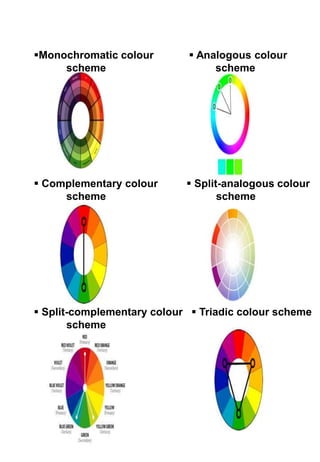
 Monochromatic colour scheme
A monochromatic colour scheme consists of different values
(tints and shades) of one single colour. These colour
schemes are easy to get right and can be very effective,
soothing and authoritative . They do, however, lack the
diversity of hues found in other colour schemes and are less
vibrant.
 Analogous colour scheme
Analogous colours are colours that are adjacent to each
other on the colour wheel. Some examples are green, yellow
green, and yellow or red, orange and yellow. Analogous
colour schemes are often found in nature and are pleasing to
the eye. The combination of these colours give a bright and
cheery effect in the area, and are able to accommodate
many changing moods. When using the analogous colour
scheme, one should make sure there is one hue as the main
colour.
 Complementary colour scheme
Complementary colours are colours that are opposite each
other on the colour wheel, such as blue and orange, red and
green, purple and yellow. Complementary colour schemes
have a more energetic feel
The high contrast between the colours creates a vibrant look,
especially when used at full saturation. Complementary
colours can be tricky to use in large doses.
 Split-analogous colour scheme
A colour scheme that includes a main colour and the two
colours one space away from it on each side of the colour
wheel. An example is red, blue, and violet.
 Split-complementary colour scheme
A colour scheme that includes a main colour and the two
colours on each side of its complementary (opposite) colour
on the colour wheel. These are the colours that are one hue
and two equally spaced from its complement. To avoid
fatigue and maintain high contrast, this colour scheme should
be used when giving PowerPoint presentations, or when
using a computer for an extended period of time. Additionally,
certain colours should not be mixed, like red and green.
Colours that should be used are red/violet and yellow/green.
 Triadic colour scheme
A colour scheme in which 3 colours of equidistant distribution
on the colour wheel are used, e.g., red, blue, and yellow.
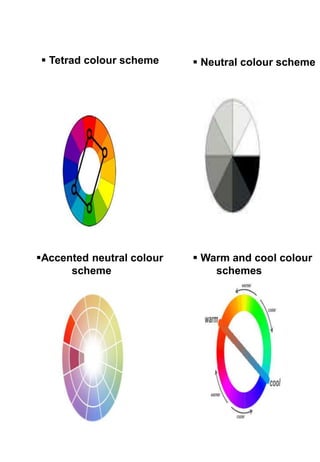
 Tetrad colour scheme
Tetrads (or quadrates) are any four colours with a logical
relationship on the colour wheel, such as double
complements.
 Neutral colour scheme
A colour scheme that includes only colours not found on the
colour wheel, called neutrals, such as beige, brown, gray,
black and white.
Accented neutral colour scheme
A colour scheme that includes neutral colours, like white,
beige, brown, grey, light brown or black, and one or more
small doses of other colours. e.g. brown and beige with blue,
gray and black with red.
 Warm and cool colour schemes
Warm colour schemes do not include blue at all, and
likewise, cool colour schemes do not include red at all. For
example, a colour scheme that includes "warmer" colours
may have orange, yellow, and red-orange in it. "Cooler"
colours are green, violet, light blue, etc.
Graphical

Presentation

     Of

  Colour

  Schemes
Monochromatic colour         Analogous colour
     scheme                       scheme


 Complementary colour       Split-analogous colour
     scheme                        scheme


 Split-complementary colour  Triadic colour scheme
       scheme
 Tetrad colour scheme      Neutral colour scheme


Accented neutral colour    Warm and cool colour
      scheme                   schemes
Hotel industry is very vast place
which provide all type of luxury
and specialized service to guests
all over the world, normally
hotels are divided into 4 main
operational sectors those are :
 Food Production.
 Food and Beverage Service
 Front Office
 House Keeping

Among 4 of the above operational sectors House keeping helps
to generate 50% of the hotel revenue total profit of hotel
depend upon the rooms sold by the hotel and the remaining
sectors are interconnected to each other.


Rooms in hotel are divided into
different categories, and they are
normally differentiated into:
1)   Single room
2)   Twin room
3)   Hollywood twin room
4)   Double room
5)   Triple room
6)   Quad room
07) Queen room
08) King room
09) Double double roomtwin double family room
10) Studio room
11) Sico room
12) Connecting rooms
13) Adjoining rooms
14) Adjacent rooms
15) Cabana
16) Duplex/bi-level suite
17) Efficiency room
18) Hospitality suite
19) Lanai
20) Parlour/saloon
21) Sample room
22) Family room
23) Penthouse
24) Executive room
Layouts

  Of

 The

Rooms
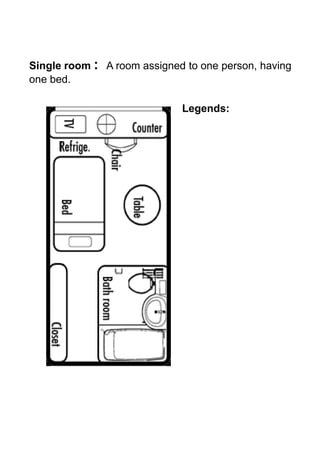
Single room : A room assigned to one person, having
one bed.

                             Legends:
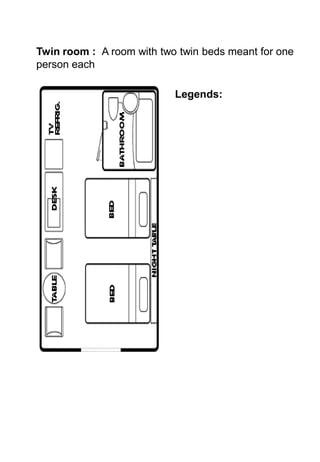
Twin room : A room with two twin beds meant for one
person each

                           Legends:
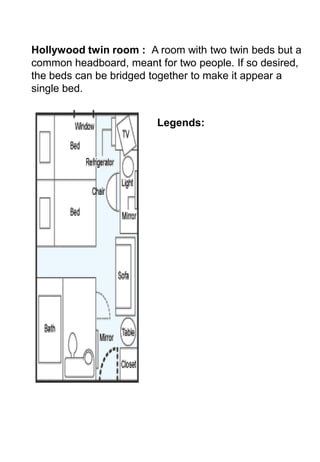
Hollywood twin room : A room with two twin beds but a
common headboard, meant for two people. If so desired,
the beds can be bridged together to make it appear a
single bed.


                         Legends:
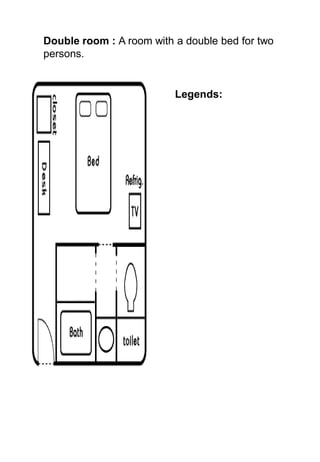
Double room : A room with a double bed for two
persons.


                          Legends:
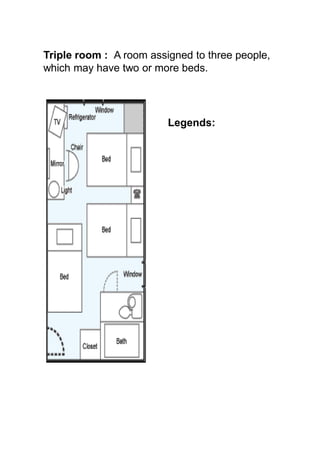
Triple room : A room assigned to three people,
which may have two or more beds.


                         Legends:
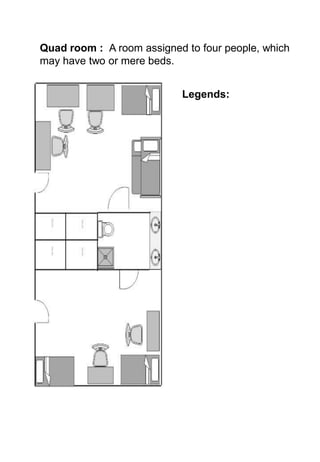
Quad room : A room assigned to four people, which
may have two or mere beds.


                           Legends:
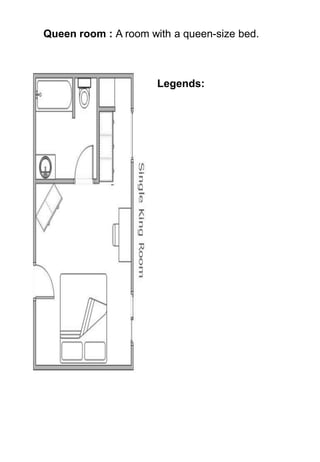
Queen room : A room with a queen-size bed.


                      Legends:
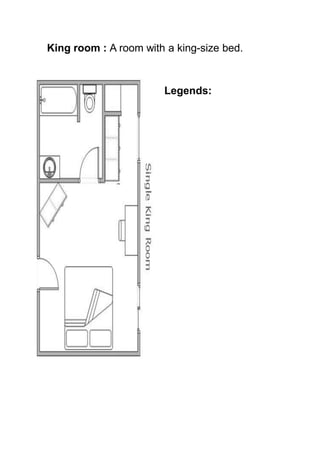
King room : A room with a king-size bed.


                       Legends:
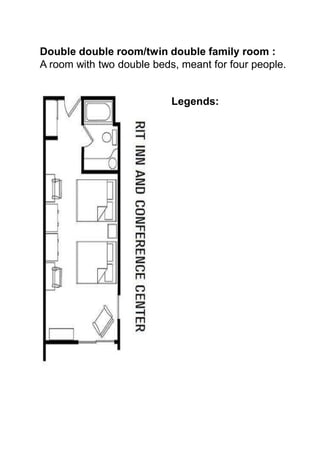
Double double room/twin double family room :
A room with two double beds, meant for four people.


                           Legends:
Studio room/extension room : A room with a
studio bed.
Sico room : A room which has Murphy or Sico bed
or                                           similar
(a pull-out or convertible or foldaway bed).
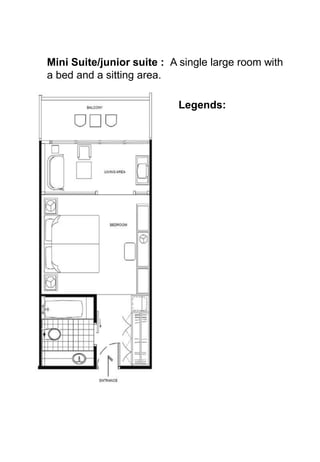
Mini Suite/junior suite : A single large room with
a bed and a sitting area.

                           Legends:
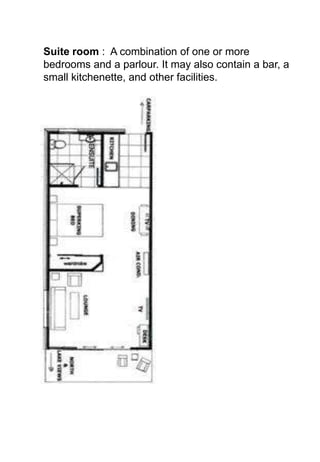
Suite room : A combination of one or more
bedrooms and a parlour. It may also contain a bar, a
small kitchenette, and other facilities.
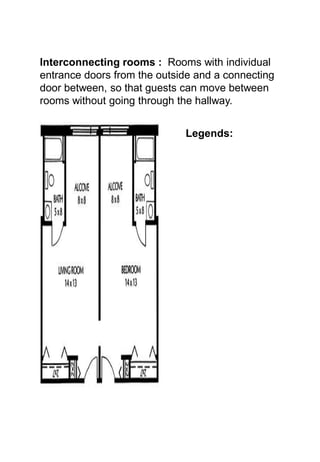
Interconnecting rooms : Rooms with individual
entrance doors from the outside and a connecting
door between, so that guests can move between
rooms without going through the hallway.


                             Legends:
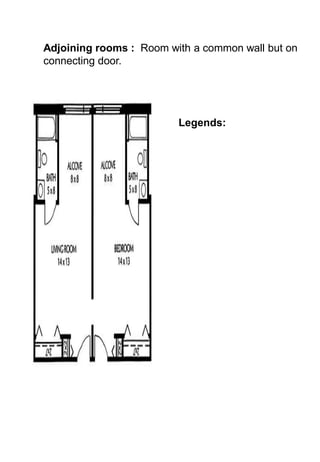
Adjoining rooms : Room with a common wall but on
connecting door.


                         Legends:
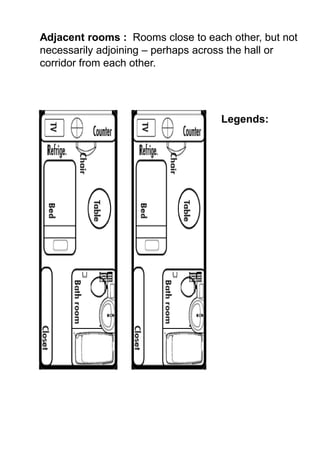
Adjacent rooms : Rooms close to each other, but not
necessarily adjoining – perhaps across the hall or
corridor from each other.


                                   Legends:
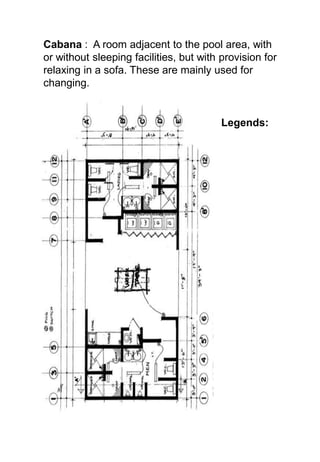
Cabana : A room adjacent to the pool area, with
or without sleeping facilities, but with provision for
relaxing in a sofa. These are mainly used for
changing.


                                         Legends:
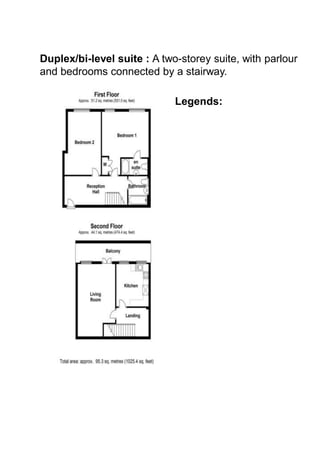
Duplex/bi-level suite : A two-storey suite, with parlour
and bedrooms connected by a stairway.

                             Legends:
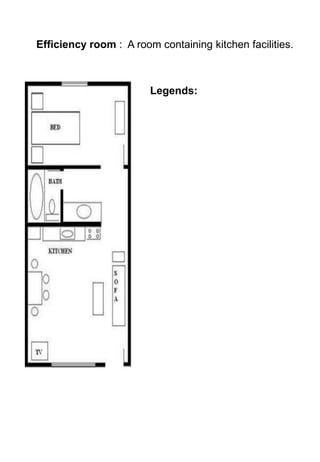
Efficiency room : A room containing kitchen facilities.


                        Legends:
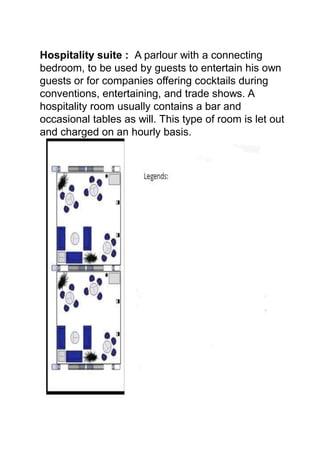
Hospitality suite : A parlour with a connecting
bedroom, to be used by guests to entertain his own
guests or for companies offering cocktails during
conventions, entertaining, and trade shows. A
hospitality room usually contains a bar and
occasional tables as will. This type of room is let out
and charged on an hourly basis.
                                 Legends
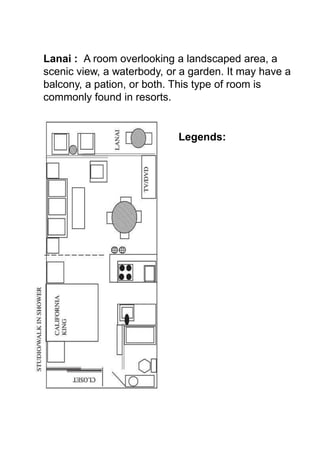
Lanai : A room overlooking a landscaped area, a
scenic view, a waterbody, or a garden. It may have a
balcony, a pation, or both. This type of room is
commonly found in resorts.


                            Legends:
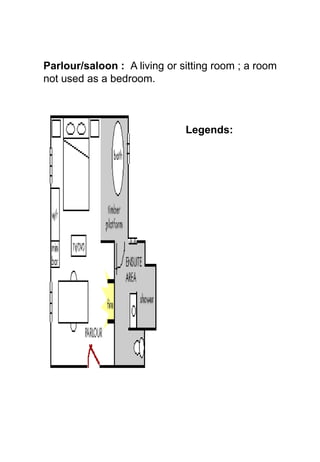
Parlour/saloon : A living or sitting room ; a room
not used as a bedroom.


                              Legends:
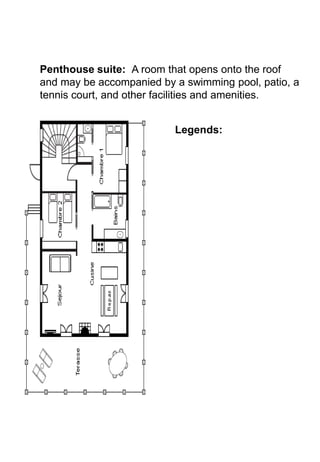
Penthouse suite: A room that opens onto the roof
and may be accompanied by a swimming pool, patio, a
tennis court, and other facilities and amenities.


                          Legends:
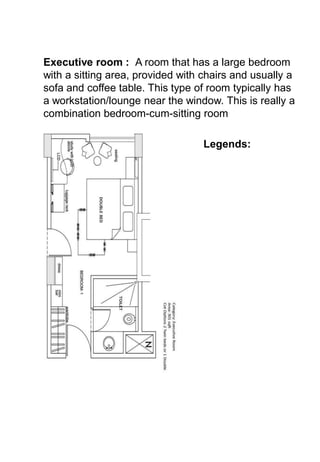
Executive room : A room that has a large bedroom
with a sitting area, provided with chairs and usually a
sofa and coffee table. This type of room typically has
a workstation/lounge near the window. This is really a
combination bedroom-cum-sitting room

                                  Legends:

Room layout

  • 1.
    HOUSE KEEPING ASSIGNMENT ON ROOMS LAYOUTS IN HOTELS TAPAN MANGESH GHARAT TYBSCHM
  • 2.
    What is LAYOUT? It may be define as “An arrangement or a plan, especially the schematic arrangement of parts or areas.” Objectives of the Layout is to develop an economical layout which will meet the requirements of:  product design and volume (product strategy).  process equipment and capacity (process strategy).  quality of work life (human resource strategy).  building and site constraints (location strategy). Strategic Importance of Layout :  Higher utilization of space, equipment and people.  Improved flow of information, materials, or people.  Improved employee morale and safer working conditions.  Improved customer/client interaction.  Flexibility.
  • 3.
    Depend upon type layouts are classified into  Fixed-position layout Large bulky projects such as ships and buildings.  Process-oriented layout Deals with low-volume, high-variety production (“job shop”, intermittent production).  Office layout Positions workers, their equipment, and spaces/offices to provide for movement of information.  Retail/service layout Allocates shelf space and responds to customer behavior.  Warehouse layout Addresses trade-offs between space and material handling.  Product-oriented layout Seeks the best personnel and machine use in repetitive or continuous production.
  • 4.
    There are differentcolor schemes are used in layouts of rooms as well as furnishing those are :  Monochromatic colour scheme A monochromatic colour scheme consists of different values (tints and shades) of one single colour. These colour schemes are easy to get right and can be very effective, soothing and authoritative . They do, however, lack the diversity of hues found in other colour schemes and are less vibrant.  Analogous colour scheme Analogous colours are colours that are adjacent to each other on the colour wheel. Some examples are green, yellow green, and yellow or red, orange and yellow. Analogous colour schemes are often found in nature and are pleasing to the eye. The combination of these colours give a bright and cheery effect in the area, and are able to accommodate many changing moods. When using the analogous colour scheme, one should make sure there is one hue as the main colour.  Complementary colour scheme Complementary colours are colours that are opposite each other on the colour wheel, such as blue and orange, red and green, purple and yellow. Complementary colour schemes have a more energetic feel The high contrast between the colours creates a vibrant look, especially when used at full saturation. Complementary colours can be tricky to use in large doses.  Split-analogous colour scheme A colour scheme that includes a main colour and the two colours one space away from it on each side of the colour wheel. An example is red, blue, and violet.
  • 5.
     Split-complementary colourscheme A colour scheme that includes a main colour and the two colours on each side of its complementary (opposite) colour on the colour wheel. These are the colours that are one hue and two equally spaced from its complement. To avoid fatigue and maintain high contrast, this colour scheme should be used when giving PowerPoint presentations, or when using a computer for an extended period of time. Additionally, certain colours should not be mixed, like red and green. Colours that should be used are red/violet and yellow/green.  Triadic colour scheme A colour scheme in which 3 colours of equidistant distribution on the colour wheel are used, e.g., red, blue, and yellow.  Tetrad colour scheme Tetrads (or quadrates) are any four colours with a logical relationship on the colour wheel, such as double complements.  Neutral colour scheme A colour scheme that includes only colours not found on the colour wheel, called neutrals, such as beige, brown, gray, black and white. Accented neutral colour scheme A colour scheme that includes neutral colours, like white, beige, brown, grey, light brown or black, and one or more small doses of other colours. e.g. brown and beige with blue, gray and black with red.  Warm and cool colour schemes Warm colour schemes do not include blue at all, and likewise, cool colour schemes do not include red at all. For example, a colour scheme that includes "warmer" colours may have orange, yellow, and red-orange in it. "Cooler" colours are green, violet, light blue, etc.
  • 6.
    Graphical Presentation Of Colour Schemes
  • 7.
    Monochromatic colour  Analogous colour scheme scheme  Complementary colour  Split-analogous colour scheme scheme  Split-complementary colour  Triadic colour scheme scheme
  • 8.
     Tetrad colourscheme  Neutral colour scheme Accented neutral colour  Warm and cool colour scheme schemes
  • 9.
    Hotel industry isvery vast place which provide all type of luxury and specialized service to guests all over the world, normally hotels are divided into 4 main operational sectors those are :  Food Production.  Food and Beverage Service  Front Office  House Keeping Among 4 of the above operational sectors House keeping helps to generate 50% of the hotel revenue total profit of hotel depend upon the rooms sold by the hotel and the remaining sectors are interconnected to each other. Rooms in hotel are divided into different categories, and they are normally differentiated into: 1) Single room 2) Twin room 3) Hollywood twin room 4) Double room 5) Triple room 6) Quad room
  • 10.
    07) Queen room 08)King room 09) Double double roomtwin double family room 10) Studio room 11) Sico room 12) Connecting rooms 13) Adjoining rooms 14) Adjacent rooms 15) Cabana 16) Duplex/bi-level suite 17) Efficiency room 18) Hospitality suite 19) Lanai 20) Parlour/saloon 21) Sample room 22) Family room 23) Penthouse 24) Executive room
  • 11.
    Layouts Of The Rooms
  • 12.
    Single room :A room assigned to one person, having one bed. Legends:
  • 13.
    Twin room :A room with two twin beds meant for one person each Legends:
  • 14.
    Hollywood twin room: A room with two twin beds but a common headboard, meant for two people. If so desired, the beds can be bridged together to make it appear a single bed. Legends:
  • 15.
    Double room :A room with a double bed for two persons. Legends:
  • 16.
    Triple room :A room assigned to three people, which may have two or more beds. Legends:
  • 17.
    Quad room :A room assigned to four people, which may have two or mere beds. Legends:
  • 18.
    Queen room :A room with a queen-size bed. Legends:
  • 19.
    King room :A room with a king-size bed. Legends:
  • 20.
    Double double room/twindouble family room : A room with two double beds, meant for four people. Legends:
  • 21.
    Studio room/extension room: A room with a studio bed.
  • 22.
    Sico room :A room which has Murphy or Sico bed or similar (a pull-out or convertible or foldaway bed).
  • 23.
    Mini Suite/junior suite: A single large room with a bed and a sitting area. Legends:
  • 24.
    Suite room :A combination of one or more bedrooms and a parlour. It may also contain a bar, a small kitchenette, and other facilities.
  • 25.
    Interconnecting rooms :Rooms with individual entrance doors from the outside and a connecting door between, so that guests can move between rooms without going through the hallway. Legends:
  • 26.
    Adjoining rooms :Room with a common wall but on connecting door. Legends:
  • 27.
    Adjacent rooms :Rooms close to each other, but not necessarily adjoining – perhaps across the hall or corridor from each other. Legends:
  • 28.
    Cabana : Aroom adjacent to the pool area, with or without sleeping facilities, but with provision for relaxing in a sofa. These are mainly used for changing. Legends:
  • 29.
    Duplex/bi-level suite :A two-storey suite, with parlour and bedrooms connected by a stairway. Legends:
  • 30.
    Efficiency room :A room containing kitchen facilities. Legends:
  • 31.
    Hospitality suite :A parlour with a connecting bedroom, to be used by guests to entertain his own guests or for companies offering cocktails during conventions, entertaining, and trade shows. A hospitality room usually contains a bar and occasional tables as will. This type of room is let out and charged on an hourly basis. Legends
  • 32.
    Lanai : Aroom overlooking a landscaped area, a scenic view, a waterbody, or a garden. It may have a balcony, a pation, or both. This type of room is commonly found in resorts. Legends:
  • 33.
    Parlour/saloon : Aliving or sitting room ; a room not used as a bedroom. Legends:
  • 34.
    Penthouse suite: Aroom that opens onto the roof and may be accompanied by a swimming pool, patio, a tennis court, and other facilities and amenities. Legends:
  • 35.
    Executive room :A room that has a large bedroom with a sitting area, provided with chairs and usually a sofa and coffee table. This type of room typically has a workstation/lounge near the window. This is really a combination bedroom-cum-sitting room Legends: