Why They Leave: Understanding Why Employees Leave Organisations and Strategies for Encouraging Employees to Stay Gerry Treuren, Carol Kulik and Prashant Bordia
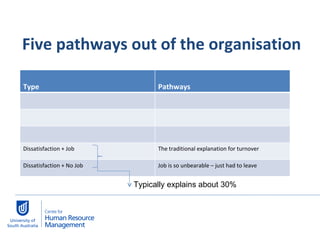
Five pathways out of the organisation Typically explains about 30% Type Pathways  Dissatisfaction + Job  The traditional explanation for turnover Dissatisfaction + No Job Job is so unbearable – just had to leave
Five pathways out of the organisation Type Pathways  Plan Was going to leave when…[…..]…happens Dissatisfaction + Job  The traditional explanation for turnover Dissatisfaction + No Job Job is so unbearable – just had to leave
Five pathways out of the organisation Type Pathways  Plan Was going to leave when…[…..]…happens Pull Pulled towards a better job Dissatisfaction + Job  The traditional explanation for turnover Dissatisfaction + No Job Job is so unbearable – just had to leave
Five pathways out of the organisation Type Pathways  Plan Was going to leave when…[…..]…happens Pull Pulled towards a better job Push Pushed out of job Dissatisfaction + Job  The traditional explanation for turnover Dissatisfaction + No Job Job is so unbearable – just had to leave
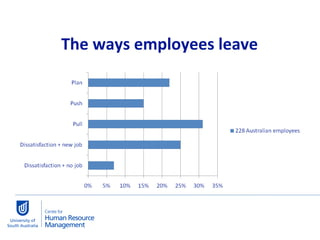
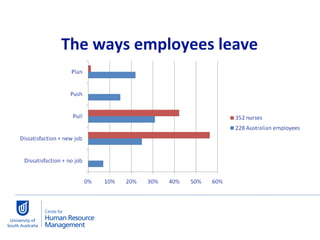
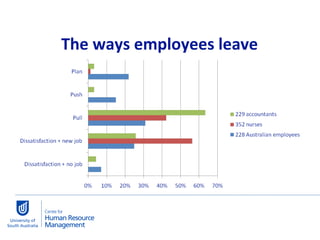
The ways employees leave
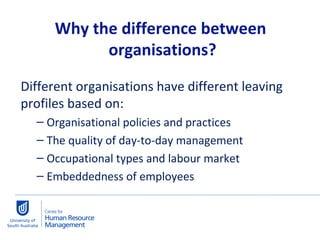
Different organisations have different leaving profiles based on: Organisational policies and practices The quality of day-to-day management Occupational types and labour market Embeddedness of employees  Why the difference between  organisations?
Employees have varying degrees of attachment to their organisation and their out-of-work life The more embedded an employee, the more likely the employee is to stay Embeddedness
Embedded employees are less likely to be dissatisfied with their job and their employment Embedded employees are less likely to resign because of shocks Management can increase the level of embeddedness  The buffer to the impulse to leave…
Embeddedness and turnover
Fit  with the organisation and other employees Linkages  with the organisation and other employees The financial and social  sacrifice  of leaving Three factors of embeddedness
Does the person fit the job, work group and the organisation? Have similar values?  Management can improve embeddedness by  Recruiting for Person-Job fit Recruiting for Person-Organisation fit Redesigning jobs to better suit high potential/ highly mobile employees Fit-based embeddedness
How well connected to their job and the organisation?  Management can adopt in-house activities Mentoring schemes Workgroups; reward team achievements Consultative processes Internal development programs Appropriate induction and socialisation schemes  Linkage-based embeddedness
What is the cost of leaving for an employee? Management can increase the economic and social cost of leaving, through:  Salary/conditions/ superannuation vesting Development of internal labour market Onsite/subsidised childcare, parking and childcare Sacrifice-based embeddedness
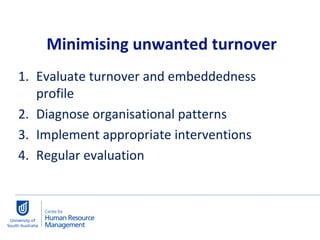
Evaluate turnover and embeddedness profile Diagnose organisational patterns Implement appropriate interventions Regular evaluation Minimising unwanted turnover
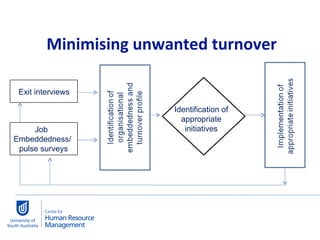
Minimising unwanted turnover Exit interviews Identification of appropriate initiatives Job  Embeddedness/ pulse surveys
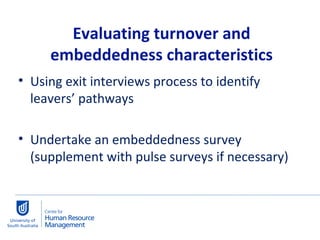
Using exit interviews process to identify leavers’ pathways Undertake an embeddedness survey (supplement with pulse surveys if necessary) Evaluating turnover and embeddedness characteristics
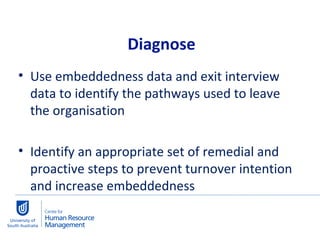
Use embeddedness data and exit interview data to identify the pathways used to leave the organisation Identify an appropriate set of remedial and proactive steps to prevent turnover intention and increase embeddedness Diagnose
Implement proposed remedies Regularly evaluate using pulse surveys and exit interviews and amend remedies if necessary Implement and evaluate
Turnover and turnover likelihood can be assessed and diagnosed Different organisations have different leaving profiles Management can cultivate embeddedness to minimise unwanted turnover Takeaway points
Thank you Questions?

Understanding and responding to turnover

  • 1.
    Why They Leave:Understanding Why Employees Leave Organisations and Strategies for Encouraging Employees to Stay Gerry Treuren, Carol Kulik and Prashant Bordia
  • 2.
    Five pathways outof the organisation Typically explains about 30% Type Pathways Dissatisfaction + Job The traditional explanation for turnover Dissatisfaction + No Job Job is so unbearable – just had to leave
  • 3.
    Five pathways outof the organisation Type Pathways Plan Was going to leave when…[…..]…happens Dissatisfaction + Job The traditional explanation for turnover Dissatisfaction + No Job Job is so unbearable – just had to leave
  • 4.
    Five pathways outof the organisation Type Pathways Plan Was going to leave when…[…..]…happens Pull Pulled towards a better job Dissatisfaction + Job The traditional explanation for turnover Dissatisfaction + No Job Job is so unbearable – just had to leave
  • 5.
    Five pathways outof the organisation Type Pathways Plan Was going to leave when…[…..]…happens Pull Pulled towards a better job Push Pushed out of job Dissatisfaction + Job The traditional explanation for turnover Dissatisfaction + No Job Job is so unbearable – just had to leave
  • 6.
  • 7.
  • 8.
  • 9.
    Different organisations havedifferent leaving profiles based on: Organisational policies and practices The quality of day-to-day management Occupational types and labour market Embeddedness of employees Why the difference between organisations?
  • 10.
    Employees have varyingdegrees of attachment to their organisation and their out-of-work life The more embedded an employee, the more likely the employee is to stay Embeddedness
  • 11.
    Embedded employees areless likely to be dissatisfied with their job and their employment Embedded employees are less likely to resign because of shocks Management can increase the level of embeddedness The buffer to the impulse to leave…
  • 12.
  • 13.
    Fit withthe organisation and other employees Linkages with the organisation and other employees The financial and social sacrifice of leaving Three factors of embeddedness
  • 14.
    Does the personfit the job, work group and the organisation? Have similar values? Management can improve embeddedness by Recruiting for Person-Job fit Recruiting for Person-Organisation fit Redesigning jobs to better suit high potential/ highly mobile employees Fit-based embeddedness
  • 15.
    How well connectedto their job and the organisation? Management can adopt in-house activities Mentoring schemes Workgroups; reward team achievements Consultative processes Internal development programs Appropriate induction and socialisation schemes Linkage-based embeddedness
  • 16.
    What is thecost of leaving for an employee? Management can increase the economic and social cost of leaving, through: Salary/conditions/ superannuation vesting Development of internal labour market Onsite/subsidised childcare, parking and childcare Sacrifice-based embeddedness
  • 17.
    Evaluate turnover andembeddedness profile Diagnose organisational patterns Implement appropriate interventions Regular evaluation Minimising unwanted turnover
  • 18.
    Minimising unwanted turnoverExit interviews Identification of appropriate initiatives Job Embeddedness/ pulse surveys
  • 19.
    Using exit interviewsprocess to identify leavers’ pathways Undertake an embeddedness survey (supplement with pulse surveys if necessary) Evaluating turnover and embeddedness characteristics
  • 20.
    Use embeddedness dataand exit interview data to identify the pathways used to leave the organisation Identify an appropriate set of remedial and proactive steps to prevent turnover intention and increase embeddedness Diagnose
  • 21.
    Implement proposed remediesRegularly evaluate using pulse surveys and exit interviews and amend remedies if necessary Implement and evaluate
  • 22.
    Turnover and turnoverlikelihood can be assessed and diagnosed Different organisations have different leaving profiles Management can cultivate embeddedness to minimise unwanted turnover Takeaway points
  • 23.