What is Media Literacy? September, 2010 Mrs. P. Denton
Few Interesting Facts 47%  of children ages 6-17 have a TV in their own bedroom. The average American watches over  4 hours  of television per day. The average American sees  2 million  TV commercials by the age of 65. Kaiser Family Foundation, 2005
Few Interesting Facts By the age of 18, children have watched  17,000 hours of television , and this number continues to increase. The average American youth spends  900 hours in school & 1,023 hours  watching TV each year. American Academy of Pediatrics, 2001
Few Interesting Facts The average home has the television on for  seven and half hours per day .  This means that the television is on nearly  sixty hours per week . Nielson Market Research, 2006
Few Interesting Facts The average child sees  13,000 violent deaths on TV  during his or her formative years and as many as 200,000 by their eighteenth birthday. The American Academy of Pediatrics, 2001
Why is Media Literacy Important? The influence of media in our central democratic process. The high rate of media consumption and the saturation of society by media. The media’s influence on shaping perceptions, beliefs and attitudes. The increasing importance of visual communication and information. The importance of information in society and the need for lifelong learning.
What is Media Literacy? What is “Media”? Activity 1.1 A way to carry a message from one person to another.
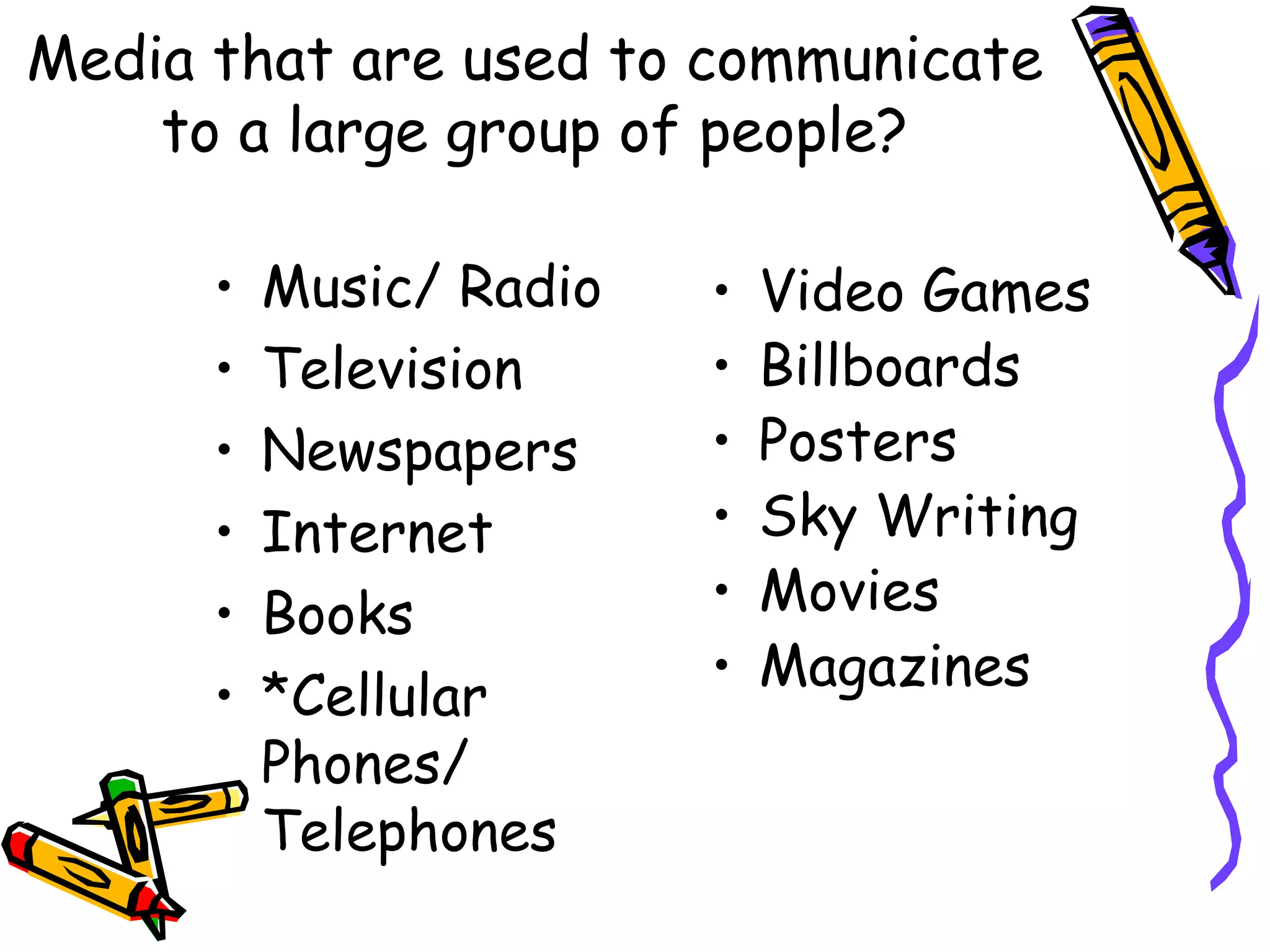
Media that are used to communicate to a large group of people? Music/ Radio Television Newspapers Internet Books *Cellular Phones/ Telephones Video Games Billboards Posters Sky Writing Movies Magazines
Media that are used to communicate from one individual to another? Email Texting Letter (Mail) Boards/Posters Pagers FAX Web Cam (Skype) Instant Messages Social Networking
Media that are used for entertainment? Television Magazines Movies Music (CDs, iPod, Radio) Video Games Comic Books Books Internet
What is Media Literacy? What is “Literacy”? The ability to decode a message.
What is Media Literacy? Sooooooo…… Activity 1.2
Media Literacy Definition Media literacy emphasizes the following elements:  a critical thinking skill that allows audiences to develop independent judgments about media content; an understanding of the process of mass communication; an awareness of the impact of media on the individual and society; the development of strategies with which to discuss and analyze media messages; an awareness of media content as “text” that provides insight into our contemporary culture and ourselves; the cultivation of an enhanced enjoyment, understanding, and appreciation of media content; the ability to produce effective and responsible media messages. (Silverblatt 2001, 120) Too Long!
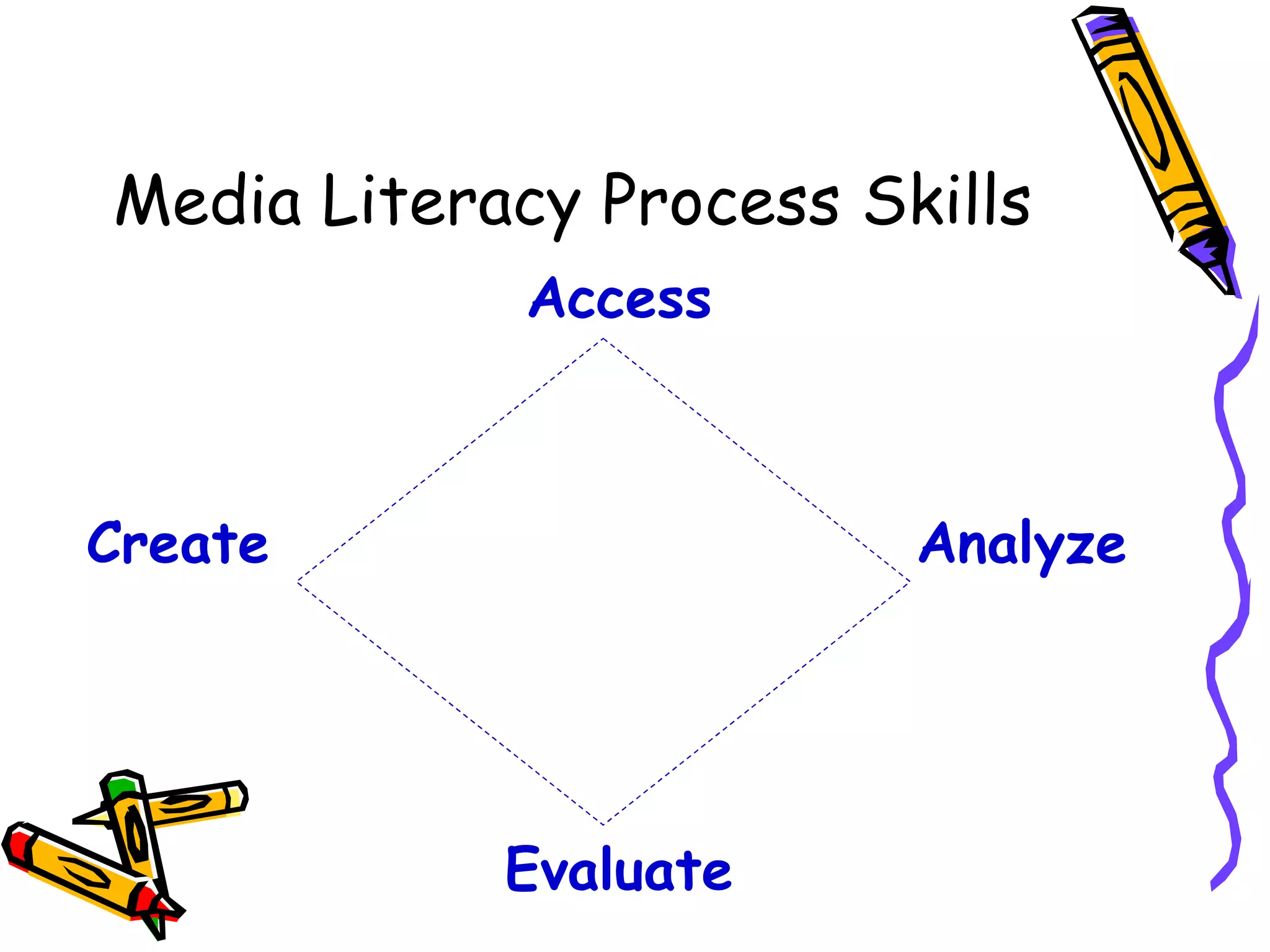
Media Literacy Definition Media literacy is the ability to access, analyze, evaluate and create media.
Media Literacy Process Skills Access Create   Analyze Evaluate
Media Literacy Process Skills Recognize and understand Media Locating media from a variety of sources Select different types of info based on the task. Access
Media Literacy Process Skills Use prior knowledge to predict outcomes. Interpret a message  Use strategies to compare/contrast, fact/opinion, cause/effect. Analyze
Media Literacy Process Skills Appreciate in interpreting messages Evaluate the quality of a message. Judge the value of a message. Respond to messages of different content. Evaluate
Media Literacy Process Skills Make use of brainstorming, planning, composing, and revising process. Use language effectively. Create and select images to achieve various goals. Use technology to communicate in the construction of messages. Create

Media literacy introduction

  • 1.
    What is MediaLiteracy? September, 2010 Mrs. P. Denton
  • 2.
    Few Interesting Facts47% of children ages 6-17 have a TV in their own bedroom. The average American watches over 4 hours of television per day. The average American sees 2 million TV commercials by the age of 65. Kaiser Family Foundation, 2005
  • 3.
    Few Interesting FactsBy the age of 18, children have watched 17,000 hours of television , and this number continues to increase. The average American youth spends 900 hours in school & 1,023 hours watching TV each year. American Academy of Pediatrics, 2001
  • 4.
    Few Interesting FactsThe average home has the television on for seven and half hours per day . This means that the television is on nearly sixty hours per week . Nielson Market Research, 2006
  • 5.
    Few Interesting FactsThe average child sees 13,000 violent deaths on TV during his or her formative years and as many as 200,000 by their eighteenth birthday. The American Academy of Pediatrics, 2001
  • 6.
    Why is MediaLiteracy Important? The influence of media in our central democratic process. The high rate of media consumption and the saturation of society by media. The media’s influence on shaping perceptions, beliefs and attitudes. The increasing importance of visual communication and information. The importance of information in society and the need for lifelong learning.
  • 7.
    What is MediaLiteracy? What is “Media”? Activity 1.1 A way to carry a message from one person to another.
  • 8.
    Media that areused to communicate to a large group of people? Music/ Radio Television Newspapers Internet Books *Cellular Phones/ Telephones Video Games Billboards Posters Sky Writing Movies Magazines
  • 9.
    Media that areused to communicate from one individual to another? Email Texting Letter (Mail) Boards/Posters Pagers FAX Web Cam (Skype) Instant Messages Social Networking
  • 10.
    Media that areused for entertainment? Television Magazines Movies Music (CDs, iPod, Radio) Video Games Comic Books Books Internet
  • 11.
    What is MediaLiteracy? What is “Literacy”? The ability to decode a message.
  • 12.
    What is MediaLiteracy? Sooooooo…… Activity 1.2
  • 13.
    Media Literacy DefinitionMedia literacy emphasizes the following elements: a critical thinking skill that allows audiences to develop independent judgments about media content; an understanding of the process of mass communication; an awareness of the impact of media on the individual and society; the development of strategies with which to discuss and analyze media messages; an awareness of media content as “text” that provides insight into our contemporary culture and ourselves; the cultivation of an enhanced enjoyment, understanding, and appreciation of media content; the ability to produce effective and responsible media messages. (Silverblatt 2001, 120) Too Long!
  • 14.
    Media Literacy DefinitionMedia literacy is the ability to access, analyze, evaluate and create media.
  • 15.
    Media Literacy ProcessSkills Access Create Analyze Evaluate
  • 16.
    Media Literacy ProcessSkills Recognize and understand Media Locating media from a variety of sources Select different types of info based on the task. Access
  • 17.
    Media Literacy ProcessSkills Use prior knowledge to predict outcomes. Interpret a message Use strategies to compare/contrast, fact/opinion, cause/effect. Analyze
  • 18.
    Media Literacy ProcessSkills Appreciate in interpreting messages Evaluate the quality of a message. Judge the value of a message. Respond to messages of different content. Evaluate
  • 19.
    Media Literacy ProcessSkills Make use of brainstorming, planning, composing, and revising process. Use language effectively. Create and select images to achieve various goals. Use technology to communicate in the construction of messages. Create

Editor's Notes

  • #4 708 days watching TV!
  • #8 See Teacher Notes Activity 1.1 Newspapers, magazines, cinema films, radio, television, photographs, the WWW, billboards, books, CDs, DVDs, videocassettes, advertisements, and computer games Changes over time
  • #12 Literacy in its most basic form is defined as the ability to read and write. What is computer literacy?
  • #13 Media is
  • #14 Ability to access, analyze, evaluate and communicate in a variety of forms and formats
  • #17 When people access messages they are able to collect relevant and useful information and comprehend its meaning effectively. They can: Recognize and understand a rich vocabulary of words, symbols and techniques of communication. Develop strategies for locating information from a wide variety of sources. Select an assortment of types of information relevant to the purpose of task.
  • #18 When people analyze messages, they are able to examine the design of the messages form, structure and sequence. They can make use of artistic, literary, social, political, and economic concepts to understand the context in which the message occurs. For example: Use prior knowledge and experiences to predict outcomes. Interpret a message using concepts such as purpose, audience, point of view, format, genre, character, plot, theme, mood, setting, context. Use strategies including compare/contract, fact/opinion, cause/effect, listing and sequencing.
  • #19 When people evaluate messages they are able to relate messages to their own experiences and make judgments about the veracity, quality, and relevance of messages. This includes being able to: Appreciate and take pleasure in interpreting messages in different genres and forms. Evaluate the quality of a message based on its content and form. Judge the value of a message based on one’s ethical, religious or democratic principles. Respond orally, in print, or electronically to messages of varying complexity and content.
  • #20 When people create (or communicate) messages, they are able to write their ideas, using words, sounds, and/or images effectively for a variety of purposes, and they are able to make use of various technologies of communication to create, edit, and disseminate their message. Make use of brainstorming, planning, composing, and revision processes. Use writing and oral language effectively with master of rules of language usage. Create and select images effectively to achieve various goals. Use technologies of communication in the construction of messages.