


















MySQL 8.0: not only good,
it’s GREAT!
Gabriela D'Ávila Ferrara
@gabidavila
Developer Advocate @ Google Cloud
gabi.fyi/me
@gabidavila
MySQL 8.0.15
@gabidavila
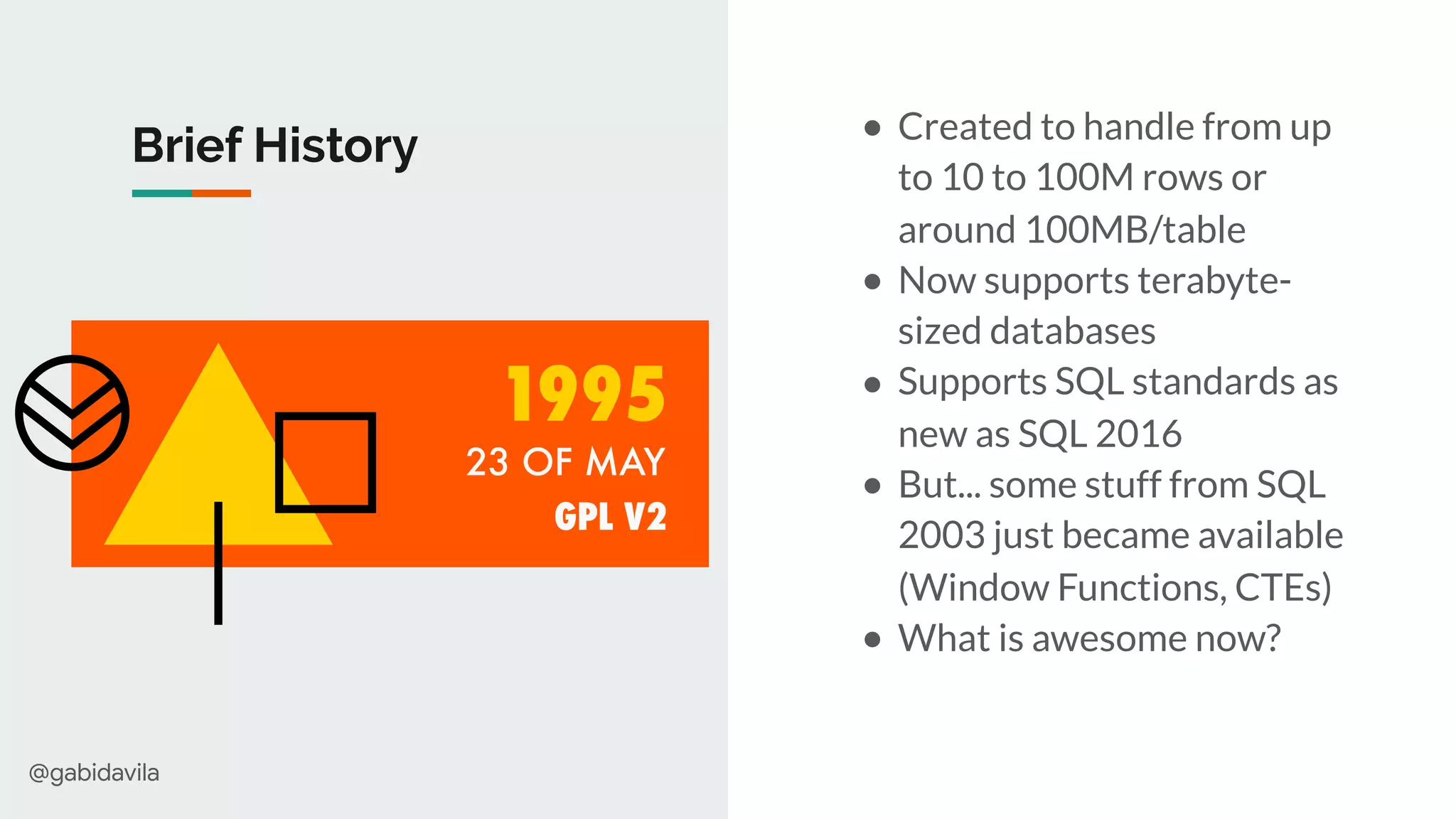
Brief History ● Created to handle from up
to 10 to 100M rows or
around 100MB/table
● Now supports terabyte-
sized databases
● Supports SQL standards as
new as SQL 2016
● But... some stuff from SQL
2003 just became available
(Window Functions, CTEs)
● What is awesome now?
23 OF MAY
1995
GPL V2
@gabidavila
Non-deterministic defaults for
table creation
@gabidavila
FUNCTIONS or EXPRESSIONS
inside CREATE TABLE
@gabidavila
That means…
@gabidavila
UUID() support!
@gabidavila
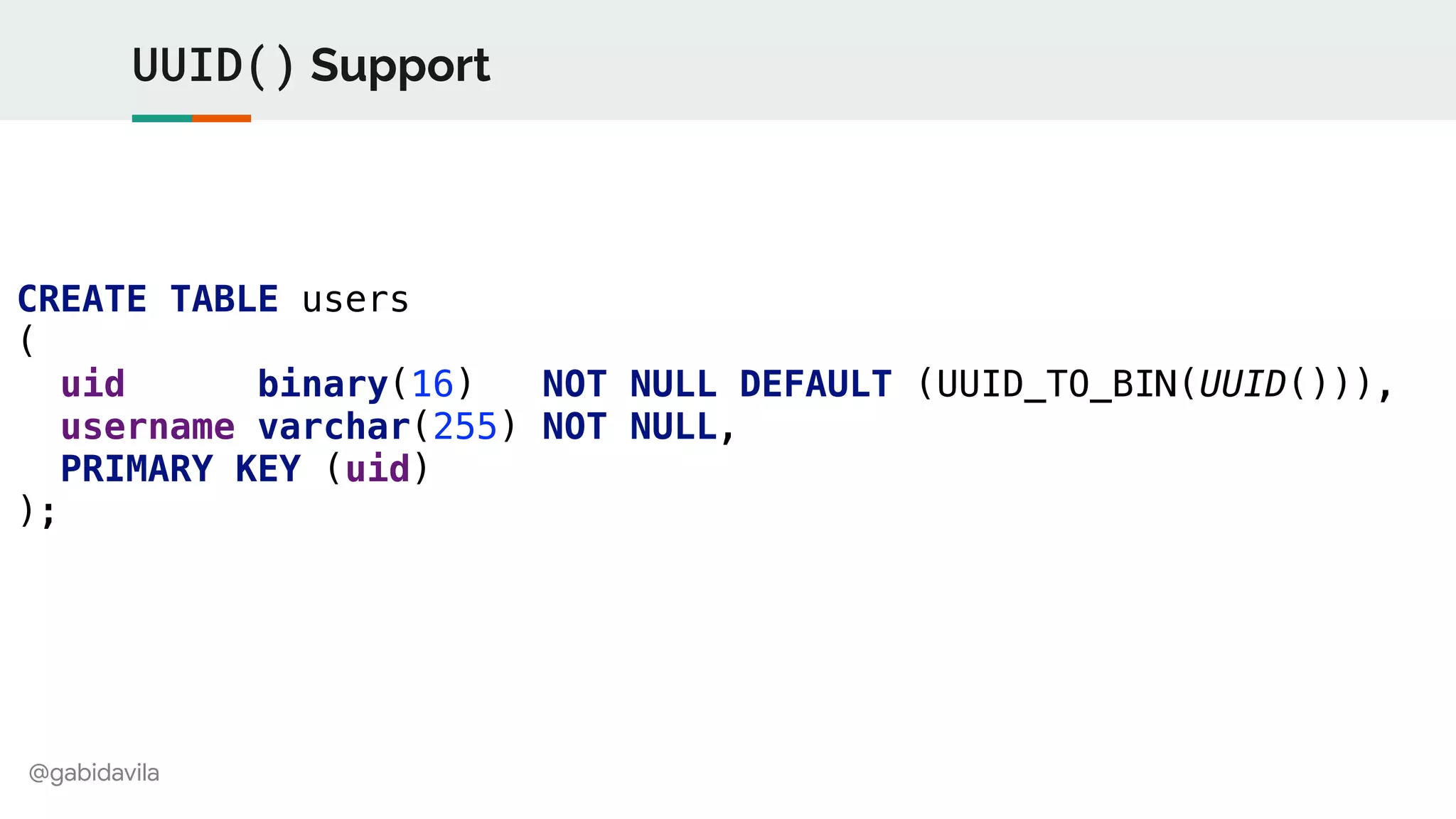
UUID() Support
CREATE TABLE users
(
uid binary(16) NOT NULL DEFAULT (UUID_TO_BIN(UUID())),
username varchar(255) NOT NULL,
PRIMARY KEY (uid)
);
@gabidavila
Demo
@gabidavila
User Management
@gabidavila
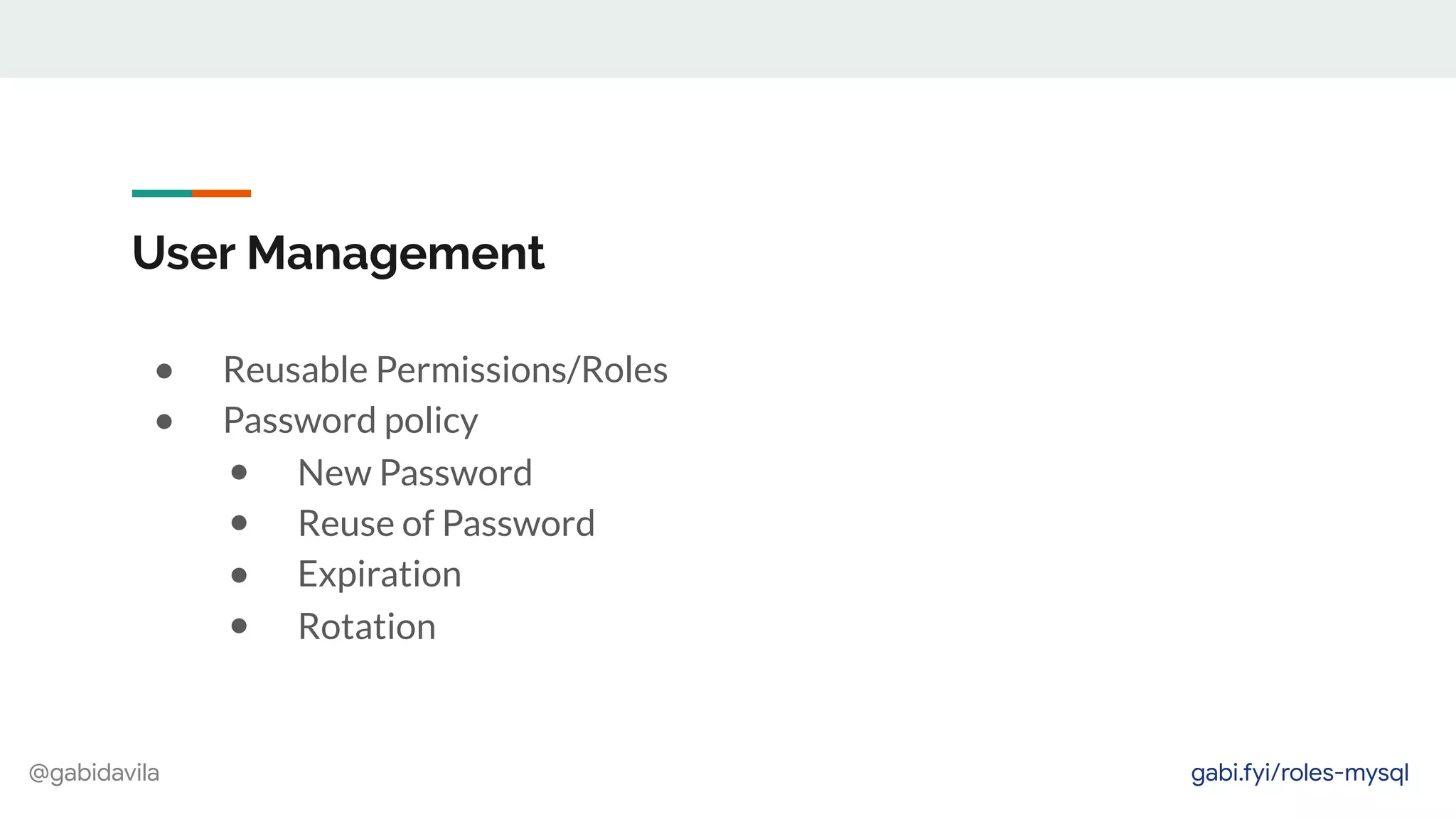
User Management
● Reusable Permissions/Roles
● Password policy
● New Password
● Reuse of Password
● Expiration
● Rotation
gabi.fyi/roles-mysql
@gabidavila
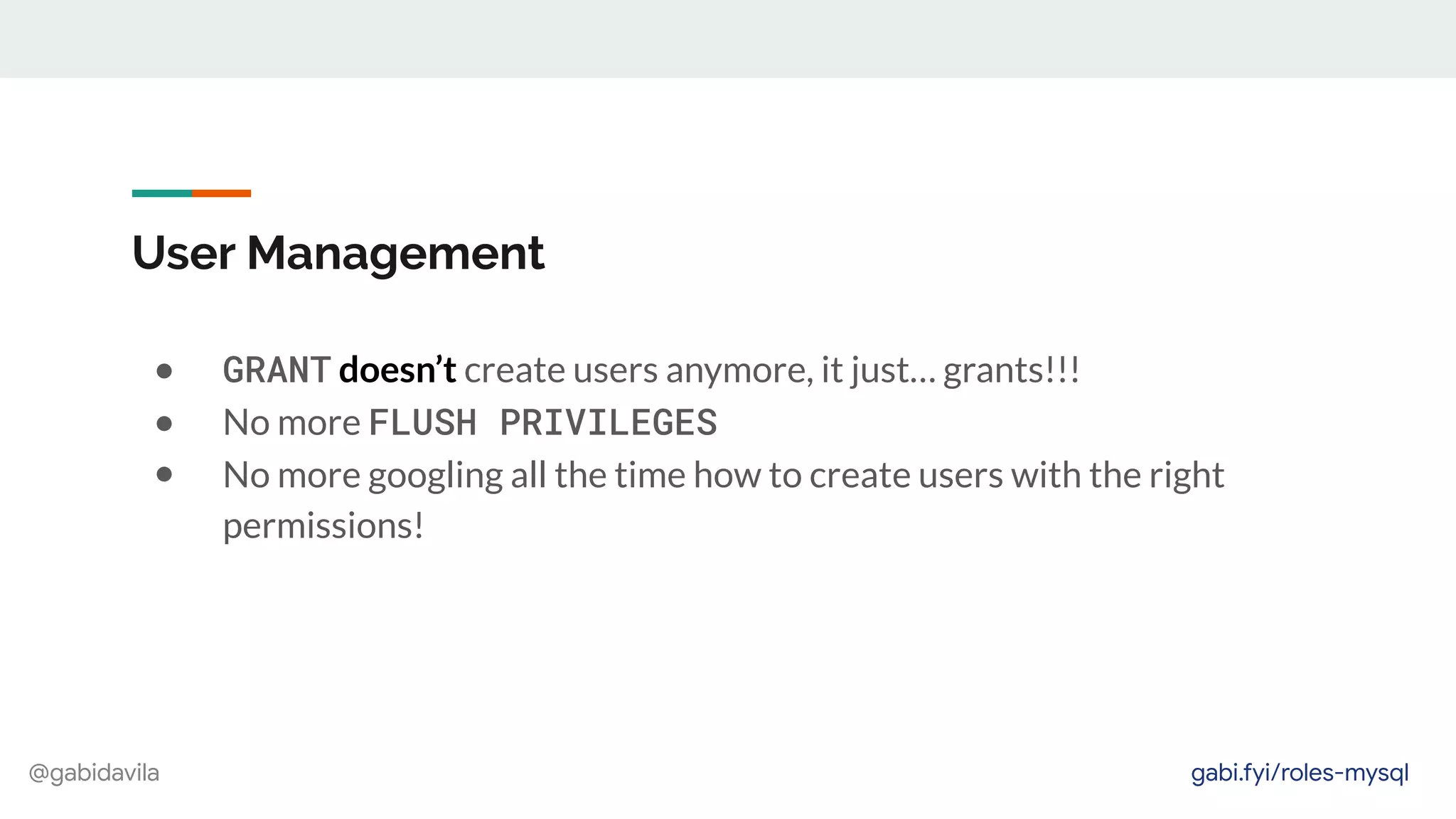
User Management
● GRANT doesn’t create users anymore, it just… grants!!!
● No more FLUSH PRIVILEGES
● No more googling all the time how to create users with the right
permissions!
gabi.fyi/roles-mysql
@gabidavila
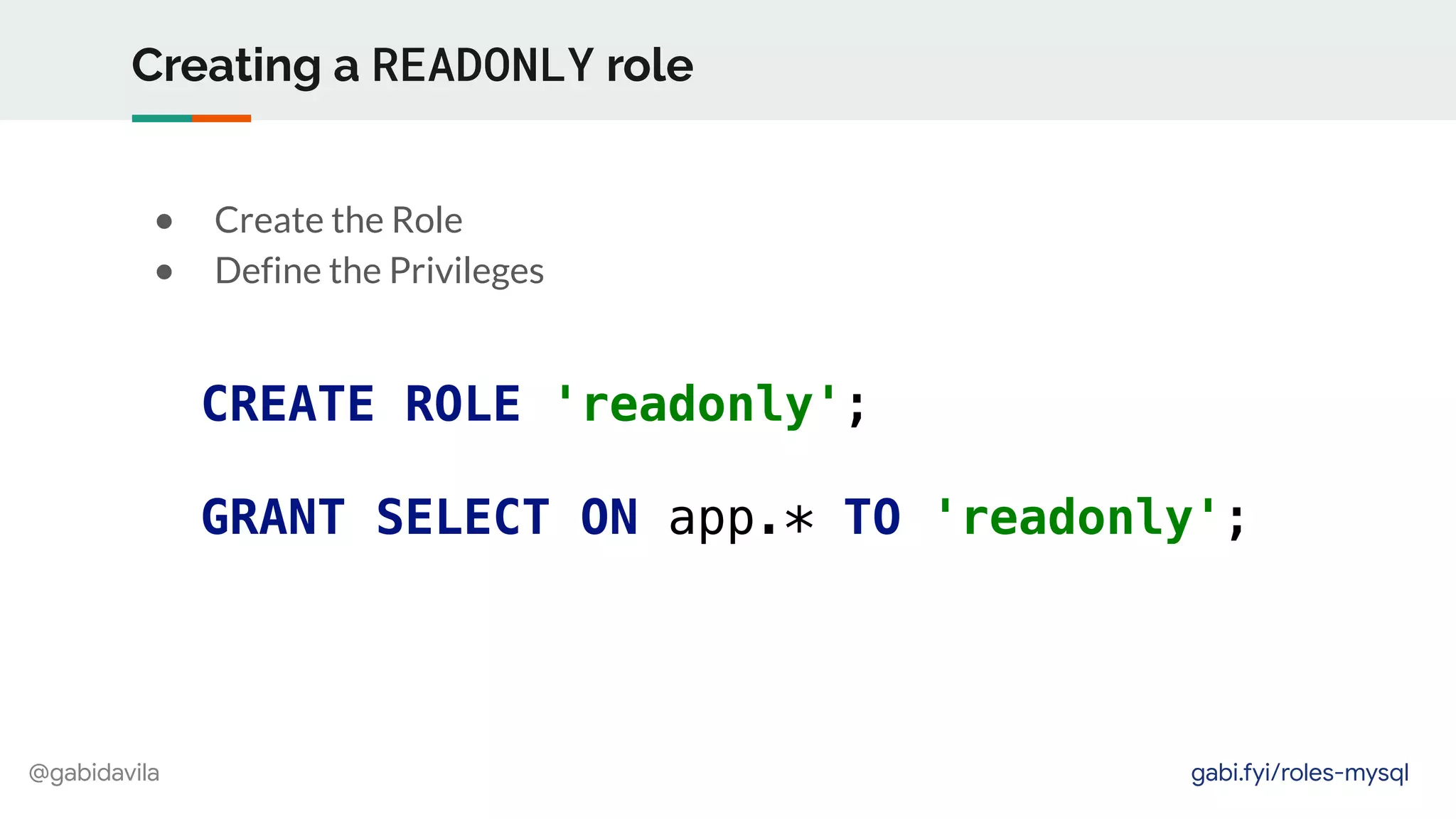
Creating a READONLY role
CREATE ROLE 'readonly';
GRANT SELECT ON app.* TO 'readonly';
● Create the Role
● Define the Privileges
gabi.fyi/roles-mysql
@gabidavila
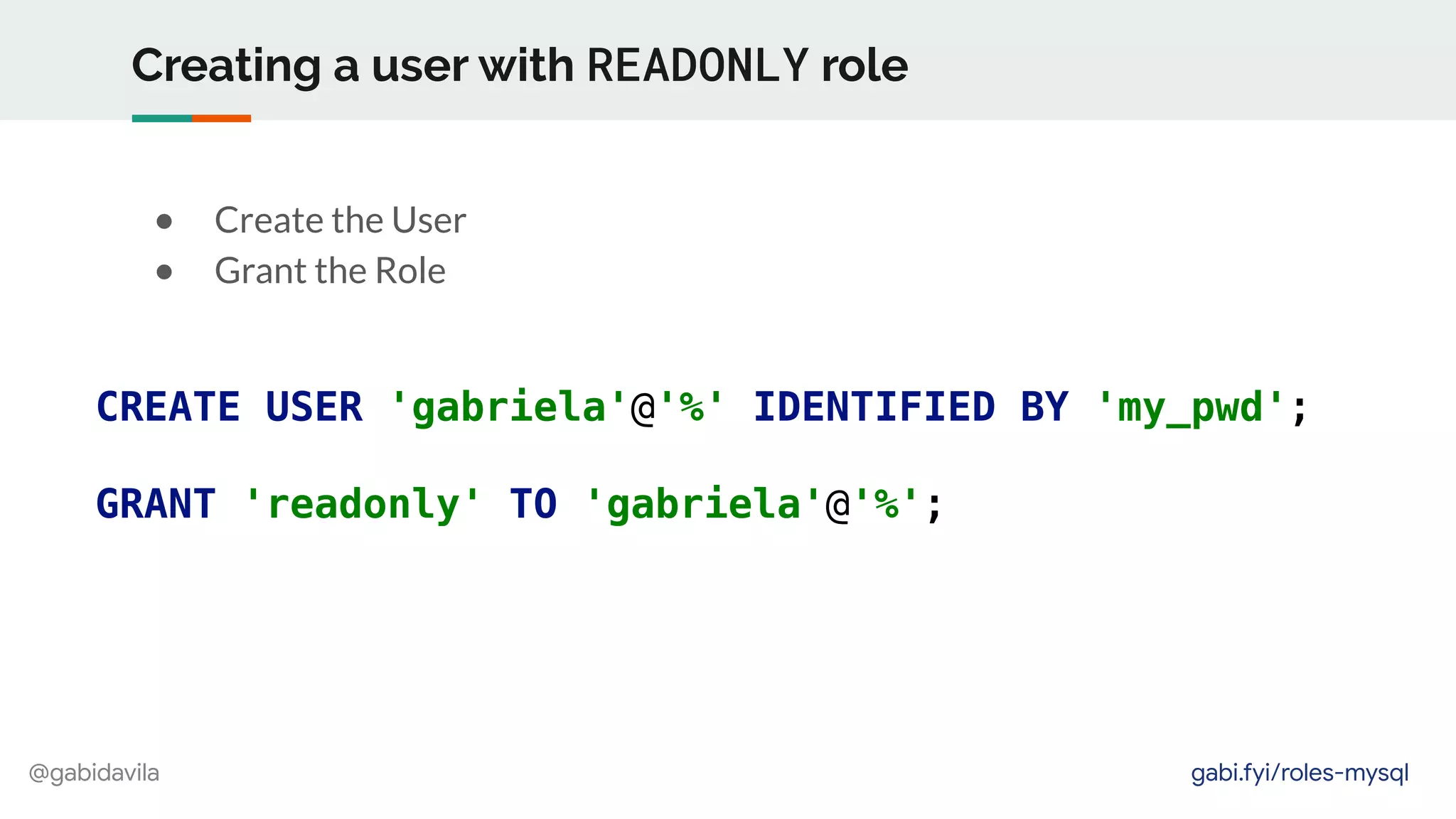
Creating a user with READONLY role
● Create the User
● Grant the Role
CREATE USER 'gabriela'@'%' IDENTIFIED BY 'my_pwd';
GRANT 'readonly' TO 'gabriela'@'%';
gabi.fyi/roles-mysql
@gabidavila
New Defaults & Variables
@gabidavila
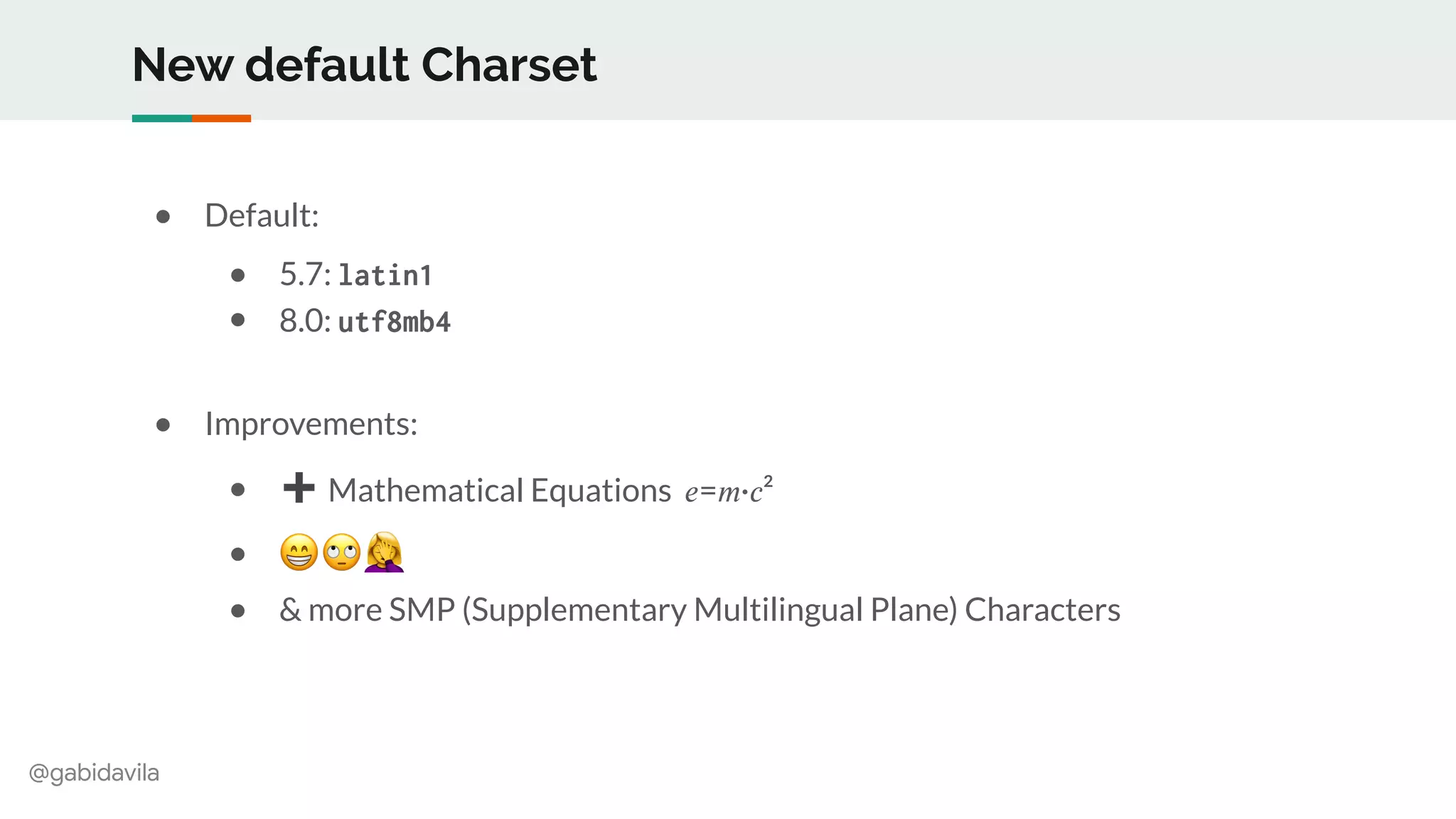
New default Charset
● Default:
● 5.7: latin1
● 8.0: utf8mb4
● Improvements:
● ➕ Mathematical Equations 𝑒=𝑚·𝑐²
● 😁 🙄 $
● & more SMP (Supplementary Multilingual Plane) Characters
@gabidavila
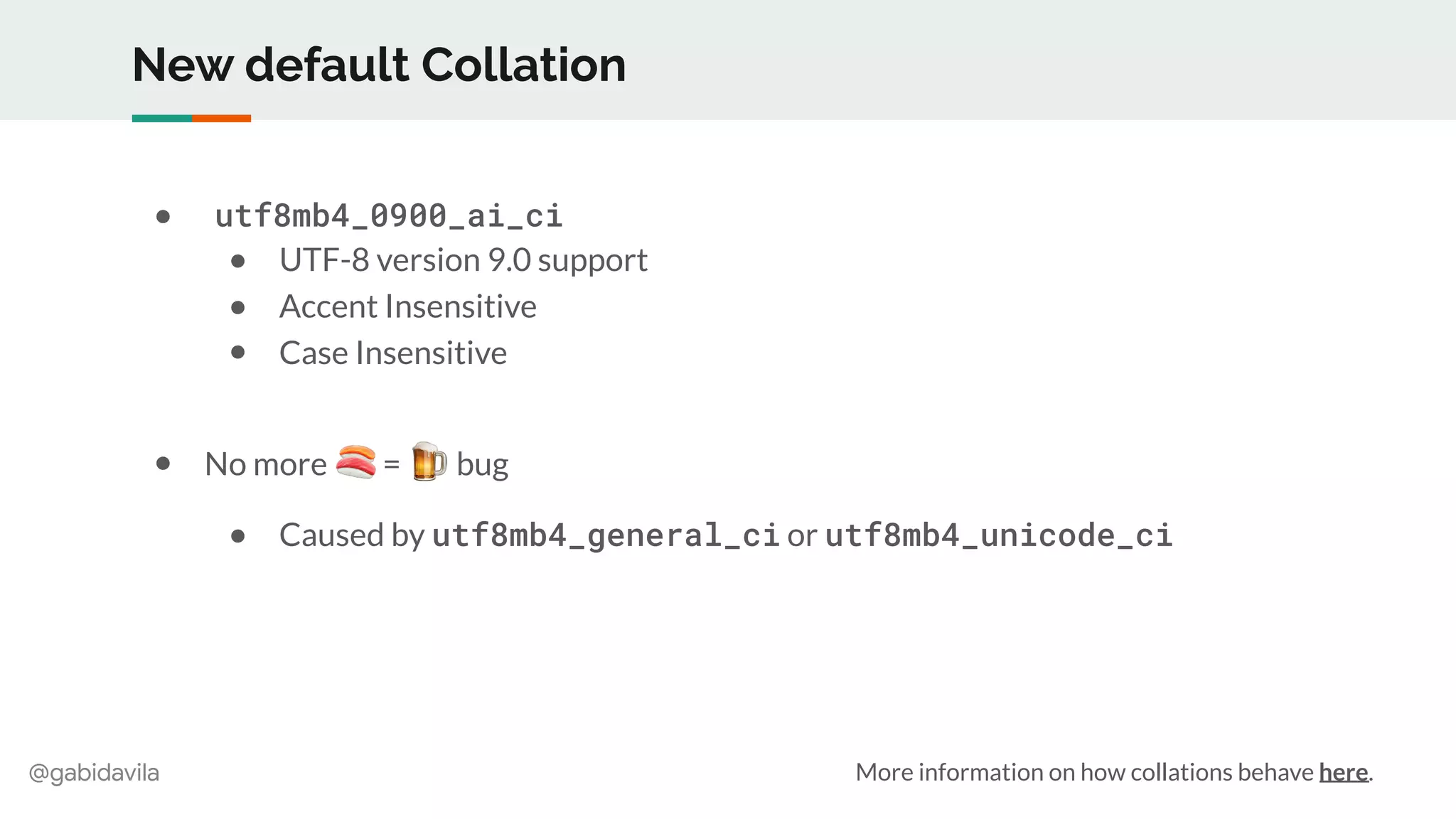
New default Collation
● utf8mb4_0900_ai_ci
● UTF-8 version 9.0 support
● Accent Insensitive
● Case Insensitive
● No more 🍣 = 🍺 bug
● Caused by utf8mb4_general_ci or utf8mb4_unicode_ci
More information on how collations behave here.
@gabidavila
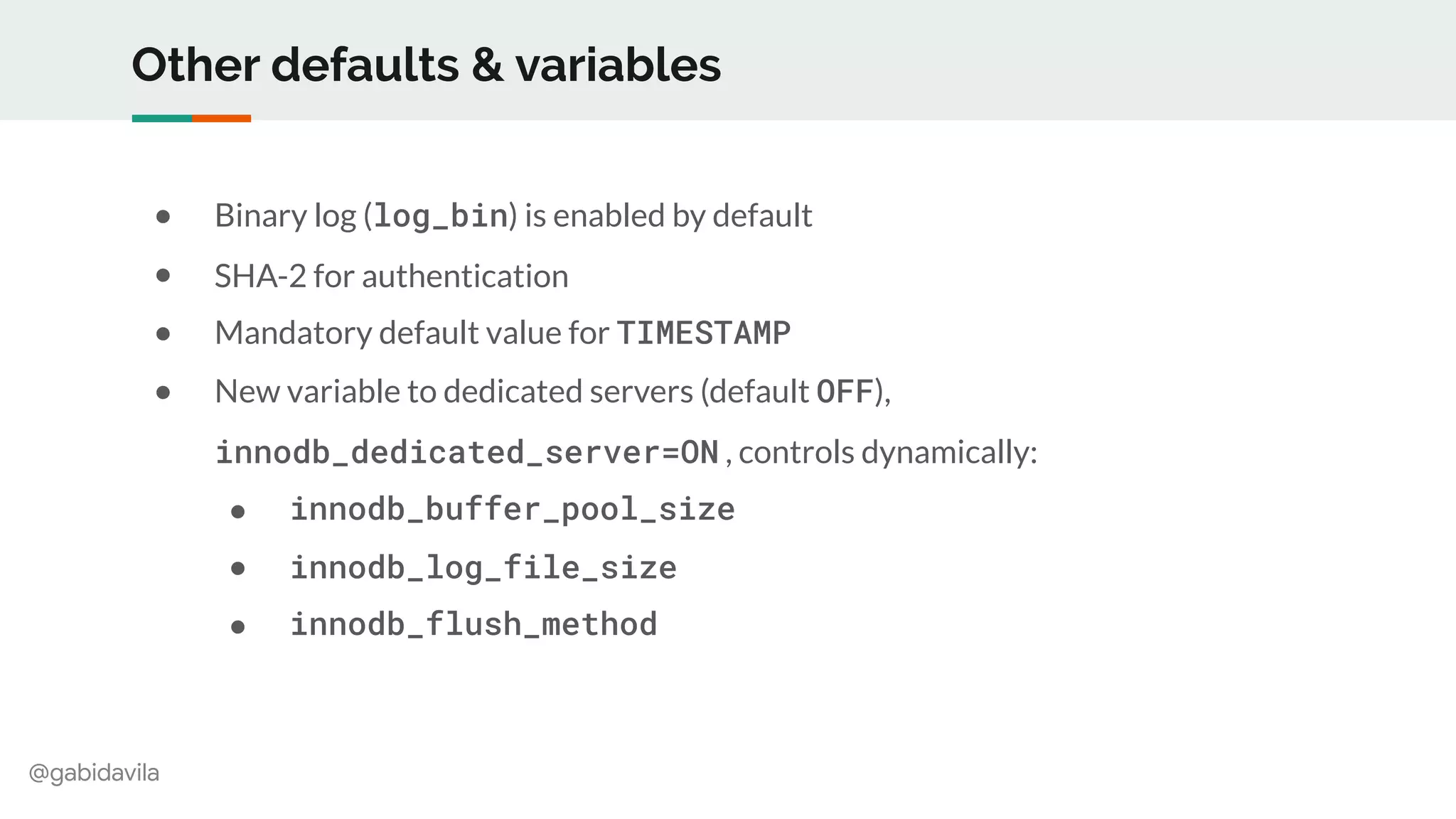
Other defaults & variables
● Binary log (log_bin) is enabled by default
● SHA-2 for authentication
● Mandatory default value for TIMESTAMP
● New variable to dedicated servers (default OFF),
innodb_dedicated_server=ON , controls dynamically:
● innodb_buffer_pool_size
● innodb_log_file_size
● innodb_flush_method
@gabidavila
Indexes
@gabidavila
Descending Indexes
@gabidavila
Descending Indexes
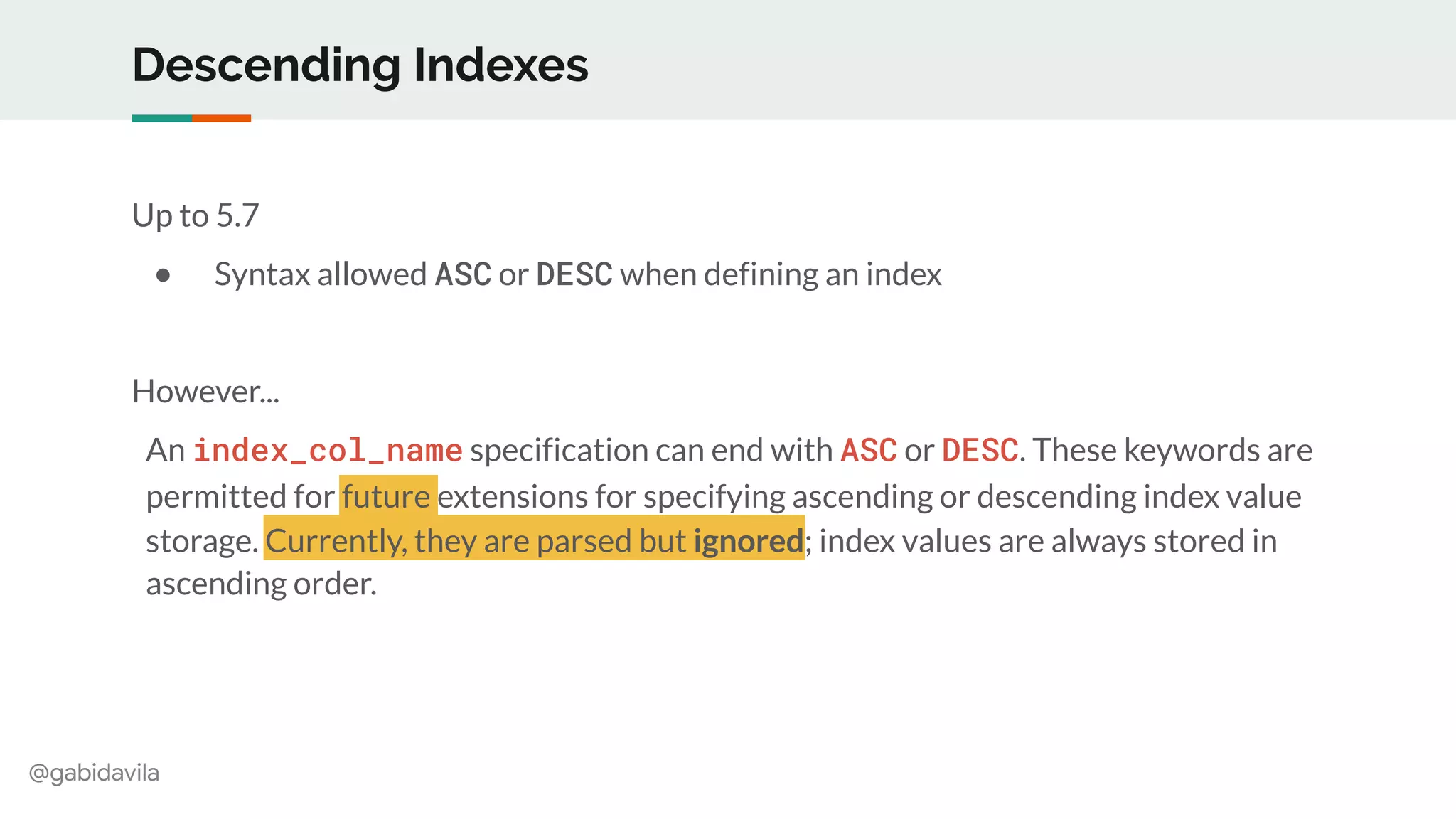
Up to 5.7
● Syntax allowed ASC or DESC when defining an index
However...
An index_col_name specification can end with ASC or DESC. These keywords are
permitted for future extensions for specifying ascending or descending index value
storage. Currently, they are parsed but ignored; index values are always stored in
ascending order.
@gabidavila
MySQL 8.0
@gabidavila
Descending Indexes
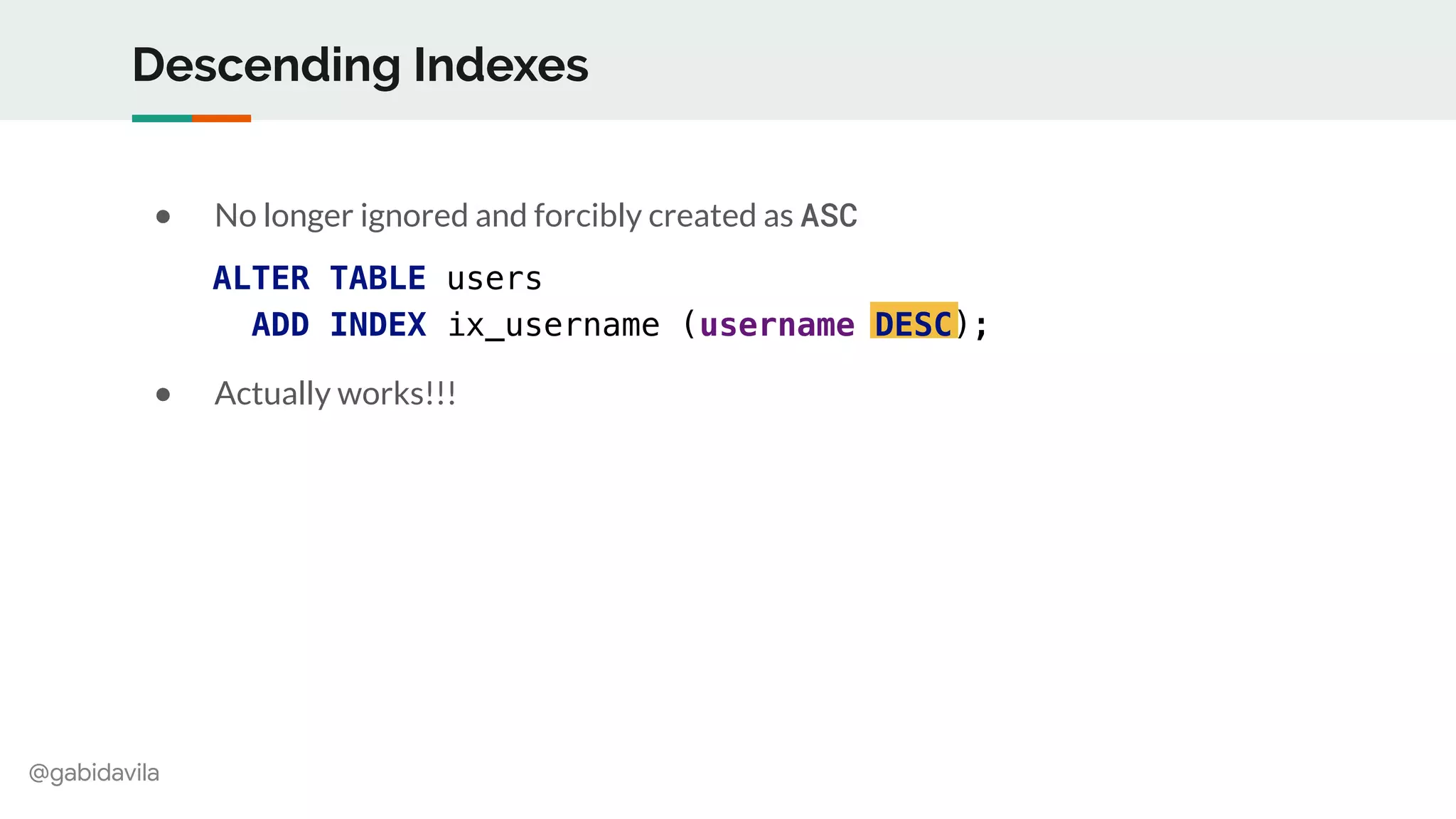
● No longer ignored and forcibly created as ASC
● Actually works!!!
ALTER TABLE users
ADD INDEX ix_username (username DESC);
@gabidavila
Descending Indexes
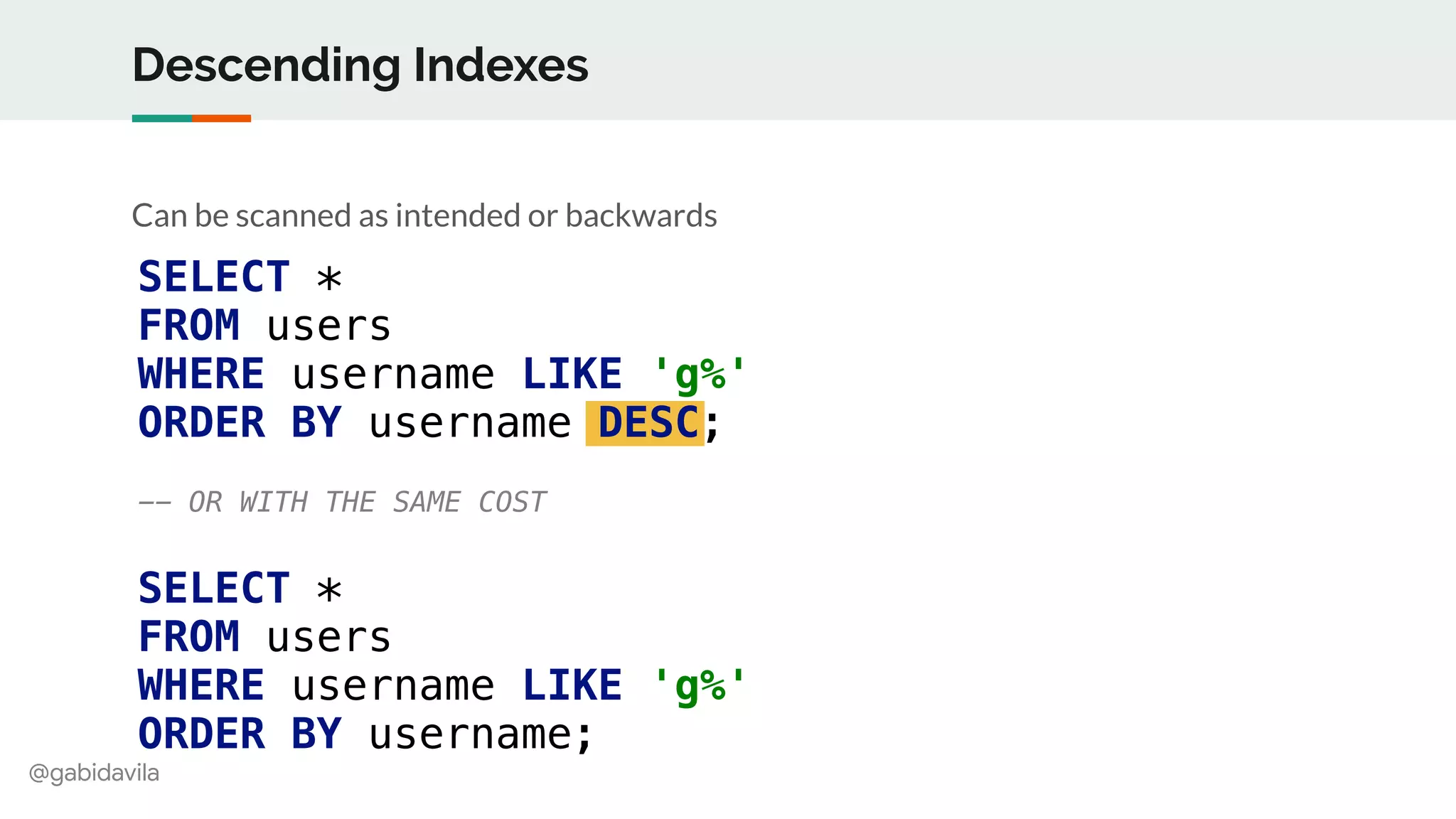
Can be scanned as intended or backwards
SELECT *
FROM users
WHERE username LIKE 'g%'
ORDER BY username DESC;
-- OR WITH THE SAME COST
SELECT *
FROM users
WHERE username LIKE 'g%'
ORDER BY username;
@gabidavila
Invisible (?) indexes
@gabidavila
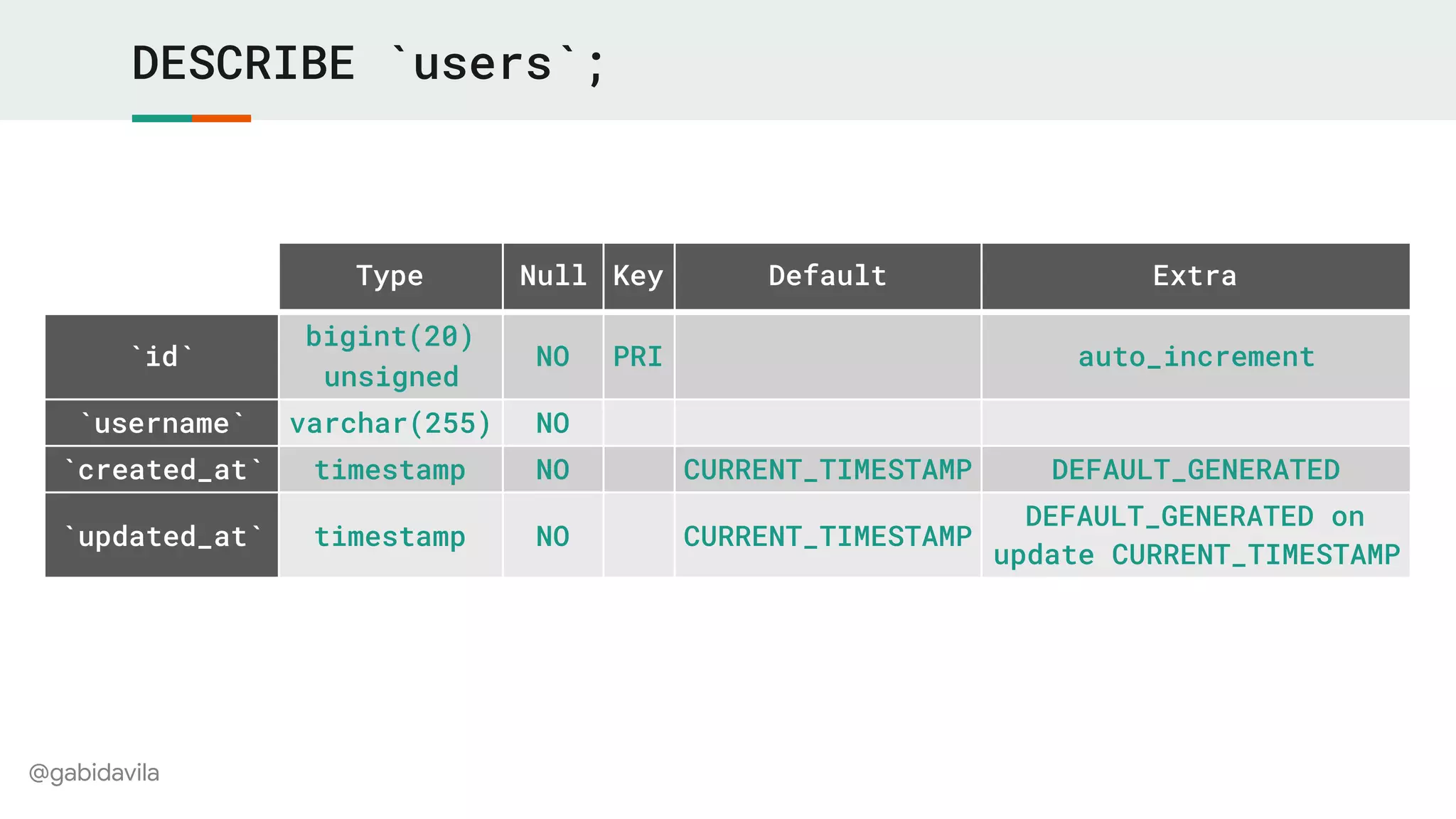
DESCRIBE `users`;
Type Null Key Default Extra
`id`
bigint(20)
unsigned
NO PRI auto_increment
`username` varchar(255) NO
`created_at` timestamp NO CURRENT_TIMESTAMP DEFAULT_GENERATED
`updated_at` timestamp NO CURRENT_TIMESTAMP
DEFAULT_GENERATED on
update CURRENT_TIMESTAMP
@gabidavila
Invisible Indexes
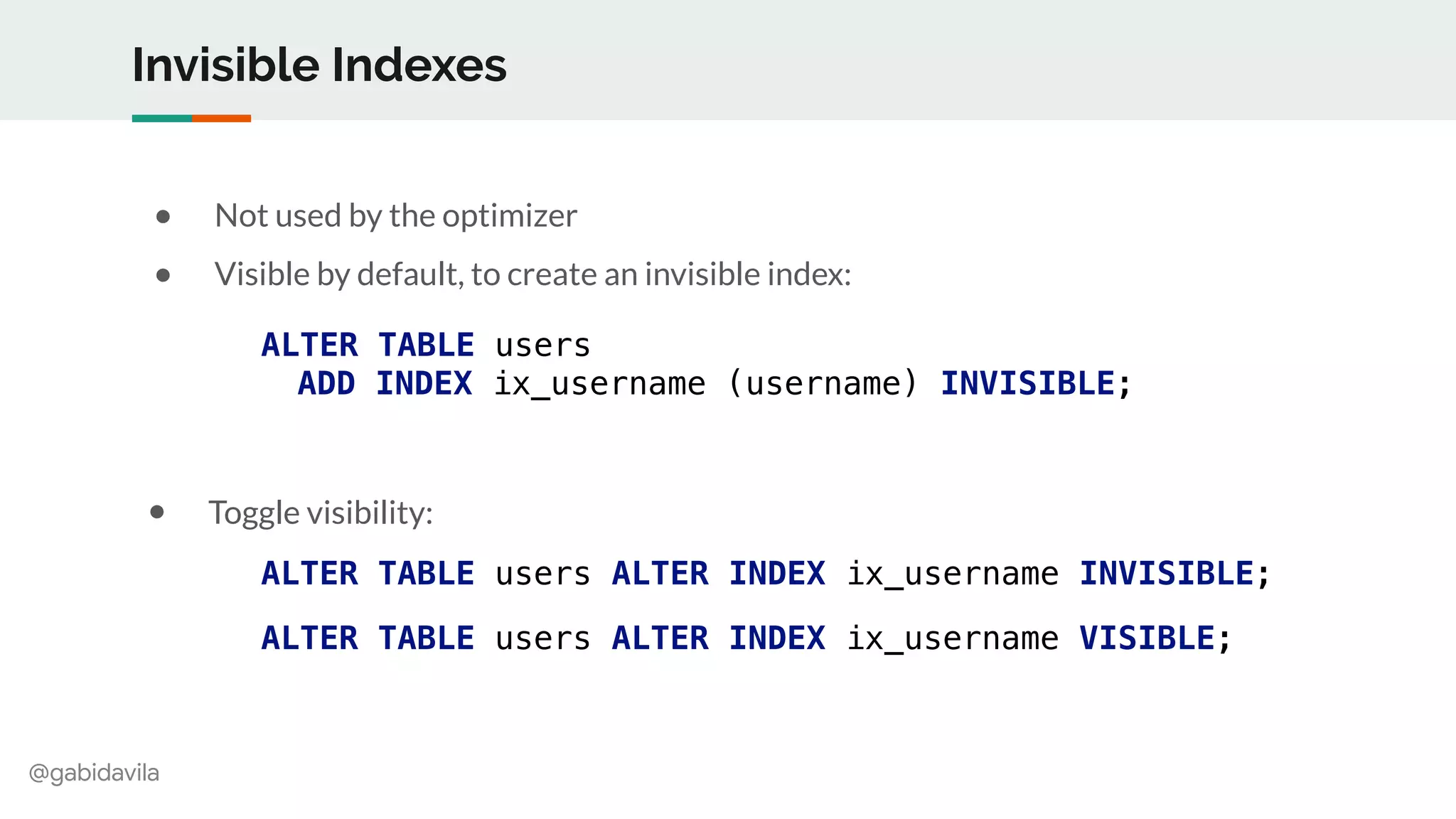
● Not used by the optimizer
● Visible by default, to create an invisible index:
ALTER TABLE users
ADD INDEX ix_username (username) INVISIBLE;
ALTER TABLE users ALTER INDEX ix_username INVISIBLE;
ALTER TABLE users ALTER INDEX ix_username VISIBLE;
● Toggle visibility:
@gabidavila
Invisible Indexes
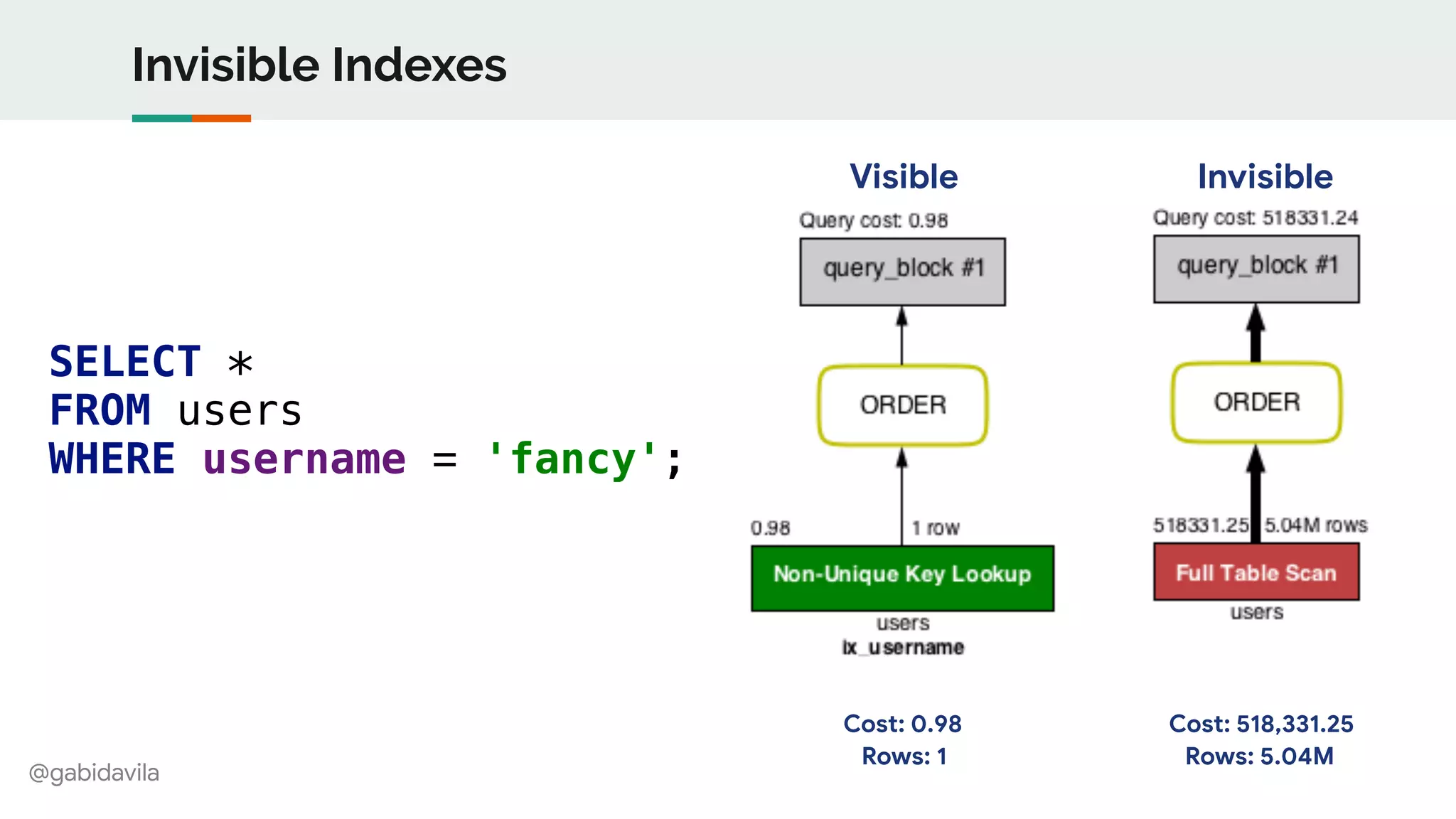
SELECT *
FROM users
WHERE username = 'fancy';
Visible
Cost: 0.98

Rows: 1
Invisible
Cost: 518,331.25

Rows: 5.04M
@gabidavila
Demo
@gabidavila
ALGORITHM=INSTANT
@gabidavila
Instant
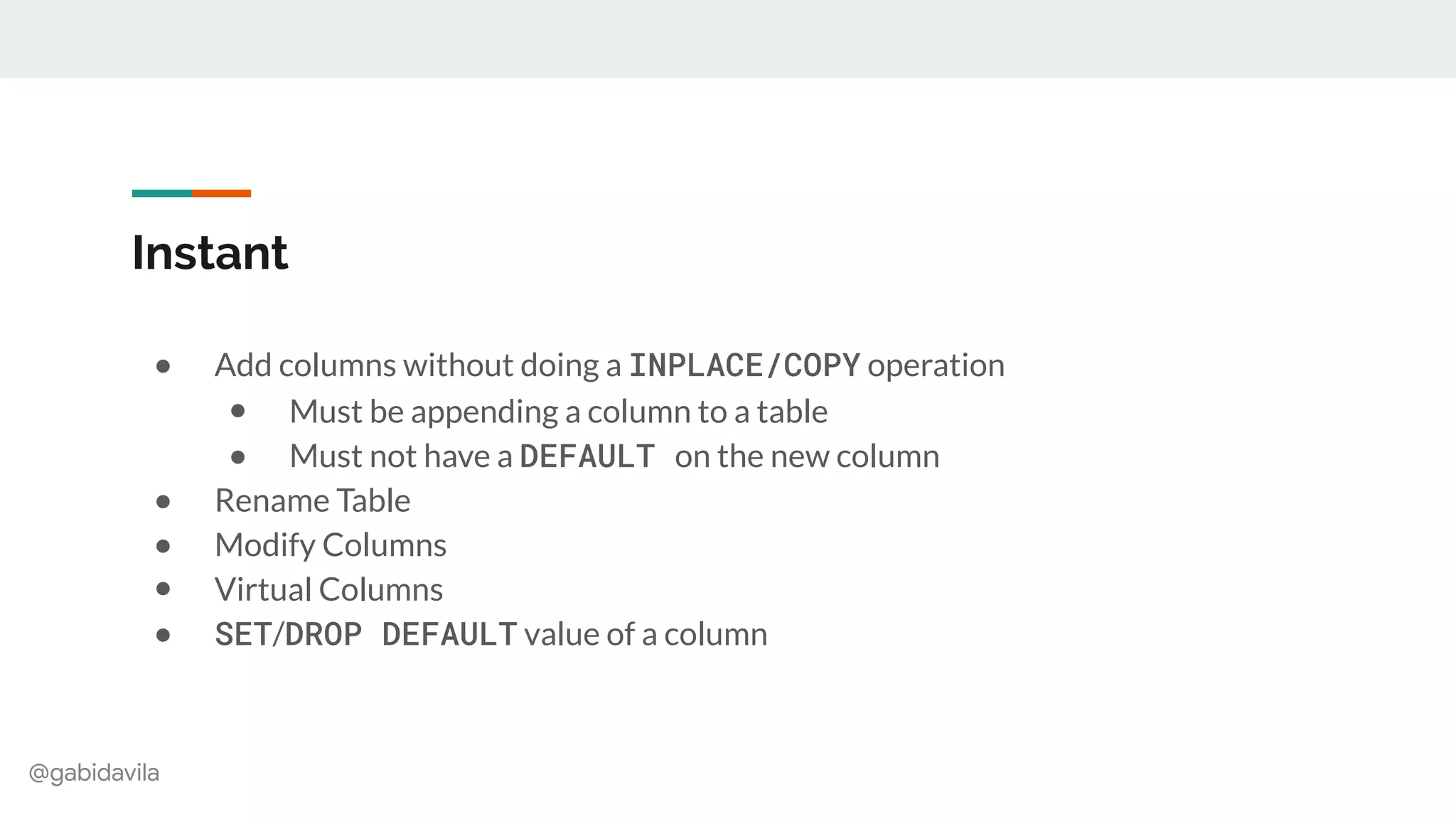
● Add columns without doing a INPLACE/COPY operation
● Must be appending a column to a table
● Must not have a DEFAULT on the new column
● Rename Table
● Modify Columns
● Virtual Columns
● SET/DROP DEFAULT value of a column
@gabidavila
Example
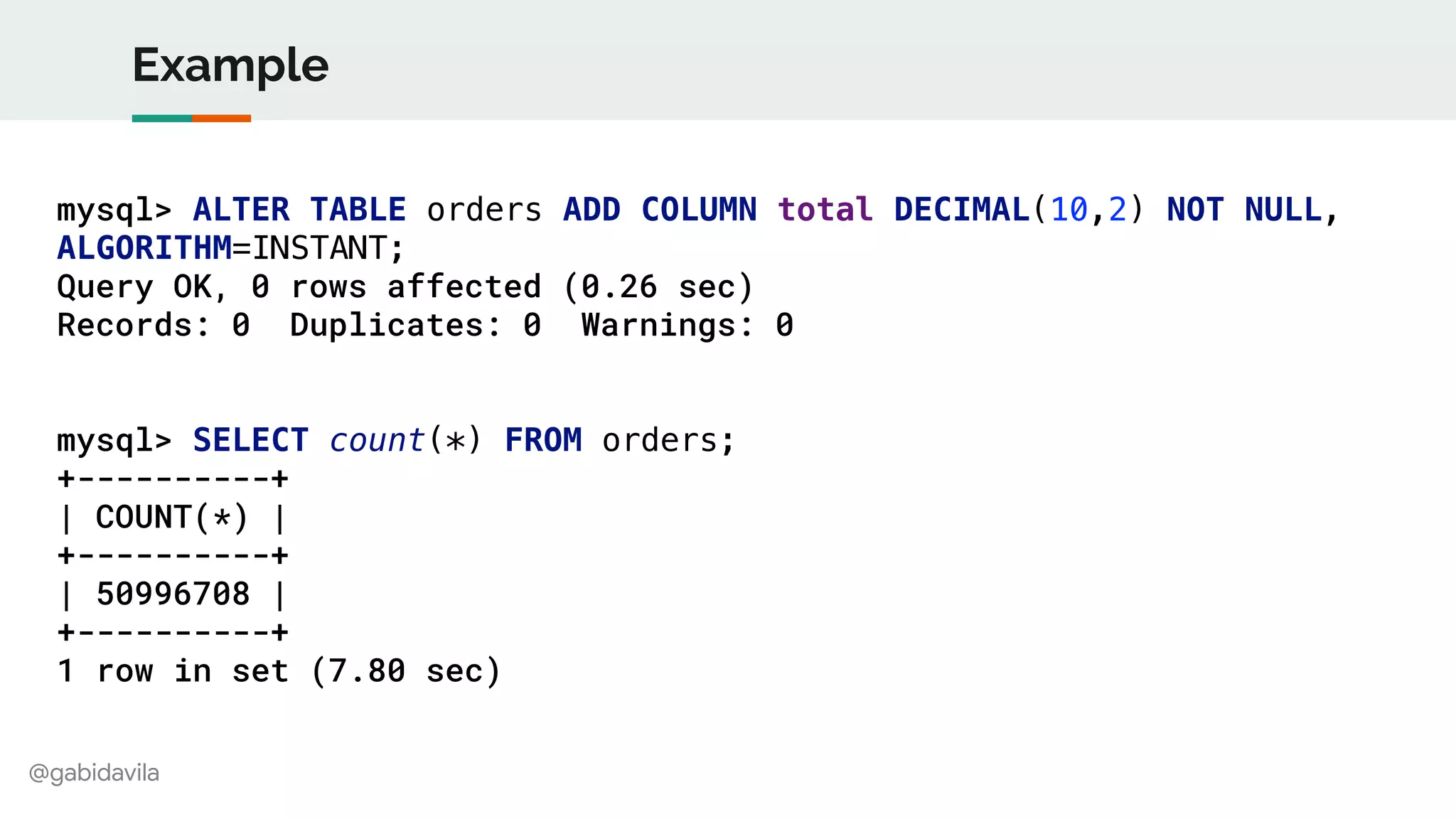
mysql> ALTER TABLE orders ADD COLUMN total DECIMAL(10,2) NOT NULL,
ALGORITHM=INSTANT;
Query OK, 0 rows affected (0.26 sec)
Records: 0 Duplicates: 0 Warnings: 0
mysql> SELECT count(*) FROM orders;
+----------+
| COUNT(*) |
+----------+
| 50996708 |
+----------+
1 row in set (7.80 sec)
@gabidavila
@gabidavila
Window Functions
@gabidavila
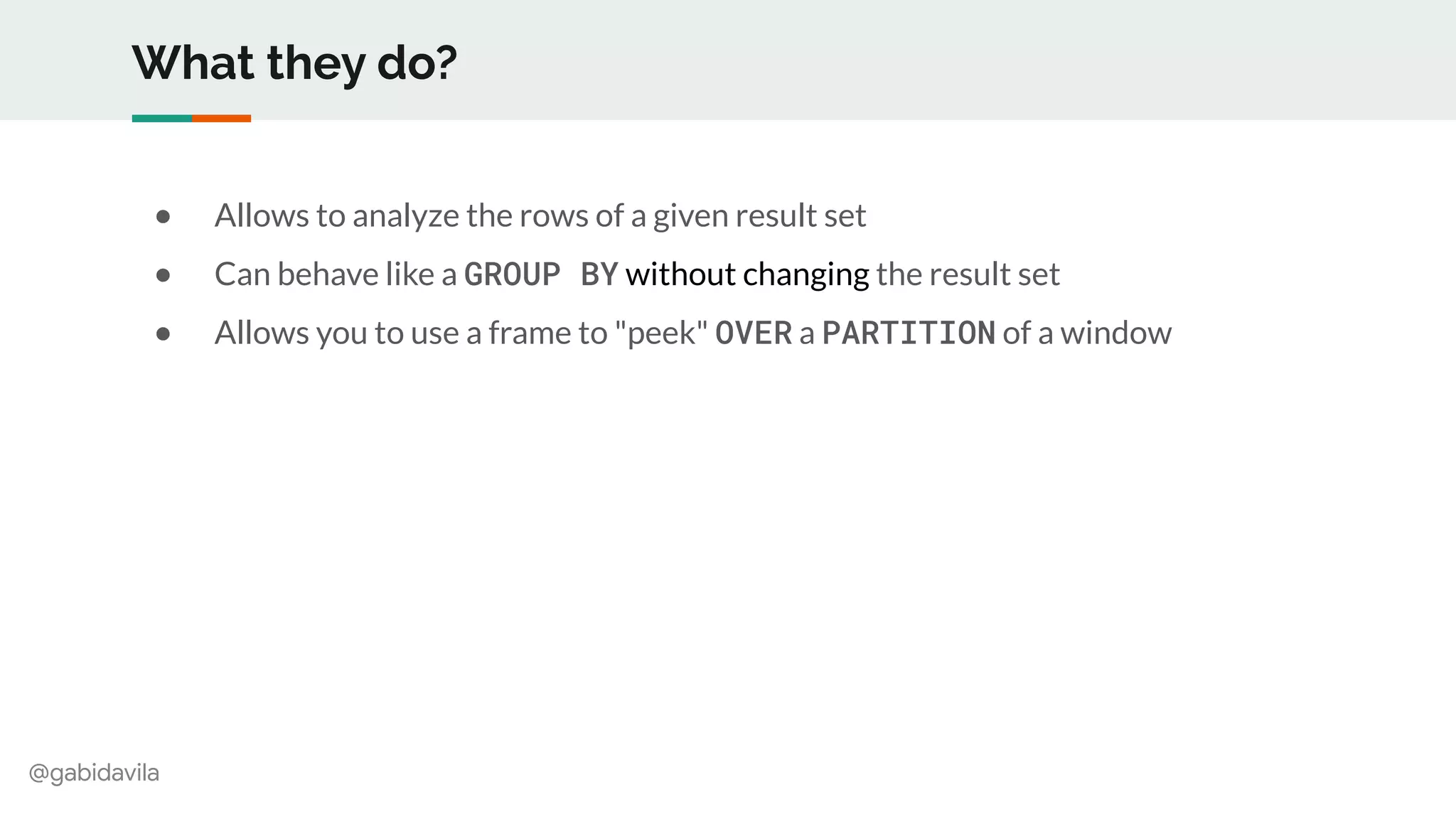
What they do?
● Allows to analyze the rows of a given result set
● Can behave like a GROUP BY without changing the result set
● Allows you to use a frame to "peek" OVER a PARTITION of a window
@gabidavila
@gabidavila
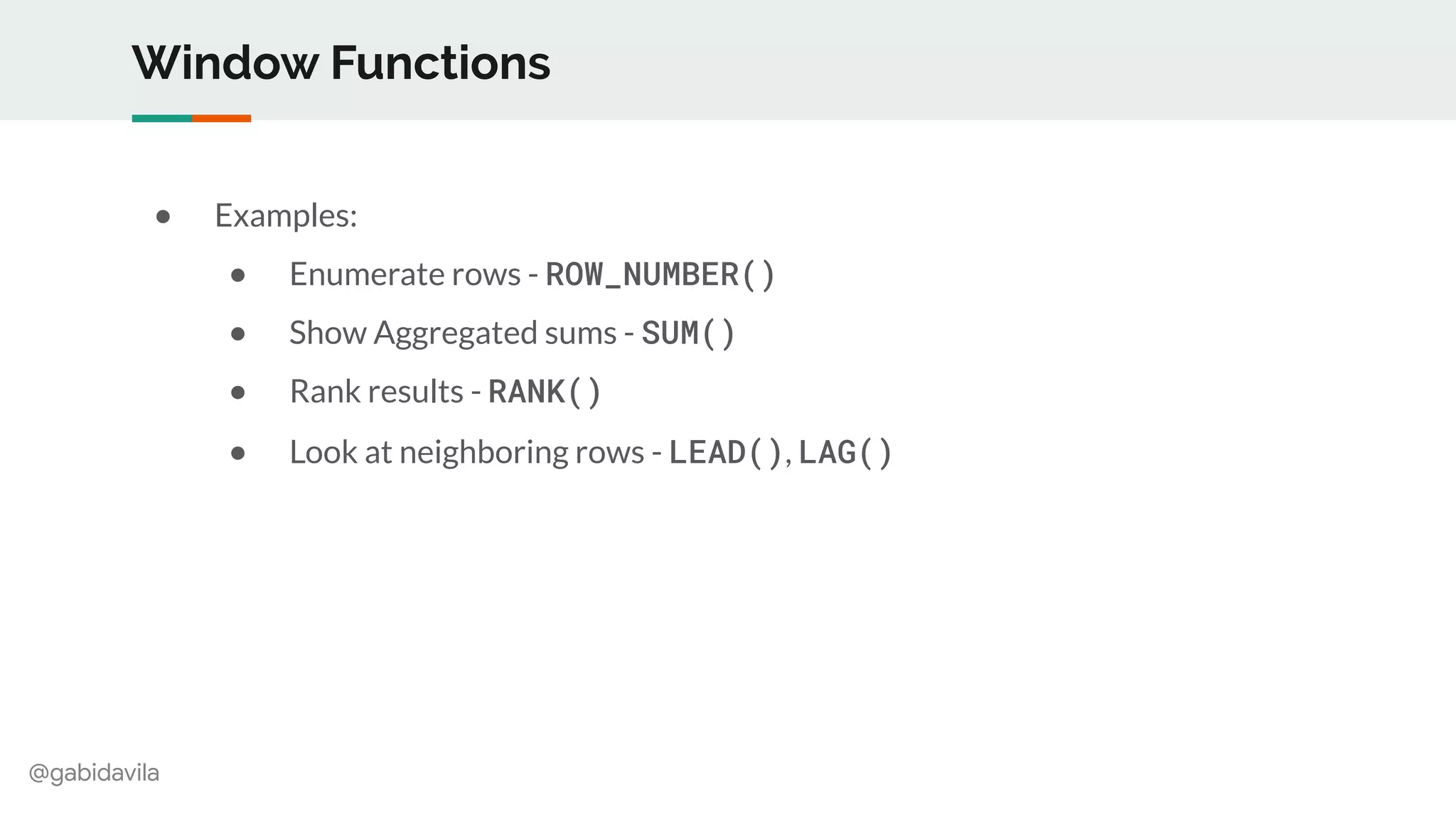
Window Functions
● Examples:
● Enumerate rows - ROW_NUMBER()
● Show Aggregated sums - SUM()
● Rank results - RANK()
● Look at neighboring rows - LEAD(), LAG()
@gabidavila
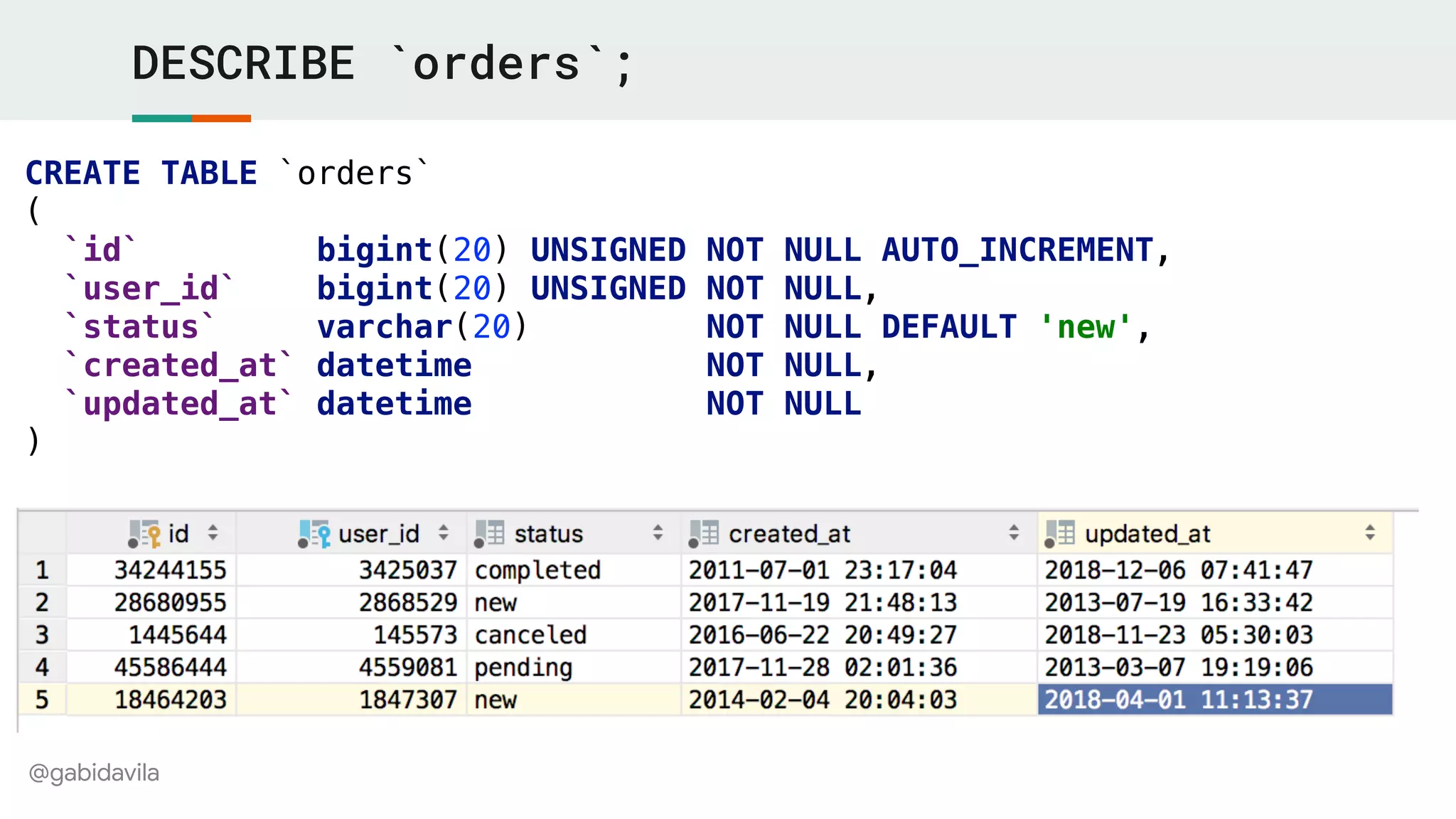
DESCRIBE `orders`;
CREATE TABLE `orders`
(
`id` bigint(20) UNSIGNED NOT NULL AUTO_INCREMENT,
`user_id` bigint(20) UNSIGNED NOT NULL,
`status` varchar(20) NOT NULL DEFAULT 'new',
`created_at` datetime NOT NULL,
`updated_at` datetime NOT NULL
)
@gabidavila
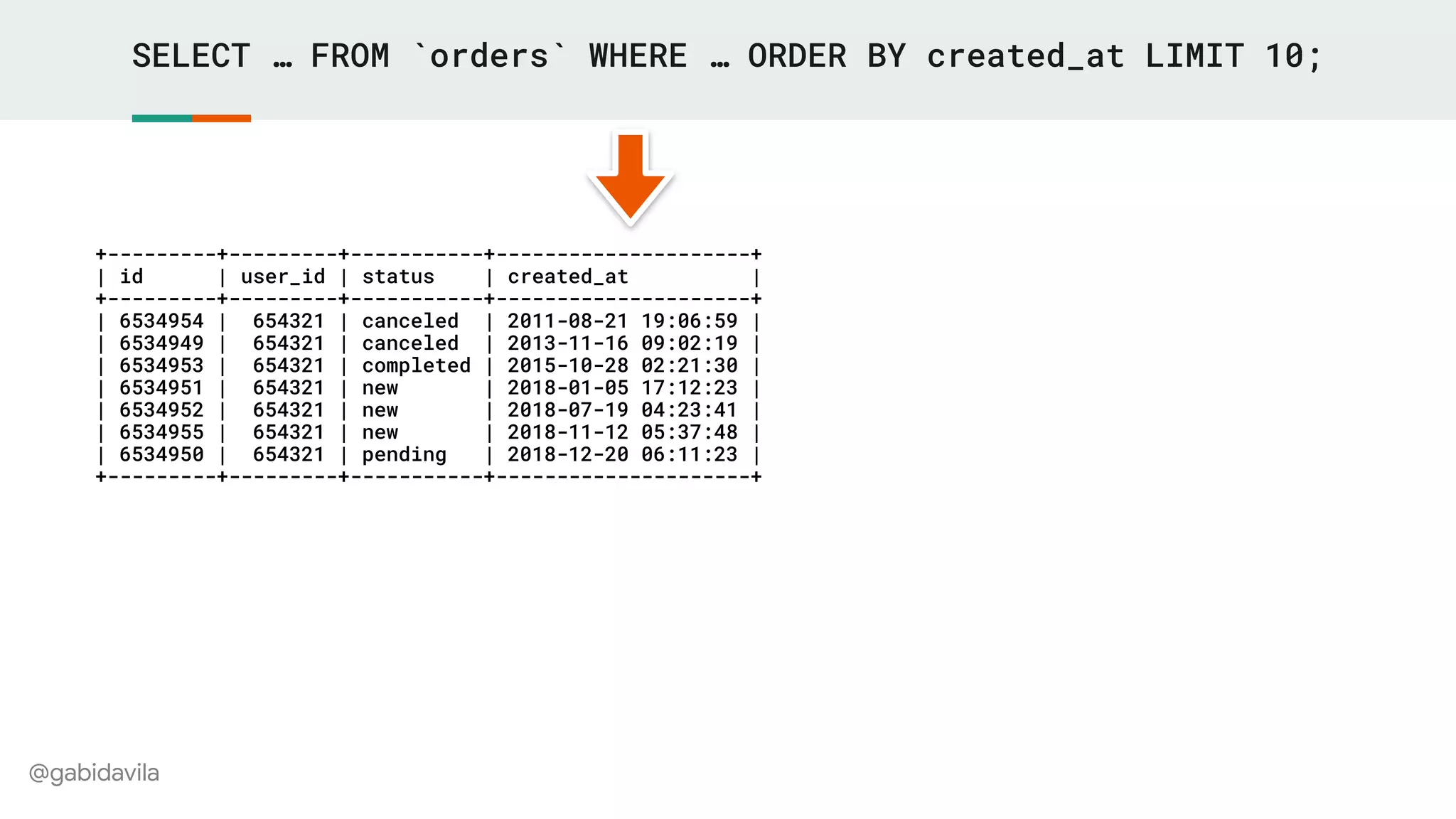
SELECT … FROM `orders` WHERE … ORDER BY created_at LIMIT 10;
+---------+---------+-----------+---------------------+
| id | user_id | status | created_at |
+---------+---------+-----------+---------------------+
| 6534954 | 654321 | canceled | 2011-08-21 19:06:59 |
| 6534949 | 654321 | canceled | 2013-11-16 09:02:19 |
| 6534953 | 654321 | completed | 2015-10-28 02:21:30 |
| 6534951 | 654321 | new | 2018-01-05 17:12:23 |
| 6534952 | 654321 | new | 2018-07-19 04:23:41 |
| 6534955 | 654321 | new | 2018-11-12 05:37:48 |
| 6534950 | 654321 | pending | 2018-12-20 06:11:23 |
+---------+---------+-----------+---------------------+
@gabidavila
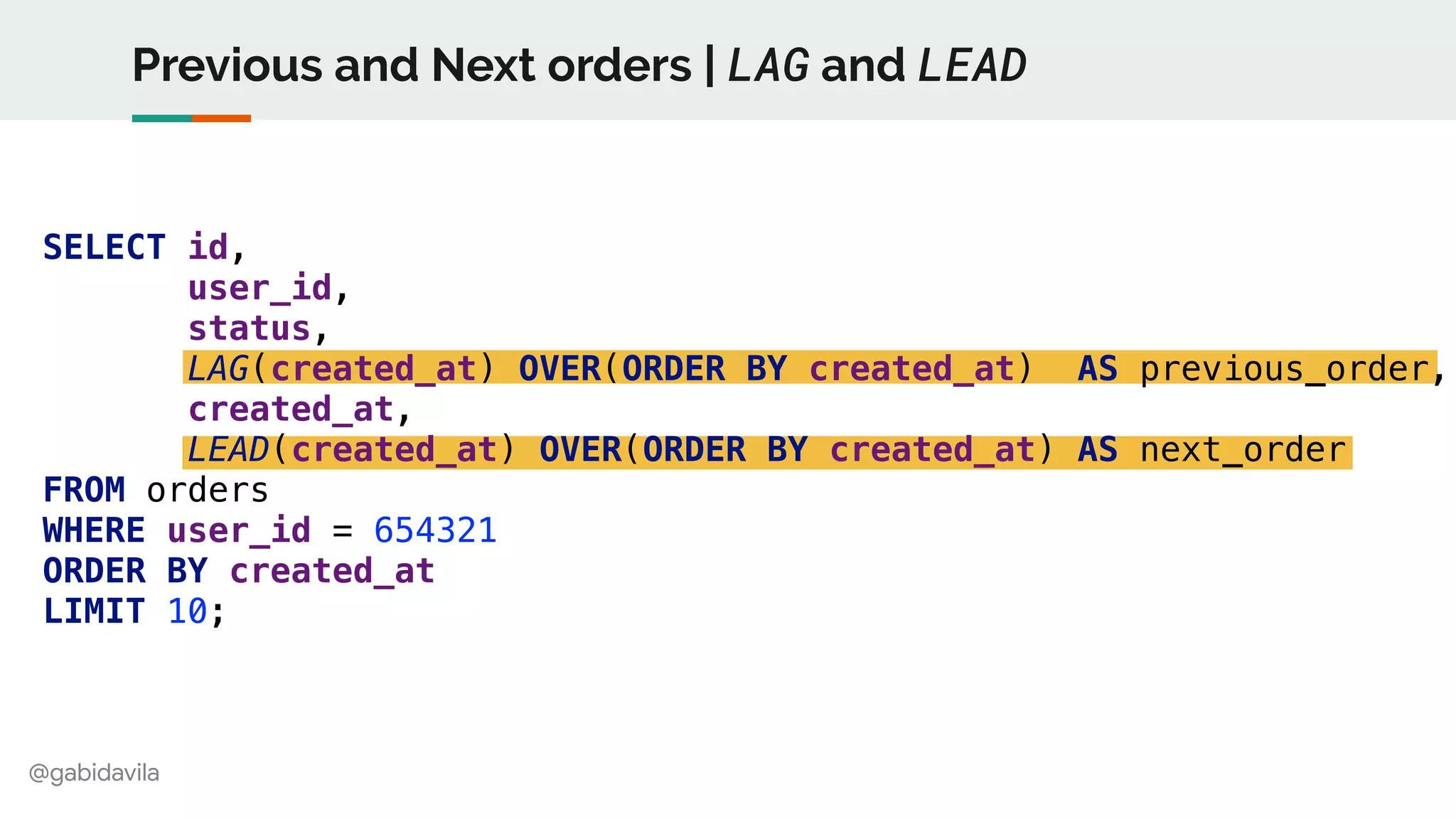
Previous and Next orders | LAG and LEAD
SELECT id,
user_id,
status,
LAG(created_at) OVER(ORDER BY created_at) AS previous_order,
created_at,
LEAD(created_at) OVER(ORDER BY created_at) AS next_order
FROM orders
WHERE user_id = 654321
ORDER BY created_at
LIMIT 10;
@gabidavila
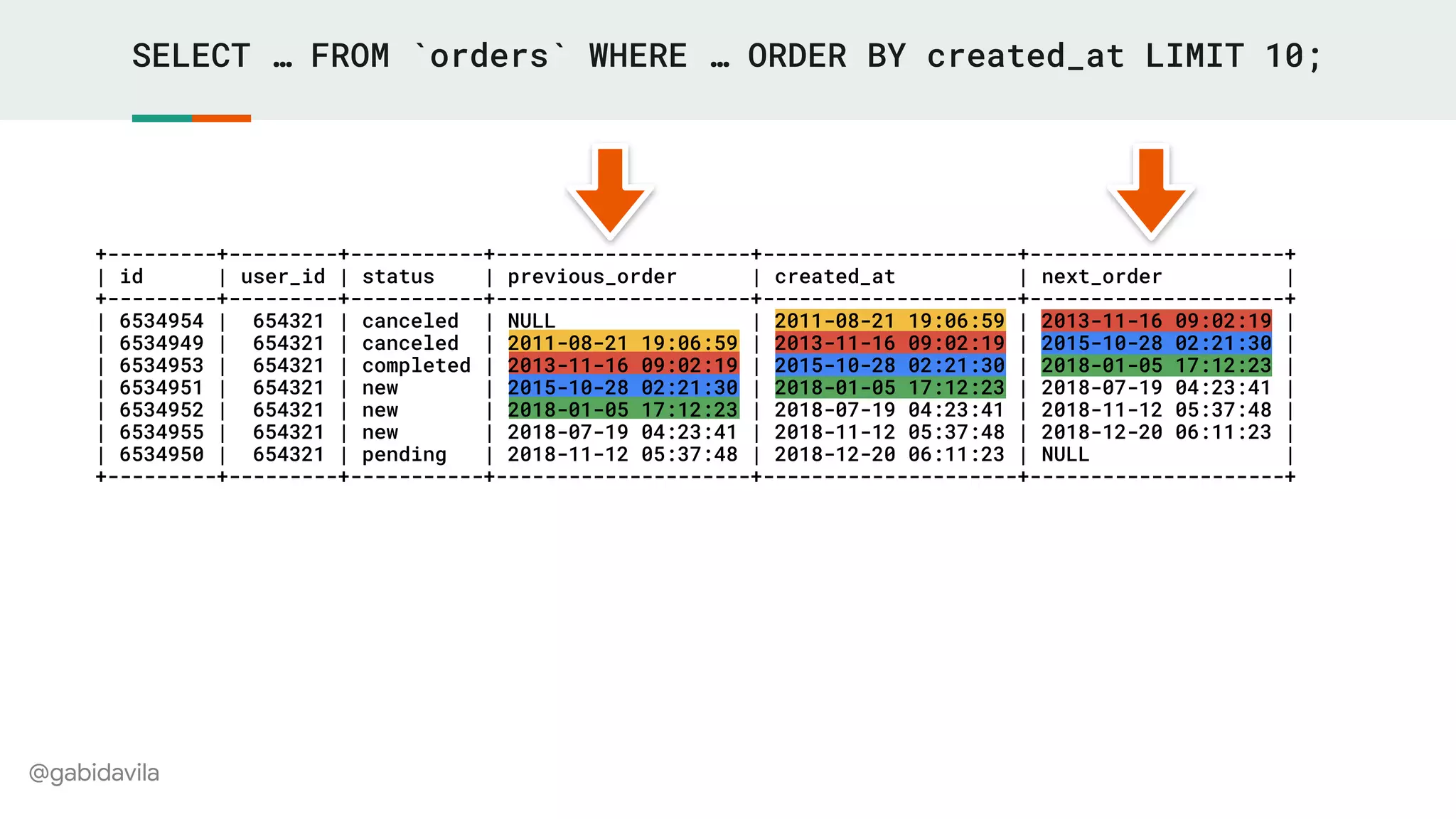
SELECT … FROM `orders` WHERE … ORDER BY created_at LIMIT 10;
+---------+---------+-----------+---------------------+---------------------+---------------------+
| id | user_id | status | previous_order | created_at | next_order |
+---------+---------+-----------+---------------------+---------------------+---------------------+
| 6534954 | 654321 | canceled | NULL | 2011-08-21 19:06:59 | 2013-11-16 09:02:19 |
| 6534949 | 654321 | canceled | 2011-08-21 19:06:59 | 2013-11-16 09:02:19 | 2015-10-28 02:21:30 |
| 6534953 | 654321 | completed | 2013-11-16 09:02:19 | 2015-10-28 02:21:30 | 2018-01-05 17:12:23 |
| 6534951 | 654321 | new | 2015-10-28 02:21:30 | 2018-01-05 17:12:23 | 2018-07-19 04:23:41 |
| 6534952 | 654321 | new | 2018-01-05 17:12:23 | 2018-07-19 04:23:41 | 2018-11-12 05:37:48 |
| 6534955 | 654321 | new | 2018-07-19 04:23:41 | 2018-11-12 05:37:48 | 2018-12-20 06:11:23 |
| 6534950 | 654321 | pending | 2018-11-12 05:37:48 | 2018-12-20 06:11:23 | NULL |
+---------+---------+-----------+---------------------+---------------------+---------------------+
@gabidavila
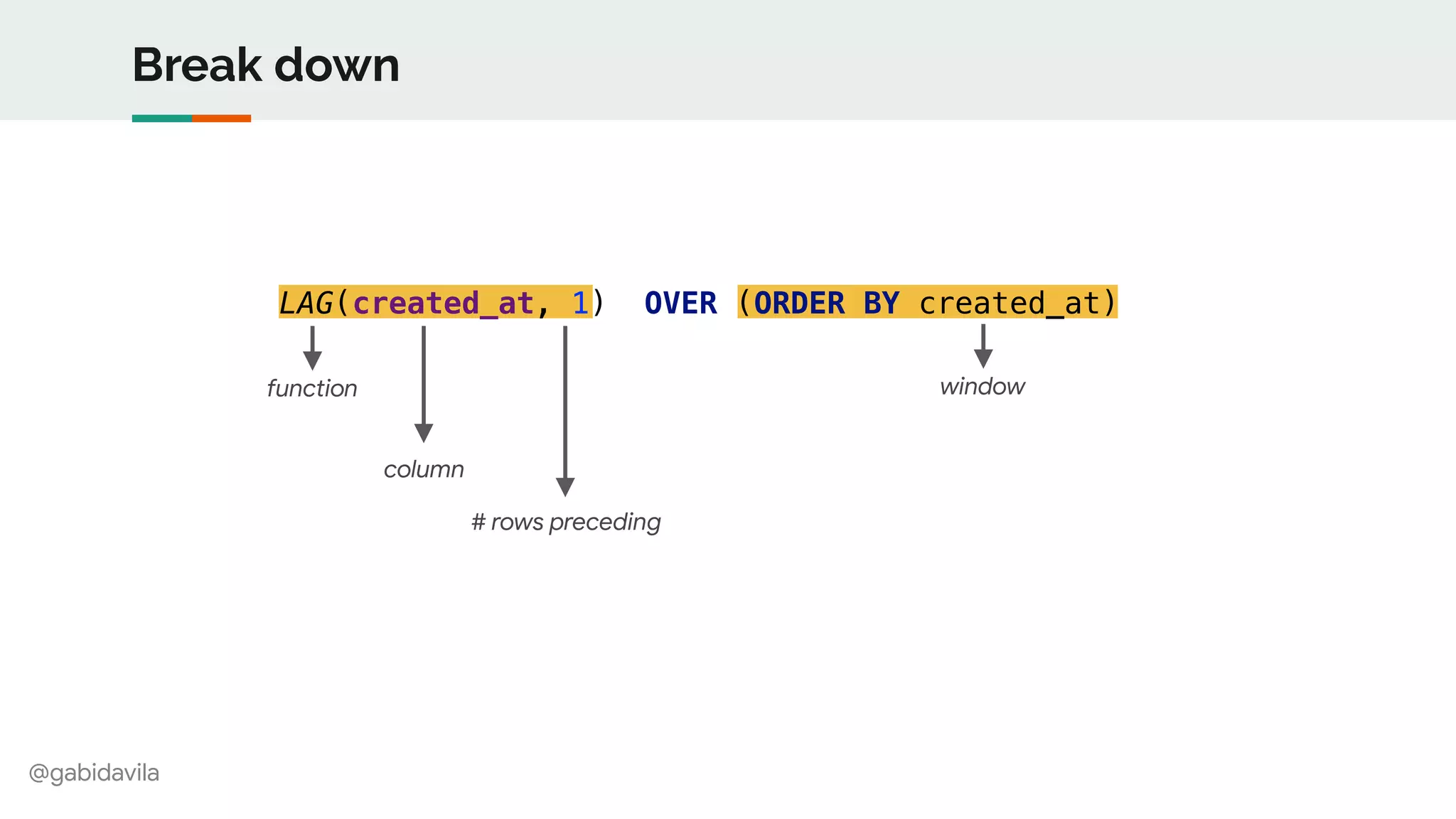
Break down
windowfunction
column
# rows preceding
LAG(created_at, 1) OVER (ORDER BY created_at)
@gabidavila
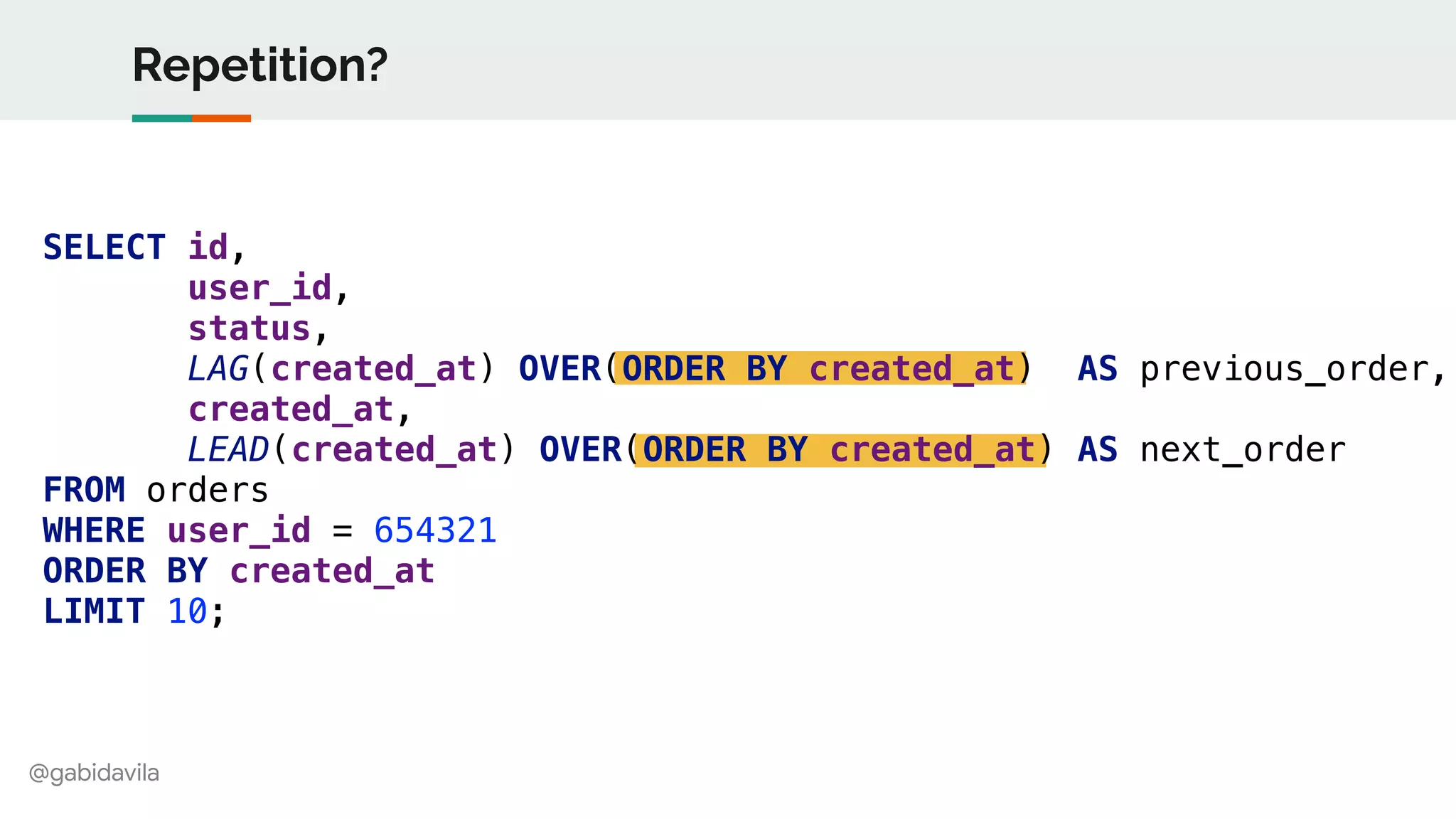
Repetition?
SELECT id,
user_id,
status,
LAG(created_at) OVER(ORDER BY created_at) AS previous_order,
created_at,
LEAD(created_at) OVER(ORDER BY created_at) AS next_order
FROM orders
WHERE user_id = 654321
ORDER BY created_at
LIMIT 10;
@gabidavila
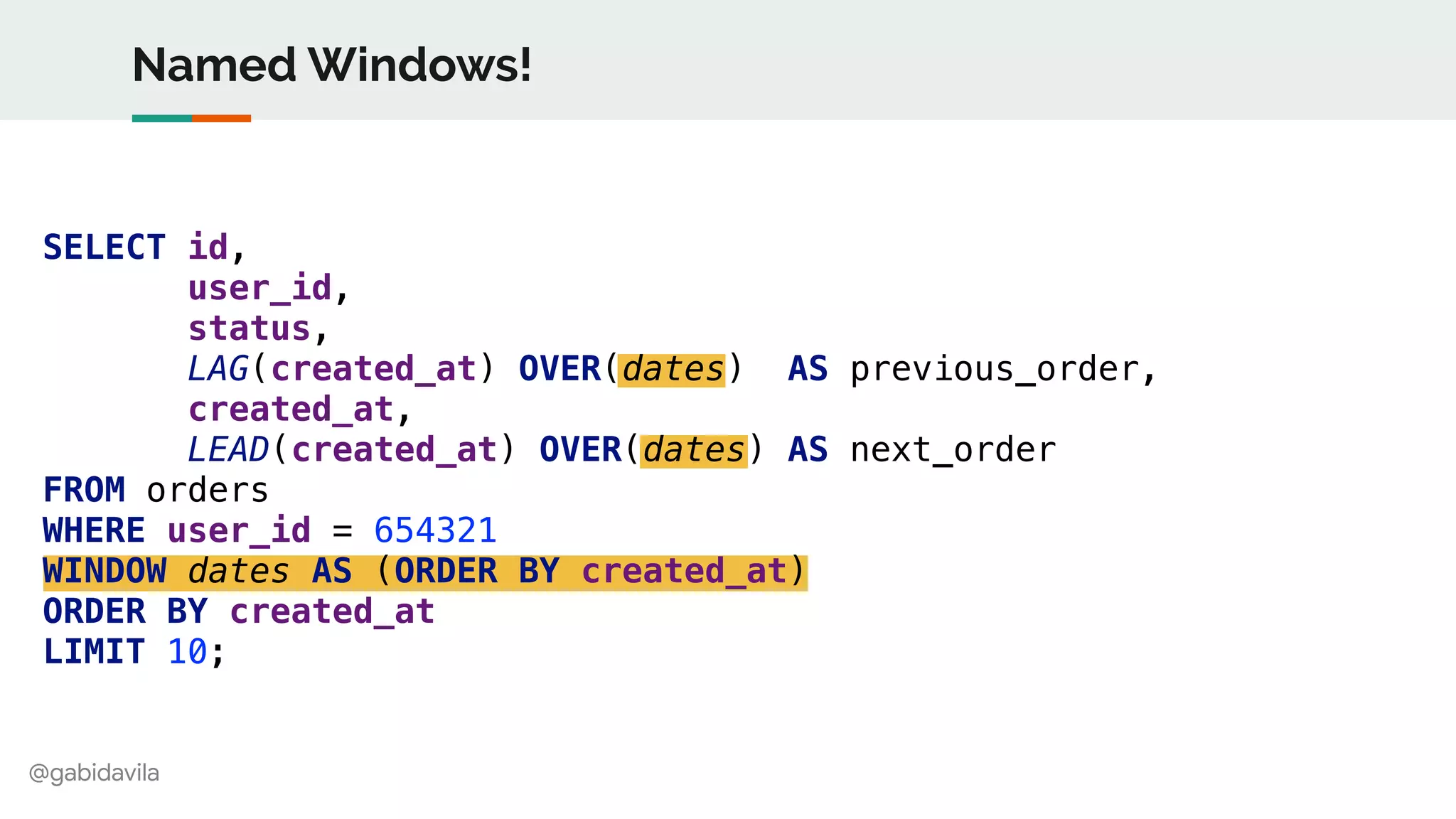
SELECT id,
user_id,
status,
LAG(created_at) OVER(dates) AS previous_order,
created_at,
LEAD(created_at) OVER(dates) AS next_order
FROM orders
WHERE user_id = 654321
WINDOW dates AS (ORDER BY created_at)
ORDER BY created_at
LIMIT 10;
Named Windows!
@gabidavila
Demo
@gabidavila
CTE

Common Table Expressions
CTE
@gabidavila
Common Table Expressions
● Similar to CREATE [TEMPORARY] TABLE
● Doesn’t need CREATE privilege
● Can reference other CTEs (if those are already defined)
● Can be recursive
● Easier to read
@gabidavila
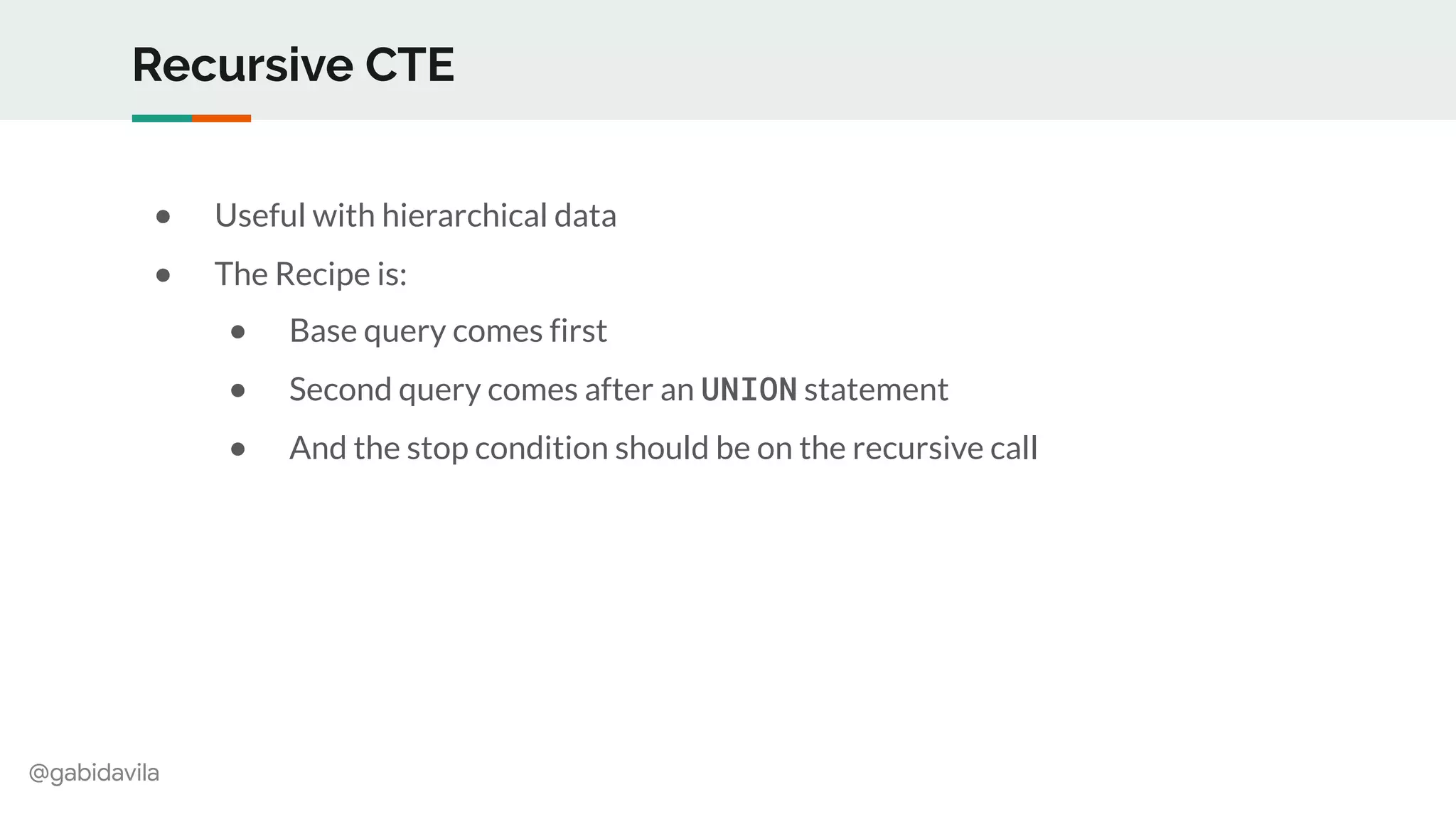
Recursive CTE
● Useful with hierarchical data
● The Recipe is:
● Base query comes first
● Second query comes after an UNION statement
● And the stop condition should be on the recursive call
@gabidavila
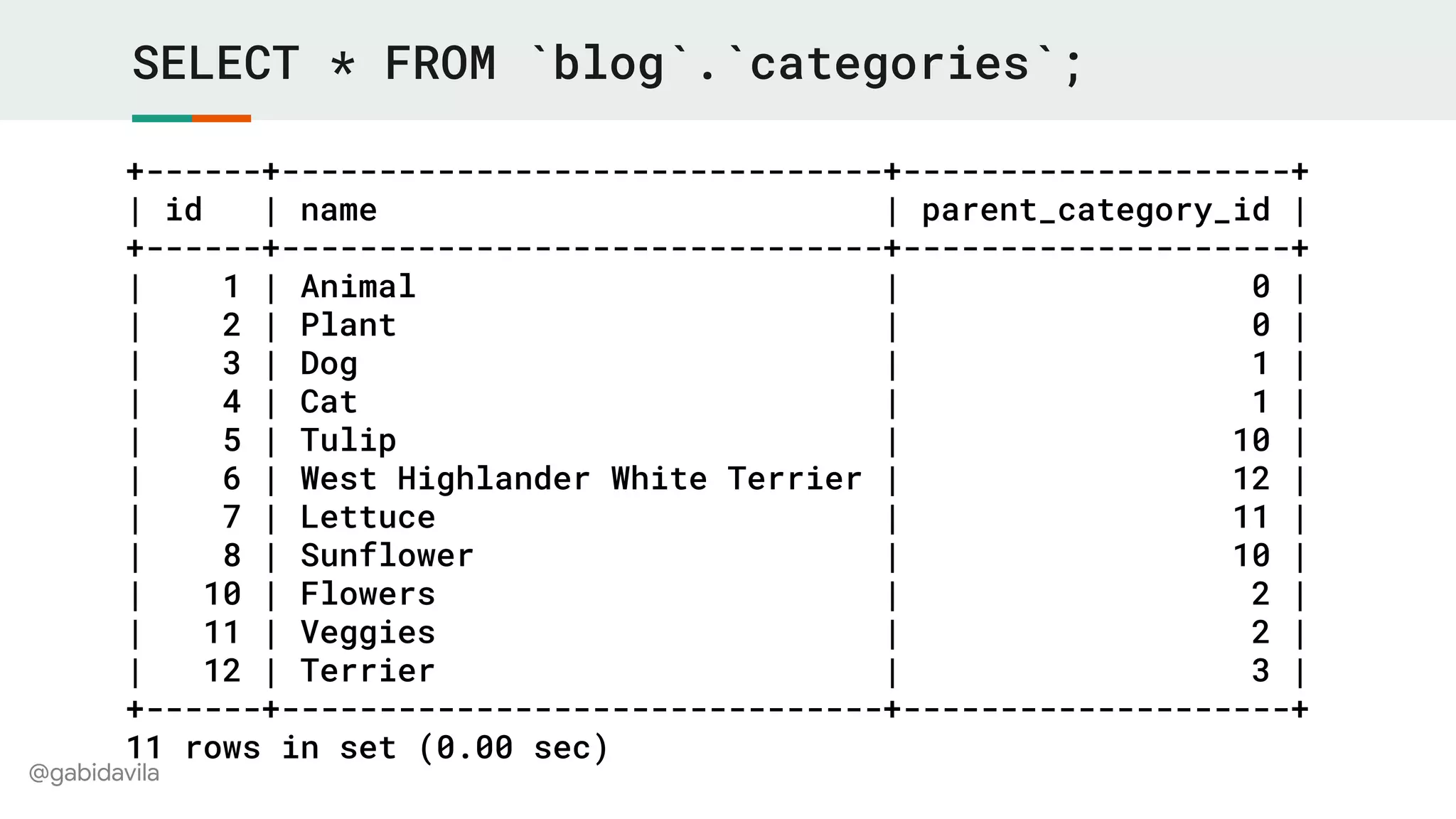
SELECT * FROM `blog`.`categories`;
+------+-------------------------------+--------------------+
| id | name | parent_category_id |
+------+-------------------------------+--------------------+
| 1 | Animal | 0 |
| 2 | Plant | 0 |
| 3 | Dog | 1 |
| 4 | Cat | 1 |
| 5 | Tulip | 10 |
| 6 | West Highlander White Terrier | 12 |
| 7 | Lettuce | 11 |
| 8 | Sunflower | 10 |
| 10 | Flowers | 2 |
| 11 | Veggies | 2 |
| 12 | Terrier | 3 |
+------+-------------------------------+--------------------+
11 rows in set (0.00 sec)
@gabidavila
Demo
@gabidavila
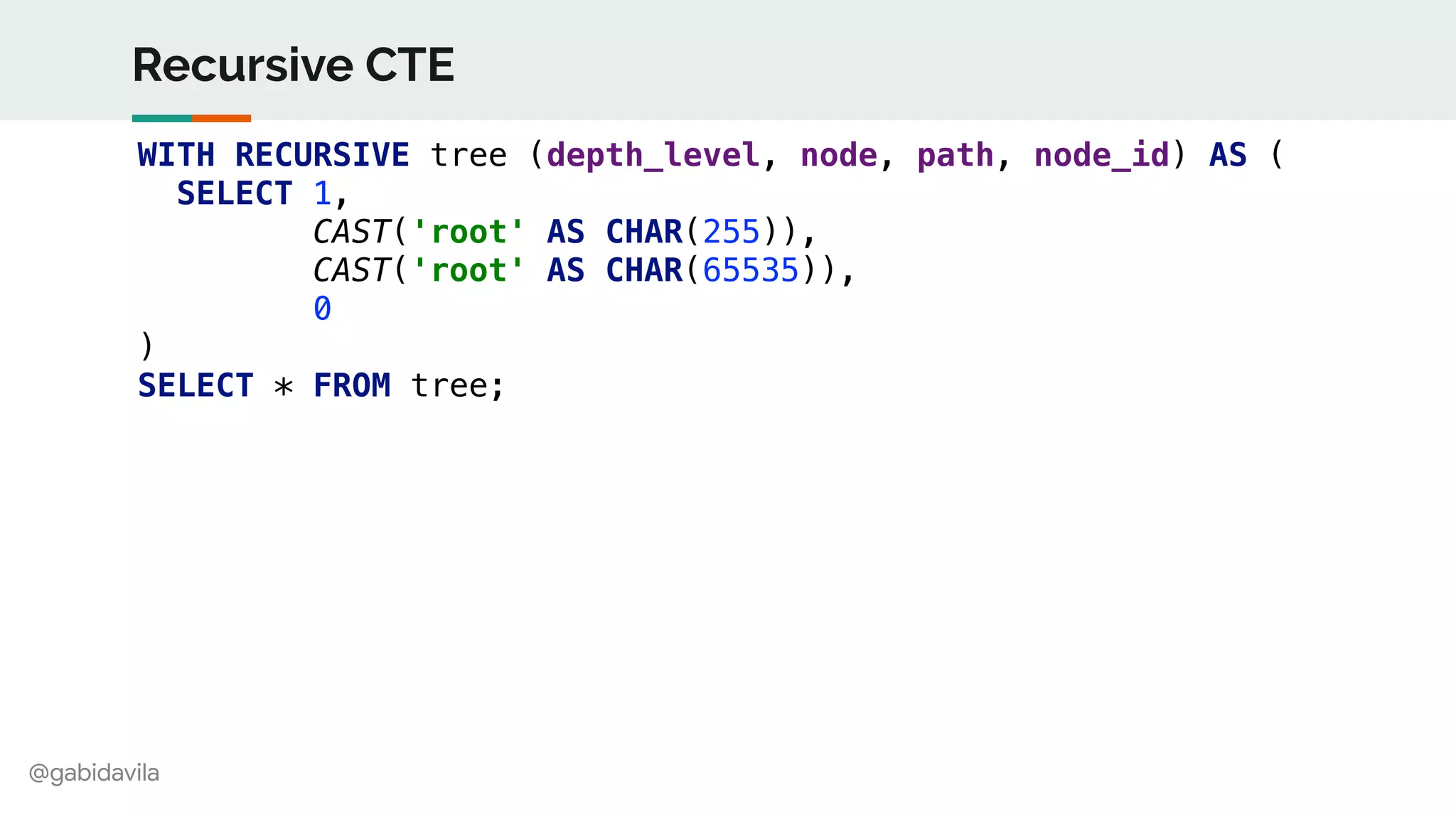
Recursive CTE
WITH RECURSIVE tree (depth_level, node, path, node_id) AS (
SELECT 1,
CAST('root' AS CHAR(255)),
CAST('root' AS CHAR(65535)),
0
)
SELECT * FROM tree;
@gabidavila
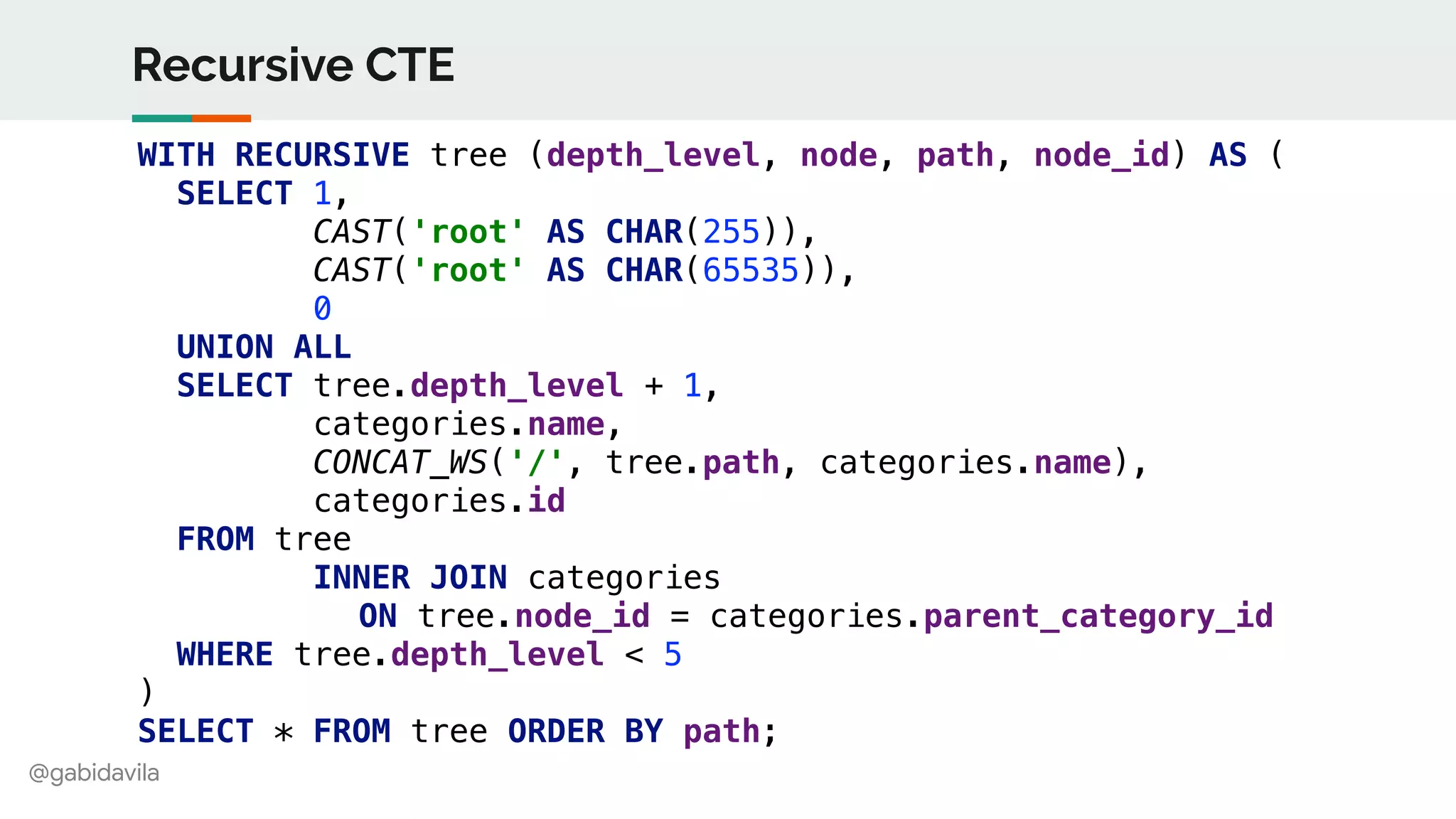
Recursive CTE
WITH RECURSIVE tree (depth_level, node, path, node_id) AS (
SELECT 1,
CAST('root' AS CHAR(255)),
CAST('root' AS CHAR(65535)),
0
UNION ALL
SELECT tree.depth_level + 1,
categories.name,
CONCAT_WS('/', tree.path, categories.name),
categories.id
FROM tree
INNER JOIN categories
ON tree.node_id = categories.parent_category_id
WHERE tree.depth_level < 5
)
SELECT * FROM tree ORDER BY path;
@gabidavila
Subqueries
@gabidavila
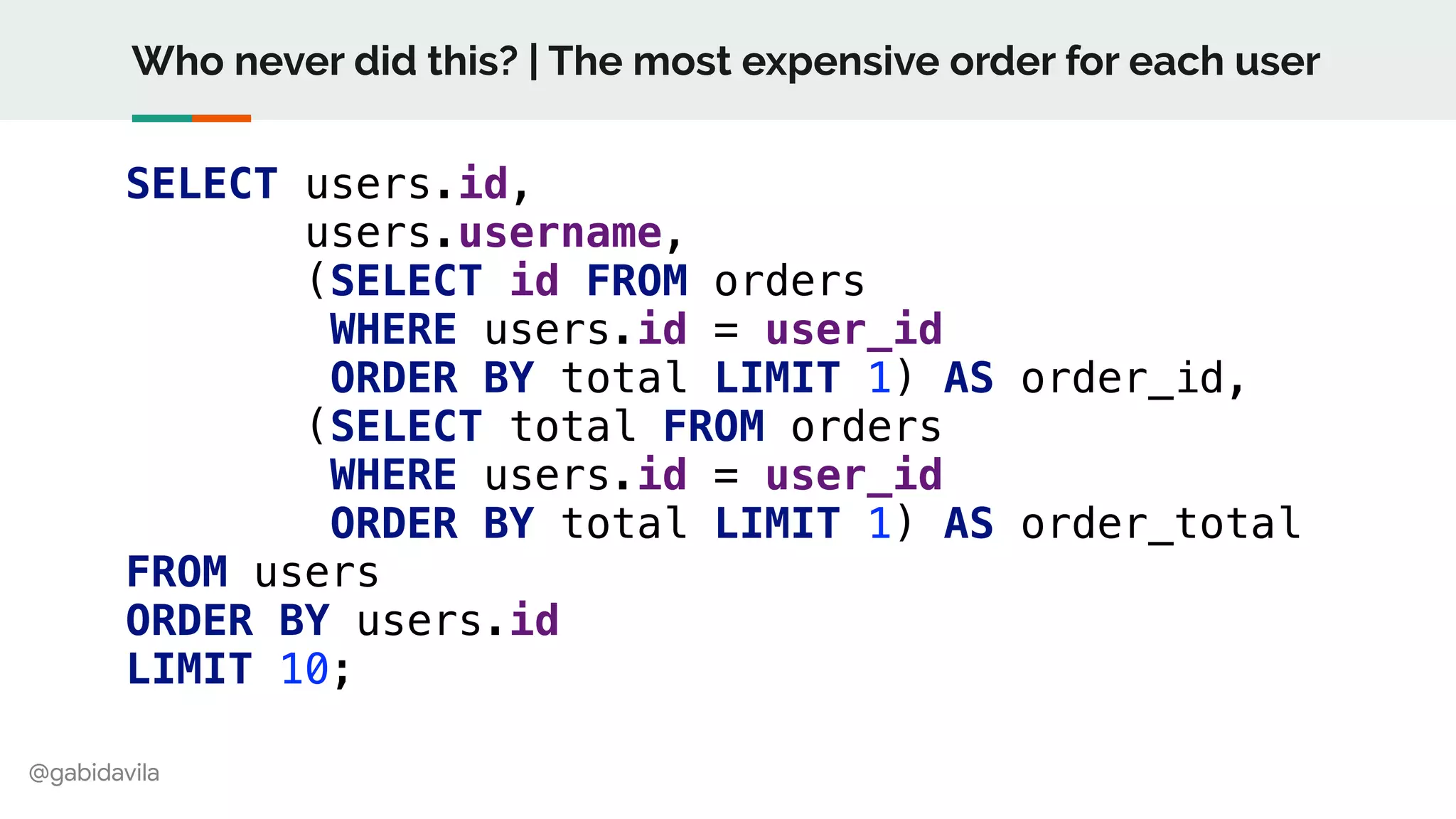
Who never did this? | The most expensive order for each user
SELECT users.id,
users.username,
(SELECT id FROM orders
WHERE users.id = user_id
ORDER BY total LIMIT 1) AS order_id,
(SELECT total FROM orders
WHERE users.id = user_id
ORDER BY total LIMIT 1) AS order_total
FROM users
ORDER BY users.id
LIMIT 10;
@gabidavila
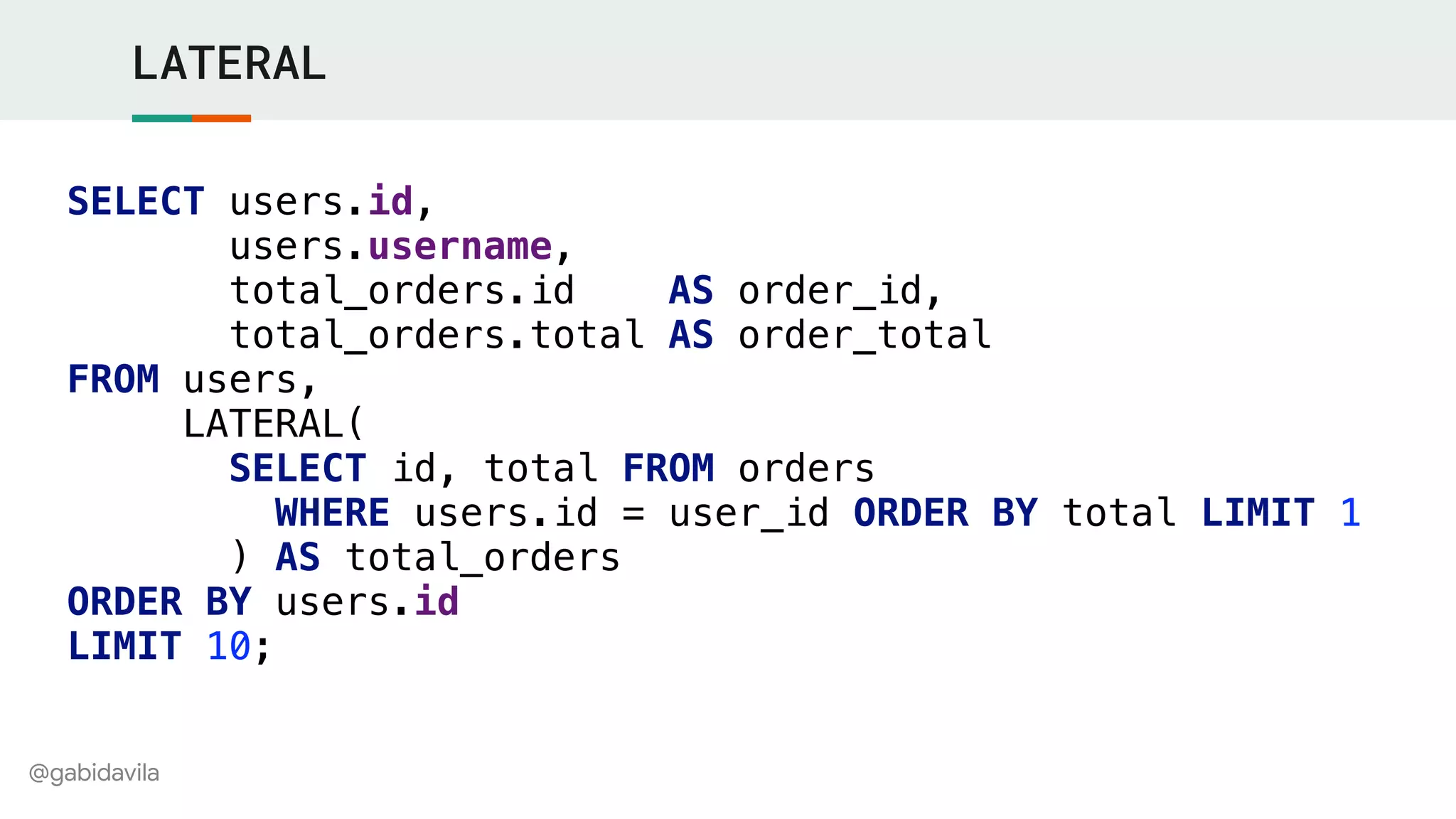
LATERAL
SELECT users.id,
users.username,
total_orders.id AS order_id,
total_orders.total AS order_total
FROM users,
LATERAL(
SELECT id, total FROM orders
WHERE users.id = user_id ORDER BY total LIMIT 1
) AS total_orders
ORDER BY users.id
LIMIT 10;
@gabidavila
Demo
@gabidavila
Thank you!
● About me: gabi.fyi/me
● Twitter: @gabidavila (DMs are open!)
● Host at: gcppodcast.com

MySQL 8.0: not only good, it’s GREAT! - PHP UK 2019

  • 1.
    MySQL 8.0: notonly good, it’s GREAT! Gabriela D'Ávila Ferrara @gabidavila Developer Advocate @ Google Cloud gabi.fyi/me
  • 2.
  • 3.
    @gabidavila Brief History ●Created to handle from up to 10 to 100M rows or around 100MB/table ● Now supports terabyte- sized databases ● Supports SQL standards as new as SQL 2016 ● But... some stuff from SQL 2003 just became available (Window Functions, CTEs) ● What is awesome now? 23 OF MAY 1995 GPL V2
  • 4.
  • 5.
  • 6.
  • 7.
  • 8.
    @gabidavila UUID() Support CREATE TABLEusers ( uid binary(16) NOT NULL DEFAULT (UUID_TO_BIN(UUID())), username varchar(255) NOT NULL, PRIMARY KEY (uid) );
  • 9.
  • 10.
  • 11.
    @gabidavila User Management ● ReusablePermissions/Roles ● Password policy ● New Password ● Reuse of Password ● Expiration ● Rotation gabi.fyi/roles-mysql
  • 12.
    @gabidavila User Management ● GRANTdoesn’t create users anymore, it just… grants!!! ● No more FLUSH PRIVILEGES ● No more googling all the time how to create users with the right permissions! gabi.fyi/roles-mysql
  • 13.
    @gabidavila Creating a READONLYrole CREATE ROLE 'readonly'; GRANT SELECT ON app.* TO 'readonly'; ● Create the Role ● Define the Privileges gabi.fyi/roles-mysql
  • 14.
    @gabidavila Creating a userwith READONLY role ● Create the User ● Grant the Role CREATE USER 'gabriela'@'%' IDENTIFIED BY 'my_pwd'; GRANT 'readonly' TO 'gabriela'@'%'; gabi.fyi/roles-mysql
  • 15.
  • 16.
    @gabidavila New default Charset ●Default: ● 5.7: latin1 ● 8.0: utf8mb4 ● Improvements: ● ➕ Mathematical Equations 𝑒=𝑚·𝑐² ● 😁 🙄 $ ● & more SMP (Supplementary Multilingual Plane) Characters
  • 17.
    @gabidavila New default Collation ●utf8mb4_0900_ai_ci ● UTF-8 version 9.0 support ● Accent Insensitive ● Case Insensitive ● No more 🍣 = 🍺 bug ● Caused by utf8mb4_general_ci or utf8mb4_unicode_ci More information on how collations behave here.
  • 18.
    @gabidavila Other defaults &variables ● Binary log (log_bin) is enabled by default ● SHA-2 for authentication ● Mandatory default value for TIMESTAMP ● New variable to dedicated servers (default OFF), innodb_dedicated_server=ON , controls dynamically: ● innodb_buffer_pool_size ● innodb_log_file_size ● innodb_flush_method
  • 19.
  • 20.
  • 21.
    @gabidavila Descending Indexes Up to5.7 ● Syntax allowed ASC or DESC when defining an index However... An index_col_name specification can end with ASC or DESC. These keywords are permitted for future extensions for specifying ascending or descending index value storage. Currently, they are parsed but ignored; index values are always stored in ascending order.
  • 22.
  • 23.
    @gabidavila Descending Indexes ● Nolonger ignored and forcibly created as ASC ● Actually works!!! ALTER TABLE users ADD INDEX ix_username (username DESC);
  • 24.
    @gabidavila Descending Indexes Can bescanned as intended or backwards SELECT * FROM users WHERE username LIKE 'g%' ORDER BY username DESC; -- OR WITH THE SAME COST SELECT * FROM users WHERE username LIKE 'g%' ORDER BY username;
  • 25.
  • 26.
    @gabidavila DESCRIBE `users`; Type NullKey Default Extra `id` bigint(20) unsigned NO PRI auto_increment `username` varchar(255) NO `created_at` timestamp NO CURRENT_TIMESTAMP DEFAULT_GENERATED `updated_at` timestamp NO CURRENT_TIMESTAMP DEFAULT_GENERATED on update CURRENT_TIMESTAMP
  • 27.
    @gabidavila Invisible Indexes ● Notused by the optimizer ● Visible by default, to create an invisible index: ALTER TABLE users ADD INDEX ix_username (username) INVISIBLE; ALTER TABLE users ALTER INDEX ix_username INVISIBLE; ALTER TABLE users ALTER INDEX ix_username VISIBLE; ● Toggle visibility:
  • 28.
    @gabidavila Invisible Indexes SELECT * FROMusers WHERE username = 'fancy'; Visible Cost: 0.98
 Rows: 1 Invisible Cost: 518,331.25
 Rows: 5.04M
  • 29.
  • 30.
  • 31.
    @gabidavila Instant ● Add columnswithout doing a INPLACE/COPY operation ● Must be appending a column to a table ● Must not have a DEFAULT on the new column ● Rename Table ● Modify Columns ● Virtual Columns ● SET/DROP DEFAULT value of a column
  • 32.
    @gabidavila Example mysql> ALTER TABLEorders ADD COLUMN total DECIMAL(10,2) NOT NULL, ALGORITHM=INSTANT; Query OK, 0 rows affected (0.26 sec) Records: 0 Duplicates: 0 Warnings: 0 mysql> SELECT count(*) FROM orders; +----------+ | COUNT(*) | +----------+ | 50996708 | +----------+ 1 row in set (7.80 sec)
  • 33.
  • 34.
  • 35.
    @gabidavila What they do? ●Allows to analyze the rows of a given result set ● Can behave like a GROUP BY without changing the result set ● Allows you to use a frame to "peek" OVER a PARTITION of a window
  • 36.
  • 37.
    @gabidavila Window Functions ● Examples: ●Enumerate rows - ROW_NUMBER() ● Show Aggregated sums - SUM() ● Rank results - RANK() ● Look at neighboring rows - LEAD(), LAG()
  • 38.
    @gabidavila DESCRIBE `orders`; CREATE TABLE`orders` ( `id` bigint(20) UNSIGNED NOT NULL AUTO_INCREMENT, `user_id` bigint(20) UNSIGNED NOT NULL, `status` varchar(20) NOT NULL DEFAULT 'new', `created_at` datetime NOT NULL, `updated_at` datetime NOT NULL )
  • 39.
    @gabidavila SELECT … FROM`orders` WHERE … ORDER BY created_at LIMIT 10; +---------+---------+-----------+---------------------+ | id | user_id | status | created_at | +---------+---------+-----------+---------------------+ | 6534954 | 654321 | canceled | 2011-08-21 19:06:59 | | 6534949 | 654321 | canceled | 2013-11-16 09:02:19 | | 6534953 | 654321 | completed | 2015-10-28 02:21:30 | | 6534951 | 654321 | new | 2018-01-05 17:12:23 | | 6534952 | 654321 | new | 2018-07-19 04:23:41 | | 6534955 | 654321 | new | 2018-11-12 05:37:48 | | 6534950 | 654321 | pending | 2018-12-20 06:11:23 | +---------+---------+-----------+---------------------+
  • 40.
    @gabidavila Previous and Nextorders | LAG and LEAD SELECT id, user_id, status, LAG(created_at) OVER(ORDER BY created_at) AS previous_order, created_at, LEAD(created_at) OVER(ORDER BY created_at) AS next_order FROM orders WHERE user_id = 654321 ORDER BY created_at LIMIT 10;
  • 41.
    @gabidavila SELECT … FROM`orders` WHERE … ORDER BY created_at LIMIT 10; +---------+---------+-----------+---------------------+---------------------+---------------------+ | id | user_id | status | previous_order | created_at | next_order | +---------+---------+-----------+---------------------+---------------------+---------------------+ | 6534954 | 654321 | canceled | NULL | 2011-08-21 19:06:59 | 2013-11-16 09:02:19 | | 6534949 | 654321 | canceled | 2011-08-21 19:06:59 | 2013-11-16 09:02:19 | 2015-10-28 02:21:30 | | 6534953 | 654321 | completed | 2013-11-16 09:02:19 | 2015-10-28 02:21:30 | 2018-01-05 17:12:23 | | 6534951 | 654321 | new | 2015-10-28 02:21:30 | 2018-01-05 17:12:23 | 2018-07-19 04:23:41 | | 6534952 | 654321 | new | 2018-01-05 17:12:23 | 2018-07-19 04:23:41 | 2018-11-12 05:37:48 | | 6534955 | 654321 | new | 2018-07-19 04:23:41 | 2018-11-12 05:37:48 | 2018-12-20 06:11:23 | | 6534950 | 654321 | pending | 2018-11-12 05:37:48 | 2018-12-20 06:11:23 | NULL | +---------+---------+-----------+---------------------+---------------------+---------------------+
  • 42.
    @gabidavila Break down windowfunction column # rowspreceding LAG(created_at, 1) OVER (ORDER BY created_at)
  • 43.
    @gabidavila Repetition? SELECT id, user_id, status, LAG(created_at) OVER(ORDERBY created_at) AS previous_order, created_at, LEAD(created_at) OVER(ORDER BY created_at) AS next_order FROM orders WHERE user_id = 654321 ORDER BY created_at LIMIT 10;
  • 44.
    @gabidavila SELECT id, user_id, status, LAG(created_at) OVER(dates)AS previous_order, created_at, LEAD(created_at) OVER(dates) AS next_order FROM orders WHERE user_id = 654321 WINDOW dates AS (ORDER BY created_at) ORDER BY created_at LIMIT 10; Named Windows!
  • 45.
  • 46.
  • 47.
    @gabidavila Common Table Expressions ●Similar to CREATE [TEMPORARY] TABLE ● Doesn’t need CREATE privilege ● Can reference other CTEs (if those are already defined) ● Can be recursive ● Easier to read
  • 48.
    @gabidavila Recursive CTE ● Usefulwith hierarchical data ● The Recipe is: ● Base query comes first ● Second query comes after an UNION statement ● And the stop condition should be on the recursive call
  • 49.
    @gabidavila SELECT * FROM`blog`.`categories`; +------+-------------------------------+--------------------+ | id | name | parent_category_id | +------+-------------------------------+--------------------+ | 1 | Animal | 0 | | 2 | Plant | 0 | | 3 | Dog | 1 | | 4 | Cat | 1 | | 5 | Tulip | 10 | | 6 | West Highlander White Terrier | 12 | | 7 | Lettuce | 11 | | 8 | Sunflower | 10 | | 10 | Flowers | 2 | | 11 | Veggies | 2 | | 12 | Terrier | 3 | +------+-------------------------------+--------------------+ 11 rows in set (0.00 sec)
  • 50.
  • 51.
    @gabidavila Recursive CTE WITH RECURSIVEtree (depth_level, node, path, node_id) AS ( SELECT 1, CAST('root' AS CHAR(255)), CAST('root' AS CHAR(65535)), 0 ) SELECT * FROM tree;
  • 52.
    @gabidavila Recursive CTE WITH RECURSIVEtree (depth_level, node, path, node_id) AS ( SELECT 1, CAST('root' AS CHAR(255)), CAST('root' AS CHAR(65535)), 0 UNION ALL SELECT tree.depth_level + 1, categories.name, CONCAT_WS('/', tree.path, categories.name), categories.id FROM tree INNER JOIN categories ON tree.node_id = categories.parent_category_id WHERE tree.depth_level < 5 ) SELECT * FROM tree ORDER BY path;
  • 53.
  • 54.
    @gabidavila Who never didthis? | The most expensive order for each user SELECT users.id, users.username, (SELECT id FROM orders WHERE users.id = user_id ORDER BY total LIMIT 1) AS order_id, (SELECT total FROM orders WHERE users.id = user_id ORDER BY total LIMIT 1) AS order_total FROM users ORDER BY users.id LIMIT 10;
  • 55.
    @gabidavila LATERAL SELECT users.id, users.username, total_orders.id ASorder_id, total_orders.total AS order_total FROM users, LATERAL( SELECT id, total FROM orders WHERE users.id = user_id ORDER BY total LIMIT 1 ) AS total_orders ORDER BY users.id LIMIT 10;
  • 56.
  • 57.
    @gabidavila Thank you! ● Aboutme: gabi.fyi/me ● Twitter: @gabidavila (DMs are open!) ● Host at: gcppodcast.com