Unclassified
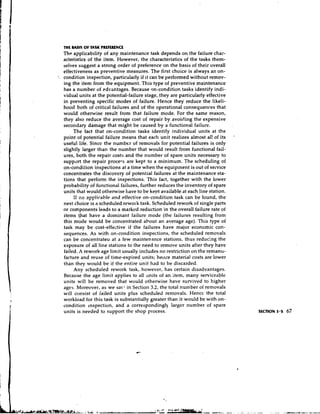
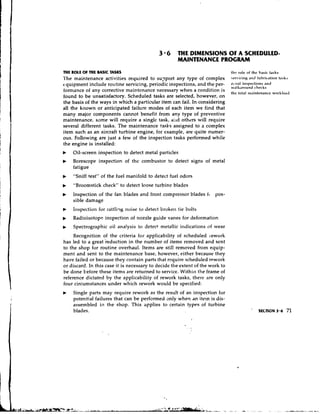
                                                         -                                                                                  -
                    , -,        A.,<,C I             %T'ON                         r , < m ,. r , <           ! l h ~ ! #> a a r z > I
                                                                                                                        j                       r*.r<.j
                                                                                                                                                                                                          ,
                                                                        '>%               " h


                                          REPORT DOCUMENTATION _..-
                                                             _ PAGE                                                                                                                                       .__
                                                                                                                                                                                                                                        K E A I ) INS I R U C T I O N S
                                                                                                                                                                                                                                I ~ K I , O I + I . :r o h ! p l . : ; m s r .
                                                                                                                                                                                                                                _                                              pore.!                                _              I
                                                                 _.
                                                                                                                                         :      GOV-               ACZEl;lOk
                                                                                                                                                                                . .
                                                                                                                                                                                . .
                                                                                                                                                                                            hO                        3
                                                                                                                                                                                                                                                                    .
                                                                                                                                                                                                                              H t C I P l C l . T ' S C A T A L O G NIIIARFH
                                                                                                                                                                                                                                                                             .         .                         ~


                                                                                                                                                                                                                                                                                                                                  --I
                                                                                                                                                                                                          I                                                    ...                     -                 -       ~   .-       ~


                                                                                                                                                                                                          i           5       TYPE OF RFPORT d FLHlOD COILIIF::

                                                                                                                                                                                                          I, . ~Final
                                                                                                                                                                                                                 ~ -
            Reliability-Centered Maintenance                                                                                                                                                                          5
                                                                                                                                                                                                                                                       ~


                                                                                                                                                                                                                              I J k l l F O H M I N . j OLi,                               NL"?I11
                                                                                                                                                                                                                                                                                                             ~


                                                                                                                                                                                                                                                                                                                 tiiiM*kr(
                                                                                                                                                                                                          I

            F. Stanley Nowlan                                                                                                                                                                             I                   MDA 903-75-C-0349
            Howard F. Heap
--          -                                  .~             .
                                           . :)l<rAN'(*
                                                                                                                                     ~


    P       I,:    irs I U U ' h                                                U C N N b M I AND A D D R E 5 5

            United Airlines
            San Francisco International Airport
            San Francisco, Ca 94128
        '           ..--          .        .. .
                                                    ~-
                                                         .r        .i           p . 4 ~ 3 ~ 'I.:      a : : ~ :
                                                                                                                       .
                                                                                                                           .
                                                                                                                               .
                                                                                                                               .            -    -.                              .-...                    .-..
                                                                                                                                                                                                          1
                                                                                                                                                                                                             ./                w
                                                                                                                                                                                                                                       -
                                                                                                                                                                                                                                           ~               ~    .
                                                                                                                                                                                                                                                                         . -.
                                                                                                                                                                                                                                                                          -
                                                                                                                                                                                                                                                                     :~) &. - c~   -
                                                                                                                                                                                                                                                                                                         - -              -


            Office of Assistant Secretary of Defense                                                                                                                                                          /                December 29,1978
            (Manpower, Reserve Affairs and I ogistics)                                                                                                                                                        1       *, ,, ,..,,,F~,
                                                                                                                                                                                                                          ~        ~


                                                                                                                                                                                                                                                                     d~     ,a , t
                                                                                                                                                                                                                                                                                                         -


            Washington, DC 20301                                                                                                                                                                              I               476
    .-                                             ..                                                                                                                    .      ..    .4                                                                                                     ~.              -
~


    '4      '.1.   ..   - ' i i ( t i      . :.    .L*.            v *YI               3   4 ~ 7 . 1 ~ 35 ,
                                                                                                         1  !,I: r.m* rrv:~.                              t       . m . r . Iltn.' UIIIII- IS                 /                ,L.(.""IT',
                                                                                                                                                                                                                                               -                -        -~
                                                                                                                                                                                                                                                                         ,.LC',%           ,.I   ,I.,       rrli    r'


                                                                                                                                                                                                              I                :!nclassified


            q p r o v e d for public release; distribution unlimited. Copies may be obtained from
            thc National Tcchnical Information Service or !he Defense Documentation Center.


                                                                                                                                                                                                                                                                                                         -


                                                                                                                                                                                                                                                                                                                                    I
                                                                                                                                                                                                                      -
                                          ..                  ..
                                                                                                                                                                                                                                                                                                             -

                                6.1            i    i7


            This work was performed by United Airlines under the sponsorship of the
            Office of !.ssistant Secretary of Defense (Manpower, Reserve Affairs and Logistics)
    .,          _ ( .*                              , ,,,.,..
                                                     1                  .       r.>    ..,.. ,,. ., .,,                 . . < ~ ,,., ,,., , , ,,, ,,,                ,,,. !,,.,,, ..,,,, *<..
            Actu, ral analysis Aircraft maintenance Cost effectiveness Decision theory
            Evaluation Failurt effects Flight safety Logistics Maintenance program
            Mechanical safety Preventive maintenance Product in~provement
            Reliability Scheduled niaintenance System effectiveness
                                                                                        - -
                                                                                         .            .       ..
                                                                                                               .           ..                                                        -.                                                                                       .
                                                                                                                                                                    ., ., .,, r , , , , , i . . . r
                                                                                                                                                                                                                  -                                                                ~-
                            .         -            ,,.,.,. .> r . . . .,.
                                                                            ~


                                                                                             ., 11 , I ...             r.   ,,,. r , ,
                                                                                                                                                      ~


                                                                                                                                                  I . .   .,I,
                                                                                                                                                              ~                                                                        ~


            This book explains basic concepts, llrinciples, definitions, and applications of a
            logical discipline for devel~pment efficient scheduled (preventive) maintenance
                                                of
            programs for complex equipment, and the on-going management of such programs.
            Such programs are called reliability-centered maintenance (RCM) programs because
            they are centered on achieving the inherent safety and reliability capabilities of
L                                                                                                                                        - -
                                                                                                                                          -                                                                                                                                                                                             I
,-)D               ,,,:",             1473                         ,             9 ;    ,     !   .       '        8         % ' ,   .:.I       -,                                                                                 Unclassified
                                                                                -.                                                                                   <&, .
                                                                                                                                                                      .
                                                                                                                                                                             ~~


                                                                                                                                                                                        .             ~


                                                                                                                                                                                              , ~ , , . ~ c , A,
                                                                                                                                                                                               ;                                    -      1   ,   )       ~        ,I    Tbdir,   V l i . 1 . l l l l l l r l l,ntn I-r>ll.rer!

                                                                                EPRODVCtD BY
                                                                                 NATIONAL TECHNICAL
                                                                                INFORMATION SERVICE                                                                                                               I
                                                                                   U.S. DLPARlMtNl OF COMMERCL
                                                                                        SPR:NGFltLD, VA. n 6
                                                                                                          11
equipment at a minimum cost. A U.S.Department of Defense objective in sponsor-
    ing preparation of this document was that it serve as a guide for application to a
    wide range of different types of military equipment.

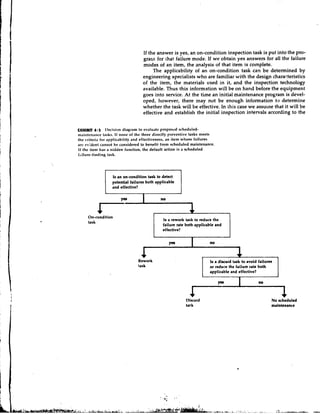
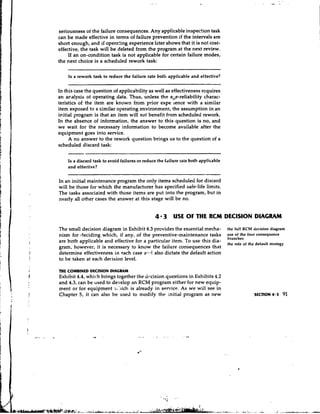
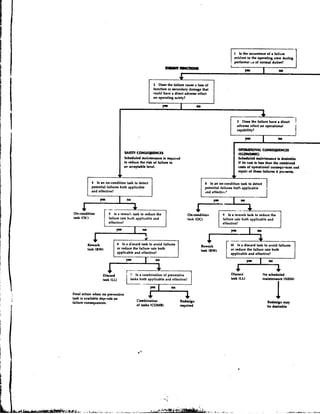
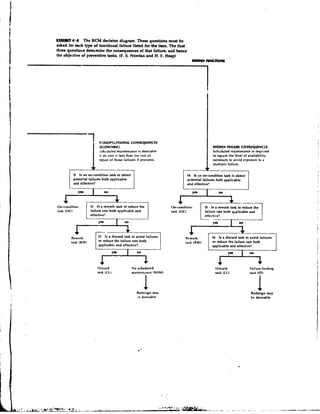
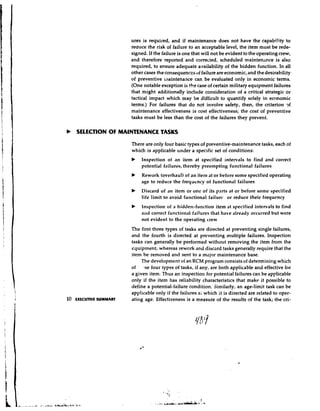
    There are essentially only four types of tasks in a scheduled maintenance program.
    Mechanics can be asked to:
        Inspect an item to detect a potential failure
        Rework an item before a ~neximumpermissible age is exceeded
        Discard an item before a maximum permissible age is exceeded
        Inspect an item to find failures that have already occurred but wert not evident
          to the equipment operating crew
    A central problem addressed in this book is how to determine which types of sched-
    uled maintenance tasks, if any, should be applied to an item and how frequently
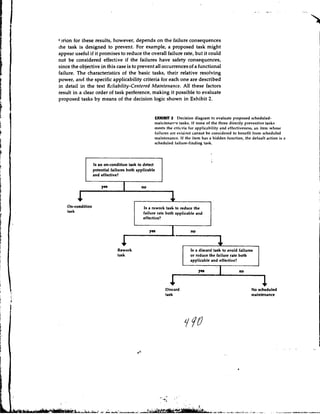
    assigned tasks should be accomplished. The use of a decision diagram as an aid in
    this analysis is illustrated. The net result is a structured, ~ystematicblend of
    experience, judgll~ent,and operational datalinformation to identify and analyze
    which type of maintenance task is both applicable and effective for each significant
    item as it relates to a particular iype of equipment. A concludingchapteremphasizes
    the key importance of having a mutually supportive partnership between the per-
    sonnel responsible for equipment design and the personnel responsible for equip-
    ment maintenance if maximum HCM results are to be achieved.

I   Appendices are included as follows:


I       Procedures fur auditing ihe development and implementation of a;.c RCM
          program
        A historic~l
                   review of equipment maintenance evolution
        Techniques of performing actuarial analyses
        An annotated bibliography
RELIABILITY-CENTERED MAlNTENANCE
reliability-centered
maintenance   F. STANLEY NOWLAN


              HOWARD F. HEAP
Prodc~cedby Dolby Access Press
Designer Nancy Clark, illustrators David A. Strassman
and Evanell Towne, compositor Jonathan D. Peck,
printer Braun-Brum.field, Inc.
preface


mls VOLUME provides the first full discl~ssionof reliability-centered
maintenance as a logic~l    discipline for the development of scheduled-
mairctenafice programs. The objective of such programs is to realize the
inherent reliability capabilities of the equipment for which they are
designed, and to do so at minimum cost. Each scheduled-maintenance
task in an RCM program is generated for an identifiable and explicit
reason. The consequences of each failure possibility are eva!uated, and
ihe failures are then classified according to the sevcrity of their conse-
quences. Then for all significant items- those whose failure involves
operating safety or has major economic consequences- proposed tasks
are evaluated according to specific criteria of applicability and effective-
ness. The resulting scheduled-maintenance program thus includes all
the tasks neccssay to protect safety and operating reliability, and only
the tasks that will accomplish this objective.
      Up to this point the only document describing tllr nse of decision
diagrams for developing maintenance programs has becn MLiG-2, the
predecessor of P.CM anillysis. MSG-2 was concerned primarily with t l ~ e
development of prior-to-service programs and did not cover the us€ 9 f
operating information to modify the maintenance program after the
equipment enters service or the role of product irnprovement in i;uip-
ment development. The chief focus was on the identificatiorl of a set of
t a s ~ that would eliminate the cost of unnecessary maintenance without
        s
compromising safety or operating capability. There was no mention of
the problem of estabiishing task intervals, of consolidating the tasks
into work packages, or of making decisions /here the necessary infoi-
mation is unavailab!~.Thc treatment of structure programs was sketchy,
and zonal and other general inspection programs were not discussed
at all.                                                                                  vii
The difficulty that many people experienced in attempting to apply
       the concepts of MSG-2 indicated the need for change.; and additions
       simply to clarify many of the points. It was also abundantly clear, hi .w-
       ever, that the scope of the material should be expanded to cover the topics
       that had not been hiccussed in that document, This volsme includes a
       major expansion of the discussion on the problem of identifying func-
       tionally and stn~cturallysignificant items. The RCM decision diagram
       itself is quite different from the one used for MSG-2. Instead of beginning
       with the evaluation of proposed maintenance tasks, the decision logic
       begins with the factor that determines the maintenance requirements of
       each item - the consequences of a functional failure- and then an evalu-
       ation of the failure modes that cause it. Tllis new diagram also recog-
       nizes the four basic maintenance tasks that mechanics can perform
       (instead of three maintenance processes), thereby clarifying the treat-
       ment of items with hidden functions. The role of a hidden-function
       failure in a sequence of nw!tiple independent failures is stressed, and
       it is also shown that the consequences of a possible multiple failure are
       explicitly recognized in the definition of tl-,e consequences of the first
       failure.
             Another important aspect of the RCM decision logic is that it
       includes a deiault strategy for making initial maintenance decisions in
       the absence of full information. There is a full discussion of the problem
       of assigning task intervals, particular!^ those for first and repeat on-
       condition inspections. The role of age exploration and the use of infor-
       mation derived from operating experience, both to modify the initial
       maintenance program and to initiate product improvement, is discussed
       at ler,gth. The content of scheduled-maintenance programs developed
       by experienced practitioners of MSG-2 techniques may be quite similar
       to the programs resulting from RCM analysis, but the RCM approach is
       Inure rigorous, and there should be much more contidence in its out-
       come. The RCM technique can also be learned more quickly hnd is more
       readily applicable to complex equipment other than transport aircraft.
             Part Qne of this volume presents a full explanation of the theory
       and principles of re'iability-centered maintenance, including a discus-
       sion of me failure process, the criteria for each of the four basic tasks,
       the use of the decision logic to develop an initial program, and the
       age-exploration activities that result in a continuing evolution of this
       program after the equipment enters service. Part Two describes the
       app!ication of these principles to the analysis of typical items in the
       systems, powerplant, and stn~cture      division of an airplane; the consid-
       erations in packaging the RCM tasks, along with other scheduled tasks,
       for actual implementation; a        the information systems necessary for
       management of the ongoing maintenance program. The concluding
       chapter discusses the relationship of scheduled maintenance to operat-
viii   ing safcty, the desigr-maintenance partnership, and tks application of
KCM analysis both tn in-service fleets and to other types of complex
equipment.
     The text is followed by four appendices. Appendix A outlines the
principles of auditing a program-development project and discusses
some of the common probiems that arise during analysis. This material
provides an excellent check list for the analyst as well as the auditor and
should be especially useful as a teaching aid for those conductii~g      train-
ing groups in RCM methods. Appendix B is a historical review of the
changes in maintenance thinking in the airline industry. Appendix C is
a discussion of the engineering procedures and techniques used in
actuarial analysis of reliability data. Appendix D, written by Dr. James
L. Dolby, is a discussion of the literature in reliability theory, information
science, decision analysis, and other areas related to RCM analysis and
provides an annotated guide to this literature as well as to the specific
literature on reliability-centered maintenance. Dr. Howard L. Resnikoff
has written an accompanying mathematical treatment of the subject,
titled Matllernaticnl Aspects of Reliability-Centered Maintenance.
     A book of this nature is the result of many efforts, only a few of
which can be acknowledged here. First of all, we wish to express our
gratitude to the late W. C. Mentzer, who directed ,he pioneering studies
of maintenance policy at United Airlines, and to the Federal Aviation
Administration for creating the environment in which this work was
developed over the last twenty years. We also thank Charles S, Smith
and Joseph C. Saia of the Department of Defense, who defined the ron-
tent of the present text and counseled us throughout its preparation.
James L. Dolby of San Jose State University, in addition to preparing
the bibliography, contributed his expertise to the text. In particular,
he helped to develop the concept of partitioning to identify significant
items and the concept of default answers as part of the decision logic,
as well as advising us on the actuarial appendix. Nancy Clark edited
our eiforts and organized them for clear exposition. Her logical thought
processes resulted in numerous major improvements throughout and
made possible the successful translation of our r~anuscript textbookto
form.
     Much help on specific areas of the text has come from friends and
cowo~kersin the industry. We especially wish to thank Me1 Stone of
Douglas Aircraft for his extensive help with the structure chapter, John
F. McDonald of the Flying Tiger Line for his comments on the theoretical
chapters, and John F. Pirtle of General Electric for his comments on the
powerplant chapter. Of the many others whose contributions influenced
the text in some i m ~ o r t a n respect, we give particular thanks to Thomas
                                 t
M. Edwards of United Airlines, Thomas D. Matteson of United Airlines,
Ernest Boyer of the Federal Aviation Adr,linistration, Captain L. Ebbert
of the U.S. Navy, Edward L. Thomas of the Air Transport Association,
and Robert Card of the University of Missouri.
We are also grateful to the ma; y people at United Airlines who pro-
v i d ~ d with specific help and assistance. The manuscript itself would
        us
not have materialized without the effortsof MarieTilson, who cheerfully
typed and retyped the material through many drafts, We also thank
Claudia Tracy, whose artwork made the draft manuscript more readable,
and J. Douglas Burch, whose efforts throughout the project helped bring
it to completio~~.  Finally, we would like to thank the management of
United Airlines for its patience m d our wives for their encouragement
over the many long months of authorship and publication.
                                                      F. Stnnley N o w l a r ~
                                                      Hownrd F. Heap
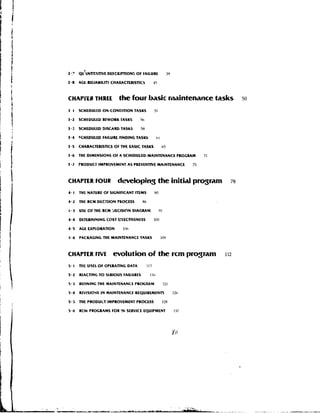
contents


      PREFACE      rrii

      4   MAINTENANCE PHILOSOPHY          .vrli


CHAPTER ONE               rcm: a maintenance discipline                   2

 .
I I THE EVOLUTION OF RCM ANALYSIS                1

1 - 2 THE BASIS O F RCM DECISION LOGIC               h

I.3   RELIABILITY PRCBLFMS I N CCMPLEX EQUIPMENT              0

1 - 4 A N OVERVIEW .OF MAINTENANCE ACTIVITY              II


                                                         PART ONE THEORY AND PRINCIPLES   15

CHAPTER TWO               the nature ot fdlure                    16

2.1   M E DEFINITION OF FAFAILURE     17

2.2   THE DETECTION O f FAILURES      ?O

2.3   THE CONSEQUENCES OF FAILURE           25

2.4   MULTIPLE FAILURES     28

2.5   THE FArlURE PROCLSS        31

2.6   FAILURE I N COMPLEX ITEMS       37
Z.?    QU~NTIT,TWE DfiCRlPTION5 OF FAILURE                  39

2.8    AGE-RUIABILIN CHARACTERISTICS              15


CHAP~TRTHREE               the four basic rimalntenance tasks                            50

3 1    SCHEDULED 0N.CONDlTION TASKS               51

3-2    SCHEDULED REWORK TASKS        5h

3.3    SCHEDULED DISCARD TASKS        58

3.4    9CHEDULED FAILURE-FINDING TASKS             hl

3.5    CHARACTERlSnCS OF THE CASlC TASKS                65

3.6    THE DIMENSIONS OF A SCHEDULED-MAINTENANCE PROGRAM                     71

3.1    PRODUCT IMPROVEMENT AS PREVENTIVE MAINTENANCE                    75


CHAPTER FOUR              developing the initid program                             78

4.1    THE N A N R E OF SIGNIFICANT ITEMS         HO

4.2    THE RCM DEC:510N PROCESS        86

4 a3   USE O THE RCM 9ECISION DIAGRAM
            F                                          91

4.4    DETEDMlYlNG COST E5FECWENESS               100

4.5    AGE WPLORATION        l!lh

4.6    PACKAGING THE MAINTENANCE TASKS                  109


CtiArnER FIVE           evolution of the rcm prqram                               112

5.1    T)IL USES OF OPERATING DATA          113

5.2    REACTING T O StRIOUS FAILURES         IIf,

5.3    REFINING TWL MAINTENANCE P R O C M M                 121

5.4    REVISIOYS I N MAINTENANCE REQUIREMENTS                     12h

5.5    THE PRODUCT-IMPROVEMENT PROCESS                  128

5.6    RCM PROGRIMS FOR !N-SERVICE EQUIPMENT                      137
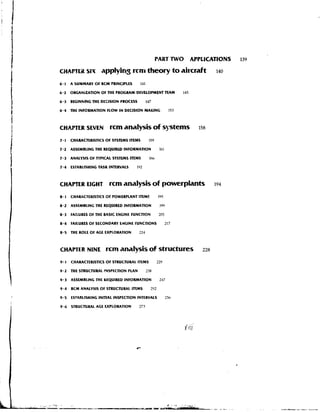
PART TWO APPLlCATlONS                139

CHA~ERslr              apptyin~
                              rcm theory to aircraft                                  140

6.1    A SUMMARY OF RCM PRINCIPLES         111

6.2    O R G A N l U l l O N OF THE PROGRAM-DEVELOPMENT T            W   145

6 - 3 BEGlNhlNG THE DECISION PROCESS            147

6 - 4 THE INFORMATION FLOW I N DECISION MAKING                   153


CHAPTER SEVEN              acm analysis of systems                             158

7- 1   CHARACTERISTICS OF SYSTEMS ITEMS          159

7.2    ASSEMBLING THE REQUIRED INFORMATION              161

7.3    ANALYSIS OF TYPICAL SYSTEMS ITEMS         lhb

7.4    ESTABLISHING TASK INTERVALS       192


CHAPTER EIGHT              rcm analysis of powerplants                                194

8.1    CHARACTERISTICS OF POWERPIANT ITEM5              195

8.2    ASSEMBLING THE REQUIRED INFORMATION              19')

8.3    FAILURES OF THE BASIC ENGINE FUNCTION            205

8.4    FAILURES OF SECONDARY ENGINE TUNCTIONS                  217

8.5    M E ROLE OF AGE EXPLORATION        224


CHAPTER NINE             rcm analysis o structures
                                       f                                        228

9.1    CHARACTERISTICS OF STRUCTURAL ITEMS             229

9.2    THE STRUCTURAL lHSPECTlON P U N          238

9 - 3 ASSEMBLING THE kEQUlRED INFORMATION               247

9.4    RCM ANALYSIS OF STRUCTURAL ITEMS           252

9 5    ESTABLISHING INITIAL INSPECTION INTERVALS               250

9 - 6 STRUCTURAL AGE EXPLORATION          273
CHAPTER TEN           completingthe maintenance program                                   276

10.1    OTHER SCHEDULED-MAINTENANCE TASKS             277

10.2    PACKAGING THE MAINTENANCE WORKLOAD                 284


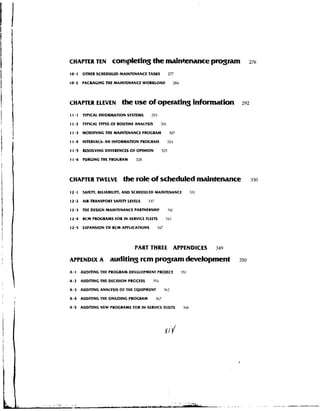
CHAMER ELEVEN              the use of operating information                          292

1 1.1   TYPICAL INFORMATION SYSTEMS      293

1 1 - 2 TYPICAL TYPES OF ROUTINE ANALYSIS       Xll

1 1 - 3 MODIFYING THE MAINTENANCE PROGRAM             307

1 1 - 4 INTERVALS: A N INFORMATION PROGRAM            321

11 - 5 RESOLVING DIFFERENCES OF OPINION         325

1 1.6    PURGING THE PROGRAM     328


CHAPTER TWELVE             the role of scheduled maintenance                               330

12.1    SAFETY. RELIABILITY, AND SCHEDULED MAINTENANCE                  331

12.2    AIR-TRANSPORT SAFETY LEVELS     337

12.3    THE DESIGN-MAINTENANCE PARTNERSHIP            341

12.4     RCM PROGRAMS FOR IN-SERVICE FLEETS          343

1 2 - 5 UPANSION OF RCM APPLICATIONS          317


                                 PART THREE APPENDICES                        349

APPEND~XA            auditin3 rcm pro3ramdevelopment                                350

A. 1 AUDITING THE PROGRAM-DEVELOPMENTPROJECT                     351

As2     AUDITING THE DECISION PRCCESS     354

A.3     AUDITING ANALYSIS O r THE CQUIPMENT         3h?

As4     AUDITING THE ONGOING PROGRAM          3h7

A.5     AUDITING NEW PROGRAMS FOR IN-SERVICL FLEETS               3bH
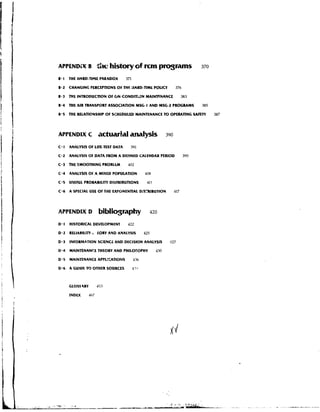
APPENP~X B               the history sf rcm programs                             370

B. I   THE HARD-TIME PARADOX         371

8.2    CHANGING PERCLPTIONS OF THE HARD-TlME POLICY                  376

B.3    THE INTRODUCTION OF GN-CONDITC3N MAINTEtiANCE                       383

B.4    THE AIR TRANSPORT ASSOCIATION MSG- 1 AND MSG-2 PROGRAMS                   385

B.5    THE RELATIONSHIP OF SCHEDULED MAINTENANCE TO OPERATING SAFETY                   387


APPENDIX C               i I c t ~ a hilfd s
                                      t l Wb
                                       !                       390

C *1   ANALYSIS OF LIFE-TEST DATA      391

C.2    ANALYSIS OF DATA FROM A DEFINED CALENDAR PERIOD                     395

C.3    THE SMOOTHING PROBLLU          402

C.4    ANALYSIS OF A MIXED POPULATION            40R

C.5    USEFUL PROBABILITY DlSTRIBUTIONS           411

C.6    A SPECIAL USE OF THE EXPONENTIAL D:STRIBUTION                 417


APPENDIX D               bibliqraptuy                  420

D. 1   HISTORICAL DEVELOPMENT         422

D.2    RELIABILITY   I   LORY AND ANALYSIS       425

D.3    INFOllMATlON SCIENCL AND DECISION ANALYSIS               427

D.4    MAINTENANCE THEORY AND PHILOSOPHY                 430

D.5    MAINTENANCE APPLICATIOHS            436

D.6    A GUlDE TO OTHER SOURCES         47<;


       GLOSZ4RY          453

       INDEX      467
a maintenance philosophy

         A,. operator's maintenance program has four objectives:
         b   To ensure realization of the inherent safety and reliability levels of
             the equipment
             To restore safety and reliability to their inherent levels when deteri-
             oration has occurred
         *   To obtain the information necessary for design improvement of
             those items whose inherent reliability proves inadequate
         b   To accomplish these goals at a minimum total cost, including main-
             tenance costs and the costs of residual failures

         Relialirlity-centered maintenance is based on the following precepts:
             A failure is an unsatisfactory condition. There are two types of fail-
             ures: frorctionnl frrilurcs, usually reported by operating crews, and
             pote!~tinlfnilrrrc.~, usually discovered by maintenance crews.
         b   The consequences of a functicnal failure determine the priority of
             maintenance effort. These consequences fall into four categories:
             b   saiety consequelrces, involving possible loss of the equipment
                 and its occupants
             b   Operational consequences, which involve an indirect economic
                 loss as well as the direct cost of repair
             b   Nonoperational consequences, which involve only the direct
                 cost of repair
             b   Hidden-failure consequences, which involve exposure to a pos-
                 sible multiple failure as a result of the undetecteci failure of a
                 hidden function
b    Scheduled maintenance is required for any item whose loss of func-
     tion or mode of failure could have safety consequences. If preven-
     tive tasks cannot reduce the risk of such failures to a n acceptable
     level, the item must be redesigned to alter its failure consequences.
b    Scheduled maintenance is required ior any item whose iunctional
     failure will not be evident to the operating crew, and therefore
     reported far corrective action.
     In all other cases the consequences of failure are economic, and
     maintenance tasks direzted at preventing such failu~esmust be
     justified on economic grounds.
I.   All failure consequences, including economic consequences, are
     established by the design characteristics of the equipment and can
     be altered only by basic changes in the design:
     b   Safety consequences can in nearly all cases be reduced to eco-
         nomic consequences by the use of redundancy.
     b   Hidden functions can usually be made evident by instrumen-
         tation or other design features.
     b   The feasibility and cost effectiveness of scheduled main-
         tenance depend on the inspectability of the item, and the cost
         of corrective maintenance depends on its failure modes and
         inherent reliability.
*    The inherent reliability of the equiprnent is the level of reliability
     achieved with an effective maintenance pr0gram.Thi.s lc.!el is estab-
     lished by the design of each item and the manufacturing processes
     that produced it. Scheduled maintenance can ensure that the in-
     herent rcliability of each item is achieved, but no form of mainte-      xvii
nance can yield a level of reliability beyond that inherent in t4e
            design.

        A reliability-centered mainteqance program includes only those tasks
        which satisfy the criteria for both appIicability and effectiveness. The
        opplicilbility of a task is determined by the characteristics of the itcin,
        and its effective?rcssis defined in teims of the consequences the task is
        designed to prevent.
            There are four basic types of tasks that mechanics can perform, each
            of which is applicable under a ilnique set of conditions. The first
            three tasks are directed at preventing functional failures of the
            items to which they are assigiled and the fourth is directed at pre-
            venting a multiple failure involving that item:
            b    On-condition inspections of an item to find and correct any
                 potential failures
            b    Rework (overhaul) of an item at or before some specified age
                 limit
            b    Discard of an item (or one of its parts) at or before some speci-
                 fied life limit
            b    Failure-finding inspections of a hidden-function item to find
                 and correct functional failures that have already occurred but
                 were not evident to the operating crew
            A simple itenr, one that is subject to only one or a very few failure
            modcs, frequently shows a decrease in reliability with increasing
            operating age. An age limit may be useful in reducing the overall
            failure rate of such items, and safe-life limits imposed on a single
            part play a crucial role in controlling critical failures.
            A co!;rple.~it~irr,
                              one whose functional failure may result from many
            different failure modes, shows little or no decrease in overall
            reliability with increasing age unless there is a dominant failure
            mode. Age limits imposed on complex t.omponents and systems
            (including the equipment itself) therefore have little or no effect
            on their overall failure rates.

        The RCM decision diagram provides a logical tool for determining which
        scheduled tasks are either necessary or desirable to protect the safety
        and operating capability of the equipment.
            The resulting set of RCM tasks is based on the following considera-
            tions:
xviii       b    The consequences of each type of functional failure
b   The visibility of a function..l failure to the operating crew
        (evidence that a failure has occurred)
    b   'The visibility of reduccii r~sistanceto failure (evidence that
        a lailure is imminent)
    b   The age-reliability characteristics of each item
    b   The economic tradeoff between the cost of scheduled main-
        tenance and the benefits to be derived from it
b   A m~ltiple    failure, resulting from a sequence of jndependent fail-
    ures, may have consequences that wo%ld be cacsed by any one
                                                not
    of the individual failures alone. These consequences are taken
    into account in the definition of the failure consequences for the
    first failure.
b   A default strategy governs decision making in the absence of full
    information or agreement. This strategy provides for conservative
    initial decisions, to be revised on the basis of information derived
    from operating experience.

.4 scheduled-maintenance program must be dynamic. Any prior-to
service program is based on limited information, and the operating
organization must be prepared to collect and respol~dto real data
throughout the operating life of the equipment.
b   Management of the ongoing maintenance program requires an
    organized information system for surveillance and analysis of the
    performance of each item under actual operating conditions. This
    information is needed for two purposes:
    b   To determine the refinements and modifications to be made in
        the initial maintenance program (including the adjustment of
        task intervals)
    b   To determine the needs for product improvement
b   The information derived from operdting experience has the follow-
    ing hierarchy of importance:
    b   Failures that could affect operating safety
    b   Faiiures that have operational consequences
    b   The failure modes of units removed as a result of failures
    b   The general condition of unfailed parts in units that have
        failed
    b   The general condition of serviceable units inspected as
        samples                                                             xix
    I
b   At the time an initial program is developed information is dvailable
    to determine the tasks necessaiy to protect safet;, and operating
    capability. However, the infomatior, reqxired to determine oyfi-
    mum task intervals and the applicability of age limits can be
    obt~inedonly from age exploration after the equipment enters
    service.
b   With any new equipment there is always the possibility of un-
    anticipated failure modes. The first occurrence of any serious
    unanticipated failure immediately sets in motion the followicg
    product-improvcrnent cycle:
    b   An on-condition task is developed to prevent recurrences
        while the item is being redesigned.
    b   The operating fleet is modified to incorporate the redesigned
        part.
    b   After the modification has proved successful, the special task
        is eliminated from the maintenance program.
b   Product improvement, based on identification of the actual relia-
    bility characteristics of each item through age exploration, is part
    of the normal development cycle of all complex equipment.
RELIABILITY-CENTERED MAINTENANCE
CHAPTER OtiE


reliability-centered maintenance


                   m TERM r e l i l a l i l - c t r c rrrnirrtc~rm~r(-c
                    E                                               refers to a scheduled-maintenance
                   program designed to realize the inherent reliability capabilities of equip-
                   ment. For years maintenaxe was a craft learned thrwgh experience
                   and rarely examined analytically. As new performance requirements
                   led to increasingly complex equipment, however, maintenance costs
                   grew accordingly. By the late 1950s the vi::ume of these costs in thtr air-
                   line industry had reached a level that warranted a new look at the entire
                   concept of preventive maintenance. By that time studies of actual oper-
                   ating data had also begun to contradict certain basic assumptior~sof
                   traditional maintenance practice.
                        One of the underlying assumptions of maintenance theory has
                   always been that there is a fundamental cause-and-effect relationship
                   between scheduled mair'pnance and operating reliability. This assump-
                   tion was based on th .,tuitive belief that because mechanical parts
                   wear out, the reliability 01any equipment is directly related to operating
                   age. It therefore followed that the more frequently equipment was over-
                   hauled, the better protected it was against the likelihood of failure. The
                   only problem was in determining w!,at age limit was necessary to assure
                   reliable operation.
                        In the case of aircraft it was also commonly assumed that all reli-
                   ability proljlems were directly related to operating safety. Over the
                   years, however, it was found that many types of failures couid not be
                   pr2vented no matter how intensive the maintenance activities. More-
                   over, in a field subioct to rapidly expanding technology it was becoming
                   increasingly difficult to eliminate uncertainty. Equipment designers
2   INTRODUCTION   were ible to cope with this problem, not by preventing failures, hut by
preventing such failures from affecting safety. In most aircraft all essen-
tial functions are protected by redundancy features which ensure that,
in the event of a fdilure, the necessary f u ~ ~ c t i o n still be available
                                                       will
from some other source. Although fail-safe and "failure-tolerant" de-
sign practices have not entirely eliminated the relationship between
safety and reliability, they have dissociated the two issues sufficiently
that their implications for maintenance have become quite different.
      A major question still remained, however, concerning the relation-
ship between scheduled maintenance and reliability. Despite the time-
honored belief that reliability was directly related to the inteivals
between scheduled overhauls, searching studies based on actuarial
analysis of failure data suggested that the traditional hard-time policies
were, apart from their expense, ineffective in controlling failure rates.
This was not because the intervals were not short enough, and surely
not because the teardown inspections were not sufficiently thorough.
Rather, it was because, contrary to expectations, for many items the
likelihood of failure did no+ in fact increase with increasing operating
age. Consequently a maintenance policy based exclusively on some
maximum operating age would, no matter what the age limit, have little
or no effect on the failure rate.
      At the same time the FAA, which is ~.esponsible regulating air-
                                                           for
line maintenance practices, was frustrated by experiences showing that
it was not possible for airlines to control the failure rate of certain types
of engines by any feasible changes in scheduled-overhaul policy. As a
resalt, in 1960 a task force was formed, consisting of representatives
from both the FAA and the airlines, to investigate the capabilities of          CHAPTER l   3
scheduled maintenance. ?he work of this group led to an FA.;/Industy
                                   Reliability Program, issued in November 1961 he he introduction to that
                                   program stated:'
                                      'Tile det.elopment of this program is towards the control of reli-
                                      ability through an analysis of the factors that affect reliability and
                                      provide a system of actions to improve low reliability levels when
                                      they exist.       ...
                                                      In the past, a great deal of emphasis has been placed
                                      on the control of overhaul periods to provide a satisfactory level of
                                      reliability. After careful study, the Committee is convinced that
                                      reliability and overhaul time control are not necessarily directly
                                      associated topics; therefore, these s ~ b j e c t are dealt with separately.
                                                                                        s
                                      Because the prcpulsion system has been the area of greatest con-
                                      cern in the recent past, and due t3 powerplant dala being more
                                      .dadily available for study, programs are being developed for the
                                    ' propulsion system first as only one system at a time can be success-
                                       fully worked out.
                                        This approach was a direct challenge to the traditional concept that
                                   the length of the inter-val between successive overhauls of an item
                          ..       was an important factor in its failure rate. The task force developed a
                                   propulsion-system reliability program, and each airline involved in the
                                   task force was then huthorized to develop and implement reliability
                                   prugrams in the area of maintenance in which it was most interested.
                                   During this process a great deal was learned about the conditions that
                                   must obtain for scheduled maintenance to be effective.t It was also found
                                   that in many cases there was no effective form of scheduled maintenance.


I 1 THE EVOLUTION OF RCM ANALYSlS
   t               ~1 1 i           tt At United Airlines an effort
                                                                  was made ;o coordinate what had been
           .li.~gr.~tnIt.~.l~t~itlut%
                                            learned from these various
                                                                 activities ant1 ?eiine a generally appli-
         .      ,
       l > r ~ ~ l l ~ ~ ~ ~ l*l ~h r~, l tll l ~ :
                      1
                       ~
                               ,
                                 :
                                   cable approach to the design of maintena1::e programs. A rudimentary
                                   decision-diagram technique was devised in 1965 and was refined over
                                   the next few years.+ This technique was eventually embodied in a docu-
                                   'FAAll~~dltstry Rcliabilit!! Pro~ra111.   Federal Aviation Agency, November 7, 1961, p. 1.
                                   tHnt~dlloclkfor M a i n t r ~ ~ n t Co~ttrolIly Kciiellility Mctlli~ds,FAA Advisory Circular 120-17,
                                                                       ~cr
                                   December 31, 1964.
                                   SH. N. Taylor and F. S. Nowlan, Turhine Engine Reliability Program, FAA Maintenance
                                   Symposium on Contin~lcdReliability of 'Transport-type Aimraft Propulsion Systems,
                                   Washington, D.C.,      NovernL1c.r 17-18, 1965. T. D. Matteson and F. S. Nowlan, Current
                                   I rends in Airline Maintenance Progmms, AlAA Commercial Aircraft Design and Opera-
                                   tions Meeting, Los Angeles, June 12-14, 1967. F. S. Nowlan, Thc Use of Decision Diagrams
                                   for Logical Analysis of Maintenancc Programs, United Airlines internal document, August
                                   2, 1967.
nlent published under the title Handbook: Maintetranee Eval~rationand
lJro~ram  Dtlvelopmenf,generally known as MSG-I.* MSG1 was used by
special teams of industry and FAA yersor~nel develop the initial pro-
                                            to
grain issued by the FAA Maintenance Review Board for the Boeing 747.
As described by the FAA, these t e a s s t
         . . . sorted out the potentid maintenance tasks and then evaluated
        them to determine which must be done for operating safel.y or
        essential hidden function protection. The remaining potential tasks
        were evaluated to determine whether they were economically use-
        ful. These:procedures provide a systematic review of the aircraft
        design so that, in the absence of real experience, the best [mainte-
        nance] plocess can be utilized for each component and system.
The Boeing 747 maintenance program so developed was the first:attempt
to apply reliebility-centered mait;tenance concepts. This program has
been successful.
     Subsequent improvements in the decision-diagram approach led
in 1970 tc a second document, MSG-2; AirlinclMarrrrfncturcr Mni~rtcnnricc
Program Plnnnitlg Documort, which was used to develop the scheduled-
maintenance programs for the Lockhred 1011 and the Douglas DC-lo.$
These programs have been successful. MSG-2 has also been applied to
tactical milit*.y aircraft such # i s the McDonnell F4J and the Lockheed
P-3, and a similar document , 1,epared in Europe was the basis of the
initial scheduled-maintenance programs for such recent aircraft as the
Airbus lndustric A-300 and the Concorde.
     The objective of the techniques outlined by MSG-1 and MSG-:! was
tc develop a qcheduled-maintenance program that assured the maxi-
mum safety and reliability of whicn the equipment was capable and
would meet this requirement at the lowest cost. As an example of the
economic benefits achieved with this type of             under traditional
maintenance policies the initial program for the Douglas DC-8 included
scheduled overhaul for 339 items, w h e r ~ a s initial progranl for the
                                               the
DC-10, based on MSG-2, assigned only seven items to overhaul. One of
the items 110longer subject to an overhaul limit in the later progr.:! II was
the turbine engine. Elimination of this scheduled task qot only led to
major reduct,ons in labor and materials costs, but also reduced the spare-
engine inventory required to cover shop activities by more than 50
percent. Since engines for larger airplanes now cost upwards of $1
million each, this is a respectable saving.
'747 hlaintcnance Steering Group. 1111r1dl~ooA:                           Mr~itltc'tra~l~.r      E~~slrrr~tiotr l1ro,.rr~ttrD r l ~ c - l ~ ~ l r -
                                                                                                                r~tlrl
ttrc3tlt( M S G - I ) . Air Transport Association, July lo, 1UhA.
t f l , r l r m l Azliatiotl Adtttitlistrntiott Crrtificriticlrl l-'rt~ccdltres,May 19. 1972, par. 3036.
S A i r l i t ~ z l M n t ~ ~ c f r ~ ~ t ~ l t ~ tl ' ~ t nP~r lo~ ~ n t t P / ~ l l t l ~ ~ l) ~ C I O ~ I M ISI C -: 2 , Air Transport
                                    Mt~it t                        ~r       ~               t O              ~ ~
Association, H & M Subcommittee, Marcy 25, 1970.                                                                                                       SECTION 1 . 1   5
As another example, under the initial program developed for the
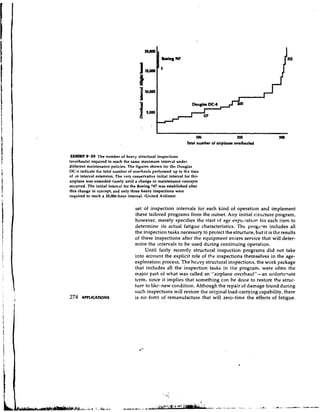
                              Boeing 747 it took United Airlines only 66,000 manhours on major struc-
                              tural inspections to reach an inspection interval of 20,000 hours. In con-
                              trast, traditional maintenance policies led to an expenditure of over
                              4 millien manhours before the same interval was attained for sttuctural
                              inspections 011the smaller and less complex Douglas DC-8. Cost reduc-
                              tions on this scale are of obvious importance to any organization
                              responsible for maintaining large fleets of complex equipment. More
                              important, they are achieved with no decrease in the reliability of the
                              equipment; in fact, a clcarer understanding of the failure process has
                              actually improved operating reliability by making it easier to pinpoint
                              signs of an imminent failure.
                                   The specific developments that led to RCM concepts as a fundi-
                              mental approach to maintenance p!anning are described in detail in
                              Appendix 8. Although MSG-1and MSG-2were short working papers,
                              intended for use by a small number of people with extensive back-
                              grounds in aircraft maintenance, further clarification of the bae;.c prin-
                              ciples has resulted in a logical discipline that applies to maintenance
                              programs for any complex equipment.


1 2 THE BASIS O RCM DECISION LOGIC
               F
             (nc naturc o f failure The principles of reliability-centered maintenance stem from a rigorous
                  idztltific.ltion of examination of certain questions that are often taken for granted:
                 significant items
            ov.ilu.~tic~n failure b How does a failure occur?
                           of
                     COIlLicl)ul'lll~CL.
     selection of .lppli1-.lh~t. .inti     What are its consequences?
                    rtfcctivc tasks
      ,hc      of age cx,,loration       b What good can preventive maintenance do?
                              One of the chief drawbacks of the old hard-time approach to scheduled
                              maintenance is that the resulting teardown inspections provided no
                              real basis for determining when serviceable parts were likely to fail-
                              that is, there was no objective means of identifying reduced resistance
                              to failure. More than any other single factor, recognition of the specific
                              need to identify potential-failure conditions has been responsible for
                              the change from scheduled overhauls to on-condition inspections for
                              siqns of imminent failure.
                                   Unfortunately, not all items can be protected by this type of main-
                              tenance task. In some cases the failure mechanism is imperfectly
                              understood, in others it is random, and in yet others the cost of such
                              inspections excecds the benefits they might provide. In fact, preventive
                              maintenance is not possible for many items of modem complex equip-
                              ment. Nor, in all cases, is it necessary. Failures which could jeopardize
6   INTRODUCTION              the safety of the equipment or its occupants must be prevented. Under
modem design practices, however, very few items fa]! into this category,
either because an essential function is provided by more than one source
or because operating safety i s protected in some other way. Similarly,
hidden functions must be protected by schedultd maintenance, both
to ensure their availability and to prevent exposure to the risk of a
multiple failure.
     In all other cases the consequences of failure are economic, and the
value of preventive maintenance must be measured in economic terms.
In some cases these consequences are major, especially if a failure
affects the operational capability of the equipment. Whenever equip-
ment must be removed from service to correct a failure, the cost of fail-
ure includes that loss of service. Thus if the intended use of the eauip-
ment is of significant value, the delay or abandonment of that use
will constitute a significant loss-a fact that must be taken into account
in evaiuating the benefit of preventive maintenance. Other failures will
incur only the cost of correction or repair, and such failures may well be
tolerable, in the sense that it is less expensive to correct them as they
occur than to invest in the cost of preventing them.
     In short, the driving element in all maintenance decisions is not
the failure of a given item, but the consequences of that failure for the
equipment as a whole. Within this context it is possible to develop an
efficient scheduled-maintenance program, subject to the constraints of
satisfying safety requirements and meeting operational-performance
goals. However, the solution of such an optimization problem requires
certain specific information which is nearly always unavailable at the
time an initial program must be developed. Hence we also need a basic
strategy for decision making which provides for optimum maintenance
decisions, given the information available at the time. The process of
developing an initial RCM program therefore consists of the following
steps:
b   Partitioning the equipment into object categories to identify those
    items that require intensive study
b   Identifying significant items, those whose failure would have safety
    or major economic consequences for the equipment as a whule, and
    all hidden functions, which require scheduled maintenance regard-
    less of their significance
b   Evaluating the maintenance requirements lor each significant item
    and hidden function in terms of the failure consequences and select-
    ing only those tasks which will satisfy these requirements
b   Identifying items for u.hich no applicable and effective task can be
    found and either recommending design changes if safety is involved
    or assigning no scheduled-maintenance tasks to these items until
    further information becomes available


                                               I-,.
F    Selecting conservative initial intervals for each of the included tasks
     anci grouping the tasks in maintenance packages for application
b   Establishing an age-exploration program to provide the factual
    information necessary to revise initial decisions
      The first of these steps is intended, as a pureiy practical matter,
to reduce the problem of analysis to manageable size and to focus it
according to areas of engineering expertise. The next three steps are
the crux of RCM analysis. They involve a specific sequence of decision
questions, worded to indicate the information required for a yeslno
answer in each case. Where this information is not available, a default
answer specifies the action that will best protect the equipment until
there is a basis for some other decision. This dezision-diagram tech-
nique, described in full in Chapter 4, not only provides an orderly basis
for making decisions with limited information, but also results in a clear
audit trail for later review.
      In the airline industry all scheduled-maintenance programs are, of
course, subject to FAA review and approval. The initial program for
each new type of equipment is promulgated by the FAA Maintecance
Review Board. This document, developed in conference with the equip-
ment manufacturers and the purchasing airlines, forms the basis of the
initial program submitted by each airline for FAA approval. Organiza-
tions operating other equipment in the civilinn and rnj!itary sphetes
may define their initial maintenance progranls differently, bc! rame
comparable review procedure is usually involved.
      Because any initlal scheduled-maintenance program must be devel-
oped and imylenlented in advance of actual operational data, an im-
portant element of RCM programs is age exploratiol~,a procedure for
systematic gathering of the information necessaly to determine the
applicability of some maintenance tasks and evaluate the effectiveness
 of otl-.ers. As this information accumulates, the same decision diagram
provides a means of revising and refining the initial program. Much of
this i n f ~ n r ~ a t i o n already available, of course, for equipment that has
                         is
been in service for some time. Although the specific data needed may
have to be retrieved from several different information sy%te;is, and
the remaining useful life of the equipment will be a factor in certain
decisions, RCM analysis under these circumsta:..~es result in fewer
                                                                will
default decisions, and hence a near-optimum program at the outset.
Such programs usually include a larger number of on-condition inspec-
 tions than the programs arrived at under older policies, and fewer of
 the scheduled rework tasks which had been included simply because
 there was no evidence that they should not be done.
      An effective scheduled-maintenance program will realize all the
 reliability of which the equipment is capable. However, ;lo form of pre-
 ventive maintenance can alter characteristics that are inherent in the
.
                .
          dcsinn. Thr8'residuaI failures that occur after all appl~cable effective
                                                                        and
        , yrsventivc tasks have been implemented reflect ihe inherrnt capability
'
          uf the equipmrnt. and if the resulting level of reliabi!ity is inad-quate.
        : the onlirc<ourse is engineering redesign. This effort may be ditected

          a i P sink& component to correct for a dominant failure mode or it may
          be directed at some characteristic that will make a particular prevcntivc
          technique feasible. Pmduc! improvement of this kind takes place-rou-
          tinely during the early years of operation of any complex equipment.
          Thus,. although reliability-centered maintenance is concerned tn the
          short m n with tasks based on the actual reliabiliky characteristics of the
          equipment, it is also concemcd with improvements that will uitimately
          increase delivered ~eliability.

                                                        1 3 ILUMIUTI PROBLWS IN
                                                            COMPLEX EQUIPMENT
            Failures are inevitable in any complex equipment, although their con- lrilurr ru*ihilitic* in
            sequences can be controlled by careful design and effective mainte- "'mr'" rquipmm'
                                                                                          pcrtltrmrnrr requirc.mcnt.
            nance. The reason for this failure incidence is apparent if we consider and ~r,iahlli,v
            some basic differences between simple and complex equipment. Simple th, lo~e,,I Jr*ijin in rr.duzin):
            equipment is asked to p r f o n n very few diiterent functions. Such ' ~ 1 l ~ l ~ ' ~ ~ " q U ' ~ ' ~
            equipment therefore consists of only a few systems and assemblies,
            and thew in turn may be s simple that some are exposed to only one
                                          o
            possible failure mode. In most cases this simplicity extends t the    o
            structur,~! elements as well, and both thc structure and the various items
            on the equipment are relatively accessible for inspt~tion.
                 As a result, simple equipme!~t certain distinct failure charac-
                                                   has
            teristics. Because it is exposed to relatively few failure possibilities, its
            overall reliability tends to be higher. For the same seasun, these fai!ures
            tend to be age-related; each type of failure tends to concentrate around
            some average age, and since only a few Vpes o hilure are involved,
                                                                f
            they govern the average age at failure. Howewer. in the absence of
            redundancy and other protective features, such faiIures mr have fairly
                                                                        iy
            serious consequences. Thus simple equipment i s often pmtected by
            "overdesign"; components are heavier and bulkier than nmssary,
            and familiar materials and processes are used to avoid the uncertainty
            associated with more comdex high-yerfotmance equipment.
                 All in all. the traditional idea that failures are directly related to
    ,       safety and that their likelihood varies directly with age i; often true
            for simple equipment. In any case, it is fairly easy to make an exhaus-
            tive'stud-y of such equipment to determine its scheduled-maintenance
            requirements.
                 The situation is quite different with the complex equipment in t t s e
            today. The general-aviation aircraft of the 1930s usually bad d si ,-pie
nviprcwating engine, a fixed-pitch propeller, fixed land~ng            gear, and
no wing flaps. The m d e m airyl.mc may have wveral turboprop or
turtwict p ~ w ~ r p l a n t wtractable I ~ n d i n g
                             s,                     gear, mrrvable high-lilt de-
vices, an airframe anti-icing system. pressure- atid ttmperature-contml
systems for the &in, extensive cnnimunicati~ns navigation q u i p -
                                                           and
mcnt, complex cockpit instrumentation, and ccrmplex ancillary systems
to support all thrsc addition'al items. This increased complexity has
greatly expanded the safe operational c~pabilityof the aircraft. The
slmplc airplane of the 19.70s was                     to trips of a few hundred
miles under wasonibfy favorable weather conditions. The higher per-
fornitice capability demanded of m d e m equipment, howcvcr, has
greatly increased not only the numhcr of items that can fail, but the
types of failurn that can occur.
     b c h new design of any high-perfcmndnct*cquipmcnt is essentially
an attempt to make earlier designs technologically obsolete, with Ihu
rtsual measure of improvcment k i n g potential opratinp, capability
(includ~ng  operating costs). In other words, this is the operating capa-
biliry cxpcctcd in the absence of any failures that might change the
ci~umstances.The basis for cvilluatin~new aircraft designs usually
includes performance factors such as the following.
     The maximum payload (military or commercial) that can be carried
     over a given distancc
     The maximum distance over which a given payload can be carried
     The minimum 512~ the vchiclt. that can carry a given payload
                         d
     over a givcn distancc
     The highest speed that can be attained under defined payl~.adl
     range conditions
    Special capabilities, such as the ability to traverse rough terrain,
    operate frpm short runways, or withstand punishment
In somc cases these hctors an! weighed against the anticipated direct
operating costs (including maintenance costs) associated with attaining
such capabilities, since a major objective may k to achieve the mini-
mum cost per unit of payload transported. In other cases perforrnaoce
takes precectence ovcf cost. This is true not on!y of military equipment.
but of certain types of civilian equipment, where there is an adtwuate
market for specialized c.ipability despite its cost.
     Another aspect of ,performance demands, of course, is the trend
toward incrcwing automation. Examples arc everywhere-automafic
flight-contml systems in aircraft, including automatic approach ahd
landing equipment; automatic transmissions in autumobiles; auto-
mated traffic-control syslcms for rapid-transit trains; and automatic
aperture-setting devices in cameras.
The design oi complex equipment, therefore, is always a tradeoff
between achieving the required performance capability and acceptable
reliability. This tradeoff entails an intentional compromise between the
lightness and compactness required for high performance and the
weight and bulk required for durability. Thus it is neither econom-
ically nor technologically feasible to produce complex equipment that
can sustain trouble-free operation for an indefinite period of time.
Although the reliability of certain items that perform single functions
may be improving, the number of such items has been vastly multi-
plied. It is therefore inevitable that failures will occur-that is, that
certain parts of the equipment will lose the capability of performing
their specified functions.
      Our concern is not with the number of these failures, but with the
consequences of a given failure for the equipment as a whole. Will
the loss of a particular function endanger the equipment or its occu-
pants? If not, is it necessary to abort the mission or take the equipment
out of service until repairs call be made? Or can unrestricted operaticn
continue and the repair be deferred to a convenient time and place? The
ability to defer failure coilsequences depends largely on the design of
the equipment. One strategy is the use of redundancy and fail-safe
construction. Anoiher strategy is failure substitution, the use of a minor
failure to preempt a major one, as in the use of fuses and circuit
breakers. This latter concept extends to maintenance activities in which
potential failures are used to preempt fi~nctionalfailures. Thus the
design may include various iqstrumentation to give some warning of
an impending failure or other features which iacilitate inspection for
possible deterioration. All these features actually increase the number
of failure possibilities in the sense that they add more items that could
fail. However, they greatly reduce the consequences of any single failure.


                                         1 4 AN OVERVIEW OF MAINTENANCE ACTIVITY
The activities of a maintenance organizaiion include both the scheduled      corrective and scheduled
work that is performed to avoid failures and the corrective work that is     maintenance
                                                                             scheduled-maintenance
performed after failures have occurred. Our present concern is with          p,g,m
preventive maintenance, the program of scheduled tasks necessary to          maintenance stations
ensure safe and reliable operation of the equipment. The complete col-       line maintenance and shop
lection of these tasks, together with their assigned iilter-- . is termed    maintenance
the scheduled vaintenance program. This program includes o. the tasks
that are scheduled in advai~ce-servicing and lubrication, illspection,
and scheduled removal and replacement of items on the equipment.
Exhibit 1.1 lists some typicai tasks in such a program.
     In order to accomplish the anticipated corrective and scheduled
maintenance, an operating orgar.ization must establish an overall sup-                    SECTION 1 * 4   11
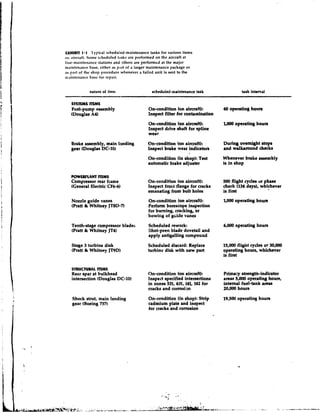
EXHIBIT 1.1 I ypical scheduled-maintenance tasks for various items
on aircraft. Some scheduled titsks are performed on the aircraft at
li~tc-maintenancestations and ethers are performed at the major
nlaititcnanrr base, either as p , ~ rof a larger maintenance package or
                                     t
-1s part of the shop procedure whenever a failed unit is sent to the
niaintenance base for rcpair.


             nature of item                     scheduled-maintenance task


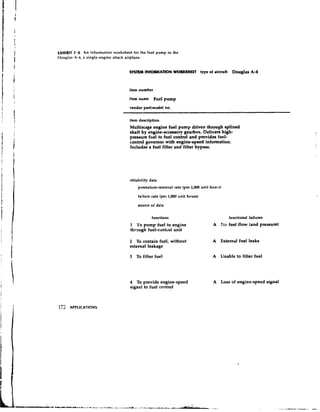
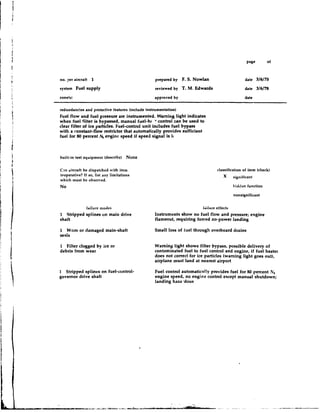
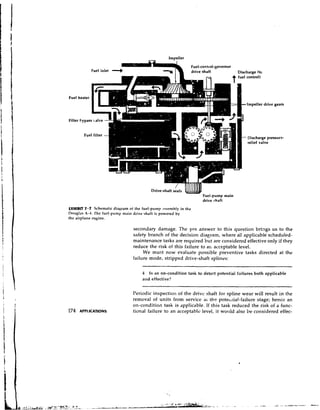
   Fuel-pump assembly                         On-con.dltion (on aircraft):       60 operating hours
   (Douglas A41                               Inspect filter for contamination
                                              on-condition (on aircraft):        1,000 operating hours
                                              Inspect drive shaft for spline
                                              weat
   Brake assembly, main landing               On-condition (on aircraft): .      During ovm@ht tops
   gear (Douglas DC-10')                      Inspect brake wear indicatoia      and w a l h u n d checks
                                              On-condition (in shop): Test       Whenever brake asecmbly
                                              automatic brake adjuster           is in shop

   rOwUPLANT ITEMS
   Compmsor rear frame                        On-condition (on aircraft):        500 flight cycles or phase
   (General Electric CF6-6)                   Inspect front flange for cracks    check (134 days), whichever
                                                                                                         t
                                              emanating from bolt holes          is first
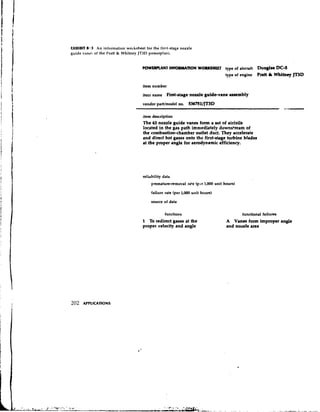
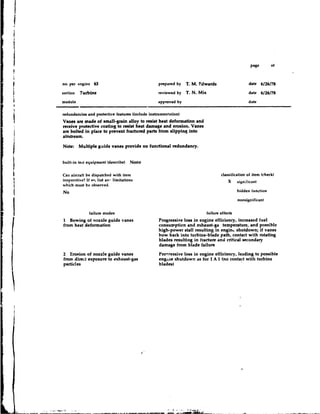
   Nozzle guide vanes                         On-condition (on aircraft):        l,000 operating h o w
   (Pratt & Whitney JT8D-7)                   Perfonn borescope inspection
                                              for burning, cracking, or
                                              bowing of guide vanes
   Tenth-stage compressor blades              Scheduled rework:                  6,000 operating hours
   (Pratt & Whitney JT4)                      Shot-peen blade dovetail and
                                              apply antigalling compound
   Stage 3 turbine disk                       Scheduled diecard: Replace         15,000 flight cycles or 30,000
   (Pratt & Whitney JTSD)                     turbine disk with new part         operating h o r n , whichever
                                                                                 is first

   STIUCTUIAL m       s
   Rear spar at bulkhead                      On-condition (on aircraft):        Primly strength-indicator
   intersection (Douglas DC-10)               Inspect specified intersections    areas 5,000 operating houn,
                                              in zones 531,631,141,142 for       internal fuel-tank areas
                                              cracks and c o m s i ~ n           20,000 houre
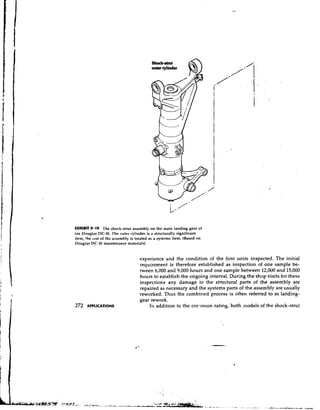
    Shock strut, main landing                 On-condition (in shop): Strip      19,500 operating hours
    gear (Boeing 737)                         cadmium plate and inspect
                                              for cracks and corrosion
port plan which includes the designation of maintenance stations, staff-
  ing with trained mechanics, provision of specialized testing equipment
  and parts inventories, and so on. The overall maintenance plan of an
  airline i:: ?pica1 of that for any transportation system in which each
  piece of bquipment operates through many stations but has no unique
  home station.
        A large proportion of the failures that occur during operation are
  first observed and reported by the operating crew. Some of these must
  be corrected after the next landing, and a few are serious enough to
  require a change in flight plan. The correction of many other failures,
  however, can be deferred to a convenient time and location. Those line
  stations with a high exposure to the need for immediate corrective work
  are designated as maintenance stations and are equipped with trained
  mechanics, spare-parts inventory, and the facilities necessary to carry
  out such repairs. United Airlines serves 91 airline stations with 19 such
  maintenance stations.
       The decision to designate a particular station as a maintenance
  station depends chiefly on the amount of traffic at that station and the
  reliabiliv of the aircraft involved. A station at which the greatest volume
  of repairs is expected is the logical first choice. However, other consid-
  erations may be the frequency with which the operating schedule pro-
  vides ov.-. .ight layovers, the relative ease of routing other aircraft to
  that station, the availability of mechanics and parts to support other
  types of aircraft, the planned volume of scheduled-maintenance work,
  and so on.
        Line-maintenance stations themselves vary in size ~ n comp:exity.
                                                                   d
  The facilities needed for immediate corrective work establish the mini-
  mum resources at any given maintenance station, but operating organi-
  zations generally consolidate the bulk of the deferrable work at a few of
  these stations for greater economy. To simplify the control of scheduled
  maintenance, individual tasks arc grouped into a fairly small number
  of maintenanc- ackages for execution. Like deferrable corrective work,
  these sched        tnainte~lancepackages can be arsigned to any con-
  venient mainr       ice station. Thus the more involved work is generally
, assigned to th!       line stations already equipped with the staff and
  inventories for ,~,ensivecorrective work.
        Not all scheduled-maintenance tasks can be carried out at line sta-
  tions. Major structur-1 inspections, scheduled rework, and inspections
  which entail exter-s; -+ dissassembly are best handled at a major main-
  tenance base equipned with shop facilities. The major base also repairs
  failed units that a. ,moved from aircraft at the line stations. Few such
  maintenance bases are needed, and reliability considerations generally
  determine their size and manpower requirements, rather than their
  location. Many large airlines operate efficiently with only one main-
  tenance base. The work performed at a maintenance base is generally
termed shop maintenance to differentiate it from line maintenance, which
                    consists primarily of replacing failed units rather than repairing them.
                         The entire process by which a detailed support plan is developed
                    is beyond the scope of this volume. Suffice it to say that a detailed plan
                    is necessary in order to implement a scheduled-maintenance program.
                    Our concern here is with the development of such a program-or rather,            L


                    with the principles underlying its development. In the following chap-
                    ters we will examine the nature of failures, the basis on which their con-
                    sequences are evaluated, and the specific criteria that determine the '
                    applicability and effectiveness of a given type of prever.live task. With
                    this framework established, we will consider the decisior, '9gic that
                    results in a scheduled-maintenance program based on the actual reli-
                    ability characteristics of the equipment. This reliability-centered ap-
                    proach ensures that the inherent safety and operating capability of the
                    equipment will be realized at the minimum cost, given the information '
                    available at any time.
                         The chapters in Part Two illustrate the application of RCM decision
                    logic to specific hardware examples and discuss some of the informa-
                    tion processes i~~volved the continuing evolution of the maintenance
                                              in
                    program after the equipment enters service. All these illustrations are
                    drawn from commercial-aircraft applications. However, it shou!d be
                    clear from the discussion in Part One that the basic principles of RCM
                    programs extend not just to otver operating contexts, but to maintenance
                    programs for any complex equipment.
                                                                                               ..I
                                                                                                 i


14   INTRODUCTION
CHAPTER TWO


                             THE PARTS of any mechanical equipment are subject to wear, corrosion,
                             and fatigue which inevitably result in some deviation from the condi-
                             tions that existed when the equipment was new. Ultimately the devia-
                             tion will become great enough that the equipment, or some item on it,
                             no longer meets the required performance standards- that is, it fails.
                             The role of scheduled maintenance is to cope with the failure process.
                             For years, h~wever, chief focus has been on anticipating the age at
                                                     the
                             which things were likely to fail, rather than on how they fail and the
                             consequences of such failures. As a result, there has been insufficient
                             attention to the failure process itself, and even less attention to the
                             question of precisely what constitutes a failure.
                                  One reason for this lack of attention has been the common assump-
                             tion that all equipment "wears out" and inevitably becomes less reli-
                             able with increasing operating age. This assumption led to the conclu-
                             sion that the overall failure rate of an item will always be reduced b y
                             an age limit which precludes operation at ages where the likelihood of
                             failure is greater. In accordance with this hard-time policy, all units were
                             taken out of service when they reached a specified age and were sent
                             tc the major maintenance base for complete disasseinbly and overhaul,
                             a procedure intended to restore each part to its original condibion.
                                  It is now known that the reliability of most complex items does not
                             vary directly with operating age, at least not in such a way as to make
                             hard-time overhaul a useful concept. Procedures directed at obtaining
                             some precise evidence that a failure is imminent are frequently a far
                             superior weapon against failure. However, to understand the specific
                             nature of such procedures as they pertain to an RCM program, it is
                             necessary to take a closer look at the entire concept of failure. Without
16   THEORY AND PRINCIPLES   a precise definition of what condition represents a failure, there is no
way either to assess its consequences or to define the physical evidence
for v lich to inspect. The term failure must, in fact, be given a far more
     ,
                                                                               .
explicit meaning than "an inability to function" in order to clarify the
basis of reliability-centered maintenance.
     In this chapter we will examine the probleln of defining failures
and some of t r ~ e
                  implications this has for the analysis of failure data. We
will also see how failure consequences are evaluated, both in terms of
single failures and in terms of multiple failures. Finally, we will discuss
the process of failure itself and see why complex items, unlike simple
items, do not necessarily wear out.


                                             2 1 THE DEFINITION OF FAILURE
Each of us has some intuitive notion of what constitutes a failure. We         failure
would all agree that an automobile engine, a fuel pumr;or a tire has           functional failure
fai!ed if it ceases to perform its intended function. But there are times      potential failure
when an item does continue to function, although not at its expected
level. An automobile engine may run powerfully and smoothly, but its
oil consumption is high; a fuel pump may pump fuel, but sluggishly;
a tire may hold air and support the car, but its bald tread indicates that
it will do neither much longer.
      Have these items failed? If not, how bad must their condition be-
come before we would say a failure has occurred? Moreover, if any of
these conditions is corrected, the time required for unanticipated re-
pairs might force a change in other plans, such as the delay or cancel-
lation of a trip. In this event could it still be argued that no failure had
occurred?
To cover all these eventualities we can define .a failure in broad
                             terms as follows:
                                                                                        -


                                 A failure is an unsatiefactory cundltion.
                                                                              .-


                             In other words, a failure is any identifiable deviation fmm the original
                             condition which is unsatisfact~ryto a particular user. The determina-
                             tion that a condition is unsatisfactory, however, depends on the con-
                             sequences of failure in a given operating contex;. For example, high oil
                             consumption in an aircraft engine may pose no problem on short-
                             or medium-range flights, whereas on long-range flights the same rate
                             of consumption would exhaust the oil supply. Similarly, engine-
                             instrument malfunctions that would not disrupt operations on multi-
                             engine equipment would be clearly unsatisfactory on a single-engine
                             plane, and performance that is acceptable in a land-based environment
                             might not be good enough for carrier operation.
                                  In short, the eract dividing line between satisfactory and unsatis-
                             factory conditions will depend not only on the function of the item in
                             question, but on the nature of the equipment in which it is installed
                             and the operating context in which that equipment is used. The deter-
                             mination will therefore vary from one operating organization to another.
                             Within a given organization, however, it is essential that the boundaries
                             between satisfactory and unsatisfactory conditions be defined for each
                             item in clear and unmistakable terms.

                             FUNCTIONAL FAILURE
                             The judgment that a condition is unsatisfactory implies that there must
                             be some condition or performance standard on which this judgment
                             can be based. As we have seen.. however, an u2satisfactory condition
                             can range from the complete inability of an item to perform its intended
                             function to some physical evidence that it will soon be unable to do so.
                             For maintenance purposes, therefore, we must classify failures further
                             as either functional failures or potential failures:

                                 A functional failure is the inability of an item (or the equipment con-
                                 taining it) to meet a specified performance standard.

                             A complete loss of function is clearly a functional failure. Note, how-
                             ever, that a functional failure also includes the inability of an item to
                             function at the level of performance that has been specified as satisfac-
                             tory. This definition thus provides us with an identifiable and measur-
18   THEORY AND PRINCIPLES   abie condition, a basis for identifying functional failures.
To define a functional failure for any item we must, of course, have
a clear understanding of its functions. This is not a trivid-ionsideration.
For example, if we say that the function of the br,~king  system on an air-
plane is to stop the plane, then only one functicnal failure is possible-
inability to stop the plane. However, this system also has the functions
of providing modulated stopping capability, providing differential .
braking for maneuvering on the ground, providing antiskid capability, .
and so on. With this expanded definition it becomes clear that the
braking system is in fact subject to a number of different functional
failures. It is extremely important to determine all the functions of an
item that are significant in a given operating context, since it is only in
these terms that its fuprtional failures can be defined.

POTENTIAL MILURE
Once a particular functional failure has been defined, some physical
condition can often be identified which indicates that this failure is
imminent. Under these circumstances it may be possible to remove the
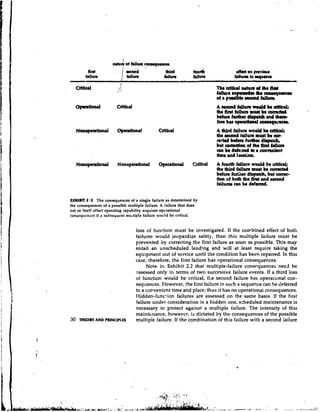
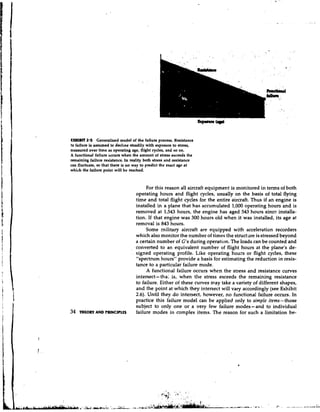
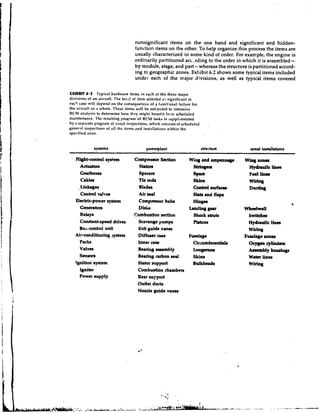
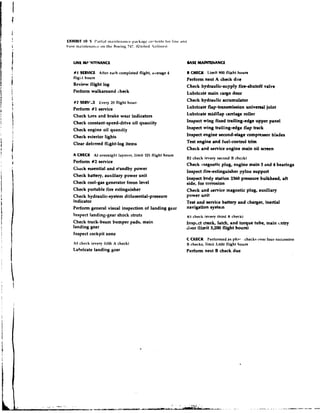
item from service before the point of functional failure: When such
conditions can be identified, they are defiqed as potential failures:

    A potential failure is an identifiqble physical condition which indicates
    a functional failure is imminent.     .
    --                 -                           -    -     -   -

The fact that potential failures can be identified is an important aspect
of modem maintenance theory, becduse it permits maximum use c.i
each item without the consequences assoc~ated     with a functional failure.
Units are removed or repaired a the potential-failure stage, so that
                                    1
potentia[,failures preempt functiorral failures.
     For some items the identifiable condition that indicates imminent
failure is directly related to the performance criterion thdt defines the
functional failure. For example, one of the functions of a tire tread is to
provide a renewable surface that protects the carcass of the tire so that
it can be retreaded. This function is not the most obvious one, and it
might well be overlooked in a listing of tire functions; nevertheless, i t
is important from an economic standpoint. Repeated use of the tire
wears away the tread, and if wear continues to the point at which the
carcass cannot be retreaded, a functional fpilure has occurred. 'To pre-
vent this particular iunctional failure, we must therefore define the
potential failure as some wear level that does not endanger the carcass.
     The ability to identify either a functional or a potential 6:ilure thus
depends on three factors:
    Clear definiticns of the functions of an item 4s they relate to the
    equipment or operating context in which the ltem is to be used
                                           '.
    .I
b   A clear definition of the conditions that constitute a functional
                                         failure in each case
                                     b   A clear definition of the conditions that indicate the imminence
                                         of this failure
                                     In other words, we must not only define the failure; we must also spec-
                                     ify the precise evidence by which it can be recognized.


2 2 M E DETECTION OF FAILURES
 the role of the operating :rew      Both functional failures and potential failures can be defined in tenns
 evident and hidden functions        of identifiable conditions for a given operatin8 context. In evaluating
        verification of failures     failuw data, however, it is important to take i:~tdadcountthe different
      interpreting failure d a t ~   frames c reference of several sets of failure observers-the operating
                                              f
                                     crew, the line mechanic, the shop mechanic, and even passengers.
                                     Understanding how and when the observer sees a failure and how he
                                     interprets it is crucial both to operating reliability and to effective pre-
                                     ventive mairllenance.
                                          The detection and reporting of failures depends on two principal
                                     e!cments f
                                     b   The abserver must be in a position to detect the failure.This "right"
                                         position may be a physical location, a particular moment in time,
                                         or access to the inspection equipment that can reveal the condition.
                                     b   The observer must have standards that enable him to recognize the
                                         condition he sees as a failure, either functional or potential.

                                     THE ROLE OF THE OPERATING CREW
                                     Members of the operating crew are the only people in a position to
                                     observe the dynamic operation of the equipment in its normal environ-
                                     ment. Whereas an airplane in a maintenance facility is in a static
                                     environment, during flight its systems are activated and the whole
                                     machine is subjected to airloads and to both low atmospheric pressure
                                     and low outside temperatures. As a result, the operating crew will be
                                     the first to observe many functional failures. Such failures are often
                                     detected at the time a crew member calls on a function and finds that
                                     it is impaired.
                                           In most complex equipment the crew's ability to observe failures
                                     is further enhanced by extensive instrumentation, warning lights, or
                                     other mortitoring devices. In some cases these indicators make failures
                                     evident at the moment they occur, when otherwise they might go un-
                                     detected until the function was needed. Siich early warning provides
   THEORY AND PRINCIPLES             more time fw- changes in operating strategy to offset the concequences
of the failure. For example, certain engine malfunctions may require
the shutdown of one engine and perhaps the selection of an alternate
landing field, or an auxiliary hydraulic pump may have to be turned on
after one of the main ones fails. Even when the flight can be continued
rk ithout incident, the crew is required to record the iailure as accurately
as possible in the flight log so the condition can be corrected at the
earliest opportunity.
      This instrumentation also permits the crew to determine whether
iioms that are still operative are functioning as well as they should. In
some cases reduced performance is an indication of an imminent fail-
ure, and these conditions vrould also be examined later to see whether
a potential faiiure exists.
      Not surprisingly, the operating crew plays a major role in detecting
failure conditions. This is illustrated by a study of the support costs on
a fleet of Boeing 747's over the iirst ten months of 1975 (a total of 51,400
operating hours). In this case 66.1 percent of all failure reports while the
plane was away from the maintenance base originated with the operat-
ing crew, and these failures accounted for 61.5 percent of the t ~ t aman-
                                                                       l
hours for corrective line maintenance. The other 33.9 percent of the
reported failures included potential failures detected by line mechanics,
along with other failures not normally evident to the operating crew.

HIDDEN-FUNCTIONITEMS
Although most functional failures are first detected by the operating
crew, many items are subject to failures that the crew is not in a posi-
tion to observe. The crew duties often include special checks of certain
hidden-function items, but most such failures must be found by inspec-
tions or tests performed by maintenance personnel. To ensure that we
will know when a failure has occurred, we must know that the observer
is in a position to detect it. Hence for maintenance purposes a basic
distinction is made between evident and hidderl f u n c t i o ~ sfrom the van-
tage point of the operating crew:

    An evident function is one whose failure will be evident to the operating
    crew during the performance of normal duties.


    A hidden function is one whose failure will not bc evident to the operat-
    ing crew during the Ferformance of normal duties.


An item may have several functions, any one of which can fail. If the
loss of one of these functions would not be evident, the item must be
classified from the maintenance standpoint as a hidden-function item.
Hidden func ;ions may be of two kinds:         :


                           b   A function that is normally active but             no indication to the
                               operating crew if it ceases
                           b   A function that is normally inactive, so that the crew cannot know
                               whether it will be available when it is needed (usually the demand
                               follows some other failure)
                           The fire-detection system in an aircraft powerplant falls into the first
                           category. This system is active whenever the engine is in use, but its
                           sensing function is hidden unless it detects a fire; thus if it fails in some
                           way, its falure is similarly hiiden. The fire-extinguishing system that
                           backs up this unit has the second kind of hidden function. It is not
                           activated unless a fire is detected, and only when it is called upon to
                           operate does the crew find out whether it works.
                                In addition to inspecting for potential failures, maintenance per-
                           sonnel also inspect most hidden-function items for functional failures.
                           Thus the operating crew and the maintenance crew complement one
                           arother as failure observers.

                           VUlFlCATlON OF FAILURE5
                           Operating crews occasionally report conditions which appear unsatis-
                           factory to them, but which are actually satisfactory according to the
                           defined standards for condition and performance. This is a basic prin-
                           ciple of prevention. The operating crew cannot always know when a
                           particular deviation represents a potential failure, and in the interests
                           of safety the crew is required to report anything questionable. In most
                           airlines the ~peratingcrew can communicate directly with a central
                           group of maintenance specialists, or controllers, about any unusual con-
                           ditions observed during flight. The controllers can determine the con-
                           sequences of the condition described to them and advise the crew
                           whether to land as soon as possible or continue the flight, with or with-
                           out operating restrictions. The controllers are also in a position to deter-
                           mine whether the condition should be corrected before the plane is
                           dispatched again. This advice is particularly important when a plane is
                           operating into a station which is not a maintenance station.
                                Once the plane is available for majntenance inspection, the main-
                           tenance crew is in a better position to diagnose the problem and deter-
                           mine whether a failure condition actually does exist. Thus the suspect
                           item may be replaced or repaired or marked "OK for continued opera-
                           tion." The fact that failure observers have different frames of reference
                           for interpreting the conditions they see often makes it difficult to evalu-
                           ate failure reports. For example, a broken seat recliner is recognizable
m t o R Y AND PRINCIPLES   to any observer as a failure. Frequently a passenger will notice the con-
dition first and complain about it to the flight attendant. The line
mechanic at the next maintenance station will take corrective action,
usually by replacing the mechanism and sending the failed unit to the
maintenance base, where the shop mechanic will record the failure and
make the repair. In this case all four types of observer would have no
difficulty recognizing the failure.
      The situation is somewhat different with an in-flight engine shut-
down as a result of erratic instrument readings. Although the passen-
gers would not be aware that a failure had occurred, the operating crew
would report an engine failure. However, the line mechanic might dis-
cover that the failure was in the cockpit instruments, not the engine. He
would then replace the faulty instrument and report an instrument fail-
ure. Thus the crew members are the only ones in a position to observe
the failure, but they are not in a position to interpret it. Under other
circumstances the situation may be reversed. For example, on certain
engines actual separation of the turbine blades-a functional failure-
is preceded by a perceptible looseness of one or more blades in their
mounts. If the blades separate, both the operating crew and the passen-
gers may become abrubtly aware of the functional failure, but since
the engine functions normally with loose blades, neither crew nor
passengers have any reason to suspect a potential failure. In this case
the crew members might be able to interpret the condition as a poten-
tial failure, but they are no1 in a position to observe it.
     The line mechanic who inspects the engine as part of scheduled
maintenance will check for loose blades by slowly rotating the turbine
assembly and feeling the blades with a probe (typically a length of stiff
rubber or plastic tubing). If he finds any loose blades, he will report a
failure and remove the engine. The mechanics in the engine-repair shop
are in an even better position for detailed observation, since they must
go inside the engine case to get at the faulty blades. (On occasion they
may be the first to observe loose blades in an engine removed for other
reasons.) If they tonfirm the line mechanic's diagnosis, they will report
the failure as verified.
      Of course, the situation is not always this clear cut. Often there are
no precise troubleshooting met!~ods to determine exactly which com-
ponent or part is responsible for a reported malfunction. Under these
circumstances the line mechanic will remove several items, any one of
which might have caused the problem. This practice is sometimes
referred to as "shotgun" troubleshooting. Many of these suspect items
will show normal performance characteristics when they are tested at
the maintenance base. Thus, although they are reported as failures at
the time they are removed from the equipment, from the shop mechan-
ic's frame of reference they are unverified failures. By the same token,
differences between the testing environment a d the field environment
will sometimes result in unverified failures for items that are actually
                             suffering functional failures in the field.
                                  Units removed from equipment either as potential failures or be-
                             cause of malfunctions are termed premature removals. This term came
                             into use when most equipment items had a fixed operating-age limit.
                             A unit removed when it reached this limit was "time-expired,'' whereas
                             one removed because it had failed (or was suspected of having failed)
                             before this age limit was a "premature" removal.

                             INTERPRETING FAILURE DATA
                             The problem of interpreting failare data is further complicated by dif-
                             ferences in reporting policy from one organization to another. For
                             example, one airline might classify an engine removed because of loose
                             turbine blades as a failure (this classification would be consistent with
                             our definition of a potential failure). This removal and all others like it
                             would then be counted as failures in all failure data. Another airline
                             might classify such removals as "precautionary," or even as "sched-
                             uled" (having discovered a potential failure, they would then schedule
                             the unit for removal at the earliest opportunity). In both these cases the
                             removals woo!d not be reported as failures.
                                  Similar differences arise as a result of varying performance require-
                             ments. The inability of an item to meet some specified performance
                             requirement is considered a functiunal failure. Thus functional failures
                        .    (and also potential failures) are created or eliminated by differences in
                             the specified limits; even in the same ~ i e c e equipment, what is a
                                                                               of
                             failure to one organization will not cecessarily be a failure to another.
                             These differences exist not only from one organization to another, but
                             within a single organization over a long calendar period. Procedures
                             change, or failure definitions are revised, and any of these changes will
                             result in a change in the reported failure rate.
                                  Another factor that must be taken into account is the difference in
                             orientation between manufacturers and users. On one hand, the oper-
                             ating organization tcnds to view a failure for any reason as undesirable
                             and expects the manufacturer to improve the product to eliminate all
                             such occurrences. On the other hand, the mknufacturer considers it his
                             responsibility to deliver a product capable of performing at the war-
                             ranted reliability level (if there is one) under the specific stress condi-
                             tiona for which it was designed. If it later develops that the equipment
                             must frequently be operated bevond these conditions, he will not want
                             to assume responsibility for any failures that may have been caused oi
                             accelerated by such operation. Thus manufacturers tend to "censor"
                             thc'failure histories of operating organizations in light of their indi-
                             vidual operating practices. The result is that equipment users, with
                             some confusion among them, talk about what they actually saw, while
24   THEORY AND PRINCIPLES   the manufacturer talks about what they should have seen.
2 3 THE CONSEQUENCES OF FAILURE
    While failure analysis may have some small intrinsic interest of its own,      safety consequences
    the reason for our concern with failure is its consequences, These may         operational consequences
    range from the modest cost of replacing a failed component to the pos-         nOnoperational
    sible destruction of a piece of equipment and the loss of lives. Thus all
    reliability-centered maintenance,. including the need for redesign, is
    dictated, not by the frequency of a particular failure, but by the nature
    of its consequences. Any preventive-maintenance program is therefore
    based on the following precept:

        The consequences of a failure determine the priority of the maintenance
        activities or design improvement required to prevent its occurre:hce.


    The more complex any piece of equipment is, the more ways there are
    in which it can fail. All failure consequences, however, can be grouped
    in the following four categories:
    b   Safety consequences, involving possible loss of the equipment and
        its occupants
    b   Operational consequences, which involve an indirect economic
.       loss as well as the direct cost of repair
    b   Nonoperational consequences, which involve only the direct cost of
        repair
    b   Hidden-failure consequences, which have no direct impact, but
        increase the likelihood of a multiple failure

    SAFETYCONSEQU WCES
    The first consideration in evaluating any failure possibility is safety:

        Does the failure cause a loss of function or secondary damage that could
        have a direct adverse effect on operating safety?


         Suppose the failure in question is the separation of a number of
    turbine blades on an aircraft engine, causing the engine to vibrate
    heavily and lqse much of its thrust. This functional failure could cer-
    tainly affect the safety of a single-engine aircraft and its occupants,
    since the loss of thrust will force an immediate landing regardless of
    the terrain below. Furthermore, if the engine is one whose case cannot
    contain ejected blades, the blades may be thrown through the engine            ,
    case and cause unpredictable, and perhaps serious, damage to the                            SECTION 2.3   25
plane itsel;. There is also danger from hot gases escaping from thq
                             tom engine case. In a multiengine plane the loss of thrust would have
                             no direct effect on safety, since the aircraft can maintain altitude and
                             complete its flight with one engine inoperative. Hence the loss df func-
                             tion is not in itself cause for alarm. However, both plane and passengers
                             will still be endangered by the possible secondary damage caused by
                             the ejected blades. In this case, therefore, the secondary effdcts ate
                             sufficient reason to classify the failure as critics:.   ,


                                  A critical failure is any failure that could have a direct effect on
                             safety. Note, however, that the term direct implies certain limitations.
                             The impact of the failure must be immediate if it is to be considered
                             direct; that is, the adverse effect must be one that will be felt before
                             planned completion of the flight. In addition, these consequences must
                             result from a single failure, not from some combination of this failure
                             with one that has not yet occurred. An important fact follows from this:
                             b   All critical failures will be evident to the operating crew. If a failure
                                 has no evident results, it cannot, b;. definition, have a direct effect
                                 on safety.
                             It may be necessary to remove a plane from service to correct certain
                             failures before continuing operation, and in some cases it may even be
                             advisable to discontinue the flight. However, as long as the failure itself
                             has no immediate safety consequences, the need for these precaution-
                             ary measures does not justify classifying this failure as critical.
                                  Not evey critical failure results in an accident; some such failures,
                             in fact, have occurred fairly often with no serious consequences. How-
                             ever, the issue is not whether such consequences are inevitable, but
                             whether they are possible. For example, the seccndary effects associated .
                             with ejected turbine blades are unpredictable. Usually they do not
                             injure passengers or damage a vital part of the plane-but they can.
                             Therefore this failure is classified as critical. Similarly, any failure
                             that causes an engine fire is critical. Despite the existence of fire-
                             extinguishing systems, there is no guarantee that a fire can be con-
                             trolled and extinguished. Safety consequences are always assessed' at
                             the most .~nservativelevel, and in the absence of pioof,that a failure
                             cannot affect safety, it is classified by deflult as critical.
                                   In the event of any c1:itical dilure, every attempt is made to prevent
                             a recurrence. Often redesign of one or more vulnerable items is neces-
                             sary. However, tine design and manufacture of new parts and their sub-
                             sequent incorporation in in-service equipment takes months, and
                             sometimes years. Hence some other action is needed in the meantime.
                             In the case of turbine-blade failure an identifiable physical condition-
                             loose blades-has been found to occur well in advance of actual sepa-
                             ration of the blades. Thus regular inspection for this condition as part
26   THEORY AND PRlNClPLLS   of scheduled maintenance makes it possible to remove engines at the
potential-failure stage, thereby forestalling all critical functional fail-
    ures. Note that this preventive-maintenance task does not prevent
    failures; rather, by s~abstituting potential failure for a functional fail-
                                     a
    ure, it precludes tne consequences of a functional failure.

    OPERATIONAL CONSEQUENCES
    Once safety consequences have been ruled out, a second set of conse-
    quences must be considered:
                        --             - -      -     -   -


        Does the failure have a direct adverse effect on operational capability?
                                                                             -
    Whenever the need to correct a failwe disrupts planned operations, the
    failure has operational consequences. Thus operational consequences
    include the need to abort an operation after a failure occurs, the delay
    or cancellation of other operations to make unanticipated repairs, or
    the need for operating restrictions until repairs can be made. (A critical
    failure can, of course, be viewed as a special case of a failure with opera-
    tional consequences.) In this case the ccnsequences are economic: they
    represent the imputed cost of lost operational capability.
         A failure tnat requires immediate correction does not necessarily
    have operational consequences. For example, if a failed item on an air-
    craft can be replaced or repaired during the normal transit time at a line
    station, then it causes no delay or cancellation of subsequent flights,
    and the or'ly economic consequence is the cost of corrective mainte-
    nance. In contrast, the rlane may be operhtional, but its reduced capa-
I
    bility will result in such costs as high fuel consumption. The definition
    of operational consequences will therefore vary from one operating
    context to another. I n all cases, however, the total cost of an operational
    failure includes the economic loss resulting from the failure as well as
    the cost of repairing it. If a failure has no operational consequences, the
    cost of corrective rn:.in. mance is still incurred, but this is the only cost.
         If a potential faihqrct such as loose turbine blades were discovered
    while the plane 1. - . ice,
                          '.          "     iime required to remove this engine
I
    and install a - * , .  ::iw would .n,dlve operational consequences. How-
    ever, inspection. :.*,.. this potential failure can be performed while the
    plane is out of sen.i:e for scheduled maintenance. In this case there is
    ample time to remove and replace any failed engines (potential failures)
    without disrupting planned operations.

    NONOPERATIONALCONSEQUENCES            I

    There are many kinds of functional failures that have no direct adverse
    effect on operational capability. One common example is the failure of
j   a navigation unit in a plane equipped with 5ighly redundant naviga-
I
    tion system. Since other units ei'.,;..:t: ava.;, 'ty oi the required func-      SECTION 2.3   27
tinn. )he                                    .
                                                                                -.. .
                                                                         ~ d s e . .. : the failed unit must be
                                               n n l v r m r - - - - * - -. .
                                                                          *

                                  replaced at some cohenient ti7:c. Thus the costs generated by such a
                                  failure are limited to the cost of corrective d,aintenance.
                                       As we have seen, potential failures also fall in this category. The
                                  purpose of defining a potential failure that can be used to preempt a
                                  functional failure 'is to reduce the failure consequences in as many cases
                                  as possible to the level of direct cost of replacement and repair.

                                   HIDDEN-FAILURECONSEQUENCES
                                   Another important class of failures that have' no immediate conse-
                                   quences consists of failures of hidden-function items. By definition,
                                   hidden failures can have no direct adverse effects (if they did, the
                                   failure would not be hidden). However, the ultimate consequences can
                                   be major if a hidden failure is not detected and ccrrected. Certain
                                   elevator-control systems, for example, are designed with concentric
                                   inner and outer shafts so that the failure of one shaft will not result in
                                   any loss of elevator control. If the second shaft Nere to fail after an
                                   undetected failure of the first one, the result would be a critical failure.
                                   In other words, the consequence of any hidden-function failure is in-
                                   creased exposure to the consequences of a multiple failure.


     2 * 4 MULTIPLE FAILURES
     probability of a multiple failure Failure consequences are often assessed in terms of a sequence of indc-
       evaluation of ntulti~le-failure pendent events leading to a multiple failure, since several successive
                       consequences
                                   failures may rt-sult in consequences that no one of the hilures would
                                   produce individually. The probability of a multiple failure is simple to
                                   calculate. Suppose items A and B in Exhibit 2.1 both have a probability
                                   of 0.99 of surviving a given two-hour flight (this would correspond to
                                   one failure per 100 flight:;,.which is in fact a very high failure rate). If
                                   items A and B are both functioning at takeoff time, there are only four
                                                                                     I
                                   possible outcomes:
                                       Item A survives and item.B survives: P = 0.;99 X 0.99 = 0.9801
                                       Item A survives and item i fails:
                                                                3                       P = 0.99 X 0.01 = 0.0099
                                   b   Item A fails and item B survives:                P = 0.01 X 0.99 = 0.0099
                                   b   Item A fails and item B fails:                   P = 0.01 X 0.01 = 0.0001
                            In other words, the probability that A and B wil! both fail during the
                            same flight is only 0.0001, or an average of once in 10,000 flights. If we
                           were considering a multiple failure of three items, the average occur-
                            rence, even with the high failure rate we have assumed here, would be
' 28 THEORY AND P~~~NCIPLES once every milliotl flights.
 '
EXHIBIT 2.1 1rce diagram showing the probability of a multiple
                                               failure of two items during the sa:nc flight when both items are
                                               servicr~ble takeoff.
                                                           at

                 .Y.


          Note t h e dfferwce, however, if item A is in a failed state when
    the flight begins. Thcprobability that B will fail is .01; thus the prob-
    ability of a multiple failure of A and B depends only on the probability
    of the second failure--01, or an average of one occurrence every 100
    flights. This becomes a matter of concern if the combination has critical
.   consequences. Becaase of the increased probability of a multiple failure,
    hidden-function items are placed in a special category, and all such
    items that are not subject to other maintenance tasks are scheduled for
    failure-finding tasks. Although this type of task is intended to diecover,
    rather than to preyent, hidden failures, it can be viewed.qs preventive
    maintenai~cebecause one of its objectives is to reduce exposure to a
    possible multiple failure.
         To illustrate how the consequences of a multiple failure might be
    evaluated, consider a sequence of failures all of which are evident. If
    the first failure has safety consequences, there is no need to assess the
    consequences of a second fhilure. This first critical failure is the sole
    concern, and every effort is made to prevent its occurrence. When the
    first loss of function is not critical, then the consequences of a second
fkrt                                     third          hr~&               aon prntoar
        fiu
         lln                                      fiu
                                                   lln           frllun            frilumi 88armn
                                                                                          n

                                                                           The laltidarhur d tk,fint
                                                                           f-'Ufr-'"'u*
                                                                            p d m a frllu~a
                                                                           O ~ I

                                                                           A w d f a u n wwld be aitlcrlt
                                                                           tfrtintthilunmlUtkcorrrtkd
                                                                           before faxther dlrpatch and tk-
                                                                           fore hu opentloarl comequ~p~cn.
                                                                           A thkd faUurt would be aW  l
                                                                           the racbnd frilun murt be a .t
                                                                           rrcad before f d t e r &pa&&
                                                                           but d o n of thr fimt failure
                                                                           can be d & d bo a conmnimt
                                                                           t b e a d 1.~uti011.
     Nonopentionrl       Nonopentiolul         Operatiod         Criticd   A fourth fUum would be dtiul;
                                                                           the third failure murt be camctrd
                                                                           before furC;rerdirpatch, but consc-
                                                                           tion of both the flrM and wand
                                                                           failurn can k deferred.

EXHIBIT 2.2 The consequences of a single failure as determined by
the consequences of a possible multiple failure. A tailure that does
not in itself affect operating capability acquires operational
conscquetrzcs if a suhscquent multiple failure would be critical.


                                   loss of function must be investigated. If the con-bined effect of both
                                   failures would jeopardize safety, then this multiple failure must be
                                   prevented by correcting the first failure as soon as possible. This may
                                   entail an unscheduled lending and will at least require taking the
                                   equipment out of service until the condition has been repaired. In this
                                   cdse, therefore, the first failure has operational consequences.
                                        Note in Exhibit 2.2 that multiple-failure conscquences need be
                                   nssessed on!y in terms of two successive failure events. If a third loss
                                   of function .would be critical, tlre second failure has operational con-
                                   sequences. However, the first failure in such a sequence can be deferred
                                   to a convenient time and place; thus it has ns operational conscquences.
                                   Hidden-function failures are assessed on the same basis. If the first
                                   failure under consideration is a hidden one, scheduled maintenance is
                                   necessary to protect .against a multiple failure. The intensity of this
                                   maintt-nance, however, is dictated by the consequences of the possible
30    THEORY AND PRINCIPLES        multiple failure. If the combination of this failure with a second lailure
would be critical, every effort is made to ensure that the hidden func-
tion will be available.
     What we are doing, in effect, is treating any single failure as the
first in a succession of events that could lead to a critical multiple fail-
ure. It is this method of assessing failure consequences that permits us
to base a maintenance program on the consequences of single failures.


                                             2 5 THE FAILURE PROCESS
FAILURE IN SIMPLE ITEMS                                                             failure in simple items
One reason for identifying unsatisfactory conditions at the potential-              a model of the failure process
failure stage is to prevent the more serious consequences of a functional           the age at failure
failure. Another reason, however, is that the removal of individual unit,
on the basis of their condition makes it possible to realize most of the
useful life of each unit. To see how this procedure works, zonsider a
simple item such as the airplane tire in Exhibit 2.3. -4lthough a tire has
other functions, here we are concerned with its retread capability.
Hence weshave defined a functional failure as the point at which the

                                            LXHIBm 2.3 Tire tread wear as a n illustration of the failure pmcess
                                            in a simple item. The potential-failure condition ifi defined in this
                                            case as the tread depth at point A. At poitit B, -when the tire is smooth,
                                            ct can still be removed as a potential failure, but if wear continues to
                                            point C the carcass will no longer be suitable for retreading, and the
                                            loss of this function will constitute a functional failure.


                          Expoow (number of lurdln@
ULHlbm 2.4 The use of potential failures to prevent function.11
iailures. When tread depth reaches the potential-failure stage, the
tire is removed and retreaded (recapped). 'This pmcess restores the
original tread, .:~IJhence the original failure rcsist,~ncr,so that
the tire ncc,r~re.iches the futrclional-failure stage.


                                   carcass plies are exposed so that the carcass is no longer suitable for
                                   retreading. The remaining tread is thus the tire's resistance to failure at
                                   any given moment. The stresses to which the tire is subjected during
                                   each landing reduce this resistance by some predictable *mount, and
                                   the number of landings is a measure of the total exposure to stress. With
                                   increasing exposure in service, the failure resistance is gradually re-
                                   duced until eventually there is a functional failure-visible plies.
                                        Zecause the reduction in failure resistance is visible and easily
                                   measured, it is usual maintenance practice to define a potential failure
                                   as some wear level just short of this failure point. The tires are inspected
                                   periodically, usually when the aircraft is out of service, and any tire
                                   worn beyond the specified level is replaced. To allow for periodic
                                   inspections, the condition we choose as the potential-failure stage
                                   must not be too close to the functional-failure condition; that is, there
                                   must be a reasonable interval in which to detect the potential failure
                                   and take action. Conversely, setting the potential-failure limit too high
                                   would mean replacing tires that still had substantial useful life.
                                        Once the optimum potential-failure level has been defined, inspec-
32   THEORY AND PRINCIPLES         tions can be scheduled at intervals based on the expected amount of
tread wear over a given number of landings. Exhibit 2.4 shows a smooth
    tread noticed at inspection 5. At this point the tire is replaced, and if
    its carcass is sound, it will be retreaded. Retreading restores the original
    tread, and hence the original resistance to failure, and a new service
    cycle begins.
         Failure resistance, as we are using the concept here, is somewhat
    analogous to the structural engineering practice of determining the
    stresses imposed by an applied load and then addir.g a safety factor to
    determine the design strength of a structural member. 'Tke difference
    between the applied load and the design strength is then the resistance
    to failure. The same principle extends to servicing and lubrication
    requirements, for example, where a specified oil quantity or lubrication
    film represents a resistance to functional failure. Similarly, loose turbine
    blades are taken as a marked reduction in failure resistance, Thc ,s a
    subtle difference, however, between this latter situation and -. tire
    example. In the case of the tire the decline in failure resistance is visible
    and rta: approximate unit of stress (average tread wear per landing) is
    k n ~ w nIn the case of turbine blades the unit of stress is unknown and
             .
    the decline in failure resistance is not apparent until the resistance has
    become quite low.

    A MOnU O THE FAILURL PROCESS
            F
    So far we have discussed a reduction in failure resistance that is cvi-
    denccd by some visible condition. The more general failure process '
    involves a direct interaction betweeri stress and resistance, as shown
    in Exhibit 2.5. The measure of exposure may be calendar time, total
    operating hours, or number of flight or landing cycles, depending on
    the item. Because the measurable events occur over tirne, it is common
    to refer to total exposure as the age of an item. Possible measures for the
    stress scale are even more varied. Stresses may include temperature and
    atmospheric conditions, vibration, abrasion, peak loads, or some com-
    bination of these factors. It is often impossible to separate all the stress
    factors that may affect an item; hence exposure to stress is usually gen-
    eralized to include all the stresses to which the item is subjected in a
    given operating context.
         The primary age measure for most aircraft equipment is operating
    hours,usually "off-to-on" (takeoff to landing) flying hours. Some failure
    modes, hawever, are related to the number of pround-air-ground stress
    cycles, and in these cases age is measured as nunlber of landings or
    flight cycles. Flight cycles are important, for exawple, in determining
    the number of stress cycles experienced by the aircraft structure and
    landing gear during landing. They are also of concern for powerplants.
    Engines undergo much more stress during takeoff and climb than dur-
i   ing cruise, and an engine that experienr2s more takeoffs in the same
    number of operating hours will deteriorate more rapidly.                        SECTION 2 - 5   33
ULHlBfT 2.5 Generalized model of the failure process. Resistance
!o failure is assumed to decl~ne  steadily with exposure to stress,
n~easured  over time as operating age, flight cycles, and so on.
A functional failure occurs when the amount of stress exceeds the
remaining failure resistance. In reality both stress and resistance
can fluctuate, so that there is no way to predict the exact age at
which the failure point will be reached.


                                        For this reason all aircraft equipment is monitored in terms of both
                                   operating hours and flight cycles, usually on the basis of total flying
                                   time and total flight cycles for the entire aircraft. Thus if an engine is
                                   installed in a plane that has accumulated 1,000 operating hours and is
                                   removed at 1,543 hours, the engine has aged 543 hours since installa-
                                   tion. If that engine was 300 hours old when it was installed, its age at
                                   removal is 843 hours.
                                        Some military aircraft are equipped with acceleration recorders
                                   which also monitor the number of times the structare is stressed beyond
                                   a certain number of G's during operation. The loads can be counted and
                                   converted to an equivalent number of flight hours at the plane's de-
                                   signed operating profile. Like operating hours or flight cycles, these
                                   "spectrum hours" provide a basis for estimating the reduction in resis-
                                   tance to a particular failure mode.
                                        A functional failure occurs when the stress and resistance curves
                                   intersect- tha: is, when the stress exceeds the remaining resistance
                                   to failure. Either of these curves may take a variety of different shapes,
                                   and the point at which they intersect will vary accordingiy (see Exhibit
                                   2.6). Until they do intersect, however, no functional failure occurs. In
                                   practice this failure model can be applied only to simple items -those
                                   subject to only one or a very few failure modes-and to individual
34   THEORY AND PrUNClPLts         failure modes in complex items. The reason for such a limitation be-
comes apparent if we consider some of the variables in just a single
failure mode.

THE AGE AT FAlUlRE
Our e%ainplesthus far imply that any given component, such as a
tire, has a well-defined initial resistance to failure and that the rate of
decline in this resistance is more or less known and predictable. It follows
that the time of failure should be predictable. In reality, however, even
nominally identical parts will vary both in their initial failure resistance
and in the rate at which this resistance declines with age. Suppose we
have two nominally identical units of a simple item, or perhaps two
identical parts in a complex item. To simplify matters further, let us say
they are exposed to only one type of stress and are subject to only one
type of failure. On this basis we might expect their failure resistance to
decline at the same rate and therefore expect both units to fail at approx-

                                             EXHIBm 2.6      Variability of stress, failure resistance, and the age
                                             at failure. In example A the resistance remains constant over time,
                                             but a sudden peak in stress causes failure to occur. In B the stress
                                             and resistance curves do not intersect, but the peak in stress has
                                             permanently lowered the remaining failure resistance. In C the
                                             reduction in failure resistance caused by the peak stress is temporary.
                                             In D the peak stress has accelerated the rate at which the remaining
                                             resistance will decline with age.


     I                                   I
               E*porure ( q e )                    Exporure ( y e )
                                                                                                  SECTION 2.5     35
EXHIBIT 2.7 The difference in failure age of two nominally identical
parts subjected to similar stress patterns. The two units begin their
service lives with coniparable initial resistance to failure, but unit B
is exposed to greater stress peaks and reacts to them consistently.
Unit A behaves less accountably; its resista~~ce unaffected by stress
                                                  is
peaks at 640 and 1,120 hours but declines rapidly between 1.200 and
1,300 hours. As a result, one unit fails at 850 hours and the other at
1,300 hours.
                                    imately the same age. However, all manufactured components are
                                    produced to specified tolerance limits, which results in a variation in
                                    initial resistance. These varia, ' m s are insignificant from a performance
                                    standpoint, but the result is that the two units will begin their service
                                    lives with slightly different capacities to resist stress, and these capaci-
                                    ties may decline at somewhat different rates.
                                          Stress also varies from moment to moment during operation, some-
                                    times quite abruptly. For example, the different loads exerted on an
                                    aircraf! structure by atmospheric turbulence can vary markedly even
                                    in the course of a short flight. Moreover, the effect of these stresses will
                                    be further influenced by the condition of the item at the particular
                                    moment it is stressed. As a result, each component will encounter a dif-
                                    ferent stress pattern even if both are operating as part of the same sys-
                                    tem. Although the variations in either stress or resistance may be slight,
                                    their interaction can make a substantial difference in the length of time
                                    a given component will operate before failing. Units A and B in Exhibit
                                           -
                                    2.;' ,~,'iridi;r;lj' 21;ke in their initial resistance, and the stress placed on
                                         -.
                                    each does not vary much from the constant stress assumed in the gener-
                                    alized mode). However, the time of failure is the point at which the
                                    stress and resistance curves intersect; thus unit B failed at an age of
36   THEORY AND PlllNClPLES         850 hours, whereas unit A survived until 1,300 hours.
Despite the variation in the failure ages of individual units, if a
large number of nominally identical units are considered, their failures
will tend to concentrate about some average age. For purposes of relia-
bility analysis, however, it is necessary to employ statistical techniques
that describe the variation about this average age.
      It is also important to recognize that the actual age at failure de-
pends on the stress the unit experiences. The wing-,to-fuselage joints
of an aircraft will stand up to normal air turbulence for a very long time,
but perhaps not to the loads encountered during a tornado. The fan
blades of a turbine engine can withstand thousands of hours of normal
stress, but they may not be able to tolerate the ingestion of a single
goose. In nearly all cases random stress peaks markedly above the aver-
age level will lower the failure resistance. This reduction may be perma-
nent, as when damage to several structural members lowers the failure
resistance of a wing, or resistance may be affected only at the time the
stress exceeds a certain level. In some cases resistance may change with
each variation in stress, as with metal fatig.de. From the standpoint of
preventive maintenance, however, the important factor is not a predic-
tion of when an item is likely to fail, but whether or not the reduction in
failure resistance can be identified by some physical evidence that
permits us to recognize an imminent failure.
      Many functional failures are evident at the time they occur, and in
t h e s cases the exact age at failure is known. Unless a failure is evi-
dent to the operating crew, hcwelrer, it is impossible to determine pre-
cisely when it cccurred. A potential failure detected by mechanics is
known only to have occurred some time between the last inspection
and the inspection at which it is observed. Sjmilarly, although there is
some exact age at which a hidden function fails, the only age we can
pinpoint is the time at which the failure is discovered. For this reason
the age at failure is defined, by convention, as the age at which a failure
is observed and reported.

                                            2 6     FAILURE IN COMPLEX ITEMS
A complex ltem is one that is subject to many different failure modes. As     failure modes
a result, the failure processes q a y i:volve a dozen different stress and    dominant failure modes
resistance considerations, and a correspondingly tangled graphic sepre-       failure age of a complex item
sentation. However, each of these considerations pertains to a single
failure mode - some particular type or manner of failure. For instance, a
bearing in a generator may wear; this causes the unit to vibrate, and
ultimately the bearing will seize. At this point the generator will suffer
a functional failure, since it can no longer rotate alld produce eiectric
power. Generators can also fail for other reasons, but the failure mode
in this case is bearing seizure.
     Of course, the bearing itself i? also subject to more than one failure
mode. It may wear as a result of abrasion or crack as a result of excessive
                                   heat. From the standpoint of the generator both conditions lead to the
                                   same failure, bearing seizure. However, the maintenance analyst must
                                   know the physical circumstances leading to a particular failure in order
                                   to define an identifiable potential-failure condition. The manufacturer
                                   also needs to know that the bearing is prone to failure and that a modi-
                                   fication is needed to improve the reliability of the generator. Such a
                                   design modification is obviously desirable if one particular failure mode
                                   is responsible for a significant proportion of all the failures of the item.
                                   Such failure modes are called domirrant failure modes.
                                        As with failures in simple items, the failure ages for a single failure
                                   mode tend to concentrate about an average age for that mode. However,

EXHIBIT 2.8 Experience with 50 newly ingtalled Pratt & Whilney
JTBD-7 engines over the first 2,000 operating hours. The 21 units that
failed before 2,000 hours flew a total of 18,076 hours, so the total
operating time for all 50 engines was 18,076 hours plus 58,000 hours
for the surviving engines, ur 76,076 hours. The mean time between
failures was therefore 76;W6/Zl, or 3,622 hours. The average age
of the failed engines, however, was only d61 hours. (United Airlines)


                                            0    2     4    6    8       l   0   1   2   U   l   6    1   1   0
                                                           Opmtiq ry at fdltur (hondrrdr of h o w )
the average ages for all the different mod?s will be distributed along
the exposure axis. Consequently, unless there is a dominant failure
mode, the overall failure ages in complex items are usually widely dis-
persed and are unrelated to a specific operating age. This is a unique
ch, racteristic of complex items. A typical example is illustrated in Ex-
hibit 2.8. In a sample of 50 newly installed Pratt & Whitnev JTBD-7
engines, 29 survived beyond 2,000 operating hours. The disparate fail-
ure ages of the 21 units that failed, however, do not show any concen-
tration about the average failure age of 861 hours.
     Nevertheless, even in complex items, no matter how numerous the
failure modes may be, the basic failure process reduces to the same
faciur- the interaction between stress and resistance to failure. Whether
failures involve redr-cad resistance, random stress peaks, or any combi-
nation of the two      .
                       7 1   interaction that brings an item to the failure
point. This aspc-' a !he failure process was summed up in a 1960
United .irlines rep -?rt:*
     The any: IC as a whole, its basic structure, its systems, and the
     various items in it are operated in an environment which causes
     stresses to be imposed upon them. The magnitudes, the durations
     and the frequencies with which specific stresses are imposed are
     all very variable. In many cases, the real spectrum of environ-
     mentally produced stresses is not known. The ability to withstand
     stress is also variable. It differs from piece to oiece of new nomi-
     nally identical equipment due to material differences, variations
     in the manufacturing prcicesses, etc. The ability to withstand stress
     may also vary with the age of a piece of equipment.
          It is implied that an instance of environmental stress that ex-
     ceeds the failure resistance of an item at a particular time consti-
     tutes failure of that item at that time.


                                                   2 'P QUANTITATIVE DESCRlPTlONS O FAILURE
                                                                                   F
Any unanticipated critical failure prompts an immediate response to                           failure rate
prevent repetitions. In other cases, however, it is necessary to know                         mean time between failures
how frequently an item is l i ~ e l y fail in order to plan for reliable
                                     to                                                       pmbability of survival
operation. There are several common reliability indexes based on the                          pmbabilib' density of
                                                                                              conditional probability
failure history of an item. Methods for deriving certain of these measures                    of failure
'F. S. Nowlan, A Comparison o the Potential Effectiveness of Numerical Regulatory
                                   r
Codes in the Fields of Overhaul Periodicity, Airplane Strength, and Airplane Perfor-
mance, United Airlines Report POA-32, April 14.1960. These remarks paraphrase a report
prepared by D. J. Davisnf theRand Corporation in 1950, which offered intensiveanalysiaof
failure data. For an excellent detailed discussion of the physical processes present in the
failure mechanism. see Robert P. Haviland, Rclinbility atld Lotrg Life Desiyn, Van Nostrand
Company, Inc., New York, 1964.                                                                             SECTION 2.7     19
are discussed in detail in Appendix C, but it is helpful at this point to
                             know what ehch measure actually represents.
                             FAILURE UE
                                      T
                             'fie failure rate is the total number of failures divided by some measure
                             of operational exposure. In most cases the failure rate is expressed as
                             failures per 1,000 operating hours. Thuc if six failures have occurred
                             over a period of 9,000 hours, the failure rate is ordinarily expressed as
                             0.667. Because measures other than operating hours are also used (flight
                             cycles, calendar time, etc.), it is important to know the units of measure
                             in comparing failure-rate data.
                                  The failure rate is an especially valuable index for new equipment,
                             since it shows whether the failure experience of an item is representa-
                             tive of the state of the art. It is also useful in assessing the economic
                             desirability of product improvement. Early product-intprovement deci-
                             sions are based on the performance of units that have beer. .-xposed to
                             fairly short individual periods of time in service, and this performance
                             is adequately measured by the failure rate.
                             MUN nML BLNYUN F A I L U ~
                                                                                                                  
                             The mean time between failures, another widely used reliability index,
                             is the reciprocal of the failure rate. Thus with six failures in 9,000 oper-
                             ating hours, the mean time between failures would be 9,00016, or 1,500
                             hours. This measure has the same uses as the failure rate. Note that the
                             mean time between failures is not necessarily the same as the average
                             age at failure. In Exhibit 2.8, for example, the average age of the failed
                             engines was 861 hours, whereas the mean time between failures was
                             3,622 hours.*
                             PROMBILITV Of SURVNAl.
                             With more extended operating experience it becomes possible to de-
                             termine the age-reliability characteristics of the item under study- the
                             relationship between its operating age and its probability of failure. At
                             :his stage we can plot a survival curve, showing the probability of sur-
                             vival without failure as a function of operating age. This curve relates
                             directly to the gener !y accepted definition of reliability:

                                  Reliability is the probability that an item will survive to a specified oper-
                                  ating age, under specified operating conditions, without failure.


                             For this reason the survival curve is commonly referred to as the reli-
                             ability function.
40   THEORY AND PRINCIPLES   'For a further discussion of this distinction, see Appendix C.
0p.nttns y rlnce lut rhap Vt&< :flight lioun,~


                                              EXHIBIT 2.9 Survival curve fur the Pratt & Whitney JT8D-7 engine
                                              of the Boeing 737, based on 58,432 total operating hours from May I
                                              to July 31,1974. The average life is computed by partitioning alang
                                              the vertical axis to form small incremental areas whose sum
                                              approximates the area under the curve. With an age limit of 1,000
                                              hours, only the shaded area enters into this computation, since no
                                              engines can contribute to the survival curve beyond this limit,
                                              despite the fact that they would I~avc survived had they been left in
                                              service. (United Airlines)


     Exhibit 2.9 shows a typical survival curve for an aircraft turbine
engine. The curve represents the percentage of installed engines that
survived to the time shown on the horizontal axis, and this is usually
our best estimate of the probability that any individual engine will
survive to that time without failure.
     A survival curve is more useful than a simple statement of the
failure rate, since it can be used to predict the percentage of units that
will survive to some given age. If the engines in Exhibit 2.9 were sched-
uldd for removal at 1,000 hours, for example, 69 percent of them would
survive to that age limit, whereas 31 percent could be expected to fail
before then. The area under the survival curve can also be used to mea-
sure the average life of the item under consideration. If the probability
scale is divided into small increments, each of which is projected to
intersect the curve, the contribution of each of these incremental areas           .
can be calculated and added to determine the average life. Thus, the tri-
angie at the top is the contribution o the first 10 percent of the units that
                                     !
fail (90 percent survive beyond this age):
                                                                           .lo
                                [(age at P = 1) t (age at P = .90)] X      -2
                            The next incremental area represents the contribution to the average life
                            of the next 10 percent of the units that fail:

                                [(age at P = .9Q   + (age at P = .80)] X -
                                                                         .10
                                                                          2
                            and so on. Completion of this computation for the entire area under the
                            curve would show that, with no age limit, the average life expected for
                            each engine in service would be 1,811 hours.
                                 Note, however, that an age limit of 1,000 hours removes all the sur-
                            viving units from service at that age. In this case, therefore, the area
                            under the curve represents only the area up to that age limit. The proba-
                            bility of survival to 1,000 hours is .692, so the contribution of any sur-
                            viving unit to the average life is only 1,500 hours X ,692 = 692 hours.
                            This contribution, added to the incremental contributions above it for
                            the units that failed, yields an average realized life of 838 hours for faded
                            and unfailed engines. Any engines that would have survived to ages
                            higher thtn 1,000 hours, and thus have added to the average life, do not
                            count. The average lives that would be realized with other age limits
                            in this case are as follows:
                                  age limit        average realized life
                                1,000 hours             838 hours
                                2,000 hours           1,393 hours
                                3,000 hours           1,685 hours
                                No limit              1,811 hours

                            PROMBILITY DWSllY OF FNLUUE
                            The probability that an engine in Exhibit 2.9 will survive to 1,000 hours
                            is ,692, and the probability that it will survive to 1,200 hours is ,639. The
                            difference between these probabilities, .053, is the probability of a fail-
                            ure during this 200-hour interval. In other words, an averaae of 5.3 out
                            of every 100 engines that enter service can be expected to fail during..,
                            this partic~tlarinterval. Similarly, an average of 5.0 engines can be ex- '.
                            pected to fail during the interval from 1,200 to 1,400 hours. This measure      ,

                            is called the probnbility density of failure.                                       7
                                 Exhibit 2.10 shows the probability densities for each 200-hour
                            age interval, plotted from the probabilities of survival at each age. A
                            decreasing percentage of the engines will fai! in each successive age
                            interval because a decreasing percentage of engines survives to enter
42   THEORY AND PRINCIPLS   that interval.
EXHIBIT 2-10 I'robability rlcnsity of failure f o ~ Pratt & Whitney
                                                                                                         the
                                                     J'I'el)-7 engine of the Hoeing 737. 1)ensitv values are plotted at the
                                                     tnidpoint of ercll 200-hour interval and represent the probability that
                                                     a tailure will occur during thi.. interval. (United Airlines)


CONDmONAL PROMBIUTY O FAILURE
                     F
The most useful measure of the age-reliability relationship is the prob-                      'y-1    *
ability that an item entering a given age interval will fail during that                          ;
interval. This measure is usually called the conditional probability of
failure-the probability of failure, given the condition that the item
enters that age interval. Sometimes it is also referred to as the hazard
rate or the local failure rate.* The conditional probability is related
to both the probability of survival and the probability density. For
example, an engine beginning at zero time has a probability of .692 ~f
reaching the age of 1,000 hours; once it has reached this age, the prob-
ability density of failure in thc next 200-hour interval is ,053. Each
engine that survives to 1,000 hours therefore has a conditional proba-
bility of failure between 1,000 and 1,200 hours of .053/.692, or .077. The
complete conditional-probability curve for this engine is shown in
Exhibit 2.11.
      If the conditional probability of failure increases with age, we say
 that the item shows wearout chnracteristics and immediately wonder if
 an age limit would be effective in reducing the overall failure rate. (Note
             >
'In some literature these tenns are defined in a narrower sense to mean the value obtained
by computing the limit of the ratio as the age interval goes to zero.                                        SECTION 2.7   43
UHIBIT 2.11 Conditional probability of failure for the Pratt &
Whitney JT811-7    engine of the Bocing 737. Probability values are
plotted at the midpoint of each 200-hour interval and represent the
average probability that an engine that survives to enter the interval
will f.lil during this interval. (United Airlines)


                                    that the term ruenroitt in this context describes the adverse effect of age
                                    on reliability; it does not necessarily imply any evident physical change
                                    in individual units.) With an age limit of 1,000 hours the average real-
                                    ized life of the engine in question is 838 hours. The probability that an
                                    engine will survive to this age is .692, so the failure rate with this limit
                                    would be the probability of failure (.308) divided by the average life,
                                    or a rate of 0.37 failures per 1,000 hours.
                                         Exhibit 2.12 shows this failure rate plotted as a function of various
                                    age limits. If the age limit is raised from 1,000 hours to 2,000 hours, the
                                    overall failure rate is 0.42, an increase of only 13.5 percent due to the
                                    second thousand hours of operation. However, the conditional prob-
                                    ability of failure in the 200-hour interval just before each of these age
                                    limits goes up from ,075 to .114, an increase of 52 percent. The rate of
                                    brcrease in the failure rate falls off with age because it depends on the
                                    conditional probability for each interval weighted by the probability of
                                    survival to that interval-and there is a continual reduction in the sur-
                                    vival probability.
                                         What this means is that the effectiveness of an age limit in control-
                                    ling failure rates depends not only on large increases in conditional
44   THEORY AND PRINCIPLES          probability at higher ages, but also on a high probability of survival to
iPOo            zoo0             s,
                                                         m               Coao
                  oparthq      limit r a hat dmp vblt (flWlt hopn)
                                      b

                                              EXHIBIT 2-12 Relationship between the failure rate and various age
                                              limits for the rratt & Whitney JTAD-7 engine of the Boeing 737.
                                              (United Airlines)


those ages. It follows that the desirability of an age limit on any item
cannot be investigated until there are sufficient operating data to con-
struct survival and conditional-probability curves.


                                              2 8 AGE-RELIABILITY CHARACTERISTICS
At one time it was believed that all equipment would show ivearout                  the bathtub curve
characteristics, and dgring the years when equipment overhaul times                 a e-mliability relationships
                                                                                    of complex items
were being rapidly extended, United Airlines developed numerous                     the ,,life,, of a comp,ex item
conditional-probability curves for aircraft components to ensure that
the higher overhaul times were not reducing overall reliability. It was
found that the conditional-probability curves fell into the six basic
patterns shown in Exhibit 2.13. Pattern A is often referred to in reliability
literature as the bathtub curve. This type of cuivt?has three identifiable
regions:
b    An infant-mortality region, the period immediately after manufac-
     ture or overhaul in which there is a relatively high probability of
     failure
The bathtub curve: infant mortality, followed
 1 might
1%              fint by a constant or gradually incmring failure
benefit from    probability and then by a pronounced "wearout"
a limit on      region. An q e limit may be desirable, ptsj
opeiating age   vfded a luge number of units suwive to the
                age at which wearout bcginr,


                Constant or gradually increadq failure pmb-
                ability, followed by a pronounced wearout
                region. Once again, an age limit may be derir-
                able (this curve is characteristic of aircraft
                recipmc'atlng engines).


                Gradually increasing failun probability, but
                with no identifiable weamut age. It L usually
                not dairable to impose an age limit h such
                caws (this curve is charactedslc of aimraft
                turbine eqined.
89% cmnot
benefit :ram
a l i d t on
open ting age
                Low failure probability when the item is new
                or just out of the shop, followed by a quick
                increase to a constant ievel.


                Constant probability of failure at all ages
                (exponential survival dbbibutlon).


                Infant mortality, followed by a constank or very
                slowly increasing failure probability :partie
                ularly applicable to electronic equipment).
A region of constant and relatively low failure probability
     A wearout region, in which tile probability of failure begins to in-
     crease rapidly with age
     If the failure pattern of an item does in fact fit this curve, we are
justified in concluding that the overall failure rate will be reduced if
some action is taken just before this item enters the wearout zonc. In
these cases allowing the item to age well intn the wearout region would
cause an appreciable increase in the failure rate. Note, however, that
 ,uch action will not have much effect on the overall rate unless there is
o high probability that the item will survive to the age at which wearout
appears.
     The Fresence of a well-defined wearout regloll is far from uni-
versal; indeed, of thc six curves in Exhibit 2.13, only A and B show
wearout characteristics. It happens, hawever, that these two curves are
associated with a great many single-celled or simple items- in the case
of aircraft, such items as tires, reciprocating-engine cylinders, brake
pads, turbine-engine compressor blades, and all parts of the airplane
structure.
     The relative frequency of each type of condition,tl-probability    curve
proved especially interesting. Somc 89 percent of the items analyzed
had no wearout zone; therefore their performance could not be im-
proved by the imposition oi an age limit. In fact, after a certain age the
conditional probability of failure continued on at a constant rate (curves
D, E, and F). Another 5 percent had no well-defined wearout zone
(curve C ) but did become steadily more likely to fail as age increased.
For a very few of these items an age limit might prove useful, provided
that it was cost-cffcctivc.
      Only 6 percpnt of the items studied showed pronounced wearout
characteristics (curves A and A). A-lthough an age limit would be appli-
cable to these items, as we have seen, its effectiveness depends on a
high probability 'that the item will survive to that age. However, the
conditional-probability curves make it possible to identify those items
 that might benefit from such a limit, and the question of effectiveness
can then be investigated. Although it is often assumed that the bathtub
curve is representative of most items, note that just 4 percent of the
 items fell into this pattern (curve A). Moreover, most complex items had
conditional-probability cu~ves     represei~tedby curves C to F--that is,
 they showed no concentration of failures directly related to operating
age.
      The basic difference between the failure palterns of complex and
 simple items has important implications for maintenance. Usually the
conditional-probability curve for a complex itelr will show some infant
 mortality; often the probability of failure right after installation is fairly
high. Usually, also, the conditional-probability curve shows no marked
                             point of increase with increasing age; the failure probability may in-
                             crease gradually or remain constant, but there is no age that can be
                             identified as the beginning of a wearout zone. For this reason, unless
                             there is a dominant failure mode, an age limit does little or nothing to
                             improve the overall reliability of a complex item. In fact, in many cases
                             scheduled overhaul actually increases the overall failure rate by intro-
                             ducing a high infant-mortality rate in an otherwise stable system.
                                   In contrast, single-celled and simple items frequently do show a
                             direct relationship between reliability and increasing age. This is partic-
                             7,larly true. of parts subject to metal fatigue or mechanical wear and
                             items designed as consumables. In this case an age limit based on some
                             maximum operating age or number of stress cycles may be highly ef-
                             fective in impr0vir.g the overall reliability of a complex item. Such
                             limits in fact play a major role in controlling critical-failure modes, since
                             they can be imposed on the part or component in which a given type of
                             failure originates.
                                   It is apparent from our discussion thus far that mow statements
                                                                                             ct
                             about the "life" of equipment tell us little about its age-reliability char-
                             acteristics. For example, the statement that an aircraft engine has a life
                             of 2,000 operating hours might mean any of the fcllowing:
                             b   No engines fail before reaching 2,000 hours.
                             b   No critical engine failures occur before 2,000 hours.
                             b   Half the engines fail before 2,000 hours.
                             b   The average age of failed engines is 2,000 hours.
                             b   Th? conditionnl probability of failure is constcnt below 2,000 hours.
                             b   Some part in the e:~ginehas a life limit of 2,000 hours.
                             The definition of reliability is the probability that an item will survive
                             a given operating period, under specified operating conditions, without
                             failure. In discussions of reliability, therefore, it is insufficient to state
                             an operating period alone as the "life" of an item. This statement has
                             no meaning unless a probability 3f survival is associated with it.
                                  It should also be apparent by now why the failure rate plays a
                             relatively unimportant role in maintenance programs: it is too simple a
                             measure. Although the frequency of failures is useful in making cost
                             decisions and in establishing appropriate intervals for maintenance
                             tasks, it tells us n o t h i ~ g
                                                            about what tasks are appropriate or the con-
                             sequences that dictate their objective. The effectiveness of a particular
                             maintenance solution can be evaluated only in terms of the safety or
48   THEORY AND PRINCIPLES   economic consequences it is intended to prevent. By the same token, a
maintenance task must be applicable to the item in question in order
to have any effect at all. Hence we must now consider the possible forms
of preventive maintenance and see how an understanding of the failure
process and the age-reliability characteristics of an item permit us to
generate maintenance tasks on the basis of explicit criteria.
CHAPTER THREE

the four basic maintenance tasks


                R ~ M u o G w s consist of specific tasks selected on the basis of the
                     r
                actual reliability characteristics of the equipment they are designed to
                protect. All these tasks can be described in terms of four basic f o m s of
                preventive maintenance, each of which is applicable under a unique
                set of circumstances:
                b   Scheduled inspection of an item at regular intervals to find any
                    potential failures
                b   Scheduled rework of an item at or before some specified age limit
                b   Scheduled discard of an item (or one of its parts) at or before some
                    specified life limit
                b   Scheduled inspection of a hidden-function item to find any func-
                    tional failures
                The first three types of tasks are directed at preventing single failures
                and the fourth at preventing multiple failures. Inspection tasks can
                usually be performed without removing the item from its installed posi-
                tion, whereas rework and discard tasks generally require that the item
                be removed from the equipment and sent to a major maintenance base.
                     The development of a scheduled-maintenance program consists of
                determining which of these four tasks, if any, arc both applicable and
                effective for a given item. Applicability depends on the failure charac-
                teristics of the item. Thus an inspection for potential failures can be
                applicable only if the item has characteristics that make it possible to
                define a potential-failure condition. Similarly, an age-limit task will be
                applicable only i f the failures at which the task is directed are related to
                age. Effectiveness is a measure of the results of the task; the task objec-
tive, however, depends on the failure consequences involved. A pro-
posed task might appear useful if it promises to reduce the overall
failure rate, but it could not be considered effective if the purpose in
applying it was to avoid functional failures altogether.
     For inspection tasks the distinction between applicability and
effectiveness is usually obvious: the item either does or does not have
characteristics that make such a task applicable. For age-limit tasks,
however, the distinction is sometimes blurred by the intuitive belief
that the task is always applicable and therefore must also be effective.
In reality imposing an age limit on an item does not in itself guarantee
that its failure rate will be reduced. The issue in this case is not whether
the task can be done, but whether doing it will in fact improve reliability.


                                             3 1 SCHEDULED ON-CONDITION TASKS
Scheduled inspections to detect potential failures are commonly termed          ilclec~ion 1 ~ ) t r t ~ t l t i .f.lilurtb
                                                                                                0                 lI
on-conditiotr tusks, siltce they call for the removal or repair of individual   ~ 1 ~ 1 ) l i c ~ l - icriteria
                                                                                                       Iity
units of an item "on the condition" that they do not meet the required
standard. Such tasks are directed at specific failure modes and are based       i"'~'~'ti"n '"""'""'"
on the feasibility of defining some identifiable physical evidence of a
reduced resistance to the type of failure in question. Each unit is in-
spected at regular intervals and remains in service until its failure
resistance falls below a defined level- that is, until a potential failure is
discovered. Since on-condition tasks discriminate between units that
require corrective maintenance to forestall a functional failure and those
units that will probably survive to the next inspection, they permit all
units of the item to realize most of their useful lives.
This type of task is applicable to tires, brakes, many parts of an air-        I
                             craft powerplant, and much of its struchire. Many routine servicing
                             tasks, such as checking oil quantity and tire pressure, are on-condition
                             tasks. The applicability of an on-condition task depends to some extent
                             on both maintenance technology and the design of the equipment. For
                             example, borescope and radioisotope techniques have been developed
                             for inspecting turbine engines, but these techniques are of value chiefly
                             because the engines have been designed to facilitate theit use.
                                  If on-condition tasks were universally applicable, all failure possi-
                             bilities could be dealt with in this way. Unfortunately there are many
                             types of failures in which the failure mode is not clearly understood or
                             is unpredictable or gives insufficient warning for preventive measures
                             to be effective. There are three criteria that must be met for an on-
                             condition task to be applicable:
                             b    It must be possible to detect reduced failure resistance for a specific
                                  failure mode.
                             b   It must be possible to define a potential-failure condition that can
                                 be detected by an expllcit task.
                             b   There must be a reasonably consistent age interval between the
                                 time of potential failure and the time of functional failure.
                                  As an example, suppose a visible crack is used as a measure of
                             metal fatigue, as shown in Exhibit 3.1. Such an item is most failure
                             resistant when it is new (point A). The resistance drops steadilv with
                             increasing age and is already somewhat reduced by the time a crack
                             appears (point B). Thereafter it is possible to monitor the growth of the
                             crack and define a potential-failure point C far enough in advance to
                             permit removal of the item before a functional failure occurs (point D).
                             Once a crack has appeared, the failure resistance drops more rapidly;
                             hence the rate of crack growth in this item must be known in order to
                             establi~han inspection interval AT that will effectively control this
                             failure mode.
                                  The data for the entire population of this item would define a range
                             of failure ages rather than one specific age. Hence both the defined
                             potential failure and the frequency of inspections depend on the objec-
                             tive of the task. If a functional failure would have safety consequences,
                             then the objective is to prevent all such failures. In this case an on-
                             condition task may be app:icable, but it would be considered effective
                             only if it minimized the likelihood of a critical failure. If the failure does
                             not involve safety, then effectiveness is measured in economic terms          -
                             that is, the task is effective only if it is cost-effective. In the case of oper-
                             ational consequences this means that the cost of finding and correcting
                             potential failures must be less than the combined cost of the operational
52   THEORY AND PRINCIPLES   consequences plus the cost of repairing the failed units. It follows from
WHIBIT 3.1     Determining the interval for on-condition inspection
                                            of an item subject to metal fatigue. Once the rate of decline in failure
                                            resistance has been determined, an inspection interval ATis established
                                            that proyides ample opportunity to detect a potential failure before a
                                            functional failure can occur.


this that when an on-condition task is effective in reducing the failure
rate, and hence the frequency of operational consequences, it is usually
also cost-effective, since the cost of inspection is relatively low.
     Exhibit 3.2 shows some typical on-condition tasks for an aircraft.
The first example concerns a specific failure mode of an aircraft engine
that has a set of 24 tie bolts between the fourth and fifth stages of its
turbine to hold an air seal in position (and a similar set of tie bolts
between the fifth and sixth stages). Failure of this set of tie bolts would
result in a loose air seal and cause major damage to the engine. Lowered
resistance to failure is evidenced by the failure of one or more individual
bolts. (Note that although this would be a functional failure of the tie
bolts, it is a potential failure from the standpoint of the engine.)
     The second example concerns the nozzle guide vanes of the same
engine. These vanes are subject to burning by the hot exhaust gases of
the engine, and also to erosion by h ~ r carbon particles from the com-
                                            d
bustor. The required borescope inspection is a visual inspection to
determine how much damage has occurred on the airfoil and inner plat-
form of the vare. The definition of potential-failure conditions in this
case is quite complex; in practice the interval between inspections is
reduced as the condition deteriorates, until a point is reachcd at which
the engine must be removed from service.
1 LOW-PRESSURE TURBINE SECTION
                               Check for failed aimed tie bolts.
                               Note: Airseal tie bolts between fourth- and fifth-stage and sixth-
                               stage rotors (last thrn staged are failing. T h m broken bolb u e
                               trapped in the h a 1 between the rotore and cruae a rattling mund
                               re they roll when the hubine L slowly rohttd.
                               A   Have fan rotated 180 degrees very slowly. Repeat 180-degree
                                   rotation as often as nececslry.
                               B Liekn at tailcone for rattling sound caused by broken bolts
                                   rolling around (do not confuse with clanking sound of blades).
                                   Attempt to determine number of broken bolts by counting nttla ,
                               C Failed-bolt limits.
                                 Three or fewer broken bolts: engine may r m i in service.
                                                                          ean
                                 Four or more broken bolte: engine must be bornoped within
                                 75 hours.
                               D Supply the following information:
                                 (1) Plane number -          -     Engine position --
                                     Engine time since last shop visit -        -
                                 (2) Number of broken bolts estimated from
                                     ,  .
                                     ,hstening" check -    -
                               E Send DIS*P5106 message giving above information.

                             2 RUST-STAGE NOZZLE GUIDE VANES
                               Borescope inspection (Boeing 747 JT9D powerpiurt).
                               A   Perform initial borescope inspection of first-stage nozzle
                                   guide vanes at 600 hours. Perform repeat inspections at
                                   600,200, 75, or 30 hours, depending on conditions f0ur.J.
                               B Dietress limits as given in MMIOV 72-00-99:
                                   (I Trailing-edge cracks: maximum of 5 cracks per vane extending
                                       to window (slot) leading edge. If distress exceeds this limit,
                                       remove engine; otherwise, repeat inspection in 600 hours.
                                   (2) Trailing-edge erosion: If burning-surface bum-through does
                                      not exceed 112 by 112 inch, repeat i~spection 600 hours; if
                                                                                   in
                                      burn-through does not exceed 314 by 314 inch, repeat inspec-
                                      tion in 200 hours; if bum-through d m not exceed 1 by 1 inch,
                                      repeat innpertion in 75 hours. If surface bum-through is up
                                      to 518 inch from leadir~gedge, repeat inspection in 30 hours.
                                      Note: 30-hour limit is a maximum fly-back limit, to be ueed
                                      one time only.
54   THEORY AND PRINCIPLES
3 ARLUE7EClOR INSTALLAllONS
    Intensified inspection of installations, leads, and connections.
    A Check for minimum clearance of 1/16 inch between ecnsing
        elements and engine, as well as between various engine
        components. Provide neceseary clearance.
    B Check for any signs of wear.
    C Wear limits:
      Acceptable: Flat spots not exceeding 0.035 inch in width;
      m y length acceptable.
      Not acceptable: Flat sputs exceeding 0.035 inch in width or worn
      spot exposing inner conductor or composition material between
      inner conductor and outer sensing-element shell.
        Note: Nominal diameter is 0.070 inch.


4   BRAKE ASSEMBLY, MAIN LANDING GEAR
    Check brake-lining wear at each assembly, using small scale.
    A   Set parking brakes.
    B Measure wear-indicator pin extension at both indicator pins.
    C Wear limits:
      If either pin is less than 0.25 inch in lengtlt, replace brake
      assembly.
        Note: Replacement may be deferred, with approval from
        SFOLM, provided wear-indicator pin measures longer than
        13/64inch. If wear-indicator pin length is 13/64 inch or less,
        immediate replacement is required.


5   PNEUMATIC DRIVE UNPTS, LEADING LDCf RAP
    Check oil level and service as required.
    Note: Drive units are numbered from outboard to inboard, 1 to 4,
    left and right wing.
    A Check oil level in proper si&.: glass. If oil level is visible in
      sight glass, no service is required.
    B If oil is not visible, slowly add oil (OIL2380) through fill port
        until sight glass is filled. Use 53769 oil dispenser.
    C Allow excess oil to draili out before installing fill plug.
                                                                          SECTION 3.1   55
In the third example the potential failure may be either lack of
                                      adequate clearance or visible wear on fire-detector sensing elements
                                      and leads. The fourth and fifth examples involve less judgment in the
                                      inspection process. Exact limits are given for the brake wear-indicator
                                      pin in the first case and oil level in the pneumatic unit in the second
                                      case. Both require a clearcut response on the part of the inspecting
                                      mechanic.
                                           Whenever an on.-condition task is applicable, it is the most desir-
                                      able type of preventive maintenance. Not only does it avoid the pre-
                                      mature removal of units that are still in satisfactory condition, but the
                                      cost of correcting potential failures is often far less than the cost of cor-
                                      recting functional failures, especially those that cause extensive second-
                                      ary damage. For this reason on-condition inspection tasks are steadily
                                      replacing older practices for the maintenance of airline equipment.


3 2 SCHEDULED REWORK TASKS
           applicability criteria     Many single-celled and simple items display wearout characteristics-
           effectiveness criteria     that is, the probability of their failure becomes significantly greater
       effect o f an ajie limit oll   after a certain operating age. When an item does have an identifiable
        maintenance workload
                                      wearout age, its overall failure rate can sometimes be reduced by im-
                                      posing a hard-time limit on all units to prevent operation at the ages
                                      of higher failure frequency. If the item is such that its original failure
                                      resistance can be restored by rework or remanufacture, the necessary
                                      rework task may be scheduled at appropriate intervals., For example,
                                      the airplane tire in Exhibit 2.4 could have been scheduled for rework
                                      after a specified number of landings, since retreading restores the
                                      original failure resistance. However, this would have resulted in the
                                      retreading of all tires at the specified age limit, whether they needed it
                                      or not, and would not have prevented functional failures in those tires
                                      that failed earlier than anticipated.
                                           Where no potential-failure condition can be defined, on-condition
                                      inspection of individual units is not feasible. In such cases a rework
                                      task mav be applicable, either for a simple item or to control a specific
                                      failure mode in a complex item. Although the age limit will be wasteful
                                      for some units and ineffective for others, the net effect on the entire
                                      population of that item will be favorable. This is not the case, however,
                                      for complete rework of a complex item. As we saw in Chapter 2, failures
                                      in complex items are the result of many different failure modes, each of
                                      'The term or~rrhn~tl the connotation that the unit is completely disassembled and re-
                                                           has
                                      manufactured part by part to restore it as nearly as possible to a "like-new ' physical
                                      condition. Kru~ork refers to a set of maintenance operations considered sufficient to
                                      restore the unit's origirlal resistance to failure. Thus rework for specific items may range
56   THEORY AND PRINCIPLES            from replacement o a single part to complete remanufacture.
                                                          f
which may occur at a different average age. Consequently the overall
failure rate cf such items remains relatively constant; in some cases
reliability decreases gradually with age, but there is no particular age
that can be identified as a wearout zone. Thus, unless there is a domi-
nant failure mode which i s eliminated in the course of rework, complete
rework of a complex item will have little or no effect on the overall
failure rate.
     A rework task can be considered applicable to an item only if the
following criteria are met:
b   There must be a n identifiable age at which the item shows a rapid
    increase in the conditional probability of failure.
    A large propartion of the units must survive to that ag:.
b   It must be possible to restore the original failure resistance of the
    item by reworking it.
Because the information required to develop survival and conditional-
probability curves for an item is not available when equipment firs1
goes into service, scheduled rework tasks rarely appear in a prior-to-
service maintenance program (only seven components were assigned to
scheduled r:work i n the initial program developed for the Douglas
DC-10). Otten, however, those items subject to very expensive failures
are put into an age-exploration program to find out as soon as possible
whether they would benefit from scheduled rework.
     Even when scheduled rework is applicable to an item, very often it
does not meet the conditions for effectiveness. A reduction in the num-
ber of expected failures, for example, would not be sufficient in the case
of safety consequences, and in the case of economic consequences the
task must be cost-effective. Moreover, since an age limit lowers the
average realized age of an item, it always increases the total number of
units sent to the shop for rework.
     As an example, consider the effect scheduled rework would have
on the turbine engine discussed in Section 2.7. With no age limit, the
failure rate of these engines is 0.552 failures per 1,000 hours. Thus over
an operating period of 1 million hours an average of 552.2 failed units
(1,000,000/1,811) are sent to the shop for repair (see Exhibit 3.3). A
rework age limit of 2,000 hours v~illreduce the failure rate to 0.416; how-
ever, it will also reduce the average realized age from 1,811 hours to
 1,393 hours. Since 42 percent of the units survive to 2,000 hours, over
the same operating period an average of 717.9 units would be sent to the
shop-the 416.3 units that failed plus the additional 301.6 scheduled
removals. In other words, there would be about 135 fewer failures, but
166 more engines that required rework. O n this basis scheduled rework
at 2,000-hour intervals would not be cost-effective unless the rework
cost for scheduled removals were substantially lower than the cost of         SECTION 3.2   57
age limit


                                                                             1
                                                                             m
                                                                              (houd
                                                                                                failure rate
                                                                                              (per &OM) hours)

                                                                                                  o 1
                                                                                                   w
                                                                                                                  yercsntrl)c uf unlb
                                                                                                                 surviving to age lmt
                                                                                                                                   ii
                                                                                                                                        averaged &d
                                                                                                                                                      -
                                                                                                                                        engine age (horn)


                                                                             a
                                                                             m                    0.4163
                                                                             3
                                                                             m                    0 . m
                                                                             None                 0.5522


                                                                           repairing failures (in this case the rework cost would have to be less
                                                                           than 135.91301.6, or 45.1 percent, of the repair cost).
                                                                                Of course, the direct cost of rework is not the only economic factor
                                                                           to be taken into account. If the failure is one that has operational con-
                                                                           sequences, the reduction in the number of failures may more than offset
                                                                           the additional cost of rework. Determining the economic desirability of
                                                                           a proposed rework age limit will be discussed in greater detail in the
                                                                           next chapter. In general, however, the effect of at least four possible
                                                                           rework intervals must be analyzed before an optimum limit can be
                                                                           determined - if indeed one does exist. In most cases a rework task will
                                                                           not prove cost-eifective unless the item has an unusually expensive
                                                                           failure mode or the cost of a functional failure includes economic losses
                                                                           other than the direct cost of repair.


3. 3              SCHEDULED DISCARD TASKS
          ,III<   I>.,    t,   ,    .,,:I,,   :,:,    ii   I   ~   I   ~   The scheduled rework of items at a specified ege limit is one type of
     ..   #.! ,          , . .,    bc,l:,     lI,,.   ;$,I~,,.             hard-time task; the other is scheduled discard of items or certain of their
                                                                           parts at some specified operating Jge. Such tasks are frequently termed
                                                                           life-limit tnsks. Life limits may be established to avoid critical failures,
                                                                           in which case they are called safr-life limits, or they may be established
                                                                           because they are ccst-effective in preventing noncritical failures, in
                                                                           which case they are called economic-life limits.

                                                                           SAFE-LIFE LIMITS
                                                                           A safe-life limit is imposed on an item only when safety is involved and
                                                                           there is no observable condition that can be defined as a potential fail-
58        WEORY AND PlUNClPLU                                              ure. In this case the item is removed at or before the specified inaximum
age and is either discarded or disassembled for discard of a time-expired
part. This practice is most useful for simple items or individual parts of
complex items, such as pyrotechnic devices in ejection seats, which have
a limited shelf life, and turbine-engine disks or nonredundant structural
members, which are subject to metal fatigue.
     The safe-life limit itself is usually established by the equipment
manufacturer on the basis of developmenta: testing. A component
whose failure would be critical is designed to begin with to have a very
long life. It is then tested in a simulated operating environment to deter-
mine what average life has actually been achieved, and a conservatively
safe fraction of this average life is used .as the safe-life limit.
     Safe-life items are nearly always single-celled parts, and their ages
at failure are grouped fairly closely about the average. However, the cor-
relation bctween a test environment and the actual operating environ-
ment is never perfect. Moreover, because testing a long-lived part to
failure is both time-consuming and expensive, the volume of test data
is often too small to permit us to dmw a survival curve with much confi-
dence. For this reason safe-lifelimits are usually established by dividing
the average failure age by a large arbitrary factor -sometimes a factor
as large as 3 or 4. The implication is that the conditional probability of
failure at this limit is essentially zero; that is, a safe-life limit is based on
a 100 percent probability of survival to that age. The difference between
a safe-life limit and the average agc at failure is illustrated in Exhibit 3.4.
     A safe-life discard task is applicable only under the following
circumstances:
b   The item must be subject to a critical failure.
b    Test data must show that no failures are expected to occur below
     the specified life limit.                                                      SECTION 3 . 3   59
Complex ihm


EXHIBIT 3.4 Corn}~arison the average age at tailure (average Irfe)
                            of
iletrrnrit~~dfro111oprr3ting data rnd .I safe-life lirrrit dcterrninrd on the
hasis of test data.

                                           Since the function of a safe-life 14.mit to avoid the occurrence of
                                                                                    is
                                      a critical failure, the resulting discard task is effective only if it accom-
                                      plishes this objective. Thus the only information for assessing effective-
                                      ness in this case will be the manufacturer's test data. Sometimes these
                                      tests have not been comp!eted at the time the initial program is devel-
                                      oped, but until a limit can be established, the available test data must
                                      show that the anticipated in-service aging of the item will be safe. An
                                      operating o~ganizationrarely has the facilities for further simulation
                                      teqting that might justify increasing a safe-life limit, nor is there usually
                                      a reasonable basis for reducing it, unless failures occur.

                                      ECONOMIC-LIFELIMITS
                                      In some instances extensive operating experiefice may indicate that
                                      scheduled discard nt an item is desirable on purely economic grounds.
                                      An econonric-lift. limit, however, is established in the same manner as
                                      an age limit for scheduled rework; that is, it is based an the act-la1age-
                                      reliability relationship of the item, rather than on some fraction of
60   THEORY AND PRlNClPLFS            the average age at failure. Whereas the objective of a safe-life limit i-
to avoid accumulating any failup data, the only justification for an
economic-life limit is cost effectiveness. Thus the failure,rate must be
known in order to predict how the total 1:umbcr of scheduled removals
at various age limits would affect the cost-benefit ratio.
     In general, an economic-life task requires the follvwing three
conditions:
b   The item must be subject to a failure that has major economic (but
    not safety) consequences.
b   There must be an identifiable age at which the item shows a rapid
    increase in the conditional probability of failur, .
b   A large proportion of the units must survive to that age.
Although an item that meets the first criterion may be put into an age-
exploration program to find out if a life limit is applicable, there are
rarely suff~cientgrounds for including this type of discard task in an
initial scheduled-maintenance program.


                                            3 4 SCHEDULED FAILURE-FINDING TASKS
Whenever an item is subject to a functional failure that would not be           . ~ l j l r l i z . t h i l i t v 1.ritt3t.1.1
evident to the operating crew, a scheduled task is necessary to prcj?~ct        ~ ~ * ~ ~ - I I I I 1  I b r~hI~ I~ ~
                                                                                                                 .~tI          v
                                                                                J"l'"bi'i'
the availability of that function. Although hidden-function failure::,
by definition, have no immediate consequences, failures that are un-
detected increase the exposure to a possible multiple failure. Hence,
if no other type of maintenance task is applicable and effective, hidden-
function items are assigned failurc-findiit~  tasks, scheduled inspections
for hidden failures. Although such tasks are intended to locate func-
tional failures rather than potential failures, they can be viewed as a
type of on-condition maintenance, since the failure of a hidden-function
item can also he kicwed as a potential n~ultiple   failure. The chief differ-
ence is in the level of iten1 consiciered; a functional failure of one item
may be only a potential failure for the equipment as a whole.
     Most items supported by failure-finding inspections remain in
service until a functional failure is discovered. Some items, however,
have several functior~s,of which only one or a few are hidden. Such
items will be removed from service to correct evident failures, and if
the removal rate is sufficient to ensure adequate availability of the
hidden function, the shop specifications may include a failure-finding
inspection at that time. Other item:; may not require scheduled failure-
finding tasks because the operating crew is required to check them
periodically. Many hidden functions, especially in systems, are made
evident by the addition of instrumentation, so that a separate insyec-
tion for hidden ffii!itres is unnecessary.
                    t'.
A scheduled failure-finding task is applicable to an item under the
                          following two conditions. Note that the second criterion is in fact a
                          default condition:
                               The item must be subject to a functional failure that ir 3t evident
                               to the operating crew during the performance of nor dl duties.
                          D    The item must be one for which no other type of task is applicable
                               and effective.
                          The objective of a failure-finding task is to ensure adequate availability
                          oi a hidden function. The level of availability that is needed, however,
                          depends on the nature of the function and the consequences of a pos-
                          siblc multiple failure. Some hidden functions, such as the fire-warning
                          system in an aircraft powerpiant, are sufficiently important that they
                          are tested before every flight.
                                ' ~pron-iate intervals for failure-finding tasks cannot be deter-
                          mint., af ~ t l as those for other types of tasks. In the case of emer-
                                             y
                          gency equipment !lidden-function items rhich are replaced at specified
                                                                              T
                                                                              .


                          intervals, such as pyrotechnic devices, are tested prior to rework or
                          discard to see if they would have functioned had they been needed.
                          The test results at any given interval provide a basis for increasing or
                          decreasing the interval. In other cases the expected availability of a hid-
                          den function can be approximated by assuming that the age-reliability
                          relationship is exponential,' assigning a conservatively high failure
                          rate, and theii determining the probability of survival across a given
                          inspection interval.
                               As an example, suppose some hidden function has an anticipated
                          fnilure rate of 0.5 per 1,000 hours. The mean time between failures is
                          1.hen 2,000 hours, If the proposed inspection interval is 500 hours, a
                          unit that is serviceable at one inspection will have aged 500 hours by
                          the next inspection. The probability that it will survive this 500-hour
                          interval (one-fourth of the mean time between failures) is .78 on an
                          exponential curve (Exhibit 3.5). The average ava~lability  would t h ~ bes


                          or a probability of .89 that the item will f~mction it is needed. If this
                                                                             if
                          degree of reliability is inadequate, the inspection intenValmust be
                          reduced. Failure-fillding tasks are always effective if the inspection
                          interval is short enough.
                               To be considered effective a failure-finding task must ensure the
                          required level of availability. Howeer, thi: task must also be cost-
                          'If the conditional probability of failure is nonincreasi.lg, this is a conservative assump-
62       AND PRINCIPLES
     ~EORY                tion.
0        0.S         0.50     0.71         1       Lb              1.50
                   Ratlo of in(mal t mcrn time between fdlum
                                    o

                                            EXHIBIT 3.5 Establishing th.)interval Lrr.1 failure-finding insprctiv~,
                                            The age-reliability relatiotishifl of an itcm is .issu~ned,in thr .~trscncv
                                            of inforlltation, to he exponential over operati~lg   age. i'hu- . ~ t-111
                                            inspection interval equal to one-fourth of the m;-an tini~.between
                                            failures, the probability that the item will survivr that interval ih .7H.
                                            This is true of the intcrv.11 between any two in>pibctions, rc#ari!lvsz
                                            I,! the age oi tkz item. O n the b,:si+ oi this inspectitrn interval, tht.
                                            .lvcrage availability of the unit would he 89 percent. ,ti interval that
                                            represented a snraller fraction of the exlwcted nieati tilnr h e t w r e ~ i
                                                                  .!
                                            failures would yield higlrer average .rv.~ilability.


effective with respect to the three other types of maintenance tasks- tnat
is, it must be the least expensive means of ensvring the necessary ievel
of availability. When a possible multiple failure is not related to safety,
an availability goal cif 95 percent is often used. Alternatively, the eco-
nomic consequences of the multiple failure can be balanced against the
costs of inspection to determine the most cost-effective inte~valand
availability level.
      Exhibit 3.6 shows some typical failure-finding ,sks for a commcr-
cia1 aircraft. In each case the scheduled task is designed to identify a
functional failure. In thc second example the failure might or might not
be evident to the operating crew, depending on whether a complaint
was received from a passenger.                                                                      SECTION 3.4     63
EXHIBIT 3.6                          1   .11111>1t~     01    f . i ~ I ~ ~ t . - t i ~ i t l i r i !i : ~ i  l w ~ [ I,I~L. ~ ~
                                                                                                                         i n           l'cs~ itlt.ti

101   . 1 1 1 I 1 1 1 1 * III,IIII~I'II.SI~L~.          1111.0 l i . i ~ ~ i t  111 l I 1 i 5
                                                                                 .                 t.~.rc1111.                i
                                                                                                                    111t~~Ii.1rlit

~ t - t l t ~ i ~ t OI:I
                    . t l            to     11%111.1~.1   .II~' . 1 1 I t s ~ 1 t 1 1 1 1 t 5 .
                                                              1                                   I( ~ ~ I I.c~ ~ l i ~ i t .  l
                                                                                                              LI


                                                                                            I      SMOKEGOCULS
                                                                                                  Replacr miesing or damyltd go@-                           (not repairable) re required by
                                                                                                  the following conditionl:
                                                                                                  A Plastic-foun face seal not adheriry to goggle rim
                                                                                                  B Lens not d d n c d within g e e gmove
                                                                                                   C     Dirt or seratchcs on lens
                                                                                                   D Any other dcMmenta1 condition


                                                                                           2       READING UGHlS PASSENWR-SERVKE SYSTEM
                                                                                                   T a t lighb in zonm A to E
                                                                                                                            .
                                                                                                   A     At positi~ns ,2 3 , and 4 on right attendmt'a panel, podtion
                                                                                                                      1
                                                                                                         ~Witchm fOll0WS:
                                                                                                                  a8
                                                                                                         PES-OFF, PSS-OFF, CH OFF, ATTND CALL-TEST (to  -
                                                                                                         illuminate blue)
                                                                                                   B t20rzone being checked, rotate teading-light r w i t d to ON
                                                                                                         position:
                                                                                                         (1) A l reading lights in that zone rhould Illuminate.
                                                                                                              l
                                                                                                         (2) Master call light should not blink.
                                                                                                   C Rotate reading-light switch to OFF pwftion:
                                                                                                     (1) All reading lightp in that zone should not be illuminated,
                                                                                                         (2)      Master call light should not blink.
                                                                                                   D Rotate reading-light switch to SEAT p i t i o n :
                                                                                                         All reading lighk in that zone should return to individual scat
                                                                                                         CrL s~lcctor.


                                                                                           3       U t H C
                                                                                                    ( l
                                                                                                    T K U m
                                                                                                   A Turn on beacon, navigation, and wing-illumination lights, and
                                                                                                     at night turn on logo lights.
                                                                                                   B Walk amund exterior of aircraft m d check lights.
                                                                                                   C Turn off lighte.
04        THEORY A N D PRINCIPLES
3 5 CHARACTERISTICS OF THE BASIC TASKS
The four types of scheduled-maintenance tasks employed in an RCM                             t c r l ~ l i ~ i ~ ~ iii~tcr~tirc.;
                                                                                                                   logv
program differ both in terminology and in concept from traditional ap-                       1 " ~            (11 t.lhh ~ ~ r r t c r t ~ l l t t ~
proaches to scheduled maintenance. In the airline industry, for example,
it is customary to refer to three "primary maintenance processes": otl-
                                                                                                   ;;~;;:;;~,~;~x~~~
                                                                                             $:~31f~~~                                 Ir61a11


c.ntrditiotr, /lard tinrc, and cotiditiotl rnorlito,.irl,y. All scheduled tasks are
considered to be either on-condition or hard-time. On-condition tasks
are defined by FAA regulations as:
     . . . restricted to components on which a determination of con-
     tinued airworthiness may be made by visual inspection, measure-
     ment, tests, or other means without a teardown inspection o r
     overhaul. These "On-Condition"checks are to be performed within
     the time limitations prescribed for the inspection or check.
     Although the term hnrd tin~t. not specifically defined, it is implied
                                  is
by a number of FAA requirements. Airline maintenance specifications
must include "time limitations, o r standards for determining time limi-
tations, for overhauls, inspections and checks of airframes, engines,
propcllers, appliances, and emergency equipment," and the basic prin-
ciple for establishing these time limitations is:
     . . . that the inspections, checks, maintenance or overhaul be per-
     forn~edat times well within the expected or proven service lift, of
     each component of the aircraft.
                                                 EXHIBIT 3.7 Co~iil?.~riso~iIZC'!il t.isA t ~ * r ~ i i i. I ~I L ~c11rrt.111 ~ ~
                                                                         of                                  I i ~ ~ l ~ ~
                                                 rcy~rl.~!c~r
                                                           u,ijii..


            RCM terminology                    current rgulatory usagc

   Inspection tasks:
     On-condition tasks (to detect         On-condition p m e ~
     potentid failurn)
     Failure-finding ksks (to detect       Condition-monitoring process
     hidden function failures)             (inspection of hidden-function

   Removal tasks:                          Hard-time proccss
    Scheduled rework                        Scheduled overhaul
    Scheduled discard                       Life limit
   Servicing heks                          Servicing
   No scheduled msintenance                Condition-monitoring proctsa
                                           (no scheduled tasks)
                                                                                                                    SECTION 3.5              65
The process termed condition monitoring is one that is characterized
                             by the absence of preventive-maintenance tasks. An iten1 is said to be
                             maintained by condition monitoring if it is permitted to remain in ser-
                             vice without preventive maintenance until a functional failure occurs.
                             However, since condition monitoring is oriented to after-the-fact detec-
                             tion of failures, this designation may refer in some instances to failure-
                             finding tasks assigned to hidden-function items and in other instances
                             to items assigned to no scheduled maintenance.
                                  Despite the overlap in terminology, there are certain fundamentai
                             differences in concept between the tasks performed under traditional
                             maintenance policies and the explicit task defi~~itions    required by a n
                             RCM program. The hard-time approach was based on the assumption
                             that complex items do have an "expected or proven service life" - that
                             is, that their overall reliability invariably decreases with age. O n this
                             premise overhaul specifications usually required that all units which
                             had survived to the specified time limit be disassembled down to their
                             smallest constituent parts and inspected in detail for signs of deteriora-
                             tion. Technical experts examined each part and formed opinions about
                             whether a given componen; could have continued to operate satisfac-
                             torily to a projected new overhaul interval; in other words, they made
                             judgments about the age at which the item was likely to faii.
                                  These teardown inspections might at first appear to qualify as on-
                             condition inspections. However, such inspections were rarely focused
                             on the specific conditions required by an on-condition task. Unfor-
                             tunately it is usually beyond human capability to look at a used part
                             and determine what its likelihood of failure will be at some later age.
                             As a result, the initial overhaul intervals for :lew equipmeqt were short
                             and were extended only by very small increments. At one point, in fact,
                             the FAA limited extensions of the interval for engine overhauls to a
                             maximum of 100 hours and required a period of at least three months
                             between successive extensions.
                                   Note that the traditional type of scheduled overhaul also fails to
                             satisfy the criteria for a rework task. Shop specifications calling for the
                             part-by-part remanufacture of complex items to restore them to "like-
                             new" condition wer2 intended to avoid operation in the age period at
                             which failures were expected to be more likely. As we have seen, how-
                             ever, this expectation does not hold for most complex items. Conse-
                             ~ u e n t l ywe cannot cxzect periodic overhaul at any operating age to
                             make a noticeable difference in their reliability. Furthermore, even
                             when a complex item does meet the applicability criteria for a rework
                             task, it is difficult to satisfy the conditions for effectiveness. For this
                             reason complete rework of items such as turbine engines is now rela-
                             tively rare, and many organizations have abandoned rework of other
                             rotating machinery, which was once considered a prime candidale for
66   THEORY AND PRINCIPLES   scheduled overhaul.
THE MS1S OF TASK PREFERENCE
  The applicability of any maintenance task depends on the failure char-
  acteristics of the item. However, the characteristics of the tasks them-
  selves suggest a strong order of preference on the basis of their overall
  effectiveness as preventive measures. The first choice is always an on-
' condition inspection, particularly if it can be performed without remov-
  ing the item from the equipment. This type of preventive maintenance
  has a number of edvantages. Because on-condition tasks identify indi-
  vidual units at the potential-failure stage, they are particularly effective
  in preventing specific modes of failure. Hence they reduce the likeli-
  hood both of critical failures and of the operational consequences that
  would otherwise result from that failure mode. For the same reason,
  they also reduce the average cost of repair by avoiding the expensive
  secondary damage that might be caused by a functional failure.
       The fact that on-condition tasks identify individual units at the
                                                                                  '
  point of potential failure means that each unit realizes a l ~ ~ oal!t of its
                                                                      s
  useful life. Sincc the number of removals for potential failures is only
  slightly larger than the number that would result from functional fail-
  ures, both the repair costs and the number of spare units necessary to
  support the repair proceqs are kept to a minimum. The scheduling of
  on-condition inspections at a time when the equipment is out of seivice
  concentrates the discovcry of potential failures at the maintenance sta-
  tions that perform the inspections. This fact, together with the lower
  probability of functional failures, further reduces the inventory of spare
  units that would otherwise have to be kept available at each line station.
       If n3 applicakde and effective on-condition task can be found, the
  next choice is a scheduled rewolk task. Scheduled rework of single parts
  or components leads to a marked reduction in the overall failure rate of
  items that have a dominant failure mode (the failures resulting from
  this mode would be concentrated about an average age). This type of
  task may be cost-effective if the failures have major economic con-
  sequences. As with on-condition inspections, the scheduled removals
  can be concentrated at a few maintenance stations, thus reducing the
  exposure of all line stations to the need to remove units after they have
  failed. A rework age limit usually includes no restriction on the remanu-
  facture and reuse of time-expired units; heilte material costs are lower
  than they would be if the entire unit had to be discarded.
       Any scheduled rework task, however, has certain disadvantages.
  Because the age limit applies to all units of an item, many serviceable
  units will be removed that would otherwise have survived to higher
  ages. Moreover, as we sal.. in Section 3.2, the total number of removals
  will consist of failed units plus scheduled removals. Hence the total
  workload for this task is substantially greater than it would be with on-
  condition inspection, and a correspondingly larger number of spare
  units is needed to support the shop process.
Scheduled discard is economically the least desirable of the three
                                                         directly preventive tasks, although it does have a few desirable features.
                                                         A safe-life limit on simple comp1)nents can prevent critical failures
                                                         caused by certain failure modes. Similarly, an cconornic-life limit can
                                                         reduce the frequency of functional failures that have major economic
                                                         consequences. However, a discard task is in itself quite costly. The aver-
                                                         age life realized by an item subject to a safe-life limit is only a fraction
                                                         of its potentially useft11 life, and the average life of an item subject to
                                                         an econ0mi.c-life limit is much less than the useful life of many indi-


EXHlblT 3.8 C'oliip.lrict~i ~ I v.iricitc~~ h a r . i c l c r i s t i c sof t h r f u u r b.ieic
                                 I
s c . l i ~ d t ~ l r J - n ~ . i i ~ ~ tt.15L*.~ i t ~ t ~ ~ *
                                          t~~i


               characteristic                                       on-condition task                       scheduled rcwork task

     Applicability criteria                              Reduced resistance to failure must         Conditional probability of failure
                                                         be detectable; rate of d u c t i o n in    must increasc at an identifiable
                                                         failure mistance must be                   rge; a large pmportion of the unib
                                                         predictable.                               must survive to that age.


     E fectivencse criteria
      f                                                  For critical failures the task must        For critical failures the trsk must
                                                         reduce the risk of failure to an           reduce the risk of failure to an
                                                         acceptable level; in all other cases       acceptable level (a rework task
                                                         the task must be cost-cff&ive.             alone is unlikely t meet this
                                                                                                                        o
                                                                                                    requirement); in ril other c a m
                                                                                                    the task must br cast-effective.
     Usual availability of                               Applicability prior to service;            Applicability after age exploration;
     required information                                efftctiventms after age exploration.       effcctiventse after age exploration.


     Effect on occurrence of                              Fallurea due to specific failure          Frequency of failures somewhat
     functional failures                                  mode eliminated or greatly reduced        less than with no scheduled
                                                          in frequency.                             maintenance.

     Distribution of                                      Removals for potential failures           Sckedu led removale concent-iated
     removals                                             concehttrated at few stations where       at a very few statione; removal8 for
                                                          inspections are performed; removals       functional failures at m y etation.
                                                          for functional failures at my station.
     Effect on shop volume                                Slightly greater than with no             Much greater than with on-
                                                          scheduled maintenance.                    condition or no scheduled
                                                                                                    maintenance.
vidual units. In addition, a discard task involves the cost 01 ~ . ~ p l a c e -
ment; new items or parts must be purchased to replace the time-expired
units, since a life limit usually does not permit remanufacture and reuse.
     Hidden-function failures have no immediate consequences; hence
our interest is in the least expensive rneans of ensuring the necessary
level of availability for the Item. When none of the other three tasks
is applicable, the default action for hidden-function items is a failure-
firtding task. Otherwise, the choice of task is detemlined by cost
effectiveness.


       scheduled discard task                        failure-finding task

Ibr &life items conditional                The occumnce of a functional
probability of failure must be zero        failure must not be evident to the
below life limit; for economic-life        operating crew.
items conditional probability of
f d u r e m u d incrrclsc at A identi-
                             ;
fiable age and a lylc proportion
of unitr must survive t that age.
                           o
A mfc-life limit muat mduce the            The task muat m u l t in the level
risk of failure to m acceptable            of availability ntccssuy to
11
 -;    m economic-life 1 M t must          reduce the risk of a multiple
be cort-effective.                         failure to an acceptable level.


Slfclife applicability and e f f d v e -   Applicability prior to atrvfce;
ncu prior to eervice; economic-life        e f f d v e n e s e after age cxploratiun.
applicability and effectiveness
after age exploration.
Failurn due to spcdfic failure             No ef irct on item hpected, but
mode eliminated (safe-life l h i t )       frequency of multiple failma
or reduced in frequency (economic-         greatly reduced.
life limit).
Scheduled removale concentrated            Removals concentrated at stations
at a very few etatione; removals           where inspections are perfomed;
for functional failures (economic-         no removals at other stations.
life limit) at my station.
Not applicable.                            Minimal.

                                                                                        SECTION 3 - 5   69
ITfMS THAT CANNOT BENEFIT FROM SCHEDULED MAINTENANCE
                             In the process of evaluating proposed maintenance tasks for an item
                             there will be a number of instances in which no appliczble task can be
                             found-that is, items for which there is no evidence that a particular
                             task will improve reliability. There will be far more instances, however,
                             in which an applicable task does not satisfy the conditions for effective-
                             ness. This may be because the failure has such minor consequences that
                             the task is not cost-effective or because it has such major consequences
                             that the task does not reduce the risk of failure to the required level. If
                             safety consequences are involved, the objective of any task is to mini-
                             mize the probability of a failure, and in this case all applicable tasks are
                             assigned as preventive main;enance. Since most essential functions in
                             well-designed equipment are protected by redundancy, the safety haz-
                             ard is usually the possible secondary damage. However, the number of
                             failure modes in which this is a factor is relatively small.
                                   When an item cannot benefit from scheduled maintenance, in some
                             cases product improvement may be necessary before the equipment
                             goes into service. More often the chore of determining what preventive
                             maintenance might accomplish for each item helps to clarify specific
                             modifications that would improve reliability in subsequent designs.
                                   Where safety consequences are not involved, ally applicable task
                             must be cost-effective, and this condition is usually difficult to satisfy
                             unless the failure has operational consequences. Once again, the design
                             often employs redundancy to limit the number of items subject to such
                             failures. As a result, there are tens of thousands of items on complex
                             equipment for which scheduled maintenance provides no advantage.
                             Since such items cannot benefit from preventive maintenance, they are
                             left in optration until a fllnctional failure occurs. This strategy permits
                             each unit to redize its maximum useful life.
                                   Items that cannot benefit from scheduled mait~tenanceare charac-
                             terized by two properties:
                                 Such items have no hidden functions; hence a failure is evident to
                                 the operating crew and will therefore be reported and corrected.
                                 I he failure is one that has no direct adverse effect on operating
                                 safety.
                             A further characteristic of such items is that many of them are complex.
                             One reason for this is that when there is no evidence that a proposed
                             task will actually improve the reliability of a complex item, there is
                             always the possibility that it will introduce new problems, either by
                             upsetting astable state or, in scme cases, by introducing worknlanship
                             problems. Thus where a complex system cannot be protected by oil-
                             condition inspections, from a purely practical standpoint the default
                             action w o ~ ~ be no scheduled maintenance. This is usually the case,
                                            ld
70   THEORY AND PRINCIPLES   for example, with dectrical and electronic systems.
3 * 6 THE DIMENSIONS OF A SCHEDULED-
                                                     MAINTENANCE PROGRAM

THE ROLE O THE BASIC TASKS
          F                                                                    this role of the basic tasks
l'he maintenance activities required to su?port any type of complex            ~rrvicingand lubric~ltionta5h.i
4 quipment include routine servicing, periodic inspections, and the per-       r c l l l d l iusllectiolls sllld
                                                                               wdlkaround ~ ~ l i c c k s
fonnance of any corrective maintenance necessary when a condition is           tlir total ~~iaititcnancr         worhlo.id
found to be unsatisfactory. Scheduled tasks are selected, however, on
the basis of the ways in which a particular item can fail. In considering
all the known or anticipated failure modes of each item we find that
many major components cannot benefit from any type of preventive
maintenance, some will require a singlc task, a i ~ dothers will require
several different tasks. The maintenance tasks assigned to a complex
item such as an aircraft turbine engine, for example, are quite numer-
ous. Following are just a few of the inspection tasks performed while
the engine is installed:
b   Oil-screen inspection to detect metal particles
b   Borescope inspection of the combustor to detect signs of metal
    fatigue
b   "Sniff test" of the fuel manifold to detect fuel odors
b   "Broomstick check" to detect loose turbine blades
b   Inspection of the fan blades and front compressor blades      fc   pos-
    sible damage
b   Inspection for rattlitlg noise to detect broken lie bolts
    Radioisotope inspection of nozzle guide vanes for deformation
b   Spectrographic oil ana!ysis to detect metallic irldications of wear
     Recognition of the criteria for applicability of scheduled 1,ework
has led to a great reduction in the number of items removed and sent
to the shop for routine overhaul. Items are still removed from equip-
ment and sent to the maintenance base, however, either because they
have failed or because they contain parts that require scheduled rework
or discard. In this case it is necessary to decide the extent of the work to
be done before these items are returned to service. Within the frame of
reference dictated by the applicability of rework tasks, there are only
four circumstances under which rework would be specified:
    Single parts may require rework as the result of an inspection for
    potential failures that can be performed only when dn item is dis-
    assembled in the shop. This ~ p p l i e sto certain types of turbine
    blades.
                                                           I
b    Single parts may require rework because their failure characteris-
                                    tics show that they will benefit from an age limit. This is the case
                                    with some fuel manifolds.
                               b    Single parts may have to be discarded because they have reached
                                    a specified life limit. This applies to the safe-life limits imposed on
                                    most compressor and turbine disks.
                                    Single parts may have to be reworked o r discarded because s h o ~
                                    inspection discloses a functional failure that was not observable
                                    when the item was installed on the equipment.
                                    The amount of work specified as part of shop maintenance de-
                               pends, of course, on the nature of the item. With some the direct cause
                               of a failure is correctea, and if the corilponent can then meet its perfor-
                               mance standards, it is returned to sewice. This practice is sometimes
                               referred to as conditio~tal          Other items, such as turbine engines,
                                                          oz)t~rltnul.
                               may have a great deal of additional work done cn them while they are
                               out of service. The work performed, however, is very much less than
                               that done under hard-time overhaul policies. As a result, the RCM
                               approach to rework tasks has substanlially decreased engine mainte-
                               nance costs, not only by reducing the volu~ne units flowing through
                                                                                 of
                               the maintenance base, but also by reducing the amourlt of work re-
                               quired when they are there.
                                    The propulsion system is not the only complex item on an aircraft;
                               however, it is a system closely associated with operating safety, and the
                               largest part of the maintenance costs for any aircraft stem from sched-
                               uled or unscheduled work on engines. Reratrse of this, on-condition
                               inspections play a major role in ~owerplant    maintenance programs, and
                               scheduled removals, when they are necessary, are set at the maximum
                               interval that will allow satisfactory operation.

                               SERVICING AND L U B R l U T l O N
                               Complex equipn~ent            requires numerous scheduled servicing and lubri-
                               cation tasks to maintain satisfactary operation. There is usually no
                               question abo~.twhich tasks are required and whether they are appli-
                               cdble and effective. I-Iowever, it is interesting to review :his aspect of
                               maintenance in light of our discussion thus f,i.r.
                                    L ~ b r i c ~ ~ t i far ,example, really constitutes scheduled discard of a
                                                        on
                               single-celled item (the old I:~bricatio~l       film). This task is applicable be-
                               cause t h c fill11 does detrrioratt. with operating age and show wearout
                               char,~ctcristics.Usually the condition of the iilm cannot be determined;
                               henceconsrrvatively short intervals areassigned for its replacen1er.t with
                               new l i ~ b r i c ~ ~ n t tasks are also cost-efiective. .An item is lubricated
                                                   Such
I M t O R V A N D PRINCIPLES   whutl~erit netbcis lubrication vr not because the cost is minuscule in
comp,riscrn to thc costs t h ~ wtruld ~vsult
                                    t           fn>m inadtlgi~,te  lubric.~tion.
In f ~ c tthe cost of this t ~ s h too low to justify studit~s dt.tcrnine thtb
           ,                     is                            to
tnwt t~conomic~.,t i~tcrv,l. ,I tvsi~lt, i ~ b r i c , ~ t is r.rely isol.~t~tI
                      tash            As         I            io~~
ior in-depth .nalysis in dtvt%loping m,intcr,~ner.program.
                                           ,
                                           
     Vhcrc,s lubric,tion constitutt~s tlis~.anit,lsh, the stwicing t,lshs -
                                          ,I
chcching tire prussrlrtu or tlui~ilt%vcls vil ,lnd hydr,~ulic
                                             in                    systt*ms-atv
on-clrnriition tasAs. In this c,sc pottuti,l failitwe ,  I ~rt*lrwstnted by
pressure or fluid Ie'tls beltw tk!t rcplenislrnent Ir.pt.l..nd :his conrii-
t ion iz; corn~ctc~i tn,chunit as nt.cttss,wy.
                     in

ZONAL INSPECTIONS AND WALKAROUND CHECKS
In contr.st ti) st8~-vicing                  .nd lilt-rir.,ttion t,lsks, zon.11 inspections dnl
walh,n~unti             chcchs of .i~.c.r.~ft        structuws do not f,dl within the rv.llrn of
KCM task dt.iinitiun. IV.~lh,roundcht~chs iintt-n~icci spot ,~cciritn-,nV                   to
t,l J,mapc ~ n fluid It..~hs , ~ n d
                                d                        htxnct- might bt*vit*weci .IS combinatio~~
on-condition ,nd i,~ilu~-finrling                          it~spections. t;~ct,
                                                                             III            tlwy 110 include a
few sptacific on condition t,shs. such .s . check of br.~ktt we,w indir..-
tors. I lowr.er, ri.~rn.~ge occur ,t any time ,nti is unwl,~tedto .ny
                                            can
dt%fin.blt.Ie*r.l of i,iluW rt.sist,~ncr,ts . wsult, tllcre is no b,sis to1
dt*iining , 1 t y l i c i t p ~ t ~ n t i , l l - f , ~ i lst.st*or ,I pt~~Iict.~blt-
                  11                                                 ~~rt>                                 ittcrvhl   ,'
                 ~ pirtt~~ti,il  i l u ~ ~ ,I h~nction,lbiluw. Sinil,~rly, C I I C ~ ~
b t  t w t ~ t ,I ~                  f.          .nd                                                    a
for Itt~As not L-astd 1111 tl~t- d i l i ~ ~ l ~ .  r , ~ ~ tof r i ~~,trticuldr
                 is                                  f          ~ ~                       ~ .I s t i ~ s       itt5n.
but'r.tht~r is iutt~rdt*d spot any u~fon>st*cn
                                            to                                       t3ceptitrns in f,ilitr~b
bch.vinr.
        Zo~,li ~ ~ s p ~ c t i a,IVcvtw Itlt;s .;pecitic. 'l'hcy .rt. not ~iitvctt~ii t
                                           t~:.                                                                     .~
, m y ~-,~rticul,~r modt., but ,nq
                             i,ilt~rt.                        me~r*lys i ~ r v ~ ytht%
                                                                          .               of       gt~~i>r,I   ~.otl-
ditions within a givtw lone.. or ,re,, oi the cqitiymt~nt.Zon.11 inspt.c-
ti(rt~s   i~~~Iittit.>     .I k.l~t.~-h , 11 tIc systc>t ~ s s ~ ~ ~  ,111d~ . s t  ~  t % ~ - t i t ~ s
                                        t>i1                       ,                    blit~ o                 1i1tt.s
 it t*.c*I~ I O I I ~ - tor st~*urity     (loost>p,rts). ol-vit>i~s      sis11sot ti.~i,$t lt-.Ls.
                                                                                                         or
. ~ n nornl,~lvc.r , m i ttl.lr .s , n%si~lt othttr ~~l,it~ttv.rzc
         ~i                                                     of                                 ,ctivitit*s.In
       pt)~vtrpI.~~t i ~ ~ s t w ~it~~.Iti~it>s i t ~ t l t>l ~ t c t ~ g i ~ ~ t -
t t ~ t b                      tl1i5                     t i o ~ ~ Ioohi~is                     >         t,~ilpipi%
,111d inlct, optwing tht- t.o.linp ,nJ c,~rninit~$ thc t ~ n ~ i n t ~ - r n o u n t t - ~ i
                                                                                ,111
,~~.ct*ssnrics. so on. Stlcl~
                        .>DL{                      i~~aycctious .In irnport.~t
                                                                     1'1.ly                        rtrlt~ l l stri~c-
                                                                                                         i
titr,I n~.i~tct~.ncc. 1llt.v , ~ l s t ~
                                     sin<;-                    i~~clutiv ptt~t.r.litspt*~.ti~>~r
                                                                           ,
                                                                                                             ,>itlrc
intt>rt,Istri1t.tt1r.11.rt-.s t11.1t L.,III si>i*~i t l ~111 i ~ ~ s t . ~ l l , ~ t i-l.~~*i>,
                                                           k>t%        v     ,                          in o ~ ~ s
 1'11~1sl ~ t >t*t>t~i>lt~~i~t*~it.t ) t$1si~bstitutt tt11- >IIV~~.III
          t                                bit1 arc ~                           tor.                        of tic
t,iItsii t > ~ ~ - ~ * ~ > ~ !t ~sii> i oi~ it~it-~tlt)pidt rs t r i t t ~ t ~ ~ rsi$~iti~*.~tt
                                       ~ i t - ~ it~~~s t ~                                           ~~llv
~tt-ms.
        :ltlitji~sl~         IOI,I-IIIS~.II.I~IOI~ i ~  s p t  ~ t i ~ ~ t1&1t 111t-t~tt l ,~pplit..-
                                                                                     w                      ~
bilitv 1.7 itcria it>r ,uiy ,hi tIt% ttbitr I.,~sic t,shs. tlri-ir cost 14: s i ~ ~.t. h                     sl,ll
t ~ r ot tht ttjt.11 ~.tjstt ~ s ~ ~ l i t ~ ~ i i t l t * ~ i
         t                                  t                  ~i,it~ti-t,~i~*t> t ~.~rt-
                                                                                   t I.t t 1 1         ~*<.L~IOIII  -
IL..III~ ii~stitii-~i tl~i*v   it         rt3sult 111 t I  c a ti~st-ovtrv tbvt-t~ tt-v pott-~it~,i
                                                                                ot             ,
                                                                                               
t.~ili~rl~s. this rt-.s~b~~ KL3h1 -n~gr.lii1s s i ~  ) ~ ~ I t ~ ~bv .It ~ t ~ t i * ~ i
                l.'or                       .IIV                                                      i ~ st-p.~.
t.,rtc j > r t y c ; l n l 01 s~*hitlttlt~tl tt~s~i~t~ttots
                                                 :1>11,1I
loccdon of                sehecluled       nut-Q.W          mechic    tdrl murharn
         work performed                 work            npO*            mports   per flwt hour


 Below A-ch& level


 Phuc check (combination of B
 and C checlu)
 D check (heavy rtruclural
 inspection)


OFT m AIulANL
     L
At main mrinttnmce buc
 Repair of failed enginea
 Repair of otl~erfailed itcmr


2 Workload at ch.cka w u pnmw with om-k.U u*llmc( t uhadulcd
                                                  o
inrp.ctlonm and w n w and mchdf -Md    t comediw d .
                                        o
3 A-chwk            mr, adjustad lo indude only rbrduled-mlnbnmm d
and the d v . work i t ynurtcd. C W w wark mu)% hoa fm         l -
m p r b la -tad      with other klow-A-check work.
4 TheDdmkHgunisn~yplal.DurLythe~~tlmrrmkuo
ample D ehulu for qeexplmtbn p l p o o a . A 1 q . r        p.rloa w o d d
lead to r d l e r D chak numbor.
5 TheconrcHvrnytreworkwupran(ld,witholnguuCr.rlgn.d~~Uc*
mporb .nd the nrulnda matpad t mcchalc flndlry..
                             o
THE TOTAL M A I M M N C E WOUUOAD
The total maintenance workload required &osupport complex equip-
ment consists of all the work performed as scheduled maintenance, plus
the corrective-maintenance work required to repair failed units. Exhibit
3.9 illustrates the ratio of these two aspects of maintenance for an air-
craft supported by a scheduled-maintenance program that is essentially
the same as an RCM program. The sclreduled tasks comprised some-
what less than 10 percent of the total manhours spent on maintenance.
yet these tasks ensured realization of all the reliability of which the
equipment was capable. Additional scheduled work would have in-
creased costs, but it would not have improved reliability.
     Approximately 75 percent of the corrective work was done at the
major maintenance base as a result of the line-mai~~tenance     practice of
replacing failed units with serviceable ones. About half the corrective
work was done on engines. The only way the corrective workload can
be reduced is by design changes that improve the inherent reliability of      '


the items that are failing. Such changes are usually directed at dominant
failure modes in items whose failure has safety or major economic con-
sequences. In this case the engine failures do have ~ e r i o u seconomic
consequences, and this engine is still undergoing intensive develop-
ment.
     The absolute size of the scheduled workload for this aircraft will
not change very much from its 1975 value, but the corrective workload             +


will decrease substantially as product iinprovement overcgmes th6se
problems which require high manhour expenditures. Conse.luently the
relative proportions of the workload components may change in the
                                                                 L
next several years. At some time in the future both components may
increase again as a result of conditions that do not occur until much
later age>.

                                             3 -7 PRODUCT IMPROVEMENT AS
                                                     PREVENTIVE MAINTENANCE
Over the vcars aircrait m.~nuiacturershave incorporated ir number i ~ t ' ;.tht-rtQnt reliability
                                                                              char~cteristi<s
design features that have increased the inherent capability of the equip- nrrlh,ds
inent for reliable operation. In most cases these yracticcs are intended fail,,
not to prevent tailure, but to rcduct. its consequences to the c<vstof cor-i
                                                                                      ,, coFinK rriththe


rcctive maintenance. Thus most sysiems iiems are designed with a high
degree of rc.du~idancyto en.GIArr that if one unit fails, the necessdry
tunction will still be available. On the same principle, structures arc
d c s i g ~ ~ ewith multiplcs 10,id paths so that they are ddnrdge-tolt*rant.
               d
I1n,tective devices mly also consist o entirkblvseparate componens, as
                                          f
in the case of emcrgenc:; equipment - fire extinguishers, autonra(ica1ly
releaser1 oxygen equipmt*nt in pdasenger aircraft, and eipction seats in
single-rngine nrilitarv aircraft.
Another common practice is failure substitution. This may be the
                             substitution of a minor functional failure to preempt a major one, as in
                             the use of automatic shutoff devices. Or it may be a feature included to
                             permit easy identification of a potential failure; for example, the outer
                             skin of an a' craft may be designed to crack before the structural mem-
                             ber beneath it fails, so that there is evidence of an imminent failure that
                             can be detected by visual inspection. Inspection features such as bore-
                             scope ports in engines also facilitate the detection of potential failures
                             that would otherwise be difficult to check for.
                                  All these features are important from the standpoint of preventive
                             maintenance, since they determine both the feasibility of certain tasks
                             and the failure consequences by which task effectiveness is measured.
                             On a short-term basis, however, any scheduled-maintenance progxam
                             must be built around the reliability characteristics of the equipment as
                             it exists. In the case of new equipment, therefore, it is important to bear
                             in mind a basic conflict between certain design goals and reliability
                             goals. This problem is nowhere more apparent than in modem aircraft,
                             where the requirement for lightness and compactness is in direct oppo-
                             sition to the strength and bulk that is necessary for failure resistance.
                             A further difficulty is posed by the rush to new technology, since this
                             means that the designer is often working with new components and
                             even new materials whose reliability has not been proved by experience.
                                  There are several pitfalls here. Designing for lightness, for example,
                             correspondingly reduces the initial margin between resistance and
                             stress. Even with familiar materials, the actual strength of a material
                             may be less than its nominal strength, or the rate at which its failure
                             resistance declines may be greater than expected. With unfamiliar ma-
                             terials and processes the likelihood is increased in both these areas. The
                             design goal of compactness may lezd to the same results and to other
                             problems as well. In a more compact area an item that functioned well
                             in a different environment may be exposed to higher temperatures or
                             to vibration from neighboring components. Such items are also likely
                             to be more difficult to reach for inspection or replacement.
                                  Where reliability problems are inherent in the design itself, there
                             are three ways of coping with the failure process:
                             b   Increasing the initial resistance to failure
                             b   Reducing the rate at which failure resistance decreases
                             b   Reducing the stress to which the item is exposed
                             All three of these effects are shown in Exhibit 3.10.
                                  Reliability improvement in each of these areas can take any number
                             of forms. In some instances the solution may be a modification in oper-
                             ating procedures. For example, the use of more reverse thrust and less
76   THEORY AND PRINCIPLES   braking to slow an airplane after it has landed will reduce the stress on
I
                   I
                   Reduce atreas


                                             FXHIBCT 3-10 Methods of coping with the failure process. An item
                                             may be redesigned to increase its inilial failure resistance, to reduce
                                             the rate al which f a l l t ~ r eresistance decays, or both. At the same
                                             time, various strategies may be employed to reduce the stress to which
                                             the item is exposed. Any or all of these procedures will improve
                                             reliability by moving the point of functional failure tarther into the
                                             future, and thus increasing the mean time between failures.


the brakes (although it increases the cumu:ative stress on the reverser).
Since this procedurc will also increase the life of the tires, it has several
implications for maintenance. In general, however, when unsatisfac-
tory reliability characteristics result in exposure to critical failures or
excessive operational or maintenance costs, the only effective form of
prevention is redesign-either to alleviate the prob!em or to mitigate
its consequences.
     When a critical-failure mode is involved, and no form of scheduled
maintenance call be found that will effectively control it, product im-
provement is mandatory. Otherwise the desirability of redesign de-
pends on an assessment of the costs involved on both sides. Since this
information is ordinarily not available until after the equipment has
been in service for somo time, items that may ultimately be redesigned
on the basis of actual operating costs are often assigned to no scheduled
maintenance in a prior-to-service program.
CHAPTER FOUR

developing the initial program


                             AN INITIALscheduled-maintenance program must be developed for new
                             equipment long before it enters service. While it might be possible to
                             obtain a small mountain of test data on every part, assembly, and sub-
                             system, the information about their actual reliability comes only from
                             operating experience. Thus the problem in basing a maintenance pro-
                             gram on reliability characteristics might Rppear to be a lack of the very
                             information that is needed. In reality the problem is not the lack of
                             information; rather, it is knowing what information is necessary in
                             order to make decisions.
                                  The RCM solution to this problem is a structured decision process
                             based, not on an attempt to estimate the reliability of each part, but on
                             the consequences of functional failures for the equipment itself. The
                             decision process thus proceeds from the top down, first to identify those
                             items whose failure is significant at the equipment level and then to
                             determine what scheduled maintenance can do for each of these items.
                             At each step of the analysis the decision is governed by the nature of
                             the failure consequences. This focus establishes the priority of main-
                             ter,ance activity and also permits us to define the effectiveness of pro-
                             posed maintenance tasks in terms of the results they must accomplish.
                             Once this determination has been made, we are in a position to examine
                             each of the four possible forms of preventive maintenance to see which
                             tasks, if any, are both applicable and effective for the item undek
                             consideration.
78   THEORY AND PRINCIPLES        The process of evaluating failure consequences and maintenance
tasks is facilitated by a decision-diagram technique which employs an
ordered set of priorities- in the case of both failure consequences and
task selection-with the questions at each level worded to define the
information required for that decision. In many cases the answer will
be obvious from mgineering expertise: the manufacturer's test data,
and previous experience with similar items. However, in developing
a prior-to-service maintenance program a strategy is required for
decision making when the appropriate information is not available.
'Thus the decision logic also provides for default answers to meet this
situation. For an item subject to critical failures, the default p 7 l hleads
ultimately to redesign. Where the consequences of failure are economic,
the default decision may be to do nothing (no scheduled maintenance)
until operating experience provides the information to justify some
other choice.
     The result of RCM analysis is a scheduled-maintenance program
that includes all scheduled tdsks necessary to ensure safety and oper-
ating economy, but only those tasks that will do so. Where there is no
basis for determining whether a particular task will pr"ve applicable
and effective, the default strategy provides the most conservative an-
swer. and as the maintenance program evolves, these initial decisions
are s! stematically modified on the basis of actual operating data. This
process continues throughout the service life of the equipment, so that
the decision structure provides for an optimal program in tern~s the   of
information available at any time. In this chapter we will examine the          CHAPTER 4   79
decision process as it relates to commercial aircraft. However, the deci-
                                   sion logic itself is general and applies to any complex equipment that
                                   requires a maintenance support program designed to realize m~ximum
                                   operating reliability at the lowest cost.


4 1 THE NATURE OF SIGNIFICANT ITEMS
  identifying significant items    A transport plane consists of a vast number of parts and components.
  structurally significant items   all of which have specific functions. All these items can be expected to
 functionally significant items    fail at one time or another, but some of the failures have more serious
                                   consequeficcs than others. Certain kinds of failures are a threat to safety,
                                   and others have a direct effect on operating capability. However, there
                                   are tens of thousands of items whose failure has no immediate impact
                                   on the equipment as a whole. The failures are simply ccrrerted soon
                                   after they occur, and the only consequence is the cost of repair. These
                                   items have no significance from the standpoint of preventive main-
                                   tenance in the sense that their consequences are tolerable. It is less
                                   expensive to leave them in service until they fail than it would be to
                                   prevent the failures. Thus the initial decision for these tens of thou-
                                   sands of items is no scheduled maintenance.
                                         The information on which to base this decision ordinarily comes
                                   from the manufacturer, who has had to face the problem of fa~lures
                                   during the design and development of the equipment. In order to
                                   qualify the aircraft for airworthiness, the manufacturer will have con-
                                   ducted a failure modes and effects analysis (FMEA) for all the major
                                   assemblies, subsystems, and systems to demonstrate how the equip-
                                   ment will perform when various items fail. In addition, the purchasing
                                   airlines will have knowledge of operating experience with similar items
                                   in the past, as well as knowledge of the failure consequences in the
                                   particular operating context in which the equipment is to be used.
                                         The failures that are of concern are those whic).. have serious con-
                                   sequences. Thus an RCM program directs tasks at a relatively smail
                                   number of items-those systems, subsystems, and assemblies whose
                                   functional failure would be significant at the equipment level, either
                                   in~mediately downstream in the event of a hidden failure.
                                                  or

                                   IDLNTIWING SIGNIFICANT ITEMS
                                   The first step in the development of a scheduled-maintenance program
                                   is a quick, approximate, but conservative identification of a set of
                                   significant items:

                                       A significant item is one whose failure could a f f ~ operating safety or
                                                                                             t
                                       have major economic consequences.
80   THEORY AND PRINCIPLES
The definition of "major economic consequences" will vary from one
operating organization !.o another, but in most cases it includes any
functional failure that has a direct effect on operational cap.rbility or
involves a failure mode with unusually high repair costs.
     So far we have used the term item in a very general sense to refer to
some component of th equipment. An item can, in fact, be of any size;
the eqtire aircra.ft might be viewed as an item, as might any one of its
parts. However, the larger and more complex the item, the more un-
wieldy the set of failure possibilities that must be taken into accoilnt.
To reduce the problem of analjsis to manageable size, it is customary to
Fartition the equipment into three major divisions - systems, power-
plant, and structure - each of which involves different areas of engineer-
ing expertise. Each,division is then par:itioned in descending order of
complexity, with successively fewer failure pcssibilities at each level.
     The chore now is to sort through the functions and failure possi-
bilities of the various components and eliminate all the obviously non-
significant items. To ensure that borderline cases and items for which
il~forrnationis lacking will always teceive further study, any .items
eliminated at this stage must be demonstrated to be nonsignificant.
Items may be classified as nonsignificant became their functions are
unrelated to operating capability or because they are replicpted, so that
a functional failure would not affect operating capability. Many items
can be eliminated because their failures ran be repaired quickly and
therefore involve no operational consequences. Other items may be
ruled out later because they are not candidates for on-condition or safe-
life tasks and hence cannot benefit from scheduled maintenance (there
is usually no information on the applicability of rework tasks at this
time). At this stage, however, all the i ~ e m s     that might benefit from
scheduled maintenance must be listed for further study.
      During the process uf classifying i t e ~ . s significdnt or nonsignifi-
                                                  as
cant certain items will be identified that have hidden functions. All
these items will require scheduled maintenance regardless of their
significance. Although the loss of a hidden function has no direct effect
on safety or operating capability, an undetected failure sxposes the
equipment to the :isk of a multiple failure which might have serious
consequences. Hence hidden-function items are subjected to the same
intensive analysis as significant items.
      Note that all items will in fact be included by this procedure, since
the partitioning process itself has the following properties:
b    Any item containing a significant item is itself significant.
b    Any nonsignificant item is contained in a higher-level significant
     item.
b    Any lower-level item cont,~inedin a nonsignificant iten1 is itself
     nonsignificant.
(or other equipntent)


                                                                                   ]   Systems   I


           4.1 P~rtitioning aircraft for preliminary identitication of
                            an
significant iteins. The equipment is fin' partitioned to show all items
in descending order of comp:exity. rhose items wbose failure clcariy
tias nn sig~tific~nt con^-quencrs a! the equipment level are then p m ~ e d
from theqree, leavdg t!ie set oi ikms on which maintenance studies
mu . 5r cdhducted. E2ch significant itt?, will include as failure
r n ~ ~ rall ~ fai:ure possibilities it contains.
         i e the

                                    Tire obiectiv?, however, is to ftnd the tnos: convenient level of each
                                    s;rstem or assembly to classify as significant. The level must be !ow
                                    enougn to znsure that no important fai!ure possibilities are overlooked,
                                    but high encjugh fdr the loss ol function to have an impact on the equip-
                                    ment itself, since ihc consequences cf a functional failure are significant
                                    only at the equipment level- that is, fzr the aircraft as a whole.
                                          Once the optinlum level of item has been selected for study in each
                                    x s e , we can prune the "trel?" back to a set of several I~undred   poten-
                                    tially significart items with the assurance that any failure possibilities
                                    they include at lower levels will be taken into account as failure modes.
                                    11s a n example, consider the engirie described in Section 3.1, in which
                                    fai1u:e oi one or r;lore individual tie bolts in a set of 24 was defined as
                                    a potcntial failure. Although this might be viewed as a functional fail-
                                    ure of the tie bolt, thd failure of a single bolt does not affect engine
                                    performance enough to be evident to the operating crew; consequently
                                    the tie bolt is not a significant item. It does, htjwever, have a hidden
82   THkORY AND PRlNClPLfS          function, and if enough tie bolts failed, the resulting multiple failure
Aircraft
                                              (or other equipment)   I


would indeed become evident. The inspection task selected to avoid
such a multiple failure would still be the one described in Exhibit 3.2-
a check for broken tie bolts. However, viewed from the engine level this
is an on-condition task, whereas at the parts level it wouid be considered
a failure-finding task.
     In other words, the level of item selected as significant is important
only as a frame of reference. Whether we look up at a multiple failure or
down at a failure mode, an analysis of all the failure possibilities will
ultimately lead to exactly the same preventive task. The chief advantage
of the ydrtitioni~g process is that it allows us to focus intensive study
on just a few hundred items instedd of many thousands. In an aircraft
these items w ~ l l
                  include' some of the parts and assemblies, same sub-
systems, each of the systems, and each of the major divisions themselves.
The parts selected as significant are usually those in which a criticol
failure mocle originates. The structure division represents a special
case, since the significant items are specific regions that require sched-
uled maintenance, rather than whole structural assemb!ies.
STRUCTURALLY SlGNlPlCMlT I T W S
                             The significant items in each of the major divisions of an aircraft have
                             certdin common characteristics which relate to their maintenance re-
                             qglirements, For example, the aircraft struct~iteis a relatively static
                             assemblage of single-celled elements, and except for items such as
                             control surfaces, landing gear, or doors, the only struct~ movement is
                                                                                          :a1
                             deflection under applied loads. However, the structure is subjected to
                             a great many such loads in the course of its operating life. As we saw in
                             Chapter 2, single-celled parts of a mechanism frequently exhibit wear-
                             out characteristics. This is true of ~netallic   stnictural elements, which
                             are subject to metal fatigue- that is, to a reduction in failure resistance
                             with increasing age.
                                   Andher physical process that can lead to the age-related faWure     of
                             structural elements is corrosion, although the effects of corrosion are
                             much less predictable than those of fatigue. Even minor pitting seri-
                             ously reduces both sratic strength and fatigue life, since the loss of load-
                             carrying material correspondingly increases the stress on the rest of,thc
                             eler lent. Accidental damage has a similar effect in preventing structural
                             components lrom realizing their inherent fatigue resistance. Thus,
                             although the aircr? . structure is designed for a very long fatigue life, it
                             is subject not only lo age-related failure in general, but to physical pro-
                             cesses that compound the decline in failure resistance with age.
                                  The failure of a major structural assembly which causes the loss of
                             some hasic structural function - such as enabling aerodynamic lilting
                             forces to balance the weight of the airplane or providing flight-control
                                                                    -
                             surfac.~<for maneuvering capability clearly has sgfety consequences.
                             Moreover, any failures short of a critical failure-failures that do not
                             result in a loss of function to the aircralt- will usually not be evident to
                             the operating crew. The primary consideration in identifying significant
                             stnictural members, therefore, is the effect that failure of a member has
                             on the residual strength of the remaining assembly, although considera-
                             tion is also given to susceptibility to corrosion and accidental damage.
                                   The generic term structrtrnlly significnnt item (SSI)is used to denote
                             each specific structural region that requires scheduled maintenance to
                             guard against the fracture of a significant member. This region may be
                             defined as a site that iilcludes a number of structural elements, it may
                             be defined as the significant member itself, or it may be a particular re-
                             gion on the member that is the best indicator of itscondition. Often such
                             items are the points at which different slructural elements are joined;
                             for example, the wing-to-fuselage joint is always listed as a structurally
                             significant item. Most aircraft structure is maintained by on-condition
                             inspe, ns of Ihe regions identified as structurally significant items.
                             These ~nspections designed to identify and repair corrosion, fatigue,
                                                  are
                             and other damage at the earliest possible stage, since the replacement of
84   THEORY AND PRINCIPLES   a failed structural element is both difficult and expensive.
FUNCTIONALLY SIGNIFICANT m M S
ilnlike structure1 items, most systems are equipped with instrumenta-
tion to monitor the performance both of the system as a whole and of
individual assemblies within it. As a result, the occurrence of any func-
tional failure in a svstem is usually evi,ient to the operating crew. More-
over, most systems are designed to be highly redundant, so that the
failhre of one unit often has no effect on operational capability. Ul~less
a second unit fails, the aircraft is dispatched as usual, and corrective
maintenance is simply deferred to a convenient time and location. Thus,
although the system as a whole is a f~tnctionally   sipt~ificantitettt (FSI), the
units that comprise it would be classified as nonsignificant, since their
individual failures have no consequences at the equipment level.
     Systems items differ in two other ways fro?^ structural items. Most
systems components are themselves multicelled, or complex; hence
their overall reliability shows little or no deterioration with dgc. Certain
metal parts in mechanical systems arc subject to fatigue and corrosion,
but these arc rarely responsible for a dominant failure mode. To meet
space and weight requirements, systems components are usually de-
signed with a narrow margin between initial failure resistance and
stress. Since they are therefore subject to more frequent faiiure, the
system is usually also designcd to facilitate the replaceroent of failed
units. A further distinction between systems .nd strlctural items is
that certain systems items, such as electrical and electtor ic components,
sre characteristically unable to benefit from scheduled maintenance.
                                           a
     Although the powerplant is it~elf system, it warrants a category
of its own because of its complexity, its high cost, and the critical nature
of some of its failure modes. The shutdown of one engine in a multi-
engine aircraft has operational, but not safety, consequences. However,
thc failure of turbine or compressor disks-or any other failures that
wnerate projectiles, cause fires, or leave the engine so that it cannot be
shut down-can clearly affect safety. 'Ihese tailure modes arc always
given careful attention in a maintenance prcgram.
     The powcrplant can bc viewed as a functionally significant item in
itself, but the failure characteristics of each of its modules, or major
subassemblies, are often quite different from those of the engine as a
whole. For example, the collective probabilities of all powerplant tail-
ures have little relation to operating age, whereas single imporlant
parts may be subject to directly age-related failures. Thus scheduled-
maintenance tasks in the powerplant program may i;lclude safe-life
limits for some items and scheduled rework for others. In as many
instances as possible, however, on-condition inspections are employed,
both to avoid the consequences of fu~lctional     failul es and to reduce the
costs assclciated with scheduled removals. The powerplant is unique
from a maintenance standpoint in that it is designed to permit exten-
sive inspection capability on the aircraft, it can be replaced in a fairly                                                  secnon 4.1 85


                                                     . ..
                                                     '-?;   "


                                                                .    . ..
                                         ---. ..:   .:
                                                    +:
                                                     I
                                                     -               ..
                                                                     I .
                                                                      .
                                                                            ,
                                                                                6..r..-~:i;i.-c.u....   >
                                                                                                         :   ... ...&   :
short time (although unscl~eduled     replacements have operational con-
                                      sequences), and it is subject to extensive shop inspections as well.
                                           In the case of new engines there may be some failure modes that
                                      cannot be effectively controlled except by redesign. The occurrence of          II
                                      an unanticipated type of failure in any engine prompts an immediate
                                      response on the part of maintenance. The failure consequences are               I
                                                                                                                      i
                                      quickly assessed and the engine is examined to determine the cause of
                                      the failure. Next, some method is usually devised for inspecting the rest       I
                                      of the engines in service (or the suspect grotty of engines) for early signs
                                      of the same kind of failure. These inspections forestall further failures
                                                                                                                      I
                                      while the part is being redesigned. The alternative, if the failure is criti-   I

                                      cal and no preventive task can be found, is grounding the fleet until the       I
                                      problem can be solved.
                                           Because items within the powerplant are exposed to many different
                                      forms of deterioration, iilcluding all those that affect the structure and
                                      the various systems, they have no conlmon failure characteristic. Unlike
                                      systems items, however, all engine failures have operational conse-
                                      quences and some failure modes have safety consequences. For this
                                      reason significant items in the powerplant are ide1;tified primarily on
                                      the basis of their failure effects. The very complexity of the powerplant
                                      results in one further characteristic. Engines are subject to so many
                                      failure possibilities that operating data accumulate rapidly, especially
                                      with use on multiengine commercial aircraft. This rapid feedback,.along
                                      with the high cost of corrective maintenance 01, engines, favors the
                                      initial selection of intensive on-condition inspections for powerplant
                                      items, since the applicability of age-limit tasks can be investigated
                                      before the point at which age-related failures would have any major
                                      economic impact.


4 2 THE RCM DECISION PROCESS
            ev.Iuation of f,lilure   The partitioning procedure gives us a conservative first approximation
                                      of the items that might benefit from scheduled maintenance. Each of
     evaluation of proposed tasks
                                      these items must now be examined in detail to determine whether its:
                                      failure consequences actually qualify it as significant - and if so, whether
                                      the item can in fact benefit from scheduled maintenance. Even when
                                      tlre significance of an item is confirmed, there may be no form of pre-
                                      ventive mainte~ance    that is applicable and effective. Such items cannot
                                      be elirr nated from consideration, however, without a full analysis.

                                      EVALUATION O F FAILURE CONSEQUENCLS
                                      The consequences of a functional failure depend on both the nature of
                                      the function and the natur? of the failure. Hence it is necessary to begin
86    THEORY AND PRINCIPLES           the ,inalysis with an accurate list of all the functions demanded of an
item and a clear definition of the conditions that constitute a functional
failure in each case. It is also necessary to know the failure modes in-
volved in order to determine the possible effects of each failure. Once
this information has been assembled for every item to be examined, we
are in a position to evaluate the actual consequences of failure.
     As a result of the partitioning process certain items will have been
identified that have hidden functions-that is, their failure will not
necessarily be evidtmt to the operating crew. The first matter to be
ascertained in all cases, however, is whether we will know when a
failure has occurred. The following question is necessary, therefore, to
ensure that all hidden functions are accounted for:


    Is the occilrrcncr of a f.iilurc eviilcnt to llic operdtil~gCI.CV dur~tigth'
    pertormance of norm,~lduties?


This question must be asked, not for each item, but for each frorctiotr of
the item. The loss of an item's basic function may be evident, but in
many cases thz item will have secondary or other characteristic functions
whose failure will not be evident to the operating crew.
     Recall from our discussion in Chapter 2 that any functional failure
which has a direct effect on operational capability- i ~ ~ c l u d i n g
                                                                     critical
failures- will always be evident to the operating crew. If the effects of a
failure are not observable, the loss of function has no immediate impact.
But by the same token, there is no assurance that the f'tilure will be
reported and corrected. Thus if the dnswer It) this first question is no
for any function, scheduled maintenancls is required for that itern. Thc
purpose of the tas!< is not necessarily to prevent failures of the hidden
function, but to prevent exposure of the equipment to a multiple failure
involving that item.
     In the case o a failure that is evident to the operating crew, thc
                   f
consequences miglrt be immediate; we therefore need to know how
serious they are likely to be:

     I)ocs tli' fail:rrix ~diihe.1 loss 0 1 f i ~ l i ~ t i 01. s ~ - c o l ~ i i . iih11i.ig~
                                                             ~ l i                  lr~      lIdl
     could Ii.rve a dirrct atlvtv-sc rffrct 011 oprr,itin): safety?


l'his question nrust be asked for each functional failure and for each
fnilrrre ttrorlc. Modern design practices ensure that transport aircraft are
exposed to very few critical losses of f ~ i n c t i oHowever, certain failure
                                                      ~~.
modes, especially in engines, d o cause seconddry damage that poses a
safety hazard. Therefore a yes answer to either aspect o this question
                                                             f
means that preventive maintenance is mandatory and can be considered
effective onlv if it prevents all occurrences of this type of failure.
Is the occurrence of a failure
                                                evident to the operating crew d u r i n ~
                                                performance of normal duties"


               I   Does the failure cause a loss of     (
                   function or secondary damage that
                   could have a direct adverse effect
                   on operating safety7


                                               Does the failure have a direct
                                               adverse effect on operational
                                               capability?


      Safety                operational consequences                Nonoperational consequences     Hidden-failure
      consequences          (economic)                              (ecunomic)                      consequences

                         Impact immediate                    --A                   Impact delayed   4
FXHIBIT 4.2 Ilecision diagram ;o identify significant itenis and
hidden functions on the basis of failure consequences. Failures
that af:ect safctv or operating capability have an immediate impact,
since the aircraft cannot be dispatched until they have been corrected.
The i~iipact nonaperational failures and hidden failures is delayed
             of
in the sense that correction can be deferred to a convenient time and
location.

                                        If the answer to the safety question is no, our next concern is with
                                    economic consequences:

                                         Does the failure have a direct adverse effect on operational capability?


                                    The consequences in this case include an immediate interruption of
88   THEORY AND PRINCIPLES          operations, reduced capability if the airplane continues in service, or
the delay or cancellation of subsequent flights to make unscheduled re-
pairs-all of which involve an economic loss beyond the cost of the
repairs. !n this case, although scheduled maintenance is not required
for safety reasons, it may be desirable on economic grounds. Thus if
the answer to this question is yes, any applicable preventive tasks must
be investigated for cost effectiveness.
     If the failure has no direct effect on operational capability, the eco-
nomic consequences include only the cost of repair. However, certain
Eunc!iorlal failures may be far more expensive to repair than to prevent,
especially in the case of a failure mode that causes extensive damage to
surrounding items. Although scheduled maintenance is more likely to
prove cost-effective when operational capability is a factor, there are
certain failure modes for which it is often desirable to investigate the
economic benefits of a preventive task.
     The relationship of these three questions and the decision outcomes
in each case are illustrated in Exhibit 4.2. This simple decision-diagram
approach provides us with the following basic information about each           -*

failure possibility:
    We know whether the failure will be evident, and therefore re-
    ported for correction.
b   We know whether its consequences include a possible safety haz-
    ard tor the equipment or its occupants.
    We know whether its consequences have a direct effect on opera-
    tional capability.
    We know the objective of preventive maintenance in each case, and
    hence the criterion for evaluating task effectiveness.
With this information we are now in a position to evaluate the main-
tenance possibilities for each item.
EVALUATING THE PROPOaED MAINTENANCE TASKS
The next ynase of RCM analysis involves a systematic study of each
failure mode to determine whether one of the four basic maintenance
tasks will satisfy both the criteria for applicability and the specific con-
ditions for effectiveness. Since there is a clear order of preference for
the first three preventive tasks, we can again use a decision-diagram
approach, as shown in Exhibit 4.3.
     Thc first task to be considered for each anticipated failure mode of
the item being studied is an on-condition inspection:

    Is an on-condition task to detect potential failures both applicable and
    effective?
                                                                                    SECTION 4 . 2   89
If the answer is yes, an on-condition inspection task is put into the pro-
                                     gram for that failure mode. If we obtain yes answers for all the failure
                                    modes of an item, the analysis of that item is complete.
                                        The applicability of an on-condition task can be determined by
                                    engineering specialists who are familiar with the design characteristics
                                    of the item, the materials used in it, and the inspection technology
                                    available. Thus this information will be on hand before the equipment
                                    goes into service. At the time an initial maintenance program is devel-
                                    oped, however, there may not be enough information to determine
                                    whether the task will be effective. In this case we assume that it will be
                                    effective and establish the initial inspection intervals according to the


U(HIBm 4.3 1)ecision diagram to evaluate proposed scheduled-
ni,iintcn,ince tasks. If nonc of the thrcc directly preventive tasks nieets
the criteria for applicability and effectiveness, an item whose failures
arc evident cannot he considered to benefit from scheduled maintenance.
If the item has a nidden function, the default action is a scheduled
f,lilurc-finding task.


                    Is an on-condition task to detect
                    potential failures both applicable
                    and effective?


     On-condition
                                               Is a rework task to reduce the
     task
                                               failure rate both applicable and
                                               effective?


                                                   Yw         I         no


                                  Rework                                Is a discard task to avoid failurea
                                  task                                  or reduce the failure rate both
                                                                        applicable and effective?
                                                                                                              A

                                                                                                   no


                                                           Discard                                        No scheduled
                                                           ta~k                                           maintenance
seriousness of the failure consequences. Any applicable inspection task
can be made effective in terms of failure prevention if the intervals are
short enough, and if operzting experience later shows that it is not cost-
effective, the task will be deleted from the program at the next review.
    If an on-condition task is not applicable for certain failure modes,
the next choice is a scheduled rework task:

    Is a rework task to reduce the failure rate both applicable and effective?


In this case the question of applicability as well as effectiveness requires
an acalysis of operating data. Thus, unless the abe-reliability charac-
teristics of the item are known from prior expe. lence with a similar
item exposed to a similar operating environment, the assumption in an
initial program is that an item will not benefit from scheduled rework.
In the absence of information, the answer to this question is no, and
we wait for the necessary information to become available after the
equipment goes into service.
     A no answer to the rework question brings us to the question of a
scheduled discard task:

    Is a discard task to avoid failures or reduce the frilure rate both applicable
    and effective?

In an initial maintenance program the only items scheduled for discard
will be those for which the manufacturer has specified safe-life limits.
The tasks associated with those items are put into the program, but in
nearly all other cases the answer at this stage will be no.


                                                4 3 USE O THE RCM DECISION DIAGRAM
                                                         F
The small decision diagram in Exhibit 4.3 provides the essential mecha-              the full RCM decision diagram
nism for deciding which, if any, of the preventive-maintenance tasks                 use of the four consequence
                                                                                     hranches
are both applicable and effective for a particular item. To use this dia-            the role of the default strategy
gram, however, it is necessary to know the failure consequences that
determine effectiveness in each case a7.d also dictate the default action
to be taken at each decision level.

THE COMBINED DECISION    DIAGRAM
Exhibit 4.4, which brings together the dixision questions in Exhibits 4.2
and 4.3, can be used to develop an RCM program either for new equip-
ment or for equipment ;..:~ich is already in senvice. As we will see in
Chapter 5, it can also be used to modify the initial program as new
evident to the operating crew during
                                                                                                               perfonna~..c of normal d u t i n ?
                                                                  lR n
                                                                   l D -                                     I-
                                                                                                                      Ire                      10
                                                                                                                                                1

                                                                           &                     ---


                                                           2 Doer the fallum caurc a loss o f
                                                           function or wcondary damage that
                                                           could have a direct advene effect
                                                           on operating ~ f e t y ?


                                                                                                                 3 DM the failure have a direct             I
                                                                                                                 a d v e w effect o n operational
                                                                                                                 capability?                                I
                                                                                                                 orruro~lu
                                                                                                                         wmrquwcs
                                    UrnCONSEQULNCU                                                               (ECOFKWK)
                                    Scheduled nwintenmce i s required                                            Scheduled malntmance lr dcrlrable
                                    to d u c c the r!rk o f failure to                                           I f b cost i s Icu than the combined
                                    m acceptable level.                                                          costa o f operational canwqu-nces and
                                                                                                                 repair o f those f a i l u r n i t p w w n b .   .
                                                                                                             w


                           7
                           1
           4 I s an on-condition task to detect        I                                    8 I s an on-condition task to detect
           potential failurea both applicable                                               potential failures hot% applicable
           and effective7                                                                   and effective?

                                                                                                                   m


                ,
t) ~ :s k
On-condltlon
        (              5 Is a rate buth applicable and
                       failure rework task to reduce the

                       effeclivel
                                                                                  On-canditio*
                                                                                  task (OC)            failure rate bulh applicable and
                                                                                                       effective?                             1
        task (RW)
         --"*             7     6   Is a discard task to avoid failures
                                or reduce the failure rate both
                                applicable and effective?                 1               Iask
                                                                                                             A
                                                                                                             or reduce the failure rate both
                                                                                                             av~licable and effective?          1
                                                                                                             10 Is a discard task to avoid failures


                    Discard                                                                                  Diualrl               N o scheduled
                    task (LL)                                                                                task (LL)             maintenance (NSMI


Final action when no preventive
task is available deprndr on
                                             Combination                      Redesign
                                                                                                                                              I
failure connquencts.
                                             of h s k s (COMB)                mqulnd
EXHIBIT 4.4 The RCM decision diagram. These questions must be
raked for each type of functional failure listed for the item. The f i t
three questio~cs           the
                 dete~mine consequences of that failure, and hence
the objective of preventive taakr. (F. S. Nowlrn and H.F. Heap)
                                                                                 MD0uNIYCTK)WI


                      I    NC)NOPti;.nONAL CONSEQUENCES
                           (ECONOMIC)                                                            HIDDEN.fAILURE CONSEQUENCZS
                           >chcrluled maintenance is desirable                                   Sch~.duled    maintenance is required
                           i its cost is less than the cost of
                           d                                                                     to e ~ s u r e level of availabilily
                                                                                                              the
                           repair of those failures it prevents.                                 necessary to avnid exposure tci r
                                                                                                 multiple failure.
                                                                                            *
         U Is an on-condition task to detect                                  14 Is an on-condition task to detect
         potential failures both applicable                                   putential failures both applicable
         and effective?                                                       and effective?

                                                                                    Y='                no

                                                                                                             4
On-condition
task (OC)         b:;v;te        both,appl~ic 1
                       I Is a rework task to reduce the
                        2
                                                 and
                                                                     On-condition
                                                                     task (OC)
                                                                                          L
                                                                                                                    ---
                                                                                            IS 1s a rework task to reduce the
                                                                                            failure rate both applicable and
                                                                                            effective?
                          '=
                           Y                                                                    Y-                no
           I

                          U Is a discard task to avoid failures
                                                                                                                   4
                                                                             Rrwork             16 Is a discard task to avoid failures


                          [
               (RW)       or reduce the failure rate both                    task ( q w )       Or reduce the failure rate both
                          applicable and effective?                                             applicable and effective?

                                                                                                            Y-      I    no


                          1)iscard             hlo scheduled                                         Discard             Failure-findin~
                          task ILL)            m~intcndnce N S M )
                                                            (                                        task (LL)           task (FF)


                                                  Redr4gn ma)                                                             Redesign may
                                                  .*c desirable                                                           hr desirable
information becomes available. The chapters in Part Two discuss the
                                 application of RCM analysis to each of the three majcr divisions of the
                                         -
                                 aircraft systems, powerplant, and structures. For the time being, hovr-
                                 ever, let us see how the failure consequences influence the process of
                                 task selection.
                                      Consider an item which is subject to a critical failure. The answer
                                 to question I is yes, since any failure that has a direct adverse effect on
                                 operating safety will be evident to the operating crew. (This answer
                                 refers, of course, only to a loss of the F .: :ticular function xnder consider-
                                 ation.) The answer to question 2 is also yes, since the failure has been
                                 stated as critical. All subsequent questions about this failure possibility
                                 therefore fall in the safety branch of the diagram. This has two important
                                 implications for scheduled maintenance:
                                 b    Scheduled maintenance is required if an applicable preventive task
                                      car, be found.
                                 b   A task can be considered effective only if i t reduces the risk of
                                     critical failure to an acceptable level.
                                 In the case of transport aircraft the risk must be at a level of extreme
                                 improbability to be acceptable, but in the general case an acceptable
                                 level does exist. For example, single-engine aircraft are utilized for
                             a

                                 variotls civilian and military applications.
                                       Each failure mode that might result in this failure is now examined
                                 to determine which of the proposed preventive tasks will accomplish
                                 the necessary objective. If an on-condition task is applicable for some
                                 failure mode, it can usually be made effective by assigning conserva-
                                 tively short inspection intervals (a yes answer to question 4). If there
                                 are failure modes for whlch on-condition inspection is not applicable,
                                 the question of scheduled rework is considered. However, in an initial
                                 program the failure data necessary to determine the applicability of
                                 such a task are rarely available, and no operating organization can
                                 arfcrd the number of critical failuzes required to provide this informa-
                                 tion. Thus : 1 the case of a critical-failure mode the answer to question 5
                                 is no.
                                       This brings us to the question of scheduled discard of the item or
                                 part in which the critical failure originates- that is, to a safe-life limit.
                                 In determining initial program requirements engineering advice may
                                 indicate that such a task is applicable. Its effectiveness cannot be evalu-
                                 ated, however, uniess a safe-life limit has been established by develop-
                                 mental testing under simulated operating conditions. If a safe-life limit
                                 has been established, scheduled discard at this limit is required; if 'i
                                 life limit has not been established for this item, the answer to question
94   THEORY AND PRINCIPLES       6 is no.
When some failure mode cannot Lt?adequately controlled by any
m e of the preceding tasks, we have one hrther recourse:
    --.--
     ----                       -                 -
                                                  .

    7       Is a combination of preventiv~tasks both applicable and effective?

There are occasional circumstances in which a combination of two or
more preventive tasks will re;luce the risk of critical failure to an accept-
able level. In a tingle-engine aircraft, for exampl.;, any and all applicable
tasks might be employed to reduce the likelihood of engine failure
to the lowest level possible. In most instances, however, this is a stop-
gap measure, pending redesign of the vulnerable part. If no combina-
tion of tasks can be found that will effectively avoid critical failures in
the interim, it may be necessary to restrict operation of the equipment
or even to remove it from service.
     To retun to the top of the dec'zion diagram, suppose the failure of
an item has no safety consequences (a no answer to question Z), but it
does have operationai consequences (a yes answer to question 3). In
this event we are concerned only with the economic consequences of a
functional fai!ure:
b   Scheduled maintenance is desirable if its cost is less than the com-
    bined costs of operational consequences and repait for those fail-
    ures it prevents.
b   A task can be considered effective only if it is cost-effective.
In scheduled airlines operational consequences can usually be measured
in terms of the inability to deliver service to passengers in a timely
fashion. In other operatir~g    contexts the cost of lost operational cspa-
biliiy might be measured differently. However, a cost can always be
imputed to any operational failure ir. terms of the opportunity cost of
being unable to use the equipment as planned.
     To determine whether a ploposed maintenance task is economi-
cally desirable, it is necessary to know the imputed cost assigned to the
expected operational consequences. In initibl programs this will usually
be an arbitrary figure based on the benefits anticipated at the time the
equipment was purchased. In addition, it is necessary to have some
idea of the likelihood of failure, the ~ o s of the proposed task, and the
                                              t
cost of corrective maintenance if the item is allowed to fail. Generally, if
the expected failure rate is low and the operational consequences are
not excessive, the decision will be to use no scheduled maintenance. As
the total cost of failure increases, preventive maintenance becomes more
attractive. In most cases it is possible to make a decision without a
formal economic-tradeoff study. (Later in the chapter we will examine
a procec'.ure for c1eterminir.g whether an economic-tradeoff study is
                           likely to be worthwhile.)
                                Wk'ere no ap~licable     and cost-effective maintenance task can be
                           fouqd, we must eithm accept the operational consequences (no sched-
                           uled maintenance) or redesign the item to reduce the frequency of
                           failures. This decision ordinarily depends on the seriousness of the
                           operational consequences. If they represent a major economic loss, the
                           default decision is redesign.
                                If the failure of an item has no operational consequences, the ques-
                           tion of task effectiveness is evaluated in direct economic terns:
                               Scheduled maintenance is desirable if its cost is less than the cost of
                               .,pair for those failures it prevents.
                           b   A task can be considered effective only if it is cost-effective.
                           Task effectiveness in this -ase is a simple tradeoff between the ccst of
                           prevention and the cost of cure. If br;th costs are of the same order of
                           magnitude, the decision goes to no scheduled maintenance. The reason
                           for this is that any preventive-maintenance task may clisturt the steady-
                           state conditions of the mechanism, and this risk should not be intro-
                           duced without good cause. Thus a preventive task will be scheduled
                           only where the cost of correcting failed items far outweighs the cost of
                           preventing failures.
                                Note that many of the items designated for no scheduled main-
                           tenance through this decision process might well have been identified
                           at the outset as those which cannot benefit from scheduled maintenance..
                           This branch of the decision diagram, however, permits us to evaluate
                           borderline items which might have benefited from a scheduled task if
                           an applicable one could be found.
                                In the case of hidden-function items task effectiveness involves
                           two criteria:
                           b   Scheduled maintenance is requit.!;d to avoid exposure to a possible
                               multiple failure.
                           b   A task can be ,considered effective only if it ensures adequate avail-
                               ability of the hidden function.
                           Some hidden functions are sufficientiy important that their availability
                           is protected by periodic checks by the operating crew - that is, they are
                           made evident by defining the normal duties of the crew to cover them.
                           In all other cases, however, scheduled inspections are necessary. Since
                           hidden failures can have no direct effect on safety or operational capa-
                           bility, we can allow such items to fail, but we cannot afford the possible
                           consequences of undetected failures. Thus, in the absence o'any directly
                           preventive task that is applicable and effectivc, a specific failure-finding
96   TWOW AND PRlNClPLES   task must always be assigned.


                                            I    .    .


                                     ?,$        .f,
                                                     ..   .
THE ROLE O THE DEFAULT STRATEGY
          F
The infarmation to be channeled into RCM decisions requires analysis
under two different sets of conditions. One is the development of an
inical maintenance program on the basis of limited information. The
other is mddification of these initial requirements as information
becomes availab!e from operating experience. As information accumu-
lates, it becomes increasingly easier to make robust decisions. In devel-
oping a prior-to-sentice program, however, there are many areas in
which there is insufficient information for a clearcut yes-or-no answer
or the study group is unable to reach a consensus. To provide for deci-
sion making under these circumstar~ces is necessary to have a backup
                                            it
default strategy which dictates the course of action in such cases.
     The default strategy summarized in Exhibit 4.5 shows tor each of
the decision questions which answer must be chosen in case of uncer-
tainty. In each case the default answ-r is based on prcteclion of the
equipment against serious conseqt!enccs. For example, in the process
of identifying significant items, if it can be demonstrated that the failure
of an item has no effect on safr' . or operating capabilitj, the iterr, can
be classified as ncnsignificant        J does not warrant further study to
see if it can benefit from schedulc.. maintenance. If there is any dcubt,
however, it must be classified as significant and cannot be dismisced
without further analysis. Similarly, if it is not certain that a loss of func-
tion will be evident to the operating crew, it is treated as hidden unless
a fcilure mode involves critical secondary damage.
     This default approach can conc5ivably lead to more preventive
maintenance than is necessary. Some tasks will be included as protec-
tion against hazards tha: do not exist, and others may be scheduled far
too frequently. The means of eliminating such excessive costs is pro-
vided by the age-exploration studies which begin as soon as the equip-
ment goes into se-vice. Through this process the infcnnatim needed to
refine the initial program (and make major revisions where necessary)
is gathered systematically for evaluation. We will examine the tech-
niques of age exploration and the nature of the infomiation it provides
in the next chapter.
     Since an analysis of age-reliability characteristics requires failure
data that will not become available until some time after the equipment
has been in service, the default strategy will result in a no answer to
nearly all questions concerning the applicability and effectiveness uf           '
scheduled rework and discard tasks. Consequently, my initial RCM
program will consist essentially of on-condition tasks, a few safe-life
discard tasks, and failure-finding tasks for hidden-function items, in
addition to the usual servicing and lubrication tasks. Scheduled rework
or economic-life discard tasks may be added at some later stage, after
their applicability and effectiveness can be evaluated, but they rarely
appear in an initial program.
EXHIBIT 4 . 5 I b - t l c * t ~ ~ i .~1 1 it s t  t * 1 - t t i III, 1 1  1 8 t l ill t I v  t - l o p i ~ ~,111 i l l i t i , !
                                         l                                                                      g
~ t ~ l i ~ - , l ~ ~ l ~ ~ l l - ~ I?III;!I;.III illct l~t * ~i k,> i+ c * ~ i ct , ~.1~ J,I~,I I I I I .~ ~ ~ t i ~ ~ ~ l
                                     ii.~i~~' i ~                              ~ ~ t0                 ~           I

~ ~ ~ L * cI~.~I~I~~ 3 1 i~ ~ ~ 1 e 1 s ,
                        c II ~


                                                                                             default answer to be used
                       deciaicn question                                                       i l l rase of uncertainty


     IDLNnFICAllON OF SIGNIFICANT ITEMS
     Is the item clearly nonsignificant?                                            Nc: classify rtem as significant.

     EVALUATION OF FAILURE CON.itQUWCLS
     Is the occurrence of a failurc evi-                                            No {except for critical sccandrry
     dent to the operating crew during                                              damage): classify function ao
     performance of normal duties?                                                  hidden.
     Doea the failure cauee a low of                                               Yes: clawify condequenm as
     function or secondary damage that                                             critic21.
     could have a direct adverse effect
     on operating safety?
     D e the failure have a direct
      os                                                                           Yes: classify c o n s q u e n w as
     adverse effccl on operational                                                 operational.
     capability?

     MUAWN                  OF r     m s m TASKS
     Is an on-condition d s k to detect                                            Yes: include on-condition task in
     potential fallurea applicable?                                                program.
     If an on-condition task is                                                    Yes: assign i n e p d o n intervals
     applicable, is it effective?                                                  short enough to ntake task
                                                                                   effective.
     Is a rewnrk task to reduce the                                                No (unless there are real and
     failure rate applicable?                                                      applicable data): assign item tr,
                                                                                   no wheduled maintenance.
     If a rework task ia applicable, is                                            No (unlers there are n l and
     it effective?                                                                 applicable dafa); assign item to
                                                                                   no scheduled m.rintenmce.
    Is a discad irsh to avoid failures                                             No {exceptfor safelife items!:
    or reduce the failure rate                                                     assign item to no scheduled
    applicable?                                                                    maintenance.
    If a discad task is applicable, is it                                          NO (except for oafe-life items):
    effective?                                                                     a s d p item to no scheduled
                                                                                   molntrnance.
ntagc at which question can be a n s w r r d
                                                                                                default coasrqurnct*s
 initial program        onsoing plugran1           possiblr advrrsr conirqucnc<*,.       ' l i n ~ i n , ~ l c1 4 t h : :
                                                                                                              ~l         -sequent
- ,-ilh default)        (operaling data)
                                                                           - --
                                                         of default J c ~ i s i n n            opcr.- tin^ inforrn.~lion
                                                                                            - ----


                                X              TJnncceuaary inspections that are
                                               not i ,st-effective

                                               Uttnecesmry redesign or schedul~d              No t ~ redewign;
                                                                                                      r
                                               nri~ltenancethat is not rwt-                   yep for s-heduled
                                               effective                                      main.enance

                                               Szhduleci mainkenance that i~ not                           Yes
                                               L-st-effective


                                               Scheduled maintenance that is not                          Yeb
                                               cost-eftective
                                               Scheduled maintenance this* is nut                         Yes
                                               cudi-rffrtiivz

                                               Deiay in exploiting a p ~ o r h m i t y                    Yes
                                               to ~educe costs

                                               LJr.ncressary wdesigt. (safety) c!             No tor redesign;
                                               delay in exploitin8 opprtun~ty                 yes for scheduled
                                               to reduce costs                                maintenance
       X                        X              l7elity in exploiting oppoitcnity                          Yes
(safe life orrly)       (economic life)        to mduce coats

       X                                       Dclay in exploiting uppnrhln~ty                            Yes
(safe life only)        (econo iic life)       to reduce costs
4 4      DETERMINING COST EFFECTIVENESS
   criteria for cost effectiveness    Since a moderate amoun! of information gathering is necessary for cal-
finding a cost-effectiw interval      culations of cost effectiveness, it is h.elpfu1 to know whether the effort is
          the impact of inherent      likely to be fruitful. The decisiun-diagram approach is also useful in this
        reliability characteristics
                                      area. Exhibit 4.6 illustrates one method for deciding whether a detailed
                                      assessment of an applicable task might be worthwhile.
                                           Up to this point we have not been concerned about failure rate,
                                      since it is nnt a primary measure of consequences. In the case of critical
                                      failures it has no b-?aring; in fact, the sole objective is to avoid any fail-
                                      ures on which to base a rate. Where the consequences are economic,
                                      however. the total cost depends on the frequency with which these
                                      consequences are likely to occur. The first question in evaluating the
                                      cost effectiveness of prevention, therefore, concerns the frequer.cy of
                                      functional failures:

                                           Is the functional-failure rate high;

                                      Since it is seldom w,orthwhilc to deal with rare types of nsncritical fail-
                                      ures, this qt1estio.r rules out items that fail so seldom that the cost of
                                      scheddled main!enancc would probably be greater than the benefits
                                      to be derived from ib.The term Irigh, oCcourse,i open to interpretation.
                                                                                        :
                                      In airline practice a failure rate greater than 1 per 1,000 hours of flight
                                      time is usually considered high, whereas d rate of less than 3.1 per 1,000
                                      hours is usually not considered important. This questio~l cften easier
                                                                                                   is
                                      to answer if the failure rate is described in terms of the number of fail-
                                      tares per month
                                           If the failure rate is judged to be high, !'~e next concern is the cost
                                      involved. Operational consequences are usuaily the major cost associ-
                                      ated with a high failwe r;~te:

                                           Does the failure involv operational consequences?

                                      Any failure that prevents continued dispatch of the equipment h-tvolves
                                      operational consequences. However, the extent of the economic loss
                                      depends largely on the intended use of the equipment. In amilitarycon-
                                      text, for example, a much higher cost might be imputed to dispatch of
                                      an airplane with restrictions on its operating perrormance than would
                                      be the case in a commercial-airline context. If the failure does hav?
                                      operational consequences, the total cost of failure includes the combined
100   THEORY AND rRlNClrLES           cost of these consequences and the cost of repair.
Even when operational consequences are not it~volved, may be
                                                             it
advantageous to forestall a particularly expensive failure mode:

    Does    any failure rnocte cause unusually high repair o r o p e r a t i n g costs?
                                                   - .-
'This question must be investigated sepdrately, since such f a i l ~ ~modes
                                                                       re
will usually be responsible for only a small fraction of the !i)till r~umber.
of fail~ves.

                                                     LXHIBIT 4.6 Derision Ji.igtanr ror c ~ a l u . ~ t i n p probable cost
                                                                                                          tht
                                                     effectiveness of i~
                                                                       proposed task when sthrlluled ~~raintenancc not   in
                                                     required to protect operating safety 01 tlrc ~vailabilitvof hi,!den
                                                     functions. The purpose of the decision technique is to reduce thc
                                                     number of farnr~l  economic-tradeoff studies that mus4he
                                                     performed.


                                consequences?


        (
        I
            Do real and applicable data show the
            desirability of the proposed task?            ltl         I     Does any failure mode Cause unusually
                                                                            high repair or operating costs?


    A a k is cost-          Does an v~.onomic-tradeoffstudy justify                                         Tark i q not
    effective               the task?                                                                       rost-effective
                                         I-

                         'hsk is coat-                     Task is not
                         effective             t           cost-effective
A yes answer to either of the preceding two q u e s t i o ~ means that
                                                                                                  ~s
                                  we need further information:

                                       Do real and applicable data show the desirability of the proposed task?


                                  It is possible to arrive at a yes answer to this question if there is sub-
                                  stantial evidence that this task was cost-effective ill the past for this or
                                  a similar item. If so, the task can be scheduled without a formal study.
U(HIB~   4.7 A pro forma for analyzing the suppurt costs associated
with scheduled removals for rework. At least four proposed rcwork
intervals must be examined to determine whether a cost-effective
interval does exist.


                                     item
                                     a ~ u volume of operation
                                            d
                                     proposed interval

                                     Number of failures per year'
                                     Average Saoe cost of =pairing a Wed unte
                                         Annual buc cost of repdrhg failed udQ
                                     Number of fail-    that have opentiolul conequencd
                                     A w e cart of operatid consequmcea after failure
                                         Annual coet of operational eonwquenm
                                     Number of d,eduled mnoval~ yeu  per
                                     Averqp base coat for a time-expired unit'
                                         Annual base cost for time-expired units
                                     Number of apm udts required to mpport w d m d
                                     Cmt of unit
                                         Annual coat of *pare units required
                                          TOW.vnnd support C O B ~ '
                                     1 it nuy be deshble to study r specific cxpendve failwe made ~ p m t d y .
                                     2 Includes cod of removhg and Ind.ULy unit at line atation ud of
                                     transporting it to and from the maintenance base
                                     3 The numba of fduma that h v e opemtiod consaquenca m y be dithrrnt
                                     trom the lotrl numba of f d u m , mince not mrg fillurn *rill have ma&
                                     ' nv '
                                      = ' "
                                     4 If the change in volume of work at the rmlnhmce brw d t a In -c
                                     in fadllty reqtlirmwnb, the m u d cost of such ehuyr b u l d be incltdd
                                     in the support corb.
102   THEORY   AND PRINCIPLES
Otherwise the question of economic tradeoff must be evaluated for
each of the applicable rnail~renance
                                   tasks:

    Does an economic-tradeoff study justify the task?


    An economic-tradeoff study involves several steps:
b   An estimate of the incremental effect of the task on the failure rate
    of the item for several different task intervals
    A translation of the reduced failure rate into cost reductions
b   An estimate of the cost of performing the proposed task for each
    of the intervals considered
b   Determination of the interval, if one exists, at which the cost-
    benefit ratio is the most favorable
Exhibit 4.7 shows a pro forma for evaluating the cost effectiveness of a
scheduled rework task. As we saw in Chapter 3, the cost factors for on-
condition tasks and scheduled rework tasks are quite different. Sched-
uled removals increase both the total shop volume and the number of
spare units required to replace the units that are undergoing rework.
Consequently, unless the frequency of a very expensive failure is ma-
terially reduced by an age limit, the total cost of this task will usually
outweigh its econon~ic    benefits.
     In contrast, the total number of potential failures removed as a
result of on-condition inspections is not appreciably greater than it
would be if each unit were allowed to fail. Moreover, the cost of repair-
ing potential failures is usually less than the cost of repair after a func-
tional failure. As a result, on-condition inspection tasks, when they are
applicable, are relatively easy to justify.
     The important role of cost effectiveness in RCM decision making
helps to clarify the nature of inherent reliability characteristics. The
inherent reliability of an item is not the length of time it will survive
with no failures; rather, it is the level of reliability the item will exhibit
when it is protected by preventive maintenance and adequate servicing
and lubrication. The degree of reliability tha; can be achieved, however,
depends on certain characteristics that are a direct result of the design
details of the equipment and the manufacturing processes that pro-
duced it. These characteristics determine both the need for preventive
maintenance and the effectiveness with which it can be provided. Thus
from a maintenance standpoint inherent re!iability characteristics are
decision factors such as those listed in Exhibit 4.8. Note that the answer
to each of the questions in Exhibit 4.4 requires a 1 :!owledge of at least
one of these characteristics.
F.ihu,~uaum8                                               -ofhelm
                                                                       ;--.tal
                                                                            abblbbddhr#bad&L
                                                                            ~~        dammima drkralt
                                                                            a    w h o no applicable and
                                                                                   vttulrcmkfsod


                               Needforufclifelimitrlo                       Kktennhea rppUuMlily and
                               prevent aittd f d u m                        intend d srh-life d b c d
                                                                            tulu
                               N e e d f a ~ r a d
                               lt~briatbn                                   Dctamtnrrapglicabili md
                                                                            interval o a e d d q
                                                                                      f
                                                                            lubrication eUka
                                                                                                    3
                            EXHIBIT 4.8    Examples of inherent reliability characteristics and their
                            impact on decision making. Each decision question in Exhibit 4.4
                            requires a knowledge of at least one of these characteristics. In the
                            abscncc c~fthis knowledge, a dcfault answer must be employed in
                            developing a11 initid scheduled-maintenanct. program.


                                 The test of cost effectiveness means that an RCM program will nor
                            include some tasks that might reduce the likelihood of noncritical fail-
                            ures. Howevcr, when a failure has economic consequences the inclusion
                            of a task that is not cost-effective would merely transfer these conse-
                            quenccs from one cost categoiy to another; it would not reduce them.
                            Thus the cost factors on both sides must be considered inherent reli-
104   WEORYAND PRINCIPLES   ability characteristics, since they dictate the level of reliability that is
feasible for an existing design. Within this framework, RCM analysis
ensures a the operat'ng reliability of which the equipment is capable.
          U
Moreover, it results in a selection of only those tasks which will accom-
plish this objective; hence it also provides the required maintenance
protection at minimum cost.
     Certain of the inherent reliability characteristics of new equipment
are unknown at the time a prior-to-service maintenance program is
developed. Consequently the initial program is somewhat more expen-
sive than later refinements of it will be (although it is still a minimum-
cost program in terms of the information available at the time). This
situation is inevitable because of the default decisions necessary to
protect the equipment in the absence of full information. It is not too
serious a matter, however, because of the relatively slow rate at which
fleets of new equipmznt grow. For example, the Boeing 727 fleet shown
in Exhibit 4.9 took six years to reach its maximum size of 150 aircraft.
Although the full fleet finally flew more than 400,000 total hours a year,
the 20 planes in service by the end of the first year had flown a total of
only 34,300 hours. Thus the maintenance costs stemming from these
initial default decisions have little overall economic impact and will be
materially reduced with the information available by the time the fleet
reaches full size.
                                           EXHlBrC 4.9 Examples of fleet groivlh in a commercial airline. Each
                                           purchasing airline has a maximum rate at which it can accept new
                                           airplanes, determined by training and staffing ri quirements. The rate
                                           at which new equipment can enter service is h i g h ~ s t large airlines.
                                                                                                   for
                                           (IJnited Airlines)
4 5      AGE EXPLORATION

             determination of     One of the most important aspccts of an initial RCM program is age
          potential-failure age
                                  exploration to determine the applicability of certain tasks and the most
         opportunity sampling
                                  effective intervals for others. In the case of aircyaft this process starts
                                  with the manufacturer's certification test flights, during which some of
                                  the most frequent types of failures will be identified. If some of these
                                  failures have major consequences, product improvement will be initi-
                                  ated before any equipment is delivered to the purchaser. The informa-
                                  tion obtained during the certification period, however, id en ti fie^ n:y
                                  those items that have iailed-presumably those with a high probability
                                  of failure. The entire certification program for a new commercial trans-
                                  port plane requires a total of only 1,500 to 2,000 flight hours accumu-
                                  lated on the five or six planes assigned to the program. The flying t i ~ n e
                                  for any one test plane is usually no more than 400 or 500 hours. ' . con-
                                  trast, once a plane is put into service, it may fly 300 or more k.~-b:.rs a
                                  month. At this point we can begin to acquire information on the addi-
                                  tional reliability characteristics of the equipment.
                                       As we saw in Section 3.1, the applicability or an on-condition task
                                  depends on the ability to measure reduced failure resistance. Its effec-
                                  tiveness, however, depends on the interval between inspections. The
                                  same holds true for failure-finding tasks assigned to hidden-function
                                  items. For this reason all such tasks are assigned conservatively short
                                  intervals in an initial program, and all items whose failure could have
                                  safety or major economic consequences are carecully monitored by fre-
                                  quent samp!e inspections to determine the exact effect of operating age
                                  on their condition. The simple metal part illustrated in Exhibit 3.1, for
                                  example, would initially be monitored at the intergals shown in Ex-
                                  hibit 4.10 to determine the exact point to be defined as a potential fail-
                                  ure, the age at which inspections should start, and the most eifective
                                  interval between inspections.
                                       Because on-condition inspections play a large role in +hemainte-
                                  nance programs for turbine e~tgines,some interesting practices have
                                  evolved to reduce the cost of obtaining this information. When an
                                  initial program is being developed, expeiience with earlier types of
                                  engines will suggest many parts that might benefit fry:n on-condition
                                  tasks, as well as some that might benefit from scheduled rework. Con-
                                  sequently the sample inspcctions required for age exploration make up
                                  a large part of the initial maintenance program for any powerplant.
                                       Some of these inspections can be performed while the engine is
                                  installed,. but others can be performed only at a major maintenance base
106   THEORY AND PRINCIPLES       after a certain amount of disassembly of the engine. The "on-the-wing"
D Functional
                                                                                failure
                                                1           1        1
            1   1   1   1   1   1   1   1
                                            7AAbr1-
                                            1   1       1                      J
                2       4       6       8      10               12       14
                        Sample-inspection intcwalr

                                                FXHIBTC 4.10    Initial sampling intervals assigned in an age-
                                                exploration program to determine the rate at which failure resistance
                                                declines. Reduced resistance is not detectable until .I visible crack
                                                appears; thereafter the rate of crack propagation is monitored io
                                                determine the exact point to be defined as a potential failure, the
                                                point at which it is necessary to begin on-condition inspections, and
                                                the most effective inspectiofi intpwal to ensure that all failing units
                                                will be identified at the potentia!-failure stage.


inspections are handled by an initial requirement for early inspection
of the item on all engines. However, if inspection of the first few engines
to reach this limit discloses no unsatisfactory conditions, the limit for
the remaining engines is extended. Thus very few engines are actually
inspected at any fixed time limit until the point at which it becomes
desirable to stop extending the limit.
     For those parts that require engine disassembly for inspection,
the practice is to define an age limit at which inspection informa-
tion is considered to be of value. The initial operating age of a pdrt
might be limited, for example, to 1,500 hours without inspection, and
the threshold age f ~ valid sampling information might be set at 500
                         r
                                                    -
hours. This was done for the General Electr' CF6-6engine in the Doug-
las DC-10. In that case the FAA required        .7ection of two sets of parts
(equivalent to two engines) to justify an i n a . .ie in the 1,500-hour limit.
The initial maintenance program stated that sampling information could
be obtained either from one part aged 500 to 1,000 hours and a second
part aged 1,000 to 1,500 hours, or else from two parts that were both
aged 1,000 to 1,500 hours. The two sets of part-inspection reports could
                           be based on the inspection of parts in any number of engines.
                                 The reason for this flexibi1Ii.y in scheduling is to take advantage of
                           opportunity samples, samples taken from engines that have failed and
                           have been sent back to the main base for repair. Any undamaged parts
                           from these engines can be used to meet the sampling requirements.
                           This procedure makes it unnecessary to schedule engine removals for
                           disassembly solely for the purpose of inspecting parts. Such forced
                           removals are necessary only when the required volume of sampling
                           cannot be obtained from opportunity samp!es. Because r.ew types of
                           engines usually have high f~ilurerates that create abundant oppor-
                           tunity samples, it is possible to make a careful evaluation of the condi-
                           tion of each part before any engines on the aircraft actually age to the
                           initial maximum limit.
                                 On-condition inspections also play the primary role in the mainte-
                           nance programs for structures. However, unlike powerplants, structure
                           does not provide opportunity samples. The structure is designed as an
                           integral unit, and corrective maintenance on any structural item removes
                           the entire airplane from service. Moreover, because the failure of any
                           major structural arsembly is critical, all parts of the structure are
                           designed to survive to very high ages. In the case of structure, therefox,
                           the inspection program itself is the only vehicle for age exploration, and
                           the inspection samples consist of individual airplanes, rather than
                           samples of parts from different airplanes. The initial inspection interval
                           for each structurally significant item is set at only a fraction of the age
                           at which evidence of deterioration is expected to appear, not only to
                           find and comct any conditions that may reduce the anticipated design
                           life, but also to i.dentify the age at which reduced failure resistance first
                           becomes evident.
                                 Whereas powerplant items are continually interchanged and re-
                           placed as part of the normal repair cycle, structural members are repaired,
                           but are rarely replaced with new parts. Consequently the age of most
                           parts of a given structure is the same as the total age of the airplane. This
                           makes it possible to concentrate age-exploration activities on the highest
                           total-time airplanes. The first few airplanes to reach the initial limit
                           established for major structural inspections are designated as inspectioil
                           samples. All inspection findings for these airplanes are carefully docu-
                           mented, so that any changes in their condition with age can be identified
                           before younger airplanes reach this age. If there are no signs of deterio-
                           ration, the starting intervals in the initial program will usually be
                           increased for the remaining airplanes in the fleet.
                                 Age exploration of systems items is conducted on still another basis.
                           Systems items are generally characterized by low reliability; hence they
                           provide abundant opportunity samples. However, because systems fail-
108 mtoRY AND PRINCIPLES   ures are rarely critical and so many systems items cannot benefit froin
scheduled maintenance, cxtensive inspection of opportunity samples is
usually not justified by the value of the information obtained. In this
case the frequency of failures is likely to have greater economic impact
than the consequences of individual failures. Tnus for systems items
age exploration is based primarily on the monitoring and analysis of
failure data to determine the cost effectiveness of proposed tasks.
     In the following chapter we will examine the many other aspects of
the age-exploration process.


                                            4 * 6 PACKAGING THE MAINTENANCE TASKS
Once each maintenance task in the prior-tc-scrvice program has been           maintenance packages
assigned an appropriate initial interval, either for the purpose of age       distt'ibutio" of maintenance
                                                                              workload
exploration or on the basis of conservative judgment, the RCM tasks
are combined with other scheduled tasks- the nervicing and lubrica-
tion tasks specified by the manufacturer and the scheduled zonal-
installation inspections. All the tasks with similar intervals are then
grouped into a number of maintenance packages, each with its own inter-
val. The principle is the same as that spelled out in new-car warranties,
which specify a certain group of servicing and inspection tasks to be
performed every 1,000 miles, another to be performed every 5,000 miles,
and so on. For commercial aircraft these intervals range from between-
flight checks at every station to major inspections at eight- to ten-year
intervals at a maintenance base.
      This grouping results in sli$htly more frequent performance of
some tasks than is strictiy necessary, but the additional cost is justified
by the increase in maintenance efficiency. Those tasks that are most
expensive, both in actual cost and in terms of down time for out-of-
service equipment, tend to shape the overall package. Thus if one task
must be performed every 1,000 miles and another can be done easily
at the same time, they will both be scheduled for that interval. If the
second task is required, say, every 2,500 miles, it will he scheduled
every other time the first task is done, and so on.
      Airlines frequently give each of the major scheduled-maintenance
 ~ackages alphabetic designation; hence they are commonly known
            an
i s letter checks. An A check .night be performed every 125 hours of
flight time, a B check every 900 hours, and so on. Exhibit 4.11 shows the
sc uence of letter checks as they would occur for an airplane over an
opdrating period of 3,600 hours. The content of a given letter check will
   '- necessarily be the same every time it is performed, since some tasks
,ill  come up only at every second or third occurrence of that check.
However, the fact that the more extensive packages occur at longer
intervals means that as the level of work increases, fewer stations need
to be equipped to handle it.                                                              SECTION 4.6        109
EXHIBIT 4.1 1 A sample schedule of maintenance packages. Each
work package includes all the scheduled tasks to be performed at that
interval. The A check includes all tasks scheduled at 125-hour
intervals; the B check consists of all tasks scheduled at 900-hour
intervals, as well as the A check that would otherwise be performed at
that interval; and the C check, scheduled for 3,600-hour intervals,
includes all the tasks scheduled for that interval, along with both the
A and B checks that would ordinarily take place at that time. The A
checks are performed at any of several line-maintenance stations.
PI; nes are muted to a few large maintenance stations for B checks,
and C checks are performed at the maintenance base.


                                   for every stop at a line maintenance station, and a #2 service check
                                   might be scheduled for every stopover of more than five hours (unless
                                   a higher-level package is being performed), and so on.
                                        In addition to the letter checks, which package the expensive or
                                   time-consuming tasks, there are a number of smaller service packages.
                                   For example, a #I service check might include those tasks scheduled
                                        The entire scheduled-maintenance program, packaged for actual
110   THEORY AND PRINCIPLES        implementation, must be completed and approved before any new air-
craft can enter service. Up to this point RCM analysis has provided us
with a set of tasks based on those reliability characteristics that can be
determined from a knowledge of the equipment and the operating con-
text. Once the equipment enters service a whole new set of information
will come to light, and from this point on the maintenance program will
evolve on the basis of data from actual operating experience. This
process will continue throughout the service life of the equipment, so
that at every stage maintenance decisions are based, not on an estimate
of what the reliability is likely to be, but on the specific reliability char-
acteristics that can be determiaed at that time.
evolution o the Ern program
           f

                         IN THE preceding chapters we have examined the framework of          RCM
                         analysis and the decision process that leads to the selection of tasks for
                         an initial maintenance program. After the equipment enters service
                         information becomes available about its actual hteraction with the
                         operating environment. This information almost certainly contains
                         some surprises-unanticipated types of failures, unexpecied failure
                         consequences, unusually high failure rates, or even an absence of antici-
                         pated failures. Bucause the volume of operation is small at first, infor-
                         mation is gained at that time about the failures that are likely to OCCUI
                         soonest and with the greatest frequency. As operating time accumu-
                         lates, the less frequent types of failures are discovered, as well as those
                         that tend to occur at higher operating ages. All this information is used
                         for continuing evolution of the o n g ~ i n g
                                                                     maintenance program.
                              Any complex equipment is a failure generator, and failure events
                         wiil occur toughout its whole operating life. The response to these
                                         "


                         events depclrds on the failure consequences. If an unanticipattd failure
                         has serious implications for safety, the first occurrence sets in motion
                         an immediate cvcle of maintenance and design changes. In other cases
                         waiting until several failures have occurred allows a better assessment
                         of their frequency to determine the economic benefits of preventive
                         tasks, or possibly redesign. Very often wditing until enough failuies
                         have occurred to permit an evaluation of age-reliability relationships
                         provides the information necessary to modity the initial maintenance
                         decisions.
                              Evolution of the scheduled-maintenance program does not consist
                         solely of reactions to unanticipated failures. The intormation that be-
                         comes available - including the absence ~f failures - is also used for
                         systematic evaluation of all tasks in the initial program. On the basis of
 THEORY AND PRINCIPLES   actual data, the initial conservative ir~tervalsfor on-condition inspec-


                                 .   .    ,
                                              8
                                                  .
                                                  ,             . - < ,   .
                                     ,,   ?,+         ,   .       A",         .   ,
                                                  ,           1 . . <
tions call be adjusted and the applicability of scheduled rework and
economic-life tasks can be investigated. Actual operations will fre-
quently confirm the a priori assessments of failure consequences, but
occasionally the consequences will be found to be more serious or less
seribue .than anticipated, c.r a failure thought to be evident to the oper-
ating crew is not, and vice versa. The process by which all this informa-
tion is obtained is called age exploration, both because the amount of
information is a direct function of the age of the equipment in serrice
and because some of this information relates to the ages of the items
themselves.


                                            5 1 THE USES OF OPERATING DATA
It is important to recognize, both in planning a prior-to-service pro-        the role of age exploration
gram and at the age-exploration staae, that a fleet of equipment does         evolution of the initial pmgranr
not materialize overnight. In commc.rcia1 aviation new plai~esare
delivered to an airline at a rate of on.: to four a month, and as we saw
in Exhibit 4.9, the number of aircraft in service and the associated
volume of operations builds up slowly. This allow:, us to concentrate
first on the most frequent failures (since those tirat occur early will
continue to occur early after either delivery or repair) or on those
failures with the most serious consequences. As the volume of oper-
ations increases, 'he less frequent failures come to light and can be
dealt with later. In a military environment, where operating experience
does not accumulate as rapidly, this latter information may be obtained
by deliberate heavy use of the first few pieces of equipment- the fleet-
leader concept-although the small size of the sample data presents a
seri~us  drawback.                                                                         SECTION 5.1    113
The diability information obtclined from actual operating experi-
                                    ence is quite varied. Although the failure rate plays a role early in oper-
                                    ation in pinpointing design problems and evaluating task effectiveness,
                                    an age-exi~loration program is organized to provide the following kinds
                                    of information:
                                    b       The types oi failures the equipment is actually exposed to, as well
                                            as their frequencies
                                    b       The consequences of each failure, ranging from direct safety haz-
                                            ards through serious operational consequences, high repair costs,
                                            long out-of-service times for repair, to a deferred need to correct
                                            inexpensive fur,ctional failures
                                    b   '   Confirmation that functional failures classified as evident to the
                                            operating crew are   fact evident during normal performance of
                                            duties
                                    b       Identification of the ci~rumstances failure to determine whether
                                                                                 of
                                            the failure occurred during normal operation or was due to sonle
                                            external factor, such as bird strike

EXHIBIT 5.1 Summary of the uses of new information in the
continuing evolution of the scheduled-maintenance program. After
the equipment enters service age exyloraticn and the evaluation of
actual operating data continue throughout :ts entire service life.


                                            mf;nemenh of initial maintenance p q n m


                                                                  pmpostd                      i:omr amlga~edto
                 inspection tasks                               agelimit hrks              no ~ lJh l d mint8nmnce
                                                                                                   u

   Con-      that reduction in failure          .    Lhtennine -reliability     nlrtion-   Monitor urd evduak
   m i r h c e ir virible.                           d i p to confirm that conditional     opu8tlonrl data t m
                                                                                                            o
                                                     probability of failure increauo       w h d - r m e a pli-
   Determine rate of reduction in failure            with we.                              cable and e d w U
   mistance.                                                                               can be drvrl~ped.
                                                     If f d l u m am we-r~lattd,
   Confirm or modify defined pokntial-               determine whether a coat-effective
   failure conditlon.                                ,ge limit cxiek
   Adjust i ~ p t c t i o n
                          interval and age tor       ~f  m t - e m v e in-d  f.n
   fint ingetion, if applicable.                     found, rdd trdc to prognm.
b   Confirmation that on-condition inspections are really measuring
    the reduction in resistance to z particular failure mode
b   'The actual rates of reduction in failure resistance, to determine
    optimum inspection intervals
b   The mechanism involved in certain failure modes, to identify new
    forms of on-condition inspection and parts that require design
    improvement
b   Ideniification of tasks assigned as default actions in the initial
    program which d o not prove applicable and effective
b   Identification of maintenance package:; that are generating few
    trouble reports
b   Identification of items that are not ,enerating tmuble reports
b   The ages at which failures occur, so that the applicability of schcd-
    ulcd rework and discard tasks can be determined by actuarial
    analysis
Exhibit 5.1 summarizes the uses of all this information in refining and
                                                                                  I


                                major revimione l initial maintenance p m r a m
                                                 o
                                                                 m u l b 01 kchnolo~lcrl
                                                                                       change
         unratlciprtcd frilun                             new or                             cltaisnger in
        modes or consequences
                                                                 ---
                                                       mdeslgned item

                                              Conduct RCM uralyais of itern
                                                                                        inspectioir tcchnolo~y

                                                                                       Evduah applicability
Develop on-condition t r 8 h t prevent
                               o
critical failure8 and to prevent or           when it first enten service.             m d d h c t l w n e u of
durn frequency of expmcive fiilurea                                                    vew on-condition
at low qr.                                    Refine mrintenmce requlremenh            Mniquer.
                                              throtqh ag- exploration.
Develop dea@ changea n m u r y for
                       of
pmnurent c o ~ c t i o n pmblema
Develop frilum-findine tasks for
hidden functions not Iden!ifid in
initld p m p m .
Develop on-condition or other tarkr to
control critical or expensive fdlunr at
hi& agr, where product hpmvement
may not be economically justified.
revising the initial maintenance program. The refinements are useful,
                                       but their overall economic impact is usually quite small. The major
                                       revisions are associated with unanticipated failures, design modifica-
                                       tions, and the exploitation of new inspection technology; in this area
                                       far greater economies are realized.


5 2        REACTING TO SERIOUS FAILURES
      the preventive-maintel~ancel     After new equipment enters service it may experience unanticipated
                    redesign cycle     types of failures and failure consequences. The mo* serious of these
        the improvable failure rate
                                       are usually in the powerplant and the basic structure. Although such
           prediction of reliability
                     improvement       failures can occur at any point in the life of the equipment, they are
                                       most likely to occur early in oyeraiion. The first failure may have such
                                       serious implications for operating safety or economics that all operating
                                       organizations and the manufacturer react immediately. Thus there is a
                                       structured pattern of events associated with unanticipated failures
                                       which results in a characteristic cycle of reliability improvement.
                                          .. Suppose the unforeseen failure is a critical engine failure. As an
                                       immediate step, engineering investigations are undertaken to deter-
                                       mine whether some on-condition inspection or other preventive task
                                       will be effective. This preventive measure may result in a substantial
                                       increase in maintenance costs. With a new engine a large number of
                                       engine removals, dictated either by the discovery of potential failures
                                       or by scheduled removal of all units, will also make it difficult to pro-
                                       vide replacement engines. The next step is action to redesign the parts
                                       in which the failure mode originates. When the new parts are available,
                                       all the engines in service must then be mociified to incorporate the
                                       change. Not ail design changes are successful, and it may take several
                                       attempts over a period of two or three years to correct the problem.
                                       Once the problem has been eliminated, the scheduled-maintenance tasks
                                       instituted to control this type of failure are no longer necessary and can
                                       be discontinued.
                                             Exhibit 5.2 illustrates this cycle. A year after this engine ente~ed
                                       service two critical failures occurred during a three-month period. Both
                                       failures were found to be caused by notch, wear in the third-stage tur-
                                       bine blades. Since this failure mode was also found to be detectable at
                                       the potential-failure stage, a line-maintenance on-condition inspection
                                       was specified to check for loose turbine blades. Frequent inspection
                                       intervals resulted in a large nt~mber engine removals for this condi-
                                                                               of
                                       tion, but removal of these potential failures prevented any further
                                       funclional failures. The turbine blade was redesigned, and halfway
                                       through the following year modification of the exist in^ engines was
                                       started to incorporate the new "low-swirl" blades. The on-condition
116    THEORY AND PRlNClPLLS           inspections were continued, but as rnore and more modified engines
50

 E              Inrtrllrtion of low-
                 , bhd" **mi
                .&
                 . I                   >


                                             EXHIBIT 5.2 The pattern of events associated with an unantic~pated
                                             critical failure mode in the Pratt & Whitney I 4 engine. The data
                                                                                             T
                                             represent all engine removals for this failure mode, the first two as
                                             functional failures and the rest as potential failures found by an
                                             on-condition task developed after the first failure events. These
                                             premature removals prevented all further functional failures, and as
                                             modified engines entered service, the number of potential failures
                                             also decreased. When no furthrr potential failures were found,
                                             the on-condition task was deleted from the program.
                                             (United Airlines)


entered service, the number of premature removajs (potential failures)
dropped. Finally, about three years atter the first two failures, the on-
condition inspections were discontinued.
      In new equipment the scheduled-maintenance tasks generated in
response to early critical failures are nearly always on-condition inspec-
tions. Age-limit tasks are not likely to b e feasible, since there are no
data for actuarial analysis, and in the case of early failures, taking some
fraction of the age at failure as a safe-life limit could easily be in-
effective. Moreover, a short safe-liie limit might effectively preclude
continued operation of the equipment, since it would be difiicult to
provide the labor and spare parts needed for such intensive mainte-
nance. The definition of an applicdble on-condition task, however, may
require great ingenuity. The failure mode must be determined, and a
specific part that shows physical evidence of r e d u ~ e d
                                                          failure resistance
mu-t be identified. Then some means of inspecting the part while it is
still installed must be devised.
      Under these circumstances both the potential-failure point and the
inspection interval will be established on a very conservative basis. As
soon its the on-condition task is implemented, all the equipment in                            SECTION 5.2    117
service is inspected. This first inspection of the fleet often leads to a
                             large number of removals for the iiewly defined' potential failure. The
                             .ate of removil after this first inspectihn will be much lower, of course.
                             It may be low enough to justify increasing the initinl conservative in-
                             spection interval, but the inspections themselves will be continued
                             until experience has demonstrated that the proble11. no longer exists.
                                  The cycle for early structural difficulties is similar. Once again, it is
                             necessary to determine the failure mocie and devise an on-condition
                             inspection for potential failures. In this case the inspections may be
                             scheduled as often as once every flight cycle or at intervals as long as
                             2,000 or 3,000 flight cycles. Again, even though the incidence of poten-
                             tial failures turns out to be relatively low after the first fleet inspection,
                             the task itself i- contir~ued  until the design can be morlified.
                                   Serious unanticipated faillires do not necessarily occur early in the
                             life of new equipment. At later ages, however, such failures may not
                             lead to design changes. The first response is still the same- the develop-
                             ment of new scheduled-maintenance tasks. At this stage the imposition
                             of safe-life limits may be both technically and economically feasible.
                             On-condition tasks may also be applicable, but the inspections can be
                             scheduled to begin at a relatively high age and may have longer inter-
                             vals. Unless the failure mode is strongly related to age, in which case a
                             life-iimit task may be more -??ropriate, the number of potential fail-
                             ures found by on-condition inspections will be far lower than in rela-
                             tively new equipment. Depending on the age of the equipment, the
                             cost of redesign may not be warranted, since economic justification
                             depends on the remaining technologically useful life of the equipment.
                                   Une further way of coping with failure is to restrict operating pro-
                             cedures to put less stress on a vulnerable component until it can be
                             redesigned. Sometimes the opposite strategy is also useful. When no
                             specific potential-failure condition can be identified, it may be possible
                             to preempt a s ~ r i o u s
                                                      failure by inducing it under other circumstances.
                             In one such case failures of a compressor disk on a tail-modnted turbine
                             engine were occurring at very low ages, and no on-condition inspec-
                             tions were feasible. It was possible to keep the plane in service, how-
                             ever, by requiring the pilot to brake at the end of the runway and apply
                             takeoff thrust with the aircraft statio~ary.    The peak stress on the disk
                             occurred when takeoff thrust was first applied and decreased as the disk
                             warmed up. Thus if the disk did not fail during warrnup, it was unlikely
                             to do so during flight. This strategy resulted in several expensive fai!-
                             ures, but they were not critical on the ground, whereas the secondary
                             effects of disk failure would have been critical in. flight.
                                   A new piece of complex equipment often experiences a high failure
                             rate. Often, too, the majority of these failures result from a smal' number
118   THEORY AND PWNClPLLS   of failure modes. In the case of aircraft engines the conditional proba-
bilities of such dominant failure modes will fzequently increase rapidly
with opercting age. Exhibit 5.3 shows the results of successive analyses
of an engine that entered service in 1964. At that time its initial reli-
abiliv was POI-.-., conditional probability of failure was high, and
                   the
this probability increased rapidly with age. However, the increase 14.-s
linear and showed no identifiable wearout zone. Within a few montlls
the reliability of this engine was substantially improved by design
modifications directed at the dominant failure modes. The initia. high
failure rate brought the unmodified engines into the shop very fre-
quently, which facilitated fairly rapid incorporation of the modified
parts. Consequently the conditional probability of failure continued
to drop, and ultimately the reliabiiity of this engine showed no relation-
::lip to operating age.
      Once the early dominant failure modes in an engine are disposed
of, it becomes increasingly difficult to make further improvements.
Because of its complexity, !he engine will always be subject to many
different failure modes, and some may even bn dominant. However,
the failure probability associated with any given mode is too low to
justify further developmei~t the engine. The difference bckween an
                              of
item's initial and mature failure rate is its irnp~ovrlblefailur? rate- the


                                              EXHIBIT 5.3 Results of successive age-reliability analyses of the
                                              Pratt L Whitney JTSU engine of the Boeing 727. As engineering
                                              inrprovements grad~ally   overcame dominant failure modes, the
                                              conditional-probahility curve continued to flatten until it eventually
                                              sho-.led no relationship of engine reliability to operating age.
                                              (United Airlines)


            I/,     October -December 3964

                       Januuy-kbntuy 1966
                                                WY-
                                                JP'Y1%'      h k r -
                                                             December 19n


                   Opmtlry y e alnce kr( shop visit (flight houn)
                                                                                                   SECTION 5.2    119
WH~BIT5.4 Compal.ison of actual failure rates of the Pratt 81
Whitney J1PP engine with a forecast made in December 1965. During
initial ope~.i:ionthe failure rate based on small samples will show
hrge variations in different calendar periods. However, since reliability
improvement is characteristically exponential, it is possible to predict
the expected reduction in failure rate over a longer calendar period.
The temporary variation tmm the forecast level in this case was the
result of a new dominant failure mode which took several years to
resolve by redesign. (United Airlines)


                                    portion that will be eliminated by product improvement. If a particular
                                    engine has a failure rate of 2 per 1,000 hours when it first enters service
                                    and we anticipate that its failure rate will ultimately drop to 0.3, then
                                    the improvable failure rate is 1.7.
                                         In many cases the improvable failure rate declines exponentially
                                    over calendar time- that is, the percentage of reduction remains con-
                                    stant, although the amount of reduction becomes smaller as the f a1 ure
                                                                                                          '1
                                    rate is reduced. This percentage has been as much as 40 percent a year
                                    for engines in a commercial-airline environment. Such a high degree of
                                    improvement is possible only when a large number of engines are in
                                    service to generate the failure data required both to direct product
                                    improvement and to lower its unit cost. The fact that improvement is
                                    characteristically exponential enables us to plot reliability growth in
                                    new equipment with a fair degree of success. Exhibit 5.4 shows a corn-
120   THEORY AND FNNCIPLES          parison of actual failure experience with a forecast that was made in
1965. The forecast was reasonably good until 1968, when a new failure
mode became dominant. This problem took nearly three years to re-
solve, after which the failure rate dropped back to the forecast level.


                                           5 3 REFINING THE MAINTENANCE PROGRAM
The maintenance tasks added in response to urranticipated failures are       adjusting task intervals
only one aspect of the age-exploration process. At the time the initial      uses of actuarial analysis
program is developed certain reliability characteristics are unknown.
For example, the ability to measure reduced failure resistance can be
determined, but there is no information on the actual rate of reduction
as various items age in service. Similarly, the information necessary to
evaluate cost effectiveness and age-reliability relationships becomes
available only after the equipment has been in service for some time.
Once the maintenance program goes into effect, the results of the sched-
uled tasks provide the basis foi adjusting the initial conservative task
intervals, and as further operating data become available the default
decisions made in the absence of information are gradually eliminated
from the program.

ADlUSTING TASK INTERVAL5
As part of the initial progrzm many items are scheduled for frequent
sample inspections to monitor their condition and performance, and
other tasks are assigned conservatively short initial intervals. All these
tasks are then packaged for implementation. If the first few units to
reach this check limit show no unsatisfactory conditions, it is safe to
assume that the task interval for the remaining units can be extended.
Any equipment that has aged to the present check limit is designated a
time-extension sample.
     In many cases, as we saw in Chapter 4, the required number of
samples is provided by opportunity samples, units that are available
for inspection because they have failed for some reason related to only
one failure mode. In the case of engines, for example, the availability of
samples of a particular part depends on the number of shop visits occa-
sioned by failures in the section of the engine containing that part.
Since a new type of engine is far more likely to experience failures of
components in the hot section than in the cold section, the engine data
in Exhibit 5.5 show far more opportunity samples for the exit guide-
vane assembly than for the coxxpressor assembly. In both Lases, how-
ever, opportunity sampling provided a means of inspecting these parts
as they aged in service. Sincc tilere was no great difference between the
age of the highest-time installed part and the age of the highest-time
sample inspected, it was possible to extend the check limits for both                      SECTION 5.3    121
FXHIBCT 5.5 Effectiveness of opportunity sampling of the Prart &
Whitney JTBD engine. Opportunity samples of the exit guide-vane
assembly (black) were more abundant than samples of the high-
compressor assembly (red), but at every age the highest-time installed
unit was only slightly older than the highest-time inspected sample.
I hus any unsatisfactory condition detected in the sample would be
found before the remaining installed units had reached this age.
(United Airlines)

                                   items until the age at which the sample units began to show signs of
                                   deterioration.
                                        Task intervals for systems and structur~l   items are o~dinarily  in-
                                   creased by increasing the interval of the letter-check package in which
                                   they have been included. However, if the inspection reports indicate
                                   that the interval for some particular task in this package should not be
                                   extended, the task must be moved to another package. A task originally
                                   assigned to the C-check package, for-instance, might be reassigned to
                                   the package designated for every second R check. Conversely, there will
                                   be tasks whose original intervals now appear far too conservative. In
                                   this case the task interval might be increased, say, from C2 to C4 at the
                                   same time that the C-check interval itself is being revised upward. The
                                   same result can be achieved, of course, by leaving the intervals of all
                                   packages fixed and moving all tasks from one package to another.
                                        The managemcnt of maintenance packages requires careful plan-
                                   ning. First, a schedule is needed for conducting the analysis necessary
                                   to support each interval extension. This schedule must allow time for
                                   the first few units that have entered service to age to the existing check
122   THEORY AND PRlNClPLLS        limit, and also time for the analysis necessary to assess the desirability
of extending the limit. The results of all inspections and corrective work
performed on these sample units must be carefully analyzed so that the
tasks for which intervals should not be extended can be moved to more
compatible packages. Tasks producing marginal results may stay with
the original package, but they should be noted for future attention. A
hard-time directory is usually maintained to identify tasks for which a
maximum interval appears likely. These tasks require closer study than
the others, and maintenance planning is facilitated by advance knowl-
edge that they may be moved to a different package in the near future.

USES OF ACTUARIAL ANALYSIS IN ACE EXPLOIATlON
Whereas serious unanticipated failures prompt an immediate response,
action on infrequent failures or those with no major consequences is
usually delayed until enough information has been gathered to make a
full assessment of possible maintenance remedies. This is particularly
true with regaru to rework tasks, since these tasks are applicable only
if the conditional-probability curve shows that an item has an identifi-
able wearout zone. Such curves are the result of an actuarial analysis in
which the number of failures during various age intervals are measured
in terms of the total exposure of the item (total operating time for all
units) and the probability of survival to that age interval.
      An actuarial analysis does not require hundreds of failure events.
A survival curve can be constructed from the data on 20 functional fail-
ures, and if necessary, from a sample of 10. However, since it takes
several thousand opirating hours to accumulate this many occurrences
of a given type of failure, there is sometimes concern about a surge of
failures as a result gf wearout after a certain age. If all the units in service
were the same age this might be the case, but because of the slow
buildup of a fleet of airplanes, the ages of the units in service are widely
distributed. If the item is very reliable at lower ages, and the first failure
does not occur until some time after the fleet has reached full strength,
the age distribution of the in-service units at that time will be the same
as F, -t of the planes in the fleet. This means that there may be a d~ffer-
enc? or iive years or more between the ages of the oldest unit and the
n  t,c5 .i one. If
                 '*  e item is not that reliable, there will be even fewer
ii;otb.-ricre11n1~ since many of the units on the older airplanes will be
  (,a.


  :a,!acements for units that have already failed.
      It is this distributi~n the ages of in-service units of an item that
                              in
makes it feasible to use actuarial analysis as a tool for age exploration.
If it is found that there is a sharp increase in t h t likelihood of failure at
higher ages, there is ample time to take preventive steps, since vrery few
units are actually approaching the "cliff" when it is discovered. It fol-
lows that attention is concentrated on the failure behavior of the oldest
units, so that in the event that there is a wearout zone, a rework task
can be added to the maintenance program long before the other units
                                    reach this age.
                                                        . -                   n6 --
                                            Exhibit 5.6 shows the *-@*llt~ 4,;uclrlal analysis conducted to
                                    A - L - ---- *
                                                      ....c..lS1 corn. - :ework of a turbine engine would be an
                                    applicable task. The upper curve shows the total conditional probability
                                    for all units removed and sent to the shop for corrective work, and the
                                    lower curve shows the conditional probability of functional failures as
                                    reported by the operating crew. The distance between these two curves
                                    at any age represents the conditional probability of potential failures
                                    detected by on-condition inspections. It is functional failures that have
                                    safety or operational consequences, and the conditional probability of
                                    such failures in this case is constant. S!nce functional failures are inde-
                                    pendent of the time since engine installation (last shop visit), operating
                                    age is not a factor in the failure rste, and a rework task is therefore not
                                    applicable.
                                            The conditional-probability curve that includes potential failures
                                    does show i-n increase with increasing age. However, we do not want to
                                    reduce the incidence of potential failures except by redesign, since these
                                    inspections for potential failures are clearly effective in reducing the
                                    nurr,ber of functional failures. As it is, each engine can remain in oper-
                                    atiol~      until a potential failure is detected, and under these conditions

EXHIBIT 5.6 Conditional-probability curves for the General Electric
CF6-6engine of the Douglas DC-10. The upper curve shows the total
number of premature removals for botl. funct;onal and potential
failures, and the lower curve shows the number of these unit$ removed
as functional failures. Although the rate of potential failures increases
with operating age, as a result of effective on-condition inspections
the tunctional-failure rate is kept in check and shows no increase with
age. (United Airlines) .


                                                  r
                                                  -

                                              0                 lPoo             rpoo             3poo        Goo0
                                                            Opera-     age m i n r r h t l o p *it (Wthoan)
                                                                                      a
124   THEORY AND PRINCIPLES
I                              ------T"7"'    Failun mode 8


        r
                        I
                                                                      I
                                                              hiIun mode A
            mortality   I
           -  4-t-fn1                                                 I


                                             FXHIBR 5.7 Partitioning of a conditional-probability c.rrve to show
                                             the number of unverified failures and the number of venfied failures
                                             resulting from each of three failure modes. Note that the only high
                                             infant mortality occurs from failure mode A; this results in an
                                             upturn of the curves above it in a layered representation.


there is no increase in the functional-failure rate with age. Thus the
on-condition task itself prevents LL wearout zone for functional failures
and at the same time permits each engine to realize almost all of its
useful life.
     The relationship of verified and unverified failures can be exam-
ined in the same way to determine the effectiveness of troubleshooting
methods. This information is of value to those concerned with stocking
and allocating replacement units and spare parts, but it is also impor-
tant in identifying the actual characteristics of verified failures, so that
the failure mode can be pinpointed more exactly and a more accurate
potential-failure condition can be defined.
     Exhibit 5.7 shows the various age-reliability relationships that can
be developed for an item subject to several different failure modes. The
upper curve shows the conditional probability for all reported failures,
and the curve below it shows the conditional probability of verified
failures. The distance between these two curves represents the prob-
ability of unscheduled removals of units that are actually sewiceablc.
                                     l'hus the first curve represents the apparent reliability of the item and
                                     the seco~~tl curve represents its actual reliability.
                                          To determine how we rnight improve the reliability of this item we
                                     must examine the cor~tribution cach failure mode to the total of veri-
                                                                        of
                                     fied failures. For example, failure modes A and B show no increase with
                                     increasing age; hence any attempt to reduce the adverse age relation-
                                     ship must be directed at failure mode C. There is also a fairly high con-
                                     ditional probability of failure immediately after a shop visit as a result
                                     of high infant mortality from failure mode A. The high.incidence of
                                     early failures from this failure mode could be d r ~ e a problem in,shop
                                                                                             to
                                     procedures. If so, the difficulty might be overcome by'.changilg shop
                                     specifications either to improve quality control or to break in a repaired
                                     unit before it is returned to service. In thc case of aircraft engines, for
                                     example, shop procedures in commercial airlines include a test-cell run
                                     at the end of the shop process, during which some engines are rejected
                                     and scnt back for further work. These test-cell rejects do not appear in
                                     the failure count, since this count begins only after the engine is in-
                                     stalled on the aircraft.
                                          An actuarial analysis c.uch as that in Exhibit 5.7 can direct improve-
                                     ments toward a great many different areas by indicating which factors
                                     are actually involved in the failure behavior of the item. An analysis of
                                     thz Boeing 727 generator, for example, showed that the cox~ditional
                                     probability of generalor failure did not increase with age until bearing
                                     failures started at an age of 2,000 hours. This' failure mode csually results
                                     in destruction of the generator. Since a new generator costs about $2,500,
                                     as opposed to $50 for a bearing replacement, a generator rework task
                                     during which the bearing was discarded was both applicable and cost-
                                     effective at 4,000-hour intervals.


5 4       REVISIONS IN MAINTENANCE REQUIREMENTS
      trew di.lgnostic tecllniques   The maintenance tasks instituted in response to serious unanticipated
                  desi~rlchanges     failures are usually interim measures, intended to control the problem
                                     until it can be resolved by redesign. Two kinds of technological change,
                                     however, may lead to revision of the requirements for scheduled main-
                                     tenance: the development of new diagnostic techniques and modifica-
                                     tion of the present equipment.

                                     NEW DA N S I T C NQ E
                                          I G O TC E H I U S
                                     Most on-condition inspections are diagnostic techniques, since they
                                     measure resistance to failure to identify specific problems. The earliest
                                     and simplest technique used for aircraft was visual examination, per-
126   THEORY AND PRINCIPLES          haps aided by a magnifying glass. This visual inspection was extended
by development of the borescope. Numerous other techniques have
been developed for detecting cracks in metallic items, such as eddy-
current, magnaflux, and zyglo inspections. Radiography is also widely
e~nployed, only for detecting cracks, but also to check clearances and
            not
changes in configuration without the need to disassemble the item.
     A useful diagnostic technique must be able to detect some specific
condition that can confidently be defined as a potential failure. It should
be suificiently accurate to identify all units that have reached this con-
dition without including a large number of units for which faillire is
remote. In other words, such techniques mue' ?rovide a high power of
discrimination. The demand for such discrimination depends in part
on the consequences of failure. A technique with low resolving power
might be of value for single-engine aircraft if it prevented even a small
number of engine failures, despite the fact that i t caused numerous
unjustified removals. For a multiengine aircraft the same technique
would be unnecessary as a safety precaution and undesirable in eco-
nomic terms.
     Certain diagnostic techniques appear to have great potential but
will require further developn~ent  before they can be universally adopted.
For example, spectrographic analysis is sometimes used to detect wear in
metal parts by measuring the concentration of metallic clenlents in
lubricating oil. In many caszs, however, it has been difficult to define a
failure condilion related to the metal . ncentrations. Parts have failed
without the expected warning, and warnings have not necessarily been
associated with imminent failure. Even a change in the brand of oil may
necessitate new criteria for interpreting the analysis. Nevertheless, if
the failure is one with major consequences, even a low incidence of
successful interpretations (and prevcntcd failures) mLy offset the cost
of the inspections that produced no useful information.
     Another recent technique is the use of computerized airborne inte-
grated data systems (AIDS), which measure and record the performance
characteristics of many items for later study. Some of these character-
istics, especially in powerplants, are also monitored by the normal flight
instrumentation, but the data arc not automatically recorded and inte-
grated with other data. This procedure opens up the possibility of
correlating performance trends with the likelil~ood failures, or "estab-
                                                      of
lishing a signature" for the failure mode. By revealing a previously over-
lookpd indication of reduced resistance to failure, AIDS may make it
possible to prevent certain functional failures by on-condition main-
'enance. The new data systems have in fact assisted in troubleshooting,
and rhey have indicated engine conditions that increase the stress on
certain internal parts. However, their success in performing a true (and
continuous) on-condition sumeillance has so far been limited. Once
again, this system may be worch:*~hile some organizations if analysis
                                         for
convinces them that the value of its contribution outweighs its costs.        SECTION 5.4   127
As we have seen, scheduled rework tasks have limited applica-
                                   bility, and discard tasks apply only under rather special circumstances,
                                   Major improvements in maintenance effectiveness depend, therefore,
                                   on expanded use of diagnostic techniques. The search for additictnal
                                   techniques continues, and the econolnic desirability of such new devel-
                                   opments must be reelraluated from time to time.

                                   DESIGN CHANGES
                                   The product-improvement process is also a factor in changing main-
                                   tenance requiren~ents,    since design modificatic ns may change the reli-
                                   ability characteristic.. of items either in:cntionally or otherwise. Hidden
                                   functions may be added or removed, critical-failure modes may be
                                   'Added or removed, dominant failure modes and/or age-reliability char-
                                   acteristics niay be altered, and redesign may change the applicability of
                                   on-condi tion tasks.
                                        Whenever an item is substantially n~odified, maintenance re-'
                                                                                           its
                                   quirements must be reviewed. It may also be necessary to repeat the
                                   age-exploration process for such items, both to find out whether the
                                   modifications have achieved their intended pu.gose and to determine
                                   how these modifications affect existing maintenance requirements for
                                   the item. Finally, entirely new items are added to most equipment dur-
                                   ing its service life. Initial requirements must be developed for each of
                                   these items, to be modified as necessary when operating data on them
                                    become available.


5 5 THE PRODUCT-IMPROVEMENT PROCESS
        determining the need for   In tht course of evaluating the maintenance requirements of complex
            product improvement
                                   equipment many items will be found that cannot benefit from sched-
    determining the desirability
        of          improvement    uled maintenance, either because there is no applicable preventive task
       infornration requirements   or because the available forms uf preventian cannot provide the level of
the role of product improvement    reliability necessary. Because of the inherent conflict between perfor-
     in equipment                  mance requirements and reliability requirements, the reliability prob-
                                   lems identified and corrected daring early operations are really a part
                                   of the normal development cycle of high-performance equipment.
                                        The degree of reliability that can bc achieved by prr-rentive main-
                                   tenance is limited by the equipment itself. Thus a product may be
                                   deemed unsatisfactory for any of the following reasons:
                                   b   Exposure to critical faiiures
                                   b   Exposure to failures that unduly reduce operational capability
                                   b   Unduly high maintenance costs
125   THEORYAND PRINCIPLES         b   A demonstrated need to make a hidden function visible
Failures may result from the stress and wear associated with tlie normal
overation of the it<m, or they may be caused by external factors such
as lightning strikes, bird ingestion, corrosive environments, and so on.
Product improvement to increase resistance to these external factors
may be just as necessary as modifications to withstand the effects of
the normal operating environment.

DETERMINING ME NEED F R PRODUCT IMPROVLMENT
                     O
Product improvement directed toward better reliability may take a
number of forms. An item may be nlodilied to prevent critical failures,
to eliminate a particularly expensive failure mode, or to reduce its over-
all failure rate. The equipment, or an item on it, may be modified to
facilitate replacement of a failed unit, to make a hidden function visible,
to incorporate features that make on-condition inspections feasible, or
to add rcdundant features which alter the ronsequenccs of failure.
      Product iinpmvement is expensive. It it~volves cost of redesign
                                                       the
and !he rnatlufacture of new parts or whole new items. The operating
organ~zation   also incurs thc direct cost of modifying the existing equip-
ment and perhaps the indirect cost of taking it out of service while such
modifications are being incorporated. Eurther risks ,ice always intro-
duced when the design of high-perfortnance equipment is changed,
and there is no dssurance that the first atti npt at improvenrent will
eliminate or even alleviate the problem at which iniprovemcnt is
directed. For this reason it is important to distinguish between situ-
ations in which product improvement is necessary and those in which
it is desirablc.
      The decision diagram in Exhibit 5.8 is hell 11 in evaluating the
necessity or desirability of initi.~ting  design chanbes. In this case the
answers to :he dccisiot~questions are all based on operating cxpcri-
ence. As always, t!,c first consideration is safety:

    Does the failure cause a loss of function or secondary damage that could
    have a direct adverse effect on operating safety?

If the answer to this question is yes. the next concern is whether such
failures can be controlled at the maintenance level:

     Are present preventive measures effectively avoiding such failures?

If the answer is no, then the safety I~.~zard not been resolved. In this
                                           has
case the only recourse is to remove the equipment frorn service until
the problem can be solved by redesign. Clearly, product improvement
is required.
Does the failure cause a loss of
                                            function or secondary damage that
                                            could have a direct adverse effect
                                            on operating aafety?


                  Are present preventive measures
                  effectively avoiding such f a i l u n ?   I
       Is product improvement cost-effective7                                    Is product improvement cost-effective?


      lmpmvement is            1mpmvem;nt is        ,       Improvement is        Improvement ie         Impmvcment L
      desirable                not justified        '       required              desirable              not justified


EXHIBm 5.8      Decision diagiam to determine whether product
improvement is required or merely desirable if it is cost-effective.
Unless product improvement is required for safety reasons, its cost
effrctivrlless 111us1 assebsed (see Lhhibit 5.9) to determine whether
                    be
the improvement is in fact economicnlly desirable.


                                          If the present preventive measures are effectively controlling criti-
                                     cal failures, then product improvement is not necessary for safety rea-
                                     sons. However, the problem may seriously restrict operating capabihty
                                     or result in unduly expensive maintenance requirements. It is therefore
                                     necessary to investigate the possibility of reducing these costs:

                                           Is product improvement cost-effective?


                                     Here we are concerned solely with economics. As long as the safety
                                     hazard has been removed, the only issue now is the cost of the preven-
                                     tive measure; employed. By the same token, if the answer to the first
130   THEORY AND PRlNClPLLS          question was no- that is, the failure has no direct effect on safety-it
may still have costly operational consequences. Thus a no answer to the
safety question brings us directly to the quzstion of cost effcctiveness.

DETERMINING THE DLSllUBlLCrY O PRODUCT IMPROVEMENT
                              F
There is no hard-and-fast rule for determining when product improve-
ment will be cost-effective. The major variables can be identified, but
the monetary values assigned in each cdse depend not only on direct
maintenance costs, but on a variety of other shop and operating costs,
as well as on the plans for continuing use of the equipment. All these
factors must be weighed against the costs of product improvement.
     An operating organization is always faced with a larger'number of
apparently cost-effective improvement projects than are physically or
economically feasible. The decision diagram in Exhibit 5.9 is helpful in
ranking such projects and determining whether a proposed improve-
ment is likely to produce discrrniblc results within a reasonable length
of time.
     The first question in this case cortcerns the anticipated further use
of the equipment:

    Is the remaining technologically useful life of the equipment high?


Any equipment, no matter how reliable, will eventually be outmoded
by new developments. Product improvement is not likely to result in
major savings when the equipment is near the end of its technologi-
cally useful life, whereas the elimination of excess costs over a span of
eight or ten years of continued service might represent a substantial
saving.
     Some organizations requlre for budget approval that the costs of
product improvement be self-liquidating over a short period -say, two
years. This is equivalent to setting the operational horizon of the equip-
ment at two years. Such a policv reduces the number of projects initi-
ated on the basis of projected coc: benefits and ensures that only those
projects with relatively high pay~tack approved. Thus if the answer
                                         are
to this first qoestion is no, we can usually conclude that product im-
provement is not justified. If the economic consequences of failure are
very large, it may be more economical to retire the equipment early
than to attempt to modify it.                                            I


     The case for product improvement is obviously strengthened if qn
item that will remain in service for some time is also experiencing fre-
quent failures:

     Is the functional-failure rate high?
                                                                             SECTION 5.5   131
M I U T 5.9 Decision diagram to aeeeeo the probable cojt
effectiveness o f t rodud improvement. If a particular                   Is the remaining technologically
impravement appears to be econsmicdly d a i n b l e , it must            useful life of the q u i p m e n t high!
be supported by a formal economic-tradeoff study.


                                                                                                       Improvement is
                                            Is the functional-failure rate high?
                                                                                                       not justified


                                    I   Does the failure involve major
                                        operational consequences?               I

                                                                                    I   Is the cost of scheduled andlor
                                                                                        corrective maintenance high?


                          Are there specific costs which might
                          be eliminated by product iniprovement?         '                  Y a       1      no
                                                                                                                    I
                                                                                                          Improvement is
                                                                                                          not justi!ird

                 Is them a high probability, with                     Improvement is
                 existing technology, that an attempt                 not justified
                 at product improvement will be
                 succebsful?


        Does an economic-tradeoff study show
        an expected cost benefit?                               n ~ justified
                                                                     t


           4
   '-.*provement is                       Improvement is
   desirable                              not justified
If the answer to this question is yes, we must consider the economic
consequences of failure:

    Does the failure involve major operational consequences?

Even when the failures have no operati~nalconsequences, there is
another economic factor to be taken into acount:

    Is the cost of scheduled andlor corrective maintenance high?

    Note that this last question may be reached by more than one path.
With a no answer to the failure-rate question, scheduled maintenance
may be effectively preventing functional failures, but only at great cost.
With a no answer to the question of operational consequences, func-
tional failures may not be affecting operating capability, but the failure
mode may be one that results in exceedingly high repair costs. Thus a
yes answer to either of the two preceding questions brings us to the
question of product improvement:

    Are there specific costs which might be eliminated by product
    improvement?


This question concerns both the imputed costs of reduced operational
capability and thc more tangible costs associated with maintenance
activities. Unless these costs are related to a specific design character-
istic, however, it is unlikely that the prob1t.m will be eliminated by
product improvement. Hence a no answer to this question means the
economic consequences of this failure will probably have to be borne.
     If the problem can be pinned down to a specific cost element, then
the economic potential of product improvement is high. But is this
effort likely to produce the desired results'?

    Is there a high probability, with existing technology, that an attempt
    at product improvement will be successful?

Although a particuiar improvement might be very desirable econorn-
ically, it may not be feasible. An improvement directed at one failure
mode may unmask another failure mode, requiring several attempts
before the problem is solved. If informed technical opinion indicates
that the probability of success is low, the proposed improvement is
unlikely to be ec.onomically worthwhile.
If the improvement under consideration has survived the screening
                              process thus far, it warrants a fonnal economic-tradeoff study:

                                   Does an economic-tradeoff study show an expected cost benefit?
                                   -
                              The tradeoff study must compare the expected reduction in costs during
                              the remaining useful life of the equipment with the costs of obtaining
                              and incorporating the improved item. The expected benefit is then the *
                              projected saving if the first attempt at improvement is successful, mul'i-
                              plied by the probability of success at the first try. Alternatively, it might
                              be considered that the improvement will always be successful, but only
                              a portion of the potential savings will be realized.
                                   There are some situations in which it may be necessary to proceed
                              with an improvement even though it does not result in an actual cost
                              benefit. In this case it is possible to work back through the set of deci-
                              sion questions and determine the values that would have to be ascribed
                              for the project to break even. Also, improvements in the form of in-
                              creased redundancy can often be justified when redesign of the offend-
                              ing item is not. This type of justification is not necessary of course,
                              when the in-service reliability characteristics of an item are specified
                              by contractua! warranties or when there is a need for improvement for
                              reasons other than cost.

                              INFOllMATlON REQUIREMENTS
                              NG manufacturer has ~nlimited
                                                          resources for product improvement. He
                              needs to know which modifications to his product are necessary and
                              which are sufiiciently desirable for him to risk the cost of developing
                              them. This information must come from the operating organizations,
                              who are in the best position to determine the consequences and costs
                              of various types of failures measure tneir frequency, and define the
                              specific conditions that thcy consider unsatisfactory.
                                   Opinions will differ from one organization to another about the
                              desirability of specific improvements, both because of differences i r ~
                              failure experience and because of differing definitions of a failure. C
                                                                                                    .
                              failure with safety consequences in one operating context may have
                              only operational consequences in another, dnd operational conse-
                              quences that are majot for one organization may not be significant for
                              another. Similarly, the costs of scheduled and corrective :naintenance
                              will vary and will also have different economic impacts, depending on
                              the resources of each organization. Nevertheless, the manufacturer
                              must assess the aggregate experience of the various users and decide
                              which improvements will be of greatest value to the entire group.
                                   With any new type of equipment, therefore, the operating organi-
134   THEORY AND PRINCIPLES   zation must start with the following assumptions:
b    Certain items on the equipment will need improvement.
b    Requests for improvement must be supported by reliability and
     cost data.
b      Specific information on the failure mode must be provided as a
       basis for redesign.
       Critical failures must be reported by a safety-alert system so that
 all operating organizations can take immediate action against identified
 safety hazards. Failure with other operational consequences are reported
 at short intervals so that the cost effectiveness of product improvement
.can be assessed as soon as possible. The airline industry imputes high
 costs to delayed or cancelled flights, and these events are usually re-
 p o r t ~ -n a daily basis. In military applications it is important that
 o p ~ -!. . . . ata. especially peacetime exercise data, be examined care-
 f l . 'LI ~ t implications for operational readiness.
  u.             s
       i-or items whose failure has no operational consequences, the only
 .ustification for prcduct improvement is a substantial reduction in
 support costs. Many of these items will be ones for which there is no
 applicable and effective form of preventive maintenance. In this case
 statistical reliability reports at monthly or quarterly intervals are suffi-
 cient to permit an assessment of the desirability of product improve-
 ment. The economic benefits of redesign will usually not be as great
 under these circumstances. In general, the information requirements
 for product improvement are similar to those for management of the
 ongoing maintenance program. In one case the information is used to
 determine necessary or desirable design modifications and in the other
 it is used to determine necessary or desirable modifications in the
 maintenance program.
M E ROLE OF PRODUCT IMPROVEMENT I N EQUIPMENT DEVLOPMENT
The role of the product-improvement process in the developme~~t           of
new equipment is exemplified by the history of a ileet of Boeing 747's.
The first planes in this fleet went into operation in 1970 and the last four
planes were delivered in 1973. By April 1976 the airline had issued a
total of 1,781 change-order authorizations. Of this total, 85 o the design
                                                               f
changes were required by regulatory agencies, 801 were the result of
altered mission requirements by the airline, and 895 were required by
unsatjsfactory reliability characteristics. The cumulative number of
these change orders over the first six years of operation is shown in
Exhibit 5.10. Most of the change orders to meet regulatory requirements
were issued in compliance with FAA airworthiness directives. Such
directives mandate specific design changes or maintenance require-
ments to prevent critical failures. The cumulative number of the 41
directives issued (some entailed more than one change) is shown by the
second curve in Exhibit 5.10.
FXHIBIT 5-10 History of change-order authorizations for design
improvements in the Boeing 747 (top) and history of FAA
airworthiness directives issued over the same time period (bottom).
(United Airlines)


136   THEORY AND PRINCIPLB
The 895 design changes required to improve reliability character-
istics did not include those associated with critical failures. They con-
sisted of the following types of product improvement:
b   Those desirable to prevent or reduce the frequency of conditions
    causing delays, cancellations, or substitutions (495)
b   Those desirable to improve structural fatigue life and reduce the
    need for frequent inspection and repairs (184)
    Those desirable to prevent or reduce the frequency of conditions
    considered to compromise ground or flight stfety (214j
All these changes were based on information gathered from actual
operations after the equipment went into service. Such information is
an essential part of the development cycle in all complex equipment.


                                            5 6 RCM PROGRAMS FOR
                                                    IN-SERVICE EQUIPMENT
The decision process outlined iii Chapter 4 was discussed in terms of        use of available information
new equipment. However, this procedure also exiends to the develop-          expected benefits
ment of ar. RCM program for equipme?t that is already in service and
is being supported by a scheduled-maintenance program developed on
some other basis. In this case there will be much less need for default
answers, since considerable information from operating experience is
already available. For example, there will be at least some information
about the total failure rate of each item, the actual economic conse-
quences of various kinds of failures, what failure modes lead to loss of
function, which cause major secondary damage, and which are domi-
nant. Many hidden functions will have been identified, and there may
be information on the age-reliability characteristics of many items.
     Preparation for the program will still require a review of the design
characteristics of the equipment to define a set of significant functions
and functional failures. The usual result will be that items currently
treated individually can be grouped as a system or subsystem to be
considered as one significant i t e ~ n the new program. A set of pro-
                                       in
posed maintenance tasks will have to be established which includes all
those existing tasks that satisfy the applicability criteria; additional
tasks may then be introduced if they also meet these requirements. The
tasks would then be analyzed for effectiveness in terms of failure con-
sequences, as with a prior-to-service program.
     The new RCM program should be developed with minimal refer-
ence to the existing program, and the two programs should not be com-
pared until the proposal for the new one is complete. This is essential                   SECTION 5.6       137
to avoia the influence of past biases and to allow for free exercise of the
                              decision structure. When a comparison is finally made, the new RCM
                              program will generally have the fallowing features:
                              b    Many systems and subsystems will be classified as significant items.
                              L,   There will be a smaller number of equipment items for which
                                   uniq:ie scheduled-maintenance tasks are specified.
                              b    Most systems items will no longer be subject to scheduled rework.
                              b    Turbine engines and other complex items will be subject to a few
                                   speciZic rework or discard tasks, rather than intensive scheduled
                                   overhaul.
                              b    There will be age-exploration sampling of certain identified parts
                                   of the powerplant, which is continued until the parts reach very
                                   high ages.
                              b    There will be increased use of on-condition tasks.
                              b    There will be some new tasks that are justified by critical-failure
                                   modes, operational consequences, or hidden functions.
                              b    The intervals of higher-level maintenance packages will be greatly
                                   increased, whereas intervals of lower-level packages, which consist
                                   primarily of servicing tasks and deferrable corrective work, will
                                   remain about the same.
                              b    The overall scheduled-maintenance workload will be reduced.
                                   i i the existing program assigns a large number of items to sched-
                              uled rework, there may be some concern that eliminating these tasks
                              will result in a substantial increase in the failure rate. This quest~on can
                              be resolved by conducting actuarial analyses of the failure data for thesc
                              items under the new program, to confirm that the change in mainte-
                              nance policy iras not adversely affected their overall reliabiliiy. If these
                              analyses show that rework tasks are both applicable and effective for
                              some items, they can be reinstated.
                                   The new RCM program will not be as labor-intensive as the pro-
                              gram it replaces, and this fact will have to be taken into account in
                              adjusting staff requirements at maintenance facilities. It may be neces-
                              sary to estimate the volume of work that has been eliminated in each
                              maintenancc package and make these adjustments when the new pro-
                              gram is first implemented. Otherwise the anticipated reductions in
                              manhours and elapsed time for scheduled maintenance will often not
                              be realized.


138   THEORY AND PRINCIPLES
PART 'IWO

applications
applying rcm theory to aircraft


          THE REASONINGbehind      RCM programs wsls described in detail in Part
          One. In the following chapters we will examine specific applications of
          these principles to actual equipment hardware. Although the examples
          discussed are drawn from commercial transport aircraft, they provide
          practical guidelines that easily extend to other operating contexts and
          to the development of scheduled-maintenance programs for other types
          of complex equipment. The principle distinction in the case of aircraft
          has to d o with design practices that are common to the aircraft industry.
               In the case of commercial aircraft continuous evolution of the design
          rcquirements promulgated by airworthiness authorities and the feed-
          back of hardware information to equipment designers by operating
          organizations have led to increasing capability of the equipment for
          safe and reliable operation. Thus most modem aircraft enter service
          with design features for certain items that allow easy identification of
          potential failures. Similarly, various parts of the airplane are designed
          for easy access when inspection is necessary or for easy removal and
          replacement of vulnerable items. A host of instruments and other indi-
          cators provide for monitoring of systems operation, and in nearly all
          cases essential functions are protected by some form of redundancy or
          by backup devices that reduce the consequences of failure to a less
          serious levei.
               Complex equipment that has not benefited from such design prac-
          tices will have diffei .nt - and less favorable- reliability characteristics,
          and therefore less capability for reliable operation. Since preventive
          maintenance. is limited by the inherent characteristics of the equip-
          ment, in many cases RCM analysis can do little more than recommend
          the design changes that would make effective maintenance feasib!~.
The principles of reliability-centered tnaintenance still apply, and the
decision questions are the same. The answers to these questions, how-
ever, must reflect the design characteristics of the equipment itself and
hence will be different for equipment designed to other standards.
    In this chapter we will briefly review certain aspects of RCM
analysis, examine the procedures for setting up a studv team to develop
a prior-to-service program, and consider some of the factors involved
in monitoring the RCM program as it evolves after the equipment
enters service.

                                            6 * 1 A SUMMARY OF RCM PRINCIPLES
The complexity of modem equipment makes it impossible to predict              signit~cantitclns
with any degree of accuracy when each part o r each assembly is likely to     .~nllvsis f ~ i l u * c o l ~ s ~ ~ u t . n c ~ s
                                                                                         of
fail. For this reason it is generally more productive to focus on those                     "'
                                                                              """u~'i"n ~ ' ~ ( ' p " ' ~ ~
reliability characteristics that can he determined from the available         'I" l'"f"U" S'r""Hy
information than to attempt to estimate failure behavior that will not
be known until the equipment enters service. In developing an initial
program, therefore, onlv a modest attempt is made tu anticipate the
0peratir.g reliability of every item. Instead, the governing factor in
RCM analysis is the impact of a functional failure at the equipment
                                                                    itcnrs-
                                               number of sisnific-a~rt
level, and tasks are directed at a fairly s~nall
those whose failure might have safety or major economic consequences.
These items, along with all hidden-function items, are subjected to
intensive study, first to classify them according to their failure conse-
quences and then to determine whether there is some form of mainte-
nance protectic-n against these consequences.                                                    SECTION 6.1      141
The first step in this prccess is to organize the problenl by parti-
                     tioning the equipment into object categories according to areas of engi-
                     neering expertise. Within each of these areas the equipment is further
                     partitioned in decreasing order of complexity to identify significant
                     items (those whose failure may have serious consequences for the
                     equipment as a whole), items with hidden functions (those whose
                     failure will not be evident and might therefore go undetected), and non-
                     significant iterns (those whose failure has no impact on operating capa-
                     bility). As this last group encompasses many thousands of itenrs on an
                     aircraft, this procedure focuses the problem of analysis on thost items
                     whose frinctions must be protected to ensure safe and reliable operation.
                          The next step is a detailed analysis of the failure consequences in
                     each case. Each function of the item under consideration is examined
                     to determine whether its failure will be evident to the operating crew;
                     if not, a scheduled-maintenance task is required to find and correct
                     hidden failures. Each failure mode of the item is then examined to
                     determine whether it has safety or other serious consequences. If
                     safety is involved, scheduled maintenance is required to avoid the risk
                     of a critical failure. If there is no direct threat to safety, but a second
                     failure in a chain of events would have safety consequences, then the
                     first failure must be corrected at once and therefore has operational
                     consequences. In this case the consequences are economic, but they
                     include the cost of lost operating capability as well as the cost of repair.
                     Thus scheduled maintenance may be desirable on economic grounds,
                     provided that its cost is less than the contbined costs of failure. The
                     consequences of .I nonoperational failure are also economic, but they
                     involve only the direct cost of repair.
                          This classification by failure consequences also establishes the
                     framework for evaluating proposed maintenance tasks. In the case of
                     critical failures - those with direct safety consequences - a task is con-
                     sidered effective only if it reduces the likelihood of a functional failure
                     to an acceptable level of risk. Although hidden failures, by definition,
                     have no direct impact on safety or operating capability, the cri!erion in
                     this case is also risk; a task qualifies as effective only if it ensures ade-
                     quate protection against the risk of a multiple failure. In the case of both
                     operational and nonoperational failures task effectiveness is measured
                     in economic terms. Thus a task may be applicable if it reduces the failure
                     rate (and hence the frequency of the eculwmic consequrnces), but it
                     must also be cost-effective- that is, the total cost of scheduled n~ainte-
                     nance must be less than the cost of the failures it prevents.
                          Whereas the criterion for task effectiveness depends on the failure
                     consequences the task is intended to prevent, the applicability of each
                     form of preventive maintenance depends on the failure characteristics
                     of the item itself. For an ott-conditiott task to be applicable there must be
142   APPLICATIONS   a definable potential-failure condition a18d a reasonaLly predictable age
interval between the point of potential failure and the point of func-
tional failure. For a schcduled ~,eroork to be applicable the reliability
                                       task
of the item must in fact be related to operating age; the age-reliability
relationship must show an increase in the conditional probability of
failure at some identifiable age (wearout) and most units of the item
must survive to that age. The applicability of discord tasks : . depends
                                                                  '


on the age-reliability relationship, except that for safe-life    .,s the life
limit is set at some traction of the average age at failure. ;ail:tre-firrding
tnsks are applicable to all hidden-function items not covered by other
tasks.
                                              EXHIBIT 6'1 Schematic representation of the RCM decision struclure.
                                              The numbers represent "re decision questions stated in full in Exhibit
                                              4.1, and the abbreviations represent the task assigned or other action
                                              taken a s an outcome of each decision question.


              ;
              I;
            COMB Red*
                                                                                                 SECTION 6.1    143
The process of developing an RCM program consists of determin-
ing which of these scheduled tasks, if any, are both applicable and
effective for a given item. The fact that failure consequences govern the
entire decision process makes it possible to use a structured decision-
diagram anproach, both to establish maintenance requirements and to
evaluate proposed tasks. The binary Iarm of a decision diagrar? allows
                                                                     3


a clear focus of engineering judgment on each issue. It also provides the
basic structure for a default strategy- the course of action to be taken if
there is insufficient information to answer the question or if the study
group is unable to reach a consensus. Thus if there is anv uncertainty
about whether a particular failure might have safety consequences, the
default answer will be yes; similarly, if there is no basis for detern~ining
whether a proposed task will prove applicable, the answer, at least in an
initial maintenance program, will be yes for on-condition tasks and no
for rework tasks.
      It is important to realize that the decision structure itself is specifi-
cally designed for the need to make decisions even with minimal infor-
mation. For example, if the default strategy demands redesign and this
is not feasible in the given timetable, then one alternative is to seek out
more information in order to resolve the problem. However, this is the
exception rather than the rule. In most cases the default path leads to no
scheduled maintenance, and the correction, if ally, comes naturally as
real and hpplicable data come into being as a result of actual use of the
equipment in service.
      The decision logic also plays the important role of specifying its
own inforrnatian requirements. The first three questions assure us that
all fai!ures will be detected and that any failures that might affect safety
or operating capability will receive first ?riority. The remaining steps
providc Ior the selection of all applicab!e ar.d eik-tive tasks, but only
those tasks that meet these criteria are inclilded. Again, real data from
opcrating experience will provide the basis tor adjusting default deci-
sions made in the ~ b s e n c eof information. Thus a prior-to-service
program consists primarily of on-condition and sample inspections,
failure-finding inspections for hidden-function items, and a few safe-
life discard tasks. As information is gathered to evaluate age-reliability
relalionships and actual operating costs, rework and discard iasks are
gradually added to the program where they are justified.
      The net result of this carefu: bounding of the decision process is a
scheduled-maintenance program which is based at every stage on the
known reliability characteristics of the equipment in the operating con-
text in which it is used. In short, reliability-centered maintenance is a
well-tested answer to the paradox of clodern aircraft maintenance- the
problem of how to maintain the equipment in h safe and economical
fashion until we have accumulated enough information to know how
to d o it.
6 2 ORGANIZATTgN OF THE
                                                      PROGRAM-DEVELOPMENT TEAM
In the airline industry the F.4A convenes a maintehance review board            regulatory authorities
(MRB) each new type ot airplane. This hoard is responsible for
         for                                                                    the role of the steering
                                                                                committee
preparing and issuing a document that defines the initial scheduled-
                                                                                the             working gmupr
maintenance program for the new equipment. Although the initial pro-
gram of each airline using the equipment is based on this document,
the airlines very quickly begin to obtain approval for revisions on the
basis of their individual experiences and operating require~~ents.      Con-
sequently the programs that ultimately come into effect may be quite
different for users of the same equipment.
     It is usual practice for the MRB -to develop this dr.cument as a joint
venture involving the air .raft and engine manufacturers, the purchasing
airlines, and members df the FAA. The industry group-the manufac-
turers and the airlines - ordinarily develop a complete program and
submit it to the MRB as a prcposal; the MRB then incorporates any nec-
essary changes before final approval and release. On m e hand, this
procedure cannot be started until the design characteristics of the
equipment are well established; on the other hand, the initial program
must be completed and approved before the new plane can enter ser-
vice. Thus there are certain time constraints involved.
     While the ill !a1 maintenance program is being developed, other
FAA personnel, manufacturing and airline engineers, and pilots of the
purchasing airlines compile a minimum-equipment list (MEL) and a con-
figuration-rieviatbn list (CDL). These two lists give explicit recognition
to the fact that the aircraft can be operated safely in a condition that is
less than its original state. In fact, these lists help to define operational
consequences, since they define the failures that must be corrected
before further operation. The minimum-equipment list specifies the
items that must be serviceable at the time a plane is dispatched and in
some cases includes mandatory operating limitations if certain items
are inoperative. The configuration .deviation list is concerned primarily
with the external envelope of the aircraft and identifies certain parts,
such as cover plates and small pieces of fairing, that are allowed to be
missing.
     The first draft of the RCM program is generally developed by an
industry task force specially appointed for that purpose. Althougll there
are no hard-and-fast rules about organization, the approach on air-
line progralns has been a steering committee supported by a number
of working groups. The steering committee consists of about ten manu-
facturer and airline representatives and is responsible for managing all
aspects qf the program developn~ent;      this committee also serves as the
interface with the manufact1 .er and the various regulatory agencies.                       SECTION 6.2   145
The first chore of the steering committee is to appoint working groups
                     of eight to ten members to conduct the detailed study of the aircraft
                     structure, powerplant, and systems. Seven such working groups were
                     employed, for example, to develop the maintenance program for the
                     Douglas DC-10. The steering committee sets the ground rules for each
                     working group and selects a group chairman. Ordinarily a steering-
                     committee member also sits in on each working-group meeting to
                     audit progress and resolve problems.'
                          One other responsibility of the steering committee is to arrange
                     for training. All members of the task force are given a one-week course
                     to familiarize them with the features of the new equipment. Members
                     of the working groups, however, require additional training in RCM
                     analysis (usually by the steering committee) and much more detailed
                     training on the particular aspect of the equipment they are to analyze.
                     The training in RCM procedures assures that all participants have a
                     uniform understanding of the basic task criteria and the definitions of
                     such key terms as siqnificant i t e m function, functional failure, failure
                     mode, failure consequences, and cost effectiveness. Working-group mem-
                     bers must also be familiar with the decision iogic used to sort and select
                     tasks and with the default strategy to be employed when there is no
                     information or the group is unable to reach a consensus.
                          The members of the task force should represent the best engineer-
                     ing and maintenance talent available. Ideally, the steering-committee
                     should be headed by someone who has had previous experience with
                     similar efforts and is completely familiar with RCM techniques (or
                     employs someone who is familiar with them). All members of that
                     committee should be generalists, rather than specialists. Their duties
                     require experience in management and analysis, whereas the working-
                     group members need actual hardware experience. Thus the steering
                     committee is often composed of reliability, engineering, and quality-
                     assurance managers, whereas the working groups consist of working
                     engineers.
                          The working groups are responsible for identifying and listing the
                     significant and hidden-function items and evaluating the proposed
                     scheduled tasks. Usually they will be able to start with preliminary
                     worksheets prepared by the manufacturers. These worksheets are
                     studied in detail, and in some cases the working group may examine
                     an aircraft that is being assembled to confirm certain points. Each group
                     recommends additions and/or deletions of significant items, essential
                     functions, failure modes, and anticipated failure consequences and
                     selects appropriate scheduled tasks and task intervals for the portion of
                     'The role of the auditor in a program-development project is discussed in detail in Appen-
                     dix A. This discussion also covers some of the common problems that arise during analysis
                     and provides a useful review for those who may be wor .ing with RCM procedures for the
146   APPLICATIONS   first time.
the equipment on which it is working. The results are then summarized
in a way that allows the steering committee to evaluate the anaiysis and
incorporate the scheduled tasks in the program.


                                            6 3      BEGINNING THE DECISION PROCESS
A new aircraft is never totally new. Rather, it is the product of an era,
although its design usually includes some recent technological develop-        the partitioning process
ments to improve performance capabilities and reduce maintenance               assembling the required
                                                                               information
costs. The program-development tear. thus begirks with a large body of         recording the decision process
knowledge gained from experience with other aircraft. In addition to
this general context of expertise, there are specific test data on the vital
portions of the aircraft. These are the manufacturer's tests, conducted
during design and development of the equipment to establish the in-
tegrity of the structure, the reliability and performance characteristics
of the powerplant, dnd other factors necessary to ensure that the various
systems and components will in fact perform as intended. Finally, the
new equipment will come to the RCM team with a list of manufacturer's
recommendations for scheduled lubrication and servicing, and often
more extensive maintenance suggestions as weil.
     In evaluating and selecting the scheduled-maintenance tasks for
this new equipment, the analysis team will therefore have a fairly good
idea from the outset of which functions, failures, and tasks are going to
demand consideration. The first step in the procedure is to partition
the aircraft into its major divisions so that these can be assigned to the
various working groups. Usually one working group is established to
study the structure, another to study the powerplant, and several more
to study the various systems.
     The systems division includes the various sets of items other than
the engine which perform specific functions-the environmental-
control system, the communications system, the hydraulic system. It
also includes the items that connect the asxmblies; for example, the
hydraulic system includes the lines that conrect the actuators to the
pump. The powerplant includes only the basic engine. It does not in-
clude the ignition system or engine-driven accessories, such as the fuel
control and the constant-speed drive, all of which are part of systems.
Nor does it include the engine cowling and stipports, which are part of
the structure. Structure includes all of the airframe structure: as well as
the movable flight-control surfaces, hinges, hinge bearing., and landing
gear. Frowever, the actuators, cables, gearboxes, and hydraulic compo-
nents associated with these items are treated as part of the systems
division.
     Each working group partitions the portion of the equipment for
which it is responsible in descending levels of complexity to identify                     SECTION 6.3    147
nonsignificant items on the one hand and significant and hidden-
                                   function items on the other. To help organize this process the items are
                                   usually characterized in some kind of order. For example, the engine is
                                   ordinarily partitioned acc-rding to the order in which it is assembled-
                                   by module, stage, and part- whereas the structure is partitioned accord-
                                   ing to geographic zones. Exhibit 6.2 shows some typical items included
                                   under each of the major divisions, as well as typical items covered

FAHIBIT 6.2 Typical hardware items in each of the three major
divisions of an aircraft. The levcl of item selected a i significant in
ear9 case wili depend on the consequencrs of a funct;onal failure for
the aircraft a s a whole. These items will be subjected to intensive
RCM analysis to determine how thcy might benefit from scheduled
maintenance. The resulting program of RCM tasks is suppkmented
by a separate program of zonal inspections, which consists of scheduled
general inspections of all the items and installations within the
specified zone.


             systems                      powerplant                      uhcture        zonal installation8

   Right-control systtm            Comprmmr Section              W i q and empennage   Wing =nu
      Actuatom                      Stators                        9n
                                                                    -                   Hydraulic Uneo
      Geuboxes                      Spacem                         sp~r                 Fuel 1
                                                                                             -
      Cablea     .                  Tie rods                      Skin8                 w w
     .LinCugel,                     Blades                        Conbol mufaces        Du*
      Control vdvea                  Air Bd
                                          e                       Slab and flaps
   Electric-power qstem             Compressor h u h              Hing-
      Generaton                     Dish                         bdin8g w              Wheelwell
      Relays                       Combustion section             Shock ebute           Switches
      Constant-speed drives         h v e n g e pumps             Pbtons                Hydraulic lines
      Bus-control unit              Exit guide van-                                     wiring
   Air-conditioning Jystem          Diffwer case        Fuselage                       haelage mnem
      Pach                          Inner cam             Cirmmferentialr                chy8en ~y1indu1
      Valves                        B t P r l ~~cmbly
                                              a           Longcrona                     Asmnbly housings
      Senmm                         Bearing cubon seal    Skins                         water line0
   Ignition system                  Stator support        Bulkheads                     w-
      @niter                        Combustion chambers
      Power supply                  Rear support
                                    Outlet ducts
                                    Nozzle guide vmea
by zonal-installation inspections. Although these general inspections
are not established on the basis of XCM analysis, the tasks themselves,
along with the necessary servicing and lubrication tasks, are included
in the final list of scheduled tasks for packaging in the maintenance
program.
     This first sorting process to identify significant items is largely a
matter of experience and judgment,.Some items will be classified as
significant because they have always been significant in the past; others
may be included because there is some uncertainty about their impact
on the system as a whole. In selecting the appropriate level of item for
intensive study, two types of error are possible: partitioni,~gtoo far
down and unnecessarily increasing the workload, or else not partition-
ing down far enough and thus overlooking some failure mode that may
later prove signilicant. The first inclination is to minimize this latter
possibility in the interests of safety. Ilowever, with limited time and
resources it is equally important to pick some cutoff point that will not
dilute the effort needed for truly significant items. The optimum cutoff
point for each item thus lies in a fairly narrow range.
     The partitioning process organizes the problem, but it is also nec-
essary to organize the infcrmation required to solve it. In addition to
the manufacturer's designation of the item, a brief description is needed
that indicates the basic function of the item and its location in the
equipment. It is also necessary to make a colnplete ~ n accurate list of
                                                              d
all the ~ t h e intended or characteristic functions of the item in order to
                r
define the functional failures to which it is subject. A functional failure
is any condition that prevents the item from meeting its specified per-
formance requirements; hence the evidence by which this conditicn
can be recognized must be specified as well. A functional failure may
have several failrire modes, and the most likely ones must be identified.
For example, the list of functional failures for the main oil pump on a
jet engine might include high pressure, low pressure, no pressure, COIL-
taminated oil, and leaks. However, the condition of no prrssure may
be caused by drive-gear failure, shaft failure, or s broken oil line.
     To evaluate the consequences of each type of failure it is necessary
to identify both the effects of a loss of function and the effects of any
secondary damage resulting from a particular failure mode. For example,
the loss of function for a generator might be described as no output; if
the cause is bearing failure, however, the probable secondary damage
is complete destruction of the generator, which is very expensive. An-
other important factor in evaluating failure consequences is the design
of the equipment itself. All redundancies, protective devices, and moni-
toring equipment must be listed, since these have a direct bearing on
the seriousness of any single failure. If an essential fui~ction available
                                                                is
from more than one source, then a failure tkat might otherwise have a
direct effect on safety or operating capability may have no significant
                                    consequences. Similarly, failure annunciators and other instrumenta-
                                    tion mean that failures that would otherwise be hidden are in fact evi-
                                    dent to the operating crew.
                                         All these data elements are assembled for each item before the
                                    analysis begins. To keep track of the necessary information it is helpful
                                    to summarize the data for each item on a descriptive worksheet like
                                    that shown in Exhibit 6.3. The analysis itself consists of a systematic
                                    examination of each failure possiuility and an evaluation of proposed
                                    maintenance tasks. Tasks are proposed by both the manufacturing

EXHIBIT 6 - 3 ltem information worksheet. The data elements that
pertain to each item are assembled and recorded on a descriptive
worksheet before the analysis is begun. For convenience in
documenting the decision process, it is helpful to use reference
numbers and letters for the various functions, functional failures, and
failure niodes of each item.


                                       mm r N # H M A m WOIYIIlUT              type of aircraft


                                       item number
                                       ltem nune
                                       vendor part/model no.


                                       reliability dab
                                            premature-removal rate (per &OW unit houm)
                                            failure rate (per &OW unit houn)
                                           source of data

                                                   functions


150 APPLICATIONS
members of the program-development team and by the members of 'he
operating organization. The manufacturer has more specific knowledge
of the equipment, its intended design features, and !he development
and testing procedures that were employed. The operating organization
has the more intimate knowledge of how the equipment will be used,
what sorts of maintenance tasks are feasible, and which ones have
proved most effective in the recent. past.
     To ensure that the entire decision process is documented, the an-
swer to each question in the decision diagram must be recorded. One
convenient form is shown in Exhibit 6.4; the numbers across the top


no. per ahrafi                                  pmp-d    by                         date
8y8tm                                           reviewed by                         date
zone(d                                         appmved by                           date
   -    -   -                                                                                -


redundancies md protective featurn (indude inrtnunentation)


bdt-in t a t equipment (describe)

Can a i m f t be dirpatched with item                                classification of item (check)
inoperative? If o lirt any limitationr
                 s,                                                            significant
which murt be observed.
                                                                             hiddell function


                failure modes                                 faiiure eff&
m p o n m to dwitlon-dirppm quntionr
                                              ref.      conmquencca                      trrk wlectioa


EXHIBIT 6.4 Decision workshret for systems .and powerplant items.
For each htnction (F), functional failure (Ft.'),and failure mode (FM),
the answer: to the questions in the decision dihgranr are recorded
to show the reasoning leading L the selection of a particular task. In
                                  o
the case ~f structural items the principal decision problem concerns
the serecti~n of task intervals; hence the worksheet form used for
stnictures i s somewhat different.


                                    represent the decision questions, and the trail of answers shows the
                                    logic by which a particular decision was reached. Depending on the
                                    n a t u r ~of the item, its failure characteristics, and the failure conse-
                                    quences that govern the evaluation, the outcome may be one or more
                                    scheduled tasks, redesign, or no scheduled maintenance. In each case,
                                    however, the reason for the decision will be clearly identiiiable, both for
                                    auditing during analysis and for later review.
                                          The study up to this point represents a substantial effort. The analy-
                                    sis for the Douglas DC-10,      which was based on similar principles, led
                                    to a set of reports approximately 10 inches high and represented about
                                    10 man years of effort over an 18-month period. Nevertheless, given the
                                    complexity of modem aircraft, this effort is still modest in comparison
                                    to what might be envisioned if the several bounds on the process were
                                    rc!axed. These bounds are established by the decision questions them-
                                    selves, by the default strategy that provides for decision making with
                                    minimal information, and also by the auditing process that goes on
                                    both during analysis and afterward.
Pya      of
                                                        Item number


                                            6 0 4 THE INFORMATION FLOW IN
                                                    DEClSlON MAKING
The flow of information in RCM decision making is a circular process          the uses of operating data
that begins with the initial selection of items for intensivi? analysis and   evolution of the nlaintenance
                                                                              program
continues throughout the life of the equipment. The very selection of                                 program
                                                                              managing the
significant items requires not only substantial factual data, but consid-
erable experience and judgment as inputs to a prior-to-sewice analysis.
The outputs are a list of all the applicable and effective tasks to be in-
cluded in the scheduled-maintenance program. These tasks are then
assigned intervals and packaged for implementation, and from this
point on the information from actual operating experience becomes the
input data.
     In most cases the transition from prior-to-service study to actual
maintenance on in-service equipment takes place gradually. The first
few planes delivered and put into service are inspected at relatively fre-
quent intervals. This "excessive" maintenance is not expensive, since
only a few planes are involved, and it servcs both to work out the short-                 SECTION 6.4    153
I                               1
                                                                         I       Evaluation of failure consequences
                                                                                                                      I
                                           Design chrrrcteristics
                                           of quipment


                                                                                        4 ,                           1
                                           Operatof8 perfonnrnce                                           v
                                                                                                  Hidden function
                                           requirement8
                                                                             y
                                                                             vt
                                                                              y                                       I
                                                                                   Operational

                                                                                                  Nonoperational


                                                                                                 4
                                                                                   Evilhation of proposed tasks
                                                                                      Scheduled inrpcctlonn
                                                                                        0.1-condition
                                                              Redesign                  Failure finding
                                         technology
                                                                                      Scheduled removals
                                                                                        Rework
                                                                                        Dibcard


                                                  Other scheduled
                                                                             I     Packaging of selected tasks
                                                                                   and intewrlo into program of
                                                                                   scheduled inspections/checb


U(H1BIT 6.5 The process of information flow and decision making
                  and evolution of an RCM program.
in the develop~nent


                                comings in the maintenance program and to provide training oppor-
                                tunities for the personnel who will eventually handle the entire fleet.
                                     During early operation the condition and performance of the air-
                                craft are continually monitored through what the FAA terms an unillysis
                                and surzreillnnct. program. The maintenance department is prepared for
                                unanticipated kinds of failures and is ready to react immediately to any
                                critical events. Other failure experiences are reported systematically,
                                and this informatio~lis used to review and revise the scheduled tasks
                                and to provide the cost data necessary to initiate product improvement.
                                The maintenance crew will also be able to confirm the reliability of
Age exploration
ProOvrm duY.r and       ~ailure coneequences
pduu imprw.mmt          Failure rates
                        Dominant failun rates
                        Maintenance costs
                        Actuarial analysis
  Nu scheduled          Correction reports
  maintenance           Inspection findings


             AdJ~rQtmt of             Observation of equipment
             tUk inta*d8              cnndition and performance


  No scheduled
  maintenance
                                       Repair

                                                            Failure
                                                                      ?
 Implmentation of                I                                    1
 schduled tulo      )
                    -
                        Scheduled
                        maintenance

                             I
                                         '
                                         .    Operational

                                              +-3


maqy items; that is, they will see a great deal of nonfailure, which is also
reflected iri the program as it evolves. For example, the inspection inter-
vals for items that are performing satisfactorily will be extended, thus
reducing the workload per plane at about the same rate that new planes
are entering service.
     By the time the fleet has reached full size-about five years after
the first planes enter service- the thrusi of maintenance analysis turns
to a more careful study of the items that may eventually show wearout
characteristics and would therefore benefit from periodic rework or
discard. As the potential-failure ages of longer-lived items are identified,
some of these items may also be modified through redesign to increase
                     their longevity, and there will be corresponding changes in their main-
                     tenande requirements, necessitating a further round of analysis and age
                     exploration to determine their new reliability characteristics. Periodi-
                     cally the entire maintenance program is subjected to "purging," both to
                     eliminate tasks that have crept in to take care of problems that have since
                     been resolved and to omit borderline tasks that have not proved to be
                     worthwhile.
                           As a result of continuous maintenance and product improvement,
                     the aircraft also evolves throughout its operating life. Most commercial
                     aircraft remain in operation for , ~least twenty vears. At the end of this
                                                             t
                     time, although the overall structure of any given plane will be essen-
                     tially the structure it started with, the rest of the aircraft will have been
                     substantially repiaced or modified, and most of the replaceable parts
                     will have been changed many times. Thus the aircraft is not in fact
                     twenty years old; only the basic structure is. This constant cycle of pre-
                     ventive and corrective maintenance ensures that an aircraft does not
                     wear out with age. Instead, it remains in service until newer designs
                     render it technologically obsolete.
                          To realize the inherent reliability of any aircraft it is necessary to
                     keep track of its state, both i~dividually collectively, from the time
                                                                  and
                     the equipment enters service until the time it is finally retired. The
                     information about failed items, potential failures, and the correspond-
                     ing replacement of parts or components in each amraft must be
                     recorded and assembled in a fonn that allows for analysis of the per-
                     formance of the aircraft as a whole, as well as the performance of indi-
                     vidual items. At the earliest stages these information requirements con-
                     cern only individual failures and failure modes. Soon after, it becomes
                     necessary  3 keep track of the accumulated operating time of the fleet
                     in order to establish fdilure rdtes, and when they are sufficiently low,
                     reduce inspection frequencies. It is sometimes helpful during the
                     middle years of operation to make extensive studies of individual item
                     histories (including actuarial analyses).
                           Given the hu.;dreds of thousands of parts on a modern aircraft,
                     these infor~nationrequirements call tor careful judgment. The notion
                     that someone must be able to determine at any point how long the light
                     bulb over seat 3F has been in operation would lead to staggering infor-
                     mation costs. Just as it is crucial at the beginning to size the problem of
                     analysis, so it is crucial to size the reporting system so that the informa-
                     Lion necessary to inanage the ongoing maintenance program is not
                     buried by an information overload. The various types of reporting
                     systems and the specific kinds of information they provide are dis-
                     cussed in Chapter 11.
                           Whatever the equipment, as the maintenance program evolves
156   APPLICAYIONS   each iteration of the decision process must be documented and audited
by independent observers if the results are to be relied upon. This docu-
mentation is just as important for subsequent modifications of the ini-
tial program as it was in developing the initial program. The structure
of the decision logic provides such documentation, since the list of
yeslno answers to specific.qucetic?ns leaves a cle,r audit trail that can
be checked both during and after the decision process. This audit trail,
together with the information on which the initial decisions were made
and modified during subsequent operation of the equipment, provides
the starting point for the next round of design evolution. Given the
transitory nature of the workforce in both government and commercial
situations and the relatively long service life of complex equipment, this
maintenance-system "memory" is a necessary factor in long-term tech-
nological improvement.
C' 'U' i R SEVEN


runanill,sis o systems
             f


                   nit sysms division includes all the systems required for o ~ e r a t i n g
                                                                                            the
                   aiqlane except the powerplant itself. Most systems are composed of
                   numerous separate assemblies, or components, linked by electrical or
                   hydraulic lines or other connecting devices. Even in a new type of air-
                   craft few of the systems components will be entirely new; most will
                   have been used in p~evious    designs. As a result, the reliability charac-
                   teristics of many systems items are fairly well known and data are oiten
                   available on e appli.cability and effectiveness of specific maintenance
                                 :
                                 !
                                 t
                   tasks. Maintenance experience has also shown that certain classes of
                   items, such as electronic components, have the generic characteristic of
                   being unable to benefit from scheduled maintenan~e.
                         A great many systems items do not require scheduled maintenance.
                   While a number of systems do have hidden functions that must be pro-
                   tected by scheduled tasks, most aircraft systems hdve been designed to
                   preclude critical failures and many have been designed to ensure that
                   the aircraft will remain fully operational after the occurrence of a fail-
                   ure. An item whose failure is evident to the operating crew and has no
                   safety or operational consequences would be classified as nonsignifi-
                   cant and assigned in an initial program to no scheduled maintenance.
                   The system itself would be designated as significant, since its overall
                   function is essential to the aircraft. In many cases, however, the units
                   that actually perform this function are nonsignificant items, since a
                   failtire of any one of them has no consequences other than the cost
                   of repair.
                         In general, the outcome of RCM analysis depends more on the
                   design charac'r-istics of the .cystern than on the nature of the item.
                   Nevertheless, certain results are typic~lfor various classes of items.
                   Mechanical items sl.-rh as fuel pumps, gearbox~s, brake assemblies
                                                                       and
will often receive on-condition tasks, and on rare occasions a rework
task, although frequently the assignment is to no scheduled mainte-
nance. Hydraulic items are generally assigned on-condition tasks in
which a gross-flow check of the entire system is followed by isolation
checks to pinpoint the source of intr-nal leaks. Electrical aiid electronic
items, unless they have hidden functions that require failure-finding
tasks, will nearly always bc assigned to no scheduled maintenance.


                                                7 1 CHARACTERlSTlCS OF SYSTEMS ITEMS
Each type of system has a unique function in an aircraft - flight control,           design characteristics
environmental control, furl supply, high-frequency communication,                    maintenance characteristics
and so on. Nevertheless, systems as a group have certain common char-
actcristics that affect their maintenance requirements. Most systems
are equipped with instrumc-ntation which allows thc operating crew
to monitor the performanc: both of the system as a whole and of *any
of its inaividual c o m p ~ ~ ~ e n t s . as a general r - ~ l functional failures
                                  Thus                         e
arc evident to the crew. Also, such failures seldoni affect operating
safety. A5 a result of careful design, even unanticipated failure modes
are unlikely to have safety consequenccs. I'he chief reason for this is
the high degree nt redundancy employed in sys:ems dcsign. All essen-
tial fonctio~is available to the aircraft from more than one scturce, so
                are
that the system is jrlil-sah..
      It is usual, in fact, tor systemc to include enough rcdund3ncy tc
txmnit completion of ,i day's flying after a f'lilure has 0ccurrr.d. Under
these circumstances the airplane can be dispatched with one unit inop-
erdtivc, and unlcss a set-ond unit falls there is no necd to interrupt sched-
LL   NSM    LL     NSM


EXHIBIT 7.1 The mnst common outcomes of RCM analysis in the
systems division. Few systems failures fall in the safety branch;
several, however, may fall in the hidden-function branch. The
principal objective of analysis is to ensure that these exceptions are
accurately identified.


                                    uled operations for zorrective maintenance. Thus, d e ~ p i t e frequency
                                                                                                   the
                                    of systems failures, the majority of these failures have n o operatior~al
                                    consequences. Correction of the failure is simply deferred to a conve-
                                    nient time and location. In addition to the protection ~ f f o r d e d redun-
                                                                                                         by
                                    dancy, some of the more exotic devices, such as the autoland system,
                                    employ a newer technique called fnil-ollerntional. In this case not only
                                    the aircraft, but the system itself remains fully operational after the
                                    occurrence of a failure.
Even though systems in commercial aircraft are designed to reduce
failure consequences to the nonoperational level, once the equipment
enters service the performance of all items, including those assigned
to no scheduled maintenance, is carefully monitored during the early
stages of operation. To meet the space and weight requirements of high-
perfomance aircraft, systems components are generally designed with
a low .initial malgin of failure resistance; hence their overall reliability
tends to be low. To offset this problem components are usually designed
for easy replacement in the field. Even so, the poor reliability of certain
items may result in unacceptable repair or support costs, and the need
to improve systems items by redesign is quite commo; in new aikcraft.
      Another characteristic of systems is that the assemhies that com-
prise them are themselves multicelled and subject to numerous failure
modes- that is, they are complex items. Since the overall reliability of a
complex item generally shows little or no relationship to operating age,
scheduled rework is rarely applicable to systems components (see Sec-
tion 3.2) Rework or discard tasks may be applicable, however, to
relatively simple parts such as connecting lines or to items subject to
mechanical wear or metal fatigue. Some assemblies may also include
safe-life parts, such as the actuator endcaps in certain flight-control sys-
tems, for which redundancy is not feasible.
      In terms of RCM analysis, then, systems items are characterized by
evident failures which fall primarily in the economic branches of the
dt!cision diagram, where scheduled maintenance is desirable only if it
 is cost-effective (see Exhibit 7.1). For this reason, and because most
 failures are unrelated to operating age, the most frequent outcome of
analysis is either an on-condition task or no scheduled maintcn,?nce.
 However, the exceptions to this general pattern may fall in any branch
and lead to almost any of the possible outcomes. The principal focus in
developing a prior-to-service program for systems is on proper identi-
 fication of these exceptions.
                                         7 2 ASSEMBLING THE REQUIRED INFORAWION
The analysis of a system, subsystem, or assembly requires a knowledge          initial infonnation roqui~ments
both of the system itself and of the relationship of the system to the air-    the information worksheet
craft as a whole. To evaluate the consequences of a functional failure
it is necessary to visualize the vcrious failure possibilities in terms of
the basic function of the entire system, rather than from the standpoint
of its component units. For this reason particular attention must be ?aid
to redundancies and other fail-safe features, since the amount of repli-
cation of a given function will determine the seriousness of the failure
consequences. A failure in a nonredundant system might represent a
critical loss of function for the aircraft, whereas the same failure in a
highly redundant system may not even affect operatianal capability.
WHIBIT 7 . 2 The data elements needed for analysis of systems items.


                                     IDIENTIMTION OF ITLM
                                     Type of aircraft                                      Quantity per aim?&
                                     System designation                                    Loution(s)
                                     Item name
                                     Manufacturefs part number

                                     ITEM 1 N H ) W T K ) N
                                     Item d d p t i o n (general function and major aasembliee)
                                     Xedundandes and protective features (including h b u m e n W o n )
                                     Built-in test equipment

                                     AVAUABLt UUAI;UTT DATA
                                     Anticipated premature-removd rate
                                     Anticipated verified f d u r e rate
                                     Suurct of data (test data or operating experience)

                                     oruAnm lt~smc~~mr
                                     C m aircraft be dispatched with item inoperative? ( r mMEL)
                                                                                        fo
                                     if so, do any limiting conditions apply?

                                     RCM INPUT
                                     Item functions
                                     Functional failures (as defined for each function)
                                     Most probable failure modes
                                     Predictable failure effects (for each failulr mode)
                                          Evidence of functional failurt
                                          Bffecta of loss of function on operating capability
                                          Effects of railure beyond lose of fun.&on   (including ultimate
                                          effects of possible secondary damege)
                                     Nature of failure ~.onstquencee
                                     Evidence of rcduced failure ~ r e i s b ~ that can be used to define
                                                                               ce
                                     potential-failure conditions
                                     Experience with other equipment on which the slme or similar
                                     item has been used
162   APPLICATIONS
Another design feature that affects the evaluation of failure con-
sequences is the instrumentation or built-in test equipment tor the
system. This instrumentation is a major factor in determining whether
functional failures will be evident or hidden from the operating crew.
It is also necesscry to know enough about the duties of the operating
crew to judge whether functional failure will be evident during routine
activities, either through use of the function or as a result of standard
crew checks of certain hidden-function items.
     In the airline industry the minimum-equipment list and the
configuration-deviation list, issued by the l:AA, specify whether or not
an aircraft can be dispatched with a given item inoperative. These lists
help to determine whether a failure has operational consequences.
They are not the sole determinant; a failure that can be corrected quickly
may cause no delay in flight schedules, and highly unreliable items
may involve occasional operational consequences as the result of a mul-
tiple failure. However, any regulations that define acceptable flight con-
figuration are an important p u t of the initial information requirements.
      Exhibit 7.2 lists the data elements that must be collected and orga-
nized for each item to be studied. In the case of new aircraft much of
this information is supplied by the manufacturer in the various mainte-
nance manuals and stores catalogs furnished with the equipment. For
the wide-body Douglas DC-10, for example, the wcrking groups were
provided with worksheets, instruction manuals, and schematic dia-
grams showing nearly all the data available. Usually 200 to 300 of the
most important systems, subsystems, and assemblies will be classified
either as functionally significant itercs or as items with hidden func-
tions. If there is any doubt about whether an item is significant or b.is
a hidden function, it is always classified on this basis initially and
included in the list of items to receive further study.
      Once the data elements for each item have been assembled, they
are summarized on descriptive worksheets for convenient reference
during cnalysis. Note in Exhibit 7.3 that the item description indicates
the general function of the item, the level of item being considered, and
the major assemblies and components it includes. The failure of any one
of these components would represent a failure mode for the item itself.
In listing the functions of the item it is important to describe both its
basic funct~on each of its secondary functions clearly and accurately,
                   and
since each of these functions must be analyzed separately. The func-
tional failtires should be worded to define the condition that consti-
tutes a failure. Generally this is the condition or state that exists after
a failure has occurred.
      Failitre cffects refers to all the immediate results of the failure. For
example, one effect of a locked wheel in a brake assembly is a tire blow-
out, with possible secondary damage to the airplane structure; another
EXHIBIT 7.3 An information   worksheet for the air-conditioning park
in the Uouqlas I)C-10.


                                     SYSTEM IHK)RMAllON WOUCSHFIJ              type of airctrfl Douglas m l l
                                                                                                         -&O


                                     item number
                                     item name     Air-conditioning pack         .
                                     vendor partlmodel no.     A-arch          9273734

                                     item description
                                     Pack dcliven temperature-contnlJed air to conditioned-
                                     air distribution ducts of airplane. Major assemblies afe
                                     heat exchanger, air-cycle machine, anti-ice vdve, water
                                     separator, and bulkhead check vdve.


                                     reliability data
                                          premature-removal rate (rer LO00 unit hours)
                                         failure rate (per 1,000 unit hours)
                                         source of data

                                                 fidnctions
                                     I
                                     1 To supply air ta conditioned-                 A Conditioned air is not
                                     air distribution ducts at the                   supplied at called-for
                                     temperature called for by pack                  temperature
                                     temperature controller


                                     2 To prevent loss of cabin                      A  No protection again?:
                                     preseure by backflov~ duct
                                                            if                       oackflow
                                     fails in unpressurized nos<-
                                     wheel compartment
page       of


no. per aircraft 3                                   by
                                             p m p l ~     r. S. N O W ~ P ~                  date    3/6/78
system   Air conditioning                    reviewed by J. E. Kuhi                           date    3/6/78
zone(s1 110                                  approved by                                      date

: lundancies and protective features (include instrumenhtio~~)
The thrze packs are completekj independent. Each pack has a check valve
to prevent loss of cabin preseure in case of duct failure in unpressurized
ncse-wh-1 compartment. Flow to each pack is modulated by a flow-control
valve which provides automatic overtemperature protection backed by an
overtemperature Mpoff. Full cockpit instrumentation for each yack includes
indicators for pack flow, turbine inlet temperature, pack-temperature valve
position, and yack discharge temperature.

built-in test equipmpnt (describe) None

Can aimraft be dispatched with item                                            claseification of item (check)
inoperative? If so, list i n y limitationn                                              significant
which nust be observed.
Yes. No operating restrictions with one                                           X    hidden function
pack inoperative


              failure modes                                          failure effects
1 Air-cycle machine seized                   Reduced pack flow, annmalolas readings cn pack-flow
                                             indicator and other instruments
2  Blocked ram-air passages in heat          High turbine-inlet temperature and partial closure of
exchanger                                    flow-conhol valve by overtemperature protection, with
                                             resulting reduction in pack air flow
3 Failure of anti-ice valve                  If valve fail5 in open position, increase in pack discharge
                                             temperature; if valve fails in closed position, reduced pack
                                             air flow
4   Failure of water separator               Condensation (water drops, fog, or ice crystals) in cabin

1 Failure of 'xlkhraci check va!ve           None (hidden function); if duct or connectors fail in pack
                                             bay, loss of cabiu pressure by backflow, and airplane must
                                             descend to lower altitude
effect is noise 2nd vibration, which will be apparent to the operating
                                crew. The description of failure effects shbilld always include any phys-
                                ical evidence by which the occurrence of a failure can be recognized.
                                Very often this evidence is an instrument indication or a warning light
                                that informs the pilot of a malfunction. In some cases the failure effects
                                also include specific operating restrictions, such as the need to descend
                                to a lower altitude. The failure effects must be described for each type
                                of func:tional failure, since they help to determine the consequences of
                                that failure for the equipment and its occupants.
                                     All this information is examined, and the item is given a conserva-
                                tive initial clii.;sification of significant or nonsignificant on the basis
                                of its failure consequences. Items in either category may have hidden
                                functions; these must be identified whether the item is significant or
                                not. Thus some itelils may have two classifications. An item classified
                                as significant during the initial partitioning process may later be as-
                                signed to no scheduled maintenance, either because its failure conse-
                                quences do not in fact qualify it as significant or because no maintenance
                                task can he found that will improve its reliability. At this stage, hdw-
                                ever, any borderline items would be included for analysis.


7 3    ANALYSIS OF TYPICAL SYSTEMS ITEMS

  DC-10 air-conditioning pack   ANALYSIS O F A N AIR-CONDITIONING PACK
    nonredundant fuel pump      The air-conditioning pack described in Exhibit 7.3 is the cooling por-
       I)C-10 brake assembly    tion of the Douglas DC-10 air-conditioning system. This subsvstem was
   Boei*g 747 hiah-frwency      classified as significant during thc first review of the DC-10 systems
  communications subsystem
  other typical systems items   because of its size, complexity, a . d cost. There are three inde2endent
                                installations of this i t ~ r nlocated in the unpressurized nose-wheel side
                                                               ,
                                compartment of the airplane (see Exhibit 7.4). Hot high-pressure air,
                                which has been bled from the compressor section of the engine, enters
                                the pack through a flow-control valve and is cooled and dehumidified
                                by a heat exchanges and the turbine of an air-cycle refrigeration ma-
                                chine. The cooled air is then directed through a distribution duct to a
                                manifold in the pressurized are.1 of the airplane, where it is mixed with
                                hot trim air and distributed to the various compartments. The per-
                                fonnance of each pack is controlled by a pack temperature controller.
                                Each pack is also monitored by cockpit instrumentation and can be con-
                                trolled manually i f there is trouble with the ~ u t o m a t i c
                                                                                               control system.
                                     The pack itself consists of the heat exchanger, the air-cycle mcrchine
                                (which has air bearings), an anti-ice valve, a watc.r separator, and a
                                check valve at the pressure bulkhead to prevent backflow and cabin
                                deprcssr~rizationi f there is a duct failure in the unpressurized area.
- ,
                                                          "                 Anti-ice valve


                                                                                                           From
                                                                                                           engine
                                                                                               ,
                                                                                               -
                                                                                                               /


                                                                                             ,I    valve


                                                                      Heat exchanger


Ram-air inlet

                                           UHIBIT 7.4 The air-conditioning pack in the Douglas DC-10.
                                           The location of the three packs in the nose-wheel compartn~entis
                                           indicated at the upper right. (Based on Airesearch 1.1ai11tenance
                                           materials)

The duct is treated as part of the distribution system; similarly the
flow-control valve through which air enters thr pack is part of the pneu-
matic system. The pack temperature controller is part of a complex
temperature-control system and is also not analyzed as part of the air-
conditioning pack.                                                                           SECTION 7.3       167
Two functions have been listed for the air-conditioning pack. Its
                     basic function is to supply air to the distribution duct at the tempet'a-
                     ture called for by the pack controller. This function is considered finbt:

                         1  Is the occurrence of a failure evident to the operating crew during
                         performance of normal duties?


                     Any one of the failure modes listed will result in changes in the pack'!;
                     performance, and these anomalies will be reflected by the cackpit instru.-
                     ments. Hence the functional failure in this case can be classified as
                     evident.
                         The loss of function in itself does not affect operating safety; hovr-
                     ever, each of the failure modes must be examined for possible secondary
                     damage:

                          2 Does the failure cause a loss of function or secondary damage that
                          could have a direct adverse effect on oper..ting safety?

                     Engineering study of the design of this item shows that none of the
                     failure modes causes any damage to surrounding items, so the answer
                     to this question is no.
                          The next question concerns oyi.rational consequences:

                         3 Does the failrlre have a direct adverse effect on operational
                         capability?

                     Because the packs are fully rep!icated, the aircraft can be dispatched
                     with no operating restrictions when any one pack is inoperative. There-
                     fore there is no immediate need for corrective maintenance. In tact, the
                     aircraft can be dispatched even if two units are inoperative, although
                     in this event operation would be restricted to altitudes of less than
                     25,000 feet.
                          On this basis we would reclassify the air-conditioning pack as a
                     functionally nonsignificant item. Failure of any one of the three packs
                     to perform its basic function will be e iderlt, ,lnd therefore reported and
                     corrected, A single failure has no effect on safety or operational capa-
                     bility, and since replacement of the failed unit can be deferred, there
                     are n o economic consequences other than the direct cost of corrective
                     maintenance. Under these circumstances schr2ulcd maintenance is
                     unlikely to be cost-effective, and the costs cannot be assessed in any
168   APPLICATIONS   event until after Ihe equipment enters service. Thus in developing a
/
prior-to-service pmsram there is n o reed to make an intensive search
for scheriuled tasks that might prevent this type of failutz.
     When we examine the second function of the air-conditioning
pack, however, we find an element that does require scheduled mainte-
nancr. The hiilkhead check valve, which prevents backflow in case of
a duct failure, is of lightweight construction and flutters back and forth
during normal operation. Eventually n~echenicalwear will cause the
flapper to disengage from its hinge mount, and if tire duct in 'he unprcs-
surized nosc-wheel compartment should rupture, the valve will not seal
the entrance to the pressurized cabin.
     To analyze this second iype of failure we start again with the tirst
question in the decision diahran~:

     1 Is the occurrence of a failure evident to the operating crew during
     pcrfonnmce of nonnal duties?

The c r ~ w will have no way of knowing whether the check vc~lve                     has
failed utiless there is also a riuct failure. Thus the valve has a hidden
function, ,nd scheduled mainten,incc is required to avoid the risk of
d multiple failure--failure of the chcch p.ilve, iollowed ,it some 1,ltt.r
       hv
t ~ n w failure of the duct. Although the first failure woi~ldhave no
opercitionstlc o ~ ~ s c ~ l u r n c e s , ~nultiple
                                    this            lailure w r ~ l l dnecessitate Jes-
cent to ,I lower ,~ltituJe,    and the ,~irpldne     could not be ~1isp.itcheli    ,iftcr
I*r~di~ig rcpail-s were n1.1de.
          until
      With a 111 answer to question 1 proposed tasks for the check v ~ l v e
fall in the hillden-function branch of tlic decision diagr,~n~:
     -~   -   -    . --                        -   -   -   -                    --   ~-

     14 Is an on-cotrdition tatik to detect potential failures both applicable
     and effective:

Engineering ,~dvicc. tli,it the duct can be disconnected a11r1t t ~ c
                      is                                                   valve
checked tor signs of we,ir. t-l~-nctl on-condition task is .ipplic,iL~le.
                                      an                                      To
be effectivethe inspections n u s t be schcdulcd at short ei~i~iigh   ir.rter.als
to ensure adequ,~te                 of                      On
                      ,~v.~ilability tht- hidden h~nction. thc P,~sis          of
experience with t>thertleets, ,In initid interv.11 id 10.000 I~clurs syeci-
                                                                       is
tied, and the an~lysis this iiii~ction complcie.
                         of               is
      la this case inspecting thtt valve ior wedr costs 11,) morc than
insp~ctingw t,i~leriv,lv~.s
             1.                sncl is :~n~fer,blcbcc.~uscof the ezonomic
cat~sequei~ces a p-ssihle multiple f.ilurt. If ~ni~ltiplc
                 of                                            failure h,ld no
tqwr,ition.il cilnsey~lenct.?;. hcciulcd i~lspect~itns
                              sr                        woi~litstill bt- ncces-
s,iy to protect thr 11iridt~11
                            t~lil.tion:hc>we~r, woi~lij
                                                 tht.!'       pmb.iLdy h a w
Lt.en scheduled at longer 'ntervals a s 3 failure-finding task.
1
                                          1
                                               A
                                               A
                                                     1
                                                     2
                                                          Y
                                                          Y
                                                               N
                                                               N
                                                                      N
                                                                      N
                                                                                                                 1
                                          1
                                          I A
                                               A     3    Y
                                                     I Y ' N
                                                               N      N
                                                                      N                                          i
EXHIBIT 7.5 A worksheet showing the results of RCM analysis of the
air-conditioning pack in the Douglas DC-10. The references in the
first column are to the functions, 'unctional failures, and failure
modes listed in Exhibit 7.3.


                                         Exhibit 7.5 shows the results of the preceding analysis, including
                                    the response to each question in the decision diagram. Note that the
                                    b ~ s i s each answer t ~ the first three quesfiolt; is directly traceable
                                            for               l
                                    to the information recorded on the descriptive worksheet in Exhibit 7.3.

                                    ANALYslS OF A NONREDUNDANT FUEL PUMP
                                    The fuel-pump assen~blydescribed in ~ x h i b i t was classified as a
                                                                                        7.6
                                    significant item because the aircraft in which it is ins!.~.lled a single-
                                                                                                     is
                                    engine attack plane. This means that a complete loss of function will
                                    bring the airplane aut of the sky. As indicclted on the worksheet, the
                                    fuel pump is subject to four types of functional failures. The ficst of these
                                    is loss of fuel flow (and pressure), and the associated failure mode is
                                    stripped splines on the main drive shaft.

                                          1 Is the occurrence of  failure evident to the operating crew during
                                          performance of no .ma1 duties?
Dirowwd duet to mrnitdd and             Not t QEl.d l0,MO houm
                                             o
.rumimchack valve for w e u


Lc~.s fuel flow results in fuel starvation of the engine .111d an imme-
       of
diate and complete loss of thrust (tlan~eout).    The pilo+ will sense this
loss of tltrust by ,I rc.duc.tior1 in engine noise and decclGration of the
aircrdft, 5r.1tit will also be evidenced by many instruments-tfik fuel-
pressure indicator, the fuel-flow indicator, the engine tachometer, the
airspeed indicator, and the altimeter. The a~lswer question 1 is ther.e-
                                                     to
fore yes.
     ';ince the iailurr. is evident, the next concern is ivith its direct
consequences:

    2 Does the failure cause a loss of fr~nction secondary damage th.~t
                                                 or
    could have r direct ddverse effect on operating safety?

In the event of a !'!ameout, the pilot must either eject or make the best
power-off landing he ccjn, regdrclless of the landing conditions. In this
case the loss of function itself has safety coljseyucnces, so i t is unnect. -
s,iry to consider whether either of the failure mo~ies  c'1uses hazarc!ous
U(H1BIT 7 . 6 An information worksheet for the   fuel pump in the
Ilouglas A-4, a single-engine attack airplane.


                                     SYSTEM INFOIIYATiON WORKSHEET type o aircraft
                                                                         f                Douglas A-4


                                     item number
                                     item name      Fuel pump
                                     vendor prrtlrnodel no.

                                     item description
                                     Multistage engine fuel pump driven through splined
                                     shaft by engine-accessory gearbox. Deliverrr high-
                                     pressure fuel to fuel control and provides fucl-
                                     control governor with engine-speed infomation.
                                     Includes a fuel filter and filter bypass.


                                     reliability data
                                          premature-removal rate (per 1,000 unit hou~s)
                                         failure rate (per 1,000 nit hours)

                                         source of data

                                                   functions                          functional failures
                                     1 To pump fuel to engine                   A F a fuel flow (and pressure)
                                                                                   J
                                     thrsugh fuel-con601 unit

                                     2 To contain fuel, without                 A    External fuel leaks
                                     external leakage

                                     3 To filter fuel                           A    Unable to filter fuel


                                     4  To provide engine-speed                  A Loss of engine-speed signal
                                     signs1 to fuel control


172   APPLICATIONS
page       of


no. per aircraft   1                              prepared by    F. S. Nowlan                     date 3/6/78

system Fuel supply                                reviewed by T. M. Edwards                       date 3/6/78

zone!s:                                           approved by                                     date

redundancies and protective features (include instrumentation)
Fuel flow and fuel pressure are instrumented. Warning light indicates
when fuel filter is bypassed, manual f u e l - h ~ control can be used to
clear filter of ice particles. Fuel-control unit includes fuel bypass
with a constant-flow restrictor that automatically provides sufficient
fuel for 80 percent N, esginc speed if speed signal is Ic


buiit-in test equipment (describe) None

C3n aircraft be dispatched with item                                              classification of item (check)
i~operative? so, list any limitations
             If                                                                       X     significant
which must be observed.
No                                                                                          hidden function

                                                                                            nonsignificant


               failure nlodes                                             idilure effects
1 Stripped splines on main drive                  Instruments show no fuel flow and pressure; engine
shaft                                             flameout, requiring forced no-power landing

1 Worn or damaged main-shaft                      Small loss of fuel through overboard drains
seals

1 Filter clogged by ice or                        Warning light shows filter bypass, possible delivery of
debris from wear                                  contaminated fuel to fuel control and engine; if fuel heater
                                                  does not correct for ice particles (warning light goes out),
                                                  airplane must land at nearest airport

1 Stripped splines on fuel-control-               Fuel control automatically provides fuel for 80 percent N,
governor drive shaft                              engine speed, no engine control except manual shutdown;
                                                  landing haza .dous
Fuel-control-governor
            Fuel inlet   +                                    drive shaft             Discnarge ( t ~
                                                                                           control)


Fuel
                                                                                          .Impeller drive gears


Filte


                                                                                          - Discharge pressuro-
                                                                                            relief valve


                                          Drive-shaft seals
                                                                    Fuel-pump main
                                                                    drive shaft
FXHIBIT 7 . 7 Schematic di~gram the fuel-putnp .isscmhly in the
                               ot
Douglas .4-4. The furl-pump mail drive shaft is powered by
the airplane engine.

                                 secondary damage. The yes answer to this question brings u s to the
                                 safety branch of the decision diagram, where all applicable scheduled-
                                 maintenance tasks are required but are considered effective only if they
                                 reduce the risk of this failure to arkacceptable level.
                                      We must now evaluate possible preventive tasks directed at the
                                 failure mode, stripped drive-shaft splines:

                                      4  Is an on-condition task to detect potentiai failures both applicable
                                      2nd effective?


                                 Periodic inspection of the drivc shaft for spline wear will result in the
                                 removal of units from service ai t h e potei,rial-failure stage; hence an
                                 on-condition task is dpplicable. If this task reduced the risk of a func-
174     APPLICATIONS             tional failure to an acceptable level, it wotild also b e considered effec-
tive, and the answer to the question wculd be yes. In an initial program,
however, the chief source of infcrmation concerning the effectiveness
of an on-condition task is prior experience with a similar item. In this
case such information is not available, and even though we know the
task will be applicable, we have no means of determining that it will pro-
vide the degree of protection required. Under these circumstances we
would be reluctant to consider this task as meeting the effectiveness
criterion, and the answer to the on-condition question must therefore
be no.
     Since an effective on-condition task has not been identified, we
must investigate other types of tasks:


    5 Is a rework task to reduce the failure rate both applicable and
    effective?

The fuel pump is a complex item, so we would not expect scheduled
rework to make a difference in its overall reiiability. Such a task might
be applicable, however, for a specific failure mode involving a simple
part, such as stripped drive-shaft splines. In this case scheduled rework
would probably entail removing the pump from the aircraft and send-
ing it to the maintenance base for machine work to restore the splines
to "like-new" condi.:ion. If analysis of the other failure possibilities
identified additional parts that could be-~cfit from rework, there might
be quite extensive rework activity while the pump was at the base.
     Scheduled reworii might lead to an appreciable reduction in fuel-
pump failures if the failure modes for which rework tasks were appli-
cable represented a large proportion of the failure possibilities for this
item. However, this is an unusual situation fqr a complex iten- More-
over, the information necessary to assess the value of a rework task is
not available at the time an initial program is developed. At this stage,
therefore, we cannot conclude that scheduled yework would provide
any guarantee of operating safety and would have to answer this ques-
tion no.
     A no answer to the rework question means that we must move on
to the question of a discard task:


    6  !s a discard task to avoid failures or reduce the failurc rate both
    applicabie alrd effective?

During the development of an initial program the answer to this ques-
tion must be no uniess the pump manufacturer has specified a safe-life
limit for the drive shaft.
Since no single task has been identified thus far which will pro-
                                    tect against luss of the basic fuel-pump function, there is one further
                                    recourse:

                                         7 Is a combination of preventive tasks both applicable a n d effective?
                                                                                                                 --

                                    The answer must again be no, since the only task that might pos3ibly
                                    be of benefit is an on-condition inspection of the drive shaft. The nut-
                                    come of the analysis, therefore, is that scheduled maintenance cannot
                                    prevent pump failures, and to avoid critical failures the design must

EXHIBIT 7.8 A worksheet showing the msults of RCM analysis of
the fuel pump in the L)ouglas A-4. The references irl the first column
are to the functions, functional failures, and failure modes listed in
Exhibit 7.6.


                                       S Y t T U bEMION WO-rn              type of airmft   Douglar A 4


                                       item name    Fuel pump

                                                                       responacs to decision-diagram questions
                               0             ref.       consequences                            task relection


                                         1    A     1    Y Y       -     N N N N

                                                              If airplane must mlrr ~ 4 c b t k m design ic
                                                                                              .
                                                                                                                         1
                                                              modified, the following mpon#r would be appro-
                                                              priate, although them is no asrunnce that d e d u l t d
                                                              h k s will meet effectivencer dterion.

                                         1    A     1    Y Y - Y

                                        2    A      1   N     -    -      -    -    -       -        ----        N N N


                                        4    A      1    Y    Y   -      N N N N
176   APPLICATIONS
be changed-in this case to provide redundant pulnping capabilities
in the fuel-supply system.
     What can be done if the aircraft must enter service before the de-
sign can be modifit.,l? An on-condition inspection of the drive shaft
for spline wear can ,.,e assigned because such a task is usually effective
for a single mechanical part. We do not know whether it will prove
effective in this case. A rework task would probably not he scheduled to
remachine the splines, instead the shaft would be replaced if the splines
were in bad condition. All such tasks, however, would entail scheduled
removals, because the fuel pump must be disassen~bled gain access
                                                           to
to the shaft. The initial intervals wou!d be very conservative, and we


                                                        P'Bc     of
                                                        item number

prepuecl by F. 5 NOW^
                .                   reviewed by T. M. Edwuds


           proposed task                        initial interval


None. Rednign L ncceusay to
provide sufficient redundancy for
operating safety.


Inspect main fuel-pump drive                Not to exceed 1,000 houra
&aft for epliite wear

Inspect for external leaks                  During w d h u n d check8
(failure finding)                           and ovemwt stops
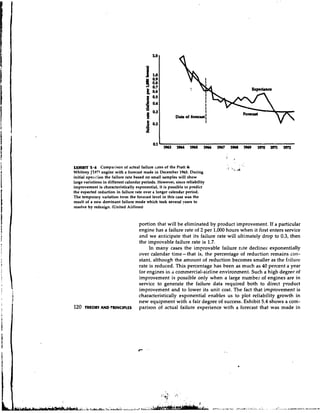
Inspect filter for contamination            Not to exceed 60 hours

Outcome as for failure of
m r h drive shaft, 1 A 1
would still have to re&-ognize    that uperating experience may show that
thesc measures are not reducing the hazard to an acceptable level.
     In addition to loss of fuel flow as a result of mechanic~l   failure, the
pump is also subject to external leaks. While a leak serious enctugh to
affect fuel pressure would be evident to the ofcrating crew, the fact that
a leak has formed will not be evident from the cockpit instrumel~tation.
The answer to the firs1 decision q~iestion therefore no, which takes us
                                              is
to the hidden-function branch oi the diagram. Ac indicated by the
answers recorded in Exhibit 7.8, tllere ar? no applicable and effective
on-condition, rework, or discard tash:. in this case. Therefore we arrive
at the dcfablt alternative and must scnedule ir failure-finding task-a11
inspection during walkaround checks and overnight :;tops for ally leaks
that exceed a specified  d u e .
     The third type of funct' ma1 failure results from clogging of the fuel
filter. A warning light informs the pilot when this condition exists, so
the failure is classified as evident. It does not present any safety prob-
lems, but it does have operational consequences, since a single-engine
plane must land at the nearest airport and cannot be dispatched until
this condition has been corrected. An on-condition inspection of the
fuel filter for contamination is applicable. In this case the failure con-
sequences are economic; hence the criterion of task effectiveness is
cost. The cost of performing this task is so low that it would be judged
as cost-effective in an initial program. As a result of experience with
other fuel pumps, an iriitial interval of 60 hours is set for this check.
     The fourth type of failure is inrl.:ilitv to provide engine-speed in-
formation to the fuel-control assembly, ca~tsed failure of the govemor
                                                   by
drive shaft (see Exhibit 7.7). Since the analysis of this failure is similar
to that for failure of the m,lin drive shaft, the details are not repeated in
Exhibit 7.8. If tasks were scheduled, they ~ ~ o u l c ! performed at the
                                                        be
sanw tinw as tllos~. the main drive sha!i.
                       fur
ANALYSIS OF A LANDING-GEAR BRAKE ASSEMBLY
The brake assembly for the main landing gear o t!~eDouglas DC-10 is
                                                 f
classified as significant becausc the primary function of the braking
system is to provide stopping capabilit) after 1andi.1~: during other
                                                          or
ground operation. Since a complete loss of this function would clearly
have safety consequenccs, it is necessary to consider how the brake
assembly centributes to the overall system function. The full braking
capacity is rarely used, and its cffect is masked by concurrent use of
reverse thrust from the engine. As a result, the pilot is not likely to
notice the reduction in stopping capability caused by a failure in one
brake assembly of a multiwheeled landing gear. ' h i s item therefore has
hidden functions as well. Had there been a difference of opinion about
the crew's ability to detect this condition, the default strategy would
also have required that these functions be classified as hiddcn.
i'ressure plate      Barking plate
                     of torque tube

                  EXHIBIT 7 . 9  I he brake assemhly on each wheel of the nuin
                  landing gear of the Douglas DC-10. (Based on Goodyear
                  ~naintenancematerials)
EXHIBIT I . 1 0 111 inforliiatiot~worksheet for thin~ i i a i t i - l a l ~ d i r ~ f i - ~ e . ~
I-rake ssseiihl of the Ih~~it:li.sI)L'-O.


                                                   SYSTEM INFOUWATiON WORKSMEET type of alrcrvft              Douglas w-10-10


                                                   itrm number

                                                   item name        Bmke assembly, mdn landing gear

                                              -   vendor prrtlmodel no. Coodyerr 5OOmS
                                                                                                                                  -
                                                   item dtscription
                                                   Multiple-plate disk brak~(seven rotors and six statore)
                                                   powered by eight hydrddlic-driven pistona. Preasun?
                                                   line to this rsscmbly is included for purpoeeu of
                                                   analysis


                                                  reliability data
                                                        premature-removal rate (per 1,000 uni: hours) 1 per            l~ndhgs
                                                        failure rate (per 1,000 unit hours)

                                                        source of data Similar equipment

                                                                  functions                                 functloi~rlfailures
                                                   1 To pmvide s t o p p i q                         A   No braking action
                                                  capability on cotnmand during
                                                  ground operation
                                                                                                     7   Reduced braking action


                                                  2 To release brakes                                A Dragging brake


                                                  3 To contain hydraulic fluid                       A External hydraulic leaks

180     APPLICATIONS
page        of


no. per alrrrrft 8                              prrparrd by     F. S. Nowlen                      date    3/6/78

syatetn   Landing gear                          rev~ewedbv      T.   M.Edwards                    date    3/6/78


rcdundrncies and pmtective features (include instn~mentation)
One brake asscmbly in each wheel (four) of each main-landing-gear
truck. Separate hydraulic system&power half the pintone in each brake:
loss of brake fluid due to failed pressure line to wlrrel prevented by
fluid quantity limiters in eaclr hydraulic system. Engine thrrrst reverser
provides another murce of stopping capability. Wh~elwell designed
                                                             is
to paevent critical secondary damdge by debris from tire failure.


built-in test equipment (describe) Visual wear indicators

Can aircraft he dispatched with item                                              cirssification of item (check)
innpcrativet If so, list any limilations
                                                                                      X     signific~nt
which must be observed.
Yes. If one brake asscmbly inoperative,                                               X     hidden tun,-tion
gross takeoff a d landing weights must 5c
reduced.

               failure modes                                              tailwre effects
1 Brake wear to point of seizure                Wheel skid, causing tire blowollt; audible noise and
                                                vibration, possible;xtens!vc secondary damage to systems
                                                within svheelwell; requires correction before dispatch
1 Broken pressure line                          No braking action fmm half the actuating pistons in on?
                                                assembly, ciusing reduced braking capability and slightly
                                                increased mi~!imrrrnstopping distance

1 Malfrrnction of aduster assembly              Increased wear of pad and disk; overheating of brake and
                                                tire may cause tire fuse plugs to blow, with landing nn flat
                                                tire and secandaly damage from the failure; requires cor-
                                                rection before dispatch

1 Damaaed or distorted piston seals             Slow Loss of hydraulic fluid from one system
A review oi the design cl~aracteristics the DC-10 shows that each
                                                                     of
                     truck on the tnain landing gear has four wheels, and each wheel has a
                     multiple-disk brake assembly consisting of seven rotors and six stators
                     (see Exhibit 7.9). The brakes are powered by eight pistons, four of
                     which are driven by one hvdraulic system and four by another. With-
                     out this extensive replication, especially of the wheels on each truck,
                     reduced stopping capability in one brake assembly might be a critical
                     faildre. In this case the failure results only in slightly increased stopping
                     distances. One of the failure effects, however, is a possible tire blowout,
                     with secondary damage caused by rubber thrown from the damaged
                     tire. Brake assemblies can be replaced in the field, but the time required
                     will cause delays. The aircraft can also be dispalched with one assembly
                     inoperative, but only at a great penalty in operating weight. Thus any
                     observed failure of a brake assembly has operational consequences.
                          Note that in tt.is case the primary function of the brahe assembly
                     is subject to two failure possibilities, no braking action and reduced
                     braking action. Each of these functional failures must be considered
                     separately. The first type of failure is no braking action, caused by
                     brake wear:

                          1 Is the occurrence of a failure evident to the operating crew during
                          performance of normal duties?

                     If the brake pads are allowe~l wear beyond a certain point, they come
                                                    to
                     loose from the rotor and jam between the rotors and stators, causing the
                     brake to seize. The wheel will therefore not rotate on landing, and the
                     tire will skid and blow out, throwing pieces around the wheelwell. The
                     resulting noise and vibration wollld be evident to the flight crew; thus
                     the answer to this question is yes.
                          With a yes answer to cluestion 1 wc must now consider the possible
                     consequences of this failure:

                          2  Docs the failure cause a loss of function or secondary damage that
                          could have a direct adverse effect on operating safety?

                     Thc loss of braking function for one of the eight wl~eelsis not in itself
                     critical, so the answer to the first part of this question is no. The answer
                     to 7c second part is also no, because this failure has hecn taken into
                     account in the design of the wheelwell, so that secondary damage from
                     occasional tire failures will not be critical.
                           Although a scheduled task is not required for safcty reasons, the
182   APPLICATIONS   secondary damage does hz.ve serious operational consequences:
3  Does the failure have a direct adverse effect on operational
     capability?

In addition to the tinie rccluired to exchange the brake assembly, this
particular type of failure can result in extensive damage to hydraulic
lines, flight-control surfaces, and other fail-safe systems. Thus !he sec-
ondary damage alone may prevent the airplane from being dispatched.
Such a failure therefore has serious economic consequences, and we
must consider the possible preventive tasks.
    'The first 1-hoice is an on-condition task directed at detecting brake
wear:

    8  Is an on-condition task to detect potential failures both applicable
    and effective?

This brake assembly is eqt~ipped    with wear indicators that show when
the pad and disk stack have reached a wear level that calls for replace-
ment. Since thtl wear indicators make it possible to define a potential.
failure condition, an on-condition task is applicable; it will also be
effective as long as the il~spectioninterval is short enough to ensure
sufficient remaining p.iJ to keep the brake from locking.
      In an initia: program inspection of the wear indicators might !v
assigned for every overnight layover at a maintenance station, si~icc    this
would be a convcnirnt time to change brake asseniblics i t a potenti'il
failure is fourlci. The brake assenibly will ordinarily be removed if thc
wear indicator shows that fewcr than 30 niore landings are possible.
The wear indicators will also he checked at every preflight : ~ ~ l l k a r o ~ ~ n d ,
but the wear criterion will be less stringent. The objective is for the
overnight mechanics to be the first to identify the need fcr a brake
change, to reduce the number of delays incurred by t!ie discovery of
potenti'11 failures in the field.
      The second type of functional failure, reduced braking 'lction, is
                                     -
caused by a broken pressure line the line froni the fluid quantity lim-
iter to the brake assembly itself. (These lines are treated as part of the
brake assembly because the limiters and lines are independent for each
s:.rstem to each wheel.) Analysis of this failure possibility takes us
again to the first question in the decision diagram:

    1  Is the occurrence of a failure evident to the operating crew during
    perform~nceof normal duties?
                                                                                          SECTION 7 . 3   183
A broken pressure line will result in a loss of function for only half the
                                  actuating pistons in the affected assembly, as the limiter stops the flow
                                  of hydraulic fluid when the line b r t 2 s . Thus the other four pistons in
                                  the assembly will still provide normal braking action. There is sufficient
                                  braking margin that the slight reduction in braking capability would not
                                  come to the attention of the operating crew-that is, the failure would
                                  not be evident.
                                       A no answer to the first question means that a scheduled task is
                                  required to ensure that the failure will be found and corrected, and
                                  fur::~er analysis falls in the hidden-function branch of the decision dia-
                                  gram. In this case either one of the directly preventive tasks or a failme-
                                  fi~dinp; task must be assigned to avoid the risk of a multiple failure. The
                                  choice depends on technical feasibility and relative cost.

                                        14 Is an on-condition task to detect potential failures both applicable
                                        and effective?


EXHIBIT 7-11 A worksheet showing the results of RCPA analysis of
the Douglas DC-I0 hr.ike assembly. References in the first column are
to the functions, tunc~iunaltailures, and failure modes listed in
Exhibit 7.10.


                                      SYSTEM D W ' O N WORKSHEET type of aircraft      Dough8 D C - l W


                                     item name    Brake aescmbly, main landing gear

                                                                   reaponace to decision-diagram question8
                                           ref.      consequences                      +askselection


184   APPLICATIONS
On-condition inspections are not applicable for this failure mode be-
        cause we cannot define a conditio~l will preclude functionnl failures.
                                           that
        This brings us to the question of a rework task:

            15 Is a rework task to reduce the failure rate both applicable and
             effective?

        At the time the initial program is devc:oped there is no information to
        indicate that a i-ework task is applicable and will be cost-effective; hence
        the answer to this question is no.

            16   Is a discard task to avoid failures or reduce the failure rate both
             applicable and effective?
                                                -      -


        Once again, there is no information to support the applicability of all
        economic-life limit, so the answer in an initial program'is no. A failure-


                                                                      p.ge      of
                                                                     item number


                   p r o w*k                                 initial interval


        Inspect brake wear indicators               During walluround ch&       and
                                                    ovamight mtopr

        h p d for broken tinee                      Durlng wdkuound checb and
        (failure finding)                           wcmi&t 9top
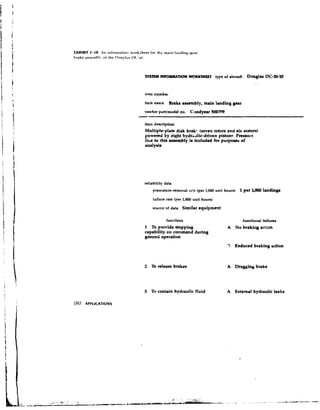
        Test outomtic bmke adjueter                 Whenever brake awembly Ir in
                                                    hop
        Ineptd for txtemd leaks (failure            During walkamund checka and
i   ;
        findW                                       ovrmi%tetopr
                                                                                       SECTION 7.3   185
finding task is therefore required-an inspection during preflight walk-
arounds and overnight layovers to check for broken lines.
     In addition to its primary function of providing stopping capabilitv,
the brake assembly has two further functions. It must be capable of
releasing the brake, so that it does not drag, and it must contain the
hydraulic fluid. Brake drag is caused by a malfrlnctioning automatic
brake adjuster, and this subassembly is not visible unless the brake
assembly is removed and disassern'c'ed. In most cases the only effect of
this failure is increased brake wear, which will show up on the brake
wear indicator. Thus the brake assen~bly eventually be removed for
                                            will
repair as a result of the on-condition task already scheduled, and the
automatic adjuster can then be checked and adjusted as necessary while
the assembly is in the shop. In a few cases the failure effects may ii~clude
overheating of the brake assembly, pulling of the brake on one side, a
blowout of the tire-pressure plug, and possibly a landing on a flat tire-
in short, the same ultimate effects as those caused by a locked brake. In
this event the failure would be evident to the operating Crew; however,
the same additional task would apply in either case: a shop specitlcation
to irlspect the automatic brake adjuster on all brake assemblies that
come in for repair.
     The last type of failure, hydraulic leaks causcd by damaged or dis-
torted seals, results in a slow loss of fluid from the hydraulic system.
Like the broken pressure line, this failure possibility falls in the hidden-
function branch. If some leakage were permitted, so that a slight leak
could be defined as a potential failure, an on-condition task would be
applicable. In this case, however, any leak is defined as a functional
failure. Rework and discard tasks are not applicable for this failure mode,
so the only choice, by default, is a failure-finding task, an inspection
during pretlight walkarounds and overnight layovers for external leaks.
     Tile results of this analysis are summarized in Exhibit 7.11. Note
that we have discussed four types of functional failures, all of which
could ultimately affect the stopping capability of the airplane. If we had
treated reduced stopping capability as a single functional failure, we
would have considered exactly the same failure modes and identified
exactly the same inspection tasks for inclusion in the program.

ANMYSLS OF A HIGH-FREQULNCY COMMUNICATIONS SUBSYSTLM
The information worksheet in Exhibit 7.12 describes the high-frequency
communications system used for voice communications on Boeing 747
aircraft operated on long overwater flights. This system consists of two
identical subsystems which are completely independent of each other,
right down to the antennas and the source of electrical power from the
airplane's power-supply system. Thus either subsystem provides the
full system function. Additional sources of voice communication are
provided by a separate very-high-frequency system. Each of the sub-
systems consists of numerous assemblies and components, all of which
have specific functions. However, failure of any one of these compo-
nents results in only three types of failure in terms of communications:
inability to transmit, inability to receive, or inability to select the de-
sired channel (frequency).

    1 Is the occurrence of a failure evident to the operating crew during
     performance of normal duties?


The failure effects described in Exhibit 7.12 show that any of these three
basic types of failure will immediately be evident to the operating crew.
Hence the answer to the first decision question is yes.
                                                         -   -


    2  Does the failure cause a loss of function or secondary damage that
    could have a direct adverse effect on operating safety?

Because of system redundancy, none of the failures will result in a loss
of the system function and will therefore not affect operating safety, so
the answer to this question is no.
     This brings us to the question of operational consequences:

    3  Does the failure have a direct adverse effect on operational
    capability?

Most of the major assemblies in this item aro plug-inlphg-out units
and can be changed very quickly after a failure has occurred. The time
required to replace a failed unit may result in no delay if the failure is
reported at a maintenance statior,, but it will cause a delay if the failure
report is received at a nonmaintenance ,.tation. Since both subsystems
must be operative before the plane can v.- dispatched, a failure is con-
sidered to have operational consequences. This means that the item
must be classified as significant.
     At this point we would ordinarily ex;-mine each failure mode to
find preventive tasks that are both ap2licable and cost-effective. How-
ever, past experience with .':is iyye of system has shown that, although
each major assembly is subject to many failure modes, current tech-
nology provides no means of detecting reduced failure resistance. There
are therefore no applicable forms of on-condition inspection. We would
not expect scheduled rework to reduce the failure rate in a complex
item, and in fact it does not. By the same token, discard tasks are not
EXHIBIT 7.12 A n infom~ationworksheet for the high-iriquency
con~niunicdtionssubsy tern in the Hoeing 747.


                                    SYSTEM INIQRMATtOW WORKSHUT type 06 ilrcraft         Bocing 747


                                    item number

                                    item name    High-frequency communications subsystem
                                                               All models
                                    vendor p~ltlrnodelno.
                                                                                                                 -
                                    item description
                                    Communicatinns subsystem consisting of receiver,
                                    transmitter, power modulator, frequency-selector
                                    panel, antenna coupler, accessory unit, lightning
                                    arrester, and boom antenna.


                                    reliability data
                                        premature-removal rate (per 1,000 unit hnb-m)
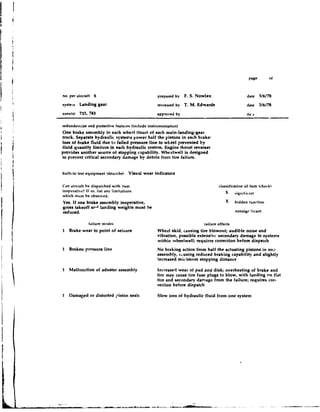
                                         fai!ure r ~ t e
                                                       (per 1,000 unit hours)

                                        source of data


                                                functions                               h~nctionalfailures
                                    1 To tralrsm~t
                                                 voice signals                  A No output


                                    2 To recei.re voice signals                 A No reception


                                    3 'To select desired channel                A  Failure to tune to selected
                                                                                channel
page       of


   no. per aircraft   2                             prepared by    F. S Nowlan
                                                                       .                           date 5/6/70

  systenl Cummunications                            r   +wed by E. S. Wagner                       date 3/6/78


- zonets)                                           appmvcd by                                     date

  redundancica ..nd protective features (include in*tmmentation)
  The system consists of two identical independent subsystems which
  can be used simdtaneously for transmitting or receiving or. any
  frequency. Backup sj-stems include a very-high-frequency system for
  relay of messages and SELCAL (selective calling), which ~ l l o w s
                                                                    ground
  stations to ring bell in cockpit to notify crew o i call.


  built-in test equipment (describe) Fault-annunciator panel on accessory unit


  Can aircraft be di6;patched wit11 i t r ~ n                                      classification of item (check)
  inoperative? I f so, list any lirnitatiol~s
                                                                                       X     significa~~t
  which must be observed.
                                                                                             hidden function

                                                                                             nonsignificant

                  failure modes                                            failure effects
  1 Many                                            No voice amplification, n o response to transmission; loss of
                                                    backup-frequency transmitting capabilitv

  1 Many                                            No background noise from receiver, no messages heard;
                                                    loss of backup-frequency monitoring capability

  1 Failure of frequency selector                   No response to transmission on expected frequencies;
                                                    possible loss of backup-frequency monitoring capability
SYSTEM DMISkON WORKSHEET type of aircraft               Boeing 747


                                       item name     Xgh-frequency communications subsystem

                                                                        mponses to decision-diagram questions
                                              ref.       consequences                          task selection
                                          F   FF FM       1    2    3      4   5   6   7   8    9   10111213 1 4 N 1 6


                                                                          ----
                                          1
                                          2
                                          3   A
                                               A
                                               A
                                                     1
                                                     1
                                                     1
                                                          Y
                                                          Y
                                                          Y
                                                               N
                                                               N Y
                                                               N Y

 U(HlB1T 7-13 A worksheet showing the results of RCM analysis of
                                                                    Y
                                                                          ----
                                                                          ----
                                                                                           N N N
                                                                                           N N N
                                                                                           N N N                         I
the Boeing 747 high-frequency communications subsystem. The
references are to the functions, functional failures, and failure modes
listed in Exhibit 7.12.

                                    applicable. We must therefore conclude that this system cannot benefit
                                    from scheduled maintenance. If operating experience shows that its
                                    reliability is inadequate, especially as the result of a dominant failure
                                    mode, design changes directed at the faulty component will be the only
                                    way of overcoming the problem. The results of this analysis are shown
                                    in Bxhibit 7.13.

                                    ANALYSIS O F OTHER TYPICAL SYSTEMS ITEMS
                                    The failure of a hidden function cannot, by definition, have a direct
                                    effect on operating safety. In some cases, however, the consequences of
                                    a multiple failure involving the loss of this function can be critical. This
                                    situation is characteristic of emergency equipment, where the demand
                                    for a hidden function arises as the result of some other failure. i'wo
                                    examples are the powerplant fire-waming system and ejection-seat
                                    pyrotechnic devices. All such items must be protected by some sched-
                                    uled task to ensure that the hidden function will be available if it is
                                    needed.
                                         The powerplant fire-warning system is active whenever an zirplane
                                    is in use, but its function is hidden unless it senses a fire. Although
                                    some warning systems include fault indicators, certain failure modes
                                    can result in a loss of function that is not shown by the indicators; con-
                                    sequently this systan is always classified as a hidden-function item.
190   APPLICATIONS                  However, the required failure-finding task is not necessarily performed
plBc     of
                                                          Item number

prep&     by   F S. Nowlm
               .                     revlcmd by   B 8. Wagner
                                                  .


None. T h m u e no rppllcrble
md effective echeduled-
maintenance brkr for this
ByBttm.


by the maintenance crew. In this case it is specified as part of the duties
of the operating crew. The crew tests the system before each flight by
means of a built-in self-test circuit.
      The pyrotechnic device in an ejection seat is also a hidden-function
item that requires a high degree of availability. Pyrotechnic materials
deteriorate with age whether they are installed or not, so a discard task
is applicable to this item. In an initial program the task interval is set
either conservatively low or at a life limit based an previous experience
with the same item in other aircraft. All units are tested when they are
removed from service to see whether they would have worked, and the
interval is adjusted as necessary on the basis of the test results. The
cool-gas generator for the inflatable evacuation chute of passenger air-
craft is accorded the same treatment.
      Although systems items in commercial transport airplanes rarely
fall in the safety branch of the decision diagram, not all systenls compo-
nents can be protected by redundancy. One example is the hydraulic
landing-gear actuator, which powers the mechanism that raises and
lowers the landing gear. If the actuator fails to retract the gear, the air-
plane must return to the point of takeoff. If it fails to extend the gear, the
gear can still be extended by a free-fall feature. In either case the loss of
function does not affect safety, hut one of the failure modes does cause
secondary damage.
      One failure mode for these actuators involves cracking or separa-
tion of the endcap as a result of fatigue, perhaps accelerated by pitting
                                   corrosion. This type of failure may cause secondary damage to the air-
                                   craft structure, but only in the unlikely event of certain multiple failures.
                                   The structural damage in this case does not affect safety, but it does have
                                   major operational consequences, since any stn~ctural        repairs take the
                                   entire aircraft out of service. Pitting corrosion, which will greatly shorten
                                   the fatigue life of the endcap, is visible when the actuator is disassembled
                                   in the shop. An on-condition inspection for corrosion is therefore appli-
                                   cable and would be scheduled as part of any shop visit of the landing-
                                   gear actuator. However, the primary hilure process is fatigue, and it is
                                   not feasible to inspect the endcap often enough to detect fatigue cracks
                                   at the potential-failure stage. Scheduled rework is not applicable for this
                                   fai:ure mode. A discard task would take care of the fatigue problem, but
                                   this particular cap was designed for a fatigue lifc greater than the ex-
                                   pected service life of the airplane; hence a life limit was considered
                                   unnecessary.


7 4 ESTABLISHING TASK INTERVALS
               initial intervals   At the time an initial maintenance program is developed there is usually
   the role of age exploration     enough information to determine the applicability of on-conditton and
                                   failure-finding tasks. However, the information needr I to determine
                                   optimum inspection intervals is ordinarily not available until after the
                                   equipment enters service. In many cases previous experience with the
                                   same or a similar item serves as a guide, but in the absence of actual
                                   operating data it is necessary to set conservatively short intervals for all
                                   tasks and increase them on the basis of age exploration. Thus on a new
                                   aircraft the tires and brake wear indicators are ordinarily checked once a
                                   day to determine the rate of reduction in failure resistance unde~ictual
                                   operating conditions. Once this has been established, precise limits can
                                   be defined for potential failures ar.i the inspection intervals can be
                                   adjusted as necessary.
                                        Scheduled rework tasks have proved to be ineffective for complex
                                   items in systems, and in any case, the information required to determine
                                   their applicability is rarely availdble until sufficient operating experi-
                                   ence has dccurnulated for an actuarial analysis. Occasionally prior ex-
                                   perience or concern about the economic impact of failures leads to the
                                   specification of rework tasks in an initial program. Seven items were
                                   specified for rework ill the Douglas DC-10 program and eight in the
                                   Boeing 747 program. The DC-10 generator control unit was scheduled
                                   for rework at an initial interval of 3,000 hours, the DC-10 high-pressure
                                   bleed-control valve at an interval of 8,000 hours, and the Boeing 747
                                   generator at an interval of 5,000 hours.
The intervals for safe-life items are known at the outset, since these
are established by the manufacturer. Economic-life discard tasks for
simple items such as hydraulic lines may be anticipated in an initial
program, but they are rarely included at this stage. Like rework tasks,
there is no basis for establishing a cost-effective interval until the equip-
ment begins to age in service. The role of age exploration, especially in
monitoring the performance of the malty systems assigned to no sched-
ule maintenance, is discussed in detail in Chapter 11.
CHAPTER EIGHT-


                       THE POWERPLANT   division of an airplane includes only the basic engine.
                       Engines bre complex, however, and are subject to numerous forms of
                       failure, most of which are expensive and some of which are critical. More-
                       cver, nearly all powerplant failures have operational consequences,
                       since it is usually necessary to remove an engine and install a replace-
                       ment after a failure has occurred. Thus the coet of failure includes both
                       opcr.ttiona1 consequences and the support cost of very expensive re-
                       plar.t-..~~ent
                                   units, in addition to the high cost of corrective maintenance.
                       Itor all these reasons there is a particularly strong incentive to find
                       applicv>bleand effective preventive tasks.
                            Tic ?everplant is accompanied by a number of engine-driven
                       accessories, such as the f ~ e pump and the fuel-control system. On
                                                        l
                       some types of engines the thrust reverser is also an accessory, rather
                       ihan an integral pa t of the engine. TI:ese accessories, as well as their
                       connecting links to the engine, are treated as part of the systems divi-
                       sion. However, some of thc failure possibilities to which they are ex-
                       p sed will influence !.he furctioning of the engine itself; a fuel-pump
                       failure, for example, may c a u s ~ engine flameout. It is therefore im-
                                                          an
                       pcrtant for the study group working on the powerplant program to
                       review the irndlyses of the essential engine accessories.
                            Because of its cvmplexity a turbine engine is subject to a great
                       many types of failures, most of which never reach the functional-
                       failure stage. While potential failures may result in age-related remov-
                       als, particularly if there are dominant failure modes, the residual fail-
                       ure rate- those failures: seen by the operating crew - remains relatively
                       constant at all ages because uf the large number of failure modes in-
                       volved. Chis fact has severzl implications for a scheduled-maintenance
i94   APFI ICATl(3NS   program. First of all, because those functional failures that cannot be
prevented by on-condition tasks occur at widely disparate ages, sched-
uled overhaul of the entire engine atasome particular age will d o little
or nothing to improve its reliability. However, engine removals for
both potential and functional failures result in a continual flow of en-
gines to the shop throughout their operating lives, thus providing the
opportunity for a more effective form of protection through on-condition
tasks scheduled as part of the repair process. New engines in particular
supply an abundance of such opportunity samples, and the assignment
of internal engine parts to inspections for intensive age expioration is
an important part of the initial powerplant program


                                          8 1 CHARACTERISTICS OF POWERPLANT ITEMS
The operating gross weights of transport aircraft are not only restricted      the basic engine functior
by structural considerations; they are also restricted Bight by flight to      design characteristics
ensure that a multiengine airplane will have a specified periwmance            nlai;ltenance characteristics
capability, measured as available rate of climb, after a complete loss of
thrust from one engine (in some cases two engines). Hence the airplane
is capable of safe operation with one engine inoperative as long as the
remaining engines meet specified performance requirements. For this
reason the basic function of an aircraft engine is defined as the capn-
bility of providing a specified dmount of thrust, without vibration and
at acceptable Iwels of other operating parameters. If an engine cannot
perform this function, , I functional failure has occurred. This failure may
range from a completr loss of thrust (an engine shutdown) to insuffi-
cient thrust, caused, for example, by high exhaust-gas temperatures. In
aircraft other than civilian transport airplanes the basic function of the
cngine can still be stated in terms of specified thrust, but the conse-
quences of a functional tailure rnight be quite different. In a single-
engine aircraft, for instance, a signific~nt  loss of thrust would have a
direct effcct on operating safety, since there is oniy one source of power.
      Cockpit instruments enable the operating crew to monitor most
aspects of engine performance, such as compressor ratation speed,
exhaust-gas temperature, fuel flow, oil pressure, oil-inlet temperature,
and the engine pressure mtio. The engine pressure ratio is correlated
with engine thrust, and power is set by advancing the throttle until a
desired pressure ratio is reached. Ordinarily power will be obtaincrl at
dn exhaust-gas temp~rature     well below the maximum limit. However,
when there is deterioration that reduces combustior, efficiency or the
efficienry of gas flow through the engine, more throttle movement, and
hence more fuel consumption, is needed to obtain the same power.
Consequently the exhaust-gas temperature is increased, and the engine
may become temperature-limited even though no parts within it have
failed. An cngine failure of this kind always has operational conse-
quences because, although a multiengine airplane can safely complete
its flight with one engine inoperative, it cannot be dispatched in this
condition.
     In addition to failure6 resulting from inefficient engine perfom-
ance, an aircraft engine is subject to numerous other failure modes,
some of which cause secondary damage that presents a safety hazard.
For both these reasens the engine as a whole must be classified as a
significant item; a ful~ctional failure may have safety consequences and
always has major economic consequences. If the engine is partitioned
into smaller items, by nodule or by stage, many of its components will
also be classified as significant items.
     As an example, consider the Pratt & Whitney JT8D engine, which is
in usc on such aircraft as thc Bocing 737, thc Douglas DC-9, and thc
Boeing 727. This turbine engine has five general sections, as illustrated
in Exhibit 8.1. The compLeessor    section consists of two axial-flow com-
pressors, a front low-preswre compressor with six stages and a rear
high-pressure comprcc.;or ?vith seven stages. E ~ c h   compressor is built
up from individual disks '?r each stage. These disks rotate, and small
blades attached to their peripheries compress the air as it flows by
them. Air from the inlet section of the engine flows into the front com-
pressor. The first two stages of this compressor are fan stages, and some
of the air that flows through them bypasses the other compressor stages;
the rest moves on to higher stages, with its pressure increased at each
successive stage. The compressed irir then enters the nine-can (can-
annular) combustion chamber. Fuel is added to the air, the mixture
is burned, and the expanding gases flow through a four-stage turbine
and filially pick up speed as they are expanded out of the exhaust nozzle,
(hereby creating thrust.
Flmt and second     Secondary Prltnary     Compressor          Firat-stage          First-stage                'ILrbine        Exhaust
 Ian stages 1        air flow  air flow     disklblade          nozzle gulde         turbine blades             dlaklblade      nozzlc
                                          assembly            vanes                                                             I


                   Low pressure +
                                -I         High pressure rI      (a~iikrurt..l~i
                                                                              rrtlion   -1                            l~~li.i~~.t
                                                                                                                             .i,ttio~i
        .-
        -                                                                                    -
                          C'oiiir~~~k~
                                   1. sectiot~                                               1'1irhi1wL - C  ~ I I I I


                                                  EXHIBIT 8.1 5clictiratir rltcrjir.rni of llre I1r.itt L Whitncv I'I'H'I Ir~rhitic
                                                           'The thrust Ivversrt. is not slrorv~i.(ILthed on i'rdtt & 'liittrt-!
                                                  ctrfii~rr.
                                                  tr.iini11gtiralerials)


       Each stage of the turbine is disk with blades on its periphery, some-
  what like the compressoi stages. The forward stage ot thc turbine drives
  the high-pressure compressor and the other three stages drive the low-
  pressure compressor by . v a n s of cuncentric rotor shafts. Power is taken
  from the outer shaft by bevel gears and directed down a towershaft to
 the main accessory case. Each accessory attached to this case is driven
  by a spline-pinion connection to thc main gear. Plenum rings and ports
 built into the engire case bleed off air from the sixth, eighth, and thir-
  teenth stages of the compressor and direct i t into ducting; this high-
  pressure air supplies the pneumatic system for cabin pressurization, air
  conditioning, anti-icing, thrust-reverser act:~aticn, and engine cross-
  starting capability.
       The thrust leverser is an accessory on the IT8D e11gip.eand would
  ordinarily be analyzed as a systems item. However, in some installa-
  tions it is attached in such a way that it is removed along with the basic
  engine, and on other t i r e s of engines it is often part of the basic engine.
,.For convenience, therefore, we will consider it as a powerpl~nt         item in
  this case. The thrust reverser is mounted behind the exhaust nozzle.
It is of the mechanical-blockage type and moves two clamshell-shaped
                     deflectors into the exhaust stream on the pilot's command. The deflected
                     exhaust is then redirected forward by a panel of cascade vanes mounted
                     on each side of the engine. The reverser is actuated pneumatically by a
                     system of controls, valves, actuators, linkages, and plumbing.
                           When the engine is partitioned into modules (systems), sections
                     (subsystems), and stages (assemblies), some modules will be found to
                     contain very few parts that are not significant. In a compressor, for
                     example, the disks, hubs, and shafts are all significant items. Failures
                     of most of the rotating parts and parts exposed to the gas path will be
                     evident to the operating crew from the cockpit instruments; they will
                     therefore have operational consequences. Failures of nonrotating, non-
                     gas-path parts, many of which iorm plenums (containing gases under
                     pressure) or reservoirs (containing operating fluids such as oil) may :lot
                     be evident and will require scheduled inspections for this reason. : i ~
                     short, there are very few parts of an engine that do not require some
                     form of scheduled maintenance.
                           Because of the great number of failure modes to which an aircraft
                     engine is exposed, RCM analysis of powerplant items may fall in any
                     of the four branches of the decision diagram. Many engine parts are
                     subject to failures with critical secondary damage and will therefore be
                     assigned safe-life discard tasks. In an initial powerplant program, how-
                     ever, the most frequent outcome in any consequence category is an on-
                     condition task, with intensive inspection of certain items as part of the
                     age-exploration plan. One reason for this is that corrective maintenance
                     on engines is responsible for more than half the support cost for any
                     airplane, and even when fractured parts do not cause hazardous dam-
                     age, they may cause damage that is very expensive to repair. Another
                     reason, of course, is to avoid the safety and operational consequences
                     of a functional failure.
                           On-condition inspections of powerplant items are performed at
                     two levels, depending on the accessibility of the 'tem. Many items can
                     be inspected visually or by borescoye and racliography techniques
                     while the engine is on the aircraft. Most internal engine parts cannot
                     be inspected without a certain amount of disassembly. These parts are
                     therefore assigned on-condition inspections in the shop when the en-
                     gine is being disassembled for repair. When the combustion-chamber
                     retaining lug is removed, for example, a plug gage is fitted into the lug.
                     If the fit meets specifications the combustion chamber can be rein-
                     stalled as is; otherwise it is routed to repair.
                           Whereas on-condition inspections on installed engines are per-
                     formed at fixed intervals, the shop inspections of internal engine items
                     are scheduled on the basis of opportunity samples, someiimes with a
                     maximum age interval as a precaution. Opportunity samples take ad-
198   APPLICATIONS   vantage of the fact that with large fleets of multiengine airplanes there
will be a sufficient flow of engines through the shop to provide con-
tinuing exposure of all the major parts. During the first few years of
operation, when the fleet is small, the failure rate is ilsually also at its
highest, which automatically brings a larger number of engines to the
shop. These frequent sbop visits not only provide information on the
items that have failed, but also permit easy inspection of all the parts
that must be removed to gain access to the failed item. Thus, in addition
to the on-condition tasks that are known to be applicable, in an initial
program many internal engine parts are assigned such inspections for
the purpose of age exploration. Although some of these inspectiuns may
prove to have no real on-condition capability, they will be the only
source of information on items that are not experiencing failures.

                                       8 2      ASSEMBLING THE REQUIRED INFORMATION

The analysis of significant items in an aircraft powerplant requires a initial information requirements
broad knowledge of current maintenance practices, as well as a detailed the infomation worksheet
understanding of the specific engine under consideration. The mem-
hpr- ~f the powerplant working group will know from previous experi-
e1tc.e the areas of the engine that tend to be the most troublesome in new
designs. They will also be familiar with the various forms of on-condition
inspection and the uses of opportunity sampling in conducting age
exploration. In addition to this background information, the engine
manufacturer provides specific information about any new engine by
reviewing the design characteristics of the production model with the
entire working group. During this process similarities to and differences
from in-service types of engines become apparent. The review also pin-
points areas in which new, or relatively new, technology has been
incorporated in the design, either to reduce the weight of the engine or
to increase its performance capabilities.
      New aircraft engines are designed and developed over a period of
years preceding certification of the aircraft in which they are installed.
Extensive testing is conducted at each stage of development to ensure
that a reliable product is being developed. Many different prototype
engines are usually used during the certificztion test flights of the air-
plane itself, and experience with these engines gives the manufacturer
an opportunity to identify and resolve any problems that come tc light.
In addition, once the engine design is stabilized, several engines are
tested in endurance runs, either as part of the engine certification pro-
gram or as an adjunct to it. Unfortunately this early experience may not
be of great use during the development of an initial maintenance pro-
gram, because the enginc will usually have been modified tc-, correct
any known problems before the production engiries are delivered. The
developn~entof an effective powerplant maintenance program thus
WHIBIT 8 ~2 1 1 1 ~ ~ rlc~iiriits~iccdedf o r a~idly!~i?. p ~ ~ w e r p l d ~ i t
                  d.rl,i                              of
itc~~l?..

                                            IDENllFICAnON O ITfM
                                                             F
                                            Type of aircraft                                Quantity per engine
                                            Type of engine                                  Location (section/rnodule)
                                            Item name
                                            Manufacturer's part and model number

                                            ITFM 1NFORMATION
                                            Item description (general function and major parts)
                                            Redundancies and protective features (including instrumentation)
                                            Built-in test equipment

                                           AVAILMU WIABI LITY DAU
                                           Anticipated premature-removal rate
                                            Anticipated verified failure rate
                                            Source of data (test data or operating experience)

                                            RCM INPUT
                                            Item functions
                                            Functional failures (as defined 'qr each function)
                                            Most probable failure n;odes
                                            Predictable failure effects (for each failure mode)
                                                 Evidence of functional failure
                                                 Effects of loss of function on operating capability
                                                 Effects of failure beycr*:: loss of function (including
                                                 ultimate effects of possible secondary damage)
                                            Nature of failure consequences
                                            Evidence of reduced failure resistance that can be used to
                                            define potential-failure conditions
                                            Experience with other engines containing the same or
                                            similar item


200    APPLICATIONS
depends heavily on the knowledge and experience of the working
group.
     Exhibit 8.2 lists the data elements that must be assembled before
analysis begins. Much of this information comes from detailed review
of the production model, supplemented by the manufacturer's instruc-
tion manuals and test data. The data elements for each item to be ana-
lyzed are recorded on an information worksheet like that used for
systems items. In the case of powerplant items the manufacturer's
identification is usually functionally descriptive in itself. However, the
item description should include all major components and should reflect
the level of item being considered (see Exhibit 8.3). Where the item is
a module or stage, the description shculd list all the major assemblies it
contains.
     As with systems items, it is important to list all redundancies and
protective features. Bypasses and pressure-relief systems, as well as the
extent of the cockpit instrumentation, are all factors in evaluating the
consequences of a functional failure. If the engine case is designed to
contain fractured parts, this information should be included, since it
means that the secondary damage resulting from certain failures will
not have safety consequences (although it may have major econcmic
consequences). Ordinarily an aircraft cannot be dispatched with any
major engine item inoperative (this information comes from the mini-
mum-equipment list and pertains primarily to systems items). How-
ever, a yes answer for an individual part may mean that this item can
be classified as nonsignificant, since a functional failure will have no
operational consequences.
     In listing the functions of an item it is important to describe both
its basic function and all secondary or characteristic functions. Each
function described should relate in some way to one of the overall
engine functions. For example, the basic function of the nozzle guide
vanes is to redirect the exhaust gases o r ~ t o first-stage turbine blades;
                                               the
a second function is to create the proper nozzle area for efficient engine
operation. The functional failures are the inability to perform these
functions; note that in some cases there is more than one failure possi-
bility for a given function. The failure modes are the specific ways each
type of functional failure can occur. In addition to the failure modes
listed for the nozzle guide vanes, rotating parts such as blades and
disks are subject to fatigue. Combustion chambers may crack or burn
through, or their locating pins may wear. Unless the failure modes are
clearly identified, there is no way to determine what preventive tasks
might be applicable.
     The failure effects identify the immediate result; 2f '.!ie failure. These
effects include any secondary damage caused by the iailure, as well as
 the impact of the loss of function both un the engine and on the aircraft.       SECTION 8.2   201
EXHIBIT 8.3 An information wolksheet for the first-stage nozzle
guide vane!; of the Pratt & Whitney JT3D powerplant.


                                     PW
                                     O-             IWtOUUTION WORKSHUT type of aircraft          Douglar D C 9
                                                                                 type of engine   Pntt 4 Whitney JTJD

                                     item number

                                     item name     First-stage nozzle guide-vane aescmbly
                                     vendor partlmodel no.     5367JliJT3D

                                     item description
                                     The 63 nozzle guide vanes fonn a set of airfoils
                                     located in the gas path immediately downskeam of
                                     the combustion-chamber outlet duct. They accelerate
                                     and direct hot gases onto the fint-stage turbine blades
                                     at the proper angle for aerodynamic efficiency.


                                     reliability data
                                          premature-removal rate (pcr 1,000 unit hours)

                                          failure rate (per 1,000 unit hours)

                                          source of data

                                                  functions                               functional failuroe
                                     1 To redired gases at the                    A Vanes fonn improper angle
                                     proper velocity and angle                    and nozzle area
page       of


no. per engine 63                                 prepared by    T. M. Edwards                       date 6/26/78

section   Turbine                                 reviewed by    T. N. Mix                           date 6/26/78

module                                            approved by                                        date

redundancies and protective features (include instrumentation)
Van- axe made of small-grain alloy to m i s t heat deformation and
receive protective coating to n e b t heat damage and erosion. Vanes
are bolted in place to prevent fractured pacts from slippin8 into
aimtream.
Note: Multiple ~ u i d vanes provide no functional redundancy.
                       e


built-in test equipment (describe)     None

Can aircraft be dispatched with item                                                 classification of item (check)
inoperative? If sn, list an. limitations                                                X     significant
which must be observed.
                                                                                               hidden function

                                                                                               nonsignificant


               failure modes                                                 failure effects
1 Bowing of nozzle guide vanes                    Progressive loss in engine efficiency, increased fuel
from heat deformation                             consumption and exhaust-ga temperature, and possible
                                                  high-power stall resulting in en gin^ shutdown; if vanes
                                                  bow back into turbine-blade path, contact with rotating
                                                  blades resulting in fracture and critical secondary
                                                  damage from blade failure
2 Erosion of nozzle guide vanes                    Pmaessive loss in engine efficiency, leading to possible
from dimk exposu.re to exhaust-gas                 englne shutdown as for 1A 1 (no contact with turbine
particles                                          blades)
The description should also specify any physical evidence by which the
                     occurrence of the failure can be recognized by the operating crew. In
                     the case of most engine failures this is an instrument indication, often
                     the exhaust-gas temperature reading. The failure effects must be de-
                     scribed for each failure possibility, since they help to determine the
                     consequences of that failure, and hence the priority of maintenance
                     requirements.
                          As an example, one of the failure modes listed in Exhibit 8.3 for the
                     JT3D engine is bowing of the turbine nozzle guide vanes as a result of
                     prolonged exposure to high temperatures. The effects in this case are
                     progressive. Slight bowing will change the entry direction of the gases,
                     reducing the efficiency of turbine-blade action and causing the exhaust-
                     gas temperature to rise for a given thrust sating. If the temperature is
                     already high because of other deterioration in the engine, the permis-
                     sible temperature will be exceeded, and the pilot will report a functional
                     failure. However, the exhaust-gas temperature measures the overall
                     efficiency of the engine, and if the limit temperature is not reached,
                     bowing may continue to a point at which the stationary vanes come
                     into contact with the rotating turbine blades. Either the blades or the
                      vanes will fracture, and if the engine case cannot contain the fractured
                     parts, the ultimate effect of bowed guide vanes in this engine design is
                     critical secondary damage. The fa!lure must therefore be classified as
                     having safety consequences.
                          All the relevant information is examined for each engine item, and
                     the item is then classified as significant or nonsignificant on the basis
                     of its failure consequences. Items in either category may have one or
                     more hidden functions; thus an i t ~ m    may be identified in this initial
                     partitioning process as nonsignificant, but also as having a hidden
                     function. Since all hidden functions must be protected by scheduled
                     maintenance to ensure that failures wili be found and corrected, both
                     significant items and hidden-function items must be subjected to full
                     RCM analysis.
                          The objective of the partitioning process outlined in Chapter 4 is
                     to select the most convenient level of item for analysis. Most powerplant
                     analyses can be conducted conveniently at the module or section level.
                     In this case the failure of any significant item included in the module or
                     sectiol~under consideration would constitute a failure mode. For ex-
                     ample, if the item selected for study were the turbine section, one of the
                     failure modes would be failure of the first-stage turbinc nozzle gull2
                     vanes. However, th, powerplant itself can also be viewed as an item.
                     While this is only one of several possible approaches, it has certain ad-
                     vantages in sorting the vast number of failure possibilities that must be
                     considered into an organized pattern on the basis of their consequences.
                     In the examples that follow, therefore, we will consider the entire engine
204   APPLICATIONS   as a significant item.
8 . 3 FAILURES OF THE BASIC ENGINE FUNCTION
The Pratt & Whitney JT8D engine used on the three-engine Boeing 727            fractures with critical
                                                                               secondary damage
is described by the information worksheet in Exhibit 8.4. Although this
                                                                               fractures with no critical
engine might be analyzed at the mcdule or section level, at the engine         secondary damage
level its functions can be defined as follows:                                 failures caused by deterioration
b   To provide specified amounts of thrust without exceeding the ac-
    ceptable levels of the engine operating parameters
b   To drive engine-mounted accessories, such as the fuel pump, oil
    pump, fuel-control unit, hydraulic pump, and constant-speed drive
    generator
b   To provide high-pressure air to the pneumatic.system for use by
    subsystems
b   To provide reverse thrust to assist in braking the airplane (assumed
    as a function of this engine design)
At this point let us consider the first type of engine failure, a failure to
provide specified thrust (including complete loss of thrust, or an engine
shutdown):

    1 Is the occurrence of a failure evident to ihe operating crew during
    normal performance of duties?


Any reduction in engine thrust will be evident, because the engine
pressure ratio and other instrument readings are closely monitored by
the operating crew. When the airplane is in flight, changes in engine
output may also be signaled by throttle vibration or audible thumps.
Hence the answer to this question is yes.
     The next step in RCM analysis would ordinarily be to examine each
of the failure modes that might lead to this functional failure. In identi-
jring the probable failure moc!:s, however, it will be found that some
involve the fracture of a part that can cause critical secondary damage,
whereas others involve a fracture without such damage, and still others
involve general deterioration with no fractured parts. For convenience,
then, we cdn group all significant assemblies and parts into these three
   ~ssesand analyze each class of failure modes separately.

 'ACNILS WITH C r n c A L SECONDARY DAMAGE
 -urnpressor disks, turbine disks, and turbine blades are typical of the
powerplant items whose fracture can cause critical secondary damage.
It is apparent from the failure effects described in Exhibit 8.4 that all
EXHIBIT 8.4 An information worksheet for analysis of the Pratt &
Whitney JT8D-7 powerplant of the Boeing 727.


                                     r O W U T U M INFO-ON          WOIlOHKT type of aircraft     B O c h 727
                                                                                type of engine    Rrlt & Whitney JT8D-7
                                     item number

                                     item name    Ropuldon powerplant
                                     vendor partlmodel no.    JT8D-7

                                     item de~ription
                                     Axlzl-flow front-hubofan engine with r thirteen-
                                     stage split compressor (two spools), r nine-cur
                                     (can-annular)combnetion chamber, and a split four-
                                     stage turbine.


                                     mliability data
                                         premature-removal rate (per 1,000 unit hours)

                                         failure rate (per 1,000 unit hours)

                                         source of data

                                                 functions                               functional failurcr
                                     1 To provide specified mounbs               A Engine docs not provide
                                     of W e t without exceeding the              specified b a t ~hduding
                                     acceptable values of engine                 CUM of no thrust)
                                     operating parameters
page       of


no. per aimraft 3                                 prepared by T.   M. Edwuds                   d-r 2/14/70
section                                           reviewed hy    F. S. Nowlut                  cr.o 2/14/78

module                                            approved by                                  date

redundiurcia and protective features (include instrumentation)
The airplane har three engines; operating weight is contmll~d for
all f l a b so that airworthiness reauimments c m be met with one enainr
inopeia~ve.   Full inshumentaHon df all engtnt operaHng parametere;
                                                                          -
each engine protected by fire-warning and fire-extinguishing system.

built-in teat equipment (describe) None

C n aimraft be dispatched with item
 a
inoperative? If so, list my limitations
which must be obeewed.
                                                                                         hidden function


              failure modes
1 Failure of p u t s whore fracture               Immediate lbas of thrust or flameout, confinned by
can cause critical secondary damage:              instrument readings; pomible critiial reconday dain~ge      if
   a Failure uf .:ompressor or                    engine case dots not contain frictured parts; y l b t will abort
   turbine disks                                  takeoff if prior to takeoff-refusal cpeed, othrtmke will land
                                                  at neareat suitable airport; engine c h a n ~ e q ~ i i c d
                                                                                                v

2 Failure of parts whose fracture                 Immediate loss of ihmst or flameout, ccniinned by
does not cause critical secondary                 instrument reading$; operafional effwta as for 1A 3; engine
dunage:                                           change required
   Towershaft bearing or gear
   failure
3 Failure resulting from general                  Progressive loss of engine efficiency as shown by inshu-
deterioraHon without the fracture                 ment readings; it desired thrust cannot be ~btained
of puts:                                          without exceeding mudmum exhaust-gas temperature.
   Deterioration of combustion                    pilot will abort takeoff if prior to '~keoff-refusalspeed;
   chambeis, nozzle guide vanes,                  if airborne may continue flight at reduced power or shut
   compressor bladcs, etc.                        down engine and land at nearest suitable airpott; engice
                                                  change may be required
such failures will immediately be evident to the operating crew. As for
ar.y failure of the basic engine function, therefore, the answer to the first
decision-diagram question is yes.
     The next step in the decision process is to determine the precise
nature of the failure consequences:

    2 Does the failure cause a loss of function or secondary damage that
    could have a direct adverse effect on operating safety?


     Although the loss of thrust has no safety consequences, all items
w h s e failure involves sec0nda.q damage fall in the safety branch of
the decision diagram (see Exhibit 8.5).
     Disks, for ex~mple, subject to low-cycle fatigue failures, and when
                          are
they fracture, any fragments that cannot be contained by the engine
case can damage the nacelle, wing, or fuselage. Even if these projectiles
do not damage the aircraft structure, t l ~ e ~ ethe hazard of hot gases
                                                 is
escaping thmdgh the t o n engine case. Ejected turbine blades present
the same hazards. Turbine-blade failures have sometimes occurred with
no observable effect on thrust and no other evidence of failure (in this
case failure-finding inspections are necessary). However, they have also
been k ~ o w n be eiected and cause critical secondary damage. There
               to
is no way of knowing whether this problem has been overcome in the
present desfgn, so in the interests of conservatism the blades have been
iriduded ir! this class o items.
                         f
     The next step is ;o eva!uate proposed scheduled-maintenance tasks.
A yes answer to the safety question means that no task can be con-
sidered effective unless it rcduces risk of a functional failure to an accept-
able level. Srom this poi.nt on, however, we must examine each failure
niude separately, because the applicability of a particular task will
dspend on the faii1:re characteristics of the part. Our next question
therefore concerns a possible maintenance task for the disk:

    4 Is an on-L. ~ ~ d i t i . o n to iletect potential failures both applicable
                                task
    and effective?


A low-cycle fatigue failure begins as a slip along crystallographic planes
in the metal, which progresses under repeated load applications until a
small crack eventually becomes visible. Afier this point, however, the
crack pto)ragates very rapidly te the point of fracture. Most of the disks
are also inaccessible in the installed engine; thus even if it were possible
to def~ne crack as a potential-failure condition, the engine would
           the
have to be reinoved and disassembled more frequently than is feasible.
An on-condition task is therefore not applicable to the disk.
2


                                                                          +
           COMB Rdenign


                                              EXHIBIT 8.5 The branch of the decision diagram used for analysis of
                                              engine failures invoiving critical secondary damage.


    A no answer to the on-condition question means we must look for
other tasks:

    5  Is a rework task to avoid failures or &,educe failure rate both
                                                   the
    applicable and effective?
                                     -    -                    -

The conditional probability of disk failure does increase at an identi-
fiable operating age. Nowever, a rework task must restore the item's
orig;nal ,&stance to failure. For a part subject to metal fat~que rework
                                                                no
method has been found that will eliminate the material's "memory" of
                         repeated loads, so the answer to the rework question is no.

                             b  Is a discad task to avoid failures or reduce the failure rate both
                             applicable and effective?


                         Because on-condition inspections are not applicable, the manufacturer
                         has established a safe-life limit for the disk in each stage of the com-
                         pressor and the turbine. One engine manufactur~r          uses a computer
                         model, based on material strength tests and stress calculations, that
                         simulates the in-service aging of the disk. This model has been validated
                         by the results of developmental spin testing of many different disks
                         used in various engine designs. The safe-life limit determined by this
                         technique is the operating age at which one disk per 1,000 will develop
                         a crack of 1/32 inch. The disks are designed to have safe lives ranging
                         from 10,000 to 20,000 hours, and these are the intervals that will be used
                         for the discard tasks.
                              The answer to the discard question is yes, and the analysis of this
                         failure mode is complete. Each type of disk is assigned a discard task
                         scheduled for the safe-life limit established for that disk. In this case
                         an on-condition task might alsc be assigned--an inspection for any
                         damage that might prevent attainment of the safe-life age, to be per-
                         formed whenever the disks are accessible during the normal course of
                         repair work on the engine.
                              The failure process in turbine blades is somewhat different from
                         that in disks. The blades are in a hot-gas stream that exzrts at rodynamic
                         forces on them. The forces pulsate as the blades pass by the st~tionary
                         guide vanes, with the result that the blades are also subject to fatig-le
                         failure. The propzgation of fatigue cracks in blades, however, is much
                         slower than it is in disks. In addition, the blades are subject to creep and
                         oxidation caused by the high temperature of the gases and to erosion
                         from solid particles in the gas. In this case on-condition inspection is
                         more promising:

                             4  Is an on-condition task to detect potential failures both applicable
                             and effcctive?

                         Potential failures can be defined for such conditions as oxidation, ero-
                     .   sion, blade-root wear, and fatigue cracks; therefore an on-condition task
                         is applicable. It will also be effective, since the blades c'in be inspected
                         at short enough intervals to ensure that potential failures will preempt
                         functional failures. Thus the answer is yes, and analysis of this failure
210   APPLICATIONS       mode is complete.
011-condition tasks for the blades would prc)bably h ~ !  specified at
two levels-on the aircraft and in the shop. Far example, a bolescope
inspection of all turbine blades on installed engines might be assigned
at an initial interval of 150 operating hours, with a "broomstick" check
of the lourth-stage turbine blades for looseness sched~yledat intervals
of 300 to 400 hours. In addition, as part of the opportunity-sampling
program, an inspectiox? of the blades for creep, heat iqeterioration, cracks,
and wear at the roots would probably be schoi :lied f.w every shop visit
of the engine, with a threshold age of 500 hours.
      Note that on some engines the first-stage tc:bine nozzle guide
vanes would also fall into the class cf items whose failure can cause
critical secondary danrage. The nozzlt guide vanes on the j'r3D engine.
described in Exhibit 8.3, would therefore be analyzed through the safety
branch of the decision di?gram. This e r g i ~ has a hollolv shaft throu~:h
                                                 e
which an isotope pill can be inserted to expose radiographic film placed
on the engine case at the outer ends of the vanes. l'he exposed film
shows the amount of bowing that has occurre~l, also the remaining
                                                     and
c!earance between the vanes and the acijacent turbine blades. Thus an
on-condition task is aypli~~ible, it would be scheduled at intervals
                                   and
short enouqlr to prevent all critiral failures.
      In the engine under con side ratio^^ here the same task would ,~pply.
However, the JT8[) e~lginehas kcen designed so that bowing of the
nozzie guide vanes will cause the ~!xI~aust-gas    tem~erature reach the
                                                                to
limit before the vanes reach a stnte in wl~ich    they can intersect the tur-
bine plane. Thus the ultimate effect of this failure mode in the JT8C
engine is a tiinctional failure caused by engilie irlefficiency, rather than
a failure with critical secondary dalnage.

FRACTURES WITH NO CRITICAL SECONDARY DAMAGE
Thc sccond class of powcrylant items is snbjcct to fracttires t h ~ do not
                                                                        t
cause critical secondary damage (although the secondary ,lanlage is
often expensive), Typical items in this cl'~ssare the towerslraft bearing
and the towersh~ftgears. Fail~treof either of these items will .esult :n
inability to drive the engine-mounted accessories, including the fuel
pump, alrd the engine will flame out. We know, therefore, that the fail-
urc wili be evident lo thr operating crew. S i n c ~ 105s of tklrust is not
                                                      a
                                  modes llas no critic'l! secondary effects,
c:rit~cn!and this class of i.~ilure
we also know that there are no s;,tety consec;uences.
      A no answer to the sdfety questicm b r i ~ ~ussto thc questior. of oper-
                                                  g
a!ional consequence?:

     3  Does the failure i ~ a v r * direct advers~effect on operational
                                   a
     capability?
                                                                                 SECTION 8.3 ?11
x             LL


EXHlbtT 8.6 The branch of the decision diagram used for analysis of
                                                                      NSM


engine failures that do not invnlve critical secondary damage.


                                  The answer to this question is yes, because any failure of the basic
                                  engine function has operational consequences. Since these conse-
                                  quences are economic, scheduled maintenance is desirable if it is cost-
                                  effective. Hence wc must examine all applicabie tasks on this basis (see
                                  Exhibit 8.6).
                                       Bearing and gear failures are caused by fatigue, perhaps accelerated
                                  by inadequate or contaminated lubrication. The failure process begins
                                  with spalling and fine cracks on tile bearings and wear and fine cracks
                                  in the gears. Eventuallv flagments of metal arechipped from theworking
surfaces, and when the integrity of the hard surface has been lost, com-
plete disintegration proceeds rapidly.

      8  Is an on-condition task to detect pute~itial
                                                    failures both applicable
      and effective?

In some cases fragments of shed metal can be detected by inspection
of magnetic plugs and oil screens, and the existence of these metal par-
ticles can be defined as a potential failure. While such inspections ace
applicable, they miss a large number of potential failures. They are cost-
effective, however, because the discovery of even one potential failure
more than offsets the cost of years of such inspections. Thus the answer
is yes for these tasks, and they would be included in the program.
     The real c o n t r ~ of gear and bearing failures comes from on-condi-
                          l
tion inspections performed when the engine is in the shop. Visual
inspection of the balls, rollers, races, and gear teeth for cracking, wear,
or deformation, using 10- to 30-power magnification, has been found
to identify most potential failures. The bearings and gears are put in
the opportunity-sampling program to establish the optimum interval
for shop inspections, and the analysis of these items is complete.

FAILURFS CAUSED BY DETERIORATION
Whereas fractured parts can cause extensive secondary damage - with
or without safety consequences-a large number of engine failures arc
the result of deterioration that does not involve the fracture of any part.
When some part of the engine is not functioning efficiently, more and
more throttle is required to attain the desired thrust. This increases the
fuel flow, and thus the exhaust-gas temperature, which may further
accelerate deterioration of thc parts involved. Eventually one of the
engine operating parameters, usually the exhaust-gas temperature, will
be exceeded before the desired thrust is reached, and a functional fail-
ure of the engine has occurred. Items involved in this class of failure
modes are the airseais, compressor blades, combustion chambers, and
in this engine the turbine nozzle guide vanes.
     The ~cductionin engine power is evident to the operating crew
and has no safety consequences. Such failures will still have opera-
tional consequences, however, because the engine may be replaced
after the airplane lands. Hence analysis of the items in this category also
t,~llsin the operational-cnnsequencrs branch of the decision diagram,
where scheduled maintenance is desirable if it is cost-effective.
     Compressor blades are exposed to ero:,ion and airseals to wear,
causing losses in aerodynami: efficiency. Sin:e the burner cans and the
turbine nozzle guide vanes are in the gas path, they are also subject to
EXHIBIT 8.7 A worksheet showing the results of analysis for the
primary engine function of the Pratt 81 Whitney JT8D-7 powerplant.
The references in the first column are to the failure modes listed for
the primary engine function in F ,hibit 8.4.


                                       mwmuwr DfUSKlW WOIKSHEn                      type of a i m &   Boeing 727
                                                                                    type of engine Pratt & W h i t w Jl'BD-7

                                       item name Propuleion powerplant

                                                                         xwponsea to decision-diagram questions
                                              ref.      conscquenrcs                             ?ask wlection

                                          F FF FM         1    2    3       4   5    6   7   8    9   1011 U U 1 4 1 5 1 6

                                          1   A la       Y    Y    -       N N Y

                                          1 A l b Y Y - Y -
page 1 of      2
                                                             item number

prepared by   T. M. Edwards        reviewed by   F. S. NowIan


                                                     initial interval


Remove and discard all compres-           Manufacturefs safe-life limit for
sor and turbine d i s h at life limit     each type of disk
Borescope inspectiun cf all               50 flight cycles or 150 hours,
turbine blades                            whichever is first
Broomstick check of focrth-stage          300 to 400 hours
turbirte blades for looseness
Inspect all turbine blades for            During engine shop visit; use
wear, creep, and cracking                 opportunity sampling to establish
                                          best fr~?quency,
                                                         initial threshold
                                          500 hours
Check magnetic plugs and screens          300 to 400 hours
for metallic particles
Inspect a11 towemhaft and drive-          During engine shop visit; use
train elernentj for Hear, deforma-        opportunity sampling to esiablish
tion, and cracking                        best fresuency, initial threshold
                                          500 hours
Borescope inspection of combus-           50 flight cycles or 150 hours,
tion chambers, nozzle guide vanes,        whichever is first
linem, supports, and seals visible
through hot-section access ports
Borescope inspection of seventh- to       150 flight cycles or 450 hours,
thirteenth-stage compressor blades,       whichever is first
stators, spacers, and seals visible
through compressor access ports
Inspect all rotating parts, gas-path       During disassembly for engine
parts, hot-section parts, and main         repair; use opportunity sampling
bearings for wear, deformat,brt,           to establish best frequency,
and cracking                               initial threshold 500 hours
heat deformation. All these deterioration processes occur slowly and at
                     a relatively constant rate, a situation which favors on-condition inspec-
                     tions:
                         - -
                          - -              --            -


                         8 Is an on-condition task to detect potential failures both applicable
                         and effective?                                            .    ,   .   s


                     The answer is yes for most of these items, such as compressor blades,
                     combustion chambers, and nozzle guide vanes. Their condition can be
                     ascertained by borescope or radioisotope inspections while the engine
                     is still installed, and the rate of deterioration is slow enough to identify
                     at the potential-failure stage.
                           Since the hot section usually suffers the most rapid deterioration
                     in a new engine, borescope inspections might be scheduled for the
                     combustion-chamber outlets, nozzle guide vanes, and surrounding
                     liners, supports, and seals at an initial interval of 50 flight cycles or 150
                     operating hours, whichever comes first.* Next to the hot section, the
                     high-pressure compressor has the highest rate of deterior~iion.         Thus
                     borescope inspections of the seventh- to thirteenth-stage compressor
                     blades might be scheduled for an initial interval of 150 to 200 flight
                     cycles or 450 to 600 operating hours.
                           In addition to these scheduled inspections on installed engines,
                     most of the rotating parts, gas-path parts, hot-section parts, and bear-
                     ings would be assigned to shop inspection of opportunity samples,
                     wit11 an initial age threshold of perhaps 500 hours. During these inspec-
                     tions the dimensions and condition of each part are compared with the
                     "acceptable for service" limits established by the manufacturer. Parts
                     that have deteriorated beyond these limits are repaired or replaced and
                     parts within the limits are returned to service.
                           Note that taking the engine out of service because the exhaust-gas
                     temperature exceeds a defined limit is in itself a form of on-condition
                     action, since this limit is established to prevent expensive damage to
                     the combustors, turbine blades, vanes, and liners. One might wonder,
                     therefore, why additional on-condition tasks are directed at these items.
                     The reason is that increzsed exhaust-gas temperature measures the total
                     efficiency of all gas-path parts. Thus the temperature might be within
                     the limit if most parts were in good condition, even if one part-say,
                     the nozzle guide vanes- had deteriorated beyond the point of econom-
                     ical repair. In the interests of economy, then, it is better to inspect the
                     nozzle guide vanes and judge them by their individual condition than
                     to wait for the temperature to reach the limit. This concept becomes
                     increasingly important for in-service engines, which are composed of
                     parts of diverse ages as a result of the normal repair cycle.
216   APPLICATIONS   'These luw initial intervals represent the practices followed in the mid-1960s.
It is also important to bear in mind that this analysis is based on a
redundant engine installation. The engine is one of three in a multi-
engine airplane. If this engine were installed in a single-engine air-
craft, analysis of the same items would lead to completely different
results, because in this case a loss of function might in itself constitute
a critical failure. The analysis of all failure modes involving a major loss
of thrust would therefore fall in the safety branch, where any applicable
tasks would be scheduled regardless of cost effectiveness. The criteria
for task applicability would remain the same, however; thus scheduled
rework would still be applicable only for those engine parts whose
conditional-probability curves show both an identifiable wearout age
and a high probability of reaching that age without failure. Since an
item subject to numerous failure modes rarely satisfies these conditions
(see Section 2.8), scheduled rework of the entire engine would be un-
likely to make a significant difference in its operating safety.


                                             8.4     FAILURES O SECONDARY
                                                               F
                                                     ENGINE FUNCTIONS
In addition to the baic engine function of providing specified thrust, failure to drive accessories
three secondary functions have been listed for the Pratt & Whitney             :;l:t",",
                                                                                to supply pneumatic
JT8D engine under consideration. These functions and their associated failure to provide reverse thrust
functional failures and failure modes are listed on the continuation
worksheet shown in Exhibit 8.8. One of these functions, to drive the
engine-mounted accessories, has two failure possibilities: inability to
drive cny of the accessories and the inability to drive a particular acces-
sory. The failure modes that cause a total inability to drive any of the
accessories are associated with bearing and gear failures in the tower-
shaft drive train, discussed in the preceding section. The inability to
drive individual accessories could be defined as a separtte functional
failure for each accessory. From the standpoint of the engine, how-
ever, we can consider this case as a single functional failuye with several
failure modes.
     The first question, as before, is whether failure of the engine to
drive some one oi the accessories will be evident:

    1 Is the occurrence of a failure evident to the operating crew during
    performance of normal duties?


The performance of each engine accessory is monitored by means of
cockpit instrumentation, and a malfunction of any accessory would be
evident from the instrument readings (see Exhibit 8.8).Thus the answer
to this question is yes for all failure modes.                                             SECTION 8.4   217
LXHIBIT 8.8 Continuation information worksheet for the secondary
functions of the Pratt & Whitney JTBD-7 powerplant.


                                     COW1PYUAIKm-                  typcof 8Irurft   7'
                                                                                     27
                                                                   type of mglne h Q Wtney FOD.7
                                                                                  t
                                                                                  t

                                     itan nurnkr
                                     item name Pmpuldon powerplant
                                '   vendor partlmodel no.   JT8D-7

                                              functions                            functional falun-s
                                     2 To drive the engine-mounted          A I ~ b l U t y M my w
                                                                                          to E             e
                                     acct~rics                              aY
                                                                             -


                                                                           B Inability to drive one of the
                                                                           en@e acctmdeo


                                     3 To provide high-pressure air        A Doea not provide ruffidtnt
                                     to t h pneumatic system               bleed a& (pneumatic pmwuce)


                                     4 To provide reverse thruet for       A Inability to pmvide reverse
                                     braking assistance                    thntst


                                                                           B ~ t r e v e m e junmed
                                                                                              r
                                                                           during meme-thmt m q e c
                                                                                                e unc
no. per aircraft 3                        prepactd by   T. M. Edwuds                  date   2/14/78
section                                   ~vicwcd
                                                by      F. S. Nowlm                   date   2/14/78
module                                    appmved by                                  date

              failure mode8                                      failure effecta
1 Failure of maingearbox drive          Instrumenb show no output from m y acmsory; enafne
                                        fluneout; pilot will abort takeoff if prior to hkeoff-refud
                                        speed, othervviw wl land at neueat suitable airport; engine
                                                          il
                                        c h g c rrquircd
1 Failure of co~turt-~pccd-drive        Instrumtnb dhow no output f o one perator; crew will
                                                                       rm
generator splines                       disconnect generator from constant-speed dtive M a
                                        precaution; aircraft can be dispatched with one generator
                                        inupmtive
2 Failure of hydraulic-pump drive       Inrtnuntnb show no prewure fmm one pump; cncw will
spline0                                 disconnect pump for completion of flight; gearbox or engine
                                                                             -    -
                                        change required at dtstinition
3 Failure of fuel-pump drive            lnstnunenb ehow no output from fuel pump; engine flame-
splines or bearings                     out, wikh operational effects as for 2 A 2; gearbox or engine
                                        change required
4 Failure of oil-pump drive             hstrumenb show 106s of oil p m w , requiring engine
beuings                                 shutdown; operatiomi tffecb as for 2 A 1 engine change
                                                                                ;
                                        requirtd

1 Burst mddle duct                      b e e of anme pneumatic pressure, h t n u n e n b show increaed
                                        fie1 flow, exhaust-gas temperature, and engine speed; heat
                                        damage to insulation and hoses, with probable fire waming
                                        m u l i n g in ergine hutdown; operational effecta as for 2 A 1;
                                        engine chande required

      Burst pnrumatic-actuator supply   Instnunente show t h w t rwezwcr inoperative, 1 of
                                                                                      -
                                                                                      .
   ,.ct                                braking wbtance from one engine; may require correction
                                        before further dispatch

1 Binding due to wear of          '     Instruments ehow thrust reverser active; ~omction're~uired
mechanical components                   before fu'ttier dispatch
This bring* us to the question of possible safe+- consequences:
                          -.
                          2  m.-
                              a.   -    - I
                                     . -..
                                      . ..U          !a loss of function or secondary damage
                          that could h a w a di. cct aeverse effect on operating safety?


                      Failure of certain of tile accessory drives, such as those for the fuel pump
                      and the oil pump, can lead to complete loss of thrust from the engine,
                      but an erlgine shutdown does not in itself affect safety. Recent engines,
                      inLludingthis one, hcve also been designed so that accessory-drivc parts
                      do not penetrate thc case. There is tl--refore no exposure to critical
                      secondaqjr damage from these failures, and the answer to this question
                      is no.
                                                      --                                            -
                          3 Does the failure have a direct adverse effect on operational
                          ca: ibility?
                                           -
                      The airplane usually cannot be dispatched when one of the engine-
                      driven accessories is inoperative (this information would appear on
                      the information ivorksheets for the pertinent systems items). If the pro-
                      blem is caused by a failure of the internal accessory drive, however,
                      it is necessary to repair or replace the engine before further dispatch.
                      Thus any failure of the accessory drive train has operational conse-

                               -
                      q lences, and scheduled maintenance is desirable if it is cost-effective.
                           To :aluate proposed tasks we must consider the failure process:

                          8 Is an on---.ndition task to detect potential failures both applicable
                          and effective?

                      Spline wear in each of the accessory drive trains is a major source of
                      troclble, and we know that on-condition inspections to measure spline
                      wear are applicable. Hence the answer to this question is yes. The
                      accessory drive shafts, gear, and bearings are assigned to the shop
                      oppor,unity-sampling program to determine the most effective inspec-
                      ticn interval; in addition, the splines in the accessory gear box are sched-
                      uled for inspection on the aircraft whenever an accessory is changed.
                           The third function of thk engine is to provide high-pressure air
                      for the pneumatic system, 6 11 one failure mode is a burst bleed-air
                      duct. In a powerplan: analysis :re wcluld be concerned with the duct-
                      ing that is part of the quick-engine-change assembly; this includes
                      the sixth-, eighth-, and thirtecntil-stzge saddle ducts. Downstream duct-
220   AIPl 'CATIONS   ing is analyzed either as part of the pneumatic system or as part of the
system it serves. A burst saddle duct i n any of these stages will be evi-
dent to the operating crew. Cockpit instrumentation shows the pressure
in the duct to the cabin air-conditioning system, but hot air from the
duct will also trigger a fire warning, and the free escape of bleed air will
affect engine performance.
      Because of the fire-warning system, tiis type of failure is not
critical. Although hot thirteenth-stage bleed air may burn wiring insula-
tion and char hoses, the most serious effect ic the need to shut down
an engine after a fire warning. Such a failure does have operational
consequences, however, since the airplane cannot be dispatched until
the burst duct is repaired. Thus once again we are concerned only with
the cost effectiveness of proposed maintenance tasks.
      Examination of the failure process shows that stresses in the duct
lead to the development of fine cracks, which can be detected by on-
condition inspections. Experience with earlier equipment has shown
that such inspections will not identify all potential failures. However,
this task can be performed on installed engines and can be schedq-lled
for short intervals. An on-condition task is therefor? both a~plicable
and cost-effective, and our analysis of this type of failure is complete.
      The fourth function of the engine is to provide reverse thrust to
assist in braking the airplane, and this function is also subject to two
failure possibilities: either the reverser will not operate at all or it jams
during the reversing sequence. The only predictable mode for the first
type of failure is bursting of the pneumatic supply duct to the actuator,
whereas the second type of failure can be caused by wear in many
different parts of the mechanical linkages. The cockpit instruments
include a light that indicates when the reverser has left its stowed posi-
tion and is in transit to the reverse-thrust position. Inability of the
reverser to operate is therefore evident.
      No credit is given to availability of reverse thrust in determining
 the runway lengths required for landing and takeoff, and it is permis-
sible to dispatch an airplane with one reverser inoperative. Thus the
 failure of a reverser is not considered to have safety consequences.
The reverser does have great value in certain situations, however, such
 as the need to avoid other aircraft on the runway or when braking
action is reduced by water or maw. For certain destination conditions
 the operating crew may request that all reversers be operative at take-
 off. A reverser failure is therefore classified as having operational con-
 sequences, although these consequences will not be involved under
 all circumstances. Inspection of the pneumatic supply ducts would be
 scheduled for the same work package as inspection of the engine pneu-
 matic ducts, as shown in Exhibit 8.9.
      The second type of failure, jamming of the reverser in the reverse-
,thrust position, is also evident, since there is a cockpit warning light
WHlBIT 8.9 A wnrksheet shc ,in& results of analysis for the
                                     tl*-
secsndary engine functio~isof the Prai & Whitney J n D - 7
powerplant. The reference:, rn the fint colum a n to the functions,
functional failures, and failure modes listed in Exhibit 8.8.


                                      lam nun*     Propulrion powerplant

                                                                      mporuar t drcMon.dLyPrn qu~tion~
                                                                               o
                                            nf.        conuquenea                    hrk ~1crtlon


222   APPLICATIONS
page 2 of 2
                                                                 item number

prepared by T.   M.Edwards            reviewed by F. S. Nowlan


            pm~osed
                  task                                 inl;LI interval


Sune tasks as 1A 2 for towemhaft
drivetrain elements

Inspect all drive shafts for spline         Whenever Pcceswly unit is
wear                                        changed or is acccssiblc during
                                            rngine ehop vidt

Inspect all acceseory ddve-train            During engine shop vieit; use
elements for wear and cracking              opportunity sampling t establish
                                                                    o
                                            best hequency, initial t h h o l d
                                            500 hours

Inspect a11 engine pneumatic                100 to 200 hours
ducts for heat distress, cracking,
and leaks

Inspect thruat-reverser pneumatic           100 to 200 hours
ducts for heat dietress, cracking,
and leaks

Inspect thruet-reverser linkages,           100 to 200 hours
tracks, and actuator mechanism
for wear or binding
that indicates when the reverser is i this position. In this case the
                                                                       n
                                 failure clearly has operational conseqcences. V'?ar and binding in the
                                 thrust-reverser mechanism are signs uf reduced resistance to failure,
                                 On-condition inspection is therefore applicable. and tire various link-
                                 ages, actuators, and tracks would be sched~.~led inspection at the
                                                                                   for
                                 same time as the supply ducts.


8 * 5 THE ROLE O AGE EXPLORIUTQN
                F
sample-inspection requirements   The preceding analysis covers only a few of +he tasks that would be
     the opportuni!y-samplins    included in an initial powerplant program. It is apparent from t!~ese
                      program
   age exploration and product
                                 examples, however, that when the engine itself is treated as a sisnifi-
                  impmvcmcnt     cant item, the parts that cause it to fail will generally be assigned only
                                 two types of tasks. Some parts whose failure could cause critical second-
                                 ary damage will be assigned safe-life dischrd tdsks, but most parts are
                                 assigned on-condition tasks, often as part of an o~portuni:v-sampling
                                 age-exploration program.
                                      The reason no failure-finding tasks were assigned has to d o with
                                 the level of the analysis. The fracture of a single compressor bl?de or
                                 guide vane does not cause a perceptible reduction in engine thrust
                                 and since it also may not result in any secondary damage, the failure of
                                 individual blades and vanes may not be evident to the operating crew.
                                 Viewed from the parts level, each of these failures would be classified as
                                 a hidden functional failure. Similarly, at the assembly level etosion uf
                                 these parts beyond the acceptahle limits would be defined as o hidden
                                 failure, since this condition would not necessarily be apparent frorr, the
                                 overall exhaust-gas temperature. At the engine level, however, these
                                 conditions become potential failures fur the engine itself, and in both
                                 cases on-condition tasks have been specified. The periodic insrnctions
                                 assigned to the compressor blades and the nozzle guide vanes would
                                 reveal any fractured elements as well as other fonns of deterioration.
                                      Note that the initial program also contains no rework tasks for
                                 individual items. This is partly because there is no infomation at this
                                 stage to support their applicability and partly because 01: condition
                                 tasks are applicable to so many engine parts. After the equipment enters
                                 service the abundance of opportunity samples results in a very rapid
                                 accumulation of operating data on engines. Thus the applicability and
                                 cost-effectiveness of rework for specific items can be established by the
                                 tinic the first few airplanes in the fleet reach a proposed rework age.
                                 Even when age exploration does show that certain items would benefit
                                 from scheduled rework, however, the intenpals at which such tasks are
                                 cost-effective may vary widely for different items. Since there are no
224   APPLlCAnoNs                rework tasks that can be consolidated into a single work package to be
performed at some specified operating age, complete rework (scheduled
over - .:I of the entire engine is unl .ely to be justified at any point
                                                                 
ir, it; operating life, let alone in 3 n initial program.
       An aee-exploration program is required for all new aircraft engines.
In most cases t h requirement calls for the inspection of sets of parts
                      ~
equivalent to two or three complete engines before any installed engine
exceeds a swecified ,~peratingage, say, 1,500 hours. The use of oppor-
tuni!y samples from engi tes that have aged to a specified lower limit-
perhaps SOU or I,lr00 hours- is permitted to satisfy this requirement. If
there are not enough premature removals to provide the required sam-
~ l e s it may be nrccc:saryto remove and disassemble engines that have
        ,
reached the 1,500-hour limit for the sole purpose of inspecting their
parts. After the condition of the parts is evaluated, the upper limit for
complete sets of parts ntsy be extended, say, to 3,000 hours.
       The requirement for whole-engine samplinr           usually dropped
after two such inspections, but there will be conti. ,lng age exploration
for certain selrcted items. The s,~mpling this case may also be based
                                               in
on two threshold limits tor each item. The inspection information is
useful in assessing the effects of age only if the item has aged to the
lower limit. With this type of program m y units of the item that have
aged to the upper threshold must be inspected even if additional dis-
assembly of the engine is necessary to reach them. Such units are termed
forced snrnples, in contrast to the opportunity samples of parts available
for inspection during the normal course of disassembly. Both threshold
limits are ordinarily extended after two or three snrnples of an item have
been inspected and found to be in satisfactory condition.
       A newer and more economical variation of this procedure is an
age-exploration plan based entirely on opportunity sampling. This con-
cept involves a lower thresbnld limit and a sample size of one unit. The
first opportunity sample whose age exceeds an initidl lower limit is
 inspected, and if the inspection findings are satisfactory, tile age of this
sample unit becomes the new threshold limit. As a result, documented
sample information increases steadily in small age increments, with the
age of the olde: I inspection sample roughly parallel at all times to the
age of the oldest installed engine (see Exhibit 5.9 in Chapter 5). It is
perferable in this type of program that the inspection samples not be
 reworked before they are reinstalled unless their condition is, judget4
                                                       ..
unacceptable for continued service. In this way tl time since'rework
 is not zeroed out, and it is possible for sampling to proceed rapidly to
units of higher ages.
       At some age the condition of the units inspected will show enough
deteriordtion to identify the appropriate intervals for first and repeat
 inspections of all units of the item. In this case the condition defined as
 a potential failure would be bascd on an inspection interval roughly
June4uy.t 1964

                                                        Augurt-October 1964


                                                           S)ctober-December 1964


                                                          Operating age rince last l o p visit (flight houm)

EXHIBIT 8.10 The results of successive age-reliability analyses of
the Pratt & Whitney JTBD-7 engine after it entered scwice.
(United Airlines)

                                   equal to the interval between successive shop visits of the engine (the
                                   mean time between removals). As an alternative, the sampling threshold
                                   may be held at a fixed age limit to accumulate more information on the
                                   condition of parts at that particular age. If this additional information
                                   shows that a large proportion of the units are reaching the potential-
                                   failure point at a fairly well-defined age, a rework task might be as-
                                   signed to that item-or, depending on the ratio of rework cost to re-
                                   placement cost, a discard task might be specified for a slightly higher
                                   age.
                                        Sxhibit 8.10 shows the results of successive age-reliability analyses
                                   conducted as part of the age-exploration activities after the Pratt &
                                   Whitney JT8D engine entered service. Each curve represents all pre-
                                   mature removals, both those resulting from on-condition inspections
                                   and those iesulting from crew-reported malfunctions. Whi!e the first
                                   few curves show a very high conditional probability of failure, complete
                                   engine overhauls at an age low enough to affect the premature-removal
                                   rate would have grounded the fleet (engine overhauls take about 45
                                   days). If the data had been partitioned to show the respective contribu-
                                   tions of potential and functional failures to the total premature removals,
                                   it would also be apparent that the potential failures were much more
                                   age-related than the functional failures. In other words, on-condition
                                   inspections were effectively removing faulty units from service at a
                                   much earlie; stage than would have been feasible with any rework age
                                   limit.
In this case actuarial analysis of the premature-removal data iden-
tified the dominant failure modes, which were in the hot section of the
engine, and redesign of the parts most susceptible to rapid heat deteri-
oration resulted in the ultimate reliability shown by the final curves.
Apart from the fact that complete engine overhauls would have repre-
sented a needless expenditure on the other sections of the engine, which
were in excellent condition, they would have impeded improvement of
the engine itself. If all parts of the engine had been zero-timed a t fixed
intervals, there would have been no means of determining the actual
potential-failure ages of individual items and improving the inherent
reliability of the engine accordingly. In the powerplant division age
exploration in fact plays a dual role. On one hand, it provides a means
of determining the actual maintenance requirements of each engine
itern, and on the other, it provides the information necessary to improve
the overall safety and operating reliability of the engine. This latter role
is an integral part of the development process for any new engine.
CHAPTER NINE

rcm analysis of structures

               THE S ~ U C T U I Idivision consists of all the load-carrying elements of the
                                  L
               airplhne. These include not only the basic airframe- the fuselage, winbs,
               and tail assembly- but a variety of other assemblies and components
               that are subjected to loads:
               b   The landing gear (except brakes.. tires, and retraction mechanisms)
               b   Movable flight-control surfaces and high-lift devices (except their
                   associated actuators and gearboxes)
               b   Integral fuel tanks
               b   Powerplant pylons, supports, and cowlings
               b   The aircraft skin
               b   Doors, hatches, windshields, and cabin windows
               b   Internal partitions, decks, and braces
               b   Connecting elements such as brackets and clips
               Airplane structures are subject to many types of loads during operation    -
               gust loads, maneuvering loads, landing loads. The magnitude and fre-
               quency of these loads depend on the nature of the operating environ-
               ment, although in general low loads will occur frequently and peak loads
               will be encountered very infrequently. The structure must therefore be
               designed in terms of all its load spectra and must be so strong that it is
               extremely unlikely to encounter any load it cannot withstand duriiig
               its intended type of operation. The role of scheduled maintenance is
               to find and correct any deterioration that would impair this load-
               carrying capability.
                    Unlike systems and powerplant item?, few failures short of a critical
               failure will be evident to the operating crew. The ultimate effects of
most functional failures, however, have a direct impact on safety; hence
RCM analvsis of all structurally significant items falls in the safety
branch of the decision diagram. In [his case there are only two task out-
comes: on-condition inspections for all items, with the addition of a
discard task for safe-liie elements. The focus in developing a structure
program, therefore, is not on a search for applicable and effective t.asks.
Rather, it is on determining an appropriate inspection interval for each
item. All parts of the structure are exposed to the age-related processes
of fatigue and corrosion, but these processes interact and arc not entirely
predictable. Thus even for an airplane that embodies well-known mate-
A.ials,design practices, and production processes, the int-jrvalsassigned
in an initial program are only a small fraction of the age at which any
evidence of deterioration is anticipated. In fact, the inspection plan
itself merely delineates the start of structural age-exploration activities.


                                            9 1 CHARACTERESllCS OF
                                                    STRUCTURAL ITEMS

The structure of an airplane consists of numerous : .dividual assemblies.
                                                  :                            design strength
As an integral unit, however, it performs a variety of functions, a few of     the fatigue process
which can be Jefitrkd as follows:                                              factors that affect fatigue life
                                                                               structurally significant items
b   To enable aerodynamic lifting forces to balance the weight of the
    airplane
b   To provide mounts for the powerplants that produce the thrust
    necessary to balance aerodynamic drag
b   To provide movable flight-control surfaces for maneuvering the
    airplane
b   To provide the means (landl..g gear) for making a transition from
    air to ground operation
b   To provide volumes for carrying fuel
b   To provide space and mounting points for the various systems
    required for operating capability
b   To provide space with a suitable environment (often pressurized)
    for the operating crew and the payload to be carried
Loads are imposed on the structure during the performance of these
functions, and if any major assembly cannot withstand them, the
structure experiences a functional failure. Thus the basic function of
individual assemblies or structural members is to withstand the loads
imposed on them without collapsing or fracturing.
     Many of the functions !isted above are of such a nature that a func-
tional failure would have an immediate effect on operating safety;
hence the design practices followed for the structure ensure that failures
are extremely unlikely. Whereas other parts of the aircraft are designed
to facilitate reports of functional failures by the operating crew, the
crew will rarely be in a position to report structural failures (although
there are occasional crew reports of failed landing gear and high-lift
devices).
     It is also very difficult and expensive to replace parts of the struc-
ture. Systems and powerplant items are continually changed through-
out the operating life of the aircraft; hence on any in-service airplane
these items are likely to be of widely varying ages. In contrast, structural
elelnents are repaired, often by the ~ s of doublers, and they are also
                                            e
modified, but they are rarely replaced. Consequently, except for those
parts added as repairs or modifications, nearly ail parts of the structure
on any given airplane will be of the same age. Since all structural ele-
ments are subject to a primary failure process that is directly related to
total age, the structure as a whole i s designed to a goal of failure ages
far longer than the expected operating life of the airplane.

OMlGN STRENGTH
Airplane structures are designed to withstand many different kinds of
loads, such as those causcd by air turbulen~e,flight maneuvers, land-
i r ~ ~and takeoffs. For commercial transport airplanes manufactured
        s,
in the dnited States, each of these load requirements is defined by FAA
airworthiness regulations. For aircraft operating in other contexts, load
requirements are specified either by the appropriate airworthiness
authority in the case of civil aviation or by the purchasing organization
in the case of military aviation. Individual design-load requirements
are stringent enough to ensure that a more severe load situation would
be cxtremely improbable in the operating environment for which the
airplane is desipned. For example, one of the load requirements for
    structures in the commercial-transport category is defined as follows:*
         25.341 Gust Loads
         a The airplane is assumed to be subjected to symmetrical vertical.
             gusts in level flight. The resulting limit load factors must cor-
             respond to the conditions determined as follows:
             I Positive (up) and negative (down) raugh air gusts of 66 ips
                at V H [the design speed for maximum gust intensity] must
                be considered at altitudes between sea level and 20,000 feet.
                The gust velocity may be reduced linearly from 66 fps at
                20,000 feet to 38 fps at 50,000 feet.
             2 Positive and negative gusts of 50 fps at V(.[the design cruis-
                ing speed] must be considered at altitudes between sea level
                 .r.d 20,000 feet. The gust velocity may be reduced Ilnearly
                irolil 30 fps at 20,000 feet to 25 fps at 50,000 feet.
             3 Positive and negative gusts of 25 fps at V,, [the design dive
                speed] must be considered at altitudes between sea level
                and 20.000 feet. The gust vdocity may- be reduced linearly
                fro111 25 fps at 20,000 feet to 12.5 fps at 50,000 fret.
         During the development and certification of any new aircraft the
    manufacturer conducts numerous tests to confirm that each structural
    assembly can withstand the specified design loads without damage or
-   permaxlent deformation. Design loads with this objective are called limit
    loads. There are also requirements that the structure be able to with-
    stand at least 150 percent of the limit load without collapsing (experi-
    encing a functional failure). When design loads are factored upward
    in this way they are called ultimate loads. The present airworthiness
    requirements for design strength have been effective in protecting
    against functional failures as long as the specified load-carrying capa-
    bilities of the structure are preserved.
         After the airplane enters service the operating organization is
    responsible both for preserving the design strength of the structure and
    also for ensurinb that the operating gross weight of the airplane does
    not exceed the maximum weight at which the structure can satisfy the
    various l o ~ drequirrments.

    THE FATIGUE PROCUS
    All the loads to which an aircraft structure is subjected are repeated
    rnany times throughout the col;rse of its operating life. Although ar.y
    single load application may be only a fraction of the load-carrying
    capability of the element, the stress impos.ld by each one reduces the
    *F~.drrnl Avintiot~ R~-&rtlatiotrs,Airworthiness Standards: Transport Categoty Airpl'lnes,
    sec. 25.341, effcclivc Februar).. 1, 19h5.
f                                                       C a wL b r
                                                           mk tLr


  l 1 - P
  %
  '
                        -4P-Bod


                        DmBign limit lard


  B
                                  Applied lord (cycles)


EXHIBIT 9.1 Model of tne effect of fatigue on thc strenglh of a
single structural element exposed to cyclic loads.


remaining margin of failure resistance. Eventually, as a result of these
cumulative reductions, a small crack will appear in the metal. Until the
crack reaches the stage at which it is visible, there is little change in
the strength of the affected element. Thereafter, as internal stresses
cause the crack to propagate, the strength of the element is reduced at an
ever-increasing rate.
     The fatigue process thus has two aspects. Because the effects of
repeated loads are cumulative, as the operating age increases, the age
interval before a crack will appear decreases-that is, there is a reduc-
tion in the remaining time before crack initiation, the appearance of a
visible crack. The operating age at which a fatigue crack first appears in
a structural item is termed the fatigue life of the item.* The second aspect
is the reduction in the strength, or load-resisting capability, of the item
associated with crack propagation. Both fatigue life and the rate of crack
propagation vary not only with the material from which the ' t e m   ~    is
made, but also with its size and shape and the manufacturing process
by v%ich it was produced. For this reason fatigue tests must be con-
ducted on actual structural elements and assemblies to determine their
individual fatigue characteristics.
     The fatigue process in a single structural element is illustrated in
Exhibit 9.1. When the structure is new the element can withstand an
ultimate load, or 150 percent of its design limit load. As the element ages

'The term fatigue life is also used to denote the age at which a fract~re occurs as a result
of fatigue. In this discussion fatigue life always means the time to crack mitiation.
EXHlBlT 9.2 Model of the effect of fatigre on the strength of a
                                            :,!~liple-!oad-path(redundant) structural assembly exposed to
                                            ~ / c i i cloads.


in service its failure resistance (time to crack initiation) decreases with
repeated load applications until a fatigue crack appears. Up to this point
its load-resisting capability is relatively unchanged. Now, however,
the crack will propagate, and the strength of the element will decrease
accordingly. At some point the crack will reach a length at which the
element can no longer withstand the limit load; it then becomes a critical
crack. If this element is subjected to the limit load it will fracture imme-
diately, but even when the continued loads are much lower than the
limit load, the rate of crack growth will become so rapid that a fracture
cannot be prevented by scheduled maintenance.
     If the item that fractures is a monolithic element and is not part of
a redundant assembly, this functional failure is usually critical. If the
itern is one element of a multiple-load-path assembly, the fracture
reduces the load-carrying capability of the assembly but does not result
in a complete loss of function. The resulting redistribution of the load
to the remaining elements does, however, accelerate the fatigue process
in those elements. This situation is illustrated in Fxhibit 9.2. The crack-
ing or fracture of the first element reduces the residual strength of the
assembly. After this the !oad-carrying capability will remain relatively
constant until a crack initiates in a second element, which results in a
transition to a still lower residual strength. The amount of reduction in
each case will depend on the contribution of each element to the total
strength of the assembly.
     The difference between these two situations has led to two basic
structural-design practices to prevent critical failures. The older, and                       SECTION 9.1    233
perhaps better-known, practice is safe-life design, which applies to
                     structural elements with little or no redundancy. A newer practice is
                     damage-tolerant (f8il-safe)design. This term refers not only to redundant
                     fail-safe structure, but also to monolithic portions of the structure char-
                     acterized by easily detected cracks with slow propagation rates. A struc-
                     tural assembly is said to be damage-tolerant if after the complete frac-
                     ture of any one element it can still withstand the damage-tolerant loads
                     specified by the appropriate airworthiness authority. A monolithic item
                     is considered damage-tolerant if the rate of crack propagation is slow
                     enough for at least two inspections to be feasible during the interval
                     from crack initiation to a crack of critical length.
                          Suppose, for example, that the specified damage-tolerant load is
                     the design limit load treated as an ultimate load. This means that in its
                     intact condition a structural assembly must be capable of withstanding
                     the limit load without permanent defom~ation,          whereas after the failure
                     of oile of its elements it must be able to withstand the same load with-
                     out a functional failure. This specification is similar to the requirement
                     that the engines on a transport airplane provide sufficient residual thrust
                     for safe operation after a complete loss of thrust from one engine (or,
                     in certain situations, from two engines). The residual strength after a
                     single element fails is lower than desired for continuous operation.
                     However, it is still so high that the airplane is unlikely to encounter
                     dangerous loads during the time that will pass before the failed element
                     is discovered and repaired. The concept of damage-tolerant design
                     depends, of course, on an adequate inspection program.
                          It is rare for the failure of a single element to reduce residual strength
                     to the damage-tolerant level. In fact, depending on the degree of redun-
                     dancy (number of load paths), the failure of some structural elements
                     has little effect on the assembly. Moreover, the design strength of most
                     elements is determined by the single highest load requirement, such
                     as that for landing loads, and their contribution to the strength of the
                     assembly may be less under other loading conditions. The appearance
                     of a fatigue crack in an element can therefore be defined as a potential-
                     failure condition, and since even the fracture of a single element is not
                     critical, on-condition inspections will be effective at intervals short
                     enough to ensure that not more than one element will fracture.
                          Most modern aircraft employ damage-tolerant design principles as
                     widely as possible, but there are some parts of the structure, such as the
                     landing gear, for which the criteria for damage tolerance cannot be met.
                     Consequently it is necessary to impose eafe-life limits on these ele-
                     ments. Since fatigue is directly related to total operating age, the limit
                     is based on tests conducted to simulate operating loads in order to deter-
                     mine the fatigue life (time to crack initiation) for ewh element. Although
                     a safe-life discard task based on such fatigue tqs'fs is applicable, it can-
234   APPLICATIONS   not be considered effective in the case of structural elements because
they are e x ~ o s e d other deterioration processes that may prevertt the
                     to
safe-life limit from being achieved. Hence any safe-life structural items
must be supported by a combination of tasks - on-condition inspections
for corrosion and accidental damage and a safe-life discard task to ensure
that the item is removed from service before a fatigue failure can occur.
     The replacement of safe-li:e items and the repair of fatigue damage
in o t h ~ r
           structural elements is both time-consuming and very expen-
sive. 'Thus for econom;~   reasons as well as safety reasons, the structure
of an aircraft is designed for high safe-life limits, and also for a long
tatigue liie. The design goal for the Douglas DC-10, for example, was
a mean fatigue life (to crack initidion) of 120,000 hours for the structure
as a whole, with the expectation that any individual airplane would be
free of ally fatigue prsblems up to 60,000 hours.

FAUORS MNAFFECT FATIGUE LIFE
The primary deterioration process in structure is fatigue. However, the
                             ..
integrity of the structure is so threatened by manufacturing imperfec-
tions, accidental damage, overloads during operation, and corrosion.
All these factors can have a direct effect on structural strength and can
also accelerate the fatigue process itself. The age at which fatigue cracks
first appear in a given structural item may therefore vary widely from
one airplane to another, and structural inspections must begin long
before the age at which fatigue-test data indicate that a fatigue crack can
be expected.
     One well-recognized manufacturing problem is assembiy-induced
preload, . condition caused by design, fabrication, or assembly errors.
Exhibit 9.3 shows an example of a preload condition in an angle splice.
In this case a missing chamfer allows the edge of the angle to gouge
into the radius of the chord piece. When the horizontal joint is drilled
and bolted without proper shimming, a further effect is deformation

                                            E.XHIBCT 9.3 Example of a preload condition. Although the discovery
                                            of this conditior~ one airplane prompted an immediate inspection
                                                               on
                                            of the entire fleet, anly a few cases of preload were actually found.


   Bulkhead c h o d
        /


  hper'chrmfer          ~ i u i n chamfer
                                  a            Deformation due t preload
                                                                o
of the pieces. ?'he result is either radial cracking at the joint or a splice
with such high imposed loads that it is highly susceptible to any small
additional loads, In either case the residual strength of the assembly
containing this chord and splice will deteriorate in a fraction of its in-
tended design life. Fortunately the existence of a preload condition is
usually detected early in the age-exploration process, but its discovery
necessitates immediate inspection of the entire fleet to locate all defec-
tive units.
     In addition to localized problems, all parts of the structure are
exposed to corrosion, the deterioration and ultimate destruction of a
metal by its environment. There are many different forms of corrosion,
ransing from simple oxidation to electrolytic reactions. Like fatigue,
corrosion is age-related. It is not nearly so predictable, however, since
metals corrode at rates that depend on a complex of environmental
cor~ditions and maintenance practices. Corrosion damage has a partic-
ularly adverse effect on structural strength. Unless it is detected at an
early stage, the localized loss of material will reduce the load-carrying
capability of the portion of the stmcture affected, and the resulting
increase in stress levels will accelerate the fatigue process in the remain-
ing metal.
     Most types of corrosion are observable as surface deterioration
which results in a measurable reduction in the cross section of the ele-
ment. Stress corrosion, however, is more difficult to detect. This fonn
of corrosion is caused by the combined effects of environment and
sustained or cyclic tensile stress, and it can lead to the spontaneous
collapse of the metal with no macroscopic signs of impending failure.
Stress corrosion develops as fine intercrystalline or transcrystalline
cracks in the metal itself. Since there may be no external evidence of
deterioration, we must rely on such nondestructive techniques as eddy-
current inspection to detect this condition. In a moist environment
stress-corrosion cracking can occur under stresses much lower than
the yield stress of the material. The problem is most commo? in high-
strength aluminum alloys that have been strengthened by heat-treating.
It can be caused by improper heat treatment, a poor choice of materials
for a particular set of conditions, or the lack of adequate protective
coatings. In some cases it may also be caused by the sustained stress
created by preload conditions.
     Generally tile areas that are exposed to dirt, moisture, and heat are
the most susceptible to corrosion, and properly applied and maintained
protective coatings are necessary to prevent deterioration. Particularly
short inspection intervals are required in such corrosion-prone areas
as fuselage bilges, the areas ur.der lavatories and galleys, and cargo
pits to check for incipient corrosion a l ~ d  restore any deteriorated prs-
tective coatings.
STRUCNMLLY SIGNIFICANT W         S
Nearly all parts of an airplane structure are inspected at one time or
another, both to preserve the design strength of the structure and he-
cause deterioration detected in its early stages is relatively inexpensive
to repair Because of the cost and difficulty of replacing failed struc-
tural nIen,oers, most such items might be viewed as significant on the
basis of economic consequences. Howcver, the primary consideration
in determilling structural significance is the effect that failure of an
element has on the residual strength of the remaining assembly and on
the functional capability of the overall structure. Thus safe-life elements
and damage-tolerant monolithic elements are classified as significant
because their failure would lead to a complete loss of function of a major
assembly either immediately or in the near future. Many elements of a
damage-tolerant assembly will also be classified as significant, depend-
ing on their contribution to the strength of the assembly and the signifi-
cance of the assembly to the overall structure.
     The generic term str~tct~trnlly~ t r i f i c a titcnt ( S S I ) is used to denote
                                    si               ~t
each specific structural region that requires scheduled maintenance as
p i ~ of t an RCM program to guard against the fracture of significant
      ~
elements. Such an item may be defined as a site which includes several
elements, it may be defined as the significant element itself, or it may
be defined in terms of specific regions on the element which are the
best indicators of its condition. In this sense a structurally significant
item is selected in much the same way as a functionally significant item,
which may be a system, .l subsystem, an assembly, or a significant part
in an assembly.
     During the selection of str~lcturally   significant items consideration
is also given to the susceptibility of various parts of the structure to
corrosiotl and accidental damage. Thus the relative ranking of signifi-
c ~ ~items takes into account not only the effect of the item's failure, but
       nt
also how soon a particular item is likely to cause problems. Conse-
quently, although significant items are often defined in terms of specific
stress points, such a s the joint between two structural members, an
entire area that is exposed to moisture, and hence tcl corrosion problems,
may also be classified as significant. In this case specific stress points
within the area might be designated as separate items on the basis of
fatigue factors. Sometimes different surfaces of the Sdme structural
element are designated as separate items, especially if different access
routes are required to perform the inspections.
     In the development of a prior-to-service program thc manufacturer
provides the initial designation of sttucturally significant items, since
at that time he is the only one in a position to identify safe-life and
d,~m.~ge-tolerant  monolithic items, the effect of a failed element on the
strength of damage-tolerant assen~blies,and the expected fatigue life
and crack-propagation characteristics of each structural element. Al-
                                    though the numbering schemes differ from one manufacturer to another,
                                    significant items are usually identified on the basis of a three-dimen-
                                    siorral reference system that shows their exact physical location by
                                    section or station 01. within a designated zone.
                                         All structurally significant items are subjected to detniled i~rspec.Hot~s.
                                    Many of these injpections are visual, but they must be performed at
                                    close range and require special attention to small areas, such as a check
                                    for corrosion in bolt holes. Others may entail the use of special equip-
                                    ment, such as x-ray or eddy-current devices. In addition to these detailed
                                    inspections, many items also receive frequent gettern1 ittsyectiorts, visual
                                    checks for any obvious problems, which require no tools or disassembly
                                    other than the opening of quick-access doors. These latter inspections
                                    are performed as part of the preflight walkaround checks, the zonal pro-
                                    gram, and general external inspections, which include nonsignificant
                                    portions of the structure as well. Thus, although the RCM structural
                                    program includes only those items designated as structurally signifi-
                                    cant, every aspect of the structure is examined at one time or another to
                                    ensure that any signs of fatigue, corrosion, or accidental damage will
                                    be detected in their early stages.


9 2 THE STRUCTURAL INSPECTION PLAN
 wtcrnrl anti intrvnal structure    'The structure of an airplilne is exposed to random datnage from contact
  structurally significant itcnis   with loading or other ground equipment and from foreign objects such
        structurai rating factors   as stones or ice on runways and bird strikes during flight. It is also
                         nilnrhcr subject to occasional severe loads during, ~ p e r ~ ~ t as n result of air
                                                                                               io a
   relative itrsprction i~itr'rvals
                                    turbulence or hard landiaigs. However, the chief causes of deterioration
                                     (,I reduction in failure resistance) ,re fatigue and corrosion, both of
                                    which are age-related. Fatigtlr is related to the total operating age of the
                                    structure, and corrosion is a function of the time since corrosion damage
                                    was last repaired and antico rosion treatments were renewed. The ob-
                                    jective of the structural inspection plan is to find and correct any :l,?teri-
                                    oration of those items of greatest significance to the structural integrity
                                    of the airplane, and to collect inforn1at;on on the aging characteristics of
                                    less signiticant items by inspections of a sample of the fleet. The sampling
                                     information may, of rourse, lead to inspection of certain items on every
                                    airplane as evidence of these char,~cteristicsbegins to appeal-.
                                           Because deterioration in its early stages is relatively inexpensive
                                    to repair, it is cost ~ffcctivc i n s p x t many stnlctural items far more
                                                                    to
                                     frequently than would be required solely to prntect the airworthiness
                                    of the airplane. General inspections of the external structure, for exam-
                                    ple, are scheduled very frecluently because they cci be performed
quickly and easily. Extc.rttrtl strtirtitrnl items .Ire those portions of the
stnict~irc*  that can be seen without removing any covering items r)r
opening any access doors. These general inspections will detect not
only accidental damage, but also any external signs of ink-al deteri-
oration, such as discoloration, poppeci rivets, buckled r              and fuel
leaks. This external evidence is often a specificdt?sign fea:. . C in damage-
tolerant structure, and the ease of external i~~spectians     makes it practical
and safe to lengthen the inspection intervals for the internal items
themselves.
      Any part of the structure that is not visible externaily is termed an
                                                                                   '
itttrrtrnl strirctttn~l
                      itettt. Intcmal items are more difficult to inspect. Some
rcquire only the opening of quick-access doors, but others require the
removal of floorboards, linirlgs, and insulation or the disassembly of
other parts of the structlrre or of the aircraft systems. Internal significant
items, l ~ k externdl o n e ., receive detailed inspections. However, whereas
              e
external inspections ae performed on every ai-plane, some internal
                            :
inspections are performed nn only a portion of the fleet. In the power-
plant division age exploration of internal engine itcms is based on a
continual flow of engines through ;e repair shop, but structure does
not provide such opportunity sampiea-portions removed and sent to
the shop while the airplane remains in service.Thus the inspection pro-
gram itself is the onlv vehicle for age exploration. The intervals assigned
in an initial program therefore represent only a fraction of the ages at
which any signs of deterioration are expected and, in effect, merely de-
fine the start of age exploration for each item.
      The current practice in developing an initial structure program is
based on a rating scheme that makes full use of the designer's i-for-
mation and the manufacturer's test data for the various stl.uctural ele-
ments. The first consicleration is whether the portion o i the structure
in question is a structurally signific'lnt item. If so, it will b~ assigned
a detailed inspection task, but the frequency of inspection will depend
on further considerations. If the item is on the underside of the airplane,
which is particularly susceptible to accidental damage, it will be in-
spected more often than one on the upper surf,lce. The inspection inter-
vals for damage-tolerant items will be longer in general than those for
safe-life elements. In this case, however, the interval for internal items
wi!l depend on whether a damage-tolera~li          as-embly has been designed
to provide external evidence of internal d,~nage.        The general relatio~l-
ship of these considerations is diagrammed in Exhibit 9.4.
      The starting point for the development of a structure program is a
list of structurally significant items. Not all these items will be of the
same significance. The failure of some redundant elements, for example,
will cause a much greater reduction in residual strength than the failure
of others. Moreover, the test data on faiigue life, as well as differences             SECTION 9.2   239
in susceptibility tc corrosion and accidental damage, will usually indi-
                                   cate that inspection of all items need not start at the same operating age.
                                   To determine an appropriate interval for each item, therefore, it is
                                   necessary to assess the following design characteristics:
                                   b       The ?ffect of failure of the item on residual s!:ength

EXHIIN 9.4 A plan for inspection of the complete structure.


                                                                  -   - --     --


                                             I   1 this p o d o n of the structure
                                                  1
                                                 a stmclurdly significant item?

                                                     pl         I         m
                                                                                     1
            S T I U C N l l U Y SSN!tKCMT !lfM                                 NONSKiNIFICAW STRUCNUL tlltM
            R m i v l r d d e d A~pectionunder                                 Recelvea general Luptction am put
            kCM struchrd inopcctlon program                                    of other inspution pmg~.amr


                       Is the assembly damagetolerant


              Damage-toleiant item
                                             I I                    Safe-life item
                                                                                            I
        Rate for the following factors:
        b Effect of failure un rebidual
            strength
                                                        Rate for the following factotn:
                                                            Susceptibility to c o m i o n   I
                                                        b Susceptibility to rccidental
        b Fatigue life                                      damage
        b Crack-propagation rate
        b   Susceptibility to corrosion
        b   Susceptibility to accidentrl

        Convert ratinga to class number                 Convert ratings to class number


        Establish inspection interval as a function
        of class number, deeign goals, and operating                     under walkar~und,
                                                                                         zonal, or other non-RCM
The anticipated crack-free life (fatigue life) of the item
    The crack-propagation characteristics of the item
    Susceptibility of the item to corrosion
    Susceptibility of the item to accidental damage
These five factors are used to develop inspection ratings for each item,
and the ratings are then transformed into a class number that identifies
the appropriate relative interval.
     To illustrate, suppose the item is an internal structural element in
a damage-tolaant assembly. The first step is to rate each of the five
factors independently or a scale of 1 to 4, as outlined in Exhibit 9.5.
This scale keeps the nwnber of clloices small, but &lsoavoids a middle
value, which would tend to be overused. Note tllat the ratings for fa-
tigue life and crack 1.ropagation for an intemal item may be increased
by 1 i i there is external evidence of the item's failure. This does not
apply to corrosion ratings, however, since the objective is to inspect
often enough to prevent corrosion damage from reaching the stage at
which it would be evident externally. Nor does it apply to accidental
damage. Thus this particular intemal item might be rated as having
very little effect on the residual strength of the assembly (4), moderate
                                              +
fatigue life (2 + 1 = 3), rapid crack growth (1 1= 2), moderate scscepti-
bility to corr~sl . (2), and very little exposure to accidental damage (4).
                    I
     The procedure for safe-life items is similar, except that these items
are rated for only two factors: corrosion and exposure to accidental
damage. A fuilct;snal failure (fracture of the item) would reduce the


                                            U(H[)m 9.5 Rating scales for the five factors that determine
                                            stmctural inspection intervals. Each structural!y significant item is
                                            ranked on a wale of 1 to 4 for each of the factors that apply. The
                                            lowest of these rankings represents the class number assigned to
                                            that item.


   reduction in           fatlpe            ctack             rurccptlbllity to      rurceptibllity to
  midud rtrength           Ilfe*          PmP~hn*                cormdon            accidmtal damrgc        rw
                                                                                                            a
     tulp              short              W d                    M@
                                                                  l                     Htsh                   1
     M
     *                 Modilnr            Md a
                                           o mk                  Modark                 M o d e               2
     small             Log                Slow                   Lorv                   Law                   3
     v q 8md           "rrlr 1-8          v r dow
                                           ey                    vary low              v r low
                                                                                        ey                    4
residual strength to zercs, and crack propagation is not a consideration
becal~se safe-life item cannot be all~wed reach the point of crack
          a                                    to
initiation. If it were feasible to defii~e crack as a potential failure and
                                         a
depend solely on on-cond;tion inspections to ensure removal of the
item before the crack reached critical length, the item would have been
classified as damage-tolerant instead of safe-life.
     While the ratings are clearly a matter of judgment, they make the
best possible use of the information that is available at the time. For
example, in assessing tne reduction in residual strength caused by the
fracture of a single element, consideration must be given not only to
the role of the element in relation to the load-carrying capability of the
assembly, but also to the role of the assembly itself in relation to the
overall structure. From the standpoint of the assembly, one detennining
factor is tl e number of elements at the same site that can fail before
damage-tolerant capabili j is lost. The reduction is rated as major if
the failure of a second element wou!d leave the assembly incapable of
supporting the damage-tolerant load; it would be rated as moderate if
the failure of two elements could be tolerated, and if the loads originally
carried by the two elements were of the same order of magnitude. Alter-
natively, the ratings can be based on the percentage of loss in residual
strength caused by the fracture of structural elements. For example, if
the failure of two elements can be tolerated, a rating of 2 would be used
if these failures reduce the margin between the ultimate and damage-
tolerant strength by 75 p'ercent; a reduction of 50 percent would be rated
as 3, and a reduction of 25 percent would warrant a rating of 4.
     In assessing fatigue life and crack-propagdtion characteristics the
working group would consider whether or not the item had undergone


        reduction in residual strrngth              fatigue life of clement
   no. of elements that can fail
    without reducing strength                   ratio to fatigue-life
   below damage-tolerant level       rating         design goal          rating
                                     -
         One                             1           Lea8 than 1              1
         Two or more                     2           I-1%                     2
         Two or more                     3           ll/s-2                   3
         Two or more                     4           More than 2              4
fatigue and crack-propagation tests (if not, all the ratings would be
lower), whether the loads applied to the test items are representative
of the expected operating loads, and the results of the test in relation to
the fatigue-life goal for the airplane. In making corrosion ratings they
would consider previous experience with the anticorrosion treatments
used in manufacture, the type of environment in which the equipment
will be operated, and any specific problems related to the location of
the item in the equipment. Operation in a hot, humid environment close
to salt water, for examplt . would affect corrosior. ratings for the entire
structure. In commercial aircraft those structural items adjacent to the
cargo pits, galleys, hot-air ducts, and lavatories are particularly sus-
ceptible to corrosion. Susceptibility to corrosion is difficult to rate,
since corrosion is a function of the operating environment, and for some
types of equipment evidence of corrosion might be acceptable at much
lower ages than it is for transport aircraft. Similarly, the susceptibility
of an item to accidentai damage will range from high for external items
exposed to foreign objects on runways to low for internal areas subject
to little traffic from maintenance personnel.
      One way of rating the fatigue life and crack-propagation charac-
teristics of an item is in terms of the fatigue-life design goal for the
structure as a whole. The design goal for the Douglas DC-10, for exam-
ple, was an average fatigue life of 120,000 hours to crack initiation (about
40 years of airline service, or two operating lifetimes). An individual
item with an expected fatigue life of less than 120,000 hours would be
rated 1 for fatigue life, an item with an expected fatigue life of 120,000
to 180,000 hours would be rated 2, and so on. The ratings for crack propa-

                                                 EXHIBIT 9.6 Factors uscd to dcvclop ratings for damage-
                                                 tolerant structurally signific~nt  items. In each case the item is
                                                 rated for the effect of a single failure on the residual strength
                                                 of the assembly. 'l'he fatigue life of each item represents the
                                                 time l o crack initiation in relation to the fatigue-life design
                                                 goal for the structure as a whole.


     crack-propagation rate                 susceptibility to corrosion            susceptibility to accidental damage
                                    ,   ratio of corrosion-free
   ratio of interval to                   ege to fatigue-life                      exposure a s a result
fatlgud-life design goal   rating             design goal          rating              of location                rating

          118                 1                   118                 1                  'w                           1
          114                 2                   114                 2                  Moderate                     2
          318                 3                  318                  3                  Low                          3
          112                 4                  112                  4                  very low                     4
gation would be based similarly on a ratio of the crack-propagation
interval for the item to .'.e overall fatigue-life desidn goal. Thus an item
with an interval of less than 15,000 hours from the time of crack initia-
tion to critical crack length (or in the case of a redundant element, to
fracture of the element) would receive a rating of 1 for this factor.
     Corrosion ratings can be developed in the same way, by comparing
the age at h.hich corrosion is first expected t3 become evident with the
fatigue-life design goal. The ratings for susceptibility to accidental
damage callnot be expressed in terms of a reference age, but they ale
based on the item's resistance to damage, as well as the type and fre-
quency of damage to which it is exposed.
     Once the item under consideration has been rated for each of the
factors that apply, the lowest rating for any individual factor is assigned
as the class number for that item.* The damage-tolerant item de:scri'>ed
above has ratings of 4,3,2,2, and 4; hence its class number is 2. A safe-
life item rated 4 for corrosion and 1 for susceptibility to accidental
damage would have a class number of 1. The class number the basis
for the relative length of the initial inspection interval. The lower the
rating, the lower the class number, and thzrefore the shorter the inspec-
tion interval.
     For damage-tolerant items the design goal can also serve as a ref-
erence for converting class numbers to inspection intervals. The interval
must be one that provides for at least two inspections during the crack-
propagation interval; if the first inspection does not disclose a poten-
tial failure, the second one will. In addition, there should be 20 to 30
inspections before thc expected appearance of a fatigue crack on the
most significant items, although there may be as few as five for those
of least significance. Such inspections not only protect the structure
fiiom the effects of incipient corrosion and accidental damage, but also
make it possible to confirm that the design fatigue life has in fact been
achieved.
     There is no hard-and-fast rule for cstablishing initial inspection
intervals, because the rating process itself must be based on cautious
informed professional judgment. The scale outlined in Exhibit 9.7 does,
however, reflect current practice for commercial swept-wing jet transport
aircraft. This scale applies only to structural items that meet damage-
tolerant design criteria. Safe-life items must also be inspected to find
and correct any deterioration that could prevent attainment of the safe-
life limit. The ratings for corrosion and susceptibility to accidental
damage will provide rankings for the relative intensity of such inspec-                    .
tions, but there is no accepted basis for converting the resulting class
numbers to actual intervals. This is because of the wide variations both
in susceptibility to such damage and in the value judgments applied
'The lowest number m'ust be used because t h e ~ e no basis for tradeoffs hetween any of
                                                 is
the individual rating factors.
fnltirl inopaetlon Intmval
          drr number urigned to item          rr r fraction of fatigue-
             as a moult of ratingr                Hfe dm@ p l


  note8
  1 Anin~i~ln~~cl.un~bcrhrkm~kcr~~~dorrrrul
  d e b i l i t y will hrvr an uJodaW atrmd 581witb the clrw number d the
  i n t a d A n without thfr w.
              t
              m
  2 CLr1.ndeku2I~nryhwnridcndfor~inlHdIntcrp.lron
  l a m rirrnft after a otaffident number of kupectlonr on the or
                                                                i
                                                                w fl.rt have
  &Own no 03gu of dotdontion.
  3 Ctur3d~4itcm,maykcoluidduundi&~forbot.l-tlmr
  fleet-leada umplin8 after pertinent operat@ h r f o ~ ~ available; - -
                                                                     e o            -

                                             EXHIBLT 9.7 A suggested scale for converting class numbers to
                                             relative inspection intervals for significant items in damage-tolerant
                                             structure. In this case the initial interval is expressed as a fraction of
                                             the fatigue-life design goal for entire structure. A similar scale cannot
                                             be csed for safe-life elements because the only two factors rated
                                             (susceptibility to corrosion and accidental damage) vary with the item
                                             and the intended use of the equipment.


to ratings i n individual operating contexts. Consequently the initial
intervals for safe-life elements are generally set a t conservative values
which reflect their relative class numbers and are extended, if possible,
on the basis of the findings from these inspections after the equipment
enters service.
     At this point let us examine some of the implications of Exhibits
9.6 and 9.7 and see how the starting and repeat intervals for structural
items relate to the fatigue characteristics of the item. Consider a case
in which the class number of an item results from its crack-propagation
rating. The relationships would be as follows:
                           ratio of crack-growth            ratio of inspection
                            interval to fatigue-           interval to fatigue-
    class number               life design goal               lifg design goal
                                       18
                                        I                           1/24
                                       114                          1/12
                                       318                          118
                                       112                          1I 6                           SECTION 9 . 2    245
In each case the inspection interval ensures three inspectiol~s    be-
tween the time of crack initiation and time at which the crack will reach
critical length. The intervals are therefore quite satisfactory for use as
repeat intervals to detect potential failures before the item actually frac-
tures. However, these intervals are also used in the initial program to
define the ages at which inspections rnust be performed to begin the
age-exploration process. The same interval will be used for the Cirst,
second, and subsequent inspections of the item until there is sufficient
information to support a change. Such information will usually show an
absence of deterioration at lower ages, and it will then be possible to
start inspections on later-delivery airplanes at a higher age- that is, to
eliminate the first few inspections in the sequence.
      Now suppose that :he item in question has a class number of 1,
and that the ratings for residual strength and crack propagation are both
1. The inspection interval of 1/24 of the fatigue-life design goal is suf-
ficiently conservative to protect a very significant item in damage-
tolerant structure. If both ratings are 2, the inspection interval will be
increased to 1/12 of the design goal. However, if the item has been rated
1 for residual strength and 2 for crack propagation, the class number is 1
and the inspection interval remains at 1/24 of the fatigue-life design
goal-a somewhat illogical but subjectively attractive increase in con-
servatism, both for protection of the item and for the intensity of age
exploration.
      Low ratings for fatigue !;fe and exposure to corrosion or accidental
damage can lead in the same way to increased conservatism. Although
the intervals in Exhibit 9.7 are genera!ly conservative, items with fair':
rapid crack-propagation characteristics may be far off the scale and may
require special treatment. This is frequently the case with serious unan-
ticipated failures which occur after the ail-plane enters service, but then
real information is available for use in establishing the appropriate
intervals for first a2d repeat inspections.
      While the question of when each item should first be inspected is
always believed to be of intrinsic importance in developing an initial
inspection program, it is an interesting paradox that the methods actu-
ally used to determine initial intervals can be explained only in terms
of repeat intervals, with in-service age exploration to establish which
multiple of these intervals should be used as the starting interval on
later-delivery airplanes. There has been a gradual extension of initial
inspection intervals as a result of satisfactory experience with in-service
aircrait, and further experience may well support substantially longer
initial it~tervals designs incorporating familiar technology.
                  for
      It is important to remember that the intervals suggested in Exhibit
9.7 are based on vast experience with various types of airplanes that
have employed similar materials, design practices, and manufacturing
processes. They can therefore be applied with confidence to new types
of airplanes that represent an extrapolation of this experience. However,
if the aircraft designer is less experienced in this field, or if new types
of materials or new mmufacturing or bonding processes are empioyed,
or if the equipment is to be opereted in an unfamiiiar environment
(such as supersonic transport), the initial interrals must be far more
conxrvative and the age-exploration activity more intensive. It goes
without saying that the effectiveness of an inspection pogram depends
on the proper identification of stn~ctcrally significant items. It is essen-
tial, therefore, that all operating orga~tizationsreport serious structural
deterioration at any age to central coordinating agencies, usually the
ma~~ufacturer the regulatory agencies, who will evaluate them and
                and
define new significant items, adjust inspection intervals, call for spc-
cial inspections, or even require that modifications be made to the
structure.


                                             9 3 ASSEMBLING THE REQUIRED
                                                     INFORMATlON
Most of r!,e information required to develop an initial structural pro-        initial inf~nnation
gram must be supplied by the manufacturer. In addition to the test             rcqu'"men's
                                                                               thc information worksheet
data usea to establish fatigue life and the effect of a failure on residual
strength, the working group must know the flight profile assumed as
the basis for fatigue-life design goals and the structural design philoso-
phy that was followed. To determine appropriate inspecfion intervals,
they must also know whether the design characteristics include external
evidence of internal failures, what the accessibility of each item will be,
the physical propertiss of each of the materials used, anci the corrosion-
prevention procedures and types of paint systems used.
     All this information is provided during the design reviews con-
ducted by the manufacturer. As an example, the following design goals
were discussed with the entire working group during early prcsenta-
tions on the Douglas DC-10:
b   The residual strength after the failure of any single structural item
    must be great enough to withstand the applied limit load con-
    sidered as an ultimate load (the criterion for damage-tolerant
    structure).
b   A part containing discontinuities must have a fatigue life equal to
    or greater then the same part withoui discontinuities.
    Joints rr~ustbe stronger than their surrounciing elements.
b   The design goal for the airplane is a mean fatigue life of 120,000
    flight hours, with a reasonable probability that any single airpldne
    will be crack-free to 60,000 hours (approximately 20 years).
b   Every effort must be made to ensure that areas most subject to
    fatigue damage are easy to inspect by detailed inspections in small
    localized areas.
b   The outer-skin cracks which are evidence of fractures in adjacent
    internal elements must be detectable before they reach critical
    length.
     Proper evaluation of this informatioh, however, depends heavily
on the experience and professional judgment that the working-group
members bring to the decision process. From experience with other
recent designs, they will know the areas of the structure in which fa-
tigue cracks are most likely to appear, the parts of the airplane subjected
to the harshest environmental conditions (trapped water, condensation,
spillage, damage from cargo), the durability and effectiveness of pro-
tect~vecoatings in actual use, and the reaction of various structural
materials under loads and environmental conditions similar to those
to which the new aircraft will be subjected.
     The data elements that must be assembled for each structural item
to be analyzed are similar to those required for systems and powerplant
 items. Because the primary decision problem concerns the assignment
of appropriate inspection intervals, however, the information is re-
corded in a slightly different form (see Exhibit 9.8). In addition to the
item name and number, which are usually based on the manufacturer's
 identification of parts for design refelence, a brief description is needed
to pinpoint the exact location of the item. The zone numbers zre also
included, since they are useful when the tasks are assembled into work
packages. If an item appears on both sides of the aircraft, both zone
numbers should be included. Similarly, if it is a skin panel or some
other large area, all zone designators should be included.
     It is important to specify the materials from which the item is manu-
factured, since prior experience with various materials will have great
bearing on the evaiuation of their properties. The results of fatigue and
static-load tests of the complete airplane or its major assemblies are
usualiy not available at the time an initial program is developed, since
the tests on most items will still be in progress. However, there are cften
test data on smaller assemblies, and in some cases relevant data may be
available for a similar portion of the structure on in-service aircraft.
'Where tests on safe-life items are still in progress, the test data which
are available must show a zero conditional probability of failure at the
safe-life limit indicated.
     In the case of 811 structural analyses it is necessary to indicate
whether the item is a safe-life element or meets :he criteria for damage-
tolerant design. 'The worksheet should also show whether the item is an
internal one or is visible externally. As with systems and powerplant
items, the design redundancies that make an item damage-tolerant and
                  the external detectability of intemal problems help to determine the
                  specific area (or areas) of the structure defined as structurally signifi-
                  cant, as well as the ratings which establish the intensity oi inspection
                  required. The ratings themselves are recorded on the worksheet, along
                  with the class number assigned to the item as a result of the controlling
                  rating factor. Where individual ratings have been increased because of
                  external detectability or decreased because of the absence of test data,
                  these adjustmer't factors should be noted. The information on related
                  structurally significant items is especially useful in evaluatit~g       later
                  adjustmer~ts the initial intervals as a result of age expl~~ration.
                                of
                       Whereas the information worksheets for eystems and powerplant
                  items included a detailed list of functions, functional failures, failure
                  modes, and failure effects, this informatioil is rarely needed on struc-
                  tures worksheets. (The reason for this will be explained in the next sec-
                  tion.) Instead, the rest of the worksheet covers the nature of the pro-
                  posed inspection tasks. Where both general and detailed inspections
                  are required for the same item, each task is listed separately, with its
                  appropriate interval. If the item is one that is likely to control the work
                  packagd in which it is included, the initial interval should be stated ir.
                  actual operating hours, spectrum hours, or flight cycles. Where a wide
                  range of intervals can be assigned, it may be necessary only to state the
                  letter-check package in which the task is to be included (see Section 4.6).
                        In assigning initial inspection intervals it is important to bear in
                  mind that the structural inspection pr3gram will provide the framework
                  for all the major scheduled-maintenance packages. Thus tasks must be
                  considered not only in terms of their frequency, but also in terms of the
                  length of time the aircraft will have to be out of service while they are
                  performed. Inspections directed at those portions of the structure that
                  are both easily accessible and the most susceptible to corrosion or acci-
                  dental damage are called out in the more frequent lower-level packages,
                  from the walkaround check on up. While the intervals must be short
                  enough both to protect the equipment and to find damage at a stage
                  when it is still inexpensive to repair, when damage is found, the repair
                  itself may be scheduled for a later time.
                       The more extensive inspectinns- those that will take the airplane
                  out of service for more than twenty-four hours-are usually consoli-
                  dated in a work package performed at much longer intervals. Many of
                  the intemal inspections can be performed only at the mkjor mainte-
                  narice base, where the airplane can be disassembled as necessary to
                  check parts of the structure for evidence of fatigue as well as corrosion
                  damage. This comprehensive inspection, or "cirplane overhaul," is
                  usually referred to as a D check and includes all, or nearly all, the inspec-
                  tion tasks in the program. Depending on the complexity of the structure


I.... . . . . .. ..........
                  ...
EXHIBIT 9-13 A workslicct for 1.1.cording the relevant information,
        .ind task outconies for structumlly significant ile~ns.
r~litlgs,


                                       STRUCTURES WORKSHRtT type of aircnft


                                       item number                                         no. per aircraft

                                       item name                                           major area
                                       vendor partlmodel no.                                zone(s)

                                       deocription/location details


                                       material (include manufacture~s
                                                                     trade name)


                                       fatigue-test data
                                           expected fatigue life             hours     crack propagation               hours
                                           es!ablished safe life

                                           design conversion ratio          operating toura/flight cycle


                                         residual     fatigue       crack                  accidental                  controlling
                                    -    strength       life       growth    com~ion        damage         class no.     factor


                                         adjustment factor3


250   APPLICATIONS
dcrign criterion (check)                   inspection accew (Aeck)
     damye-tolermt element                       internal
      safe-life element                          external

rcdundmcy and cxkrnal detectability


I6 element inspected via a related         classiHcation of
SSI? If so, list SS! no.                   item (check)


                                                 nonsignificant


                           proposed task   initial interval
and the size of the maintenance crew, it may take the airplane out of
                                   senrice fot a week to several months.
                                        The first of these complete inspections is a very important part of
                                   the age-exploration program, since it incl~rdesmany inspections that
                                   are being performed for the first time. The first airplane that ages to the
                                   initial interval becomes the inspection sample; the findings for each
                                   item are carefully evaluated, tasks and intervals for individual items
                                   are adjusted as necessary, and the conservative initial inkerval for the
                                   D-check package is extended. Consequently, although external inspec-
                                   tions fire performed on every airplane, most internal items will be
                                   inspected at the initial interval only on the first one or first few air-
                                   planes to reach this age limit. They will, however, be inspected at suc-
                                   cessive]!~ higher ages as the equipment ages in service, often 0x1 a fleet-
                                   leader sampling basis.


9 - 4 RCM ANP.3SIS O STRUCTURAL ITEMS
                    F
  analysis of damage-tolerant      As we saw in Chapters 7 and 8, RCM analysis of systems and power-
                     rlrmcnts
                                   plant items may fall in any branch of the decision diagram. In contrast,
 analvsis oi safe-litr rlr~nents
                                   all structurally significant items fall in the safety branct and the eval-
                                   uation of proposed tasks can have only one of two possible outconies
                                   (see Exhibit 9.9). This is true no matter which of the structural functions
                                   we consider. As an example, one function of the aircraft structure is to '
                                   permit lifting forces to balance the weight of the airplane. Although
                                   most uf the lift is provided by the wing, its center of lift does not neces-
                                   sarily coincide with the airplane's center of gravity, and the horizontal
                                   stabilizer must provide a balancing load that brings the vertical folces
                                   into equilibrium. The portions of the structure ~ssociatedwith this
                                   function, therefore, are the wing, the fuselage, and the horizontal tail.
                                         The first question is whether a loss c.f the balancing function will
                                   be evident:

                                       1 Is the occurrence of a failure evident to the operating crew during
                                       performance of nonrlal duties?

                                   The answer is yes, of course, since a loss of this function as the result
                                   of a structural failure would be a!l tot>evident, not only to the crew, but
                                   to any other occupants of the airplane as well.
                                        Next we would ordinarily examine the various failure modes that
                                   could cause such a failure. In the case of structural items, however,
                                   the failure modes all involve the fracture of a load-carrying metnbvr.
252   AHLICA~~N~                   Thus the following question relates to any of the failure possibilities:
COMB Rdmlgn


                                                   WHIBII' 9.9 The branch of the decision diagram used for KCM
                                                    analysis of all function.- of the aircraft structure. The only possible task
                                                    outcomes for structurally significant items are on-condition inspection
                                                    for elements of damage-tolerant structure and a combination of
                                                    on-condition and discard tasks for safe-life elements.


     2 D o e s t h e failure cause i; loss of function o r secondary d a m a g e that
     could have a direct adverse effect o n operating safety?

The fracture of a structural item rnay well cause critical seconic~~ry   dam-
age, but in this case the loss of function alone is sufficient to classify the
failure as critical. The answer to this question is therefore yes regard-
less of the failure mode involved, and further analysis falls in the safety
branch of the decision diagram. This means that scheduled mainte-
nance is required and that a task will ' 2 considered effective only if it
reduces the risk of a functional faill.. 2 to an acceptable level; in other
words, it must result in substantial preservation of the load-carrying
capability of the Item.
     The first type of task we would consider is an on-condition inspec-
tion:

    4  Is an on-condition task to detect potential failures both applicable
    and effective?

For items designed to damage-tolerance criteria the answer to this
question is yes. The existence of a crack in a structural element can be
defined as a potential failure, and in an assembly with redundant load
p ~ t h even the fracture of one element will not reduce residual strength
        s
below the safety level. Hence an on-condition task is applicable, and
if it is performed at short enough intervals to ensure that a second cle-
ment does not liacture (or in the case of a monolithic member, that the
crack does not pzopagate to critical length), the task is also effective.
RCM ana!-/sis of a damage-tolerant element is therefore complete once
this question has been answered, and all that remaips is to assign appro-
priate inspection intervals for each of the significant items.
      For safe-life items the answer to question 4 is no. Although the
initiation of a fatigue crack can still be defined as 2 potential failure,
unless its propagation characteristics meet damage-tolerant load re-
quirements, we cannot rely on on-condition inspections to prevent
fatigue failures. Such inspections are applicable to detect corrosion and
accidental damage, which can greatly shorten fatigue life, but since they
will not prevent all functional failures, we must look for other tasks:

    5 Is a rework task to reduce the failure rate both applicabie and
    effective?
                                                        -


Although the fatigue process is directly related to operating age, there
it; no form of remanufacture that will erase the cumulative effect of the
loads the material has experienced up to that point (restore the original
resistance to failure). A revpork task can therefore have no effect on the
time at which fatigue failures might occur. Since this task is not appli-
cable, the answer fothe rework question is no, and we must consider the
nex! possibility, a safe-life discard task.
6 Is a discard task to avoid failures or reduce the failure rate both
     applicable and effective?
                                                          -   -       -   -


A safe-life limit is based on the fatigue life of the item, as est.~blished
during developmental testing. However, since corrosion and damage
can affect that life, these factors may prevent a structural element from
reaching the safe-life age established on the basls of testing in a less
hostile environment. Consequently we cannot conclude that a safe-life
discard task alone will satisfy the critrrion for effectiveness in pre-
venting critical failures, hnd the answer to this question is no.
     A no answer to question 6 brings us to the final question in the
safety branch:


     7   Is a combination of preventive tasks both appl::ablt and effective?

Both on-condition and discard tasks are applicable, and a combination
of the two meets the effectiveness requirements. The on-condition
inspections ensure that the item will reach its safe-life limit, and the
discard task ensures that it will be removed from service before a fatigue
failure occurs.
     The results of this analysis are shown on the decision worksheet,
in Exhibit 9.10. Note that an iin,ilysis of any one of the functions listed
in Section 9.1 would follow tl-re same path and lead to the same out-
comes: on-condition inspections for damage-tolerant items and on-
condition inspections plus discard at the safe-life limit for safe-life
items. If the elements of a damagc-tolerant assembly were analyzed
individually, the fracture of a single element would be viewed at the
assembly level as a hidden failure. The task itself, however, would be
exactly the same-an inspection for cracks and corrosion scheduled at
intervals short enough to avoid the risk of a multiple failure of such
elements.
     Once again, particular care must be given to the definition of func-
tions and functional failures. For example, one of the functions of the
structure is to provide movable flight-control surfaces for maneuvering
thz airplane. However, if the ailerons on each wing are duplicated, a
failure of one of the two ailerons will not result in a loss of that function.
Rather, from the standpoint of maneuvering capability, it will result in
C potential failure. In this sensc the f .illire of a single dileron is analogous
I

to the fracture of a single element in a damage-tolerant assembly, and
the maintenance task to prevent a loss of ,?ileron function to the aircraft
is an on-condition inspection scheduled at intervals short enough to
prevent the failure of more than one aileron.
Y   Y    -    Y


                                                          Y Y       -      N N N Y


EXHIBIT 9-10 The results of RCM analysis for structurallv significant
items. All functions of the aircraft structure depend on the ability of
significant ele~nents withstand aplrlied loads, and all failure modes
                      to
lead ultimately to a fatigue failure resulting in the loss of this load-
canying capability. Thus the answers to the decision-dia,%rrm
questions will be the samc for any damage-tolerant item and for any
safe-life item, regardless of the particular item u~rdcr consideration.


9 5       ESTABLISHING 1NinAL INSPECTION INTERVALS
          damage-tolerant items      The Douglas DC-10 is basically a damage-tolerant aircraft, the only
                 safe-life itelrrs   safe-life items being the nonredundant parts of the landing gear. During
                                     the very early development of this design typical structural components
                                     were fatigue-tested, either individually or in assemblies or sections,
                                     to determine their contribution to the design gar1 of an average crack-
                                     free fatigue lif? of 120,000 hours, with 60,000 hours of crack-free opera-
                                     tion for any individual airplane. Although a fatigue test on the entire
                                     structure was conducted to the full 120,000 hours, and insrections were
                                     to be concentrated on this article as the test progressed, the final results
                                     were not available at the time the initial program for the DC-10 was
                                     developed. The following examples have been updated to reflect both
PYI      of
                                                                                 itnn number


On-condition iarpeetioa for arckr,                     A, detemhed by            cLw number
d o n , md d e n t a l m                    e          o item
                                                       f
Di$cmrd at wfe-life Wt                                 A8 dttemrintd         by ufc-lfc limit
                                                       for item


the results of the fatigue test and the additional parameters used in RCM
analysis.* However, the recommended intervals resulting from this
analysis are similar to (although not identical with) those in the original
prior-to-service program.
'The structural program for the DC-10, develcped just before this aircraft was certified,
was based on MSG-2 principles, which involved a similar con~prehensiveanalysis. For
                                                                      -
a detailed discussion of the considerations behind the original program see M. B. Stone
                                                                              . -
and 14. F. Heap, Developing the DC-10 Structural lnspectior~Program. S E I J C I Annual              I~~
F A A Intcnlationnl A ~ ~ t i ~ t.Mnintc.nairct. S~mgi>sivrn,
                                  io~t                       Oklahoma City, Oklahoma, December
7-9, 1971, and M. E. Stone, ~ i r w o r t h i n e ~ sh i l o s o ~ e v~ l o ~ e d - f r oFull-scale Testing,
                                                                   h e                   m
HlannlcaI M r c t i ~ gof tlc9 ~ntenrutional Cnmnlittrc 018 Aero~rautical Fatiguz, London, July
23-25, 1973.                                                                                                   SECTION 9 . 5   257
DAMAGE-TOLERANT STIUCTUW ITEMS
                                 The wing-to-fuselage attach tee, together with the stnlctural area around
                                 it, is one of the damage-tolerant struct~.irallysignificant items on the
                                 Douglas DC-10.This portion of the structure, identified as SSI 105, is
                                 located on the top surface of the wing and consists of the titanium-alloy
                                 tee at wing station XW 118.2and the aluminum-alloy fuselage and upper
                                 wing skin within 12 inches of it. The tee, which is in three separate,
                                 sections, extends from the front to the rear spar and forms part of the


FXHIBIT 9.11 Worksheet for analysis of the wing-to-fuselage attach
tee on the Douglas DC-10.


                                                                  type of a i m &   D-
                                                                                     O       DC-10-10


                                     item number 105                                     no. per rLenft 2
                                     itrm nune W i ~ - b f w e rttrch "tee"
                                                               I~                        major uer Outer             u    w rldn p e l
                                     vendor put/model no. 573.01.105/DC-10-10            zone(8) 26415,16112, 254/5,2745

                                     demiption/lof.tion detail8
                                    At&& tee u located under upper *-root        fddq and runs don#
                                    upper chord from front to rear rpu at wine W o n XW 118.2; SSI
                                    includur attach tee and rkin 12 In.all rida of tee (both faced,
                                    rcccasible through doom 527FB, 627FB, 527GB, md 627GB.

                                     materW (include cunufacturefs trade name)        T i t d m d10y 6AL.4V
                                                                                      (Doughs rpecifiation l680)

                                     fatigue-tesi data
                                          expected fatigue life 240,000 houm        crack propagation 6
                                                                                                      0m houm


                                         design conversion ratio 1.5 operating hourslflight cycle


                                       residual    fatigue    crack                     accidental               con troll in^
                                       rtmngth       life    growth       corrosion      damage      class no.      factor


258   APPLICATIONS
mating joint between the wing and the fuselage. It also forms part of
the pressure vessel; thus it is subjected to pressurization loads as well
as to flight loads. This structural item cannot be seen externally. The
outer portion is under the wing-to-fuselage fairing and the inner portion
is under the cabin flooring.
     Exhibit 9.11 shows all the pertinent information for this.signi.ficant
item, a record of the ratings, and the resulting inspection interval.
The rating for residual strength in this case is 4 because the tee plays


:,,.epared by   H F. Heap
                 .                                        date 5/12/78

reviewed by     F S Nowlan
                 . .                                      date 5/12/78
approved by                                               date

design criterion (check)                            inspection access (check)
 X damage-tolerant element                              X internal
      safelife element                                     external

redundancy and external detchbility
Three piece8 to prevent crack8 from growing to entire
length of tee; no external detectability.


Is element inspected via a related                  classification of
SSl? If ao, list SSI no.                            item (check)
                                                        X significant
                                                           nonsignificant


inspection
 (int.lext.)               propostd task            initial interval

Internal         Detailed visual inspection   Not to exceed 20,001
                 for corrosion and cracking   hours (Dcheck)
EXHIBIT 9-12 A portion of (he Douglas DC-10 outer wing, showing
the outer face of the wing-to-fuselage attach tee (SSI 105). l'his view
is from the left-hand wing, looking inborrd at thc fusel.lge
touter fairing rcmovcd). tUot~glas Aircraft)


                                    a relatively minor role in transferring wing loads to the fuselage, and
                                    even the failure of two of the three sections of the tee results in only a
                                    small reduction in the load-carrying capability of the basic structure.
                                    The attach tee is made of an alloy that has excellent fatigue and corro-
                                    sion resistance, and this part of the structure is expected to survive to
                                    more than twice the 120,000-hour design goal; hence the fatigue-life
                                    rating is 4. The crack-propagation interval is more than half the design
                                    goal, so this rating is also 4. The area is well-protected and well drained,
                                    and these properties, in addition to the high corrosion resistance of the
                                    material itself, warrant a corrosion rating of 4. This is an internal
                                    structural item (either the inner flooring or the outer fairing must be
                                    removed for inspection), and since it is exposed to little mechanic traf-
                                    fic, the accidental-damage rating is also 4. The result of these ratings
                                    is a class number of 4. From the rating scale outlined in Exhibit 9.7
                                    we see that this class lumber represents an initial inspection interval
                                    of 116 of the fatigue-life design goal, or 20,000 hours.
                                         Another significant structural element on the Douglas DC-10 is the
                                    wing rear spar, which is one cf the main load-carrying members of the
                                    airplane. A failure of the aluminum-alloy lower cap of that spar would
                                    cause a large reduction in the residual strength of the wing, although it
                                    would still be able to carry the damage-tolerant load in the absence of
260   APPLICATIONS                  failures of any other significant eli~ments the same site. The spar also
                                                                                  at
forms the rear wall of the integral fuel tanks, and since the front tang
of the spar cap is therefore difficult to inspect, it was designed fora lower
stress level than the rear tang and will thu have a longer fatigue life.
This means that inspection of the rear tang will provide the first evidence
of fatigue in the spar cap, particularly if inspections arc concentrated on
regions of structural discontinuities, such as splices (the spar is made in
four sections which are spliced together).
     The area identified as SSI 079 in Exhibit 9.13 is the rear tang >f the
lower spar cap at a point where the spar is spliced and also changes
direction. This point lies behind the wing-engine pylon and is in front
of the aileron attach fitting. The spar cap and splice require internal

                                                  EXHIBIT 9-13 A portion of the DougIrih DC-I0 wing rear spar,
                                                  showing the lower Spar cap and splice (SSI 079). 'Thib view is fmni
                                                  aft of the left-hand wing, looking fonvard at the outer-wing rear slur
                                                  and hailing-edge hcani. (Douglas ~ircraft)
     'kailing-edge beam     Station XORS385
                                              I


                                                              I Rear spar       .080  .082  Trailing-edge beam

                                                                                                     SECTION 9.5    261
inspection and are accessible through two doors in the lower wing skin
                                 behind the wing tank on each side of the aircraft. Internal problems are
                                 expected to show such external signs as fuel leaks, cracked skin, or
                                 popped rivets long before any extensive deterioration of the underlying
                                 structure occurs.
                                      The information for this item is summarized on the worksheet in
                                 Exhibit 9.14. In this case a failure will have a large effect on residual
                                 strength. The rating for residual strength is therefore 1. The splice has

EXHIBIT 9-14 Worksheet for analysis of the lower spar cap and splice
on the wing rear gpar of the Douglas DC-10.


                                     item number 079                                   no. per r i d 2
                                     item name    Lower rpu cap and bplice             major uu     Whg
                                     vendor part/model no, 57l.M.O79/DC-10-10          zone(#) 541,641

                                    derrdption/location detail8
                                    Cap and #puce are located on a€t lower face of wing n epu at w k r
                                                                                          u
                                                             to 4 0 SSI includcr aft face of u p and bplict,
                                                                 8;
                                                                   WHB, M F B , and 641FlI.


                                     material (include manufacturefr trade nune) Aluminum dloy 7 ' 5 T 5
                                                                                                01-61


                                     fatigue-teat data
                                         expected fatigae life 1 ) houm
                                                                #m                 crack propryation 15,000 houm

                                         eatabliched safe life

                                         deeign conversion ratlo 1.5 operating houmltlight cycle

                                                                 ratings
                                       residual     fatigue       crack                accidental               controlling
                                       etrength       life       growth    corrosion    damage      class no.     factor


                                       rdjuatment factors *I~lcreaetd 1for exttmd dtktability
                                                                    by
262   APPLICATIONS
an anticipated fatigue life 1'h times the 120,000-hour design goal, and
the crack-propagation interval is 118 of this time. Ordinarily this would
mean a fatigue-life rating of 2 and a crack-propagation rating of 1. How-
ever, because of the excellent external i ~ d i c ~ t oofsdeterioration, both
                                                        r
ratings have been increased by 1. The corr?sion rating is 2 because of
the location of :his ~ t e mit is exposed to dirt andmoisture condensation.
                            ;
The rating for susceptibility to accidental damage is 4 because the item
is ~nternal and is expos,ed to very little mechanic traffic.


prrpared by    H. P. Heap                                 date 5/12/78
reviewed by    F. S. Nowlm                                date 5/121?8
approved by                                               date

daign criterion (check)                              inrpection accees (check)
  X danqctolermt clement                               X internal
      mft-lik element                                      external
redundancy m d external detcchbility
Pcrigned fur =u tang of apu cap t ahow fimt evidence of
                                    o
fatigue; deteriontion viaible externally (fuel Icrks, cncked
akin, popped riveb, dlscolorr~ion;

Is element lrrspected via a related                  classification of
S311 If so, liat SSI no.                             item (check)
YW. SSI O (forward face) SSI 079
         R                                            X significant
(external axea)
                                                           nonoignlficmt


inspection
 (int.lext.1              proporcd task              initial interval

Internal        Detailed visual inrpcaion     Not to exceed 5,000 hours
                for cormion and cracking
The controlling factor is the residual-strength rating. The class
                                    number is therefore 1, and this item is scheduled for inspection at 1/24
                                    of the overall fatigue life, or an interval of 5,000 hours. This is a starting
                                    interval for the initial program, and it may be extended for later-delivery
                                    airplanes on the basis of the inspection findings after the first airplanes                     I
                                    have gone into service. In addition to this internal inspection, the ex-
                                    ternal area expected to show evidence of internal problems will also be


EXHIBIT 9.15 Workshrct for .lnalysis of tlie lower spar cdp d n d
splice (forward f.1c.c) or1 thc wing rcar spar of the L)ougl.~sDC-10.
                                                                                                                                    I
                                                                                                                                    i

                                        item nilmber 077                                   no. per aimnft 2
                                        item name LO-r        e p u Cap and 8 p l h        major area W b

                                        vendor part/modcl no.       57I.01.077/DC-lO-10     zondd 599,

                                        descriptionllocation dehilr
                                        Cap and rplice ue locaicd on forwud f.ca of wing reu epu at o o h m r
                                        spar rtationm X,gn   to 4 0 SSI includea forward face of cap and rplice,
                                                                 8;
                                        acceeoiblr:through doom 533AT md 633AT.


                                        matedal (include mmufacturpfs m d e name)         Aluminum dloy -Ta1


                                        fatigue-test data
                                            expected fatigue life            houn     crack propagation               hours

                                            established safe life

                                            design conversion ratio 1.5 operating hourslflight cycle


                                          residual     fatigue       crack                 accidental                 rontro!llng
                                          strength       life       growth   corrosion      damage        class no,     factor


                                          adjustn~ent
                                                    factors      h$l not applicable, covere.,f a wSSII&, and cmck
                                                                      for d d u d itnngth          e                                I
                                                                 yo                            by      079
desisnated ,I si~nitic'mtitem, and thrs external area will be inspected
~t least ,IS frequently.
     The fnmt t ~ n g the spar cdp, identified as SSI 077, is not expected
                         of
to be the first indicator of f.~tipledamage. It must be i n s p t ~ t r dfor
conusion. howevt-r, bec,~ust.it is in the h ~ e tartk and is !hus exposed
                                                   l
td , ~ l i f i r r ~environme~it
                   nt         from the wdr t,In$. Since thr fonv,ini fact: of
the spdr is ,In interior surf.~cr. the iuel tank, it is .wers,v to brain and
                                 of


                                                         drk    W1m
                                                         date   snnm
                                                         dc&

dhbn crltcdon (chech)                                Inqetlon a m s (chcckh
 X drmaptoler~nt    element                           X Internal
      ufc-life clement                                    crkmrl
dundancy and external dekctrb;lity
A8 for SSI 079


la clement inspwhd via a wlrtet.4                    clrwiiic~tinnof
SSlt I I so, list SSI no.                            tkm (check)
Yn. SS1079 bh f a d , SSI 077                             significant
~e*CImrl
       anr)


inspution
tint.Iex1,~                 p m p ~ xtask
                                      l              Initial inklurl

lnhrnrl           Detailed vlruol inapedon     Not to acead 20,OO
                  for c o w and arckhq         houn (Dchtckb
Upper cap and eplice


                                                                                         Span at bulkhead
                                                                                         intemection

                                                                                         Lower cap and vplice       .


EXHIBIT 9.16 A portion of the Douglas DC-10 wing rear spar,
showing the fonvard face of the lower spar cap and splice (SSI 077).
This view is from forward ui the left-hand wing, looking aft at the
rear spar of the outer wing box (upper panel ren~uvedfor c!arity).
(Douglas Aircraft)

                                   purge the tank in order to inspect it. The worksheet in Exhibit 9.15
                                   shows n o ratings fi!r residual strength, fatigue life, or crack propagation
                                   because these factors are covered for the spar cap by SSI 079.Suscepti-
                                   bility to cor~osion rated as very low, 4, because the tank itself is com-
                                                       is
                                   pletely sealed and is protected from microbial action by inhibitors.
                                   The accidental-damage rating is also 4, because this fdce 01 the spar is
                                   exposed to w e n less possibility for damage than the c>pp~)site    face.
                                        The class number in this case is the lowcr of the two rating factors,
                                   cr 4. Thus this item will be inspccted initially at 116 of the fatigue-life
                                   design goal, ,)r an interv'tl of 2C,000 hours. With a ciass number of 4 , it
                                   wii! also ba eligible ':i.i*
                                                              reduced inspection in the ongoing program if
                                   the results of carly sa~lplinl; confirm t'lat the area is not prone to deteri-
                                   oration. This is an example of a situation in which two structurally
                                   signiticant itcms have heon designated to identifv specific regions ot a
single element that should be inspected to cater to different factors and
environments. There are many additional such designations along the
full length of the rear spal. The designer plays an important role in such
cases in making the primary indicators of deterioration occur in easily
inspectable areas.

SAR-LIFE STRUCNML ITfMS
The shock-strut outer cylinder on the main landing gear of the Douglas
DC-10 is one of the few safe-life structural items on this aircraft. The
following analysis of this item shows the treatment of a safe-life item
in an airline context. However, there is no universal approach to setting
inspection it~tervals safe-life items, and eashcase must be considered
                       for
separately. This particular item is of interest because there are two
different models, and the outer cylinder on each model has a different
safe-life litnit. Exhibits 9.17and 9.18are worksheets for the two models.
     Since this is a safe-life item, it must be removed from service before
J fatigue crack is expected to occur; hence it is not rated for residual
strength, fatigue life, or crack-propagation characteristics. Both models
are of the same material. However, the manufacturer's fat:'gue tests
showed that model ARC 7002-501had a safe-life limit of 23,200landings,
or 34,800flight hours, whereas tests on a redesigned model, ARG 7002-
505,resulted in a safe-life limit of 46,800landings, or 70,200flight hours.
The safe-life limits are effective only if nothing prevents the item from
reaching them, and in the case of structural items there are two factors
that introduce this possibility- corrosion and accidental damage. Both
factors reduce the expected fatigue life from that for an undamaged part,
and both apply equally to the two models of the shock-strut outer
cylinder.
     Experience has shown that landing-gear cylinders of this type art.
subject to two corrosion problems. First, the outer cylinder is suscep-
tible to corrosion from moisturc that enters the joints at which other
components are attached; second, high-strength steels srrch as 4330 M O D
are subject to stress corrosion in some of the same areas. Both models
are therefore gr en a corrosion eating of 1, which re:;ults in a class num-
bcr of 1.
     The onset of corrosion is more predictable in a well-developed
design than irt a new one, and,previous operation of ,I similar design
in a similar environment has shown that severe corrosion is likely to
develop by 15,000to 20,000hours (five to seven yews of operation). I t
can be detected only I y inspcction of the internal joints after shop
disassembly; hence this inspection will be performed only in conjunc-
tion with scheduled inspecti~lnsof the landing-gear assemb!~.This
corrosion inspection is one of the controlling tdctors in establishing the
shop-in~1,~ction    interval. It is custon~ary start such inspections at a
                                               to
conservative interval and increase the interval at .I rate determined try
EXHIBIT 9-17 Worksheet for analysis nf the outer cylinder of the
sllock-strut assembly, model A K C 7002-501, on the Douglas DC-10.


                                      S T I U I C N W WOULSHW type of aircraft         Dougdas DC-20-10


                                     item number     1.01                                 no. per a h a f t   2
                                     Item name     Shock-strut outer cylinder             major a m     Main h d h g gear
                                     vendor partlmodel no.       P.N. ARC 7002-501        zonets)     144,145


                                      Shock-strut maembly ie located on main landing gear; SSI consists of outer
                                      cylinder (both faces).


                                     material (include manufactures's trade name)       Steel alloy 4330 MOD
                                                                                        (Douglas TRICENT 300 MI
                                     fatigue-test data
                                         expected fatigue life             hours    cnck propagation                 hours

                                         established safe life 23,200 landings, 34,800 operating h o w

                                          design conversion ratio    1.5 operating hourslflight cycle

                                                                 ratings
                                       residuai     fatigue       crack                  accidental                  conhnlling
                                       strength       life       growth    corrosion      damage         class no.     factor

                                         -           - -                       1              4               1      Corrosion

                                       adjustment factors


268   APPLICATIONS
prrputd by H. F. Heap                                     date 3/12/78

reviewed by    P S. Nowlm
                .                                         date 5/12/76

approved by                                               date

design criterion (check)                             inspection access (check)
      damage-talerant element                         X    internal
 X    safelife clement                                X    external

redundancy and external dctcctability
NO rcdundancite; only one cylinder each 1 m b g gear,
left and right wings. No t x t e d detectabillty of
internal corrwion.

Is element inspected via a related                   classification of
SSI? If so, l i ~ SSI no.
                  t                                  item (check)
No                                                    X    significant

                                                           nonsignificant


inspection
 (int.lext.1               proposed task             initial interval

Internal        Magnetic-particle inspecqion   Sample at 6,000 to 9,000
                for cracking and detailed      hours and at l2,000 to
                visual inspection for          W,OOO hours to establish
                corrosian                      best interval
Extr ma1        General inspection of outer    During pmflight walk-
                surface                        around8 and at A checks
                Detailed visual inspection     Not to exceed 1,000 hours
                for corrosion and cracking     (C check)

                Remove and diecard at life     34,800 hours
                limit

                                                                                 SECTION 9 . 5   269
U(HIBIT 9.18 Worksheet for analysis of the outer cylinder of the
sbock-strut assembly. model ARC 7002-505, on the Douglas DC-10.


                                    SMUCTUW WOI1I(SHtm type of aircraft             DougIar DC-10-10


                                     item number 101                                     no. per aircraft 2
                                     item name Shock-strut outer cylinder                major a n a Main landing gear

                                     vendor partlmodel no.    P.N.ARC 7002-505           zone(s) 144,145

                                    description/location details
                                    Shuck-strut assembly i s located on main landing gear; SSI condsta of
                                    outer cylinder (both faces).


                                     material (include manufactunefs trade name) Steel alloy 4330 MOD
                                                                                      (Douglas TRICENT 300 M)

                                     fatigue-test data
                                         expected fatigue life             hoilrs    crack propagation               hours
                                         established safe life 46,800 landings, 70,200 operating hours

                                         design conversion ratio 1.5 operating hourslflight cycle

                                                                 ratings
                                       residual     fatigue       crack                 accidental                   controlling
                                       strength       life       growth    cnmeion       damage          class nu.     factor

                                         -          -            -             1            4               1        Corrosion

                                       adjustment factors


270 APPLICATIONS
prepared by    H.P. Heap                                 date    5/12/70
reviewed by    F. S. NowIan                              date    5/12/70


design criterion (check)                            inspection access (check)
      damage-tolerant clement                        X internal
  X uafciifc element                                 X external
redundancy and external detectabilily
No redundancies; only one cylinder each landing gear,
left and right wings. No external detectability
of internal comsion.

In element inspected via a related                  classification of
SSI? If sc, liet SSI no.                            item (check)
No                                                   X significant
                                                          nonsignificant


inspection
 (int.lext.)               proposed task            initial interval

Internal       Magnetic-particle inspection   Sample at 6,000 to 9,000
               for cracking and detailed      hours and at 12,000 to
               visual inspection for          15,000 hours to establish
               comsion                        beet interval

External       General inspection of outer    During preflight walk-
               surface                        around8 and at A checks
               Detailed visual inspection     Not to exceed l,M h ~ u r s
               for comsion and cracking       (C check)
  -            Remove and discard at Hfe      70,200 hours
               limit

                                                                                SECTION 9.5   271
WHIBIT 9.19 The shock-strut assembly on the main landing gear of
tnc Douglas DC-10. The cuter cylinder is a stmcturally significant
item; !he lest of the asuemhly is treated as a systems item. (Based on
Douglas DC-10 maintenance materials)


                                   experience and the condition of the first units inspected. The initial
                                   requirement is therefore established as inspection of one sample be-
                                   tween 6,000 and 9,000 hours and one sample between 12,000 and 15,000
                                   hours to establish the ongoing interval. During the shop visits for these
                                   inspections any damage to the structural parts of the assembly are
                                   repaired as necessary and the systems parts of the assembly are usually
                                   reworked. Thus the combined process is often referred to as landing-
                                   gear rework.
272   APPLICATIONS                     In addition to the cor-osion rating, both 111odelsof the shock-strut
cylinder are rated for susceptibility to accidental damage The cylinder
is exposed to relatively infrequent damage from rocks and other debris
thrown u p by the wl~eels.    The material is also hard enough to resist
most such damage. Its suscc.ptibility is therefore very low, and tile
rating is 4 in both cases. Ho ever, becausc the damage is random and
cannot be predicted, a general check of the outer cylinder, along with
the other landing-gear parts, is included in the walkaround inspections
and the A check, with a detailed inspection of the outer cylinder sched-
duled at the C-check interval. The same inspection program applies to
both n~odels,   since they have the samc susceptibility to corrosion and
accidental damage. The only difference is in the interval for the safe-
life discard task; this task is scheduled at the safe-life limit for each
model.
     rJote that the outer cylinder has been treated in this case as a single
structurally significant item. It could also have been designated as two
items, with the interval for the internal surface controlled by the cor-
rosion rating and that for the external surface controlled by a single
rating for accidental damage. This treatment would, of course, have
resulted in the same set of tasks and intervals.


                                             9 6 STRUCTURAL AGE EXPLORATION
In the systems and powerpldnt divisions the consequences of many               ti~crolc of the inspcction pl.111
functional failures are economic and do not involve safety. Thus little        thc flcet-lcadcr conccpt
attempt is made to predict those reliability characteristics that cannot
be determined until after the equipment enters service. Instead, the
default strategy is employed, and additional tasks are incorporated in
the scheduled-maintenance program only after there is sufficient oper-
ating information to assess their ecc.nomic desirability. In the analysis
of structural items, however, thr determination of inspection intervals
for damage-tolerant structure is based 0.1 an assessment of the effect of
failures on rcsidual strength, the relationship oi fatigue-test results for
indiviuual items to the design goal for the overall structure, crack-
propagation characteristics, and the anticipated rate of corrosion. All
these assessments involve some degree of prediction. The results are
therefore treated very conservatively, not only because they are extra-
pcjlations from test data, but also because manufacturil-,g variations,
differences in operating environments, and different loading histories
may lead to wide variations in fatigue life from one airplane to another.
     In all cases there will be differences between the manufactur~r's
test environment and the environment in which a given fleet of air-
planes is actually operated, If different airplanes in the fleet are to be
assigned quite different types of missions or will be operating in dif-
ferent types of environments, it may be advisable to devel~)p separate
                                                                a
Ibtrl number of rirplrncr o v e ~ r u l o d


 EXHIBIT 9 * 2 0 The number of heavy structural inspections
(overhauls) required to reach the same maximum interval under
different maintenance policies. The figures shown for the Douglas
DC-6 indicate the total number of overhauls performed up to the time
of an interval extension. The very conuervativc initial interval for this
airplane was extended ~ i o w l yuntil a change in maintenance concepts
occurred. The initial interval for the Boeing 747 was established after
this change in concept, and only three h e a h inspections were
required to reach a 20.000-hour interval. (U~titcd  Airlines)

                                    set of inspection intervals for each kind of operation and implement
                                    these tailored programs from the outset. Any initial structure program,
                                    however, merely specifies the start of age expluration for each item to
                                    determine its actual fatigue characteristics. The progrS7mincludes all
                                    the inspection tasks necessary to protect the structure, but it is the results
                                    of these inspections after the equipment enters service that will deter-
                                    mine the intervals to be used during continuing operation.
                                         Until fairly recently structural inspection programs did not take
                                    into account the explicit role of the inspections themselves in the age-
                                    exploration process. The hedvy structural inspections, the work package
                                    that includes all the inspection tasks in the program, were often the
                                    major part of what was called an "airplane overhaul"-an unfortuqate
                                    tcrm, since it implies that something can be done to restore the struc-
                                    ture to like-new condition. Although the repair of damage found during
                                    such inspections will restore t l ~ e
                                                                        original load-carrying capability, there
274   APPLICATIONS                  is n o f o m of remanufacture that will zera-time the effects of fatigue.
The so-called overhaul, therefore, could have no effect on the operating
 age at which fatigue cracks might appear.
      Under older policies a fairly large proportion of the fleet was given
 a full structural inspection at a low age (1,500 hours in the case of the
 Douglas DC-8), the inspection findings were assessed, and the proce-
 durc, was then repeated at a slightly longer interval. At all times, how-
 ever, the emphasis was on the time since the last inspection, not on the
 total operating age of the airplane. As a result, 117 such inspectio~ls
 were performed on one fleet of Douglas DC-8's before the overhaul
 interval was extended beyond 5,000 hours, and of the 32 overhaul::
 performed at the 5,000-hour limit, 9 represented the fourth overhaul
 and 16 the third overhaul for individual airplanes (see Exhibit 9.20).
      The density of inspections performed under this policy varied
 from item to item; some items were inspected at every overhaul, some
'at every second cverhaul, and so on. This procedure was explicit recog-
 nition of the fact that some items were more significant than others and
 that the exposure to deterioration varied from item to item. The con-
 cept of sampling is still employed in the age explora,tion ol internal
 structural items with a high class number. This and other aspects of
 structural age exploration are discussed in detail in Chapter 11.
      Since the airplanes in any given fleet will have entered service over
 a period of years, the difference in operating age between the oldest and
 the youngest airplane may be as much as 30,000 hours. As it became
 clear that the oldest members of the fleet were more likely to provide
 new information about fatigue damage, inspection emphasis shifted
 to what is often termed the fleet-leader concept, concentration of heavy
 structural inspections of the airplanes wit; the highest total time. This
 approach not only provides thc same amount of information in the
 shortest calendar time, but identifies the age at which fatigue damage
 is likely to appear before the younger aircraft reach this age limit.
 Thus it is possible to perform fleetwide inspections for damage while
 it is still in its early stages and also to develop design modifications
 that will extend the fatigue life of the structural areas involved. The
 result of this change in concept was much 5 o r e rapid extension of
 overhaul iiitcrvals and fewer such overhauls performed on aircraft too
 young to provide the necessary information.
      As the structure ages in service the intervals for many individual
 items will be adjusted to ensure that deterioration is found as early as
 possible. and some items that are unacceptably short-lived may have
 to be niodified to increase their fatigue lives. In general, however, the
 state of the art is now such that the designer can often establish q-xite
 meaningful predictions of fatigue life, and as these predictions have
 been borne out by experience, there hds been a tendency to begin age
 exploration at increasingly higher ages with each new design.
CHAPTER TEN


              THUS FAR we have been concerned with scheduled-maintenance tasks
              generated by explicit consideration of failu-e consequences and thc
              inherent reliability characteristics of each item. These tasks comprise
              the major portion of the total scheduled-maintenance pl.ogram, but not
              all of it. The set of tasks identified by RCM analysis is supplemented by
              certain other scheduled tasks which are both so easy to perform and
              so obviously cost-effectivc that they require no major analvtic effort.
              Five common categories of such additional tasks are zonal-installation
              inspections, preflight walkaround inspections, general inspections of
              extemal structure, routine servicing and lubrication, and regular testing
              of functions that are used only intermittently by the operating crew.
                    Zonal il~spections,  preflight walkarounds, and general inspections
              of extemal structure are not directed at any specific item ,ind hence can-
              not in then~selves considered RCrvl tasks. However, they often serve
                                    bc
              as a vehicle for specific on-condition or failure-finding tasks. Servicing
              and lubricaticln tasks do in fdct fit IiCM decision logic, but their bene-
              fits are so obvious that the cost of analysis is not worthwhile. In con-
              trast, the testing of infrequently used functions merely takes advantage
              of the scheduled-maintenance program to supplement the failure-
              reporting duties of the operating crew.
                    O ~ l c e the scheduled tasks have been assembled, we must turn
                            all
              our attention to the problem the maintenance organization faces in
              scheduling and controlling the accomplishment of the work. It is pos-
              sible, of course, to schedule each of the hundreds of different tasks at
              the optimum interval for each item. It may even he desirable to do so
              if the fleet is very small and the opportunities for scheduled mainte-
              nance are very frequent. In most cases, however, it is necessary to group
              the tasks into i- 'airly small number of work packages so that they can
              be consolidated .,r a few maintenance stations and do not interfere with
              scheduled use of the equipment. Although this procedure results in
shorter intervals thzn necessary tor a great many individual tasks, the
additional cost is more than offset by the overall increase in efticiency.
There is no single optlrnum way pf packaging tasks, since the overall
cost of the maintenance process depends on such factors as organiza-
tional structure, maintenance resources and facilities, and operating
requirements.
     This chapter discusses the additiondl work, beyond RCM analysis,
that is required to complete an initial scheduled-maintenance program.


                                           10 1 OTHER SCHEDULED-MAINTENANCE TASKS
ZONAL-INSmLWION INSPECTIONS
Zonal inspections are based on the three-dimensional reference system            zonal-installation inspections
required tv identify ille plysicdl lccdtioll of ally itell) on an airplane,     walkaround :nspcg-tionr:
The entire airplane is considered to be partitioned into discrete spaces,        general external insPcdtions
or zorles, usually bounded by physical features such as floors, bulk-            Sen        and luhrication tasks
                                                                                 testin5 Of         used functions
heads, and outer skins. 'rhe specific zones in each type of airplane are
                                                                                 event-orir~~ted  inspections
designated by the manufacturer, usually at the design stage, and are
then carried through to all reference material on maintenance for that
particular design. Exhibit 10.1 shows the zonal reference system used
for the McDonnell F4J and Exhibit 10.2 shows a portion of the Boeing
747 zonal system.
     The various assemblies and cunnecting lines (wiring, hoses, duct-
ing, aktach fittings) of the airc~aft  systems that are in each zone are re-
ferred to as zotrnl instc~llntio~ts. some cases, such as thc cockpit area, the
                                 In
whole zone is readily accessible. More often, however, a zone must be
entered by some access door in the outer surface so that mechanics can
inspect, repair, or replace the various installations. Consequently renal
installations are subject not only to the nur.nal wear alrd tear of use, but
hlrjor zones
     Radome and radar compartment
     Forward fuselage
     Upper rlght wing
     Aft fuselage and empennage
     Upper left wing
     Left intake duct and cavity
     Center fuselage
     Forward cockpit
     Aft cockpit
     Left engine
     Right ensine


                                                                       Major zones
                                                                       Nose Iandir~g   gear
                                                                       R i ~ h intake duct and cavity
                                                                               t
                                                                       Right main landing gear
                                                                       Lowcr right wing
                                                                       Aft fuselage and empennade
                                                                       LOW left wing
                                                                            er
                                                                       Left main landing gear
EXHIBIT 10.1 The zone n u m h e r i n ~ stem for tale McDonncll FJJ.
                                       
                                                                       Left intake duct and cavity
(McDonnell Aircraft maintenance materials)
                                                                       Center fuselage
220   Control cabin and statemoms, sta 220 ,1 sta 720
      221   Control cabin, left hand
      222   Control cabin, right hand
      223   Compartment aft of control cabh, left hand
      224   Compartment aft of control cabin, right hand
      225   Staterooms, left hand
      226   Staterooms, right hand


                                                                    hl.ijor ronr ?It)
                                                                    Upper lidlf of i u s ~ l a g e


                                                                    hlajor zone location*

                                    Major zone 200
                                    Upper halt of f u s r l a g ~


                     Major zone 100
                     1.owcr half of fr~selagc


                         Major zone 400
                         I'ower plants . ~ n dstruts


EXHIBIT I O . 2 The zone numbering system         Lmding gear and        . ,
                                                                          ...

for the tloeing 747.                              landing gear door
(Roc-ing Aircraft tnaintenan..: materials)
also to accidental damage from the traffic of mechanics and other per-
                     sonnel in the zones. In the interests of prudence, therefore, a separate
                     zonal inspection progriim is weeded to complement the program of
                     RCM taJks.
                          Although zonal inspections are dirr,,+edprimarily at the installa-
                     tions in each zone, they also include general inspections of those por-
                     ti8ns of the internal structure that can be seen with the installations in
                     place. These inspections are relatively nonspec~fic    checks on the secur-
                     ity of installed items- to detect loose or missing parts or parts that may
                     rub against each other-checks for any accidental damage, and a quick
                     sutvey for obvious lea'ks. In some cases the number and location of the
                     access doors govern the amount of a zone that is inspected. These
                     inspections do not qualify as on-conditicn tasks, since they are not
                     directed at a specific failure mode, except where leaks have been de-
                     fined as a failure condition for a given item. However, they are very
                     inexpensive to perform and provide a n o~portunity spot early signs
                                                                               to
                     of problems developing in the systems. 7'hus they are cost-effective if
                     they result in even a small reduction in repair costs or identify a poten-
                     tial failure at a time that avoids operational consequences.
                           In current practice the intervals assigned to zonal inspections are
                     judgmental, although they are based on a general consideration, zone
                     by zonc, of susceptibility and failure consequences. In this case suscep-
                     tibility refers to the overall vulnerability of the installations withip a
                     zone to damage, loss of security, and leaks (which we can construe as
                     the probability of failure for the zone).. 'and failure consequences refers
                     to the ultimate effect of not detecting and correcting the conditions that
                     could be discovered by a zonal inspection. These effects include +he
                     conseo,uences of a functional failure (even the absence of emergency
                     equipment in the event of an emergency), a more advanced potential-
                     failure stage, or a multiple fdilure that might have been avoided by the
                     inspection.
                          The interval for some zones may be very short. The cockpit of a!l
                     airplane, for example, contains many items of emergency equipment,
                     and since it is subject to heavy traffic by memt :rs of the operating
                     crew, the caLln crew, and the maintenance crew, these items are all
                     susceptible to damage. The consequences of not having this equipment
                     i position and serviceable if it is needed are also very serious. These
                      2
                     considel ~tions   lead to intervals a5 short as 2C hours and nevev longer
                     than 200 hours (the usual A-check interval) for zonal insperticns of
                     this area. These inspections are often complemented by additional
                     inspections that are part of the crew duties. At the other end of the s c ~ l e ,
                     zones that contain no system installations are inspected at D-check
                     intervals (20,000 hours or more). These inspections are for the sole pur-
                     pose of looking at the nonsignificant portions of the internal structure
280   APPLICATIONS   within these zones.
While the interval5 for tonal inspections are based on general
assessments, ra:her than a comprehensive analysis of spc,cific data, it
is sometimes helpful to rate each zone for susccptibility and conse-
quences and then assign class numbers, much like the rating scheme
used to establish interva!~ structurally significant ':ems (see Sectior~
                           for
9.2). The considerations in rating a zone for susceptibility to trouble
would include:
b   The number and complexity of installed items in the zone
b   l'he susceptibility of individual items to deterioration of one kind
    or another (damage due to corrosion, heat, or vibration, for exam-
    ple, will usually depend on the location of the zone)
b   The traffic in the zone that might cause damage, including the
    relative frequency of access for on-condition tasks and the replace-
    ment or repair of failed items

     As with structural items, a scale of 1 to 4 is used to rate suscepti-
bility and consequences separately for the zone in question:
    srl   sccpiil~ilit!y                     (ices
                                   C O ~ I S ~ ~ I ~ L
            High                    Serious
            Moderate                Moderate
            Low                     Minor
            None                    None
In this case t r o t l i t means that there are no system installations in the
zone. Such zones are still given a rating, however, since the zonal
inspectio~~  program is the vehicle that ensures general inspections of
nonsignificant internal structural items. (Structurally significant items
arc covered by the basic structure program, as described in Chapter 9.)
The ratings for both factors are, of necessity, a matter of experience and
judgment. Although consequences are taken into account, the evalua-
tion is a very broad one and is not based on detailed examination of the
reliability characteristics of each item, as is the case in developing a set
of RCM tasks.
     The lower of the two ratings is the class number for the zone and
determines the relative frequency of zonal inspections: the lower the
class number. the shorter the inspcction interval for that zone. The
intervals themselves depend on further subjective considerations of de-
sign characteristics, operating environment, and the flight hours logged
during a given operating period.
     The zonal inspection program is usually developed by a separate
working group, and the results must be intcgrated with the scheduled
tasks developed by the systems and structure groups to eliminate gaps
and overlaps between the two programs.


                                                    $ 4 ;   ,.


                  . 3 ;~i*g-%-.&:i~,.
                                   3    *                            umasL.-kxL<,,dr.e:   r:
                                                                                           .   . .....
.   --


                                                                            '
                                  Check for signs of damage on
                                                                             
                                  I Nose to wing root

                                   3 Wing trailing edge and whcelwelts
                                   4 Aft fuselage
                                   5 Empennage

UHIBIT 10.3 Diagram for a walkaround check on the Douglas
DC-10, performed before or after each flight. (Douglas Aircraft
maintenance materials)


                                  WNKAROUND INSPECTIONS
                                  Walkaround inspections are general visual inspections performed at
                                  the ground level to detect any obvious external damage. This may be
                                  accidental damage caused by contact with other aircraft, ground equip-
                                  ment, buildings, or debris thrown u p from the runway, or it may be
                                  loose fittings or leaks from the various fluid lines. These checks are
                                  performed by the maintenance crew before each departure from a main-
                                  tenance station and often incorporate simple on-condition tasks, such
                                  as a check of the brake wear indicators and specific checks of the struc-
                                  tu dl areas expected to show external evidence of internal structural
                                  damage. There may also be independent preflight inspections by a
                                  member of the operating crew. In some military operations walkaround
                                  checks are performed both before and after each flight.
                                       Walkaround inspections not olily detect failures        minor con-
                                  sequences, but often provide the first indication of an impending en-
                                  gine or stn:ctural failure. A simple diagram like that in Exhibit 10.3 is
                                  usually included in the maintenance manual to identify the portions of
282   APPLICATIONS                the airplane wlierv damage is most likely to be found.
GENERAL EXTERNAL INSPECnONS
General inspections of the external structure are similar to the inspec-
tions performed during walkarounds, except that they include those
portions of the structure that cannot be seen from the ground. Inspec-
tion of thc vertical tail and the upper surfaces of the wings and fuselage
requires the use of scaffolding that is part of the hangar dock. Conse-
quentlv these inspections are performed at intervals corresponding to
those of work packages that require hangar facilities.

SERVICING AND LUBRtCATlON USKS
The scheduled-maintenance program also includes the per~odic        servic-
ing and lubrication tasks assigned to various items on the airplane. Ser-
vicing includes such tasks as checking fluid reservoirs and pressures
and replenishing or adjusting them as necessary, replacing filters,
adding nitrogen to tires and landing-gear struts, and so on. Eacb of
these tasks could be generated by RCM analysis (see Section 3.5),and
sometimes they are. More often, however, the tasks are simply scheduled
as recommended by the aircraft, powerplant, or system manufacturer,
since their cost is so lcw in relation to the obvious benefits that deeper
analysis is not warranted.
     All servicing and lubrication tasks tend to involve the replace-
ment of consumables, where it is expected that the need will be time-
related. Although such tasks are usually assigned conservatively short
intervals, the tasks themselves Ire so inexpensive that effort is rarely
spent on age exploration to find the most economical interval.

TESTING OF RARELY USED FUNCTIONS
Much of the scheduled-maintenatwe program hinges on the fact that
the operating crew will detect and report all evident functional failures.
In some situations, however, an evident function may be utilized infre-
quently or not used at all during certain deployment of the aircraft. Such
functions are not hidden in the strict sense uf the word, since a failure
would be evident during the normal performance of crew duties. Rather,
they are hidden only when they are not being used. Under these cir-
cumstances the scheduled-maintenance program is a convenient vehi-
cle for periodic tests to ensure their continued ~ailability.
     This continued availability is especially important for multiple-
roie equipment subject to sudden changes in operational use. One
obvious example is an airplane all of whose scheduled flights fall in the
daylight hours. In this case it is necessary to include tests of the landing
lights, cockpit lights, and other i' -ms used for nighttime operation in
the maintenance program, since actual use of the-? functions by the
operating crew will not constitute an adequate failure-reporting s y s t ~ m .
The inverse of this situation-the extension of crew duties to cover
tests of certain hidden-function items- usually applies in any operating         SECTION 10-1   283
context; hence it is taken into account during RCM analysis (tests by the
                                  operatin crew make the failure evident). However, the need for inspec-
                                  tion tasks to cover rarely used functions depends on the actual use of
                                  the equipment, and such ii3sks must ordinarily be added to the program
                                  on an individual basis by each operating organizaticrt. Where the air-
                                  planes in a fleet are used under diiferent sets of operating conditions,
                                  these tasks may be required for some members of the fleet, but not for
                                  others.
                                  EVENT-ORIENTED INSPECTIONS
                                  There are specia! inspections that are not scheduled in :he ordinary
                                  sensr. :>utmust be perfonned after the occurrence of certain unusual
                                  events. rypical examples are hard-landing an,{ rough-air inspections
                                  of the stlucture and overtemperature anc! c-eerspeed inspections of
                                  engines. These are all on-conditi, . insp?::tions of the specific sig-
                                  nificant itcms which are most iikeiy to be damaged by the unusually
                                  severe load~na conditions.


10 2      PACKAGING THE MAINTENANCE WORKLOAD
         letter-check intervals   All the task intervals we have discussed so far have been based on the
 main:~nrnce-packagccontents      individual requirements of each item under consideration. The control
                                  of these individual tasks is greatly simplified by grouping the tasks into
                                  work packages that can be applied to the entire aircraft, to an installed
                                  engine, or to a removable assembly. In many cases the study groups
                                  developing each seg~nent the program will have anticipated the pack-
                                                                 of
                                  aging procedure; thus individual tasks may be specified for an inter-
                                  val that corresponds to the preflight walkaround or to the A-check or
                                  D-check interval. In some cases a maximum interval is specified in
                                  hours or flight cycles as well, and the grouping of tasks must ensure that
                                  each task will be performed at some time within this limit.
                                        Generally speaking, the tasks that heve the shortest intervals are
                                  servicing tasks and simple inspections such as the walkaround checks,
                                  which do not require specialized training, equipment, or facilities.
                                  Thus the smaller maintenance packages are generally called serrticc
                                  clrc>cks. A #1 service check may be a group of tasks that can be per-
                                  ionned at every slop at a maintenance station, and a heavier #2 service
                                  check, an~oanting 2 or 3 manhours of scheduled work, may be per-
                                                           to
                                  formt~rlduring every long layover if the airplane has flown more than
                                  20 J ~ C L L ~ Ssince the preceding #2 service. The inajor work packages,
                                  calied Iclttcr checks, are performed at successively longer intervals (see
                                  Exhib~t     4.11 in Chapter 4). Each letter check incorporates all the work
                                  covered by the ?receding checks, plus the tasks assigned at that letter-
                                  check interval. Thus each one reqtrircs an increasing amount of man-
284   APPLICA~ONS                 power, technical skills, and specialized equipmenl.
Although the intervals for letter-check packages are customarily
expressed in terms of operating hours, some organizations may prefer
to convert them to calendar time based on average daily use of the
e1,uipment. Packages would then be designed to include tasks to be
performed once a day, once a week, once a month, and so on. Similarly,
the operator of a small fleet-say, two airplanes-may not want to be
faced with a very heavy intermittent workload of two C checks a year,
each requiring an expenditure of perhaps 2,000 manhours. He may
prefer instead to distribute the C-check tasks among the more frequent
checks, with a different group of C-check tasks performed at every A
and B check. It is also possible to work out nightly packages with equal-
ized work content by distributing the A and B packages as well. In this
case, although the workload will be relatively constant, the actual tasks
to be performed will vary greatly from night to night, making control
of their accomplishment more difficult.
     Even when the letter-check packages arc not broken u p in thi3 way,
their content will not necessarily be the same each time they are per-
formed. For example, a task that has a long irterval but is not time-
consuming may he assigned to one of tne more frequent letter checks
but scheduled only for every second or every fourth such check. Con-
versely, a group of tasks that are especially time-consuming may be
distributed among succ?ssive letter checks of the same designation. or
thcre may be items that are monitored independently and scheduled
for the time of the nearest check regardless of its designation. Conse-
quently the actual tasks performed will often differ greatly for the same
letter check from one visit of the airplane to the next.
     Usually the objective in packaging is to cnnsolidate the work into
as few check intervals as possible without unduly compromising the
desired task intervals. Some maintenance organizations attempt to
make the interval for each higher check a multiple of the lower checks.
This has the advantage of simplicity, but the necessity of maintaining
the geometric relationship penalizes workload scheduling. One method
of relating each check to the next higher check is illustrated in Exhibit
10.4. In this case the intervals are arranged to overlap as follows:
b The#2 service check includes a #1 service check and therefore
     zero-times the #1 check.
b   The A check includes a #2 service check and zero-times it.
b   The B check includes the next A check due and zero-times all the
    A-check tasks performed.
b   The C check includes the next B check due and zero-times all the
    B-check tasks performed.
b   The D check includes the next C check due and zero-times all the
    C-check tasks performed.
WHIDK 10.4 One method of relating letter-check intervals.
Note that the tim:! scale is different for each line, and each check is
scheduled to include the lower-level work package due at that
interval. The C check is a special case; the tasks scheduled fnr this
interval are split inte four different phase-check packages, to be
perforr.~cd at successive B checks. Thus the eq~~ivalent t h r first C
                                                           of
check has been completed by the 8, check, a11d so on. The D check,
scheduled at 2P.000 hours, zero-times all phase-check tasks
performed through the B, check, but not those tasks scheduled
                          ,
for the D, c h r ~ k .
         ,


   #l/#2 check
                                                                           #1

               L
               0                       5                       10                    U                     20
                                                            Flight h o w


   #?/A check
                     #?         #Z           #Z        #2      #2               YZ
               L
               0
                       I         I    50
                                                                I
                                                               100
                                                                                      I
                                                                                     150
                                                                                                           I
                                                                                                          200
                                                            Flight hours


   A/B check
                    AI     As   As     &          As   &       A6
               r I I I 1                               1                              I                    I
               0                      500                     1,000                1300                 z,OOo
                                                            blight hours

   B/C check                                                                C checka r w m p l i l e d rr phaw checks
                   BI BI   p    B, BS 8s B, 8, & B,.
                                                                                    I                     I
               0                     5,000                   10,000               1,
                                                                                   5m                   ~ O r n
                                                            Flight hours


               i'u
   BIC checklD check


               0                     5,000                   10,000               15,000                 m.oao
                                                            Flight houm
Alternatively, the C check might be divided into four smaller pack-
ages, with one of these packages assigned to each B check. The check
that combines B- arid C-check tasks is often called a phase check. Whereas
a full C check would take the airplane out of service for 24 hours, it
may be possible to accomkiish a phase check in an elapsed time of 10
or 12 hours. When the C-check tasks are distributed in this way, the
D-check includes the next phase check and zero times the tasks in that
phase check.
      The first step in assernbling the tasks for each letter-check package
is to establish the desired letter-check intervals. In an initial program
these intervals, like the task intervals themselves, are highly conserva-
tive. The next step is to adjust the intervals for individual tasks to cor-
respond to the closest letter-check interval. Whenever possible, poor
fits should be accommodated by adjusting the tasli interval upward;
otherwise the task must be scheduled at the next. lower check or
multiple of that check. As an example, the initial interval assigned to a
corrosion-control task for the internal fuselage lower skin of the Poeing
747 was 9,000 hours. The inspection is essential to protect the bilge areas
of the plane from corrosion, but this interval would have necessitated a
separate visit to the maintenance base for a single task. Since the inter-
val represented a conservative value in the first place, some flexibility
was considered allowable, and it was decided that the interval could
safely be exten&d to 1'1.000 hours, which coincided with a group of
tasks scheduled fsr a midperiod visit at half the D-check i~iterval.
      Exhibit 10.5 shows a partial list of the scheduled tasks included in
each letter check for the Boeing 747. Note that this program employed
phase checks in place of a C-check work package. When phase checks
are used there is no real C check, in the sense of a group ot tasks all of
which are to be performed at the same time. It is helpful to refer to a
phantom C check, however, to develop the content of the phase-check
packages, and the tasks of the phantom C check have the desired inter-
val if they are perfor~hedat every fourth phase check.
      Exhibit 10.6 shows sample tasks from a somewhat different pack-
aging scheme for the McDonnell F4J. This program was designed for a
military context, but it includes several of the pacEaging features found
in its commercial counterpart. For example, the work package designated
as the maintenance check is actually spread out over six lower-level
phase checks, much like the series of phase checks performed at the
B-check interval on the Boeing 747.
      Both the task intervals and the package intervals in an initial pro-
gram are subject to age exploration. Usually the intervals for individual
tasks are increased by extending the package intervals, as discussed in
Section 4.6. When a maximum interval is identified for a specific task,
the task will either be assigned to a different letter-check package or,
if it is a task that controls the rest of the package, the check interval will
be frozen.
EXHIBIT 10.5 I'.irti.~l I ~ ~ . I ~ I I ~ ~ I I . I I Icc. c -~ ~ t for il if~is~* ~
                                                           ~ ~ ~ . r~~ ~ t t .111d
                                                                      c
base in~inten,1ncr,t the Horilig 747. (United .i~.li~les)


    LINE MF'NTFNANCE                                                               BASE M A l m A N C E

    # I SLRWCE After each completed flight, average 4                             ICHECK Limit 900 flijtht hours
    flight hours                                                                  Perform next A check due
    Review flight lop                                                             Check hydraulic-supply fire-shutoff valve
    Perfonn walkamund check                                                       Lubricate main cargo door
    #2 SERV!;E        Every 20 flight h o u n
                                                                                  Check hydraulic accumulator
    Perfonn #1 service                                                            Lubricate flap-transmission univenal joint
    Check tires and brake wear indicators                                         Lubricate midflap carriage roller
    Check constant-speed-drive oil quarriity                                      Inspect wing fixed trailing-edge upper panel
                 -
    Check engine oil auandh                                                       Inspect wing trailing-edge flap track
    Check exterior lights   -                                                     Inspect engine second-stage compnssor b!ades
                                                                                  Test engine and fuel-control trim
    Clear deferred flight-log items
                                                                                  Check and service engine main oil screen
    A CHECK At overnight layover, limit 125 flight hours
                                                                                  BZ check (every second B chcck)
    Perform #2 service
                                                                                  Check magnetic plug, engine main 3 and 4 bearings
    Clreck essential and standby power
                                                                                  Inspect fire-extinguisher pylon support
    Check battery, auxiliary power unit
                                                                                  Inspect body station 2360 pressure bulkhead, aft
    Check cool-gas generator freon level                                          side, for corrosion
    Check portable fire extinguisher                                              Check and aervict?magnetic plug, auxiliary
    Check hydraulic-syetem differential-pressure                                  power unit
    indicator                                                                     Test and service battery and charger, inertial
    Perform general visual inspection of landing gear                             navigation systein
    Inspect !andinggear shock ~tntts                                               153 check   (every third li check)
    Check huck-beam bumper padu, main                                             Insp~ct crank, latch, and t o q u e tube, main cntry
    landing gear                                                                  dcmr (limit 3,ZW flight hours)
    Inspect cockpit zone
                                                                                  C CNECK Performed as phr- . checks over four successive
    A5 chcck (every fifth A check)                                                B checks, limit 3,600 flight hours
    Lubricate landing gear                                                        Perform next B check due
Intensive inspection of outboard leading-ease flap        Remove ejection seat and perform general visual
actuators, attach-fitting links, and bellcranks           inspection of cockpit
Check operation of constanl-speed-drive                   Repaint aircraft
underspeed switch and freqeency drift                     Inspect control cables
MAINTENANCE CHECK        At 500 flight hours; performed   Remove landin8 gear
over six phase checks, or 480 flight hours                Replace flight-control bearing
External visual inspection of critical zones              Check component hidden functions
!nternal visual inspection of critical zones
                                                          SPECIAL CONLKTlONS
Check hydraulic-system filters; replace as necessary
Service hydraulic system                                  Engine removal, scheduled at 600 fiight hours or
                                                          on-condition
Inspect control cables for chafing, integrity, and
rigging                                                   Check boundary-layer-control bleed-air check valve
Inspect control-system mechanism; clean and               Intensive inspection of engine mounts
lubricate JS required                                     Perfonn visual check of engine firewall
Replace air filters on electronic cooling-air system      Before carrier duty
Test operation of bell-mouth seal system                  Check canopy-actuator shear-pin gap
Test operation of IFR emergency-extend system             Check operation of canopy emergency jettison
Check nose-landing-gear centering system
(strut extended)                                          After 75 arrested landings
Intensive inspection of nose-landing-gear extend          Perform magnetic-particle inspection of axlelbrakr-
system                                                    flange fillets, main landing gear
Lubricate nose-landing-gear bearing, doors, and
uplocks
Intensive inspection of critical structural items
Lu:lricate tiight controls
In~pect  and test operation of boundary-layer-
control valves and systems
Check operation of seal trim system
Intensive inspection of stabilizer actuator, rod, and
actuator fitting
Test operation of canopy jettison system
At 300 days (ranges from 200 to 600 f l i ~ h hours)
                                              t
Remove ejection seat for limited functional test;
check and service (corrosion protection) as
required

DWOT VISIT     Limit 960 flight hours or 42 months
Inspect and samplt- structural items
CHAPTER ELEVEN


                 ACE FXPLOIATION,thc  process of determining the reliability character-
                 istics of the equipment under actual operating conditions, begins the
                 day a new airplane enters service. This process includes monitoring the
                 condition and performance of each item, analyzing failure data to iden-
                 tify problems and their consequences, evaluating inspection findings
                 to adjust task intervals, and determining age-reliability relationships
                 for various iteins. Since the decision process that led to the initial
                 scheduled-maintenance program was based on prior-to-service infor-
                 mation, the program will reflect a number of default decisions. As oper-
                 ating experience begins to produce real data on each item, the same
                 decision logic can now be used to respond to unanticipated failures,
                 assess thc desirability of additional tasks, and eliminate the cost of
                 unnecessary .lnd overintensive maintenance resulting from the use of
                 default answers.
                      In the preceding chapters we considered certain aspects of age
                 exploration as they relate to task intervals and the intensive study of
                 individual item? in the systems, powerplant, and structures divisions.
                 In a broad sense, however, age exploration encolnpasses all reliability
                 information on the aircraft as it ages in service. 'Thus the heart of an
                 ongoing maintenance program is the collection and analysis of this
                 information, either by the engiqeering organizdtion or by a separate
                 group.
Change oil, constant-speed drive unit                     C chrck (every fifth C chrck)
                                                           S
Replace aircraft battery and auxiliary-power              Clean electronic racks
battery and test thermoswitch                             Senice alternate drive motor, wing trailing-edge
Check external-power receptacles                          flap
Irispert cockpit equipment and installations
                                                          Cxchrck ( a t nearest C check)
Check oil quantity and service horizontal-stabilizer-
control drive unit                                        Inspect internal fuselage lolvet skin for corrosiqn
                                                          and apply I.PS oil (12,000 hounr start, repeat at
Inspect wing trailing-edge sections                       9,000 hours zt 2.000 hours)
Perform separate operational check of each
flight-control hydraulic system                           D CHECK     Limit 25,000 flight hours
Treat wheelwell cables, main landing gear, for            Perfonn next phase check due
corrosion protection (limit 4,000 flight houru)
                                                          Inspect and sample structural items
Inspec; floor, main cabin and upper deck
                                                          Refurbieh cabin
Inspect etrgi1:e pylons
                                                          Repaint aircraft
lnspect rrrddt; .stabilizer hinge-support fitting
                                                          inspect rrdder and elevator cables
Inspect cahin interior
                                                          Test aileron and aileron-trim systenr (also test all
C2 check (every recond C check or every eighth R check)   other flight-control systems)
Inspect access door, electronic and air-conditioning      Teat fire-extinguishing system
bay                                                       Inspect a11 ac power wiring
Lubricate torque tube and sprocket, main entry            Check flight-compartment access doors
door
                                                          Inspect cables, Cuselagepressurized rreas
Test heat-override valve, aft c a g o compartment
                                                          Inspect spa~t-engine support fitling for
                                                                                 aft
Test electronic-equipment airflow detector                corrosion
Test autothrottle limit                                   Replace and rework la~~di~ig-gear oxygen
                                                                                             parts,
Lubricate flight-cilntrol-surlrie hi1ise6                 regulators, and othcr specified items
Lubricate trailing-edge flap track
Inspect fillet-fairing suppurt structure for corrosion
Inspect lower rudder, upper closing rib
C4 check (every tor~rthC check)
lnspect tail-cone intercostals
TiIRNARWND     Average every 2 fli~ht O L I I Y
                                    ~                   At 14 days when aircraft is on operational status


                .
Clear pilut squawk ~ h e e t
Perform walkaruuaid rhrck for damage
Intensive inspection of torque-arm assembly,
nose landing gear
                                                        Lub~icale aileron, spoiler, flap hingos, speed-brake
                                                        hinges, landing gear, and gesr doom
                                                        A t . flight hours; when due, combine with lowrr check
                                                            W
                                                        Check operatiw of transducer probe heater
Check fluid quantity, hydraulic ~?servoim,and           Check anglr-of-attack sensor and signal quality to
service as required                                     air-data computer
Check operation uf boundary-layer-contml                Check operation of accelerumeter
airflow at onc-half and full flaps
Check pressure gage, emergency oxygen                   At 75 days when aircraft is on operatinnal status
supply                                                  Intensive inspection of wing rear spar
                                                        Intensive inspection of lower torque-box skin
DAILY Every dry aimraft is on operational status
                                                        Intensive inspection of allemn-actuator access door
Service liquid-oxy~en  converter (pilotlradar
operator oxygen supply)                                 Intensive inspection of canopy sill (undersiue)
                                                        for corrosion
Ch~ck  pmssum gwes, ~*lrerlrnutic-system
emergency bottles                                       Intensive inspection of u.pper longemn
Check tire mndition, nose landlng gear                                    At RU flight hours; six checks per 500-hour
                                                        PHASE CHECK
Check sttut*     se landing gear and main               cycle
landing gear,    ...
                   acrvice as required
                                                        Lubricate doors, uplocks, ring, and torque collar,
Check brake condition, main landjng gear                main I ~ n d i n g
                                                                         gear
Check pTasurr gages, hydraulic-system                   Lrlhricate wingfold mechanisnis
accumula; .r
                                                        Lubricate ejection-seat components
Check visual indicators, personnel emergency
                                                        Inspect spoiler and aileron conttul-cylinder rods,
equipment                                               bolts, and nuts
Check boundary-iayer-control. bellows, and
outer-wing connectom                                    Inspect wing upper and lower skin
Ge~ierri visual inspection of lower inboard and         Inspect amsting hook
outboaid wing surface                                   Check operatim of refueling shutoff valves
General .isual inspection of wingfold area             At 1bO flisht Irou~;eve^ second phase clirck)
Check engine oil quantity                               Intensive iua,;-?c+ion of trunnion fitting, nose
                                                        landing gear
SPECIAL A t 7   days when aircraft is on operdtic*nal
..tatus
.
                                                        1n;ensive inspection of ai!eron lower-closure skin
Check chemical dryers                                   Check operation of r:neBency UHF transmitter1
                                                        receiver
Clean water drain holes, lower forward fuselage
                                                        Lubricate landin;-gear contrcl handle
Inspect drag chute for damage (if deployed in
last 7 days)                                            A t 240 flight hosrs 'rvew third phase check)
Service constant-speed drive and check for              Check operation of landing-gear emeigency
leaks                                                   extension system
Although intensive age exploration of individual items plays a direct types nf infomation systems
role ill assessing their maintenance requirements, this is only one of the uses of operating
                                                                          information
many sources of reli, rlity information. In the case of airplanes it is
also not the informatitbn of most immediate concern. In order to respo,~d
to unanticipated problems, an operating organization must have some
means of identifying those that require first priority. On this basis the
airline industry ranks the various types oi re1iab;lity data according to
the priurity of failure consequences and is generally concerned with
information in the following order:
b   Failures that could have a direct effect on safety
b   Failures that have a direct effect on operational capability, either
    by intcrruptil.g the flight or by restricting its continuation
b The failure modes of units removed as a result of functional failures
b   The causes of potential failures found as a result of on-condition
    inspections
b   The general condition of unfailed parts in units that have failed
b   The general condition of parts in units removed specifically for
    sampling purposes                                                                        -
                                                                                   SECTION 11 1   293
This order of importance is consistent with the priorities underlying
the RCM distinctions between necessary and economically desirable
scheduled-maintenance tasks.
    The data needed to manage the ongoing maintenance program
must usually be extracted from a number of information systems, some
of which were established for purposes quite different from that of
supplying data to maintenance analysis. As a result, it is soli~etimes
                                                                     a
iaborious process to assemble all the information elements needed for
maintenance decisions. Most information systems can be classified
according to three basic characteristics:
b    Event-orietrted systttns collect and record data whenever an unde-
     sirab!e event occurs. Such systems range from a plan for immediate
     telephone communications between designated executives in the
     event of any failure that involves safety considerations to a system
     for recording unsatisfactory conditions found during scheduled
     inspections.
1,   Monitoring systerm summarize data about some aspect of the oper-
     ation during a specified calendar period. The data are extracted
     from event-oriented systems and are summarized in reports such
     as the monthly premature-removal report, the monthly delay-and-
     cancellation report, and so on. These reports are prepared regardless
     of the occurrent.: of any reportable events; thus they give positive
     information about the absence of problems as well as information
     on any problems that have occurred.
b    Annl!ysis systenis not only collect, summarize, and report data, but
     also give the results of some special analysis of the information.
     This might be an actuarial analysis, a determination of the 20 items
     with the highest premature-removal rates, or some other specific
     analysis.
      One of the most important information systems is the airplane
flight log. The primary purpose of this log is to record the operating and
maintenance history of each airplane. Such information s the flight
number, the names of the crew members, fuel on board at takeoff, oil
on board at takeoff, takeoff time, landing time, and observed engine
performance parameters and vibration levels are always recorded. In
addition, any instances of unsatisfactory conditions observed during
the flight are entered on the log sheet to alert the ~naintenance  organi-
zation to the need for corrective maintenance (see Exhibit 11;l). The
maintenance crew also uses the log to record the rrpairs made as a result
of these reports, to record the performance of scheduled tasks, and by
signing a maintenance release, to certify the airplane's airworthiness.
Copies of recent log sheets are kept in the airplane for review by the
operating crew, and the older sheets are sent to a permanent central file.
EXHIBIT 11.1 Log sheet from an airplane flight log. The flight log
  shows any unsatisfactory conditions reported by the operating crew,
  as well as the corrective action taken by the maintenance crew.
  (United Airlines)


ORb
SLC
      -            .)Om

      Pulled accy c a r r j
                             - --
      oil s t r i ~ r t u ;
      oil s c r c e v l ,      "'4"'1"d"
                             mat*     01
      svrcln Ceud o                  k
      .-A* l cnd
      Re% e         oil tank.
                    tne.      N o =ah.
      0 K     ~org
                 .,~v;c,
      p v SPOLM             A. C v k * o l b
SLC   R ~ c h c ~ k *n
                   I€             msk
      ail   ~ r r r m &
                    in O            krs
      by    1-50    17iorol
      pew aFoLM C o e h l r e r 2-17
SLC  o k h con+ Def. per
     -ler    ~ ~ o L M         219
~ L cRsRACep E N T E R 80%
      / 8 . -1;                DEFIMM          21 8
                                                .

                                                      SECTION 1 1 I   295
Another event-oriented system is the aircraft maintenance infor-
mation system, which keeps track of all the scheduled-maintenance tasks
performed at each line station and the manhours required for each one,
as well as the time spent on corrective work as a result of crew-reported
failures or conditions discovered during performance of the scheduled
tasks. Some cf the larger airlines have computerized this system and
enter the log-book failure reports into it as additional data. This allows
a maintenance station to determine what deferred repairs are going to
be necessary for an arriving airplane. However, this real-time on-line
system is still in the early stages of development.
       The daily operations report is both a monitoring and an evtnt-
oriented system. Among other things, it provides a brief narrative
description of any unusual flight incident, flight interruption, delayed
departure, or cancelled flight that has occurred during the preceding
24-hour period.
       Data associated with premature removals are reported by means oi
identification and routing tags, another event-oriented system. A tag
attached to the unit that is removed records the removal information
and information on the replacement unit and then routes the removed
unit back to a maintenance base (see Exhibit 11.2). The tag stays with
the unit throughout the repair process and is then filed for future ref-
erence. When a major assembly, such as an engine or a landing gear,
reaches the shop for rework, additional tags are generated for any sub-
assembly that is removed and routed to another shop.
       Some of the event-oriented systems are complemented by moni-
toring systems. For example, data are 2xtracted periodically from the
identification and routing tags to show the premature-removal rates
of significant items. Similarly, data extracted from the daily operations
report for the monthly summaly of delays and cancellations identify
the associated failures on a periodic basis.
       There are additional information systems designed to ensure that
there will be a record of all adverse findings during every inspection
performed, as well as a record of any corrective work done as a result
of such findings. While this information is available on all items subject
to scheduled tasks, the data may be difficult to retrieve. For this reason
it i s common practice to designate certain units as time-extension samples
when an increase in task intervals is being concidered and to pay par-
ticular attention to data gathering for these samples.
       In many cases it is relatively easy to review the data and decide
whether a change in the scheduled-maintenance program would be
desirable. If it takes a long time to repair a certain type of failure, and
scheduled flights must therefore be cancelled, the economic justifica-
tion for a preventive task is apparent-particularly if the failure is one
that occurs frequently. And if no preventive tasks are applicable to
h r ~ . r ~ u u     -TION            & #wmNG TAG
                     1        &k.o.a    nUl'UJn
                               5 s        0
  uW.
  *r
   .    rs                                           r*r*     *Lc.(..L   L.w*   I


                                              EXHIBIT 11.2 An identification and routing tag showing the unit
                                              removed front the airplane, the reason for removal, verification of the
                                              problem, and disposition of the unit. (United Airlines)


an item, there is no point in adding them, regardless of the operational
consequences of the failures (there may, of course, be a point in rede-
signing the item). Sometimes, however, when a functional failure might
or might not have operational consequences, depending on the circum-
stances, it may be necessary to retrieve info-mation from s number of
different sources to gain a clear picture of the problem.
EXHIBIT 11.3 Pretiidture-removal "top-twet~ty" report. This
infortnatic~n,extracted from the riionthly preniaturc-renloval report,
lists data on the 20 items with the highcst premature-removal rates.
Nottr that this report also shows the number o t premature removals
that wcrc verified as iuncttonal failures. (Uriited Airlines)


                                            TOP TWENTY PllLMATURE lllMOVALS

   type of aircraft    Boeing 727                                                                 period    April-June 1978

                                                                                          prematu~e-
   premature-                                                                no. of      removal rate    no. of    percent of
    removal maintenance                                                  p r e m a t u e (per 1,OCC     verified    verified
      rank    records no.                   name                          removak         unit hours)   failures    failures
                                                                                                                            -
         1        21392         Control, cabin pressure                      56           32
                                                                                           .8              18*        32
         2        43132         Indicator, WX radar                         189           18
                                                                                           .5              66*        35
         3        42210         Receiver, VHF navigation                     71           1.68              5*         7
         4        25342         Dispenser, coffee maker                     368           15
                                                                                           .9              l7l*       46
         5        43122         Accessory unit, W X radar                   161           1.58              1'
                                                                                                             4         9
         6        43112         Transmitter/receiver, W X radar             151           1.48              73        48
         7        41701         Indicator, standby attitude (SAI)            13           1.28               4        31
         8        23711         Recorder, cockpit voice                     124           1.22              82        66
         9        41134         Comp lter, air data                          31           1.14              21        68
        10        42252         Receiver, VHF nav/glidescope                 22           1.08              1,
                                                                                                             0        45
        11        31212         Recorder, flight data                       104           1.02              40        38
        12        33496       + Light, anticollision                         10            .98              5*        50
                  33495       - Included with 33496
        13        2?113         Channel-pikh control                          26            -96             b          23
        14        43511         Transmitterlreceiver, radi I altimeter        95            -93            23
                                                                                                            .          24
        15        23311         Amplifier, publir address                     66            -88            1'
                                                                                                            2          18
        15        23501         Accessory unit, audio                         15            .88              '
                                                                                                             1          7
        II.       22305         Controller, pedestal                          64            .86            23'         36
        17            41294       Battery box, SAI system                     87            .85            46"         53
        18             :l55       Altimeter, electric                         17            .84             3*         18
        19            21329       Controller, cabin pressure auto             61            .82            19"         31
        20            41193       Computer, air data                          59            .79            16*         27

   *Shop data incomplete.
Suppose, for example, that the daily operations report, or perhaps
the nlonthly summary of delays and cancellations, indicates that failures
of a particular system item are causing a fairly large percentage of
delayed departures. Under these circumstances the maintenance organ-
ization would investigate to see whether these consequences csn be
alleviated. The first step is to review the delay-and-cancellation sum-
maries for the past several months to obtain a broader-based statistic
on the delays. It is then necessary to go back to the daily operations
report to find out the actual length of the delay and the assembly or
assemblies involved in most of the failures.
     Once the dimensions of the delay problem have been establiched,
the next step is to determine whether failures are evident to the oper-
ating crew, and if so, what is being reported in the flight log as evidence
of failure. It is always possible that the definitions of satisfactory per-
formance are so demancling that the cost is greater than the benefits.
The log sheets may also supply some information on the assemblies
that are failing, but the best source of this information is the aircraft
maintenance information system. This system will show whether cor-
rective maintenance involves replacing failed units, and if so, the fre-
quency of replacement and the line-station cost of the work. The fre-
quepcy of repairs may be much higher than the frequency of operational
delays; for example, failures on airplanes inbound to overnight layovers
would have no operational consequences.
     If the failures do involve the removal of units, the monthly pre-
mature-removal report will provide an overview of the frequency of
premature removals. This report also shows the proportion of pre-
mature removals that are verified failures (see Exhibit 11.3). If there
are numerous unverified failures, Setter troubleshooting methods are
needed. A check of the present methods requires reference to the iden-
tification and routing tag system, shop records, and engineering records.
A quick analysis of these records will also show whether one or more
dominant failure modes account for a large proportion of the failures.
In either case the shop cost records must be examined to determine the
material and labor costs incurred in repairing failed units.
     With this information, together with a figure for the imputed cost
of delays, it is now possible to return to the RCM decision diagram to
examine possible cost-effective tasks. If none can be found, or even if
there are applicable and effective tasks, the desirability of design
changes to improve the inherent reliability of the item should also be
investigated. One supplementary bit of information will help substan-
tiate the cost effectiveness of a design change- the reduction in spare
replacement units that would result from a lc          premature-removal
rate. This information requires a special analy; by the inventory-
planning organization.                                                        SECTION I I . I   299
A complete analysis of this type has required reference to eight
                                      different information systems (see Exhibit 11.4). In time the use of
                                      integrated data bases will make it easier to assemble the relevant data.
                                      Fortunately, however, not all maintenance decisions require th';S com-
                                      plete a study. Indeed, the need for a formal study can often be deter-
                                      mined fairly simply by means of the decision diagram discussed in
                                      Section 4.4.

EXHIBIT 11.4 An example of the information systems that might be
consulted to detennine the desirability of introducing-a change in the
scheduled-:i~aintenanceprogram.


                                                 information needed                        eource of dab

                                          Identification of system whom      Daily operatiom report or monthly
                                          fdws     may be musing operattorul summrry of delay8 d
                                 “.       delap                              ~~ceIlrti01u
                                      .         Frequency of delay               Monthly summry of dehyr
                                                                                 and C U t d 8 f i 0 ~
                                           
                                             ', Length of delays
                                              1                                  Daily opemtiona mpoa
                                                                             Flight-log E &
                                                                                         h

                                          IdentifQation of assembly or part     Daily opetations report and
                                          clueing &.largeproportion of          a h a f t nuintenmce infomation
                                          system f d y r t s                    syetcm
                                          Determinatih of whether repair at     AIrcrPft maintenrnce infotamtion
                                          line etatian ,nuires mplacemmt        system
                                          (premature removal) of unit
                                          Frequency of unit nplacement          A h a f t mrZntcnanct infarmation
                                                                                syetem and monthly pmnature-
                                                                                rcmovd report
                                          Cost of comtive maintenance           Aircraft mrjntaunn infonmfion
                                          Uabor) at line ahtion                 sy8km
                                          Coot of comctive maintenance          Shop coet
                                          (labor and nuterids) at
                                          maintenance bass
                                          Identification of failure modes and   Shop records, identification and
                                          failure-mode dominance                m u t i q tags, special a n d y ~ h
                                          Desirability of modifying             RCM mdyub
                                          scheduled-maintenance progr~m
                                          Effect of failure rate on spup-unit   I n v e n t o r y - p W g system
                                          requirements
                                          Desirability of design change         Special analpis
                                          (product improvement)
1 1 2 TYPICAL TYPES O ROUTINE ANALYSIS
                                                                 F
"Iany analyses are performed routinely as a part of age exploration.         flight-log monitoring
The engine data recorded in the flight log, for example, are fed into a      chronic maintenance problem8
computer after each flight and are analyzed on a daily basis. This corn-     z;:ysis of promature-removal
puter analysis reduces the observed data to "standard-day" reference         actuarial
conditions, compares the perfomlance of each engine with that of other       effect of an overhaul limit
engines on each airplane for a specific flight, and compares each engine     on age exploration
with its prior history. The observed data are weighted so that small
changcs in recent information receive more attention than small changes
between receilt and older performance, and statistical-significance
tests are used to identify engines whose performance parameters rc-
quire further investigation.
     This program of flight-log monitoring is useful in detecting minor
variations and trends that would not be apparent to the operating crew.
The process cannot pinpoint the exact cause of the variation, and the
readings can be affected by instrument changes, since each instrument
has different calibration errors. However, flight-log monitoring does
prompt investigations that may lead to engine removals (usually less
than 5 percent of the total premature-removal rate), and on this basis it
  tight be considered a form of on-condition inspection.
     Two other data elements that are monitored by trend analysis are
in-flight engine shutdowns and premature removals. Exhibit 11.5 shows
a cypical report generated by a shutdown event and a summary report
of all shutdowns for that type of engine during a given month. Exhibit
11.6 shows long-term trends in shutdown and premature-removal rates
for the same engine. Premature-removal rates are summarized monthly
for all significant items, usually with a supplementary report like that
in Exhibit 11.3, listing the items with the highest removal rates. These
summaries do not identify the failure soitTequences,but they do show
wb      3ems are the least reliable.
         -mature-removal data are used r 3t only for actuarial analysis,
but ..I to help identify chronic maintenance problems, failures that
are G      in a system and are not corrected by replacing the items that
seem to be causing the problem. Removal data are fed into a computer
that retains a certain amount of recent history, usually covering a period
of about ; nonth. New data are compared with the stored history and
an aleri if ~ i v e n an item has more than the expected number of re-
                    if
        '
mova!s *ring the period covered. This alert report identifies the air-
planes  .   . have had repeated removals and also notifies the mainte-
nance organization that special troubleshooting effort is needed to
locate the source of the problem. Other systems for identifying air-
planes with chronic problems use the flight log as a data base. All such
plane no. m u                                  oution 8LC   &I@W    76
                                       Incident n b e l a
                                                  a                                   un~chw,
                                                                                            lmdifq~
                                       delay          delry H e
                                                              m                       uneUatlon        aubatltutlaa
                                       fllght Inidate                                 fm out/drb
                                                                                       l t
                                       plane no. dbpatched                                in-n@t   ~       ~          l   l
                                       prlm~y   map. rtrtlon ryrhaa 79                cnglnr In-fU@t rhutdown Y u
                                       problem and repait, p a h mphcrd (include pt nor.)
                                                                                  u


                                       Action: SLC:dM mfilled oil tank, ran 30 min, no oil 1
                                       qty checked OK     *
                                       leakage found, Found oil qty
                                                             fwiq o .
                                                                    m       A-
                                                                                           -
                                                                                        r ,8-,
                                                                                         r
                                       oil ecretn, main ail wmn all checked OK. hfemd SPOMM.
                                                                                                       .--
                                                                                                No atbmrl oil
                                                                         atuck at 8.5. Swapped lrgrr and OU


EXHIBIT 11.5 Left, a typical in-flight shutdown report showing the
details for that event, and right, a monthly summary of the in-flight
shutdowns for that type of engine. (United Airlines)


EXHIBIT 11-6 Shutdown and premature-removal rates plotted over an
la-month period for the Pratt & Whituey JT3D-3 engine on the
Douglas DC-8. (United Airlines)


                                                                  Calendar t m (montha)
                                                                            ie
302    APPLICATIONS
typr of r b f t 00-           DC-8
type of eqine Pmtt L W h e y JTSD-liSIS1
      plrne,   dh
                r ,      etulne
no.    e       atation               nuon for ohutdown             line d o n                      findin*
1     m u Y7             -1        ~dlkmparhur               ~               e           Undr(rrarlnrd ~
                                                                                          t
       1       SLC                                                                       eltlcrl        other X
2     WlU      2/11      2 2 m EngLnroilkmpartun             b # n e w                   C~tPUOfOill
       2       ORD                         b a d nu                                      mmc~vitrtlonaorlon
                                           ma1 fcrild
                                                                                         bL?"3ump
                                                                                         clr d a w Mroudr
                                                                                         wNeh oil l d e d
                                                                                         rdlcrI         other X
3     dO(lU    2/18      . 16910   Low oil prruun            Found ol leak at B nub toore B nub at wkry
                                                                     i
        3      JPK                                           i1J and outlet of o l
                                                              n                 i - Macn
                                                             M A v w renrm; =-                   othrr X
                                                             torclued B nub, checked d ~ u l


reports are intended to aid in troubleshooiing on airplanes with espe-
cially complex systems, but as the use of built-in test equip.nent (BITE)
becomes more common, they may become unnecessary.
     From time to time it is desirable to exp!ore the age-reliability rela-
tionship for a particular item to determine whether a scheduled rework
task is applicable. In this case the premature-removal data are supple-
mented by other data for the several different analyses that might be
made? Exhibit 11.7 shows the history of a constant-speed-drive unit
on the Boeing 727 over one calendar quarter. Note that this report iden-
tifies the types of functional failures,as well as the failure modes. Exhibit
11.8 shows the results of an actuarial analysis of this history, and the
curvcs in Exhibit 11.9 show a summary analysis of data over a period of
several years. The constant-speed drive shows no evidence of a wearout
age, indicating that removal of this item for rework at some arbitrary
operating age will have little effect on its reliability.
'For a detailed discussion of the actuarial techniques cmployed in these analyses, see
Appendix C.
EXHIBIT 11 '7 A history of operating experience over one calendar
quarter with the constant-speed drive on the Boeing 727. The unit
TSO refets to operating age since last shop visit. (Urritcd Airli~res)
Operating age rlna laat overhaul (flight houn)


                    Operating age since lart overhaul (flight houn)

                                               EXHIBIT I 1 a 8 The results of actuarial analysis of the operating
                                               history shown in Exhibit 11.7. df the total premature removals, some
                                               units were repaired and returned to service and others required
                                               sufficienll~ extcrlsive work to zero-time their operating ages.
                                               (United Al11i11es)


     At the time the curves in Exhibits 11.8 and 11.9 were developed this
constant-speed drive was subject to an overhaul age limit', although it
was being rapidly extended as a result of actuarial analysis and the
findings from teardown inspections of time-expired units. Evidence
of deterioration will usually be found in serviceable units that are
removed at somc specified age limit, but it is generally beyond human
capability to estimate from this early evidence the rate at which the
deterioration will progress. Consequently teardown inspections of
time-expired units rarely provide the information in which we are most
~nterested.The condition of parts in failed units, however, provides
informatioll on the general deterioration of these units, as well as on
the specific failure modes to which they are subject. Moreover, since
failed units are avai'able for inspection at far rnore frequent intervals
0l
                                              1972          1973          l974      1975      17
                                                                                               )6         1977
                                                                           Cdmdu time


EXHIBIT 11 -9 The results of actuarial analysis of operating experience
over a five-year period for the constant-speed drive of the Boeing
727. (U~Jted Airlines)
                               I
                               .

                                   than would be necessary (or feasible) for a rework age limit, this infor- .,,'
                                   mation accumulates continuously without the need to remove u n j d
                                   from service at fixed intervals. Exhibit 11.10 shows how higlytiir~e
                                   inspection samples become available for age exploration with and with-
                                   out the imposition of a rework age limit.
                                        Of course, the real criterion of applicability for schedded rework
                                   is the existence of a well-defined wearout.region in the conditional-
                                   probability curve. Thus unless enough failures have occlirred to provide
                                   the necessary data for a conditional-p!.obability curve, there is no basis
                                   on which a rework task can be scheduled-nor is ihere any basis for
                                   determining whether it would be cost-effective even if it proved to be
                                   applicable.
                                        Whereas age exploration to support scheduled rework tasks relics
                                   on statistical analysis, the analyses directed2at extension of the initial
                                   intervals in an RCM program are based on,;theresults of the tasks them-
306   APPLICATIONS                 selves. Most of the tasks in an initial yrpgram are on-condition inspec-
tions, dnd when they are grouped into the various letter-check pack-
ages, it is with the expectation that the insprction findings on a small
number of airplanes (time-extension samples) will support major ex-
tensions of these work-packagr intervals, During the period ill which
intervals are being extended, engineers and ~nalysts   participate in the
inspections of the units designated as time-extension samples and
make their r?wnnotes to supplement the information that will become
available from other informalion systems.


The nature of the items in the systems, powerplant, and structures                 age exploration of syrrtems
divisions leads to different patterns in their maicltenance requirements,          age exploration of powerplants
and hence in the decision paths used to arrive at an initial set of sched-         qeexl'loration of str~ctu-s
uled tasks. For the s a n e reason, age-exploration activities in each of
the three major divisions tend to focus on different sources of reliability
information. In some cases the study oi individual items involves no
specified age limits; in other cases it involves limits that are moved

                                            EXHIBIT 11.10 The effect of an overhaul limit on agc e. plorai:on.
                                            With a hard-time limit, units that fail shortly hefore they are due for
                                            scheduled removal are overhauled prc.nr;rh;relv. This prrcedure zero-
                                            times many units, thus reducing Ihe numbel. that survic to the rnd
                                            of the interval and can be used as inspection samples to support
                                            extdnsion of the current limit. With no fixed removal limit, the
                                            economic reasons for premature overhaul n o longer exist, and
                                            inspection of the oldcst opportunity saniples provided by failures
                                            results in samples at increas~ng ases instead of a number of samples
                                            all of the same age.


                    Calendar time                                              Calendar time
freely an$,rapidly on the basis of inspection findings. The essential
factor i;wll cases is not the existence of an age limit, but knowing the
age of euuh unit of the item examined.

AGE EXPLOWON O SYSTEMS M
              F                 S
The systems division consists of a large number of readily replaceable
complex items and their relatively simple fixed connecting lines. Usually
an initial systems program includes few scheduled-maintenance tasks
other than servicing and failure-finding inspections, and there are rarely
defined age-exploration requirements, as in the powerplant and struc-
ture programs. The cost of corrective maintenance is fairly low for most
systems items, and when operating data do indicate that additional pre-
ventive tasks are justified, it is generally because of an unexpectedly
high failure rate that involves operational consequencqs. In some cases
the failure rate may be high enough to warrant the replacement of cer-
tain components with more reliable ones.
     One aspect of operational consequences no: discussed thus far is
passenger reaction to failures that would not otherwise affect the oper-
ating capability of the airplane. A case in point is the problem that
developed with toilets on the Boeing 747. The airplane is equipped with
eleven lavatories; hence the system is protected by redundancy. The
toilet units are of the recirculating type, in which the flushing water is
pumped through filters, deodorized, and eventually pumped back to
the unit for reuse. One failure mode is a plugged line or flushing ring,
so that the toilet can no longer be flushed. When this occurs the lavatory
is closecl, and the failure is recorded in the flight log for repair when
the airplane reaches its destination. However, with one or more lava-
tories closed, a long line forms at the operable units, and passengers
often find the wait uncomfortable. Moreover, one of the failure effects
that was over!ooked was the fact that the deodorizing action is inef-
fective on an inoperable toilet.
     When passenger reaction indicated an extensive problem, espe-
cially during the summer, when each trip has more passengers and
more trips are full, the failure was treated as one that had serious opera-
tional consequences. In this case an on-condition task was added to the
program. A partially plugged line or ring is evidenced by incomplete
flow from the ?ing. Thus it was possible to check the amount of the bowl
wetted during the flushing operation and treat units with incompletely
wetted bowls as potential failures (see Exhibit 11.11). This task was
scheduled, of course, to coincide with inspections for other problems.
     Since the reliability of systems items on the whole tends to be low,
the principal age-exploration tool in the systems division is actuarial
analysis of failure data. Ordinarily the conditional probability of failure
for a complex item is not expected to vary much with operating age.
gowevcr, a newly designed system will sometimes show a dominant
plane no. &let lWW            rklll   ce
                                                                            rw     sonc      phrr         job no.


                                                                     COA no.              cost clru no.


                                                   09 Cleu flush-riag fluid outlet i bowl of
                                                                                    n
                                                      midue a l l check flurfiing adlon.
                                                      Caution: Do not opmte toilet flueit pump if w u t r
                                                      tank ir empty.
                                                      A With a long-handled biwh and ryrkm fltubing
                                                              fluid, nmow all m i d w from the florhlry-
                                                              ring fluid outlrtr in bowl of toileto lirkd:
                                     2       W           1 Lav U1
                                     2       W           2 IrvB
                                     2       W           3 Irvc
                                                      B Check toilet flultng action of each toilet
                                                         lilted below, u followr:
                                                         1 Push fluah button and allow completion of one
                                                             f l cycle; wait 30 8econdr (minimum) before
                                                              ul
                                                            -B        k 8 t cycle.
                                                         2 Ruh button for teat cycle. The cycle l o u l d
                                                             stut immediately and continue for 12 plus or
                                                             minus 3 eeconds. There mult be a vigorour
                                                             flushing action in the bowl and the inside of
                                                             the bowl &all be completely wetted. Make a
                                                             writeup to mmct inadequate fluah action.


                                                                               EXHIBIT 11.11 The job instruction card for a task added to fhe
F                                                                              Boeing 747 maintenance program to prevent operational consequences.
tr-.                                                                           (United Airlines)
               .   .   & .   '           I
                             .En


F                                  failure mode that is both age-related and expensive enough to make an
                                   age-limit task desirable. Exhibit 11.12 shows a conditional-probability
1                                  curve derived from operating experience with the engine-driven gen-
                                   erator-of the Boeing 727. Therc is little change in the failure rate until
I                                  about 2,000 hours, when the bearing starts to fail; thereafter the condi-
                                   tional probability of failure increases with age as this failure mode
                                   becomes more dominant. The survival curve in Exhibit 11.12 shows the
                                   probability that a generator will not suffer a bearing failure.
       i   1
Opetitine age rince lrrt bcrrlng replacement (flight houn)


                                             0              tm
                                                            a            2,
                                                                          m            3
                                                                                       m              1,000        sm
                                                                                                                    ,
                                                      Operating age rince last bearing mplrammt (flight houm)


EXHIBIT I I . I l The results of actuarial analysis of operating
experience with the engine-driven generator of thc Bocing 727. The
data rep~esclil total of 1,3111,269 unit hours from January 1, 1970 to
                  a
J.11iuary31, lQ7l.(United Airlines)


                                              Rearing failures cause such extensive d a n ~ a yto a gcnerator that
                                                                                               ,~
                                    t i r c l entire generator must be scrapped and replaced wit11 a new one,
                                    at cost of 'ibout $2,500,      The bc..~ringitself costs only $50. In this cast- a
                                    cost a i ~ i ~ l y showed t11,it it would be desir,~blc assign an economic-
                                                       sis                                  to
                                    life discilrJ task to the brairing at an intetv,il of 4,000 hours. Such a task
                                    could ,~Iso viewed 'is ,I scheduled rework task for the generator, with
                                                  bc
                                    the rework spccific.~tion iticluding discard 'ind repl,icement of the
                                    be,~ritig.
                                         'The generdtor and bus-tie relay on the Douglas DC-8 was assigned
                                    a schedr~ledrework tlwk for a differe~~t        reason. Thc relay is a complex
                                    1i1cchanic.il iten1 in the first type of aircraft to have three-phase400-cycle
                                    ac power systcn~s. basic functions are to convey the power from each
                                                           Its
generator to its own load bus and to convey ground power to the indi-
vidual load buses. A failure of either of these functions will be reported
by the operating crew and will result in removal of the faulty relay for
repair. The relay also has a number of secondary functions, some of
which are hidden. However, the maintenance program for this aircraft
predated the use of RCM techniques, and at that time n o recognition
was given to hidden functions.
     When older units began comiqg lnic ihe shop for repair, many of
the hidden functions were found to be in a failed state; in addition, many
of the parts were so worn that the units could no longer be repaired. On
this basis the relay was assigned a rework tssl. - scheduled removal at a
maximum age limit of 14,000 hours for shop disassembly to the extent
necessary for repair. This task was intended primari!y to protect the
important hidden function;, but the saving in repairable units in this
case more than offset the expense of scheduled removals.
     Although unanticipated failures in the systems division rarely in-
volve safety, some failures do have serious enough consequences to be
treated as if they were critical. One such case was a failure of the landing-
gear actuator endcap on the Douglas DC-10, discussed in Section 7.3.
The endcap was designed to have a fatigue life longer than the expected
service life of the airplane, and since corrosion was not expected to be
a problem with this item, the only task assigned in the initial program
was an on-condition inspection of the cap whenever the actuator was in
the shop for repair. A check for internal hydrauli: leaks had also been
discussed, but it was considered unnecessary for this type of actuator.
Unfortunately this actuator is not removed as part of the landing gear,
and it has a very low failure rate. Consequently no opportunity inspec-
tions had been performed.
     The endcap ' ~ t u a l l yexperienced two failures in the industry, each
with different airlines. 'rl~ese   failures originated in the exposed internal
portion of the endcay, where an O-ring is used to seal in the hydraulic
fluid. The original design and assembly techriiques had allowed mois-
ture to accumulate between the cap and body of the actuator on the air
side of the O-ring, causing pitting corrosion. When the endcap separates
from the actuator, all the hydraulic fluid is lost from the number 3
hydraulic system, and the landing get3,      cannot be retracted. If this failure
occurred during flight, the gear in the failed position would rest on the
doors, and when the pilot extended the landing gear, all three gears
would simply free-fall to the down and locked position. However, if the
gear doors were also to fail, the failed gear would free-fall through the
opcl!ing, and in the extreme case at high speed, the door could separate
and iall to the ground. This multiple failure would be considered critical.
     While neither of the two etrdcap failures in themselves were classi-
fied as critical, thc action taken was similar to that for an unanticipated
critical failure. First, a safe-life limit was established for the endcap and
                     a modified part with greater fatigue life was designed. This modified
                     cap is being installed at or before the existing caps reach the present
                     life limit. Second, all actuators are being removed and sent to the shop
                     for upgrading as fast as they can be handled. Each actuator is dis-
                     assembled, the endcap is replaced with the new part, corrosion on other
                     parts of the actuator is removed, and improved corrosion-protection
                     materials are applied on reassembly. This procedure consists of applying
                     fluid-resistant primer to the threads of both the endcap and the barrel,
                     renewing the cadmium plating and painting, assembling the actuator
                     with grease on all threads, and applying corrosion-inhibiting sealant
                     on the last thread at all threaded joints. When all the shorter-life parts
                     are removed from service and all the actuators have been assembled
                     with this new procedure, it is expected that the problem will be resolved.
                           Failure data are also the basis for adjusting task intervals for hidden
                     functions in systems items. Many of the failure-finding tasks are based
                     on opportunity samples, tests or inspections of hidden functions on
                     units sent to the shop for other repairs. The results of these inspections
                     are recorded and analyzed to find the inspection interval that will pro-
                     vide the required level of availability at the lowest inspection cost.
                     The units tested in the shop are considered to be a random sampling of
                     the units in the operating fleet. Thus the percentage of failures found
                     in the shop tests can be taken as the percentage of failures that would be
                     found throughout the fleet. Failure-finding inspections of items in-
                     stalled on the airplane are performed at scheduled intervals. In this case
                     the percentage of failures found will represent approximately twice
                     the percentage expected in the entire fleet, because the inspection
                     occurs at the end of the assigned interval, rather than at random times
                     since the preceding inspe~tion.

                     ACE LXPLORAnON OF POWFWLANT ITEMS
                     Age exploration is an integral part of any initial powerplant program.
                     A completely n . 2 ~type of engine, often incorporating new technology,
                     is usually quite unreliable when it first enters service. During the first
                     few years of operation premature-removal rates are commonly as high
                     as 2 per. 1,000 engine hours. This high removal rate makes it possible
                     for the engine repair shop to obtain information not only on the parts
                     involved in the failure, but on the condition of other parts of the engine
                     as well.
                          Most new aircraft engines experience unanticip~tedfailures, some
                     of which are serious. The first occurrence of any serious engine failure
                     immediately sets in motion the developmental cycle described in Sec-
                     tion 5.2. The cause of the failure is identified, and an on-condition task
312   APPLICATIONS   is devised to control functional failures until the problem can be resolved
197l              1972                  1973
                                   Calendrr quutan


                                               FXHIBTt 11a 1 3 History of the C-sump problem in the General Electric
                                               CF6-6 engine on the Douglas DC-10. The on-condition task instituted
                                               to control this problem had to be reduced to 30-cycle intervals in order
                                               to prevent all functional tailures. The precise cause of this failure
                                               was never pinpointed; however, both the inspection task and the
                                               redesigned part covered both possibilities. Once modification
                                               of all in-service engines was complete no further potential
                                               failures were found, and the inspection requirement was
                                               evet~tuallyr l h i n a t e d .


    at the design level. Modified parts are then incorporated in the oper-
    ating fleet, and when continued inspections have shown that the mod-
    ification is successful, the special task requirements are terminated.
         The General Electric CF-6engine on the Douglas DC-10 experienced
    several such unanticipated failures during early operation. The low-
    pressure turbine sections separated from the engine, and these separ-
    ated rear sections fell off the airplane. Investigation determined that
'
    these failures were probably a result of oil fires in the engine case,
    caused by seepage due to a pressure imbalance in the oil scavenging
    system. However, there was also a possibility that there had been a
    structural failure of the C sump, which supports two of the bearings.
    Thus on-condition borescope inspections of the C sump were sched-
    uled to search for either cracks in the C sump or oil on its external
    surface. The initial interval for this inspection was 125 flight cycles,
                                                                                         ,
    but the interval was lowered to 30 cycles after another functional fail-
    ure occurred (see Exhibit 11.13). Inspections were continued at this
    short interval until the engines were modified.
U(HIBIT 1 1 14 A portinn of thr o p p o r t u n i t y - s a ~ ~ i p l iprngr.tn7.
                                                                         ~w
for age x p l o r ~ t i o ~ ~ I'r.itt & Whit~icy11'811-7 engine.
                        of tho
(Clnited Airline$)

                                                 section and part name                     inspection limit   inspection thr. ihold
                                                                                     ---
                                                  COLD SECTION
                                                  No. 2 bearing aeeembly
                                                       Engine Manual, 72-09-5?                   -                21,MM-24,000
                                                  Intennrdiate case (Cadillac!
                                                       Engine Manual, 72-34 r
                                                  lntermediate case (non-Cadillac)
                                                       Engine Manual, 72-34-1
                                                  13th-stage bleed MFD
                                                       Engine Manual, 72-72-0
                                                       Heavy maintenancr, 72-72-0              Available
                                                  8th-stage bleed MFD
                                                       Engine Manual, 72-12-0                    --
                                                       Heavy maintenance, 72..72-0             Available
                                                  No. 4% carbon seal,
                                                  X728981-600 assemblies only
                                                       Engine Manual, 72-09-i3
                                                       Engine Manual, 72-09-10
                                                       Engine Manual, 72-09-20
                                                       Heavy maintenance, 72-53                Available
                                                  No. 4'12 carbon seal, other
                                                  part no. assemblies
                                                       Engine Manual, 72-09-13
                                                       Engine Manual, 72-09-1U                   Y,5W
                                                       Engine Manual, 72-09-20
                                                       Heaky maintenance, 72-53                Available
                                                  No. 6 car5on seal
                                                       Engine Manual, 72-09-13
                                                       Engine Manual, 72-09-10                   8,600
                                                       Engine Manual, 72-09-20
                                                       Heavy maintenance, 72-53                Available
                                                  Accessory bearings, front
                                                  accessory drive
                                                       Engine Marrual, 72-09-50
                                                  Accessory bearings, gearbox-
                                                  drive towe~shait
                                                      Engine Manual, 72-09-50
Over the course of six or seven years, as failure information is
 use~dto improve the engine, the total premature-removal rate (for both
 potential and functional failures) usually drops to 0.3 or less per 1,00r3
 engine hours. There are many noncritical parts in the engine which                    I
 are quite reliable, however, and which may not fail at all until much
 higher operating ages. The question is whether a rework or discard
 age limit will prevent these failures from occurring. Until some unsatis-
 factory condition appears, there is no information from which to deter-
 mine an age-reliability relationship. In this case all we can do is
,inspect unfailed parts at successive ages until some signs of deteriora-
 tion appear. While such inspections do not always have on-condition
 capability, they are the only source of information on parts that are
 performing satisfactorily.
      As opportunity samples provide documented information on parts               ,

 at increasingly higher ages, the maintenancp organization gradually
 compiles a list of significant parts, their failure modes if they have
 failed, and the age at which full inspection should be started for each
 item. This list identifies the part, refers to the section of +he mainte-
 nance manual in which the task itself is defined, and states the thresh-
 old age limits at which the task is to be performed. The schedule shown
 in Exhibit 11.14 uses two threshold limits for each engine item. Any
 part th it falls within these age limits is treated as an opportuniry sam-
 ple if it becomes available for inspection while an engine is being
 disassembled for repair. If any engine has a part that has aged beyond
 the upper limit, that part must be inspected even if further disassembly
 is required for this purpose alone. In either case, the inspection sample
 is measured against appropriate standards, and its condition is docu-
 mented on a special sampling form.
      The sampling requirements usuall!. specify that the threshold
 limits for each item may be increased after two inspection samples have
 been examined and found to be in satisfactory condition, although
 engineers will often want to inspect far more than two samples before
 authorizing -y+ension of the limits. To ensure that most of the samples
 will be opy,ttu..ity samples, the two threshold limits are set ds much as
 3,000 houl-. x:?: -t while t l . ~
                                  inspection intervals are still being extended.
 Conseq . I ,, 5 i'yen a
                81:.             xim mum interval is identified, this "oppor-
 tunit) . -,I-:.I" will already have removed a great many units before they
 reached  .A.     : upper limit, leaving very few age-limited units in the
 fleet. This type of age-exploration program has been quite successful
 in extending limits without tlre need for engine removals solely io
 iiispect parts.
      If the item is one that has experienced functional failures, and an
 actuarial analysis has established that a rework or discard task will
 improve its reliability, the task is added to the program and the item is
 removed from the sampling schedule. In the event of a serious unan-
ticipated failure of a high-time part, the age status of that item w 1 L e
                                                                                                      11
                                  reviewed in the entire fleet, and the engines with high-tip- 7arts will
                                  be inspected on the wing if this is possiblp. -'.!.,,vv~se ;cl~hengines
                                  will be removed and cn-' . .        top tor disassembly.      ,
                                       AS a result of the continual process of repair and replhceinent of
                                  failed parts and the incorporation of design modifications, the parts
                                  oi any engine that has been ili service for some time will be of widely
                                  disparate ages. The overall age identified with an engine is the age of
                                  its nameplate. The nameplate is useful in referring to individual en-
                                  gines, but any engine in an operating fleet may consist of parts older
                                  or younger than its nameplate. For this reason it is necessary to keep
                                  track not just of the age of each engine, but of the ages oi all the pbrts
                                  from which it is assembled.

                                  AGE FXPLOIUTION OF STRUCTURAL ITEMS
                                  Whereas systems and powerplant items are designed to be interchange-
                                  able, there is no simple way of replacing most structural elements.
                                  Repairs and even detailed inspection of internal parts of the structure
                                  involve taking the ent~reairplane out of service, sometimes for an
                                  extended period. For this reason structural items are designed to sur-
                                  vive to much higher ages than systems or powerplant components.
                                  Nevertheless, initial intervals in the structural inspection plan are only


UHIBCT 11.15 A record of structural-in spec tic;^ findings and
corrective maintenance as reported during a r..tmbe~2 A check.
Omitted details include labor time, signoffs by the mechanic and
the inspector, and reference file numbers. (United Airlines)


                                                     TSO                          lype of r k k                     . u
                                                                                                                    mm          * b r
                                      pa.".   r"
                                               ,                 .UIh
                                                   kun     nin          ah.,   DIEV   *2SV    A   B   <   t   L*(   drl   mrh


                                       wc
                                        2r         lSGG    *                                  2                           /     at00


316   APPLICATIONS
a fraction of this design life goal, both because of the consequences of
a structural failure and because of the factors that can affect the design
fatigue life in individual airplanes. These include variations in the
manufacturing process, overloads encountered by individual airplanes,
loading spectra that differ from the standards employed by the designer,
environmental conditions causing corrosiol~,and accidental darnc~e
from foreign objects.
      In the structure division the inspection program itself is the vehicle
for age exploration. Thus the initial intervals are intended not only to
find and correct any deterioration that may have occurred, but also to
identify the age at which deterioration first becomes evident for each
structural item. Exhibit 11.15 shows the form in which the findings of
an A-check task are recorded, along with a record of any corrective
action taken. The inspection findings and work performed at line sta-
tions are usually monitored by engineers, who log all the relevant .Cind-
ings on those airplanes destgnated as inspection samples in the form
shown in Exhibit 11.16. With this information there is a good basis in
the ongoing program for revising the age at whizh inspections of struc-
turally significant items should begin in later-delivery airplanes.
      In general the interval to the first inspection in the initial program
is the same as the int:erval for repeat inspections, and successive inspec-
tions are performed on each airplane as it ages to identify the age
at which deterioration first becomes evident. This procedure provides
adequate information if the interval is short in relation to the fatigue-
life design goal. Inspection of an item at intervals of 5,000 hours, for
example, will result in documentation of its condition at total ages of
5,000 hours, 10,000 hours, 15,000 hours, and so on. However, if an item
is assigned an initial interval of 20,000 hours, subsequent 11. p ections at
                                                                7s
total ages of 40,000 and 60,000 hours would leave great gaps in the flow
of age-condition information. It is therefore necessary to schedule
inspections of several airplanes at intermediate ages to ensure that the
age at which any deterioration begins can be identified within a close
enough range for the infom~ationto be useful. The items that are
assigned such long intervals, of course, are those which not only have
very little effect on residual strength, but also have a very low suscep-
tibility to corrcsion and other damage.
      Because it takes several years for a fleet of airplanes fo build up, it
is always hoped that the conservative start-of-inspection intervals in
the initial program will apply only to the first few airplane? to reach
these ages, and that inspection findings will support an increase in the
ages at which the fiwt inspections are performed on subsequent sir-
planes entering the fleet. This increase is usually accomplished by
"forgiving" the first few inspections in the sequence, rather than by
changing the interval. The information obtained from the inspections
1 On 9/2/71 at 2! houm
                                                        8l
                                            Indication8 of nlatrrlil flowing out of center war& pump h aft
                                            wortb tank
                                            103 rivets popped or l o w , RH ride ot aft pylon fin; % rlwh loow,
                                            LH ride of aft pylon fin
                                        2 On 9/28/7l at 5 7 l houm
                                            No significant defects mcorded
                                         3 On 11/3/71at 881 hours
                                            No significant defecfa w r d e d
                                        4 On 12/12/71 at 1,166 houm
                                            No significant defects recorded
                                         5 On 1/24/72 at 1,475 hours
                                           A couple of wdteups that could indicate a chronic condition.                .
                                           Numerous loose rivets on left dc right wing tips; dm loose riveta      I


                                            on no. 2 engine top aft fairing.

                                            Repair fuelage damage under captain's window, lee side of
                                            fuselage; scrape 4 A long. Ren~oved    rivets, bumpex l out akin to
                                            contour, installed 2024133 tapered l i m e between skin & frame,
                                            reinstalled rivets. To be inspected, sta 330 frame, in approx. 3,000 hr.
                                            Lower LH leading-edge skin cracked. Installed patdtee, replaced
                                            door.
                                            Iemding-edge doom found loose even though they had pmviously
                                            been taped; one door had broken through tape, was hangiq) down
                                            approx. 314 in.
                                            Aft, center, k fwd cargo dcor hinges rusted. Cleaned and sprayed
                                            with oil.

EXHIBIT 11.16 A n example of tire irtspcctions findings recbrdcd
I<rra designated iuspertion s.1111plcol the L>ougl.ls IIC-10 airplane.
(llniled Airline.;)


                                     is supplemented by datd from the manufacturer's continuing fatigue
                                     tests, as well as by inspection information from other operating organ-
                                     izations. Once the first evidence of deterioration does appear, t' new
                                                                                                      ,IS
                                     information may indicate that adjustment of the repeat interval itself
                                     would be desirable. When early deterioration appears in a stn~ctural
                                     item, low start-of-inspection and repeat intervals must be defined and
                                     maintained until design changes have bcen incorporated that avoid the
                                     need for such early and frequent inspections.
lividenct of workinp fiveto above LH oveming entry door at rplicar,
   sllZS6 9 '1306 and lon@m3 Y. No adion taken.

   M) rivetsloore & popped rt vert. stabilizer fin above aft engine hot
   auction. R~placedrl-.
   No. 6 axle slwve h u mimted and sutrted. Shop mpaired.
   Bracket cracked on no. 1pylon cap m.Replaced bracket.
   R w t inboard spoiler upper akin cracked. Replacrd spoiler.
   Typical m d chmnlc loow leading-edge plates, poppt .. dveb on
   wing-tip shuctun.   ...
   Possible corrosion source: drain in rervice center l e a b to FPR. Blew
   out all d n i n lines, unable to find brce of leak.
           -
   Chronic right & left wing Ieading-dge plam cracked, latchen
   I
   -
   ,      etc.
   Pirewall cracked, no. 2 engine, PIT bulkhead fittiq loow and bolt
   mirslng just aft of aft engine mount. Stop-drilled cracks, installed
   doubler under bulldread fitting.
9 On 8/7/72 at 2,968 houm
   Rib fl.ngee cracked and rivets ahesred at fwd end of tail fin above
   aft end of no. 2 engine. Zd, 3d, 4th, L 5th fmm top on left sidt and
   Sth, 6th & 7th on right dde, interlor. OK t~ continue to special
   mute for COA.
   Lower leading-*e     plate cracked, looet, etc. (typical).
   Lower leading-edge skin m a just fwd of center acceesory compart-
   ment has water. Sucked out water (recorded as possible corrosion
   sourre).
   LH no. 2 lead-edge slat retract cable frayed beyond limit8 (center
   track at wing leading edge). !'eplaced cable. Cauetd by contact.   . ..


     In short, the initial stn~ctural
                                    inspection program defines the start-
ing points for an age-exploration program that will continue throughout
the operating life of the airplane. At first all significant '.items are
inspected on all airplanes, and as information is obtained, the starting
intervals assigned in the prior-to-service program are lengthened, if
possible, t~ reduce the inspection workload on tht. later-delivery 'lir-
planrs. The major structt~ralinspections, or D checks, usually entail
inspection of all signific;.nt items and most nonsignificant ones, and


                                                           s
                                                           .     ,
                                                  -.,a*;       ' ,s

                                                       ..

                              A   L   L   !
                                              B
                                              '
                                               -                             iAirA.     ... .
                                                                                      --AA I
                                                                                               .
                                                                                                   .-.-
this may he the only work package that requires inspection of class 4
                     significant items.
                          The first D checks arc: performed on the highest total-time airplanes
                     of the fleet- the fleet leaders, which are the first airplanes to reach the
                     end of the starting interval. While the starting interval for this work
                     package is being extended, the number of major structural inspections
                     in any one fleet is relatively small. Once a maximum limit is reached,
                     however, the volume of major inspections increases markedly as h d i -
                     vidual airplanes age to this fixed limit. At this point it becomes neces-
                     Pary to examine possibilities for reducing maintenance costs w h k h d o
                     not' involve interval extension. It is commoi? in the airline industry to
                     divide the ongoing inspection program into two parts-a 100 percent
                     program, which consists of those tasks to be performed on every air-
                     plane, and a sampling program, consisting of taslcs :o be performed only
                     on a specified portion of the fleet.
                          The two parts of the ongoing ilrspection program take into account
                     the wide range in the importance of individilal structurally significant
                     items which is exemplified by the rating process. Class 1 and class 2
                     items are identified by a joint consideration of the effect of their failure
                     on residual strength and their susceptibilitp to delerioration. If either of
                     these factors is large, that item must remain in the 100 percent program
                     to minimize the likelihood of a functional failure. The 100 percent pro-
                     gram thus ensures the integrity of those structural elements which are
                     essential to the safety of the airplane.
                          The concept of damage-tolerant design depends on the existence of
                     this 100 percent inspection plan to reveal any failed stnlctural member
                     before the failure of a second member can cause an unacceptable reduc-
                     tion in residual strength. In practice the inspection intervals for such
                     elements are intended to detect cracks and corrosion at a sufficiently
                     carly stage to prevent the first lnetlrber f i .rm failing. This early detection
                     of damage also lowers the cost of repairs; however, we do not differen-
                     tiate between structural integrity and economic considerations in the
                     100 percent program.
                          In contrast, the failure of a class 3 or class 4 item, by definition, has
                     only a small effect on residual strength, and such items also have little
                     susceptibility to deterioration. Consequently we can permit econor-ic
                     considerations to play a large role in their scheduled-maintenance
                     requirements. Detection of deterioration in its early stages will reducc
                     the c o 9 of repairs, but this saving must be balanced against the cost of
                     the inspections necessary to find the first evidence of deterioration in
                     every airplane. A sampling plan is therefore used to determine the age
                     characteristics of the fleet, with full knowledge that individual unin-
                     spected airplanes may require expensive repairs by the time the sample
                     inspections identify a problem area. Since the issue in this case is not
320   APPLICATIONS   structural integrity, but the relative cost of repairs, the risk of occasional
high repair costs is acceptable if the result is a marked reduction in
inspection costs. This exposure would not be acceptable, of course, for
class 1 and class 2 items, where a failure would have a marked effect on
residual strength.
     A relatively small number of sample inspections may be adequate
for economic purposes. For example, suppose an item has a relatively
shwt average fatigue life of 60,000 hours. In a sample of 10 airplanes all
of     same total age, the probability of discovering this defect by 50,000
h o ~ is .63, and the same defect would be expected to appear at this
 Ige in 10 percent of the uninspected airplanes.* In practice, hcwrver,
the sample inspections are performed on hik;llest-age airplanes, and
when the defect is discovered, its incidence in the lower-age airplanes-
in the rest of the fleet will be much less than 10 percent. In bygone
years, when a large number of airplanes were to be inspected at a fixed
major-inspection i~itervalit was common practice to inspect items of
relatively low significance on a fraction of thc fleet-say, every fifth
airplane- and this practice was referred to as fractional sampling.
     Once the sampling inspections have identified the age at vhich an
item begins to show signs of deterioration, some action must be taken.
l'nis nlav be all increase in tile number of aircraft sampled, perhaps to
100 percent, or ~t may be treatment o: m ~ d i f i c ~ ~ tof the affected area'
                                                          ion
to forestall deterioration in other airplanes. For example, doublers may
be installed on all airplanes, or protective coatings may be applied to
prevent corrosion. As the fleet ages, more and more of the sampling
inspcctions will revert to 100 percent inspections unlrss such basic
preventive measures are tdken.
     As the operating fleet of a specific type of airplane ages in service,
from time to time it is necessary to cnnduct a thorough review of the
structural maintenance program in light of the information obtained
from operating experience and later manufacturer's tests. In 1976 Doug-
las Aircraft conducted such a review for the DC-8,       and special inspec-
tions for 27 items wcre added to the progrdm for airplanes with ages
greatei than 50,000 hours. Similat reviews of its strurtural designs are
being conducted by Boeing The British Civil Aviation Authority now
requires a Structural Integrity Audit and Inspectinn Documenkt
        5   btructurrrl lnteyrity Audit R I I Inspection IIoc~onr!rt
                                              ~
        5.1 The Cottstructor's Role For each aeroplane tybe to which this
            Notice is applicable the necessary work is that the constructor
            should carry out a 'structural integrity audit' in which each
'M. E.Stone and H. F. Heap. Developing the DC-10 Structural Inspecticrit Pmgrarn,Seventh
Annual FAA International Maintenance Symposiurn,Oklahorna City,Olda..Dccembcr 7-9,
1971.
+Continuing Structural Integrity of Transport Acropl.~nes,
                                                         Cid Aviation Authority, Air-
worthiness Noticc 89, August 23, la78.                                                     SECTION 11.3   321
area of the structure for which fail-safe characteristics are
           critical is considered, and the acceptable extertt, rate of
           growth, and detectability of damage is assessed, together
           with the probability of damage being present in associated
           areas. Based on this Audit, an Inspection Docunient should
           be drawn up and made available to operators.
     5.1.1 The Inspection Document should include:
           (a) A statement of (or reference to) all the inspectiorlc /7nd
           replacements, repairs or modifications) condidc- .r by the
           constructor to be necessary to ensure that a 3i e level of
           s-tructural strength will be mdintatned.
           (b) For each location, the thresholds (tirnelflights, to first
           inspection) frequencies and type and method of inspections
           required and the extent of damage which it is aimed to be
           able to fjnd.
           (c) Reference to the types of operations for which it is con-
           sidered valid. Note: Its validity may, of course, be varied by
           reissue from time to time.
     5.1.2 The Inspecticn Document ~ o u l d  have to be prepared on the
           basis of a Structural Integrity Audit (or other process provid-
           ing similar results) generally acceptable to the Authority,
           but would not require approval in detail. Guidance on the
           method of carrying ot;t a Structural Integrity Audit and as to
           what should be included in the Inspection Document is
           given in CAX Information Leaflet, Continuing Intcgrityof
           Transport Aeraplanes.
Wiile the manufacturer is formally responsible for conducting these
structura! reviews, their value depends on adequate information from
operati~lg organizations.
     Quite apart from problems associated with higher ages, there is
always the possibility oi an unanticipated failure of a structural item at
more modest ages, just as there is for systems and powerplant items.
One such example was the cracking of the Boeing 747 floor beams as a
result of cyclic loading from cabin pressurization. This problem was
first discovered when increased floor flexibility and loose seats were
reported in an airplane that had accumulated approximately 8,400
pressurization cycles. The discovery led to a Doeing service bulletin,
followed within a week by a U.S.Department of Transportation air-
worthiness directive, detailing an on-condition insppction program for
the floor beams and specifying a modification of the structure to
eliminate the problem.* The airworthiness directive required that all
'Boeing Service Bullctin 747-53-2176. February 10, 1978, and U.S. Department of Trans-
portation Airworthiness Directive 78-04-04, F e h ~ a r y 1978.
                                                         16,
airplanes with more than 6,000 landings be inspected within the next
100 landings and that the inspections be repeated within the next 1,200
landings if no cracks were found. If not more than one beam was found
to be cracked, and if the crack in the beam web was less than 3 inches
long, the crack would be stop-drilled and inspected for evidence of
further progression within the next 50 landings, subject to the provision
that the crack be permanently repaired within 1,2?0 landings. If a crack
more than 3 inches long was found, repair was required before further
flight.
     Note that this directive embodies the concept of a long initial inter-
val followed by short repeat intervals. In this case both of the inter-
vals are firmly established by information derived from actual operating
experience. The contincing age exploration of damage-tolerant struc-
ture will lead to the same results. Once the age at which faiigue damage
becomes evident has been identified for each item, there will either
be short inspection intervals starting at this age or else a design modi-
fication that extends the fatigue li:e of the item and makes the inspec-
tion task unnecessary.
     The decision to modify an airplane structure depends c n its re-
maining technolcgically useful life. When the airplane is likely to be
outdated soon by new designs, it is usually difficult to justify struc-
tural modifications on economic grounds, and it may be necessary to
perform frequent inspections of items that have been identified as
approaching their fatigue lives. In this case there is an increasing like-
lihood that the detection of a fatigue crack will also take the airplane
out of senrice for repair, and if the cost of repair cannot be justified, it
may be necessary to retire the airplane. Whenever an active modi-
fication policy is not followed, the frequency of repair and the number
of out-of-service incidents will be c direct function of the increasing
age of the airplane.
     It is frequently considered axiomatic that all structural inspections
must be intensified when an airplane reachp, higher ages. However,
this has not necessarily been the experi-.rice with transport aircraft
because of the policy of modifying items as :?on as they are identified
as nearing their fatigue lives. Consequently in decisions concerning
fleet retirement the cost of maintaining structural integrity has been
secondary to such factors as fuel consumption, speed, passenger accep-
tance, and paylosdlrange capability.
     When a safe-life structural item reaches its defined life limit there
is usually no alternative to replacing it with a new one. Thus an airplane
designed to safe-life structural criteria must have greater economic
viability than orie desighed as damage-tolerant structure in order to
justify the more expensive procedures that are required for c o n t i ~ u e d
operation.
1 1 * 4 INTEWALS: AN INFORMATION PROBLEM
   the role of .?ge exploration   The difficulty of establishing "correct" intervals for maintenance tasks
              the dynamics of     is essentially a n informatilln problem, and one that continues through-
        product improvement
                                  out the operating life of the equipment. With the techniques of RCM
                                  analysis it is fairly simple to decide what tasks to include in a scheduled-
                                  maintenance program, but the decision logic does nct cover the
                                  intervals at which these tasks are to be perfonned. Since rework and
                                  economic-life tasks are developed on the basis of age exploration, the
                                  intervals for these tasks cannot be determined until operating infor-
                                  mation becomes available. Safe-life intervals, which are based on the
                                  manufacturer's test data, are set prior to service with the expectation
                                  that operating information will never become available. The most effec-
                                  tive preventive tool in a maintenance program, however, is on-condition
                                  inspections, and in this case there is just not enough information to
                                  set fixed intervals, even after airplanes are in service and age explora-
                                  tion is under way.
                                        At the time an initial program is developed the available informa-
                                  tion is usually limited to prior experience with similar items, famili-
                                  arity with the manufacturer's design practices, and the results of the
                                  developmental and fatigue tests for the new airplane. With this infor-
                                  mation it is possible to arrive at a rough estimate of the ages at which
                                  signs of deterioration can be expected to appear. However, the initial
                                  intervals are t+en set at cnly a fraction of these ages. Indeed, the fraction
                                  may be a very small one, to force intensive age exploration, if the
                                  manufacturer is relatively inexperienced, if the design contains new
                                  materials or processes, or if the airplane is to be operated in an unfa-
                                  miliar environment. While there is some economic penalty in the use
                                  of such short intervals, the cverall impact is small because the intent
                                  is to increase the intervals on the basis of actual operating data as the
                                  new fleet grows in siie.
                                       The basic concept underlying on-condition inspections is that the
                                  interval to the first inspection sh.-uld be long enough for some physi-
                                  cal evidence of deterioration to be seen, and the interval for repeat
                                  ~nspectionss h o ~ ~ l d short enough to ensure that any unit that has
                                                          be
                                  reached the potential-failure stage will be removed from service before
                                  a functional failure can occur. In i.heory, then, it seems that the problem
                                  should merely be one of using age exploration to determine the appro-
                                  priate intervals for first inspection and repeat inspections of each item,
                                  and that once this is done the intervals can be fixed. However, matters
                                  'ire not quite that simple.
                                        In most cases, particularly if the remaining service life of the air-
                                  plane is high, once the potential-failure ages of significant items have
been identified, they will be judged undesirably low. Items will there-
fore be modified to increase their longevity, and there must be another
age-exploration cycle to determine the intervals appropriate to the
improved item. Consequently any set of initial and repeat intervals may
apply only from the time the original information becomes available              ,
until the time the modified item goes into service. While the dynamics
of this process add to the age-exploration requirements, they also re-
duce the growth in the maintenance workload associated with short
repeat intel gals for more items as the airplane grows older.

                                                   11 5        RESOLVING DIFFERENCES O OPINION
                                                                                      F
It is inevitable that there will be differences of opinion concerning the        benefits of a rework task
interpretation of operating information and the r e v i s i o ~ sthat should     'he need for a safe-life limit
be made to the scheduled-maintenance program. In most cases these
differences can be resolved by reference to the principles underlying
the development of a n RCM program.
      One common situation is that of an item initially assigned to no
scheduled maintenance which has experienced a high in-service failure
rate. Although the failure is one that has no safety consequences, the
engineer may assume that all mechanical items have a wearout age and
that the high failure rate is in itself evidence of wearou!!. On this basis
he might propose that the item be assigned a scheduled rework task
to improve its reliability. The data required for an actuarial analysis
are available in this case, since the failure rate is high; 11encewe can
gain a fair picture of the item's age-reliability characteristics. If the con-
ditional-probability curve does show an increase with age, then the
failure rate that would result from the imposition of any given age limit
can be computed as described in Chapter 3.
      So far there is n o difference of opinion. However, scheduled re-
movals wili certainly increase the shop workload. The cost of the in-
creased workload must therefore be compared with the saving that
would result from a reduction in the failure rate. If these added costs
outweigh the benefits, the task may be applicable, but it is not cost-
effertive. Even when the proposed task appears to be ccj9.t-effective,
there may be other difficulties. Very ofton the items that show high
failure rates in service -.,,ere not expected to d o so. Thus the spare-unit
inventory is already inadequate as a result of these unexpected fail-
ures, and the same is true of the parts and tools needed for repairs.
Consequently a rework task, although economically desirable on other
grounds, may be impractical, since adding scheduled removals to the
current workload would increase an already serious logistics problem.'
'For a further discussion of this point see Section C.5 in Appendix C.
There is usually no difficulty in reaching an agreement if it turns
                     out ihat it is not practical to implement a scheduled rework task. Sup-
                     pose, however, that the conditional-probability curve shows that a re-
                     work task is not applicable to the item in question. In this case the
                     difference of opinion may be more difficult to resolve. The engineer
                     may want to know why the actuarial curves do not support his intui-
                     tive belief that a high failure rate is synonymous with wearout, and an
                     analyst working with statistical data is often not equipped to explain
                     why a particular item does not show wearout characteristics. The sitra-
                     tiort may be further con~plicated   when teardown inspections show the
                     surviving units to be in poor physical condition. There have been many
                     instances in which highly qualified inspection teams have judged the
                     parts of time-expired samples to be in such poor condition that they
                     could not have survived to a proposed higher age limit. Nevertheless,
                     when these items were allowed to continue in service with no age
                     limit, subsequent a~alysis their .opgrating histories showed no actual
                                                   of
                     increase in their failure rates. Under these circumstances the discrepancy
                     is between two sets of physical facts, and while the difference of opinicn
                     may not be resolved, an understanding of the principles discussed in
                     Chapters 2 and 3 will at least provide the basis for arriving at a decision.
                           Occasionally the problem is one that requires reference to the
                     decision logic itself. The following situation is more complex, end
                     fortunately far less common. The initial maintenance program for the
                     Douglas DC-8 called for lubrication of the flight-control elevator bear-
                     ings at every D check. At this time half the bearings were to be removed
                     and inspected; those in good condition were then reinstalled and the
                     others were scrapped. n i s task specification had remained in the
                     program without change for many years. During that time there had
                     been major extensions of the D-check interval, and the interval for
                     newer planes entering the fleet had reached 17,000 hours. When these
                     later planes aged to the D-check interval, however, the inspections
                     showed that many of the bearings were badly corroded. The inner
                     race was difficult or impossible to t u n by hand, and when it could be
                     turned, some of the bearings felt rough. Obviously the interval between
                     lubrications had become too long, and it was reduced accordingly to
                     the C-check interval. But the problem was what to do about the high-
                     time bearings in the rest of the operating fleet. One group insisted that
                     the situation was critical and that all high-time bearings would have to
                     be removd from service immediately; this was tantamount to imposing
                     a safe-hfe limit on the bearings. Another group felt that such drastic
                     action was not warranted.
                           For a clearer picture of the problem let 11s consider the bearing it-
                     self as a significant item. This item is a roller bearing housed in a fitting
326   APPLICATIONS   attached to the stabilizer. A hinge bolt on the elevator passes through
the bearing to form a corltrol-surface hinge. The function of the bearing
is to reduce friction and wear (and consequent free play) in the rotating
joint. Only two types of failure are important: wear or mecha~ical  dam-
age, resulting in loo~eness free play in the bearing, and unacceptable
                            or
operating friction, leading to seizure of the inner and outer bearing
races. This latter failure mode is the olle of concern.
     The designer's description of the control system for this aircraft
states in part:*
     Flight control surface hinges and vilot control system rotating joints
     were designed to be tolerant of inevitable deterioration andlor
     possible failure of bearings. Possible seizure of a bearing's inner
     and outer races is compensated for by assuring that the bearing's
     function is transferred to the rotating joint's pin or shaft. Friction
     in th *     ,. suld increase considerably in this event, but vould

     not I>: , . relative motion between components. Control surface
     monl~:. ahout the hinge line are so great that bearing seizure can-
             ts
     nnt impede su~face   travel. Control surface hinges and other rotating
     1~:ntsthat would be adversely affected oy bearing free play are
     redundant such that deterioration or failure of the bearing in this:
     mode will not create intolerable leve!s of looseness or structural
     loading of the connection and will not, therefore, affect the air-
     worthiness of the airplane.
     If we apply the decision logic to these characteristics, we see im-
mediately that a loss of function in this bearing will not be evident to
the operating crew. When flight tests were conducted on equipment
with high-time bearings, the handling characteristics of the airplane
were normal even though subsequent inspections showed that the
bearings were seriously deteriorated. However, while a bearing failure
has no direct effect on safety, its function is hidden. Therefore a sched-
uled task for the bearing is required to avoid the risk of a multiple
failure. The first possibility in the hidden-function sequence is an on-
condition task, and we find that there is already such a task in the
program. Combined with more f r e q ~ e n tlubrication, the scheduled
inspection of the bearings for wear should ensure adequate availability
(although the interval for this task might require adjustment as well).
     The conclusion in this case was that the situation was not critical
and there was no need to impose a safe-life limit on the bearing. How-
ever, those airplanes with high-time bearings that might already have
been affected by inadequate lubrication were scheduled for bearing
inspection prior to 20,000 hours as a failure-finding task.
'R. V. Frankel, Douglas Aircraft Company, letter to R. M. Casterline, United Airlines,
September 25, 1974.
11 6   PURGING THE PROGRAM
       conducting the review   One of the most important activities in the management of an ongoing
            typical findings   maintenance program is periodic purging of the entire program, an
                               organized review of all scheduled tasks to identify those that are no
                               longer worth continuing. Often the conditions that originally supported
                               the inclusion of a specific task will have changed, and the task can now
                               be deleted from the program. Moreover, in a maintenance organization
                               concerned with complex equipment many different groups will be
                               responsible for adding tasks to the program, and the additions are
                               often made without enough attention to the totality of scheduled tasks.
                               For this reason it is necessary to conduct a formal review every three
                               to five years to purge the program of all tasks that have become super-
                               fluous. The results can be impressive. In such a review of the Boeing 747
                               program after the airplane had been in service for six years, so many
                               tasks were eliminated from the phase-check package (a combination
                               of B and C checks) that the manhours required to ac :?mplish the sched-
                               uled work in this package were reduced by 21 percent.
                                    The review should be conducted by a speciai team, with represen-
                               tatives from each of the organizational groups concerned with the
                               maintenance program. The people selected must be knowledgeable and
                               objective and fully prepared to challenge the continued requirement
                               for any scheduled task. Oncc the group has been assembled, it will
                               ordinarily be responsible for developing review standards and proce-
                               dures, collecting and summarizirlg data, and assernbiing review pack-
                               ages consisting of task job cards, a sample of typical inspection find-
                               ings, and a list of the review procedures. The review packages are
                               then processed through the various departments involved, including
                               production (maintenance shops), production planning, reliability anal-
                               ysis, and engineering, after which they are returned to the review team
                               for resolution of any disagreements. The review team then obtains ap-
                               proval for the changes and repackages the tasks for implementation.
                                    Certain findings are typical in such a review:

                               b   Scheduled tasks that do not meet the criteria for applicability and
                                   effectiveness; these can be deleted from the program.
                               b   Tasks that originally met these criteria but are no longer effective
                                   because of subsequent modifications to the equipment; these can
                                   be deleted from the program.
                               b   The absence of tasks that do meet the criteria; these can be added.
                               b   Tasks that are duplicated; the duplication can be eliminated.
Task intervals that are either too long or too short; these intervals
    can be adjusted.
    Job cards that either do not clearly define the requirements of the
    task and the proccdures to be followed or do not reflect the intent
    of the engineering department; these can be revised.
The final result of the review will be a more effective program, as well as
a less costly one.
CHAPTER TWEWE

the role of scheduled maintenance


                ni~s H A ~ R a reprise. It brings together the concepts discussed in
                   C       is
                preceding chapters to expand in several areas on the role of scheduled
                maintenance. One of these areas is the relationship of safety, reliability,
                and scheduled maintenance as it pertains to the modern air-transport
                industry. In particular, we wili examine the current safety level of trans-
                port airplanes, the manner in which this basic safety level is affected by
                various types of functional failures, and the proposed requirement that
                the likelihood of certain failures not exceed one in a billion flights. We
                will also consider the design-maintenance partnership and the type of
                relationship necessary both to realize the inherent safety and reliability
                of the equipment and to identify the specific design modifications that
                will improve it.
                     In the preceding chapters we have discussed the development and
                evolution of RCM programs for new equipment. Because operating data
                are already available for in-service fleets, it is a simple matter to extend
                RCM analysis to the many types of airplanes that are currently being
                supported by maintenance programs developed along other lines. How-
                ever, the same principles extend to any complex equipment that requires
                a maintenance support program. Although older designs may have more
                limited capability for on-condition inspections to protect functional
                reliability, RCM analysis will pinpoint their specific maintenance re-
                qilirements, and thus permit the elimination of costly tasks which are
                not applicable and effective.
4 1
                                            2       SAFETY, RELIABILITY, A D
                                                                          N
                                                    SCHEDULED MAINTENANCE
As we have seen throughout this volume, the failure process is a pheno-      :he effect of systelns failures
menon that cannot be avoided by any form of preventive maintenance.          the effect
                                                                             powerplant failures
However, by focusing on this process in each item whose function is          the effect of
essential to the aircraft, RCM programs ensure that the maximum capa-        structural failures
bilities of preventive maintenance are used to prevent those functional
failures which impair safety or operating capability. The ns:ure and
extent of the impairment - the consequences of a particular failure- as
well as the feasibility of protecting against it, depend on the design of
the equipment itself. It is possible to design equipment ill such a way
that individual failures do not affect operating safety, or else with spe-
cific provisions for controlling such i~ilures scheduled maintenance.
                                               by
These design characteristics determine the inherent safety level of the
equipment.
     There is no yeally satisfactory analytic determination of the inher-
ent safety level associated with current airworthiness requirements for
transport airplanes. There have been instances in which modem swept-
wing jet aircraft have not had the structural or performance capability to
survive the conditions they encountered even when their structures
were intact and all engines were functioning normally. The number of
these accidents is too small to provide meaningful statistics, but in                    SECTION 12.1      331
rough terms we might say the safety level of modem transport aircraft
                     whose capabilities have not been reduced by any functional failures is
                     somewhere on the order of            or 1 accident per 10 million flights.
                     Let us therefore examine the way in which safety levels are reduced by
                     functional failures and the role of scheduled maintenance in preventing
                     this reduction.

                     SYSTEMS FAILURES
                     A complete loss of certain system functions would have critical conse-
                     quences for the aircraft; for example, a loss of all electrical power in
                     weather that requires instrument procedures would clearly jeopardize
                     the equipment and its occupants. Other system functions, such as
                     pressurization and air conditioning, are more forgiving; pilots can corn-
                     yensate for the loss by changing the conduct of the flight and, if
                     necessary, by making an unscheduled landing. In this case the loss of
                     function affects operational capability, but it is not critical. There are
                     many other functions whose loss has only minor operational conse-
                     quences or none at all. However, the designer of an aircraft system can
                     always ensure that the complete loss of a particular function will be
                     extremely unlikely simply by replicating the items that provide that
                     function.
                          The availability of a system function is usually a golno-go situation;
                     either the function is available to the airplane or it is not. When the
                     source of a function is duplicated the probability of its becoming un-
                     available during a given' flight is very small. If a failure of one source
                     does occur, the function is still available. Thus, although there may be
                     many flights during which one source of the function fails, the risk level
                     associatcd with any flight is the probability of a joint event-a failure of
                     one source, followed during the same flight by an independent failure
                     of the remaining source. After the first failure, however, the overall
                     exposure per flight hour during the remainder of the flight becomes
                     considerably higher, (see Section 2.4). Consequently the actual risk level
                     may vary not only during the course of the flight, depending on the
                     occurrence or nonoccurrence of a first failure, but also from one flieht
                     to another, depending on the duration of the flight. The risk level also
                     varies, of course, with the inherent reliability of the item and the degree
                     to which the function in question is essential to the aircraft.
                         This situation is illustrated in Exhibit 12.1. In a system with two
                     independent sources, point A represents normal performance when all
                     the items associated with both sources are serviceable. Functional
                     performance at the airplane level will still be normal after a failure of
                     one of these sources, but the risk per flight hour of a complete loss of
                     function is now much higher during the remainder of the flight. Except
332   APPLICATIONS   for servicing and lubrication, scheduled maintenance usually can do
One mum of hurctlon failed B a
                                                                             I
                                                                             I
                                                                             I
                                                                             I
                                                                             I
                                                                             I
                                                                             I
                                                                             I
                                       AUitcnulhur~Uond                    A 4


                                                WHIBm 12'1 The effect on operating safety of functional failures in
                                                the systems division.


very little to reduce the failure frequencies of individual complex items
in the systems division. Failure-finding tasks will ensure the repair of
items that have already failed, but if the failure rate proves u~~acceptably
high, the only way to improve the reliability of such items is by design
changes. The information derived from operating experience will indi-
cate very clearly the areas in which such action is needed.

POWERPUNT FAILURES
A complete loss of all propulsive power in an aircraft is always critical.
Once again, however, the likelihood of such a loss is made extremely
remote by replication of the basic engine function on multiengine trans-
port airplanes. In some cases this protection is also supported by pertain
operating restrictions. For example, the length of overwater flights for
twin-engine airplanes in commercial service is restricted to ensure that
the airplane will not have to fly more than one hour if an engine be-
comes inope;.ative. Similarly, transport aircraft operating on trans-
oceanic flights are restricted in weight to ensure that with two engines
inoperative the remaining engines will still provide the specified rate
of climb.
     Although the design goal is assurance of adequate power tc over-
come any conditions that the airplane may encounter, there is still the
remote possibility of extreme turbulence or wind shear that it cannot sur-
vive even wit11 all engines operative. When one or more engines are in-
operative, even though the remaining engines provide the required                               SECTION 12.1    333


                                                     L
                                                         ; *;    . ..
                                                                ,'<,
                                                                 ., ,
                                                                       "


                                                     .. . . ,    <.  ,,
                                                 . .';., ...i.. .
                                         . ..                 .r..;;,,i.~.P.~
minimum thrust, the airplane's performance capabilities are reduced,
                                   Thus there is an increased risk during the remainder of the flight thci
                                   it will encounter conditions that cannot be handled. This risk may vary
                                   during the course of a flight, since it is higher after an engine shutdown
                                   than it is when all e11p;inescan develop full power. The safety level may
                                   also vary from flight L flight, since airplanes fly at different weights
                                                            n
                                   below the maxfmutn pel ~nissible    ones, and airport conditions, en route
                                   terrain, and atmospheric conditions all vary from one flight to another.
                                        The general effect of an in-flight engine shutdown on the le-,el of
                                   operating risk is ihustrated in Exhibit 12.2. The performance capability
                                   of the airplane, and hence the risk level, can be measured in terms of
                                   available rate of climb. The risk is lowest when all the engines can gen-
                                   erate full power and increases as the airplane has less reserve power to
                                   draw upon. Unlike most systems functions, however, the situation is
                                   not limited to the two cases defined by points A and B. Since an engine
                                   failure is defined as the inability to develop a specified amount of
                                   thrust, there are many functional failures in which power is reduced,
                                   but not entirely lost. Thus the risk level may fall at various points be-
                                   tween A and B.
                                        In multiengine aircraft the primary control in maintaining a safe
                                   level of available performance is flight-by-flight control of the oyer-
                                   ating weight of the airplane. Whenever the actual operating weight
                                   is less than the maximum performance-limited weight, the available
                                   rate of climb is increased accordingly. The effect of this weigh: reduction

EXHIBIT (2.2 The effect on operatinn safety of functional failures in
the powerplant division.


                                                 Effect of reduced
                                                 operating weight


                                                                                        Effect of reduced
                                                                                        operating weight    2,
                                                              Available nh of climb (percent)
on the risk level is shown in Exhibit 12.2. Scheduled maintenance does
play a secor.dary role, however, since it reduces the frequency of engine
failures, and hence the frequency with which the risk level approaches
point B. In the case of single-engine aircraft, of course, scheduled main-
tenance is the primary control, since there is only one source of F      r
regardless of the operating weight.
     Scheduled maintenance can accomplish much more for engines than
it can for some of the systems items. Because modem aircraft engines
are designed to facilitate the use of advanced inspection technology,
many parts of the engine can be inspected without removing them from
the airplane. Thus on-condition tasks can be employed to protect indi-
vidual engines against many types of fmctional failures, and safe-life
tasks usually prevent the few types of failures that can cause critical
secondary damage. While the inherent level of risk depends on the
degree of engine replication an,' the design features of individual en-
gines, the overall effect of sck eduled maintenance for a multiengine
airplane is, in fact, equivalent te the effect that could be achieved by a
reduction in operating weight.

STRUCTURAL FAILURES
The consequences of a structural failure depend on the design cha1;c.-
teristics of the structure, but the functional failure of any major assembly
is usually critical. With the cxception of the landing gear, it is rarely
possible to replicate major structural assemblies; hence scheduled
maintenance is the only technique available to control the likelihootl of
functional failures. Although it usually includes some safe-life tasks, the
maintenance program consists for the most part of on-condition inspec-
tions directed at specific structural sites. It is possible to rely on on-
condition tasks, not only because they ore applicable in all cases, but also
because most modern aircraft structures are designed to be damage-
tolerant- that is, they are designed to ensure that the residual strength
of a structural assembly meets specified standards after the fracture of
an individual element. Although the objective of the inspections is to
prevent the fracture of single elements, the practice of damage-tolerant
design ensures that a structural assembly will still be capable of with-
standing the defined damage-tolerant load in the event that a fracture
does occur.
     As in the case of the powerplant, there is always the remote possi-
bility that an aircraft structure will encounter loading conditions it
cannot withstand even though there has been no reduction of its
original strength. Again, the risk level can also vary during a single
flight and from one flight to another. If a structural element fractures
in the course of a flight, the residual strength will be slightly lower
during the remainder of the ilight. Similarly, since the fractured element
Btt.ct of tedtlccd
                                                                operating weight


                                                                                     Effect of mdurrd


EXHIBIT 12.3 The effect un operatk~g
                                   safely of functional failures in
the structure division.

                                  tnay not be discovered and repaired until the next iaspection, the risk
                                  level can vary from flight to flight, depending on whether a fracture has
                                  occurred and the effect on residual strength of the particular element
                                  that fractures. In addition, the opt-rating weights of individual airplanes
                                  may be much less than the required structural limits, and there is a wide
                                             -
                                  variation sometimes from one moment to the next- in atmospheric
                                  conditions.
                                       Exhibit 12.3 illustrates the general effect that functional failures
                                  (fractures) of individual structural elements have on the risk level asso-
                                  ciated with damage-toierant assemblies. The asse:nbly itself will suffer
                                  a critical loss of functicn if it cannot withstand any load to which the
                                  airplane is exposed. The risk of such an ebeilt is lowesf when the struc-
                                  ture is intact, at point A. Tne operating weight of the airplane is restricted
                                  to ensure that the structure can withstand certain defined loading con-
                                  ditions in its undamaged state; it must also be able to withstand the
                                  defined damage-tolerant load at the same weight. After a failure occur?,
                                  the risk level increases to point B and remains at this lev21 until the
                                  damage is found and corrected. As in the powerplant division, however,
                                  the actual operating risk can assume any value between A and B, and the
                                  risk under any specific set of conditions is reduced when the operating
                                  weight is less than the maximum permissible structural weight.
                                       The primary contiol of the safety level for structures, then, is pro-
                                  vided by damage-tolerant design practices and the control of operating
                                  weights. The role of scheduled maintenance in this case i s to prevent
                                  the fracture of individual elements by detecting fatigue cracks in these
elements soon after they occur. When the program is effective, the
operating risk rarely rises above the level represented by point A. Once
again, the overall effect of scheduled maintenance is equivalent to the
effect that would be achieved by a reduction in operating weight.


                                           12 2 AIR-TRANSPORT SAFETY LEVELS
THE PROBLEM O RISK NALUATlQN
             F
As we have seen, there is a remote but undetermined risk level associ-       the problem of risk evaluation
ated with an airplane before its resi~;ance failure is reduced by any of
                                             to                              the dilemma of
                                                                             extreme improbability
the forms of impairment to which it is exposed. This inherer.t level is
increased by functional failures, 1,ut the amount of increase depends on
such design features as he rel~licationof essential functions and the
use of multiple ioad paths in damage-tolerant structures. Scheduled
maintenance rr~erely reduces the frequency with which functional
failures occur, and hence the frequency with which the basic risk levels
are exceeded. Unfortunately, however, we have n o precise means of
assessing either the inherent level of risk or the increased risks that do
result from failures.
     At first glance the assessment of risks in the systems division might
seem to be a simple mat .r of ccmputing flight hours and the failure
rates of individual items. The problem is not this straightforward, how-
ever, because the results of these considerations must be modified by a
probability distribution rep,-esenting the degree to which each function
is essential for the safety of any individual flight. Another important
variable, and one that is least amenable to analytic treatment, is the
ability of the pilot to respond to and compensate for many types of sys-
tems failures.
     Risk evaluation in the powerplant and structure divisions is even
more difficult. Airplane performance and stn~ctural-strengthrequire-
ments have slowly increased over the years as a result of the few ac-
cidents that have occurred, until they have become stringent enough to
produce the current safety record. Thus both performance and strength
requirements are based on empirical data associated with the rare-events
end of a probability distribution describing the conditions that airplanes
must be able to withstand. The problem of assessing the basic risk level
for any individual airplane is further complicated by operating weights
which are usually much less than the airworthiness limits and flight
procedures which may differ markedly from those assumed for air-
worthiness purposes. Consequently, even if the effect of each reduction
in failure resist27ce could hc- evaluatcd satisfactorily, we have no means
of determining the actual level fro: which the increase should be
measured.                                                                               SECTION 12.2    337
EXHIBIT 12'4 Fatal accident rates for all United States air carriers
over an eleven-year period. The lower curve represents the accidents that
involved a mechanical failure. (Based on National Transport Safety
Board statistics, 1965-1975)

                                         Although accident statistics do not provide enough data :..? ?stab-
                                    lish meaningful safety levels, a review of the National Transportation
                                    Safety Board statistics for the eleven-year period of 1965-1975 shows
                                    the general trends plotted in Exhibit 12.4.The data represent all fatal
                                    accidents on domestic and international operations of United States air
                                    carriers (excluding training, ferry, and military flights) over a period
                                    representing approximately 54 million flights. During these eleven
                                    years there was a total of 523 accidents from all causes, both fatal and
                                    nonfatal, and of the 73 fatal accidents, 11 were either caused by or in-
                                    volved a mechanical failure and 54 were landing accidents.
                                         The causes cf these 11 accidents were classified as shown in Exhibit
                                    12.5 to identify the ones that scheduled maintenance might have been
                                    able to prevent. Even with the benefit of hindsight, it is unlikely that
                                    additional or more effectively performed maintenance could have re-
                                    duced the rate by more than half. The residual accident rate, vrhich
                                    includes some failures of apparently sound structure in extreme turbu-
338   AFrLlCAnoNS                   lence, appears to be 1 per 10 million flights. Scheduled maintenance
probably never will be prescient enough to prevent the first occurrence
of certain completely unanticipated types cf failure, even though recur-
rences can be prevented. Thus it will be very difficult to reduce the rate
of such accidents to less than 1 in 10 million flights.

THE DlbFMMA O U l R E M E IYPROMBlLITY
             F
The current airworthiness regulations for transport airplanes cover many
aspects of aircraft design-structural strength, powerplant character-
istics, airplane performance characteristics, flight-handling qualities,
and systems characteristics. These regulations are directed not only at
reducing the likelihood of various types o failure, but also at mitigating
                                          f
the consequences of those failures that will inevitably occur. Thus
there are detailed requirements for damage-tolerant structure and for
the residual performance capabilities of the airplane after one (or more
than one) engine has lost power. In addition, there are many require-
ments to ensure that the operating crew will be capable of handling the
airplane safely after a failure h ~ occurred. These airworthiness regu-
                                    s
lations have resulted in a commendable safety record for transport
aircraft.
                                             W l l B m 12.5 Classification of fatal air-carrier accidents involving
                                             mechanical failures.


                                          no. of         preventable by
           cw of accident
            a                            accidents   stheduled rmintrmnn


      m~nrlrlkm

  Obrcun uundorul frilorrr
  involved, but role ia squence
  of event@ lea*    to rcddent
  annot be identified)
The regulations include a certification process to verify that the
                     design requirements have in fact been met, and it then becomes the
                     responsibility of the operating r tganization to maintain the equipment
                     ~ I such a way that the design characteristics are preserved. The operator
                         I
                     must also ensure that the flight crews are trained in the procedures
                     necessary to cope with various types of failures. A unique problem is
                     now being encountered. howevel-, with certain systems whose functions
                     cannot be duplicated by the human flight crew. This situation introduces
                     the possibility that at some time a relatively u~~likely     sequence of fail-
                     ures, some of them perhaps hidden, might result in the loss of one or
                     more functions that are essential to operating safety.
                           The design objective, of course, is to ensure that such critical fail-
                     ures are extremely ir~probabie, the FAA has suggested that extremely
                                                       and
                     improbabla be defined as an expected failure rate of no more than 1 per
                     billion flights (or operating hours, as applicable). Eve: when an analysis
                     based on assumed failure rates does indicate that the requirement will
                     be met, the validity of the assumed rate cannot be determined in the
                     limited amount of flying done during the certification tests. A further
                     ~roposal,therefore, is that the maintenance intervals be reduced if
                     actual failure rates are higher than those assumed for the calculations. A
                     reliability-stress analysis based or. assumed failure rates may be quite in-
                     volved even for a simple system. For example, the Boeing 727 automatic-
                     takeoff thrust control is a nonredundant system whose failure can be
                     caused by the failure of any one of approximately 100 different items,
                     some of which have hidden functions. The item considered to be the
                     least reliable in this system was a fuel-control unit that had an estimated
                     mean time between failures of 167,000 hours. To meet the extreme-
                     improbability requirement, however, the availability of this unit would
                     have to be protected by a failure-finding interval of only 125 hours.*
                           The question, of course, is whether such intensive maintenance
                     to meet this probability requirement is necessary or can possibly achieve
                     the desired lesult. One in a billion, or lo-!', is a very, very small number.
                     There probably have not been a billion airplane flights since the Wright
                     brothers took to the air. To put it another way, a billion flights repre-
                     sents 200 years of operation at the current activity level of the United
                     States air carrier industry. A risk level of 10-Ys 1 percent of the current
                     residual accident rcte that carrnot be reduced by scheduled maintenance,
                     and it is one-fifth of 1 percent of the current landing-accident rate. On
                     this basis the proposed requirement seems unrealistic. In f ~ c tit may ,
                     e'ven be counterproductive, since it is likely to prevent the development
                     of systems that would improve safety even though they cannot satisfy
                     the extremeLprobability criterion. The real issue, however, is whether
                     'For a discussion of this analysis see J.j. Treacy. Use of Probability Analysis in Aircraft
                     Certification and Its Effects on Maintenance and hquiyment Maintenance, AIAA Aircraft
340   APPLICATIONS   Systems and Technology Meeting, Seattle, Wash., August 22-24, 1977.
it is possible to develop an analytic model for evaluating new systems
that is in itself accurate to anything approaching this order of magnit~de.
      Undcr the circumstances, although reliability-stress analysis is a
valuable tool for comparing alternative design approaches, its appli-
cation to actual operating and maintenance requirements would be dif-
ficult to justify. Further work is clearlv necessary to develop a more
viabie approach to the problem.

                                         12 '3 THE DESIGN-MAINTENANCE PARTNERSHIP
The interrelationship between design and maintenance is perhaps most
apparent in the case of aircraft. On one hand, the design of the equip-
                                                                              $~,",~~,"~t~nlnce
                                                                              reauirements for
                                                                              -.---- .--;---- -
                                                                                         ~.-
ment determines its inherent reliability characteristics, including the       product rmprovement
consequences of functional failures; on the other hand, scheduled main-
tenance attempts to preserve all the safety and operating reliability of
which the equipment is capable. Realization of this goal, however,
requires a joint effort which has not aiways been recognized. Designers
have not always understood the capabilities of scheduled maintenance
and the practical limits on these capabilities. B the same token, main-
                                                  y
tenance organizations have not always had a clear grasp of the design
goals for the equipment they maintain. The need for a cooperative
effort has always existed, but the comprehensive analysis required by
RCM techniques makes this need far more apparent.
     During the development of a prior-to-service program the iden-
tificatlon of significant items and hidden functions depends on the
designer's information on failure effects as well as the operator's knowl-
edge of their consequences. At this stage the information on anticipated
failure modes and their associated mechanisms must also come from
the designer. While the maintenance members of the study group will
be able to draw on prior experience with simiiar materials, design
practices, and manufacturing techniques, this information should be
complemented by the designer's advice concerning the ages at which
various forms of deterioration are likely to become evident.
     At a more fundamental level, it is important for the designcr to
bear in mind some of the nractical aspects of scheduled maintenance.
In general, on-condition inspections are the most effective weapon
against functional failures. However, it must be possible to use them,
preferably without removing items from their installed positions on the
airplane. Thus the designer must not only help to identify the items
for which such inspections are applicable, but must also make sure
that there is some means of access to the area to be inspected. An equally
important factor is the use of materials and design features such as
damage tolerance which result in a relatively slow deterioration of
items intended for on-condition inspections.
---                           Pdor to W     N   ~
                                                                       r
                                                                                  In wrvice
   Failure consequences       IdenHfy                                      React to
   Failure modes              significant item8                            unanticipated failurea
   Age-reliability            Identify                           Measure
   characteristics            hidden functions                   failure frequencies
   (including failure         Identify                           Measure                   Improve
   frequency)
   Safe-life limits
                          *   mfe-life items
                            Select applicable
                            and effective t a s h
                                                   '
                                                  Initial
                                                  maintenance +
                                                  prosram
                                                                 failure consequences
                                                                 Measure
                                                                                           maintenance
                                                                                        =b P V a m
                                                                                           Modify
   Significant items                                             age-reliability
                            Establish                            relationships             hardware
   Hidden functions


                      -
   Product
                            task intervals                       Add or delete                      -
   improvements             Develop                              ncheduled tasks
                            work packages                        Adjust task intervals
                          I '                     I            I                       I
           A
                  I                           Information on tests
                                              and experience of other operaton,

                                            Information on operating experience
                                            m d request for design changes      +


EXHIBIT 12.6 The design-maintenance parhemhip

                                      Once the new airplane goes into service, there will be continuous
                                refinement and improvement of the basic maintenance program as a
                                r e s ~ ~ of age exploration. There will also be ananticipated failures,
                                          lt
                                some of which require immediate action. In these cases the designer's
                                help is crucial in developing new interim sctredu:ed tasks that will
                                control the problem until design changes cdn be developed and in-
                                corporated in the operating fleet. Both the design and maintenance
                                organizations must work together to identify the failure mechanism..
                                because this information is needed for product improvement as wcll
                                as to develop the interim tasks. The product-improvement process and
                                its role in the development of all complex equipment was discussed in
                                detail in Section 5.5. However, it entails a two-way flow of information:
                                the operating organization must identify the need for an improvement,
                                and the manufacturer must advise the operator of the results of his
                                contii~uingtest programs and the experiences that other users of the
                                equipment have encountered. The development of airplanes that can be
                                more effectively maintained and achieve still higher levels of reliability
                                and safety depends on a continuing close partnership, with both design
                                and maintenance organizations familiar with and sympathetic to each
                                other's problems and goals.
12 * 4 R W PROGRAMS F I IN-SERVICE FLEETS
                                                                                O,
            Aircraft have long service lives, and many of the airplanes now in               expected benefits
            service are supported by maintenance programs developed on bases                 systems programs
            quite different from RCM methods. For the most part these maintenance            powe@ant Programs
            programs have evolved to the point of providing adequate protection              stNctUre pmgrams
            of safety and operating capability. It is natural to wonder, however,
            about the extent to which an RCM program would reduce maintenance
            costs and even improve the reliability of in-service fleets. In nearly all
            cases there will be some benefits, although the size of the benefits
            will depend on the nature of the existing program. For an airline fleet
            maintained by a program based on MSG-2 principles the gains may be
            minimal, whereas a fleet supported by a traditional program will show
            major savings. The gains will be solnewhat attenuated, however, by
            Lhe fact that aircraft designed under earlier design philosophies may
            have fewer items capable of on-condition inspections and more with
            hidden functions.
                 The areas in which RCM analysis is likely to provide the greatest
            economic benefits are in the elimination of tasks that are inapplicable,
            particularly scheduled rework (hard-time overhaul) of powerplants and
            systems items, increases in task intervals, and a reduction in the number
            of items assigned to scheduled-maintenance tasks. ~ v e n         where all
            present tasks do meet the applicability criteria, the analysis will fre-
            quently eliminate a large number of unnecessary or overlapping tasks,
            thereby providing further economic gains. To ensure that these gains
            are realized it is important to reduce the size of the workforce to corre-
            spond to the reduction in the maintenance worklo~d.
                 When there is already an existing program it is sometimes tempting
            to modify it by subjecting the present tasks piecemeal to RCM decision
            logic. This practice is not recommended, since there is always a ten-
            dency to perpetuate some of the tasks that are not really justified.
            Moreover, this approach will cert~inly    overlook the need for new tasks.
            The best procedure is to put the old program aside and conduct a pure
            RCM analysis for the fleet. After the RCM program has been completed
            it should be compared with the old program and corrected for any clear
            omissions, and the differences should be evaluated to dr;ermine the
            benefits the new program will provide.
                 It is usually most efficient to set up a special task force to conduct
            the RCM analysis. The members of this team should be engineers,
  i         reliability analysts, and possibly production or production-planning
            personnel who are familiar with the type of airplane involved. The
            analysis begins with the identification of the items to be considered
            and the development of worksheets to record the data elements and the
            decision process. Individual members of the task force are then assigned


                                                                    *
                                                                                      .
                                                                                      '
JY.mYL.(1YYI
                                                                        I . . ,
                                                                .       .,
                                                            .   . .     - ,   . . .'; '. :
                                                                              .   :

      . .       -   ,..   & . *.&LA".~eA,c:
                           - A .-             .h-.-A..k.
to collect the data and complete the worksheets for each item. After each
                     member has completed the analysis of two or three items, the results
                     should be reviewed by the whole group. This review is necessary to
                     ensure a common understanding of the decision logic and to improve
                     the definitions of functions nd failure modes being used, Usually the
                     review will turn up a number of functions and failure modes that have
                     been overlooked.
                          Work should proceed quickly after this first review, with different
                     members of the task force assigned to the various systems, the power-
                     plant, and the structure. Substantial operating history for an in-service
                     fleet should provide more than enough data on reliability characteristics
                     and cost factors to make default answers unnecessary for any of the
                     proposed tasks. When each major portion of the analysis has been
                     finished, it is reviewed, any necessary adjustments are made, and all
                     the scheduled tasks are then consolidated into work packages.
                          An alternative approach is to have the analysis done by the engi-
                     neers who are normally responsible for the maintenance standards for
                     the various items on the airplane. While this method has the advantage
                     of utilizing the person with the most technical knowledge to analyze
                     each item, it has the drawback of involving a larger number of people,
                     with a conseqbent increase in the work of training and coordination.

                     SYSTEMS ? R O C I M I S
                     The analysis of systems items for an in-service fleet is similar to that
                     for the initial program of a new type of airplane. The chief difference
                     is that in this case real data are available on reliability characteristics,
                     failure consequences, and costs. Although rework tasks are seldom
                     applicable to systems items, the information is on hand to determine
                     whether such tasks do meet the applicability criteria, and if so, whether
                     they are cost-effective. In fact, except for hidden functions and the
                     rare situation that involves safety consequences, all types of tasks must
                     meet the condition of cost effectiveness. The same information also
                     makes it possible to establish optimum task intervals at this stage.
                          The airlines have applied MSG-2 techniques, the predecessor of
                     reliability-centered maintenance, to the systems of many types of in-
                     service flects with somewhat mixed results. The investigation of such
                     techniques on the Boeing 727 and 737 and the Douglas DC-8 was part
                     of the process that led to MSG-1 and MSG-2, and ultimately to RCM
                     analysis. Consequently, by the time MSG-2 programs were developed
                     for these aircraft it was found that the anticipated program revisions
                     for many items had already been accomplished in a rather piecemeal
                     fashion. Even so, the formal reviews led to significant reductions in
                     the number o scheduled rework tasks.
                                    f
                          Exhibit 12.7 shows the results of an MSG-2 review of the systems
344   APPLICATIONS   program for an in-service fleet of Boeing 727's. The differences are not
*WJ tbr brlo dgiadly & d i e d as m-catdltion did not vtlrtp flw & dl-
       of
  -alCrlrkchlrwoftuk,hrmn-tlndw(ukmd-
          J  mdwdded BlinWt (no&tmp&fu wuv ~ L d a l r d m e    and
  WON   w e ) .
  tlkdve of th.rework ltmnr had nhort+r interval#lfta th.d m .


                                            LXHIBIT 12.7 Summary of the changes in the Boeing 727 systems
                                            program as a result of MSG-2review. (United Airlines)


as dramatic as they would have beon if the existing program had not
been undergoing continuous change in this direction as MSG-2 evolved.
Another factor is that many of the rework tasks left in the program
were for highly reliable items that had been assigned very long inter-
vals, such as the major structural inspection interval. These rework
tasks were included not because they met the criteria for applicability
and effectiveness, but simply to provide a means for occasional inspec-
tion in the shop. In RCM terminology these tasks would simply be shop
on-condition inspections, although the requirement might be met in-
stead by shop inspection of the older opportunity samples.
     As noted in Section 3.5, there are some other differences between
RCM and MSG-2 terminology for the basic types of tasks. The category
now called no scheduled maintenance was termed condition monitoring
under MSG-2. MSG-2 also provided no explicit definition of failure-
finding tasks; hence some of these tasks are included in the on-condition
category and others are included under condition manitoring.

POWERPIANT PROGRAMS
If the existing maintenance program for a turbine engine includes sched-
uled rework either for the whole engine or for its hot section, RCM
analysis will probably result in major reductions in the maintenance
workload. The review will be far less productive if the present program
is already based on the results of opportunity sampling and age explor-
aticn. The economic benefits may also be somewhat limited in the                           SECTION 12.4     345
case of a single-engine airplane. Although complete dverhaul will do
                     no more to improve reliability than it would if the engine were installed
                     on a multiengine airplane, there is a natural tendency to specify all
                     possible tasks on the grounds of safety. (Unlike turbine engines, many
                     types of piston engines do have age-related wearout characteristics
                     and thus are more likely to benefit from complete rework.) However,
                     the safety branch of the decision diagram will also lead to the inclusion
                     of any task that is even partially effective in reducing the frequency of
                     loss of thrust; hence a larger number of rework tasks directed at specific
                     failure modes will probably be included on this basis.
                          The major benefit in applying RCM decision logic to in-service
                     powerplants is that it facilitates the identification of significant items,
                     so that a natural aging process can be established which minimizss
                     the need for scheduled removals or disassemblies. It is possible that the
                     existing opportunity-sampling program is adequate for age-exploration
                     purposes, but if there is any doubt, a new list of significant items can
                     be developed and compared with the present list. If the lists are the
                     same, there may be no need for further RCM analysis. If there are
                     only slight differences, it may still be possible to adjust the sampling
                     requirements instead of undertaking a complete analysis. Otherwise
                     an analysis should be completed for a sample of ten or so random signifi-
                     cant itcms to judge whether further effort will be productive.
                          The existing mainten~nceprogram for the General Electric J-79
                     engine on the McDonnell F4J was reviewed in 1975 by MSG-2 tech-
                     niques. The review did not result in a rrogram that was completely
                     structured by RCM logic, but major cost reductions were achieved
                     nevertheless by program revisions which greatly reduced the amount
                     of ineffective scheduled maintenance that was being perfomled. The
                     engine overhaul interval was doubled, from 1,200 1,our.s to 2,400 hours,
                     with a special inspection introduced at 1,200 hours, and a number of
                     tasks were eliminated from the hot-cection inspection performed every
                     600 hours.

                     STRUCTURE PROGRAMS
                     The chief benefit in the review of an existing skructure program is
                     likely to be a more effective application of maintenance resources.
                     For example, an analysis of the McDonnell F4J structure identified 161
                     items as structurally significant, in contrast to only 97 in the original
                     program. Of these 161 items, 141 were scheduled for detailed inspec-
                     tions, whereas the prior program called for detailed inspectidn of only
                     66 items. Some of the additional iiems were designated as significant
                     to focus inspections on specific parts of the st~uctuie which failures
                                                                             in
                     w o ~ l d critical, and others were so designated to ensure the discovery
                             be
                     of early deterioration for economic reasons. It is difficult to assess the
346   APPLICATIONS   economic impact of these program changes because there were many
adjustments of inspection intcrvals, a recommendation for a more
dynamic age-exploration program to reduce future costs, and a major
refinement of thc zonal ins~cl.::on program.


                                              12 5 OCPANSION O RSM APPLlCllllONS
                                                              F

The widespread and successful application of RCM principles in the                ohjectiven of a
                                                                                  maintenance pn'gram
air-transport industry has important implications for many types of
                                                                                  basic RCM precepts
con~plexeyuipn~entother than aircraft. Rapid-transit systems, fleets
of ships and buses, and even machineiy used in complex manufactur-
ing processes all require scheduled-maintenance programs that will
ensurc safe and reliable operation. Many of the current problems indi-
cate that the relationship between design and maintenance is not clearly
understood. In many instances, however the operating organizations
themselves have not considered the real capabilities and limitations of
scheduled maintenance and have been frustrated by their inability to
solve the operating problems that are caused by failures.
     In most cases the equipment will not be designed to the same
standards as those applied to commercial aircraft. There is usually f.~r
less use of redundancy to protect essential functions, with the result
that any one of a n~ultitude minor failures can render the equipment
                               of
incapable of operation. There is .11so less instrument.tion, so that
greater number of items are subject to hidden f,~ilures,      and therefore
to the risk of a ii~riltiplefailure. Parts that require inspection are often
not accessible or have not heen designed to facilitgte the detection of
potential failures. Under these circumstances RCM analysis will not
produce . magic solution to all reliability problems. However, it will
           I
identify the maintenance tnsks and product improvements that would
alleviate suc'~problems. Me,~nwhile,it will result in n program that
ensures all the reliability of which the equipment is capable and includes
only the tasks that will accon~plishthis go,~l.
     In general, 'tnv maintenance s1ippol.t progrilnl based on RCM prin-
ciples has the following objectives:
b   To ensure realization of the inherent safety and reliability levels
    of the equipment
b   To restore the erluipn~rnt these inherent levels when deteriora-
                             to
    tion occurs
b   To obtain the inforn~,~tion
                              necessxy for design improvcmcnt of
    those items whose inherent reliability proves to be i n a d e q ~ i ~ ~ t e
b   To a ~ ~ o n ~ p l tlit'3e goals at a niinim~rmtotal cost, including
                       ish
    m'iintenance costs, support costs, and the economic consequences
    of operational failures
One obstacle to all these objectives is the tendency to rely on traditional
concepts of scheduled maintenance, especially the belief that scheduled
overhauls are a universally effective weapon against failures. Thus an
organization must recognize and accept the following facts before it is
prepared to implement a detailed RCM program for its equipment:
b   The design features of the equipment establish the consequences
    of any functional failure, as well as the cost of preventing it.
b   Redundancy is a powerful design tool for preventing complete
    losses of function to the equipment.
b   Scheduled maintenance can prevent or reduce the frequency of
    complcte*losses of function (functional failures), but it cannot
    alter their consequences.
b   Scheduled maintenance can ensure that the inherent reliability of
    each item is realized, but it cannot alter the characteristics of the
    item.
b   There is no "right time" for scheduled overhauls that will solve
    reliability problems in complcx cqcipment.
b   On-condition inspections, which make it possible to preempt
    functional failures by potential failures, are the most cffectiv~
                                                                    tool
    of scheduled maintenance.
b   A scheduled-maintenancc program must be dynamic; any yrior-
    to-service program is based on limited information, and the operat-
    ing organization must be prepared to collect and respond to real
    data throughout the service life of the equipment.
b   Product improvement is a normal part of the development cycle
    for ,111 new equipment.
     Until an operating organization is comfortable with these facts
it may be difficult to proceed confidently with the results of RCM
,tnalysis. There is often concern because hard-time tasks play such a
minor role and so many complex items have no schedulcd-maintenance
requircments. in this case an orga~~ization wish to reinforce its
                                               may
confidence in the new approach by conducting studies similar to those
discussed in Appendix B. The ncw RCM program will always result in
substantial savings, chiefly through the elimination of unnecessary and
unproductive maintenance effort. More important, however, by directing
both scheduled tasks and intensive age-exploration activities at those
items whi 41 are truly significant at the equipment level, such a program
will ultin~atelyresult in equipment thiit provides a degree of reliability
consistent with the state of the art and the cap.ibilities of maintenance
technology.
,   PART THREE
APPENDIX A


             AN RCI ANALYSIS    is conducted by experienced maintenance people, and
              l e i 3fessional expertise is one of their most valuable assets. This
                 .c~a~ized experience has a corresponding penalty, in that it tends to
             create certain biases which make objective judgment difficult. The
             decision-making process therefore requires an independent review by
             someone who is not directly involved in the analysis- an aaditor, who
             can test the logic of the deci5ian against the prescribed criteria and
             procedures and check for any flaws in the reasoning. Although the
             auditor's own judgments may not be comvletely free of bias or error,
             the fact that he is independent of the detailed analysis provides him
             with a different perspective. Thus the audit serves as a practical tool
             for identifying some of the common errors in the use of the decision
             logir, and frequently some oi the more subtle errors as well.
                   In the air-transport industry the auditing function is performed by
             members of the steering committee, which also has overall responsibility
             for the program-development project (see Section 6.2). Thus the auditors
             assigned to individual workitlg groups will be aware of the scope of the
             project, the overlap of work among the various groups, and the ~pecific
             level of effort needed to coordinate their activities. Because thc prob-
             lems and focus of the analysis will diller from one group to another, it is
             difficult to offer any universal guidelines. However, working groups
             terd to stray fiom the objective of developing a set of applicable and
             Lffective scheduled tasks, aqd it is important for the auditor to be able
             to detect this and help keep the project on the track.
                   In many 0rgar.i-aticnal contexts the work of the stcering committee
             and the overall management of thf. project are themselves subject to
             audit, to ensure thclt the work will ~roceed  efficiently and will result in
             the intended product. 0:icr the program has beer! developed arld pack-
aged for implementation, a group within the operating organization
wil! be responsible for collecLing and analyzing t t ~ creliability data
needed to assess its effectiveness and evaluate the desirability of new
tasks. The auditing functions in these two areas often ~ e q u i r a dlifercnt
                                                                   e
set of skills and experience from those needed to yeview the detailed
analysis of the equipment. !n 8.11 cases, however, bcth the audit01 and
the program-development team will require a clear understanding of
the basic concepts outlined in this volume.


                                              A 1 AUDITING THE FROGRAM-
                                                       DEVELOPMENT PROJECT
'I'he first draft of cn KCM program is generally prepared by a special
task force consisting of a steering committee and several working groups.
The project may Le organwed and managed ir. several ways, and the
auditor's first concern is whether the organization, staffing, and working
procedures are adequate to carry 9ut the project.

scorc or WE PROIECT
To ensure that the finished maintena Ice program will he accurate and
complete, both the auditor and all participants in the project must have
a clear understanding of its exact scope. In some cases :he project will
encorrpass cen.in portio 1 of the equipment, rather than the entire
                              s
aircraft. In either caw it is important lo know whether the program is
to cover all levels of ~n~~intenance, servicing tasks and walkaround
                                    from
checks to the major-inspection level. I t is difficult to design a complete
maintcnnance program for only a few of the levels of maintenance, even
if the program is for just one p,. or, *.' the equipment. If Ihe prdject
does include only portions of the a1 .       %ere must also be clear pro-
visions for handling items that intert.,        the portions that are trot
included. Otherwise the resu!ting ~sritus. ill lead almost inevitably
to gaps and overlaps in the total program. The auditor should make sure
he understands the s c ~ p c the projecl and should check periodically
                            of
to see that it is not expanding beyond its intended bounds.

DEFINITION OF THE FINAL PRODUCT
The completed scheduled-maintenance prograF consists of all the
scheduled tasks and their intervals, but the exact form of this program
must also be specified. Both the auditor and the program-development
team must know whether the final product is to be simply a list of the
RCM tasks and intervals, with a brief description for the use of produc-
tion planners, or whether it is to consist of a complete set of work
packages, like the letter-check packages assembled in airline practice. In
either case, the definition of the final prod:;,ct should specify the level
of task detail and the amount of descriptive material to be included.
'~Vill procedures writers be able to translate the results of the analysis
     the
into job instructio~lsthat accurately reflect the purpose of each task? For
whom is the final report intended? Are detailed explanatory writeups
of the program needed as part of the package? The final product will
have to be checked against these requirements before it is submitted,
dnd , clear understanding of them at the outset will facilitate the work
     I
of the analyst and auditor alike.

T1METABU FOR THE PKOIECT
The timetable developed for completion of various aspects of the project
is also subject to audit. Is it realistic in terms of the amount of work to
be accomplished, the number of a ~ ~ a l y sassigned, and their previous
                                                ts
experience with RCM analysis? Are the milestones at logical points for
adequate control of the schedule-or perhaps overspecified, so that
crucial ta~gct  dates arr likely to suffer? Do they take into account the
fact thit analysis of the first few items will proceed much more slowly
as part of the learning process? It is apparent from these questions that
the timetable must be reasonably tight, but also flexible and realistic.
       The auditor must accomplish his own work within this timetable. In
most cases progress rebiews will be conducted when th2 overall plan
is drafted,  v l ~n the program-develo~mentteam has heen organized
and trained, when edch working group has agreed on a list of significant
items and analysis of the iirst few iten~s been completed, wl~eli
                                             has                      each
major portion of the program has been completed, .lnd when the final
product has been assembled and is ready iorayprc>val.Additionalaudits
will bc needed betweeri these check points to review progress and
d t d r up any questions or misconceptions in the analysis itself. Whtre
subsequent work depends on the results of the auditor's review, is the
review timed to ensure that it will not impede other aspects of the
analyst's work?

THE PROCRAM-DEVELOPMENT TEAM
In addition to those factors that relate to the project itself, the auditor
must also consider the organization of the program-development team
and the skills of the people who comprise it. Whereas the analysts will
be working e~~gineers     with extensive hardware experience, the task
force should be headed by someone with managerial experience, and
preferably someone who has had experience on similar projects. Is the
manager himself knowledgeable about RCM principles, or is he assisted
by someone who is? Is he in an organizational position that will facili-
tate completion and implementation of the project? To what extent is
the project supported by top management?
     The adequacy of the staffing, the working arrangements among the
team members, and the availability of outside resources all require
careful study. Are there enough people to do the work in the time
allotted-and not too many to work closely as a team? Are the analysts
in each working group experts in the portion of the equipment they will
be analyzing? Are all engineering and reliability disciplines represented
or availdble for consultation? How is the task force organized? Does
the organization provide for direct interaction among members of the
group, or are there organizational obstacles that may impede communi-
cation? Is each analyst responsible for a complete analysis, or are various
aspec Is of the job (researching information, completing worksheets, etc.)
assigned in a way that makes work difficult to integrate? What arrange-
ments have been made for the analyst to obtain help from outside
resources or more details about the operation and construction of the
equipment? Is the designer available to answer questions about specific
failure modes and effects? Is there someone available to each working
group who has an extensive knowledge of RCM techniques?The auditor
should not only check the availability of these resources, but also deter-
mine how frequently they are being used.

STANDCLUDS AND PROCEDURES
Onc important function of the steering committee (or manager of the
task force) is to arrange for training of ell participants. This includes
general familiarization with the design features of the new equipnent,
as well as training in RCM procedures and the standards to be used for
this particular project. If this is a large project, some members will
require more training than others. Has each member of the task force
received adequate training in RCM methods, and is the RCM text avail-
able for easy reference? Other standards that apply to the project should
also be available in written form. Does each analyst have a copy of the
cost-tradeoff models to be used, including the costs imputed by this
                   organization to various types of operational failures? What failure rates
                   or repair expenses are considered high enough to qualify an item for
                   analysis? All written standards and procedures should be checked care-
                   fully for any ambiguity or lack of clarity. They should also be checked
                   for any fundamental conflicts with basic RCM concepts.
                        Each working group will require additional detailed training on the
                   portion of the equipment to be analyzed. Have all analysts been fur-
                   nished with written materials, schematics, and full descriptions of the
                   hardware and its relationship to other aspects of the airplane? Are
                   reliability data available for similar items, either from developmental
                   testing or from service experience? Is there access to an actual production
                   model of the equipment if further questions arise?


A 2   AUDITING THE DECESION PROCESS

                   THE SUECTION OF ITEMS FOR ANALYSIS
                   Once the program-development team has been assembled, organized,
                   and trained, the focus of auditing shifts to the analysis process itself.
                   Ordinarily this phase of auditing is carried out by a member of tile
                   steering committee, but the chief prerequisite is a clear understanding
                   of RCM principles. As a preliminary step the working group will screen
                   out all obviously nonsignificant items and complete descriptive work-
                   sheets for those items selected for analysis. Thus the first problem may       .
                   be in arriving at a common definition of significant item. There is often
                   a tendency to identify items as significant on the basis of their cost
                   and complexity, rather than on the basis of their failure consequences.
                   It is important that all members of the group understand that failure
                   consequences refers to the direct impact of a particular loss of function
                   on the safety and operating capability of the equipment, not to the
                   number of failure possibilities for the item or the effect of these failures
                   on the item itself.
                        Another area that may require ciarification is the definition of
                   operational consequences. If the minintilm-equipment list or other
                   regulatio~~s stipulate that the equipment cannot be dispatched with
                   an item inoperative, the iten1 is always classified initially as one whose
                   failure will have operational consequences. However, the actual eco-
                   nomic impact will vary from one operating roiltext to another and
                   even from organization to organization, depending on scheduled use
                   of the equipment, maintenance facilities, the ease of replacing failed
                   units, and a variety of otherconsiderations. For this reason it is necessary
                   to have a clear definition of the circumstances that constitule operational
                   consequences and the relative costs imputed to those consequences
                   by the organization for which the program is being prepared. Without
this information there is no clear basis for determining whether a given
    type of failure would have major economic consequences for this par-
    ticular organization.

    REVIEWING T E INFOllMAtlONWORKSHEETS
               H
    Several problems mi-y come to light when the completed worksheet
    forms are examined. One of these is the design of the worksheets them-
    selves. Each organization will have its own preferences about forms,
    but the worksheets must cover all the points to be considered in the
    analysis. Whenever worksheets are redesigned there is always the
    danger of overlooking some of the basic elements or introducing "im-
    provements" that reflect misconceptions. In general the forms should
    be as simple as possible and still provide an adequate record of the
    decision process. The chief criterion is that each task be completely
    traceable. At any time, either during or after analysis, it must be yos-
    sible to start with any function and trace through to the task assigned
    to protect it or to backtrack from a given task to examine the reasoning
    that led to it. Obvious omissions can often be spotted from an examina-
    tion of the blank forms, but more subtle difficulties may not come to
    light until the first few worksheets are completed.
         Another problem-and perhaps the single most important error for
    thc auditor to detect-is improper definition of the functions of an
    itcp~.Is the basic function stated precisely for the level of item in
    question? Does it relate directly to some higher-level function that is
    essential to operating capability? If not, there may be some confusion
    about the level of item under discussion. Have all secondary or charac-
    teristic functions been listed, and is each in fact a separate function
    from tl- standpoint of the operating crew or the system as a whole? Does
    the list include all hidden functions (again, stated in !ems of the system
    as a whole)? If there are failure possibilities with no related function,
    this is a clue that the functions themselves require further thought.
    For example, the basic function of a fuel pump is to pump fuel; however,
    if this item is also subject to leaks, one additional function must be to
    contain the fuel (be free of leaks).
         It is important to bear in mind that the level of item being analyzed
    will affect the way the functions are described. At the parts level each
    part has a function with respect to the assembly in which it iscontained,
    but a description of these functions leads to an analysis of failures
    only from the standpoint of the assembly, not from the standpoint of the
    system or the aircraft as a whole. At too high a level the number of
    functions and failure possibilities may be too great for efficient analysis.
    One test is to select a few items and try combining them or dividing
    them further to see whether this chznges the list of functions. If so,
    select the level that makes the analysis most efficient but still includes
I   all the functions that can clearly be visualized from the aircraft level.      SECTION A.2   355
The statement of functional failures should be examined care full!^
for any confusion between functional failures and failure modes. This
statement must describe the condition defined as a functional failure
(a loss of the stated function), not the manner in which this. failure.
occurs. There is often a tendency to describe a failure such as external
leaks as "leaking oil seal," with the result that other failure modes that
lead to external leaks may bc overlooked, or else erroneously attributed
to some other function. This problem is often a source of the difficulty
in defining the item's functions. The statement describing the loss of a
hidden function requires particular care to ensure that it does not refer
to a multiple failure. For example, if the function of a check valve is to
prevent backflow in case of a duct failute, the functional failure in this
case is not backflow, but no protection against backflow. Errors in this
area can be quite subtle and difficult to spot, but they frequently lead
to confusion about the failure consequences.
     The identification of failure modes is another ~ r o b l e marea. Do the
worksheets list failure modes that have never actually occurred? Are
the failure modes reasonable in light of experience with similar equip-
ment? Have any important fail~-.re     modes been overlooked? In this area
the auditor will have to rely on his own general engineering background
to identify points on which further consultation with the designer or
other specialists is advisable. One problem to watch for is superfici-
ality- failure modes that are not the basic cause of the failure. Another is
the tendency to list all possible failure modes, regardless of their like-
lihood. This resul:: in a great deal of unnecessary analysis and the
possible inclusion of unnecessary tasks in thc initial program.
     Just as failure modes may slide back into the description of func-
tional failures, they also tend to s!ide into the description of failure
effects. Thus one point to watch for is a description of failure effects
that relate to the cause of the failure, rather than to its immediate results.
Again, the failure mode "leaking oil seal" will sometimes be stated as a
failure effect (perhaps with "oil-seal failure" given as the failure mode).
This is a subtle error, but it obscures the effect of the functional iailure
in question on the equipment and its occupants.
     The description of failure effects must include all the information
necessary to support the analyst's evaluation of the failure consequences.
Does the statement inc!;tde the physical evidence by which theoperating
crew will recognize that a failure has occurred-01. if there is none (a
hidden failure), is this fact mentioned? Are the effects of secondary
damage stated, as well as the effects of a loss of function, and is it clear,
from the description whctlier or not the secondary damage is critical?
Is the description stated in ie~lns the ultimate effects of the failure
                                       of
with no preventive maintenance? In the case of hidden fu~~ctions          the
ultimate effects will usually represent the combined effects of a possible
multiple failure. This information helps to establish the intensity of
maintenance required to protect the hidden function; however, it must
be clear from the description that these effects are not the immediate
result of the single failure under consideration.
    The failure effects should be examined to ensure that they do not
represent overreaction by inexperienced analysts. At the other extreme,
there is a possibility that serious effects may have been overlooked
where the equipment cannot be shown to be damage-tolerant for certain
types of failures. In either case the effects stated - including secondary
damage-must be a direct result of the single failure in question, and
not effects that will occur only in conjunction with some other failure
or as a result of possible pilot error. As with hidden-function items,
protection against multiple failures is provided for in the decision
logic by independent analysis of each single failure possibility.

CLASSIFICATION OF FAILURE CONSEQUENCES
The first three questions in the decision logic identify the consequences
of each type of failure, and hence the branch of the decision diagram
in which proposed tasks are to be evaluated. The answers to these
questions therefore warrant special attention during auditing to ensure
that the tasks have been measured against the correct effectiveness
criterion. The basis for each answer should be clearly traceable to the
information recorded on the descriptive worksheet.
     There are several common problems in identifying hidden func.
tions. The first matter to be ascertained concerns the use of the decision
diagram itself. Has the evident-failure question been asked, not for
the item, but for each of its functions? If not, the answer may be true
only for the basic function, and other functions will be analyzed
according to the wroirg criteria. And if the basic function of the item
happens to be evident, hidden functions that require scheduled tasks
may be overlooked. Another common error is the tendency to overlook
cockpit instrumentation as a means of notifying the operating crew of
malfunctions that would otherwise not be evident. An error that is more
difficult to spot is the identification of a replicated function in an active
system as evident when a failure would in fact not become evident until
both units failed.
     Have the hidden functions of emergency items, such as ejection-
seat pyrotechnics and stored oxygen, been overlooked? Hidden-function
items with built-in test equipment may be improperly identified as
having evident functions because failure-finding tasks are performed
by the operating crew. S;nilarly, items whose loss of function is evident
during normal use may be mistakenly classified as hidden-function
items simply because they are not used during every flight. (In this
case the failure-reporting system may have to be supplelnented by               SECTION A - 2   357
maintenance checks to ensure continued availability, but the analysis
                   of this function does not fall in the hidden-function branch.)
                        Answers to the safety questions may reflect some misconceptions
                   about the definition of a critical failure. Has a failure been identified
                   as critical (or for that matter, as evident) on the basis of multiple-
                   failure consequences, rather than the consequences of a single failure?
                   Has it been identified as critical because it requires immedidte corrective
                   maintenance-that is, it has operational (but not safety) consequences?
                   Has the analyst taken into account redundancy and fail-safe protection
                   that prevent a functional failure from being critical? One problem that
                   requires special attention is the failure to identify secondary damage
                   as critical when the aircraft cannot be shown to be damage-tolerant in
                   this respect.
                        Answers to the operational-consequences question should be
                   checked for any inconsistencies with the minimum-equipment list
                   (MEL) the configuration-deviation list (CDL). auditor should
                           and                                             The
                   watch for tendencies to interpret failures that are expensive to repair
                   as having operational consequences, or to ascribe operational conse-
                   quences to failures that inconvenience the operating crew but do not          I
                   limit the operating capability of the equipment in any way. In some
                   cases operating restrictions associated with continued operation after
                   the occurrence of a failure may be overlc-oked as operational conse-
                   quences. If they have also been over1ool;ed in the statement of failure
                   effects, they should be added to the information worksheet.
                        A no answer to question 3 means that the failure in question has
                   only nonoperational consequences, and that function need not be pro-
                   tected by scheduled tasks in an initial program. If the item is subject
                   to a particularly expersive failure mode, it will ordinarily be assigned
                   to intensive age explorati~ntc determine whether scheduled main-
                   tenance will be cost-effective. At this stage, however, any task analysis
                   that falls in the third Lrar,ch of the decision diagram is subject to chal-
                   lenge by the auditor and must be supported by a cost-tradeoff study
                   based on operating data for the same or a similar item.
                        All answer.; to the first three decision questions should be examined
                   in detail, at least for the first few items completed by each analyst.
                   Even experienced analysts will have to refer to the RCM procedures to
                   refresh their memories on certain points, and the auditor's review of
                   this aspect of the decision logic is essential not only to correct errors,
                   but to ensure that the analyst fully understands the nature of the
Nowlan and Heape RCM Study   (US DoD funded)

Nowlan and Heape RCM Study (US DoD funded)

  • 1.
    Unclassified - - , -, A.,<,C I %T'ON r , < m ,. r , < ! l h ~ ! #> a a r z > I j r*.r<.j , '>% " h REPORT DOCUMENTATION _..- _ PAGE .__ K E A I ) INS I R U C T I O N S I ~ K I , O I + I . :r o h ! p l . : ; m s r . _ pore.! _ I _. : GOV- ACZEl;lOk . . . . hO 3 . H t C I P l C l . T ' S C A T A L O G NIIIARFH . . ~ --I I ... - - ~ .- ~ i 5 TYPE OF RFPORT d FLHlOD COILIIF:: I, . ~Final ~ - Reliability-Centered Maintenance 5 ~ I J k l l F O H M I N . j OLi, NL"?I11 ~ tiiiM*kr( I F. Stanley Nowlan I MDA 903-75-C-0349 Howard F. Heap -- - .~ . . :)l<rAN'(* ~ P I,: irs I U U ' h U C N N b M I AND A D D R E 5 5 United Airlines San Francisco International Airport San Francisco, Ca 94128 ' ..-- . .. . ~- .r .i p . 4 ~ 3 ~ 'I.: a : : ~ : . . . . - -. .-... .-.. 1 ./ w - ~ ~ . . -. - :~) &. - c~ - - - - Office of Assistant Secretary of Defense / December 29,1978 (Manpower, Reserve Affairs and I ogistics) 1 *, ,, ,..,,,F~, ~ ~ d~ ,a , t - Washington, DC 20301 I 476 .- .. . .. .4 ~. - ~ '4 '.1. .. - ' i i ( t i . :. .L*. v *YI 3 4 ~ 7 . 1 ~ 35 , 1 !,I: r.m* rrv:~. t . m . r . Iltn.' UIIIII- IS / ,L.(.""IT', - - -~ ,.LC',% ,.I ,I., rrli r' I :!nclassified q p r o v e d for public release; distribution unlimited. Copies may be obtained from thc National Tcchnical Information Service or !he Defense Documentation Center. - I - .. .. - 6.1 i i7 This work was performed by United Airlines under the sponsorship of the Office of !.ssistant Secretary of Defense (Manpower, Reserve Affairs and Logistics) ., _ ( .* , ,,,.,.. 1 . r.> ..,.. ,,. ., .,, . . < ~ ,,., ,,., , , ,,, ,,, ,,,. !,,.,,, ..,,,, *<.. Actu, ral analysis Aircraft maintenance Cost effectiveness Decision theory Evaluation Failurt effects Flight safety Logistics Maintenance program Mechanical safety Preventive maintenance Product in~provement Reliability Scheduled niaintenance System effectiveness - - . . .. . .. -. . ., ., .,, r , , , , , i . . . r - ~- . - ,,.,.,. .> r . . . .,. ~ ., 11 , I ... r. ,,,. r , , ~ I . . .,I, ~ ~ This book explains basic concepts, llrinciples, definitions, and applications of a logical discipline for devel~pment efficient scheduled (preventive) maintenance of programs for complex equipment, and the on-going management of such programs. Such programs are called reliability-centered maintenance (RCM) programs because they are centered on achieving the inherent safety and reliability capabilities of L - - - I ,-)D ,,,:", 1473 , 9 ; , ! . ' 8 % ' , .:.I -, Unclassified -. <&, . . ~~ . ~ , ~ , , . ~ c , A, ; - 1 , ) ~ ,I Tbdir, V l i . 1 . l l l l l l r l l,ntn I-r>ll.rer! EPRODVCtD BY NATIONAL TECHNICAL INFORMATION SERVICE I U.S. DLPARlMtNl OF COMMERCL SPR:NGFltLD, VA. n 6 11
  • 2.
    equipment at aminimum cost. A U.S.Department of Defense objective in sponsor- ing preparation of this document was that it serve as a guide for application to a wide range of different types of military equipment. There are essentially only four types of tasks in a scheduled maintenance program. Mechanics can be asked to: Inspect an item to detect a potential failure Rework an item before a ~neximumpermissible age is exceeded Discard an item before a maximum permissible age is exceeded Inspect an item to find failures that have already occurred but wert not evident to the equipment operating crew A central problem addressed in this book is how to determine which types of sched- uled maintenance tasks, if any, should be applied to an item and how frequently assigned tasks should be accomplished. The use of a decision diagram as an aid in this analysis is illustrated. The net result is a structured, ~ystematicblend of experience, judgll~ent,and operational datalinformation to identify and analyze which type of maintenance task is both applicable and effective for each significant item as it relates to a particular iype of equipment. A concludingchapteremphasizes the key importance of having a mutually supportive partnership between the per- sonnel responsible for equipment design and the personnel responsible for equip- ment maintenance if maximum HCM results are to be achieved. I Appendices are included as follows: I Procedures fur auditing ihe development and implementation of a;.c RCM program A historic~l review of equipment maintenance evolution Techniques of performing actuarial analyses An annotated bibliography
  • 3.
  • 4.
  • 5.
    maintenance F. STANLEY NOWLAN HOWARD F. HEAP
  • 6.
    Prodc~cedby Dolby AccessPress Designer Nancy Clark, illustrators David A. Strassman and Evanell Towne, compositor Jonathan D. Peck, printer Braun-Brum.field, Inc.
  • 7.
    preface mls VOLUME providesthe first full discl~ssionof reliability-centered maintenance as a logic~l discipline for the development of scheduled- mairctenafice programs. The objective of such programs is to realize the inherent reliability capabilities of the equipment for which they are designed, and to do so at minimum cost. Each scheduled-maintenance task in an RCM program is generated for an identifiable and explicit reason. The consequences of each failure possibility are eva!uated, and ihe failures are then classified according to the sevcrity of their conse- quences. Then for all significant items- those whose failure involves operating safety or has major economic consequences- proposed tasks are evaluated according to specific criteria of applicability and effective- ness. The resulting scheduled-maintenance program thus includes all the tasks neccssay to protect safety and operating reliability, and only the tasks that will accomplish this objective. Up to this point the only document describing tllr nse of decision diagrams for developing maintenance programs has becn MLiG-2, the predecessor of P.CM anillysis. MSG-2 was concerned primarily with t l ~ e development of prior-to-service programs and did not cover the us€ 9 f operating information to modify the maintenance program after the equipment enters service or the role of product irnprovement in i;uip- ment development. The chief focus was on the identificatiorl of a set of t a s ~ that would eliminate the cost of unnecessary maintenance without s compromising safety or operating capability. There was no mention of the problem of estabiishing task intervals, of consolidating the tasks into work packages, or of making decisions /here the necessary infoi- mation is unavailab!~.Thc treatment of structure programs was sketchy, and zonal and other general inspection programs were not discussed at all. vii
  • 8.
    The difficulty thatmany people experienced in attempting to apply the concepts of MSG-2 indicated the need for change.; and additions simply to clarify many of the points. It was also abundantly clear, hi .w- ever, that the scope of the material should be expanded to cover the topics that had not been hiccussed in that document, This volsme includes a major expansion of the discussion on the problem of identifying func- tionally and stn~cturallysignificant items. The RCM decision diagram itself is quite different from the one used for MSG-2. Instead of beginning with the evaluation of proposed maintenance tasks, the decision logic begins with the factor that determines the maintenance requirements of each item - the consequences of a functional failure- and then an evalu- ation of the failure modes that cause it. Tllis new diagram also recog- nizes the four basic maintenance tasks that mechanics can perform (instead of three maintenance processes), thereby clarifying the treat- ment of items with hidden functions. The role of a hidden-function failure in a sequence of nw!tiple independent failures is stressed, and it is also shown that the consequences of a possible multiple failure are explicitly recognized in the definition of tl-,e consequences of the first failure. Another important aspect of the RCM decision logic is that it includes a deiault strategy for making initial maintenance decisions in the absence of full information. There is a full discussion of the problem of assigning task intervals, particular!^ those for first and repeat on- condition inspections. The role of age exploration and the use of infor- mation derived from operating experience, both to modify the initial maintenance program and to initiate product improvement, is discussed at ler,gth. The content of scheduled-maintenance programs developed by experienced practitioners of MSG-2 techniques may be quite similar to the programs resulting from RCM analysis, but the RCM approach is Inure rigorous, and there should be much more contidence in its out- come. The RCM technique can also be learned more quickly hnd is more readily applicable to complex equipment other than transport aircraft. Part Qne of this volume presents a full explanation of the theory and principles of re'iability-centered maintenance, including a discus- sion of me failure process, the criteria for each of the four basic tasks, the use of the decision logic to develop an initial program, and the age-exploration activities that result in a continuing evolution of this program after the equipment enters service. Part Two describes the app!ication of these principles to the analysis of typical items in the systems, powerplant, and stn~cture division of an airplane; the consid- erations in packaging the RCM tasks, along with other scheduled tasks, for actual implementation; a the information systems necessary for management of the ongoing maintenance program. The concluding chapter discusses the relationship of scheduled maintenance to operat- viii ing safcty, the desigr-maintenance partnership, and tks application of
  • 9.
    KCM analysis bothtn in-service fleets and to other types of complex equipment. The text is followed by four appendices. Appendix A outlines the principles of auditing a program-development project and discusses some of the common probiems that arise during analysis. This material provides an excellent check list for the analyst as well as the auditor and should be especially useful as a teaching aid for those conductii~g train- ing groups in RCM methods. Appendix B is a historical review of the changes in maintenance thinking in the airline industry. Appendix C is a discussion of the engineering procedures and techniques used in actuarial analysis of reliability data. Appendix D, written by Dr. James L. Dolby, is a discussion of the literature in reliability theory, information science, decision analysis, and other areas related to RCM analysis and provides an annotated guide to this literature as well as to the specific literature on reliability-centered maintenance. Dr. Howard L. Resnikoff has written an accompanying mathematical treatment of the subject, titled Matllernaticnl Aspects of Reliability-Centered Maintenance. A book of this nature is the result of many efforts, only a few of which can be acknowledged here. First of all, we wish to express our gratitude to the late W. C. Mentzer, who directed ,he pioneering studies of maintenance policy at United Airlines, and to the Federal Aviation Administration for creating the environment in which this work was developed over the last twenty years. We also thank Charles S, Smith and Joseph C. Saia of the Department of Defense, who defined the ron- tent of the present text and counseled us throughout its preparation. James L. Dolby of San Jose State University, in addition to preparing the bibliography, contributed his expertise to the text. In particular, he helped to develop the concept of partitioning to identify significant items and the concept of default answers as part of the decision logic, as well as advising us on the actuarial appendix. Nancy Clark edited our eiforts and organized them for clear exposition. Her logical thought processes resulted in numerous major improvements throughout and made possible the successful translation of our r~anuscript textbookto form. Much help on specific areas of the text has come from friends and cowo~kersin the industry. We especially wish to thank Me1 Stone of Douglas Aircraft for his extensive help with the structure chapter, John F. McDonald of the Flying Tiger Line for his comments on the theoretical chapters, and John F. Pirtle of General Electric for his comments on the powerplant chapter. Of the many others whose contributions influenced the text in some i m ~ o r t a n respect, we give particular thanks to Thomas t M. Edwards of United Airlines, Thomas D. Matteson of United Airlines, Ernest Boyer of the Federal Aviation Adr,linistration, Captain L. Ebbert of the U.S. Navy, Edward L. Thomas of the Air Transport Association, and Robert Card of the University of Missouri.
  • 10.
    We are alsograteful to the ma; y people at United Airlines who pro- v i d ~ d with specific help and assistance. The manuscript itself would us not have materialized without the effortsof MarieTilson, who cheerfully typed and retyped the material through many drafts, We also thank Claudia Tracy, whose artwork made the draft manuscript more readable, and J. Douglas Burch, whose efforts throughout the project helped bring it to completio~~. Finally, we would like to thank the management of United Airlines for its patience m d our wives for their encouragement over the many long months of authorship and publication. F. Stnnley N o w l a r ~ Hownrd F. Heap
  • 11.
    contents PREFACE rrii 4 MAINTENANCE PHILOSOPHY .vrli CHAPTER ONE rcm: a maintenance discipline 2 . I I THE EVOLUTION OF RCM ANALYSIS 1 1 - 2 THE BASIS O F RCM DECISION LOGIC h I.3 RELIABILITY PRCBLFMS I N CCMPLEX EQUIPMENT 0 1 - 4 A N OVERVIEW .OF MAINTENANCE ACTIVITY II PART ONE THEORY AND PRINCIPLES 15 CHAPTER TWO the nature ot fdlure 16 2.1 M E DEFINITION OF FAFAILURE 17 2.2 THE DETECTION O f FAILURES ?O 2.3 THE CONSEQUENCES OF FAILURE 25 2.4 MULTIPLE FAILURES 28 2.5 THE FArlURE PROCLSS 31 2.6 FAILURE I N COMPLEX ITEMS 37
  • 12.
    Z.? QU~NTIT,TWE DfiCRlPTION5 OF FAILURE 39 2.8 AGE-RUIABILIN CHARACTERISTICS 15 CHAP~TRTHREE the four basic rimalntenance tasks 50 3 1 SCHEDULED 0N.CONDlTION TASKS 51 3-2 SCHEDULED REWORK TASKS 5h 3.3 SCHEDULED DISCARD TASKS 58 3.4 9CHEDULED FAILURE-FINDING TASKS hl 3.5 CHARACTERlSnCS OF THE CASlC TASKS 65 3.6 THE DIMENSIONS OF A SCHEDULED-MAINTENANCE PROGRAM 71 3.1 PRODUCT IMPROVEMENT AS PREVENTIVE MAINTENANCE 75 CHAPTER FOUR developing the initid program 78 4.1 THE N A N R E OF SIGNIFICANT ITEMS HO 4.2 THE RCM DEC:510N PROCESS 86 4 a3 USE O THE RCM 9ECISION DIAGRAM F 91 4.4 DETEDMlYlNG COST E5FECWENESS 100 4.5 AGE WPLORATION l!lh 4.6 PACKAGING THE MAINTENANCE TASKS 109 CtiArnER FIVE evolution of the rcm prqram 112 5.1 T)IL USES OF OPERATING DATA 113 5.2 REACTING T O StRIOUS FAILURES IIf, 5.3 REFINING TWL MAINTENANCE P R O C M M 121 5.4 REVISIOYS I N MAINTENANCE REQUIREMENTS 12h 5.5 THE PRODUCT-IMPROVEMENT PROCESS 128 5.6 RCM PROGRIMS FOR !N-SERVICE EQUIPMENT 137
  • 13.
    PART TWO APPLlCATlONS 139 CHA~ERslr apptyin~ rcm theory to aircraft 140 6.1 A SUMMARY OF RCM PRINCIPLES 111 6.2 O R G A N l U l l O N OF THE PROGRAM-DEVELOPMENT T W 145 6 - 3 BEGlNhlNG THE DECISION PROCESS 147 6 - 4 THE INFORMATION FLOW I N DECISION MAKING 153 CHAPTER SEVEN acm analysis of systems 158 7- 1 CHARACTERISTICS OF SYSTEMS ITEMS 159 7.2 ASSEMBLING THE REQUIRED INFORMATION 161 7.3 ANALYSIS OF TYPICAL SYSTEMS ITEMS lhb 7.4 ESTABLISHING TASK INTERVALS 192 CHAPTER EIGHT rcm analysis of powerplants 194 8.1 CHARACTERISTICS OF POWERPIANT ITEM5 195 8.2 ASSEMBLING THE REQUIRED INFORMATION 19') 8.3 FAILURES OF THE BASIC ENGINE FUNCTION 205 8.4 FAILURES OF SECONDARY ENGINE TUNCTIONS 217 8.5 M E ROLE OF AGE EXPLORATION 224 CHAPTER NINE rcm analysis o structures f 228 9.1 CHARACTERISTICS OF STRUCTURAL ITEMS 229 9.2 THE STRUCTURAL lHSPECTlON P U N 238 9 - 3 ASSEMBLING THE kEQUlRED INFORMATION 247 9.4 RCM ANALYSIS OF STRUCTURAL ITEMS 252 9 5 ESTABLISHING INITIAL INSPECTION INTERVALS 250 9 - 6 STRUCTURAL AGE EXPLORATION 273
  • 14.
    CHAPTER TEN completingthe maintenance program 276 10.1 OTHER SCHEDULED-MAINTENANCE TASKS 277 10.2 PACKAGING THE MAINTENANCE WORKLOAD 284 CHAMER ELEVEN the use of operating information 292 1 1.1 TYPICAL INFORMATION SYSTEMS 293 1 1 - 2 TYPICAL TYPES OF ROUTINE ANALYSIS Xll 1 1 - 3 MODIFYING THE MAINTENANCE PROGRAM 307 1 1 - 4 INTERVALS: A N INFORMATION PROGRAM 321 11 - 5 RESOLVING DIFFERENCES OF OPINION 325 1 1.6 PURGING THE PROGRAM 328 CHAPTER TWELVE the role of scheduled maintenance 330 12.1 SAFETY. RELIABILITY, AND SCHEDULED MAINTENANCE 331 12.2 AIR-TRANSPORT SAFETY LEVELS 337 12.3 THE DESIGN-MAINTENANCE PARTNERSHIP 341 12.4 RCM PROGRAMS FOR IN-SERVICE FLEETS 343 1 2 - 5 UPANSION OF RCM APPLICATIONS 317 PART THREE APPENDICES 349 APPEND~XA auditin3 rcm pro3ramdevelopment 350 A. 1 AUDITING THE PROGRAM-DEVELOPMENTPROJECT 351 As2 AUDITING THE DECISION PRCCESS 354 A.3 AUDITING ANALYSIS O r THE CQUIPMENT 3h? As4 AUDITING THE ONGOING PROGRAM 3h7 A.5 AUDITING NEW PROGRAMS FOR IN-SERVICL FLEETS 3bH
  • 15.
    APPENP~X B the history sf rcm programs 370 B. I THE HARD-TIME PARADOX 371 8.2 CHANGING PERCLPTIONS OF THE HARD-TlME POLICY 376 B.3 THE INTRODUCTION OF GN-CONDITC3N MAINTEtiANCE 383 B.4 THE AIR TRANSPORT ASSOCIATION MSG- 1 AND MSG-2 PROGRAMS 385 B.5 THE RELATIONSHIP OF SCHEDULED MAINTENANCE TO OPERATING SAFETY 387 APPENDIX C i I c t ~ a hilfd s t l Wb ! 390 C *1 ANALYSIS OF LIFE-TEST DATA 391 C.2 ANALYSIS OF DATA FROM A DEFINED CALENDAR PERIOD 395 C.3 THE SMOOTHING PROBLLU 402 C.4 ANALYSIS OF A MIXED POPULATION 40R C.5 USEFUL PROBABILITY DlSTRIBUTIONS 411 C.6 A SPECIAL USE OF THE EXPONENTIAL D:STRIBUTION 417 APPENDIX D bibliqraptuy 420 D. 1 HISTORICAL DEVELOPMENT 422 D.2 RELIABILITY I LORY AND ANALYSIS 425 D.3 INFOllMATlON SCIENCL AND DECISION ANALYSIS 427 D.4 MAINTENANCE THEORY AND PHILOSOPHY 430 D.5 MAINTENANCE APPLICATIOHS 436 D.6 A GUlDE TO OTHER SOURCES 47<; GLOSZ4RY 453 INDEX 467
  • 16.
    a maintenance philosophy A,. operator's maintenance program has four objectives: b To ensure realization of the inherent safety and reliability levels of the equipment To restore safety and reliability to their inherent levels when deteri- oration has occurred * To obtain the information necessary for design improvement of those items whose inherent reliability proves inadequate b To accomplish these goals at a minimum total cost, including main- tenance costs and the costs of residual failures Relialirlity-centered maintenance is based on the following precepts: A failure is an unsatisfactory condition. There are two types of fail- ures: frorctionnl frrilurcs, usually reported by operating crews, and pote!~tinlfnilrrrc.~, usually discovered by maintenance crews. b The consequences of a functicnal failure determine the priority of maintenance effort. These consequences fall into four categories: b saiety consequelrces, involving possible loss of the equipment and its occupants b Operational consequences, which involve an indirect economic loss as well as the direct cost of repair b Nonoperational consequences, which involve only the direct cost of repair b Hidden-failure consequences, which involve exposure to a pos- sible multiple failure as a result of the undetecteci failure of a hidden function
  • 17.
    b Scheduled maintenance is required for any item whose loss of func- tion or mode of failure could have safety consequences. If preven- tive tasks cannot reduce the risk of such failures to a n acceptable level, the item must be redesigned to alter its failure consequences. b Scheduled maintenance is required ior any item whose iunctional failure will not be evident to the operating crew, and therefore reported far corrective action. In all other cases the consequences of failure are economic, and maintenance tasks direzted at preventing such failu~esmust be justified on economic grounds. I. All failure consequences, including economic consequences, are established by the design characteristics of the equipment and can be altered only by basic changes in the design: b Safety consequences can in nearly all cases be reduced to eco- nomic consequences by the use of redundancy. b Hidden functions can usually be made evident by instrumen- tation or other design features. b The feasibility and cost effectiveness of scheduled main- tenance depend on the inspectability of the item, and the cost of corrective maintenance depends on its failure modes and inherent reliability. * The inherent reliability of the equiprnent is the level of reliability achieved with an effective maintenance pr0gram.Thi.s lc.!el is estab- lished by the design of each item and the manufacturing processes that produced it. Scheduled maintenance can ensure that the in- herent rcliability of each item is achieved, but no form of mainte- xvii
  • 18.
    nance can yielda level of reliability beyond that inherent in t4e design. A reliability-centered mainteqance program includes only those tasks which satisfy the criteria for both appIicability and effectiveness. The opplicilbility of a task is determined by the characteristics of the itcin, and its effective?rcssis defined in teims of the consequences the task is designed to prevent. There are four basic types of tasks that mechanics can perform, each of which is applicable under a ilnique set of conditions. The first three tasks are directed at preventing functional failures of the items to which they are assigiled and the fourth is directed at pre- venting a multiple failure involving that item: b On-condition inspections of an item to find and correct any potential failures b Rework (overhaul) of an item at or before some specified age limit b Discard of an item (or one of its parts) at or before some speci- fied life limit b Failure-finding inspections of a hidden-function item to find and correct functional failures that have already occurred but were not evident to the operating crew A simple itenr, one that is subject to only one or a very few failure modcs, frequently shows a decrease in reliability with increasing operating age. An age limit may be useful in reducing the overall failure rate of such items, and safe-life limits imposed on a single part play a crucial role in controlling critical failures. A co!;rple.~it~irr, one whose functional failure may result from many different failure modes, shows little or no decrease in overall reliability with increasing age unless there is a dominant failure mode. Age limits imposed on complex t.omponents and systems (including the equipment itself) therefore have little or no effect on their overall failure rates. The RCM decision diagram provides a logical tool for determining which scheduled tasks are either necessary or desirable to protect the safety and operating capability of the equipment. The resulting set of RCM tasks is based on the following considera- tions: xviii b The consequences of each type of functional failure
  • 19.
    b The visibility of a function..l failure to the operating crew (evidence that a failure has occurred) b 'The visibility of reduccii r~sistanceto failure (evidence that a lailure is imminent) b The age-reliability characteristics of each item b The economic tradeoff between the cost of scheduled main- tenance and the benefits to be derived from it b A m~ltiple failure, resulting from a sequence of jndependent fail- ures, may have consequences that wo%ld be cacsed by any one not of the individual failures alone. These consequences are taken into account in the definition of the failure consequences for the first failure. b A default strategy governs decision making in the absence of full information or agreement. This strategy provides for conservative initial decisions, to be revised on the basis of information derived from operating experience. .4 scheduled-maintenance program must be dynamic. Any prior-to service program is based on limited information, and the operating organization must be prepared to collect and respol~dto real data throughout the operating life of the equipment. b Management of the ongoing maintenance program requires an organized information system for surveillance and analysis of the performance of each item under actual operating conditions. This information is needed for two purposes: b To determine the refinements and modifications to be made in the initial maintenance program (including the adjustment of task intervals) b To determine the needs for product improvement b The information derived from operdting experience has the follow- ing hierarchy of importance: b Failures that could affect operating safety b Faiiures that have operational consequences b The failure modes of units removed as a result of failures b The general condition of unfailed parts in units that have failed b The general condition of serviceable units inspected as samples xix I
  • 20.
    b At the time an initial program is developed information is dvailable to determine the tasks necessaiy to protect safet;, and operating capability. However, the infomatior, reqxired to determine oyfi- mum task intervals and the applicability of age limits can be obt~inedonly from age exploration after the equipment enters service. b With any new equipment there is always the possibility of un- anticipated failure modes. The first occurrence of any serious unanticipated failure immediately sets in motion the followicg product-improvcrnent cycle: b An on-condition task is developed to prevent recurrences while the item is being redesigned. b The operating fleet is modified to incorporate the redesigned part. b After the modification has proved successful, the special task is eliminated from the maintenance program. b Product improvement, based on identification of the actual relia- bility characteristics of each item through age exploration, is part of the normal development cycle of all complex equipment.
  • 21.
  • 22.
    CHAPTER OtiE reliability-centered maintenance m TERM r e l i l a l i l - c t r c rrrnirrtc~rm~r(-c E refers to a scheduled-maintenance program designed to realize the inherent reliability capabilities of equip- ment. For years maintenaxe was a craft learned thrwgh experience and rarely examined analytically. As new performance requirements led to increasingly complex equipment, however, maintenance costs grew accordingly. By the late 1950s the vi::ume of these costs in thtr air- line industry had reached a level that warranted a new look at the entire concept of preventive maintenance. By that time studies of actual oper- ating data had also begun to contradict certain basic assumptior~sof traditional maintenance practice. One of the underlying assumptions of maintenance theory has always been that there is a fundamental cause-and-effect relationship between scheduled mair'pnance and operating reliability. This assump- tion was based on th .,tuitive belief that because mechanical parts wear out, the reliability 01any equipment is directly related to operating age. It therefore followed that the more frequently equipment was over- hauled, the better protected it was against the likelihood of failure. The only problem was in determining w!,at age limit was necessary to assure reliable operation. In the case of aircraft it was also commonly assumed that all reli- ability proljlems were directly related to operating safety. Over the years, however, it was found that many types of failures couid not be pr2vented no matter how intensive the maintenance activities. More- over, in a field subioct to rapidly expanding technology it was becoming increasingly difficult to eliminate uncertainty. Equipment designers 2 INTRODUCTION were ible to cope with this problem, not by preventing failures, hut by
  • 23.
    preventing such failuresfrom affecting safety. In most aircraft all essen- tial functions are protected by redundancy features which ensure that, in the event of a fdilure, the necessary f u ~ ~ c t i o n still be available will from some other source. Although fail-safe and "failure-tolerant" de- sign practices have not entirely eliminated the relationship between safety and reliability, they have dissociated the two issues sufficiently that their implications for maintenance have become quite different. A major question still remained, however, concerning the relation- ship between scheduled maintenance and reliability. Despite the time- honored belief that reliability was directly related to the inteivals between scheduled overhauls, searching studies based on actuarial analysis of failure data suggested that the traditional hard-time policies were, apart from their expense, ineffective in controlling failure rates. This was not because the intervals were not short enough, and surely not because the teardown inspections were not sufficiently thorough. Rather, it was because, contrary to expectations, for many items the likelihood of failure did no+ in fact increase with increasing operating age. Consequently a maintenance policy based exclusively on some maximum operating age would, no matter what the age limit, have little or no effect on the failure rate. At the same time the FAA, which is ~.esponsible regulating air- for line maintenance practices, was frustrated by experiences showing that it was not possible for airlines to control the failure rate of certain types of engines by any feasible changes in scheduled-overhaul policy. As a resalt, in 1960 a task force was formed, consisting of representatives from both the FAA and the airlines, to investigate the capabilities of CHAPTER l 3
  • 24.
    scheduled maintenance. ?hework of this group led to an FA.;/Industy Reliability Program, issued in November 1961 he he introduction to that program stated:' 'Tile det.elopment of this program is towards the control of reli- ability through an analysis of the factors that affect reliability and provide a system of actions to improve low reliability levels when they exist. ... In the past, a great deal of emphasis has been placed on the control of overhaul periods to provide a satisfactory level of reliability. After careful study, the Committee is convinced that reliability and overhaul time control are not necessarily directly associated topics; therefore, these s ~ b j e c t are dealt with separately. s Because the prcpulsion system has been the area of greatest con- cern in the recent past, and due t3 powerplant dala being more .dadily available for study, programs are being developed for the ' propulsion system first as only one system at a time can be success- fully worked out. This approach was a direct challenge to the traditional concept that the length of the inter-val between successive overhauls of an item .. was an important factor in its failure rate. The task force developed a propulsion-system reliability program, and each airline involved in the task force was then huthorized to develop and implement reliability prugrams in the area of maintenance in which it was most interested. During this process a great deal was learned about the conditions that must obtain for scheduled maintenance to be effective.t It was also found that in many cases there was no effective form of scheduled maintenance. I 1 THE EVOLUTION OF RCM ANALYSlS t ~1 1 i tt At United Airlines an effort was made ;o coordinate what had been .li.~gr.~tnIt.~.l~t~itlut% learned from these various activities ant1 ?eiine a generally appli- . , l > r ~ ~ l l ~ ~ ~ ~ l*l ~h r~, l tll l ~ : 1 ~ , : cable approach to the design of maintena1::e programs. A rudimentary decision-diagram technique was devised in 1965 and was refined over the next few years.+ This technique was eventually embodied in a docu- 'FAAll~~dltstry Rcliabilit!! Pro~ra111. Federal Aviation Agency, November 7, 1961, p. 1. tHnt~dlloclkfor M a i n t r ~ ~ n t Co~ttrolIly Kciiellility Mctlli~ds,FAA Advisory Circular 120-17, ~cr December 31, 1964. SH. N. Taylor and F. S. Nowlan, Turhine Engine Reliability Program, FAA Maintenance Symposium on Contin~lcdReliability of 'Transport-type Aimraft Propulsion Systems, Washington, D.C., NovernL1c.r 17-18, 1965. T. D. Matteson and F. S. Nowlan, Current I rends in Airline Maintenance Progmms, AlAA Commercial Aircraft Design and Opera- tions Meeting, Los Angeles, June 12-14, 1967. F. S. Nowlan, Thc Use of Decision Diagrams for Logical Analysis of Maintenancc Programs, United Airlines internal document, August 2, 1967.
  • 25.
    nlent published underthe title Handbook: Maintetranee Eval~rationand lJro~ram Dtlvelopmenf,generally known as MSG-I.* MSG1 was used by special teams of industry and FAA yersor~nel develop the initial pro- to grain issued by the FAA Maintenance Review Board for the Boeing 747. As described by the FAA, these t e a s s t . . . sorted out the potentid maintenance tasks and then evaluated them to determine which must be done for operating safel.y or essential hidden function protection. The remaining potential tasks were evaluated to determine whether they were economically use- ful. These:procedures provide a systematic review of the aircraft design so that, in the absence of real experience, the best [mainte- nance] plocess can be utilized for each component and system. The Boeing 747 maintenance program so developed was the first:attempt to apply reliebility-centered mait;tenance concepts. This program has been successful. Subsequent improvements in the decision-diagram approach led in 1970 tc a second document, MSG-2; AirlinclMarrrrfncturcr Mni~rtcnnricc Program Plnnnitlg Documort, which was used to develop the scheduled- maintenance programs for the Lockhred 1011 and the Douglas DC-lo.$ These programs have been successful. MSG-2 has also been applied to tactical milit*.y aircraft such # i s the McDonnell F4J and the Lockheed P-3, and a similar document , 1,epared in Europe was the basis of the initial scheduled-maintenance programs for such recent aircraft as the Airbus lndustric A-300 and the Concorde. The objective of the techniques outlined by MSG-1 and MSG-:! was tc develop a qcheduled-maintenance program that assured the maxi- mum safety and reliability of whicn the equipment was capable and would meet this requirement at the lowest cost. As an example of the economic benefits achieved with this type of under traditional maintenance policies the initial program for the Douglas DC-8 included scheduled overhaul for 339 items, w h e r ~ a s initial progranl for the the DC-10, based on MSG-2, assigned only seven items to overhaul. One of the items 110longer subject to an overhaul limit in the later progr.:! II was the turbine engine. Elimination of this scheduled task qot only led to major reduct,ons in labor and materials costs, but also reduced the spare- engine inventory required to cover shop activities by more than 50 percent. Since engines for larger airplanes now cost upwards of $1 million each, this is a respectable saving. '747 hlaintcnance Steering Group. 1111r1dl~ooA: Mr~itltc'tra~l~.r E~~slrrr~tiotr l1ro,.rr~ttrD r l ~ c - l ~ ~ l r - r~tlrl ttrc3tlt( M S G - I ) . Air Transport Association, July lo, 1UhA. t f l , r l r m l Azliatiotl Adtttitlistrntiott Crrtificriticlrl l-'rt~ccdltres,May 19. 1972, par. 3036. S A i r l i t ~ z l M n t ~ ~ c f r ~ ~ t ~ l t ~ tl ' ~ t nP~r lo~ ~ n t t P / ~ l l t l ~ ~ l) ~ C I O ~ I M ISI C -: 2 , Air Transport Mt~it t ~r ~ t O ~ ~ Association, H & M Subcommittee, Marcy 25, 1970. SECTION 1 . 1 5
  • 26.
    As another example,under the initial program developed for the Boeing 747 it took United Airlines only 66,000 manhours on major struc- tural inspections to reach an inspection interval of 20,000 hours. In con- trast, traditional maintenance policies led to an expenditure of over 4 millien manhours before the same interval was attained for sttuctural inspections 011the smaller and less complex Douglas DC-8. Cost reduc- tions on this scale are of obvious importance to any organization responsible for maintaining large fleets of complex equipment. More important, they are achieved with no decrease in the reliability of the equipment; in fact, a clcarer understanding of the failure process has actually improved operating reliability by making it easier to pinpoint signs of an imminent failure. The specific developments that led to RCM concepts as a fundi- mental approach to maintenance p!anning are described in detail in Appendix 8. Although MSG-1and MSG-2were short working papers, intended for use by a small number of people with extensive back- grounds in aircraft maintenance, further clarification of the bae;.c prin- ciples has resulted in a logical discipline that applies to maintenance programs for any complex equipment. 1 2 THE BASIS O RCM DECISION LOGIC F (nc naturc o f failure The principles of reliability-centered maintenance stem from a rigorous idztltific.ltion of examination of certain questions that are often taken for granted: significant items ov.ilu.~tic~n failure b How does a failure occur? of COIlLicl)ul'lll~CL. selection of .lppli1-.lh~t. .inti What are its consequences? rtfcctivc tasks ,hc of age cx,,loration b What good can preventive maintenance do? One of the chief drawbacks of the old hard-time approach to scheduled maintenance is that the resulting teardown inspections provided no real basis for determining when serviceable parts were likely to fail- that is, there was no objective means of identifying reduced resistance to failure. More than any other single factor, recognition of the specific need to identify potential-failure conditions has been responsible for the change from scheduled overhauls to on-condition inspections for siqns of imminent failure. Unfortunately, not all items can be protected by this type of main- tenance task. In some cases the failure mechanism is imperfectly understood, in others it is random, and in yet others the cost of such inspections excecds the benefits they might provide. In fact, preventive maintenance is not possible for many items of modem complex equip- ment. Nor, in all cases, is it necessary. Failures which could jeopardize 6 INTRODUCTION the safety of the equipment or its occupants must be prevented. Under
  • 27.
    modem design practices,however, very few items fa]! into this category, either because an essential function is provided by more than one source or because operating safety i s protected in some other way. Similarly, hidden functions must be protected by schedultd maintenance, both to ensure their availability and to prevent exposure to the risk of a multiple failure. In all other cases the consequences of failure are economic, and the value of preventive maintenance must be measured in economic terms. In some cases these consequences are major, especially if a failure affects the operational capability of the equipment. Whenever equip- ment must be removed from service to correct a failure, the cost of fail- ure includes that loss of service. Thus if the intended use of the eauip- ment is of significant value, the delay or abandonment of that use will constitute a significant loss-a fact that must be taken into account in evaiuating the benefit of preventive maintenance. Other failures will incur only the cost of correction or repair, and such failures may well be tolerable, in the sense that it is less expensive to correct them as they occur than to invest in the cost of preventing them. In short, the driving element in all maintenance decisions is not the failure of a given item, but the consequences of that failure for the equipment as a whole. Within this context it is possible to develop an efficient scheduled-maintenance program, subject to the constraints of satisfying safety requirements and meeting operational-performance goals. However, the solution of such an optimization problem requires certain specific information which is nearly always unavailable at the time an initial program must be developed. Hence we also need a basic strategy for decision making which provides for optimum maintenance decisions, given the information available at the time. The process of developing an initial RCM program therefore consists of the following steps: b Partitioning the equipment into object categories to identify those items that require intensive study b Identifying significant items, those whose failure would have safety or major economic consequences for the equipment as a whule, and all hidden functions, which require scheduled maintenance regard- less of their significance b Evaluating the maintenance requirements lor each significant item and hidden function in terms of the failure consequences and select- ing only those tasks which will satisfy these requirements b Identifying items for u.hich no applicable and effective task can be found and either recommending design changes if safety is involved or assigning no scheduled-maintenance tasks to these items until further information becomes available I-,.
  • 28.
    F Selecting conservative initial intervals for each of the included tasks anci grouping the tasks in maintenance packages for application b Establishing an age-exploration program to provide the factual information necessary to revise initial decisions The first of these steps is intended, as a pureiy practical matter, to reduce the problem of analysis to manageable size and to focus it according to areas of engineering expertise. The next three steps are the crux of RCM analysis. They involve a specific sequence of decision questions, worded to indicate the information required for a yeslno answer in each case. Where this information is not available, a default answer specifies the action that will best protect the equipment until there is a basis for some other decision. This dezision-diagram tech- nique, described in full in Chapter 4, not only provides an orderly basis for making decisions with limited information, but also results in a clear audit trail for later review. In the airline industry all scheduled-maintenance programs are, of course, subject to FAA review and approval. The initial program for each new type of equipment is promulgated by the FAA Maintecance Review Board. This document, developed in conference with the equip- ment manufacturers and the purchasing airlines, forms the basis of the initial program submitted by each airline for FAA approval. Organiza- tions operating other equipment in the civilinn and rnj!itary sphetes may define their initial maintenance progranls differently, bc! rame comparable review procedure is usually involved. Because any initlal scheduled-maintenance program must be devel- oped and imylenlented in advance of actual operational data, an im- portant element of RCM programs is age exploratiol~,a procedure for systematic gathering of the information necessaly to determine the applicability of some maintenance tasks and evaluate the effectiveness of otl-.ers. As this information accumulates, the same decision diagram provides a means of revising and refining the initial program. Much of this i n f ~ n r ~ a t i o n already available, of course, for equipment that has is been in service for some time. Although the specific data needed may have to be retrieved from several different information sy%te;is, and the remaining useful life of the equipment will be a factor in certain decisions, RCM analysis under these circumsta:..~es result in fewer will default decisions, and hence a near-optimum program at the outset. Such programs usually include a larger number of on-condition inspec- tions than the programs arrived at under older policies, and fewer of the scheduled rework tasks which had been included simply because there was no evidence that they should not be done. An effective scheduled-maintenance program will realize all the reliability of which the equipment is capable. However, ;lo form of pre- ventive maintenance can alter characteristics that are inherent in the
  • 29.
    . . dcsinn. Thr8'residuaI failures that occur after all appl~cable effective and , yrsventivc tasks have been implemented reflect ihe inherrnt capability ' uf the equipmrnt. and if the resulting level of reliabi!ity is inad-quate. : the onlirc<ourse is engineering redesign. This effort may be ditected a i P sink& component to correct for a dominant failure mode or it may be directed at some characteristic that will make a particular prevcntivc technique feasible. Pmduc! improvement of this kind takes place-rou- tinely during the early years of operation of any complex equipment. Thus,. although reliability-centered maintenance is concerned tn the short m n with tasks based on the actual reliabiliky characteristics of the equipment, it is also concemcd with improvements that will uitimately increase delivered ~eliability. 1 3 ILUMIUTI PROBLWS IN COMPLEX EQUIPMENT Failures are inevitable in any complex equipment, although their con- lrilurr ru*ihilitic* in sequences can be controlled by careful design and effective mainte- "'mr'" rquipmm' pcrtltrmrnrr requirc.mcnt. nance. The reason for this failure incidence is apparent if we consider and ~r,iahlli,v some basic differences between simple and complex equipment. Simple th, lo~e,,I Jr*ijin in rr.duzin): equipment is asked to p r f o n n very few diiterent functions. Such ' ~ 1 l ~ l ~ ' ~ ~ " q U ' ~ ' ~ equipment therefore consists of only a few systems and assemblies, and thew in turn may be s simple that some are exposed to only one o possible failure mode. In most cases this simplicity extends t the o structur,~! elements as well, and both thc structure and the various items on the equipment are relatively accessible for inspt~tion. As a result, simple equipme!~t certain distinct failure charac- has teristics. Because it is exposed to relatively few failure possibilities, its overall reliability tends to be higher. For the same seasun, these fai!ures tend to be age-related; each type of failure tends to concentrate around some average age, and since only a few Vpes o hilure are involved, f they govern the average age at failure. Howewer. in the absence of redundancy and other protective features, such faiIures mr have fairly iy serious consequences. Thus simple equipment i s often pmtected by "overdesign"; components are heavier and bulkier than nmssary, and familiar materials and processes are used to avoid the uncertainty associated with more comdex high-yerfotmance equipment. All in all. the traditional idea that failures are directly related to , safety and that their likelihood varies directly with age i; often true for simple equipment. In any case, it is fairly easy to make an exhaus- tive'stud-y of such equipment to determine its scheduled-maintenance requirements. The situation is quite different with the complex equipment in t t s e today. The general-aviation aircraft of the 1930s usually bad d si ,-pie
  • 30.
    nviprcwating engine, afixed-pitch propeller, fixed land~ng gear, and no wing flaps. The m d e m airyl.mc may have wveral turboprop or turtwict p ~ w ~ r p l a n t wtractable I ~ n d i n g s, gear, mrrvable high-lilt de- vices, an airframe anti-icing system. pressure- atid ttmperature-contml systems for the &in, extensive cnnimunicati~ns navigation q u i p - and mcnt, complex cockpit instrumentation, and ccrmplex ancillary systems to support all thrsc addition'al items. This increased complexity has greatly expanded the safe operational c~pabilityof the aircraft. The slmplc airplane of the 19.70s was to trips of a few hundred miles under wasonibfy favorable weather conditions. The higher per- fornitice capability demanded of m d e m equipment, howcvcr, has greatly increased not only the numhcr of items that can fail, but the types of failurn that can occur. b c h new design of any high-perfcmndnct*cquipmcnt is essentially an attempt to make earlier designs technologically obsolete, with Ihu rtsual measure of improvcment k i n g potential opratinp, capability (includ~ng operating costs). In other words, this is the operating capa- biliry cxpcctcd in the absence of any failures that might change the ci~umstances.The basis for cvilluatin~new aircraft designs usually includes performance factors such as the following. The maximum payload (military or commercial) that can be carried over a given distancc The maximum distance over which a given payload can be carried The minimum 512~ the vchiclt. that can carry a given payload d over a givcn distancc The highest speed that can be attained under defined payl~.adl range conditions Special capabilities, such as the ability to traverse rough terrain, operate frpm short runways, or withstand punishment In somc cases these hctors an! weighed against the anticipated direct operating costs (including maintenance costs) associated with attaining such capabilities, since a major objective may k to achieve the mini- mum cost per unit of payload transported. In other cases perforrnaoce takes precectence ovcf cost. This is true not on!y of military equipment. but of certain types of civilian equipment, where there is an adtwuate market for specialized c.ipability despite its cost. Another aspect of ,performance demands, of course, is the trend toward incrcwing automation. Examples arc everywhere-automafic flight-contml systems in aircraft, including automatic approach ahd landing equipment; automatic transmissions in autumobiles; auto- mated traffic-control syslcms for rapid-transit trains; and automatic aperture-setting devices in cameras.
  • 31.
    The design oicomplex equipment, therefore, is always a tradeoff between achieving the required performance capability and acceptable reliability. This tradeoff entails an intentional compromise between the lightness and compactness required for high performance and the weight and bulk required for durability. Thus it is neither econom- ically nor technologically feasible to produce complex equipment that can sustain trouble-free operation for an indefinite period of time. Although the reliability of certain items that perform single functions may be improving, the number of such items has been vastly multi- plied. It is therefore inevitable that failures will occur-that is, that certain parts of the equipment will lose the capability of performing their specified functions. Our concern is not with the number of these failures, but with the consequences of a given failure for the equipment as a whole. Will the loss of a particular function endanger the equipment or its occu- pants? If not, is it necessary to abort the mission or take the equipment out of service until repairs call be made? Or can unrestricted operaticn continue and the repair be deferred to a convenient time and place? The ability to defer failure coilsequences depends largely on the design of the equipment. One strategy is the use of redundancy and fail-safe construction. Anoiher strategy is failure substitution, the use of a minor failure to preempt a major one, as in the use of fuses and circuit breakers. This latter concept extends to maintenance activities in which potential failures are used to preempt fi~nctionalfailures. Thus the design may include various iqstrumentation to give some warning of an impending failure or other features which iacilitate inspection for possible deterioration. All these features actually increase the number of failure possibilities in the sense that they add more items that could fail. However, they greatly reduce the consequences of any single failure. 1 4 AN OVERVIEW OF MAINTENANCE ACTIVITY The activities of a maintenance organizaiion include both the scheduled corrective and scheduled work that is performed to avoid failures and the corrective work that is maintenance scheduled-maintenance performed after failures have occurred. Our present concern is with p,g,m preventive maintenance, the program of scheduled tasks necessary to maintenance stations ensure safe and reliable operation of the equipment. The complete col- line maintenance and shop lection of these tasks, together with their assigned iilter-- . is termed maintenance the scheduled vaintenance program. This program includes o. the tasks that are scheduled in advai~ce-servicing and lubrication, illspection, and scheduled removal and replacement of items on the equipment. Exhibit 1.1 lists some typicai tasks in such a program. In order to accomplish the anticipated corrective and scheduled maintenance, an operating orgar.ization must establish an overall sup- SECTION 1 * 4 11
  • 32.
    EXHIBIT 1.1 Iypical scheduled-maintenance tasks for various items on aircraft. Some scheduled titsks are performed on the aircraft at li~tc-maintenancestations and ethers are performed at the major nlaititcnanrr base, either as p , ~ rof a larger maintenance package or t -1s part of the shop procedure whenever a failed unit is sent to the niaintenance base for rcpair. nature of item scheduled-maintenance task Fuel-pump assembly On-con.dltion (on aircraft): 60 operating hours (Douglas A41 Inspect filter for contamination on-condition (on aircraft): 1,000 operating hours Inspect drive shaft for spline weat Brake assembly, main landing On-condition (on aircraft): . During ovm@ht tops gear (Douglas DC-10') Inspect brake wear indicatoia and w a l h u n d checks On-condition (in shop): Test Whenever brake asecmbly automatic brake adjuster is in shop rOwUPLANT ITEMS Compmsor rear frame On-condition (on aircraft): 500 flight cycles or phase (General Electric CF6-6) Inspect front flange for cracks check (134 days), whichever t emanating from bolt holes is first Nozzle guide vanes On-condition (on aircraft): l,000 operating h o w (Pratt & Whitney JT8D-7) Perfonn borescope inspection for burning, cracking, or bowing of guide vanes Tenth-stage compressor blades Scheduled rework: 6,000 operating hours (Pratt & Whitney JT4) Shot-peen blade dovetail and apply antigalling compound Stage 3 turbine disk Scheduled diecard: Replace 15,000 flight cycles or 30,000 (Pratt & Whitney JTSD) turbine disk with new part operating h o r n , whichever is first STIUCTUIAL m s Rear spar at bulkhead On-condition (on aircraft): Primly strength-indicator intersection (Douglas DC-10) Inspect specified intersections areas 5,000 operating houn, in zones 531,631,141,142 for internal fuel-tank areas cracks and c o m s i ~ n 20,000 houre Shock strut, main landing On-condition (in shop): Strip 19,500 operating hours gear (Boeing 737) cadmium plate and inspect for cracks and corrosion
  • 33.
    port plan whichincludes the designation of maintenance stations, staff- ing with trained mechanics, provision of specialized testing equipment and parts inventories, and so on. The overall maintenance plan of an airline i:: ?pica1 of that for any transportation system in which each piece of bquipment operates through many stations but has no unique home station. A large proportion of the failures that occur during operation are first observed and reported by the operating crew. Some of these must be corrected after the next landing, and a few are serious enough to require a change in flight plan. The correction of many other failures, however, can be deferred to a convenient time and location. Those line stations with a high exposure to the need for immediate corrective work are designated as maintenance stations and are equipped with trained mechanics, spare-parts inventory, and the facilities necessary to carry out such repairs. United Airlines serves 91 airline stations with 19 such maintenance stations. The decision to designate a particular station as a maintenance station depends chiefly on the amount of traffic at that station and the reliabiliv of the aircraft involved. A station at which the greatest volume of repairs is expected is the logical first choice. However, other consid- erations may be the frequency with which the operating schedule pro- vides ov.-. .ight layovers, the relative ease of routing other aircraft to that station, the availability of mechanics and parts to support other types of aircraft, the planned volume of scheduled-maintenance work, and so on. Line-maintenance stations themselves vary in size ~ n comp:exity. d The facilities needed for immediate corrective work establish the mini- mum resources at any given maintenance station, but operating organi- zations generally consolidate the bulk of the deferrable work at a few of these stations for greater economy. To simplify the control of scheduled maintenance, individual tasks arc grouped into a fairly small number of maintenanc- ackages for execution. Like deferrable corrective work, these sched tnainte~lancepackages can be arsigned to any con- venient mainr ice station. Thus the more involved work is generally , assigned to th! line stations already equipped with the staff and inventories for ,~,ensivecorrective work. Not all scheduled-maintenance tasks can be carried out at line sta- tions. Major structur-1 inspections, scheduled rework, and inspections which entail exter-s; -+ dissassembly are best handled at a major main- tenance base equipned with shop facilities. The major base also repairs failed units that a. ,moved from aircraft at the line stations. Few such maintenance bases are needed, and reliability considerations generally determine their size and manpower requirements, rather than their location. Many large airlines operate efficiently with only one main- tenance base. The work performed at a maintenance base is generally
  • 34.
    termed shop maintenanceto differentiate it from line maintenance, which consists primarily of replacing failed units rather than repairing them. The entire process by which a detailed support plan is developed is beyond the scope of this volume. Suffice it to say that a detailed plan is necessary in order to implement a scheduled-maintenance program. Our concern here is with the development of such a program-or rather, L with the principles underlying its development. In the following chap- ters we will examine the nature of failures, the basis on which their con- sequences are evaluated, and the specific criteria that determine the ' applicability and effectiveness of a given type of prever.live task. With this framework established, we will consider the decisior, '9gic that results in a scheduled-maintenance program based on the actual reli- ability characteristics of the equipment. This reliability-centered ap- proach ensures that the inherent safety and operating capability of the equipment will be realized at the minimum cost, given the information ' available at any time. The chapters in Part Two illustrate the application of RCM decision logic to specific hardware examples and discuss some of the informa- tion processes i~~volved the continuing evolution of the maintenance in program after the equipment enters service. All these illustrations are drawn from commercial-aircraft applications. However, it shou!d be clear from the discussion in Part One that the basic principles of RCM programs extend not just to otver operating contexts, but to maintenance programs for any complex equipment. ..I i 14 INTRODUCTION
  • 36.
    CHAPTER TWO THE PARTS of any mechanical equipment are subject to wear, corrosion, and fatigue which inevitably result in some deviation from the condi- tions that existed when the equipment was new. Ultimately the devia- tion will become great enough that the equipment, or some item on it, no longer meets the required performance standards- that is, it fails. The role of scheduled maintenance is to cope with the failure process. For years, h~wever, chief focus has been on anticipating the age at the which things were likely to fail, rather than on how they fail and the consequences of such failures. As a result, there has been insufficient attention to the failure process itself, and even less attention to the question of precisely what constitutes a failure. One reason for this lack of attention has been the common assump- tion that all equipment "wears out" and inevitably becomes less reli- able with increasing operating age. This assumption led to the conclu- sion that the overall failure rate of an item will always be reduced b y an age limit which precludes operation at ages where the likelihood of failure is greater. In accordance with this hard-time policy, all units were taken out of service when they reached a specified age and were sent tc the major maintenance base for complete disasseinbly and overhaul, a procedure intended to restore each part to its original condibion. It is now known that the reliability of most complex items does not vary directly with operating age, at least not in such a way as to make hard-time overhaul a useful concept. Procedures directed at obtaining some precise evidence that a failure is imminent are frequently a far superior weapon against failure. However, to understand the specific nature of such procedures as they pertain to an RCM program, it is necessary to take a closer look at the entire concept of failure. Without 16 THEORY AND PRINCIPLES a precise definition of what condition represents a failure, there is no
  • 37.
    way either toassess its consequences or to define the physical evidence for v lich to inspect. The term failure must, in fact, be given a far more , . explicit meaning than "an inability to function" in order to clarify the basis of reliability-centered maintenance. In this chapter we will examine the probleln of defining failures and some of t r ~ e implications this has for the analysis of failure data. We will also see how failure consequences are evaluated, both in terms of single failures and in terms of multiple failures. Finally, we will discuss the process of failure itself and see why complex items, unlike simple items, do not necessarily wear out. 2 1 THE DEFINITION OF FAILURE Each of us has some intuitive notion of what constitutes a failure. We failure would all agree that an automobile engine, a fuel pumr;or a tire has functional failure fai!ed if it ceases to perform its intended function. But there are times potential failure when an item does continue to function, although not at its expected level. An automobile engine may run powerfully and smoothly, but its oil consumption is high; a fuel pump may pump fuel, but sluggishly; a tire may hold air and support the car, but its bald tread indicates that it will do neither much longer. Have these items failed? If not, how bad must their condition be- come before we would say a failure has occurred? Moreover, if any of these conditions is corrected, the time required for unanticipated re- pairs might force a change in other plans, such as the delay or cancel- lation of a trip. In this event could it still be argued that no failure had occurred?
  • 38.
    To cover allthese eventualities we can define .a failure in broad terms as follows: - A failure is an unsatiefactory cundltion. .- In other words, a failure is any identifiable deviation fmm the original condition which is unsatisfact~ryto a particular user. The determina- tion that a condition is unsatisfactory, however, depends on the con- sequences of failure in a given operating contex;. For example, high oil consumption in an aircraft engine may pose no problem on short- or medium-range flights, whereas on long-range flights the same rate of consumption would exhaust the oil supply. Similarly, engine- instrument malfunctions that would not disrupt operations on multi- engine equipment would be clearly unsatisfactory on a single-engine plane, and performance that is acceptable in a land-based environment might not be good enough for carrier operation. In short, the eract dividing line between satisfactory and unsatis- factory conditions will depend not only on the function of the item in question, but on the nature of the equipment in which it is installed and the operating context in which that equipment is used. The deter- mination will therefore vary from one operating organization to another. Within a given organization, however, it is essential that the boundaries between satisfactory and unsatisfactory conditions be defined for each item in clear and unmistakable terms. FUNCTIONAL FAILURE The judgment that a condition is unsatisfactory implies that there must be some condition or performance standard on which this judgment can be based. As we have seen.. however, an u2satisfactory condition can range from the complete inability of an item to perform its intended function to some physical evidence that it will soon be unable to do so. For maintenance purposes, therefore, we must classify failures further as either functional failures or potential failures: A functional failure is the inability of an item (or the equipment con- taining it) to meet a specified performance standard. A complete loss of function is clearly a functional failure. Note, how- ever, that a functional failure also includes the inability of an item to function at the level of performance that has been specified as satisfac- tory. This definition thus provides us with an identifiable and measur- 18 THEORY AND PRINCIPLES abie condition, a basis for identifying functional failures.
  • 39.
    To define afunctional failure for any item we must, of course, have a clear understanding of its functions. This is not a trivid-ionsideration. For example, if we say that the function of the br,~king system on an air- plane is to stop the plane, then only one functicnal failure is possible- inability to stop the plane. However, this system also has the functions of providing modulated stopping capability, providing differential . braking for maneuvering on the ground, providing antiskid capability, . and so on. With this expanded definition it becomes clear that the braking system is in fact subject to a number of different functional failures. It is extremely important to determine all the functions of an item that are significant in a given operating context, since it is only in these terms that its fuprtional failures can be defined. POTENTIAL MILURE Once a particular functional failure has been defined, some physical condition can often be identified which indicates that this failure is imminent. Under these circumstances it may be possible to remove the item from service before the point of functional failure: When such conditions can be identified, they are defiqed as potential failures: A potential failure is an identifiqble physical condition which indicates a functional failure is imminent. . -- - - - - - The fact that potential failures can be identified is an important aspect of modem maintenance theory, becduse it permits maximum use c.i each item without the consequences assoc~ated with a functional failure. Units are removed or repaired a the potential-failure stage, so that 1 potentia[,failures preempt functiorral failures. For some items the identifiable condition that indicates imminent failure is directly related to the performance criterion thdt defines the functional failure. For example, one of the functions of a tire tread is to provide a renewable surface that protects the carcass of the tire so that it can be retreaded. This function is not the most obvious one, and it might well be overlooked in a listing of tire functions; nevertheless, i t is important from an economic standpoint. Repeated use of the tire wears away the tread, and if wear continues to the point at which the carcass cannot be retreaded, a functional fpilure has occurred. 'To pre- vent this particular iunctional failure, we must therefore define the potential failure as some wear level that does not endanger the carcass. The ability to identify either a functional or a potential 6:ilure thus depends on three factors: Clear definiticns of the functions of an item 4s they relate to the equipment or operating context in which the ltem is to be used '. .I
  • 40.
    b A clear definition of the conditions that constitute a functional failure in each case b A clear definition of the conditions that indicate the imminence of this failure In other words, we must not only define the failure; we must also spec- ify the precise evidence by which it can be recognized. 2 2 M E DETECTION OF FAILURES the role of the operating :rew Both functional failures and potential failures can be defined in tenns evident and hidden functions of identifiable conditions for a given operatin8 context. In evaluating verification of failures failuw data, however, it is important to take i:~tdadcountthe different interpreting failure d a t ~ frames c reference of several sets of failure observers-the operating f crew, the line mechanic, the shop mechanic, and even passengers. Understanding how and when the observer sees a failure and how he interprets it is crucial both to operating reliability and to effective pre- ventive mairllenance. The detection and reporting of failures depends on two principal e!cments f b The abserver must be in a position to detect the failure.This "right" position may be a physical location, a particular moment in time, or access to the inspection equipment that can reveal the condition. b The observer must have standards that enable him to recognize the condition he sees as a failure, either functional or potential. THE ROLE OF THE OPERATING CREW Members of the operating crew are the only people in a position to observe the dynamic operation of the equipment in its normal environ- ment. Whereas an airplane in a maintenance facility is in a static environment, during flight its systems are activated and the whole machine is subjected to airloads and to both low atmospheric pressure and low outside temperatures. As a result, the operating crew will be the first to observe many functional failures. Such failures are often detected at the time a crew member calls on a function and finds that it is impaired. In most complex equipment the crew's ability to observe failures is further enhanced by extensive instrumentation, warning lights, or other mortitoring devices. In some cases these indicators make failures evident at the moment they occur, when otherwise they might go un- detected until the function was needed. Siich early warning provides THEORY AND PRINCIPLES more time fw- changes in operating strategy to offset the concequences
  • 41.
    of the failure.For example, certain engine malfunctions may require the shutdown of one engine and perhaps the selection of an alternate landing field, or an auxiliary hydraulic pump may have to be turned on after one of the main ones fails. Even when the flight can be continued rk ithout incident, the crew is required to record the iailure as accurately as possible in the flight log so the condition can be corrected at the earliest opportunity. This instrumentation also permits the crew to determine whether iioms that are still operative are functioning as well as they should. In some cases reduced performance is an indication of an imminent fail- ure, and these conditions vrould also be examined later to see whether a potential faiiure exists. Not surprisingly, the operating crew plays a major role in detecting failure conditions. This is illustrated by a study of the support costs on a fleet of Boeing 747's over the iirst ten months of 1975 (a total of 51,400 operating hours). In this case 66.1 percent of all failure reports while the plane was away from the maintenance base originated with the operat- ing crew, and these failures accounted for 61.5 percent of the t ~ t aman- l hours for corrective line maintenance. The other 33.9 percent of the reported failures included potential failures detected by line mechanics, along with other failures not normally evident to the operating crew. HIDDEN-FUNCTIONITEMS Although most functional failures are first detected by the operating crew, many items are subject to failures that the crew is not in a posi- tion to observe. The crew duties often include special checks of certain hidden-function items, but most such failures must be found by inspec- tions or tests performed by maintenance personnel. To ensure that we will know when a failure has occurred, we must know that the observer is in a position to detect it. Hence for maintenance purposes a basic distinction is made between evident and hidderl f u n c t i o ~ sfrom the van- tage point of the operating crew: An evident function is one whose failure will be evident to the operating crew during the performance of normal duties. A hidden function is one whose failure will not bc evident to the operat- ing crew during the Ferformance of normal duties. An item may have several functions, any one of which can fail. If the loss of one of these functions would not be evident, the item must be classified from the maintenance standpoint as a hidden-function item.
  • 42.
    Hidden func ;ionsmay be of two kinds: : b A function that is normally active but no indication to the operating crew if it ceases b A function that is normally inactive, so that the crew cannot know whether it will be available when it is needed (usually the demand follows some other failure) The fire-detection system in an aircraft powerplant falls into the first category. This system is active whenever the engine is in use, but its sensing function is hidden unless it detects a fire; thus if it fails in some way, its falure is similarly hiiden. The fire-extinguishing system that backs up this unit has the second kind of hidden function. It is not activated unless a fire is detected, and only when it is called upon to operate does the crew find out whether it works. In addition to inspecting for potential failures, maintenance per- sonnel also inspect most hidden-function items for functional failures. Thus the operating crew and the maintenance crew complement one arother as failure observers. VUlFlCATlON OF FAILURE5 Operating crews occasionally report conditions which appear unsatis- factory to them, but which are actually satisfactory according to the defined standards for condition and performance. This is a basic prin- ciple of prevention. The operating crew cannot always know when a particular deviation represents a potential failure, and in the interests of safety the crew is required to report anything questionable. In most airlines the ~peratingcrew can communicate directly with a central group of maintenance specialists, or controllers, about any unusual con- ditions observed during flight. The controllers can determine the con- sequences of the condition described to them and advise the crew whether to land as soon as possible or continue the flight, with or with- out operating restrictions. The controllers are also in a position to deter- mine whether the condition should be corrected before the plane is dispatched again. This advice is particularly important when a plane is operating into a station which is not a maintenance station. Once the plane is available for majntenance inspection, the main- tenance crew is in a better position to diagnose the problem and deter- mine whether a failure condition actually does exist. Thus the suspect item may be replaced or repaired or marked "OK for continued opera- tion." The fact that failure observers have different frames of reference for interpreting the conditions they see often makes it difficult to evalu- ate failure reports. For example, a broken seat recliner is recognizable m t o R Y AND PRINCIPLES to any observer as a failure. Frequently a passenger will notice the con-
  • 43.
    dition first andcomplain about it to the flight attendant. The line mechanic at the next maintenance station will take corrective action, usually by replacing the mechanism and sending the failed unit to the maintenance base, where the shop mechanic will record the failure and make the repair. In this case all four types of observer would have no difficulty recognizing the failure. The situation is somewhat different with an in-flight engine shut- down as a result of erratic instrument readings. Although the passen- gers would not be aware that a failure had occurred, the operating crew would report an engine failure. However, the line mechanic might dis- cover that the failure was in the cockpit instruments, not the engine. He would then replace the faulty instrument and report an instrument fail- ure. Thus the crew members are the only ones in a position to observe the failure, but they are not in a position to interpret it. Under other circumstances the situation may be reversed. For example, on certain engines actual separation of the turbine blades-a functional failure- is preceded by a perceptible looseness of one or more blades in their mounts. If the blades separate, both the operating crew and the passen- gers may become abrubtly aware of the functional failure, but since the engine functions normally with loose blades, neither crew nor passengers have any reason to suspect a potential failure. In this case the crew members might be able to interpret the condition as a poten- tial failure, but they are no1 in a position to observe it. The line mechanic who inspects the engine as part of scheduled maintenance will check for loose blades by slowly rotating the turbine assembly and feeling the blades with a probe (typically a length of stiff rubber or plastic tubing). If he finds any loose blades, he will report a failure and remove the engine. The mechanics in the engine-repair shop are in an even better position for detailed observation, since they must go inside the engine case to get at the faulty blades. (On occasion they may be the first to observe loose blades in an engine removed for other reasons.) If they tonfirm the line mechanic's diagnosis, they will report the failure as verified. Of course, the situation is not always this clear cut. Often there are no precise troubleshooting met!~ods to determine exactly which com- ponent or part is responsible for a reported malfunction. Under these circumstances the line mechanic will remove several items, any one of which might have caused the problem. This practice is sometimes referred to as "shotgun" troubleshooting. Many of these suspect items will show normal performance characteristics when they are tested at the maintenance base. Thus, although they are reported as failures at the time they are removed from the equipment, from the shop mechan- ic's frame of reference they are unverified failures. By the same token, differences between the testing environment a d the field environment
  • 44.
    will sometimes resultin unverified failures for items that are actually suffering functional failures in the field. Units removed from equipment either as potential failures or be- cause of malfunctions are termed premature removals. This term came into use when most equipment items had a fixed operating-age limit. A unit removed when it reached this limit was "time-expired,'' whereas one removed because it had failed (or was suspected of having failed) before this age limit was a "premature" removal. INTERPRETING FAILURE DATA The problem of interpreting failare data is further complicated by dif- ferences in reporting policy from one organization to another. For example, one airline might classify an engine removed because of loose turbine blades as a failure (this classification would be consistent with our definition of a potential failure). This removal and all others like it would then be counted as failures in all failure data. Another airline might classify such removals as "precautionary," or even as "sched- uled" (having discovered a potential failure, they would then schedule the unit for removal at the earliest opportunity). In both these cases the removals woo!d not be reported as failures. Similar differences arise as a result of varying performance require- ments. The inability of an item to meet some specified performance requirement is considered a functiunal failure. Thus functional failures . (and also potential failures) are created or eliminated by differences in the specified limits; even in the same ~ i e c e equipment, what is a of failure to one organization will not cecessarily be a failure to another. These differences exist not only from one organization to another, but within a single organization over a long calendar period. Procedures change, or failure definitions are revised, and any of these changes will result in a change in the reported failure rate. Another factor that must be taken into account is the difference in orientation between manufacturers and users. On one hand, the oper- ating organization tcnds to view a failure for any reason as undesirable and expects the manufacturer to improve the product to eliminate all such occurrences. On the other hand, the mknufacturer considers it his responsibility to deliver a product capable of performing at the war- ranted reliability level (if there is one) under the specific stress condi- tiona for which it was designed. If it later develops that the equipment must frequently be operated bevond these conditions, he will not want to assume responsibility for any failures that may have been caused oi accelerated by such operation. Thus manufacturers tend to "censor" thc'failure histories of operating organizations in light of their indi- vidual operating practices. The result is that equipment users, with some confusion among them, talk about what they actually saw, while 24 THEORY AND PRINCIPLES the manufacturer talks about what they should have seen.
  • 45.
    2 3 THECONSEQUENCES OF FAILURE While failure analysis may have some small intrinsic interest of its own, safety consequences the reason for our concern with failure is its consequences, These may operational consequences range from the modest cost of replacing a failed component to the pos- nOnoperational sible destruction of a piece of equipment and the loss of lives. Thus all reliability-centered maintenance,. including the need for redesign, is dictated, not by the frequency of a particular failure, but by the nature of its consequences. Any preventive-maintenance program is therefore based on the following precept: The consequences of a failure determine the priority of the maintenance activities or design improvement required to prevent its occurre:hce. The more complex any piece of equipment is, the more ways there are in which it can fail. All failure consequences, however, can be grouped in the following four categories: b Safety consequences, involving possible loss of the equipment and its occupants b Operational consequences, which involve an indirect economic . loss as well as the direct cost of repair b Nonoperational consequences, which involve only the direct cost of repair b Hidden-failure consequences, which have no direct impact, but increase the likelihood of a multiple failure SAFETYCONSEQU WCES The first consideration in evaluating any failure possibility is safety: Does the failure cause a loss of function or secondary damage that could have a direct adverse effect on operating safety? Suppose the failure in question is the separation of a number of turbine blades on an aircraft engine, causing the engine to vibrate heavily and lqse much of its thrust. This functional failure could cer- tainly affect the safety of a single-engine aircraft and its occupants, since the loss of thrust will force an immediate landing regardless of the terrain below. Furthermore, if the engine is one whose case cannot contain ejected blades, the blades may be thrown through the engine , case and cause unpredictable, and perhaps serious, damage to the SECTION 2.3 25
  • 46.
    plane itsel;. Thereis also danger from hot gases escaping from thq tom engine case. In a multiengine plane the loss of thrust would have no direct effect on safety, since the aircraft can maintain altitude and complete its flight with one engine inoperative. Hence the loss df func- tion is not in itself cause for alarm. However, both plane and passengers will still be endangered by the possible secondary damage caused by the ejected blades. In this case, therefore, the secondary effdcts ate sufficient reason to classify the failure as critics:. , A critical failure is any failure that could have a direct effect on safety. Note, however, that the term direct implies certain limitations. The impact of the failure must be immediate if it is to be considered direct; that is, the adverse effect must be one that will be felt before planned completion of the flight. In addition, these consequences must result from a single failure, not from some combination of this failure with one that has not yet occurred. An important fact follows from this: b All critical failures will be evident to the operating crew. If a failure has no evident results, it cannot, b;. definition, have a direct effect on safety. It may be necessary to remove a plane from service to correct certain failures before continuing operation, and in some cases it may even be advisable to discontinue the flight. However, as long as the failure itself has no immediate safety consequences, the need for these precaution- ary measures does not justify classifying this failure as critical. Not evey critical failure results in an accident; some such failures, in fact, have occurred fairly often with no serious consequences. How- ever, the issue is not whether such consequences are inevitable, but whether they are possible. For example, the seccndary effects associated . with ejected turbine blades are unpredictable. Usually they do not injure passengers or damage a vital part of the plane-but they can. Therefore this failure is classified as critical. Similarly, any failure that causes an engine fire is critical. Despite the existence of fire- extinguishing systems, there is no guarantee that a fire can be con- trolled and extinguished. Safety consequences are always assessed' at the most .~nservativelevel, and in the absence of pioof,that a failure cannot affect safety, it is classified by deflult as critical. In the event of any c1:itical dilure, every attempt is made to prevent a recurrence. Often redesign of one or more vulnerable items is neces- sary. However, tine design and manufacture of new parts and their sub- sequent incorporation in in-service equipment takes months, and sometimes years. Hence some other action is needed in the meantime. In the case of turbine-blade failure an identifiable physical condition- loose blades-has been found to occur well in advance of actual sepa- ration of the blades. Thus regular inspection for this condition as part 26 THEORY AND PRlNClPLLS of scheduled maintenance makes it possible to remove engines at the
  • 47.
    potential-failure stage, therebyforestalling all critical functional fail- ures. Note that this preventive-maintenance task does not prevent failures; rather, by s~abstituting potential failure for a functional fail- a ure, it precludes tne consequences of a functional failure. OPERATIONAL CONSEQUENCES Once safety consequences have been ruled out, a second set of conse- quences must be considered: -- - - - - - Does the failure have a direct adverse effect on operational capability? - Whenever the need to correct a failwe disrupts planned operations, the failure has operational consequences. Thus operational consequences include the need to abort an operation after a failure occurs, the delay or cancellation of other operations to make unanticipated repairs, or the need for operating restrictions until repairs can be made. (A critical failure can, of course, be viewed as a special case of a failure with opera- tional consequences.) In this case the ccnsequences are economic: they represent the imputed cost of lost operational capability. A failure tnat requires immediate correction does not necessarily have operational consequences. For example, if a failed item on an air- craft can be replaced or repaired during the normal transit time at a line station, then it causes no delay or cancellation of subsequent flights, and the or'ly economic consequence is the cost of corrective mainte- nance. In contrast, the rlane may be operhtional, but its reduced capa- I bility will result in such costs as high fuel consumption. The definition of operational consequences will therefore vary from one operating context to another. I n all cases, however, the total cost of an operational failure includes the economic loss resulting from the failure as well as the cost of repairing it. If a failure has no operational consequences, the cost of corrective rn:.in. mance is still incurred, but this is the only cost. If a potential faihqrct such as loose turbine blades were discovered while the plane 1. - . ice, '. " iime required to remove this engine I and install a - * , . ::iw would .n,dlve operational consequences. How- ever, inspection. :.*,.. this potential failure can be performed while the plane is out of sen.i:e for scheduled maintenance. In this case there is ample time to remove and replace any failed engines (potential failures) without disrupting planned operations. NONOPERATIONALCONSEQUENCES I There are many kinds of functional failures that have no direct adverse effect on operational capability. One common example is the failure of j a navigation unit in a plane equipped with 5ighly redundant naviga- I tion system. Since other units ei'.,;..:t: ava.;, 'ty oi the required func- SECTION 2.3 27
  • 48.
    tinn. )he . -.. . ~ d s e . .. : the failed unit must be n n l v r m r - - - - * - -. . * replaced at some cohenient ti7:c. Thus the costs generated by such a failure are limited to the cost of corrective d,aintenance. As we have seen, potential failures also fall in this category. The purpose of defining a potential failure that can be used to preempt a functional failure 'is to reduce the failure consequences in as many cases as possible to the level of direct cost of replacement and repair. HIDDEN-FAILURECONSEQUENCES Another important class of failures that have' no immediate conse- quences consists of failures of hidden-function items. By definition, hidden failures can have no direct adverse effects (if they did, the failure would not be hidden). However, the ultimate consequences can be major if a hidden failure is not detected and ccrrected. Certain elevator-control systems, for example, are designed with concentric inner and outer shafts so that the failure of one shaft will not result in any loss of elevator control. If the second shaft Nere to fail after an undetected failure of the first one, the result would be a critical failure. In other words, the consequence of any hidden-function failure is in- creased exposure to the consequences of a multiple failure. 2 * 4 MULTIPLE FAILURES probability of a multiple failure Failure consequences are often assessed in terms of a sequence of indc- evaluation of ntulti~le-failure pendent events leading to a multiple failure, since several successive consequences failures may rt-sult in consequences that no one of the hilures would produce individually. The probability of a multiple failure is simple to calculate. Suppose items A and B in Exhibit 2.1 both have a probability of 0.99 of surviving a given two-hour flight (this would correspond to one failure per 100 flight:;,.which is in fact a very high failure rate). If items A and B are both functioning at takeoff time, there are only four I possible outcomes: Item A survives and item.B survives: P = 0.;99 X 0.99 = 0.9801 Item A survives and item i fails: 3 P = 0.99 X 0.01 = 0.0099 b Item A fails and item B survives: P = 0.01 X 0.99 = 0.0099 b Item A fails and item B fails: P = 0.01 X 0.01 = 0.0001 In other words, the probability that A and B wil! both fail during the same flight is only 0.0001, or an average of once in 10,000 flights. If we were considering a multiple failure of three items, the average occur- rence, even with the high failure rate we have assumed here, would be ' 28 THEORY AND P~~~NCIPLES once every milliotl flights. '
  • 49.
    EXHIBIT 2.1 1rcediagram showing the probability of a multiple failure of two items during the sa:nc flight when both items are servicr~ble takeoff. at .Y. Note t h e dfferwce, however, if item A is in a failed state when the flight begins. Thcprobability that B will fail is .01; thus the prob- ability of a multiple failure of A and B depends only on the probability of the second failure--01, or an average of one occurrence every 100 flights. This becomes a matter of concern if the combination has critical . consequences. Becaase of the increased probability of a multiple failure, hidden-function items are placed in a special category, and all such items that are not subject to other maintenance tasks are scheduled for failure-finding tasks. Although this type of task is intended to diecover, rather than to preyent, hidden failures, it can be viewed.qs preventive maintenai~cebecause one of its objectives is to reduce exposure to a possible multiple failure. To illustrate how the consequences of a multiple failure might be evaluated, consider a sequence of failures all of which are evident. If the first failure has safety consequences, there is no need to assess the consequences of a second fhilure. This first critical failure is the sole concern, and every effort is made to prevent its occurrence. When the first loss of function is not critical, then the consequences of a second
  • 50.
    fkrt third hr~& aon prntoar fiu lln fiu lln frllun frilumi 88armn n The laltidarhur d tk,fint f-'Ufr-'"'u* p d m a frllu~a O ~ I A w d f a u n wwld be aitlcrlt tfrtintthilunmlUtkcorrrtkd before faxther dlrpatch and tk- fore hu opentloarl comequ~p~cn. A thkd faUurt would be aW l the racbnd frilun murt be a .t rrcad before f d t e r &pa&& but d o n of thr fimt failure can be d & d bo a conmnimt t b e a d 1.~uti011. Nonopentionrl Nonopentiolul Operatiod Criticd A fourth fUum would be dtiul; the third failure murt be camctrd before furC;rerdirpatch, but consc- tion of both the flrM and wand failurn can k deferred. EXHIBIT 2.2 The consequences of a single failure as determined by the consequences of a possible multiple failure. A tailure that does not in itself affect operating capability acquires operational conscquetrzcs if a suhscquent multiple failure would be critical. loss of function must be investigated. If the con-bined effect of both failures would jeopardize safety, then this multiple failure must be prevented by correcting the first failure as soon as possible. This may entail an unscheduled lending and will at least require taking the equipment out of service until the condition has been repaired. In this cdse, therefore, the first failure has operational consequences. Note in Exhibit 2.2 that multiple-failure conscquences need be nssessed on!y in terms of two successive failure events. If a third loss of function .would be critical, tlre second failure has operational con- sequences. However, the first failure in such a sequence can be deferred to a convenient time and place; thus it has ns operational conscquences. Hidden-function failures are assessed on the same basis. If the first failure under consideration is a hidden one, scheduled maintenance is necessary to protect .against a multiple failure. The intensity of this maintt-nance, however, is dictated by the consequences of the possible 30 THEORY AND PRINCIPLES multiple failure. If the combination of this failure with a second lailure
  • 51.
    would be critical,every effort is made to ensure that the hidden func- tion will be available. What we are doing, in effect, is treating any single failure as the first in a succession of events that could lead to a critical multiple fail- ure. It is this method of assessing failure consequences that permits us to base a maintenance program on the consequences of single failures. 2 5 THE FAILURE PROCESS FAILURE IN SIMPLE ITEMS failure in simple items One reason for identifying unsatisfactory conditions at the potential- a model of the failure process failure stage is to prevent the more serious consequences of a functional the age at failure failure. Another reason, however, is that the removal of individual unit, on the basis of their condition makes it possible to realize most of the useful life of each unit. To see how this procedure works, zonsider a simple item such as the airplane tire in Exhibit 2.3. -4lthough a tire has other functions, here we are concerned with its retread capability. Hence weshave defined a functional failure as the point at which the LXHIBm 2.3 Tire tread wear as a n illustration of the failure pmcess in a simple item. The potential-failure condition ifi defined in this case as the tread depth at point A. At poitit B, -when the tire is smooth, ct can still be removed as a potential failure, but if wear continues to point C the carcass will no longer be suitable for retreading, and the loss of this function will constitute a functional failure. Expoow (number of lurdln@
  • 52.
    ULHlbm 2.4 Theuse of potential failures to prevent function.11 iailures. When tread depth reaches the potential-failure stage, the tire is removed and retreaded (recapped). 'This pmcess restores the original tread, .:~IJhence the original failure rcsist,~ncr,so that the tire ncc,r~re.iches the futrclional-failure stage. carcass plies are exposed so that the carcass is no longer suitable for retreading. The remaining tread is thus the tire's resistance to failure at any given moment. The stresses to which the tire is subjected during each landing reduce this resistance by some predictable *mount, and the number of landings is a measure of the total exposure to stress. With increasing exposure in service, the failure resistance is gradually re- duced until eventually there is a functional failure-visible plies. Zecause the reduction in failure resistance is visible and easily measured, it is usual maintenance practice to define a potential failure as some wear level just short of this failure point. The tires are inspected periodically, usually when the aircraft is out of service, and any tire worn beyond the specified level is replaced. To allow for periodic inspections, the condition we choose as the potential-failure stage must not be too close to the functional-failure condition; that is, there must be a reasonable interval in which to detect the potential failure and take action. Conversely, setting the potential-failure limit too high would mean replacing tires that still had substantial useful life. Once the optimum potential-failure level has been defined, inspec- 32 THEORY AND PRINCIPLES tions can be scheduled at intervals based on the expected amount of
  • 53.
    tread wear overa given number of landings. Exhibit 2.4 shows a smooth tread noticed at inspection 5. At this point the tire is replaced, and if its carcass is sound, it will be retreaded. Retreading restores the original tread, and hence the original resistance to failure, and a new service cycle begins. Failure resistance, as we are using the concept here, is somewhat analogous to the structural engineering practice of determining the stresses imposed by an applied load and then addir.g a safety factor to determine the design strength of a structural member. 'Tke difference between the applied load and the design strength is then the resistance to failure. The same principle extends to servicing and lubrication requirements, for example, where a specified oil quantity or lubrication film represents a resistance to functional failure. Similarly, loose turbine blades are taken as a marked reduction in failure resistance, Thc ,s a subtle difference, however, between this latter situation and -. tire example. In the case of the tire the decline in failure resistance is visible and rta: approximate unit of stress (average tread wear per landing) is k n ~ w nIn the case of turbine blades the unit of stress is unknown and . the decline in failure resistance is not apparent until the resistance has become quite low. A MOnU O THE FAILURL PROCESS F So far we have discussed a reduction in failure resistance that is cvi- denccd by some visible condition. The more general failure process ' involves a direct interaction betweeri stress and resistance, as shown in Exhibit 2.5. The measure of exposure may be calendar time, total operating hours, or number of flight or landing cycles, depending on the item. Because the measurable events occur over tirne, it is common to refer to total exposure as the age of an item. Possible measures for the stress scale are even more varied. Stresses may include temperature and atmospheric conditions, vibration, abrasion, peak loads, or some com- bination of these factors. It is often impossible to separate all the stress factors that may affect an item; hence exposure to stress is usually gen- eralized to include all the stresses to which the item is subjected in a given operating context. The primary age measure for most aircraft equipment is operating hours,usually "off-to-on" (takeoff to landing) flying hours. Some failure modes, hawever, are related to the number of pround-air-ground stress cycles, and in these cases age is measured as nunlber of landings or flight cycles. Flight cycles are important, for exawple, in determining the number of stress cycles experienced by the aircraft structure and landing gear during landing. They are also of concern for powerplants. Engines undergo much more stress during takeoff and climb than dur- i ing cruise, and an engine that experienr2s more takeoffs in the same number of operating hours will deteriorate more rapidly. SECTION 2 - 5 33
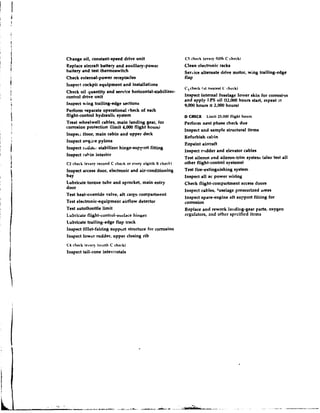
  • 54.
    ULHlBfT 2.5 Generalizedmodel of the failure process. Resistance !o failure is assumed to decl~ne steadily with exposure to stress, n~easured over time as operating age, flight cycles, and so on. A functional failure occurs when the amount of stress exceeds the remaining failure resistance. In reality both stress and resistance can fluctuate, so that there is no way to predict the exact age at which the failure point will be reached. For this reason all aircraft equipment is monitored in terms of both operating hours and flight cycles, usually on the basis of total flying time and total flight cycles for the entire aircraft. Thus if an engine is installed in a plane that has accumulated 1,000 operating hours and is removed at 1,543 hours, the engine has aged 543 hours since installa- tion. If that engine was 300 hours old when it was installed, its age at removal is 843 hours. Some military aircraft are equipped with acceleration recorders which also monitor the number of times the structare is stressed beyond a certain number of G's during operation. The loads can be counted and converted to an equivalent number of flight hours at the plane's de- signed operating profile. Like operating hours or flight cycles, these "spectrum hours" provide a basis for estimating the reduction in resis- tance to a particular failure mode. A functional failure occurs when the stress and resistance curves intersect- tha: is, when the stress exceeds the remaining resistance to failure. Either of these curves may take a variety of different shapes, and the point at which they intersect will vary accordingiy (see Exhibit 2.6). Until they do intersect, however, no functional failure occurs. In practice this failure model can be applied only to simple items -those subject to only one or a very few failure modes-and to individual 34 THEORY AND PrUNClPLts failure modes in complex items. The reason for such a limitation be-
  • 55.
    comes apparent ifwe consider some of the variables in just a single failure mode. THE AGE AT FAlUlRE Our e%ainplesthus far imply that any given component, such as a tire, has a well-defined initial resistance to failure and that the rate of decline in this resistance is more or less known and predictable. It follows that the time of failure should be predictable. In reality, however, even nominally identical parts will vary both in their initial failure resistance and in the rate at which this resistance declines with age. Suppose we have two nominally identical units of a simple item, or perhaps two identical parts in a complex item. To simplify matters further, let us say they are exposed to only one type of stress and are subject to only one type of failure. On this basis we might expect their failure resistance to decline at the same rate and therefore expect both units to fail at approx- EXHIBm 2.6 Variability of stress, failure resistance, and the age at failure. In example A the resistance remains constant over time, but a sudden peak in stress causes failure to occur. In B the stress and resistance curves do not intersect, but the peak in stress has permanently lowered the remaining failure resistance. In C the reduction in failure resistance caused by the peak stress is temporary. In D the peak stress has accelerated the rate at which the remaining resistance will decline with age. I I E*porure ( q e ) Exporure ( y e ) SECTION 2.5 35
  • 56.
    EXHIBIT 2.7 Thedifference in failure age of two nominally identical parts subjected to similar stress patterns. The two units begin their service lives with coniparable initial resistance to failure, but unit B is exposed to greater stress peaks and reacts to them consistently. Unit A behaves less accountably; its resista~~ce unaffected by stress is peaks at 640 and 1,120 hours but declines rapidly between 1.200 and 1,300 hours. As a result, one unit fails at 850 hours and the other at 1,300 hours. imately the same age. However, all manufactured components are produced to specified tolerance limits, which results in a variation in initial resistance. These varia, ' m s are insignificant from a performance standpoint, but the result is that the two units will begin their service lives with slightly different capacities to resist stress, and these capaci- ties may decline at somewhat different rates. Stress also varies from moment to moment during operation, some- times quite abruptly. For example, the different loads exerted on an aircraf! structure by atmospheric turbulence can vary markedly even in the course of a short flight. Moreover, the effect of these stresses will be further influenced by the condition of the item at the particular moment it is stressed. As a result, each component will encounter a dif- ferent stress pattern even if both are operating as part of the same sys- tem. Although the variations in either stress or resistance may be slight, their interaction can make a substantial difference in the length of time a given component will operate before failing. Units A and B in Exhibit - 2.;' ,~,'iridi;r;lj' 21;ke in their initial resistance, and the stress placed on -. each does not vary much from the constant stress assumed in the gener- alized mode). However, the time of failure is the point at which the stress and resistance curves intersect; thus unit B failed at an age of 36 THEORY AND PlllNClPLES 850 hours, whereas unit A survived until 1,300 hours.
  • 57.
    Despite the variationin the failure ages of individual units, if a large number of nominally identical units are considered, their failures will tend to concentrate about some average age. For purposes of relia- bility analysis, however, it is necessary to employ statistical techniques that describe the variation about this average age. It is also important to recognize that the actual age at failure de- pends on the stress the unit experiences. The wing-,to-fuselage joints of an aircraft will stand up to normal air turbulence for a very long time, but perhaps not to the loads encountered during a tornado. The fan blades of a turbine engine can withstand thousands of hours of normal stress, but they may not be able to tolerate the ingestion of a single goose. In nearly all cases random stress peaks markedly above the aver- age level will lower the failure resistance. This reduction may be perma- nent, as when damage to several structural members lowers the failure resistance of a wing, or resistance may be affected only at the time the stress exceeds a certain level. In some cases resistance may change with each variation in stress, as with metal fatig.de. From the standpoint of preventive maintenance, however, the important factor is not a predic- tion of when an item is likely to fail, but whether or not the reduction in failure resistance can be identified by some physical evidence that permits us to recognize an imminent failure. Many functional failures are evident at the time they occur, and in t h e s cases the exact age at failure is known. Unless a failure is evi- dent to the operating crew, hcwelrer, it is impossible to determine pre- cisely when it cccurred. A potential failure detected by mechanics is known only to have occurred some time between the last inspection and the inspection at which it is observed. Sjmilarly, although there is some exact age at which a hidden function fails, the only age we can pinpoint is the time at which the failure is discovered. For this reason the age at failure is defined, by convention, as the age at which a failure is observed and reported. 2 6 FAILURE IN COMPLEX ITEMS A complex ltem is one that is subject to many different failure modes. As failure modes a result, the failure processes q a y i:volve a dozen different stress and dominant failure modes resistance considerations, and a correspondingly tangled graphic sepre- failure age of a complex item sentation. However, each of these considerations pertains to a single failure mode - some particular type or manner of failure. For instance, a bearing in a generator may wear; this causes the unit to vibrate, and ultimately the bearing will seize. At this point the generator will suffer a functional failure, since it can no longer rotate alld produce eiectric power. Generators can also fail for other reasons, but the failure mode in this case is bearing seizure. Of course, the bearing itself i? also subject to more than one failure
  • 58.
    mode. It maywear as a result of abrasion or crack as a result of excessive heat. From the standpoint of the generator both conditions lead to the same failure, bearing seizure. However, the maintenance analyst must know the physical circumstances leading to a particular failure in order to define an identifiable potential-failure condition. The manufacturer also needs to know that the bearing is prone to failure and that a modi- fication is needed to improve the reliability of the generator. Such a design modification is obviously desirable if one particular failure mode is responsible for a significant proportion of all the failures of the item. Such failure modes are called domirrant failure modes. As with failures in simple items, the failure ages for a single failure mode tend to concentrate about an average age for that mode. However, EXHIBIT 2.8 Experience with 50 newly ingtalled Pratt & Whilney JTBD-7 engines over the first 2,000 operating hours. The 21 units that failed before 2,000 hours flew a total of 18,076 hours, so the total operating time for all 50 engines was 18,076 hours plus 58,000 hours for the surviving engines, ur 76,076 hours. The mean time between failures was therefore 76;W6/Zl, or 3,622 hours. The average age of the failed engines, however, was only d61 hours. (United Airlines) 0 2 4 6 8 l 0 1 2 U l 6 1 1 0 Opmtiq ry at fdltur (hondrrdr of h o w )
  • 59.
    the average agesfor all the different mod?s will be distributed along the exposure axis. Consequently, unless there is a dominant failure mode, the overall failure ages in complex items are usually widely dis- persed and are unrelated to a specific operating age. This is a unique ch, racteristic of complex items. A typical example is illustrated in Ex- hibit 2.8. In a sample of 50 newly installed Pratt & Whitnev JTBD-7 engines, 29 survived beyond 2,000 operating hours. The disparate fail- ure ages of the 21 units that failed, however, do not show any concen- tration about the average failure age of 861 hours. Nevertheless, even in complex items, no matter how numerous the failure modes may be, the basic failure process reduces to the same faciur- the interaction between stress and resistance to failure. Whether failures involve redr-cad resistance, random stress peaks, or any combi- nation of the two . 7 1 interaction that brings an item to the failure point. This aspc-' a !he failure process was summed up in a 1960 United .irlines rep -?rt:* The any: IC as a whole, its basic structure, its systems, and the various items in it are operated in an environment which causes stresses to be imposed upon them. The magnitudes, the durations and the frequencies with which specific stresses are imposed are all very variable. In many cases, the real spectrum of environ- mentally produced stresses is not known. The ability to withstand stress is also variable. It differs from piece to oiece of new nomi- nally identical equipment due to material differences, variations in the manufacturing prcicesses, etc. The ability to withstand stress may also vary with the age of a piece of equipment. It is implied that an instance of environmental stress that ex- ceeds the failure resistance of an item at a particular time consti- tutes failure of that item at that time. 2 'P QUANTITATIVE DESCRlPTlONS O FAILURE F Any unanticipated critical failure prompts an immediate response to failure rate prevent repetitions. In other cases, however, it is necessary to know mean time between failures how frequently an item is l i ~ e l y fail in order to plan for reliable to pmbability of survival operation. There are several common reliability indexes based on the pmbabilib' density of conditional probability failure history of an item. Methods for deriving certain of these measures of failure 'F. S. Nowlan, A Comparison o the Potential Effectiveness of Numerical Regulatory r Codes in the Fields of Overhaul Periodicity, Airplane Strength, and Airplane Perfor- mance, United Airlines Report POA-32, April 14.1960. These remarks paraphrase a report prepared by D. J. Davisnf theRand Corporation in 1950, which offered intensiveanalysiaof failure data. For an excellent detailed discussion of the physical processes present in the failure mechanism. see Robert P. Haviland, Rclinbility atld Lotrg Life Desiyn, Van Nostrand Company, Inc., New York, 1964. SECTION 2.7 19
  • 60.
    are discussed indetail in Appendix C, but it is helpful at this point to know what ehch measure actually represents. FAILURE UE T 'fie failure rate is the total number of failures divided by some measure of operational exposure. In most cases the failure rate is expressed as failures per 1,000 operating hours. Thuc if six failures have occurred over a period of 9,000 hours, the failure rate is ordinarily expressed as 0.667. Because measures other than operating hours are also used (flight cycles, calendar time, etc.), it is important to know the units of measure in comparing failure-rate data. The failure rate is an especially valuable index for new equipment, since it shows whether the failure experience of an item is representa- tive of the state of the art. It is also useful in assessing the economic desirability of product improvement. Early product-intprovement deci- sions are based on the performance of units that have beer. .-xposed to fairly short individual periods of time in service, and this performance is adequately measured by the failure rate. MUN nML BLNYUN F A I L U ~ The mean time between failures, another widely used reliability index, is the reciprocal of the failure rate. Thus with six failures in 9,000 oper- ating hours, the mean time between failures would be 9,00016, or 1,500 hours. This measure has the same uses as the failure rate. Note that the mean time between failures is not necessarily the same as the average age at failure. In Exhibit 2.8, for example, the average age of the failed engines was 861 hours, whereas the mean time between failures was 3,622 hours.* PROMBILITV Of SURVNAl. With more extended operating experience it becomes possible to de- termine the age-reliability characteristics of the item under study- the relationship between its operating age and its probability of failure. At :his stage we can plot a survival curve, showing the probability of sur- vival without failure as a function of operating age. This curve relates directly to the gener !y accepted definition of reliability: Reliability is the probability that an item will survive to a specified oper- ating age, under specified operating conditions, without failure. For this reason the survival curve is commonly referred to as the reli- ability function. 40 THEORY AND PRINCIPLES 'For a further discussion of this distinction, see Appendix C.
  • 61.
    0p.nttns y rlncelut rhap Vt&< :flight lioun,~ EXHIBIT 2.9 Survival curve fur the Pratt & Whitney JT8D-7 engine of the Boeing 737, based on 58,432 total operating hours from May I to July 31,1974. The average life is computed by partitioning alang the vertical axis to form small incremental areas whose sum approximates the area under the curve. With an age limit of 1,000 hours, only the shaded area enters into this computation, since no engines can contribute to the survival curve beyond this limit, despite the fact that they would I~avc survived had they been left in service. (United Airlines) Exhibit 2.9 shows a typical survival curve for an aircraft turbine engine. The curve represents the percentage of installed engines that survived to the time shown on the horizontal axis, and this is usually our best estimate of the probability that any individual engine will survive to that time without failure. A survival curve is more useful than a simple statement of the failure rate, since it can be used to predict the percentage of units that will survive to some given age. If the engines in Exhibit 2.9 were sched- uldd for removal at 1,000 hours, for example, 69 percent of them would survive to that age limit, whereas 31 percent could be expected to fail before then. The area under the survival curve can also be used to mea- sure the average life of the item under consideration. If the probability scale is divided into small increments, each of which is projected to intersect the curve, the contribution of each of these incremental areas . can be calculated and added to determine the average life. Thus, the tri- angie at the top is the contribution o the first 10 percent of the units that !
  • 62.
    fail (90 percentsurvive beyond this age): .lo [(age at P = 1) t (age at P = .90)] X -2 The next incremental area represents the contribution to the average life of the next 10 percent of the units that fail: [(age at P = .9Q + (age at P = .80)] X - .10 2 and so on. Completion of this computation for the entire area under the curve would show that, with no age limit, the average life expected for each engine in service would be 1,811 hours. Note, however, that an age limit of 1,000 hours removes all the sur- viving units from service at that age. In this case, therefore, the area under the curve represents only the area up to that age limit. The proba- bility of survival to 1,000 hours is .692, so the contribution of any sur- viving unit to the average life is only 1,500 hours X ,692 = 692 hours. This contribution, added to the incremental contributions above it for the units that failed, yields an average realized life of 838 hours for faded and unfailed engines. Any engines that would have survived to ages higher thtn 1,000 hours, and thus have added to the average life, do not count. The average lives that would be realized with other age limits in this case are as follows: age limit average realized life 1,000 hours 838 hours 2,000 hours 1,393 hours 3,000 hours 1,685 hours No limit 1,811 hours PROMBILITY DWSllY OF FNLUUE The probability that an engine in Exhibit 2.9 will survive to 1,000 hours is ,692, and the probability that it will survive to 1,200 hours is ,639. The difference between these probabilities, .053, is the probability of a fail- ure during this 200-hour interval. In other words, an averaae of 5.3 out of every 100 engines that enter service can be expected to fail during.., this partic~tlarinterval. Similarly, an average of 5.0 engines can be ex- '. pected to fail during the interval from 1,200 to 1,400 hours. This measure , is called the probnbility density of failure. 7 Exhibit 2.10 shows the probability densities for each 200-hour age interval, plotted from the probabilities of survival at each age. A decreasing percentage of the engines will fai! in each successive age interval because a decreasing percentage of engines survives to enter 42 THEORY AND PRINCIPLS that interval.
  • 63.
    EXHIBIT 2-10 I'robabilityrlcnsity of failure f o ~ Pratt & Whitney the J'I'el)-7 engine of the Hoeing 737. 1)ensitv values are plotted at the tnidpoint of ercll 200-hour interval and represent the probability that a tailure will occur during thi.. interval. (United Airlines) CONDmONAL PROMBIUTY O FAILURE F The most useful measure of the age-reliability relationship is the prob- 'y-1 * ability that an item entering a given age interval will fail during that ; interval. This measure is usually called the conditional probability of failure-the probability of failure, given the condition that the item enters that age interval. Sometimes it is also referred to as the hazard rate or the local failure rate.* The conditional probability is related to both the probability of survival and the probability density. For example, an engine beginning at zero time has a probability of .692 ~f reaching the age of 1,000 hours; once it has reached this age, the prob- ability density of failure in thc next 200-hour interval is ,053. Each engine that survives to 1,000 hours therefore has a conditional proba- bility of failure between 1,000 and 1,200 hours of .053/.692, or .077. The complete conditional-probability curve for this engine is shown in Exhibit 2.11. If the conditional probability of failure increases with age, we say that the item shows wearout chnracteristics and immediately wonder if an age limit would be effective in reducing the overall failure rate. (Note > 'In some literature these tenns are defined in a narrower sense to mean the value obtained by computing the limit of the ratio as the age interval goes to zero. SECTION 2.7 43
  • 64.
    UHIBIT 2.11 Conditionalprobability of failure for the Pratt & Whitney JT811-7 engine of the Bocing 737. Probability values are plotted at the midpoint of each 200-hour interval and represent the average probability that an engine that survives to enter the interval will f.lil during this interval. (United Airlines) that the term ruenroitt in this context describes the adverse effect of age on reliability; it does not necessarily imply any evident physical change in individual units.) With an age limit of 1,000 hours the average real- ized life of the engine in question is 838 hours. The probability that an engine will survive to this age is .692, so the failure rate with this limit would be the probability of failure (.308) divided by the average life, or a rate of 0.37 failures per 1,000 hours. Exhibit 2.12 shows this failure rate plotted as a function of various age limits. If the age limit is raised from 1,000 hours to 2,000 hours, the overall failure rate is 0.42, an increase of only 13.5 percent due to the second thousand hours of operation. However, the conditional prob- ability of failure in the 200-hour interval just before each of these age limits goes up from ,075 to .114, an increase of 52 percent. The rate of brcrease in the failure rate falls off with age because it depends on the conditional probability for each interval weighted by the probability of survival to that interval-and there is a continual reduction in the sur- vival probability. What this means is that the effectiveness of an age limit in control- ling failure rates depends not only on large increases in conditional 44 THEORY AND PRINCIPLES probability at higher ages, but also on a high probability of survival to
  • 65.
    iPOo zoo0 s, m Coao oparthq limit r a hat dmp vblt (flWlt hopn) b EXHIBIT 2-12 Relationship between the failure rate and various age limits for the rratt & Whitney JTAD-7 engine of the Boeing 737. (United Airlines) those ages. It follows that the desirability of an age limit on any item cannot be investigated until there are sufficient operating data to con- struct survival and conditional-probability curves. 2 8 AGE-RELIABILITY CHARACTERISTICS At one time it was believed that all equipment would show ivearout the bathtub curve characteristics, and dgring the years when equipment overhaul times a e-mliability relationships of complex items were being rapidly extended, United Airlines developed numerous the ,,life,, of a comp,ex item conditional-probability curves for aircraft components to ensure that the higher overhaul times were not reducing overall reliability. It was found that the conditional-probability curves fell into the six basic patterns shown in Exhibit 2.13. Pattern A is often referred to in reliability literature as the bathtub curve. This type of cuivt?has three identifiable regions: b An infant-mortality region, the period immediately after manufac- ture or overhaul in which there is a relatively high probability of failure
  • 66.
    The bathtub curve:infant mortality, followed 1 might 1% fint by a constant or gradually incmring failure benefit from probability and then by a pronounced "wearout" a limit on region. An q e limit may be desirable, ptsj opeiating age vfded a luge number of units suwive to the age at which wearout bcginr, Constant or gradually increadq failure pmb- ability, followed by a pronounced wearout region. Once again, an age limit may be derir- able (this curve is characteristic of aircraft recipmc'atlng engines). Gradually increasing failun probability, but with no identifiable weamut age. It L usually not dairable to impose an age limit h such caws (this curve is charactedslc of aimraft turbine eqined. 89% cmnot benefit :ram a l i d t on open ting age Low failure probability when the item is new or just out of the shop, followed by a quick increase to a constant ievel. Constant probability of failure at all ages (exponential survival dbbibutlon). Infant mortality, followed by a constank or very slowly increasing failure probability :partie ularly applicable to electronic equipment).
  • 67.
    A region ofconstant and relatively low failure probability A wearout region, in which tile probability of failure begins to in- crease rapidly with age If the failure pattern of an item does in fact fit this curve, we are justified in concluding that the overall failure rate will be reduced if some action is taken just before this item enters the wearout zonc. In these cases allowing the item to age well intn the wearout region would cause an appreciable increase in the failure rate. Note, however, that ,uch action will not have much effect on the overall rate unless there is o high probability that the item will survive to the age at which wearout appears. The Fresence of a well-defined wearout regloll is far from uni- versal; indeed, of thc six curves in Exhibit 2.13, only A and B show wearout characteristics. It happens, hawever, that these two curves are associated with a great many single-celled or simple items- in the case of aircraft, such items as tires, reciprocating-engine cylinders, brake pads, turbine-engine compressor blades, and all parts of the airplane structure. The relative frequency of each type of condition,tl-probability curve proved especially interesting. Somc 89 percent of the items analyzed had no wearout zone; therefore their performance could not be im- proved by the imposition oi an age limit. In fact, after a certain age the conditional probability of failure continued on at a constant rate (curves D, E, and F). Another 5 percent had no well-defined wearout zone (curve C ) but did become steadily more likely to fail as age increased. For a very few of these items an age limit might prove useful, provided that it was cost-cffcctivc. Only 6 percpnt of the items studied showed pronounced wearout characteristics (curves A and A). A-lthough an age limit would be appli- cable to these items, as we have seen, its effectiveness depends on a high probability 'that the item will survive to that age. However, the conditional-probability curves make it possible to identify those items that might benefit from such a limit, and the question of effectiveness can then be investigated. Although it is often assumed that the bathtub curve is representative of most items, note that just 4 percent of the items fell into this pattern (curve A). Moreover, most complex items had conditional-probability cu~ves represei~tedby curves C to F--that is, they showed no concentration of failures directly related to operating age. The basic difference between the failure palterns of complex and simple items has important implications for maintenance. Usually the conditional-probability curve for a complex itelr will show some infant mortality; often the probability of failure right after installation is fairly
  • 68.
    high. Usually, also,the conditional-probability curve shows no marked point of increase with increasing age; the failure probability may in- crease gradually or remain constant, but there is no age that can be identified as the beginning of a wearout zone. For this reason, unless there is a dominant failure mode, an age limit does little or nothing to improve the overall reliability of a complex item. In fact, in many cases scheduled overhaul actually increases the overall failure rate by intro- ducing a high infant-mortality rate in an otherwise stable system. In contrast, single-celled and simple items frequently do show a direct relationship between reliability and increasing age. This is partic- 7,larly true. of parts subject to metal fatigue or mechanical wear and items designed as consumables. In this case an age limit based on some maximum operating age or number of stress cycles may be highly ef- fective in impr0vir.g the overall reliability of a complex item. Such limits in fact play a major role in controlling critical-failure modes, since they can be imposed on the part or component in which a given type of failure originates. It is apparent from our discussion thus far that mow statements ct about the "life" of equipment tell us little about its age-reliability char- acteristics. For example, the statement that an aircraft engine has a life of 2,000 operating hours might mean any of the fcllowing: b No engines fail before reaching 2,000 hours. b No critical engine failures occur before 2,000 hours. b Half the engines fail before 2,000 hours. b The average age of failed engines is 2,000 hours. b Th? conditionnl probability of failure is constcnt below 2,000 hours. b Some part in the e:~ginehas a life limit of 2,000 hours. The definition of reliability is the probability that an item will survive a given operating period, under specified operating conditions, without failure. In discussions of reliability, therefore, it is insufficient to state an operating period alone as the "life" of an item. This statement has no meaning unless a probability 3f survival is associated with it. It should also be apparent by now why the failure rate plays a relatively unimportant role in maintenance programs: it is too simple a measure. Although the frequency of failures is useful in making cost decisions and in establishing appropriate intervals for maintenance tasks, it tells us n o t h i ~ g about what tasks are appropriate or the con- sequences that dictate their objective. The effectiveness of a particular maintenance solution can be evaluated only in terms of the safety or 48 THEORY AND PRINCIPLES economic consequences it is intended to prevent. By the same token, a
  • 69.
    maintenance task mustbe applicable to the item in question in order to have any effect at all. Hence we must now consider the possible forms of preventive maintenance and see how an understanding of the failure process and the age-reliability characteristics of an item permit us to generate maintenance tasks on the basis of explicit criteria.
  • 70.
    CHAPTER THREE the fourbasic maintenance tasks R ~ M u o G w s consist of specific tasks selected on the basis of the r actual reliability characteristics of the equipment they are designed to protect. All these tasks can be described in terms of four basic f o m s of preventive maintenance, each of which is applicable under a unique set of circumstances: b Scheduled inspection of an item at regular intervals to find any potential failures b Scheduled rework of an item at or before some specified age limit b Scheduled discard of an item (or one of its parts) at or before some specified life limit b Scheduled inspection of a hidden-function item to find any func- tional failures The first three types of tasks are directed at preventing single failures and the fourth at preventing multiple failures. Inspection tasks can usually be performed without removing the item from its installed posi- tion, whereas rework and discard tasks generally require that the item be removed from the equipment and sent to a major maintenance base. The development of a scheduled-maintenance program consists of determining which of these four tasks, if any, arc both applicable and effective for a given item. Applicability depends on the failure charac- teristics of the item. Thus an inspection for potential failures can be applicable only if the item has characteristics that make it possible to define a potential-failure condition. Similarly, an age-limit task will be applicable only i f the failures at which the task is directed are related to age. Effectiveness is a measure of the results of the task; the task objec-
  • 71.
    tive, however, dependson the failure consequences involved. A pro- posed task might appear useful if it promises to reduce the overall failure rate, but it could not be considered effective if the purpose in applying it was to avoid functional failures altogether. For inspection tasks the distinction between applicability and effectiveness is usually obvious: the item either does or does not have characteristics that make such a task applicable. For age-limit tasks, however, the distinction is sometimes blurred by the intuitive belief that the task is always applicable and therefore must also be effective. In reality imposing an age limit on an item does not in itself guarantee that its failure rate will be reduced. The issue in this case is not whether the task can be done, but whether doing it will in fact improve reliability. 3 1 SCHEDULED ON-CONDITION TASKS Scheduled inspections to detect potential failures are commonly termed ilclec~ion 1 ~ ) t r t ~ t l t i .f.lilurtb 0 lI on-conditiotr tusks, siltce they call for the removal or repair of individual ~ 1 ~ 1 ) l i c ~ l - icriteria Iity units of an item "on the condition" that they do not meet the required standard. Such tasks are directed at specific failure modes and are based i"'~'~'ti"n '"""'""'" on the feasibility of defining some identifiable physical evidence of a reduced resistance to the type of failure in question. Each unit is in- spected at regular intervals and remains in service until its failure resistance falls below a defined level- that is, until a potential failure is discovered. Since on-condition tasks discriminate between units that require corrective maintenance to forestall a functional failure and those units that will probably survive to the next inspection, they permit all units of the item to realize most of their useful lives.
  • 72.
    This type oftask is applicable to tires, brakes, many parts of an air- I craft powerplant, and much of its struchire. Many routine servicing tasks, such as checking oil quantity and tire pressure, are on-condition tasks. The applicability of an on-condition task depends to some extent on both maintenance technology and the design of the equipment. For example, borescope and radioisotope techniques have been developed for inspecting turbine engines, but these techniques are of value chiefly because the engines have been designed to facilitate theit use. If on-condition tasks were universally applicable, all failure possi- bilities could be dealt with in this way. Unfortunately there are many types of failures in which the failure mode is not clearly understood or is unpredictable or gives insufficient warning for preventive measures to be effective. There are three criteria that must be met for an on- condition task to be applicable: b It must be possible to detect reduced failure resistance for a specific failure mode. b It must be possible to define a potential-failure condition that can be detected by an expllcit task. b There must be a reasonably consistent age interval between the time of potential failure and the time of functional failure. As an example, suppose a visible crack is used as a measure of metal fatigue, as shown in Exhibit 3.1. Such an item is most failure resistant when it is new (point A). The resistance drops steadilv with increasing age and is already somewhat reduced by the time a crack appears (point B). Thereafter it is possible to monitor the growth of the crack and define a potential-failure point C far enough in advance to permit removal of the item before a functional failure occurs (point D). Once a crack has appeared, the failure resistance drops more rapidly; hence the rate of crack growth in this item must be known in order to establi~han inspection interval AT that will effectively control this failure mode. The data for the entire population of this item would define a range of failure ages rather than one specific age. Hence both the defined potential failure and the frequency of inspections depend on the objec- tive of the task. If a functional failure would have safety consequences, then the objective is to prevent all such failures. In this case an on- condition task may be app:icable, but it would be considered effective only if it minimized the likelihood of a critical failure. If the failure does not involve safety, then effectiveness is measured in economic terms - that is, the task is effective only if it is cost-effective. In the case of oper- ational consequences this means that the cost of finding and correcting potential failures must be less than the combined cost of the operational 52 THEORY AND PRINCIPLES consequences plus the cost of repairing the failed units. It follows from
  • 73.
    WHIBIT 3.1 Determining the interval for on-condition inspection of an item subject to metal fatigue. Once the rate of decline in failure resistance has been determined, an inspection interval ATis established that proyides ample opportunity to detect a potential failure before a functional failure can occur. this that when an on-condition task is effective in reducing the failure rate, and hence the frequency of operational consequences, it is usually also cost-effective, since the cost of inspection is relatively low. Exhibit 3.2 shows some typical on-condition tasks for an aircraft. The first example concerns a specific failure mode of an aircraft engine that has a set of 24 tie bolts between the fourth and fifth stages of its turbine to hold an air seal in position (and a similar set of tie bolts between the fifth and sixth stages). Failure of this set of tie bolts would result in a loose air seal and cause major damage to the engine. Lowered resistance to failure is evidenced by the failure of one or more individual bolts. (Note that although this would be a functional failure of the tie bolts, it is a potential failure from the standpoint of the engine.) The second example concerns the nozzle guide vanes of the same engine. These vanes are subject to burning by the hot exhaust gases of the engine, and also to erosion by h ~ r carbon particles from the com- d bustor. The required borescope inspection is a visual inspection to determine how much damage has occurred on the airfoil and inner plat- form of the vare. The definition of potential-failure conditions in this case is quite complex; in practice the interval between inspections is reduced as the condition deteriorates, until a point is reachcd at which the engine must be removed from service.
  • 74.
    1 LOW-PRESSURE TURBINESECTION Check for failed aimed tie bolts. Note: Airseal tie bolts between fourth- and fifth-stage and sixth- stage rotors (last thrn staged are failing. T h m broken bolb u e trapped in the h a 1 between the rotore and cruae a rattling mund re they roll when the hubine L slowly rohttd. A Have fan rotated 180 degrees very slowly. Repeat 180-degree rotation as often as nececslry. B Liekn at tailcone for rattling sound caused by broken bolts rolling around (do not confuse with clanking sound of blades). Attempt to determine number of broken bolts by counting nttla , C Failed-bolt limits. Three or fewer broken bolts: engine may r m i in service. ean Four or more broken bolte: engine must be bornoped within 75 hours. D Supply the following information: (1) Plane number - - Engine position -- Engine time since last shop visit - - (2) Number of broken bolts estimated from , . ,hstening" check - - E Send DIS*P5106 message giving above information. 2 RUST-STAGE NOZZLE GUIDE VANES Borescope inspection (Boeing 747 JT9D powerpiurt). A Perform initial borescope inspection of first-stage nozzle guide vanes at 600 hours. Perform repeat inspections at 600,200, 75, or 30 hours, depending on conditions f0ur.J. B Dietress limits as given in MMIOV 72-00-99: (I Trailing-edge cracks: maximum of 5 cracks per vane extending to window (slot) leading edge. If distress exceeds this limit, remove engine; otherwise, repeat inspection in 600 hours. (2) Trailing-edge erosion: If burning-surface bum-through does not exceed 112 by 112 inch, repeat i~spection 600 hours; if in burn-through does not exceed 314 by 314 inch, repeat inspec- tion in 200 hours; if bum-through d m not exceed 1 by 1 inch, repeat innpertion in 75 hours. If surface bum-through is up to 518 inch from leadir~gedge, repeat inspection in 30 hours. Note: 30-hour limit is a maximum fly-back limit, to be ueed one time only. 54 THEORY AND PRINCIPLES
  • 75.
    3 ARLUE7EClOR INSTALLAllONS Intensified inspection of installations, leads, and connections. A Check for minimum clearance of 1/16 inch between ecnsing elements and engine, as well as between various engine components. Provide neceseary clearance. B Check for any signs of wear. C Wear limits: Acceptable: Flat spots not exceeding 0.035 inch in width; m y length acceptable. Not acceptable: Flat sputs exceeding 0.035 inch in width or worn spot exposing inner conductor or composition material between inner conductor and outer sensing-element shell. Note: Nominal diameter is 0.070 inch. 4 BRAKE ASSEMBLY, MAIN LANDING GEAR Check brake-lining wear at each assembly, using small scale. A Set parking brakes. B Measure wear-indicator pin extension at both indicator pins. C Wear limits: If either pin is less than 0.25 inch in lengtlt, replace brake assembly. Note: Replacement may be deferred, with approval from SFOLM, provided wear-indicator pin measures longer than 13/64inch. If wear-indicator pin length is 13/64 inch or less, immediate replacement is required. 5 PNEUMATIC DRIVE UNPTS, LEADING LDCf RAP Check oil level and service as required. Note: Drive units are numbered from outboard to inboard, 1 to 4, left and right wing. A Check oil level in proper si&.: glass. If oil level is visible in sight glass, no service is required. B If oil is not visible, slowly add oil (OIL2380) through fill port until sight glass is filled. Use 53769 oil dispenser. C Allow excess oil to draili out before installing fill plug. SECTION 3.1 55
  • 76.
    In the thirdexample the potential failure may be either lack of adequate clearance or visible wear on fire-detector sensing elements and leads. The fourth and fifth examples involve less judgment in the inspection process. Exact limits are given for the brake wear-indicator pin in the first case and oil level in the pneumatic unit in the second case. Both require a clearcut response on the part of the inspecting mechanic. Whenever an on.-condition task is applicable, it is the most desir- able type of preventive maintenance. Not only does it avoid the pre- mature removal of units that are still in satisfactory condition, but the cost of correcting potential failures is often far less than the cost of cor- recting functional failures, especially those that cause extensive second- ary damage. For this reason on-condition inspection tasks are steadily replacing older practices for the maintenance of airline equipment. 3 2 SCHEDULED REWORK TASKS applicability criteria Many single-celled and simple items display wearout characteristics- effectiveness criteria that is, the probability of their failure becomes significantly greater effect o f an ajie limit oll after a certain operating age. When an item does have an identifiable maintenance workload wearout age, its overall failure rate can sometimes be reduced by im- posing a hard-time limit on all units to prevent operation at the ages of higher failure frequency. If the item is such that its original failure resistance can be restored by rework or remanufacture, the necessary rework task may be scheduled at appropriate intervals., For example, the airplane tire in Exhibit 2.4 could have been scheduled for rework after a specified number of landings, since retreading restores the original failure resistance. However, this would have resulted in the retreading of all tires at the specified age limit, whether they needed it or not, and would not have prevented functional failures in those tires that failed earlier than anticipated. Where no potential-failure condition can be defined, on-condition inspection of individual units is not feasible. In such cases a rework task mav be applicable, either for a simple item or to control a specific failure mode in a complex item. Although the age limit will be wasteful for some units and ineffective for others, the net effect on the entire population of that item will be favorable. This is not the case, however, for complete rework of a complex item. As we saw in Chapter 2, failures in complex items are the result of many different failure modes, each of 'The term or~rrhn~tl the connotation that the unit is completely disassembled and re- has manufactured part by part to restore it as nearly as possible to a "like-new ' physical condition. Kru~ork refers to a set of maintenance operations considered sufficient to restore the unit's origirlal resistance to failure. Thus rework for specific items may range 56 THEORY AND PRINCIPLES from replacement o a single part to complete remanufacture. f
  • 77.
    which may occurat a different average age. Consequently the overall failure rate cf such items remains relatively constant; in some cases reliability decreases gradually with age, but there is no particular age that can be identified as a wearout zone. Thus, unless there is a domi- nant failure mode which i s eliminated in the course of rework, complete rework of a complex item will have little or no effect on the overall failure rate. A rework task can be considered applicable to an item only if the following criteria are met: b There must be a n identifiable age at which the item shows a rapid increase in the conditional probability of failure. A large propartion of the units must survive to that ag:. b It must be possible to restore the original failure resistance of the item by reworking it. Because the information required to develop survival and conditional- probability curves for an item is not available when equipment firs1 goes into service, scheduled rework tasks rarely appear in a prior-to- service maintenance program (only seven components were assigned to scheduled r:work i n the initial program developed for the Douglas DC-10). Otten, however, those items subject to very expensive failures are put into an age-exploration program to find out as soon as possible whether they would benefit from scheduled rework. Even when scheduled rework is applicable to an item, very often it does not meet the conditions for effectiveness. A reduction in the num- ber of expected failures, for example, would not be sufficient in the case of safety consequences, and in the case of economic consequences the task must be cost-effective. Moreover, since an age limit lowers the average realized age of an item, it always increases the total number of units sent to the shop for rework. As an example, consider the effect scheduled rework would have on the turbine engine discussed in Section 2.7. With no age limit, the failure rate of these engines is 0.552 failures per 1,000 hours. Thus over an operating period of 1 million hours an average of 552.2 failed units (1,000,000/1,811) are sent to the shop for repair (see Exhibit 3.3). A rework age limit of 2,000 hours v~illreduce the failure rate to 0.416; how- ever, it will also reduce the average realized age from 1,811 hours to 1,393 hours. Since 42 percent of the units survive to 2,000 hours, over the same operating period an average of 717.9 units would be sent to the shop-the 416.3 units that failed plus the additional 301.6 scheduled removals. In other words, there would be about 135 fewer failures, but 166 more engines that required rework. O n this basis scheduled rework at 2,000-hour intervals would not be cost-effective unless the rework cost for scheduled removals were substantially lower than the cost of SECTION 3.2 57
  • 78.
    age limit 1 m (houd failure rate (per &OM) hours) o 1 w yercsntrl)c uf unlb surviving to age lmt ii averaged &d - engine age (horn) a m 0.4163 3 m 0 . m None 0.5522 repairing failures (in this case the rework cost would have to be less than 135.91301.6, or 45.1 percent, of the repair cost). Of course, the direct cost of rework is not the only economic factor to be taken into account. If the failure is one that has operational con- sequences, the reduction in the number of failures may more than offset the additional cost of rework. Determining the economic desirability of a proposed rework age limit will be discussed in greater detail in the next chapter. In general, however, the effect of at least four possible rework intervals must be analyzed before an optimum limit can be determined - if indeed one does exist. In most cases a rework task will not prove cost-eifective unless the item has an unusually expensive failure mode or the cost of a functional failure includes economic losses other than the direct cost of repair. 3. 3 SCHEDULED DISCARD TASKS ,III< I>., t, , .,,:I,, :,:, ii I ~ I ~ The scheduled rework of items at a specified ege limit is one type of .. #.! , , . ., bc,l:, lI,,. ;$,I~,,. hard-time task; the other is scheduled discard of items or certain of their parts at some specified operating Jge. Such tasks are frequently termed life-limit tnsks. Life limits may be established to avoid critical failures, in which case they are called safr-life limits, or they may be established because they are ccst-effective in preventing noncritical failures, in which case they are called economic-life limits. SAFE-LIFE LIMITS A safe-life limit is imposed on an item only when safety is involved and there is no observable condition that can be defined as a potential fail- 58 WEORY AND PlUNClPLU ure. In this case the item is removed at or before the specified inaximum
  • 79.
    age and iseither discarded or disassembled for discard of a time-expired part. This practice is most useful for simple items or individual parts of complex items, such as pyrotechnic devices in ejection seats, which have a limited shelf life, and turbine-engine disks or nonredundant structural members, which are subject to metal fatigue. The safe-life limit itself is usually established by the equipment manufacturer on the basis of developmenta: testing. A component whose failure would be critical is designed to begin with to have a very long life. It is then tested in a simulated operating environment to deter- mine what average life has actually been achieved, and a conservatively safe fraction of this average life is used .as the safe-life limit. Safe-life items are nearly always single-celled parts, and their ages at failure are grouped fairly closely about the average. However, the cor- relation bctween a test environment and the actual operating environ- ment is never perfect. Moreover, because testing a long-lived part to failure is both time-consuming and expensive, the volume of test data is often too small to permit us to dmw a survival curve with much confi- dence. For this reason safe-lifelimits are usually established by dividing the average failure age by a large arbitrary factor -sometimes a factor as large as 3 or 4. The implication is that the conditional probability of failure at this limit is essentially zero; that is, a safe-life limit is based on a 100 percent probability of survival to that age. The difference between a safe-life limit and the average agc at failure is illustrated in Exhibit 3.4. A safe-life discard task is applicable only under the following circumstances: b The item must be subject to a critical failure. b Test data must show that no failures are expected to occur below the specified life limit. SECTION 3 . 3 59
  • 80.
    Complex ihm EXHIBIT 3.4Corn}~arison the average age at tailure (average Irfe) of iletrrnrit~~dfro111oprr3ting data rnd .I safe-life lirrrit dcterrninrd on the hasis of test data. Since the function of a safe-life 14.mit to avoid the occurrence of is a critical failure, the resulting discard task is effective only if it accom- plishes this objective. Thus the only information for assessing effective- ness in this case will be the manufacturer's test data. Sometimes these tests have not been comp!eted at the time the initial program is devel- oped, but until a limit can be established, the available test data must show that the anticipated in-service aging of the item will be safe. An operating o~ganizationrarely has the facilities for further simulation teqting that might justify increasing a safe-life limit, nor is there usually a reasonable basis for reducing it, unless failures occur. ECONOMIC-LIFELIMITS In some instances extensive operating experiefice may indicate that scheduled discard nt an item is desirable on purely economic grounds. An econonric-lift. limit, however, is established in the same manner as an age limit for scheduled rework; that is, it is based an the act-la1age- reliability relationship of the item, rather than on some fraction of 60 THEORY AND PRlNClPLFS the average age at failure. Whereas the objective of a safe-life limit i-
  • 81.
    to avoid accumulatingany failup data, the only justification for an economic-life limit is cost effectiveness. Thus the failure,rate must be known in order to predict how the total 1:umbcr of scheduled removals at various age limits would affect the cost-benefit ratio. In general, an economic-life task requires the follvwing three conditions: b The item must be subject to a failure that has major economic (but not safety) consequences. b There must be an identifiable age at which the item shows a rapid increase in the conditional probability of failur, . b A large proportion of the units must survive to that age. Although an item that meets the first criterion may be put into an age- exploration program to find out if a life limit is applicable, there are rarely suff~cientgrounds for including this type of discard task in an initial scheduled-maintenance program. 3 4 SCHEDULED FAILURE-FINDING TASKS Whenever an item is subject to a functional failure that would not be . ~ l j l r l i z . t h i l i t v 1.ritt3t.1.1 evident to the operating crew, a scheduled task is necessary to prcj?~ct ~ ~ * ~ ~ - I I I I 1 I b r~hI~ I~ ~ .~tI v J"l'"bi'i' the availability of that function. Although hidden-function failure::, by definition, have no immediate consequences, failures that are un- detected increase the exposure to a possible multiple failure. Hence, if no other type of maintenance task is applicable and effective, hidden- function items are assigned failurc-findiit~ tasks, scheduled inspections for hidden failures. Although such tasks are intended to locate func- tional failures rather than potential failures, they can be viewed as a type of on-condition maintenance, since the failure of a hidden-function item can also he kicwed as a potential n~ultiple failure. The chief differ- ence is in the level of iten1 consiciered; a functional failure of one item may be only a potential failure for the equipment as a whole. Most items supported by failure-finding inspections remain in service until a functional failure is discovered. Some items, however, have several functior~s,of which only one or a few are hidden. Such items will be removed from service to correct evident failures, and if the removal rate is sufficient to ensure adequate availability of the hidden function, the shop specifications may include a failure-finding inspection at that time. Other item:; may not require scheduled failure- finding tasks because the operating crew is required to check them periodically. Many hidden functions, especially in systems, are made evident by the addition of instrumentation, so that a separate insyec- tion for hidden ffii!itres is unnecessary. t'.
  • 82.
    A scheduled failure-findingtask is applicable to an item under the following two conditions. Note that the second criterion is in fact a default condition: The item must be subject to a functional failure that ir 3t evident to the operating crew during the performance of nor dl duties. D The item must be one for which no other type of task is applicable and effective. The objective of a failure-finding task is to ensure adequate availability oi a hidden function. The level of availability that is needed, however, depends on the nature of the function and the consequences of a pos- siblc multiple failure. Some hidden functions, such as the fire-warning system in an aircraft powerpiant, are sufficiently important that they are tested before every flight. ' ~pron-iate intervals for failure-finding tasks cannot be deter- mint., af ~ t l as those for other types of tasks. In the case of emer- y gency equipment !lidden-function items rhich are replaced at specified T . intervals, such as pyrotechnic devices, are tested prior to rework or discard to see if they would have functioned had they been needed. The test results at any given interval provide a basis for increasing or decreasing the interval. In other cases the expected availability of a hid- den function can be approximated by assuming that the age-reliability relationship is exponential,' assigning a conservatively high failure rate, and theii determining the probability of survival across a given inspection interval. As an example, suppose some hidden function has an anticipated fnilure rate of 0.5 per 1,000 hours. The mean time between failures is 1.hen 2,000 hours, If the proposed inspection interval is 500 hours, a unit that is serviceable at one inspection will have aged 500 hours by the next inspection. The probability that it will survive this 500-hour interval (one-fourth of the mean time between failures) is .78 on an exponential curve (Exhibit 3.5). The average ava~lability would t h ~ bes or a probability of .89 that the item will f~mction it is needed. If this if degree of reliability is inadequate, the inspection intenValmust be reduced. Failure-fillding tasks are always effective if the inspection interval is short enough. To be considered effective a failure-finding task must ensure the required level of availability. Howeer, thi: task must also be cost- 'If the conditional probability of failure is nonincreasi.lg, this is a conservative assump- 62 AND PRINCIPLES ~EORY tion.
  • 83.
    0 0.S 0.50 0.71 1 Lb 1.50 Ratlo of in(mal t mcrn time between fdlum o EXHIBIT 3.5 Establishing th.)interval Lrr.1 failure-finding insprctiv~, The age-reliability relatiotishifl of an itcm is .issu~ned,in thr .~trscncv of inforlltation, to he exponential over operati~lg age. i'hu- . ~ t-111 inspection interval equal to one-fourth of the m;-an tini~.between failures, the probability that the item will survivr that interval ih .7H. This is true of the intcrv.11 between any two in>pibctions, rc#ari!lvsz I,! the age oi tkz item. O n the b,:si+ oi this inspectitrn interval, tht. .lvcrage availability of the unit would he 89 percent. ,ti interval that represented a snraller fraction of the exlwcted nieati tilnr h e t w r e ~ i .! failures would yield higlrer average .rv.~ilability. effective with respect to the three other types of maintenance tasks- tnat is, it must be the least expensive means of ensvring the necessary ievel of availability. When a possible multiple failure is not related to safety, an availability goal cif 95 percent is often used. Alternatively, the eco- nomic consequences of the multiple failure can be balanced against the costs of inspection to determine the most cost-effective inte~valand availability level. Exhibit 3.6 shows some typical failure-finding ,sks for a commcr- cia1 aircraft. In each case the scheduled task is designed to identify a functional failure. In thc second example the failure might or might not be evident to the operating crew, depending on whether a complaint was received from a passenger. SECTION 3.4 63
  • 84.
    EXHIBIT 3.6 1 .11111>1t~ 01 f . i ~ I ~ ~ t . - t i ~ i t l i r i !i : ~ i l w ~ [ I,I~L. ~ ~ i n l'cs~ itlt.ti 101 . 1 1 1 I 1 1 1 1 * III,IIII~I'II.SI~L~. 1111.0 l i . i ~ ~ i t 111 l I 1 i 5 . t.~.rc1111. i 111t~~Ii.1rlit ~ t - t l t ~ i ~ t OI:I . t l to 11%111.1~.1 .II~' . 1 1 I t s ~ 1 t 1 1 1 1 t 5 . 1 I( ~ ~ I I.c~ ~ l i ~ i t . l LI I SMOKEGOCULS Replacr miesing or damyltd go@- (not repairable) re required by the following conditionl: A Plastic-foun face seal not adheriry to goggle rim B Lens not d d n c d within g e e gmove C Dirt or seratchcs on lens D Any other dcMmenta1 condition 2 READING UGHlS PASSENWR-SERVKE SYSTEM T a t lighb in zonm A to E . A At positi~ns ,2 3 , and 4 on right attendmt'a panel, podtion 1 ~Witchm fOll0WS: a8 PES-OFF, PSS-OFF, CH OFF, ATTND CALL-TEST (to - illuminate blue) B t20rzone being checked, rotate teading-light r w i t d to ON position: (1) A l reading lights in that zone rhould Illuminate. l (2) Master call light should not blink. C Rotate reading-light switch to OFF pwftion: (1) All reading lightp in that zone should not be illuminated, (2) Master call light should not blink. D Rotate reading-light switch to SEAT p i t i o n : All reading lighk in that zone should return to individual scat CrL s~lcctor. 3 U t H C ( l T K U m A Turn on beacon, navigation, and wing-illumination lights, and at night turn on logo lights. B Walk amund exterior of aircraft m d check lights. C Turn off lighte. 04 THEORY A N D PRINCIPLES
  • 85.
    3 5 CHARACTERISTICSOF THE BASIC TASKS The four types of scheduled-maintenance tasks employed in an RCM t c r l ~ l i ~ i ~ ~ iii~tcr~tirc.; logv program differ both in terminology and in concept from traditional ap- 1 " ~ (11 t.lhh ~ ~ r r t c r t ~ l l t t ~ proaches to scheduled maintenance. In the airline industry, for example, it is customary to refer to three "primary maintenance processes": otl- ;;~;;:;;~,~;~x~~~ $:~31f~~~ Ir61a11 c.ntrditiotr, /lard tinrc, and cotiditiotl rnorlito,.irl,y. All scheduled tasks are considered to be either on-condition or hard-time. On-condition tasks are defined by FAA regulations as: . . . restricted to components on which a determination of con- tinued airworthiness may be made by visual inspection, measure- ment, tests, or other means without a teardown inspection o r overhaul. These "On-Condition"checks are to be performed within the time limitations prescribed for the inspection or check. Although the term hnrd tin~t. not specifically defined, it is implied is by a number of FAA requirements. Airline maintenance specifications must include "time limitations, o r standards for determining time limi- tations, for overhauls, inspections and checks of airframes, engines, propcllers, appliances, and emergency equipment," and the basic prin- ciple for establishing these time limitations is: . . . that the inspections, checks, maintenance or overhaul be per- forn~edat times well within the expected or proven service lift, of each component of the aircraft. EXHIBIT 3.7 Co~iil?.~riso~iIZC'!il t.isA t ~ * r ~ i i i. I ~I L ~c11rrt.111 ~ ~ of I i ~ ~ l ~ ~ rcy~rl.~!c~r u,ijii.. RCM terminology current rgulatory usagc Inspection tasks: On-condition tasks (to detect On-condition p m e ~ potentid failurn) Failure-finding ksks (to detect Condition-monitoring process hidden function failures) (inspection of hidden-function Removal tasks: Hard-time proccss Scheduled rework Scheduled overhaul Scheduled discard Life limit Servicing heks Servicing No scheduled msintenance Condition-monitoring proctsa (no scheduled tasks) SECTION 3.5 65
  • 86.
    The process termedcondition monitoring is one that is characterized by the absence of preventive-maintenance tasks. An iten1 is said to be maintained by condition monitoring if it is permitted to remain in ser- vice without preventive maintenance until a functional failure occurs. However, since condition monitoring is oriented to after-the-fact detec- tion of failures, this designation may refer in some instances to failure- finding tasks assigned to hidden-function items and in other instances to items assigned to no scheduled maintenance. Despite the overlap in terminology, there are certain fundamentai differences in concept between the tasks performed under traditional maintenance policies and the explicit task defi~~itions required by a n RCM program. The hard-time approach was based on the assumption that complex items do have an "expected or proven service life" - that is, that their overall reliability invariably decreases with age. O n this premise overhaul specifications usually required that all units which had survived to the specified time limit be disassembled down to their smallest constituent parts and inspected in detail for signs of deteriora- tion. Technical experts examined each part and formed opinions about whether a given componen; could have continued to operate satisfac- torily to a projected new overhaul interval; in other words, they made judgments about the age at which the item was likely to faii. These teardown inspections might at first appear to qualify as on- condition inspections. However, such inspections were rarely focused on the specific conditions required by an on-condition task. Unfor- tunately it is usually beyond human capability to look at a used part and determine what its likelihood of failure will be at some later age. As a result, the initial overhaul intervals for :lew equipmeqt were short and were extended only by very small increments. At one point, in fact, the FAA limited extensions of the interval for engine overhauls to a maximum of 100 hours and required a period of at least three months between successive extensions. Note that the traditional type of scheduled overhaul also fails to satisfy the criteria for a rework task. Shop specifications calling for the part-by-part remanufacture of complex items to restore them to "like- new" condition wer2 intended to avoid operation in the age period at which failures were expected to be more likely. As we have seen, how- ever, this expectation does not hold for most complex items. Conse- ~ u e n t l ywe cannot cxzect periodic overhaul at any operating age to make a noticeable difference in their reliability. Furthermore, even when a complex item does meet the applicability criteria for a rework task, it is difficult to satisfy the conditions for effectiveness. For this reason complete rework of items such as turbine engines is now rela- tively rare, and many organizations have abandoned rework of other rotating machinery, which was once considered a prime candidale for 66 THEORY AND PRINCIPLES scheduled overhaul.
  • 87.
    THE MS1S OFTASK PREFERENCE The applicability of any maintenance task depends on the failure char- acteristics of the item. However, the characteristics of the tasks them- selves suggest a strong order of preference on the basis of their overall effectiveness as preventive measures. The first choice is always an on- ' condition inspection, particularly if it can be performed without remov- ing the item from the equipment. This type of preventive maintenance has a number of edvantages. Because on-condition tasks identify indi- vidual units at the potential-failure stage, they are particularly effective in preventing specific modes of failure. Hence they reduce the likeli- hood both of critical failures and of the operational consequences that would otherwise result from that failure mode. For the same reason, they also reduce the average cost of repair by avoiding the expensive secondary damage that might be caused by a functional failure. The fact that on-condition tasks identify individual units at the ' point of potential failure means that each unit realizes a l ~ ~ oal!t of its s useful life. Sincc the number of removals for potential failures is only slightly larger than the number that would result from functional fail- ures, both the repair costs and the number of spare units necessary to support the repair proceqs are kept to a minimum. The scheduling of on-condition inspections at a time when the equipment is out of seivice concentrates the discovcry of potential failures at the maintenance sta- tions that perform the inspections. This fact, together with the lower probability of functional failures, further reduces the inventory of spare units that would otherwise have to be kept available at each line station. If n3 applicakde and effective on-condition task can be found, the next choice is a scheduled rewolk task. Scheduled rework of single parts or components leads to a marked reduction in the overall failure rate of items that have a dominant failure mode (the failures resulting from this mode would be concentrated about an average age). This type of task may be cost-effective if the failures have major economic con- sequences. As with on-condition inspections, the scheduled removals can be concentrated at a few maintenance stations, thus reducing the exposure of all line stations to the need to remove units after they have failed. A rework age limit usually includes no restriction on the remanu- facture and reuse of time-expired units; heilte material costs are lower than they would be if the entire unit had to be discarded. Any scheduled rework task, however, has certain disadvantages. Because the age limit applies to all units of an item, many serviceable units will be removed that would otherwise have survived to higher ages. Moreover, as we sal.. in Section 3.2, the total number of removals will consist of failed units plus scheduled removals. Hence the total workload for this task is substantially greater than it would be with on- condition inspection, and a correspondingly larger number of spare units is needed to support the shop process.
  • 88.
    Scheduled discard iseconomically the least desirable of the three directly preventive tasks, although it does have a few desirable features. A safe-life limit on simple comp1)nents can prevent critical failures caused by certain failure modes. Similarly, an cconornic-life limit can reduce the frequency of functional failures that have major economic consequences. However, a discard task is in itself quite costly. The aver- age life realized by an item subject to a safe-life limit is only a fraction of its potentially useft11 life, and the average life of an item subject to an econ0mi.c-life limit is much less than the useful life of many indi- EXHlblT 3.8 C'oliip.lrict~i ~ I v.iricitc~~ h a r . i c l c r i s t i c sof t h r f u u r b.ieic I s c . l i ~ d t ~ l r J - n ~ . i i ~ ~ tt.15L*.~ i t ~ t ~ ~ * t~~i characteristic on-condition task scheduled rcwork task Applicability criteria Reduced resistance to failure must Conditional probability of failure be detectable; rate of d u c t i o n in must increasc at an identifiable failure mistance must be rge; a large pmportion of the unib predictable. must survive to that age. E fectivencse criteria f For critical failures the task must For critical failures the trsk must reduce the risk of failure to an reduce the risk of failure to an acceptable level; in all other cases acceptable level (a rework task the task must be cost-cff&ive. alone is unlikely t meet this o requirement); in ril other c a m the task must br cast-effective. Usual availability of Applicability prior to service; Applicability after age exploration; required information efftctiventms after age exploration. effcctiventse after age exploration. Effect on occurrence of Fallurea due to specific failure Frequency of failures somewhat functional failures mode eliminated or greatly reduced less than with no scheduled in frequency. maintenance. Distribution of Removals for potential failures Sckedu led removale concent-iated removals concehttrated at few stations where at a very few statione; removal8 for inspections are performed; removals functional failures at m y etation. for functional failures at my station. Effect on shop volume Slightly greater than with no Much greater than with on- scheduled maintenance. condition or no scheduled maintenance.
  • 89.
    vidual units. Inaddition, a discard task involves the cost 01 ~ . ~ p l a c e - ment; new items or parts must be purchased to replace the time-expired units, since a life limit usually does not permit remanufacture and reuse. Hidden-function failures have no immediate consequences; hence our interest is in the least expensive rneans of ensuring the necessary level of availability for the Item. When none of the other three tasks is applicable, the default action for hidden-function items is a failure- firtding task. Otherwise, the choice of task is detemlined by cost effectiveness. scheduled discard task failure-finding task Ibr &life items conditional The occumnce of a functional probability of failure must be zero failure must not be evident to the below life limit; for economic-life operating crew. items conditional probability of f d u r e m u d incrrclsc at A identi- ; fiable age and a lylc proportion of unitr must survive t that age. o A mfc-life limit muat mduce the The task muat m u l t in the level risk of failure to m acceptable of availability ntccssuy to 11 -; m economic-life 1 M t must reduce the risk of a multiple be cort-effective. failure to an acceptable level. Slfclife applicability and e f f d v e - Applicability prior to atrvfce; ncu prior to eervice; economic-life e f f d v e n e s e after age cxploratiun. applicability and effectiveness after age exploration. Failurn due to spcdfic failure No ef irct on item hpected, but mode eliminated (safe-life l h i t ) frequency of multiple failma or reduced in frequency (economic- greatly reduced. life limit). Scheduled removale concentrated Removals concentrated at stations at a very few etatione; removals where inspections are perfomed; for functional failures (economic- no removals at other stations. life limit) at my station. Not applicable. Minimal. SECTION 3 - 5 69
  • 90.
    ITfMS THAT CANNOTBENEFIT FROM SCHEDULED MAINTENANCE In the process of evaluating proposed maintenance tasks for an item there will be a number of instances in which no appliczble task can be found-that is, items for which there is no evidence that a particular task will improve reliability. There will be far more instances, however, in which an applicable task does not satisfy the conditions for effective- ness. This may be because the failure has such minor consequences that the task is not cost-effective or because it has such major consequences that the task does not reduce the risk of failure to the required level. If safety consequences are involved, the objective of any task is to mini- mize the probability of a failure, and in this case all applicable tasks are assigned as preventive main;enance. Since most essential functions in well-designed equipment are protected by redundancy, the safety haz- ard is usually the possible secondary damage. However, the number of failure modes in which this is a factor is relatively small. When an item cannot benefit from scheduled maintenance, in some cases product improvement may be necessary before the equipment goes into service. More often the chore of determining what preventive maintenance might accomplish for each item helps to clarify specific modifications that would improve reliability in subsequent designs. Where safety consequences are not involved, ally applicable task must be cost-effective, and this condition is usually difficult to satisfy unless the failure has operational consequences. Once again, the design often employs redundancy to limit the number of items subject to such failures. As a result, there are tens of thousands of items on complex equipment for which scheduled maintenance provides no advantage. Since such items cannot benefit from preventive maintenance, they are left in optration until a fllnctional failure occurs. This strategy permits each unit to redize its maximum useful life. Items that cannot benefit from scheduled mait~tenanceare charac- terized by two properties: Such items have no hidden functions; hence a failure is evident to the operating crew and will therefore be reported and corrected. I he failure is one that has no direct adverse effect on operating safety. A further characteristic of such items is that many of them are complex. One reason for this is that when there is no evidence that a proposed task will actually improve the reliability of a complex item, there is always the possibility that it will introduce new problems, either by upsetting astable state or, in scme cases, by introducing worknlanship problems. Thus where a complex system cannot be protected by oil- condition inspections, from a purely practical standpoint the default action w o ~ ~ be no scheduled maintenance. This is usually the case, ld 70 THEORY AND PRINCIPLES for example, with dectrical and electronic systems.
  • 91.
    3 * 6THE DIMENSIONS OF A SCHEDULED- MAINTENANCE PROGRAM THE ROLE O THE BASIC TASKS F this role of the basic tasks l'he maintenance activities required to su?port any type of complex ~rrvicingand lubric~ltionta5h.i 4 quipment include routine servicing, periodic inspections, and the per- r c l l l d l iusllectiolls sllld wdlkaround ~ ~ l i c c k s fonnance of any corrective maintenance necessary when a condition is tlir total ~~iaititcnancr worhlo.id found to be unsatisfactory. Scheduled tasks are selected, however, on the basis of the ways in which a particular item can fail. In considering all the known or anticipated failure modes of each item we find that many major components cannot benefit from any type of preventive maintenance, some will require a singlc task, a i ~ dothers will require several different tasks. The maintenance tasks assigned to a complex item such as an aircraft turbine engine, for example, are quite numer- ous. Following are just a few of the inspection tasks performed while the engine is installed: b Oil-screen inspection to detect metal particles b Borescope inspection of the combustor to detect signs of metal fatigue b "Sniff test" of the fuel manifold to detect fuel odors b "Broomstick check" to detect loose turbine blades b Inspection of the fan blades and front compressor blades fc pos- sible damage b Inspection for rattlitlg noise to detect broken lie bolts Radioisotope inspection of nozzle guide vanes for deformation b Spectrographic oil ana!ysis to detect metallic irldications of wear Recognition of the criteria for applicability of scheduled 1,ework has led to a great reduction in the number of items removed and sent to the shop for routine overhaul. Items are still removed from equip- ment and sent to the maintenance base, however, either because they have failed or because they contain parts that require scheduled rework or discard. In this case it is necessary to decide the extent of the work to be done before these items are returned to service. Within the frame of reference dictated by the applicability of rework tasks, there are only four circumstances under which rework would be specified: Single parts may require rework as the result of an inspection for potential failures that can be performed only when dn item is dis- assembled in the shop. This ~ p p l i e sto certain types of turbine blades. I
  • 92.
    b Single parts may require rework because their failure characteris- tics show that they will benefit from an age limit. This is the case with some fuel manifolds. b Single parts may have to be discarded because they have reached a specified life limit. This applies to the safe-life limits imposed on most compressor and turbine disks. Single parts may have to be reworked o r discarded because s h o ~ inspection discloses a functional failure that was not observable when the item was installed on the equipment. The amount of work specified as part of shop maintenance de- pends, of course, on the nature of the item. With some the direct cause of a failure is correctea, and if the corilponent can then meet its perfor- mance standards, it is returned to sewice. This practice is sometimes referred to as conditio~tal Other items, such as turbine engines, oz)t~rltnul. may have a great deal of additional work done cn them while they are out of service. The work performed, however, is very much less than that done under hard-time overhaul policies. As a result, the RCM approach to rework tasks has substanlially decreased engine mainte- nance costs, not only by reducing the volu~ne units flowing through of the maintenance base, but also by reducing the amourlt of work re- quired when they are there. The propulsion system is not the only complex item on an aircraft; however, it is a system closely associated with operating safety, and the largest part of the maintenance costs for any aircraft stem from sched- uled or unscheduled work on engines. Reratrse of this, on-condition inspections play a major role in ~owerplant maintenance programs, and scheduled removals, when they are necessary, are set at the maximum interval that will allow satisfactory operation. SERVICING AND L U B R l U T l O N Complex equipn~ent requires numerous scheduled servicing and lubri- cation tasks to maintain satisfactary operation. There is usually no question abo~.twhich tasks are required and whether they are appli- cdble and effective. I-Iowever, it is interesting to review :his aspect of maintenance in light of our discussion thus f,i.r. L ~ b r i c ~ ~ t i far ,example, really constitutes scheduled discard of a on single-celled item (the old I:~bricatio~l film). This task is applicable be- cause t h c fill11 does detrrioratt. with operating age and show wearout char,~ctcristics.Usually the condition of the iilm cannot be determined; henceconsrrvatively short intervals areassigned for its replacen1er.t with new l i ~ b r i c ~ ~ n t tasks are also cost-efiective. .An item is lubricated Such I M t O R V A N D PRINCIPLES whutl~erit netbcis lubrication vr not because the cost is minuscule in
  • 93.
    comp,riscrn to thccosts t h ~ wtruld ~vsult t fn>m inadtlgi~,te lubric.~tion. In f ~ c tthe cost of this t ~ s h too low to justify studit~s dt.tcrnine thtb , is to tnwt t~conomic~.,t i~tcrv,l. ,I tvsi~lt, i ~ b r i c , ~ t is r.rely isol.~t~tI tash As I io~~ ior in-depth .nalysis in dtvt%loping m,intcr,~ner.program. , Vhcrc,s lubric,tion constitutt~s tlis~.anit,lsh, the stwicing t,lshs - ,I chcching tire prussrlrtu or tlui~ilt%vcls vil ,lnd hydr,~ulic in systt*ms-atv on-clrnriition tasAs. In this c,sc pottuti,l failitwe , I ~rt*lrwstnted by pressure or fluid Ie'tls beltw tk!t rcplenislrnent Ir.pt.l..nd :his conrii- t ion iz; corn~ctc~i tn,chunit as nt.cttss,wy. in ZONAL INSPECTIONS AND WALKAROUND CHECKS In contr.st ti) st8~-vicing .nd lilt-rir.,ttion t,lsks, zon.11 inspections dnl walh,n~unti chcchs of .i~.c.r.~ft structuws do not f,dl within the rv.llrn of KCM task dt.iinitiun. IV.~lh,roundcht~chs iintt-n~icci spot ,~cciritn-,nV to t,l J,mapc ~ n fluid It..~hs , ~ n d d htxnct- might bt*vit*weci .IS combinatio~~ on-condition ,nd i,~ilu~-finrling it~spections. t;~ct, III tlwy 110 include a few sptacific on condition t,shs. such .s . check of br.~ktt we,w indir..- tors. I lowr.er, ri.~rn.~ge occur ,t any time ,nti is unwl,~tedto .ny can dt%fin.blt.Ie*r.l of i,iluW rt.sist,~ncr,ts . wsult, tllcre is no b,sis to1 dt*iining , 1 t y l i c i t p ~ t ~ n t i , l l - f , ~ i lst.st*or ,I pt~~Iict.~blt- 11 ~~rt> ittcrvhl ,' ~ pirtt~~ti,il i l u ~ ~ ,I h~nction,lbiluw. Sinil,~rly, C I I C ~ ~ b t t w t ~ t ,I ~ f. .nd a for Itt~As not L-astd 1111 tl~t- d i l i ~ ~ l ~ . r , ~ ~ tof r i ~~,trticuldr is f ~ ~ ~ .I s t i ~ s itt5n. but'r.tht~r is iutt~rdt*d spot any u~fon>st*cn to t3ceptitrns in f,ilitr~b bch.vinr. Zo~,li ~ ~ s p ~ c t i a,IVcvtw Itlt;s .;pecitic. 'l'hcy .rt. not ~iitvctt~ii t t~:. .~ , m y ~-,~rticul,~r modt., but ,nq i,ilt~rt. me~r*lys i ~ r v ~ ytht% . of gt~~i>r,I ~.otl- ditions within a givtw lone.. or ,re,, oi the cqitiymt~nt.Zon.11 inspt.c- ti(rt~s i~~~Iittit.> .I k.l~t.~-h , 11 tIc systc>t ~ s s ~ ~ ~ ,111d~ . s t ~ t % ~ - t i t ~ s t>i1 , blit~ o 1i1tt.s it t*.c*I~ I O I I ~ - tor st~*urity (loost>p,rts). ol-vit>i~s sis11sot ti.~i,$t lt-.Ls. or . ~ n nornl,~lvc.r , m i ttl.lr .s , n%si~lt othttr ~~l,it~ttv.rzc ~i of ,ctivitit*s.In pt)~vtrpI.~~t i ~ ~ s t w ~it~~.Iti~it>s i t ~ t l t>l ~ t c t ~ g i ~ ~ t - t t ~ t b tl1i5 t i o ~ ~ Ioohi~is > t,~ilpipi% ,111d inlct, optwing tht- t.o.linp ,nJ c,~rninit~$ thc t ~ n ~ i n t ~ - r n o u n t t - ~ i ,111 ,~~.ct*ssnrics. so on. Stlcl~ .>DL{ i~~aycctious .In irnport.~t 1'1.ly rtrlt~ l l stri~c- i titr,I n~.i~tct~.ncc. 1llt.v , ~ l s t ~ sin<;- i~~clutiv ptt~t.r.litspt*~.ti~>~r , ,>itlrc intt>rt,Istri1t.tt1r.11.rt-.s t11.1t L.,III si>i*~i t l ~111 i ~ ~ s t . ~ l l , ~ t i-l.~~*i>, k>t% v , in o ~ ~ s 1'11~1sl ~ t >t*t>t~i>lt~~i~t*~it.t ) t$1si~bstitutt tt11- >IIV~~.III t bit1 arc ~ tor. of tic t,iItsii t > ~ ~ - ~ * ~ > ~ !t ~sii> i oi~ it~it-~tlt)pidt rs t r i t t ~ t ~ ~ rsi$~iti~*.~tt ~ i t - ~ it~~~s t ~ ~~llv ~tt-ms. :ltlitji~sl~ IOI,I-IIIS~.II.I~IOI~ i ~ s p t ~ t i ~ ~ t1&1t 111t-t~tt l ,~pplit..- w ~ bilitv 1.7 itcria it>r ,uiy ,hi tIt% ttbitr I.,~sic t,shs. tlri-ir cost 14: s i ~ ~.t. h sl,ll t ~ r ot tht ttjt.11 ~.tjstt ~ s ~ ~ l i t ~ ~ i i t l t * ~ i t t ~i,it~ti-t,~i~*t> t ~.~rt- t I.t t 1 1 ~*<.L~IOIII - IL..III~ ii~stitii-~i tl~i*v it rt3sult 111 t I c a ti~st-ovtrv tbvt-t~ tt-v pott-~it~,i ot , t.~ili~rl~s. this rt-.s~b~~ KL3h1 -n~gr.lii1s s i ~ ) ~ ~ I t ~ ~bv .It ~ t ~ t i * ~ i l.'or .IIV i ~ st-p.~. t.,rtc j > r t y c ; l n l 01 s~*hitlttlt~tl tt~s~i~t~ttots :1>11,1I
  • 94.
    loccdon of sehecluled nut-Q.W mechic tdrl murharn work performed work npO* mports per flwt hour Below A-ch& level Phuc check (combination of B and C checlu) D check (heavy rtruclural inspection) OFT m AIulANL L At main mrinttnmce buc Repair of failed enginea Repair of otl~erfailed itcmr 2 Workload at ch.cka w u pnmw with om-k.U u*llmc( t uhadulcd o inrp.ctlonm and w n w and mchdf -Md t comediw d . o 3 A-chwk mr, adjustad lo indude only rbrduled-mlnbnmm d and the d v . work i t ynurtcd. C W w wark mu)% hoa fm l - m p r b la -tad with other klow-A-check work. 4 TheDdmkHgunisn~yplal.DurLythe~~tlmrrmkuo ample D ehulu for qeexplmtbn p l p o o a . A 1 q . r p.rloa w o d d lead to r d l e r D chak numbor. 5 TheconrcHvrnytreworkwupran(ld,witholnguuCr.rlgn.d~~Uc* mporb .nd the nrulnda matpad t mcchalc flndlry.. o
  • 95.
    THE TOTAL MA I M M N C E WOUUOAD The total maintenance workload required &osupport complex equip- ment consists of all the work performed as scheduled maintenance, plus the corrective-maintenance work required to repair failed units. Exhibit 3.9 illustrates the ratio of these two aspects of maintenance for an air- craft supported by a scheduled-maintenance program that is essentially the same as an RCM program. The sclreduled tasks comprised some- what less than 10 percent of the total manhours spent on maintenance. yet these tasks ensured realization of all the reliability of which the equipment was capable. Additional scheduled work would have in- creased costs, but it would not have improved reliability. Approximately 75 percent of the corrective work was done at the major maintenance base as a result of the line-mai~~tenance practice of replacing failed units with serviceable ones. About half the corrective work was done on engines. The only way the corrective workload can be reduced is by design changes that improve the inherent reliability of ' the items that are failing. Such changes are usually directed at dominant failure modes in items whose failure has safety or major economic con- sequences. In this case the engine failures do have ~ e r i o u seconomic consequences, and this engine is still undergoing intensive develop- ment. The absolute size of the scheduled workload for this aircraft will not change very much from its 1975 value, but the corrective workload + will decrease substantially as product iinprovement overcgmes th6se problems which require high manhour expenditures. Conse.luently the relative proportions of the workload components may change in the L next several years. At some time in the future both components may increase again as a result of conditions that do not occur until much later age>. 3 -7 PRODUCT IMPROVEMENT AS PREVENTIVE MAINTENANCE Over the vcars aircrait m.~nuiacturershave incorporated ir number i ~ t ' ;.tht-rtQnt reliability char~cteristi<s design features that have increased the inherent capability of the equip- nrrlh,ds inent for reliable operation. In most cases these yracticcs are intended fail,, not to prevent tailure, but to rcduct. its consequences to the c<vstof cor-i ,, coFinK rriththe rcctive maintenance. Thus most sysiems iiems are designed with a high degree of rc.du~idancyto en.GIArr that if one unit fails, the necessdry tunction will still be available. On the same principle, structures arc d c s i g ~ ~ ewith multiplcs 10,id paths so that they are ddnrdge-tolt*rant. d I1n,tective devices mly also consist o entirkblvseparate componens, as f in the case of emcrgenc:; equipment - fire extinguishers, autonra(ica1ly releaser1 oxygen equipmt*nt in pdasenger aircraft, and eipction seats in single-rngine nrilitarv aircraft.
  • 96.
    Another common practiceis failure substitution. This may be the substitution of a minor functional failure to preempt a major one, as in the use of automatic shutoff devices. Or it may be a feature included to permit easy identification of a potential failure; for example, the outer skin of an a' craft may be designed to crack before the structural mem- ber beneath it fails, so that there is evidence of an imminent failure that can be detected by visual inspection. Inspection features such as bore- scope ports in engines also facilitate the detection of potential failures that would otherwise be difficult to check for. All these features are important from the standpoint of preventive maintenance, since they determine both the feasibility of certain tasks and the failure consequences by which task effectiveness is measured. On a short-term basis, however, any scheduled-maintenance progxam must be built around the reliability characteristics of the equipment as it exists. In the case of new equipment, therefore, it is important to bear in mind a basic conflict between certain design goals and reliability goals. This problem is nowhere more apparent than in modem aircraft, where the requirement for lightness and compactness is in direct oppo- sition to the strength and bulk that is necessary for failure resistance. A further difficulty is posed by the rush to new technology, since this means that the designer is often working with new components and even new materials whose reliability has not been proved by experience. There are several pitfalls here. Designing for lightness, for example, correspondingly reduces the initial margin between resistance and stress. Even with familiar materials, the actual strength of a material may be less than its nominal strength, or the rate at which its failure resistance declines may be greater than expected. With unfamiliar ma- terials and processes the likelihood is increased in both these areas. The design goal of compactness may lezd to the same results and to other problems as well. In a more compact area an item that functioned well in a different environment may be exposed to higher temperatures or to vibration from neighboring components. Such items are also likely to be more difficult to reach for inspection or replacement. Where reliability problems are inherent in the design itself, there are three ways of coping with the failure process: b Increasing the initial resistance to failure b Reducing the rate at which failure resistance decreases b Reducing the stress to which the item is exposed All three of these effects are shown in Exhibit 3.10. Reliability improvement in each of these areas can take any number of forms. In some instances the solution may be a modification in oper- ating procedures. For example, the use of more reverse thrust and less 76 THEORY AND PRINCIPLES braking to slow an airplane after it has landed will reduce the stress on
  • 97.
    I I Reduce atreas FXHIBCT 3-10 Methods of coping with the failure process. An item may be redesigned to increase its inilial failure resistance, to reduce the rate al which f a l l t ~ r eresistance decays, or both. At the same time, various strategies may be employed to reduce the stress to which the item is exposed. Any or all of these procedures will improve reliability by moving the point of functional failure tarther into the future, and thus increasing the mean time between failures. the brakes (although it increases the cumu:ative stress on the reverser). Since this procedurc will also increase the life of the tires, it has several implications for maintenance. In general, however, when unsatisfac- tory reliability characteristics result in exposure to critical failures or excessive operational or maintenance costs, the only effective form of prevention is redesign-either to alleviate the prob!em or to mitigate its consequences. When a critical-failure mode is involved, and no form of scheduled maintenance call be found that will effectively control it, product im- provement is mandatory. Otherwise the desirability of redesign de- pends on an assessment of the costs involved on both sides. Since this information is ordinarily not available until after the equipment has been in service for somo time, items that may ultimately be redesigned on the basis of actual operating costs are often assigned to no scheduled maintenance in a prior-to-service program.
  • 98.
    CHAPTER FOUR developing theinitial program AN INITIALscheduled-maintenance program must be developed for new equipment long before it enters service. While it might be possible to obtain a small mountain of test data on every part, assembly, and sub- system, the information about their actual reliability comes only from operating experience. Thus the problem in basing a maintenance pro- gram on reliability characteristics might Rppear to be a lack of the very information that is needed. In reality the problem is not the lack of information; rather, it is knowing what information is necessary in order to make decisions. The RCM solution to this problem is a structured decision process based, not on an attempt to estimate the reliability of each part, but on the consequences of functional failures for the equipment itself. The decision process thus proceeds from the top down, first to identify those items whose failure is significant at the equipment level and then to determine what scheduled maintenance can do for each of these items. At each step of the analysis the decision is governed by the nature of the failure consequences. This focus establishes the priority of main- ter,ance activity and also permits us to define the effectiveness of pro- posed maintenance tasks in terms of the results they must accomplish. Once this determination has been made, we are in a position to examine each of the four possible forms of preventive maintenance to see which tasks, if any, are both applicable and effective for the item undek consideration. 78 THEORY AND PRINCIPLES The process of evaluating failure consequences and maintenance
  • 99.
    tasks is facilitatedby a decision-diagram technique which employs an ordered set of priorities- in the case of both failure consequences and task selection-with the questions at each level worded to define the information required for that decision. In many cases the answer will be obvious from mgineering expertise: the manufacturer's test data, and previous experience with similar items. However, in developing a prior-to-service maintenance program a strategy is required for decision making when the appropriate information is not available. 'Thus the decision logic also provides for default answers to meet this situation. For an item subject to critical failures, the default p 7 l hleads ultimately to redesign. Where the consequences of failure are economic, the default decision may be to do nothing (no scheduled maintenance) until operating experience provides the information to justify some other choice. The result of RCM analysis is a scheduled-maintenance program that includes all scheduled tdsks necessary to ensure safety and oper- ating economy, but only those tasks that will do so. Where there is no basis for determining whether a particular task will pr"ve applicable and effective, the default strategy provides the most conservative an- swer. and as the maintenance program evolves, these initial decisions are s! stematically modified on the basis of actual operating data. This process continues throughout the service life of the equipment, so that the decision structure provides for an optimal program in tern~s the of information available at any time. In this chapter we will examine the CHAPTER 4 79
  • 100.
    decision process asit relates to commercial aircraft. However, the deci- sion logic itself is general and applies to any complex equipment that requires a maintenance support program designed to realize m~ximum operating reliability at the lowest cost. 4 1 THE NATURE OF SIGNIFICANT ITEMS identifying significant items A transport plane consists of a vast number of parts and components. structurally significant items all of which have specific functions. All these items can be expected to functionally significant items fail at one time or another, but some of the failures have more serious consequeficcs than others. Certain kinds of failures are a threat to safety, and others have a direct effect on operating capability. However, there are tens of thousands of items whose failure has no immediate impact on the equipment as a whole. The failures are simply ccrrerted soon after they occur, and the only consequence is the cost of repair. These items have no significance from the standpoint of preventive main- tenance in the sense that their consequences are tolerable. It is less expensive to leave them in service until they fail than it would be to prevent the failures. Thus the initial decision for these tens of thou- sands of items is no scheduled maintenance. The information on which to base this decision ordinarily comes from the manufacturer, who has had to face the problem of fa~lures during the design and development of the equipment. In order to qualify the aircraft for airworthiness, the manufacturer will have con- ducted a failure modes and effects analysis (FMEA) for all the major assemblies, subsystems, and systems to demonstrate how the equip- ment will perform when various items fail. In addition, the purchasing airlines will have knowledge of operating experience with similar items in the past, as well as knowledge of the failure consequences in the particular operating context in which the equipment is to be used. The failures that are of concern are those whic).. have serious con- sequences. Thus an RCM program directs tasks at a relatively smail number of items-those systems, subsystems, and assemblies whose functional failure would be significant at the equipment level, either in~mediately downstream in the event of a hidden failure. or IDLNTIWING SIGNIFICANT ITEMS The first step in the development of a scheduled-maintenance program is a quick, approximate, but conservative identification of a set of significant items: A significant item is one whose failure could a f f ~ operating safety or t have major economic consequences. 80 THEORY AND PRINCIPLES
  • 101.
    The definition of"major economic consequences" will vary from one operating organization !.o another, but in most cases it includes any functional failure that has a direct effect on operational cap.rbility or involves a failure mode with unusually high repair costs. So far we have used the term item in a very general sense to refer to some component of th equipment. An item can, in fact, be of any size; the eqtire aircra.ft might be viewed as an item, as might any one of its parts. However, the larger and more complex the item, the more un- wieldy the set of failure possibilities that must be taken into accoilnt. To reduce the problem of analjsis to manageable size, it is customary to Fartition the equipment into three major divisions - systems, power- plant, and structure - each of which involves different areas of engineer- ing expertise. Each,division is then par:itioned in descending order of complexity, with successively fewer failure pcssibilities at each level. The chore now is to sort through the functions and failure possi- bilities of the various components and eliminate all the obviously non- significant items. To ensure that borderline cases and items for which il~forrnationis lacking will always teceive further study, any .items eliminated at this stage must be demonstrated to be nonsignificant. Items may be classified as nonsignificant became their functions are unrelated to operating capability or because they are replicpted, so that a functional failure would not affect operating capability. Many items can be eliminated because their failures ran be repaired quickly and therefore involve no operational consequences. Other items may be ruled out later because they are not candidates for on-condition or safe- life tasks and hence cannot benefit from scheduled maintenance (there is usually no information on the applicability of rework tasks at this time). At this stage, however, all the i ~ e m s that might benefit from scheduled maintenance must be listed for further study. During the process uf classifying i t e ~ . s significdnt or nonsignifi- as cant certain items will be identified that have hidden functions. All these items will require scheduled maintenance regardless of their significance. Although the loss of a hidden function has no direct effect on safety or operating capability, an undetected failure sxposes the equipment to the :isk of a multiple failure which might have serious consequences. Hence hidden-function items are subjected to the same intensive analysis as significant items. Note that all items will in fact be included by this procedure, since the partitioning process itself has the following properties: b Any item containing a significant item is itself significant. b Any nonsignificant item is contained in a higher-level significant item. b Any lower-level item cont,~inedin a nonsignificant iten1 is itself nonsignificant.
  • 102.
    (or other equipntent) ] Systems I 4.1 P~rtitioning aircraft for preliminary identitication of an significant iteins. The equipment is fin' partitioned to show all items in descending order of comp:exity. rhose items wbose failure clcariy tias nn sig~tific~nt con^-quencrs a! the equipment level are then p m ~ e d from theqree, leavdg t!ie set oi ikms on which maintenance studies mu . 5r cdhducted. E2ch significant itt?, will include as failure r n ~ ~ rall ~ fai:ure possibilities it contains. i e the Tire obiectiv?, however, is to ftnd the tnos: convenient level of each s;rstem or assembly to classify as significant. The level must be !ow enougn to znsure that no important fai!ure possibilities are overlooked, but high encjugh fdr the loss ol function to have an impact on the equip- ment itself, since ihc consequences cf a functional failure are significant only at the equipment level- that is, fzr the aircraft as a whole. Once the optinlum level of item has been selected for study in each x s e , we can prune the "trel?" back to a set of several I~undred poten- tially significart items with the assurance that any failure possibilities they include at lower levels will be taken into account as failure modes. 11s a n example, consider the engirie described in Section 3.1, in which fai1u:e oi one or r;lore individual tie bolts in a set of 24 was defined as a potcntial failure. Although this might be viewed as a functional fail- ure of the tie bolt, thd failure of a single bolt does not affect engine performance enough to be evident to the operating crew; consequently the tie bolt is not a significant item. It does, htjwever, have a hidden 82 THkORY AND PRlNClPLfS function, and if enough tie bolts failed, the resulting multiple failure
  • 103.
    Aircraft (or other equipment) I would indeed become evident. The inspection task selected to avoid such a multiple failure would still be the one described in Exhibit 3.2- a check for broken tie bolts. However, viewed from the engine level this is an on-condition task, whereas at the parts level it wouid be considered a failure-finding task. In other words, the level of item selected as significant is important only as a frame of reference. Whether we look up at a multiple failure or down at a failure mode, an analysis of all the failure possibilities will ultimately lead to exactly the same preventive task. The chief advantage of the ydrtitioni~g process is that it allows us to focus intensive study on just a few hundred items instedd of many thousands. In an aircraft these items w ~ l l include' some of the parts and assemblies, same sub- systems, each of the systems, and each of the major divisions themselves. The parts selected as significant are usually those in which a criticol failure mocle originates. The structure division represents a special case, since the significant items are specific regions that require sched- uled maintenance, rather than whole structural assemb!ies.
  • 104.
    STRUCTURALLY SlGNlPlCMlT IT W S The significant items in each of the major divisions of an aircraft have certdin common characteristics which relate to their maintenance re- qglirements, For example, the aircraft struct~iteis a relatively static assemblage of single-celled elements, and except for items such as control surfaces, landing gear, or doors, the only struct~ movement is :a1 deflection under applied loads. However, the structure is subjected to a great many such loads in the course of its operating life. As we saw in Chapter 2, single-celled parts of a mechanism frequently exhibit wear- out characteristics. This is true of ~netallic stnictural elements, which are subject to metal fatigue- that is, to a reduction in failure resistance with increasing age. Andher physical process that can lead to the age-related faWure of structural elements is corrosion, although the effects of corrosion are much less predictable than those of fatigue. Even minor pitting seri- ously reduces both sratic strength and fatigue life, since the loss of load- carrying material correspondingly increases the stress on the rest of,thc eler lent. Accidental damage has a similar effect in preventing structural components lrom realizing their inherent fatigue resistance. Thus, although the aircr? . structure is designed for a very long fatigue life, it is subject not only lo age-related failure in general, but to physical pro- cesses that compound the decline in failure resistance with age. The failure of a major structural assembly which causes the loss of some hasic structural function - such as enabling aerodynamic lilting forces to balance the weight of the airplane or providing flight-control - surfac.~<for maneuvering capability clearly has sgfety consequences. Moreover, any failures short of a critical failure-failures that do not result in a loss of function to the aircralt- will usually not be evident to the operating crew. The primary consideration in identifying significant stnictural members, therefore, is the effect that failure of a member has on the residual strength of the remaining assembly, although considera- tion is also given to susceptibility to corrosion and accidental damage. The generic term structrtrnlly significnnt item (SSI)is used to denote each specific structural region that requires scheduled maintenance to guard against the fracture of a significant member. This region may be defined as a site that iilcludes a number of structural elements, it may be defined as the significant member itself, or it may be a particular re- gion on the member that is the best indicator of itscondition. Often such items are the points at which different slructural elements are joined; for example, the wing-to-fuselage joint is always listed as a structurally significant item. Most aircraft structure is maintained by on-condition inspe, ns of Ihe regions identified as structurally significant items. These ~nspections designed to identify and repair corrosion, fatigue, are and other damage at the earliest possible stage, since the replacement of 84 THEORY AND PRINCIPLES a failed structural element is both difficult and expensive.
  • 105.
    FUNCTIONALLY SIGNIFICANT mM S ilnlike structure1 items, most systems are equipped with instrumenta- tion to monitor the performance both of the system as a whole and of individual assemblies within it. As a result, the occurrence of any func- tional failure in a svstem is usually evi,ient to the operating crew. More- over, most systems are designed to be highly redundant, so that the failhre of one unit often has no effect on operational capability. Ul~less a second unit fails, the aircraft is dispatched as usual, and corrective maintenance is simply deferred to a convenient time and location. Thus, although the system as a whole is a f~tnctionally sipt~ificantitettt (FSI), the units that comprise it would be classified as nonsignificant, since their individual failures have no consequences at the equipment level. Systems items differ in two other ways fro?^ structural items. Most systems components are themselves multicelled, or complex; hence their overall reliability shows little or no deterioration with dgc. Certain metal parts in mechanical systems arc subject to fatigue and corrosion, but these arc rarely responsible for a dominant failure mode. To meet space and weight requirements, systems components are usually de- signed with a narrow margin between initial failure resistance and stress. Since they are therefore subject to more frequent faiiure, the system is usually also designcd to facilitate the replaceroent of failed units. A further distinction between systems .nd strlctural items is that certain systems items, such as electrical and electtor ic components, sre characteristically unable to benefit from scheduled maintenance. a Although the powerplant is it~elf system, it warrants a category of its own because of its complexity, its high cost, and the critical nature of some of its failure modes. The shutdown of one engine in a multi- engine aircraft has operational, but not safety, consequences. However, thc failure of turbine or compressor disks-or any other failures that wnerate projectiles, cause fires, or leave the engine so that it cannot be shut down-can clearly affect safety. 'Ihese tailure modes arc always given careful attention in a maintenance prcgram. The powcrplant can bc viewed as a functionally significant item in itself, but the failure characteristics of each of its modules, or major subassemblies, are often quite different from those of the engine as a whole. For example, the collective probabilities of all powerplant tail- ures have little relation to operating age, whereas single imporlant parts may be subject to directly age-related failures. Thus scheduled- maintenance tasks in the powerplant program may i;lclude safe-life limits for some items and scheduled rework for others. In as many instances as possible, however, on-condition inspections are employed, both to avoid the consequences of fu~lctional failul es and to reduce the costs assclciated with scheduled removals. The powerplant is unique from a maintenance standpoint in that it is designed to permit exten- sive inspection capability on the aircraft, it can be replaced in a fairly secnon 4.1 85 . .. '-?; " . . .. ---. ..: .: +: I - .. I . . , 6..r..-~:i;i.-c.u.... > : ... ...& :
  • 106.
    short time (althoughunscl~eduled replacements have operational con- sequences), and it is subject to extensive shop inspections as well. In the case of new engines there may be some failure modes that cannot be effectively controlled except by redesign. The occurrence of II an unanticipated type of failure in any engine prompts an immediate response on the part of maintenance. The failure consequences are I i quickly assessed and the engine is examined to determine the cause of the failure. Next, some method is usually devised for inspecting the rest I of the engines in service (or the suspect grotty of engines) for early signs of the same kind of failure. These inspections forestall further failures I while the part is being redesigned. The alternative, if the failure is criti- I cal and no preventive task can be found, is grounding the fleet until the I problem can be solved. Because items within the powerplant are exposed to many different forms of deterioration, iilcluding all those that affect the structure and the various systems, they have no conlmon failure characteristic. Unlike systems items, however, all engine failures have operational conse- quences and some failure modes have safety consequences. For this reason significant items in the powerplant are ide1;tified primarily on the basis of their failure effects. The very complexity of the powerplant results in one further characteristic. Engines are subject to so many failure possibilities that operating data accumulate rapidly, especially with use on multiengine commercial aircraft. This rapid feedback,.along with the high cost of corrective maintenance 01, engines, favors the initial selection of intensive on-condition inspections for powerplant items, since the applicability of age-limit tasks can be investigated before the point at which age-related failures would have any major economic impact. 4 2 THE RCM DECISION PROCESS ev.Iuation of f,lilure The partitioning procedure gives us a conservative first approximation of the items that might benefit from scheduled maintenance. Each of evaluation of proposed tasks these items must now be examined in detail to determine whether its: failure consequences actually qualify it as significant - and if so, whether the item can in fact benefit from scheduled maintenance. Even when tlre significance of an item is confirmed, there may be no form of pre- ventive mainte~ance that is applicable and effective. Such items cannot be elirr nated from consideration, however, without a full analysis. EVALUATION O F FAILURE CONSEQUENCLS The consequences of a functional failure depend on both the nature of the function and the natur? of the failure. Hence it is necessary to begin 86 THEORY AND PRINCIPLES the ,inalysis with an accurate list of all the functions demanded of an
  • 107.
    item and aclear definition of the conditions that constitute a functional failure in each case. It is also necessary to know the failure modes in- volved in order to determine the possible effects of each failure. Once this information has been assembled for every item to be examined, we are in a position to evaluate the actual consequences of failure. As a result of the partitioning process certain items will have been identified that have hidden functions-that is, their failure will not necessarily be evidtmt to the operating crew. The first matter to be ascertained in all cases, however, is whether we will know when a failure has occurred. The following question is necessary, therefore, to ensure that all hidden functions are accounted for: Is the occilrrcncr of a f.iilurc eviilcnt to llic operdtil~gCI.CV dur~tigth' pertormance of norm,~lduties? This question must be asked, not for each item, but for each frorctiotr of the item. The loss of an item's basic function may be evident, but in many cases thz item will have secondary or other characteristic functions whose failure will not be evident to the operating crew. Recall from our discussion in Chapter 2 that any functional failure which has a direct effect on operational capability- i ~ ~ c l u d i n g critical failures- will always be evident to the operating crew. If the effects of a failure are not observable, the loss of function has no immediate impact. But by the same token, there is no assurance that the f'tilure will be reported and corrected. Thus if the dnswer It) this first question is no for any function, scheduled maintenancls is required for that itern. Thc purpose of the tas!< is not necessarily to prevent failures of the hidden function, but to prevent exposure of the equipment to a multiple failure involving that item. In the case o a failure that is evident to the operating crew, thc f consequences miglrt be immediate; we therefore need to know how serious they are likely to be: I)ocs tli' fail:rrix ~diihe.1 loss 0 1 f i ~ l i ~ t i 01. s ~ - c o l ~ i i . iih11i.ig~ ~ l i lr~ lIdl could Ii.rve a dirrct atlvtv-sc rffrct 011 oprr,itin): safety? l'his question nrust be asked for each functional failure and for each fnilrrre ttrorlc. Modern design practices ensure that transport aircraft are exposed to very few critical losses of f ~ i n c t i oHowever, certain failure ~~. modes, especially in engines, d o cause seconddry damage that poses a safety hazard. Therefore a yes answer to either aspect o this question f means that preventive maintenance is mandatory and can be considered effective onlv if it prevents all occurrences of this type of failure.
  • 108.
    Is the occurrenceof a failure evident to the operating crew d u r i n ~ performance of normal duties" I Does the failure cause a loss of ( function or secondary damage that could have a direct adverse effect on operating safety7 Does the failure have a direct adverse effect on operational capability? Safety operational consequences Nonoperational consequences Hidden-failure consequences (economic) (ecunomic) consequences Impact immediate --A Impact delayed 4 FXHIBIT 4.2 Ilecision diagram ;o identify significant itenis and hidden functions on the basis of failure consequences. Failures that af:ect safctv or operating capability have an immediate impact, since the aircraft cannot be dispatched until they have been corrected. The i~iipact nonaperational failures and hidden failures is delayed of in the sense that correction can be deferred to a convenient time and location. If the answer to the safety question is no, our next concern is with economic consequences: Does the failure have a direct adverse effect on operational capability? The consequences in this case include an immediate interruption of 88 THEORY AND PRINCIPLES operations, reduced capability if the airplane continues in service, or
  • 109.
    the delay orcancellation of subsequent flights to make unscheduled re- pairs-all of which involve an economic loss beyond the cost of the repairs. !n this case, although scheduled maintenance is not required for safety reasons, it may be desirable on economic grounds. Thus if the answer to this question is yes, any applicable preventive tasks must be investigated for cost effectiveness. If the failure has no direct effect on operational capability, the eco- nomic consequences include only the cost of repair. However, certain Eunc!iorlal failures may be far more expensive to repair than to prevent, especially in the case of a failure mode that causes extensive damage to surrounding items. Although scheduled maintenance is more likely to prove cost-effective when operational capability is a factor, there are certain failure modes for which it is often desirable to investigate the economic benefits of a preventive task. The relationship of these three questions and the decision outcomes in each case are illustrated in Exhibit 4.2. This simple decision-diagram approach provides us with the following basic information about each -* failure possibility: We know whether the failure will be evident, and therefore re- ported for correction. b We know whether its consequences include a possible safety haz- ard tor the equipment or its occupants. We know whether its consequences have a direct effect on opera- tional capability. We know the objective of preventive maintenance in each case, and hence the criterion for evaluating task effectiveness. With this information we are now in a position to evaluate the main- tenance possibilities for each item. EVALUATING THE PROPOaED MAINTENANCE TASKS The next ynase of RCM analysis involves a systematic study of each failure mode to determine whether one of the four basic maintenance tasks will satisfy both the criteria for applicability and the specific con- ditions for effectiveness. Since there is a clear order of preference for the first three preventive tasks, we can again use a decision-diagram approach, as shown in Exhibit 4.3. Thc first task to be considered for each anticipated failure mode of the item being studied is an on-condition inspection: Is an on-condition task to detect potential failures both applicable and effective? SECTION 4 . 2 89
  • 110.
    If the answeris yes, an on-condition inspection task is put into the pro- gram for that failure mode. If we obtain yes answers for all the failure modes of an item, the analysis of that item is complete. The applicability of an on-condition task can be determined by engineering specialists who are familiar with the design characteristics of the item, the materials used in it, and the inspection technology available. Thus this information will be on hand before the equipment goes into service. At the time an initial maintenance program is devel- oped, however, there may not be enough information to determine whether the task will be effective. In this case we assume that it will be effective and establish the initial inspection intervals according to the U(HIBm 4.3 1)ecision diagram to evaluate proposed scheduled- ni,iintcn,ince tasks. If nonc of the thrcc directly preventive tasks nieets the criteria for applicability and effectiveness, an item whose failures arc evident cannot he considered to benefit from scheduled maintenance. If the item has a nidden function, the default action is a scheduled f,lilurc-finding task. Is an on-condition task to detect potential failures both applicable and effective? On-condition Is a rework task to reduce the task failure rate both applicable and effective? Yw I no Rework Is a discard task to avoid failurea task or reduce the failure rate both applicable and effective? A no Discard No scheduled ta~k maintenance
  • 111.
    seriousness of thefailure consequences. Any applicable inspection task can be made effective in terms of failure prevention if the intervals are short enough, and if operzting experience later shows that it is not cost- effective, the task will be deleted from the program at the next review. If an on-condition task is not applicable for certain failure modes, the next choice is a scheduled rework task: Is a rework task to reduce the failure rate both applicable and effective? In this case the question of applicability as well as effectiveness requires an acalysis of operating data. Thus, unless the abe-reliability charac- teristics of the item are known from prior expe. lence with a similar item exposed to a similar operating environment, the assumption in an initial program is that an item will not benefit from scheduled rework. In the absence of information, the answer to this question is no, and we wait for the necessary information to become available after the equipment goes into service. A no answer to the rework question brings us to the question of a scheduled discard task: Is a discard task to avoid failures or reduce the frilure rate both applicable and effective? In an initial maintenance program the only items scheduled for discard will be those for which the manufacturer has specified safe-life limits. The tasks associated with those items are put into the program, but in nearly all other cases the answer at this stage will be no. 4 3 USE O THE RCM DECISION DIAGRAM F The small decision diagram in Exhibit 4.3 provides the essential mecha- the full RCM decision diagram nism for deciding which, if any, of the preventive-maintenance tasks use of the four consequence hranches are both applicable and effective for a particular item. To use this dia- the role of the default strategy gram, however, it is necessary to know the failure consequences that determine effectiveness in each case a7.d also dictate the default action to be taken at each decision level. THE COMBINED DECISION DIAGRAM Exhibit 4.4, which brings together the dixision questions in Exhibits 4.2 and 4.3, can be used to develop an RCM program either for new equip- ment or for equipment ;..:~ich is already in senvice. As we will see in Chapter 5, it can also be used to modify the initial program as new
  • 112.
    evident to theoperating crew during perfonna~..c of normal d u t i n ? lR n l D - I- Ire 10 1 & --- 2 Doer the fallum caurc a loss o f function or wcondary damage that could have a direct advene effect on operating ~ f e t y ? 3 DM the failure have a direct I a d v e w effect o n operational capability? I orruro~lu wmrquwcs UrnCONSEQULNCU (ECOFKWK) Scheduled nwintenmce i s required Scheduled malntmance lr dcrlrable to d u c c the r!rk o f failure to I f b cost i s Icu than the combined m acceptable level. costa o f operational canwqu-nces and repair o f those f a i l u r n i t p w w n b . . w 7 1 4 I s an on-condition task to detect I 8 I s an on-condition task to detect potential failurea both applicable potential failures hot% applicable and effective7 and effective? m , t) ~ :s k On-condltlon ( 5 Is a rate buth applicable and failure rework task to reduce the effeclivel On-canditio* task (OC) failure rate bulh applicable and effective? 1 task (RW) --"* 7 6 Is a discard task to avoid failures or reduce the failure rate both applicable and effective? 1 Iask A or reduce the failure rate both av~licable and effective? 1 10 Is a discard task to avoid failures Discard Diualrl N o scheduled task (LL) task (LL) maintenance (NSMI Final action when no preventive task is available deprndr on Combination Redesign I failure connquencts. of h s k s (COMB) mqulnd
  • 113.
    EXHIBIT 4.4 TheRCM decision diagram. These questions must be raked for each type of functional failure listed for the item. The f i t three questio~cs the dete~mine consequences of that failure, and hence the objective of preventive taakr. (F. S. Nowlrn and H.F. Heap) MD0uNIYCTK)WI I NC)NOPti;.nONAL CONSEQUENCES (ECONOMIC) HIDDEN.fAILURE CONSEQUENCZS >chcrluled maintenance is desirable Sch~.duled maintenance is required i its cost is less than the cost of d to e ~ s u r e level of availabilily the repair of those failures it prevents. necessary to avnid exposure tci r multiple failure. * U Is an on-condition task to detect 14 Is an on-condition task to detect potential failures both applicable putential failures both applicable and effective? and effective? Y=' no 4 On-condition task (OC) b:;v;te both,appl~ic 1 I Is a rework task to reduce the 2 and On-condition task (OC) L --- IS 1s a rework task to reduce the failure rate both applicable and effective? '= Y Y- no I U Is a discard task to avoid failures 4 Rrwork 16 Is a discard task to avoid failures [ (RW) or reduce the failure rate both task ( q w ) Or reduce the failure rate both applicable and effective? applicable and effective? Y- I no 1)iscard hlo scheduled Discard Failure-findin~ task ILL) m~intcndnce N S M ) ( task (LL) task (FF) Redr4gn ma) Redesign may .*c desirable hr desirable
  • 114.
    information becomes available.The chapters in Part Two discuss the application of RCM analysis to each of the three majcr divisions of the - aircraft systems, powerplant, and structures. For the time being, hovr- ever, let us see how the failure consequences influence the process of task selection. Consider an item which is subject to a critical failure. The answer to question I is yes, since any failure that has a direct adverse effect on operating safety will be evident to the operating crew. (This answer refers, of course, only to a loss of the F .: :ticular function xnder consider- ation.) The answer to question 2 is also yes, since the failure has been stated as critical. All subsequent questions about this failure possibility therefore fall in the safety branch of the diagram. This has two important implications for scheduled maintenance: b Scheduled maintenance is required if an applicable preventive task car, be found. b A task can be considered effective only if i t reduces the risk of critical failure to an acceptable level. In the case of transport aircraft the risk must be at a level of extreme improbability to be acceptable, but in the general case an acceptable level does exist. For example, single-engine aircraft are utilized for a variotls civilian and military applications. Each failure mode that might result in this failure is now examined to determine which of the proposed preventive tasks will accomplish the necessary objective. If an on-condition task is applicable for some failure mode, it can usually be made effective by assigning conserva- tively short inspection intervals (a yes answer to question 4). If there are failure modes for whlch on-condition inspection is not applicable, the question of scheduled rework is considered. However, in an initial program the failure data necessary to determine the applicability of such a task are rarely available, and no operating organization can arfcrd the number of critical failuzes required to provide this informa- tion. Thus : 1 the case of a critical-failure mode the answer to question 5 is no. This brings us to the question of scheduled discard of the item or part in which the critical failure originates- that is, to a safe-life limit. In determining initial program requirements engineering advice may indicate that such a task is applicable. Its effectiveness cannot be evalu- ated, however, uniess a safe-life limit has been established by develop- mental testing under simulated operating conditions. If a safe-life limit has been established, scheduled discard at this limit is required; if 'i life limit has not been established for this item, the answer to question 94 THEORY AND PRINCIPLES 6 is no.
  • 115.
    When some failuremode cannot Lt?adequately controlled by any m e of the preceding tasks, we have one hrther recourse: --.-- ---- - - . 7 Is a combination of preventiv~tasks both applicable and effective? There are occasional circumstances in which a combination of two or more preventive tasks will re;luce the risk of critical failure to an accept- able level. In a tingle-engine aircraft, for exampl.;, any and all applicable tasks might be employed to reduce the likelihood of engine failure to the lowest level possible. In most instances, however, this is a stop- gap measure, pending redesign of the vulnerable part. If no combina- tion of tasks can be found that will effectively avoid critical failures in the interim, it may be necessary to restrict operation of the equipment or even to remove it from service. To retun to the top of the dec'zion diagram, suppose the failure of an item has no safety consequences (a no answer to question Z), but it does have operationai consequences (a yes answer to question 3). In this event we are concerned only with the economic consequences of a functional fai!ure: b Scheduled maintenance is desirable if its cost is less than the com- bined costs of operational consequences and repait for those fail- ures it prevents. b A task can be considered effective only if it is cost-effective. In scheduled airlines operational consequences can usually be measured in terms of the inability to deliver service to passengers in a timely fashion. In other operatir~g contexts the cost of lost operational cspa- biliiy might be measured differently. However, a cost can always be imputed to any operational failure ir. terms of the opportunity cost of being unable to use the equipment as planned. To determine whether a ploposed maintenance task is economi- cally desirable, it is necessary to know the imputed cost assigned to the expected operational consequences. In initibl programs this will usually be an arbitrary figure based on the benefits anticipated at the time the equipment was purchased. In addition, it is necessary to have some idea of the likelihood of failure, the ~ o s of the proposed task, and the t cost of corrective maintenance if the item is allowed to fail. Generally, if the expected failure rate is low and the operational consequences are not excessive, the decision will be to use no scheduled maintenance. As the total cost of failure increases, preventive maintenance becomes more attractive. In most cases it is possible to make a decision without a formal economic-tradeoff study. (Later in the chapter we will examine
  • 116.
    a procec'.ure forc1eterminir.g whether an economic-tradeoff study is likely to be worthwhile.) Wk'ere no ap~licable and cost-effective maintenance task can be fouqd, we must eithm accept the operational consequences (no sched- uled maintenance) or redesign the item to reduce the frequency of failures. This decision ordinarily depends on the seriousness of the operational consequences. If they represent a major economic loss, the default decision is redesign. If the failure of an item has no operational consequences, the ques- tion of task effectiveness is evaluated in direct economic terns: Scheduled maintenance is desirable if its cost is less than the cost of .,pair for those failures it prevents. b A task can be considered effective only if it is cost-effective. Task effectiveness in this -ase is a simple tradeoff between the ccst of prevention and the cost of cure. If br;th costs are of the same order of magnitude, the decision goes to no scheduled maintenance. The reason for this is that any preventive-maintenance task may clisturt the steady- state conditions of the mechanism, and this risk should not be intro- duced without good cause. Thus a preventive task will be scheduled only where the cost of correcting failed items far outweighs the cost of preventing failures. Note that many of the items designated for no scheduled main- tenance through this decision process might well have been identified at the outset as those which cannot benefit from scheduled maintenance.. This branch of the decision diagram, however, permits us to evaluate borderline items which might have benefited from a scheduled task if an applicable one could be found. In the case of hidden-function items task effectiveness involves two criteria: b Scheduled maintenance is requit.!;d to avoid exposure to a possible multiple failure. b A task can be ,considered effective only if it ensures adequate avail- ability of the hidden function. Some hidden functions are sufficientiy important that their availability is protected by periodic checks by the operating crew - that is, they are made evident by defining the normal duties of the crew to cover them. In all other cases, however, scheduled inspections are necessary. Since hidden failures can have no direct effect on safety or operational capa- bility, we can allow such items to fail, but we cannot afford the possible consequences of undetected failures. Thus, in the absence o'any directly preventive task that is applicable and effectivc, a specific failure-finding 96 TWOW AND PRlNClPLES task must always be assigned. I . . ?,$ .f, .. .
  • 117.
    THE ROLE OTHE DEFAULT STRATEGY F The infarmation to be channeled into RCM decisions requires analysis under two different sets of conditions. One is the development of an inical maintenance program on the basis of limited information. The other is mddification of these initial requirements as information becomes availab!e from operating experience. As information accumu- lates, it becomes increasingly easier to make robust decisions. In devel- oping a prior-to-sentice program, however, there are many areas in which there is insufficient information for a clearcut yes-or-no answer or the study group is unable to reach a consensus. To provide for deci- sion making under these circumstar~ces is necessary to have a backup it default strategy which dictates the course of action in such cases. The default strategy summarized in Exhibit 4.5 shows tor each of the decision questions which answer must be chosen in case of uncer- tainty. In each case the default answ-r is based on prcteclion of the equipment against serious conseqt!enccs. For example, in the process of identifying significant items, if it can be demonstrated that the failure of an item has no effect on safr' . or operating capabilitj, the iterr, can be classified as ncnsignificant J does not warrant further study to see if it can benefit from schedulc.. maintenance. If there is any dcubt, however, it must be classified as significant and cannot be dismisced without further analysis. Similarly, if it is not certain that a loss of func- tion will be evident to the operating crew, it is treated as hidden unless a fcilure mode involves critical secondary damage. This default approach can conc5ivably lead to more preventive maintenance than is necessary. Some tasks will be included as protec- tion against hazards tha: do not exist, and others may be scheduled far too frequently. The means of eliminating such excessive costs is pro- vided by the age-exploration studies which begin as soon as the equip- ment goes into se-vice. Through this process the infcnnatim needed to refine the initial program (and make major revisions where necessary) is gathered systematically for evaluation. We will examine the tech- niques of age exploration and the nature of the infomiation it provides in the next chapter. Since an analysis of age-reliability characteristics requires failure data that will not become available until some time after the equipment has been in service, the default strategy will result in a no answer to nearly all questions concerning the applicability and effectiveness uf ' scheduled rework and discard tasks. Consequently, my initial RCM program will consist essentially of on-condition tasks, a few safe-life discard tasks, and failure-finding tasks for hidden-function items, in addition to the usual servicing and lubrication tasks. Scheduled rework or economic-life discard tasks may be added at some later stage, after their applicability and effectiveness can be evaluated, but they rarely appear in an initial program.
  • 118.
    EXHIBIT 4 .5 I b - t l c * t ~ ~ i .~1 1 it s t t * 1 - t t i III, 1 1 1 8 t l ill t I v t - l o p i ~ ~,111 i l l i t i , ! l g ~ t ~ l i ~ - , l ~ ~ l ~ ~ l l - ~ I?III;!I;.III illct l~t * ~i k,> i+ c * ~ i ct , ~.1~ J,I~,I I I I I .~ ~ ~ t i ~ ~ ~ l ii.~i~~' i ~ ~ ~ t0 ~ I ~ ~ ~ L * cI~.~I~I~~ 3 1 i~ ~ ~ 1 e 1 s , c II ~ default answer to be used deciaicn question i l l rase of uncertainty IDLNnFICAllON OF SIGNIFICANT ITEMS Is the item clearly nonsignificant? Nc: classify rtem as significant. EVALUATION OF FAILURE CON.itQUWCLS Is the occurrence of a failurc evi- No {except for critical sccandrry dent to the operating crew during damage): classify function ao performance of normal duties? hidden. Doea the failure cauee a low of Yes: clawify condequenm as function or secondary damage that critic21. could have a direct adverse effect on operating safety? D e the failure have a direct os Yes: classify c o n s q u e n w as adverse effccl on operational operational. capability? MUAWN OF r m s m TASKS Is an on-condition d s k to detect Yes: include on-condition task in potential fallurea applicable? program. If an on-condition task is Yes: assign i n e p d o n intervals applicable, is it effective? short enough to ntake task effective. Is a rewnrk task to reduce the No (unless there are real and failure rate applicable? applicable data): assign item tr, no wheduled maintenance. If a rework task ia applicable, is No (unlers there are n l and it effective? applicable dafa); assign item to no scheduled m.rintenmce. Is a discad irsh to avoid failures No {exceptfor safelife items!: or reduce the failure rate assign item to no scheduled applicable? maintenance. If a discad task is applicable, is it NO (except for oafe-life items): effective? a s d p item to no scheduled molntrnance.
  • 119.
    ntagc at whichquestion can be a n s w r r d default coasrqurnct*s initial program onsoing plugran1 possiblr advrrsr conirqucnc<*,. ' l i n ~ i n , ~ l c1 4 t h : : ~l -sequent - ,-ilh default) (operaling data) - -- of default J c ~ i s i n n opcr.- tin^ inforrn.~lion - ---- X TJnncceuaary inspections that are not i ,st-effective Uttnecesmry redesign or schedul~d No t ~ redewign; r nri~ltenancethat is not rwt- yep for s-heduled effective main.enance Szhduleci mainkenance that i~ not Yes L-st-effective Scheduled maintenance that is not Yeb cost-eftective Scheduled maintenance this* is nut Yes cudi-rffrtiivz Deiay in exploiting a p ~ o r h m i t y Yes to ~educe costs LJr.ncressary wdesigt. (safety) c! No tor redesign; delay in exploitin8 opprtun~ty yes for scheduled to reduce costs maintenance X X l7elity in exploiting oppoitcnity Yes (safe life orrly) (economic life) to mduce coats X Dclay in exploiting uppnrhln~ty Yes (safe life only) (econo iic life) to reduce costs
  • 120.
    4 4 DETERMINING COST EFFECTIVENESS criteria for cost effectiveness Since a moderate amoun! of information gathering is necessary for cal- finding a cost-effectiw interval culations of cost effectiveness, it is h.elpfu1 to know whether the effort is the impact of inherent likely to be fruitful. The decisiun-diagram approach is also useful in this reliability characteristics area. Exhibit 4.6 illustrates one method for deciding whether a detailed assessment of an applicable task might be worthwhile. Up to this point we have not been concerned about failure rate, since it is nnt a primary measure of consequences. In the case of critical failures it has no b-?aring; in fact, the sole objective is to avoid any fail- ures on which to base a rate. Where the consequences are economic, however. the total cost depends on the frequency with which these consequences are likely to occur. The first question in evaluating the cost effectiveness of prevention, therefore, concerns the frequer.cy of functional failures: Is the functional-failure rate high; Since it is seldom w,orthwhilc to deal with rare types of nsncritical fail- ures, this qt1estio.r rules out items that fail so seldom that the cost of scheddled main!enancc would probably be greater than the benefits to be derived from ib.The term Irigh, oCcourse,i open to interpretation. : In airline practice a failure rate greater than 1 per 1,000 hours of flight time is usually considered high, whereas d rate of less than 3.1 per 1,000 hours is usually not considered important. This questio~l cften easier is to answer if the failure rate is described in terms of the number of fail- tares per month If the failure rate is judged to be high, !'~e next concern is the cost involved. Operational consequences are usuaily the major cost associ- ated with a high failwe r;~te: Does the failure involv operational consequences? Any failure that prevents continued dispatch of the equipment h-tvolves operational consequences. However, the extent of the economic loss depends largely on the intended use of the equipment. In amilitarycon- text, for example, a much higher cost might be imputed to dispatch of an airplane with restrictions on its operating perrormance than would be the case in a commercial-airline context. If the failure does hav? operational consequences, the total cost of failure includes the combined 100 THEORY AND rRlNClrLES cost of these consequences and the cost of repair.
  • 121.
    Even when operationalconsequences are not it~volved, may be it advantageous to forestall a particularly expensive failure mode: Does any failure rnocte cause unusually high repair o r o p e r a t i n g costs? - .- 'This question must be investigated sepdrately, since such f a i l ~ ~modes re will usually be responsible for only a small fraction of the !i)till r~umber. of fail~ves. LXHIBIT 4.6 Derision Ji.igtanr ror c ~ a l u . ~ t i n p probable cost tht effectiveness of i~ proposed task when sthrlluled ~~raintenancc not in required to protect operating safety 01 tlrc ~vailabilitvof hi,!den functions. The purpose of the decision technique is to reduce thc number of farnr~l economic-tradeoff studies that mus4he performed. consequences? ( I Do real and applicable data show the desirability of the proposed task? ltl I Does any failure mode Cause unusually high repair or operating costs? A a k is cost- Does an v~.onomic-tradeoffstudy justify Tark i q not effective the task? rost-effective I- 'hsk is coat- Task is not effective t cost-effective
  • 122.
    A yes answerto either of the preceding two q u e s t i o ~ means that ~s we need further information: Do real and applicable data show the desirability of the proposed task? It is possible to arrive at a yes answer to this question if there is sub- stantial evidence that this task was cost-effective ill the past for this or a similar item. If so, the task can be scheduled without a formal study. U(HIB~ 4.7 A pro forma for analyzing the suppurt costs associated with scheduled removals for rework. At least four proposed rcwork intervals must be examined to determine whether a cost-effective interval does exist. item a ~ u volume of operation d proposed interval Number of failures per year' Average Saoe cost of =pairing a Wed unte Annual buc cost of repdrhg failed udQ Number of fail- that have opentiolul conequencd A w e cart of operatid consequmcea after failure Annual coet of operational eonwquenm Number of d,eduled mnoval~ yeu per Averqp base coat for a time-expired unit' Annual base cost for time-expired units Number of apm udts required to mpport w d m d Cmt of unit Annual coat of *pare units required TOW.vnnd support C O B ~ ' 1 it nuy be deshble to study r specific cxpendve failwe made ~ p m t d y . 2 Includes cod of removhg and Ind.ULy unit at line atation ud of transporting it to and from the maintenance base 3 The numba of fduma that h v e opemtiod consaquenca m y be dithrrnt trom the lotrl numba of f d u m , mince not mrg fillurn *rill have ma& ' nv ' = ' " 4 If the change in volume of work at the rmlnhmce brw d t a In -c in fadllty reqtlirmwnb, the m u d cost of such ehuyr b u l d be incltdd in the support corb. 102 THEORY AND PRINCIPLES
  • 123.
    Otherwise the questionof economic tradeoff must be evaluated for each of the applicable rnail~renance tasks: Does an economic-tradeoff study justify the task? An economic-tradeoff study involves several steps: b An estimate of the incremental effect of the task on the failure rate of the item for several different task intervals A translation of the reduced failure rate into cost reductions b An estimate of the cost of performing the proposed task for each of the intervals considered b Determination of the interval, if one exists, at which the cost- benefit ratio is the most favorable Exhibit 4.7 shows a pro forma for evaluating the cost effectiveness of a scheduled rework task. As we saw in Chapter 3, the cost factors for on- condition tasks and scheduled rework tasks are quite different. Sched- uled removals increase both the total shop volume and the number of spare units required to replace the units that are undergoing rework. Consequently, unless the frequency of a very expensive failure is ma- terially reduced by an age limit, the total cost of this task will usually outweigh its econon~ic benefits. In contrast, the total number of potential failures removed as a result of on-condition inspections is not appreciably greater than it would be if each unit were allowed to fail. Moreover, the cost of repair- ing potential failures is usually less than the cost of repair after a func- tional failure. As a result, on-condition inspection tasks, when they are applicable, are relatively easy to justify. The important role of cost effectiveness in RCM decision making helps to clarify the nature of inherent reliability characteristics. The inherent reliability of an item is not the length of time it will survive with no failures; rather, it is the level of reliability the item will exhibit when it is protected by preventive maintenance and adequate servicing and lubrication. The degree of reliability tha; can be achieved, however, depends on certain characteristics that are a direct result of the design details of the equipment and the manufacturing processes that pro- duced it. These characteristics determine both the need for preventive maintenance and the effectiveness with which it can be provided. Thus from a maintenance standpoint inherent re!iability characteristics are decision factors such as those listed in Exhibit 4.8. Note that the answer to each of the questions in Exhibit 4.4 requires a 1 :!owledge of at least one of these characteristics.
  • 124.
    F.ihu,~uaum8 -ofhelm ;--.tal abblbbddhr#bad&L ~~ dammima drkralt a w h o no applicable and vttulrcmkfsod Needforufclifelimitrlo Kktennhea rppUuMlily and prevent aittd f d u m intend d srh-life d b c d tulu N e e d f a ~ r a d lt~briatbn Dctamtnrrapglicabili md interval o a e d d q f lubrication eUka 3 EXHIBIT 4.8 Examples of inherent reliability characteristics and their impact on decision making. Each decision question in Exhibit 4.4 requires a knowledge of at least one of these characteristics. In the abscncc c~fthis knowledge, a dcfault answer must be employed in developing a11 initid scheduled-maintenanct. program. The test of cost effectiveness means that an RCM program will nor include some tasks that might reduce the likelihood of noncritical fail- ures. Howevcr, when a failure has economic consequences the inclusion of a task that is not cost-effective would merely transfer these conse- quenccs from one cost categoiy to another; it would not reduce them. Thus the cost factors on both sides must be considered inherent reli- 104 WEORYAND PRINCIPLES ability characteristics, since they dictate the level of reliability that is
  • 125.
    feasible for anexisting design. Within this framework, RCM analysis ensures a the operat'ng reliability of which the equipment is capable. U Moreover, it results in a selection of only those tasks which will accom- plish this objective; hence it also provides the required maintenance protection at minimum cost. Certain of the inherent reliability characteristics of new equipment are unknown at the time a prior-to-service maintenance program is developed. Consequently the initial program is somewhat more expen- sive than later refinements of it will be (although it is still a minimum- cost program in terms of the information available at the time). This situation is inevitable because of the default decisions necessary to protect the equipment in the absence of full information. It is not too serious a matter, however, because of the relatively slow rate at which fleets of new equipmznt grow. For example, the Boeing 727 fleet shown in Exhibit 4.9 took six years to reach its maximum size of 150 aircraft. Although the full fleet finally flew more than 400,000 total hours a year, the 20 planes in service by the end of the first year had flown a total of only 34,300 hours. Thus the maintenance costs stemming from these initial default decisions have little overall economic impact and will be materially reduced with the information available by the time the fleet reaches full size. EXHlBrC 4.9 Examples of fleet groivlh in a commercial airline. Each purchasing airline has a maximum rate at which it can accept new airplanes, determined by training and staffing ri quirements. The rate at which new equipment can enter service is h i g h ~ s t large airlines. for (IJnited Airlines)
  • 126.
    4 5 AGE EXPLORATION determination of One of the most important aspccts of an initial RCM program is age potential-failure age exploration to determine the applicability of certain tasks and the most opportunity sampling effective intervals for others. In the case of aircyaft this process starts with the manufacturer's certification test flights, during which some of the most frequent types of failures will be identified. If some of these failures have major consequences, product improvement will be initi- ated before any equipment is delivered to the purchaser. The informa- tion obtained during the certification period, however, id en ti fie^ n:y those items that have iailed-presumably those with a high probability of failure. The entire certification program for a new commercial trans- port plane requires a total of only 1,500 to 2,000 flight hours accumu- lated on the five or six planes assigned to the program. The flying t i ~ n e for any one test plane is usually no more than 400 or 500 hours. ' . con- trast, once a plane is put into service, it may fly 300 or more k.~-b:.rs a month. At this point we can begin to acquire information on the addi- tional reliability characteristics of the equipment. As we saw in Section 3.1, the applicability or an on-condition task depends on the ability to measure reduced failure resistance. Its effec- tiveness, however, depends on the interval between inspections. The same holds true for failure-finding tasks assigned to hidden-function items. For this reason all such tasks are assigned conservatively short intervals in an initial program, and all items whose failure could have safety or major economic consequences are carecully monitored by fre- quent samp!e inspections to determine the exact effect of operating age on their condition. The simple metal part illustrated in Exhibit 3.1, for example, would initially be monitored at the intergals shown in Ex- hibit 4.10 to determine the exact point to be defined as a potential fail- ure, the age at which inspections should start, and the most eifective interval between inspections. Because on-condition inspections play a large role in +hemainte- nance programs for turbine e~tgines,some interesting practices have evolved to reduce the cost of obtaining this information. When an initial program is being developed, expeiience with earlier types of engines will suggest many parts that might benefit fry:n on-condition tasks, as well as some that might benefit from scheduled rework. Con- sequently the sample inspcctions required for age exploration make up a large part of the initial maintenance program for any powerplant. Some of these inspections can be performed while the engine is installed,. but others can be performed only at a major maintenance base 106 THEORY AND PRINCIPLES after a certain amount of disassembly of the engine. The "on-the-wing"
  • 127.
    D Functional failure 1 1 1 1 1 1 1 1 1 1 1 7AAbr1- 1 1 1 J 2 4 6 8 10 12 14 Sample-inspection intcwalr FXHIBTC 4.10 Initial sampling intervals assigned in an age- exploration program to determine the rate at which failure resistance declines. Reduced resistance is not detectable until .I visible crack appears; thereafter the rate of crack propagation is monitored io determine the exact point to be defined as a potential failure, the point at which it is necessary to begin on-condition inspections, and the most effective inspectiofi intpwal to ensure that all failing units will be identified at the potentia!-failure stage. inspections are handled by an initial requirement for early inspection of the item on all engines. However, if inspection of the first few engines to reach this limit discloses no unsatisfactory conditions, the limit for the remaining engines is extended. Thus very few engines are actually inspected at any fixed time limit until the point at which it becomes desirable to stop extending the limit. For those parts that require engine disassembly for inspection, the practice is to define an age limit at which inspection informa- tion is considered to be of value. The initial operating age of a pdrt might be limited, for example, to 1,500 hours without inspection, and the threshold age f ~ valid sampling information might be set at 500 r - hours. This was done for the General Electr' CF6-6engine in the Doug- las DC-10. In that case the FAA required .7ection of two sets of parts (equivalent to two engines) to justify an i n a . .ie in the 1,500-hour limit. The initial maintenance program stated that sampling information could be obtained either from one part aged 500 to 1,000 hours and a second part aged 1,000 to 1,500 hours, or else from two parts that were both
  • 128.
    aged 1,000 to1,500 hours. The two sets of part-inspection reports could be based on the inspection of parts in any number of engines. The reason for this flexibi1Ii.y in scheduling is to take advantage of opportunity samples, samples taken from engines that have failed and have been sent back to the main base for repair. Any undamaged parts from these engines can be used to meet the sampling requirements. This procedure makes it unnecessary to schedule engine removals for disassembly solely for the purpose of inspecting parts. Such forced removals are necessary only when the required volume of sampling cannot be obtained from opportunity samp!es. Because r.ew types of engines usually have high f~ilurerates that create abundant oppor- tunity samples, it is possible to make a careful evaluation of the condi- tion of each part before any engines on the aircraft actually age to the initial maximum limit. On-condition inspections also play the primary role in the mainte- nance programs for structures. However, unlike powerplants, structure does not provide opportunity samples. The structure is designed as an integral unit, and corrective maintenance on any structural item removes the entire airplane from service. Moreover, because the failure of any major structural arsembly is critical, all parts of the structure are designed to survive to very high ages. In the case of structure, therefox, the inspection program itself is the only vehicle for age exploration, and the inspection samples consist of individual airplanes, rather than samples of parts from different airplanes. The initial inspection interval for each structurally significant item is set at only a fraction of the age at which evidence of deterioration is expected to appear, not only to find and comct any conditions that may reduce the anticipated design life, but also to i.dentify the age at which reduced failure resistance first becomes evident. Whereas powerplant items are continually interchanged and re- placed as part of the normal repair cycle, structural members are repaired, but are rarely replaced with new parts. Consequently the age of most parts of a given structure is the same as the total age of the airplane. This makes it possible to concentrate age-exploration activities on the highest total-time airplanes. The first few airplanes to reach the initial limit established for major structural inspections are designated as inspectioil samples. All inspection findings for these airplanes are carefully docu- mented, so that any changes in their condition with age can be identified before younger airplanes reach this age. If there are no signs of deterio- ration, the starting intervals in the initial program will usually be increased for the remaining airplanes in the fleet. Age exploration of systems items is conducted on still another basis. Systems items are generally characterized by low reliability; hence they provide abundant opportunity samples. However, because systems fail- 108 mtoRY AND PRINCIPLES ures are rarely critical and so many systems items cannot benefit froin
  • 129.
    scheduled maintenance, cxtensiveinspection of opportunity samples is usually not justified by the value of the information obtained. In this case the frequency of failures is likely to have greater economic impact than the consequences of individual failures. Tnus for systems items age exploration is based primarily on the monitoring and analysis of failure data to determine the cost effectiveness of proposed tasks. In the following chapter we will examine the many other aspects of the age-exploration process. 4 * 6 PACKAGING THE MAINTENANCE TASKS Once each maintenance task in the prior-tc-scrvice program has been maintenance packages assigned an appropriate initial interval, either for the purpose of age distt'ibutio" of maintenance workload exploration or on the basis of conservative judgment, the RCM tasks are combined with other scheduled tasks- the nervicing and lubrica- tion tasks specified by the manufacturer and the scheduled zonal- installation inspections. All the tasks with similar intervals are then grouped into a number of maintenance packages, each with its own inter- val. The principle is the same as that spelled out in new-car warranties, which specify a certain group of servicing and inspection tasks to be performed every 1,000 miles, another to be performed every 5,000 miles, and so on. For commercial aircraft these intervals range from between- flight checks at every station to major inspections at eight- to ten-year intervals at a maintenance base. This grouping results in sli$htly more frequent performance of some tasks than is strictiy necessary, but the additional cost is justified by the increase in maintenance efficiency. Those tasks that are most expensive, both in actual cost and in terms of down time for out-of- service equipment, tend to shape the overall package. Thus if one task must be performed every 1,000 miles and another can be done easily at the same time, they will both be scheduled for that interval. If the second task is required, say, every 2,500 miles, it will he scheduled every other time the first task is done, and so on. Airlines frequently give each of the major scheduled-maintenance ~ackages alphabetic designation; hence they are commonly known an i s letter checks. An A check .night be performed every 125 hours of flight time, a B check every 900 hours, and so on. Exhibit 4.11 shows the sc uence of letter checks as they would occur for an airplane over an opdrating period of 3,600 hours. The content of a given letter check will '- necessarily be the same every time it is performed, since some tasks ,ill come up only at every second or third occurrence of that check. However, the fact that the more extensive packages occur at longer intervals means that as the level of work increases, fewer stations need to be equipped to handle it. SECTION 4.6 109
  • 130.
    EXHIBIT 4.1 1A sample schedule of maintenance packages. Each work package includes all the scheduled tasks to be performed at that interval. The A check includes all tasks scheduled at 125-hour intervals; the B check consists of all tasks scheduled at 900-hour intervals, as well as the A check that would otherwise be performed at that interval; and the C check, scheduled for 3,600-hour intervals, includes all the tasks scheduled for that interval, along with both the A and B checks that would ordinarily take place at that time. The A checks are performed at any of several line-maintenance stations. PI; nes are muted to a few large maintenance stations for B checks, and C checks are performed at the maintenance base. for every stop at a line maintenance station, and a #2 service check might be scheduled for every stopover of more than five hours (unless a higher-level package is being performed), and so on. In addition to the letter checks, which package the expensive or time-consuming tasks, there are a number of smaller service packages. For example, a #I service check might include those tasks scheduled The entire scheduled-maintenance program, packaged for actual 110 THEORY AND PRINCIPLES implementation, must be completed and approved before any new air-
  • 131.
    craft can enterservice. Up to this point RCM analysis has provided us with a set of tasks based on those reliability characteristics that can be determined from a knowledge of the equipment and the operating con- text. Once the equipment enters service a whole new set of information will come to light, and from this point on the maintenance program will evolve on the basis of data from actual operating experience. This process will continue throughout the service life of the equipment, so that at every stage maintenance decisions are based, not on an estimate of what the reliability is likely to be, but on the specific reliability char- acteristics that can be determiaed at that time.
  • 132.
    evolution o theErn program f IN THE preceding chapters we have examined the framework of RCM analysis and the decision process that leads to the selection of tasks for an initial maintenance program. After the equipment enters service information becomes available about its actual hteraction with the operating environment. This information almost certainly contains some surprises-unanticipated types of failures, unexpecied failure consequences, unusually high failure rates, or even an absence of antici- pated failures. Bucause the volume of operation is small at first, infor- mation is gained at that time about the failures that are likely to OCCUI soonest and with the greatest frequency. As operating time accumu- lates, the less frequent types of failures are discovered, as well as those that tend to occur at higher operating ages. All this information is used for continuing evolution of the o n g ~ i n g maintenance program. Any complex equipment is a failure generator, and failure events wiil occur toughout its whole operating life. The response to these " events depclrds on the failure consequences. If an unanticipattd failure has serious implications for safety, the first occurrence sets in motion an immediate cvcle of maintenance and design changes. In other cases waiting until several failures have occurred allows a better assessment of their frequency to determine the economic benefits of preventive tasks, or possibly redesign. Very often wditing until enough failuies have occurred to permit an evaluation of age-reliability relationships provides the information necessary to modity the initial maintenance decisions. Evolution of the scheduled-maintenance program does not consist solely of reactions to unanticipated failures. The intormation that be- comes available - including the absence ~f failures - is also used for systematic evaluation of all tasks in the initial program. On the basis of THEORY AND PRINCIPLES actual data, the initial conservative ir~tervalsfor on-condition inspec- . . , 8 . , . - < , . ,, ?,+ , . A", . , , 1 . . <
  • 133.
    tions call beadjusted and the applicability of scheduled rework and economic-life tasks can be investigated. Actual operations will fre- quently confirm the a priori assessments of failure consequences, but occasionally the consequences will be found to be more serious or less seribue .than anticipated, c.r a failure thought to be evident to the oper- ating crew is not, and vice versa. The process by which all this informa- tion is obtained is called age exploration, both because the amount of information is a direct function of the age of the equipment in serrice and because some of this information relates to the ages of the items themselves. 5 1 THE USES OF OPERATING DATA It is important to recognize, both in planning a prior-to-service pro- the role of age exploration gram and at the age-exploration staae, that a fleet of equipment does evolution of the initial pmgranr not materialize overnight. In commc.rcia1 aviation new plai~esare delivered to an airline at a rate of on.: to four a month, and as we saw in Exhibit 4.9, the number of aircraft in service and the associated volume of operations builds up slowly. This allow:, us to concentrate first on the most frequent failures (since those tirat occur early will continue to occur early after either delivery or repair) or on those failures with the most serious consequences. As the volume of oper- ations increases, 'he less frequent failures come to light and can be dealt with later. In a military environment, where operating experience does not accumulate as rapidly, this latter information may be obtained by deliberate heavy use of the first few pieces of equipment- the fleet- leader concept-although the small size of the sample data presents a seri~us drawback. SECTION 5.1 113
  • 134.
    The diability informationobtclined from actual operating experi- ence is quite varied. Although the failure rate plays a role early in oper- ation in pinpointing design problems and evaluating task effectiveness, an age-exi~loration program is organized to provide the following kinds of information: b The types oi failures the equipment is actually exposed to, as well as their frequencies b The consequences of each failure, ranging from direct safety haz- ards through serious operational consequences, high repair costs, long out-of-service times for repair, to a deferred need to correct inexpensive fur,ctional failures b ' Confirmation that functional failures classified as evident to the operating crew are fact evident during normal performance of duties b Identification of the ci~rumstances failure to determine whether of the failure occurred during normal operation or was due to sonle external factor, such as bird strike EXHIBIT 5.1 Summary of the uses of new information in the continuing evolution of the scheduled-maintenance program. After the equipment enters service age exyloraticn and the evaluation of actual operating data continue throughout :ts entire service life. mf;nemenh of initial maintenance p q n m pmpostd i:omr amlga~edto inspection tasks agelimit hrks no ~ lJh l d mint8nmnce u Con- that reduction in failure . Lhtennine -reliability nlrtion- Monitor urd evduak m i r h c e ir virible. d i p to confirm that conditional opu8tlonrl data t m o probability of failure increauo w h d - r m e a pli- Determine rate of reduction in failure with we. cable and e d w U mistance. can be drvrl~ped. If f d l u m am we-r~lattd, Confirm or modify defined pokntial- determine whether a coat-effective failure conditlon. ,ge limit cxiek Adjust i ~ p t c t i o n interval and age tor ~f m t - e m v e in-d f.n fint ingetion, if applicable. found, rdd trdc to prognm.
  • 135.
    b Confirmation that on-condition inspections are really measuring the reduction in resistance to z particular failure mode b 'The actual rates of reduction in failure resistance, to determine optimum inspection intervals b The mechanism involved in certain failure modes, to identify new forms of on-condition inspection and parts that require design improvement b Ideniification of tasks assigned as default actions in the initial program which d o not prove applicable and effective b Identification of maintenance package:; that are generating few trouble reports b Identification of items that are not ,enerating tmuble reports b The ages at which failures occur, so that the applicability of schcd- ulcd rework and discard tasks can be determined by actuarial analysis Exhibit 5.1 summarizes the uses of all this information in refining and I major revimione l initial maintenance p m r a m o m u l b 01 kchnolo~lcrl change unratlciprtcd frilun new or cltaisnger in modes or consequences --- mdeslgned item Conduct RCM uralyais of itern inspectioir tcchnolo~y Evduah applicability Develop on-condition t r 8 h t prevent o critical failure8 and to prevent or when it first enten service. m d d h c t l w n e u of durn frequency of expmcive fiilurea vew on-condition at low qr. Refine mrintenmce requlremenh Mniquer. throtqh ag- exploration. Develop dea@ changea n m u r y for of pmnurent c o ~ c t i o n pmblema Develop frilum-findine tasks for hidden functions not Iden!ifid in initld p m p m . Develop on-condition or other tarkr to control critical or expensive fdlunr at hi& agr, where product hpmvement may not be economically justified.
  • 136.
    revising the initialmaintenance program. The refinements are useful, but their overall economic impact is usually quite small. The major revisions are associated with unanticipated failures, design modifica- tions, and the exploitation of new inspection technology; in this area far greater economies are realized. 5 2 REACTING TO SERIOUS FAILURES the preventive-maintel~ancel After new equipment enters service it may experience unanticipated redesign cycle types of failures and failure consequences. The mo* serious of these the improvable failure rate are usually in the powerplant and the basic structure. Although such prediction of reliability improvement failures can occur at any point in the life of the equipment, they are most likely to occur early in oyeraiion. The first failure may have such serious implications for operating safety or economics that all operating organizations and the manufacturer react immediately. Thus there is a structured pattern of events associated with unanticipated failures which results in a characteristic cycle of reliability improvement. .. Suppose the unforeseen failure is a critical engine failure. As an immediate step, engineering investigations are undertaken to deter- mine whether some on-condition inspection or other preventive task will be effective. This preventive measure may result in a substantial increase in maintenance costs. With a new engine a large number of engine removals, dictated either by the discovery of potential failures or by scheduled removal of all units, will also make it difficult to pro- vide replacement engines. The next step is action to redesign the parts in which the failure mode originates. When the new parts are available, all the engines in service must then be mociified to incorporate the change. Not ail design changes are successful, and it may take several attempts over a period of two or three years to correct the problem. Once the problem has been eliminated, the scheduled-maintenance tasks instituted to control this type of failure are no longer necessary and can be discontinued. Exhibit 5.2 illustrates this cycle. A year after this engine ente~ed service two critical failures occurred during a three-month period. Both failures were found to be caused by notch, wear in the third-stage tur- bine blades. Since this failure mode was also found to be detectable at the potential-failure stage, a line-maintenance on-condition inspection was specified to check for loose turbine blades. Frequent inspection intervals resulted in a large nt~mber engine removals for this condi- of tion, but removal of these potential failures prevented any further funclional failures. The turbine blade was redesigned, and halfway through the following year modification of the exist in^ engines was started to incorporate the new "low-swirl" blades. The on-condition 116 THEORY AND PRlNClPLLS inspections were continued, but as rnore and more modified engines
  • 137.
    50 E Inrtrllrtion of low- , bhd" **mi .& . I > EXHIBIT 5.2 The pattern of events associated with an unantic~pated critical failure mode in the Pratt & Whitney I 4 engine. The data T represent all engine removals for this failure mode, the first two as functional failures and the rest as potential failures found by an on-condition task developed after the first failure events. These premature removals prevented all further functional failures, and as modified engines entered service, the number of potential failures also decreased. When no furthrr potential failures were found, the on-condition task was deleted from the program. (United Airlines) entered service, the number of premature removajs (potential failures) dropped. Finally, about three years atter the first two failures, the on- condition inspections were discontinued. In new equipment the scheduled-maintenance tasks generated in response to early critical failures are nearly always on-condition inspec- tions. Age-limit tasks are not likely to b e feasible, since there are no data for actuarial analysis, and in the case of early failures, taking some fraction of the age at failure as a safe-life limit could easily be in- effective. Moreover, a short safe-liie limit might effectively preclude continued operation of the equipment, since it would be difiicult to provide the labor and spare parts needed for such intensive mainte- nance. The definition of an applicdble on-condition task, however, may require great ingenuity. The failure mode must be determined, and a specific part that shows physical evidence of r e d u ~ e d failure resistance mu-t be identified. Then some means of inspecting the part while it is still installed must be devised. Under these circumstances both the potential-failure point and the inspection interval will be established on a very conservative basis. As soon its the on-condition task is implemented, all the equipment in SECTION 5.2 117
  • 138.
    service is inspected.This first inspection of the fleet often leads to a large number of removals for the iiewly defined' potential failure. The .ate of removil after this first inspectihn will be much lower, of course. It may be low enough to justify increasing the initinl conservative in- spection interval, but the inspections themselves will be continued until experience has demonstrated that the proble11. no longer exists. The cycle for early structural difficulties is similar. Once again, it is necessary to determine the failure mocie and devise an on-condition inspection for potential failures. In this case the inspections may be scheduled as often as once every flight cycle or at intervals as long as 2,000 or 3,000 flight cycles. Again, even though the incidence of poten- tial failures turns out to be relatively low after the first fleet inspection, the task itself i- contir~ued until the design can be morlified. Serious unanticipated faillires do not necessarily occur early in the life of new equipment. At later ages, however, such failures may not lead to design changes. The first response is still the same- the develop- ment of new scheduled-maintenance tasks. At this stage the imposition of safe-life limits may be both technically and economically feasible. On-condition tasks may also be applicable, but the inspections can be scheduled to begin at a relatively high age and may have longer inter- vals. Unless the failure mode is strongly related to age, in which case a life-iimit task may be more -??ropriate, the number of potential fail- ures found by on-condition inspections will be far lower than in rela- tively new equipment. Depending on the age of the equipment, the cost of redesign may not be warranted, since economic justification depends on the remaining technologically useful life of the equipment. Une further way of coping with failure is to restrict operating pro- cedures to put less stress on a vulnerable component until it can be redesigned. Sometimes the opposite strategy is also useful. When no specific potential-failure condition can be identified, it may be possible to preempt a s ~ r i o u s failure by inducing it under other circumstances. In one such case failures of a compressor disk on a tail-modnted turbine engine were occurring at very low ages, and no on-condition inspec- tions were feasible. It was possible to keep the plane in service, how- ever, by requiring the pilot to brake at the end of the runway and apply takeoff thrust with the aircraft statio~ary. The peak stress on the disk occurred when takeoff thrust was first applied and decreased as the disk warmed up. Thus if the disk did not fail during warrnup, it was unlikely to do so during flight. This strategy resulted in several expensive fai!- ures, but they were not critical on the ground, whereas the secondary effects of disk failure would have been critical in. flight. A new piece of complex equipment often experiences a high failure rate. Often, too, the majority of these failures result from a smal' number 118 THEORY AND PWNClPLLS of failure modes. In the case of aircraft engines the conditional proba-
  • 139.
    bilities of suchdominant failure modes will fzequently increase rapidly with opercting age. Exhibit 5.3 shows the results of successive analyses of an engine that entered service in 1964. At that time its initial reli- abiliv was POI-.-., conditional probability of failure was high, and the this probability increased rapidly with age. However, the increase 14.-s linear and showed no identifiable wearout zone. Within a few montlls the reliability of this engine was substantially improved by design modifications directed at the dominant failure modes. The initia. high failure rate brought the unmodified engines into the shop very fre- quently, which facilitated fairly rapid incorporation of the modified parts. Consequently the conditional probability of failure continued to drop, and ultimately the reliabiiity of this engine showed no relation- ::lip to operating age. Once the early dominant failure modes in an engine are disposed of, it becomes increasingly difficult to make further improvements. Because of its complexity, !he engine will always be subject to many different failure modes, and some may even bn dominant. However, the failure probability associated with any given mode is too low to justify further developmei~t the engine. The difference bckween an of item's initial and mature failure rate is its irnp~ovrlblefailur? rate- the EXHIBIT 5.3 Results of successive age-reliability analyses of the Pratt L Whitney JTSU engine of the Boeing 727. As engineering inrprovements grad~ally overcame dominant failure modes, the conditional-probahility curve continued to flatten until it eventually sho-.led no relationship of engine reliability to operating age. (United Airlines) I/, October -December 3964 Januuy-kbntuy 1966 WY- JP'Y1%' h k r - December 19n Opmtlry y e alnce kr( shop visit (flight houn) SECTION 5.2 119
  • 140.
    WH~BIT5.4 Compal.ison ofactual failure rates of the Pratt 81 Whitney J1PP engine with a forecast made in December 1965. During initial ope~.i:ionthe failure rate based on small samples will show hrge variations in different calendar periods. However, since reliability improvement is characteristically exponential, it is possible to predict the expected reduction in failure rate over a longer calendar period. The temporary variation tmm the forecast level in this case was the result of a new dominant failure mode which took several years to resolve by redesign. (United Airlines) portion that will be eliminated by product improvement. If a particular engine has a failure rate of 2 per 1,000 hours when it first enters service and we anticipate that its failure rate will ultimately drop to 0.3, then the improvable failure rate is 1.7. In many cases the improvable failure rate declines exponentially over calendar time- that is, the percentage of reduction remains con- stant, although the amount of reduction becomes smaller as the f a1 ure '1 rate is reduced. This percentage has been as much as 40 percent a year for engines in a commercial-airline environment. Such a high degree of improvement is possible only when a large number of engines are in service to generate the failure data required both to direct product improvement and to lower its unit cost. The fact that improvement is characteristically exponential enables us to plot reliability growth in new equipment with a fair degree of success. Exhibit 5.4 shows a corn- 120 THEORY AND FNNCIPLES parison of actual failure experience with a forecast that was made in
  • 141.
    1965. The forecastwas reasonably good until 1968, when a new failure mode became dominant. This problem took nearly three years to re- solve, after which the failure rate dropped back to the forecast level. 5 3 REFINING THE MAINTENANCE PROGRAM The maintenance tasks added in response to urranticipated failures are adjusting task intervals only one aspect of the age-exploration process. At the time the initial uses of actuarial analysis program is developed certain reliability characteristics are unknown. For example, the ability to measure reduced failure resistance can be determined, but there is no information on the actual rate of reduction as various items age in service. Similarly, the information necessary to evaluate cost effectiveness and age-reliability relationships becomes available only after the equipment has been in service for some time. Once the maintenance program goes into effect, the results of the sched- uled tasks provide the basis foi adjusting the initial conservative task intervals, and as further operating data become available the default decisions made in the absence of information are gradually eliminated from the program. ADlUSTING TASK INTERVAL5 As part of the initial progrzm many items are scheduled for frequent sample inspections to monitor their condition and performance, and other tasks are assigned conservatively short initial intervals. All these tasks are then packaged for implementation. If the first few units to reach this check limit show no unsatisfactory conditions, it is safe to assume that the task interval for the remaining units can be extended. Any equipment that has aged to the present check limit is designated a time-extension sample. In many cases, as we saw in Chapter 4, the required number of samples is provided by opportunity samples, units that are available for inspection because they have failed for some reason related to only one failure mode. In the case of engines, for example, the availability of samples of a particular part depends on the number of shop visits occa- sioned by failures in the section of the engine containing that part. Since a new type of engine is far more likely to experience failures of components in the hot section than in the cold section, the engine data in Exhibit 5.5 show far more opportunity samples for the exit guide- vane assembly than for the coxxpressor assembly. In both Lases, how- ever, opportunity sampling provided a means of inspecting these parts as they aged in service. Sincc tilere was no great difference between the age of the highest-time installed part and the age of the highest-time sample inspected, it was possible to extend the check limits for both SECTION 5.3 121
  • 142.
    FXHIBCT 5.5 Effectivenessof opportunity sampling of the Prart & Whitney JTBD engine. Opportunity samples of the exit guide-vane assembly (black) were more abundant than samples of the high- compressor assembly (red), but at every age the highest-time installed unit was only slightly older than the highest-time inspected sample. I hus any unsatisfactory condition detected in the sample would be found before the remaining installed units had reached this age. (United Airlines) items until the age at which the sample units began to show signs of deterioration. Task intervals for systems and structur~l items are o~dinarily in- creased by increasing the interval of the letter-check package in which they have been included. However, if the inspection reports indicate that the interval for some particular task in this package should not be extended, the task must be moved to another package. A task originally assigned to the C-check package, for-instance, might be reassigned to the package designated for every second R check. Conversely, there will be tasks whose original intervals now appear far too conservative. In this case the task interval might be increased, say, from C2 to C4 at the same time that the C-check interval itself is being revised upward. The same result can be achieved, of course, by leaving the intervals of all packages fixed and moving all tasks from one package to another. The managemcnt of maintenance packages requires careful plan- ning. First, a schedule is needed for conducting the analysis necessary to support each interval extension. This schedule must allow time for the first few units that have entered service to age to the existing check 122 THEORY AND PRlNClPLLS limit, and also time for the analysis necessary to assess the desirability
  • 143.
    of extending thelimit. The results of all inspections and corrective work performed on these sample units must be carefully analyzed so that the tasks for which intervals should not be extended can be moved to more compatible packages. Tasks producing marginal results may stay with the original package, but they should be noted for future attention. A hard-time directory is usually maintained to identify tasks for which a maximum interval appears likely. These tasks require closer study than the others, and maintenance planning is facilitated by advance knowl- edge that they may be moved to a different package in the near future. USES OF ACTUARIAL ANALYSIS IN ACE EXPLOIATlON Whereas serious unanticipated failures prompt an immediate response, action on infrequent failures or those with no major consequences is usually delayed until enough information has been gathered to make a full assessment of possible maintenance remedies. This is particularly true with regaru to rework tasks, since these tasks are applicable only if the conditional-probability curve shows that an item has an identifi- able wearout zone. Such curves are the result of an actuarial analysis in which the number of failures during various age intervals are measured in terms of the total exposure of the item (total operating time for all units) and the probability of survival to that age interval. An actuarial analysis does not require hundreds of failure events. A survival curve can be constructed from the data on 20 functional fail- ures, and if necessary, from a sample of 10. However, since it takes several thousand opirating hours to accumulate this many occurrences of a given type of failure, there is sometimes concern about a surge of failures as a result gf wearout after a certain age. If all the units in service were the same age this might be the case, but because of the slow buildup of a fleet of airplanes, the ages of the units in service are widely distributed. If the item is very reliable at lower ages, and the first failure does not occur until some time after the fleet has reached full strength, the age distribution of the in-service units at that time will be the same as F, -t of the planes in the fleet. This means that there may be a d~ffer- enc? or iive years or more between the ages of the oldest unit and the n t,c5 .i one. If '* e item is not that reliable, there will be even fewer ii;otb.-ricre11n1~ since many of the units on the older airplanes will be (,a. :a,!acements for units that have already failed. It is this distributi~n the ages of in-service units of an item that in makes it feasible to use actuarial analysis as a tool for age exploration. If it is found that there is a sharp increase in t h t likelihood of failure at higher ages, there is ample time to take preventive steps, since vrery few units are actually approaching the "cliff" when it is discovered. It fol- lows that attention is concentrated on the failure behavior of the oldest units, so that in the event that there is a wearout zone, a rework task
  • 144.
    can be addedto the maintenance program long before the other units reach this age. . - n6 -- Exhibit 5.6 shows the *-@*llt~ 4,;uclrlal analysis conducted to A - L - ---- * ....c..lS1 corn. - :ework of a turbine engine would be an applicable task. The upper curve shows the total conditional probability for all units removed and sent to the shop for corrective work, and the lower curve shows the conditional probability of functional failures as reported by the operating crew. The distance between these two curves at any age represents the conditional probability of potential failures detected by on-condition inspections. It is functional failures that have safety or operational consequences, and the conditional probability of such failures in this case is constant. S!nce functional failures are inde- pendent of the time since engine installation (last shop visit), operating age is not a factor in the failure rste, and a rework task is therefore not applicable. The conditional-probability curve that includes potential failures does show i-n increase with increasing age. However, we do not want to reduce the incidence of potential failures except by redesign, since these inspections for potential failures are clearly effective in reducing the nurr,ber of functional failures. As it is, each engine can remain in oper- atiol~ until a potential failure is detected, and under these conditions EXHIBIT 5.6 Conditional-probability curves for the General Electric CF6-6engine of the Douglas DC-10. The upper curve shows the total number of premature removals for botl. funct;onal and potential failures, and the lower curve shows the number of these unit$ removed as functional failures. Although the rate of potential failures increases with operating age, as a result of effective on-condition inspections the tunctional-failure rate is kept in check and shows no increase with age. (United Airlines) . r - 0 lPoo rpoo 3poo Goo0 Opera- age m i n r r h t l o p *it (Wthoan) a 124 THEORY AND PRINCIPLES
  • 145.
    I ------T"7"' Failun mode 8 r I I hiIun mode A mortality I - 4-t-fn1 I FXHIBR 5.7 Partitioning of a conditional-probability c.rrve to show the number of unverified failures and the number of venfied failures resulting from each of three failure modes. Note that the only high infant mortality occurs from failure mode A; this results in an upturn of the curves above it in a layered representation. there is no increase in the functional-failure rate with age. Thus the on-condition task itself prevents LL wearout zone for functional failures and at the same time permits each engine to realize almost all of its useful life. The relationship of verified and unverified failures can be exam- ined in the same way to determine the effectiveness of troubleshooting methods. This information is of value to those concerned with stocking and allocating replacement units and spare parts, but it is also impor- tant in identifying the actual characteristics of verified failures, so that the failure mode can be pinpointed more exactly and a more accurate potential-failure condition can be defined. Exhibit 5.7 shows the various age-reliability relationships that can be developed for an item subject to several different failure modes. The upper curve shows the conditional probability for all reported failures, and the curve below it shows the conditional probability of verified failures. The distance between these two curves represents the prob-
  • 146.
    ability of unscheduledremovals of units that are actually sewiceablc. l'hus the first curve represents the apparent reliability of the item and the seco~~tl curve represents its actual reliability. To determine how we rnight improve the reliability of this item we must examine the cor~tribution cach failure mode to the total of veri- of fied failures. For example, failure modes A and B show no increase with increasing age; hence any attempt to reduce the adverse age relation- ship must be directed at failure mode C. There is also a fairly high con- ditional probability of failure immediately after a shop visit as a result of high infant mortality from failure mode A. The high.incidence of early failures from this failure mode could be d r ~ e a problem in,shop to procedures. If so, the difficulty might be overcome by'.changilg shop specifications either to improve quality control or to break in a repaired unit before it is returned to service. In thc case of aircraft engines, for example, shop procedures in commercial airlines include a test-cell run at the end of the shop process, during which some engines are rejected and scnt back for further work. These test-cell rejects do not appear in the failure count, since this count begins only after the engine is in- stalled on the aircraft. An actuarial analysis c.uch as that in Exhibit 5.7 can direct improve- ments toward a great many different areas by indicating which factors are actually involved in the failure behavior of the item. An analysis of thz Boeing 727 generator, for example, showed that the cox~ditional probability of generalor failure did not increase with age until bearing failures started at an age of 2,000 hours. This' failure mode csually results in destruction of the generator. Since a new generator costs about $2,500, as opposed to $50 for a bearing replacement, a generator rework task during which the bearing was discarded was both applicable and cost- effective at 4,000-hour intervals. 5 4 REVISIONS IN MAINTENANCE REQUIREMENTS trew di.lgnostic tecllniques The maintenance tasks instituted in response to serious unanticipated desi~rlchanges failures are usually interim measures, intended to control the problem until it can be resolved by redesign. Two kinds of technological change, however, may lead to revision of the requirements for scheduled main- tenance: the development of new diagnostic techniques and modifica- tion of the present equipment. NEW DA N S I T C NQ E I G O TC E H I U S Most on-condition inspections are diagnostic techniques, since they measure resistance to failure to identify specific problems. The earliest and simplest technique used for aircraft was visual examination, per- 126 THEORY AND PRINCIPLES haps aided by a magnifying glass. This visual inspection was extended
  • 147.
    by development ofthe borescope. Numerous other techniques have been developed for detecting cracks in metallic items, such as eddy- current, magnaflux, and zyglo inspections. Radiography is also widely e~nployed, only for detecting cracks, but also to check clearances and not changes in configuration without the need to disassemble the item. A useful diagnostic technique must be able to detect some specific condition that can confidently be defined as a potential failure. It should be suificiently accurate to identify all units that have reached this con- dition without including a large number of units for which faillire is remote. In other words, such techniques mue' ?rovide a high power of discrimination. The demand for such discrimination depends in part on the consequences of failure. A technique with low resolving power might be of value for single-engine aircraft if it prevented even a small number of engine failures, despite the fact that i t caused numerous unjustified removals. For a multiengine aircraft the same technique would be unnecessary as a safety precaution and undesirable in eco- nomic terms. Certain diagnostic techniques appear to have great potential but will require further developn~ent before they can be universally adopted. For example, spectrographic analysis is sometimes used to detect wear in metal parts by measuring the concentration of metallic clenlents in lubricating oil. In many caszs, however, it has been difficult to define a failure condilion related to the metal . ncentrations. Parts have failed without the expected warning, and warnings have not necessarily been associated with imminent failure. Even a change in the brand of oil may necessitate new criteria for interpreting the analysis. Nevertheless, if the failure is one with major consequences, even a low incidence of successful interpretations (and prevcntcd failures) mLy offset the cost of the inspections that produced no useful information. Another recent technique is the use of computerized airborne inte- grated data systems (AIDS), which measure and record the performance characteristics of many items for later study. Some of these character- istics, especially in powerplants, are also monitored by the normal flight instrumentation, but the data arc not automatically recorded and inte- grated with other data. This procedure opens up the possibility of correlating performance trends with the likelil~ood failures, or "estab- of lishing a signature" for the failure mode. By revealing a previously over- lookpd indication of reduced resistance to failure, AIDS may make it possible to prevent certain functional failures by on-condition main- 'enance. The new data systems have in fact assisted in troubleshooting, and rhey have indicated engine conditions that increase the stress on certain internal parts. However, their success in performing a true (and continuous) on-condition sumeillance has so far been limited. Once again, this system may be worch:*~hile some organizations if analysis for convinces them that the value of its contribution outweighs its costs. SECTION 5.4 127
  • 148.
    As we haveseen, scheduled rework tasks have limited applica- bility, and discard tasks apply only under rather special circumstances, Major improvements in maintenance effectiveness depend, therefore, on expanded use of diagnostic techniques. The search for additictnal techniques continues, and the econolnic desirability of such new devel- opments must be reelraluated from time to time. DESIGN CHANGES The product-improvement process is also a factor in changing main- tenance requiren~ents, since design modificatic ns may change the reli- ability characteristic.. of items either in:cntionally or otherwise. Hidden functions may be added or removed, critical-failure modes may be 'Added or removed, dominant failure modes and/or age-reliability char- acteristics niay be altered, and redesign may change the applicability of on-condi tion tasks. Whenever an item is substantially n~odified, maintenance re-' its quirements must be reviewed. It may also be necessary to repeat the age-exploration process for such items, both to find out whether the modifications have achieved their intended pu.gose and to determine how these modifications affect existing maintenance requirements for the item. Finally, entirely new items are added to most equipment dur- ing its service life. Initial requirements must be developed for each of these items, to be modified as necessary when operating data on them become available. 5 5 THE PRODUCT-IMPROVEMENT PROCESS determining the need for In tht course of evaluating the maintenance requirements of complex product improvement equipment many items will be found that cannot benefit from sched- determining the desirability of improvement uled maintenance, either because there is no applicable preventive task infornration requirements or because the available forms uf preventian cannot provide the level of the role of product improvement reliability necessary. Because of the inherent conflict between perfor- in equipment mance requirements and reliability requirements, the reliability prob- lems identified and corrected daring early operations are really a part of the normal development cycle of high-performance equipment. The degree of reliability that can bc achieved by prr-rentive main- tenance is limited by the equipment itself. Thus a product may be deemed unsatisfactory for any of the following reasons: b Exposure to critical faiiures b Exposure to failures that unduly reduce operational capability b Unduly high maintenance costs 125 THEORYAND PRINCIPLES b A demonstrated need to make a hidden function visible
  • 149.
    Failures may resultfrom the stress and wear associated with tlie normal overation of the it<m, or they may be caused by external factors such as lightning strikes, bird ingestion, corrosive environments, and so on. Product improvement to increase resistance to these external factors may be just as necessary as modifications to withstand the effects of the normal operating environment. DETERMINING ME NEED F R PRODUCT IMPROVLMENT O Product improvement directed toward better reliability may take a number of forms. An item may be nlodilied to prevent critical failures, to eliminate a particularly expensive failure mode, or to reduce its over- all failure rate. The equipment, or an item on it, may be modified to facilitate replacement of a failed unit, to make a hidden function visible, to incorporate features that make on-condition inspections feasible, or to add rcdundant features which alter the ronsequenccs of failure. Product iinpmvement is expensive. It it~volves cost of redesign the and !he rnatlufacture of new parts or whole new items. The operating organ~zation also incurs thc direct cost of modifying the existing equip- ment and perhaps the indirect cost of taking it out of service while such modifications are being incorporated. Eurther risks ,ice always intro- duced when the design of high-perfortnance equipment is changed, and there is no dssurance that the first atti npt at improvenrent will eliminate or even alleviate the problem at which iniprovemcnt is directed. For this reason it is important to distinguish between situ- ations in which product improvement is necessary and those in which it is desirablc. The decision diagram in Exhibit 5.8 is hell 11 in evaluating the necessity or desirability of initi.~ting design chanbes. In this case the answers to :he dccisiot~questions are all based on operating cxpcri- ence. As always, t!,c first consideration is safety: Does the failure cause a loss of function or secondary damage that could have a direct adverse effect on operating safety? If the answer to this question is yes. the next concern is whether such failures can be controlled at the maintenance level: Are present preventive measures effectively avoiding such failures? If the answer is no, then the safety I~.~zard not been resolved. In this has case the only recourse is to remove the equipment frorn service until the problem can be solved by redesign. Clearly, product improvement is required.
  • 150.
    Does the failurecause a loss of function or secondary damage that could have a direct adverse effect on operating aafety? Are present preventive measures effectively avoiding such f a i l u n ? I Is product improvement cost-effective7 Is product improvement cost-effective? lmpmvement is 1mpmvem;nt is , Improvement is Improvement ie Impmvcment L desirable not justified ' required desirable not justified EXHIBm 5.8 Decision diagiam to determine whether product improvement is required or merely desirable if it is cost-effective. Unless product improvement is required for safety reasons, its cost effrctivrlless 111us1 assebsed (see Lhhibit 5.9) to determine whether be the improvement is in fact economicnlly desirable. If the present preventive measures are effectively controlling criti- cal failures, then product improvement is not necessary for safety rea- sons. However, the problem may seriously restrict operating capabihty or result in unduly expensive maintenance requirements. It is therefore necessary to investigate the possibility of reducing these costs: Is product improvement cost-effective? Here we are concerned solely with economics. As long as the safety hazard has been removed, the only issue now is the cost of the preven- tive measure; employed. By the same token, if the answer to the first 130 THEORY AND PRlNClPLLS question was no- that is, the failure has no direct effect on safety-it
  • 151.
    may still havecostly operational consequences. Thus a no answer to the safety question brings us directly to the quzstion of cost effcctiveness. DETERMINING THE DLSllUBlLCrY O PRODUCT IMPROVEMENT F There is no hard-and-fast rule for determining when product improve- ment will be cost-effective. The major variables can be identified, but the monetary values assigned in each cdse depend not only on direct maintenance costs, but on a variety of other shop and operating costs, as well as on the plans for continuing use of the equipment. All these factors must be weighed against the costs of product improvement. An operating organization is always faced with a larger'number of apparently cost-effective improvement projects than are physically or economically feasible. The decision diagram in Exhibit 5.9 is helpful in ranking such projects and determining whether a proposed improve- ment is likely to produce discrrniblc results within a reasonable length of time. The first question in this case cortcerns the anticipated further use of the equipment: Is the remaining technologically useful life of the equipment high? Any equipment, no matter how reliable, will eventually be outmoded by new developments. Product improvement is not likely to result in major savings when the equipment is near the end of its technologi- cally useful life, whereas the elimination of excess costs over a span of eight or ten years of continued service might represent a substantial saving. Some organizations requlre for budget approval that the costs of product improvement be self-liquidating over a short period -say, two years. This is equivalent to setting the operational horizon of the equip- ment at two years. Such a policv reduces the number of projects initi- ated on the basis of projected coc: benefits and ensures that only those projects with relatively high pay~tack approved. Thus if the answer are to this first qoestion is no, we can usually conclude that product im- provement is not justified. If the economic consequences of failure are very large, it may be more economical to retire the equipment early than to attempt to modify it. I The case for product improvement is obviously strengthened if qn item that will remain in service for some time is also experiencing fre- quent failures: Is the functional-failure rate high? SECTION 5.5 131
  • 152.
    M I UT 5.9 Decision diagram to aeeeeo the probable cojt effectiveness o f t rodud improvement. If a particular Is the remaining technologically impravement appears to be econsmicdly d a i n b l e , it must useful life of the q u i p m e n t high! be supported by a formal economic-tradeoff study. Improvement is Is the functional-failure rate high? not justified I Does the failure involve major operational consequences? I I Is the cost of scheduled andlor corrective maintenance high? Are there specific costs which might be eliminated by product iniprovement? ' Y a 1 no I Improvement is not justi!ird Is them a high probability, with Improvement is existing technology, that an attempt not justified at product improvement will be succebsful? Does an economic-tradeoff study show an expected cost benefit? n ~ justified t 4 '-.*provement is Improvement is desirable not justified
  • 153.
    If the answerto this question is yes, we must consider the economic consequences of failure: Does the failure involve major operational consequences? Even when the failures have no operati~nalconsequences, there is another economic factor to be taken into acount: Is the cost of scheduled andlor corrective maintenance high? Note that this last question may be reached by more than one path. With a no answer to the failure-rate question, scheduled maintenance may be effectively preventing functional failures, but only at great cost. With a no answer to the question of operational consequences, func- tional failures may not be affecting operating capability, but the failure mode may be one that results in exceedingly high repair costs. Thus a yes answer to either of the two preceding questions brings us to the question of product improvement: Are there specific costs which might be eliminated by product improvement? This question concerns both the imputed costs of reduced operational capability and thc more tangible costs associated with maintenance activities. Unless these costs are related to a specific design character- istic, however, it is unlikely that the prob1t.m will be eliminated by product improvement. Hence a no answer to this question means the economic consequences of this failure will probably have to be borne. If the problem can be pinned down to a specific cost element, then the economic potential of product improvement is high. But is this effort likely to produce the desired results'? Is there a high probability, with existing technology, that an attempt at product improvement will be successful? Although a particuiar improvement might be very desirable econorn- ically, it may not be feasible. An improvement directed at one failure mode may unmask another failure mode, requiring several attempts before the problem is solved. If informed technical opinion indicates that the probability of success is low, the proposed improvement is unlikely to be ec.onomically worthwhile.
  • 154.
    If the improvementunder consideration has survived the screening process thus far, it warrants a fonnal economic-tradeoff study: Does an economic-tradeoff study show an expected cost benefit? - The tradeoff study must compare the expected reduction in costs during the remaining useful life of the equipment with the costs of obtaining and incorporating the improved item. The expected benefit is then the * projected saving if the first attempt at improvement is successful, mul'i- plied by the probability of success at the first try. Alternatively, it might be considered that the improvement will always be successful, but only a portion of the potential savings will be realized. There are some situations in which it may be necessary to proceed with an improvement even though it does not result in an actual cost benefit. In this case it is possible to work back through the set of deci- sion questions and determine the values that would have to be ascribed for the project to break even. Also, improvements in the form of in- creased redundancy can often be justified when redesign of the offend- ing item is not. This type of justification is not necessary of course, when the in-service reliability characteristics of an item are specified by contractua! warranties or when there is a need for improvement for reasons other than cost. INFOllMATlON REQUIREMENTS NG manufacturer has ~nlimited resources for product improvement. He needs to know which modifications to his product are necessary and which are sufiiciently desirable for him to risk the cost of developing them. This information must come from the operating organizations, who are in the best position to determine the consequences and costs of various types of failures measure tneir frequency, and define the specific conditions that thcy consider unsatisfactory. Opinions will differ from one organization to another about the desirability of specific improvements, both because of differences i r ~ failure experience and because of differing definitions of a failure. C . failure with safety consequences in one operating context may have only operational consequences in another, dnd operational conse- quences that are majot for one organization may not be significant for another. Similarly, the costs of scheduled and corrective :naintenance will vary and will also have different economic impacts, depending on the resources of each organization. Nevertheless, the manufacturer must assess the aggregate experience of the various users and decide which improvements will be of greatest value to the entire group. With any new type of equipment, therefore, the operating organi- 134 THEORY AND PRINCIPLES zation must start with the following assumptions:
  • 155.
    b Certain items on the equipment will need improvement. b Requests for improvement must be supported by reliability and cost data. b Specific information on the failure mode must be provided as a basis for redesign. Critical failures must be reported by a safety-alert system so that all operating organizations can take immediate action against identified safety hazards. Failure with other operational consequences are reported at short intervals so that the cost effectiveness of product improvement .can be assessed as soon as possible. The airline industry imputes high costs to delayed or cancelled flights, and these events are usually re- p o r t ~ -n a daily basis. In military applications it is important that o p ~ -!. . . . ata. especially peacetime exercise data, be examined care- f l . 'LI ~ t implications for operational readiness. u. s i-or items whose failure has no operational consequences, the only .ustification for prcduct improvement is a substantial reduction in support costs. Many of these items will be ones for which there is no applicable and effective form of preventive maintenance. In this case statistical reliability reports at monthly or quarterly intervals are suffi- cient to permit an assessment of the desirability of product improve- ment. The economic benefits of redesign will usually not be as great under these circumstances. In general, the information requirements for product improvement are similar to those for management of the ongoing maintenance program. In one case the information is used to determine necessary or desirable design modifications and in the other it is used to determine necessary or desirable modifications in the maintenance program. M E ROLE OF PRODUCT IMPROVEMENT I N EQUIPMENT DEVLOPMENT The role of the product-improvement process in the developme~~t of new equipment is exemplified by the history of a ileet of Boeing 747's. The first planes in this fleet went into operation in 1970 and the last four planes were delivered in 1973. By April 1976 the airline had issued a total of 1,781 change-order authorizations. Of this total, 85 o the design f changes were required by regulatory agencies, 801 were the result of altered mission requirements by the airline, and 895 were required by unsatjsfactory reliability characteristics. The cumulative number of these change orders over the first six years of operation is shown in Exhibit 5.10. Most of the change orders to meet regulatory requirements were issued in compliance with FAA airworthiness directives. Such directives mandate specific design changes or maintenance require- ments to prevent critical failures. The cumulative number of the 41 directives issued (some entailed more than one change) is shown by the second curve in Exhibit 5.10.
  • 156.
    FXHIBIT 5-10 Historyof change-order authorizations for design improvements in the Boeing 747 (top) and history of FAA airworthiness directives issued over the same time period (bottom). (United Airlines) 136 THEORY AND PRINCIPLB
  • 157.
    The 895 designchanges required to improve reliability character- istics did not include those associated with critical failures. They con- sisted of the following types of product improvement: b Those desirable to prevent or reduce the frequency of conditions causing delays, cancellations, or substitutions (495) b Those desirable to improve structural fatigue life and reduce the need for frequent inspection and repairs (184) Those desirable to prevent or reduce the frequency of conditions considered to compromise ground or flight stfety (214j All these changes were based on information gathered from actual operations after the equipment went into service. Such information is an essential part of the development cycle in all complex equipment. 5 6 RCM PROGRAMS FOR IN-SERVICE EQUIPMENT The decision process outlined iii Chapter 4 was discussed in terms of use of available information new equipment. However, this procedure also exiends to the develop- expected benefits ment of ar. RCM program for equipme?t that is already in service and is being supported by a scheduled-maintenance program developed on some other basis. In this case there will be much less need for default answers, since considerable information from operating experience is already available. For example, there will be at least some information about the total failure rate of each item, the actual economic conse- quences of various kinds of failures, what failure modes lead to loss of function, which cause major secondary damage, and which are domi- nant. Many hidden functions will have been identified, and there may be information on the age-reliability characteristics of many items. Preparation for the program will still require a review of the design characteristics of the equipment to define a set of significant functions and functional failures. The usual result will be that items currently treated individually can be grouped as a system or subsystem to be considered as one significant i t e ~ n the new program. A set of pro- in posed maintenance tasks will have to be established which includes all those existing tasks that satisfy the applicability criteria; additional tasks may then be introduced if they also meet these requirements. The tasks would then be analyzed for effectiveness in terms of failure con- sequences, as with a prior-to-service program. The new RCM program should be developed with minimal refer- ence to the existing program, and the two programs should not be com- pared until the proposal for the new one is complete. This is essential SECTION 5.6 137
  • 158.
    to avoia theinfluence of past biases and to allow for free exercise of the decision structure. When a comparison is finally made, the new RCM program will generally have the fallowing features: b Many systems and subsystems will be classified as significant items. L, There will be a smaller number of equipment items for which uniq:ie scheduled-maintenance tasks are specified. b Most systems items will no longer be subject to scheduled rework. b Turbine engines and other complex items will be subject to a few speciZic rework or discard tasks, rather than intensive scheduled overhaul. b There will be age-exploration sampling of certain identified parts of the powerplant, which is continued until the parts reach very high ages. b There will be increased use of on-condition tasks. b There will be some new tasks that are justified by critical-failure modes, operational consequences, or hidden functions. b The intervals of higher-level maintenance packages will be greatly increased, whereas intervals of lower-level packages, which consist primarily of servicing tasks and deferrable corrective work, will remain about the same. b The overall scheduled-maintenance workload will be reduced. i i the existing program assigns a large number of items to sched- uled rework, there may be some concern that eliminating these tasks will result in a substantial increase in the failure rate. This quest~on can be resolved by conducting actuarial analyses of the failure data for thesc items under the new program, to confirm that the change in mainte- nance policy iras not adversely affected their overall reliabiliiy. If these analyses show that rework tasks are both applicable and effective for some items, they can be reinstated. The new RCM program will not be as labor-intensive as the pro- gram it replaces, and this fact will have to be taken into account in adjusting staff requirements at maintenance facilities. It may be neces- sary to estimate the volume of work that has been eliminated in each maintenancc package and make these adjustments when the new pro- gram is first implemented. Otherwise the anticipated reductions in manhours and elapsed time for scheduled maintenance will often not be realized. 138 THEORY AND PRINCIPLES
  • 159.
  • 160.
    applying rcm theoryto aircraft THE REASONINGbehind RCM programs wsls described in detail in Part One. In the following chapters we will examine specific applications of these principles to actual equipment hardware. Although the examples discussed are drawn from commercial transport aircraft, they provide practical guidelines that easily extend to other operating contexts and to the development of scheduled-maintenance programs for other types of complex equipment. The principle distinction in the case of aircraft has to d o with design practices that are common to the aircraft industry. In the case of commercial aircraft continuous evolution of the design rcquirements promulgated by airworthiness authorities and the feed- back of hardware information to equipment designers by operating organizations have led to increasing capability of the equipment for safe and reliable operation. Thus most modem aircraft enter service with design features for certain items that allow easy identification of potential failures. Similarly, various parts of the airplane are designed for easy access when inspection is necessary or for easy removal and replacement of vulnerable items. A host of instruments and other indi- cators provide for monitoring of systems operation, and in nearly all cases essential functions are protected by some form of redundancy or by backup devices that reduce the consequences of failure to a less serious levei. Complex equipment that has not benefited from such design prac- tices will have diffei .nt - and less favorable- reliability characteristics, and therefore less capability for reliable operation. Since preventive maintenance. is limited by the inherent characteristics of the equip- ment, in many cases RCM analysis can do little more than recommend the design changes that would make effective maintenance feasib!~.
  • 161.
    The principles ofreliability-centered tnaintenance still apply, and the decision questions are the same. The answers to these questions, how- ever, must reflect the design characteristics of the equipment itself and hence will be different for equipment designed to other standards. In this chapter we will briefly review certain aspects of RCM analysis, examine the procedures for setting up a studv team to develop a prior-to-service program, and consider some of the factors involved in monitoring the RCM program as it evolves after the equipment enters service. 6 * 1 A SUMMARY OF RCM PRINCIPLES The complexity of modem equipment makes it impossible to predict signit~cantitclns with any degree of accuracy when each part o r each assembly is likely to .~nllvsis f ~ i l u * c o l ~ s ~ ~ u t . n c ~ s of fail. For this reason it is generally more productive to focus on those "' """u~'i"n ~ ' ~ ( ' p " ' ~ ~ reliability characteristics that can he determined from the available 'I" l'"f"U" S'r""Hy information than to attempt to estimate failure behavior that will not be known until the equipment enters service. In developing an initial program, therefore, onlv a modest attempt is made tu anticipate the 0peratir.g reliability of every item. Instead, the governing factor in RCM analysis is the impact of a functional failure at the equipment itcnrs- number of sisnific-a~rt level, and tasks are directed at a fairly s~nall those whose failure might have safety or major economic consequences. These items, along with all hidden-function items, are subjected to intensive study, first to classify them according to their failure conse- quences and then to determine whether there is some form of mainte- nance protectic-n against these consequences. SECTION 6.1 141
  • 162.
    The first stepin this prccess is to organize the problenl by parti- tioning the equipment into object categories according to areas of engi- neering expertise. Within each of these areas the equipment is further partitioned in decreasing order of complexity to identify significant items (those whose failure may have serious consequences for the equipment as a whole), items with hidden functions (those whose failure will not be evident and might therefore go undetected), and non- significant iterns (those whose failure has no impact on operating capa- bility). As this last group encompasses many thousands of itenrs on an aircraft, this procedure focuses the problem of analysis on thost items whose frinctions must be protected to ensure safe and reliable operation. The next step is a detailed analysis of the failure consequences in each case. Each function of the item under consideration is examined to determine whether its failure will be evident to the operating crew; if not, a scheduled-maintenance task is required to find and correct hidden failures. Each failure mode of the item is then examined to determine whether it has safety or other serious consequences. If safety is involved, scheduled maintenance is required to avoid the risk of a critical failure. If there is no direct threat to safety, but a second failure in a chain of events would have safety consequences, then the first failure must be corrected at once and therefore has operational consequences. In this case the consequences are economic, but they include the cost of lost operating capability as well as the cost of repair. Thus scheduled maintenance may be desirable on economic grounds, provided that its cost is less than the contbined costs of failure. The consequences of .I nonoperational failure are also economic, but they involve only the direct cost of repair. This classification by failure consequences also establishes the framework for evaluating proposed maintenance tasks. In the case of critical failures - those with direct safety consequences - a task is con- sidered effective only if it reduces the likelihood of a functional failure to an acceptable level of risk. Although hidden failures, by definition, have no direct impact on safety or operating capability, the cri!erion in this case is also risk; a task qualifies as effective only if it ensures ade- quate protection against the risk of a multiple failure. In the case of both operational and nonoperational failures task effectiveness is measured in economic terms. Thus a task may be applicable if it reduces the failure rate (and hence the frequency of the eculwmic consequrnces), but it must also be cost-effective- that is, the total cost of scheduled n~ainte- nance must be less than the cost of the failures it prevents. Whereas the criterion for task effectiveness depends on the failure consequences the task is intended to prevent, the applicability of each form of preventive maintenance depends on the failure characteristics of the item itself. For an ott-conditiott task to be applicable there must be 142 APPLICATIONS a definable potential-failure condition a18d a reasonaLly predictable age
  • 163.
    interval between thepoint of potential failure and the point of func- tional failure. For a schcduled ~,eroork to be applicable the reliability task of the item must in fact be related to operating age; the age-reliability relationship must show an increase in the conditional probability of failure at some identifiable age (wearout) and most units of the item must survive to that age. The applicability of discord tasks : . depends ' on the age-reliability relationship, except that for safe-life .,s the life limit is set at some traction of the average age at failure. ;ail:tre-firrding tnsks are applicable to all hidden-function items not covered by other tasks. EXHIBIT 6'1 Schematic representation of the RCM decision struclure. The numbers represent "re decision questions stated in full in Exhibit 4.1, and the abbreviations represent the task assigned or other action taken a s an outcome of each decision question. ; I; COMB Red* SECTION 6.1 143
  • 164.
    The process ofdeveloping an RCM program consists of determin- ing which of these scheduled tasks, if any, are both applicable and effective for a given item. The fact that failure consequences govern the entire decision process makes it possible to use a structured decision- diagram anproach, both to establish maintenance requirements and to evaluate proposed tasks. The binary Iarm of a decision diagrar? allows 3 a clear focus of engineering judgment on each issue. It also provides the basic structure for a default strategy- the course of action to be taken if there is insufficient information to answer the question or if the study group is unable to reach a consensus. Thus if there is anv uncertainty about whether a particular failure might have safety consequences, the default answer will be yes; similarly, if there is no basis for detern~ining whether a proposed task will prove applicable, the answer, at least in an initial maintenance program, will be yes for on-condition tasks and no for rework tasks. It is important to realize that the decision structure itself is specifi- cally designed for the need to make decisions even with minimal infor- mation. For example, if the default strategy demands redesign and this is not feasible in the given timetable, then one alternative is to seek out more information in order to resolve the problem. However, this is the exception rather than the rule. In most cases the default path leads to no scheduled maintenance, and the correction, if ally, comes naturally as real and hpplicable data come into being as a result of actual use of the equipment in service. The decision logic also plays the important role of specifying its own inforrnatian requirements. The first three questions assure us that all fai!ures will be detected and that any failures that might affect safety or operating capability will receive first ?riority. The remaining steps providc Ior the selection of all applicab!e ar.d eik-tive tasks, but only those tasks that meet these criteria are inclilded. Again, real data from opcrating experience will provide the basis tor adjusting default deci- sions made in the ~ b s e n c eof information. Thus a prior-to-service program consists primarily of on-condition and sample inspections, failure-finding inspections for hidden-function items, and a few safe- life discard tasks. As information is gathered to evaluate age-reliability relalionships and actual operating costs, rework and discard iasks are gradually added to the program where they are justified. The net result of this carefu: bounding of the decision process is a scheduled-maintenance program which is based at every stage on the known reliability characteristics of the equipment in the operating con- text in which it is used. In short, reliability-centered maintenance is a well-tested answer to the paradox of clodern aircraft maintenance- the problem of how to maintain the equipment in h safe and economical fashion until we have accumulated enough information to know how to d o it.
  • 165.
    6 2 ORGANIZATTgNOF THE PROGRAM-DEVELOPMENT TEAM In the airline industry the F.4A convenes a maintehance review board regulatory authorities (MRB) each new type ot airplane. This hoard is responsible for for the role of the steering committee preparing and issuing a document that defines the initial scheduled- the working gmupr maintenance program for the new equipment. Although the initial pro- gram of each airline using the equipment is based on this document, the airlines very quickly begin to obtain approval for revisions on the basis of their individual experiences and operating require~~ents. Con- sequently the programs that ultimately come into effect may be quite different for users of the same equipment. It is usual practice for the MRB -to develop this dr.cument as a joint venture involving the air .raft and engine manufacturers, the purchasing airlines, and members df the FAA. The industry group-the manufac- turers and the airlines - ordinarily develop a complete program and submit it to the MRB as a prcposal; the MRB then incorporates any nec- essary changes before final approval and release. On m e hand, this procedure cannot be started until the design characteristics of the equipment are well established; on the other hand, the initial program must be completed and approved before the new plane can enter ser- vice. Thus there are certain time constraints involved. While the ill !a1 maintenance program is being developed, other FAA personnel, manufacturing and airline engineers, and pilots of the purchasing airlines compile a minimum-equipment list (MEL) and a con- figuration-rieviatbn list (CDL). These two lists give explicit recognition to the fact that the aircraft can be operated safely in a condition that is less than its original state. In fact, these lists help to define operational consequences, since they define the failures that must be corrected before further operation. The minimum-equipment list specifies the items that must be serviceable at the time a plane is dispatched and in some cases includes mandatory operating limitations if certain items are inoperative. The configuration .deviation list is concerned primarily with the external envelope of the aircraft and identifies certain parts, such as cover plates and small pieces of fairing, that are allowed to be missing. The first draft of the RCM program is generally developed by an industry task force specially appointed for that purpose. Althougll there are no hard-and-fast rules about organization, the approach on air- line progralns has been a steering committee supported by a number of working groups. The steering committee consists of about ten manu- facturer and airline representatives and is responsible for managing all aspects qf the program developn~ent; this committee also serves as the interface with the manufact1 .er and the various regulatory agencies. SECTION 6.2 145
  • 166.
    The first choreof the steering committee is to appoint working groups of eight to ten members to conduct the detailed study of the aircraft structure, powerplant, and systems. Seven such working groups were employed, for example, to develop the maintenance program for the Douglas DC-10. The steering committee sets the ground rules for each working group and selects a group chairman. Ordinarily a steering- committee member also sits in on each working-group meeting to audit progress and resolve problems.' One other responsibility of the steering committee is to arrange for training. All members of the task force are given a one-week course to familiarize them with the features of the new equipment. Members of the working groups, however, require additional training in RCM analysis (usually by the steering committee) and much more detailed training on the particular aspect of the equipment they are to analyze. The training in RCM procedures assures that all participants have a uniform understanding of the basic task criteria and the definitions of such key terms as siqnificant i t e m function, functional failure, failure mode, failure consequences, and cost effectiveness. Working-group mem- bers must also be familiar with the decision iogic used to sort and select tasks and with the default strategy to be employed when there is no information or the group is unable to reach a consensus. The members of the task force should represent the best engineer- ing and maintenance talent available. Ideally, the steering-committee should be headed by someone who has had previous experience with similar efforts and is completely familiar with RCM techniques (or employs someone who is familiar with them). All members of that committee should be generalists, rather than specialists. Their duties require experience in management and analysis, whereas the working- group members need actual hardware experience. Thus the steering committee is often composed of reliability, engineering, and quality- assurance managers, whereas the working groups consist of working engineers. The working groups are responsible for identifying and listing the significant and hidden-function items and evaluating the proposed scheduled tasks. Usually they will be able to start with preliminary worksheets prepared by the manufacturers. These worksheets are studied in detail, and in some cases the working group may examine an aircraft that is being assembled to confirm certain points. Each group recommends additions and/or deletions of significant items, essential functions, failure modes, and anticipated failure consequences and selects appropriate scheduled tasks and task intervals for the portion of 'The role of the auditor in a program-development project is discussed in detail in Appen- dix A. This discussion also covers some of the common problems that arise during analysis and provides a useful review for those who may be wor .ing with RCM procedures for the 146 APPLICATIONS first time.
  • 167.
    the equipment onwhich it is working. The results are then summarized in a way that allows the steering committee to evaluate the anaiysis and incorporate the scheduled tasks in the program. 6 3 BEGINNING THE DECISION PROCESS A new aircraft is never totally new. Rather, it is the product of an era, although its design usually includes some recent technological develop- the partitioning process ments to improve performance capabilities and reduce maintenance assembling the required information costs. The program-development tear. thus begirks with a large body of recording the decision process knowledge gained from experience with other aircraft. In addition to this general context of expertise, there are specific test data on the vital portions of the aircraft. These are the manufacturer's tests, conducted during design and development of the equipment to establish the in- tegrity of the structure, the reliability and performance characteristics of the powerplant, dnd other factors necessary to ensure that the various systems and components will in fact perform as intended. Finally, the new equipment will come to the RCM team with a list of manufacturer's recommendations for scheduled lubrication and servicing, and often more extensive maintenance suggestions as weil. In evaluating and selecting the scheduled-maintenance tasks for this new equipment, the analysis team will therefore have a fairly good idea from the outset of which functions, failures, and tasks are going to demand consideration. The first step in the procedure is to partition the aircraft into its major divisions so that these can be assigned to the various working groups. Usually one working group is established to study the structure, another to study the powerplant, and several more to study the various systems. The systems division includes the various sets of items other than the engine which perform specific functions-the environmental- control system, the communications system, the hydraulic system. It also includes the items that connect the asxmblies; for example, the hydraulic system includes the lines that conrect the actuators to the pump. The powerplant includes only the basic engine. It does not in- clude the ignition system or engine-driven accessories, such as the fuel control and the constant-speed drive, all of which are part of systems. Nor does it include the engine cowling and stipports, which are part of the structure. Structure includes all of the airframe structure: as well as the movable flight-control surfaces, hinges, hinge bearing., and landing gear. Frowever, the actuators, cables, gearboxes, and hydraulic compo- nents associated with these items are treated as part of the systems division. Each working group partitions the portion of the equipment for which it is responsible in descending levels of complexity to identify SECTION 6.3 147
  • 168.
    nonsignificant items onthe one hand and significant and hidden- function items on the other. To help organize this process the items are usually characterized in some kind of order. For example, the engine is ordinarily partitioned acc-rding to the order in which it is assembled- by module, stage, and part- whereas the structure is partitioned accord- ing to geographic zones. Exhibit 6.2 shows some typical items included under each of the major divisions, as well as typical items covered FAHIBIT 6.2 Typical hardware items in each of the three major divisions of an aircraft. The levcl of item selected a i significant in ear9 case wili depend on the consequencrs of a funct;onal failure for the aircraft a s a whole. These items will be subjected to intensive RCM analysis to determine how thcy might benefit from scheduled maintenance. The resulting program of RCM tasks is suppkmented by a separate program of zonal inspections, which consists of scheduled general inspections of all the items and installations within the specified zone. systems powerplant uhcture zonal installation8 Right-control systtm Comprmmr Section W i q and empennage Wing =nu Actuatom Stators 9n - Hydraulic Uneo Geuboxes Spacem sp~r Fuel 1 - Cablea . Tie rods Skin8 w w .LinCugel, Blades Conbol mufaces Du* Control vdvea Air Bd e Slab and flaps Electric-power qstem Compressor h u h Hing- Generaton Dish bdin8g w Wheelwell Relays Combustion section Shock ebute Switches Constant-speed drives h v e n g e pumps Pbtons Hydraulic lines Bus-control unit Exit guide van- wiring Air-conditioning Jystem Diffwer case Fuselage haelage mnem Pach Inner cam Cirmmferentialr chy8en ~y1indu1 Valves B t P r l ~~cmbly a Longcrona Asmnbly housings Senmm Bearing cubon seal Skins water line0 Ignition system Stator support Bulkheads w- @niter Combustion chambers Power supply Rear support Outlet ducts Nozzle guide vmea
  • 169.
    by zonal-installation inspections.Although these general inspections are not established on the basis of XCM analysis, the tasks themselves, along with the necessary servicing and lubrication tasks, are included in the final list of scheduled tasks for packaging in the maintenance program. This first sorting process to identify significant items is largely a matter of experience and judgment,.Some items will be classified as significant because they have always been significant in the past; others may be included because there is some uncertainty about their impact on the system as a whole. In selecting the appropriate level of item for intensive study, two types of error are possible: partitioni,~gtoo far down and unnecessarily increasing the workload, or else not partition- ing down far enough and thus overlooking some failure mode that may later prove signilicant. The first inclination is to minimize this latter possibility in the interests of safety. Ilowever, with limited time and resources it is equally important to pick some cutoff point that will not dilute the effort needed for truly significant items. The optimum cutoff point for each item thus lies in a fairly narrow range. The partitioning process organizes the problem, but it is also nec- essary to organize the infcrmation required to solve it. In addition to the manufacturer's designation of the item, a brief description is needed that indicates the basic function of the item and its location in the equipment. It is also necessary to make a colnplete ~ n accurate list of d all the ~ t h e intended or characteristic functions of the item in order to r define the functional failures to which it is subject. A functional failure is any condition that prevents the item from meeting its specified per- formance requirements; hence the evidence by which this conditicn can be recognized must be specified as well. A functional failure may have several failrire modes, and the most likely ones must be identified. For example, the list of functional failures for the main oil pump on a jet engine might include high pressure, low pressure, no pressure, COIL- taminated oil, and leaks. However, the condition of no prrssure may be caused by drive-gear failure, shaft failure, or s broken oil line. To evaluate the consequences of each type of failure it is necessary to identify both the effects of a loss of function and the effects of any secondary damage resulting from a particular failure mode. For example, the loss of function for a generator might be described as no output; if the cause is bearing failure, however, the probable secondary damage is complete destruction of the generator, which is very expensive. An- other important factor in evaluating failure consequences is the design of the equipment itself. All redundancies, protective devices, and moni- toring equipment must be listed, since these have a direct bearing on the seriousness of any single failure. If an essential fui~ction available is from more than one source, then a failure tkat might otherwise have a
  • 170.
    direct effect onsafety or operating capability may have no significant consequences. Similarly, failure annunciators and other instrumenta- tion mean that failures that would otherwise be hidden are in fact evi- dent to the operating crew. All these data elements are assembled for each item before the analysis begins. To keep track of the necessary information it is helpful to summarize the data for each item on a descriptive worksheet like that shown in Exhibit 6.3. The analysis itself consists of a systematic examination of each failure possiuility and an evaluation of proposed maintenance tasks. Tasks are proposed by both the manufacturing EXHIBIT 6 - 3 ltem information worksheet. The data elements that pertain to each item are assembled and recorded on a descriptive worksheet before the analysis is begun. For convenience in documenting the decision process, it is helpful to use reference numbers and letters for the various functions, functional failures, and failure niodes of each item. mm r N # H M A m WOIYIIlUT type of aircraft item number ltem nune vendor part/model no. reliability dab premature-removal rate (per &OW unit houm) failure rate (per &OW unit houn) source of data functions 150 APPLICATIONS
  • 171.
    members of theprogram-development team and by the members of 'he operating organization. The manufacturer has more specific knowledge of the equipment, its intended design features, and !he development and testing procedures that were employed. The operating organization has the more intimate knowledge of how the equipment will be used, what sorts of maintenance tasks are feasible, and which ones have proved most effective in the recent. past. To ensure that the entire decision process is documented, the an- swer to each question in the decision diagram must be recorded. One convenient form is shown in Exhibit 6.4; the numbers across the top no. per ahrafi pmp-d by date 8y8tm reviewed by date zone(d appmved by date - - - - redundancies md protective featurn (indude inrtnunentation) bdt-in t a t equipment (describe) Can a i m f t be dirpatched with item classification of item (check) inoperative? If o lirt any limitationr s, significant which murt be observed. hiddell function failure modes faiiure eff&
  • 172.
    m p on m to dwitlon-dirppm quntionr ref. conmquencca trrk wlectioa EXHIBIT 6.4 Decision workshret for systems .and powerplant items. For each htnction (F), functional failure (Ft.'),and failure mode (FM), the answer: to the questions in the decision dihgranr are recorded to show the reasoning leading L the selection of a particular task. In o the case ~f structural items the principal decision problem concerns the serecti~n of task intervals; hence the worksheet form used for stnictures i s somewhat different. represent the decision questions, and the trail of answers shows the logic by which a particular decision was reached. Depending on the n a t u r ~of the item, its failure characteristics, and the failure conse- quences that govern the evaluation, the outcome may be one or more scheduled tasks, redesign, or no scheduled maintenance. In each case, however, the reason for the decision will be clearly identiiiable, both for auditing during analysis and for later review. The study up to this point represents a substantial effort. The analy- sis for the Douglas DC-10, which was based on similar principles, led to a set of reports approximately 10 inches high and represented about 10 man years of effort over an 18-month period. Nevertheless, given the complexity of modem aircraft, this effort is still modest in comparison to what might be envisioned if the several bounds on the process were rc!axed. These bounds are established by the decision questions them- selves, by the default strategy that provides for decision making with minimal information, and also by the auditing process that goes on both during analysis and afterward.
  • 173.
    Pya of Item number 6 0 4 THE INFORMATION FLOW IN DEClSlON MAKING The flow of information in RCM decision making is a circular process the uses of operating data that begins with the initial selection of items for intensivi? analysis and evolution of the nlaintenance program continues throughout the life of the equipment. The very selection of program managing the significant items requires not only substantial factual data, but consid- erable experience and judgment as inputs to a prior-to-sewice analysis. The outputs are a list of all the applicable and effective tasks to be in- cluded in the scheduled-maintenance program. These tasks are then assigned intervals and packaged for implementation, and from this point on the information from actual operating experience becomes the input data. In most cases the transition from prior-to-service study to actual maintenance on in-service equipment takes place gradually. The first few planes delivered and put into service are inspected at relatively fre- quent intervals. This "excessive" maintenance is not expensive, since only a few planes are involved, and it servcs both to work out the short- SECTION 6.4 153
  • 174.
    I 1 I Evaluation of failure consequences I Design chrrrcteristics of quipment 4 , 1 Operatof8 perfonnrnce v Hidden function requirement8 y vt y I Operational Nonoperational 4 Evilhation of proposed tasks Scheduled inrpcctlonn 0.1-condition Redesign Failure finding technology Scheduled removals Rework Dibcard Other scheduled I Packaging of selected tasks and intewrlo into program of scheduled inspections/checb U(H1BIT 6.5 The process of information flow and decision making and evolution of an RCM program. in the develop~nent comings in the maintenance program and to provide training oppor- tunities for the personnel who will eventually handle the entire fleet. During early operation the condition and performance of the air- craft are continually monitored through what the FAA terms an unillysis and surzreillnnct. program. The maintenance department is prepared for unanticipated kinds of failures and is ready to react immediately to any critical events. Other failure experiences are reported systematically, and this informatio~lis used to review and revise the scheduled tasks and to provide the cost data necessary to initiate product improvement. The maintenance crew will also be able to confirm the reliability of
  • 175.
    Age exploration ProOvrm duY.rand ~ailure coneequences pduu imprw.mmt Failure rates Dominant failun rates Maintenance costs Actuarial analysis Nu scheduled Correction reports maintenance Inspection findings AdJ~rQtmt of Observation of equipment tUk inta*d8 cnndition and performance No scheduled maintenance Repair Failure ? Implmentation of I 1 schduled tulo ) - Scheduled maintenance I ' . Operational +-3 maqy items; that is, they will see a great deal of nonfailure, which is also reflected iri the program as it evolves. For example, the inspection inter- vals for items that are performing satisfactorily will be extended, thus reducing the workload per plane at about the same rate that new planes are entering service. By the time the fleet has reached full size-about five years after the first planes enter service- the thrusi of maintenance analysis turns to a more careful study of the items that may eventually show wearout characteristics and would therefore benefit from periodic rework or discard. As the potential-failure ages of longer-lived items are identified,
  • 176.
    some of theseitems may also be modified through redesign to increase their longevity, and there will be corresponding changes in their main- tenande requirements, necessitating a further round of analysis and age exploration to determine their new reliability characteristics. Periodi- cally the entire maintenance program is subjected to "purging," both to eliminate tasks that have crept in to take care of problems that have since been resolved and to omit borderline tasks that have not proved to be worthwhile. As a result of continuous maintenance and product improvement, the aircraft also evolves throughout its operating life. Most commercial aircraft remain in operation for , ~least twenty vears. At the end of this t time, although the overall structure of any given plane will be essen- tially the structure it started with, the rest of the aircraft will have been substantially repiaced or modified, and most of the replaceable parts will have been changed many times. Thus the aircraft is not in fact twenty years old; only the basic structure is. This constant cycle of pre- ventive and corrective maintenance ensures that an aircraft does not wear out with age. Instead, it remains in service until newer designs render it technologically obsolete. To realize the inherent reliability of any aircraft it is necessary to keep track of its state, both i~dividually collectively, from the time and the equipment enters service until the time it is finally retired. The information about failed items, potential failures, and the correspond- ing replacement of parts or components in each amraft must be recorded and assembled in a fonn that allows for analysis of the per- formance of the aircraft as a whole, as well as the performance of indi- vidual items. At the earliest stages these information requirements con- cern only individual failures and failure modes. Soon after, it becomes necessary 3 keep track of the accumulated operating time of the fleet in order to establish fdilure rdtes, and when they are sufficiently low, reduce inspection frequencies. It is sometimes helpful during the middle years of operation to make extensive studies of individual item histories (including actuarial analyses). Given the hu.;dreds of thousands of parts on a modern aircraft, these infor~nationrequirements call tor careful judgment. The notion that someone must be able to determine at any point how long the light bulb over seat 3F has been in operation would lead to staggering infor- mation costs. Just as it is crucial at the beginning to size the problem of analysis, so it is crucial to size the reporting system so that the informa- Lion necessary to inanage the ongoing maintenance program is not buried by an information overload. The various types of reporting systems and the specific kinds of information they provide are dis- cussed in Chapter 11. Whatever the equipment, as the maintenance program evolves 156 APPLICAYIONS each iteration of the decision process must be documented and audited
  • 177.
    by independent observersif the results are to be relied upon. This docu- mentation is just as important for subsequent modifications of the ini- tial program as it was in developing the initial program. The structure of the decision logic provides such documentation, since the list of yeslno answers to specific.qucetic?ns leaves a cle,r audit trail that can be checked both during and after the decision process. This audit trail, together with the information on which the initial decisions were made and modified during subsequent operation of the equipment, provides the starting point for the next round of design evolution. Given the transitory nature of the workforce in both government and commercial situations and the relatively long service life of complex equipment, this maintenance-system "memory" is a necessary factor in long-term tech- nological improvement.
  • 178.
    C' 'U' iR SEVEN runanill,sis o systems f nit sysms division includes all the systems required for o ~ e r a t i n g the aiqlane except the powerplant itself. Most systems are composed of numerous separate assemblies, or components, linked by electrical or hydraulic lines or other connecting devices. Even in a new type of air- craft few of the systems components will be entirely new; most will have been used in p~evious designs. As a result, the reliability charac- teristics of many systems items are fairly well known and data are oiten available on e appli.cability and effectiveness of specific maintenance : ! t tasks. Maintenance experience has also shown that certain classes of items, such as electronic components, have the generic characteristic of being unable to benefit from scheduled maintenan~e. A great many systems items do not require scheduled maintenance. While a number of systems do have hidden functions that must be pro- tected by scheduled tasks, most aircraft systems hdve been designed to preclude critical failures and many have been designed to ensure that the aircraft will remain fully operational after the occurrence of a fail- ure. An item whose failure is evident to the operating crew and has no safety or operational consequences would be classified as nonsignifi- cant and assigned in an initial program to no scheduled maintenance. The system itself would be designated as significant, since its overall function is essential to the aircraft. In many cases, however, the units that actually perform this function are nonsignificant items, since a failtire of any one of them has no consequences other than the cost of repair. In general, the outcome of RCM analysis depends more on the design charac'r-istics of the .cystern than on the nature of the item. Nevertheless, certain results are typic~lfor various classes of items. Mechanical items sl.-rh as fuel pumps, gearbox~s, brake assemblies and
  • 179.
    will often receiveon-condition tasks, and on rare occasions a rework task, although frequently the assignment is to no scheduled mainte- nance. Hydraulic items are generally assigned on-condition tasks in which a gross-flow check of the entire system is followed by isolation checks to pinpoint the source of intr-nal leaks. Electrical aiid electronic items, unless they have hidden functions that require failure-finding tasks, will nearly always bc assigned to no scheduled maintenance. 7 1 CHARACTERlSTlCS OF SYSTEMS ITEMS Each type of system has a unique function in an aircraft - flight control, design characteristics environmental control, furl supply, high-frequency communication, maintenance characteristics and so on. Nevertheless, systems as a group have certain common char- actcristics that affect their maintenance requirements. Most systems are equipped with instrumc-ntation which allows thc operating crew to monitor the performanc: both of the system as a whole and of *any of its inaividual c o m p ~ ~ ~ e n t s . as a general r - ~ l functional failures Thus e arc evident to the crew. Also, such failures seldoni affect operating safety. A5 a result of careful design, even unanticipated failure modes are unlikely to have safety consequenccs. I'he chief reason for this is the high degree nt redundancy employed in sys:ems dcsign. All essen- tial fonctio~is available to the aircraft from more than one scturce, so are that the system is jrlil-sah.. It is usual, in fact, tor systemc to include enough rcdund3ncy tc txmnit completion of ,i day's flying after a f'lilure has 0ccurrr.d. Under these circumstances the airplane can be dispatched with one unit inop- erdtivc, and unlcss a set-ond unit falls there is no necd to interrupt sched-
  • 180.
    LL NSM LL NSM EXHIBIT 7.1 The mnst common outcomes of RCM analysis in the systems division. Few systems failures fall in the safety branch; several, however, may fall in the hidden-function branch. The principal objective of analysis is to ensure that these exceptions are accurately identified. uled operations for zorrective maintenance. Thus, d e ~ p i t e frequency the of systems failures, the majority of these failures have n o operatior~al consequences. Correction of the failure is simply deferred to a conve- nient time and location. In addition to the protection ~ f f o r d e d redun- by dancy, some of the more exotic devices, such as the autoland system, employ a newer technique called fnil-ollerntional. In this case not only the aircraft, but the system itself remains fully operational after the occurrence of a failure.
  • 181.
    Even though systemsin commercial aircraft are designed to reduce failure consequences to the nonoperational level, once the equipment enters service the performance of all items, including those assigned to no scheduled maintenance, is carefully monitored during the early stages of operation. To meet the space and weight requirements of high- perfomance aircraft, systems components are generally designed with a low .initial malgin of failure resistance; hence their overall reliability tends to be low. To offset this problem components are usually designed for easy replacement in the field. Even so, the poor reliability of certain items may result in unacceptable repair or support costs, and the need to improve systems items by redesign is quite commo; in new aikcraft. Another characteristic of systems is that the assemhies that com- prise them are themselves multicelled and subject to numerous failure modes- that is, they are complex items. Since the overall reliability of a complex item generally shows little or no relationship to operating age, scheduled rework is rarely applicable to systems components (see Sec- tion 3.2) Rework or discard tasks may be applicable, however, to relatively simple parts such as connecting lines or to items subject to mechanical wear or metal fatigue. Some assemblies may also include safe-life parts, such as the actuator endcaps in certain flight-control sys- tems, for which redundancy is not feasible. In terms of RCM analysis, then, systems items are characterized by evident failures which fall primarily in the economic branches of the dt!cision diagram, where scheduled maintenance is desirable only if it is cost-effective (see Exhibit 7.1). For this reason, and because most failures are unrelated to operating age, the most frequent outcome of analysis is either an on-condition task or no scheduled maintcn,?nce. However, the exceptions to this general pattern may fall in any branch and lead to almost any of the possible outcomes. The principal focus in developing a prior-to-service program for systems is on proper identi- fication of these exceptions. 7 2 ASSEMBLING THE REQUIRED INFORAWION The analysis of a system, subsystem, or assembly requires a knowledge initial infonnation roqui~ments both of the system itself and of the relationship of the system to the air- the information worksheet craft as a whole. To evaluate the consequences of a functional failure it is necessary to visualize the vcrious failure possibilities in terms of the basic function of the entire system, rather than from the standpoint of its component units. For this reason particular attention must be ?aid to redundancies and other fail-safe features, since the amount of repli- cation of a given function will determine the seriousness of the failure consequences. A failure in a nonredundant system might represent a critical loss of function for the aircraft, whereas the same failure in a highly redundant system may not even affect operatianal capability.
  • 182.
    WHIBIT 7 .2 The data elements needed for analysis of systems items. IDIENTIMTION OF ITLM Type of aircraft Quantity per aim?& System designation Loution(s) Item name Manufacturefs part number ITEM 1 N H ) W T K ) N Item d d p t i o n (general function and major aasembliee) Xedundandes and protective features (including h b u m e n W o n ) Built-in test equipment AVAUABLt UUAI;UTT DATA Anticipated premature-removd rate Anticipated verified f d u r e rate Suurct of data (test data or operating experience) oruAnm lt~smc~~mr C m aircraft be dispatched with item inoperative? ( r mMEL) fo if so, do any limiting conditions apply? RCM INPUT Item functions Functional failures (as defined for each function) Most probable failure modes Predictable failure effects (for each failulr mode) Evidence of functional failurt Bffecta of loss of function on operating capability Effects of railure beyond lose of fun.&on (including ultimate effects of possible secondary damege) Nature of failure ~.onstquencee Evidence of rcduced failure ~ r e i s b ~ that can be used to define ce potential-failure conditions Experience with other equipment on which the slme or similar item has been used 162 APPLICATIONS
  • 183.
    Another design featurethat affects the evaluation of failure con- sequences is the instrumentation or built-in test equipment tor the system. This instrumentation is a major factor in determining whether functional failures will be evident or hidden from the operating crew. It is also necesscry to know enough about the duties of the operating crew to judge whether functional failure will be evident during routine activities, either through use of the function or as a result of standard crew checks of certain hidden-function items. In the airline industry the minimum-equipment list and the configuration-deviation list, issued by the l:AA, specify whether or not an aircraft can be dispatched with a given item inoperative. These lists help to determine whether a failure has operational consequences. They are not the sole determinant; a failure that can be corrected quickly may cause no delay in flight schedules, and highly unreliable items may involve occasional operational consequences as the result of a mul- tiple failure. However, any regulations that define acceptable flight con- figuration are an important p u t of the initial information requirements. Exhibit 7.2 lists the data elements that must be collected and orga- nized for each item to be studied. In the case of new aircraft much of this information is supplied by the manufacturer in the various mainte- nance manuals and stores catalogs furnished with the equipment. For the wide-body Douglas DC-10, for example, the wcrking groups were provided with worksheets, instruction manuals, and schematic dia- grams showing nearly all the data available. Usually 200 to 300 of the most important systems, subsystems, and assemblies will be classified either as functionally significant itercs or as items with hidden func- tions. If there is any doubt about whether an item is significant or b.is a hidden function, it is always classified on this basis initially and included in the list of items to receive further study. Once the data elements for each item have been assembled, they are summarized on descriptive worksheets for convenient reference during cnalysis. Note in Exhibit 7.3 that the item description indicates the general function of the item, the level of item being considered, and the major assemblies and components it includes. The failure of any one of these components would represent a failure mode for the item itself. In listing the functions of the item it is important to describe both its basic funct~on each of its secondary functions clearly and accurately, and since each of these functions must be analyzed separately. The func- tional failtires should be worded to define the condition that consti- tutes a failure. Generally this is the condition or state that exists after a failure has occurred. Failitre cffects refers to all the immediate results of the failure. For example, one effect of a locked wheel in a brake assembly is a tire blow- out, with possible secondary damage to the airplane structure; another
  • 184.
    EXHIBIT 7.3 Aninformation worksheet for the air-conditioning park in the Uouqlas I)C-10. SYSTEM IHK)RMAllON WOUCSHFIJ type of airctrfl Douglas m l l -&O item number item name Air-conditioning pack . vendor partlmodel no. A-arch 9273734 item description Pack dcliven temperature-contnlJed air to conditioned- air distribution ducts of airplane. Major assemblies afe heat exchanger, air-cycle machine, anti-ice vdve, water separator, and bulkhead check vdve. reliability data premature-removal rate (rer LO00 unit hours) failure rate (per 1,000 unit hours) source of data fidnctions I 1 To supply air ta conditioned- A Conditioned air is not air distribution ducts at the supplied at called-for temperature called for by pack temperature temperature controller 2 To prevent loss of cabin A No protection again?: preseure by backflov~ duct if oackflow fails in unpressurized nos<- wheel compartment
  • 185.
    page of no. per aircraft 3 by p m p l ~ r. S. N O W ~ P ~ date 3/6/78 system Air conditioning reviewed by J. E. Kuhi date 3/6/78 zone(s1 110 approved by date : lundancies and protective features (include instrumenhtio~~) The thrze packs are completekj independent. Each pack has a check valve to prevent loss of cabin preseure in case of duct failure in unpressurized ncse-wh-1 compartment. Flow to each pack is modulated by a flow-control valve which provides automatic overtemperature protection backed by an overtemperature Mpoff. Full cockpit instrumentation for each yack includes indicators for pack flow, turbine inlet temperature, pack-temperature valve position, and yack discharge temperature. built-in test equipmpnt (describe) None Can aimraft be dispatched with item claseification of item (check) inoperative? If so, list i n y limitationn significant which nust be observed. Yes. No operating restrictions with one X hidden function pack inoperative failure modes failure effects 1 Air-cycle machine seized Reduced pack flow, annmalolas readings cn pack-flow indicator and other instruments 2 Blocked ram-air passages in heat High turbine-inlet temperature and partial closure of exchanger flow-conhol valve by overtemperature protection, with resulting reduction in pack air flow 3 Failure of anti-ice valve If valve fail5 in open position, increase in pack discharge temperature; if valve fails in closed position, reduced pack air flow 4 Failure of water separator Condensation (water drops, fog, or ice crystals) in cabin 1 Failure of 'xlkhraci check va!ve None (hidden function); if duct or connectors fail in pack bay, loss of cabiu pressure by backflow, and airplane must descend to lower altitude
  • 186.
    effect is noise2nd vibration, which will be apparent to the operating crew. The description of failure effects shbilld always include any phys- ical evidence by which the occurrence of a failure can be recognized. Very often this evidence is an instrument indication or a warning light that informs the pilot of a malfunction. In some cases the failure effects also include specific operating restrictions, such as the need to descend to a lower altitude. The failure effects must be described for each type of func:tional failure, since they help to determine the consequences of that failure for the equipment and its occupants. All this information is examined, and the item is given a conserva- tive initial clii.;sification of significant or nonsignificant on the basis of its failure consequences. Items in either category may have hidden functions; these must be identified whether the item is significant or not. Thus some itelils may have two classifications. An item classified as significant during the initial partitioning process may later be as- signed to no scheduled maintenance, either because its failure conse- quences do not in fact qualify it as significant or because no maintenance task can he found that will improve its reliability. At this stage, hdw- ever, any borderline items would be included for analysis. 7 3 ANALYSIS OF TYPICAL SYSTEMS ITEMS DC-10 air-conditioning pack ANALYSIS O F A N AIR-CONDITIONING PACK nonredundant fuel pump The air-conditioning pack described in Exhibit 7.3 is the cooling por- I)C-10 brake assembly tion of the Douglas DC-10 air-conditioning system. This subsvstem was Boei*g 747 hiah-frwency classified as significant during thc first review of the DC-10 systems communications subsystem other typical systems items because of its size, complexity, a . d cost. There are three inde2endent installations of this i t ~ r nlocated in the unpressurized nose-wheel side , compartment of the airplane (see Exhibit 7.4). Hot high-pressure air, which has been bled from the compressor section of the engine, enters the pack through a flow-control valve and is cooled and dehumidified by a heat exchanges and the turbine of an air-cycle refrigeration ma- chine. The cooled air is then directed through a distribution duct to a manifold in the pressurized are.1 of the airplane, where it is mixed with hot trim air and distributed to the various compartments. The per- fonnance of each pack is controlled by a pack temperature controller. Each pack is also monitored by cockpit instrumentation and can be con- trolled manually i f there is trouble with the ~ u t o m a t i c control system. The pack itself consists of the heat exchanger, the air-cycle mcrchine (which has air bearings), an anti-ice valve, a watc.r separator, and a check valve at the pressure bulkhead to prevent backflow and cabin deprcssr~rizationi f there is a duct failure in the unpressurized area.
  • 187.
    - , " Anti-ice valve From engine , - / ,I valve Heat exchanger Ram-air inlet UHIBIT 7.4 The air-conditioning pack in the Douglas DC-10. The location of the three packs in the nose-wheel compartn~entis indicated at the upper right. (Based on Airesearch 1.1ai11tenance materials) The duct is treated as part of the distribution system; similarly the flow-control valve through which air enters thr pack is part of the pneu- matic system. The pack temperature controller is part of a complex temperature-control system and is also not analyzed as part of the air- conditioning pack. SECTION 7.3 167
  • 188.
    Two functions havebeen listed for the air-conditioning pack. Its basic function is to supply air to the distribution duct at the tempet'a- ture called for by the pack controller. This function is considered finbt: 1 Is the occurrence of a failure evident to the operating crew during performance of normal duties? Any one of the failure modes listed will result in changes in the pack'!; performance, and these anomalies will be reflected by the cackpit instru.- ments. Hence the functional failure in this case can be classified as evident. The loss of function in itself does not affect operating safety; hovr- ever, each of the failure modes must be examined for possible secondary damage: 2 Does the failure cause a loss of function or secondary damage that could have a direct adverse effect on oper..ting safety? Engineering study of the design of this item shows that none of the failure modes causes any damage to surrounding items, so the answer to this question is no. The next question concerns oyi.rational consequences: 3 Does the failrlre have a direct adverse effect on operational capability? Because the packs are fully rep!icated, the aircraft can be dispatched with no operating restrictions when any one pack is inoperative. There- fore there is no immediate need for corrective maintenance. In tact, the aircraft can be dispatched even if two units are inoperative, although in this event operation would be restricted to altitudes of less than 25,000 feet. On this basis we would reclassify the air-conditioning pack as a functionally nonsignificant item. Failure of any one of the three packs to perform its basic function will be e iderlt, ,lnd therefore reported and corrected, A single failure has no effect on safety or operational capa- bility, and since replacement of the failed unit can be deferred, there are n o economic consequences other than the direct cost of corrective maintenance. Under these circumstances schr2ulcd maintenance is unlikely to be cost-effective, and the costs cannot be assessed in any 168 APPLICATIONS event until after Ihe equipment enters service. Thus in developing a
  • 189.
    / prior-to-service pmsram thereis n o reed to make an intensive search for scheriuled tasks that might prevent this type of failutz. When we examine the second function of the air-conditioning pack, however, we find an element that does require scheduled mainte- nancr. The hiilkhead check valve, which prevents backflow in case of a duct failure, is of lightweight construction and flutters back and forth during normal operation. Eventually n~echenicalwear will cause the flapper to disengage from its hinge mount, and if tire duct in 'he unprcs- surized nosc-wheel compartment should rupture, the valve will not seal the entrance to the pressurized cabin. To analyze this second iype of failure we start again with the tirst question in the decision diahran~: 1 Is the occurrence of a failure evident to the operating crew during pcrfonnmce of nonnal duties? The c r ~ w will have no way of knowing whether the check vc~lve has failed utiless there is also a riuct failure. Thus the valve has a hidden function, ,nd scheduled mainten,incc is required to avoid the risk of d multiple failure--failure of the chcch p.ilve, iollowed ,it some 1,ltt.r hv t ~ n w failure of the duct. Although the first failure woi~ldhave no opercitionstlc o ~ ~ s c ~ l u r n c e s , ~nultiple this lailure w r ~ l l dnecessitate Jes- cent to ,I lower ,~ltituJe, and the ,~irpldne could not be ~1isp.itcheli ,iftcr I*r~di~ig rcpail-s were n1.1de. until With a 111 answer to question 1 proposed tasks for the check v ~ l v e fall in the hillden-function branch of tlic decision diagr,~n~: -~ - - . -- - - - - -- ~- 14 Is an on-cotrdition tatik to detect potential failures both applicable and effective: Engineering ,~dvicc. tli,it the duct can be disconnected a11r1t t ~ c is valve checked tor signs of we,ir. t-l~-nctl on-condition task is .ipplic,iL~le. an To be effectivethe inspections n u s t be schcdulcd at short ei~i~iigh ir.rter.als to ensure adequ,~te of On ,~v.~ilability tht- hidden h~nction. thc P,~sis of experience with t>thertleets, ,In initid interv.11 id 10.000 I~clurs syeci- is tied, and the an~lysis this iiii~ction complcie. of is la this case inspecting thtt valve ior wedr costs 11,) morc than insp~ctingw t,i~leriv,lv~.s 1. sncl is :~n~fer,blcbcc.~uscof the ezonomic cat~sequei~ces a p-ssihle multiple f.ilurt. If ~ni~ltiplc of failure h,ld no tqwr,ition.il cilnsey~lenct.?;. hcciulcd i~lspect~itns sr woi~litstill bt- ncces- s,iy to protect thr 11iridt~11 t~lil.tion:hc>we~r, woi~lij tht.!' pmb.iLdy h a w Lt.en scheduled at longer 'ntervals a s 3 failure-finding task.
  • 190.
    1 1 A A 1 2 Y Y N N N N 1 1 I A A 3 Y I Y ' N N N N i EXHIBIT 7.5 A worksheet showing the results of RCM analysis of the air-conditioning pack in the Douglas DC-10. The references in the first column are to the functions, 'unctional failures, and failure modes listed in Exhibit 7.3. Exhibit 7.5 shows the results of the preceding analysis, including the response to each question in the decision diagram. Note that the b ~ s i s each answer t ~ the first three quesfiolt; is directly traceable for l to the information recorded on the descriptive worksheet in Exhibit 7.3. ANALYslS OF A NONREDUNDANT FUEL PUMP The fuel-pump assen~blydescribed in ~ x h i b i t was classified as a 7.6 significant item because the aircraft in which it is ins!.~.lled a single- is engine attack plane. This means that a complete loss of function will bring the airplane aut of the sky. As indicclted on the worksheet, the fuel pump is subject to four types of functional failures. The ficst of these is loss of fuel flow (and pressure), and the associated failure mode is stripped splines on the main drive shaft. 1 Is the occurrence of failure evident to the operating crew during performance of no .ma1 duties?
  • 191.
    Dirowwd duet tomrnitdd and Not t QEl.d l0,MO houm o .rumimchack valve for w e u Lc~.s fuel flow results in fuel starvation of the engine .111d an imme- of diate and complete loss of thrust (tlan~eout). The pilo+ will sense this loss of tltrust by ,I rc.duc.tior1 in engine noise and decclGration of the aircrdft, 5r.1tit will also be evidenced by many instruments-tfik fuel- pressure indicator, the fuel-flow indicator, the engine tachometer, the airspeed indicator, and the altimeter. The a~lswer question 1 is ther.e- to fore yes. ';ince the iailurr. is evident, the next concern is ivith its direct consequences: 2 Does the failure cause a loss of fr~nction secondary damage th.~t or could have r direct ddverse effect on operating safety? In the event of a !'!ameout, the pilot must either eject or make the best power-off landing he ccjn, regdrclless of the landing conditions. In this case the loss of function itself has safety coljseyucnces, so i t is unnect. - s,iry to consider whether either of the failure mo~ies c'1uses hazarc!ous
  • 192.
    U(H1BIT 7 .6 An information worksheet for the fuel pump in the Ilouglas A-4, a single-engine attack airplane. SYSTEM INFOIIYATiON WORKSHEET type o aircraft f Douglas A-4 item number item name Fuel pump vendor prrtlrnodel no. item description Multistage engine fuel pump driven through splined shaft by engine-accessory gearbox. Deliverrr high- pressure fuel to fuel control and provides fucl- control governor with engine-speed infomation. Includes a fuel filter and filter bypass. reliability data premature-removal rate (per 1,000 unit hou~s) failure rate (per 1,000 nit hours) source of data functions functional failures 1 To pump fuel to engine A F a fuel flow (and pressure) J thrsugh fuel-con601 unit 2 To contain fuel, without A External fuel leaks external leakage 3 To filter fuel A Unable to filter fuel 4 To provide engine-speed A Loss of engine-speed signal signs1 to fuel control 172 APPLICATIONS
  • 193.
    page of no. per aircraft 1 prepared by F. S. Nowlan date 3/6/78 system Fuel supply reviewed by T. M. Edwards date 3/6/78 zone!s: approved by date redundancies and protective features (include instrumentation) Fuel flow and fuel pressure are instrumented. Warning light indicates when fuel filter is bypassed, manual f u e l - h ~ control can be used to clear filter of ice particles. Fuel-control unit includes fuel bypass with a constant-flow restrictor that automatically provides sufficient fuel for 80 percent N, esginc speed if speed signal is Ic buiit-in test equipment (describe) None C3n aircraft be dispatched with item classification of item (check) i~operative? so, list any limitations If X significant which must be observed. No hidden function nonsignificant failure nlodes idilure effects 1 Stripped splines on main drive Instruments show no fuel flow and pressure; engine shaft flameout, requiring forced no-power landing 1 Worn or damaged main-shaft Small loss of fuel through overboard drains seals 1 Filter clogged by ice or Warning light shows filter bypass, possible delivery of debris from wear contaminated fuel to fuel control and engine; if fuel heater does not correct for ice particles (warning light goes out), airplane must land at nearest airport 1 Stripped splines on fuel-control- Fuel control automatically provides fuel for 80 percent N, governor drive shaft engine speed, no engine control except manual shutdown; landing haza .dous
  • 194.
    Fuel-control-governor Fuel inlet + drive shaft Discnarge ( t ~ control) Fuel .Impeller drive gears Filte - Discharge pressuro- relief valve Drive-shaft seals Fuel-pump main drive shaft FXHIBIT 7 . 7 Schematic di~gram the fuel-putnp .isscmhly in the ot Douglas .4-4. The furl-pump mail drive shaft is powered by the airplane engine. secondary damage. The yes answer to this question brings u s to the safety branch of the decision diagram, where all applicable scheduled- maintenance tasks are required but are considered effective only if they reduce the risk of this failure to arkacceptable level. We must now evaluate possible preventive tasks directed at the failure mode, stripped drive-shaft splines: 4 Is an on-condition task to detect potentiai failures both applicable 2nd effective? Periodic inspection of the drivc shaft for spline wear will result in the removal of units from service ai t h e potei,rial-failure stage; hence an on-condition task is dpplicable. If this task reduced the risk of a func- 174 APPLICATIONS tional failure to an acceptable level, it wotild also b e considered effec-
  • 195.
    tive, and theanswer to the question wculd be yes. In an initial program, however, the chief source of infcrmation concerning the effectiveness of an on-condition task is prior experience with a similar item. In this case such information is not available, and even though we know the task will be applicable, we have no means of determining that it will pro- vide the degree of protection required. Under these circumstances we would be reluctant to consider this task as meeting the effectiveness criterion, and the answer to the on-condition question must therefore be no. Since an effective on-condition task has not been identified, we must investigate other types of tasks: 5 Is a rework task to reduce the failure rate both applicable and effective? The fuel pump is a complex item, so we would not expect scheduled rework to make a difference in its overall reiiability. Such a task might be applicable, however, for a specific failure mode involving a simple part, such as stripped drive-shaft splines. In this case scheduled rework would probably entail removing the pump from the aircraft and send- ing it to the maintenance base for machine work to restore the splines to "like-new" condi.:ion. If analysis of the other failure possibilities identified additional parts that could be-~cfit from rework, there might be quite extensive rework activity while the pump was at the base. Scheduled reworii might lead to an appreciable reduction in fuel- pump failures if the failure modes for which rework tasks were appli- cable represented a large proportion of the failure possibilities for this item. However, this is an unusual situation fqr a complex iten- More- over, the information necessary to assess the value of a rework task is not available at the time an initial program is developed. At this stage, therefore, we cannot conclude that scheduled yework would provide any guarantee of operating safety and would have to answer this ques- tion no. A no answer to the rework question means that we must move on to the question of a discard task: 6 !s a discard task to avoid failures or reduce the failurc rate both applicabie alrd effective? During the development of an initial program the answer to this ques- tion must be no uniess the pump manufacturer has specified a safe-life limit for the drive shaft.
  • 196.
    Since no singletask has been identified thus far which will pro- tect against luss of the basic fuel-pump function, there is one further recourse: 7 Is a combination of preventive tasks both applicable a n d effective? -- The answer must again be no, since the only task that might pos3ibly be of benefit is an on-condition inspection of the drive shaft. The nut- come of the analysis, therefore, is that scheduled maintenance cannot prevent pump failures, and to avoid critical failures the design must EXHIBIT 7.8 A worksheet showing the msults of RCM analysis of the fuel pump in the L)ouglas A-4. The references irl the first column are to the functions, functional failures, and failure modes listed in Exhibit 7.6. S Y t T U bEMION WO-rn type of airmft Douglar A 4 item name Fuel pump responacs to decision-diagram questions 0 ref. consequences task relection 1 A 1 Y Y - N N N N If airplane must mlrr ~ 4 c b t k m design ic . 1 modified, the following mpon#r would be appro- priate, although them is no asrunnce that d e d u l t d h k s will meet effectivencer dterion. 1 A 1 Y Y - Y 2 A 1 N - - - - - - ---- N N N 4 A 1 Y Y - N N N N 176 APPLICATIONS
  • 197.
    be changed-in thiscase to provide redundant pulnping capabilities in the fuel-supply system. What can be done if the aircraft must enter service before the de- sign can be modifit.,l? An on-condition inspection of the drive shaft for spline wear can ,.,e assigned because such a task is usually effective for a single mechanical part. We do not know whether it will prove effective in this case. A rework task would probably not he scheduled to remachine the splines, instead the shaft would be replaced if the splines were in bad condition. All such tasks, however, would entail scheduled removals, because the fuel pump must be disassen~bled gain access to to the shaft. The initial intervals wou!d be very conservative, and we P'Bc of item number prepuecl by F. 5 NOW^ . reviewed by T. M. Edwuds proposed task initial interval None. Rednign L ncceusay to provide sufficient redundancy for operating safety. Inspect main fuel-pump drive Not to exceed 1,000 houra &aft for epliite wear Inspect for external leaks During w d h u n d check8 (failure finding) and ovemwt stops Inspect filter for contamination Not to exceed 60 hours Outcome as for failure of m r h drive shaft, 1 A 1
  • 198.
    would still haveto re&-ognize that uperating experience may show that thesc measures are not reducing the hazard to an acceptable level. In addition to loss of fuel flow as a result of mechanic~l failure, the pump is also subject to external leaks. While a leak serious enctugh to affect fuel pressure would be evident to the ofcrating crew, the fact that a leak has formed will not be evident from the cockpit instrumel~tation. The answer to the firs1 decision q~iestion therefore no, which takes us is to the hidden-function branch oi the diagram. Ac indicated by the answers recorded in Exhibit 7.8, tllere ar? no applicable and effective on-condition, rework, or discard tash:. in this case. Therefore we arrive at the dcfablt alternative and must scnedule ir failure-finding task-a11 inspection during walkaround checks and overnight :;tops for ally leaks that exceed a specified d u e . The third type of funct' ma1 failure results from clogging of the fuel filter. A warning light informs the pilot when this condition exists, so the failure is classified as evident. It does not present any safety prob- lems, but it does have operational consequences, since a single-engine plane must land at the nearest airport and cannot be dispatched until this condition has been corrected. An on-condition inspection of the fuel filter for contamination is applicable. In this case the failure con- sequences are economic; hence the criterion of task effectiveness is cost. The cost of performing this task is so low that it would be judged as cost-effective in an initial program. As a result of experience with other fuel pumps, an iriitial interval of 60 hours is set for this check. The fourth type of failure is inrl.:ilitv to provide engine-speed in- formation to the fuel-control assembly, ca~tsed failure of the govemor by drive shaft (see Exhibit 7.7). Since the analysis of this failure is similar to that for failure of the m,lin drive shaft, the details are not repeated in Exhibit 7.8. If tasks were scheduled, they ~ ~ o u l c ! performed at the be sanw tinw as tllos~. the main drive sha!i. fur ANALYSIS OF A LANDING-GEAR BRAKE ASSEMBLY The brake assembly for the main landing gear o t!~eDouglas DC-10 is f classified as significant becausc the primary function of the braking system is to provide stopping capabilit) after 1andi.1~: during other or ground operation. Since a complete loss of this function would clearly have safety consequenccs, it is necessary to consider how the brake assembly centributes to the overall system function. The full braking capacity is rarely used, and its cffect is masked by concurrent use of reverse thrust from the engine. As a result, the pilot is not likely to notice the reduction in stopping capability caused by a failure in one brake assembly of a multiwheeled landing gear. ' h i s item therefore has hidden functions as well. Had there been a difference of opinion about the crew's ability to detect this condition, the default strategy would also have required that these functions be classified as hiddcn.
  • 199.
    i'ressure plate Barking plate of torque tube EXHIBIT 7 . 9 I he brake assemhly on each wheel of the nuin landing gear of the Douglas DC-10. (Based on Goodyear ~naintenancematerials)
  • 200.
    EXHIBIT I .1 0 111 inforliiatiot~worksheet for thin~ i i a i t i - l a l ~ d i r ~ f i - ~ e . ~ I-rake ssseiihl of the Ih~~it:li.sI)L'-O. SYSTEM INFOUWATiON WORKSMEET type of alrcrvft Douglas w-10-10 itrm number item name Bmke assembly, mdn landing gear - vendor prrtlmodel no. Coodyerr 5OOmS - item dtscription Multiple-plate disk brak~(seven rotors and six statore) powered by eight hydrddlic-driven pistona. Preasun? line to this rsscmbly is included for purpoeeu of analysis reliability data premature-removal rate (per 1,000 uni: hours) 1 per l~ndhgs failure rate (per 1,000 unit hours) source of data Similar equipment functions functloi~rlfailures 1 To pmvide s t o p p i q A No braking action capability on cotnmand during ground operation 7 Reduced braking action 2 To release brakes A Dragging brake 3 To contain hydraulic fluid A External hydraulic leaks 180 APPLICATIONS
  • 201.
    page of no. per alrrrrft 8 prrparrd by F. S. Nowlen date 3/6/78 syatetn Landing gear rev~ewedbv T. M.Edwards date 3/6/78 rcdundrncies and pmtective features (include instn~mentation) One brake asscmbly in each wheel (four) of each main-landing-gear truck. Separate hydraulic system&power half the pintone in each brake: loss of brake fluid due to failed pressure line to wlrrel prevented by fluid quantity limiters in eaclr hydraulic system. Engine thrrrst reverser provides another murce of stopping capability. Wh~elwell designed is to paevent critical secondary damdge by debris from tire failure. built-in test equipment (describe) Visual wear indicators Can aircraft he dispatched with item cirssification of item (check) innpcrativet If so, list any limilations X signific~nt which must be observed. Yes. If one brake asscmbly inoperative, X hidden tun,-tion gross takeoff a d landing weights must 5c reduced. failure modes tailwre effects 1 Brake wear to point of seizure Wheel skid, causing tire blowollt; audible noise and vibration, possible;xtens!vc secondary damage to systems within svheelwell; requires correction before dispatch 1 Broken pressure line No braking action fmm half the actuating pistons in on? assembly, ciusing reduced braking capability and slightly increased mi~!imrrrnstopping distance 1 Malfrrnction of aduster assembly Increased wear of pad and disk; overheating of brake and tire may cause tire fuse plugs to blow, with landing nn flat tire and secandaly damage from the failure; requires cor- rection before dispatch 1 Damaaed or distorted piston seals Slow Loss of hydraulic fluid from one system
  • 202.
    A review oithe design cl~aracteristics the DC-10 shows that each of truck on the tnain landing gear has four wheels, and each wheel has a multiple-disk brake assembly consisting of seven rotors and six stators (see Exhibit 7.9). The brakes are powered by eight pistons, four of which are driven by one hvdraulic system and four by another. With- out this extensive replication, especially of the wheels on each truck, reduced stopping capability in one brake assembly might be a critical faildre. In this case the failure results only in slightly increased stopping distances. One of the failure effects, however, is a possible tire blowout, with secondary damage caused by rubber thrown from the damaged tire. Brake assemblies can be replaced in the field, but the time required will cause delays. The aircraft can also be dispalched with one assembly inoperative, but only at a great penalty in operating weight. Thus any observed failure of a brake assembly has operational consequences. Note that in tt.is case the primary function of the brahe assembly is subject to two failure possibilities, no braking action and reduced braking action. Each of these functional failures must be considered separately. The first type of failure is no braking action, caused by brake wear: 1 Is the occurrence of a failure evident to the operating crew during performance of normal duties? If the brake pads are allowe~l wear beyond a certain point, they come to loose from the rotor and jam between the rotors and stators, causing the brake to seize. The wheel will therefore not rotate on landing, and the tire will skid and blow out, throwing pieces around the wheelwell. The resulting noise and vibration wollld be evident to the flight crew; thus the answer to this question is yes. With a yes answer to cluestion 1 wc must now consider the possible consequences of this failure: 2 Docs the failure cause a loss of function or secondary damage that could have a direct adverse effect on operating safety? Thc loss of braking function for one of the eight wl~eelsis not in itself critical, so the answer to the first part of this question is no. The answer to 7c second part is also no, because this failure has hecn taken into account in the design of the wheelwell, so that secondary damage from occasional tire failures will not be critical. Although a scheduled task is not required for safcty reasons, the 182 APPLICATIONS secondary damage does hz.ve serious operational consequences:
  • 203.
    3 Doesthe failure have a direct adverse effect on operational capability? In addition to the tinie rccluired to exchange the brake assembly, this particular type of failure can result in extensive damage to hydraulic lines, flight-control surfaces, and other fail-safe systems. Thus !he sec- ondary damage alone may prevent the airplane from being dispatched. Such a failure therefore has serious economic consequences, and we must consider the possible preventive tasks. 'The first 1-hoice is an on-condition task directed at detecting brake wear: 8 Is an on-condition task to detect potential failures both applicable and effective? This brake assembly is eqt~ipped with wear indicators that show when the pad and disk stack have reached a wear level that calls for replace- ment. Since thtl wear indicators make it possible to define a potential. failure condition, an on-condition task is applicable; it will also be effective as long as the il~spectioninterval is short enough to ensure sufficient remaining p.iJ to keep the brake from locking. In an initia: program inspection of the wear indicators might !v assigned for every overnight layover at a maintenance station, si~icc this would be a convcnirnt time to change brake asseniblics i t a potenti'il failure is fourlci. The brake assenibly will ordinarily be removed if thc wear indicator shows that fewcr than 30 niore landings are possible. The wear indicators will also he checked at every preflight : ~ ~ l l k a r o ~ ~ n d , but the wear criterion will be less stringent. The objective is for the overnight mechanics to be the first to identify the need fcr a brake change, to reduce the number of delays incurred by t!ie discovery of potenti'11 failures in the field. The second type of functional failure, reduced braking 'lction, is - caused by a broken pressure line the line froni the fluid quantity lim- iter to the brake assembly itself. (These lines are treated as part of the brake assembly because the limiters and lines are independent for each s:.rstem to each wheel.) Analysis of this failure possibility takes us again to the first question in the decision diagram: 1 Is the occurrence of a failure evident to the operating crew during perform~nceof normal duties? SECTION 7 . 3 183
  • 204.
    A broken pressureline will result in a loss of function for only half the actuating pistons in the affected assembly, as the limiter stops the flow of hydraulic fluid when the line b r t 2 s . Thus the other four pistons in the assembly will still provide normal braking action. There is sufficient braking margin that the slight reduction in braking capability would not come to the attention of the operating crew-that is, the failure would not be evident. A no answer to the first question means that a scheduled task is required to ensure that the failure will be found and corrected, and fur::~er analysis falls in the hidden-function branch of the decision dia- gram. In this case either one of the directly preventive tasks or a failme- fi~dinp; task must be assigned to avoid the risk of a multiple failure. The choice depends on technical feasibility and relative cost. 14 Is an on-condition task to detect potential failures both applicable and effective? EXHIBIT 7-11 A worksheet showing the results of RCPA analysis of the Douglas DC-I0 hr.ike assembly. References in the first column are to the functions, tunc~iunaltailures, and failure modes listed in Exhibit 7.10. SYSTEM D W ' O N WORKSHEET type of aircraft Dough8 D C - l W item name Brake aescmbly, main landing gear reaponace to decision-diagram question8 ref. consequences +askselection 184 APPLICATIONS
  • 205.
    On-condition inspections arenot applicable for this failure mode be- cause we cannot define a conditio~l will preclude functionnl failures. that This brings us to the question of a rework task: 15 Is a rework task to reduce the failure rate both applicable and effective? At the time the initial program is devc:oped there is no information to indicate that a i-ework task is applicable and will be cost-effective; hence the answer to this question is no. 16 Is a discard task to avoid failures or reduce the failure rate both applicable and effective? - - Once again, there is no information to support the applicability of all economic-life limit, so the answer in an initial program'is no. A failure- p.ge of item number p r o w*k initial interval Inspect brake wear indicators During walluround ch& and ovamight mtopr h p d for broken tinee Durlng wdkuound checb and (failure finding) wcmi&t 9top Test outomtic bmke adjueter Whenever brake awembly Ir in hop Ineptd for txtemd leaks (failure During walkamund checka and i ; findW ovrmi%tetopr SECTION 7.3 185
  • 206.
    finding task istherefore required-an inspection during preflight walk- arounds and overnight layovers to check for broken lines. In addition to its primary function of providing stopping capabilitv, the brake assembly has two further functions. It must be capable of releasing the brake, so that it does not drag, and it must contain the hydraulic fluid. Brake drag is caused by a malfrlnctioning automatic brake adjuster, and this subassembly is not visible unless the brake assembly is removed and disassern'c'ed. In most cases the only effect of this failure is increased brake wear, which will show up on the brake wear indicator. Thus the brake assen~bly eventually be removed for will repair as a result of the on-condition task already scheduled, and the automatic adjuster can then be checked and adjusted as necessary while the assembly is in the shop. In a few cases the failure effects may ii~clude overheating of the brake assembly, pulling of the brake on one side, a blowout of the tire-pressure plug, and possibly a landing on a flat tire- in short, the same ultimate effects as those caused by a locked brake. In this event the failure would be evident to the operating Crew; however, the same additional task would apply in either case: a shop specitlcation to irlspect the automatic brake adjuster on all brake assemblies that come in for repair. The last type of failure, hydraulic leaks causcd by damaged or dis- torted seals, results in a slow loss of fluid from the hydraulic system. Like the broken pressure line, this failure possibility falls in the hidden- function branch. If some leakage were permitted, so that a slight leak could be defined as a potential failure, an on-condition task would be applicable. In this case, however, any leak is defined as a functional failure. Rework and discard tasks are not applicable for this failure mode, so the only choice, by default, is a failure-finding task, an inspection during pretlight walkarounds and overnight layovers for external leaks. Tile results of this analysis are summarized in Exhibit 7.11. Note that we have discussed four types of functional failures, all of which could ultimately affect the stopping capability of the airplane. If we had treated reduced stopping capability as a single functional failure, we would have considered exactly the same failure modes and identified exactly the same inspection tasks for inclusion in the program. ANMYSLS OF A HIGH-FREQULNCY COMMUNICATIONS SUBSYSTLM The information worksheet in Exhibit 7.12 describes the high-frequency communications system used for voice communications on Boeing 747 aircraft operated on long overwater flights. This system consists of two identical subsystems which are completely independent of each other, right down to the antennas and the source of electrical power from the airplane's power-supply system. Thus either subsystem provides the full system function. Additional sources of voice communication are
  • 207.
    provided by aseparate very-high-frequency system. Each of the sub- systems consists of numerous assemblies and components, all of which have specific functions. However, failure of any one of these compo- nents results in only three types of failure in terms of communications: inability to transmit, inability to receive, or inability to select the de- sired channel (frequency). 1 Is the occurrence of a failure evident to the operating crew during performance of normal duties? The failure effects described in Exhibit 7.12 show that any of these three basic types of failure will immediately be evident to the operating crew. Hence the answer to the first decision question is yes. - - 2 Does the failure cause a loss of function or secondary damage that could have a direct adverse effect on operating safety? Because of system redundancy, none of the failures will result in a loss of the system function and will therefore not affect operating safety, so the answer to this question is no. This brings us to the question of operational consequences: 3 Does the failure have a direct adverse effect on operational capability? Most of the major assemblies in this item aro plug-inlphg-out units and can be changed very quickly after a failure has occurred. The time required to replace a failed unit may result in no delay if the failure is reported at a maintenance statior,, but it will cause a delay if the failure report is received at a nonmaintenance ,.tation. Since both subsystems must be operative before the plane can v.- dispatched, a failure is con- sidered to have operational consequences. This means that the item must be classified as significant. At this point we would ordinarily ex;-mine each failure mode to find preventive tasks that are both ap2licable and cost-effective. How- ever, past experience with .':is iyye of system has shown that, although each major assembly is subject to many failure modes, current tech- nology provides no means of detecting reduced failure resistance. There are therefore no applicable forms of on-condition inspection. We would not expect scheduled rework to reduce the failure rate in a complex item, and in fact it does not. By the same token, discard tasks are not
  • 208.
    EXHIBIT 7.12 An infom~ationworksheet for the high-iriquency con~niunicdtionssubsy tern in the Hoeing 747. SYSTEM INIQRMATtOW WORKSHUT type 06 ilrcraft Bocing 747 item number item name High-frequency communications subsystem All models vendor p~ltlrnodelno. - item description Communicatinns subsystem consisting of receiver, transmitter, power modulator, frequency-selector panel, antenna coupler, accessory unit, lightning arrester, and boom antenna. reliability data premature-removal rate (per 1,000 unit hnb-m) fai!ure r ~ t e (per 1,000 unit hours) source of data functions h~nctionalfailures 1 To tralrsm~t voice signals A No output 2 To recei.re voice signals A No reception 3 'To select desired channel A Failure to tune to selected channel
  • 209.
    page of no. per aircraft 2 prepared by F. S Nowlan . date 5/6/70 systenl Cummunications r +wed by E. S. Wagner date 3/6/78 - zonets) appmvcd by date redundancica ..nd protective features (include in*tmmentation) The system consists of two identical independent subsystems which can be used simdtaneously for transmitting or receiving or. any frequency. Backup sj-stems include a very-high-frequency system for relay of messages and SELCAL (selective calling), which ~ l l o w s ground stations to ring bell in cockpit to notify crew o i call. built-in test equipment (describe) Fault-annunciator panel on accessory unit Can aircraft be di6;patched wit11 i t r ~ n classification of item (check) inoperative? I f so, list any lirnitatiol~s X significa~~t which must be observed. hidden function nonsignificant failure modes failure effects 1 Many No voice amplification, n o response to transmission; loss of backup-frequency transmitting capabilitv 1 Many No background noise from receiver, no messages heard; loss of backup-frequency monitoring capability 1 Failure of frequency selector No response to transmission on expected frequencies; possible loss of backup-frequency monitoring capability
  • 210.
    SYSTEM DMISkON WORKSHEETtype of aircraft Boeing 747 item name Xgh-frequency communications subsystem mponses to decision-diagram questions ref. consequences task selection F FF FM 1 2 3 4 5 6 7 8 9 10111213 1 4 N 1 6 ---- 1 2 3 A A A 1 1 1 Y Y Y N N Y N Y U(HlB1T 7-13 A worksheet showing the results of RCM analysis of Y ---- ---- N N N N N N N N N I the Boeing 747 high-frequency communications subsystem. The references are to the functions, functional failures, and failure modes listed in Exhibit 7.12. applicable. We must therefore conclude that this system cannot benefit from scheduled maintenance. If operating experience shows that its reliability is inadequate, especially as the result of a dominant failure mode, design changes directed at the faulty component will be the only way of overcoming the problem. The results of this analysis are shown in Bxhibit 7.13. ANALYSIS O F OTHER TYPICAL SYSTEMS ITEMS The failure of a hidden function cannot, by definition, have a direct effect on operating safety. In some cases, however, the consequences of a multiple failure involving the loss of this function can be critical. This situation is characteristic of emergency equipment, where the demand for a hidden function arises as the result of some other failure. i'wo examples are the powerplant fire-waming system and ejection-seat pyrotechnic devices. All such items must be protected by some sched- uled task to ensure that the hidden function will be available if it is needed. The powerplant fire-warning system is active whenever an zirplane is in use, but its function is hidden unless it senses a fire. Although some warning systems include fault indicators, certain failure modes can result in a loss of function that is not shown by the indicators; con- sequently this systan is always classified as a hidden-function item. 190 APPLICATIONS However, the required failure-finding task is not necessarily performed
  • 211.
    plBc of Item number prep& by F S. Nowlm . revlcmd by B 8. Wagner . None. T h m u e no rppllcrble md effective echeduled- maintenance brkr for this ByBttm. by the maintenance crew. In this case it is specified as part of the duties of the operating crew. The crew tests the system before each flight by means of a built-in self-test circuit. The pyrotechnic device in an ejection seat is also a hidden-function item that requires a high degree of availability. Pyrotechnic materials deteriorate with age whether they are installed or not, so a discard task is applicable to this item. In an initial program the task interval is set either conservatively low or at a life limit based an previous experience with the same item in other aircraft. All units are tested when they are removed from service to see whether they would have worked, and the interval is adjusted as necessary on the basis of the test results. The cool-gas generator for the inflatable evacuation chute of passenger air- craft is accorded the same treatment. Although systems items in commercial transport airplanes rarely fall in the safety branch of the decision diagram, not all systenls compo- nents can be protected by redundancy. One example is the hydraulic landing-gear actuator, which powers the mechanism that raises and lowers the landing gear. If the actuator fails to retract the gear, the air- plane must return to the point of takeoff. If it fails to extend the gear, the gear can still be extended by a free-fall feature. In either case the loss of function does not affect safety, hut one of the failure modes does cause secondary damage. One failure mode for these actuators involves cracking or separa-
  • 212.
    tion of theendcap as a result of fatigue, perhaps accelerated by pitting corrosion. This type of failure may cause secondary damage to the air- craft structure, but only in the unlikely event of certain multiple failures. The structural damage in this case does not affect safety, but it does have major operational consequences, since any stn~ctural repairs take the entire aircraft out of service. Pitting corrosion, which will greatly shorten the fatigue life of the endcap, is visible when the actuator is disassembled in the shop. An on-condition inspection for corrosion is therefore appli- cable and would be scheduled as part of any shop visit of the landing- gear actuator. However, the primary hilure process is fatigue, and it is not feasible to inspect the endcap often enough to detect fatigue cracks at the potential-failure stage. Scheduled rework is not applicable for this fai:ure mode. A discard task would take care of the fatigue problem, but this particular cap was designed for a fatigue lifc greater than the ex- pected service life of the airplane; hence a life limit was considered unnecessary. 7 4 ESTABLISHING TASK INTERVALS initial intervals At the time an initial maintenance program is developed there is usually the role of age exploration enough information to determine the applicability of on-conditton and failure-finding tasks. However, the information needr I to determine optimum inspection intervals is ordinarily not available until after the equipment enters service. In many cases previous experience with the same or a similar item serves as a guide, but in the absence of actual operating data it is necessary to set conservatively short intervals for all tasks and increase them on the basis of age exploration. Thus on a new aircraft the tires and brake wear indicators are ordinarily checked once a day to determine the rate of reduction in failure resistance unde~ictual operating conditions. Once this has been established, precise limits can be defined for potential failures ar.i the inspection intervals can be adjusted as necessary. Scheduled rework tasks have proved to be ineffective for complex items in systems, and in any case, the information required to determine their applicability is rarely availdble until sufficient operating experi- ence has dccurnulated for an actuarial analysis. Occasionally prior ex- perience or concern about the economic impact of failures leads to the specification of rework tasks in an initial program. Seven items were specified for rework ill the Douglas DC-10 program and eight in the Boeing 747 program. The DC-10 generator control unit was scheduled for rework at an initial interval of 3,000 hours, the DC-10 high-pressure bleed-control valve at an interval of 8,000 hours, and the Boeing 747 generator at an interval of 5,000 hours.
  • 213.
    The intervals forsafe-life items are known at the outset, since these are established by the manufacturer. Economic-life discard tasks for simple items such as hydraulic lines may be anticipated in an initial program, but they are rarely included at this stage. Like rework tasks, there is no basis for establishing a cost-effective interval until the equip- ment begins to age in service. The role of age exploration, especially in monitoring the performance of the malty systems assigned to no sched- ule maintenance, is discussed in detail in Chapter 11.
  • 214.
    CHAPTER EIGHT- THE POWERPLANT division of an airplane includes only the basic engine. Engines bre complex, however, and are subject to numerous forms of failure, most of which are expensive and some of which are critical. More- cver, nearly all powerplant failures have operational consequences, since it is usually necessary to remove an engine and install a replace- ment after a failure has occurred. Thus the coet of failure includes both opcr.ttiona1 consequences and the support cost of very expensive re- plar.t-..~~ent units, in addition to the high cost of corrective maintenance. Itor all these reasons there is a particularly strong incentive to find applicv>bleand effective preventive tasks. Tic ?everplant is accompanied by a number of engine-driven accessories, such as the f ~ e pump and the fuel-control system. On l some types of engines the thrust reverser is also an accessory, rather ihan an integral pa t of the engine. TI:ese accessories, as well as their connecting links to the engine, are treated as part of the systems divi- sion. However, some of thc failure possibilities to which they are ex- p sed will influence !.he furctioning of the engine itself; a fuel-pump failure, for example, may c a u s ~ engine flameout. It is therefore im- an pcrtant for the study group working on the powerplant program to review the irndlyses of the essential engine accessories. Because of its cvmplexity a turbine engine is subject to a great many types of failures, most of which never reach the functional- failure stage. While potential failures may result in age-related remov- als, particularly if there are dominant failure modes, the residual fail- ure rate- those failures: seen by the operating crew - remains relatively constant at all ages because uf the large number of failure modes in- volved. Chis fact has severzl implications for a scheduled-maintenance i94 APFI ICATl(3NS program. First of all, because those functional failures that cannot be
  • 215.
    prevented by on-conditiontasks occur at widely disparate ages, sched- uled overhaul of the entire engine atasome particular age will d o little or nothing to improve its reliability. However, engine removals for both potential and functional failures result in a continual flow of en- gines to the shop throughout their operating lives, thus providing the opportunity for a more effective form of protection through on-condition tasks scheduled as part of the repair process. New engines in particular supply an abundance of such opportunity samples, and the assignment of internal engine parts to inspections for intensive age expioration is an important part of the initial powerplant program 8 1 CHARACTERISTICS OF POWERPLANT ITEMS The operating gross weights of transport aircraft are not only restricted the basic engine functior by structural considerations; they are also restricted Bight by flight to design characteristics ensure that a multiengine airplane will have a specified periwmance nlai;ltenance characteristics capability, measured as available rate of climb, after a complete loss of thrust from one engine (in some cases two engines). Hence the airplane is capable of safe operation with one engine inoperative as long as the remaining engines meet specified performance requirements. For this reason the basic function of an aircraft engine is defined as the capn- bility of providing a specified dmount of thrust, without vibration and at acceptable Iwels of other operating parameters. If an engine cannot perform this function, , I functional failure has occurred. This failure may range from a completr loss of thrust (an engine shutdown) to insuffi- cient thrust, caused, for example, by high exhaust-gas temperatures. In aircraft other than civilian transport airplanes the basic function of the
  • 216.
    cngine can stillbe stated in terms of specified thrust, but the conse- quences of a functional tailure rnight be quite different. In a single- engine aircraft, for instance, a signific~nt loss of thrust would have a direct effcct on operating safety, since there is oniy one source of power. Cockpit instruments enable the operating crew to monitor most aspects of engine performance, such as compressor ratation speed, exhaust-gas temperature, fuel flow, oil pressure, oil-inlet temperature, and the engine pressure mtio. The engine pressure ratio is correlated with engine thrust, and power is set by advancing the throttle until a desired pressure ratio is reached. Ordinarily power will be obtaincrl at dn exhaust-gas temp~rature well below the maximum limit. However, when there is deterioration that reduces combustior, efficiency or the efficienry of gas flow through the engine, more throttle movement, and hence more fuel consumption, is needed to obtain the same power. Consequently the exhaust-gas temperature is increased, and the engine may become temperature-limited even though no parts within it have failed. An cngine failure of this kind always has operational conse- quences because, although a multiengine airplane can safely complete its flight with one engine inoperative, it cannot be dispatched in this condition. In addition to failure6 resulting from inefficient engine perfom- ance, an aircraft engine is subject to numerous other failure modes, some of which cause secondary damage that presents a safety hazard. For both these reasens the engine as a whole must be classified as a significant item; a ful~ctional failure may have safety consequences and always has major economic consequences. If the engine is partitioned into smaller items, by nodule or by stage, many of its components will also be classified as significant items. As an example, consider the Pratt & Whitney JT8D engine, which is in usc on such aircraft as thc Bocing 737, thc Douglas DC-9, and thc Boeing 727. This turbine engine has five general sections, as illustrated in Exhibit 8.1. The compLeessor section consists of two axial-flow com- pressors, a front low-preswre compressor with six stages and a rear high-pressure comprcc.;or ?vith seven stages. E ~ c h compressor is built up from individual disks '?r each stage. These disks rotate, and small blades attached to their peripheries compress the air as it flows by them. Air from the inlet section of the engine flows into the front com- pressor. The first two stages of this compressor are fan stages, and some of the air that flows through them bypasses the other compressor stages; the rest moves on to higher stages, with its pressure increased at each successive stage. The compressed irir then enters the nine-can (can- annular) combustion chamber. Fuel is added to the air, the mixture is burned, and the expanding gases flow through a four-stage turbine and filially pick up speed as they are expanded out of the exhaust nozzle, (hereby creating thrust.
  • 217.
    Flmt and second Secondary Prltnary Compressor Firat-stage First-stage 'ILrbine Exhaust Ian stages 1 air flow air flow disklblade nozzle gulde turbine blades dlaklblade nozzlc assembly vanes I Low pressure + -I High pressure rI (a~iikrurt..l~i rrtlion -1 l~~li.i~~.t .i,ttio~i .- - - C'oiiir~~~k~ 1. sectiot~ 1'1irhi1wL - C ~ I I I I EXHIBIT 8.1 5clictiratir rltcrjir.rni of llre I1r.itt L Whitncv I'I'H'I Ir~rhitic 'The thrust Ivversrt. is not slrorv~i.(ILthed on i'rdtt & 'liittrt-! ctrfii~rr. tr.iini11gtiralerials) Each stage of the turbine is disk with blades on its periphery, some- what like the compressoi stages. The forward stage ot thc turbine drives the high-pressure compressor and the other three stages drive the low- pressure compressor by . v a n s of cuncentric rotor shafts. Power is taken from the outer shaft by bevel gears and directed down a towershaft to the main accessory case. Each accessory attached to this case is driven by a spline-pinion connection to thc main gear. Plenum rings and ports built into the engire case bleed off air from the sixth, eighth, and thir- teenth stages of the compressor and direct i t into ducting; this high- pressure air supplies the pneumatic system for cabin pressurization, air conditioning, anti-icing, thrust-reverser act:~aticn, and engine cross- starting capability. The thrust leverser is an accessory on the IT8D e11gip.eand would ordinarily be analyzed as a systems item. However, in some installa- tions it is attached in such a way that it is removed along with the basic engine, and on other t i r e s of engines it is often part of the basic engine. ,.For convenience, therefore, we will consider it as a powerpl~nt item in this case. The thrust reverser is mounted behind the exhaust nozzle.
  • 218.
    It is ofthe mechanical-blockage type and moves two clamshell-shaped deflectors into the exhaust stream on the pilot's command. The deflected exhaust is then redirected forward by a panel of cascade vanes mounted on each side of the engine. The reverser is actuated pneumatically by a system of controls, valves, actuators, linkages, and plumbing. When the engine is partitioned into modules (systems), sections (subsystems), and stages (assemblies), some modules will be found to contain very few parts that are not significant. In a compressor, for example, the disks, hubs, and shafts are all significant items. Failures of most of the rotating parts and parts exposed to the gas path will be evident to the operating crew from the cockpit instruments; they will therefore have operational consequences. Failures of nonrotating, non- gas-path parts, many of which iorm plenums (containing gases under pressure) or reservoirs (containing operating fluids such as oil) may :lot be evident and will require scheduled inspections for this reason. : i ~ short, there are very few parts of an engine that do not require some form of scheduled maintenance. Because of the great number of failure modes to which an aircraft engine is exposed, RCM analysis of powerplant items may fall in any of the four branches of the decision diagram. Many engine parts are subject to failures with critical secondary damage and will therefore be assigned safe-life discard tasks. In an initial powerplant program, how- ever, the most frequent outcome in any consequence category is an on- condition task, with intensive inspection of certain items as part of the age-exploration plan. One reason for this is that corrective maintenance on engines is responsible for more than half the support cost for any airplane, and even when fractured parts do not cause hazardous dam- age, they may cause damage that is very expensive to repair. Another reason, of course, is to avoid the safety and operational consequences of a functional failure. On-condition inspections of powerplant items are performed at two levels, depending on the accessibility of the 'tem. Many items can be inspected visually or by borescoye and racliography techniques while the engine is on the aircraft. Most internal engine parts cannot be inspected without a certain amount of disassembly. These parts are therefore assigned on-condition inspections in the shop when the en- gine is being disassembled for repair. When the combustion-chamber retaining lug is removed, for example, a plug gage is fitted into the lug. If the fit meets specifications the combustion chamber can be rein- stalled as is; otherwise it is routed to repair. Whereas on-condition inspections on installed engines are per- formed at fixed intervals, the shop inspections of internal engine items are scheduled on the basis of opportunity samples, someiimes with a maximum age interval as a precaution. Opportunity samples take ad- 198 APPLICATIONS vantage of the fact that with large fleets of multiengine airplanes there
  • 219.
    will be asufficient flow of engines through the shop to provide con- tinuing exposure of all the major parts. During the first few years of operation, when the fleet is small, the failure rate is ilsually also at its highest, which automatically brings a larger number of engines to the shop. These frequent sbop visits not only provide information on the items that have failed, but also permit easy inspection of all the parts that must be removed to gain access to the failed item. Thus, in addition to the on-condition tasks that are known to be applicable, in an initial program many internal engine parts are assigned such inspections for the purpose of age exploration. Although some of these inspectiuns may prove to have no real on-condition capability, they will be the only source of information on items that are not experiencing failures. 8 2 ASSEMBLING THE REQUIRED INFORMATION The analysis of significant items in an aircraft powerplant requires a initial information requirements broad knowledge of current maintenance practices, as well as a detailed the infomation worksheet understanding of the specific engine under consideration. The mem- hpr- ~f the powerplant working group will know from previous experi- e1tc.e the areas of the engine that tend to be the most troublesome in new designs. They will also be familiar with the various forms of on-condition inspection and the uses of opportunity sampling in conducting age exploration. In addition to this background information, the engine manufacturer provides specific information about any new engine by reviewing the design characteristics of the production model with the entire working group. During this process similarities to and differences from in-service types of engines become apparent. The review also pin- points areas in which new, or relatively new, technology has been incorporated in the design, either to reduce the weight of the engine or to increase its performance capabilities. New aircraft engines are designed and developed over a period of years preceding certification of the aircraft in which they are installed. Extensive testing is conducted at each stage of development to ensure that a reliable product is being developed. Many different prototype engines are usually used during the certificztion test flights of the air- plane itself, and experience with these engines gives the manufacturer an opportunity to identify and resolve any problems that come tc light. In addition, once the engine design is stabilized, several engines are tested in endurance runs, either as part of the engine certification pro- gram or as an adjunct to it. Unfortunately this early experience may not be of great use during the development of an initial maintenance pro- gram, because the enginc will usually have been modified tc-, correct any known problems before the production engiries are delivered. The developn~entof an effective powerplant maintenance program thus
  • 220.
    WHIBIT 8 ~21 1 1 ~ ~ rlc~iiriits~iccdedf o r a~idly!~i?. p ~ ~ w e r p l d ~ i t d.rl,i of itc~~l?.. IDENllFICAnON O ITfM F Type of aircraft Quantity per engine Type of engine Location (section/rnodule) Item name Manufacturer's part and model number ITFM 1NFORMATION Item description (general function and major parts) Redundancies and protective features (including instrumentation) Built-in test equipment AVAILMU WIABI LITY DAU Anticipated premature-removal rate Anticipated verified failure rate Source of data (test data or operating experience) RCM INPUT Item functions Functional failures (as defined 'qr each function) Most probable failure n;odes Predictable failure effects (for each failure mode) Evidence of functional failure Effects of loss of function on operating capability Effects of failure beycr*:: loss of function (including ultimate effects of possible secondary damage) Nature of failure consequences Evidence of reduced failure resistance that can be used to define potential-failure conditions Experience with other engines containing the same or similar item 200 APPLICATIONS
  • 221.
    depends heavily onthe knowledge and experience of the working group. Exhibit 8.2 lists the data elements that must be assembled before analysis begins. Much of this information comes from detailed review of the production model, supplemented by the manufacturer's instruc- tion manuals and test data. The data elements for each item to be ana- lyzed are recorded on an information worksheet like that used for systems items. In the case of powerplant items the manufacturer's identification is usually functionally descriptive in itself. However, the item description should include all major components and should reflect the level of item being considered (see Exhibit 8.3). Where the item is a module or stage, the description shculd list all the major assemblies it contains. As with systems items, it is important to list all redundancies and protective features. Bypasses and pressure-relief systems, as well as the extent of the cockpit instrumentation, are all factors in evaluating the consequences of a functional failure. If the engine case is designed to contain fractured parts, this information should be included, since it means that the secondary damage resulting from certain failures will not have safety consequences (although it may have major econcmic consequences). Ordinarily an aircraft cannot be dispatched with any major engine item inoperative (this information comes from the mini- mum-equipment list and pertains primarily to systems items). How- ever, a yes answer for an individual part may mean that this item can be classified as nonsignificant, since a functional failure will have no operational consequences. In listing the functions of an item it is important to describe both its basic function and all secondary or characteristic functions. Each function described should relate in some way to one of the overall engine functions. For example, the basic function of the nozzle guide vanes is to redirect the exhaust gases o r ~ t o first-stage turbine blades; the a second function is to create the proper nozzle area for efficient engine operation. The functional failures are the inability to perform these functions; note that in some cases there is more than one failure possi- bility for a given function. The failure modes are the specific ways each type of functional failure can occur. In addition to the failure modes listed for the nozzle guide vanes, rotating parts such as blades and disks are subject to fatigue. Combustion chambers may crack or burn through, or their locating pins may wear. Unless the failure modes are clearly identified, there is no way to determine what preventive tasks might be applicable. The failure effects identify the immediate result; 2f '.!ie failure. These effects include any secondary damage caused by the iailure, as well as the impact of the loss of function both un the engine and on the aircraft. SECTION 8.2 201
  • 222.
    EXHIBIT 8.3 Aninformation wolksheet for the first-stage nozzle guide vane!; of the Pratt & Whitney JT3D powerplant. PW O- IWtOUUTION WORKSHUT type of aircraft Douglar D C 9 type of engine Pntt 4 Whitney JTJD item number item name First-stage nozzle guide-vane aescmbly vendor partlmodel no. 5367JliJT3D item description The 63 nozzle guide vanes fonn a set of airfoils located in the gas path immediately downskeam of the combustion-chamber outlet duct. They accelerate and direct hot gases onto the fint-stage turbine blades at the proper angle for aerodynamic efficiency. reliability data premature-removal rate (pcr 1,000 unit hours) failure rate (per 1,000 unit hours) source of data functions functional failuroe 1 To redired gases at the A Vanes fonn improper angle proper velocity and angle and nozzle area
  • 223.
    page of no. per engine 63 prepared by T. M. Edwards date 6/26/78 section Turbine reviewed by T. N. Mix date 6/26/78 module approved by date redundancies and protective features (include instrumentation) Van- axe made of small-grain alloy to m i s t heat deformation and receive protective coating to n e b t heat damage and erosion. Vanes are bolted in place to prevent fractured pacts from slippin8 into aimtream. Note: Multiple ~ u i d vanes provide no functional redundancy. e built-in test equipment (describe) None Can aircraft be dispatched with item classification of item (check) inoperative? If sn, list an. limitations X significant which must be observed. hidden function nonsignificant failure modes failure effects 1 Bowing of nozzle guide vanes Progressive loss in engine efficiency, increased fuel from heat deformation consumption and exhaust-ga temperature, and possible high-power stall resulting in en gin^ shutdown; if vanes bow back into turbine-blade path, contact with rotating blades resulting in fracture and critical secondary damage from blade failure 2 Erosion of nozzle guide vanes Pmaessive loss in engine efficiency, leading to possible from dimk exposu.re to exhaust-gas englne shutdown as for 1A 1 (no contact with turbine particles blades)
  • 224.
    The description shouldalso specify any physical evidence by which the occurrence of the failure can be recognized by the operating crew. In the case of most engine failures this is an instrument indication, often the exhaust-gas temperature reading. The failure effects must be de- scribed for each failure possibility, since they help to determine the consequences of that failure, and hence the priority of maintenance requirements. As an example, one of the failure modes listed in Exhibit 8.3 for the JT3D engine is bowing of the turbine nozzle guide vanes as a result of prolonged exposure to high temperatures. The effects in this case are progressive. Slight bowing will change the entry direction of the gases, reducing the efficiency of turbine-blade action and causing the exhaust- gas temperature to rise for a given thrust sating. If the temperature is already high because of other deterioration in the engine, the permis- sible temperature will be exceeded, and the pilot will report a functional failure. However, the exhaust-gas temperature measures the overall efficiency of the engine, and if the limit temperature is not reached, bowing may continue to a point at which the stationary vanes come into contact with the rotating turbine blades. Either the blades or the vanes will fracture, and if the engine case cannot contain the fractured parts, the ultimate effect of bowed guide vanes in this engine design is critical secondary damage. The fa!lure must therefore be classified as having safety consequences. All the relevant information is examined for each engine item, and the item is then classified as significant or nonsignificant on the basis of its failure consequences. Items in either category may have one or more hidden functions; thus an i t ~ m may be identified in this initial partitioning process as nonsignificant, but also as having a hidden function. Since all hidden functions must be protected by scheduled maintenance to ensure that failures wili be found and corrected, both significant items and hidden-function items must be subjected to full RCM analysis. The objective of the partitioning process outlined in Chapter 4 is to select the most convenient level of item for analysis. Most powerplant analyses can be conducted conveniently at the module or section level. In this case the failure of any significant item included in the module or sectiol~under consideration would constitute a failure mode. For ex- ample, if the item selected for study were the turbine section, one of the failure modes would be failure of the first-stage turbinc nozzle gull2 vanes. However, th, powerplant itself can also be viewed as an item. While this is only one of several possible approaches, it has certain ad- vantages in sorting the vast number of failure possibilities that must be considered into an organized pattern on the basis of their consequences. In the examples that follow, therefore, we will consider the entire engine 204 APPLICATIONS as a significant item.
  • 225.
    8 . 3FAILURES OF THE BASIC ENGINE FUNCTION The Pratt & Whitney JT8D engine used on the three-engine Boeing 727 fractures with critical secondary damage is described by the information worksheet in Exhibit 8.4. Although this fractures with no critical engine might be analyzed at the mcdule or section level, at the engine secondary damage level its functions can be defined as follows: failures caused by deterioration b To provide specified amounts of thrust without exceeding the ac- ceptable levels of the engine operating parameters b To drive engine-mounted accessories, such as the fuel pump, oil pump, fuel-control unit, hydraulic pump, and constant-speed drive generator b To provide high-pressure air to the pneumatic.system for use by subsystems b To provide reverse thrust to assist in braking the airplane (assumed as a function of this engine design) At this point let us consider the first type of engine failure, a failure to provide specified thrust (including complete loss of thrust, or an engine shutdown): 1 Is the occurrence of a failure evident to ihe operating crew during normal performance of duties? Any reduction in engine thrust will be evident, because the engine pressure ratio and other instrument readings are closely monitored by the operating crew. When the airplane is in flight, changes in engine output may also be signaled by throttle vibration or audible thumps. Hence the answer to this question is yes. The next step in RCM analysis would ordinarily be to examine each of the failure modes that might lead to this functional failure. In identi- jring the probable failure moc!:s, however, it will be found that some involve the fracture of a part that can cause critical secondary damage, whereas others involve a fracture without such damage, and still others involve general deterioration with no fractured parts. For convenience, then, we cdn group all significant assemblies and parts into these three ~ssesand analyze each class of failure modes separately. 'ACNILS WITH C r n c A L SECONDARY DAMAGE -urnpressor disks, turbine disks, and turbine blades are typical of the powerplant items whose fracture can cause critical secondary damage. It is apparent from the failure effects described in Exhibit 8.4 that all
  • 226.
    EXHIBIT 8.4 Aninformation worksheet for analysis of the Pratt & Whitney JT8D-7 powerplant of the Boeing 727. r O W U T U M INFO-ON WOIlOHKT type of aircraft B O c h 727 type of engine Rrlt & Whitney JT8D-7 item number item name Ropuldon powerplant vendor partlmodel no. JT8D-7 item de~ription Axlzl-flow front-hubofan engine with r thirteen- stage split compressor (two spools), r nine-cur (can-annular)combnetion chamber, and a split four- stage turbine. mliability data premature-removal rate (per 1,000 unit hours) failure rate (per 1,000 unit hours) source of data functions functional failurcr 1 To provide specified mounbs A Engine docs not provide of W e t without exceeding the specified b a t ~hduding acceptable values of engine CUM of no thrust) operating parameters
  • 227.
    page of no. per aimraft 3 prepared by T. M. Edwuds d-r 2/14/70 section reviewed hy F. S. Nowlut cr.o 2/14/78 module approved by date redundiurcia and protective features (include instrumentation) The airplane har three engines; operating weight is contmll~d for all f l a b so that airworthiness reauimments c m be met with one enainr inopeia~ve. Full inshumentaHon df all engtnt operaHng parametere; - each engine protected by fire-warning and fire-extinguishing system. built-in teat equipment (describe) None C n aimraft be dispatched with item a inoperative? If so, list my limitations which must be obeewed. hidden function failure modes 1 Failure of p u t s whore fracture Immediate lbas of thrust or flameout, confinned by can cause critical secondary damage: instrument readings; pomible critiial reconday dain~ge if a Failure uf .:ompressor or engine case dots not contain frictured parts; y l b t will abort turbine disks takeoff if prior to takeoff-refusal cpeed, othrtmke will land at neareat suitable airport; engine c h a n ~ e q ~ i i c d v 2 Failure of parts whose fracture Immediate loss of ihmst or flameout, ccniinned by does not cause critical secondary instrument reading$; operafional effwta as for 1A 3; engine dunage: change required Towershaft bearing or gear failure 3 Failure resulting from general Progressive loss of engine efficiency as shown by inshu- deterioraHon without the fracture ment readings; it desired thrust cannot be ~btained of puts: without exceeding mudmum exhaust-gas temperature. Deterioration of combustion pilot will abort takeoff if prior to '~keoff-refusalspeed; chambeis, nozzle guide vanes, if airborne may continue flight at reduced power or shut compressor bladcs, etc. down engine and land at nearest suitable airpott; engice change may be required
  • 228.
    such failures willimmediately be evident to the operating crew. As for ar.y failure of the basic engine function, therefore, the answer to the first decision-diagram question is yes. The next step in the decision process is to determine the precise nature of the failure consequences: 2 Does the failure cause a loss of function or secondary damage that could have a direct adverse effect on operating safety? Although the loss of thrust has no safety consequences, all items w h s e failure involves sec0nda.q damage fall in the safety branch of the decision diagram (see Exhibit 8.5). Disks, for ex~mple, subject to low-cycle fatigue failures, and when are they fracture, any fragments that cannot be contained by the engine case can damage the nacelle, wing, or fuselage. Even if these projectiles do not damage the aircraft structure, t l ~ e ~ ethe hazard of hot gases is escaping thmdgh the t o n engine case. Ejected turbine blades present the same hazards. Turbine-blade failures have sometimes occurred with no observable effect on thrust and no other evidence of failure (in this case failure-finding inspections are necessary). However, they have also been k ~ o w n be eiected and cause critical secondary damage. There to is no way of knowing whether this problem has been overcome in the present desfgn, so in the interests of conservatism the blades have been iriduded ir! this class o items. f The next step is ;o eva!uate proposed scheduled-maintenance tasks. A yes answer to the safety question means that no task can be con- sidered effective unless it rcduces risk of a functional failure to an accept- able level. Srom this poi.nt on, however, we must examine each failure niude separately, because the applicability of a particular task will dspend on the faii1:re characteristics of the part. Our next question therefore concerns a possible maintenance task for the disk: 4 Is an on-L. ~ ~ d i t i . o n to iletect potential failures both applicable task and effective? A low-cycle fatigue failure begins as a slip along crystallographic planes in the metal, which progresses under repeated load applications until a small crack eventually becomes visible. Afier this point, however, the crack pto)ragates very rapidly te the point of fracture. Most of the disks are also inaccessible in the installed engine; thus even if it were possible to def~ne crack as a potential-failure condition, the engine would the have to be reinoved and disassembled more frequently than is feasible. An on-condition task is therefore not applicable to the disk.
  • 229.
    2 + COMB Rdenign EXHIBIT 8.5 The branch of the decision diagram used for analysis of engine failures invoiving critical secondary damage. A no answer to the on-condition question means we must look for other tasks: 5 Is a rework task to avoid failures or &,educe failure rate both the applicable and effective? - - - The conditional probability of disk failure does increase at an identi- fiable operating age. Nowever, a rework task must restore the item's orig;nal ,&stance to failure. For a part subject to metal fat~que rework no
  • 230.
    method has beenfound that will eliminate the material's "memory" of repeated loads, so the answer to the rework question is no. b Is a discad task to avoid failures or reduce the failure rate both applicable and effective? Because on-condition inspections are not applicable, the manufacturer has established a safe-life limit for the disk in each stage of the com- pressor and the turbine. One engine manufactur~r uses a computer model, based on material strength tests and stress calculations, that simulates the in-service aging of the disk. This model has been validated by the results of developmental spin testing of many different disks used in various engine designs. The safe-life limit determined by this technique is the operating age at which one disk per 1,000 will develop a crack of 1/32 inch. The disks are designed to have safe lives ranging from 10,000 to 20,000 hours, and these are the intervals that will be used for the discard tasks. The answer to the discard question is yes, and the analysis of this failure mode is complete. Each type of disk is assigned a discard task scheduled for the safe-life limit established for that disk. In this case an on-condition task might alsc be assigned--an inspection for any damage that might prevent attainment of the safe-life age, to be per- formed whenever the disks are accessible during the normal course of repair work on the engine. The failure process in turbine blades is somewhat different from that in disks. The blades are in a hot-gas stream that exzrts at rodynamic forces on them. The forces pulsate as the blades pass by the st~tionary guide vanes, with the result that the blades are also subject to fatig-le failure. The propzgation of fatigue cracks in blades, however, is much slower than it is in disks. In addition, the blades are subject to creep and oxidation caused by the high temperature of the gases and to erosion from solid particles in the gas. In this case on-condition inspection is more promising: 4 Is an on-condition task to detect potential failures both applicable and effcctive? Potential failures can be defined for such conditions as oxidation, ero- . sion, blade-root wear, and fatigue cracks; therefore an on-condition task is applicable. It will also be effective, since the blades c'in be inspected at short enough intervals to ensure that potential failures will preempt functional failures. Thus the answer is yes, and analysis of this failure 210 APPLICATIONS mode is complete.
  • 231.
    011-condition tasks forthe blades would prc)bably h ~ ! specified at two levels-on the aircraft and in the shop. Far example, a bolescope inspection of all turbine blades on installed engines might be assigned at an initial interval of 150 operating hours, with a "broomstick" check of the lourth-stage turbine blades for looseness sched~yledat intervals of 300 to 400 hours. In addition, as part of the opportunity-sampling program, an inspectiox? of the blades for creep, heat iqeterioration, cracks, and wear at the roots would probably be schoi :lied f.w every shop visit of the engine, with a threshold age of 500 hours. Note that on some engines the first-stage tc:bine nozzle guide vanes would also fall into the class cf items whose failure can cause critical secondary danrage. The nozzlt guide vanes on the j'r3D engine. described in Exhibit 8.3, would therefore be analyzed through the safety branch of the decision di?gram. This e r g i ~ has a hollolv shaft throu~:h e which an isotope pill can be inserted to expose radiographic film placed on the engine case at the outer ends of the vanes. l'he exposed film shows the amount of bowing that has occurre~l, also the remaining and c!earance between the vanes and the acijacent turbine blades. Thus an on-condition task is aypli~~ible, it would be scheduled at intervals and short enouqlr to prevent all critiral failures. In the engine under con side ratio^^ here the same task would ,~pply. However, the JT8[) e~lginehas kcen designed so that bowing of the nozzie guide vanes will cause the ~!xI~aust-gas tem~erature reach the to limit before the vanes reach a stnte in wl~ich they can intersect the tur- bine plane. Thus the ultimate effect of this failure mode in the JT8C engine is a tiinctional failure caused by engilie irlefficiency, rather than a failure with critical secondary dalnage. FRACTURES WITH NO CRITICAL SECONDARY DAMAGE Thc sccond class of powcrylant items is snbjcct to fracttires t h ~ do not t cause critical secondary damage (although the secondary ,lanlage is often expensive), Typical items in this cl'~ssare the towerslraft bearing and the towersh~ftgears. Fail~treof either of these items will .esult :n inability to drive the engine-mounted accessories, including the fuel pump, alrd the engine will flame out. We know, therefore, that the fail- urc wili be evident lo thr operating crew. S i n c ~ 105s of tklrust is not a modes llas no critic'l! secondary effects, c:rit~cn!and this class of i.~ilure we also know that there are no s;,tety consec;uences. A no answer to the sdfety questicm b r i ~ ~ussto thc questior. of oper- g a!ional consequence?: 3 Does the failure i ~ a v r * direct advers~effect on operational a capability? SECTION 8.3 ?11
  • 232.
    x LL EXHlbtT 8.6 The branch of the decision diagram used for analysis of NSM engine failures that do not invnlve critical secondary damage. The answer to this question is yes, because any failure of the basic engine function has operational consequences. Since these conse- quences are economic, scheduled maintenance is desirable if it is cost- effective. Hence wc must examine all applicabie tasks on this basis (see Exhibit 8.6). Bearing and gear failures are caused by fatigue, perhaps accelerated by inadequate or contaminated lubrication. The failure process begins with spalling and fine cracks on tile bearings and wear and fine cracks in the gears. Eventuallv flagments of metal arechipped from theworking
  • 233.
    surfaces, and whenthe integrity of the hard surface has been lost, com- plete disintegration proceeds rapidly. 8 Is an on-condition task to detect pute~itial failures both applicable and effective? In some cases fragments of shed metal can be detected by inspection of magnetic plugs and oil screens, and the existence of these metal par- ticles can be defined as a potential failure. While such inspections ace applicable, they miss a large number of potential failures. They are cost- effective, however, because the discovery of even one potential failure more than offsets the cost of years of such inspections. Thus the answer is yes for these tasks, and they would be included in the program. The real c o n t r ~ of gear and bearing failures comes from on-condi- l tion inspections performed when the engine is in the shop. Visual inspection of the balls, rollers, races, and gear teeth for cracking, wear, or deformation, using 10- to 30-power magnification, has been found to identify most potential failures. The bearings and gears are put in the opportunity-sampling program to establish the optimum interval for shop inspections, and the analysis of these items is complete. FAILURFS CAUSED BY DETERIORATION Whereas fractured parts can cause extensive secondary damage - with or without safety consequences-a large number of engine failures arc the result of deterioration that does not involve the fracture of any part. When some part of the engine is not functioning efficiently, more and more throttle is required to attain the desired thrust. This increases the fuel flow, and thus the exhaust-gas temperature, which may further accelerate deterioration of thc parts involved. Eventually one of the engine operating parameters, usually the exhaust-gas temperature, will be exceeded before the desired thrust is reached, and a functional fail- ure of the engine has occurred. Items involved in this class of failure modes are the airseais, compressor blades, combustion chambers, and in this engine the turbine nozzle guide vanes. The ~cductionin engine power is evident to the operating crew and has no safety consequences. Such failures will still have opera- tional consequences, however, because the engine may be replaced after the airplane lands. Hence analysis of the items in this category also t,~llsin the operational-cnnsequencrs branch of the decision diagram, where scheduled maintenance is desirable if it is cost-effective. Compressor blades are exposed to ero:,ion and airseals to wear, causing losses in aerodynami: efficiency. Sin:e the burner cans and the turbine nozzle guide vanes are in the gas path, they are also subject to
  • 234.
    EXHIBIT 8.7 Aworksheet showing the results of analysis for the primary engine function of the Pratt 81 Whitney JT8D-7 powerplant. The references in the first column are to the failure modes listed for the primary engine function in F ,hibit 8.4. mwmuwr DfUSKlW WOIKSHEn type of a i m & Boeing 727 type of engine Pratt & W h i t w Jl'BD-7 item name Propuleion powerplant xwponsea to decision-diagram questions ref. conscquenrcs ?ask wlection F FF FM 1 2 3 4 5 6 7 8 9 1011 U U 1 4 1 5 1 6 1 A la Y Y - N N Y 1 A l b Y Y - Y -
  • 235.
    page 1 of 2 item number prepared by T. M. Edwards reviewed by F. S. NowIan initial interval Remove and discard all compres- Manufacturefs safe-life limit for sor and turbine d i s h at life limit each type of disk Borescope inspectiun cf all 50 flight cycles or 150 hours, turbine blades whichever is first Broomstick check of focrth-stage 300 to 400 hours turbirte blades for looseness Inspect all turbine blades for During engine shop visit; use wear, creep, and cracking opportunity sampling to establish best fr~?quency, initial threshold 500 hours Check magnetic plugs and screens 300 to 400 hours for metallic particles Inspect a11 towemhaft and drive- During engine shop visit; use train elernentj for Hear, deforma- opportunity sampling to esiablish tion, and cracking best fresuency, initial threshold 500 hours Borescope inspection of combus- 50 flight cycles or 150 hours, tion chambers, nozzle guide vanes, whichever is first linem, supports, and seals visible through hot-section access ports Borescope inspection of seventh- to 150 flight cycles or 450 hours, thirteenth-stage compressor blades, whichever is first stators, spacers, and seals visible through compressor access ports Inspect all rotating parts, gas-path During disassembly for engine parts, hot-section parts, and main repair; use opportunity sampling bearings for wear, deformat,brt, to establish best frequency, and cracking initial threshold 500 hours
  • 236.
    heat deformation. Allthese deterioration processes occur slowly and at a relatively constant rate, a situation which favors on-condition inspec- tions: - - - - -- - 8 Is an on-condition task to detect potential failures both applicable and effective? . , . s The answer is yes for most of these items, such as compressor blades, combustion chambers, and nozzle guide vanes. Their condition can be ascertained by borescope or radioisotope inspections while the engine is still installed, and the rate of deterioration is slow enough to identify at the potential-failure stage. Since the hot section usually suffers the most rapid deterioration in a new engine, borescope inspections might be scheduled for the combustion-chamber outlets, nozzle guide vanes, and surrounding liners, supports, and seals at an initial interval of 50 flight cycles or 150 operating hours, whichever comes first.* Next to the hot section, the high-pressure compressor has the highest rate of deterior~iion. Thus borescope inspections of the seventh- to thirteenth-stage compressor blades might be scheduled for an initial interval of 150 to 200 flight cycles or 450 to 600 operating hours. In addition to these scheduled inspections on installed engines, most of the rotating parts, gas-path parts, hot-section parts, and bear- ings would be assigned to shop inspection of opportunity samples, wit11 an initial age threshold of perhaps 500 hours. During these inspec- tions the dimensions and condition of each part are compared with the "acceptable for service" limits established by the manufacturer. Parts that have deteriorated beyond these limits are repaired or replaced and parts within the limits are returned to service. Note that taking the engine out of service because the exhaust-gas temperature exceeds a defined limit is in itself a form of on-condition action, since this limit is established to prevent expensive damage to the combustors, turbine blades, vanes, and liners. One might wonder, therefore, why additional on-condition tasks are directed at these items. The reason is that increzsed exhaust-gas temperature measures the total efficiency of all gas-path parts. Thus the temperature might be within the limit if most parts were in good condition, even if one part-say, the nozzle guide vanes- had deteriorated beyond the point of econom- ical repair. In the interests of economy, then, it is better to inspect the nozzle guide vanes and judge them by their individual condition than to wait for the temperature to reach the limit. This concept becomes increasingly important for in-service engines, which are composed of parts of diverse ages as a result of the normal repair cycle. 216 APPLICATIONS 'These luw initial intervals represent the practices followed in the mid-1960s.
  • 237.
    It is alsoimportant to bear in mind that this analysis is based on a redundant engine installation. The engine is one of three in a multi- engine airplane. If this engine were installed in a single-engine air- craft, analysis of the same items would lead to completely different results, because in this case a loss of function might in itself constitute a critical failure. The analysis of all failure modes involving a major loss of thrust would therefore fall in the safety branch, where any applicable tasks would be scheduled regardless of cost effectiveness. The criteria for task applicability would remain the same, however; thus scheduled rework would still be applicable only for those engine parts whose conditional-probability curves show both an identifiable wearout age and a high probability of reaching that age without failure. Since an item subject to numerous failure modes rarely satisfies these conditions (see Section 2.8), scheduled rework of the entire engine would be un- likely to make a significant difference in its operating safety. 8.4 FAILURES O SECONDARY F ENGINE FUNCTIONS In addition to the baic engine function of providing specified thrust, failure to drive accessories three secondary functions have been listed for the Pratt & Whitney :;l:t",", to supply pneumatic JT8D engine under consideration. These functions and their associated failure to provide reverse thrust functional failures and failure modes are listed on the continuation worksheet shown in Exhibit 8.8. One of these functions, to drive the engine-mounted accessories, has two failure possibilities: inability to drive cny of the accessories and the inability to drive a particular acces- sory. The failure modes that cause a total inability to drive any of the accessories are associated with bearing and gear failures in the tower- shaft drive train, discussed in the preceding section. The inability to drive individual accessories could be defined as a separtte functional failure for each accessory. From the standpoint of the engine, how- ever, we can consider this case as a single functional failuye with several failure modes. The first question, as before, is whether failure of the engine to drive some one oi the accessories will be evident: 1 Is the occurrence of a failure evident to the operating crew during performance of normal duties? The performance of each engine accessory is monitored by means of cockpit instrumentation, and a malfunction of any accessory would be evident from the instrument readings (see Exhibit 8.8).Thus the answer to this question is yes for all failure modes. SECTION 8.4 217
  • 238.
    LXHIBIT 8.8 Continuationinformation worksheet for the secondary functions of the Pratt & Whitney JTBD-7 powerplant. COW1PYUAIKm- typcof 8Irurft 7' 27 type of mglne h Q Wtney FOD.7 t t itan nurnkr item name Pmpuldon powerplant ' vendor partlmodel no. JT8D-7 functions functional falun-s 2 To drive the engine-mounted A I ~ b l U t y M my w to E e acct~rics aY - B Inability to drive one of the en@e acctmdeo 3 To provide high-pressure air A Doea not provide ruffidtnt to t h pneumatic system bleed a& (pneumatic pmwuce) 4 To provide reverse thruet for A Inability to pmvide reverse braking assistance thntst B ~ t r e v e m e junmed r during meme-thmt m q e c e unc
  • 239.
    no. per aircraft3 prepactd by T. M. Edwuds date 2/14/78 section ~vicwcd by F. S. Nowlm date 2/14/78 module appmved by date failure mode8 failure effecta 1 Failure of maingearbox drive Instrumenb show no output from m y acmsory; enafne fluneout; pilot will abort takeoff if prior to hkeoff-refud speed, othervviw wl land at neueat suitable airport; engine il c h g c rrquircd 1 Failure of co~turt-~pccd-drive Instrumtnb dhow no output f o one perator; crew will rm generator splines disconnect generator from constant-speed dtive M a precaution; aircraft can be dispatched with one generator inupmtive 2 Failure of hydraulic-pump drive Inrtnuntnb show no prewure fmm one pump; cncw will spline0 disconnect pump for completion of flight; gearbox or engine - - change required at dtstinition 3 Failure of fuel-pump drive lnstnunenb ehow no output from fuel pump; engine flame- splines or bearings out, wikh operational effects as for 2 A 2; gearbox or engine change required 4 Failure of oil-pump drive hstrumenb show 106s of oil p m w , requiring engine beuings shutdown; operatiomi tffecb as for 2 A 1 engine change ; requirtd 1 Burst mddle duct b e e of anme pneumatic pressure, h t n u n e n b show increaed fie1 flow, exhaust-gas temperature, and engine speed; heat damage to insulation and hoses, with probable fire waming m u l i n g in ergine hutdown; operational effecta as for 2 A 1; engine chande required Burst pnrumatic-actuator supply Instnunente show t h w t rwezwcr inoperative, 1 of - . ,.ct braking wbtance from one engine; may require correction before further dispatch 1 Binding due to wear of ' Instruments ehow thrust reverser active; ~omction're~uired mechanical components before fu'ttier dispatch
  • 240.
    This bring* usto the question of possible safe+- consequences: -. 2 m.- a. - - I . -.. . ..U !a loss of function or secondary damage that could h a w a di. cct aeverse effect on operating safety? Failure of certain of tile accessory drives, such as those for the fuel pump and the oil pump, can lead to complete loss of thrust from the engine, but an erlgine shutdown does not in itself affect safety. Recent engines, inLludingthis one, hcve also been designed so that accessory-drivc parts do not penetrate thc case. There is tl--refore no exposure to critical secondaqjr damage from these failures, and the answer to this question is no. -- - 3 Does the failure have a direct adverse effect on operational ca: ibility? - The airplane usually cannot be dispatched when one of the engine- driven accessories is inoperative (this information would appear on the information ivorksheets for the pertinent systems items). If the pro- blem is caused by a failure of the internal accessory drive, however, it is necessary to repair or replace the engine before further dispatch. Thus any failure of the accessory drive train has operational conse- - q lences, and scheduled maintenance is desirable if it is cost-effective. To :aluate proposed tasks we must consider the failure process: 8 Is an on---.ndition task to detect potential failures both applicable and effective? Spline wear in each of the accessory drive trains is a major source of troclble, and we know that on-condition inspections to measure spline wear are applicable. Hence the answer to this question is yes. The accessory drive shafts, gear, and bearings are assigned to the shop oppor,unity-sampling program to determine the most effective inspec- ticn interval; in addition, the splines in the accessory gear box are sched- uled for inspection on the aircraft whenever an accessory is changed. The third function of thk engine is to provide high-pressure air for the pneumatic system, 6 11 one failure mode is a burst bleed-air duct. In a powerplan: analysis :re wcluld be concerned with the duct- ing that is part of the quick-engine-change assembly; this includes the sixth-, eighth-, and thirtecntil-stzge saddle ducts. Downstream duct- 220 AIPl 'CATIONS ing is analyzed either as part of the pneumatic system or as part of the
  • 241.
    system it serves.A burst saddle duct i n any of these stages will be evi- dent to the operating crew. Cockpit instrumentation shows the pressure in the duct to the cabin air-conditioning system, but hot air from the duct will also trigger a fire warning, and the free escape of bleed air will affect engine performance. Because of the fire-warning system, tiis type of failure is not critical. Although hot thirteenth-stage bleed air may burn wiring insula- tion and char hoses, the most serious effect ic the need to shut down an engine after a fire warning. Such a failure does have operational consequences, however, since the airplane cannot be dispatched until the burst duct is repaired. Thus once again we are concerned only with the cost effectiveness of proposed maintenance tasks. Examination of the failure process shows that stresses in the duct lead to the development of fine cracks, which can be detected by on- condition inspections. Experience with earlier equipment has shown that such inspections will not identify all potential failures. However, this task can be performed on installed engines and can be schedq-lled for short intervals. An on-condition task is therefor? both a~plicable and cost-effective, and our analysis of this type of failure is complete. The fourth function of the engine is to provide reverse thrust to assist in braking the airplane, and this function is also subject to two failure possibilities: either the reverser will not operate at all or it jams during the reversing sequence. The only predictable mode for the first type of failure is bursting of the pneumatic supply duct to the actuator, whereas the second type of failure can be caused by wear in many different parts of the mechanical linkages. The cockpit instruments include a light that indicates when the reverser has left its stowed posi- tion and is in transit to the reverse-thrust position. Inability of the reverser to operate is therefore evident. No credit is given to availability of reverse thrust in determining the runway lengths required for landing and takeoff, and it is permis- sible to dispatch an airplane with one reverser inoperative. Thus the failure of a reverser is not considered to have safety consequences. The reverser does have great value in certain situations, however, such as the need to avoid other aircraft on the runway or when braking action is reduced by water or maw. For certain destination conditions the operating crew may request that all reversers be operative at take- off. A reverser failure is therefore classified as having operational con- sequences, although these consequences will not be involved under all circumstances. Inspection of the pneumatic supply ducts would be scheduled for the same work package as inspection of the engine pneu- matic ducts, as shown in Exhibit 8.9. The second type of failure, jamming of the reverser in the reverse- ,thrust position, is also evident, since there is a cockpit warning light
  • 242.
    WHlBIT 8.9 Awnrksheet shc ,in& results of analysis for the tl*- secsndary engine functio~isof the Prai & Whitney J n D - 7 powerplant. The reference:, rn the fint colum a n to the functions, functional failures, and failure modes listed in Exhibit 8.8. lam nun* Propulrion powerplant mporuar t drcMon.dLyPrn qu~tion~ o nf. conuquenea hrk ~1crtlon 222 APPLICATIONS
  • 243.
    page 2 of2 item number prepared by T. M.Edwards reviewed by F. S. Nowlan pm~osed task inl;LI interval Sune tasks as 1A 2 for towemhaft drivetrain elements Inspect all drive shafts for spline Whenever Pcceswly unit is wear changed or is acccssiblc during rngine ehop vidt Inspect all acceseory ddve-train During engine shop vieit; use elements for wear and cracking opportunity sampling t establish o best hequency, initial t h h o l d 500 hours Inspect a11 engine pneumatic 100 to 200 hours ducts for heat distress, cracking, and leaks Inspect thruat-reverser pneumatic 100 to 200 hours ducts for heat dietress, cracking, and leaks Inspect thruet-reverser linkages, 100 to 200 hours tracks, and actuator mechanism for wear or binding
  • 244.
    that indicates whenthe reverser is i this position. In this case the n failure clearly has operational conseqcences. V'?ar and binding in the thrust-reverser mechanism are signs uf reduced resistance to failure, On-condition inspection is therefore applicable. and tire various link- ages, actuators, and tracks would be sched~.~led inspection at the for same time as the supply ducts. 8 * 5 THE ROLE O AGE EXPLORIUTQN F sample-inspection requirements The preceding analysis covers only a few of +he tasks that would be the opportuni!y-samplins included in an initial powerplant program. It is apparent from t!~ese program age exploration and product examples, however, that when the engine itself is treated as a sisnifi- impmvcmcnt cant item, the parts that cause it to fail will generally be assigned only two types of tasks. Some parts whose failure could cause critical second- ary damage will be assigned safe-life dischrd tdsks, but most parts are assigned on-condition tasks, often as part of an o~portuni:v-sampling age-exploration program. The reason no failure-finding tasks were assigned has to d o with the level of the analysis. The fracture of a single compressor bl?de or guide vane does not cause a perceptible reduction in engine thrust and since it also may not result in any secondary damage, the failure of individual blades and vanes may not be evident to the operating crew. Viewed from the parts level, each of these failures would be classified as a hidden functional failure. Similarly, at the assembly level etosion uf these parts beyond the acceptahle limits would be defined as o hidden failure, since this condition would not necessarily be apparent frorr, the overall exhaust-gas temperature. At the engine level, however, these conditions become potential failures fur the engine itself, and in both cases on-condition tasks have been specified. The periodic insrnctions assigned to the compressor blades and the nozzle guide vanes would reveal any fractured elements as well as other fonns of deterioration. Note that the initial program also contains no rework tasks for individual items. This is partly because there is no infomation at this stage to support their applicability and partly because 01: condition tasks are applicable to so many engine parts. After the equipment enters service the abundance of opportunity samples results in a very rapid accumulation of operating data on engines. Thus the applicability and cost-effectiveness of rework for specific items can be established by the tinic the first few airplanes in the fleet reach a proposed rework age. Even when age exploration does show that certain items would benefit from scheduled rework, however, the intenpals at which such tasks are cost-effective may vary widely for different items. Since there are no 224 APPLlCAnoNs rework tasks that can be consolidated into a single work package to be
  • 245.
    performed at somespecified operating age, complete rework (scheduled over - .:I of the entire engine is unl .ely to be justified at any point ir, it; operating life, let alone in 3 n initial program. An aee-exploration program is required for all new aircraft engines. In most cases t h requirement calls for the inspection of sets of parts ~ equivalent to two or three complete engines before any installed engine exceeds a swecified ,~peratingage, say, 1,500 hours. The use of oppor- tuni!y samples from engi tes that have aged to a specified lower limit- perhaps SOU or I,lr00 hours- is permitted to satisfy this requirement. If there are not enough premature removals to provide the required sam- ~ l e s it may be nrccc:saryto remove and disassemble engines that have , reached the 1,500-hour limit for the sole purpose of inspecting their parts. After the condition of the parts is evaluated, the upper limit for complete sets of parts ntsy be extended, say, to 3,000 hours. The requirement for whole-engine samplinr usually dropped after two such inspections, but there will be conti. ,lng age exploration for certain selrcted items. The s,~mpling this case may also be based in on two threshold limits tor each item. The inspection information is useful in assessing the effects of age only if the item has aged to the lower limit. With this type of program m y units of the item that have aged to the upper threshold must be inspected even if additional dis- assembly of the engine is necessary to reach them. Such units are termed forced snrnples, in contrast to the opportunity samples of parts available for inspection during the normal course of disassembly. Both threshold limits are ordinarily extended after two or three snrnples of an item have been inspected and found to be in satisfactory condition. A newer and more economical variation of this procedure is an age-exploration plan based entirely on opportunity sampling. This con- cept involves a lower thresbnld limit and a sample size of one unit. The first opportunity sample whose age exceeds an initidl lower limit is inspected, and if the inspection findings are satisfactory, tile age of this sample unit becomes the new threshold limit. As a result, documented sample information increases steadily in small age increments, with the age of the olde: I inspection sample roughly parallel at all times to the age of the oldest installed engine (see Exhibit 5.9 in Chapter 5). It is perferable in this type of program that the inspection samples not be reworked before they are reinstalled unless their condition is, judget4 .. unacceptable for continued service. In this way tl time since'rework is not zeroed out, and it is possible for sampling to proceed rapidly to units of higher ages. At some age the condition of the units inspected will show enough deteriordtion to identify the appropriate intervals for first and repeat inspections of all units of the item. In this case the condition defined as a potential failure would be bascd on an inspection interval roughly
  • 246.
    June4uy.t 1964 Augurt-October 1964 S)ctober-December 1964 Operating age rince last l o p visit (flight houm) EXHIBIT 8.10 The results of successive age-reliability analyses of the Pratt & Whitney JTBD-7 engine after it entered scwice. (United Airlines) equal to the interval between successive shop visits of the engine (the mean time between removals). As an alternative, the sampling threshold may be held at a fixed age limit to accumulate more information on the condition of parts at that particular age. If this additional information shows that a large proportion of the units are reaching the potential- failure point at a fairly well-defined age, a rework task might be as- signed to that item-or, depending on the ratio of rework cost to re- placement cost, a discard task might be specified for a slightly higher age. Sxhibit 8.10 shows the results of successive age-reliability analyses conducted as part of the age-exploration activities after the Pratt & Whitney JT8D engine entered service. Each curve represents all pre- mature removals, both those resulting from on-condition inspections and those iesulting from crew-reported malfunctions. Whi!e the first few curves show a very high conditional probability of failure, complete engine overhauls at an age low enough to affect the premature-removal rate would have grounded the fleet (engine overhauls take about 45 days). If the data had been partitioned to show the respective contribu- tions of potential and functional failures to the total premature removals, it would also be apparent that the potential failures were much more age-related than the functional failures. In other words, on-condition inspections were effectively removing faulty units from service at a much earlie; stage than would have been feasible with any rework age limit.
  • 247.
    In this caseactuarial analysis of the premature-removal data iden- tified the dominant failure modes, which were in the hot section of the engine, and redesign of the parts most susceptible to rapid heat deteri- oration resulted in the ultimate reliability shown by the final curves. Apart from the fact that complete engine overhauls would have repre- sented a needless expenditure on the other sections of the engine, which were in excellent condition, they would have impeded improvement of the engine itself. If all parts of the engine had been zero-timed a t fixed intervals, there would have been no means of determining the actual potential-failure ages of individual items and improving the inherent reliability of the engine accordingly. In the powerplant division age exploration in fact plays a dual role. On one hand, it provides a means of determining the actual maintenance requirements of each engine itern, and on the other, it provides the information necessary to improve the overall safety and operating reliability of the engine. This latter role is an integral part of the development process for any new engine.
  • 248.
    CHAPTER NINE rcm analysisof structures THE S ~ U C T U I Idivision consists of all the load-carrying elements of the L airplhne. These include not only the basic airframe- the fuselage, winbs, and tail assembly- but a variety of other assemblies and components that are subjected to loads: b The landing gear (except brakes.. tires, and retraction mechanisms) b Movable flight-control surfaces and high-lift devices (except their associated actuators and gearboxes) b Integral fuel tanks b Powerplant pylons, supports, and cowlings b The aircraft skin b Doors, hatches, windshields, and cabin windows b Internal partitions, decks, and braces b Connecting elements such as brackets and clips Airplane structures are subject to many types of loads during operation - gust loads, maneuvering loads, landing loads. The magnitude and fre- quency of these loads depend on the nature of the operating environ- ment, although in general low loads will occur frequently and peak loads will be encountered very infrequently. The structure must therefore be designed in terms of all its load spectra and must be so strong that it is extremely unlikely to encounter any load it cannot withstand duriiig its intended type of operation. The role of scheduled maintenance is to find and correct any deterioration that would impair this load- carrying capability. Unlike systems and powerplant item?, few failures short of a critical failure will be evident to the operating crew. The ultimate effects of
  • 249.
    most functional failures,however, have a direct impact on safety; hence RCM analvsis of all structurally significant items falls in the safety branch of the decision diagram. In [his case there are only two task out- comes: on-condition inspections for all items, with the addition of a discard task for safe-liie elements. The focus in developing a structure program, therefore, is not on a search for applicable and effective t.asks. Rather, it is on determining an appropriate inspection interval for each item. All parts of the structure are exposed to the age-related processes of fatigue and corrosion, but these processes interact and arc not entirely predictable. Thus even for an airplane that embodies well-known mate- A.ials,design practices, and production processes, the int-jrvalsassigned in an initial program are only a small fraction of the age at which any evidence of deterioration is anticipated. In fact, the inspection plan itself merely delineates the start of structural age-exploration activities. 9 1 CHARACTERESllCS OF STRUCTURAL ITEMS The structure of an airplane consists of numerous : .dividual assemblies. : design strength As an integral unit, however, it performs a variety of functions, a few of the fatigue process which can be Jefitrkd as follows: factors that affect fatigue life structurally significant items b To enable aerodynamic lifting forces to balance the weight of the airplane b To provide mounts for the powerplants that produce the thrust necessary to balance aerodynamic drag b To provide movable flight-control surfaces for maneuvering the airplane
  • 250.
    b To provide the means (landl..g gear) for making a transition from air to ground operation b To provide volumes for carrying fuel b To provide space and mounting points for the various systems required for operating capability b To provide space with a suitable environment (often pressurized) for the operating crew and the payload to be carried Loads are imposed on the structure during the performance of these functions, and if any major assembly cannot withstand them, the structure experiences a functional failure. Thus the basic function of individual assemblies or structural members is to withstand the loads imposed on them without collapsing or fracturing. Many of the functions !isted above are of such a nature that a func- tional failure would have an immediate effect on operating safety; hence the design practices followed for the structure ensure that failures are extremely unlikely. Whereas other parts of the aircraft are designed to facilitate reports of functional failures by the operating crew, the crew will rarely be in a position to report structural failures (although there are occasional crew reports of failed landing gear and high-lift devices). It is also very difficult and expensive to replace parts of the struc- ture. Systems and powerplant items are continually changed through- out the operating life of the aircraft; hence on any in-service airplane these items are likely to be of widely varying ages. In contrast, structural elelnents are repaired, often by the ~ s of doublers, and they are also e modified, but they are rarely replaced. Consequently, except for those parts added as repairs or modifications, nearly ail parts of the structure on any given airplane will be of the same age. Since all structural ele- ments are subject to a primary failure process that is directly related to total age, the structure as a whole i s designed to a goal of failure ages far longer than the expected operating life of the airplane. OMlGN STRENGTH Airplane structures are designed to withstand many different kinds of loads, such as those causcd by air turbulen~e,flight maneuvers, land- i r ~ ~and takeoffs. For commercial transport airplanes manufactured s, in the dnited States, each of these load requirements is defined by FAA airworthiness regulations. For aircraft operating in other contexts, load requirements are specified either by the appropriate airworthiness authority in the case of civil aviation or by the purchasing organization in the case of military aviation. Individual design-load requirements are stringent enough to ensure that a more severe load situation would be cxtremely improbable in the operating environment for which the
  • 251.
    airplane is desipned.For example, one of the load requirements for structures in the commercial-transport category is defined as follows:* 25.341 Gust Loads a The airplane is assumed to be subjected to symmetrical vertical. gusts in level flight. The resulting limit load factors must cor- respond to the conditions determined as follows: I Positive (up) and negative (down) raugh air gusts of 66 ips at V H [the design speed for maximum gust intensity] must be considered at altitudes between sea level and 20,000 feet. The gust velocity may be reduced linearly from 66 fps at 20,000 feet to 38 fps at 50,000 feet. 2 Positive and negative gusts of 50 fps at V(.[the design cruis- ing speed] must be considered at altitudes between sea level .r.d 20,000 feet. The gust velocity may be reduced Ilnearly irolil 30 fps at 20,000 feet to 25 fps at 50,000 feet. 3 Positive and negative gusts of 25 fps at V,, [the design dive speed] must be considered at altitudes between sea level and 20.000 feet. The gust vdocity may- be reduced linearly fro111 25 fps at 20,000 feet to 12.5 fps at 50,000 fret. During the development and certification of any new aircraft the manufacturer conducts numerous tests to confirm that each structural assembly can withstand the specified design loads without damage or - permaxlent deformation. Design loads with this objective are called limit loads. There are also requirements that the structure be able to with- stand at least 150 percent of the limit load without collapsing (experi- encing a functional failure). When design loads are factored upward in this way they are called ultimate loads. The present airworthiness requirements for design strength have been effective in protecting against functional failures as long as the specified load-carrying capa- bilities of the structure are preserved. After the airplane enters service the operating organization is responsible both for preserving the design strength of the structure and also for ensurinb that the operating gross weight of the airplane does not exceed the maximum weight at which the structure can satisfy the various l o ~ drequirrments. THE FATIGUE PROCUS All the loads to which an aircraft structure is subjected are repeated rnany times throughout the col;rse of its operating life. Although ar.y single load application may be only a fraction of the load-carrying capability of the element, the stress impos.ld by each one reduces the *F~.drrnl Avintiot~ R~-&rtlatiotrs,Airworthiness Standards: Transport Categoty Airpl'lnes, sec. 25.341, effcclivc Februar).. 1, 19h5.
  • 252.
    f C a wL b r mk tLr l 1 - P % ' -4P-Bod DmBign limit lard B Applied lord (cycles) EXHIBIT 9.1 Model of tne effect of fatigue on thc strenglh of a single structural element exposed to cyclic loads. remaining margin of failure resistance. Eventually, as a result of these cumulative reductions, a small crack will appear in the metal. Until the crack reaches the stage at which it is visible, there is little change in the strength of the affected element. Thereafter, as internal stresses cause the crack to propagate, the strength of the element is reduced at an ever-increasing rate. The fatigue process thus has two aspects. Because the effects of repeated loads are cumulative, as the operating age increases, the age interval before a crack will appear decreases-that is, there is a reduc- tion in the remaining time before crack initiation, the appearance of a visible crack. The operating age at which a fatigue crack first appears in a structural item is termed the fatigue life of the item.* The second aspect is the reduction in the strength, or load-resisting capability, of the item associated with crack propagation. Both fatigue life and the rate of crack propagation vary not only with the material from which the ' t e m ~ is made, but also with its size and shape and the manufacturing process by v%ich it was produced. For this reason fatigue tests must be con- ducted on actual structural elements and assemblies to determine their individual fatigue characteristics. The fatigue process in a single structural element is illustrated in Exhibit 9.1. When the structure is new the element can withstand an ultimate load, or 150 percent of its design limit load. As the element ages 'The term fatigue life is also used to denote the age at which a fract~re occurs as a result of fatigue. In this discussion fatigue life always means the time to crack mitiation.
  • 253.
    EXHlBlT 9.2 Modelof the effect of fatigre on the strength of a :,!~liple-!oad-path(redundant) structural assembly exposed to ~ / c i i cloads. in service its failure resistance (time to crack initiation) decreases with repeated load applications until a fatigue crack appears. Up to this point its load-resisting capability is relatively unchanged. Now, however, the crack will propagate, and the strength of the element will decrease accordingly. At some point the crack will reach a length at which the element can no longer withstand the limit load; it then becomes a critical crack. If this element is subjected to the limit load it will fracture imme- diately, but even when the continued loads are much lower than the limit load, the rate of crack growth will become so rapid that a fracture cannot be prevented by scheduled maintenance. If the item that fractures is a monolithic element and is not part of a redundant assembly, this functional failure is usually critical. If the itern is one element of a multiple-load-path assembly, the fracture reduces the load-carrying capability of the assembly but does not result in a complete loss of function. The resulting redistribution of the load to the remaining elements does, however, accelerate the fatigue process in those elements. This situation is illustrated in Fxhibit 9.2. The crack- ing or fracture of the first element reduces the residual strength of the assembly. After this the !oad-carrying capability will remain relatively constant until a crack initiates in a second element, which results in a transition to a still lower residual strength. The amount of reduction in each case will depend on the contribution of each element to the total strength of the assembly. The difference between these two situations has led to two basic structural-design practices to prevent critical failures. The older, and SECTION 9.1 233
  • 254.
    perhaps better-known, practiceis safe-life design, which applies to structural elements with little or no redundancy. A newer practice is damage-tolerant (f8il-safe)design. This term refers not only to redundant fail-safe structure, but also to monolithic portions of the structure char- acterized by easily detected cracks with slow propagation rates. A struc- tural assembly is said to be damage-tolerant if after the complete frac- ture of any one element it can still withstand the damage-tolerant loads specified by the appropriate airworthiness authority. A monolithic item is considered damage-tolerant if the rate of crack propagation is slow enough for at least two inspections to be feasible during the interval from crack initiation to a crack of critical length. Suppose, for example, that the specified damage-tolerant load is the design limit load treated as an ultimate load. This means that in its intact condition a structural assembly must be capable of withstanding the limit load without permanent defom~ation, whereas after the failure of oile of its elements it must be able to withstand the same load with- out a functional failure. This specification is similar to the requirement that the engines on a transport airplane provide sufficient residual thrust for safe operation after a complete loss of thrust from one engine (or, in certain situations, from two engines). The residual strength after a single element fails is lower than desired for continuous operation. However, it is still so high that the airplane is unlikely to encounter dangerous loads during the time that will pass before the failed element is discovered and repaired. The concept of damage-tolerant design depends, of course, on an adequate inspection program. It is rare for the failure of a single element to reduce residual strength to the damage-tolerant level. In fact, depending on the degree of redun- dancy (number of load paths), the failure of some structural elements has little effect on the assembly. Moreover, the design strength of most elements is determined by the single highest load requirement, such as that for landing loads, and their contribution to the strength of the assembly may be less under other loading conditions. The appearance of a fatigue crack in an element can therefore be defined as a potential- failure condition, and since even the fracture of a single element is not critical, on-condition inspections will be effective at intervals short enough to ensure that not more than one element will fracture. Most modern aircraft employ damage-tolerant design principles as widely as possible, but there are some parts of the structure, such as the landing gear, for which the criteria for damage tolerance cannot be met. Consequently it is necessary to impose eafe-life limits on these ele- ments. Since fatigue is directly related to total operating age, the limit is based on tests conducted to simulate operating loads in order to deter- mine the fatigue life (time to crack initiation) for ewh element. Although a safe-life discard task based on such fatigue tqs'fs is applicable, it can- 234 APPLICATIONS not be considered effective in the case of structural elements because
  • 255.
    they are ex ~ o s e d other deterioration processes that may prevertt the to safe-life limit from being achieved. Hence any safe-life structural items must be supported by a combination of tasks - on-condition inspections for corrosion and accidental damage and a safe-life discard task to ensure that the item is removed from service before a fatigue failure can occur. The replacement of safe-li:e items and the repair of fatigue damage in o t h ~ r structural elements is both time-consuming and very expen- sive. 'Thus for econom;~ reasons as well as safety reasons, the structure of an aircraft is designed for high safe-life limits, and also for a long tatigue liie. The design goal for the Douglas DC-10, for example, was a mean fatigue life (to crack initidion) of 120,000 hours for the structure as a whole, with the expectation that any individual airplane would be free of ally fatigue prsblems up to 60,000 hours. FAUORS MNAFFECT FATIGUE LIFE The primary deterioration process in structure is fatigue. However, the .. integrity of the structure is so threatened by manufacturing imperfec- tions, accidental damage, overloads during operation, and corrosion. All these factors can have a direct effect on structural strength and can also accelerate the fatigue process itself. The age at which fatigue cracks first appear in a given structural item may therefore vary widely from one airplane to another, and structural inspections must begin long before the age at which fatigue-test data indicate that a fatigue crack can be expected. One well-recognized manufacturing problem is assembiy-induced preload, . condition caused by design, fabrication, or assembly errors. Exhibit 9.3 shows an example of a preload condition in an angle splice. In this case a missing chamfer allows the edge of the angle to gouge into the radius of the chord piece. When the horizontal joint is drilled and bolted without proper shimming, a further effect is deformation E.XHIBCT 9.3 Example of a preload condition. Although the discovery of this conditior~ one airplane prompted an immediate inspection on of the entire fleet, anly a few cases of preload were actually found. Bulkhead c h o d / hper'chrmfer ~ i u i n chamfer a Deformation due t preload o
  • 256.
    of the pieces.?'he result is either radial cracking at the joint or a splice with such high imposed loads that it is highly susceptible to any small additional loads, In either case the residual strength of the assembly containing this chord and splice will deteriorate in a fraction of its in- tended design life. Fortunately the existence of a preload condition is usually detected early in the age-exploration process, but its discovery necessitates immediate inspection of the entire fleet to locate all defec- tive units. In addition to localized problems, all parts of the structure are exposed to corrosion, the deterioration and ultimate destruction of a metal by its environment. There are many different forms of corrosion, ransing from simple oxidation to electrolytic reactions. Like fatigue, corrosion is age-related. It is not nearly so predictable, however, since metals corrode at rates that depend on a complex of environmental cor~ditions and maintenance practices. Corrosion damage has a partic- ularly adverse effect on structural strength. Unless it is detected at an early stage, the localized loss of material will reduce the load-carrying capability of the portion of the stmcture affected, and the resulting increase in stress levels will accelerate the fatigue process in the remain- ing metal. Most types of corrosion are observable as surface deterioration which results in a measurable reduction in the cross section of the ele- ment. Stress corrosion, however, is more difficult to detect. This fonn of corrosion is caused by the combined effects of environment and sustained or cyclic tensile stress, and it can lead to the spontaneous collapse of the metal with no macroscopic signs of impending failure. Stress corrosion develops as fine intercrystalline or transcrystalline cracks in the metal itself. Since there may be no external evidence of deterioration, we must rely on such nondestructive techniques as eddy- current inspection to detect this condition. In a moist environment stress-corrosion cracking can occur under stresses much lower than the yield stress of the material. The problem is most commo? in high- strength aluminum alloys that have been strengthened by heat-treating. It can be caused by improper heat treatment, a poor choice of materials for a particular set of conditions, or the lack of adequate protective coatings. In some cases it may also be caused by the sustained stress created by preload conditions. Generally tile areas that are exposed to dirt, moisture, and heat are the most susceptible to corrosion, and properly applied and maintained protective coatings are necessary to prevent deterioration. Particularly short inspection intervals are required in such corrosion-prone areas as fuselage bilges, the areas ur.der lavatories and galleys, and cargo pits to check for incipient corrosion a l ~ d restore any deteriorated prs- tective coatings.
  • 257.
    STRUCNMLLY SIGNIFICANT W S Nearly all parts of an airplane structure are inspected at one time or another, both to preserve the design strength of the structure and he- cause deterioration detected in its early stages is relatively inexpensive to repair Because of the cost and difficulty of replacing failed struc- tural nIen,oers, most such items might be viewed as significant on the basis of economic consequences. Howcver, the primary consideration in determilling structural significance is the effect that failure of an element has on the residual strength of the remaining assembly and on the functional capability of the overall structure. Thus safe-life elements and damage-tolerant monolithic elements are classified as significant because their failure would lead to a complete loss of function of a major assembly either immediately or in the near future. Many elements of a damage-tolerant assembly will also be classified as significant, depend- ing on their contribution to the strength of the assembly and the signifi- cance of the assembly to the overall structure. The generic term str~tct~trnlly~ t r i f i c a titcnt ( S S I ) is used to denote si ~t each specific structural region that requires scheduled maintenance as p i ~ of t an RCM program to guard against the fracture of significant ~ elements. Such an item may be defined as a site which includes several elements, it may be defined as the significant element itself, or it may be defined in terms of specific regions on the element which are the best indicators of its condition. In this sense a structurally significant item is selected in much the same way as a functionally significant item, which may be a system, .l subsystem, an assembly, or a significant part in an assembly. During the selection of str~lcturally significant items consideration is also given to the susceptibility of various parts of the structure to corrosiotl and accidental damage. Thus the relative ranking of signifi- c ~ ~items takes into account not only the effect of the item's failure, but nt also how soon a particular item is likely to cause problems. Conse- quently, although significant items are often defined in terms of specific stress points, such a s the joint between two structural members, an entire area that is exposed to moisture, and hence tcl corrosion problems, may also be classified as significant. In this case specific stress points within the area might be designated as separate items on the basis of fatigue factors. Sometimes different surfaces of the Sdme structural element are designated as separate items, especially if different access routes are required to perform the inspections. In the development of a prior-to-service program thc manufacturer provides the initial designation of sttucturally significant items, since at that time he is the only one in a position to identify safe-life and d,~m.~ge-tolerant monolithic items, the effect of a failed element on the strength of damage-tolerant assen~blies,and the expected fatigue life
  • 258.
    and crack-propagation characteristicsof each structural element. Al- though the numbering schemes differ from one manufacturer to another, significant items are usually identified on the basis of a three-dimen- siorral reference system that shows their exact physical location by section or station 01. within a designated zone. All structurally significant items are subjected to detniled i~rspec.Hot~s. Many of these injpections are visual, but they must be performed at close range and require special attention to small areas, such as a check for corrosion in bolt holes. Others may entail the use of special equip- ment, such as x-ray or eddy-current devices. In addition to these detailed inspections, many items also receive frequent gettern1 ittsyectiorts, visual checks for any obvious problems, which require no tools or disassembly other than the opening of quick-access doors. These latter inspections are performed as part of the preflight walkaround checks, the zonal pro- gram, and general external inspections, which include nonsignificant portions of the structure as well. Thus, although the RCM structural program includes only those items designated as structurally signifi- cant, every aspect of the structure is examined at one time or another to ensure that any signs of fatigue, corrosion, or accidental damage will be detected in their early stages. 9 2 THE STRUCTURAL INSPECTION PLAN wtcrnrl anti intrvnal structure 'The structure of an airplilne is exposed to random datnage from contact structurally significant itcnis with loading or other ground equipment and from foreign objects such structurai rating factors as stones or ice on runways and bird strikes during flight. It is also nilnrhcr subject to occasional severe loads during, ~ p e r ~ ~ t as n result of air io a relative itrsprction i~itr'rvals turbulence or hard landiaigs. However, the chief causes of deterioration (,I reduction in failure resistance) ,re fatigue and corrosion, both of which are age-related. Fatigtlr is related to the total operating age of the structure, and corrosion is a function of the time since corrosion damage was last repaired and antico rosion treatments were renewed. The ob- jective of the structural inspection plan is to find and correct any :l,?teri- oration of those items of greatest significance to the structural integrity of the airplane, and to collect inforn1at;on on the aging characteristics of less signiticant items by inspections of a sample of the fleet. The sampling information may, of rourse, lead to inspection of certain items on every airplane as evidence of these char,~cteristicsbegins to appeal-. Because deterioration in its early stages is relatively inexpensive to repair, it is cost ~ffcctivc i n s p x t many stnlctural items far more to frequently than would be required solely to prntect the airworthiness of the airplane. General inspections of the external structure, for exam- ple, are scheduled very frecluently because they cci be performed
  • 259.
    quickly and easily.Extc.rttrtl strtirtitrnl items .Ire those portions of the stnict~irc* that can be seen without removing any covering items r)r opening any access doors. These general inspections will detect not only accidental damage, but also any external signs of ink-al deteri- oration, such as discoloration, poppeci rivets, buckled r and fuel leaks. This external evidence is often a specificdt?sign fea:. . C in damage- tolerant structure, and the ease of external i~~spectians makes it practical and safe to lengthen the inspection intervals for the internal items themselves. Any part of the structure that is not visible externaily is termed an ' itttrrtrnl strirctttn~l itettt. Intcmal items are more difficult to inspect. Some rcquire only the opening of quick-access doors, but others require the removal of floorboards, linirlgs, and insulation or the disassembly of other parts of the structlrre or of the aircraft systems. Internal significant items, l ~ k externdl o n e ., receive detailed inspections. However, whereas e external inspections ae performed on every ai-plane, some internal : inspections are performed nn only a portion of the fleet. In the power- plant division age exploration of internal engine itcms is based on a continual flow of engines through ;e repair shop, but structure does not provide such opportunity sampiea-portions removed and sent to the shop while the airplane remains in service.Thus the inspection pro- gram itself is the onlv vehicle for age exploration. The intervals assigned in an initial program therefore represent only a fraction of the ages at which any signs of deterioration are expected and, in effect, merely de- fine the start of age exploration for each item. The current practice in developing an initial structure program is based on a rating scheme that makes full use of the designer's i-for- mation and the manufacturer's test data for the various stl.uctural ele- ments. The first consicleration is whether the portion o i the structure in question is a structurally signific'lnt item. If so, it will b~ assigned a detailed inspection task, but the frequency of inspection will depend on further considerations. If the item is on the underside of the airplane, which is particularly susceptible to accidental damage, it will be in- spected more often than one on the upper surf,lce. The inspection inter- vals for damage-tolerant items will be longer in general than those for safe-life elements. In this case, however, the interval for internal items wi!l depend on whether a damage-tolera~li as-embly has been designed to provide external evidence of internal d,~nage. The general relatio~l- ship of these considerations is diagrammed in Exhibit 9.4. The starting point for the development of a structure program is a list of structurally significant items. Not all these items will be of the same significance. The failure of some redundant elements, for example, will cause a much greater reduction in residual strength than the failure of others. Moreover, the test data on faiigue life, as well as differences SECTION 9.2 239
  • 260.
    in susceptibility tccorrosion and accidental damage, will usually indi- cate that inspection of all items need not start at the same operating age. To determine an appropriate interval for each item, therefore, it is necessary to assess the following design characteristics: b The ?ffect of failure of the item on residual s!:ength EXHIIN 9.4 A plan for inspection of the complete structure. - - -- -- I 1 this p o d o n of the structure 1 a stmclurdly significant item? pl I m 1 S T I U C N l l U Y SSN!tKCMT !lfM NONSKiNIFICAW STRUCNUL tlltM R m i v l r d d e d A~pectionunder Recelvea general Luptction am put kCM struchrd inopcctlon program of other inspution pmg~.amr Is the assembly damagetolerant Damage-toleiant item I I Safe-life item I Rate for the following factors: b Effect of failure un rebidual strength Rate for the following factotn: Susceptibility to c o m i o n I b Susceptibility to rccidental b Fatigue life damage b Crack-propagation rate b Susceptibility to corrosion b Susceptibility to accidentrl Convert ratinga to class number Convert ratings to class number Establish inspection interval as a function of class number, deeign goals, and operating under walkar~und, zonal, or other non-RCM
  • 261.
    The anticipated crack-freelife (fatigue life) of the item The crack-propagation characteristics of the item Susceptibility of the item to corrosion Susceptibility of the item to accidental damage These five factors are used to develop inspection ratings for each item, and the ratings are then transformed into a class number that identifies the appropriate relative interval. To illustrate, suppose the item is an internal structural element in a damage-tolaant assembly. The first step is to rate each of the five factors independently or a scale of 1 to 4, as outlined in Exhibit 9.5. This scale keeps the nwnber of clloices small, but &lsoavoids a middle value, which would tend to be overused. Note tllat the ratings for fa- tigue life and crack 1.ropagation for an intemal item may be increased by 1 i i there is external evidence of the item's failure. This does not apply to corrosion ratings, however, since the objective is to inspect often enough to prevent corrosion damage from reaching the stage at which it would be evident externally. Nor does it apply to accidental damage. Thus this particular intemal item might be rated as having very little effect on the residual strength of the assembly (4), moderate + fatigue life (2 + 1 = 3), rapid crack growth (1 1= 2), moderate scscepti- bility to corr~sl . (2), and very little exposure to accidental damage (4). I The procedure for safe-life items is similar, except that these items are rated for only two factors: corrosion and exposure to accidental damage. A fuilct;snal failure (fracture of the item) would reduce the U(H[)m 9.5 Rating scales for the five factors that determine stmctural inspection intervals. Each structural!y significant item is ranked on a wale of 1 to 4 for each of the factors that apply. The lowest of these rankings represents the class number assigned to that item. reduction in fatlpe ctack rurccptlbllity to rurceptibllity to midud rtrength Ilfe* PmP~hn* cormdon accidmtal damrgc rw a tulp short W d M@ l Htsh 1 M * Modilnr Md a o mk Modark M o d e 2 small Log Slow Lorv Law 3 v q 8md "rrlr 1-8 v r dow ey vary low v r low ey 4
  • 262.
    residual strength tozercs, and crack propagation is not a consideration becal~se safe-life item cannot be all~wed reach the point of crack a to initiation. If it were feasible to defii~e crack as a potential failure and a depend solely on on-cond;tion inspections to ensure removal of the item before the crack reached critical length, the item would have been classified as damage-tolerant instead of safe-life. While the ratings are clearly a matter of judgment, they make the best possible use of the information that is available at the time. For example, in assessing tne reduction in residual strength caused by the fracture of a single element, consideration must be given not only to the role of the element in relation to the load-carrying capability of the assembly, but also to the role of the assembly itself in relation to the overall structure. From the standpoint of the assembly, one detennining factor is tl e number of elements at the same site that can fail before damage-tolerant capabili j is lost. The reduction is rated as major if the failure of a second element wou!d leave the assembly incapable of supporting the damage-tolerant load; it would be rated as moderate if the failure of two elements could be tolerated, and if the loads originally carried by the two elements were of the same order of magnitude. Alter- natively, the ratings can be based on the percentage of loss in residual strength caused by the fracture of structural elements. For example, if the failure of two elements can be tolerated, a rating of 2 would be used if these failures reduce the margin between the ultimate and damage- tolerant strength by 75 p'ercent; a reduction of 50 percent would be rated as 3, and a reduction of 25 percent would warrant a rating of 4. In assessing fatigue life and crack-propagdtion characteristics the working group would consider whether or not the item had undergone reduction in residual strrngth fatigue life of clement no. of elements that can fail without reducing strength ratio to fatigue-life below damage-tolerant level rating design goal rating - One 1 Lea8 than 1 1 Two or more 2 I-1% 2 Two or more 3 ll/s-2 3 Two or more 4 More than 2 4
  • 263.
    fatigue and crack-propagationtests (if not, all the ratings would be lower), whether the loads applied to the test items are representative of the expected operating loads, and the results of the test in relation to the fatigue-life goal for the airplane. In making corrosion ratings they would consider previous experience with the anticorrosion treatments used in manufacture, the type of environment in which the equipment will be operated, and any specific problems related to the location of the item in the equipment. Operation in a hot, humid environment close to salt water, for examplt . would affect corrosior. ratings for the entire structure. In commercial aircraft those structural items adjacent to the cargo pits, galleys, hot-air ducts, and lavatories are particularly sus- ceptible to corrosion. Susceptibility to corrosion is difficult to rate, since corrosion is a function of the operating environment, and for some types of equipment evidence of corrosion might be acceptable at much lower ages than it is for transport aircraft. Similarly, the susceptibility of an item to accidentai damage will range from high for external items exposed to foreign objects on runways to low for internal areas subject to little traffic from maintenance personnel. One way of rating the fatigue life and crack-propagation charac- teristics of an item is in terms of the fatigue-life design goal for the structure as a whole. The design goal for the Douglas DC-10, for exam- ple, was an average fatigue life of 120,000 hours to crack initiation (about 40 years of airline service, or two operating lifetimes). An individual item with an expected fatigue life of less than 120,000 hours would be rated 1 for fatigue life, an item with an expected fatigue life of 120,000 to 180,000 hours would be rated 2, and so on. The ratings for crack propa- EXHIBIT 9.6 Factors uscd to dcvclop ratings for damage- tolerant structurally signific~nt items. In each case the item is rated for the effect of a single failure on the residual strength of the assembly. 'l'he fatigue life of each item represents the time l o crack initiation in relation to the fatigue-life design goal for the structure as a whole. crack-propagation rate susceptibility to corrosion susceptibility to accidental damage , ratio of corrosion-free ratio of interval to ege to fatigue-life exposure a s a result fatlgud-life design goal rating design goal rating of location rating 118 1 118 1 'w 1 114 2 114 2 Moderate 2 318 3 318 3 Low 3 112 4 112 4 very low 4
  • 264.
    gation would bebased similarly on a ratio of the crack-propagation interval for the item to .'.e overall fatigue-life desidn goal. Thus an item with an interval of less than 15,000 hours from the time of crack initia- tion to critical crack length (or in the case of a redundant element, to fracture of the element) would receive a rating of 1 for this factor. Corrosion ratings can be developed in the same way, by comparing the age at h.hich corrosion is first expected t3 become evident with the fatigue-life design goal. The ratings for susceptibility to accidental damage callnot be expressed in terms of a reference age, but they ale based on the item's resistance to damage, as well as the type and fre- quency of damage to which it is exposed. Once the item under consideration has been rated for each of the factors that apply, the lowest rating for any individual factor is assigned as the class number for that item.* The damage-tolerant item de:scri'>ed above has ratings of 4,3,2,2, and 4; hence its class number is 2. A safe- life item rated 4 for corrosion and 1 for susceptibility to accidental damage would have a class number of 1. The class number the basis for the relative length of the initial inspection interval. The lower the rating, the lower the class number, and thzrefore the shorter the inspec- tion interval. For damage-tolerant items the design goal can also serve as a ref- erence for converting class numbers to inspection intervals. The interval must be one that provides for at least two inspections during the crack- propagation interval; if the first inspection does not disclose a poten- tial failure, the second one will. In addition, there should be 20 to 30 inspections before thc expected appearance of a fatigue crack on the most significant items, although there may be as few as five for those of least significance. Such inspections not only protect the structure fiiom the effects of incipient corrosion and accidental damage, but also make it possible to confirm that the design fatigue life has in fact been achieved. There is no hard-and-fast rule for cstablishing initial inspection intervals, because the rating process itself must be based on cautious informed professional judgment. The scale outlined in Exhibit 9.7 does, however, reflect current practice for commercial swept-wing jet transport aircraft. This scale applies only to structural items that meet damage- tolerant design criteria. Safe-life items must also be inspected to find and correct any deterioration that could prevent attainment of the safe- life limit. The ratings for corrosion and susceptibility to accidental damage will provide rankings for the relative intensity of such inspec- . tions, but there is no accepted basis for converting the resulting class numbers to actual intervals. This is because of the wide variations both in susceptibility to such damage and in the value judgments applied 'The lowest number m'ust be used because t h e ~ e no basis for tradeoffs hetween any of is the individual rating factors.
  • 265.
    fnltirl inopaetlon Intmval drr number urigned to item rr r fraction of fatigue- as a moult of ratingr Hfe dm@ p l note8 1 Anin~i~ln~~cl.un~bcrhrkm~kcr~~~dorrrrul d e b i l i t y will hrvr an uJodaW atrmd 581witb the clrw number d the i n t a d A n without thfr w. t m 2 CLr1.ndeku2I~nryhwnridcndfor~inlHdIntcrp.lron l a m rirrnft after a otaffident number of kupectlonr on the or i w fl.rt have &Own no 03gu of dotdontion. 3 Ctur3d~4itcm,maykcoluidduundi&~forbot.l-tlmr fleet-leada umplin8 after pertinent operat@ h r f o ~ ~ available; - - e o - EXHIBLT 9.7 A suggested scale for converting class numbers to relative inspection intervals for significant items in damage-tolerant structure. In this case the initial interval is expressed as a fraction of the fatigue-life design goal for entire structure. A similar scale cannot be csed for safe-life elements because the only two factors rated (susceptibility to corrosion and accidental damage) vary with the item and the intended use of the equipment. to ratings i n individual operating contexts. Consequently the initial intervals for safe-life elements are generally set a t conservative values which reflect their relative class numbers and are extended, if possible, on the basis of the findings from these inspections after the equipment enters service. At this point let us examine some of the implications of Exhibits 9.6 and 9.7 and see how the starting and repeat intervals for structural items relate to the fatigue characteristics of the item. Consider a case in which the class number of an item results from its crack-propagation rating. The relationships would be as follows: ratio of crack-growth ratio of inspection interval to fatigue- interval to fatigue- class number life design goal lifg design goal 18 I 1/24 114 1/12 318 118 112 1I 6 SECTION 9 . 2 245
  • 266.
    In each casethe inspection interval ensures three inspectiol~s be- tween the time of crack initiation and time at which the crack will reach critical length. The intervals are therefore quite satisfactory for use as repeat intervals to detect potential failures before the item actually frac- tures. However, these intervals are also used in the initial program to define the ages at which inspections rnust be performed to begin the age-exploration process. The same interval will be used for the Cirst, second, and subsequent inspections of the item until there is sufficient information to support a change. Such information will usually show an absence of deterioration at lower ages, and it will then be possible to start inspections on later-delivery airplanes at a higher age- that is, to eliminate the first few inspections in the sequence. Now suppose that :he item in question has a class number of 1, and that the ratings for residual strength and crack propagation are both 1. The inspection interval of 1/24 of the fatigue-life design goal is suf- ficiently conservative to protect a very significant item in damage- tolerant structure. If both ratings are 2, the inspection interval will be increased to 1/12 of the design goal. However, if the item has been rated 1 for residual strength and 2 for crack propagation, the class number is 1 and the inspection interval remains at 1/24 of the fatigue-life design goal-a somewhat illogical but subjectively attractive increase in con- servatism, both for protection of the item and for the intensity of age exploration. Low ratings for fatigue !;fe and exposure to corrosion or accidental damage can lead in the same way to increased conservatism. Although the intervals in Exhibit 9.7 are genera!ly conservative, items with fair': rapid crack-propagation characteristics may be far off the scale and may require special treatment. This is frequently the case with serious unan- ticipated failures which occur after the ail-plane enters service, but then real information is available for use in establishing the appropriate intervals for first a2d repeat inspections. While the question of when each item should first be inspected is always believed to be of intrinsic importance in developing an initial inspection program, it is an interesting paradox that the methods actu- ally used to determine initial intervals can be explained only in terms of repeat intervals, with in-service age exploration to establish which multiple of these intervals should be used as the starting interval on later-delivery airplanes. There has been a gradual extension of initial inspection intervals as a result of satisfactory experience with in-service aircrait, and further experience may well support substantially longer initial it~tervals designs incorporating familiar technology. for It is important to remember that the intervals suggested in Exhibit 9.7 are based on vast experience with various types of airplanes that have employed similar materials, design practices, and manufacturing processes. They can therefore be applied with confidence to new types
  • 267.
    of airplanes thatrepresent an extrapolation of this experience. However, if the aircraft designer is less experienced in this field, or if new types of materials or new mmufacturing or bonding processes are empioyed, or if the equipment is to be opereted in an unfamiiiar environment (such as supersonic transport), the initial interrals must be far more conxrvative and the age-exploration activity more intensive. It goes without saying that the effectiveness of an inspection pogram depends on the proper identification of stn~ctcrally significant items. It is essen- tial, therefore, that all operating orga~tizationsreport serious structural deterioration at any age to central coordinating agencies, usually the ma~~ufacturer the regulatory agencies, who will evaluate them and and define new significant items, adjust inspection intervals, call for spc- cial inspections, or even require that modifications be made to the structure. 9 3 ASSEMBLING THE REQUIRED INFORMATlON Most of r!,e information required to develop an initial structural pro- initial inf~nnation gram must be supplied by the manufacturer. In addition to the test rcqu'"men's thc information worksheet data usea to establish fatigue life and the effect of a failure on residual strength, the working group must know the flight profile assumed as the basis for fatigue-life design goals and the structural design philoso- phy that was followed. To determine appropriate inspecfion intervals, they must also know whether the design characteristics include external evidence of internal failures, what the accessibility of each item will be, the physical propertiss of each of the materials used, anci the corrosion- prevention procedures and types of paint systems used. All this information is provided during the design reviews con- ducted by the manufacturer. As an example, the following design goals were discussed with the entire working group during early prcsenta- tions on the Douglas DC-10: b The residual strength after the failure of any single structural item must be great enough to withstand the applied limit load con- sidered as an ultimate load (the criterion for damage-tolerant structure). b A part containing discontinuities must have a fatigue life equal to or greater then the same part withoui discontinuities. Joints rr~ustbe stronger than their surrounciing elements. b The design goal for the airplane is a mean fatigue life of 120,000 flight hours, with a reasonable probability that any single airpldne will be crack-free to 60,000 hours (approximately 20 years).
  • 268.
    b Every effort must be made to ensure that areas most subject to fatigue damage are easy to inspect by detailed inspections in small localized areas. b The outer-skin cracks which are evidence of fractures in adjacent internal elements must be detectable before they reach critical length. Proper evaluation of this informatioh, however, depends heavily on the experience and professional judgment that the working-group members bring to the decision process. From experience with other recent designs, they will know the areas of the structure in which fa- tigue cracks are most likely to appear, the parts of the airplane subjected to the harshest environmental conditions (trapped water, condensation, spillage, damage from cargo), the durability and effectiveness of pro- tect~vecoatings in actual use, and the reaction of various structural materials under loads and environmental conditions similar to those to which the new aircraft will be subjected. The data elements that must be assembled for each structural item to be analyzed are similar to those required for systems and powerplant items. Because the primary decision problem concerns the assignment of appropriate inspection intervals, however, the information is re- corded in a slightly different form (see Exhibit 9.8). In addition to the item name and number, which are usually based on the manufacturer's identification of parts for design refelence, a brief description is needed to pinpoint the exact location of the item. The zone numbers zre also included, since they are useful when the tasks are assembled into work packages. If an item appears on both sides of the aircraft, both zone numbers should be included. Similarly, if it is a skin panel or some other large area, all zone designators should be included. It is important to specify the materials from which the item is manu- factured, since prior experience with various materials will have great bearing on the evaiuation of their properties. The results of fatigue and static-load tests of the complete airplane or its major assemblies are usualiy not available at the time an initial program is developed, since the tests on most items will still be in progress. However, there are cften test data on smaller assemblies, and in some cases relevant data may be available for a similar portion of the structure on in-service aircraft. 'Where tests on safe-life items are still in progress, the test data which are available must show a zero conditional probability of failure at the safe-life limit indicated. In the case of 811 structural analyses it is necessary to indicate whether the item is a safe-life element or meets :he criteria for damage- tolerant design. 'The worksheet should also show whether the item is an internal one or is visible externally. As with systems and powerplant
  • 269.
    items, the designredundancies that make an item damage-tolerant and the external detectability of intemal problems help to determine the specific area (or areas) of the structure defined as structurally signifi- cant, as well as the ratings which establish the intensity oi inspection required. The ratings themselves are recorded on the worksheet, along with the class number assigned to the item as a result of the controlling rating factor. Where individual ratings have been increased because of external detectability or decreased because of the absence of test data, these adjustmer't factors should be noted. The information on related structurally significant items is especially useful in evaluatit~g later adjustmer~ts the initial intervals as a result of age expl~~ration. of Whereas the information worksheets for eystems and powerplant items included a detailed list of functions, functional failures, failure modes, and failure effects, this informatioil is rarely needed on struc- tures worksheets. (The reason for this will be explained in the next sec- tion.) Instead, the rest of the worksheet covers the nature of the pro- posed inspection tasks. Where both general and detailed inspections are required for the same item, each task is listed separately, with its appropriate interval. If the item is one that is likely to control the work packagd in which it is included, the initial interval should be stated ir. actual operating hours, spectrum hours, or flight cycles. Where a wide range of intervals can be assigned, it may be necessary only to state the letter-check package in which the task is to be included (see Section 4.6). In assigning initial inspection intervals it is important to bear in mind that the structural inspection pr3gram will provide the framework for all the major scheduled-maintenance packages. Thus tasks must be considered not only in terms of their frequency, but also in terms of the length of time the aircraft will have to be out of service while they are performed. Inspections directed at those portions of the structure that are both easily accessible and the most susceptible to corrosion or acci- dental damage are called out in the more frequent lower-level packages, from the walkaround check on up. While the intervals must be short enough both to protect the equipment and to find damage at a stage when it is still inexpensive to repair, when damage is found, the repair itself may be scheduled for a later time. The more extensive inspectinns- those that will take the airplane out of service for more than twenty-four hours-are usually consoli- dated in a work package performed at much longer intervals. Many of the intemal inspections can be performed only at the mkjor mainte- narice base, where the airplane can be disassembled as necessary to check parts of the structure for evidence of fatigue as well as corrosion damage. This comprehensive inspection, or "cirplane overhaul," is usually referred to as a D check and includes all, or nearly all, the inspec- tion tasks in the program. Depending on the complexity of the structure I.... . . . . .. .......... ...
  • 270.
    EXHIBIT 9-13 Aworkslicct for 1.1.cording the relevant information, .ind task outconies for structumlly significant ile~ns. r~litlgs, STRUCTURES WORKSHRtT type of aircnft item number no. per aircraft item name major area vendor partlmodel no. zone(s) deocription/location details material (include manufacture~s trade name) fatigue-test data expected fatigue life hours crack propagation hours es!ablished safe life design conversion ratio operating toura/flight cycle residual fatigue crack accidental controlling - strength life growth com~ion damage class no. factor adjustment factor3 250 APPLICATIONS
  • 271.
    dcrign criterion (check) inspection accew (Aeck) damye-tolermt element internal safe-life element external rcdundmcy and cxkrnal detectability I6 element inspected via a related classiHcation of SSI? If so, list SS! no. item (check) nonsignificant proposed task initial interval
  • 272.
    and the sizeof the maintenance crew, it may take the airplane out of senrice fot a week to several months. The first of these complete inspections is a very important part of the age-exploration program, since it incl~rdesmany inspections that are being performed for the first time. The first airplane that ages to the initial interval becomes the inspection sample; the findings for each item are carefully evaluated, tasks and intervals for individual items are adjusted as necessary, and the conservative initial inkerval for the D-check package is extended. Consequently, although external inspec- tions fire performed on every airplane, most internal items will be inspected at the initial interval only on the first one or first few air- planes to reach this age limit. They will, however, be inspected at suc- cessive]!~ higher ages as the equipment ages in service, often 0x1 a fleet- leader sampling basis. 9 - 4 RCM ANP.3SIS O STRUCTURAL ITEMS F analysis of damage-tolerant As we saw in Chapters 7 and 8, RCM analysis of systems and power- rlrmcnts plant items may fall in any branch of the decision diagram. In contrast, analvsis oi safe-litr rlr~nents all structurally significant items fall in the safety branct and the eval- uation of proposed tasks can have only one of two possible outconies (see Exhibit 9.9). This is true no matter which of the structural functions we consider. As an example, one function of the aircraft structure is to ' permit lifting forces to balance the weight of the airplane. Although most uf the lift is provided by the wing, its center of lift does not neces- sarily coincide with the airplane's center of gravity, and the horizontal stabilizer must provide a balancing load that brings the vertical folces into equilibrium. The portions of the structure ~ssociatedwith this function, therefore, are the wing, the fuselage, and the horizontal tail. The first question is whether a loss c.f the balancing function will be evident: 1 Is the occurrence of a failure evident to the operating crew during performance of nonrlal duties? The answer is yes, of course, since a loss of this function as the result of a structural failure would be a!l tot>evident, not only to the crew, but to any other occupants of the airplane as well. Next we would ordinarily examine the various failure modes that could cause such a failure. In the case of structural items, however, the failure modes all involve the fracture of a load-carrying metnbvr. 252 AHLICA~~N~ Thus the following question relates to any of the failure possibilities:
  • 273.
    COMB Rdmlgn WHIBII' 9.9 The branch of the decision diagram used for KCM analysis of all function.- of the aircraft structure. The only possible task outcomes for structurally significant items are on-condition inspection for elements of damage-tolerant structure and a combination of on-condition and discard tasks for safe-life elements. 2 D o e s t h e failure cause i; loss of function o r secondary d a m a g e that could have a direct adverse effect o n operating safety? The fracture of a structural item rnay well cause critical seconic~~ry dam- age, but in this case the loss of function alone is sufficient to classify the
  • 274.
    failure as critical.The answer to this question is therefore yes regard- less of the failure mode involved, and further analysis falls in the safety branch of the decision diagram. This means that scheduled mainte- nance is required and that a task will ' 2 considered effective only if it reduces the risk of a functional faill.. 2 to an acceptable level; in other words, it must result in substantial preservation of the load-carrying capability of the Item. The first type of task we would consider is an on-condition inspec- tion: 4 Is an on-condition task to detect potential failures both applicable and effective? For items designed to damage-tolerance criteria the answer to this question is yes. The existence of a crack in a structural element can be defined as a potential failure, and in an assembly with redundant load p ~ t h even the fracture of one element will not reduce residual strength s below the safety level. Hence an on-condition task is applicable, and if it is performed at short enough intervals to ensure that a second cle- ment does not liacture (or in the case of a monolithic member, that the crack does not pzopagate to critical length), the task is also effective. RCM ana!-/sis of a damage-tolerant element is therefore complete once this question has been answered, and all that remaips is to assign appro- priate inspection intervals for each of the significant items. For safe-life items the answer to question 4 is no. Although the initiation of a fatigue crack can still be defined as 2 potential failure, unless its propagation characteristics meet damage-tolerant load re- quirements, we cannot rely on on-condition inspections to prevent fatigue failures. Such inspections are applicable to detect corrosion and accidental damage, which can greatly shorten fatigue life, but since they will not prevent all functional failures, we must look for other tasks: 5 Is a rework task to reduce the failure rate both applicabie and effective? - Although the fatigue process is directly related to operating age, there it; no form of remanufacture that will erase the cumulative effect of the loads the material has experienced up to that point (restore the original resistance to failure). A revpork task can therefore have no effect on the time at which fatigue failures might occur. Since this task is not appli- cable, the answer fothe rework question is no, and we must consider the nex! possibility, a safe-life discard task.
  • 275.
    6 Is adiscard task to avoid failures or reduce the failure rate both applicable and effective? - - - - A safe-life limit is based on the fatigue life of the item, as est.~blished during developmental testing. However, since corrosion and damage can affect that life, these factors may prevent a structural element from reaching the safe-life age established on the basls of testing in a less hostile environment. Consequently we cannot conclude that a safe-life discard task alone will satisfy the critrrion for effectiveness in pre- venting critical failures, hnd the answer to this question is no. A no answer to question 6 brings us to the final question in the safety branch: 7 Is a combination of preventive tasks both appl::ablt and effective? Both on-condition and discard tasks are applicable, and a combination of the two meets the effectiveness requirements. The on-condition inspections ensure that the item will reach its safe-life limit, and the discard task ensures that it will be removed from service before a fatigue failure occurs. The results of this analysis are shown on the decision worksheet, in Exhibit 9.10. Note that an iin,ilysis of any one of the functions listed in Section 9.1 would follow tl-re same path and lead to the same out- comes: on-condition inspections for damage-tolerant items and on- condition inspections plus discard at the safe-life limit for safe-life items. If the elements of a damagc-tolerant assembly were analyzed individually, the fracture of a single element would be viewed at the assembly level as a hidden failure. The task itself, however, would be exactly the same-an inspection for cracks and corrosion scheduled at intervals short enough to avoid the risk of a multiple failure of such elements. Once again, particular care must be given to the definition of func- tions and functional failures. For example, one of the functions of the structure is to provide movable flight-control surfaces for maneuvering thz airplane. However, if the ailerons on each wing are duplicated, a failure of one of the two ailerons will not result in a loss of that function. Rather, from the standpoint of maneuvering capability, it will result in C potential failure. In this sensc the f .illire of a single dileron is analogous I to the fracture of a single element in a damage-tolerant assembly, and the maintenance task to prevent a loss of ,?ileron function to the aircraft is an on-condition inspection scheduled at intervals short enough to prevent the failure of more than one aileron.
  • 276.
    Y Y - Y Y Y - N N N Y EXHIBIT 9-10 The results of RCM analysis for structurallv significant items. All functions of the aircraft structure depend on the ability of significant ele~nents withstand aplrlied loads, and all failure modes to lead ultimately to a fatigue failure resulting in the loss of this load- canying capability. Thus the answers to the decision-dia,%rrm questions will be the samc for any damage-tolerant item and for any safe-life item, regardless of the particular item u~rdcr consideration. 9 5 ESTABLISHING 1NinAL INSPECTION INTERVALS damage-tolerant items The Douglas DC-10 is basically a damage-tolerant aircraft, the only safe-life itelrrs safe-life items being the nonredundant parts of the landing gear. During the very early development of this design typical structural components were fatigue-tested, either individually or in assemblies or sections, to determine their contribution to the design gar1 of an average crack- free fatigue lif? of 120,000 hours, with 60,000 hours of crack-free opera- tion for any individual airplane. Although a fatigue test on the entire structure was conducted to the full 120,000 hours, and insrections were to be concentrated on this article as the test progressed, the final results were not available at the time the initial program for the DC-10 was developed. The following examples have been updated to reflect both
  • 277.
    PYI of itnn number On-condition iarpeetioa for arckr, A, detemhed by cLw number d o n , md d e n t a l m e o item f Di$cmrd at wfe-life Wt A8 dttemrintd by ufc-lfc limit for item the results of the fatigue test and the additional parameters used in RCM analysis.* However, the recommended intervals resulting from this analysis are similar to (although not identical with) those in the original prior-to-service program. 'The structural program for the DC-10, develcped just before this aircraft was certified, was based on MSG-2 principles, which involved a similar con~prehensiveanalysis. For - a detailed discussion of the considerations behind the original program see M. B. Stone . - and 14. F. Heap, Developing the DC-10 Structural lnspectior~Program. S E I J C I Annual I~~ F A A Intcnlationnl A ~ ~ t i ~ t.Mnintc.nairct. S~mgi>sivrn, io~t Oklahoma City, Oklahoma, December 7-9, 1971, and M. E. Stone, ~ i r w o r t h i n e ~ sh i l o s o ~ e v~ l o ~ e d - f r oFull-scale Testing, h e m HlannlcaI M r c t i ~ gof tlc9 ~ntenrutional Cnmnlittrc 018 Aero~rautical Fatiguz, London, July 23-25, 1973. SECTION 9 . 5 257
  • 278.
    DAMAGE-TOLERANT STIUCTUW ITEMS The wing-to-fuselage attach tee, together with the stnlctural area around it, is one of the damage-tolerant struct~.irallysignificant items on the Douglas DC-10.This portion of the structure, identified as SSI 105, is located on the top surface of the wing and consists of the titanium-alloy tee at wing station XW 118.2and the aluminum-alloy fuselage and upper wing skin within 12 inches of it. The tee, which is in three separate, sections, extends from the front to the rear spar and forms part of the FXHIBIT 9.11 Worksheet for analysis of the wing-to-fuselage attach tee on the Douglas DC-10. type of a i m & D- O DC-10-10 item number 105 no. per rLenft 2 itrm nune W i ~ - b f w e rttrch "tee" I~ major uer Outer u w rldn p e l vendor put/model no. 573.01.105/DC-10-10 zone(8) 26415,16112, 254/5,2745 demiption/lof.tion detail8 At&& tee u located under upper *-root fddq and runs don# upper chord from front to rear rpu at wine W o n XW 118.2; SSI includur attach tee and rkin 12 In.all rida of tee (both faced, rcccasible through doom 527FB, 627FB, 527GB, md 627GB. materW (include cunufacturefs trade name) T i t d m d10y 6AL.4V (Doughs rpecifiation l680) fatigue-tesi data expected fatigue life 240,000 houm crack propagation 6 0m houm design conversion ratio 1.5 operating hourslflight cycle residual fatigue crack accidental con troll in^ rtmngth life growth corrosion damage class no. factor 258 APPLICATIONS
  • 279.
    mating joint betweenthe wing and the fuselage. It also forms part of the pressure vessel; thus it is subjected to pressurization loads as well as to flight loads. This structural item cannot be seen externally. The outer portion is under the wing-to-fuselage fairing and the inner portion is under the cabin flooring. Exhibit 9.11 shows all the pertinent information for this.signi.ficant item, a record of the ratings, and the resulting inspection interval. The rating for residual strength in this case is 4 because the tee plays :,,.epared by H F. Heap . date 5/12/78 reviewed by F S Nowlan . . date 5/12/78 approved by date design criterion (check) inspection access (check) X damage-tolerant element X internal safelife element external redundancy and external detchbility Three piece8 to prevent crack8 from growing to entire length of tee; no external detectability. Is element inspected via a related classification of SSl? If ao, list SSI no. item (check) X significant nonsignificant inspection (int.lext.) propostd task initial interval Internal Detailed visual inspection Not to exceed 20,001 for corrosion and cracking hours (Dcheck)
  • 280.
    EXHIBIT 9-12 Aportion of (he Douglas DC-10 outer wing, showing the outer face of the wing-to-fuselage attach tee (SSI 105). l'his view is from the left-hand wing, looking inborrd at thc fusel.lge touter fairing rcmovcd). tUot~glas Aircraft) a relatively minor role in transferring wing loads to the fuselage, and even the failure of two of the three sections of the tee results in only a small reduction in the load-carrying capability of the basic structure. The attach tee is made of an alloy that has excellent fatigue and corro- sion resistance, and this part of the structure is expected to survive to more than twice the 120,000-hour design goal; hence the fatigue-life rating is 4. The crack-propagation interval is more than half the design goal, so this rating is also 4. The area is well-protected and well drained, and these properties, in addition to the high corrosion resistance of the material itself, warrant a corrosion rating of 4. This is an internal structural item (either the inner flooring or the outer fairing must be removed for inspection), and since it is exposed to little mechanic traf- fic, the accidental-damage rating is also 4. The result of these ratings is a class number of 4. From the rating scale outlined in Exhibit 9.7 we see that this class lumber represents an initial inspection interval of 116 of the fatigue-life design goal, or 20,000 hours. Another significant structural element on the Douglas DC-10 is the wing rear spar, which is one cf the main load-carrying members of the airplane. A failure of the aluminum-alloy lower cap of that spar would cause a large reduction in the residual strength of the wing, although it would still be able to carry the damage-tolerant load in the absence of 260 APPLICATIONS failures of any other significant eli~ments the same site. The spar also at
  • 281.
    forms the rearwall of the integral fuel tanks, and since the front tang of the spar cap is therefore difficult to inspect, it was designed fora lower stress level than the rear tang and will thu have a longer fatigue life. This means that inspection of the rear tang will provide the first evidence of fatigue in the spar cap, particularly if inspections arc concentrated on regions of structural discontinuities, such as splices (the spar is made in four sections which are spliced together). The area identified as SSI 079 in Exhibit 9.13 is the rear tang >f the lower spar cap at a point where the spar is spliced and also changes direction. This point lies behind the wing-engine pylon and is in front of the aileron attach fitting. The spar cap and splice require internal EXHIBIT 9-13 A portion of the DougIrih DC-I0 wing rear spar, showing the lower Spar cap and splice (SSI 079). 'Thib view is fmni aft of the left-hand wing, looking fonvard at the outer-wing rear slur and hailing-edge hcani. (Douglas ~ircraft) 'kailing-edge beam Station XORS385 I I Rear spar .080 .082 Trailing-edge beam SECTION 9.5 261
  • 282.
    inspection and areaccessible through two doors in the lower wing skin behind the wing tank on each side of the aircraft. Internal problems are expected to show such external signs as fuel leaks, cracked skin, or popped rivets long before any extensive deterioration of the underlying structure occurs. The information for this item is summarized on the worksheet in Exhibit 9.14. In this case a failure will have a large effect on residual strength. The rating for residual strength is therefore 1. The splice has EXHIBIT 9-14 Worksheet for analysis of the lower spar cap and splice on the wing rear gpar of the Douglas DC-10. item number 079 no. per r i d 2 item name Lower rpu cap and bplice major uu Whg vendor part/model no, 57l.M.O79/DC-10-10 zone(#) 541,641 derrdption/location detail8 Cap and #puce are located on a€t lower face of wing n epu at w k r u to 4 0 SSI includcr aft face of u p and bplict, 8; WHB, M F B , and 641FlI. material (include manufacturefr trade nune) Aluminum dloy 7 ' 5 T 5 01-61 fatigue-teat data expected fatigae life 1 ) houm #m crack propryation 15,000 houm eatabliched safe life deeign conversion ratlo 1.5 operating houmltlight cycle ratings residual fatigue crack accidental controlling etrength life growth corrosion damage class no. factor rdjuatment factors *I~lcreaetd 1for exttmd dtktability by 262 APPLICATIONS
  • 283.
    an anticipated fatiguelife 1'h times the 120,000-hour design goal, and the crack-propagation interval is 118 of this time. Ordinarily this would mean a fatigue-life rating of 2 and a crack-propagation rating of 1. How- ever, because of the excellent external i ~ d i c ~ t oofsdeterioration, both r ratings have been increased by 1. The corr?sion rating is 2 because of the location of :his ~ t e mit is exposed to dirt andmoisture condensation. ; The rating for susceptibility to accidental damage is 4 because the item is ~nternal and is expos,ed to very little mechanic traffic. prrpared by H. P. Heap date 5/12/78 reviewed by F. S. Nowlm date 5/121?8 approved by date daign criterion (check) inrpection accees (check) X danqctolermt clement X internal mft-lik element external redundancy m d external detcchbility Pcrigned fur =u tang of apu cap t ahow fimt evidence of o fatigue; deteriontion viaible externally (fuel Icrks, cncked akin, popped riveb, dlscolorr~ion; Is element lrrspected via a related classification of S311 If so, liat SSI no. item (check) YW. SSI O (forward face) SSI 079 R X significant (external axea) nonoignlficmt inspection (int.lext.1 proporcd task initial interval Internal Detailed visual inrpcaion Not to exceed 5,000 hours for cormion and cracking
  • 284.
    The controlling factoris the residual-strength rating. The class number is therefore 1, and this item is scheduled for inspection at 1/24 of the overall fatigue life, or an interval of 5,000 hours. This is a starting interval for the initial program, and it may be extended for later-delivery airplanes on the basis of the inspection findings after the first airplanes I have gone into service. In addition to this internal inspection, the ex- ternal area expected to show evidence of internal problems will also be EXHIBIT 9.15 Workshrct for .lnalysis of tlie lower spar cdp d n d splice (forward f.1c.c) or1 thc wing rcar spar of the L)ougl.~sDC-10. I i item nilmber 077 no. per aimnft 2 item name LO-r e p u Cap and 8 p l h major area W b vendor part/modcl no. 57I.01.077/DC-lO-10 zondd 599, descriptionllocation dehilr Cap and rplice ue locaicd on forwud f.ca of wing reu epu at o o h m r spar rtationm X,gn to 4 0 SSI includea forward face of cap and rplice, 8; acceeoiblr:through doom 533AT md 633AT. matedal (include mmufacturpfs m d e name) Aluminum dloy -Ta1 fatigue-test data expected fatigue life houn crack propagation hours established safe life design conversion ratio 1.5 operating hourslflight cycle residual fatigue crack accidental rontro!llng strength life growth corrosion damage class no, factor adjustn~ent factors h$l not applicable, covere.,f a wSSII&, and cmck for d d u d itnngth e I yo by 079
  • 285.
    desisnated ,I si~nitic'mtitem,and thrs external area will be inspected ~t least ,IS frequently. The fnmt t ~ n g the spar cdp, identified as SSI 077, is not expected of to be the first indicator of f.~tipledamage. It must be i n s p t ~ t r dfor conusion. howevt-r, bec,~ust.it is in the h ~ e tartk and is !hus exposed l td , ~ l i f i r r ~environme~it nt from the wdr t,In$. Since thr fonv,ini fact: of the spdr is ,In interior surf.~cr. the iuel tank, it is .wers,v to brain and of drk W1m date snnm dc& dhbn crltcdon (chech) Inqetlon a m s (chcckh X drmaptoler~nt element X Internal ufc-life clement crkmrl dundancy and external dekctrb;lity A8 for SSI 079 la clement inspwhd via a wlrtet.4 clrwiiic~tinnof SSlt I I so, list SSI no. tkm (check) Yn. SS1079 bh f a d , SSI 077 significant ~e*CImrl anr) inspution tint.Iex1,~ p m p ~ xtask l Initial inklurl lnhrnrl Detailed vlruol inapedon Not to acead 20,OO for c o w and arckhq houn (Dchtckb
  • 286.
    Upper cap andeplice Span at bulkhead intemection Lower cap and vplice . EXHIBIT 9.16 A portion of the Douglas DC-10 wing rear spar, showing the fonvard face of the lower spar cap and splice (SSI 077). This view is from forward ui the left-hand wing, looking aft at the rear spar of the outer wing box (upper panel ren~uvedfor c!arity). (Douglas Aircraft) purge the tank in order to inspect it. The worksheet in Exhibit 9.15 shows n o ratings fi!r residual strength, fatigue life, or crack propagation because these factors are covered for the spar cap by SSI 079.Suscepti- bility to cor~osion rated as very low, 4, because the tank itself is com- is pletely sealed and is protected from microbial action by inhibitors. The accidental-damage rating is also 4, because this fdce 01 the spar is exposed to w e n less possibility for damage than the c>pp~)site face. The class number in this case is the lowcr of the two rating factors, cr 4. Thus this item will be inspccted initially at 116 of the fatigue-life design goal, ,)r an interv'tl of 2C,000 hours. With a ciass number of 4 , it wii! also ba eligible ':i.i* reduced inspection in the ongoing program if the results of carly sa~lplinl; confirm t'lat the area is not prone to deteri- oration. This is an example of a situation in which two structurally signiticant itcms have heon designated to identifv specific regions ot a
  • 287.
    single element thatshould be inspected to cater to different factors and environments. There are many additional such designations along the full length of the rear spal. The designer plays an important role in such cases in making the primary indicators of deterioration occur in easily inspectable areas. SAR-LIFE STRUCNML ITfMS The shock-strut outer cylinder on the main landing gear of the Douglas DC-10 is one of the few safe-life structural items on this aircraft. The following analysis of this item shows the treatment of a safe-life item in an airline context. However, there is no universal approach to setting inspection it~tervals safe-life items, and eashcase must be considered for separately. This particular item is of interest because there are two different models, and the outer cylinder on each model has a different safe-life litnit. Exhibits 9.17and 9.18are worksheets for the two models. Since this is a safe-life item, it must be removed from service before J fatigue crack is expected to occur; hence it is not rated for residual strength, fatigue life, or crack-propagation characteristics. Both models are of the same material. However, the manufacturer's fat:'gue tests showed that model ARC 7002-501had a safe-life limit of 23,200landings, or 34,800flight hours, whereas tests on a redesigned model, ARG 7002- 505,resulted in a safe-life limit of 46,800landings, or 70,200flight hours. The safe-life limits are effective only if nothing prevents the item from reaching them, and in the case of structural items there are two factors that introduce this possibility- corrosion and accidental damage. Both factors reduce the expected fatigue life from that for an undamaged part, and both apply equally to the two models of the shock-strut outer cylinder. Experience has shown that landing-gear cylinders of this type art. subject to two corrosion problems. First, the outer cylinder is suscep- tible to corrosion from moisturc that enters the joints at which other components are attached; second, high-strength steels srrch as 4330 M O D are subject to stress corrosion in some of the same areas. Both models are therefore gr en a corrosion eating of 1, which re:;ults in a class num- bcr of 1. The onset of corrosion is more predictable in a well-developed design than irt a new one, and,previous operation of ,I similar design in a similar environment has shown that severe corrosion is likely to develop by 15,000to 20,000hours (five to seven yews of operation). I t can be detected only I y inspcction of the internal joints after shop disassembly; hence this inspection will be performed only in conjunc- tion with scheduled inspecti~lnsof the landing-gear assemb!~.This corrosion inspection is one of the controlling tdctors in establishing the shop-in~1,~ction interval. It is custon~ary start such inspections at a to conservative interval and increase the interval at .I rate determined try
  • 288.
    EXHIBIT 9-17 Worksheetfor analysis nf the outer cylinder of the sllock-strut assembly, model A K C 7002-501, on the Douglas DC-10. S T I U I C N W WOULSHW type of aircraft Dougdas DC-20-10 item number 1.01 no. per a h a f t 2 Item name Shock-strut outer cylinder major a m Main h d h g gear vendor partlmodel no. P.N. ARC 7002-501 zonets) 144,145 Shock-strut maembly ie located on main landing gear; SSI consists of outer cylinder (both faces). material (include manufactures's trade name) Steel alloy 4330 MOD (Douglas TRICENT 300 MI fatigue-test data expected fatigue life hours cnck propagation hours established safe life 23,200 landings, 34,800 operating h o w design conversion ratio 1.5 operating hourslflight cycle ratings residuai fatigue crack accidental conhnlling strength life growth corrosion damage class no. factor - - - 1 4 1 Corrosion adjustment factors 268 APPLICATIONS
  • 289.
    prrputd by H.F. Heap date 3/12/78 reviewed by P S. Nowlm . date 5/12/76 approved by date design criterion (check) inspection access (check) damage-talerant element X internal X safelife clement X external redundancy and external dctcctability NO rcdundancite; only one cylinder each 1 m b g gear, left and right wings. No t x t e d detectabillty of internal corrwion. Is element inspected via a related classification of SSI? If so, l i ~ SSI no. t item (check) No X significant nonsignificant inspection (int.lext.1 proposed task initial interval Internal Magnetic-particle inspecqion Sample at 6,000 to 9,000 for cracking and detailed hours and at l2,000 to visual inspection for W,OOO hours to establish corrosian best interval Extr ma1 General inspection of outer During pmflight walk- surface around8 and at A checks Detailed visual inspection Not to exceed 1,000 hours for corrosion and cracking (C check) Remove and diecard at life 34,800 hours limit SECTION 9 . 5 269
  • 290.
    U(HIBIT 9.18 Worksheetfor analysis of the outer cylinder of the sbock-strut assembly. model ARC 7002-505, on the Douglas DC-10. SMUCTUW WOI1I(SHtm type of aircraft DougIar DC-10-10 item number 101 no. per aircraft 2 item name Shock-strut outer cylinder major a n a Main landing gear vendor partlmodel no. P.N.ARC 7002-505 zone(s) 144,145 description/location details Shuck-strut assembly i s located on main landing gear; SSI condsta of outer cylinder (both faces). material (include manufactunefs trade name) Steel alloy 4330 MOD (Douglas TRICENT 300 M) fatigue-test data expected fatigue life hoilrs crack propagation hours established safe life 46,800 landings, 70,200 operating hours design conversion ratio 1.5 operating hourslflight cycle ratings residual fatigue crack accidental controlling strength life growth cnmeion damage class nu. factor - - - 1 4 1 Corrosion adjustment factors 270 APPLICATIONS
  • 291.
    prepared by H.P. Heap date 5/12/70 reviewed by F. S. NowIan date 5/12/70 design criterion (check) inspection access (check) damage-tolerant clement X internal X uafciifc element X external redundancy and external detectabilily No redundancies; only one cylinder each landing gear, left and right wings. No external detectability of internal comsion. In element inspected via a related classification of SSI? If sc, liet SSI no. item (check) No X significant nonsignificant inspection (int.lext.) proposed task initial interval Internal Magnetic-particle inspection Sample at 6,000 to 9,000 for cracking and detailed hours and at 12,000 to visual inspection for 15,000 hours to establish comsion beet interval External General inspection of outer During preflight walk- surface around8 and at A checks Detailed visual inspection Not to exceed l,M h ~ u r s for comsion and cracking (C check) - Remove and discard at Hfe 70,200 hours limit SECTION 9.5 271
  • 292.
    WHIBIT 9.19 Theshock-strut assembly on the main landing gear of tnc Douglas DC-10. The cuter cylinder is a stmcturally significant item; !he lest of the asuemhly is treated as a systems item. (Based on Douglas DC-10 maintenance materials) experience and the condition of the first units inspected. The initial requirement is therefore established as inspection of one sample be- tween 6,000 and 9,000 hours and one sample between 12,000 and 15,000 hours to establish the ongoing interval. During the shop visits for these inspections any damage to the structural parts of the assembly are repaired as necessary and the systems parts of the assembly are usually reworked. Thus the combined process is often referred to as landing- gear rework. 272 APPLICATIONS In addition to the cor-osion rating, both 111odelsof the shock-strut
  • 293.
    cylinder are ratedfor susceptibility to accidental damage The cylinder is exposed to relatively infrequent damage from rocks and other debris thrown u p by the wl~eels. The material is also hard enough to resist most such damage. Its suscc.ptibility is therefore very low, and tile rating is 4 in both cases. Ho ever, becausc the damage is random and cannot be predicted, a general check of the outer cylinder, along with the other landing-gear parts, is included in the walkaround inspections and the A check, with a detailed inspection of the outer cylinder sched- duled at the C-check interval. The same inspection program applies to both n~odels, since they have the samc susceptibility to corrosion and accidental damage. The only difference is in the interval for the safe- life discard task; this task is scheduled at the safe-life limit for each model. rJote that the outer cylinder has been treated in this case as a single structurally significant item. It could also have been designated as two items, with the interval for the internal surface controlled by the cor- rosion rating and that for the external surface controlled by a single rating for accidental damage. This treatment would, of course, have resulted in the same set of tasks and intervals. 9 6 STRUCTURAL AGE EXPLORATION In the systems and powerpldnt divisions the consequences of many ti~crolc of the inspcction pl.111 functional failures are economic and do not involve safety. Thus little thc flcet-lcadcr conccpt attempt is made to predict those reliability characteristics that cannot be determined until after the equipment enters service. Instead, the default strategy is employed, and additional tasks are incorporated in the scheduled-maintenance program only after there is sufficient oper- ating information to assess their ecc.nomic desirability. In the analysis of structural items, however, thr determination of inspection intervals for damage-tolerant structure is based 0.1 an assessment of the effect of failures on rcsidual strength, the relationship oi fatigue-test results for indiviuual items to the design goal for the overall structure, crack- propagation characteristics, and the anticipated rate of corrosion. All these assessments involve some degree of prediction. The results are therefore treated very conservatively, not only because they are extra- pcjlations from test data, but also because manufacturil-,g variations, differences in operating environments, and different loading histories may lead to wide variations in fatigue life from one airplane to another. In all cases there will be differences between the manufactur~r's test environment and the environment in which a given fleet of air- planes is actually operated, If different airplanes in the fleet are to be assigned quite different types of missions or will be operating in dif- ferent types of environments, it may be advisable to devel~)p separate a
  • 294.
    Ibtrl number ofrirplrncr o v e ~ r u l o d EXHIBIT 9 * 2 0 The number of heavy structural inspections (overhauls) required to reach the same maximum interval under different maintenance policies. The figures shown for the Douglas DC-6 indicate the total number of overhauls performed up to the time of an interval extension. The very conuervativc initial interval for this airplane was extended ~ i o w l yuntil a change in maintenance concepts occurred. The initial interval for the Boeing 747 was established after this change in concept, and only three h e a h inspections were required to reach a 20.000-hour interval. (U~titcd Airlines) set of inspection intervals for each kind of operation and implement these tailored programs from the outset. Any initial structure program, however, merely specifies the start of age expluration for each item to determine its actual fatigue characteristics. The progrS7mincludes all the inspection tasks necessary to protect the structure, but it is the results of these inspections after the equipment enters service that will deter- mine the intervals to be used during continuing operation. Until fairly recently structural inspection programs did not take into account the explicit role of the inspections themselves in the age- exploration process. The hedvy structural inspections, the work package that includes all the inspection tasks in the program, were often the major part of what was called an "airplane overhaul"-an unfortuqate tcrm, since it implies that something can be done to restore the struc- ture to like-new condition. Although the repair of damage found during such inspections will restore t l ~ e original load-carrying capability, there 274 APPLICATIONS is n o f o m of remanufacture that will zera-time the effects of fatigue.
  • 295.
    The so-called overhaul,therefore, could have no effect on the operating age at which fatigue cracks might appear. Under older policies a fairly large proportion of the fleet was given a full structural inspection at a low age (1,500 hours in the case of the Douglas DC-8), the inspection findings were assessed, and the proce- durc, was then repeated at a slightly longer interval. At all times, how- ever, the emphasis was on the time since the last inspection, not on the total operating age of the airplane. As a result, 117 such inspectio~ls were performed on one fleet of Douglas DC-8's before the overhaul interval was extended beyond 5,000 hours, and of the 32 overhaul:: performed at the 5,000-hour limit, 9 represented the fourth overhaul and 16 the third overhaul for individual airplanes (see Exhibit 9.20). The density of inspections performed under this policy varied from item to item; some items were inspected at every overhaul, some 'at every second cverhaul, and so on. This procedure was explicit recog- nition of the fact that some items were more significant than others and that the exposure to deterioration varied from item to item. The con- cept of sampling is still employed in the age explora,tion ol internal structural items with a high class number. This and other aspects of structural age exploration are discussed in detail in Chapter 11. Since the airplanes in any given fleet will have entered service over a period of years, the difference in operating age between the oldest and the youngest airplane may be as much as 30,000 hours. As it became clear that the oldest members of the fleet were more likely to provide new information about fatigue damage, inspection emphasis shifted to what is often termed the fleet-leader concept, concentration of heavy structural inspections of the airplanes wit; the highest total time. This approach not only provides thc same amount of information in the shortest calendar time, but identifies the age at which fatigue damage is likely to appear before the younger aircraft reach this age limit. Thus it is possible to perform fleetwide inspections for damage while it is still in its early stages and also to develop design modifications that will extend the fatigue life of the structural areas involved. The result of this change in concept was much 5 o r e rapid extension of overhaul iiitcrvals and fewer such overhauls performed on aircraft too young to provide the necessary information. As the structure ages in service the intervals for many individual items will be adjusted to ensure that deterioration is found as early as possible. and some items that are unacceptably short-lived may have to be niodified to increase their fatigue lives. In general, however, the state of the art is now such that the designer can often establish q-xite meaningful predictions of fatigue life, and as these predictions have been borne out by experience, there hds been a tendency to begin age exploration at increasingly higher ages with each new design.
  • 296.
    CHAPTER TEN THUS FAR we have been concerned with scheduled-maintenance tasks generated by explicit consideration of failu-e consequences and thc inherent reliability characteristics of each item. These tasks comprise the major portion of the total scheduled-maintenance pl.ogram, but not all of it. The set of tasks identified by RCM analysis is supplemented by certain other scheduled tasks which are both so easy to perform and so obviously cost-effectivc that they require no major analvtic effort. Five common categories of such additional tasks are zonal-installation inspections, preflight walkaround inspections, general inspections of extemal structure, routine servicing and lubrication, and regular testing of functions that are used only intermittently by the operating crew. Zonal il~spections, preflight walkarounds, and general inspections of extemal structure are not directed at any specific item ,ind hence can- not in then~selves considered RCrvl tasks. However, they often serve bc as a vehicle for specific on-condition or failure-finding tasks. Servicing and lubricaticln tasks do in fdct fit IiCM decision logic, but their bene- fits are so obvious that the cost of analysis is not worthwhile. In con- trast, the testing of infrequently used functions merely takes advantage of the scheduled-maintenance program to supplement the failure- reporting duties of the operating crew. O ~ l c e the scheduled tasks have been assembled, we must turn all our attention to the problem the maintenance organization faces in scheduling and controlling the accomplishment of the work. It is pos- sible, of course, to schedule each of the hundreds of different tasks at the optimum interval for each item. It may even he desirable to do so if the fleet is very small and the opportunities for scheduled mainte- nance are very frequent. In most cases, however, it is necessary to group the tasks into i- 'airly small number of work packages so that they can be consolidated .,r a few maintenance stations and do not interfere with scheduled use of the equipment. Although this procedure results in
  • 297.
    shorter intervals thznnecessary tor a great many individual tasks, the additional cost is more than offset by the overall increase in efticiency. There is no single optlrnum way pf packaging tasks, since the overall cost of the maintenance process depends on such factors as organiza- tional structure, maintenance resources and facilities, and operating requirements. This chapter discusses the additiondl work, beyond RCM analysis, that is required to complete an initial scheduled-maintenance program. 10 1 OTHER SCHEDULED-MAINTENANCE TASKS ZONAL-INSmLWION INSPECTIONS Zonal inspections are based on the three-dimensional reference system zonal-installation inspections required tv identify ille plysicdl lccdtioll of ally itell) on an airplane, walkaround :nspcg-tionr: The entire airplane is considered to be partitioned into discrete spaces, general external insPcdtions or zorles, usually bounded by physical features such as floors, bulk- Sen and luhrication tasks testin5 Of used functions heads, and outer skins. 'rhe specific zones in each type of airplane are event-orir~~ted inspections designated by the manufacturer, usually at the design stage, and are then carried through to all reference material on maintenance for that particular design. Exhibit 10.1 shows the zonal reference system used for the McDonnell F4J and Exhibit 10.2 shows a portion of the Boeing 747 zonal system. The various assemblies and cunnecting lines (wiring, hoses, duct- ing, aktach fittings) of the airc~aft systems that are in each zone are re- ferred to as zotrnl instc~llntio~ts. some cases, such as thc cockpit area, the In whole zone is readily accessible. More often, however, a zone must be entered by some access door in the outer surface so that mechanics can inspect, repair, or replace the various installations. Consequently renal installations are subject not only to the nur.nal wear alrd tear of use, but
  • 298.
    hlrjor zones Radome and radar compartment Forward fuselage Upper rlght wing Aft fuselage and empennage Upper left wing Left intake duct and cavity Center fuselage Forward cockpit Aft cockpit Left engine Right ensine Major zones Nose Iandir~g gear R i ~ h intake duct and cavity t Right main landing gear Lowcr right wing Aft fuselage and empennade LOW left wing er Left main landing gear EXHIBIT 10.1 The zone n u m h e r i n ~ stem for tale McDonncll FJJ. Left intake duct and cavity (McDonnell Aircraft maintenance materials) Center fuselage
  • 299.
    220 Control cabin and statemoms, sta 220 ,1 sta 720 221 Control cabin, left hand 222 Control cabin, right hand 223 Compartment aft of control cabh, left hand 224 Compartment aft of control cabin, right hand 225 Staterooms, left hand 226 Staterooms, right hand hl.ijor ronr ?It) Upper lidlf of i u s ~ l a g e hlajor zone location* Major zone 200 Upper halt of f u s r l a g ~ Major zone 100 1.owcr half of fr~selagc Major zone 400 I'ower plants . ~ n dstruts EXHIBIT I O . 2 The zone numbering system Lmding gear and . , ... for the tloeing 747. landing gear door (Roc-ing Aircraft tnaintenan..: materials)
  • 300.
    also to accidentaldamage from the traffic of mechanics and other per- sonnel in the zones. In the interests of prudence, therefore, a separate zonal inspection progriim is weeded to complement the program of RCM taJks. Although zonal inspections are dirr,,+edprimarily at the installa- tions in each zone, they also include general inspections of those por- ti8ns of the internal structure that can be seen with the installations in place. These inspections are relatively nonspec~fic checks on the secur- ity of installed items- to detect loose or missing parts or parts that may rub against each other-checks for any accidental damage, and a quick sutvey for obvious lea'ks. In some cases the number and location of the access doors govern the amount of a zone that is inspected. These inspections do not qualify as on-conditicn tasks, since they are not directed at a specific failure mode, except where leaks have been de- fined as a failure condition for a given item. However, they are very inexpensive to perform and provide a n o~portunity spot early signs to of problems developing in the systems. 7'hus they are cost-effective if they result in even a small reduction in repair costs or identify a poten- tial failure at a time that avoids operational consequences. In current practice the intervals assigned to zonal inspections are judgmental, although they are based on a general consideration, zone by zonc, of susceptibility and failure consequences. In this case suscep- tibility refers to the overall vulnerability of the installations withip a zone to damage, loss of security, and leaks (which we can construe as the probability of failure for the zone).. 'and failure consequences refers to the ultimate effect of not detecting and correcting the conditions that could be discovered by a zonal inspection. These effects include +he conseo,uences of a functional failure (even the absence of emergency equipment in the event of an emergency), a more advanced potential- failure stage, or a multiple fdilure that might have been avoided by the inspection. The interval for some zones may be very short. The cockpit of a!l airplane, for example, contains many items of emergency equipment, and since it is subject to heavy traffic by memt :rs of the operating crew, the caLln crew, and the maintenance crew, these items are all susceptible to damage. The consequences of not having this equipment i position and serviceable if it is needed are also very serious. These 2 considel ~tions lead to intervals a5 short as 2C hours and nevev longer than 200 hours (the usual A-check interval) for zonal insperticns of this area. These inspections are often complemented by additional inspections that are part of the crew duties. At the other end of the s c ~ l e , zones that contain no system installations are inspected at D-check intervals (20,000 hours or more). These inspections are for the sole pur- pose of looking at the nonsignificant portions of the internal structure 280 APPLICATIONS within these zones.
  • 301.
    While the interval5for tonal inspections are based on general assessments, ra:her than a comprehensive analysis of spc,cific data, it is sometimes helpful to rate each zone for susccptibility and conse- quences and then assign class numbers, much like the rating scheme used to establish interva!~ structurally significant ':ems (see Sectior~ for 9.2). The considerations in rating a zone for susceptibility to trouble would include: b The number and complexity of installed items in the zone b l'he susceptibility of individual items to deterioration of one kind or another (damage due to corrosion, heat, or vibration, for exam- ple, will usually depend on the location of the zone) b The traffic in the zone that might cause damage, including the relative frequency of access for on-condition tasks and the replace- ment or repair of failed items As with structural items, a scale of 1 to 4 is used to rate suscepti- bility and consequences separately for the zone in question: srl sccpiil~ilit!y (ices C O ~ I S ~ ~ I ~ L High Serious Moderate Moderate Low Minor None None In this case t r o t l i t means that there are no system installations in the zone. Such zones are still given a rating, however, since the zonal inspectio~~ program is the vehicle that ensures general inspections of nonsignificant internal structural items. (Structurally significant items arc covered by the basic structure program, as described in Chapter 9.) The ratings for both factors are, of necessity, a matter of experience and judgment. Although consequences are taken into account, the evalua- tion is a very broad one and is not based on detailed examination of the reliability characteristics of each item, as is the case in developing a set of RCM tasks. The lower of the two ratings is the class number for the zone and determines the relative frequency of zonal inspections: the lower the class number. the shorter the inspcction interval for that zone. The intervals themselves depend on further subjective considerations of de- sign characteristics, operating environment, and the flight hours logged during a given operating period. The zonal inspection program is usually developed by a separate working group, and the results must be intcgrated with the scheduled tasks developed by the systems and structure groups to eliminate gaps and overlaps between the two programs. $ 4 ; ,. . 3 ;~i*g-%-.&:i~,. 3 * umasL.-kxL<,,dr.e: r: . . .....
  • 302.
    . -- ' Check for signs of damage on I Nose to wing root 3 Wing trailing edge and whcelwelts 4 Aft fuselage 5 Empennage UHIBIT 10.3 Diagram for a walkaround check on the Douglas DC-10, performed before or after each flight. (Douglas Aircraft maintenance materials) WNKAROUND INSPECTIONS Walkaround inspections are general visual inspections performed at the ground level to detect any obvious external damage. This may be accidental damage caused by contact with other aircraft, ground equip- ment, buildings, or debris thrown u p from the runway, or it may be loose fittings or leaks from the various fluid lines. These checks are performed by the maintenance crew before each departure from a main- tenance station and often incorporate simple on-condition tasks, such as a check of the brake wear indicators and specific checks of the struc- tu dl areas expected to show external evidence of internal structural damage. There may also be independent preflight inspections by a member of the operating crew. In some military operations walkaround checks are performed both before and after each flight. Walkaround inspections not olily detect failures minor con- sequences, but often provide the first indication of an impending en- gine or stn:ctural failure. A simple diagram like that in Exhibit 10.3 is usually included in the maintenance manual to identify the portions of 282 APPLICATIONS the airplane wlierv damage is most likely to be found.
  • 303.
    GENERAL EXTERNAL INSPECnONS Generalinspections of the external structure are similar to the inspec- tions performed during walkarounds, except that they include those portions of the structure that cannot be seen from the ground. Inspec- tion of thc vertical tail and the upper surfaces of the wings and fuselage requires the use of scaffolding that is part of the hangar dock. Conse- quentlv these inspections are performed at intervals corresponding to those of work packages that require hangar facilities. SERVICING AND LUBRtCATlON USKS The scheduled-maintenance program also includes the per~odic servic- ing and lubrication tasks assigned to various items on the airplane. Ser- vicing includes such tasks as checking fluid reservoirs and pressures and replenishing or adjusting them as necessary, replacing filters, adding nitrogen to tires and landing-gear struts, and so on. Eacb of these tasks could be generated by RCM analysis (see Section 3.5),and sometimes they are. More often, however, the tasks are simply scheduled as recommended by the aircraft, powerplant, or system manufacturer, since their cost is so lcw in relation to the obvious benefits that deeper analysis is not warranted. All servicing and lubrication tasks tend to involve the replace- ment of consumables, where it is expected that the need will be time- related. Although such tasks are usually assigned conservatively short intervals, the tasks themselves Ire so inexpensive that effort is rarely spent on age exploration to find the most economical interval. TESTING OF RARELY USED FUNCTIONS Much of the scheduled-maintenatwe program hinges on the fact that the operating crew will detect and report all evident functional failures. In some situations, however, an evident function may be utilized infre- quently or not used at all during certain deployment of the aircraft. Such functions are not hidden in the strict sense uf the word, since a failure would be evident during the normal performance of crew duties. Rather, they are hidden only when they are not being used. Under these cir- cumstances the scheduled-maintenance program is a convenient vehi- cle for periodic tests to ensure their continued ~ailability. This continued availability is especially important for multiple- roie equipment subject to sudden changes in operational use. One obvious example is an airplane all of whose scheduled flights fall in the daylight hours. In this case it is necessary to include tests of the landing lights, cockpit lights, and other i' -ms used for nighttime operation in the maintenance program, since actual use of the-? functions by the operating crew will not constitute an adequate failure-reporting s y s t ~ m . The inverse of this situation-the extension of crew duties to cover tests of certain hidden-function items- usually applies in any operating SECTION 10-1 283
  • 304.
    context; hence itis taken into account during RCM analysis (tests by the operatin crew make the failure evident). However, the need for inspec- tion tasks to cover rarely used functions depends on the actual use of the equipment, and such ii3sks must ordinarily be added to the program on an individual basis by each operating organizaticrt. Where the air- planes in a fleet are used under diiferent sets of operating conditions, these tasks may be required for some members of the fleet, but not for others. EVENT-ORIENTED INSPECTIONS There are specia! inspections that are not scheduled in :he ordinary sensr. :>utmust be perfonned after the occurrence of certain unusual events. rypical examples are hard-landing an,{ rough-air inspections of the stlucture and overtemperature anc! c-eerspeed inspections of engines. These are all on-conditi, . insp?::tions of the specific sig- nificant itcms which are most iikeiy to be damaged by the unusually severe load~na conditions. 10 2 PACKAGING THE MAINTENANCE WORKLOAD letter-check intervals All the task intervals we have discussed so far have been based on the main:~nrnce-packagccontents individual requirements of each item under consideration. The control of these individual tasks is greatly simplified by grouping the tasks into work packages that can be applied to the entire aircraft, to an installed engine, or to a removable assembly. In many cases the study groups developing each seg~nent the program will have anticipated the pack- of aging procedure; thus individual tasks may be specified for an inter- val that corresponds to the preflight walkaround or to the A-check or D-check interval. In some cases a maximum interval is specified in hours or flight cycles as well, and the grouping of tasks must ensure that each task will be performed at some time within this limit. Generally speaking, the tasks that heve the shortest intervals are servicing tasks and simple inspections such as the walkaround checks, which do not require specialized training, equipment, or facilities. Thus the smaller maintenance packages are generally called serrticc clrc>cks. A #1 service check may be a group of tasks that can be per- ionned at every slop at a maintenance station, and a heavier #2 service check, an~oanting 2 or 3 manhours of scheduled work, may be per- to formt~rlduring every long layover if the airplane has flown more than 20 J ~ C L L ~ Ssince the preceding #2 service. The inajor work packages, calied Iclttcr checks, are performed at successively longer intervals (see Exhib~t 4.11 in Chapter 4). Each letter check incorporates all the work covered by the ?receding checks, plus the tasks assigned at that letter- check interval. Thus each one reqtrircs an increasing amount of man- 284 APPLICA~ONS power, technical skills, and specialized equipmenl.
  • 305.
    Although the intervalsfor letter-check packages are customarily expressed in terms of operating hours, some organizations may prefer to convert them to calendar time based on average daily use of the e1,uipment. Packages would then be designed to include tasks to be performed once a day, once a week, once a month, and so on. Similarly, the operator of a small fleet-say, two airplanes-may not want to be faced with a very heavy intermittent workload of two C checks a year, each requiring an expenditure of perhaps 2,000 manhours. He may prefer instead to distribute the C-check tasks among the more frequent checks, with a different group of C-check tasks performed at every A and B check. It is also possible to work out nightly packages with equal- ized work content by distributing the A and B packages as well. In this case, although the workload will be relatively constant, the actual tasks to be performed will vary greatly from night to night, making control of their accomplishment more difficult. Even when the letter-check packages arc not broken u p in thi3 way, their content will not necessarily be the same each time they are per- formed. For example, a task that has a long irterval but is not time- consuming may he assigned to one of tne more frequent letter checks but scheduled only for every second or every fourth such check. Con- versely, a group of tasks that are especially time-consuming may be distributed among succ?ssive letter checks of the same designation. or thcre may be items that are monitored independently and scheduled for the time of the nearest check regardless of its designation. Conse- quently the actual tasks performed will often differ greatly for the same letter check from one visit of the airplane to the next. Usually the objective in packaging is to cnnsolidate the work into as few check intervals as possible without unduly compromising the desired task intervals. Some maintenance organizations attempt to make the interval for each higher check a multiple of the lower checks. This has the advantage of simplicity, but the necessity of maintaining the geometric relationship penalizes workload scheduling. One method of relating each check to the next higher check is illustrated in Exhibit 10.4. In this case the intervals are arranged to overlap as follows: b The#2 service check includes a #1 service check and therefore zero-times the #1 check. b The A check includes a #2 service check and zero-times it. b The B check includes the next A check due and zero-times all the A-check tasks performed. b The C check includes the next B check due and zero-times all the B-check tasks performed. b The D check includes the next C check due and zero-times all the C-check tasks performed.
  • 306.
    WHIDK 10.4 Onemethod of relating letter-check intervals. Note that the tim:! scale is different for each line, and each check is scheduled to include the lower-level work package due at that interval. The C check is a special case; the tasks scheduled fnr this interval are split inte four different phase-check packages, to be perforr.~cd at successive B checks. Thus the eq~~ivalent t h r first C of check has been completed by the 8, check, a11d so on. The D check, scheduled at 2P.000 hours, zero-times all phase-check tasks performed through the B, check, but not those tasks scheduled , for the D, c h r ~ k . , #l/#2 check #1 L 0 5 10 U 20 Flight h o w #?/A check #? #Z #Z #2 #2 YZ L 0 I I 50 I 100 I 150 I 200 Flight hours A/B check AI As As & As & A6 r I I I 1 1 I I 0 500 1,000 1300 z,OOo blight hours B/C check C checka r w m p l i l e d rr phaw checks BI BI p B, BS 8s B, 8, & B,. I I 0 5,000 10,000 1, 5m ~ O r n Flight hours i'u BIC checklD check 0 5,000 10,000 15,000 m.oao Flight houm
  • 307.
    Alternatively, the Ccheck might be divided into four smaller pack- ages, with one of these packages assigned to each B check. The check that combines B- arid C-check tasks is often called a phase check. Whereas a full C check would take the airplane out of service for 24 hours, it may be possible to accomkiish a phase check in an elapsed time of 10 or 12 hours. When the C-check tasks are distributed in this way, the D-check includes the next phase check and zero times the tasks in that phase check. The first step in assernbling the tasks for each letter-check package is to establish the desired letter-check intervals. In an initial program these intervals, like the task intervals themselves, are highly conserva- tive. The next step is to adjust the intervals for individual tasks to cor- respond to the closest letter-check interval. Whenever possible, poor fits should be accommodated by adjusting the tasli interval upward; otherwise the task must be scheduled at the next. lower check or multiple of that check. As an example, the initial interval assigned to a corrosion-control task for the internal fuselage lower skin of the Poeing 747 was 9,000 hours. The inspection is essential to protect the bilge areas of the plane from corrosion, but this interval would have necessitated a separate visit to the maintenance base for a single task. Since the inter- val represented a conservative value in the first place, some flexibility was considered allowable, and it was decided that the interval could safely be exten&d to 1'1.000 hours, which coincided with a group of tasks scheduled fsr a midperiod visit at half the D-check i~iterval. Exhibit 10.5 shows a partial list of the scheduled tasks included in each letter check for the Boeing 747. Note that this program employed phase checks in place of a C-check work package. When phase checks are used there is no real C check, in the sense of a group ot tasks all of which are to be performed at the same time. It is helpful to refer to a phantom C check, however, to develop the content of the phase-check packages, and the tasks of the phantom C check have the desired inter- val if they are perfor~hedat every fourth phase check. Exhibit 10.6 shows sample tasks from a somewhat different pack- aging scheme for the McDonnell F4J. This program was designed for a military context, but it includes several of the pacEaging features found in its commercial counterpart. For example, the work package designated as the maintenance check is actually spread out over six lower-level phase checks, much like the series of phase checks performed at the B-check interval on the Boeing 747. Both the task intervals and the package intervals in an initial pro- gram are subject to age exploration. Usually the intervals for individual tasks are increased by extending the package intervals, as discussed in Section 4.6. When a maximum interval is identified for a specific task, the task will either be assigned to a different letter-check package or, if it is a task that controls the rest of the package, the check interval will be frozen.
  • 308.
    EXHIBIT 10.5 I'.irti.~lI ~ ~ . I ~ I I ~ ~ I I . I I Icc. c -~ ~ t for il if~is~* ~ ~ ~ ~ . r~~ ~ t t .111d c base in~inten,1ncr,t the Horilig 747. (United .i~.li~les) LINE MF'NTFNANCE BASE M A l m A N C E # I SLRWCE After each completed flight, average 4 ICHECK Limit 900 flijtht hours flight hours Perform next A check due Review flight lop Check hydraulic-supply fire-shutoff valve Perfonn walkamund check Lubricate main cargo door #2 SERV!;E Every 20 flight h o u n Check hydraulic accumulator Perfonn #1 service Lubricate flap-transmission univenal joint Check tires and brake wear indicators Lubricate midflap carriage roller Check constant-speed-drive oil quarriity Inspect wing fixed trailing-edge upper panel - Check engine oil auandh Inspect wing trailing-edge flap track Check exterior lights - Inspect engine second-stage compnssor b!ades Test engine and fuel-control trim Clear deferred flight-log items Check and service engine main oil screen A CHECK At overnight layover, limit 125 flight hours BZ check (every second B chcck) Perform #2 service Check magnetic plug, engine main 3 and 4 bearings Clreck essential and standby power Inspect fire-extinguisher pylon support Check battery, auxiliary power unit Inspect body station 2360 pressure bulkhead, aft Check cool-gas generator freon level side, for corrosion Check portable fire extinguisher Check and aervict?magnetic plug, auxiliary Check hydraulic-syetem differential-pressure power unit indicator Test and service battery and charger, inertial Perform general visual inspection of landing gear navigation systein Inspect !andinggear shock ~tntts 153 check (every third li check) Check huck-beam bumper padu, main Insp~ct crank, latch, and t o q u e tube, main cntry landing gear dcmr (limit 3,ZW flight hours) Inspect cockpit zone C CNECK Performed as phr- . checks over four successive A5 chcck (every fifth A check) B checks, limit 3,600 flight hours Lubricate landing gear Perform next B check due
  • 309.
    Intensive inspection ofoutboard leading-ease flap Remove ejection seat and perform general visual actuators, attach-fitting links, and bellcranks inspection of cockpit Check operation of constanl-speed-drive Repaint aircraft underspeed switch and freqeency drift Inspect control cables MAINTENANCE CHECK At 500 flight hours; performed Remove landin8 gear over six phase checks, or 480 flight hours Replace flight-control bearing External visual inspection of critical zones Check component hidden functions !nternal visual inspection of critical zones SPECIAL CONLKTlONS Check hydraulic-system filters; replace as necessary Service hydraulic system Engine removal, scheduled at 600 fiight hours or on-condition Inspect control cables for chafing, integrity, and rigging Check boundary-layer-control bleed-air check valve Inspect control-system mechanism; clean and Intensive inspection of engine mounts lubricate JS required Perfonn visual check of engine firewall Replace air filters on electronic cooling-air system Before carrier duty Test operation of bell-mouth seal system Check canopy-actuator shear-pin gap Test operation of IFR emergency-extend system Check operation of canopy emergency jettison Check nose-landing-gear centering system (strut extended) After 75 arrested landings Intensive inspection of nose-landing-gear extend Perform magnetic-particle inspection of axlelbrakr- system flange fillets, main landing gear Lubricate nose-landing-gear bearing, doors, and uplocks Intensive inspection of critical structural items Lu:lricate tiight controls In~pect and test operation of boundary-layer- control valves and systems Check operation of seal trim system Intensive inspection of stabilizer actuator, rod, and actuator fitting Test operation of canopy jettison system At 300 days (ranges from 200 to 600 f l i ~ h hours) t Remove ejection seat for limited functional test; check and service (corrosion protection) as required DWOT VISIT Limit 960 flight hours or 42 months Inspect and samplt- structural items
  • 310.
    CHAPTER ELEVEN ACE FXPLOIATION,thc process of determining the reliability character- istics of the equipment under actual operating conditions, begins the day a new airplane enters service. This process includes monitoring the condition and performance of each item, analyzing failure data to iden- tify problems and their consequences, evaluating inspection findings to adjust task intervals, and determining age-reliability relationships for various iteins. Since the decision process that led to the initial scheduled-maintenance program was based on prior-to-service infor- mation, the program will reflect a number of default decisions. As oper- ating experience begins to produce real data on each item, the same decision logic can now be used to respond to unanticipated failures, assess thc desirability of additional tasks, and eliminate the cost of unnecessary .lnd overintensive maintenance resulting from the use of default answers. In the preceding chapters we considered certain aspects of age exploration as they relate to task intervals and the intensive study of individual item? in the systems, powerplant, and structures divisions. In a broad sense, however, age exploration encolnpasses all reliability information on the aircraft as it ages in service. 'Thus the heart of an ongoing maintenance program is the collection and analysis of this information, either by the engiqeering organizdtion or by a separate group.
  • 311.
    Change oil, constant-speeddrive unit C chrck (every fifth C chrck) S Replace aircraft battery and auxiliary-power Clean electronic racks battery and test thermoswitch Senice alternate drive motor, wing trailing-edge Check external-power receptacles flap Irispert cockpit equipment and installations Cxchrck ( a t nearest C check) Check oil quantity and service horizontal-stabilizer- control drive unit Inspect internal fuselage lolvet skin for corrosiqn and apply I.PS oil (12,000 hounr start, repeat at Inspect wing trailing-edge sections 9,000 hours zt 2.000 hours) Perform separate operational check of each flight-control hydraulic system D CHECK Limit 25,000 flight hours Treat wheelwell cables, main landing gear, for Perfonn next phase check due corrosion protection (limit 4,000 flight houru) Inspect and sample structural items Inspec; floor, main cabin and upper deck Refurbieh cabin Inspect etrgi1:e pylons Repaint aircraft lnspect rrrddt; .stabilizer hinge-support fitting inspect rrdder and elevator cables Inspect cahin interior Test aileron and aileron-trim systenr (also test all C2 check (every recond C check or every eighth R check) other flight-control systems) Inspect access door, electronic and air-conditioning Teat fire-extinguishing system bay Inspect a11 ac power wiring Lubricate torque tube and sprocket, main entry Check flight-compartment access doors door Inspect cables, Cuselagepressurized rreas Test heat-override valve, aft c a g o compartment Inspect spa~t-engine support fitling for aft Test electronic-equipment airflow detector corrosion Test autothrottle limit Replace and rework la~~di~ig-gear oxygen parts, Lubricate flight-cilntrol-surlrie hi1ise6 regulators, and othcr specified items Lubricate trailing-edge flap track Inspect fillet-fairing suppurt structure for corrosion Inspect lower rudder, upper closing rib C4 check (every tor~rthC check) lnspect tail-cone intercostals
  • 312.
    TiIRNARWND Average every 2 fli~ht O L I I Y ~ At 14 days when aircraft is on operational status . Clear pilut squawk ~ h e e t Perform walkaruuaid rhrck for damage Intensive inspection of torque-arm assembly, nose landing gear Lub~icale aileron, spoiler, flap hingos, speed-brake hinges, landing gear, and gesr doom A t . flight hours; when due, combine with lowrr check W Check operatiw of transducer probe heater Check fluid quantity, hydraulic ~?servoim,and Check anglr-of-attack sensor and signal quality to service as required air-data computer Check operation uf boundary-layer-contml Check operation of accelerumeter airflow at onc-half and full flaps Check pressure gage, emergency oxygen At 75 days when aircraft is on operatinnal status supply Intensive inspection of wing rear spar Intensive inspection of lower torque-box skin DAILY Every dry aimraft is on operational status Intensive inspection of allemn-actuator access door Service liquid-oxy~en converter (pilotlradar operator oxygen supply) Intensive inspection of canopy sill (undersiue) for corrosion Ch~ck pmssum gwes, ~*lrerlrnutic-system emergency bottles Intensive inspection of u.pper longemn Check tire mndition, nose landlng gear At RU flight hours; six checks per 500-hour PHASE CHECK Check sttut* se landing gear and main cycle landing gear, ... acrvice as required Lubricate doors, uplocks, ring, and torque collar, Check brake condition, main landjng gear main I ~ n d i n g gear Check pTasurr gages, hydraulic-system Lrlhricate wingfold mechanisnis accumula; .r Lubricate ejection-seat components Check visual indicators, personnel emergency Inspect spoiler and aileron conttul-cylinder rods, equipment bolts, and nuts Check boundary-iayer-control. bellows, and outer-wing connectom Inspect wing upper and lower skin Ge~ierri visual inspection of lower inboard and Inspect amsting hook outboaid wing surface Check operatim of refueling shutoff valves General .isual inspection of wingfold area At 1bO flisht Irou~;eve^ second phase clirck) Check engine oil quantity Intensive iua,;-?c+ion of trunnion fitting, nose landing gear SPECIAL A t 7 days when aircraft is on operdtic*nal ..tatus . 1n;ensive inspection of ai!eron lower-closure skin Check chemical dryers Check operation of r:neBency UHF transmitter1 receiver Clean water drain holes, lower forward fuselage Lubricate landin;-gear contrcl handle Inspect drag chute for damage (if deployed in last 7 days) A t 240 flight hosrs 'rvew third phase check) Service constant-speed drive and check for Check operation of landing-gear emeigency leaks extension system
  • 313.
    Although intensive ageexploration of individual items plays a direct types nf infomation systems role ill assessing their maintenance requirements, this is only one of the uses of operating information many sources of reli, rlity information. In the case of airplanes it is also not the informatitbn of most immediate concern. In order to respo,~d to unanticipated problems, an operating organization must have some means of identifying those that require first priority. On this basis the airline industry ranks the various types oi re1iab;lity data according to the priurity of failure consequences and is generally concerned with information in the following order: b Failures that could have a direct effect on safety b Failures that have a direct effect on operational capability, either by intcrruptil.g the flight or by restricting its continuation b The failure modes of units removed as a result of functional failures b The causes of potential failures found as a result of on-condition inspections b The general condition of unfailed parts in units that have failed b The general condition of parts in units removed specifically for sampling purposes - SECTION 11 1 293
  • 314.
    This order ofimportance is consistent with the priorities underlying the RCM distinctions between necessary and economically desirable scheduled-maintenance tasks. The data needed to manage the ongoing maintenance program must usually be extracted from a number of information systems, some of which were established for purposes quite different from that of supplying data to maintenance analysis. As a result, it is soli~etimes a iaborious process to assemble all the information elements needed for maintenance decisions. Most information systems can be classified according to three basic characteristics: b Event-orietrted systttns collect and record data whenever an unde- sirab!e event occurs. Such systems range from a plan for immediate telephone communications between designated executives in the event of any failure that involves safety considerations to a system for recording unsatisfactory conditions found during scheduled inspections. 1, Monitoring systerm summarize data about some aspect of the oper- ation during a specified calendar period. The data are extracted from event-oriented systems and are summarized in reports such as the monthly premature-removal report, the monthly delay-and- cancellation report, and so on. These reports are prepared regardless of the occurrent.: of any reportable events; thus they give positive information about the absence of problems as well as information on any problems that have occurred. b Annl!ysis systenis not only collect, summarize, and report data, but also give the results of some special analysis of the information. This might be an actuarial analysis, a determination of the 20 items with the highest premature-removal rates, or some other specific analysis. One of the most important information systems is the airplane flight log. The primary purpose of this log is to record the operating and maintenance history of each airplane. Such information s the flight number, the names of the crew members, fuel on board at takeoff, oil on board at takeoff, takeoff time, landing time, and observed engine performance parameters and vibration levels are always recorded. In addition, any instances of unsatisfactory conditions observed during the flight are entered on the log sheet to alert the ~naintenance organi- zation to the need for corrective maintenance (see Exhibit 11;l). The maintenance crew also uses the log to record the rrpairs made as a result of these reports, to record the performance of scheduled tasks, and by signing a maintenance release, to certify the airplane's airworthiness. Copies of recent log sheets are kept in the airplane for review by the operating crew, and the older sheets are sent to a permanent central file.
  • 315.
    EXHIBIT 11.1 Logsheet from an airplane flight log. The flight log shows any unsatisfactory conditions reported by the operating crew, as well as the corrective action taken by the maintenance crew. (United Airlines) ORb SLC - .)Om Pulled accy c a r r j - -- oil s t r i ~ r t u ; oil s c r c e v l , "'4"'1"d" mat* 01 svrcln Ceud o k .-A* l cnd Re% e oil tank. tne. N o =ah. 0 K ~org .,~v;c, p v SPOLM A. C v k * o l b SLC R ~ c h c ~ k *n I€ msk ail ~ r r r m & in O krs by 1-50 17iorol pew aFoLM C o e h l r e r 2-17 SLC o k h con+ Def. per -ler ~ ~ o L M 219 ~ L cRsRACep E N T E R 80% / 8 . -1; DEFIMM 21 8 . SECTION 1 1 I 295
  • 316.
    Another event-oriented systemis the aircraft maintenance infor- mation system, which keeps track of all the scheduled-maintenance tasks performed at each line station and the manhours required for each one, as well as the time spent on corrective work as a result of crew-reported failures or conditions discovered during performance of the scheduled tasks. Some cf the larger airlines have computerized this system and enter the log-book failure reports into it as additional data. This allows a maintenance station to determine what deferred repairs are going to be necessary for an arriving airplane. However, this real-time on-line system is still in the early stages of development. The daily operations report is both a monitoring and an evtnt- oriented system. Among other things, it provides a brief narrative description of any unusual flight incident, flight interruption, delayed departure, or cancelled flight that has occurred during the preceding 24-hour period. Data associated with premature removals are reported by means oi identification and routing tags, another event-oriented system. A tag attached to the unit that is removed records the removal information and information on the replacement unit and then routes the removed unit back to a maintenance base (see Exhibit 11.2). The tag stays with the unit throughout the repair process and is then filed for future ref- erence. When a major assembly, such as an engine or a landing gear, reaches the shop for rework, additional tags are generated for any sub- assembly that is removed and routed to another shop. Some of the event-oriented systems are complemented by moni- toring systems. For example, data are 2xtracted periodically from the identification and routing tags to show the premature-removal rates of significant items. Similarly, data extracted from the daily operations report for the monthly summaly of delays and cancellations identify the associated failures on a periodic basis. There are additional information systems designed to ensure that there will be a record of all adverse findings during every inspection performed, as well as a record of any corrective work done as a result of such findings. While this information is available on all items subject to scheduled tasks, the data may be difficult to retrieve. For this reason it i s common practice to designate certain units as time-extension samples when an increase in task intervals is being concidered and to pay par- ticular attention to data gathering for these samples. In many cases it is relatively easy to review the data and decide whether a change in the scheduled-maintenance program would be desirable. If it takes a long time to repair a certain type of failure, and scheduled flights must therefore be cancelled, the economic justifica- tion for a preventive task is apparent-particularly if the failure is one that occurs frequently. And if no preventive tasks are applicable to
  • 317.
    h r ~. r ~ u u -TION & #wmNG TAG 1 &k.o.a nUl'UJn 5 s 0 uW. *r . rs r*r* *Lc.(..L L.w* I EXHIBIT 11.2 An identification and routing tag showing the unit removed front the airplane, the reason for removal, verification of the problem, and disposition of the unit. (United Airlines) an item, there is no point in adding them, regardless of the operational consequences of the failures (there may, of course, be a point in rede- signing the item). Sometimes, however, when a functional failure might or might not have operational consequences, depending on the circum- stances, it may be necessary to retrieve info-mation from s number of different sources to gain a clear picture of the problem.
  • 318.
    EXHIBIT 11.3 Pretiidture-removal"top-twet~ty" report. This infortnatic~n,extracted from the riionthly preniaturc-renloval report, lists data on the 20 items with the highcst premature-removal rates. Nottr that this report also shows the number o t premature removals that wcrc verified as iuncttonal failures. (Uriited Airlines) TOP TWENTY PllLMATURE lllMOVALS type of aircraft Boeing 727 period April-June 1978 prematu~e- premature- no. of removal rate no. of percent of removal maintenance p r e m a t u e (per 1,OCC verified verified rank records no. name removak unit hours) failures failures - 1 21392 Control, cabin pressure 56 32 .8 18* 32 2 43132 Indicator, WX radar 189 18 .5 66* 35 3 42210 Receiver, VHF navigation 71 1.68 5* 7 4 25342 Dispenser, coffee maker 368 15 .9 l7l* 46 5 43122 Accessory unit, W X radar 161 1.58 1' 4 9 6 43112 Transmitter/receiver, W X radar 151 1.48 73 48 7 41701 Indicator, standby attitude (SAI) 13 1.28 4 31 8 23711 Recorder, cockpit voice 124 1.22 82 66 9 41134 Comp lter, air data 31 1.14 21 68 10 42252 Receiver, VHF nav/glidescope 22 1.08 1, 0 45 11 31212 Recorder, flight data 104 1.02 40 38 12 33496 + Light, anticollision 10 .98 5* 50 33495 - Included with 33496 13 2?113 Channel-pikh control 26 -96 b 23 14 43511 Transmitterlreceiver, radi I altimeter 95 -93 23 . 24 15 23311 Amplifier, publir address 66 -88 1' 2 18 15 23501 Accessory unit, audio 15 .88 ' 1 7 II. 22305 Controller, pedestal 64 .86 23' 36 17 41294 Battery box, SAI system 87 .85 46" 53 18 :l55 Altimeter, electric 17 .84 3* 18 19 21329 Controller, cabin pressure auto 61 .82 19" 31 20 41193 Computer, air data 59 .79 16* 27 *Shop data incomplete.
  • 319.
    Suppose, for example,that the daily operations report, or perhaps the nlonthly summary of delays and cancellations, indicates that failures of a particular system item are causing a fairly large percentage of delayed departures. Under these circumstances the maintenance organ- ization would investigate to see whether these consequences csn be alleviated. The first step is to review the delay-and-cancellation sum- maries for the past several months to obtain a broader-based statistic on the delays. It is then necessary to go back to the daily operations report to find out the actual length of the delay and the assembly or assemblies involved in most of the failures. Once the dimensions of the delay problem have been establiched, the next step is to determine whether failures are evident to the oper- ating crew, and if so, what is being reported in the flight log as evidence of failure. It is always possible that the definitions of satisfactory per- formance are so demancling that the cost is greater than the benefits. The log sheets may also supply some information on the assemblies that are failing, but the best source of this information is the aircraft maintenance information system. This system will show whether cor- rective maintenance involves replacing failed units, and if so, the fre- quency of replacement and the line-station cost of the work. The fre- quepcy of repairs may be much higher than the frequency of operational delays; for example, failures on airplanes inbound to overnight layovers would have no operational consequences. If the failures do involve the removal of units, the monthly pre- mature-removal report will provide an overview of the frequency of premature removals. This report also shows the proportion of pre- mature removals that are verified failures (see Exhibit 11.3). If there are numerous unverified failures, Setter troubleshooting methods are needed. A check of the present methods requires reference to the iden- tification and routing tag system, shop records, and engineering records. A quick analysis of these records will also show whether one or more dominant failure modes account for a large proportion of the failures. In either case the shop cost records must be examined to determine the material and labor costs incurred in repairing failed units. With this information, together with a figure for the imputed cost of delays, it is now possible to return to the RCM decision diagram to examine possible cost-effective tasks. If none can be found, or even if there are applicable and effective tasks, the desirability of design changes to improve the inherent reliability of the item should also be investigated. One supplementary bit of information will help substan- tiate the cost effectiveness of a design change- the reduction in spare replacement units that would result from a lc premature-removal rate. This information requires a special analy; by the inventory- planning organization. SECTION I I . I 299
  • 320.
    A complete analysisof this type has required reference to eight different information systems (see Exhibit 11.4). In time the use of integrated data bases will make it easier to assemble the relevant data. Fortunately, however, not all maintenance decisions require th';S com- plete a study. Indeed, the need for a formal study can often be deter- mined fairly simply by means of the decision diagram discussed in Section 4.4. EXHIBIT 11.4 An example of the information systems that might be consulted to detennine the desirability of introducing-a change in the scheduled-:i~aintenanceprogram. information needed eource of dab Identification of system whom Daily operatiom report or monthly fdws may be musing operattorul summrry of delay8 d “. delap ~~ceIlrti01u . Frequency of delay Monthly summry of dehyr and C U t d 8 f i 0 ~ ', Length of delays 1 Daily opemtiona mpoa Flight-log E & h IdentifQation of assembly or part Daily opetations report and clueing &.largeproportion of a h a f t nuintenmce infomation system f d y r t s syetcm Determinatih of whether repair at AIrcrPft maintenrnce infotamtion line etatian ,nuires mplacemmt system (premature removal) of unit Frequency of unit nplacement A h a f t mrZntcnanct infarmation syetem and monthly pmnature- rcmovd report Cost of comtive maintenance Aircraft mrjntaunn infonmfion Uabor) at line ahtion sy8km Coot of comctive maintenance Shop coet (labor and nuterids) at maintenance bass Identification of failure modes and Shop records, identification and failure-mode dominance m u t i q tags, special a n d y ~ h Desirability of modifying RCM mdyub scheduled-maintenance progr~m Effect of failure rate on spup-unit I n v e n t o r y - p W g system requirements Desirability of design change Special analpis (product improvement)
  • 321.
    1 1 2TYPICAL TYPES O ROUTINE ANALYSIS F "Iany analyses are performed routinely as a part of age exploration. flight-log monitoring The engine data recorded in the flight log, for example, are fed into a chronic maintenance problem8 computer after each flight and are analyzed on a daily basis. This corn- z;:ysis of promature-removal puter analysis reduces the observed data to "standard-day" reference actuarial conditions, compares the perfomlance of each engine with that of other effect of an overhaul limit engines on each airplane for a specific flight, and compares each engine on age exploration with its prior history. The observed data are weighted so that small changcs in recent information receive more attention than small changes between receilt and older performance, and statistical-significance tests are used to identify engines whose performance parameters rc- quire further investigation. This program of flight-log monitoring is useful in detecting minor variations and trends that would not be apparent to the operating crew. The process cannot pinpoint the exact cause of the variation, and the readings can be affected by instrument changes, since each instrument has different calibration errors. However, flight-log monitoring does prompt investigations that may lead to engine removals (usually less than 5 percent of the total premature-removal rate), and on this basis it tight be considered a form of on-condition inspection. Two other data elements that are monitored by trend analysis are in-flight engine shutdowns and premature removals. Exhibit 11.5 shows a cypical report generated by a shutdown event and a summary report of all shutdowns for that type of engine during a given month. Exhibit 11.6 shows long-term trends in shutdown and premature-removal rates for the same engine. Premature-removal rates are summarized monthly for all significant items, usually with a supplementary report like that in Exhibit 11.3, listing the items with the highest removal rates. These summaries do not identify the failure soitTequences,but they do show wb 3ems are the least reliable. -mature-removal data are used r 3t only for actuarial analysis, but ..I to help identify chronic maintenance problems, failures that are G in a system and are not corrected by replacing the items that seem to be causing the problem. Removal data are fed into a computer that retains a certain amount of recent history, usually covering a period of about ; nonth. New data are compared with the stored history and an aleri if ~ i v e n an item has more than the expected number of re- if ' mova!s *ring the period covered. This alert report identifies the air- planes . . have had repeated removals and also notifies the mainte- nance organization that special troubleshooting effort is needed to locate the source of the problem. Other systems for identifying air- planes with chronic problems use the flight log as a data base. All such
  • 322.
    plane no. mu oution 8LC &I@W 76 Incident n b e l a a un~chw, lmdifq~ delay delry H e m uneUatlon aubatltutlaa fllght Inidate fm out/drb l t plane no. dbpatched in-n@t ~ ~ l l prlm~y map. rtrtlon ryrhaa 79 cnglnr In-fU@t rhutdown Y u problem and repait, p a h mphcrd (include pt nor.) u Action: SLC:dM mfilled oil tank, ran 30 min, no oil 1 qty checked OK * leakage found, Found oil qty fwiq o . m A- - r ,8-, r oil ecretn, main ail wmn all checked OK. hfemd SPOMM. .-- No atbmrl oil atuck at 8.5. Swapped lrgrr and OU EXHIBIT 11.5 Left, a typical in-flight shutdown report showing the details for that event, and right, a monthly summary of the in-flight shutdowns for that type of engine. (United Airlines) EXHIBIT 11-6 Shutdown and premature-removal rates plotted over an la-month period for the Pratt & Whituey JT3D-3 engine on the Douglas DC-8. (United Airlines) Calendar t m (montha) ie 302 APPLICATIONS
  • 323.
    typr of rb f t 00- DC-8 type of eqine Pmtt L W h e y JTSD-liSIS1 plrne, dh r , etulne no. e atation nuon for ohutdown line d o n findin* 1 m u Y7 -1 ~dlkmparhur ~ e Undr(rrarlnrd ~ t 1 SLC eltlcrl other X 2 WlU 2/11 2 2 m EngLnroilkmpartun b # n e w C~tPUOfOill 2 ORD b a d nu mmc~vitrtlonaorlon ma1 fcrild bL?"3ump clr d a w Mroudr wNeh oil l d e d rdlcrI other X 3 dO(lU 2/18 . 16910 Low oil prruun Found ol leak at B nub toore B nub at wkry i 3 JPK i1J and outlet of o l n i - Macn M A v w renrm; =- othrr X torclued B nub, checked d ~ u l reports are intended to aid in troubleshooiing on airplanes with espe- cially complex systems, but as the use of built-in test equip.nent (BITE) becomes more common, they may become unnecessary. From time to time it is desirable to exp!ore the age-reliability rela- tionship for a particular item to determine whether a scheduled rework task is applicable. In this case the premature-removal data are supple- mented by other data for the several different analyses that might be made? Exhibit 11.7 shows the history of a constant-speed-drive unit on the Boeing 727 over one calendar quarter. Note that this report iden- tifies the types of functional failures,as well as the failure modes. Exhibit 11.8 shows the results of an actuarial analysis of this history, and the curvcs in Exhibit 11.9 show a summary analysis of data over a period of several years. The constant-speed drive shows no evidence of a wearout age, indicating that removal of this item for rework at some arbitrary operating age will have little effect on its reliability. 'For a detailed discussion of the actuarial techniques cmployed in these analyses, see Appendix C.
  • 324.
    EXHIBIT 11 '7A history of operating experience over one calendar quarter with the constant-speed drive on the Boeing 727. The unit TSO refets to operating age since last shop visit. (Urritcd Airli~res)
  • 325.
    Operating age rlnalaat overhaul (flight houn) Operating age since lart overhaul (flight houn) EXHIBIT I 1 a 8 The results of actuarial analysis of the operating history shown in Exhibit 11.7. df the total premature removals, some units were repaired and returned to service and others required sufficienll~ extcrlsive work to zero-time their operating ages. (United Al11i11es) At the time the curves in Exhibits 11.8 and 11.9 were developed this constant-speed drive was subject to an overhaul age limit', although it was being rapidly extended as a result of actuarial analysis and the findings from teardown inspections of time-expired units. Evidence of deterioration will usually be found in serviceable units that are removed at somc specified age limit, but it is generally beyond human capability to estimate from this early evidence the rate at which the deterioration will progress. Consequently teardown inspections of time-expired units rarely provide the information in which we are most ~nterested.The condition of parts in failed units, however, provides informatioll on the general deterioration of these units, as well as on the specific failure modes to which they are subject. Moreover, since failed units are avai'able for inspection at far rnore frequent intervals
  • 326.
    0l 1972 1973 l974 1975 17 )6 1977 Cdmdu time EXHIBIT 11 -9 The results of actuarial analysis of operating experience over a five-year period for the constant-speed drive of the Boeing 727. (U~Jted Airlines) I . than would be necessary (or feasible) for a rework age limit, this infor- .,,' mation accumulates continuously without the need to remove u n j d from service at fixed intervals. Exhibit 11.10 shows how higlytiir~e inspection samples become available for age exploration with and with- out the imposition of a rework age limit. Of course, the real criterion of applicability for schedded rework is the existence of a well-defined wearout.region in the conditional- probability curve. Thus unless enough failures have occlirred to provide the necessary data for a conditional-p!.obability curve, there is no basis on which a rework task can be scheduled-nor is ihere any basis for determining whether it would be cost-effective even if it proved to be applicable. Whereas age exploration to support scheduled rework tasks relics on statistical analysis, the analyses directed2at extension of the initial intervals in an RCM program are based on,;theresults of the tasks them- 306 APPLICATIONS selves. Most of the tasks in an initial yrpgram are on-condition inspec-
  • 327.
    tions, dnd whenthey are grouped into the various letter-check pack- ages, it is with the expectation that the insprction findings on a small number of airplanes (time-extension samples) will support major ex- tensions of these work-packagr intervals, During the period ill which intervals are being extended, engineers and ~nalysts participate in the inspections of the units designated as time-extension samples and make their r?wnnotes to supplement the information that will become available from other informalion systems. The nature of the items in the systems, powerplant, and structures age exploration of syrrtems divisions leads to different patterns in their maicltenance requirements, age exploration of powerplants and hence in the decision paths used to arrive at an initial set of sched- qeexl'loration of str~ctu-s uled tasks. For the s a n e reason, age-exploration activities in each of the three major divisions tend to focus on different sources of reliability information. In some cases the study oi individual items involves no specified age limits; in other cases it involves limits that are moved EXHIBIT 11.10 The effect of an overhaul limit on agc e. plorai:on. With a hard-time limit, units that fail shortly hefore they are due for scheduled removal are overhauled prc.nr;rh;relv. This prrcedure zero- times many units, thus reducing Ihe numbel. that survic to the rnd of the interval and can be used as inspection samples to support extdnsion of the current limit. With no fixed removal limit, the economic reasons for premature overhaul n o longer exist, and inspection of the oldcst opportunity saniples provided by failures results in samples at increas~ng ases instead of a number of samples all of the same age. Calendar time Calendar time
  • 328.
    freely an$,rapidly onthe basis of inspection findings. The essential factor i;wll cases is not the existence of an age limit, but knowing the age of euuh unit of the item examined. AGE EXPLOWON O SYSTEMS M F S The systems division consists of a large number of readily replaceable complex items and their relatively simple fixed connecting lines. Usually an initial systems program includes few scheduled-maintenance tasks other than servicing and failure-finding inspections, and there are rarely defined age-exploration requirements, as in the powerplant and struc- ture programs. The cost of corrective maintenance is fairly low for most systems items, and when operating data do indicate that additional pre- ventive tasks are justified, it is generally because of an unexpectedly high failure rate that involves operational consequencqs. In some cases the failure rate may be high enough to warrant the replacement of cer- tain components with more reliable ones. One aspect of operational consequences no: discussed thus far is passenger reaction to failures that would not otherwise affect the oper- ating capability of the airplane. A case in point is the problem that developed with toilets on the Boeing 747. The airplane is equipped with eleven lavatories; hence the system is protected by redundancy. The toilet units are of the recirculating type, in which the flushing water is pumped through filters, deodorized, and eventually pumped back to the unit for reuse. One failure mode is a plugged line or flushing ring, so that the toilet can no longer be flushed. When this occurs the lavatory is closecl, and the failure is recorded in the flight log for repair when the airplane reaches its destination. However, with one or more lava- tories closed, a long line forms at the operable units, and passengers often find the wait uncomfortable. Moreover, one of the failure effects that was over!ooked was the fact that the deodorizing action is inef- fective on an inoperable toilet. When passenger reaction indicated an extensive problem, espe- cially during the summer, when each trip has more passengers and more trips are full, the failure was treated as one that had serious opera- tional consequences. In this case an on-condition task was added to the program. A partially plugged line or ring is evidenced by incomplete flow from the ?ing. Thus it was possible to check the amount of the bowl wetted during the flushing operation and treat units with incompletely wetted bowls as potential failures (see Exhibit 11.11). This task was scheduled, of course, to coincide with inspections for other problems. Since the reliability of systems items on the whole tends to be low, the principal age-exploration tool in the systems division is actuarial analysis of failure data. Ordinarily the conditional probability of failure for a complex item is not expected to vary much with operating age. gowevcr, a newly designed system will sometimes show a dominant
  • 329.
    plane no. &letlWW rklll ce rw sonc phrr job no. COA no. cost clru no. 09 Cleu flush-riag fluid outlet i bowl of n midue a l l check flurfiing adlon. Caution: Do not opmte toilet flueit pump if w u t r tank ir empty. A With a long-handled biwh and ryrkm fltubing fluid, nmow all m i d w from the florhlry- ring fluid outlrtr in bowl of toileto lirkd: 2 W 1 Lav U1 2 W 2 IrvB 2 W 3 Irvc B Check toilet flultng action of each toilet lilted below, u followr: 1 Push fluah button and allow completion of one f l cycle; wait 30 8econdr (minimum) before ul -B k 8 t cycle. 2 Ruh button for teat cycle. The cycle l o u l d stut immediately and continue for 12 plus or minus 3 eeconds. There mult be a vigorour flushing action in the bowl and the inside of the bowl &all be completely wetted. Make a writeup to mmct inadequate fluah action. EXHIBIT 11.11 The job instruction card for a task added to fhe F Boeing 747 maintenance program to prevent operational consequences. tr-. (United Airlines) . . & . ' I .En F failure mode that is both age-related and expensive enough to make an age-limit task desirable. Exhibit 11.12 shows a conditional-probability 1 curve derived from operating experience with the engine-driven gen- erator-of the Boeing 727. Therc is little change in the failure rate until I about 2,000 hours, when the bearing starts to fail; thereafter the condi- tional probability of failure increases with age as this failure mode becomes more dominant. The survival curve in Exhibit 11.12 shows the probability that a generator will not suffer a bearing failure. i 1
  • 330.
    Opetitine age rincelrrt bcrrlng replacement (flight houn) 0 tm a 2, m 3 m 1,000 sm , Operating age rince last bearing mplrammt (flight houm) EXHIBIT I I . I l The results of actuarial analysis of operating experience with the engine-driven generator of thc Bocing 727. The data rep~esclil total of 1,3111,269 unit hours from January 1, 1970 to a J.11iuary31, lQ7l.(United Airlines) Rearing failures cause such extensive d a n ~ a yto a gcnerator that ,~ t i r c l entire generator must be scrapped and replaced wit11 a new one, at cost of 'ibout $2,500, The bc..~ringitself costs only $50. In this cast- a cost a i ~ i ~ l y showed t11,it it would be desir,~blc assign an economic- sis to life discilrJ task to the brairing at an intetv,il of 4,000 hours. Such a task could ,~Iso viewed 'is ,I scheduled rework task for the generator, with bc the rework spccific.~tion iticluding discard 'ind repl,icement of the be,~ritig. 'The generdtor and bus-tie relay on the Douglas DC-8 was assigned a schedr~ledrework tlwk for a differe~~t reason. Thc relay is a complex 1i1cchanic.il iten1 in the first type of aircraft to have three-phase400-cycle ac power systcn~s. basic functions are to convey the power from each Its
  • 331.
    generator to itsown load bus and to convey ground power to the indi- vidual load buses. A failure of either of these functions will be reported by the operating crew and will result in removal of the faulty relay for repair. The relay also has a number of secondary functions, some of which are hidden. However, the maintenance program for this aircraft predated the use of RCM techniques, and at that time n o recognition was given to hidden functions. When older units began comiqg lnic ihe shop for repair, many of the hidden functions were found to be in a failed state; in addition, many of the parts were so worn that the units could no longer be repaired. On this basis the relay was assigned a rework tssl. - scheduled removal at a maximum age limit of 14,000 hours for shop disassembly to the extent necessary for repair. This task was intended primari!y to protect the important hidden function;, but the saving in repairable units in this case more than offset the expense of scheduled removals. Although unanticipated failures in the systems division rarely in- volve safety, some failures do have serious enough consequences to be treated as if they were critical. One such case was a failure of the landing- gear actuator endcap on the Douglas DC-10, discussed in Section 7.3. The endcap was designed to have a fatigue life longer than the expected service life of the airplane, and since corrosion was not expected to be a problem with this item, the only task assigned in the initial program was an on-condition inspection of the cap whenever the actuator was in the shop for repair. A check for internal hydrauli: leaks had also been discussed, but it was considered unnecessary for this type of actuator. Unfortunately this actuator is not removed as part of the landing gear, and it has a very low failure rate. Consequently no opportunity inspec- tions had been performed. The endcap ' ~ t u a l l yexperienced two failures in the industry, each with different airlines. 'rl~ese failures originated in the exposed internal portion of the endcay, where an O-ring is used to seal in the hydraulic fluid. The original design and assembly techriiques had allowed mois- ture to accumulate between the cap and body of the actuator on the air side of the O-ring, causing pitting corrosion. When the endcap separates from the actuator, all the hydraulic fluid is lost from the number 3 hydraulic system, and the landing get3, cannot be retracted. If this failure occurred during flight, the gear in the failed position would rest on the doors, and when the pilot extended the landing gear, all three gears would simply free-fall to the down and locked position. However, if the gear doors were also to fail, the failed gear would free-fall through the opcl!ing, and in the extreme case at high speed, the door could separate and iall to the ground. This multiple failure would be considered critical. While neither of the two etrdcap failures in themselves were classi- fied as critical, thc action taken was similar to that for an unanticipated
  • 332.
    critical failure. First,a safe-life limit was established for the endcap and a modified part with greater fatigue life was designed. This modified cap is being installed at or before the existing caps reach the present life limit. Second, all actuators are being removed and sent to the shop for upgrading as fast as they can be handled. Each actuator is dis- assembled, the endcap is replaced with the new part, corrosion on other parts of the actuator is removed, and improved corrosion-protection materials are applied on reassembly. This procedure consists of applying fluid-resistant primer to the threads of both the endcap and the barrel, renewing the cadmium plating and painting, assembling the actuator with grease on all threads, and applying corrosion-inhibiting sealant on the last thread at all threaded joints. When all the shorter-life parts are removed from service and all the actuators have been assembled with this new procedure, it is expected that the problem will be resolved. Failure data are also the basis for adjusting task intervals for hidden functions in systems items. Many of the failure-finding tasks are based on opportunity samples, tests or inspections of hidden functions on units sent to the shop for other repairs. The results of these inspections are recorded and analyzed to find the inspection interval that will pro- vide the required level of availability at the lowest inspection cost. The units tested in the shop are considered to be a random sampling of the units in the operating fleet. Thus the percentage of failures found in the shop tests can be taken as the percentage of failures that would be found throughout the fleet. Failure-finding inspections of items in- stalled on the airplane are performed at scheduled intervals. In this case the percentage of failures found will represent approximately twice the percentage expected in the entire fleet, because the inspection occurs at the end of the assigned interval, rather than at random times since the preceding inspe~tion. ACE LXPLORAnON OF POWFWLANT ITEMS Age exploration is an integral part of any initial powerplant program. A completely n . 2 ~type of engine, often incorporating new technology, is usually quite unreliable when it first enters service. During the first few years of operation premature-removal rates are commonly as high as 2 per. 1,000 engine hours. This high removal rate makes it possible for the engine repair shop to obtain information not only on the parts involved in the failure, but on the condition of other parts of the engine as well. Most new aircraft engines experience unanticip~tedfailures, some of which are serious. The first occurrence of any serious engine failure immediately sets in motion the developmental cycle described in Sec- tion 5.2. The cause of the failure is identified, and an on-condition task 312 APPLICATIONS is devised to control functional failures until the problem can be resolved
  • 333.
    197l 1972 1973 Calendrr quutan FXHIBTt 11a 1 3 History of the C-sump problem in the General Electric CF6-6 engine on the Douglas DC-10. The on-condition task instituted to control this problem had to be reduced to 30-cycle intervals in order to prevent all functional tailures. The precise cause of this failure was never pinpointed; however, both the inspection task and the redesigned part covered both possibilities. Once modification of all in-service engines was complete no further potential failures were found, and the inspection requirement was evet~tuallyr l h i n a t e d . at the design level. Modified parts are then incorporated in the oper- ating fleet, and when continued inspections have shown that the mod- ification is successful, the special task requirements are terminated. The General Electric CF-6engine on the Douglas DC-10 experienced several such unanticipated failures during early operation. The low- pressure turbine sections separated from the engine, and these separ- ated rear sections fell off the airplane. Investigation determined that ' these failures were probably a result of oil fires in the engine case, caused by seepage due to a pressure imbalance in the oil scavenging system. However, there was also a possibility that there had been a structural failure of the C sump, which supports two of the bearings. Thus on-condition borescope inspections of the C sump were sched- uled to search for either cracks in the C sump or oil on its external surface. The initial interval for this inspection was 125 flight cycles, , but the interval was lowered to 30 cycles after another functional fail- ure occurred (see Exhibit 11.13). Inspections were continued at this short interval until the engines were modified.
  • 334.
    U(HIBIT 1 114 A portinn of thr o p p o r t u n i t y - s a ~ ~ i p l iprngr.tn7. ~w for age x p l o r ~ t i o ~ ~ I'r.itt & Whit~icy11'811-7 engine. of tho (Clnited Airline$) section and part name inspection limit inspection thr. ihold --- COLD SECTION No. 2 bearing aeeembly Engine Manual, 72-09-5? - 21,MM-24,000 Intennrdiate case (Cadillac! Engine Manual, 72-34 r lntermediate case (non-Cadillac) Engine Manual, 72-34-1 13th-stage bleed MFD Engine Manual, 72-72-0 Heavy maintenancr, 72-72-0 Available 8th-stage bleed MFD Engine Manual, 72-12-0 -- Heavy maintenance, 72..72-0 Available No. 4% carbon seal, X728981-600 assemblies only Engine Manual, 72-09-i3 Engine Manual, 72-09-10 Engine Manual, 72-09-20 Heavy maintenance, 72-53 Available No. 4'12 carbon seal, other part no. assemblies Engine Manual, 72-09-13 Engine Manual, 72-09-1U Y,5W Engine Manual, 72-09-20 Heaky maintenance, 72-53 Available No. 6 car5on seal Engine Manual, 72-09-13 Engine Manual, 72-09-10 8,600 Engine Manual, 72-09-20 Heavy maintenance, 72-53 Available Accessory bearings, front accessory drive Engine Marrual, 72-09-50 Accessory bearings, gearbox- drive towe~shait Engine Manual, 72-09-50
  • 335.
    Over the courseof six or seven years, as failure information is use~dto improve the engine, the total premature-removal rate (for both potential and functional failures) usually drops to 0.3 or less per 1,00r3 engine hours. There are many noncritical parts in the engine which I are quite reliable, however, and which may not fail at all until much higher operating ages. The question is whether a rework or discard age limit will prevent these failures from occurring. Until some unsatis- factory condition appears, there is no information from which to deter- mine an age-reliability relationship. In this case all we can do is ,inspect unfailed parts at successive ages until some signs of deteriora- tion appear. While such inspections do not always have on-condition capability, they are the only source of information on parts that are performing satisfactorily. As opportunity samples provide documented information on parts , at increasingly higher ages, the maintenancp organization gradually compiles a list of significant parts, their failure modes if they have failed, and the age at which full inspection should be started for each item. This list identifies the part, refers to the section of +he mainte- nance manual in which the task itself is defined, and states the thresh- old age limits at which the task is to be performed. The schedule shown in Exhibit 11.14 uses two threshold limits for each engine item. Any part th it falls within these age limits is treated as an opportuniry sam- ple if it becomes available for inspection while an engine is being disassembled for repair. If any engine has a part that has aged beyond the upper limit, that part must be inspected even if further disassembly is required for this purpose alone. In either case, the inspection sample is measured against appropriate standards, and its condition is docu- mented on a special sampling form. The sampling requirements usuall!. specify that the threshold limits for each item may be increased after two inspection samples have been examined and found to be in satisfactory condition, although engineers will often want to inspect far more than two samples before authorizing -y+ension of the limits. To ensure that most of the samples will be opy,ttu..ity samples, the two threshold limits are set ds much as 3,000 houl-. x:?: -t while t l . ~ inspection intervals are still being extended. Conseq . I ,, 5 i'yen a 81:. xim mum interval is identified, this "oppor- tunit) . -,I-:.I" will already have removed a great many units before they reached .A. : upper limit, leaving very few age-limited units in the fleet. This type of age-exploration program has been quite successful in extending limits without tlre need for engine removals solely io iiispect parts. If the item is one that has experienced functional failures, and an actuarial analysis has established that a rework or discard task will improve its reliability, the task is added to the program and the item is removed from the sampling schedule. In the event of a serious unan-
  • 336.
    ticipated failure ofa high-time part, the age status of that item w 1 L e 11 reviewed in the entire fleet, and the engines with high-tip- 7arts will be inspected on the wing if this is possiblp. -'.!.,,vv~se ;cl~hengines will be removed and cn-' . . top tor disassembly. , AS a result of the continual process of repair and replhceinent of failed parts and the incorporation of design modifications, the parts oi any engine that has been ili service for some time will be of widely disparate ages. The overall age identified with an engine is the age of its nameplate. The nameplate is useful in referring to individual en- gines, but any engine in an operating fleet may consist of parts older or younger than its nameplate. For this reason it is necessary to keep track not just of the age of each engine, but of the ages oi all the pbrts from which it is assembled. AGE FXPLOIUTION OF STRUCTURAL ITEMS Whereas systems and powerplant items are designed to be interchange- able, there is no simple way of replacing most structural elements. Repairs and even detailed inspection of internal parts of the structure involve taking the ent~reairplane out of service, sometimes for an extended period. For this reason structural items are designed to sur- vive to much higher ages than systems or powerplant components. Nevertheless, initial intervals in the structural inspection plan are only UHIBCT 11.15 A record of structural-in spec tic;^ findings and corrective maintenance as reported during a r..tmbe~2 A check. Omitted details include labor time, signoffs by the mechanic and the inspector, and reference file numbers. (United Airlines) TSO lype of r k k . u mm * b r pa.". r" , .UIh kun nin ah., DIEV *2SV A B < t L*( drl mrh wc 2r lSGG * 2 / at00 316 APPLICATIONS
  • 337.
    a fraction ofthis design life goal, both because of the consequences of a structural failure and because of the factors that can affect the design fatigue life in individual airplanes. These include variations in the manufacturing process, overloads encountered by individual airplanes, loading spectra that differ from the standards employed by the designer, environmental conditions causing corrosiol~,and accidental darnc~e from foreign objects. In the structure division the inspection program itself is the vehicle for age exploration. Thus the initial intervals are intended not only to find and correct any deterioration that may have occurred, but also to identify the age at which deterioration first becomes evident for each structural item. Exhibit 11.15 shows the form in which the findings of an A-check task are recorded, along with a record of any corrective action taken. The inspection findings and work performed at line sta- tions are usually monitored by engineers, who log all the relevant .Cind- ings on those airplanes destgnated as inspection samples in the form shown in Exhibit 11.16. With this information there is a good basis in the ongoing program for revising the age at whizh inspections of struc- turally significant items should begin in later-delivery airplanes. In general the interval to the first inspection in the initial program is the same as the int:erval for repeat inspections, and successive inspec- tions are performed on each airplane as it ages to identify the age at which deterioration first becomes evident. This procedure provides adequate information if the interval is short in relation to the fatigue- life design goal. Inspection of an item at intervals of 5,000 hours, for example, will result in documentation of its condition at total ages of 5,000 hours, 10,000 hours, 15,000 hours, and so on. However, if an item is assigned an initial interval of 20,000 hours, subsequent 11. p ections at 7s total ages of 40,000 and 60,000 hours would leave great gaps in the flow of age-condition information. It is therefore necessary to schedule inspections of several airplanes at intermediate ages to ensure that the age at which any deterioration begins can be identified within a close enough range for the infom~ationto be useful. The items that are assigned such long intervals, of course, are those which not only have very little effect on residual strength, but also have a very low suscep- tibility to corrcsion and other damage. Because it takes several years for a fleet of airplanes fo build up, it is always hoped that the conservative start-of-inspection intervals in the initial program will apply only to the first few airplane? to reach these ages, and that inspection findings will support an increase in the ages at which the fiwt inspections are performed on subsequent sir- planes entering the fleet. This increase is usually accomplished by "forgiving" the first few inspections in the sequence, rather than by changing the interval. The information obtained from the inspections
  • 338.
    1 On 9/2/71at 2! houm 8l Indication8 of nlatrrlil flowing out of center war& pump h aft wortb tank 103 rivets popped or l o w , RH ride ot aft pylon fin; % rlwh loow, LH ride of aft pylon fin 2 On 9/28/7l at 5 7 l houm No significant defects mcorded 3 On 11/3/71at 881 hours No significant defecfa w r d e d 4 On 12/12/71 at 1,166 houm No significant defects recorded 5 On 1/24/72 at 1,475 hours A couple of wdteups that could indicate a chronic condition. . Numerous loose rivets on left dc right wing tips; dm loose riveta I on no. 2 engine top aft fairing. Repair fuelage damage under captain's window, lee side of fuselage; scrape 4 A long. Ren~oved rivets, bumpex l out akin to contour, installed 2024133 tapered l i m e between skin & frame, reinstalled rivets. To be inspected, sta 330 frame, in approx. 3,000 hr. Lower LH leading-edge skin cracked. Installed patdtee, replaced door. Iemding-edge doom found loose even though they had pmviously been taped; one door had broken through tape, was hangiq) down approx. 314 in. Aft, center, k fwd cargo dcor hinges rusted. Cleaned and sprayed with oil. EXHIBIT 11.16 A n example of tire irtspcctions findings recbrdcd I<rra designated iuspertion s.1111plcol the L>ougl.ls IIC-10 airplane. (llniled Airline.;) is supplemented by datd from the manufacturer's continuing fatigue tests, as well as by inspection information from other operating organ- izations. Once the first evidence of deterioration does appear, t' new ,IS information may indicate that adjustment of the repeat interval itself would be desirable. When early deterioration appears in a stn~ctural item, low start-of-inspection and repeat intervals must be defined and maintained until design changes have bcen incorporated that avoid the need for such early and frequent inspections.
  • 339.
    lividenct of workinpfiveto above LH oveming entry door at rplicar, sllZS6 9 '1306 and lon@m3 Y. No adion taken. M) rivetsloore & popped rt vert. stabilizer fin above aft engine hot auction. R~placedrl-. No. 6 axle slwve h u mimted and sutrted. Shop mpaired. Bracket cracked on no. 1pylon cap m.Replaced bracket. R w t inboard spoiler upper akin cracked. Replacrd spoiler. Typical m d chmnlc loow leading-edge plates, poppt .. dveb on wing-tip shuctun. ... Possible corrosion source: drain in rervice center l e a b to FPR. Blew out all d n i n lines, unable to find brce of leak. - Chronic right & left wing Ieading-dge plam cracked, latchen I - , etc. Pirewall cracked, no. 2 engine, PIT bulkhead fittiq loow and bolt mirslng just aft of aft engine mount. Stop-drilled cracks, installed doubler under bulldread fitting. 9 On 8/7/72 at 2,968 houm Rib fl.ngee cracked and rivets ahesred at fwd end of tail fin above aft end of no. 2 engine. Zd, 3d, 4th, L 5th fmm top on left sidt and Sth, 6th & 7th on right dde, interlor. OK t~ continue to special mute for COA. Lower leading-*e plate cracked, looet, etc. (typical). Lower leading-edge skin m a just fwd of center acceesory compart- ment has water. Sucked out water (recorded as possible corrosion sourre). LH no. 2 lead-edge slat retract cable frayed beyond limit8 (center track at wing leading edge). !'eplaced cable. Cauetd by contact. . .. In short, the initial stn~ctural inspection program defines the start- ing points for an age-exploration program that will continue throughout the operating life of the airplane. At first all significant '.items are inspected on all airplanes, and as information is obtained, the starting intervals assigned in the prior-to-service program are lengthened, if possible, t~ reduce the inspection workload on tht. later-delivery 'lir- planrs. The major structt~ralinspections, or D checks, usually entail inspection of all signific;.nt items and most nonsignificant ones, and s . , -.,a*; ' ,s .. A L L ! B ' - iAirA. ... . --AA I . .-.-
  • 340.
    this may hethe only work package that requires inspection of class 4 significant items. The first D checks arc: performed on the highest total-time airplanes of the fleet- the fleet leaders, which are the first airplanes to reach the end of the starting interval. While the starting interval for this work package is being extended, the number of major structural inspections in any one fleet is relatively small. Once a maximum limit is reached, however, the volume of major inspections increases markedly as h d i - vidual airplanes age to this fixed limit. At this point it becomes neces- Pary to examine possibilities for reducing maintenance costs w h k h d o not' involve interval extension. It is commoi? in the airline industry to divide the ongoing inspection program into two parts-a 100 percent program, which consists of those tasks to be performed on every air- plane, and a sampling program, consisting of taslcs :o be performed only on a specified portion of the fleet. The two parts of the ongoing ilrspection program take into account the wide range in the importance of individilal structurally significant items which is exemplified by the rating process. Class 1 and class 2 items are identified by a joint consideration of the effect of their failure on residual strength and their susceptibilitp to delerioration. If either of these factors is large, that item must remain in the 100 percent program to minimize the likelihood of a functional failure. The 100 percent pro- gram thus ensures the integrity of those structural elements which are essential to the safety of the airplane. The concept of damage-tolerant design depends on the existence of this 100 percent inspection plan to reveal any failed stnlctural member before the failure of a second member can cause an unacceptable reduc- tion in residual strength. In practice the inspection intervals for such elements are intended to detect cracks and corrosion at a sufficiently carly stage to prevent the first lnetlrber f i .rm failing. This early detection of damage also lowers the cost of repairs; however, we do not differen- tiate between structural integrity and economic considerations in the 100 percent program. In contrast, the failure of a class 3 or class 4 item, by definition, has only a small effect on residual strength, and such items also have little susceptibility to deterioration. Consequently we can permit econor-ic considerations to play a large role in their scheduled-maintenance requirements. Detection of deterioration in its early stages will reducc the c o 9 of repairs, but this saving must be balanced against the cost of the inspections necessary to find the first evidence of deterioration in every airplane. A sampling plan is therefore used to determine the age characteristics of the fleet, with full knowledge that individual unin- spected airplanes may require expensive repairs by the time the sample inspections identify a problem area. Since the issue in this case is not 320 APPLICATIONS structural integrity, but the relative cost of repairs, the risk of occasional
  • 341.
    high repair costsis acceptable if the result is a marked reduction in inspection costs. This exposure would not be acceptable, of course, for class 1 and class 2 items, where a failure would have a marked effect on residual strength. A relatively small number of sample inspections may be adequate for economic purposes. For example, suppose an item has a relatively shwt average fatigue life of 60,000 hours. In a sample of 10 airplanes all of same total age, the probability of discovering this defect by 50,000 h o ~ is .63, and the same defect would be expected to appear at this Ige in 10 percent of the uninspected airplanes.* In practice, hcwrver, the sample inspections are performed on hik;llest-age airplanes, and when the defect is discovered, its incidence in the lower-age airplanes- in the rest of the fleet will be much less than 10 percent. In bygone years, when a large number of airplanes were to be inspected at a fixed major-inspection i~itervalit was common practice to inspect items of relatively low significance on a fraction of thc fleet-say, every fifth airplane- and this practice was referred to as fractional sampling. Once the sampling inspections have identified the age at vhich an item begins to show signs of deterioration, some action must be taken. l'nis nlav be all increase in tile number of aircraft sampled, perhaps to 100 percent, or ~t may be treatment o: m ~ d i f i c ~ ~ tof the affected area' ion to forestall deterioration in other airplanes. For example, doublers may be installed on all airplanes, or protective coatings may be applied to prevent corrosion. As the fleet ages, more and more of the sampling inspcctions will revert to 100 percent inspections unlrss such basic preventive measures are tdken. As the operating fleet of a specific type of airplane ages in service, from time to time it is necessary to cnnduct a thorough review of the structural maintenance program in light of the information obtained from operating experience and later manufacturer's tests. In 1976 Doug- las Aircraft conducted such a review for the DC-8, and special inspec- tions for 27 items wcre added to the progrdm for airplanes with ages greatei than 50,000 hours. Similat reviews of its strurtural designs are being conducted by Boeing The British Civil Aviation Authority now requires a Structural Integrity Audit and Inspectinn Documenkt 5 btructurrrl lnteyrity Audit R I I Inspection IIoc~onr!rt ~ 5.1 The Cottstructor's Role For each aeroplane tybe to which this Notice is applicable the necessary work is that the constructor should carry out a 'structural integrity audit' in which each 'M. E.Stone and H. F. Heap. Developing the DC-10 Structural Inspecticrit Pmgrarn,Seventh Annual FAA International Maintenance Symposiurn,Oklahorna City,Olda..Dccembcr 7-9, 1971. +Continuing Structural Integrity of Transport Acropl.~nes, Cid Aviation Authority, Air- worthiness Noticc 89, August 23, la78. SECTION 11.3 321
  • 342.
    area of thestructure for which fail-safe characteristics are critical is considered, and the acceptable extertt, rate of growth, and detectability of damage is assessed, together with the probability of damage being present in associated areas. Based on this Audit, an Inspection Docunient should be drawn up and made available to operators. 5.1.1 The Inspection Document should include: (a) A statement of (or reference to) all the inspectiorlc /7nd replacements, repairs or modifications) condidc- .r by the constructor to be necessary to ensure that a 3i e level of s-tructural strength will be mdintatned. (b) For each location, the thresholds (tirnelflights, to first inspection) frequencies and type and method of inspections required and the extent of damage which it is aimed to be able to fjnd. (c) Reference to the types of operations for which it is con- sidered valid. Note: Its validity may, of course, be varied by reissue from time to time. 5.1.2 The Inspecticn Document ~ o u l d have to be prepared on the basis of a Structural Integrity Audit (or other process provid- ing similar results) generally acceptable to the Authority, but would not require approval in detail. Guidance on the method of carrying ot;t a Structural Integrity Audit and as to what should be included in the Inspection Document is given in CAX Information Leaflet, Continuing Intcgrityof Transport Aeraplanes. Wiile the manufacturer is formally responsible for conducting these structura! reviews, their value depends on adequate information from operati~lg organizations. Quite apart from problems associated with higher ages, there is always the possibility oi an unanticipated failure of a structural item at more modest ages, just as there is for systems and powerplant items. One such example was the cracking of the Boeing 747 floor beams as a result of cyclic loading from cabin pressurization. This problem was first discovered when increased floor flexibility and loose seats were reported in an airplane that had accumulated approximately 8,400 pressurization cycles. The discovery led to a Doeing service bulletin, followed within a week by a U.S.Department of Transportation air- worthiness directive, detailing an on-condition insppction program for the floor beams and specifying a modification of the structure to eliminate the problem.* The airworthiness directive required that all 'Boeing Service Bullctin 747-53-2176. February 10, 1978, and U.S. Department of Trans- portation Airworthiness Directive 78-04-04, F e h ~ a r y 1978. 16,
  • 343.
    airplanes with morethan 6,000 landings be inspected within the next 100 landings and that the inspections be repeated within the next 1,200 landings if no cracks were found. If not more than one beam was found to be cracked, and if the crack in the beam web was less than 3 inches long, the crack would be stop-drilled and inspected for evidence of further progression within the next 50 landings, subject to the provision that the crack be permanently repaired within 1,2?0 landings. If a crack more than 3 inches long was found, repair was required before further flight. Note that this directive embodies the concept of a long initial inter- val followed by short repeat intervals. In this case both of the inter- vals are firmly established by information derived from actual operating experience. The contincing age exploration of damage-tolerant struc- ture will lead to the same results. Once the age at which faiigue damage becomes evident has been identified for each item, there will either be short inspection intervals starting at this age or else a design modi- fication that extends the fatigue li:e of the item and makes the inspec- tion task unnecessary. The decision to modify an airplane structure depends c n its re- maining technolcgically useful life. When the airplane is likely to be outdated soon by new designs, it is usually difficult to justify struc- tural modifications on economic grounds, and it may be necessary to perform frequent inspections of items that have been identified as approaching their fatigue lives. In this case there is an increasing like- lihood that the detection of a fatigue crack will also take the airplane out of senrice for repair, and if the cost of repair cannot be justified, it may be necessary to retire the airplane. Whenever an active modi- fication policy is not followed, the frequency of repair and the number of out-of-service incidents will be c direct function of the increasing age of the airplane. It is frequently considered axiomatic that all structural inspections must be intensified when an airplane reachp, higher ages. However, this has not necessarily been the experi-.rice with transport aircraft because of the policy of modifying items as :?on as they are identified as nearing their fatigue lives. Consequently in decisions concerning fleet retirement the cost of maintaining structural integrity has been secondary to such factors as fuel consumption, speed, passenger accep- tance, and paylosdlrange capability. When a safe-life structural item reaches its defined life limit there is usually no alternative to replacing it with a new one. Thus an airplane designed to safe-life structural criteria must have greater economic viability than orie desighed as damage-tolerant structure in order to justify the more expensive procedures that are required for c o n t i ~ u e d operation.
  • 344.
    1 1 *4 INTEWALS: AN INFORMATION PROBLEM the role of .?ge exploration The difficulty of establishing "correct" intervals for maintenance tasks the dynamics of is essentially a n informatilln problem, and one that continues through- product improvement out the operating life of the equipment. With the techniques of RCM analysis it is fairly simple to decide what tasks to include in a scheduled- maintenance program, but the decision logic does nct cover the intervals at which these tasks are to be perfonned. Since rework and economic-life tasks are developed on the basis of age exploration, the intervals for these tasks cannot be determined until operating infor- mation becomes available. Safe-life intervals, which are based on the manufacturer's test data, are set prior to service with the expectation that operating information will never become available. The most effec- tive preventive tool in a maintenance program, however, is on-condition inspections, and in this case there is just not enough information to set fixed intervals, even after airplanes are in service and age explora- tion is under way. At the time an initial program is developed the available informa- tion is usually limited to prior experience with similar items, famili- arity with the manufacturer's design practices, and the results of the developmental and fatigue tests for the new airplane. With this infor- mation it is possible to arrive at a rough estimate of the ages at which signs of deterioration can be expected to appear. However, the initial intervals are t+en set at cnly a fraction of these ages. Indeed, the fraction may be a very small one, to force intensive age exploration, if the manufacturer is relatively inexperienced, if the design contains new materials or processes, or if the airplane is to be operated in an unfa- miliar environment. While there is some economic penalty in the use of such short intervals, the cverall impact is small because the intent is to increase the intervals on the basis of actual operating data as the new fleet grows in siie. The basic concept underlying on-condition inspections is that the interval to the first inspection sh.-uld be long enough for some physi- cal evidence of deterioration to be seen, and the interval for repeat ~nspectionss h o ~ ~ l d short enough to ensure that any unit that has be reached the potential-failure stage will be removed from service before a functional failure can occur. In i.heory, then, it seems that the problem should merely be one of using age exploration to determine the appro- priate intervals for first inspection and repeat inspections of each item, and that once this is done the intervals can be fixed. However, matters 'ire not quite that simple. In most cases, particularly if the remaining service life of the air- plane is high, once the potential-failure ages of significant items have
  • 345.
    been identified, theywill be judged undesirably low. Items will there- fore be modified to increase their longevity, and there must be another age-exploration cycle to determine the intervals appropriate to the improved item. Consequently any set of initial and repeat intervals may apply only from the time the original information becomes available , until the time the modified item goes into service. While the dynamics of this process add to the age-exploration requirements, they also re- duce the growth in the maintenance workload associated with short repeat intel gals for more items as the airplane grows older. 11 5 RESOLVING DIFFERENCES O OPINION F It is inevitable that there will be differences of opinion concerning the benefits of a rework task interpretation of operating information and the r e v i s i o ~ sthat should 'he need for a safe-life limit be made to the scheduled-maintenance program. In most cases these differences can be resolved by reference to the principles underlying the development of a n RCM program. One common situation is that of an item initially assigned to no scheduled maintenance which has experienced a high in-service failure rate. Although the failure is one that has no safety consequences, the engineer may assume that all mechanical items have a wearout age and that the high failure rate is in itself evidence of wearou!!. On this basis he might propose that the item be assigned a scheduled rework task to improve its reliability. The data required for an actuarial analysis are available in this case, since the failure rate is high; 11encewe can gain a fair picture of the item's age-reliability characteristics. If the con- ditional-probability curve does show an increase with age, then the failure rate that would result from the imposition of any given age limit can be computed as described in Chapter 3. So far there is n o difference of opinion. However, scheduled re- movals wili certainly increase the shop workload. The cost of the in- creased workload must therefore be compared with the saving that would result from a reduction in the failure rate. If these added costs outweigh the benefits, the task may be applicable, but it is not cost- effertive. Even when the proposed task appears to be ccj9.t-effective, there may be other difficulties. Very ofton the items that show high failure rates in service -.,,ere not expected to d o so. Thus the spare-unit inventory is already inadequate as a result of these unexpected fail- ures, and the same is true of the parts and tools needed for repairs. Consequently a rework task, although economically desirable on other grounds, may be impractical, since adding scheduled removals to the current workload would increase an already serious logistics problem.' 'For a further discussion of this point see Section C.5 in Appendix C.
  • 346.
    There is usuallyno difficulty in reaching an agreement if it turns out ihat it is not practical to implement a scheduled rework task. Sup- pose, however, that the conditional-probability curve shows that a re- work task is not applicable to the item in question. In this case the difference of opinion may be more difficult to resolve. The engineer may want to know why the actuarial curves do not support his intui- tive belief that a high failure rate is synonymous with wearout, and an analyst working with statistical data is often not equipped to explain why a particular item does not show wearout characteristics. The sitra- tiort may be further con~plicated when teardown inspections show the surviving units to be in poor physical condition. There have been many instances in which highly qualified inspection teams have judged the parts of time-expired samples to be in such poor condition that they could not have survived to a proposed higher age limit. Nevertheless, when these items were allowed to continue in service with no age limit, subsequent a~alysis their .opgrating histories showed no actual of increase in their failure rates. Under these circumstances the discrepancy is between two sets of physical facts, and while the difference of opinicn may not be resolved, an understanding of the principles discussed in Chapters 2 and 3 will at least provide the basis for arriving at a decision. Occasionally the problem is one that requires reference to the decision logic itself. The following situation is more complex, end fortunately far less common. The initial maintenance program for the Douglas DC-8 called for lubrication of the flight-control elevator bear- ings at every D check. At this time half the bearings were to be removed and inspected; those in good condition were then reinstalled and the others were scrapped. n i s task specification had remained in the program without change for many years. During that time there had been major extensions of the D-check interval, and the interval for newer planes entering the fleet had reached 17,000 hours. When these later planes aged to the D-check interval, however, the inspections showed that many of the bearings were badly corroded. The inner race was difficult or impossible to t u n by hand, and when it could be turned, some of the bearings felt rough. Obviously the interval between lubrications had become too long, and it was reduced accordingly to the C-check interval. But the problem was what to do about the high- time bearings in the rest of the operating fleet. One group insisted that the situation was critical and that all high-time bearings would have to be removd from service immediately; this was tantamount to imposing a safe-hfe limit on the bearings. Another group felt that such drastic action was not warranted. For a clearer picture of the problem let 11s consider the bearing it- self as a significant item. This item is a roller bearing housed in a fitting 326 APPLICATIONS attached to the stabilizer. A hinge bolt on the elevator passes through
  • 347.
    the bearing toform a corltrol-surface hinge. The function of the bearing is to reduce friction and wear (and consequent free play) in the rotating joint. Only two types of failure are important: wear or mecha~ical dam- age, resulting in loo~eness free play in the bearing, and unacceptable or operating friction, leading to seizure of the inner and outer bearing races. This latter failure mode is the olle of concern. The designer's description of the control system for this aircraft states in part:* Flight control surface hinges and vilot control system rotating joints were designed to be tolerant of inevitable deterioration andlor possible failure of bearings. Possible seizure of a bearing's inner and outer races is compensated for by assuring that the bearing's function is transferred to the rotating joint's pin or shaft. Friction in th * ,. suld increase considerably in this event, but vould not I>: , . relative motion between components. Control surface monl~:. ahout the hinge line are so great that bearing seizure can- ts nnt impede su~face travel. Control surface hinges and other rotating 1~:ntsthat would be adversely affected oy bearing free play are redundant such that deterioration or failure of the bearing in this: mode will not create intolerable leve!s of looseness or structural loading of the connection and will not, therefore, affect the air- worthiness of the airplane. If we apply the decision logic to these characteristics, we see im- mediately that a loss of function in this bearing will not be evident to the operating crew. When flight tests were conducted on equipment with high-time bearings, the handling characteristics of the airplane were normal even though subsequent inspections showed that the bearings were seriously deteriorated. However, while a bearing failure has no direct effect on safety, its function is hidden. Therefore a sched- uled task for the bearing is required to avoid the risk of a multiple failure. The first possibility in the hidden-function sequence is an on- condition task, and we find that there is already such a task in the program. Combined with more f r e q ~ e n tlubrication, the scheduled inspection of the bearings for wear should ensure adequate availability (although the interval for this task might require adjustment as well). The conclusion in this case was that the situation was not critical and there was no need to impose a safe-life limit on the bearing. How- ever, those airplanes with high-time bearings that might already have been affected by inadequate lubrication were scheduled for bearing inspection prior to 20,000 hours as a failure-finding task. 'R. V. Frankel, Douglas Aircraft Company, letter to R. M. Casterline, United Airlines, September 25, 1974.
  • 348.
    11 6 PURGING THE PROGRAM conducting the review One of the most important activities in the management of an ongoing typical findings maintenance program is periodic purging of the entire program, an organized review of all scheduled tasks to identify those that are no longer worth continuing. Often the conditions that originally supported the inclusion of a specific task will have changed, and the task can now be deleted from the program. Moreover, in a maintenance organization concerned with complex equipment many different groups will be responsible for adding tasks to the program, and the additions are often made without enough attention to the totality of scheduled tasks. For this reason it is necessary to conduct a formal review every three to five years to purge the program of all tasks that have become super- fluous. The results can be impressive. In such a review of the Boeing 747 program after the airplane had been in service for six years, so many tasks were eliminated from the phase-check package (a combination of B and C checks) that the manhours required to ac :?mplish the sched- uled work in this package were reduced by 21 percent. The review should be conducted by a speciai team, with represen- tatives from each of the organizational groups concerned with the maintenance program. The people selected must be knowledgeable and objective and fully prepared to challenge the continued requirement for any scheduled task. Oncc the group has been assembled, it will ordinarily be responsible for developing review standards and proce- dures, collecting and summarizirlg data, and assernbiing review pack- ages consisting of task job cards, a sample of typical inspection find- ings, and a list of the review procedures. The review packages are then processed through the various departments involved, including production (maintenance shops), production planning, reliability anal- ysis, and engineering, after which they are returned to the review team for resolution of any disagreements. The review team then obtains ap- proval for the changes and repackages the tasks for implementation. Certain findings are typical in such a review: b Scheduled tasks that do not meet the criteria for applicability and effectiveness; these can be deleted from the program. b Tasks that originally met these criteria but are no longer effective because of subsequent modifications to the equipment; these can be deleted from the program. b The absence of tasks that do meet the criteria; these can be added. b Tasks that are duplicated; the duplication can be eliminated.
  • 349.
    Task intervals thatare either too long or too short; these intervals can be adjusted. Job cards that either do not clearly define the requirements of the task and the proccdures to be followed or do not reflect the intent of the engineering department; these can be revised. The final result of the review will be a more effective program, as well as a less costly one.
  • 350.
    CHAPTER TWEWE the roleof scheduled maintenance ni~s H A ~ R a reprise. It brings together the concepts discussed in C is preceding chapters to expand in several areas on the role of scheduled maintenance. One of these areas is the relationship of safety, reliability, and scheduled maintenance as it pertains to the modern air-transport industry. In particular, we wili examine the current safety level of trans- port airplanes, the manner in which this basic safety level is affected by various types of functional failures, and the proposed requirement that the likelihood of certain failures not exceed one in a billion flights. We will also consider the design-maintenance partnership and the type of relationship necessary both to realize the inherent safety and reliability of the equipment and to identify the specific design modifications that will improve it. In the preceding chapters we have discussed the development and evolution of RCM programs for new equipment. Because operating data are already available for in-service fleets, it is a simple matter to extend RCM analysis to the many types of airplanes that are currently being supported by maintenance programs developed along other lines. How- ever, the same principles extend to any complex equipment that requires a maintenance support program. Although older designs may have more limited capability for on-condition inspections to protect functional reliability, RCM analysis will pinpoint their specific maintenance re- qilirements, and thus permit the elimination of costly tasks which are not applicable and effective.
  • 351.
    4 1 2 SAFETY, RELIABILITY, A D N SCHEDULED MAINTENANCE As we have seen throughout this volume, the failure process is a pheno- :he effect of systelns failures menon that cannot be avoided by any form of preventive maintenance. the effect powerplant failures However, by focusing on this process in each item whose function is the effect of essential to the aircraft, RCM programs ensure that the maximum capa- structural failures bilities of preventive maintenance are used to prevent those functional failures which impair safety or operating capability. The ns:ure and extent of the impairment - the consequences of a particular failure- as well as the feasibility of protecting against it, depend on the design of the equipment itself. It is possible to design equipment ill such a way that individual failures do not affect operating safety, or else with spe- cific provisions for controlling such i~ilures scheduled maintenance. by These design characteristics determine the inherent safety level of the equipment. There is no yeally satisfactory analytic determination of the inher- ent safety level associated with current airworthiness requirements for transport airplanes. There have been instances in which modem swept- wing jet aircraft have not had the structural or performance capability to survive the conditions they encountered even when their structures were intact and all engines were functioning normally. The number of these accidents is too small to provide meaningful statistics, but in SECTION 12.1 331
  • 352.
    rough terms wemight say the safety level of modem transport aircraft whose capabilities have not been reduced by any functional failures is somewhere on the order of or 1 accident per 10 million flights. Let us therefore examine the way in which safety levels are reduced by functional failures and the role of scheduled maintenance in preventing this reduction. SYSTEMS FAILURES A complete loss of certain system functions would have critical conse- quences for the aircraft; for example, a loss of all electrical power in weather that requires instrument procedures would clearly jeopardize the equipment and its occupants. Other system functions, such as pressurization and air conditioning, are more forgiving; pilots can corn- yensate for the loss by changing the conduct of the flight and, if necessary, by making an unscheduled landing. In this case the loss of function affects operational capability, but it is not critical. There are many other functions whose loss has only minor operational conse- quences or none at all. However, the designer of an aircraft system can always ensure that the complete loss of a particular function will be extremely unlikely simply by replicating the items that provide that function. The availability of a system function is usually a golno-go situation; either the function is available to the airplane or it is not. When the source of a function is duplicated the probability of its becoming un- available during a given' flight is very small. If a failure of one source does occur, the function is still available. Thus, although there may be many flights during which one source of the function fails, the risk level associatcd with any flight is the probability of a joint event-a failure of one source, followed during the same flight by an independent failure of the remaining source. After the first failure, however, the overall exposure per flight hour during the remainder of the flight becomes considerably higher, (see Section 2.4). Consequently the actual risk level may vary not only during the course of the flight, depending on the occurrence or nonoccurrence of a first failure, but also from one flieht to another, depending on the duration of the flight. The risk level also varies, of course, with the inherent reliability of the item and the degree to which the function in question is essential to the aircraft. This situation is illustrated in Exhibit 12.1. In a system with two independent sources, point A represents normal performance when all the items associated with both sources are serviceable. Functional performance at the airplane level will still be normal after a failure of one of these sources, but the risk per flight hour of a complete loss of function is now much higher during the remainder of the flight. Except 332 APPLICATIONS for servicing and lubrication, scheduled maintenance usually can do
  • 353.
    One mum ofhurctlon failed B a I I I I I I I I AUitcnulhur~Uond A 4 WHIBm 12'1 The effect on operating safety of functional failures in the systems division. very little to reduce the failure frequencies of individual complex items in the systems division. Failure-finding tasks will ensure the repair of items that have already failed, but if the failure rate proves u~~acceptably high, the only way to improve the reliability of such items is by design changes. The information derived from operating experience will indi- cate very clearly the areas in which such action is needed. POWERPUNT FAILURES A complete loss of all propulsive power in an aircraft is always critical. Once again, however, the likelihood of such a loss is made extremely remote by replication of the basic engine function on multiengine trans- port airplanes. In some cases this protection is also supported by pertain operating restrictions. For example, the length of overwater flights for twin-engine airplanes in commercial service is restricted to ensure that the airplane will not have to fly more than one hour if an engine be- comes inope;.ative. Similarly, transport aircraft operating on trans- oceanic flights are restricted in weight to ensure that with two engines inoperative the remaining engines will still provide the specified rate of climb. Although the design goal is assurance of adequate power tc over- come any conditions that the airplane may encounter, there is still the remote possibility of extreme turbulence or wind shear that it cannot sur- vive even wit11 all engines operative. When one or more engines are in- operative, even though the remaining engines provide the required SECTION 12.1 333 L ; *; . .. ,'<, ., , " .. . . , <. ,, . .';., ...i.. . . .. .r..;;,,i.~.P.~
  • 354.
    minimum thrust, theairplane's performance capabilities are reduced, Thus there is an increased risk during the remainder of the flight thci it will encounter conditions that cannot be handled. This risk may vary during the course of a flight, since it is higher after an engine shutdown than it is when all e11p;inescan develop full power. The safety level may also vary from flight L flight, since airplanes fly at different weights n below the maxfmutn pel ~nissible ones, and airport conditions, en route terrain, and atmospheric conditions all vary from one flight to another. The general effect of an in-flight engine shutdown on the le-,el of operating risk is ihustrated in Exhibit 12.2. The performance capability of the airplane, and hence the risk level, can be measured in terms of available rate of climb. The risk is lowest when all the engines can gen- erate full power and increases as the airplane has less reserve power to draw upon. Unlike most systems functions, however, the situation is not limited to the two cases defined by points A and B. Since an engine failure is defined as the inability to develop a specified amount of thrust, there are many functional failures in which power is reduced, but not entirely lost. Thus the risk level may fall at various points be- tween A and B. In multiengine aircraft the primary control in maintaining a safe level of available performance is flight-by-flight control of the oyer- ating weight of the airplane. Whenever the actual operating weight is less than the maximum performance-limited weight, the available rate of climb is increased accordingly. The effect of this weigh: reduction EXHIBIT (2.2 The effect on operatinn safety of functional failures in the powerplant division. Effect of reduced operating weight Effect of reduced operating weight 2, Available nh of climb (percent)
  • 355.
    on the risklevel is shown in Exhibit 12.2. Scheduled maintenance does play a secor.dary role, however, since it reduces the frequency of engine failures, and hence the frequency with which the risk level approaches point B. In the case of single-engine aircraft, of course, scheduled main- tenance is the primary control, since there is only one source of F r regardless of the operating weight. Scheduled maintenance can accomplish much more for engines than it can for some of the systems items. Because modem aircraft engines are designed to facilitate the use of advanced inspection technology, many parts of the engine can be inspected without removing them from the airplane. Thus on-condition tasks can be employed to protect indi- vidual engines against many types of fmctional failures, and safe-life tasks usually prevent the few types of failures that can cause critical secondary damage. While the inherent level of risk depends on the degree of engine replication an,' the design features of individual en- gines, the overall effect of sck eduled maintenance for a multiengine airplane is, in fact, equivalent te the effect that could be achieved by a reduction in operating weight. STRUCTURAL FAILURES The consequences of a structural failure depend on the design cha1;c.- teristics of the structure, but the functional failure of any major assembly is usually critical. With the cxception of the landing gear, it is rarely possible to replicate major structural assemblies; hence scheduled maintenance is the only technique available to control the likelihootl of functional failures. Although it usually includes some safe-life tasks, the maintenance program consists for the most part of on-condition inspec- tions directed at specific structural sites. It is possible to rely on on- condition tasks, not only because they ore applicable in all cases, but also because most modern aircraft structures are designed to be damage- tolerant- that is, they are designed to ensure that the residual strength of a structural assembly meets specified standards after the fracture of an individual element. Although the objective of the inspections is to prevent the fracture of single elements, the practice of damage-tolerant design ensures that a structural assembly will still be capable of with- standing the defined damage-tolerant load in the event that a fracture does occur. As in the case of the powerplant, there is always the remote possi- bility that an aircraft structure will encounter loading conditions it cannot withstand even though there has been no reduction of its original strength. Again, the risk level can also vary during a single flight and from one flight to another. If a structural element fractures in the course of a flight, the residual strength will be slightly lower during the remainder of the ilight. Similarly, since the fractured element
  • 356.
    Btt.ct of tedtlccd operating weight Effect of mdurrd EXHIBIT 12.3 The effect un operatk~g safely of functional failures in the structure division. tnay not be discovered and repaired until the next iaspection, the risk level can vary from flight to flight, depending on whether a fracture has occurred and the effect on residual strength of the particular element that fractures. In addition, the opt-rating weights of individual airplanes may be much less than the required structural limits, and there is a wide - variation sometimes from one moment to the next- in atmospheric conditions. Exhibit 12.3 illustrates the general effect that functional failures (fractures) of individual structural elements have on the risk level asso- ciated with damage-toierant assemblies. The asse:nbly itself will suffer a critical loss of functicn if it cannot withstand any load to which the airplane is exposed. The risk of such an ebeilt is lowesf when the struc- ture is intact, at point A. Tne operating weight of the airplane is restricted to ensure that the structure can withstand certain defined loading con- ditions in its undamaged state; it must also be able to withstand the defined damage-tolerant load at the same weight. After a failure occur?, the risk level increases to point B and remains at this lev21 until the damage is found and corrected. As in the powerplant division, however, the actual operating risk can assume any value between A and B, and the risk under any specific set of conditions is reduced when the operating weight is less than the maximum permissible structural weight. The primary contiol of the safety level for structures, then, is pro- vided by damage-tolerant design practices and the control of operating weights. The role of scheduled maintenance in this case i s to prevent the fracture of individual elements by detecting fatigue cracks in these
  • 357.
    elements soon afterthey occur. When the program is effective, the operating risk rarely rises above the level represented by point A. Once again, the overall effect of scheduled maintenance is equivalent to the effect that would be achieved by a reduction in operating weight. 12 2 AIR-TRANSPORT SAFETY LEVELS THE PROBLEM O RISK NALUATlQN F As we have seen, there is a remote but undetermined risk level associ- the problem of risk evaluation ated with an airplane before its resi~;ance failure is reduced by any of to the dilemma of extreme improbability the forms of impairment to which it is exposed. This inherer.t level is increased by functional failures, 1,ut the amount of increase depends on such design features as he rel~licationof essential functions and the use of multiple ioad paths in damage-tolerant structures. Scheduled maintenance rr~erely reduces the frequency with which functional failures occur, and hence the frequency with which the basic risk levels are exceeded. Unfortunately, however, we have n o precise means of assessing either the inherent level of risk or the increased risks that do result from failures. At first glance the assessment of risks in the systems division might seem to be a simple mat .r of ccmputing flight hours and the failure rates of individual items. The problem is not this straightforward, how- ever, because the results of these considerations must be modified by a probability distribution rep,-esenting the degree to which each function is essential for the safety of any individual flight. Another important variable, and one that is least amenable to analytic treatment, is the ability of the pilot to respond to and compensate for many types of sys- tems failures. Risk evaluation in the powerplant and structure divisions is even more difficult. Airplane performance and stn~ctural-strengthrequire- ments have slowly increased over the years as a result of the few ac- cidents that have occurred, until they have become stringent enough to produce the current safety record. Thus both performance and strength requirements are based on empirical data associated with the rare-events end of a probability distribution describing the conditions that airplanes must be able to withstand. The problem of assessing the basic risk level for any individual airplane is further complicated by operating weights which are usually much less than the airworthiness limits and flight procedures which may differ markedly from those assumed for air- worthiness purposes. Consequently, even if the effect of each reduction in failure resist27ce could hc- evaluatcd satisfactorily, we have no means of determining the actual level fro: which the increase should be measured. SECTION 12.2 337
  • 358.
    EXHIBIT 12'4 Fatalaccident rates for all United States air carriers over an eleven-year period. The lower curve represents the accidents that involved a mechanical failure. (Based on National Transport Safety Board statistics, 1965-1975) Although accident statistics do not provide enough data :..? ?stab- lish meaningful safety levels, a review of the National Transportation Safety Board statistics for the eleven-year period of 1965-1975 shows the general trends plotted in Exhibit 12.4.The data represent all fatal accidents on domestic and international operations of United States air carriers (excluding training, ferry, and military flights) over a period representing approximately 54 million flights. During these eleven years there was a total of 523 accidents from all causes, both fatal and nonfatal, and of the 73 fatal accidents, 11 were either caused by or in- volved a mechanical failure and 54 were landing accidents. The causes cf these 11 accidents were classified as shown in Exhibit 12.5 to identify the ones that scheduled maintenance might have been able to prevent. Even with the benefit of hindsight, it is unlikely that additional or more effectively performed maintenance could have re- duced the rate by more than half. The residual accident rate, vrhich includes some failures of apparently sound structure in extreme turbu- 338 AFrLlCAnoNS lence, appears to be 1 per 10 million flights. Scheduled maintenance
  • 359.
    probably never willbe prescient enough to prevent the first occurrence of certain completely unanticipated types cf failure, even though recur- rences can be prevented. Thus it will be very difficult to reduce the rate of such accidents to less than 1 in 10 million flights. THE DlbFMMA O U l R E M E IYPROMBlLITY F The current airworthiness regulations for transport airplanes cover many aspects of aircraft design-structural strength, powerplant character- istics, airplane performance characteristics, flight-handling qualities, and systems characteristics. These regulations are directed not only at reducing the likelihood of various types o failure, but also at mitigating f the consequences of those failures that will inevitably occur. Thus there are detailed requirements for damage-tolerant structure and for the residual performance capabilities of the airplane after one (or more than one) engine has lost power. In addition, there are many require- ments to ensure that the operating crew will be capable of handling the airplane safely after a failure h ~ occurred. These airworthiness regu- s lations have resulted in a commendable safety record for transport aircraft. W l l B m 12.5 Classification of fatal air-carrier accidents involving mechanical failures. no. of preventable by cw of accident a accidents stheduled rmintrmnn m~nrlrlkm Obrcun uundorul frilorrr involved, but role ia squence of event@ lea* to rcddent annot be identified)
  • 360.
    The regulations includea certification process to verify that the design requirements have in fact been met, and it then becomes the responsibility of the operating r tganization to maintain the equipment ~ I such a way that the design characteristics are preserved. The operator I must also ensure that the flight crews are trained in the procedures necessary to cope with various types of failures. A unique problem is now being encountered. howevel-, with certain systems whose functions cannot be duplicated by the human flight crew. This situation introduces the possibility that at some time a relatively u~~likely sequence of fail- ures, some of them perhaps hidden, might result in the loss of one or more functions that are essential to operating safety. The design objective, of course, is to ensure that such critical fail- ures are extremely ir~probabie, the FAA has suggested that extremely and improbabla be defined as an expected failure rate of no more than 1 per billion flights (or operating hours, as applicable). Eve: when an analysis based on assumed failure rates does indicate that the requirement will be met, the validity of the assumed rate cannot be determined in the limited amount of flying done during the certification tests. A further ~roposal,therefore, is that the maintenance intervals be reduced if actual failure rates are higher than those assumed for the calculations. A reliability-stress analysis based or. assumed failure rates may be quite in- volved even for a simple system. For example, the Boeing 727 automatic- takeoff thrust control is a nonredundant system whose failure can be caused by the failure of any one of approximately 100 different items, some of which have hidden functions. The item considered to be the least reliable in this system was a fuel-control unit that had an estimated mean time between failures of 167,000 hours. To meet the extreme- improbability requirement, however, the availability of this unit would have to be protected by a failure-finding interval of only 125 hours.* The question, of course, is whether such intensive maintenance to meet this probability requirement is necessary or can possibly achieve the desired lesult. One in a billion, or lo-!', is a very, very small number. There probably have not been a billion airplane flights since the Wright brothers took to the air. To put it another way, a billion flights repre- sents 200 years of operation at the current activity level of the United States air carrier industry. A risk level of 10-Ys 1 percent of the current residual accident rcte that carrnot be reduced by scheduled maintenance, and it is one-fifth of 1 percent of the current landing-accident rate. On this basis the proposed requirement seems unrealistic. In f ~ c tit may , e'ven be counterproductive, since it is likely to prevent the development of systems that would improve safety even though they cannot satisfy the extremeLprobability criterion. The real issue, however, is whether 'For a discussion of this analysis see J.j. Treacy. Use of Probability Analysis in Aircraft Certification and Its Effects on Maintenance and hquiyment Maintenance, AIAA Aircraft 340 APPLICATIONS Systems and Technology Meeting, Seattle, Wash., August 22-24, 1977.
  • 361.
    it is possibleto develop an analytic model for evaluating new systems that is in itself accurate to anything approaching this order of magnit~de. Undcr the circumstances, although reliability-stress analysis is a valuable tool for comparing alternative design approaches, its appli- cation to actual operating and maintenance requirements would be dif- ficult to justify. Further work is clearlv necessary to develop a more viabie approach to the problem. 12 '3 THE DESIGN-MAINTENANCE PARTNERSHIP The interrelationship between design and maintenance is perhaps most apparent in the case of aircraft. On one hand, the design of the equip- $~,",~~,"~t~nlnce reauirements for -.---- .--;---- - ~.- ment determines its inherent reliability characteristics, including the product rmprovement consequences of functional failures; on the other hand, scheduled main- tenance attempts to preserve all the safety and operating reliability of which the equipment is capable. Realization of this goal, however, requires a joint effort which has not aiways been recognized. Designers have not always understood the capabilities of scheduled maintenance and the practical limits on these capabilities. B the same token, main- y tenance organizations have not always had a clear grasp of the design goals for the equipment they maintain. The need for a cooperative effort has always existed, but the comprehensive analysis required by RCM techniques makes this need far more apparent. During the development of a prior-to-service program the iden- tificatlon of significant items and hidden functions depends on the designer's information on failure effects as well as the operator's knowl- edge of their consequences. At this stage the information on anticipated failure modes and their associated mechanisms must also come from the designer. While the maintenance members of the study group will be able to draw on prior experience with simiiar materials, design practices, and manufacturing techniques, this information should be complemented by the designer's advice concerning the ages at which various forms of deterioration are likely to become evident. At a more fundamental level, it is important for the designcr to bear in mind some of the nractical aspects of scheduled maintenance. In general, on-condition inspections are the most effective weapon against functional failures. However, it must be possible to use them, preferably without removing items from their installed positions on the airplane. Thus the designer must not only help to identify the items for which such inspections are applicable, but must also make sure that there is some means of access to the area to be inspected. An equally important factor is the use of materials and design features such as damage tolerance which result in a relatively slow deterioration of items intended for on-condition inspections.
  • 362.
    --- Pdor to W N ~ r In wrvice Failure consequences IdenHfy React to Failure modes significant item8 unanticipated failurea Age-reliability Identify Measure characteristics hidden functions failure frequencies (including failure Identify Measure Improve frequency) Safe-life limits * mfe-life items Select applicable and effective t a s h ' Initial maintenance + prosram failure consequences Measure maintenance =b P V a m Modify Significant items age-reliability Establish relationships hardware Hidden functions - Product task intervals Add or delete - improvements Develop ncheduled tasks work packages Adjust task intervals I ' I I I A I Information on tests and experience of other operaton, Information on operating experience m d request for design changes + EXHIBIT 12.6 The design-maintenance parhemhip Once the new airplane goes into service, there will be continuous refinement and improvement of the basic maintenance program as a r e s ~ ~ of age exploration. There will also be ananticipated failures, lt some of which require immediate action. In these cases the designer's help is crucial in developing new interim sctredu:ed tasks that will control the problem until design changes cdn be developed and in- corporated in the operating fleet. Both the design and maintenance organizations must work together to identify the failure mechanism.. because this information is needed for product improvement as wcll as to develop the interim tasks. The product-improvement process and its role in the development of all complex equipment was discussed in detail in Section 5.5. However, it entails a two-way flow of information: the operating organization must identify the need for an improvement, and the manufacturer must advise the operator of the results of his contii~uingtest programs and the experiences that other users of the equipment have encountered. The development of airplanes that can be more effectively maintained and achieve still higher levels of reliability and safety depends on a continuing close partnership, with both design and maintenance organizations familiar with and sympathetic to each other's problems and goals.
  • 363.
    12 * 4R W PROGRAMS F I IN-SERVICE FLEETS O, Aircraft have long service lives, and many of the airplanes now in expected benefits service are supported by maintenance programs developed on bases systems programs quite different from RCM methods. For the most part these maintenance powe@ant Programs programs have evolved to the point of providing adequate protection stNctUre pmgrams of safety and operating capability. It is natural to wonder, however, about the extent to which an RCM program would reduce maintenance costs and even improve the reliability of in-service fleets. In nearly all cases there will be some benefits, although the size of the benefits will depend on the nature of the existing program. For an airline fleet maintained by a program based on MSG-2 principles the gains may be minimal, whereas a fleet supported by a traditional program will show major savings. The gains will be solnewhat attenuated, however, by Lhe fact that aircraft designed under earlier design philosophies may have fewer items capable of on-condition inspections and more with hidden functions. The areas in which RCM analysis is likely to provide the greatest economic benefits are in the elimination of tasks that are inapplicable, particularly scheduled rework (hard-time overhaul) of powerplants and systems items, increases in task intervals, and a reduction in the number of items assigned to scheduled-maintenance tasks. ~ v e n where all present tasks do meet the applicability criteria, the analysis will fre- quently eliminate a large number of unnecessary or overlapping tasks, thereby providing further economic gains. To ensure that these gains are realized it is important to reduce the size of the workforce to corre- spond to the reduction in the maintenance worklo~d. When there is already an existing program it is sometimes tempting to modify it by subjecting the present tasks piecemeal to RCM decision logic. This practice is not recommended, since there is always a ten- dency to perpetuate some of the tasks that are not really justified. Moreover, this approach will cert~inly overlook the need for new tasks. The best procedure is to put the old program aside and conduct a pure RCM analysis for the fleet. After the RCM program has been completed it should be compared with the old program and corrected for any clear omissions, and the differences should be evaluated to dr;ermine the benefits the new program will provide. It is usually most efficient to set up a special task force to conduct the RCM analysis. The members of this team should be engineers, i reliability analysts, and possibly production or production-planning personnel who are familiar with the type of airplane involved. The analysis begins with the identification of the items to be considered and the development of worksheets to record the data elements and the decision process. Individual members of the task force are then assigned * . ' JY.mYL.(1YYI I . . , . ., . . . - , . . .'; '. : . : . . - ,.. & . *.&LA".~eA,c: - A .- .h-.-A..k.
  • 364.
    to collect thedata and complete the worksheets for each item. After each member has completed the analysis of two or three items, the results should be reviewed by the whole group. This review is necessary to ensure a common understanding of the decision logic and to improve the definitions of functions nd failure modes being used, Usually the review will turn up a number of functions and failure modes that have been overlooked. Work should proceed quickly after this first review, with different members of the task force assigned to the various systems, the power- plant, and the structure. Substantial operating history for an in-service fleet should provide more than enough data on reliability characteristics and cost factors to make default answers unnecessary for any of the proposed tasks. When each major portion of the analysis has been finished, it is reviewed, any necessary adjustments are made, and all the scheduled tasks are then consolidated into work packages. An alternative approach is to have the analysis done by the engi- neers who are normally responsible for the maintenance standards for the various items on the airplane. While this method has the advantage of utilizing the person with the most technical knowledge to analyze each item, it has the drawback of involving a larger number of people, with a conseqbent increase in the work of training and coordination. SYSTEMS ? R O C I M I S The analysis of systems items for an in-service fleet is similar to that for the initial program of a new type of airplane. The chief difference is that in this case real data are available on reliability characteristics, failure consequences, and costs. Although rework tasks are seldom applicable to systems items, the information is on hand to determine whether such tasks do meet the applicability criteria, and if so, whether they are cost-effective. In fact, except for hidden functions and the rare situation that involves safety consequences, all types of tasks must meet the condition of cost effectiveness. The same information also makes it possible to establish optimum task intervals at this stage. The airlines have applied MSG-2 techniques, the predecessor of reliability-centered maintenance, to the systems of many types of in- service flects with somewhat mixed results. The investigation of such techniques on the Boeing 727 and 737 and the Douglas DC-8 was part of the process that led to MSG-1 and MSG-2, and ultimately to RCM analysis. Consequently, by the time MSG-2 programs were developed for these aircraft it was found that the anticipated program revisions for many items had already been accomplished in a rather piecemeal fashion. Even so, the formal reviews led to significant reductions in the number o scheduled rework tasks. f Exhibit 12.7 shows the results of an MSG-2 review of the systems 344 APPLICATIONS program for an in-service fleet of Boeing 727's. The differences are not
  • 365.
    *WJ tbr brlodgiadly & d i e d as m-catdltion did not vtlrtp flw & dl- of -alCrlrkchlrwoftuk,hrmn-tlndw(ukmd- J mdwdded BlinWt (no&tmp&fu wuv ~ L d a l r d m e and WON w e ) . tlkdve of th.rework ltmnr had nhort+r interval#lfta th.d m . LXHIBIT 12.7 Summary of the changes in the Boeing 727 systems program as a result of MSG-2review. (United Airlines) as dramatic as they would have beon if the existing program had not been undergoing continuous change in this direction as MSG-2 evolved. Another factor is that many of the rework tasks left in the program were for highly reliable items that had been assigned very long inter- vals, such as the major structural inspection interval. These rework tasks were included not because they met the criteria for applicability and effectiveness, but simply to provide a means for occasional inspec- tion in the shop. In RCM terminology these tasks would simply be shop on-condition inspections, although the requirement might be met in- stead by shop inspection of the older opportunity samples. As noted in Section 3.5, there are some other differences between RCM and MSG-2 terminology for the basic types of tasks. The category now called no scheduled maintenance was termed condition monitoring under MSG-2. MSG-2 also provided no explicit definition of failure- finding tasks; hence some of these tasks are included in the on-condition category and others are included under condition manitoring. POWERPIANT PROGRAMS If the existing maintenance program for a turbine engine includes sched- uled rework either for the whole engine or for its hot section, RCM analysis will probably result in major reductions in the maintenance workload. The review will be far less productive if the present program is already based on the results of opportunity sampling and age explor- aticn. The economic benefits may also be somewhat limited in the SECTION 12.4 345
  • 366.
    case of asingle-engine airplane. Although complete dverhaul will do no more to improve reliability than it would if the engine were installed on a multiengine airplane, there is a natural tendency to specify all possible tasks on the grounds of safety. (Unlike turbine engines, many types of piston engines do have age-related wearout characteristics and thus are more likely to benefit from complete rework.) However, the safety branch of the decision diagram will also lead to the inclusion of any task that is even partially effective in reducing the frequency of loss of thrust; hence a larger number of rework tasks directed at specific failure modes will probably be included on this basis. The major benefit in applying RCM decision logic to in-service powerplants is that it facilitates the identification of significant items, so that a natural aging process can be established which minimizss the need for scheduled removals or disassemblies. It is possible that the existing opportunity-sampling program is adequate for age-exploration purposes, but if there is any doubt, a new list of significant items can be developed and compared with the present list. If the lists are the same, there may be no need for further RCM analysis. If there are only slight differences, it may still be possible to adjust the sampling requirements instead of undertaking a complete analysis. Otherwise an analysis should be completed for a sample of ten or so random signifi- cant itcms to judge whether further effort will be productive. The existing mainten~nceprogram for the General Electric J-79 engine on the McDonnell F4J was reviewed in 1975 by MSG-2 tech- niques. The review did not result in a rrogram that was completely structured by RCM logic, but major cost reductions were achieved nevertheless by program revisions which greatly reduced the amount of ineffective scheduled maintenance that was being perfomled. The engine overhaul interval was doubled, from 1,200 1,our.s to 2,400 hours, with a special inspection introduced at 1,200 hours, and a number of tasks were eliminated from the hot-cection inspection performed every 600 hours. STRUCTURE PROGRAMS The chief benefit in the review of an existing skructure program is likely to be a more effective application of maintenance resources. For example, an analysis of the McDonnell F4J structure identified 161 items as structurally significant, in contrast to only 97 in the original program. Of these 161 items, 141 were scheduled for detailed inspec- tions, whereas the prior program called for detailed inspectidn of only 66 items. Some of the additional iiems were designated as significant to focus inspections on specific parts of the st~uctuie which failures in w o ~ l d critical, and others were so designated to ensure the discovery be of early deterioration for economic reasons. It is difficult to assess the 346 APPLICATIONS economic impact of these program changes because there were many
  • 367.
    adjustments of inspectionintcrvals, a recommendation for a more dynamic age-exploration program to reduce future costs, and a major refinement of thc zonal ins~cl.::on program. 12 5 OCPANSION O RSM APPLlCllllONS F The widespread and successful application of RCM principles in the ohjectiven of a maintenance pn'gram air-transport industry has important implications for many types of basic RCM precepts con~plexeyuipn~entother than aircraft. Rapid-transit systems, fleets of ships and buses, and even machineiy used in complex manufactur- ing processes all require scheduled-maintenance programs that will ensurc safe and reliable operation. Many of the current problems indi- cate that the relationship between design and maintenance is not clearly understood. In many instances, however the operating organizations themselves have not considered the real capabilities and limitations of scheduled maintenance and have been frustrated by their inability to solve the operating problems that are caused by failures. In most cases the equipment will not be designed to the same standards as those applied to commercial aircraft. There is usually f.~r less use of redundancy to protect essential functions, with the result that any one of a n~ultitude minor failures can render the equipment of incapable of operation. There is .11so less instrument.tion, so that greater number of items are subject to hidden f,~ilures, and therefore to the risk of a ii~riltiplefailure. Parts that require inspection are often not accessible or have not heen designed to facilitgte the detection of potential failures. Under these circumstances RCM analysis will not produce . magic solution to all reliability problems. However, it will I identify the maintenance tnsks and product improvements that would alleviate suc'~problems. Me,~nwhile,it will result in n program that ensures all the reliability of which the equipment is capable and includes only the tasks that will accon~plishthis go,~l. In general, 'tnv maintenance s1ippol.t progrilnl based on RCM prin- ciples has the following objectives: b To ensure realization of the inherent safety and reliability levels of the equipment b To restore the erluipn~rnt these inherent levels when deteriora- to tion occurs b To obtain the inforn~,~tion necessxy for design improvcmcnt of those items whose inherent reliability proves to be i n a d e q ~ i ~ ~ t e b To a ~ ~ o n ~ p l tlit'3e goals at a niinim~rmtotal cost, including ish m'iintenance costs, support costs, and the economic consequences of operational failures
  • 368.
    One obstacle toall these objectives is the tendency to rely on traditional concepts of scheduled maintenance, especially the belief that scheduled overhauls are a universally effective weapon against failures. Thus an organization must recognize and accept the following facts before it is prepared to implement a detailed RCM program for its equipment: b The design features of the equipment establish the consequences of any functional failure, as well as the cost of preventing it. b Redundancy is a powerful design tool for preventing complete losses of function to the equipment. b Scheduled maintenance can prevent or reduce the frequency of complcte*losses of function (functional failures), but it cannot alter their consequences. b Scheduled maintenance can ensure that the inherent reliability of each item is realized, but it cannot alter the characteristics of the item. b There is no "right time" for scheduled overhauls that will solve reliability problems in complcx cqcipment. b On-condition inspections, which make it possible to preempt functional failures by potential failures, are the most cffectiv~ tool of scheduled maintenance. b A scheduled-maintenancc program must be dynamic; any yrior- to-service program is based on limited information, and the operat- ing organization must be prepared to collect and respond to real data throughout the service life of the equipment. b Product improvement is a normal part of the development cycle for ,111 new equipment. Until an operating organization is comfortable with these facts it may be difficult to proceed confidently with the results of RCM ,tnalysis. There is often concern because hard-time tasks play such a minor role and so many complex items have no schedulcd-maintenance requircments. in this case an orga~~ization wish to reinforce its may confidence in the new approach by conducting studies similar to those discussed in Appendix B. The ncw RCM program will always result in substantial savings, chiefly through the elimination of unnecessary and unproductive maintenance effort. More important, however, by directing both scheduled tasks and intensive age-exploration activities at those items whi 41 are truly significant at the equipment level, such a program will ultin~atelyresult in equipment thiit provides a degree of reliability consistent with the state of the art and the cap.ibilities of maintenance technology.
  • 369.
    , PART THREE
  • 370.
    APPENDIX A AN RCI ANALYSIS is conducted by experienced maintenance people, and l e i 3fessional expertise is one of their most valuable assets. This .c~a~ized experience has a corresponding penalty, in that it tends to create certain biases which make objective judgment difficult. The decision-making process therefore requires an independent review by someone who is not directly involved in the analysis- an aaditor, who can test the logic of the deci5ian against the prescribed criteria and procedures and check for any flaws in the reasoning. Although the auditor's own judgments may not be comvletely free of bias or error, the fact that he is independent of the detailed analysis provides him with a different perspective. Thus the audit serves as a practical tool for identifying some of the common errors in the use of the decision logir, and frequently some oi the more subtle errors as well. In the air-transport industry the auditing function is performed by members of the steering committee, which also has overall responsibility for the program-development project (see Section 6.2). Thus the auditors assigned to individual workitlg groups will be aware of the scope of the project, the overlap of work among the various groups, and the ~pecific level of effort needed to coordinate their activities. Because thc prob- lems and focus of the analysis will diller from one group to another, it is difficult to offer any universal guidelines. However, working groups terd to stray fiom the objective of developing a set of applicable and Lffective scheduled tasks, aqd it is important for the auditor to be able to detect this and help keep the project on the track. In many 0rgar.i-aticnal contexts the work of the stcering committee and the overall management of thf. project are themselves subject to audit, to ensure thclt the work will ~roceed efficiently and will result in the intended product. 0:icr the program has beer! developed arld pack-
  • 371.
    aged for implementation,a group within the operating organization wil! be responsible for collecLing and analyzing t t ~ creliability data needed to assess its effectiveness and evaluate the desirability of new tasks. The auditing functions in these two areas often ~ e q u i r a dlifercnt e set of skills and experience from those needed to yeview the detailed analysis of the equipment. !n 8.11 cases, however, bcth the audit01 and the program-development team will require a clear understanding of the basic concepts outlined in this volume. A 1 AUDITING THE FROGRAM- DEVELOPMENT PROJECT 'I'he first draft of cn KCM program is generally prepared by a special task force consisting of a steering committee and several working groups. The project may Le organwed and managed ir. several ways, and the auditor's first concern is whether the organization, staffing, and working procedures are adequate to carry 9ut the project. scorc or WE PROIECT To ensure that the finished maintena Ice program will he accurate and complete, both the auditor and all participants in the project must have a clear understanding of its exact scope. In some cases :he project will encorrpass cen.in portio 1 of the equipment, rather than the entire s aircraft. In either caw it is important lo know whether the program is to cover all levels of ~n~~intenance, servicing tasks and walkaround from checks to the major-inspection level. I t is difficult to design a complete maintcnnance program for only a few of the levels of maintenance, even
  • 372.
    if the programis for just one p,. or, *.' the equipment. If Ihe prdject does include only portions of the a1 . %ere must also be clear pro- visions for handling items that intert., the portions that are trot included. Otherwise the resu!ting ~sritus. ill lead almost inevitably to gaps and overlaps in the total program. The auditor should make sure he understands the s c ~ p c the projecl and should check periodically of to see that it is not expanding beyond its intended bounds. DEFINITION OF THE FINAL PRODUCT The completed scheduled-maintenance prograF consists of all the scheduled tasks and their intervals, but the exact form of this program must also be specified. Both the auditor and the program-development team must know whether the final product is to be simply a list of the RCM tasks and intervals, with a brief description for the use of produc- tion planners, or whether it is to consist of a complete set of work packages, like the letter-check packages assembled in airline practice. In either case, the definition of the final prod:;,ct should specify the level of task detail and the amount of descriptive material to be included. '~Vill procedures writers be able to translate the results of the analysis the into job instructio~lsthat accurately reflect the purpose of each task? For whom is the final report intended? Are detailed explanatory writeups of the program needed as part of the package? The final product will have to be checked against these requirements before it is submitted, dnd , clear understanding of them at the outset will facilitate the work I of the analyst and auditor alike. T1METABU FOR THE PKOIECT The timetable developed for completion of various aspects of the project is also subject to audit. Is it realistic in terms of the amount of work to be accomplished, the number of a ~ ~ a l y sassigned, and their previous ts experience with RCM analysis? Are the milestones at logical points for adequate control of the schedule-or perhaps overspecified, so that crucial ta~gct dates arr likely to suffer? Do they take into account the fact thit analysis of the first few items will proceed much more slowly as part of the learning process? It is apparent from these questions that the timetable must be reasonably tight, but also flexible and realistic. The auditor must accomplish his own work within this timetable. In most cases progress rebiews will be conducted when th2 overall plan is drafted, v l ~n the program-develo~mentteam has heen organized and trained, when edch working group has agreed on a list of significant items and analysis of the iirst few iten~s been completed, wl~eli has each major portion of the program has been completed, .lnd when the final product has been assembled and is ready iorayprc>val.Additionalaudits will bc needed betweeri these check points to review progress and d t d r up any questions or misconceptions in the analysis itself. Whtre
  • 373.
    subsequent work dependson the results of the auditor's review, is the review timed to ensure that it will not impede other aspects of the analyst's work? THE PROCRAM-DEVELOPMENT TEAM In addition to those factors that relate to the project itself, the auditor must also consider the organization of the program-development team and the skills of the people who comprise it. Whereas the analysts will be working e~~gineers with extensive hardware experience, the task force should be headed by someone with managerial experience, and preferably someone who has had experience on similar projects. Is the manager himself knowledgeable about RCM principles, or is he assisted by someone who is? Is he in an organizational position that will facili- tate completion and implementation of the project? To what extent is the project supported by top management? The adequacy of the staffing, the working arrangements among the team members, and the availability of outside resources all require careful study. Are there enough people to do the work in the time allotted-and not too many to work closely as a team? Are the analysts in each working group experts in the portion of the equipment they will be analyzing? Are all engineering and reliability disciplines represented or availdble for consultation? How is the task force organized? Does the organization provide for direct interaction among members of the group, or are there organizational obstacles that may impede communi- cation? Is each analyst responsible for a complete analysis, or are various aspec Is of the job (researching information, completing worksheets, etc.) assigned in a way that makes work difficult to integrate? What arrange- ments have been made for the analyst to obtain help from outside resources or more details about the operation and construction of the equipment? Is the designer available to answer questions about specific failure modes and effects? Is there someone available to each working group who has an extensive knowledge of RCM techniques?The auditor should not only check the availability of these resources, but also deter- mine how frequently they are being used. STANDCLUDS AND PROCEDURES Onc important function of the steering committee (or manager of the task force) is to arrange for training of ell participants. This includes general familiarization with the design features of the new equipnent, as well as training in RCM procedures and the standards to be used for this particular project. If this is a large project, some members will require more training than others. Has each member of the task force received adequate training in RCM methods, and is the RCM text avail- able for easy reference? Other standards that apply to the project should also be available in written form. Does each analyst have a copy of the
  • 374.
    cost-tradeoff models tobe used, including the costs imputed by this organization to various types of operational failures? What failure rates or repair expenses are considered high enough to qualify an item for analysis? All written standards and procedures should be checked care- fully for any ambiguity or lack of clarity. They should also be checked for any fundamental conflicts with basic RCM concepts. Each working group will require additional detailed training on the portion of the equipment to be analyzed. Have all analysts been fur- nished with written materials, schematics, and full descriptions of the hardware and its relationship to other aspects of the airplane? Are reliability data available for similar items, either from developmental testing or from service experience? Is there access to an actual production model of the equipment if further questions arise? A 2 AUDITING THE DECESION PROCESS THE SUECTION OF ITEMS FOR ANALYSIS Once the program-development team has been assembled, organized, and trained, the focus of auditing shifts to the analysis process itself. Ordinarily this phase of auditing is carried out by a member of tile steering committee, but the chief prerequisite is a clear understanding of RCM principles. As a preliminary step the working group will screen out all obviously nonsignificant items and complete descriptive work- sheets for those items selected for analysis. Thus the first problem may . be in arriving at a common definition of significant item. There is often a tendency to identify items as significant on the basis of their cost and complexity, rather than on the basis of their failure consequences. It is important that all members of the group understand that failure consequences refers to the direct impact of a particular loss of function on the safety and operating capability of the equipment, not to the number of failure possibilities for the item or the effect of these failures on the item itself. Another area that may require ciarification is the definition of operational consequences. If the minintilm-equipment list or other regulatio~~s stipulate that the equipment cannot be dispatched with an item inoperative, the iten1 is always classified initially as one whose failure will have operational consequences. However, the actual eco- nomic impact will vary from one operating roiltext to another and even from organization to organization, depending on scheduled use of the equipment, maintenance facilities, the ease of replacing failed units, and a variety of otherconsiderations. For this reason it is necessary to have a clear definition of the circumstances that constitule operational consequences and the relative costs imputed to those consequences by the organization for which the program is being prepared. Without
  • 375.
    this information thereis no clear basis for determining whether a given type of failure would have major economic consequences for this par- ticular organization. REVIEWING T E INFOllMAtlONWORKSHEETS H Several problems mi-y come to light when the completed worksheet forms are examined. One of these is the design of the worksheets them- selves. Each organization will have its own preferences about forms, but the worksheets must cover all the points to be considered in the analysis. Whenever worksheets are redesigned there is always the danger of overlooking some of the basic elements or introducing "im- provements" that reflect misconceptions. In general the forms should be as simple as possible and still provide an adequate record of the decision process. The chief criterion is that each task be completely traceable. At any time, either during or after analysis, it must be yos- sible to start with any function and trace through to the task assigned to protect it or to backtrack from a given task to examine the reasoning that led to it. Obvious omissions can often be spotted from an examina- tion of the blank forms, but more subtle difficulties may not come to light until the first few worksheets are completed. Another problem-and perhaps the single most important error for thc auditor to detect-is improper definition of the functions of an itcp~.Is the basic function stated precisely for the level of item in question? Does it relate directly to some higher-level function that is essential to operating capability? If not, there may be some confusion about the level of item under discussion. Have all secondary or charac- teristic functions been listed, and is each in fact a separate function from tl- standpoint of the operating crew or the system as a whole? Does the list include all hidden functions (again, stated in !ems of the system as a whole)? If there are failure possibilities with no related function, this is a clue that the functions themselves require further thought. For example, the basic function of a fuel pump is to pump fuel; however, if this item is also subject to leaks, one additional function must be to contain the fuel (be free of leaks). It is important to bear in mind that the level of item being analyzed will affect the way the functions are described. At the parts level each part has a function with respect to the assembly in which it iscontained, but a description of these functions leads to an analysis of failures only from the standpoint of the assembly, not from the standpoint of the system or the aircraft as a whole. At too high a level the number of functions and failure possibilities may be too great for efficient analysis. One test is to select a few items and try combining them or dividing them further to see whether this chznges the list of functions. If so, select the level that makes the analysis most efficient but still includes I all the functions that can clearly be visualized from the aircraft level. SECTION A.2 355
  • 376.
    The statement offunctional failures should be examined care full!^ for any confusion between functional failures and failure modes. This statement must describe the condition defined as a functional failure (a loss of the stated function), not the manner in which this. failure. occurs. There is often a tendency to describe a failure such as external leaks as "leaking oil seal," with the result that other failure modes that lead to external leaks may bc overlooked, or else erroneously attributed to some other function. This problem is often a source of the difficulty in defining the item's functions. The statement describing the loss of a hidden function requires particular care to ensure that it does not refer to a multiple failure. For example, if the function of a check valve is to prevent backflow in case of a duct failute, the functional failure in this case is not backflow, but no protection against backflow. Errors in this area can be quite subtle and difficult to spot, but they frequently lead to confusion about the failure consequences. The identification of failure modes is another ~ r o b l e marea. Do the worksheets list failure modes that have never actually occurred? Are the failure modes reasonable in light of experience with similar equip- ment? Have any important fail~-.re modes been overlooked? In this area the auditor will have to rely on his own general engineering background to identify points on which further consultation with the designer or other specialists is advisable. One problem to watch for is superfici- ality- failure modes that are not the basic cause of the failure. Another is the tendency to list all possible failure modes, regardless of their like- lihood. This resul:: in a great deal of unnecessary analysis and the possible inclusion of unnecessary tasks in thc initial program. Just as failure modes may slide back into the description of func- tional failures, they also tend to s!ide into the description of failure effects. Thus one point to watch for is a description of failure effects that relate to the cause of the failure, rather than to its immediate results. Again, the failure mode "leaking oil seal" will sometimes be stated as a failure effect (perhaps with "oil-seal failure" given as the failure mode). This is a subtle error, but it obscures the effect of the functional iailure in question on the equipment and its occupants. The description of failure effects must include all the information necessary to support the analyst's evaluation of the failure consequences. Does the statement inc!;tde the physical evidence by which theoperating crew will recognize that a failure has occurred-01. if there is none (a hidden failure), is this fact mentioned? Are the effects of secondary damage stated, as well as the effects of a loss of function, and is it clear, from the description whctlier or not the secondary damage is critical? Is the description stated in ie~lns the ultimate effects of the failure of with no preventive maintenance? In the case of hidden fu~~ctions the ultimate effects will usually represent the combined effects of a possible
  • 377.
    multiple failure. Thisinformation helps to establish the intensity of maintenance required to protect the hidden function; however, it must be clear from the description that these effects are not the immediate result of the single failure under consideration. The failure effects should be examined to ensure that they do not represent overreaction by inexperienced analysts. At the other extreme, there is a possibility that serious effects may have been overlooked where the equipment cannot be shown to be damage-tolerant for certain types of failures. In either case the effects stated - including secondary damage-must be a direct result of the single failure in question, and not effects that will occur only in conjunction with some other failure or as a result of possible pilot error. As with hidden-function items, protection against multiple failures is provided for in the decision logic by independent analysis of each single failure possibility. CLASSIFICATION OF FAILURE CONSEQUENCES The first three questions in the decision logic identify the consequences of each type of failure, and hence the branch of the decision diagram in which proposed tasks are to be evaluated. The answers to these questions therefore warrant special attention during auditing to ensure that the tasks have been measured against the correct effectiveness criterion. The basis for each answer should be clearly traceable to the information recorded on the descriptive worksheet. There are several common problems in identifying hidden func. tions. The first matter to be ascertained concerns the use of the decision diagram itself. Has the evident-failure question been asked, not for the item, but for each of its functions? If not, the answer may be true only for the basic function, and other functions will be analyzed according to the wroirg criteria. And if the basic function of the item happens to be evident, hidden functions that require scheduled tasks may be overlooked. Another common error is the tendency to overlook cockpit instrumentation as a means of notifying the operating crew of malfunctions that would otherwise not be evident. An error that is more difficult to spot is the identification of a replicated function in an active system as evident when a failure would in fact not become evident until both units failed. Have the hidden functions of emergency items, such as ejection- seat pyrotechnics and stored oxygen, been overlooked? Hidden-function items with built-in test equipment may be improperly identified as having evident functions because failure-finding tasks are performed by the operating crew. S;nilarly, items whose loss of function is evident during normal use may be mistakenly classified as hidden-function items simply because they are not used during every flight. (In this case the failure-reporting system may have to be supplelnented by SECTION A - 2 357
  • 378.
    maintenance checks toensure continued availability, but the analysis of this function does not fall in the hidden-function branch.) Answers to the safety questions may reflect some misconceptions about the definition of a critical failure. Has a failure been identified as critical (or for that matter, as evident) on the basis of multiple- failure consequences, rather than the consequences of a single failure? Has it been identified as critical because it requires immedidte corrective maintenance-that is, it has operational (but not safety) consequences? Has the analyst taken into account redundancy and fail-safe protection that prevent a functional failure from being critical? One problem that requires special attention is the failure to identify secondary damage as critical when the aircraft cannot be shown to be damage-tolerant in this respect. Answers to the operational-consequences question should be checked for any inconsistencies with the minimum-equipment list (MEL) the configuration-deviation list (CDL). auditor should and The watch for tendencies to interpret failures that are expensive to repair as having operational consequences, or to ascribe operational conse- quences to failures that inconvenience the operating crew but do not I limit the operating capability of the equipment in any way. In some cases operating restrictions associated with continued operation after the occurrence of a failure may be overlc-oked as operational conse- quences. If they have also been over1ool;ed in the statement of failure effects, they should be added to the information worksheet. A no answer to question 3 means that the failure in question has only nonoperational consequences, and that function need not be pro- tected by scheduled tasks in an initial program. If the item is subject to a particularly expersive failure mode, it will ordinarily be assigned to intensive age explorati~ntc determine whether scheduled main- tenance will be cost-effective. At this stage, however, any task analysis that falls in the third Lrar,ch of the decision diagram is subject to chal- lenge by the auditor and must be supported by a cost-tradeoff study based on operating data for the same or a similar item. All answer.; to the first three decision questions should be examined in detail, at least for the first few items completed by each analyst. Even experienced analysts will have to refer to the RCM procedures to refresh their memories on certain points, and the auditor's review of this aspect of the decision logic is essential not only to correct errors, but to ensure that the analyst fully understands the nature of the