AVOID THIS
RCM
MISTAKE
Nancy Regan
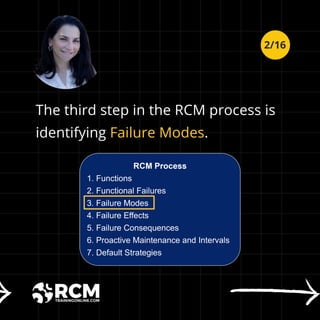
The third step in the RCM process is
identifying Failure Modes.
2/16
A Failure Mode is what causes a
Functional Failure.
It can also be referred to as a
Failure Cause.
3/16
Identifying Failure Modes is a vital
step in the RCM process because we
manage physical assets at the Failure
Mode level.
That's why we must write them
properly to get the results we need.
4/16
But writing Failure Modes is often
done poorly. It's a major reason why
RCM "fails" for so many
organizations.
5/16
When we write Failure Modes too
generically, we get generic results.
And when we write Failure Modes
too detailed, we end up in analysis
paralysis.
6/16
The key it to write them at the right
level of detail so that an appropriate
Failure Management Strategy can be
identified.
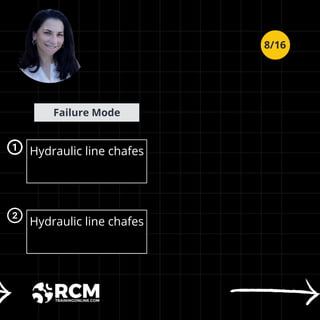
Here are two examples.
7/16
Failure Mode
Hydraulic line chafes
due to normal
equipment vibration.
Hydraulic line chafes
due to improper
routing. routing.
8/16
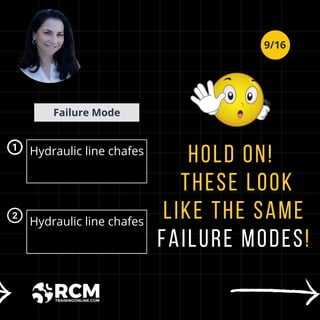
Hold on!
These look
like the same
Failure modes!
Failure Mode
Hydraulic line chafes
due to normal
equipment vibration.
Hydraulic line chafes
due to improper
routing. routing.
9/16
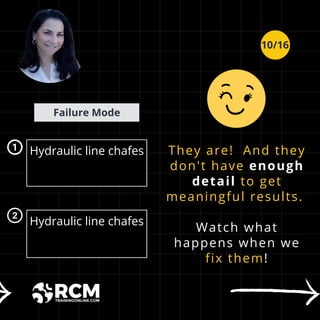
They are! And they
don't have enough
detail to get
meaningful results.
Watch what
happens when we
fix them!
Failure Mode
Hydraulic line chafes
due to normal
equipment vibration.
Hydraulic line chafes
due to improper
routing.
10/16
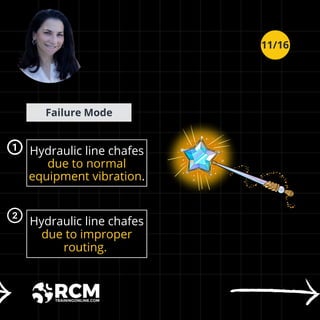
Failure Mode
Hydraulic line chafes
due to normal
equipment vibration.
Hydraulic line chafes
due to improper
routing.
11/16
Failure Mode
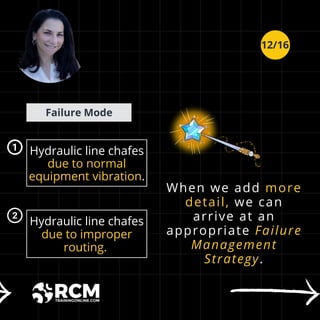
When we add more
detail, we can
arrive at an
appropriate Failure
Management
Strategy.
Hydraulic line chafes
due to normal
equipment vibration.
Hydraulic line chafes
due to improper
routing.
12/16
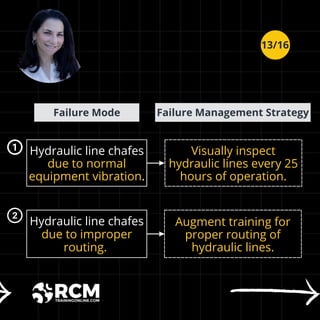
Failure Mode Failure Management Strategy
Hydraulic line chafes
due to normal
equipment vibration.
Hydraulic line chafes
due to improper
routing.
Visually inspect
hydraulic lines every 25
hours of operation.
Augment training for
proper routing of
hydraulic lines.
13/16
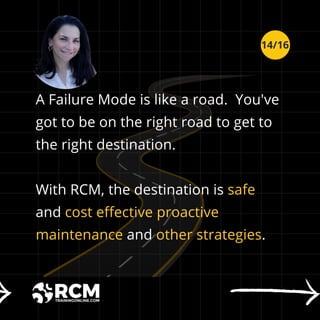
A Failure Mode is like a road. You've
got to be on the right road to get to
the right destination.
With RCM, the destination is safe
and cost effective proactive
maintenance and other strategies.
14/16
Don't make one of the most
common RCM mistakes!
Write your Failure Modes properly so
you can identify the right Proactive
Maintenance and other actions that
will get you the Reliability you need!
15/16
Thank you for
reading!
16/16

05-Failure Modes Right Detail.pdf

  • 1.
  • 2.
    The third stepin the RCM process is identifying Failure Modes. 2/16
  • 3.
    A Failure Modeis what causes a Functional Failure. It can also be referred to as a Failure Cause. 3/16
  • 4.
    Identifying Failure Modesis a vital step in the RCM process because we manage physical assets at the Failure Mode level. That's why we must write them properly to get the results we need. 4/16
  • 5.
    But writing FailureModes is often done poorly. It's a major reason why RCM "fails" for so many organizations. 5/16
  • 6.
    When we writeFailure Modes too generically, we get generic results. And when we write Failure Modes too detailed, we end up in analysis paralysis. 6/16
  • 7.
    The key itto write them at the right level of detail so that an appropriate Failure Management Strategy can be identified. Here are two examples. 7/16
  • 8.
    Failure Mode Hydraulic linechafes due to normal equipment vibration. Hydraulic line chafes due to improper routing. routing. 8/16
  • 9.
    Hold on! These look likethe same Failure modes! Failure Mode Hydraulic line chafes due to normal equipment vibration. Hydraulic line chafes due to improper routing. routing. 9/16
  • 10.
    They are! Andthey don't have enough detail to get meaningful results. Watch what happens when we fix them! Failure Mode Hydraulic line chafes due to normal equipment vibration. Hydraulic line chafes due to improper routing. 10/16
  • 11.
    Failure Mode Hydraulic linechafes due to normal equipment vibration. Hydraulic line chafes due to improper routing. 11/16
  • 12.
    Failure Mode When weadd more detail, we can arrive at an appropriate Failure Management Strategy. Hydraulic line chafes due to normal equipment vibration. Hydraulic line chafes due to improper routing. 12/16
  • 13.
    Failure Mode FailureManagement Strategy Hydraulic line chafes due to normal equipment vibration. Hydraulic line chafes due to improper routing. Visually inspect hydraulic lines every 25 hours of operation. Augment training for proper routing of hydraulic lines. 13/16
  • 14.
    A Failure Modeis like a road. You've got to be on the right road to get to the right destination. With RCM, the destination is safe and cost effective proactive maintenance and other strategies. 14/16
  • 15.
    Don't make oneof the most common RCM mistakes! Write your Failure Modes properly so you can identify the right Proactive Maintenance and other actions that will get you the Reliability you need! 15/16
  • 16.