Rapid Process Improvementp p
Introduction
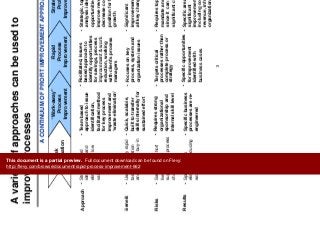
A variety of approaches can be used to
impro e processes
A CONTINUUM OF PROFIT IMPROVEMENT APPROACHES
improve processes
‘Work-away”
Process
Improvement
Rapid
Process
Improvement
Strategic
Profit
Improvement
6 Sigma
(Leadership
Development)
Task
Elimination
• Straightforward
identification and
elimination of low
value tasks
• Team based
approach to issue
identification,
facilitated method
• Facilitated, issues
based approach to
identify opportunities
for savings, process
improvement & work
• Strategic, top down
analysis identifying
opportunities to
improve revenue,
• Develop future
company leadership
through in-depth
training in process
Approach
U f l f id
for key process
improvement and
‘waste elimination’
Q i k l bl
improvement & work
reduction, working
with client’s process
managers
F k
decrease cost and
position for future
growth
Si ifi t
g p
change and leadership
behavior change
methods
O i i tB fit • Useful for very rapid
task simplification
and company buy-in
• Quick, scalable,
built to transfer
skills internally for
sustained effort
• Focuses on key
process, system and
organization issues
• Significant
improvement among
all key change levers
• Ongoing improvement
of results
Benefit
• Savings are short
lived unless
supported by process
changes
• Requires strong
organizational
sponsorship and
internal skill level
• Targets critical
processes rather than
complete process or
strategy
• Requires top executive
mandate and support,
since it can drive very
significant change
• Requires full
commitment of top
management
for a long time
Risks
• Specific tasks
eliminated, reducing
workload
• Specific business
processes are re-
engineered
• Specific opportunities
for improvement
identified with
business cases
• Specific areas for
significant
improvement,
including cost,
• Change in corporate
culture to value data
based change methods
in managing the
Results
3
business cases including cost,
revenue, infrastructure,
organization, etc.
in managing the
business
This document is a partial preview. Full document download can be found on Flevy:
http://flevy.com/browse/document/rapid-process-improvement-662
R id P I t
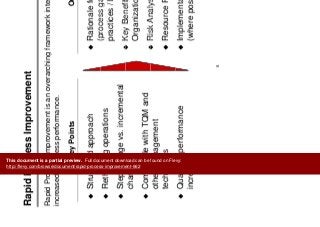
Introduction
Rapid Process Improvement
Rapid Process Improvement is an overarching framework intended to drivep p g
increased business performance.
Key Points Outputs
Structured approach Rationale for Change
(process gaps best
y p
Rethinking operations
Step change vs. incremental
(process gaps, best
practices / benchmarks)
Key Benefits for the
change
Compatible with TQM and
Key Benefits for the
Organization
Risk Analysis
other management
techniques
Risk Analysis
Resource Requirements
Quantum performance
increase
Implementation Approaches
(where possible)
6
This document is a partial preview. Full document download can be found on Flevy:
http://flevy.com/browse/document/rapid-process-improvement-662
Introduction
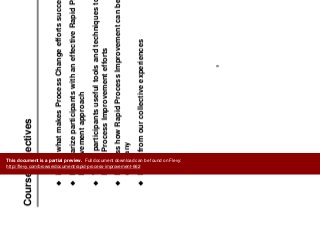
C Obj tiCourse Objectives
Learn what makes Process Change efforts successful
Familiarize participants with an effective Rapid Processp p p
Improvement approach
Teach participants useful tools and techniques to support
Rapid Process Improvement efforts
Discuss how Rapid Process Improvement can be applied in this
companycompany
Learn from our collective experiences
9
This document is a partial preview. Full document download can be found on Flevy:
http://flevy.com/browse/document/rapid-process-improvement-662
P Vi
Key Concepts
Process View
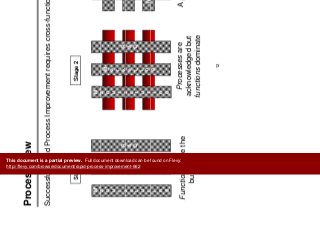
Successful Rapid Process Improvement requires cross-functional process views.
y p
Stage 1 Stage 2 Stage 3
p p q p
Stage 1 Stage 2 Stage 3
M M
a
n
u
f
a
M
a
r
k R
a
n
u
f
a
M
a
r
k
Order Management
Ra
c
t
u
r
e
t
i
n
&
D
a
c
t
u
r
e
t
i
n
Resource Planning
New Product Development
&
D
i
n
g
g i
n
g
g
Functions drive the
business
Processes are
acknowledged but
functions dominate
A process view drives
Rapid Process
Improvement
12
p
This document is a partial preview. Full document download can be found on Flevy:
http://flevy.com/browse/document/rapid-process-improvement-662
F t i S f l P Ch
Key Concepts
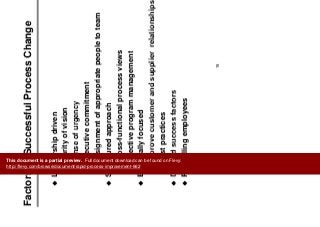
Factors in Successful Process Change
y p
Leadership driven
– Clarity of vision
Sense of urgency– Sense of urgency
– Executive commitment
– Assignment of appropriate people to teamg pp p p p
Structured approach
– Cross-functional process views
– Effective program management
Externally focused
Improve customer and supplier relationships– Improve customer and supplier relationships
– Best practices
Defined success factorsDefined success factors
Re-skilling employees
15
This document is a partial preview. Full document download can be found on Flevy:
http://flevy.com/browse/document/rapid-process-improvement-662
R id P I O i
Approach Overview
Rapid Process Improvement Overview
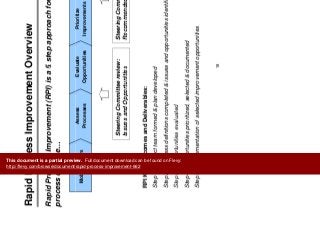
Rapid Process Improvement (RPI) is a 5 step approach for implementing
pp
Rapid Process Improvement (RPI) is a 5 step approach for implementing
process change…
Implement
Improvements
Prioritize
Improvements
Evaluate
Opportunities
Assess
Processes
Mobilize Team
Steering Committee review:
Recommended Improvements
Steering Committee review:
Issues and Opportunities Recommended Improvements
RPI Key Outcomes and Deliverables:
Issues and Opportunities
Step 1: Project team formed & plan developed
Step 2: Process definitions completed & issues and opportunities identified
Step 3: Opportunities evaluatedStep 3: Opportunities evaluated
Step 4: Opportunities prioritized, selected & documented
Step 5: Implementation of selected improvement opportunities
18
This document is a partial preview. Full document download can be found on Flevy:
http://flevy.com/browse/document/rapid-process-improvement-662
St 3 E l t O t iti
Approach Overview
Step 3: Evaluate Opportunities
pp
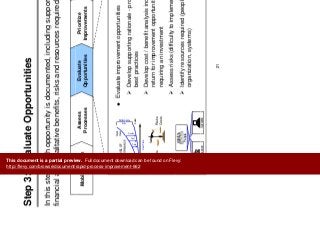
In this step, each opportunity is documented, including supporting rationales,p, pp y , g pp g ,
financial and qualitative benefits, risks and resources required.
Implement
Improvements
Prioritize
Improvements
Evaluate
Opportunities
Assess
Processes
Mobilize Team
Evaluate improvement opportunitiesLEVEL OF
PERFORMANCE
World
Class
Perform
Gap
Develop supporting rationale - process gaps,
best practices
Develop cost / benefit analysis including
PERFORMANCE
mance
p
Actual
Over Time
Quality
Cost
Time
return for improvement opportunities
requiring an investment
Assess risks (difficulty to implement)
Risks
Costs
Benefits
Identify resources required (people,
organization, systems)
S t
People
O i ti
21
SystemsOrganization
This document is a partial preview. Full document download can be found on Flevy:
http://flevy.com/browse/document/rapid-process-improvement-662
R id P I t Ti i
Approach Overview
Rapid Process Improvement Timing
pp
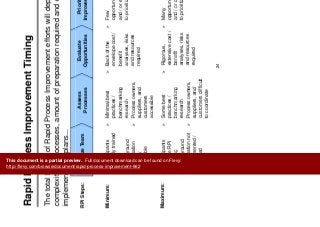
The total length of Rapid Process Improvement efforts will depend on theg p p p
complexity of processes, amount of preparation required and duration of
implementation plans...
RPI Steps:
Implement
Improvements
Prioritize
Improvements
Evaluate
Opportunities
Assess
Processes
Mobilize Team
Minimum: Participants
already trained
in RPI
B k d
Minimal best
practices /
benchmarking
research
Few
opportunities
and / or easy
to prioritize
Back of the
envelope cost /
benefit
analyses risks
Quick hits
Simple task
elimination
Background
information
readily
available
research
Process owners,
suppliers, and
customers
accessible
to prioritizeanalyses, risks
and resources
required
accessible
Maximum: Participants
require RPI
training
Many
opportunities
and / or difficult
Some best
practices /
benchmarking
Rigorous,
extensive cost /
benefit
Full process
redesign
Leadershiptraining
Background
information not
documented /
updated
and / or difficult
to prioritize
benchmarking
research
Process owners,
suppliers, and
customers difficult
benefit
analyses, risks
and resources
required
Leadership
development
24
updated customers difficult
to coordinate
This document is a partial preview. Full document download can be found on Flevy:
http://flevy.com/browse/document/rapid-process-improvement-662
Establish Process Team Roles and
T i T
Mobilize Team
Train Team
Objective
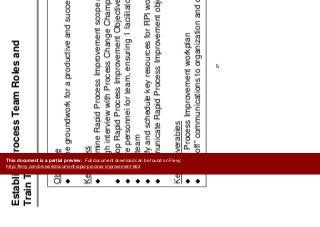
Lay the groundwork for a productive and successful effort
Key Tasks
Determine Rapid Process Improvement scope and schedulep p p
through interview with Process Change Champion
Develop Rapid Process Improvement Objective (Champion)
S l f t i 1 f ilit tSecure personnel for team, ensuring 1 facilitator per process
Train team
Identify and schedule key resources for RPI workshopsy y p
Communicate Rapid Process Improvement objectives
K D li blKey Deliverables
Rapid Process Improvement workplan
“Kick-off” communications to organization and department
27
g p
This document is a partial preview. Full document download can be found on Flevy:
http://flevy.com/browse/document/rapid-process-improvement-662
K F t I ti S d S h d l
Mobilize Team
Key Factors Impacting Scope and Schedule
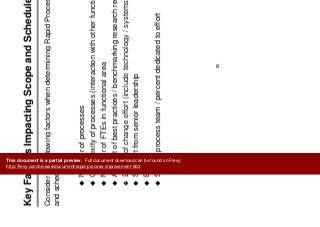
Consider the following factors when determining Rapid Process Improvement scopeg g p p p
and schedule:
Number of processes
Complexity of processes (interaction with other functional areas)
Number of FTEs in functional area
Amount of best practices / benchmarking research required
Extent of change effort (include technology / systems changes)Extent of change effort (include technology / systems changes)
Support from senior leadership
Budgetg
Size of process team / percent dedicated to effort
30
This document is a partial preview. Full document download can be found on Flevy:
http://flevy.com/browse/document/rapid-process-improvement-662
Cl l D fi d R l & R ibiliti
Mobilize Team
Clearly Defined Roles & Responsibilities...
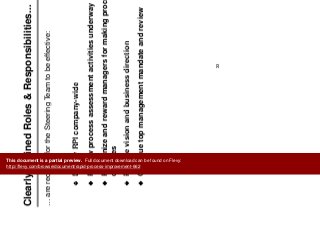
… are required for the Steering Team to be effective:
Deploy RPI company wide
q g
Deploy RPI company-wide
Review process assessment activities underway
Recognize and reward managers for making process
changes
Provide vision and business directionProvide vision and business direction
Continue top management mandate and review
33
This document is a partial preview. Full document download can be found on Flevy:
http://flevy.com/browse/document/rapid-process-improvement-662
T i i th T
Mobilize Team
Training the Team
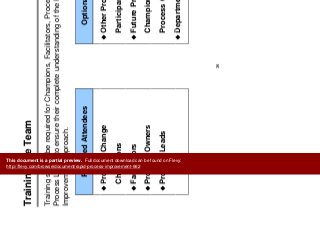
Training should be required for Champions, Facilitators, Process Owners andg q p , ,
Process Leads to ensure their complete understanding of the Rapid Process
Improvement approach.
Required Attendees Optional Attendees
P Ch Oth PProcess Change
Champions
Other Process
Participants/SMEs
Facilitators
Process Owners
Future Process Change
Champions / Facilitators /
Process Leads
p
Process Owners
D t t H dDepartment Heads
36
This document is a partial preview. Full document download can be found on Flevy:
http://flevy.com/browse/document/rapid-process-improvement-662
C i ti t th D t t
Mobilize Team
Communicating to the Department
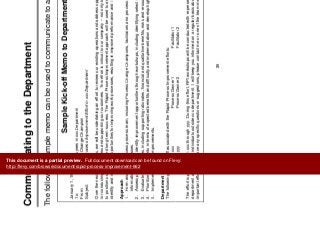
The following sample memo can be used to communicate to a department.
January 1, 1999
T All l i D t t
Sample Kick-off Memo to Department
g p p
To: All employees in xxx Department
From: Process Change Champion
Subject: Rapid Process Improvement Effort in xxx Department
Over the next few months, we will be undertaking an effort to review our existing operations and address opportunities to improve our processes
f d ti b i d ti t Thi ff t i iti l t t l t i t ti b tfor conducting our business and supporting our customers. This effort is critical to our company -- not only to improve our current operations but
to position us for continued long-term success. The Rapid Process Improvement approach will be used to assess functional processes and to
identify and implement opportunities for improving work processes, resulting in improved performance and / or time and cost savings.
Approach
1 F d t i t i l di P Ch Ch i f ilit t d d ll t b k d1. Form and train a process process team, including Process Change Champions, facilitators and process owners, and collect background
information on processes.
2. Assess processes to identify improvement opportunities through workshops, including identifying select best practices and benchmarks.
3. Evaluate opportunities, including supporting rationales, financial and qualitative benefits, risks and resources required.
4. Prioritize improvements in terms of expected benefits and difficulty and implementation and develop high-level implementation approaches
5 I l t l t d i t5. Implement selected improvements.
Department Processes
The following are the staff associated with the Rapid Process Improvement efforts:
Process xxx Process Owner 1 Facilitator 1
P P O 2 F ili 2Process yyy Process Owner 2 Facilitator 2
The effort is planned from xxx through yyy. During this effort, RPI workshops will be conducted with representatives from various groups in xxx
department and selected individuals outside xxx department. I will keep you informed on a regular basis about the developments on this
important effort. If you have any specific questions or suggestions, please contact me or one of the team members.
39
This document is a partial preview. Full document download can be found on Flevy:
http://flevy.com/browse/document/rapid-process-improvement-662
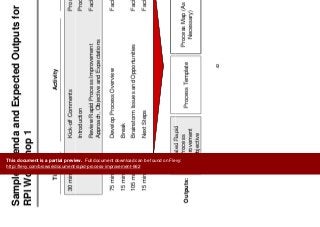
Sample Agenda and Expected Outputs for
RPI W k h 1
Mobilize Team
RPI Workshop 1
Part of Mobilize Team
Kick-off Comments Process Change Champion30 minutes
Time Activity Responsible
Introduction
Review Rapid Process Improvement
Approach, Objective and Expectations
Process Change Champion
Facilitator
pp , j p
Develop Process Overview
Break
Facilitator75 minutes
15 minutes
Brainstorm Issues and Opportunities
Next Steps
Facilitator
Facilitator
105 minutes
15 minutes
Updated Rapid
Outputs: Process Template
Process Map (As
Necessary)
List of Issues and
Opportunities
Updated Rapid
Process
Improvement
Objective
42
This document is a partial preview. Full document download can be found on Flevy:
http://flevy.com/browse/document/rapid-process-improvement-662
Assess Processes
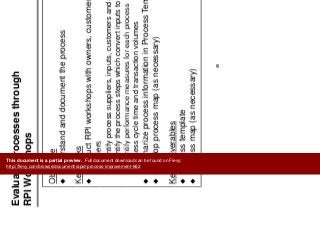
Evaluate Processes through
RPI W k h
Obj ti
RPI Workshops
Objective
Understand and document the process
K T kKey Tasks
Conduct RPI workshops with owners, customers and
supplierssuppliers
Identify process suppliers, inputs, customers and outputs
Identify the process steps which convert inputs to outputs
Identify performance measures for each processIdentify performance measures for each process
Assess cycle time and transaction volumes
Summarize process information in Process Template
Develop process map (as necessary)
Key Deliverablesy
Process template
Process map (as necessary)
45
This document is a partial preview. Full document download can be found on Flevy:
http://flevy.com/browse/document/rapid-process-improvement-662
P D fi iti P
Assess Processes
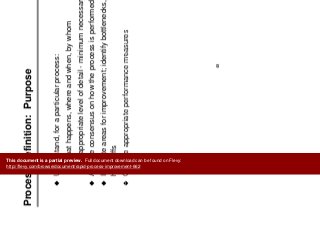
Process Definition: Purpose
Understand, for a particular process:
What happens, where and when, by whom
At appropriate level of detail - minimum necessary
Achieve consensus on how the process is performed
Illustrate areas for improvement; identify bottlenecks, rework loops, and
hand-offs
Capture appropriate performance measuresCapture appropriate performance measures
48
This document is a partial preview. Full document download can be found on Flevy:
http://flevy.com/browse/document/rapid-process-improvement-662
P D iti T l t
Assess Processes
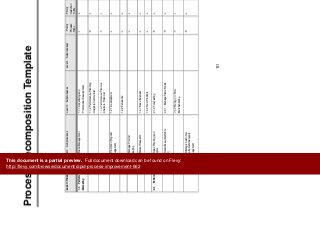
Process Decomposition Template
Level 1 Process Level 2 Subprocesses Level 3 Subprocesses Level 4 Subprocesses Priority
Process
H-M-L
Priority
Selection
H-M-L
Team
(F/S)
Interview
Done?
(Y/N)
Doc.
Done?
(Y/N)
In
Scope
(Y/N)( ) ( ) ( )
1.0 Perform
Marketing
1.1 Brand Management 1.1.1 Advertising and
Promotional Development
L L F&S
1.1.2 Performance Planning
Analysis-Commercial
H L F&S Y
1 1 3 Performance Planning H L F&S “1.1.3 Performance Planning
Analysis- Financial
H L F&S
1.2 Promotion Program
Management
1.2.1 Development L L F&S
1.2.2 Evaluative L L F&S
1.3 Manage Product
Packaging
L L F&S N
1.4 Market Research 1.4.1 Base Business L L F&S N
1.4.2 New Products L L F&S N
2.0 Perform Sales 2.1 Sales Planning and
Analysis
2.1.2 Forecasting H L F&S Y
2.2 Retail Execution(Store
level)
2.2.1 ManageTrade Funds H L F&S Y
2 2 2 Manage In-Store H L F&S2.2.2 Manage In Store
Merchandising
H L F&S
2.3 Strategic Customer
Development/Category
Management
H L F&S
51
This document is a partial preview. Full document download can be found on Flevy:
http://flevy.com/browse/document/rapid-process-improvement-662
P M i
Assess Processes
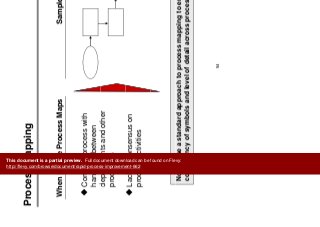
Process Mapping
SampleWhen to Use Process Maps
Complex process with
hand-offs between
d t t d thdepartments and other
processes
Lack of consensus on
process activities
Note: Use a standard approach to process mapping to ensure
consistency of symbols and level of detail across processes
54
This document is a partial preview. Full document download can be found on Flevy:
http://flevy.com/browse/document/rapid-process-improvement-662
Identify Issues and Improvement
O t iti
Assess Processes
Opportunities
Objective
Identify issues and improvement opportunities to simplifyIdentify issues and improvement opportunities to simplify,
streamline and eliminate work
Supplement processes with additional recommendations to
i fimprove performance
Key Tasksy
Conduct workshops to brainstorm issues, assess gaps
between current processes and customer / supplier
i t d id tif i t t itirequirements, and identify improvement opportunities
Develop new approaches to address key issues
Key Deliverables
Summary of issues and opportunities
57
This document is a partial preview. Full document download can be found on Flevy:
http://flevy.com/browse/document/rapid-process-improvement-662
I d O t iti T l t
Assess Processes
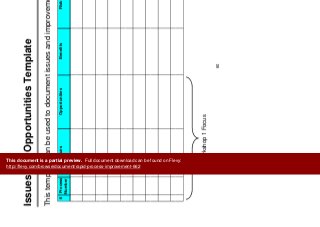
Issues and Opportunities Template
This template can be used to document issues and improvement opportunities.p p pp
# Process
Number
Issues Opportunities Benefits Risks Resources Required
60
Workshop 1 Focus
This document is a partial preview. Full document download can be found on Flevy:
http://flevy.com/browse/document/rapid-process-improvement-662
Assess Processes
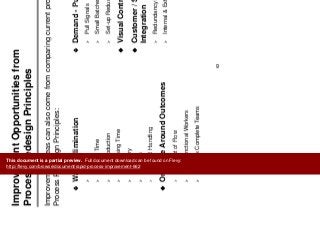
Improvement Opportunities from
P R d i P i i lProcess Redesign Principles
Improvement ideas can also come from comparing current processes to thep p g p
Process Redesign Principles:
Demand Pull FlowWaste Elimination Demand - Pull Flow
Pull Signals
Small Batches
Waste Elimination
Motion
Waiting Time
Set-up Reduction
Visual Controls
g
Overproduction
Processing Time
Customer / Supplier
Integration
Inventory
Defects
Material Handling
Redundancy Elimination
Internal & External Integration
Material Handling
Organize Around Outcomes
Concept of FlowConcept of Flow
Multi-functional Workers
Process Complete Teams
63
This document is a partial preview. Full document download can be found on Flevy:
http://flevy.com/browse/document/rapid-process-improvement-662
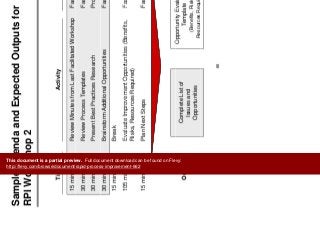
Sample Agenda and Expected Outputs for
RPI W k h 2
Assess Processes
RPI Workshop 2
Part of Assess Processes
Review Minutes from Last Facilitated Workshop Facilitator15 minutes
Time Activity Responsible
p
Review Process Templates
Present Best Practices Research
Facilitator
Process Owner
30 minutes
30 minutes
Brainstorm Additional Opportunities
Break
Evaluate Improvement Opportunities (Benefits
Facilitator
Facilitator
30 minutes
15 minutes
105 minutes Evaluate Improvement Opportunities (Benefits,
Risks, Resources Required)
Plan Next Steps
Facilitator
Facilitator
105 minutes
15 minutes
O t it E l tiOpportunity Evaluation
Template
(Benefits, Risks,
Resources Required)
Outputs: Complete List of
Issues and
Opportunities
66
This document is a partial preview. Full document download can be found on Flevy:
http://flevy.com/browse/document/rapid-process-improvement-662
B t P ti I t Id
Assess Processes
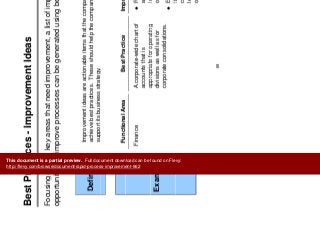
Best Practices - Improvement Ideas
Focusing on the key areas that need improvement, a list of improvementg y p , p
opportunities to improve processes can be generated using best practices.
Definition
Improvement ideas are actionable items that the company should undertake to
achieve best practices. These should help the company improve processes to
support its business strategy.pp gy
Functional Area Best Practice Improvement Opportunity
Finance A corporate-wide chart of
accounts that is
appropriate for operating
Reconfigure chart of
accounts across all
levels of the
p pp y
Examples
appropriate for operating
divisions as well as for
corporate consolidations.
levels of the
organization
Establish automated
linkages to ensurelinkages to ensure
consistency between all
levels of the
organization
69
This document is a partial preview. Full document download can be found on Flevy:
http://flevy.com/browse/document/rapid-process-improvement-662
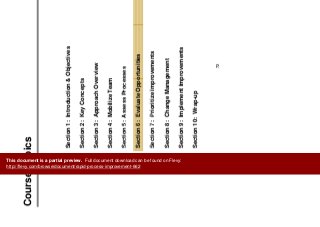
C T i
RPI Course
Course Topics
Section 1: Introduction & Objectives
Section 2: Key Concepts
Section 3: Approach Overview
Section 4: Mobilize Team
Section 5: Assess ProcessesSection 5: Assess Processes
Section 6: Evaluate Opportunities
S ti 7 P i iti I tSection 7: Prioritize Improvements
Section 8: Change Management
Section 9: Implement Improvements
Section 10: Wrap-up
72
This document is a partial preview. Full document download can be found on Flevy:
http://flevy.com/browse/document/rapid-process-improvement-662
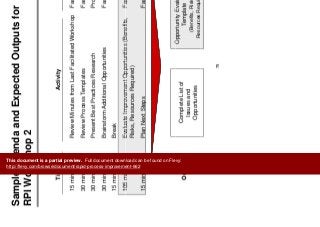
Sample Agenda and Expected Outputs for
RPI W k h 2
Evaluate
Opportunities
RPI Workshop 2 Opportunities
Part of Evaluate Opportunities
Review Minutes from Last Facilitated Workshop Facilitator15 minutes
Time Activity Responsible
p
Review Process Templates
Present Best Practices Research
Facilitator
Process Owner
30 minutes
30 minutes
Brainstorm Additional Opportunities
Break
Evaluate Improvement Opportunities (Benefits
Facilitator
Facilitator
30 minutes
15 minutes
105 minutes Evaluate Improvement Opportunities (Benefits,
Risks, Resources Required)
Plan Next Steps
Facilitator
Facilitator
105 minutes
15 minutes
O t it E l tiOpportunity Evaluation
Template
(Benefits, Risks,
Resources Required)
Outputs: Complete List of
Issues and
Opportunities
75
This document is a partial preview. Full document download can be found on Flevy:
http://flevy.com/browse/document/rapid-process-improvement-662
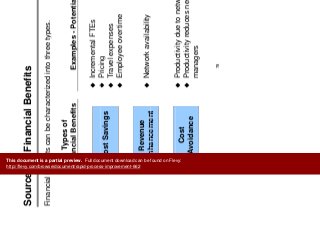
S f Fi i l B fit
Evaluate
Opportunities
Sources of Financial Benefits
Financial benefits can be characterized into three types.
Opportunities
yp
Types of
Financial Benefits Examples - Potential DriversFinancial Benefits
Incremental FTEs
Pricing
Examples Potential Drivers
Pricing
Travel expenses
Employee overtime
Cost Savings
Network availability
Revenue
Enhancement
Prod cti it d e to net ork a ailabilit
Enhancement
Productivity due to network availability
Productivity reduces need to hire new
managers
Cost
Avoidance
78
This document is a partial preview. Full document download can be found on Flevy:
http://flevy.com/browse/document/rapid-process-improvement-662
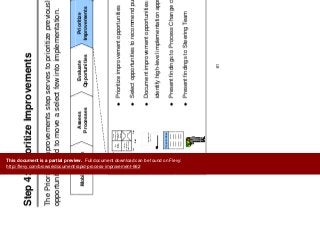
St 4 P i iti I t
Prioritize
Improvements
Step 4: Prioritize Improvements Improvements
The Prioritize Improvements step serves to prioritize previously evaluatedp p p p y
opportunities and to move a select few into implementation.
Implement
Improvements
Prioritize
Improvements
Evaluate
Opportunities
Assess
Processes
Mobilize Team
Prioritize improvement opportunities
High
Return
Take
Action
Quickly
Focus
Attention and
Resources to
Ensure
Success
Capture
Do not
Select opportunities to recommend pursuing
Document improvement opportunities and
Low
Low High
Risk
p
Opportunity;
Lower Priority
Do not
pursue
Improvement
Opportunity
identify high-level implementation approaches
Present findings to Process Change champions
Opportunities
Opportunity
Present findings to Steering Team
81
This document is a partial preview. Full document download can be found on Flevy:
http://flevy.com/browse/document/rapid-process-improvement-662
O t it P i iti ti C it i R t
Prioritize
Improvements
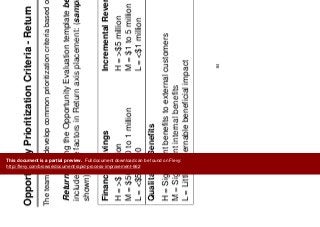
Opportunity Prioritization Criteria - Return
The team must develop common prioritization criteria based on the situation...
Improvements
p p
Return: Using the Opportunity Evaluation template benefits data,
include these factors in Return axis placement: (sample weightingsinclude these factors in Return axis placement: (sample weightings
shown)
Financial Savings Incremental Revenue
H = >$ 1 million H = >$5 million
M $500 000 t 1 illi M $1 t 5 illiM = $500,000 to 1 million M = $1 to 5 million
L = <$500,000 L = <$1 million
Qualitative BenefitsQualitative Benefits
H = Significant benefits to external customers
M = Significant internal benefitsM = Significant internal benefits
L = Little discernable beneficial impact
84
This document is a partial preview. Full document download can be found on Flevy:
http://flevy.com/browse/document/rapid-process-improvement-662
P i iti ti F k
Prioritize
Improvements
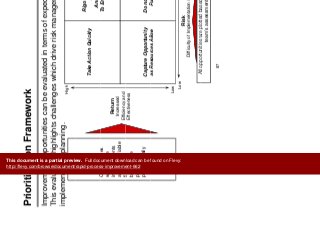
Prioritization Framework Improvements
Improvement opportunities can be evaluated in terms of expected returns and risks.
Thi l i hi hli h h ll hi h d i i k d
High
This evaluation highlights challenges which drive risk management and
implementation planning.
Opportunities
Take Action Quickly
Rigorous Focus of
Attention
And Resources
Opportunities
with service
improvements
and quantifiable
financial
Return
Increased
Efficiency and
To Ensure Success
financial
benefits are
plotted
proportionally
y
Effectiveness
Capture Opportunity
as Resources Allow
Do not Pursue, or
Pursue Last
Low
as Resources Allow Pursue Last
Low High
Risk
Difficulty of Implementation / Impact
All opportunities are plotted based on the project
87
All opportunities are plotted based on the project
team’s assessment
This document is a partial preview. Full document download can be found on Flevy:
http://flevy.com/browse/document/rapid-process-improvement-662
Prioritize
Improvements
O t it C T l t 1 Improvements
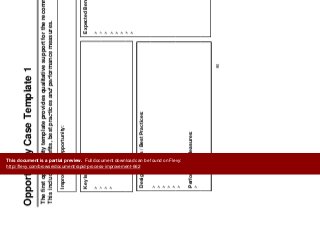
Opportunity Case Template 1
The first opportunity template provides qualitative support for the recommended opportunity.
This includes benefits best practices and performance measures
Improvement Opportunity:
This includes benefits, best practices and performance measures.
Key Issues: Expected Benefits:Key Issues: Expected Benefits:
Design Factors / Best Practices:Design Factors / Best Practices:
Performance Measures:
90
This document is a partial preview. Full document download can be found on Flevy:
http://flevy.com/browse/document/rapid-process-improvement-662
E i I l t ti A h
Prioritize
Improvements
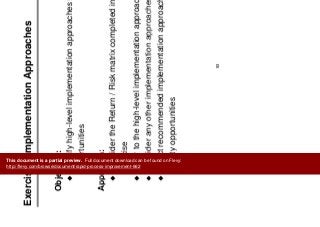
Exercise: Implementation Approaches Improvements
Objective:
Identify high-level implementation approaches for high priority
opportunities
Approach:Approach:
Consider the Return / Risk matrix completed in the last
exerciseexercise
Refer to the high-level implementation approach chart
Consider any other implementation approaches you knowConsider any other implementation approaches you know
Select recommended implementation approach for the high
priority opportunitiesp y pp
93
This document is a partial preview. Full document download can be found on Flevy:
http://flevy.com/browse/document/rapid-process-improvement-662
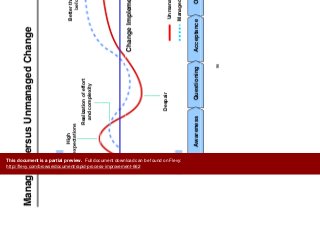
M d V U d Ch
Change Management
Managed Versus Unmanaged Change
g g
High
expectations
Better than
beforeexpectations
Realization of effort
and complexity Light at
the end
of the
before
tivity
of the
tunnel
ProductMorale&
Change Implementation
Despair
M
Unmanaged Change
Managed Change
OwnershipAcceptanceQuestioningAwareness
96
This document is a partial preview. Full document download can be found on Flevy:
http://flevy.com/browse/document/rapid-process-improvement-662
Ch M t D fi d
Change Management
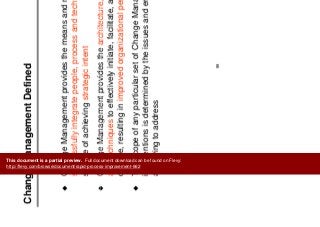
Change Management Defined
g g
Change Management provides the means and methods to
successfully integrate people process and technology in thesuccessfully integrate people, process and technology in the
service of achieving strategic intent
Change Management provides the architecture enablers toolsChange Management provides the architecture, enablers, tools
and techniques to effectively initiate, facilitate, and manage
change, resulting in improved organizational performance
The scope of any particular set of Change Management
interventions is determined by the issues and environment we
are trying to address
99
This document is a partial preview. Full document download can be found on Flevy:
http://flevy.com/browse/document/rapid-process-improvement-662
St k h ld M t
Change Management
Stakeholder Management
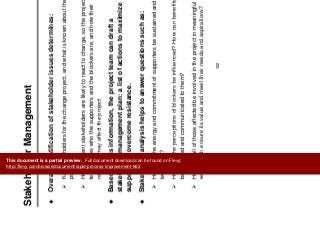
Overall identification of stakeholder issues determines:
g g
Overall, identification of stakeholder issues determines:
Key stakeholders for the change project, and what is known about their
positions
How different stakeholders are likely to react to change, so the project
team knows who the supporters and the blockers are, and how their
reactions may affect the projectreactions may affect the project
Based on this information, the project team can draft a
stakeholder management plan: a list of actions to maximize
support and overcome resistance.
Stakeholder analysis helps to answer questions such as:
How can the energy and commitment of supporters be sustained and
leveraged?
How can the perceptions of blockers be influenced? How can benefitsHow can the perceptions of blockers be influenced? How can benefits
be identified and communicated to them?
How can all of those affected be involved in the project in meaningful
ways which ensure its value and meet their needs and aspirations?
102
ways which ensure its value and meet their needs and aspirations?
This document is a partial preview. Full document download can be found on Flevy:
http://flevy.com/browse/document/rapid-process-improvement-662
C i ti
Change Management
Communication
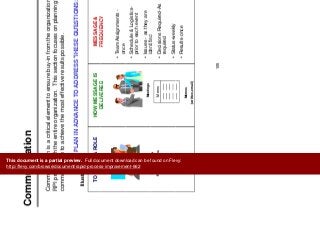
Communication is a critical element to ensure buy-in from the organization and to initiate the
g g
y g
RPI project with the entire organization. This section focuses on planning the elements of
communication to achieve the most effective results possible.
PLAN IN ADVANCE TO ADDRESS THESE QUESTIONS:PLAN IN ADVANCE TO ADDRESS THESE QUESTIONS:
TO WHOM & ROLE HOW MESSAGE IS
DELIVERED
FROM WHOM &
STATUS
MESSAGE &
FREQUENCY
Illustrative
DELIVERED STATUSFREQUENCY
• Team Assignments -
once
MeetingsKey
St k h ld
• Schedule & Logistics-
prior to each event
• Issues - as they are
identified Project Team
Memo
Stakeholders,
Responsibilities
identified
• Decisions Required-As
required
• Status-weekly
Project Team
Steering Committee
Project Sponsors
Memos
(written, email)
• Results-once
105
This document is a partial preview. Full document download can be found on Flevy:
http://flevy.com/browse/document/rapid-process-improvement-662
Ch R di W k h
Change Management
Change Readiness Workshops
g g
A structured approach for assessing the capabilities for change in an
enterprise.
USED TO:USED TO:
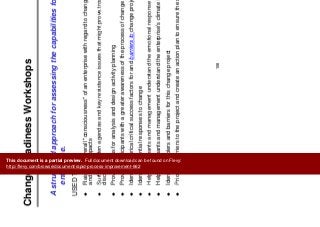
Raise the overall "consciousness" of an enterprise with regard to change, the change process
and likely impacts
Surface hidden agendas and key resistance issues that might prove troublesome later if notSurface hidden agendas and key resistance issues that might prove troublesome later if not
discovered
Provide focus for analysis and design activity planning
Provide participants with a greater awareness of the process of change
Identify historical critical success factors for and barriers to change projects
Identify potential responses to change
Help participants and management understand the emotional response to changeHelp participants and management understand the emotional response to change
Help participants and management understand the enterprise's climate for change
Identify enablers and barriers for this change project
Prioritize barriers to the project and create an action plan to ensure the success of the changePrioritize barriers to the project and create an action plan to ensure the success of the change
108
This document is a partial preview. Full document download can be found on Flevy:
http://flevy.com/browse/document/rapid-process-improvement-662
St 5 I l t I t
Implement
Improvements
Step 5: Implement Improvements Improvements
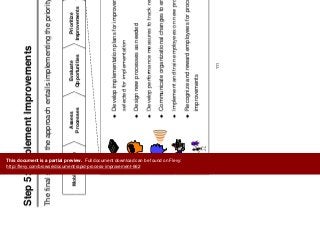
The final step of the approach entails implementing the priority improvements.p pp p g p y p
ImplementPrioritizeEvaluateAssess
Mobilize Team
ImprovementsImprovementsOpportunitiesProcesses
Mobilize Team
Develop implementation plans for improvements
selected for implementation
Plan
se ected o p e e tat o
Design new processes as needed
Develop performance measures to track resultsDevelop performance measures to track results
Communicate organizational changes to employees
Implement and train employees on new processesImplement and train employees on new processes
Recognize and reward employees for process
improvements
111
This document is a partial preview. Full document download can be found on Flevy:
http://flevy.com/browse/document/rapid-process-improvement-662
S l I l t ti Pl
Implement
ImprovementsILLUSTRATIVE
Sample Implementation Plan
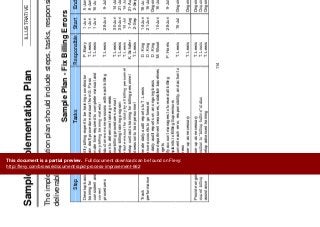
The implementation plan should include steps, tasks, responsibilities, timing and
ImprovementsILLUSTRATIVE
Status
p p p , , p , g
deliverables.
Sample Plan - Fix Billing Errors
Step Tasks Responsible Start End Deliverable Status
Complete
Complete
Complete
Step
Develop basic
training for
consistent and
correct
Tasks
Identify billing expert to be training coordinator
Obtain draft procedure manual from S. Pass
Estimate time required to complete manual and
develop billing training material
Responsible
P. Barry
T. Lewis
T. Lewis
Start
1-Jun
1-Jun
1-Jun
End
5-Jun
8-Jun
16-Jun
Deliverable
Individual selected
Manual on hand
Estimate to complete
Underway
Underway
Underway
correct
procedures
develop billing training material
Conduct one-on-one sessions with each billing
person to determine training needs
Revise billing procedures manual
Develop billing training program
Distribute manual for study by all billing personnel
T. Lewis
T. Lewis
T. Lewis
T Lewis
28-Jun
30-Jun
30-Jun
14-Jul
9-Jul
14-Jul
21-Jul
14-Jul
Sessions conducted
Manual completed
Program developed
Manual distributed
Complete
Underway
Distribute manual for study by all billing personnel
Develop contracts training for billing personnel
Hold session to train personnel
T. Lewis
K. Schafer
T. Lewis
14 Jul
1-Aug
2-Sep
14 Jul
21-Aug
2-Sep
Track
performance
Generate daily audit reports to T. Lewis
Balance accounts to go forward
D. King
D. King
14-Jun
21-Jun
18-Jun
16-Jul
Manual distributed
Program developed
Sessions conducted
Report to T. Lewis
Accounts balanced
OngoingUse daily audit reports on an ongoing basis
Define department measures, establish baselines
& targets
Notify account managers to forward all billing
complaints to Billing Supervisors
D. King
M. Wood
P. Harris
10-Jun
28-Jun
Ongoing
16-Jul
9-Jul
Accounts balanced
Measures by region
Communications sent
Ongoing
Ongoing
Provide ongoing
expert billing
Follow-up as necessary
Transition to “billing hotline” status
T. Lewis
T Lewis
Document each error, responsibility, and action to
address
Follow-up as necessary
T. Lewis
T. Lewis
19-Jul Ongoing
Ongoing
Completed form
Ongoing
Ongoing
Ongoing
Ongoing
Ongoing
114
expert billing
assistance
Transition to billing hotline status
Develop advanced training
T. Lewis
T. Lewis
Ongoing
Ongoing Training program
Ongoing
Ongoing
This document is a partial preview. Full document download can be found on Flevy:
http://flevy.com/browse/document/rapid-process-improvement-662
C i t O i ti l Ch
Implement
Improvements
Communicate Organizational Changes Improvements
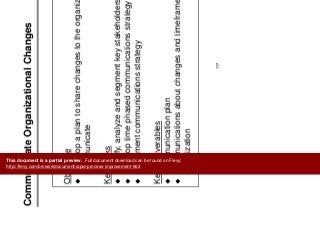
Objective
D l l t h h t th i ti dDevelop a plan to share changes to the organization and
communicate
Key Tasks
Identify, analyze and segment key stakeholders
D l ti h d i ti t tDevelop time phased communications strategy
Implement communications strategy
Key Deliverables
Communication plan
C i ti b t h d ti f t thCommunications about changes and timeframe to the
organization
117
This document is a partial preview. Full document download can be found on Flevy:
http://flevy.com/browse/document/rapid-process-improvement-662
S l C i ti Pl C ti d
Implement
Improvements
Sample - Communication Plan, Continued Improvements
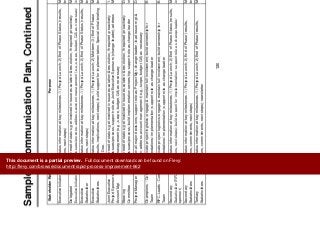
Stakeholder Role Purpose FrequencyStakeholder Role Purpose Frequency
Executive Initiator Provide status information at key milestones: 1) Project Launch; 2) End of Phase Status (results,
implications, next steps)
Major Milestones as noted; plus informal
briefing opportunities
Delegated
Executive Initiator
Keep informed of status; get involved in issue escalation & resolution, if required; proactively
manage issues/process; address account management (e g scope budget QA) as necessary
Major Milestones as noted; plus informal
briefing opportunitiesExecutive Initiator manage issues/process; address account management (e.g., scope, budget, QA) as necessary briefing opportunities
Executive
Stakeholder
Provide status information at key milestones: 1) Project Launch; 2) End of Phase Status (results,
implications, next steps)
Major Milestones as noted; plus informal
briefing opportunities
Executive
Stakeholders
Provide status information at key milestones: 1) Project Launch; 2) Mid-term; 3) End of Phase
Status (results, implications, next steps); build support for implementation. Special initial briefing
Major Milestones as noted; plus informal
briefing opportunities
with Jane Doe.
Joint Executive
Project Sponsors;
Account Mgt.
Keep informed of status; get involved in issue escalation & resolution, if required; proactively
manage issues/process; support role as Joint Executive Sponsors (change leader); address
account management (e.g., scope, budget, QA) as necessary
1-2 times per week plus Steering Comm
Mtg.
Steering Keep informed of status; get involved in issue escalation & resolution, if required; proactively Designated Meetings & Conference Calls;g
Committee
p ; g , q ; p y
manage issues/process; build implementation ownership; support role as change leader
g g ;
informal briefing opportunities
Project Manager Consult on all major decisions; support role as Project Mgr. change leader; lead issue mgt. &
escalation; address account management (e.g., scope, budget, QA) as necessary
Daily
Champions - Core Communicate project logistics; engage & maintain full involvement; build ownership for
/
Bi-Weekly
Team recommendations/ implementation; support role as change leader
RPC Leads - Core
Team
Communicate project logistics; engage & maintain full involvement; build ownership for
recommendations/ implementation; support role as change leader
Bi-Weekly
Secondary
Stakeholder (RPC
Provide status information at key milestones: 1) Project Launch; 2) End of Phase Status (results,
implications next steps); build support for implementation; support role as change leader
Major Milestones as noted; plus informal
briefing opportunitiesStakeholder (RPC
sponsor)
implications, next steps); build support for implementation; support role as change leader briefing opportunities
Secondary
Stakeholders
Provide status information at key milestones: 1) Project Launch; 2) End of Phase (results,
implications, commitments, next steps)
Major Milestones as noted; plus informal
briefing opportunities
Tertiary
St k h ld
Provide status information at key milestones: 1) Project Launch; 2) End of Phase (results,
i li ti it t t t ) l tt
Major Milestones as noted
120
Stakeholders implications, commitments, next steps); newsletter
This document is a partial preview. Full document download can be found on Flevy:
http://flevy.com/browse/document/rapid-process-improvement-662
C T i
RPI Course
Course Topics
Section 1: Introduction & Objectives
Section 2: Key Concepts
Section 3: Approach Overview
Section 4: Mobilize Team
Section 5: Assess ProcessesSection 5: Assess Processes
Section 6: Evaluate Opportunities
S ti 7 P i iti I tSection 7: Prioritize Improvements
Section 8: Change Management
Section 9: Implement Improvements
Section 10: Wrap-up
123
This document is a partial preview. Full document download can be found on Flevy:
http://flevy.com/browse/document/rapid-process-improvement-662
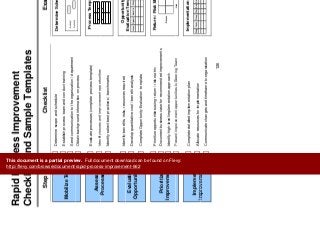
Rapid Process Improvement
Ch kli t d S l T l t
RPI Course
Checklist and Sample Templates
Step Checklist Example Templates
Mobilize Team
Determine Schedule Communication to
Organization / Dept
Send communication to the organization / department
Establish process team and conduct training
Memo
Determine scope and schedule
Activity 1
Activity 2
Assess
Process Template Issues and
Opportunities
Obtain background information on process
Evaluate processes (complete process template)
Identify issues and improvement opportunities
P r o c e s s D e s c r i p t i o n :
P r o c e s s O w n e r ( s ) :
S u p p l i e r s : 1 .
2 .
3 .
I n p u t s : 1 .
2 .
3 .
M a j o r P r o c e s s S t e p s : 1 . 1
y
Process Step Issue Opportunity
Processes
Opportunity
Identify issues and improvement opportunities
Identify select best practices / benchmarks
Identify benefits, risks, resources required
C u s t o m e r s : 1 .
2 .
3 .
O u t p u t s : 1 .
2 .
3 .
P e r f o r m a n c e M e a s u r e s :
C y c l e T i m e :
T r a n s a c t i o n V o l u m e ( d e s c r i p t i o n ,
c o u n t , p e r i o d ) :
Process Step Issue Opportunity
Evaluate
Opportunities
Evaluation Template
Develop quantitative cost / benefit analysis
Complete Opportunity Evaluation template
Issue Opport. Benefits Risks Resources
Document business case for recommended improvementsPrioritize
Improvements
Return / Risk Matrix
Return
Risk
Prioritize opportunities using return / risk matrix
Identify high-level implementation approach
Present improvement opportunities to Steering Team
Improvement
Opportunity Templates
Improvement Opportunity:
Key Evidence: Qualitative
Benefits:
Implement
Improvements
Implementation Plan
RiskPresent improvement opportunities to Steering Team
Complete detailed implementation plan
Allocate resources for implementation
Step Tasks Resp. Start End Deliver Status
Process Map
126
Improvements
Communicate changes and timeframe to organization
This document is a partial preview. Full document download can be found on Flevy:
http://flevy.com/browse/document/rapid-process-improvement-662
1
Flevy (www.flevy.com) is the marketplace
for premium documents. These
documents can range from Business
Frameworks to Financial Models to
PowerPoint Templates.
Flevy was founded under the principle that
companies waste a lot of time and money
recreating the same foundational business
documents. Our vision is for Flevy to
become a comprehensive knowledge base
of business documents. All organizations,
from startups to large enterprises, can use
Flevy— whether it's to jumpstart projects, to
find reference or comparison materials, or
just to learn.
Contact Us
Please contact us with any questions you may have
about our company.
• General Inquiries
support@flevy.com
• Media/PR
press@flevy.com
• Billing
billing@flevy.com

Rapid Process Improvement

  • 1.
  • 2.
    Introduction A variety ofapproaches can be used to impro e processes A CONTINUUM OF PROFIT IMPROVEMENT APPROACHES improve processes ‘Work-away” Process Improvement Rapid Process Improvement Strategic Profit Improvement 6 Sigma (Leadership Development) Task Elimination • Straightforward identification and elimination of low value tasks • Team based approach to issue identification, facilitated method • Facilitated, issues based approach to identify opportunities for savings, process improvement & work • Strategic, top down analysis identifying opportunities to improve revenue, • Develop future company leadership through in-depth training in process Approach U f l f id for key process improvement and ‘waste elimination’ Q i k l bl improvement & work reduction, working with client’s process managers F k decrease cost and position for future growth Si ifi t g p change and leadership behavior change methods O i i tB fit • Useful for very rapid task simplification and company buy-in • Quick, scalable, built to transfer skills internally for sustained effort • Focuses on key process, system and organization issues • Significant improvement among all key change levers • Ongoing improvement of results Benefit • Savings are short lived unless supported by process changes • Requires strong organizational sponsorship and internal skill level • Targets critical processes rather than complete process or strategy • Requires top executive mandate and support, since it can drive very significant change • Requires full commitment of top management for a long time Risks • Specific tasks eliminated, reducing workload • Specific business processes are re- engineered • Specific opportunities for improvement identified with business cases • Specific areas for significant improvement, including cost, • Change in corporate culture to value data based change methods in managing the Results 3 business cases including cost, revenue, infrastructure, organization, etc. in managing the business This document is a partial preview. Full document download can be found on Flevy: http://flevy.com/browse/document/rapid-process-improvement-662
  • 3.
    R id PI t Introduction Rapid Process Improvement Rapid Process Improvement is an overarching framework intended to drivep p g increased business performance. Key Points Outputs Structured approach Rationale for Change (process gaps best y p Rethinking operations Step change vs. incremental (process gaps, best practices / benchmarks) Key Benefits for the change Compatible with TQM and Key Benefits for the Organization Risk Analysis other management techniques Risk Analysis Resource Requirements Quantum performance increase Implementation Approaches (where possible) 6 This document is a partial preview. Full document download can be found on Flevy: http://flevy.com/browse/document/rapid-process-improvement-662
  • 4.
    Introduction C Obj tiCourseObjectives Learn what makes Process Change efforts successful Familiarize participants with an effective Rapid Processp p p Improvement approach Teach participants useful tools and techniques to support Rapid Process Improvement efforts Discuss how Rapid Process Improvement can be applied in this companycompany Learn from our collective experiences 9 This document is a partial preview. Full document download can be found on Flevy: http://flevy.com/browse/document/rapid-process-improvement-662
  • 5.
    P Vi Key Concepts ProcessView Successful Rapid Process Improvement requires cross-functional process views. y p Stage 1 Stage 2 Stage 3 p p q p Stage 1 Stage 2 Stage 3 M M a n u f a M a r k R a n u f a M a r k Order Management Ra c t u r e t i n & D a c t u r e t i n Resource Planning New Product Development & D i n g g i n g g Functions drive the business Processes are acknowledged but functions dominate A process view drives Rapid Process Improvement 12 p This document is a partial preview. Full document download can be found on Flevy: http://flevy.com/browse/document/rapid-process-improvement-662
  • 6.
    F t iS f l P Ch Key Concepts Factors in Successful Process Change y p Leadership driven – Clarity of vision Sense of urgency– Sense of urgency – Executive commitment – Assignment of appropriate people to teamg pp p p p Structured approach – Cross-functional process views – Effective program management Externally focused Improve customer and supplier relationships– Improve customer and supplier relationships – Best practices Defined success factorsDefined success factors Re-skilling employees 15 This document is a partial preview. Full document download can be found on Flevy: http://flevy.com/browse/document/rapid-process-improvement-662
  • 7.
    R id PI O i Approach Overview Rapid Process Improvement Overview Rapid Process Improvement (RPI) is a 5 step approach for implementing pp Rapid Process Improvement (RPI) is a 5 step approach for implementing process change… Implement Improvements Prioritize Improvements Evaluate Opportunities Assess Processes Mobilize Team Steering Committee review: Recommended Improvements Steering Committee review: Issues and Opportunities Recommended Improvements RPI Key Outcomes and Deliverables: Issues and Opportunities Step 1: Project team formed & plan developed Step 2: Process definitions completed & issues and opportunities identified Step 3: Opportunities evaluatedStep 3: Opportunities evaluated Step 4: Opportunities prioritized, selected & documented Step 5: Implementation of selected improvement opportunities 18 This document is a partial preview. Full document download can be found on Flevy: http://flevy.com/browse/document/rapid-process-improvement-662
  • 8.
    St 3 El t O t iti Approach Overview Step 3: Evaluate Opportunities pp In this step, each opportunity is documented, including supporting rationales,p, pp y , g pp g , financial and qualitative benefits, risks and resources required. Implement Improvements Prioritize Improvements Evaluate Opportunities Assess Processes Mobilize Team Evaluate improvement opportunitiesLEVEL OF PERFORMANCE World Class Perform Gap Develop supporting rationale - process gaps, best practices Develop cost / benefit analysis including PERFORMANCE mance p Actual Over Time Quality Cost Time return for improvement opportunities requiring an investment Assess risks (difficulty to implement) Risks Costs Benefits Identify resources required (people, organization, systems) S t People O i ti 21 SystemsOrganization This document is a partial preview. Full document download can be found on Flevy: http://flevy.com/browse/document/rapid-process-improvement-662
  • 9.
    R id PI t Ti i Approach Overview Rapid Process Improvement Timing pp The total length of Rapid Process Improvement efforts will depend on theg p p p complexity of processes, amount of preparation required and duration of implementation plans... RPI Steps: Implement Improvements Prioritize Improvements Evaluate Opportunities Assess Processes Mobilize Team Minimum: Participants already trained in RPI B k d Minimal best practices / benchmarking research Few opportunities and / or easy to prioritize Back of the envelope cost / benefit analyses risks Quick hits Simple task elimination Background information readily available research Process owners, suppliers, and customers accessible to prioritizeanalyses, risks and resources required accessible Maximum: Participants require RPI training Many opportunities and / or difficult Some best practices / benchmarking Rigorous, extensive cost / benefit Full process redesign Leadershiptraining Background information not documented / updated and / or difficult to prioritize benchmarking research Process owners, suppliers, and customers difficult benefit analyses, risks and resources required Leadership development 24 updated customers difficult to coordinate This document is a partial preview. Full document download can be found on Flevy: http://flevy.com/browse/document/rapid-process-improvement-662
  • 10.
    Establish Process TeamRoles and T i T Mobilize Team Train Team Objective Lay the groundwork for a productive and successful effort Key Tasks Determine Rapid Process Improvement scope and schedulep p p through interview with Process Change Champion Develop Rapid Process Improvement Objective (Champion) S l f t i 1 f ilit tSecure personnel for team, ensuring 1 facilitator per process Train team Identify and schedule key resources for RPI workshopsy y p Communicate Rapid Process Improvement objectives K D li blKey Deliverables Rapid Process Improvement workplan “Kick-off” communications to organization and department 27 g p This document is a partial preview. Full document download can be found on Flevy: http://flevy.com/browse/document/rapid-process-improvement-662
  • 11.
    K F tI ti S d S h d l Mobilize Team Key Factors Impacting Scope and Schedule Consider the following factors when determining Rapid Process Improvement scopeg g p p p and schedule: Number of processes Complexity of processes (interaction with other functional areas) Number of FTEs in functional area Amount of best practices / benchmarking research required Extent of change effort (include technology / systems changes)Extent of change effort (include technology / systems changes) Support from senior leadership Budgetg Size of process team / percent dedicated to effort 30 This document is a partial preview. Full document download can be found on Flevy: http://flevy.com/browse/document/rapid-process-improvement-662
  • 12.
    Cl l Dfi d R l & R ibiliti Mobilize Team Clearly Defined Roles & Responsibilities... … are required for the Steering Team to be effective: Deploy RPI company wide q g Deploy RPI company-wide Review process assessment activities underway Recognize and reward managers for making process changes Provide vision and business directionProvide vision and business direction Continue top management mandate and review 33 This document is a partial preview. Full document download can be found on Flevy: http://flevy.com/browse/document/rapid-process-improvement-662
  • 13.
    T i ith T Mobilize Team Training the Team Training should be required for Champions, Facilitators, Process Owners andg q p , , Process Leads to ensure their complete understanding of the Rapid Process Improvement approach. Required Attendees Optional Attendees P Ch Oth PProcess Change Champions Other Process Participants/SMEs Facilitators Process Owners Future Process Change Champions / Facilitators / Process Leads p Process Owners D t t H dDepartment Heads 36 This document is a partial preview. Full document download can be found on Flevy: http://flevy.com/browse/document/rapid-process-improvement-662
  • 14.
    C i tit th D t t Mobilize Team Communicating to the Department The following sample memo can be used to communicate to a department. January 1, 1999 T All l i D t t Sample Kick-off Memo to Department g p p To: All employees in xxx Department From: Process Change Champion Subject: Rapid Process Improvement Effort in xxx Department Over the next few months, we will be undertaking an effort to review our existing operations and address opportunities to improve our processes f d ti b i d ti t Thi ff t i iti l t t l t i t ti b tfor conducting our business and supporting our customers. This effort is critical to our company -- not only to improve our current operations but to position us for continued long-term success. The Rapid Process Improvement approach will be used to assess functional processes and to identify and implement opportunities for improving work processes, resulting in improved performance and / or time and cost savings. Approach 1 F d t i t i l di P Ch Ch i f ilit t d d ll t b k d1. Form and train a process process team, including Process Change Champions, facilitators and process owners, and collect background information on processes. 2. Assess processes to identify improvement opportunities through workshops, including identifying select best practices and benchmarks. 3. Evaluate opportunities, including supporting rationales, financial and qualitative benefits, risks and resources required. 4. Prioritize improvements in terms of expected benefits and difficulty and implementation and develop high-level implementation approaches 5 I l t l t d i t5. Implement selected improvements. Department Processes The following are the staff associated with the Rapid Process Improvement efforts: Process xxx Process Owner 1 Facilitator 1 P P O 2 F ili 2Process yyy Process Owner 2 Facilitator 2 The effort is planned from xxx through yyy. During this effort, RPI workshops will be conducted with representatives from various groups in xxx department and selected individuals outside xxx department. I will keep you informed on a regular basis about the developments on this important effort. If you have any specific questions or suggestions, please contact me or one of the team members. 39 This document is a partial preview. Full document download can be found on Flevy: http://flevy.com/browse/document/rapid-process-improvement-662
  • 15.
    Sample Agenda andExpected Outputs for RPI W k h 1 Mobilize Team RPI Workshop 1 Part of Mobilize Team Kick-off Comments Process Change Champion30 minutes Time Activity Responsible Introduction Review Rapid Process Improvement Approach, Objective and Expectations Process Change Champion Facilitator pp , j p Develop Process Overview Break Facilitator75 minutes 15 minutes Brainstorm Issues and Opportunities Next Steps Facilitator Facilitator 105 minutes 15 minutes Updated Rapid Outputs: Process Template Process Map (As Necessary) List of Issues and Opportunities Updated Rapid Process Improvement Objective 42 This document is a partial preview. Full document download can be found on Flevy: http://flevy.com/browse/document/rapid-process-improvement-662
  • 16.
    Assess Processes Evaluate Processesthrough RPI W k h Obj ti RPI Workshops Objective Understand and document the process K T kKey Tasks Conduct RPI workshops with owners, customers and supplierssuppliers Identify process suppliers, inputs, customers and outputs Identify the process steps which convert inputs to outputs Identify performance measures for each processIdentify performance measures for each process Assess cycle time and transaction volumes Summarize process information in Process Template Develop process map (as necessary) Key Deliverablesy Process template Process map (as necessary) 45 This document is a partial preview. Full document download can be found on Flevy: http://flevy.com/browse/document/rapid-process-improvement-662
  • 17.
    P D fiiti P Assess Processes Process Definition: Purpose Understand, for a particular process: What happens, where and when, by whom At appropriate level of detail - minimum necessary Achieve consensus on how the process is performed Illustrate areas for improvement; identify bottlenecks, rework loops, and hand-offs Capture appropriate performance measuresCapture appropriate performance measures 48 This document is a partial preview. Full document download can be found on Flevy: http://flevy.com/browse/document/rapid-process-improvement-662
  • 18.
    P D itiT l t Assess Processes Process Decomposition Template Level 1 Process Level 2 Subprocesses Level 3 Subprocesses Level 4 Subprocesses Priority Process H-M-L Priority Selection H-M-L Team (F/S) Interview Done? (Y/N) Doc. Done? (Y/N) In Scope (Y/N)( ) ( ) ( ) 1.0 Perform Marketing 1.1 Brand Management 1.1.1 Advertising and Promotional Development L L F&S 1.1.2 Performance Planning Analysis-Commercial H L F&S Y 1 1 3 Performance Planning H L F&S “1.1.3 Performance Planning Analysis- Financial H L F&S 1.2 Promotion Program Management 1.2.1 Development L L F&S 1.2.2 Evaluative L L F&S 1.3 Manage Product Packaging L L F&S N 1.4 Market Research 1.4.1 Base Business L L F&S N 1.4.2 New Products L L F&S N 2.0 Perform Sales 2.1 Sales Planning and Analysis 2.1.2 Forecasting H L F&S Y 2.2 Retail Execution(Store level) 2.2.1 ManageTrade Funds H L F&S Y 2 2 2 Manage In-Store H L F&S2.2.2 Manage In Store Merchandising H L F&S 2.3 Strategic Customer Development/Category Management H L F&S 51 This document is a partial preview. Full document download can be found on Flevy: http://flevy.com/browse/document/rapid-process-improvement-662
  • 19.
    P M i AssessProcesses Process Mapping SampleWhen to Use Process Maps Complex process with hand-offs between d t t d thdepartments and other processes Lack of consensus on process activities Note: Use a standard approach to process mapping to ensure consistency of symbols and level of detail across processes 54 This document is a partial preview. Full document download can be found on Flevy: http://flevy.com/browse/document/rapid-process-improvement-662
  • 20.
    Identify Issues andImprovement O t iti Assess Processes Opportunities Objective Identify issues and improvement opportunities to simplifyIdentify issues and improvement opportunities to simplify, streamline and eliminate work Supplement processes with additional recommendations to i fimprove performance Key Tasksy Conduct workshops to brainstorm issues, assess gaps between current processes and customer / supplier i t d id tif i t t itirequirements, and identify improvement opportunities Develop new approaches to address key issues Key Deliverables Summary of issues and opportunities 57 This document is a partial preview. Full document download can be found on Flevy: http://flevy.com/browse/document/rapid-process-improvement-662
  • 21.
    I d Ot iti T l t Assess Processes Issues and Opportunities Template This template can be used to document issues and improvement opportunities.p p pp # Process Number Issues Opportunities Benefits Risks Resources Required 60 Workshop 1 Focus This document is a partial preview. Full document download can be found on Flevy: http://flevy.com/browse/document/rapid-process-improvement-662
  • 22.
    Assess Processes Improvement Opportunitiesfrom P R d i P i i lProcess Redesign Principles Improvement ideas can also come from comparing current processes to thep p g p Process Redesign Principles: Demand Pull FlowWaste Elimination Demand - Pull Flow Pull Signals Small Batches Waste Elimination Motion Waiting Time Set-up Reduction Visual Controls g Overproduction Processing Time Customer / Supplier Integration Inventory Defects Material Handling Redundancy Elimination Internal & External Integration Material Handling Organize Around Outcomes Concept of FlowConcept of Flow Multi-functional Workers Process Complete Teams 63 This document is a partial preview. Full document download can be found on Flevy: http://flevy.com/browse/document/rapid-process-improvement-662
  • 23.
    Sample Agenda andExpected Outputs for RPI W k h 2 Assess Processes RPI Workshop 2 Part of Assess Processes Review Minutes from Last Facilitated Workshop Facilitator15 minutes Time Activity Responsible p Review Process Templates Present Best Practices Research Facilitator Process Owner 30 minutes 30 minutes Brainstorm Additional Opportunities Break Evaluate Improvement Opportunities (Benefits Facilitator Facilitator 30 minutes 15 minutes 105 minutes Evaluate Improvement Opportunities (Benefits, Risks, Resources Required) Plan Next Steps Facilitator Facilitator 105 minutes 15 minutes O t it E l tiOpportunity Evaluation Template (Benefits, Risks, Resources Required) Outputs: Complete List of Issues and Opportunities 66 This document is a partial preview. Full document download can be found on Flevy: http://flevy.com/browse/document/rapid-process-improvement-662
  • 24.
    B t Pti I t Id Assess Processes Best Practices - Improvement Ideas Focusing on the key areas that need improvement, a list of improvementg y p , p opportunities to improve processes can be generated using best practices. Definition Improvement ideas are actionable items that the company should undertake to achieve best practices. These should help the company improve processes to support its business strategy.pp gy Functional Area Best Practice Improvement Opportunity Finance A corporate-wide chart of accounts that is appropriate for operating Reconfigure chart of accounts across all levels of the p pp y Examples appropriate for operating divisions as well as for corporate consolidations. levels of the organization Establish automated linkages to ensurelinkages to ensure consistency between all levels of the organization 69 This document is a partial preview. Full document download can be found on Flevy: http://flevy.com/browse/document/rapid-process-improvement-662
  • 25.
    C T i RPICourse Course Topics Section 1: Introduction & Objectives Section 2: Key Concepts Section 3: Approach Overview Section 4: Mobilize Team Section 5: Assess ProcessesSection 5: Assess Processes Section 6: Evaluate Opportunities S ti 7 P i iti I tSection 7: Prioritize Improvements Section 8: Change Management Section 9: Implement Improvements Section 10: Wrap-up 72 This document is a partial preview. Full document download can be found on Flevy: http://flevy.com/browse/document/rapid-process-improvement-662
  • 26.
    Sample Agenda andExpected Outputs for RPI W k h 2 Evaluate Opportunities RPI Workshop 2 Opportunities Part of Evaluate Opportunities Review Minutes from Last Facilitated Workshop Facilitator15 minutes Time Activity Responsible p Review Process Templates Present Best Practices Research Facilitator Process Owner 30 minutes 30 minutes Brainstorm Additional Opportunities Break Evaluate Improvement Opportunities (Benefits Facilitator Facilitator 30 minutes 15 minutes 105 minutes Evaluate Improvement Opportunities (Benefits, Risks, Resources Required) Plan Next Steps Facilitator Facilitator 105 minutes 15 minutes O t it E l tiOpportunity Evaluation Template (Benefits, Risks, Resources Required) Outputs: Complete List of Issues and Opportunities 75 This document is a partial preview. Full document download can be found on Flevy: http://flevy.com/browse/document/rapid-process-improvement-662
  • 27.
    S f Fii l B fit Evaluate Opportunities Sources of Financial Benefits Financial benefits can be characterized into three types. Opportunities yp Types of Financial Benefits Examples - Potential DriversFinancial Benefits Incremental FTEs Pricing Examples Potential Drivers Pricing Travel expenses Employee overtime Cost Savings Network availability Revenue Enhancement Prod cti it d e to net ork a ailabilit Enhancement Productivity due to network availability Productivity reduces need to hire new managers Cost Avoidance 78 This document is a partial preview. Full document download can be found on Flevy: http://flevy.com/browse/document/rapid-process-improvement-662
  • 28.
    St 4 Pi iti I t Prioritize Improvements Step 4: Prioritize Improvements Improvements The Prioritize Improvements step serves to prioritize previously evaluatedp p p p y opportunities and to move a select few into implementation. Implement Improvements Prioritize Improvements Evaluate Opportunities Assess Processes Mobilize Team Prioritize improvement opportunities High Return Take Action Quickly Focus Attention and Resources to Ensure Success Capture Do not Select opportunities to recommend pursuing Document improvement opportunities and Low Low High Risk p Opportunity; Lower Priority Do not pursue Improvement Opportunity identify high-level implementation approaches Present findings to Process Change champions Opportunities Opportunity Present findings to Steering Team 81 This document is a partial preview. Full document download can be found on Flevy: http://flevy.com/browse/document/rapid-process-improvement-662
  • 29.
    O t itP i iti ti C it i R t Prioritize Improvements Opportunity Prioritization Criteria - Return The team must develop common prioritization criteria based on the situation... Improvements p p Return: Using the Opportunity Evaluation template benefits data, include these factors in Return axis placement: (sample weightingsinclude these factors in Return axis placement: (sample weightings shown) Financial Savings Incremental Revenue H = >$ 1 million H = >$5 million M $500 000 t 1 illi M $1 t 5 illiM = $500,000 to 1 million M = $1 to 5 million L = <$500,000 L = <$1 million Qualitative BenefitsQualitative Benefits H = Significant benefits to external customers M = Significant internal benefitsM = Significant internal benefits L = Little discernable beneficial impact 84 This document is a partial preview. Full document download can be found on Flevy: http://flevy.com/browse/document/rapid-process-improvement-662
  • 30.
    P i ititi F k Prioritize Improvements Prioritization Framework Improvements Improvement opportunities can be evaluated in terms of expected returns and risks. Thi l i hi hli h h ll hi h d i i k d High This evaluation highlights challenges which drive risk management and implementation planning. Opportunities Take Action Quickly Rigorous Focus of Attention And Resources Opportunities with service improvements and quantifiable financial Return Increased Efficiency and To Ensure Success financial benefits are plotted proportionally y Effectiveness Capture Opportunity as Resources Allow Do not Pursue, or Pursue Last Low as Resources Allow Pursue Last Low High Risk Difficulty of Implementation / Impact All opportunities are plotted based on the project 87 All opportunities are plotted based on the project team’s assessment This document is a partial preview. Full document download can be found on Flevy: http://flevy.com/browse/document/rapid-process-improvement-662
  • 31.
    Prioritize Improvements O t itC T l t 1 Improvements Opportunity Case Template 1 The first opportunity template provides qualitative support for the recommended opportunity. This includes benefits best practices and performance measures Improvement Opportunity: This includes benefits, best practices and performance measures. Key Issues: Expected Benefits:Key Issues: Expected Benefits: Design Factors / Best Practices:Design Factors / Best Practices: Performance Measures: Performance Measures: 90 This document is a partial preview. Full document download can be found on Flevy: http://flevy.com/browse/document/rapid-process-improvement-662
  • 32.
    E i Il t ti A h Prioritize Improvements Exercise: Implementation Approaches Improvements Objective: Identify high-level implementation approaches for high priority opportunities Approach:Approach: Consider the Return / Risk matrix completed in the last exerciseexercise Refer to the high-level implementation approach chart Consider any other implementation approaches you knowConsider any other implementation approaches you know Select recommended implementation approach for the high priority opportunitiesp y pp 93 This document is a partial preview. Full document download can be found on Flevy: http://flevy.com/browse/document/rapid-process-improvement-662
  • 33.
    M d VU d Ch Change Management Managed Versus Unmanaged Change g g High expectations Better than beforeexpectations Realization of effort and complexity Light at the end of the before tivity of the tunnel ProductMorale& Change Implementation Despair M Unmanaged Change Managed Change OwnershipAcceptanceQuestioningAwareness 96 This document is a partial preview. Full document download can be found on Flevy: http://flevy.com/browse/document/rapid-process-improvement-662
  • 34.
    Ch M tD fi d Change Management Change Management Defined g g Change Management provides the means and methods to successfully integrate people process and technology in thesuccessfully integrate people, process and technology in the service of achieving strategic intent Change Management provides the architecture enablers toolsChange Management provides the architecture, enablers, tools and techniques to effectively initiate, facilitate, and manage change, resulting in improved organizational performance The scope of any particular set of Change Management interventions is determined by the issues and environment we are trying to address 99 This document is a partial preview. Full document download can be found on Flevy: http://flevy.com/browse/document/rapid-process-improvement-662
  • 35.
    St k hld M t Change Management Stakeholder Management Overall identification of stakeholder issues determines: g g Overall, identification of stakeholder issues determines: Key stakeholders for the change project, and what is known about their positions How different stakeholders are likely to react to change, so the project team knows who the supporters and the blockers are, and how their reactions may affect the projectreactions may affect the project Based on this information, the project team can draft a stakeholder management plan: a list of actions to maximize support and overcome resistance. Stakeholder analysis helps to answer questions such as: How can the energy and commitment of supporters be sustained and leveraged? How can the perceptions of blockers be influenced? How can benefitsHow can the perceptions of blockers be influenced? How can benefits be identified and communicated to them? How can all of those affected be involved in the project in meaningful ways which ensure its value and meet their needs and aspirations? 102 ways which ensure its value and meet their needs and aspirations? This document is a partial preview. Full document download can be found on Flevy: http://flevy.com/browse/document/rapid-process-improvement-662
  • 36.
    C i ti ChangeManagement Communication Communication is a critical element to ensure buy-in from the organization and to initiate the g g y g RPI project with the entire organization. This section focuses on planning the elements of communication to achieve the most effective results possible. PLAN IN ADVANCE TO ADDRESS THESE QUESTIONS:PLAN IN ADVANCE TO ADDRESS THESE QUESTIONS: TO WHOM & ROLE HOW MESSAGE IS DELIVERED FROM WHOM & STATUS MESSAGE & FREQUENCY Illustrative DELIVERED STATUSFREQUENCY • Team Assignments - once MeetingsKey St k h ld • Schedule & Logistics- prior to each event • Issues - as they are identified Project Team Memo Stakeholders, Responsibilities identified • Decisions Required-As required • Status-weekly Project Team Steering Committee Project Sponsors Memos (written, email) • Results-once 105 This document is a partial preview. Full document download can be found on Flevy: http://flevy.com/browse/document/rapid-process-improvement-662
  • 37.
    Ch R diW k h Change Management Change Readiness Workshops g g A structured approach for assessing the capabilities for change in an enterprise. USED TO:USED TO: Raise the overall "consciousness" of an enterprise with regard to change, the change process and likely impacts Surface hidden agendas and key resistance issues that might prove troublesome later if notSurface hidden agendas and key resistance issues that might prove troublesome later if not discovered Provide focus for analysis and design activity planning Provide participants with a greater awareness of the process of change Identify historical critical success factors for and barriers to change projects Identify potential responses to change Help participants and management understand the emotional response to changeHelp participants and management understand the emotional response to change Help participants and management understand the enterprise's climate for change Identify enablers and barriers for this change project Prioritize barriers to the project and create an action plan to ensure the success of the changePrioritize barriers to the project and create an action plan to ensure the success of the change 108 This document is a partial preview. Full document download can be found on Flevy: http://flevy.com/browse/document/rapid-process-improvement-662
  • 38.
    St 5 Il t I t Implement Improvements Step 5: Implement Improvements Improvements The final step of the approach entails implementing the priority improvements.p pp p g p y p ImplementPrioritizeEvaluateAssess Mobilize Team ImprovementsImprovementsOpportunitiesProcesses Mobilize Team Develop implementation plans for improvements selected for implementation Plan se ected o p e e tat o Design new processes as needed Develop performance measures to track resultsDevelop performance measures to track results Communicate organizational changes to employees Implement and train employees on new processesImplement and train employees on new processes Recognize and reward employees for process improvements 111 This document is a partial preview. Full document download can be found on Flevy: http://flevy.com/browse/document/rapid-process-improvement-662
  • 39.
    S l Il t ti Pl Implement ImprovementsILLUSTRATIVE Sample Implementation Plan The implementation plan should include steps, tasks, responsibilities, timing and ImprovementsILLUSTRATIVE Status p p p , , p , g deliverables. Sample Plan - Fix Billing Errors Step Tasks Responsible Start End Deliverable Status Complete Complete Complete Step Develop basic training for consistent and correct Tasks Identify billing expert to be training coordinator Obtain draft procedure manual from S. Pass Estimate time required to complete manual and develop billing training material Responsible P. Barry T. Lewis T. Lewis Start 1-Jun 1-Jun 1-Jun End 5-Jun 8-Jun 16-Jun Deliverable Individual selected Manual on hand Estimate to complete Underway Underway Underway correct procedures develop billing training material Conduct one-on-one sessions with each billing person to determine training needs Revise billing procedures manual Develop billing training program Distribute manual for study by all billing personnel T. Lewis T. Lewis T. Lewis T Lewis 28-Jun 30-Jun 30-Jun 14-Jul 9-Jul 14-Jul 21-Jul 14-Jul Sessions conducted Manual completed Program developed Manual distributed Complete Underway Distribute manual for study by all billing personnel Develop contracts training for billing personnel Hold session to train personnel T. Lewis K. Schafer T. Lewis 14 Jul 1-Aug 2-Sep 14 Jul 21-Aug 2-Sep Track performance Generate daily audit reports to T. Lewis Balance accounts to go forward D. King D. King 14-Jun 21-Jun 18-Jun 16-Jul Manual distributed Program developed Sessions conducted Report to T. Lewis Accounts balanced OngoingUse daily audit reports on an ongoing basis Define department measures, establish baselines & targets Notify account managers to forward all billing complaints to Billing Supervisors D. King M. Wood P. Harris 10-Jun 28-Jun Ongoing 16-Jul 9-Jul Accounts balanced Measures by region Communications sent Ongoing Ongoing Provide ongoing expert billing Follow-up as necessary Transition to “billing hotline” status T. Lewis T Lewis Document each error, responsibility, and action to address Follow-up as necessary T. Lewis T. Lewis 19-Jul Ongoing Ongoing Completed form Ongoing Ongoing Ongoing Ongoing Ongoing 114 expert billing assistance Transition to billing hotline status Develop advanced training T. Lewis T. Lewis Ongoing Ongoing Training program Ongoing Ongoing This document is a partial preview. Full document download can be found on Flevy: http://flevy.com/browse/document/rapid-process-improvement-662
  • 40.
    C i tO i ti l Ch Implement Improvements Communicate Organizational Changes Improvements Objective D l l t h h t th i ti dDevelop a plan to share changes to the organization and communicate Key Tasks Identify, analyze and segment key stakeholders D l ti h d i ti t tDevelop time phased communications strategy Implement communications strategy Key Deliverables Communication plan C i ti b t h d ti f t thCommunications about changes and timeframe to the organization 117 This document is a partial preview. Full document download can be found on Flevy: http://flevy.com/browse/document/rapid-process-improvement-662
  • 41.
    S l Ci ti Pl C ti d Implement Improvements Sample - Communication Plan, Continued Improvements Stakeholder Role Purpose FrequencyStakeholder Role Purpose Frequency Executive Initiator Provide status information at key milestones: 1) Project Launch; 2) End of Phase Status (results, implications, next steps) Major Milestones as noted; plus informal briefing opportunities Delegated Executive Initiator Keep informed of status; get involved in issue escalation & resolution, if required; proactively manage issues/process; address account management (e g scope budget QA) as necessary Major Milestones as noted; plus informal briefing opportunitiesExecutive Initiator manage issues/process; address account management (e.g., scope, budget, QA) as necessary briefing opportunities Executive Stakeholder Provide status information at key milestones: 1) Project Launch; 2) End of Phase Status (results, implications, next steps) Major Milestones as noted; plus informal briefing opportunities Executive Stakeholders Provide status information at key milestones: 1) Project Launch; 2) Mid-term; 3) End of Phase Status (results, implications, next steps); build support for implementation. Special initial briefing Major Milestones as noted; plus informal briefing opportunities with Jane Doe. Joint Executive Project Sponsors; Account Mgt. Keep informed of status; get involved in issue escalation & resolution, if required; proactively manage issues/process; support role as Joint Executive Sponsors (change leader); address account management (e.g., scope, budget, QA) as necessary 1-2 times per week plus Steering Comm Mtg. Steering Keep informed of status; get involved in issue escalation & resolution, if required; proactively Designated Meetings & Conference Calls;g Committee p ; g , q ; p y manage issues/process; build implementation ownership; support role as change leader g g ; informal briefing opportunities Project Manager Consult on all major decisions; support role as Project Mgr. change leader; lead issue mgt. & escalation; address account management (e.g., scope, budget, QA) as necessary Daily Champions - Core Communicate project logistics; engage & maintain full involvement; build ownership for / Bi-Weekly Team recommendations/ implementation; support role as change leader RPC Leads - Core Team Communicate project logistics; engage & maintain full involvement; build ownership for recommendations/ implementation; support role as change leader Bi-Weekly Secondary Stakeholder (RPC Provide status information at key milestones: 1) Project Launch; 2) End of Phase Status (results, implications next steps); build support for implementation; support role as change leader Major Milestones as noted; plus informal briefing opportunitiesStakeholder (RPC sponsor) implications, next steps); build support for implementation; support role as change leader briefing opportunities Secondary Stakeholders Provide status information at key milestones: 1) Project Launch; 2) End of Phase (results, implications, commitments, next steps) Major Milestones as noted; plus informal briefing opportunities Tertiary St k h ld Provide status information at key milestones: 1) Project Launch; 2) End of Phase (results, i li ti it t t t ) l tt Major Milestones as noted 120 Stakeholders implications, commitments, next steps); newsletter This document is a partial preview. Full document download can be found on Flevy: http://flevy.com/browse/document/rapid-process-improvement-662
  • 42.
    C T i RPICourse Course Topics Section 1: Introduction & Objectives Section 2: Key Concepts Section 3: Approach Overview Section 4: Mobilize Team Section 5: Assess ProcessesSection 5: Assess Processes Section 6: Evaluate Opportunities S ti 7 P i iti I tSection 7: Prioritize Improvements Section 8: Change Management Section 9: Implement Improvements Section 10: Wrap-up 123 This document is a partial preview. Full document download can be found on Flevy: http://flevy.com/browse/document/rapid-process-improvement-662
  • 43.
    Rapid Process Improvement Chkli t d S l T l t RPI Course Checklist and Sample Templates Step Checklist Example Templates Mobilize Team Determine Schedule Communication to Organization / Dept Send communication to the organization / department Establish process team and conduct training Memo Determine scope and schedule Activity 1 Activity 2 Assess Process Template Issues and Opportunities Obtain background information on process Evaluate processes (complete process template) Identify issues and improvement opportunities P r o c e s s D e s c r i p t i o n : P r o c e s s O w n e r ( s ) : S u p p l i e r s : 1 . 2 . 3 . I n p u t s : 1 . 2 . 3 . M a j o r P r o c e s s S t e p s : 1 . 1 y Process Step Issue Opportunity Processes Opportunity Identify issues and improvement opportunities Identify select best practices / benchmarks Identify benefits, risks, resources required C u s t o m e r s : 1 . 2 . 3 . O u t p u t s : 1 . 2 . 3 . P e r f o r m a n c e M e a s u r e s : C y c l e T i m e : T r a n s a c t i o n V o l u m e ( d e s c r i p t i o n , c o u n t , p e r i o d ) : Process Step Issue Opportunity Evaluate Opportunities Evaluation Template Develop quantitative cost / benefit analysis Complete Opportunity Evaluation template Issue Opport. Benefits Risks Resources Document business case for recommended improvementsPrioritize Improvements Return / Risk Matrix Return Risk Prioritize opportunities using return / risk matrix Identify high-level implementation approach Present improvement opportunities to Steering Team Improvement Opportunity Templates Improvement Opportunity: Key Evidence: Qualitative Benefits: Implement Improvements Implementation Plan RiskPresent improvement opportunities to Steering Team Complete detailed implementation plan Allocate resources for implementation Step Tasks Resp. Start End Deliver Status Process Map 126 Improvements Communicate changes and timeframe to organization This document is a partial preview. Full document download can be found on Flevy: http://flevy.com/browse/document/rapid-process-improvement-662
  • 44.
    1 Flevy (www.flevy.com) isthe marketplace for premium documents. These documents can range from Business Frameworks to Financial Models to PowerPoint Templates. Flevy was founded under the principle that companies waste a lot of time and money recreating the same foundational business documents. Our vision is for Flevy to become a comprehensive knowledge base of business documents. All organizations, from startups to large enterprises, can use Flevy— whether it's to jumpstart projects, to find reference or comparison materials, or just to learn. Contact Us Please contact us with any questions you may have about our company. • General Inquiries support@flevy.com • Media/PR press@flevy.com • Billing billing@flevy.com