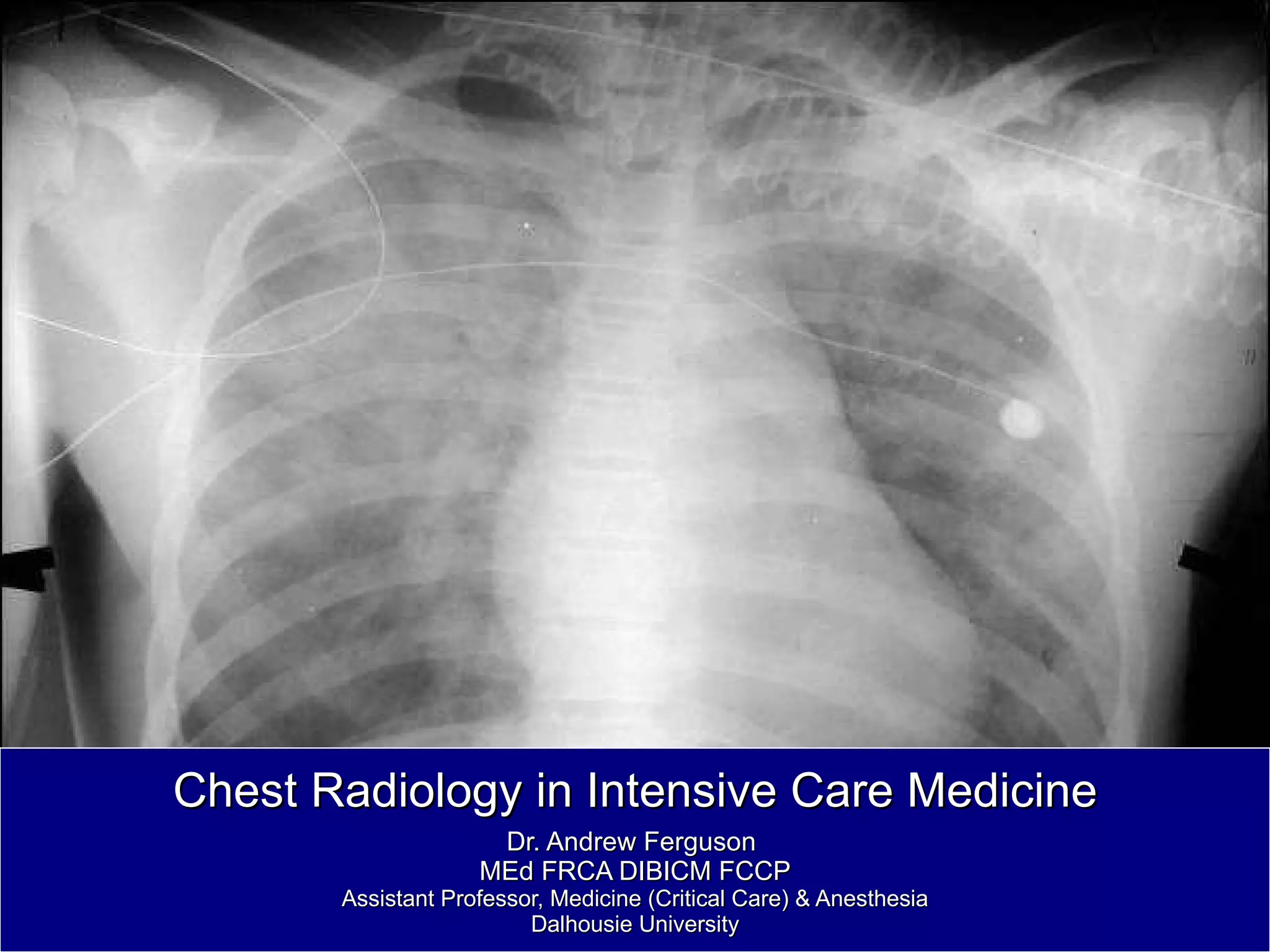
Chest Radiology in Intensive Care Medicine Dr. Andrew Ferguson  MEd FRCA DIBICM FCCP Assistant Professor, Medicine (Critical Care) & Anesthesia Dalhousie University
Overview Air bronchograms & silhouette sign Hilar enlargement Alveolar & interstitial infiltrates Effusions Pulmonary oedema Assessment of volume status using CXR Lobar anatomy & collapse Abnormal air collections Lines, tubes and drains
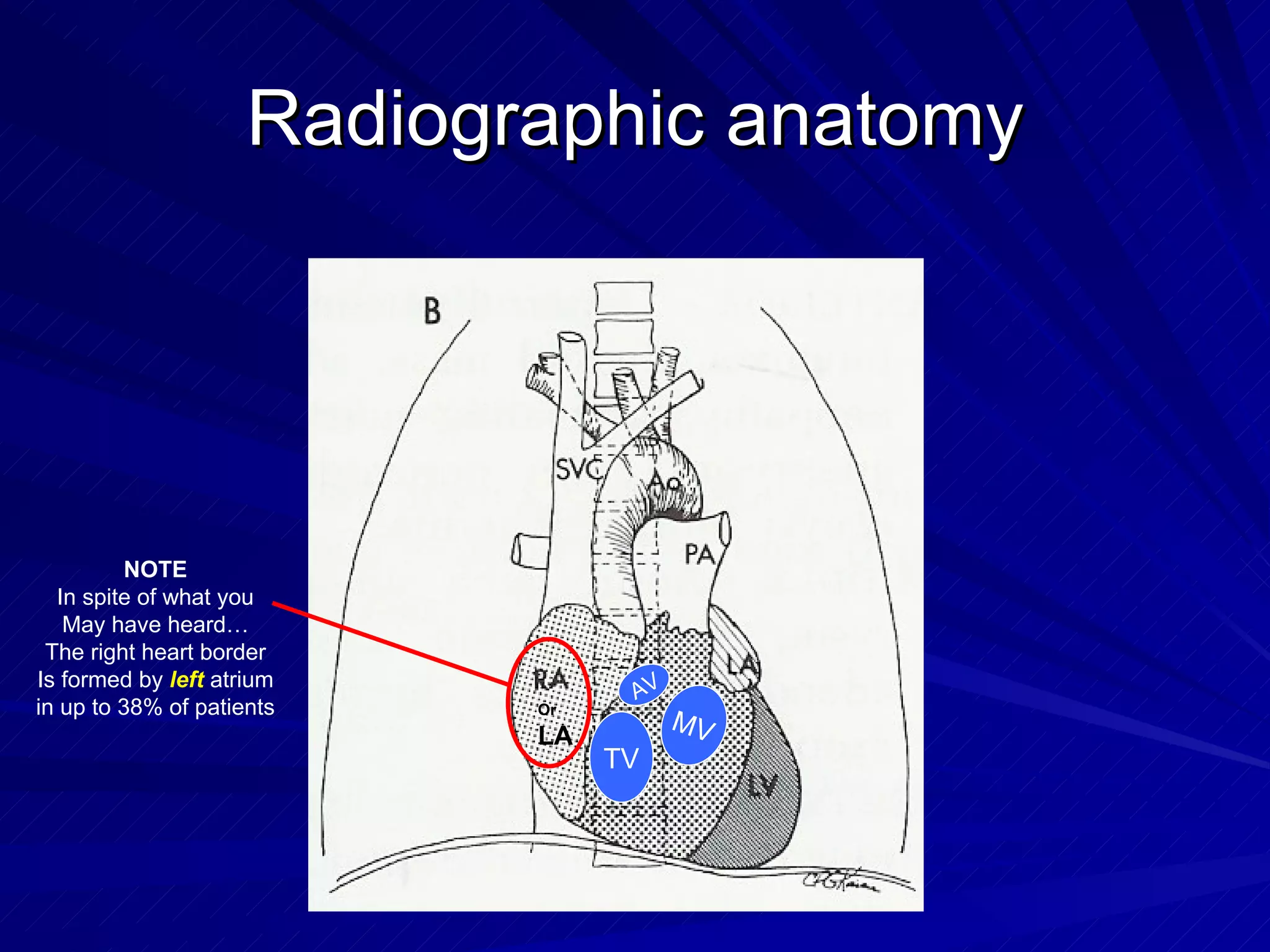
Radiographic anatomy Or LA NOTE In spite of what you May have heard… The right heart border Is formed by  left   atrium in up to 38% of patients AV TV MV
Air bronchograms Bronchi normally  invisible  as they are thin-walled,  filled with air , and  surrounded by air Except when alveoli fill with substance with the density of fluid e.g. Pulmonary oedema Blood Gastric aspirate Inflammatory exudate Bronchi visible when surrounded by diseased lung =  air bronchogram
Silhouette Sign When   an   object   is   in   contact   with   another   of   different   density   the   adjoining   edge   is   visible   e.g.   heart   border   against   aerated   lung When   objects   of   the   same   density   are   in   contact   the   adjoining   edge   is   invisible   e.g.   heart   border   against   consolidated   lung
Silhouette Sign Lobe Silhouetted structure Right middle lobe Right heart border Left lingula Left heart border Right lower lobe Right hemidiaphragm Left lower lobe Left hemidiaphragm Post apical segment left upper lobe Aortic knob Ant segment right upper lobe Ascending aorta
Hilar enlargement Unilateral  hilar adenopathy  Neoplasm  Primary Tuberculosis Sarcoidosis (3-8%)  Primary pulmonary fungal infection  Bilateral  hilar adenopathy Sarcoidosis may also see right paratracheal nodes Lymphoma  False positive  Expiration film   Pulmonary Hypertension
Alveolar infiltrates Air bronchograms “ Fluffy” / indistinct appearance Segmental or lobar distribution Homogeneous & confluent What can fill alveoli? Water:   pulmonary oedema Protein:  ARDS, alveolar proteinosis Fibrous tissue:  BOOP, radiation Cells: Neutrophils :  pneumonia; pneumonitis  Eosinophils :  eosinophilic pneumonia RBCs :  DAH, contusion, infarction, vasculitis Neoplastic :  carcinoma, lymphoma,  Lymphocytes : pneumonitis, sarcoidosis
Rapid Clearance of Alveolar Infiltrate Pulmonary oedema Pulmonary haemorrhage Aspiration Pneumococcal pneumonia (possibly)
Interstitial Infiltrates Inhomogeneous Discrete No   bronchograms Reticular   (lines)   and/or Nodular   (circles) Fibrosis   Connective   tissue   disease   Sarcoidosis   Radiation   fibrosis   Asbestosis   Lymphangitis   carcinomatosis   Silicosis TB
Pleural effusions
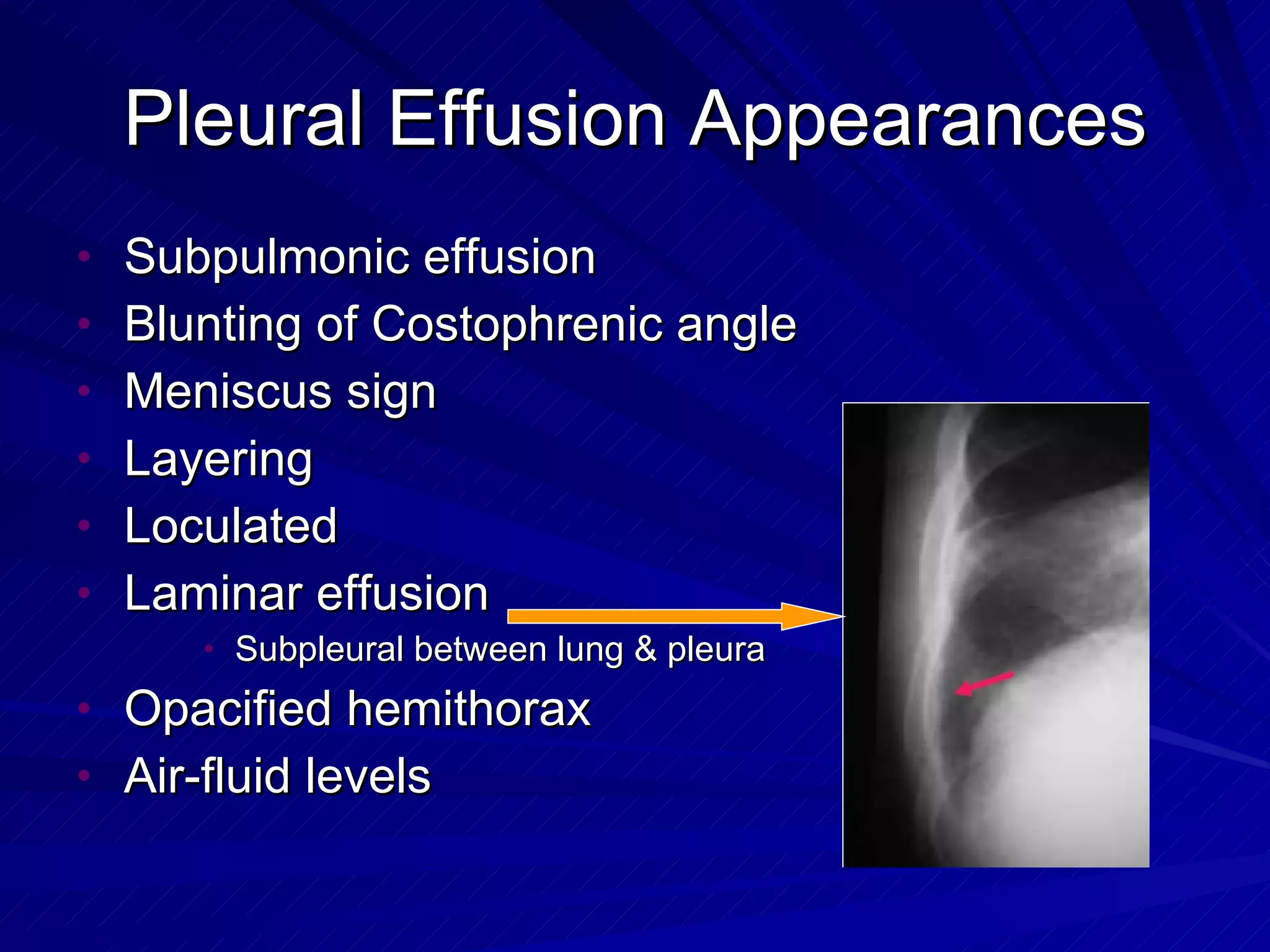
Pleural Effusion Appearances Subpulmonic effusion  Blunting of Costophrenic angle  Meniscus sign  Layering  Loculated  Laminar effusion Subpleural between lung & pleura  Opacified hemithorax  Air-fluid levels
Subpulmonic Effusion Tented diaphragmatic dome or apex more lateral than expected Costophrenic angle more shallow than expected Elevated diaphragm appears thicker and more separated from gastric bubble Usually < 350 ml volume
Blunting of Costo-phrenic Angle 200-300 ml effusion required (AP film) 100-150 ml blunts posterior angle on lateral CXR
Pulmonary Oedema
Pulmonary Oedema ? Upper lobe diversion (“cephalization”) Infiltrates Batswing Diffuse Pleural effusions Septal lines e.g. Kerley B Basal, 1-2 cm long, straight, 90 o  to pleura Thickening of fissures Peribronchial cuffing Interstitial Oedema
Left atrial pressure & CXR signs
< 10% of cases of pulmonary oedema, usually in rapid onset oedema e.g. acute MR
Kerley B lines
Peribronchial Cuffing May be normal finding if right at hilum
Asymmetric pulmonary oedema Chronic lung disease altering vascular flow Acute MR - jet to right pulm vein often RUL Patient position (gravitational) Re-expansion
Vascular Pedicle Width in Pulmonary Oedema
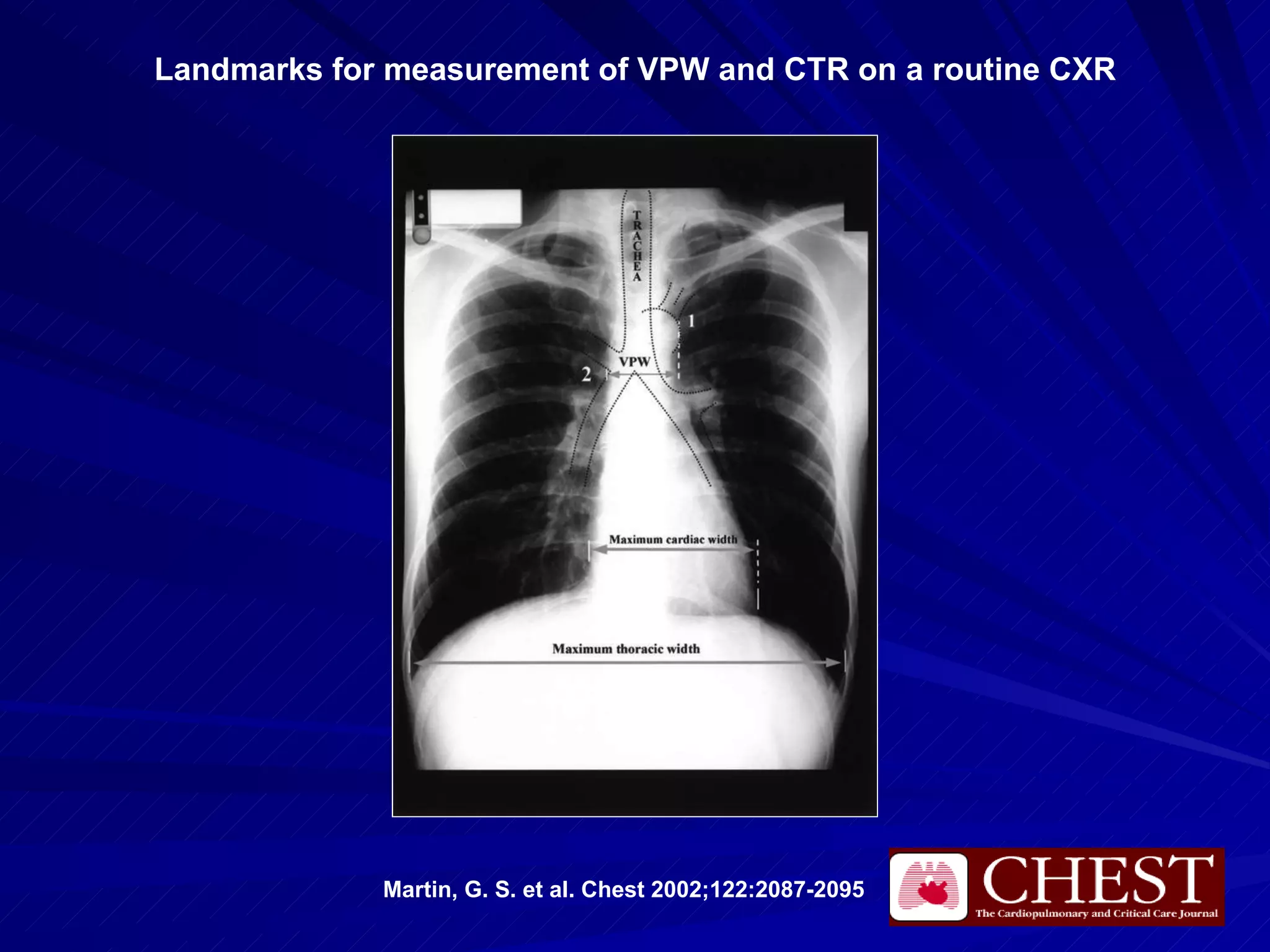
Martin, G. S. et al. Chest 2002;122:2087-2095 Landmarks for measurement of VPW and CTR on a routine CXR
Vascular pedicle width and fluid status in pulmonary oedema
Using Vascular Pedicle Width
VPW/CTR as predictor of PCWP > 18 Criteria Sensitivity Specificity PPV NPV Odds ratio VPW  >  70 & CTR  >  0.55 54% 83% 76% 65% 3.2 VPW  >  70 69% 72% 70% 72% 2.5 CTR  >  0.55 63% 50% 56% 57% 1.3
Lobar anatomy and collapse
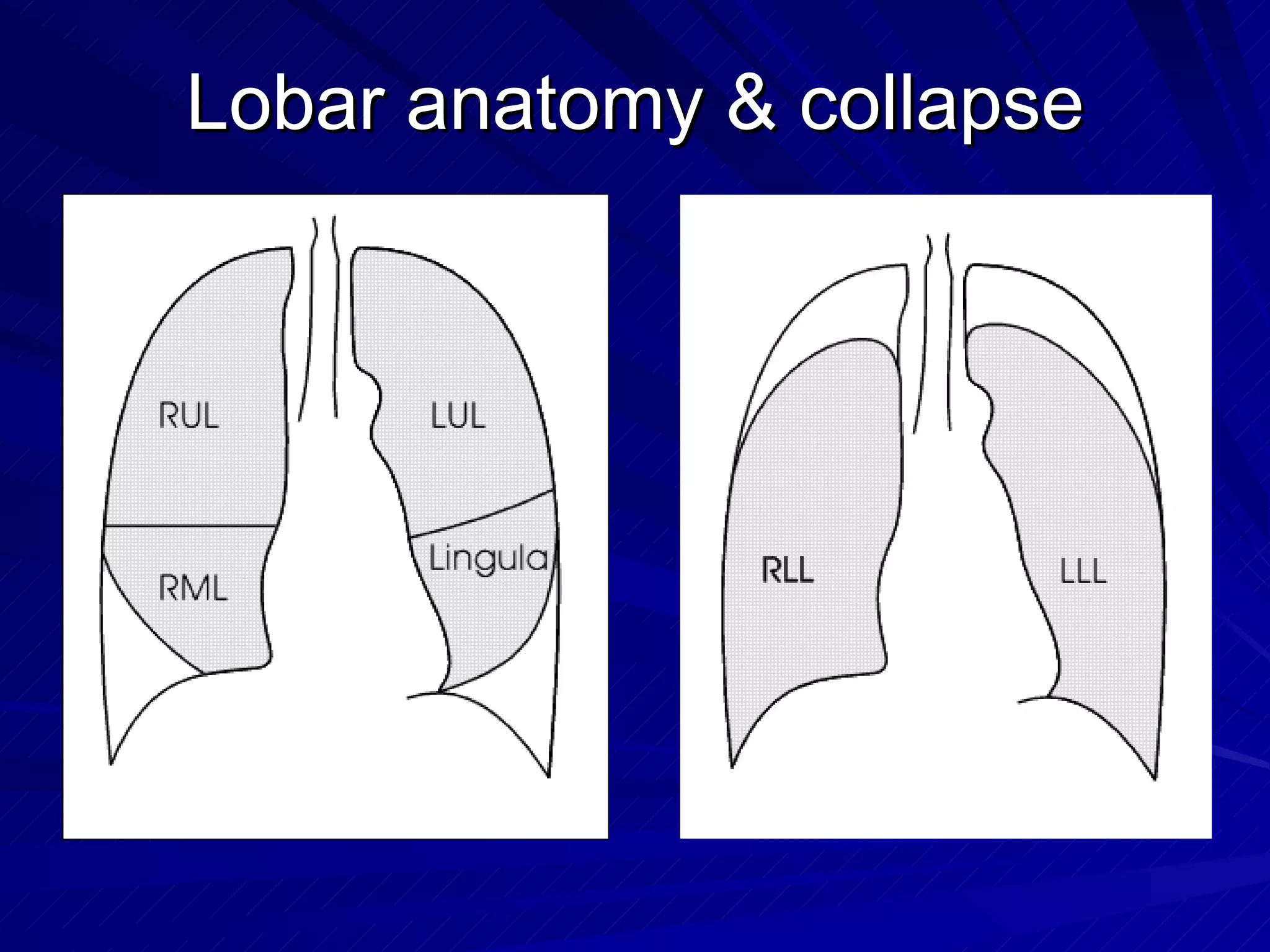
Lobar anatomy & collapse
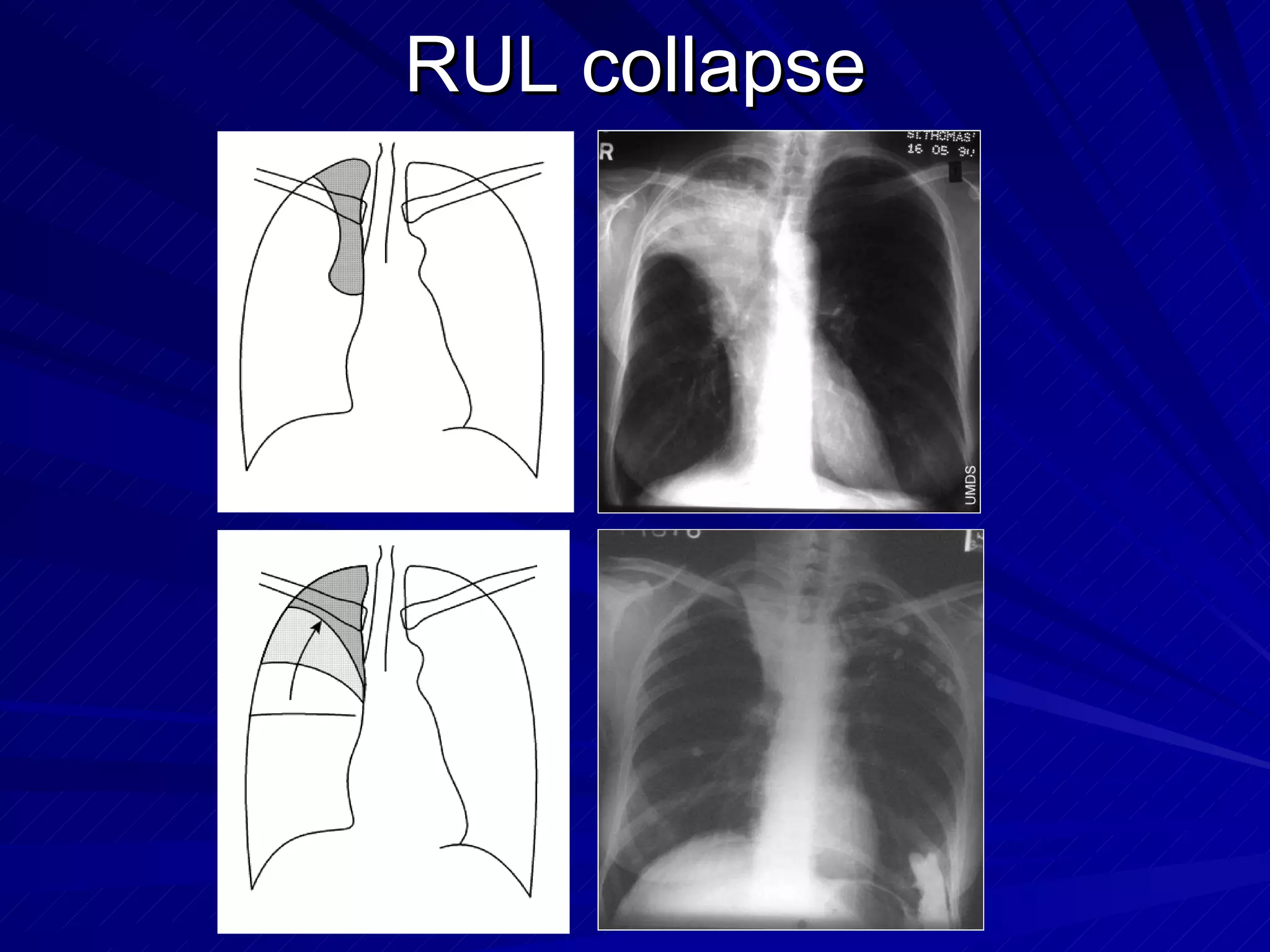
RUL collapse
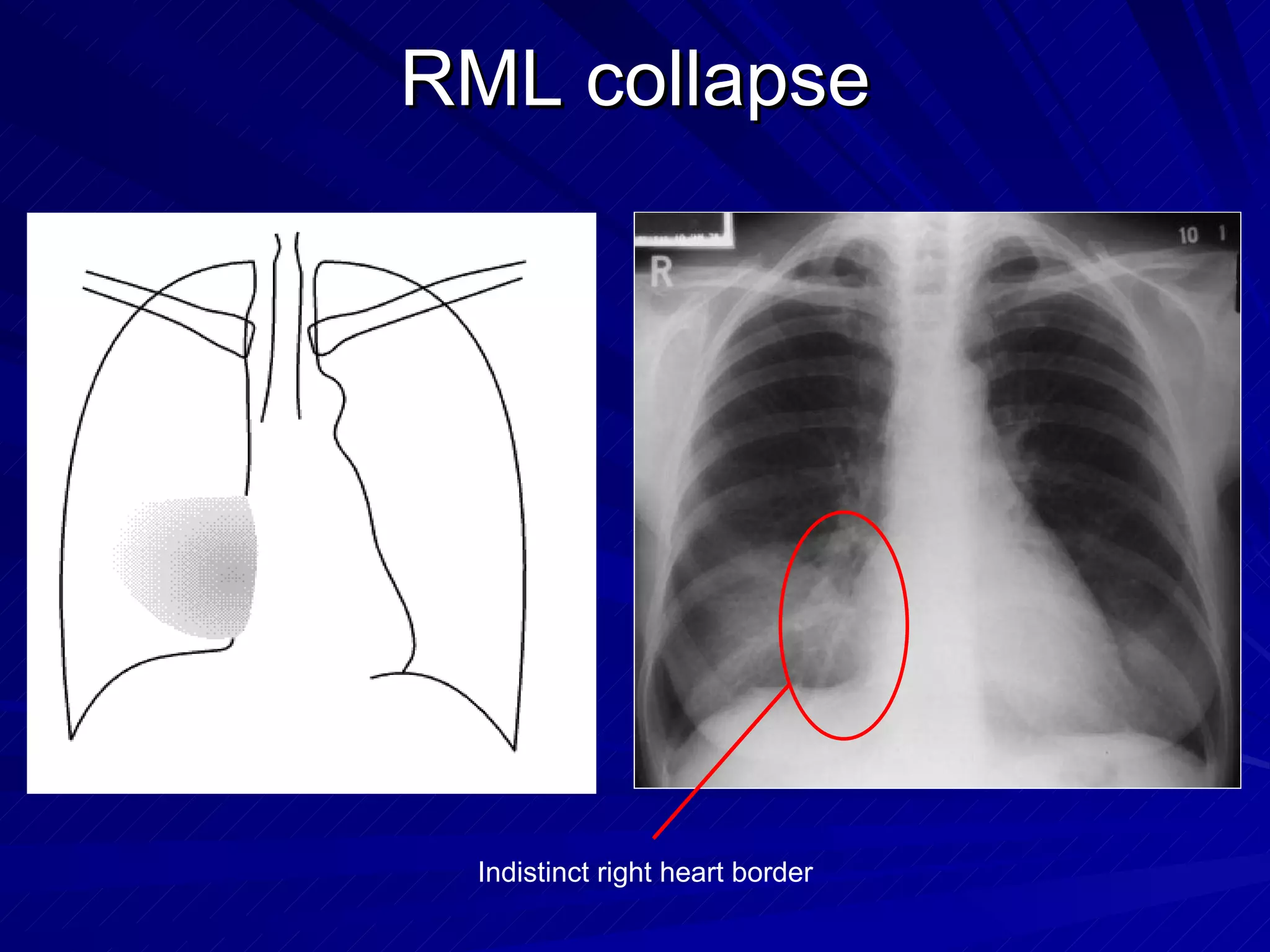
RML collapse Indistinct right heart border
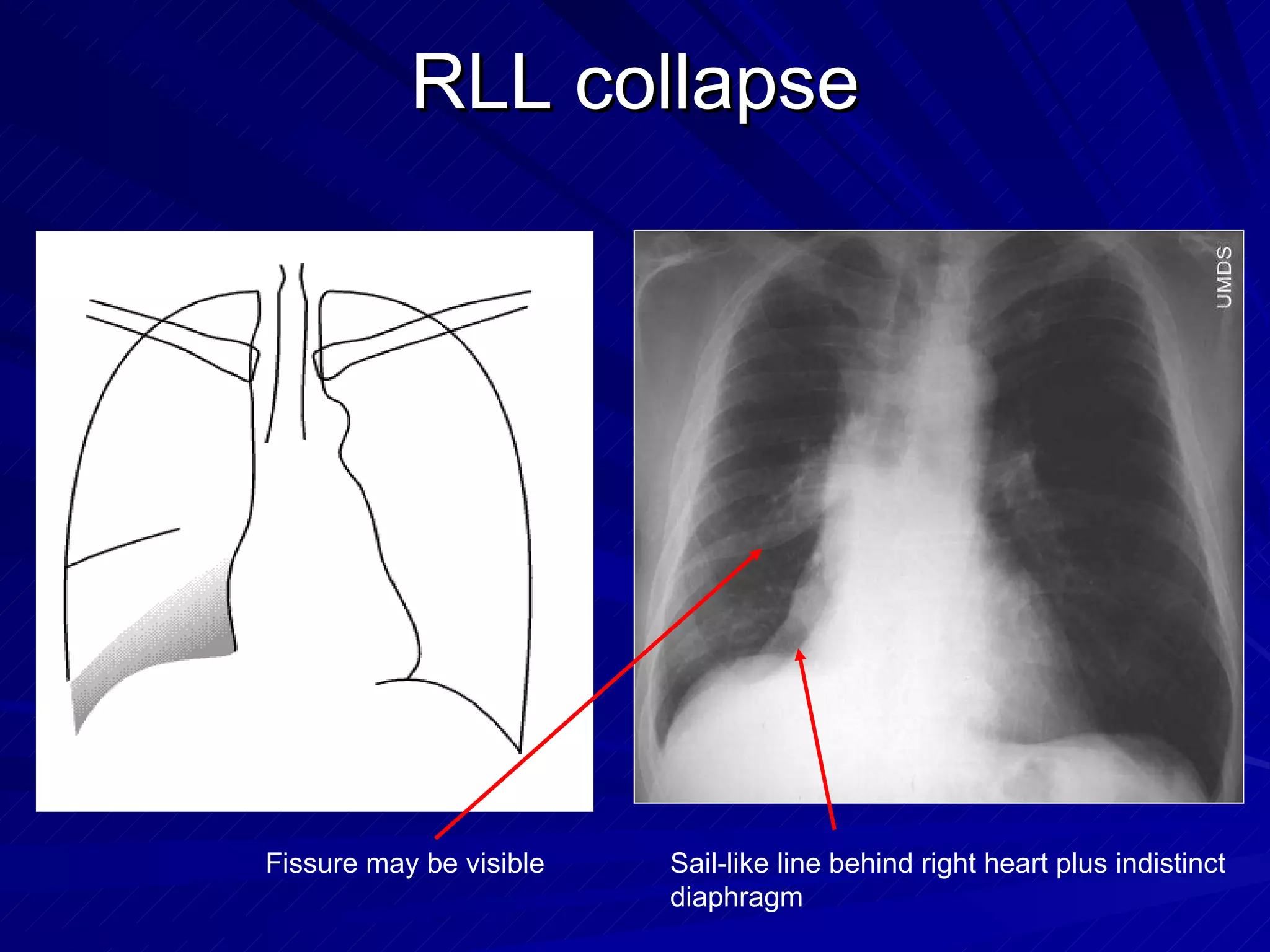
RLL collapse Fissure may be visible Sail-like line behind right heart plus indistinct diaphragm
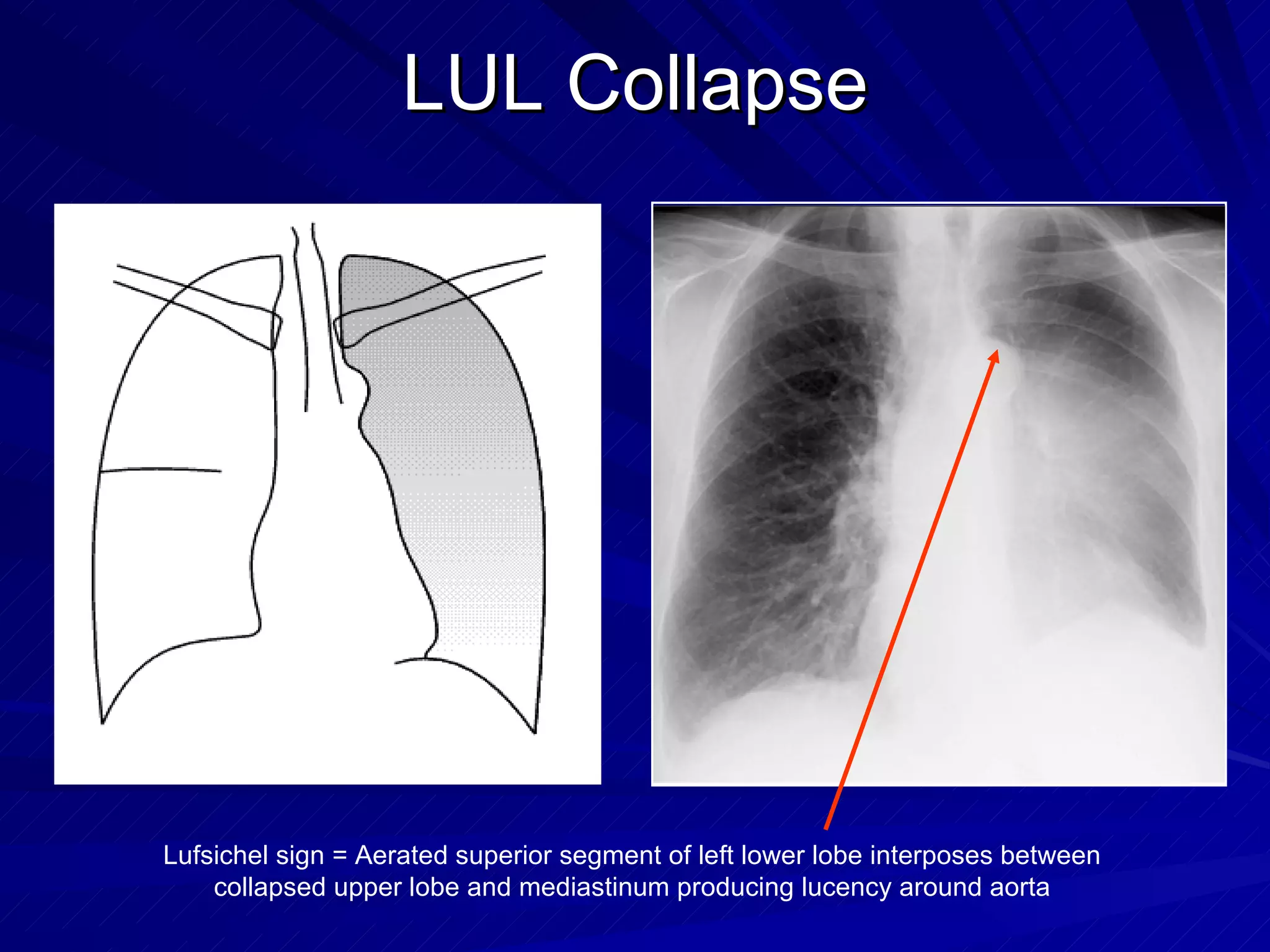
LUL Collapse Lufsichel sign = Aerated superior segment of left lower lobe interposes between collapsed upper lobe and mediastinum producing lucency around aorta
LLL collapse Sail-like line behind heart – occasionally seen as extremely straight heart border
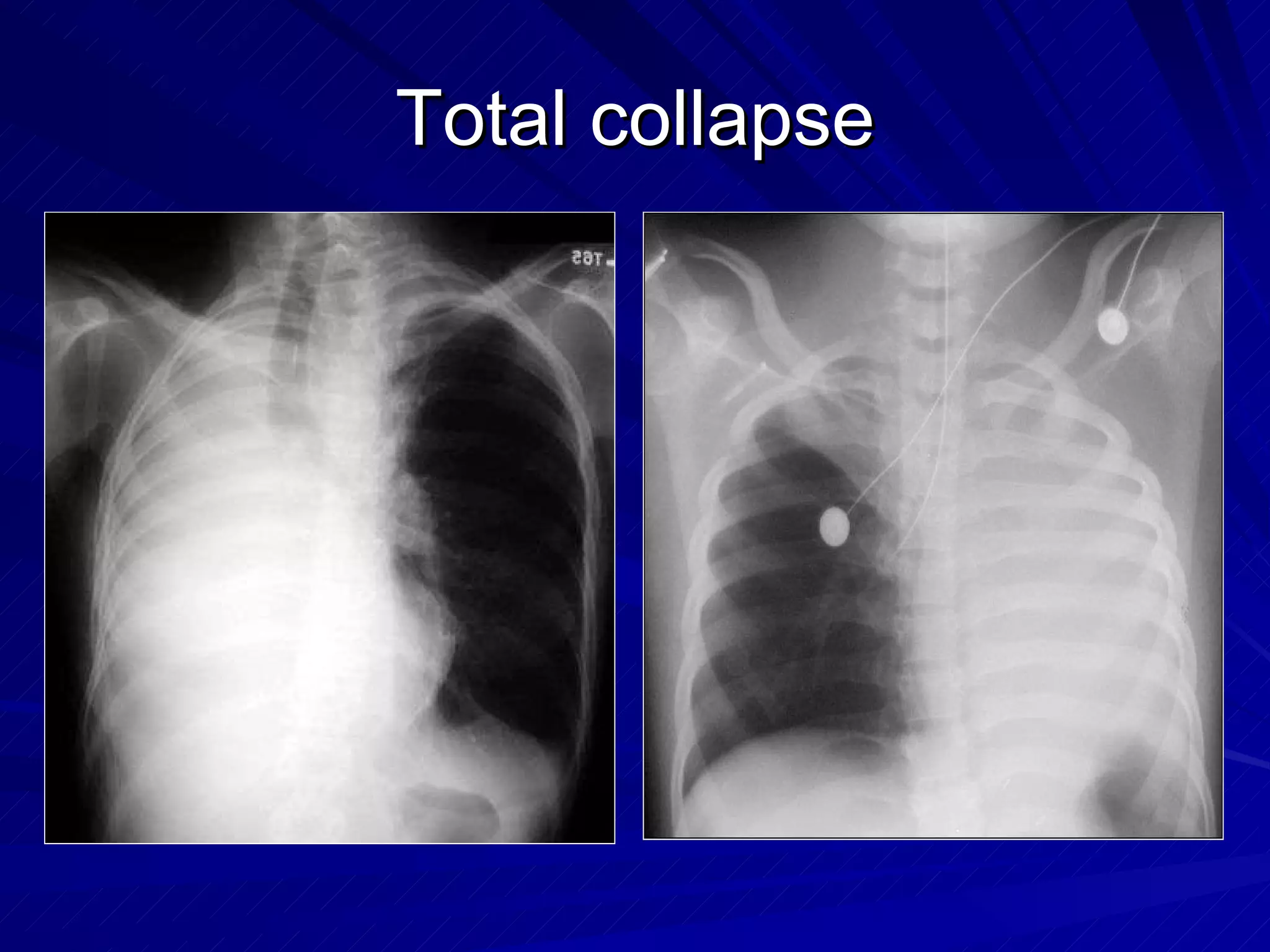
Total collapse
Abnormal Air Collections Subcutaneous emphysema Pneumomediastinum Pneumothorax Pulmonary interstitial emphysema
Pulmonary Interstitial Emphysema Much more common in neonates, rare in adults Alveolar rupture: air dissects into pulmonary interstitium Factors associated: Anything increasing intrapulmonary pressure Ventilation with peak airway pressures > 30 cm H 2 0 RDS or ARDS severity Associated pulmonary abnormalities CXR features : subtle & often hidden by other pathology Multiple small and large parenchymal cysts Small, mottled or streaky lucencies extending from hilum Perivascular halos from air collections Intra-septal air Subpleural cysts
Pulmonary Interstitial Emphysema
Pneumomediastinum Sources   of   air Intrathoracic Trachea   and   major   bronchi Esophagus Lung Pleural   space Extrathoracic Head   and   neck Intraperitoneum   and   retroperitoneum
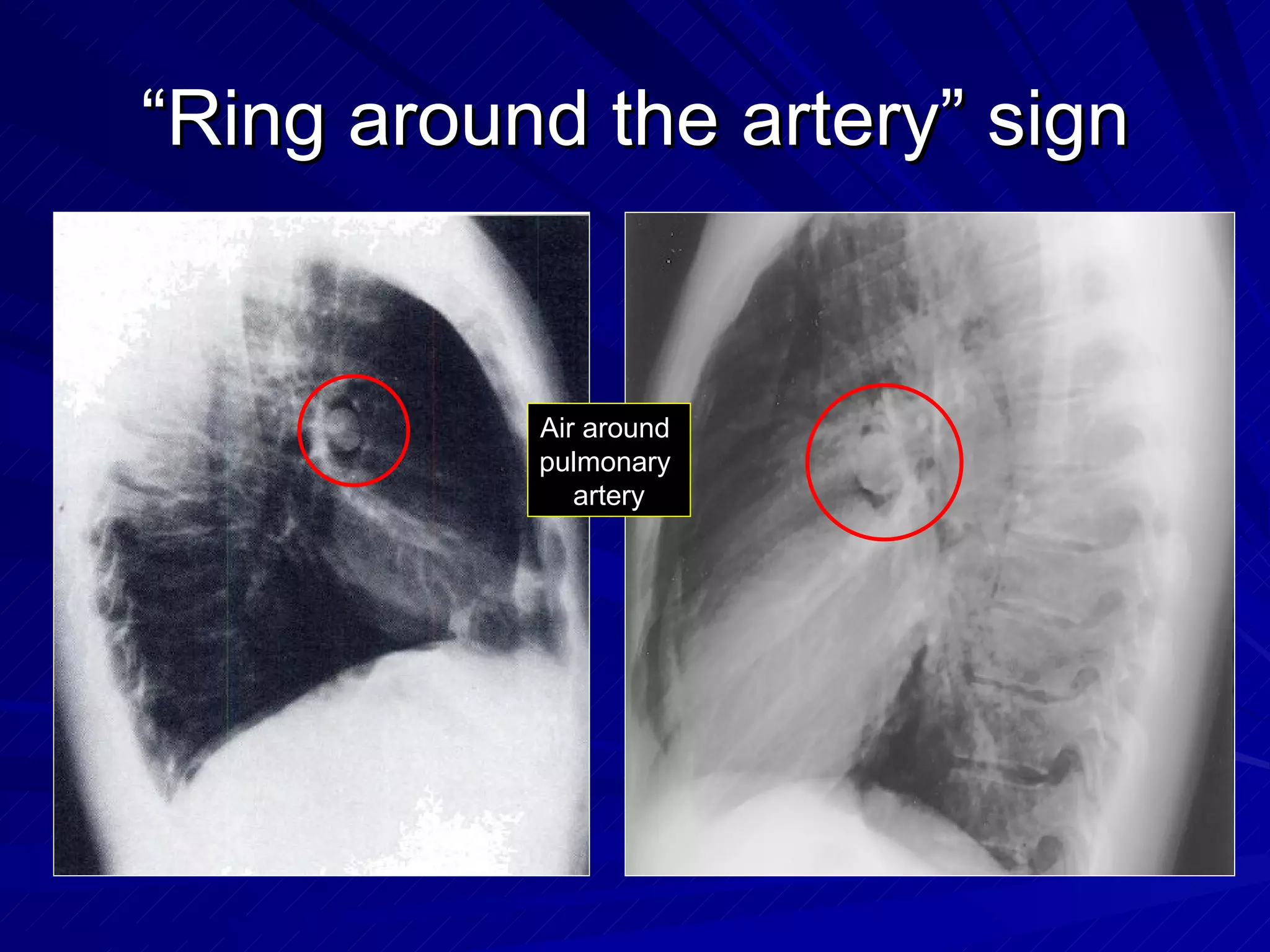
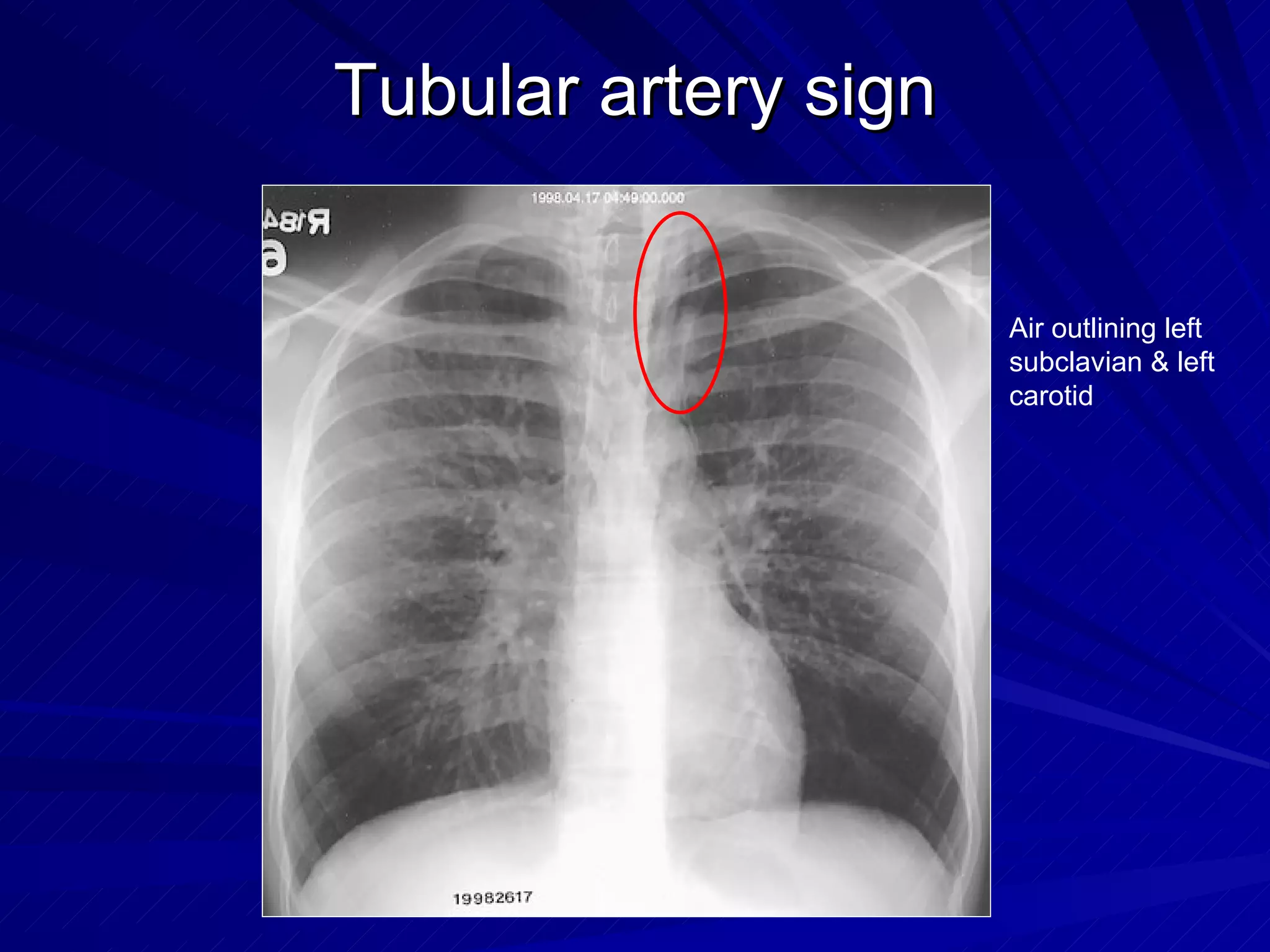
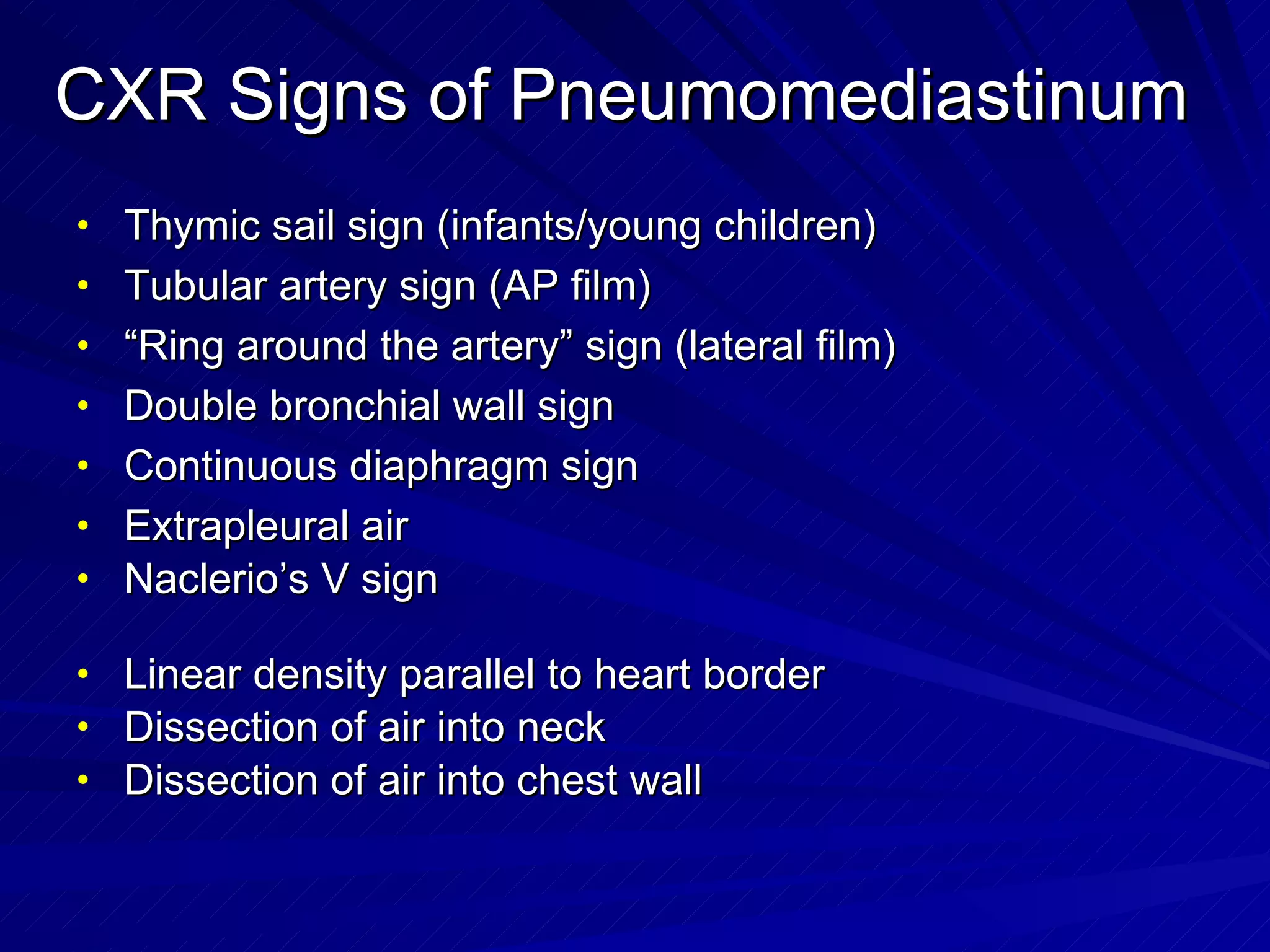
CXR Signs of Pneumomediastinum Thymic   sail   sign   (infants/young   children) Tubular   artery   sign   (AP   film) “ Ring   around   the   artery”   sign   (lateral   film) Double   bronchial   wall   sign Continuous   diaphragm   sign Extrapleural   air Naclerio ’s   V   sign Linear   density   parallel   to   heart   border Dissection   of   air   into   neck Dissection   of   air   into   chest   wall
Continuous diaphragm sign
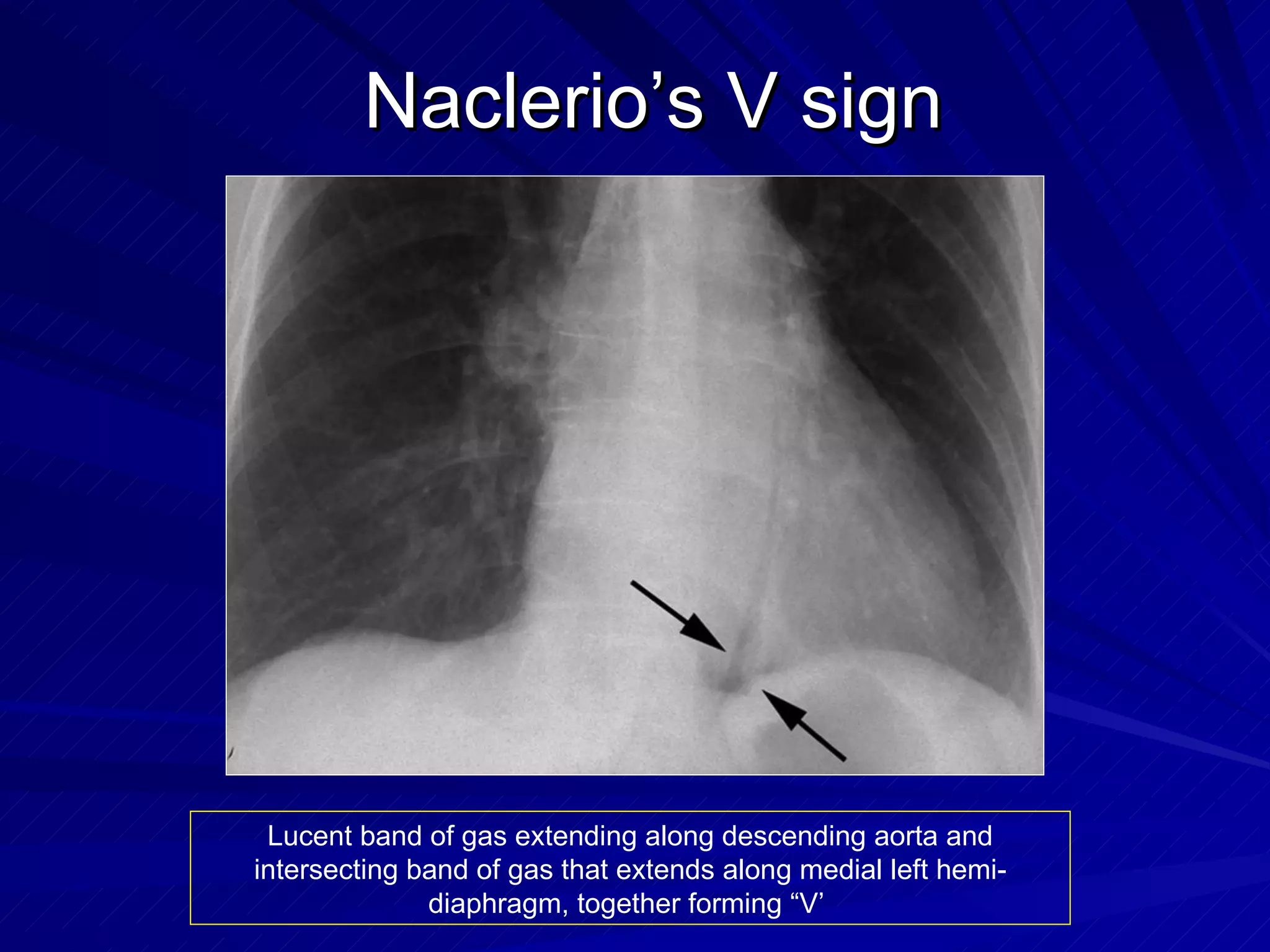
Naclerio’s V sign Lucent band of gas extending along descending aorta and intersecting band of gas that extends along medial left hemi- diaphragm, together forming  “V’
Double bronchial wall sign Air on both sides of bronchial wall makes full wall visible
“ Ring around the artery” sign Air around  pulmonary  artery
Tubular artery sign Air outlining left subclavian & left carotid
Thymic sail sign Thymus outlined by air Also air tracking up into neck
Extrapleural air e.g. pleura peeled off diaphragm
Mediastinal air
Mediastinal air running parallel to descending aorta
Pneumomediastinum vs pneumothorax
Pneumomediastinum vs pneumocardium
Pneumopericardium
Pitfalls – Mach band effect “ The Mach band effect is associated with convex surfaces, appearing as a region of lucency adjacent to structures with convex borders. The absence of an (associated) opaque line, which is typically seen in pneumomediastinum, can aid in differentiation ” Zylak C. Pneumomediastinum Revisited. Radiographics 2000; 20: 1043-1057.
Pneumothorax Apicolateral visceral pleural line Generally requires erect/semi-erect film Skin fold   may be mistaken for pleural line Lack of lung markings outside line Caution in COPD/bullous disease Bullae generally convex ICU CXR often supine/semi-erect Different criteria for diagnosis Often subtle WATCH OUT!
“ Occult” pneumothorax Crisp cardiac silhouette with increased lucency
Occult pneumothorax II Cardiophrenic sulcus highly visible Crisp heart border
Potential signs of pneumothorax Pleural   line   with   absent   markings Double   diaphragm   sign Visible   anterior   costophrenic   recess   interface   Sharpened   cardiac   silhouette   &   apex Hyperlucent   hemithorax Inferior   edge   of   collapsed   lung Deep   sulcus   sign Depressed   diaphragm Apical   pericardial   fat Discrete   lobulated   densities   (1-1   .5cm)   adjacent   to   cardiac   apex
Tension pneumothorax Flattening of heart border Flattening of adjacent vascular structures e.g. SVC Mediastinal shift - AWAY Diaphragmatic inversion
Double diaphragm sign
Pneumothorax in Supine Patients Anteromedial  - unusually sharp outline of: Mediastinal vascular structures Heart border Cardiophrenic sulcus Posteromedial Lucent band outlining mediastinal surface of a collapsed lower lobe Increased visibility of paraspinous line & descending aorta Increased visibility of posterior costophrenic sulcus Subpulmonic Hyperlucent upper abdominal quadrant Deep costophrenic sulcus (“deep sulcus” sign) Sharp hemidiaphragm despite opacification in lower lobe of lung (if consolidated) Visualisation of inferior surface of consolidated lung
Posteromedial Pneumothorax
Subpulmonic pneumothorax Deep sulcus, lucent RUQ Rankine, J. J et al. Postgrad Med J 2000;76:399-404
Anteromedial pneumothorax Sharp outline of mediastinum and right heart border. Right hemithorax has concurrent consolidation and effusion Rankine, J. J et al. Postgrad Med J 2000;76:399-404
Mimics - Skin fold
Subcutaneous emphysema
Lines, tubes and drains
Central line positioning - issues Right   upper   heart   border   is   left   atrium,   not   the   right ,   in   38%   of   patients   Radiographic   SVC/RA   junction: hard   to   see   in   10% inaccurate:   can   be   up   to   2.8   cm   higher   than   echocardiographic   junction not   all   lines   within   heart   shadow   on   xray   are   in   the   RA CVC   tip   should   lie in   SVC above   pericardial   reflection   (but   no   radiographic   marker   of   this   structure) BUT   is   acceptable   for   dialysis   line   tip   to   lie   at   SVC/RA   junction   or   in   RA Line   should   lie   parallel   to   vessel   wall Line   tip   <   2.9   cm   beyond   take-off   of   right   main   bronchus   is   always   in   SVC Right   tracheobronchial   angle   is   always   below   junction   of   brachiocephalic   veins Carina   is   mean   of   1.3   cm   below   mid-point   of   the   SVC   and   up   to   0.7   cm   below   pericardial   reflection   –   is   suitable   location   for   line   tip
British Journal of Anaesthesia 2006 96(3):335-340
Catheter tips abutting SVC wall – risk of perforation
 
Malposition – subclavian line into jugular vein
Images to review
Asthma + diversion + peribronchial cuffing
Right Haemothorax with bullet
LUL collapse + LLL collapse
Linear (plate) atelectasis + small bowel obstruction
Bilateral hilar enlargement - lymphoma
Bilateral cavitating lesions with fluid levels - Staph abcess
Chilaiditi's syndrome – colon interspersed between liver/spleen and diaphragm
Deep sulcus sign – left pneumothorax
 
Diffuse alveolar haemorrhage
Node in aortopulmonary window
Fluid level behind heart – hiatus hernia
Silicone breast implants
Pneumothorax - blocked chest drain
Subcutaneous emphysema, LIJ CVC tip position poor
Residual haemothorax on left with chest tube and LLL collapse/consolidation + air bronchogram: haemothorax on right. Oesophagus displaced to left

Chest radiology in intensive care

  • 1.
    Chest Radiology inIntensive Care Medicine Dr. Andrew Ferguson MEd FRCA DIBICM FCCP Assistant Professor, Medicine (Critical Care) & Anesthesia Dalhousie University
  • 2.
    Overview Air bronchograms& silhouette sign Hilar enlargement Alveolar & interstitial infiltrates Effusions Pulmonary oedema Assessment of volume status using CXR Lobar anatomy & collapse Abnormal air collections Lines, tubes and drains
  • 3.
    Radiographic anatomy OrLA NOTE In spite of what you May have heard… The right heart border Is formed by left atrium in up to 38% of patients AV TV MV
  • 4.
    Air bronchograms Bronchinormally invisible as they are thin-walled, filled with air , and surrounded by air Except when alveoli fill with substance with the density of fluid e.g. Pulmonary oedema Blood Gastric aspirate Inflammatory exudate Bronchi visible when surrounded by diseased lung = air bronchogram
  • 5.
    Silhouette Sign When an object is in contact with another of different density the adjoining edge is visible e.g. heart border against aerated lung When objects of the same density are in contact the adjoining edge is invisible e.g. heart border against consolidated lung
  • 6.
    Silhouette Sign LobeSilhouetted structure Right middle lobe Right heart border Left lingula Left heart border Right lower lobe Right hemidiaphragm Left lower lobe Left hemidiaphragm Post apical segment left upper lobe Aortic knob Ant segment right upper lobe Ascending aorta
  • 7.
    Hilar enlargement Unilateral hilar adenopathy Neoplasm Primary Tuberculosis Sarcoidosis (3-8%) Primary pulmonary fungal infection Bilateral hilar adenopathy Sarcoidosis may also see right paratracheal nodes Lymphoma False positive Expiration film Pulmonary Hypertension
  • 8.
    Alveolar infiltrates Airbronchograms “ Fluffy” / indistinct appearance Segmental or lobar distribution Homogeneous & confluent What can fill alveoli? Water: pulmonary oedema Protein: ARDS, alveolar proteinosis Fibrous tissue: BOOP, radiation Cells: Neutrophils : pneumonia; pneumonitis Eosinophils : eosinophilic pneumonia RBCs : DAH, contusion, infarction, vasculitis Neoplastic : carcinoma, lymphoma, Lymphocytes : pneumonitis, sarcoidosis
  • 9.
    Rapid Clearance ofAlveolar Infiltrate Pulmonary oedema Pulmonary haemorrhage Aspiration Pneumococcal pneumonia (possibly)
  • 10.
    Interstitial Infiltrates InhomogeneousDiscrete No bronchograms Reticular (lines) and/or Nodular (circles) Fibrosis Connective tissue disease Sarcoidosis Radiation fibrosis Asbestosis Lymphangitis carcinomatosis Silicosis TB
  • 11.
  • 12.
    Pleural Effusion AppearancesSubpulmonic effusion Blunting of Costophrenic angle Meniscus sign Layering Loculated Laminar effusion Subpleural between lung & pleura Opacified hemithorax Air-fluid levels
  • 13.
    Subpulmonic Effusion Tenteddiaphragmatic dome or apex more lateral than expected Costophrenic angle more shallow than expected Elevated diaphragm appears thicker and more separated from gastric bubble Usually < 350 ml volume
  • 14.
    Blunting of Costo-phrenicAngle 200-300 ml effusion required (AP film) 100-150 ml blunts posterior angle on lateral CXR
  • 15.
  • 16.
    Pulmonary Oedema ?Upper lobe diversion (“cephalization”) Infiltrates Batswing Diffuse Pleural effusions Septal lines e.g. Kerley B Basal, 1-2 cm long, straight, 90 o to pleura Thickening of fissures Peribronchial cuffing Interstitial Oedema
  • 17.
  • 18.
    < 10% ofcases of pulmonary oedema, usually in rapid onset oedema e.g. acute MR
  • 19.
  • 20.
    Peribronchial Cuffing Maybe normal finding if right at hilum
  • 21.
    Asymmetric pulmonary oedemaChronic lung disease altering vascular flow Acute MR - jet to right pulm vein often RUL Patient position (gravitational) Re-expansion
  • 22.
    Vascular Pedicle Widthin Pulmonary Oedema
  • 23.
    Martin, G. S.et al. Chest 2002;122:2087-2095 Landmarks for measurement of VPW and CTR on a routine CXR
  • 24.
    Vascular pedicle widthand fluid status in pulmonary oedema
  • 25.
  • 26.
    VPW/CTR as predictorof PCWP > 18 Criteria Sensitivity Specificity PPV NPV Odds ratio VPW > 70 & CTR > 0.55 54% 83% 76% 65% 3.2 VPW > 70 69% 72% 70% 72% 2.5 CTR > 0.55 63% 50% 56% 57% 1.3
  • 27.
  • 28.
  • 29.
  • 30.
    RML collapse Indistinctright heart border
  • 31.
    RLL collapse Fissuremay be visible Sail-like line behind right heart plus indistinct diaphragm
  • 32.
    LUL Collapse Lufsichelsign = Aerated superior segment of left lower lobe interposes between collapsed upper lobe and mediastinum producing lucency around aorta
  • 33.
    LLL collapse Sail-likeline behind heart – occasionally seen as extremely straight heart border
  • 34.
  • 35.
    Abnormal Air CollectionsSubcutaneous emphysema Pneumomediastinum Pneumothorax Pulmonary interstitial emphysema
  • 36.
    Pulmonary Interstitial EmphysemaMuch more common in neonates, rare in adults Alveolar rupture: air dissects into pulmonary interstitium Factors associated: Anything increasing intrapulmonary pressure Ventilation with peak airway pressures > 30 cm H 2 0 RDS or ARDS severity Associated pulmonary abnormalities CXR features : subtle & often hidden by other pathology Multiple small and large parenchymal cysts Small, mottled or streaky lucencies extending from hilum Perivascular halos from air collections Intra-septal air Subpleural cysts
  • 37.
  • 38.
    Pneumomediastinum Sources of air Intrathoracic Trachea and major bronchi Esophagus Lung Pleural space Extrathoracic Head and neck Intraperitoneum and retroperitoneum
  • 39.
    CXR Signs ofPneumomediastinum Thymic sail sign (infants/young children) Tubular artery sign (AP film) “ Ring around the artery” sign (lateral film) Double bronchial wall sign Continuous diaphragm sign Extrapleural air Naclerio ’s V sign Linear density parallel to heart border Dissection of air into neck Dissection of air into chest wall
  • 40.
  • 41.
    Naclerio’s V signLucent band of gas extending along descending aorta and intersecting band of gas that extends along medial left hemi- diaphragm, together forming “V’
  • 42.
    Double bronchial wallsign Air on both sides of bronchial wall makes full wall visible
  • 43.
    “ Ring aroundthe artery” sign Air around pulmonary artery
  • 44.
    Tubular artery signAir outlining left subclavian & left carotid
  • 45.
    Thymic sail signThymus outlined by air Also air tracking up into neck
  • 46.
    Extrapleural air e.g.pleura peeled off diaphragm
  • 47.
  • 48.
    Mediastinal air runningparallel to descending aorta
  • 49.
  • 50.
  • 51.
  • 52.
    Pitfalls – Machband effect “ The Mach band effect is associated with convex surfaces, appearing as a region of lucency adjacent to structures with convex borders. The absence of an (associated) opaque line, which is typically seen in pneumomediastinum, can aid in differentiation ” Zylak C. Pneumomediastinum Revisited. Radiographics 2000; 20: 1043-1057.
  • 53.
    Pneumothorax Apicolateral visceralpleural line Generally requires erect/semi-erect film Skin fold may be mistaken for pleural line Lack of lung markings outside line Caution in COPD/bullous disease Bullae generally convex ICU CXR often supine/semi-erect Different criteria for diagnosis Often subtle WATCH OUT!
  • 54.
    “ Occult” pneumothoraxCrisp cardiac silhouette with increased lucency
  • 55.
    Occult pneumothorax IICardiophrenic sulcus highly visible Crisp heart border
  • 56.
    Potential signs ofpneumothorax Pleural line with absent markings Double diaphragm sign Visible anterior costophrenic recess interface Sharpened cardiac silhouette & apex Hyperlucent hemithorax Inferior edge of collapsed lung Deep sulcus sign Depressed diaphragm Apical pericardial fat Discrete lobulated densities (1-1 .5cm) adjacent to cardiac apex
  • 57.
    Tension pneumothorax Flatteningof heart border Flattening of adjacent vascular structures e.g. SVC Mediastinal shift - AWAY Diaphragmatic inversion
  • 58.
  • 59.
    Pneumothorax in SupinePatients Anteromedial - unusually sharp outline of: Mediastinal vascular structures Heart border Cardiophrenic sulcus Posteromedial Lucent band outlining mediastinal surface of a collapsed lower lobe Increased visibility of paraspinous line & descending aorta Increased visibility of posterior costophrenic sulcus Subpulmonic Hyperlucent upper abdominal quadrant Deep costophrenic sulcus (“deep sulcus” sign) Sharp hemidiaphragm despite opacification in lower lobe of lung (if consolidated) Visualisation of inferior surface of consolidated lung
  • 60.
  • 61.
    Subpulmonic pneumothorax Deepsulcus, lucent RUQ Rankine, J. J et al. Postgrad Med J 2000;76:399-404
  • 62.
    Anteromedial pneumothorax Sharpoutline of mediastinum and right heart border. Right hemithorax has concurrent consolidation and effusion Rankine, J. J et al. Postgrad Med J 2000;76:399-404
  • 63.
  • 64.
  • 65.
  • 66.
    Central line positioning- issues Right upper heart border is left atrium, not the right , in 38% of patients Radiographic SVC/RA junction: hard to see in 10% inaccurate: can be up to 2.8 cm higher than echocardiographic junction not all lines within heart shadow on xray are in the RA CVC tip should lie in SVC above pericardial reflection (but no radiographic marker of this structure) BUT is acceptable for dialysis line tip to lie at SVC/RA junction or in RA Line should lie parallel to vessel wall Line tip < 2.9 cm beyond take-off of right main bronchus is always in SVC Right tracheobronchial angle is always below junction of brachiocephalic veins Carina is mean of 1.3 cm below mid-point of the SVC and up to 0.7 cm below pericardial reflection – is suitable location for line tip
  • 67.
    British Journal ofAnaesthesia 2006 96(3):335-340
  • 68.
    Catheter tips abuttingSVC wall – risk of perforation
  • 69.
  • 70.
    Malposition – subclavianline into jugular vein
  • 71.
  • 72.
    Asthma + diversion+ peribronchial cuffing
  • 73.
  • 74.
    LUL collapse +LLL collapse
  • 75.
    Linear (plate) atelectasis+ small bowel obstruction
  • 76.
  • 77.
    Bilateral cavitating lesionswith fluid levels - Staph abcess
  • 78.
    Chilaiditi's syndrome –colon interspersed between liver/spleen and diaphragm
  • 79.
    Deep sulcus sign– left pneumothorax
  • 80.
  • 81.
  • 82.
  • 83.
    Fluid level behindheart – hiatus hernia
  • 84.
  • 85.
  • 86.
    Subcutaneous emphysema, LIJCVC tip position poor
  • 87.
    Residual haemothorax onleft with chest tube and LLL collapse/consolidation + air bronchogram: haemothorax on right. Oesophagus displaced to left