DAILY LESSON PLANNED
SUBJECT: FIZIK
FORM 4 CLASS ACT
DATE 13-Jun-22 WEEK 25 TIME 12.30 p.m. – 2.00 p.m.
VENUE Physics Lab ATTENDANCE
THEME/TOPIC/
LEARNING AREA
ELECTRIC AND ELECTROMAGNET
CONTENT STANDARD 3.2 Resistance
LEARNING STANDARD
3.2.1 Compare and contrast an Ohmic Conductor and non-ohmic conductor.
3.2.2 Solve problems involving combination of series and parallel circuit.
3.2.3 Explain resistivity of wire.
3.2.4 Describe the factors affect resistance of wire, using experiment and conclude R =𝜌𝑙𝐴
3.2.5 Communicate on the application of resistivity of wire in daily life.
3.2.6 Solve problems involving resistance using formula, R = 𝜌𝑙𝐴
LEARNING OBJECTIVES/
SUCCESS CRITERIA
Students can compare an Ohmic Conductor and non-ohmic conductor.
Students Solve problems involving combination of series and parallel circuit.
Students write the meaning of resistivity of wire,
Students give 2 factors affect resistance of wire, using experiment and conclude R =𝜌𝑙𝐴
Students give 2 applications of resistivity of wire in daily life.
Students can solve problems involving resistance using formula, R = 𝜌𝑙𝐴
STEPS TEACHING & LEARNING ACTIVITIES
FORMATIVE
ASSESSMENT
DIFFERENTIATION
ENGAGEMENT
Students are shown an LED and a few
students are asked about its function.
Stations
EXPLORATION
Students carry out experiment to study the
relationship between I and V of an ohmic
conductor and non ohmic conductor.
Experiment To study the relationship
between the length and the resistance of a
wire.
To study the relationship between the cross-
sectional area and the resistance of a wire.
To study the relationship between the
resistivity and the resistance of a wire.
Students relate R to length and surface area
to get an equation of resistivity.
Experiment report
Station
EXPLANATION
Students discuss in group about the
difference between the 2 experiments
results.
Complete comparison
table
ELABORATION
Students explore, discuss, and compare
series and parallel circuits. Discuss about
factors affecting the resistance of wire.
Gallery walks.
EVALUATION Students answer quiz. Quiz.
CLOSURE/
SUMMARISATION
Students are asked to recall back the key points learned today. Ask them to write on the
whiteboard what they remember the most.
CROSS CURRICULUM
ELEMENT
Noble Values
SCIENTIFIC ATTITUDES
AND MORAL VALUE
Cooperative
STRATEGY Scientific Investigation/Experiment
21st LEARNING
ACTIVITIES
Parking Lot, Gallery walk, Online resources.
TEACHING&LEARNING
AIDS/SOURCES/
REFERENCES
REFLECTION
Notes (IGCSE)
Describe an experiment to determine resistance using a voltmeter and an ammeter
Supplement
• Sketch and explain the current–voltage characteristic of an ohmic resistor and a filament lamp
• Recall and use quantitatively the proportionality between resistance and length, and the inverse proportionality
between resistance and cross-sectional area of a wire

3.2 Resistance (revision final).pdf

  • 1.
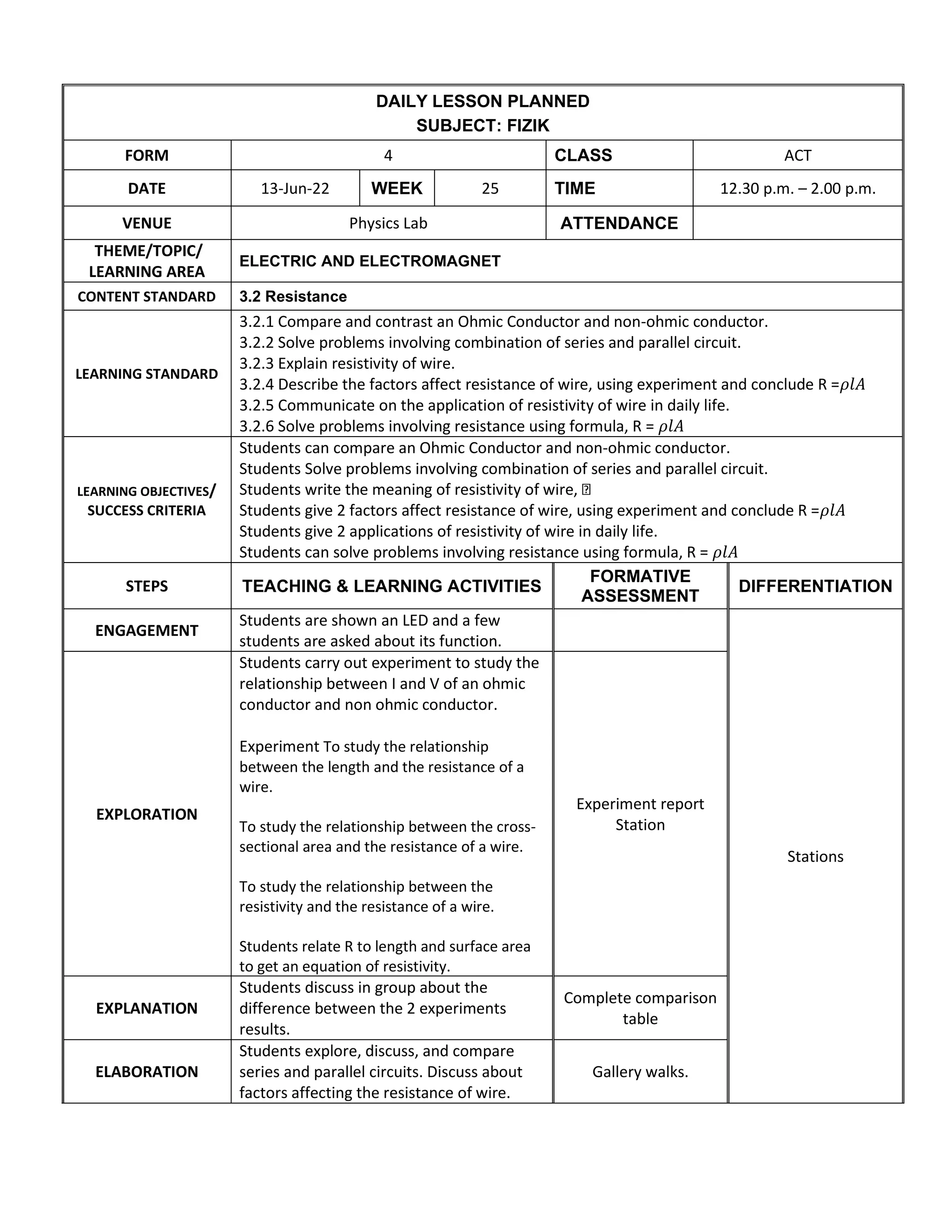
    DAILY LESSON PLANNED SUBJECT:FIZIK FORM 4 CLASS ACT DATE 13-Jun-22 WEEK 25 TIME 12.30 p.m. – 2.00 p.m. VENUE Physics Lab ATTENDANCE THEME/TOPIC/ LEARNING AREA ELECTRIC AND ELECTROMAGNET CONTENT STANDARD 3.2 Resistance LEARNING STANDARD 3.2.1 Compare and contrast an Ohmic Conductor and non-ohmic conductor. 3.2.2 Solve problems involving combination of series and parallel circuit. 3.2.3 Explain resistivity of wire. 3.2.4 Describe the factors affect resistance of wire, using experiment and conclude R =𝜌𝑙𝐴 3.2.5 Communicate on the application of resistivity of wire in daily life. 3.2.6 Solve problems involving resistance using formula, R = 𝜌𝑙𝐴 LEARNING OBJECTIVES/ SUCCESS CRITERIA Students can compare an Ohmic Conductor and non-ohmic conductor. Students Solve problems involving combination of series and parallel circuit. Students write the meaning of resistivity of wire, Students give 2 factors affect resistance of wire, using experiment and conclude R =𝜌𝑙𝐴 Students give 2 applications of resistivity of wire in daily life. Students can solve problems involving resistance using formula, R = 𝜌𝑙𝐴 STEPS TEACHING & LEARNING ACTIVITIES FORMATIVE ASSESSMENT DIFFERENTIATION ENGAGEMENT Students are shown an LED and a few students are asked about its function. Stations EXPLORATION Students carry out experiment to study the relationship between I and V of an ohmic conductor and non ohmic conductor. Experiment To study the relationship between the length and the resistance of a wire. To study the relationship between the cross- sectional area and the resistance of a wire. To study the relationship between the resistivity and the resistance of a wire. Students relate R to length and surface area to get an equation of resistivity. Experiment report Station EXPLANATION Students discuss in group about the difference between the 2 experiments results. Complete comparison table ELABORATION Students explore, discuss, and compare series and parallel circuits. Discuss about factors affecting the resistance of wire. Gallery walks.
  • 2.
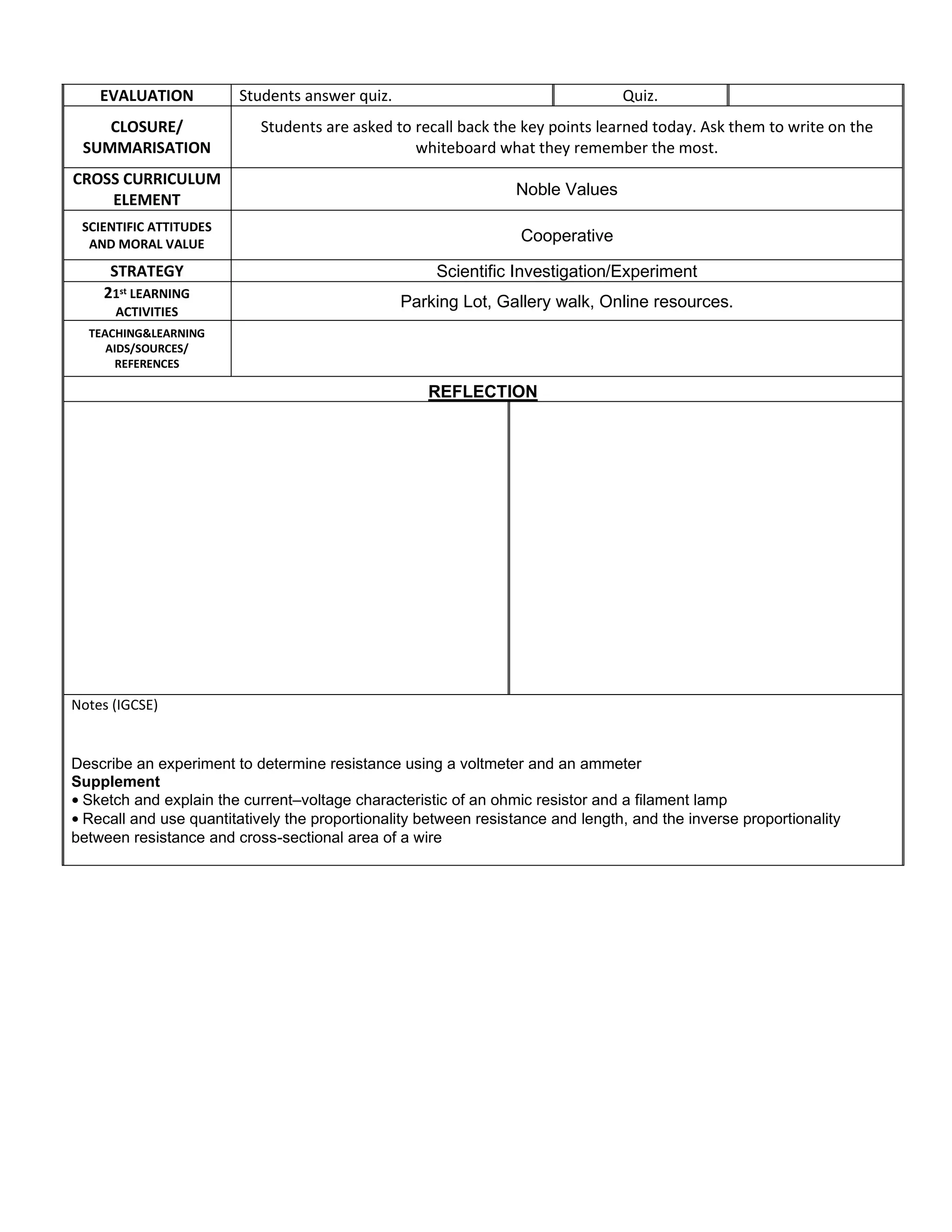
    EVALUATION Students answerquiz. Quiz. CLOSURE/ SUMMARISATION Students are asked to recall back the key points learned today. Ask them to write on the whiteboard what they remember the most. CROSS CURRICULUM ELEMENT Noble Values SCIENTIFIC ATTITUDES AND MORAL VALUE Cooperative STRATEGY Scientific Investigation/Experiment 21st LEARNING ACTIVITIES Parking Lot, Gallery walk, Online resources. TEACHING&LEARNING AIDS/SOURCES/ REFERENCES REFLECTION Notes (IGCSE) Describe an experiment to determine resistance using a voltmeter and an ammeter Supplement • Sketch and explain the current–voltage characteristic of an ohmic resistor and a filament lamp • Recall and use quantitatively the proportionality between resistance and length, and the inverse proportionality between resistance and cross-sectional area of a wire