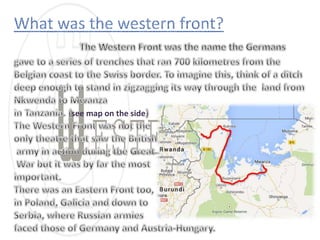
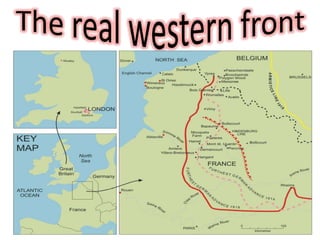
see map on the side
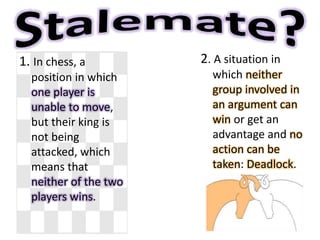
1. In chess, a
position in which
one player is
unable to move,
but their king is
not being
attacked, which
means that
neither of the two
players wins.
2. A situation in
which neither
group involved in
an argument can
win or get an
advantage and no
action can be
taken: Deadlock.
For the first two months of the WW1, the
armies fought each other in a ‘war of
movement’ ;movements of troops in both
France and Belgium. Later on, fighting was
characterized by the static (no movement)
warfare in the long trench system known as
the Western Front. By Christmas the positions
of these trenches were more-or-less fixed for
the next three years.
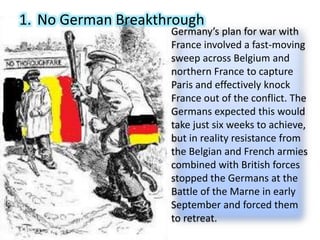
Germany’s plan for war with
France involved a fast-moving
sweep across Belgium and
northern France to capture
Paris and effectively knock
France out of the conflict. The
Germans expected this would
take just six weeks to achieve,
but in reality resistance from
the Belgian and French armies
combined with British forces
stopped the Germans at the
Battle of the Marne in early
September and forced them
to retreat.
1. No German Breakthrough
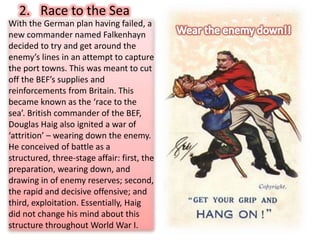
With the German plan having failed, a
new commander named Falkenhayn
decided to try and get around the
enemy’s lines in an attempt to capture
the port towns. This was meant to cut
off the BEF’s supplies and
reinforcements from Britain. This
became known as the ‘race to the
sea’. British commander of the BEF,
Douglas Haig also ignited a war of
‘attrition’ – wearing down the enemy.
He conceived of battle as a
structured, three-stage affair: first, the
preparation, wearing down, and
drawing in of enemy reserves; second,
the rapid and decisive offensive; and
third, exploitation. Essentially, Haig
did not change his mind about this
structure throughout World War I.
2. Race to the Sea
3. Defensive positions. The Germans and Allies
resisted each other's attacks
by digging defensive
positions. Having retreated
some 45 miles in a matter
of days, the German army
showed the value of
trenches as defensive
positions at the Battle of
the Aisne. The Germans
used machine guns and
artillery to fend off Allied
assaults. Similar defensive
positions were constructed
all along the emerging
Western Front.
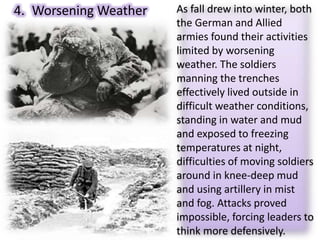
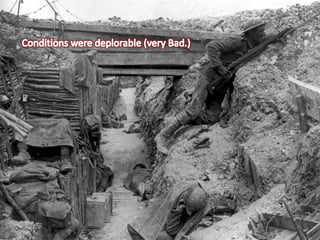
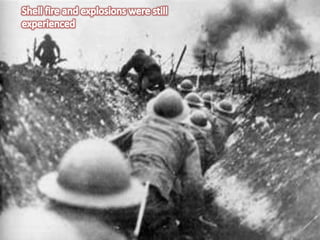
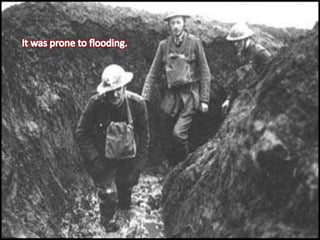
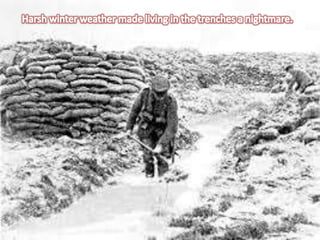
4. Worsening Weather As fall drew into winter, both
the German and Allied
armies found their activities
limited by worsening
weather. The soldiers
manning the trenches
effectively lived outside in
difficult weather conditions,
standing in water and mud
and exposed to freezing
temperatures at night,
difficulties of moving soldiers
around in knee-deep mud
and using artillery in mist
and fog. Attacks proved
impossible, forcing leaders to
think more defensively.
The Germans were more thorough,
and built their trenches deeper, with
more amenities and general attitude
that they were there to stay!
The British did not want to encourage any
feeling of being there to stay – a trench was a
temporary structure, from which to attack the
enemy and move on! Their attitude changed a
bit throughout the war, and the trenches
developed better amenities.
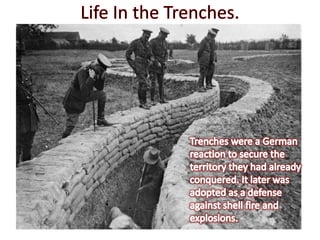
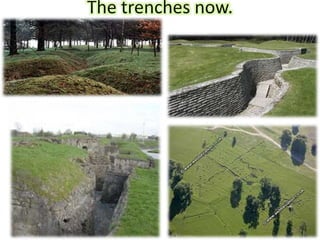
Trenches were never dug in one straight line but were zigzagged one way or another.
That prevented the enemy from enfilading a long length of trench. Quite how the
trenches were constructed depended on the soil. In Flanders it was muddy and the
water table was high, especially after the Belgians had opened the lock gates to allow
flooding by the sea water.
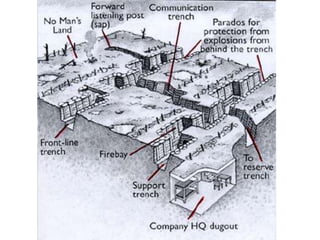
Front line trenches might only be 10 –20 metres away from the enemy, or as much as
350 metres. Behind these would be support trenches, and connecting trenches
between the two systems. The network of trenches was too complex, at times soldiers
would get lost. It took a skilled guide to lead men in and out.
Life in the trenches was described as:
80% bored to death
19% frozen to death
1% scared to death
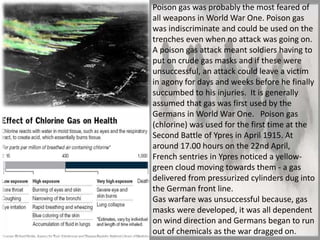
Poison gas was probably the most feared of
all weapons in World War One. Poison gas
was indiscriminate and could be used on the
trenches even when no attack was going on.
A poison gas attack meant soldiers having to
put on crude gas masks and if these were
unsuccessful, an attack could leave a victim
in agony for days and weeks before he finally
succumbed to his injuries. It is generally
assumed that gas was first used by the
Germans in World War One. Poison gas
(chlorine) was used for the first time at the
Second Battle of Ypres in April 1915. At
around 17.00 hours on the 22nd April,
French sentries in Ypres noticed a yellow-
green cloud moving towards them - a gas
delivered from pressurized cylinders dug into
the German front line.
Gas warfare was unsuccessful because, gas
masks were developed, it was all dependent
on wind direction and Germans began to run
out of chemicals as the war dragged on.
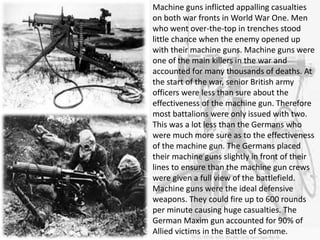
Machine guns inflicted appalling casualties
on both war fronts in World War One. Men
who went over-the-top in trenches stood
little chance when the enemy opened up
with their machine guns. Machine guns were
one of the main killers in the war and
accounted for many thousands of deaths. At
the start of the war, senior British army
officers were less than sure about the
effectiveness of the machine gun. Therefore
most battalions were only issued with two.
This was a lot less than the Germans who
were much more sure as to the effectiveness
of the machine gun. The Germans placed
their machine guns slightly in front of their
lines to ensure than the machine gun crews
were given a full view of the battlefield.
Machine guns were the ideal defensive
weapons. They could fire up to 600 rounds
per minute causing huge casualties. The
German Maxim gun accounted for 90% of
Allied victims in the Battle of Somme.
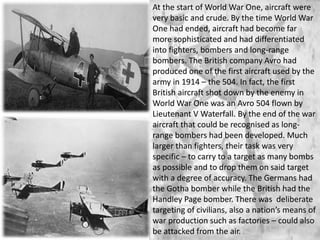
At the start of World War One, aircraft were
very basic and crude. By the time World War
One had ended, aircraft had become far
more sophisticated and had differentiated
into fighters, bombers and long-range
bombers. The British company Avro had
produced one of the first aircraft used by the
army in 1914 – the 504. In fact, the first
British aircraft shot down by the enemy in
World War One was an Avro 504 flown by
Lieutenant V Waterfall. By the end of the war
aircraft that could be recognised as long-
range bombers had been developed. Much
larger than fighters, their task was very
specific – to carry to a target as many bombs
as possible and to drop them on said target
with a degree of accuracy. The Germans had
the Gotha bomber while the British had the
Handley Page bomber. There was deliberate
targeting of civilians, also a nation’s means of
war production such as factories – could also
be attacked from the air.
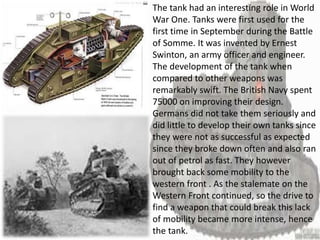
The tank had an interesting role in World
War One. Tanks were first used for the
first time in September during the Battle
of Somme. It was invented by Ernest
Swinton, an army officer and engineer.
The development of the tank when
compared to other weapons was
remarkably swift. The British Navy spent
75000 on improving their design.
Germans did not take them seriously and
did little to develop their own tanks since
they were not as successful as expected
since they broke down often and also ran
out of petrol as fast. They however
brought back some mobility to the
western front . As the stalemate on the
Western Front continued, so the drive to
find a weapon that could break this lack
of mobility became more intense, hence
the tank.
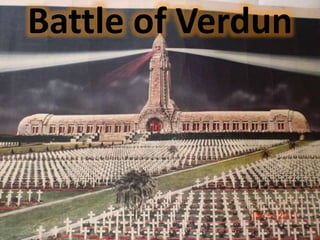
Battle of Verdun
On February 21st in 1916, the German army sets
off this major offensive against Verdun. This date
marks the beginning of a nightmare for all
French soldiers. The “hell of Verdun” (l’Enfer de
Verdun) will last 10 months ; 300 days and 300
nights of ceaseless and murderous battles.
The Battle of Verdun in 1916 was the longest single battle of World
War One. The casualties from Verdun and the impact the battle had
on the French Army was a primary reason for the British starting the
Battle of the Somme in July 1916 in an effort to take German
pressure off of the French at Verdun. The Battle of Verdun started on
February 21st 1916 and ended on December 16th in 1916. The attack
on Verdun came about because of a plan by the German Chief of
General Staff, von Falkenhayn. He wanted to launch a massive
German attack on a narrow stretch of land that had historic
sentiment for the French as a fortress region. Falkenhayn believed
that the French would lose so many men at the battle in an attempt
to save Verdun and this would change the course of the war.
140,000 German troops started the
attack. They were supported by
1,200 artillery guns that targeted
2,500,000 shells at the Verdun
region. 1,300 ammunition trains
were needed to supply these guns.
The Germans also had complete air
supremacy with 168 planes located
in the area - the largest
concentration of planes in history
up to that point. To start with, the
French only had 30,000 troops to
oppose the Germans. On the day
the battle started, February 21st,
1000 German artillery guns fired on
a six mile line along the French
front. On the fourth day, the
Germans captured the outer
defences of Verdun.
The French put General Philippe Pétain
in charge of the defense of Verdun.
25,000 tons of supplies were moved into
Verdun and 90,000 soldiers. But despite
the new military input, the French
suffered badly. The Germans also
suffered huge losses. By the end of April,
the Germans had lost 120,000 men and
the French 133,000 men. On June 1st,
Germany launched a massive attack at
Verdun. By June 23rd, they were closing
in on Verdun itself but this attack
faltered as the German army itself had
given all that it had and it could give no
more. In addition, the British decision to
attack Germans on the Somme caused
the Germans to call off the offensive.
The loss of life and those wounded was huge at Verdun. It is
probable that an accurate figure will never be known. It is said
that the French lost over 360,000 and the Germans nearly
340,000. To relieve the pressure being felt by the French, the
British launched the Battle of the Somme in July 1916. It was
hoped that a swift British victory here would force the
Germans to remove troops from the Verdun area. However,
like the French, the British got involved in a battle that was to
last months rather than days.
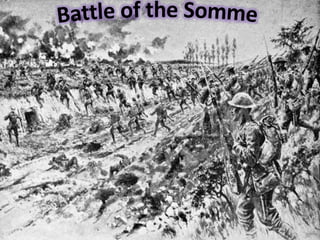
The battle of the Somme was
fought in the area around the
river Somme. This battle has
been known as the biggest and
bloodiest battle in the history of
war. It dates back to the German
planned attack on Verdun in an
attempt to capture some
important French forts. This
battle dragged on with both sides
losing so many men. Douglas
Haig launched an offensive in the
Somme region against the
Germans to relieve pressure on
Verdun and to support the
French army.
In early 1916, the French proposed a
joint Franco-British (including the
Australians who were still under
British command)offensive on both
sides of the river Somme. Hence, on
July 1, 1916, the British army attacked
north of the Somme with fourteen
infantry divisions (approx 120,000
men), while the French attacked
across and south of the Somme with
five divisions. In defense, the German
army deployed seven divisions. The
British attack was planned by Douglas
Haig. Haig's 'Great Push' on the
Somme was his first major offensive
since his promotion to Commander in
Chief in December 1915 and his
reputation was at stake.
THE FIRST PHASE
Haig believed that a successful attack would include a heavy
bombardment by artillery in order to destroy German barbed wire,
trenches, machine guns and soldiers. After which the Germans would
cross over No-Man’s Land and occupy German trenches. The plan was
conducted as it was. As the British left their bunkers to advance into
No-Man’s land, the German started firing with machine guns at the
British troops who were now exposed on the field. Very few British
troops actually got to the barbed wire and those that did were too weak
to capture German trenches. Furthermore, the intense and prolonged
bombardment which lasted up to 5 days churned up the ground,
making it difficult for the infantry to advance with speed. The British
were not successful and on the first day alone they sustained 60 000
casualties, including 20 000 dead. In spite of this setback Haig
determined to continue with the offensive. In this he was encouraged by
the French, who to the south of the British had done comparatively well.
THE BRITISH ACCOUNT
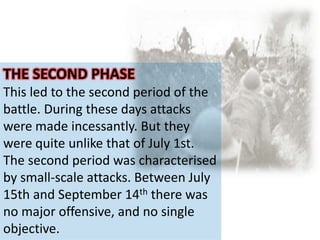
THE SECOND PHASE
This led to the second period of the
battle. During these days attacks
were made incessantly. But they
were quite unlike that of July 1st.
The second period was characterised
by small-scale attacks. Between July
15th and September 14th there was
no major offensive, and no single
objective.
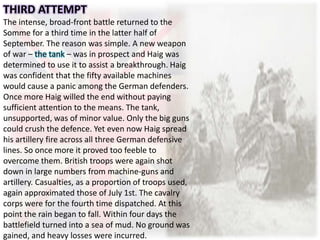
THIRD ATTEMPT
The intense, broad-front battle returned to the
Somme for a third time in the latter half of
September. The reason was simple. A new weapon
of war – the tank – was in prospect and Haig was
determined to use it to assist a breakthrough. Haig
was confident that the fifty available machines
would cause a panic among the German defenders.
Once more Haig willed the end without paying
sufficient attention to the means. The tank,
unsupported, was of minor value. Only the big guns
could crush the defence. Yet even now Haig spread
his artillery fire across all three German defensive
lines. So once more it proved too feeble to
overcome them. British troops were again shot
down in large numbers from machine-guns and
artillery. Casualties, as a proportion of troops used,
again approximated those of July 1st. The cavalry
corps were for the fourth time dispatched. At this
point the rain began to fall. Within four days the
battlefield turned into a sea of mud. No ground was
gained, and heavy losses were incurred.
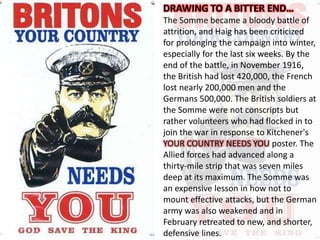
DRAWING TO A BITTER END…
The Somme became a bloody battle of
attrition, and Haig has been criticized
for prolonging the campaign into winter,
especially for the last six weeks. By the
end of the battle, in November 1916,
the British had lost 420,000, the French
lost nearly 200,000 men and the
Germans 500,000. The British soldiers at
the Somme were not conscripts but
rather volunteers who had flocked in to
join the war in response to Kitchener's
YOUR COUNTRY NEEDS YOU poster. The
Allied forces had advanced along a
thirty-mile strip that was seven miles
deep at its maximum. The Somme was
an expensive lesson in how not to
mount effective attacks, but the German
army was also weakened and in
February retreated to new, and shorter,
defensive lines.

Why was there stalemate on the western front

  • 2.
    see map onthe side
  • 4.
    1. In chess,a position in which one player is unable to move, but their king is not being attacked, which means that neither of the two players wins. 2. A situation in which neither group involved in an argument can win or get an advantage and no action can be taken: Deadlock.
  • 5.
    For the firsttwo months of the WW1, the armies fought each other in a ‘war of movement’ ;movements of troops in both France and Belgium. Later on, fighting was characterized by the static (no movement) warfare in the long trench system known as the Western Front. By Christmas the positions of these trenches were more-or-less fixed for the next three years.
  • 6.
    Germany’s plan forwar with France involved a fast-moving sweep across Belgium and northern France to capture Paris and effectively knock France out of the conflict. The Germans expected this would take just six weeks to achieve, but in reality resistance from the Belgian and French armies combined with British forces stopped the Germans at the Battle of the Marne in early September and forced them to retreat. 1. No German Breakthrough
  • 7.
    With the Germanplan having failed, a new commander named Falkenhayn decided to try and get around the enemy’s lines in an attempt to capture the port towns. This was meant to cut off the BEF’s supplies and reinforcements from Britain. This became known as the ‘race to the sea’. British commander of the BEF, Douglas Haig also ignited a war of ‘attrition’ – wearing down the enemy. He conceived of battle as a structured, three-stage affair: first, the preparation, wearing down, and drawing in of enemy reserves; second, the rapid and decisive offensive; and third, exploitation. Essentially, Haig did not change his mind about this structure throughout World War I. 2. Race to the Sea
  • 8.
    3. Defensive positions.The Germans and Allies resisted each other's attacks by digging defensive positions. Having retreated some 45 miles in a matter of days, the German army showed the value of trenches as defensive positions at the Battle of the Aisne. The Germans used machine guns and artillery to fend off Allied assaults. Similar defensive positions were constructed all along the emerging Western Front.
  • 9.
    4. Worsening WeatherAs fall drew into winter, both the German and Allied armies found their activities limited by worsening weather. The soldiers manning the trenches effectively lived outside in difficult weather conditions, standing in water and mud and exposed to freezing temperatures at night, difficulties of moving soldiers around in knee-deep mud and using artillery in mist and fog. Attacks proved impossible, forcing leaders to think more defensively.
  • 11.
    The Germans weremore thorough, and built their trenches deeper, with more amenities and general attitude that they were there to stay! The British did not want to encourage any feeling of being there to stay – a trench was a temporary structure, from which to attack the enemy and move on! Their attitude changed a bit throughout the war, and the trenches developed better amenities. Trenches were never dug in one straight line but were zigzagged one way or another. That prevented the enemy from enfilading a long length of trench. Quite how the trenches were constructed depended on the soil. In Flanders it was muddy and the water table was high, especially after the Belgians had opened the lock gates to allow flooding by the sea water. Front line trenches might only be 10 –20 metres away from the enemy, or as much as 350 metres. Behind these would be support trenches, and connecting trenches between the two systems. The network of trenches was too complex, at times soldiers would get lost. It took a skilled guide to lead men in and out. Life in the trenches was described as: 80% bored to death 19% frozen to death 1% scared to death
  • 19.
    Poison gas wasprobably the most feared of all weapons in World War One. Poison gas was indiscriminate and could be used on the trenches even when no attack was going on. A poison gas attack meant soldiers having to put on crude gas masks and if these were unsuccessful, an attack could leave a victim in agony for days and weeks before he finally succumbed to his injuries. It is generally assumed that gas was first used by the Germans in World War One. Poison gas (chlorine) was used for the first time at the Second Battle of Ypres in April 1915. At around 17.00 hours on the 22nd April, French sentries in Ypres noticed a yellow- green cloud moving towards them - a gas delivered from pressurized cylinders dug into the German front line. Gas warfare was unsuccessful because, gas masks were developed, it was all dependent on wind direction and Germans began to run out of chemicals as the war dragged on.
  • 20.
    Machine guns inflictedappalling casualties on both war fronts in World War One. Men who went over-the-top in trenches stood little chance when the enemy opened up with their machine guns. Machine guns were one of the main killers in the war and accounted for many thousands of deaths. At the start of the war, senior British army officers were less than sure about the effectiveness of the machine gun. Therefore most battalions were only issued with two. This was a lot less than the Germans who were much more sure as to the effectiveness of the machine gun. The Germans placed their machine guns slightly in front of their lines to ensure than the machine gun crews were given a full view of the battlefield. Machine guns were the ideal defensive weapons. They could fire up to 600 rounds per minute causing huge casualties. The German Maxim gun accounted for 90% of Allied victims in the Battle of Somme.
  • 21.
    At the startof World War One, aircraft were very basic and crude. By the time World War One had ended, aircraft had become far more sophisticated and had differentiated into fighters, bombers and long-range bombers. The British company Avro had produced one of the first aircraft used by the army in 1914 – the 504. In fact, the first British aircraft shot down by the enemy in World War One was an Avro 504 flown by Lieutenant V Waterfall. By the end of the war aircraft that could be recognised as long- range bombers had been developed. Much larger than fighters, their task was very specific – to carry to a target as many bombs as possible and to drop them on said target with a degree of accuracy. The Germans had the Gotha bomber while the British had the Handley Page bomber. There was deliberate targeting of civilians, also a nation’s means of war production such as factories – could also be attacked from the air.
  • 22.
    The tank hadan interesting role in World War One. Tanks were first used for the first time in September during the Battle of Somme. It was invented by Ernest Swinton, an army officer and engineer. The development of the tank when compared to other weapons was remarkably swift. The British Navy spent 75000 on improving their design. Germans did not take them seriously and did little to develop their own tanks since they were not as successful as expected since they broke down often and also ran out of petrol as fast. They however brought back some mobility to the western front . As the stalemate on the Western Front continued, so the drive to find a weapon that could break this lack of mobility became more intense, hence the tank.
  • 23.
  • 24.
    On February 21stin 1916, the German army sets off this major offensive against Verdun. This date marks the beginning of a nightmare for all French soldiers. The “hell of Verdun” (l’Enfer de Verdun) will last 10 months ; 300 days and 300 nights of ceaseless and murderous battles. The Battle of Verdun in 1916 was the longest single battle of World War One. The casualties from Verdun and the impact the battle had on the French Army was a primary reason for the British starting the Battle of the Somme in July 1916 in an effort to take German pressure off of the French at Verdun. The Battle of Verdun started on February 21st 1916 and ended on December 16th in 1916. The attack on Verdun came about because of a plan by the German Chief of General Staff, von Falkenhayn. He wanted to launch a massive German attack on a narrow stretch of land that had historic sentiment for the French as a fortress region. Falkenhayn believed that the French would lose so many men at the battle in an attempt to save Verdun and this would change the course of the war.
  • 25.
    140,000 German troopsstarted the attack. They were supported by 1,200 artillery guns that targeted 2,500,000 shells at the Verdun region. 1,300 ammunition trains were needed to supply these guns. The Germans also had complete air supremacy with 168 planes located in the area - the largest concentration of planes in history up to that point. To start with, the French only had 30,000 troops to oppose the Germans. On the day the battle started, February 21st, 1000 German artillery guns fired on a six mile line along the French front. On the fourth day, the Germans captured the outer defences of Verdun. The French put General Philippe Pétain in charge of the defense of Verdun. 25,000 tons of supplies were moved into Verdun and 90,000 soldiers. But despite the new military input, the French suffered badly. The Germans also suffered huge losses. By the end of April, the Germans had lost 120,000 men and the French 133,000 men. On June 1st, Germany launched a massive attack at Verdun. By June 23rd, they were closing in on Verdun itself but this attack faltered as the German army itself had given all that it had and it could give no more. In addition, the British decision to attack Germans on the Somme caused the Germans to call off the offensive.
  • 26.
    The loss oflife and those wounded was huge at Verdun. It is probable that an accurate figure will never be known. It is said that the French lost over 360,000 and the Germans nearly 340,000. To relieve the pressure being felt by the French, the British launched the Battle of the Somme in July 1916. It was hoped that a swift British victory here would force the Germans to remove troops from the Verdun area. However, like the French, the British got involved in a battle that was to last months rather than days.
  • 28.
    The battle ofthe Somme was fought in the area around the river Somme. This battle has been known as the biggest and bloodiest battle in the history of war. It dates back to the German planned attack on Verdun in an attempt to capture some important French forts. This battle dragged on with both sides losing so many men. Douglas Haig launched an offensive in the Somme region against the Germans to relieve pressure on Verdun and to support the French army. In early 1916, the French proposed a joint Franco-British (including the Australians who were still under British command)offensive on both sides of the river Somme. Hence, on July 1, 1916, the British army attacked north of the Somme with fourteen infantry divisions (approx 120,000 men), while the French attacked across and south of the Somme with five divisions. In defense, the German army deployed seven divisions. The British attack was planned by Douglas Haig. Haig's 'Great Push' on the Somme was his first major offensive since his promotion to Commander in Chief in December 1915 and his reputation was at stake.
  • 29.
    THE FIRST PHASE Haigbelieved that a successful attack would include a heavy bombardment by artillery in order to destroy German barbed wire, trenches, machine guns and soldiers. After which the Germans would cross over No-Man’s Land and occupy German trenches. The plan was conducted as it was. As the British left their bunkers to advance into No-Man’s land, the German started firing with machine guns at the British troops who were now exposed on the field. Very few British troops actually got to the barbed wire and those that did were too weak to capture German trenches. Furthermore, the intense and prolonged bombardment which lasted up to 5 days churned up the ground, making it difficult for the infantry to advance with speed. The British were not successful and on the first day alone they sustained 60 000 casualties, including 20 000 dead. In spite of this setback Haig determined to continue with the offensive. In this he was encouraged by the French, who to the south of the British had done comparatively well. THE BRITISH ACCOUNT
  • 30.
    THE SECOND PHASE Thisled to the second period of the battle. During these days attacks were made incessantly. But they were quite unlike that of July 1st. The second period was characterised by small-scale attacks. Between July 15th and September 14th there was no major offensive, and no single objective.
  • 31.
    THIRD ATTEMPT The intense,broad-front battle returned to the Somme for a third time in the latter half of September. The reason was simple. A new weapon of war – the tank – was in prospect and Haig was determined to use it to assist a breakthrough. Haig was confident that the fifty available machines would cause a panic among the German defenders. Once more Haig willed the end without paying sufficient attention to the means. The tank, unsupported, was of minor value. Only the big guns could crush the defence. Yet even now Haig spread his artillery fire across all three German defensive lines. So once more it proved too feeble to overcome them. British troops were again shot down in large numbers from machine-guns and artillery. Casualties, as a proportion of troops used, again approximated those of July 1st. The cavalry corps were for the fourth time dispatched. At this point the rain began to fall. Within four days the battlefield turned into a sea of mud. No ground was gained, and heavy losses were incurred.
  • 32.
    DRAWING TO ABITTER END… The Somme became a bloody battle of attrition, and Haig has been criticized for prolonging the campaign into winter, especially for the last six weeks. By the end of the battle, in November 1916, the British had lost 420,000, the French lost nearly 200,000 men and the Germans 500,000. The British soldiers at the Somme were not conscripts but rather volunteers who had flocked in to join the war in response to Kitchener's YOUR COUNTRY NEEDS YOU poster. The Allied forces had advanced along a thirty-mile strip that was seven miles deep at its maximum. The Somme was an expensive lesson in how not to mount effective attacks, but the German army was also weakened and in February retreated to new, and shorter, defensive lines.