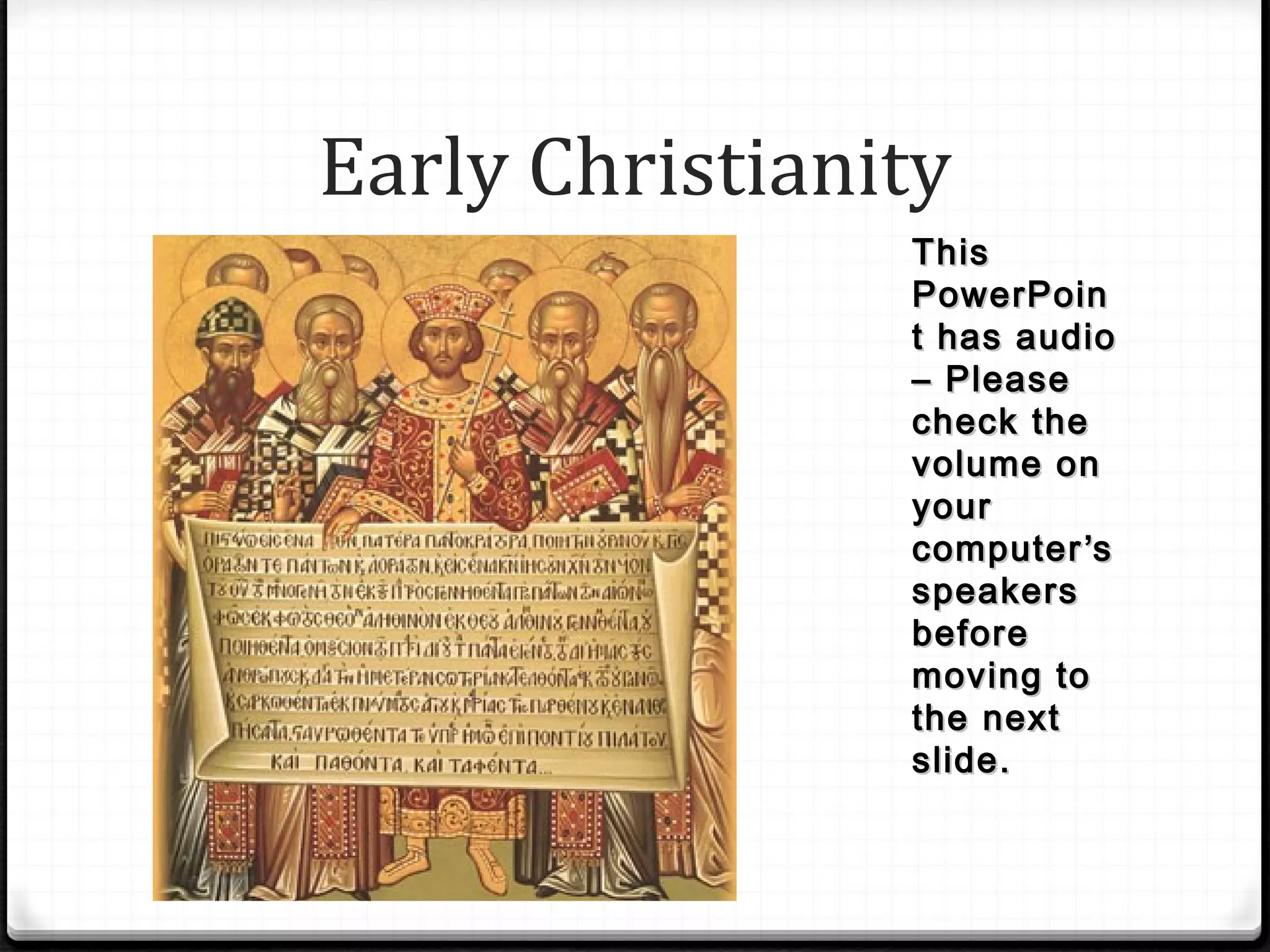

Early Christianity
ThisThis
PowerPoinPowerPoin
t has audiot has audio
– Please– Please
check thecheck the
volume onvolume on
youryour
computercomputer’’ss
speakersspeakers
beforebefore
moving tomoving to
the nextthe next
slide.slide.
Content Goals and Objectives:
Goal 1 – Christianity
0Trace and evaluate the impact of Christianity on
medieval Europe.
0 Define the setting for Christianity during the period
before and after the birth of Christ.
0 Map the spread of Christianity through Roman
Empire during the first three centuries after the
death of Jesus of Nazareth.
0 Summarize the early developments of the Christian
church during the first three centuries after its
creation.
0 Evaluate the contributions of Christian culture to the
culture of medieval Europe.
Main Idea
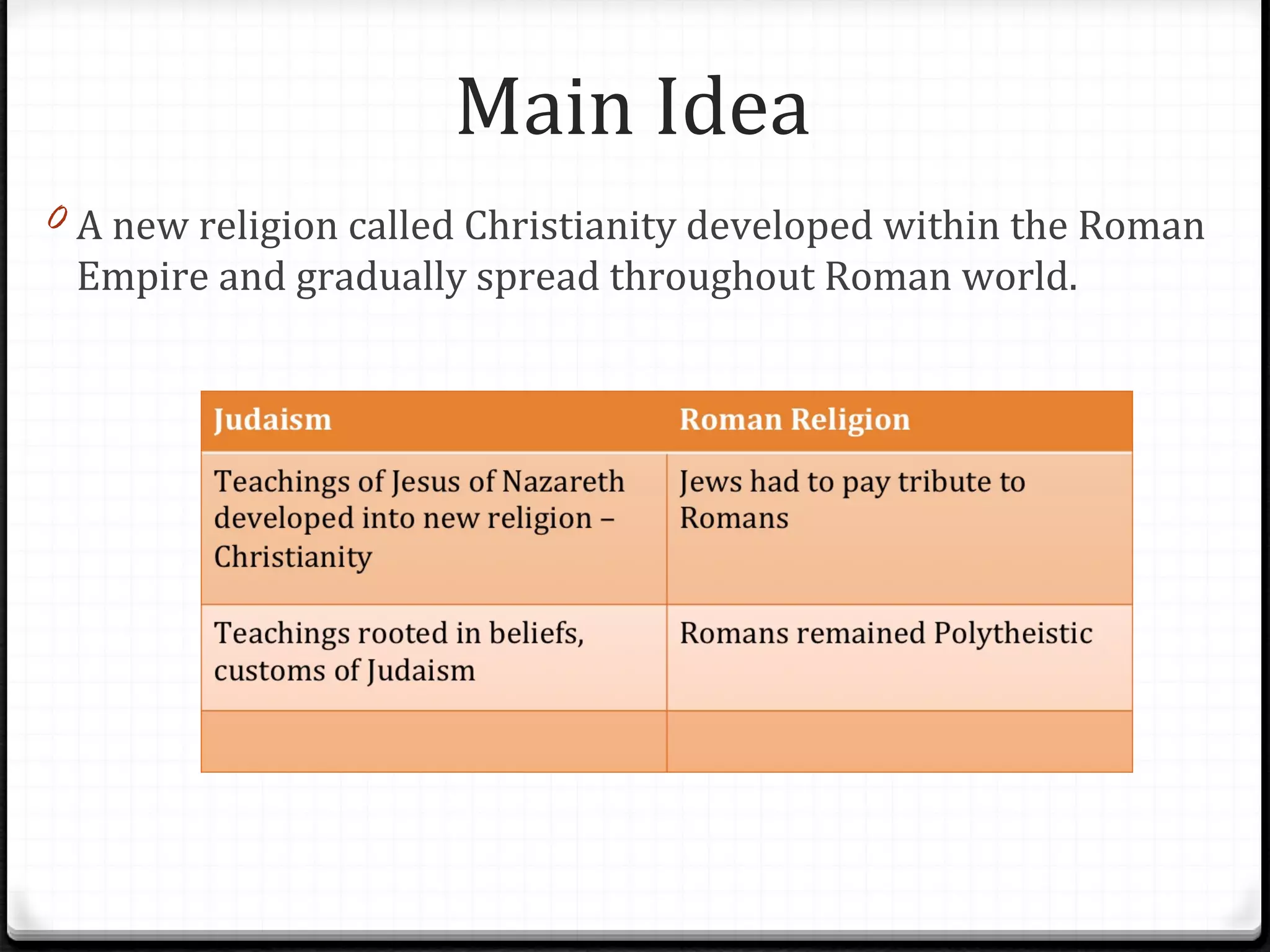
0 A new religion called Christianity developed within the Roman
Empire and gradually spread throughout Roman world.
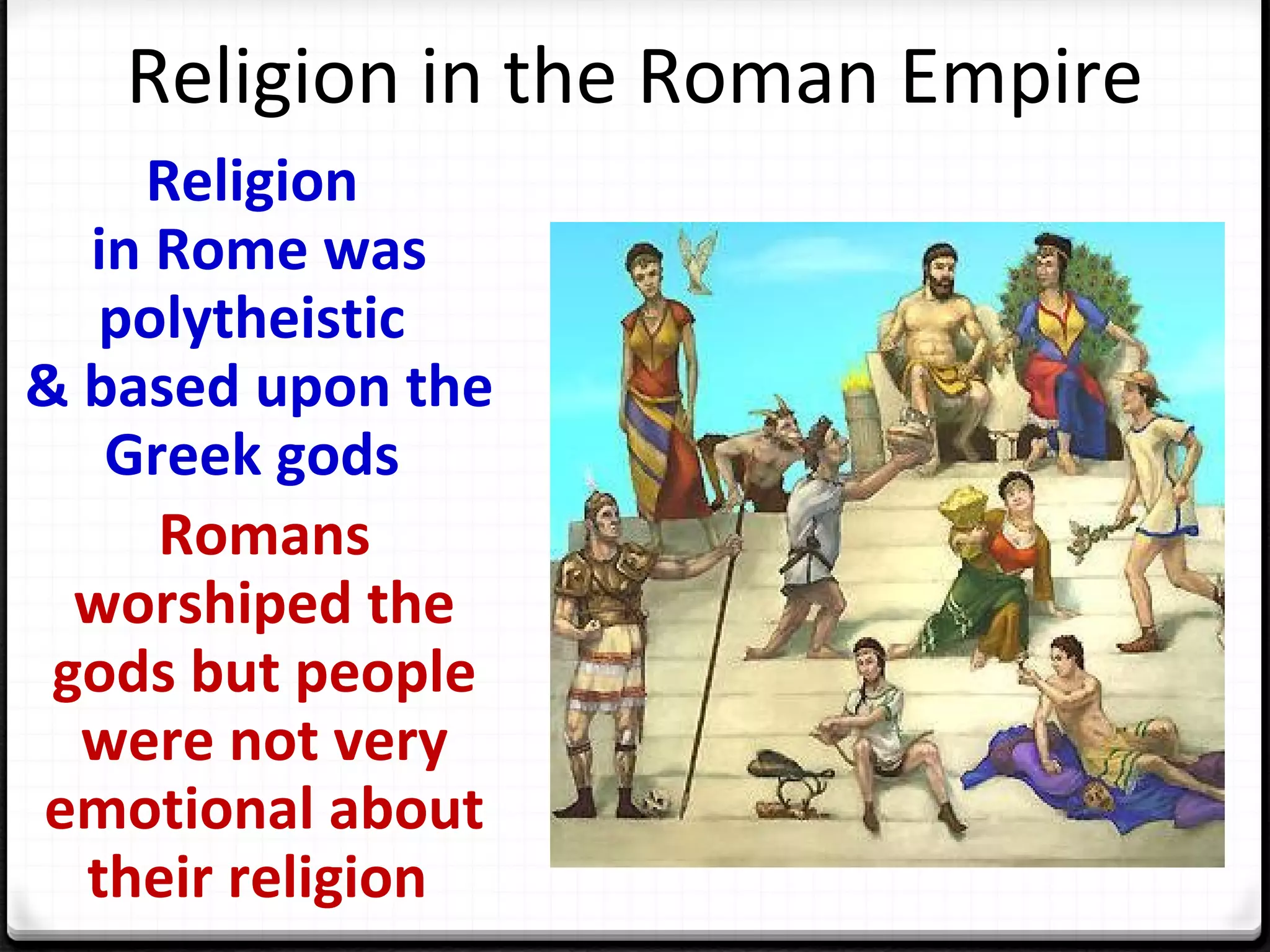
Religion in the Roman Empire
Religion
in Rome was
polytheistic
& based upon the
Greek gods
Romans
worshiped the
gods but people
were not very
emotional about
their religion
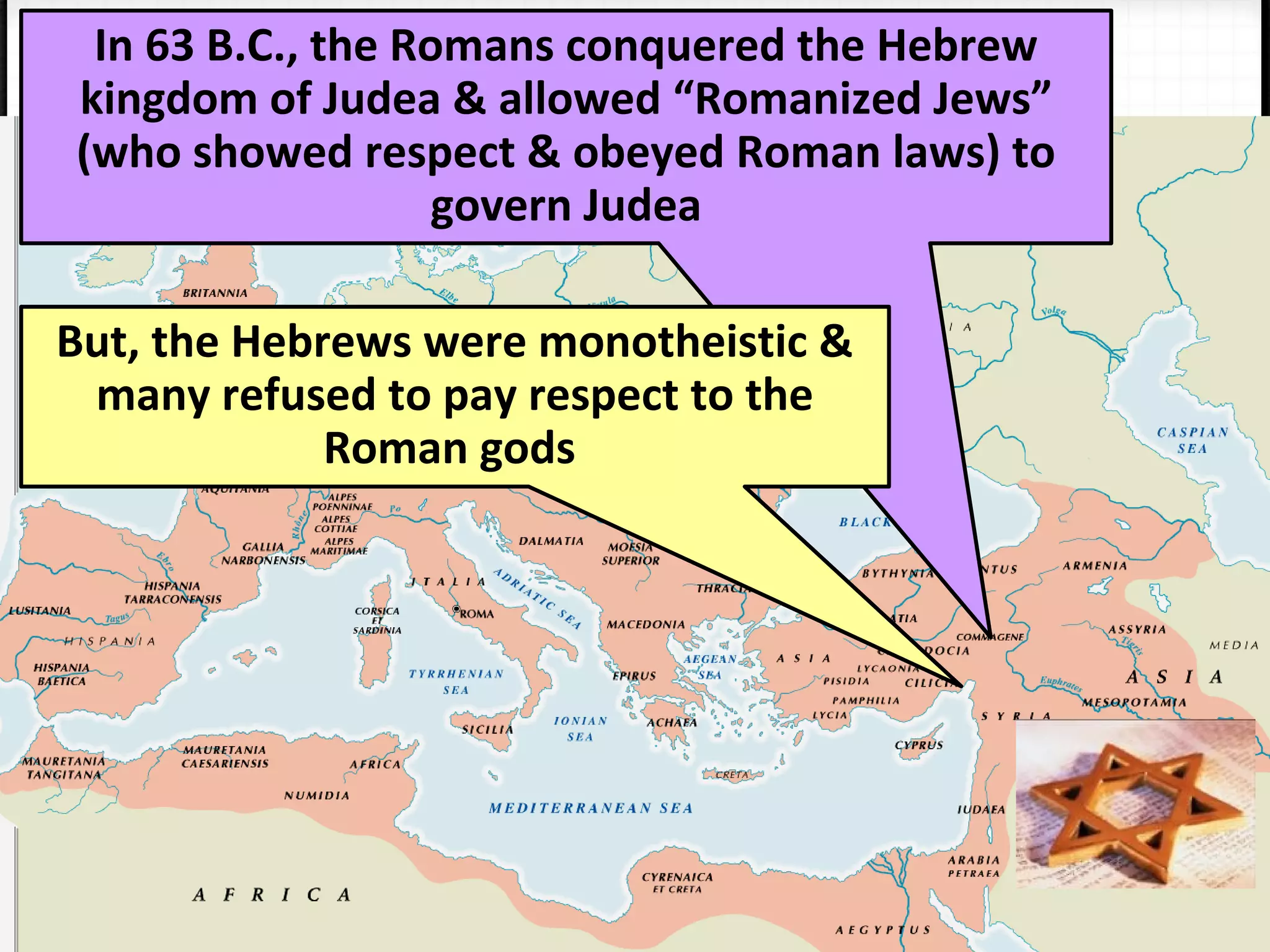
In 63 B.C., the Romans conquered the Hebrew
kingdom of Judea & allowed “Romanized Jews”
(who showed respect & obeyed Roman laws) to
govern Judea
But, the Hebrews were monotheistic &
many refused to pay respect to the
Roman gods
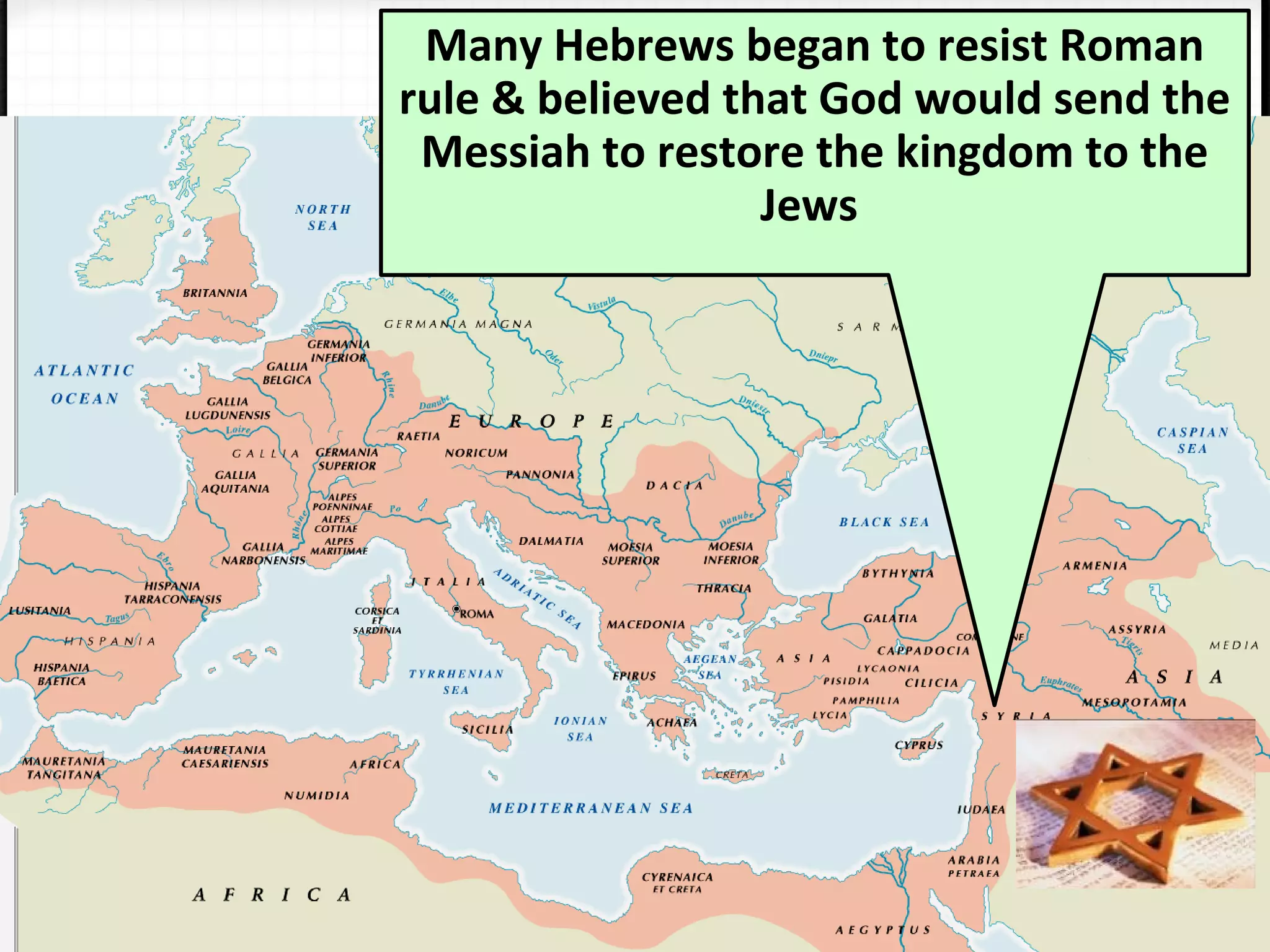
Many Hebrews began to resist Roman
rule & believed that God would send the
Messiah to restore the kingdom to the
Jews
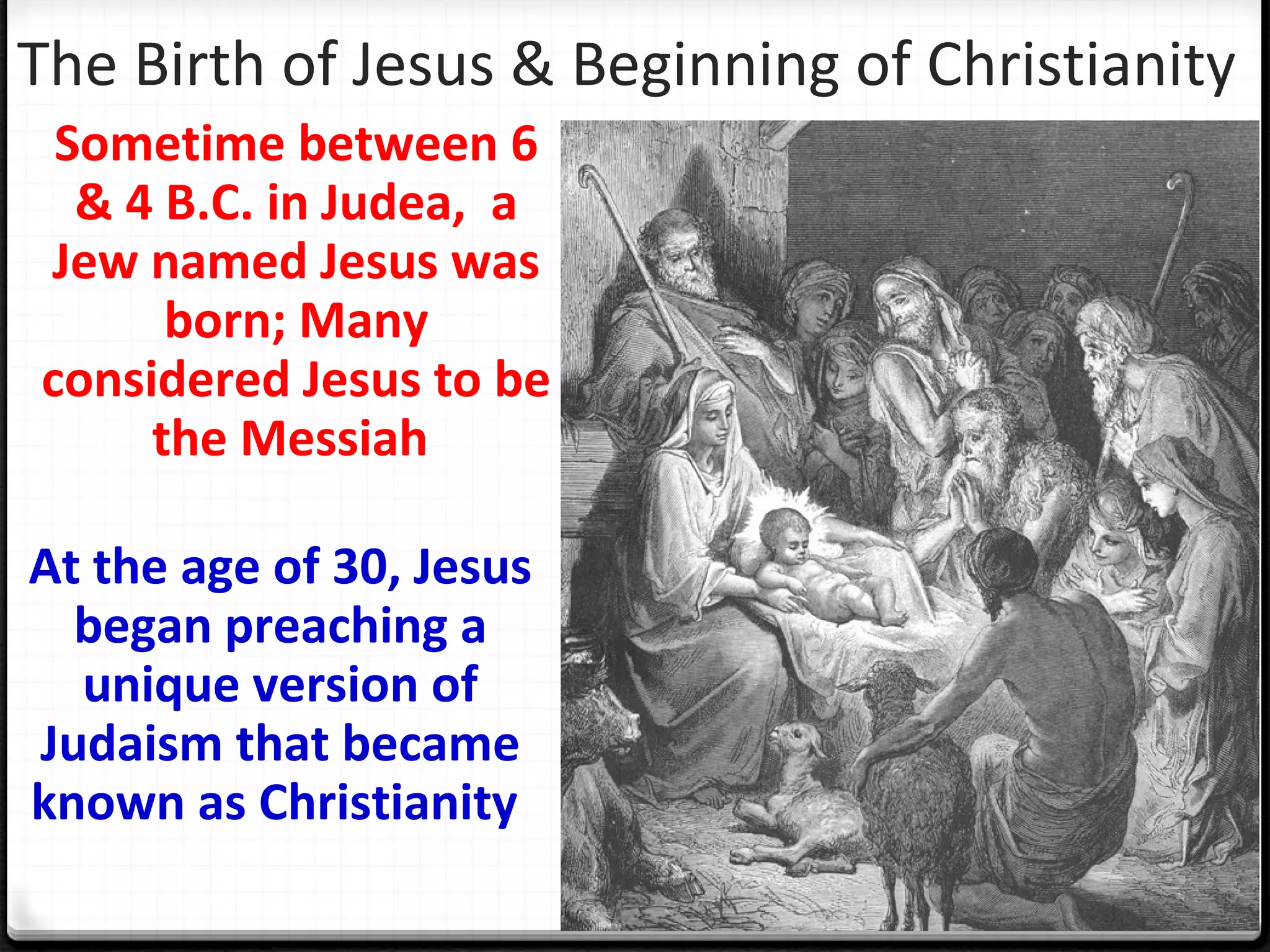
The Birth of Jesus & Beginning of Christianity
Sometime between 6
& 4 B.C. in Judea, a
Jew named Jesus was
born; Many
considered Jesus to be
the Messiah
At the age of 30, Jesus
began preaching a
unique version of
Judaism that became
known as Christianity
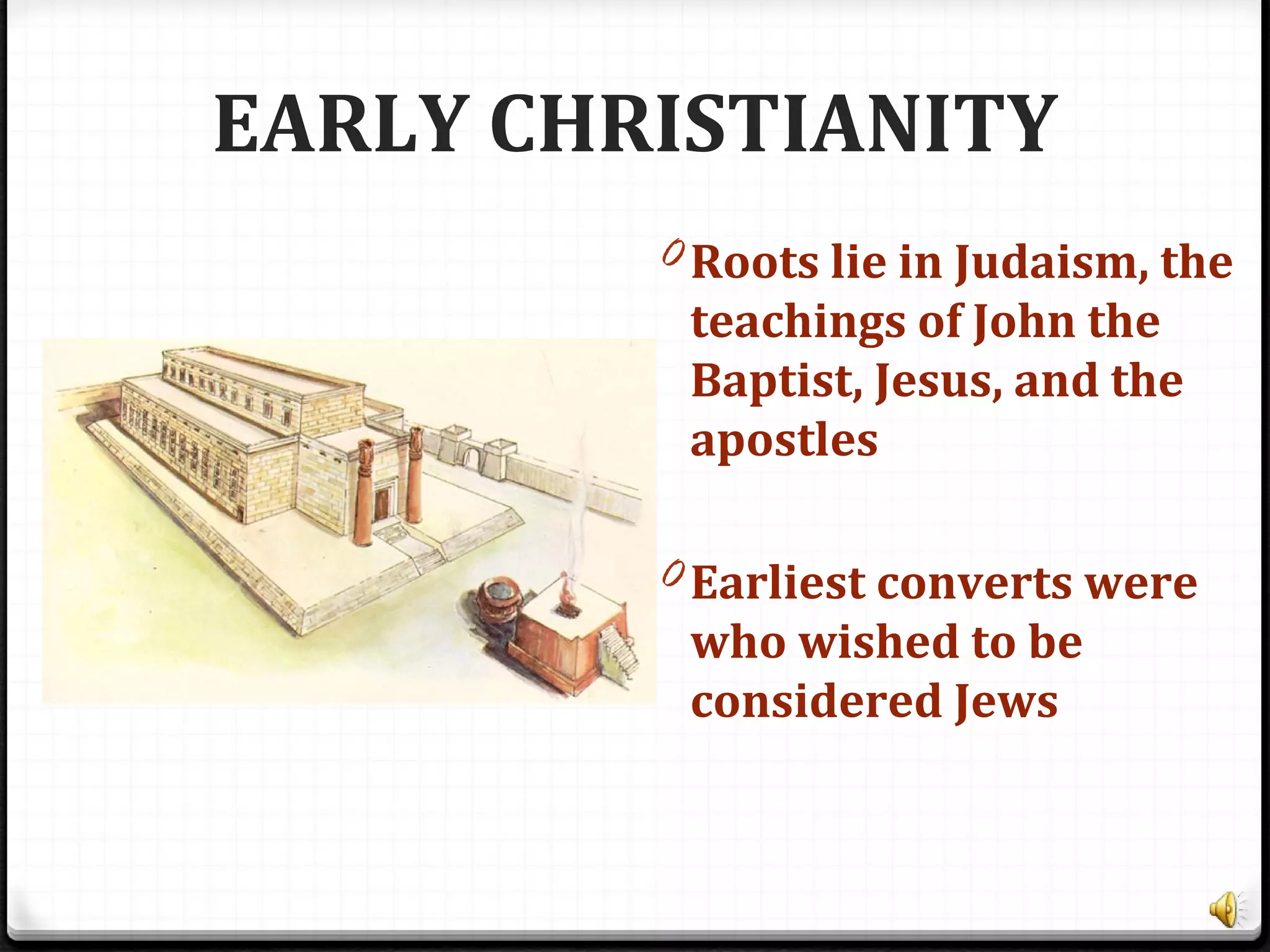
EARLY CHRISTIANITY
0 Roots lie in Judaism, the
teachings of John the
Baptist, Jesus, and the
apostles
0 Earliest converts were
who wished to be
considered Jews
A NEW DIRECTION
0 Christians began to emphasize
their separateness
0 Christian leaders decided
Gentiles who converted to
Christianity did not have to
become Jews in order to
become Christians
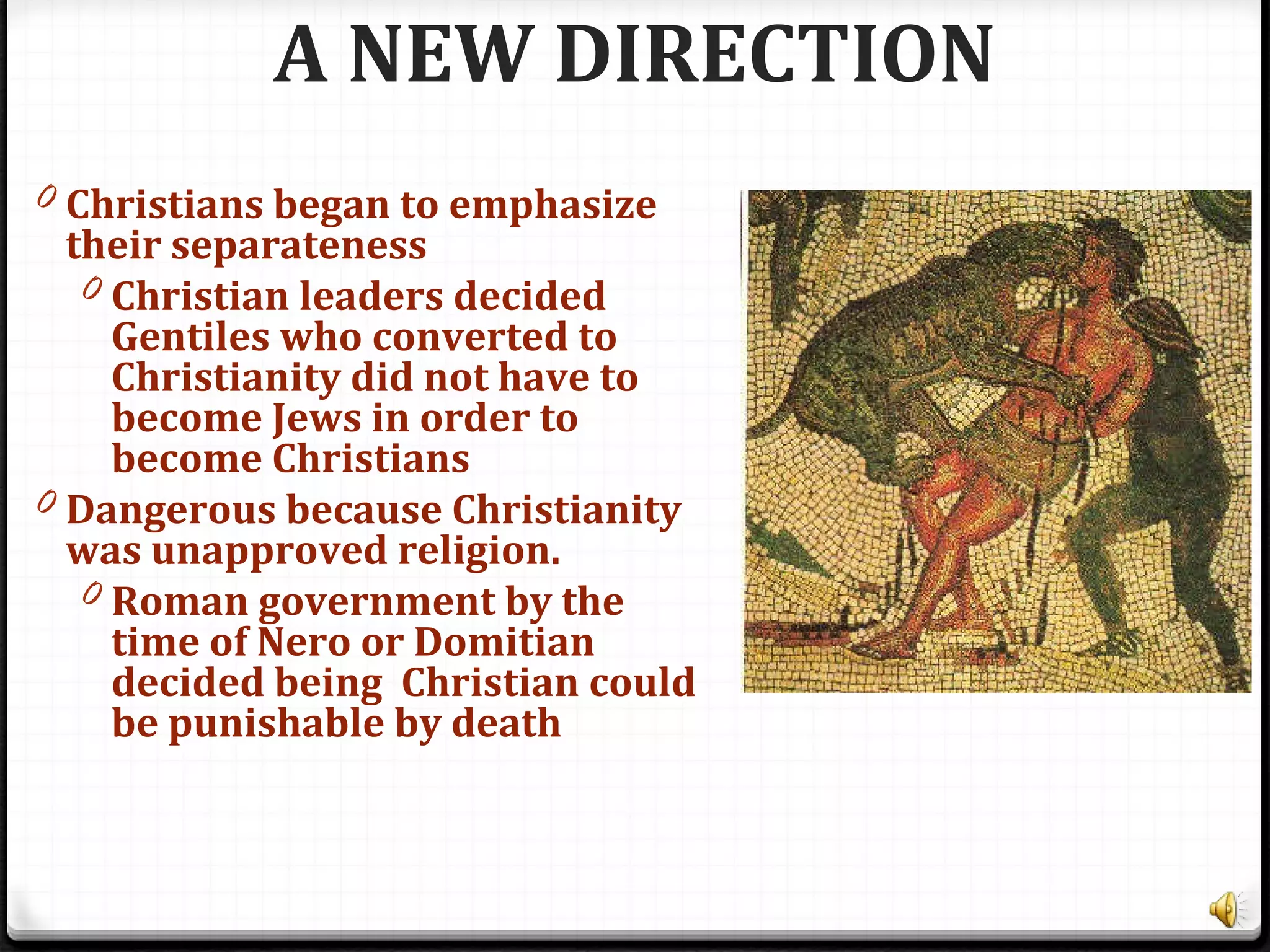
0 Dangerous because Christianity
was unapproved religion.
0 Roman government by the
time of Nero or Domitian
decided being Christian could
be punishable by death
GROWTH
0 Christianity strongest in Asia Minor and Greece
0 Also took hold in Rome and western provinces
0 Hellenistic religions helped pave the way for
success of Christianity
0 Shared similarities with such cults as Isis made
Christianity acceptable
0 Many found Christianity superior to Hellenistic
cults
0 Jesus, a historical rather than a mythological
figure
0 His teachings presented in the Gospels popular.
0 Books were elevated in tone and content
but written in the language of the people
and in a style that many educated people
sneered at
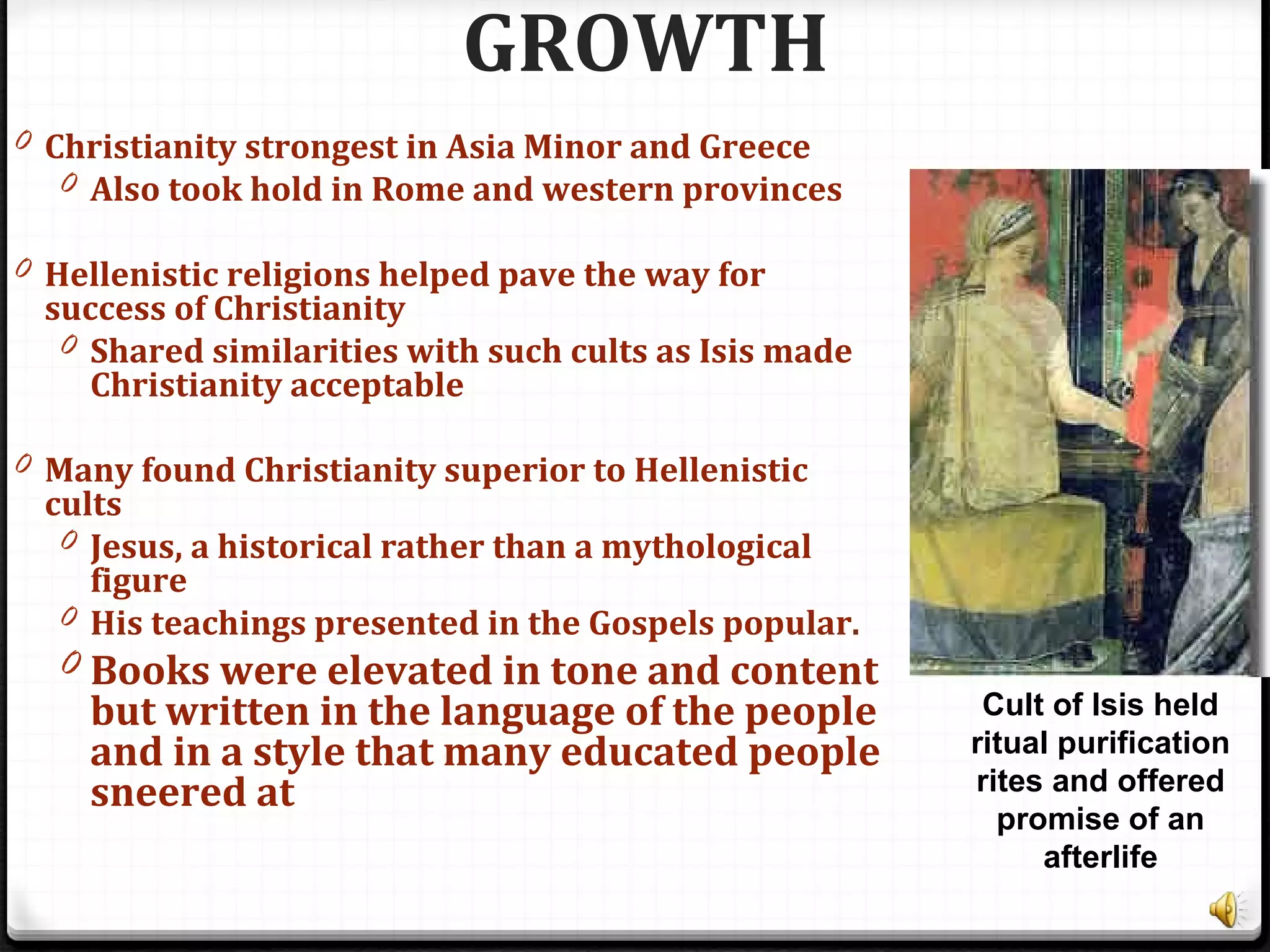
Cult of Isis held
ritual purification
rites and offered
promise of an
afterlife
BIG GAP
0 Christian literature composed in
classical rhetoric style after 100 AD
0 Pagan intellectuals still offended by
crude style
0 Huge spiritual gulf between Christian
and pagan because much of Roman
world offended Christians who saw
obscenity, loose sexual morals,
skepticism, materialism and
hedonism everywhere.
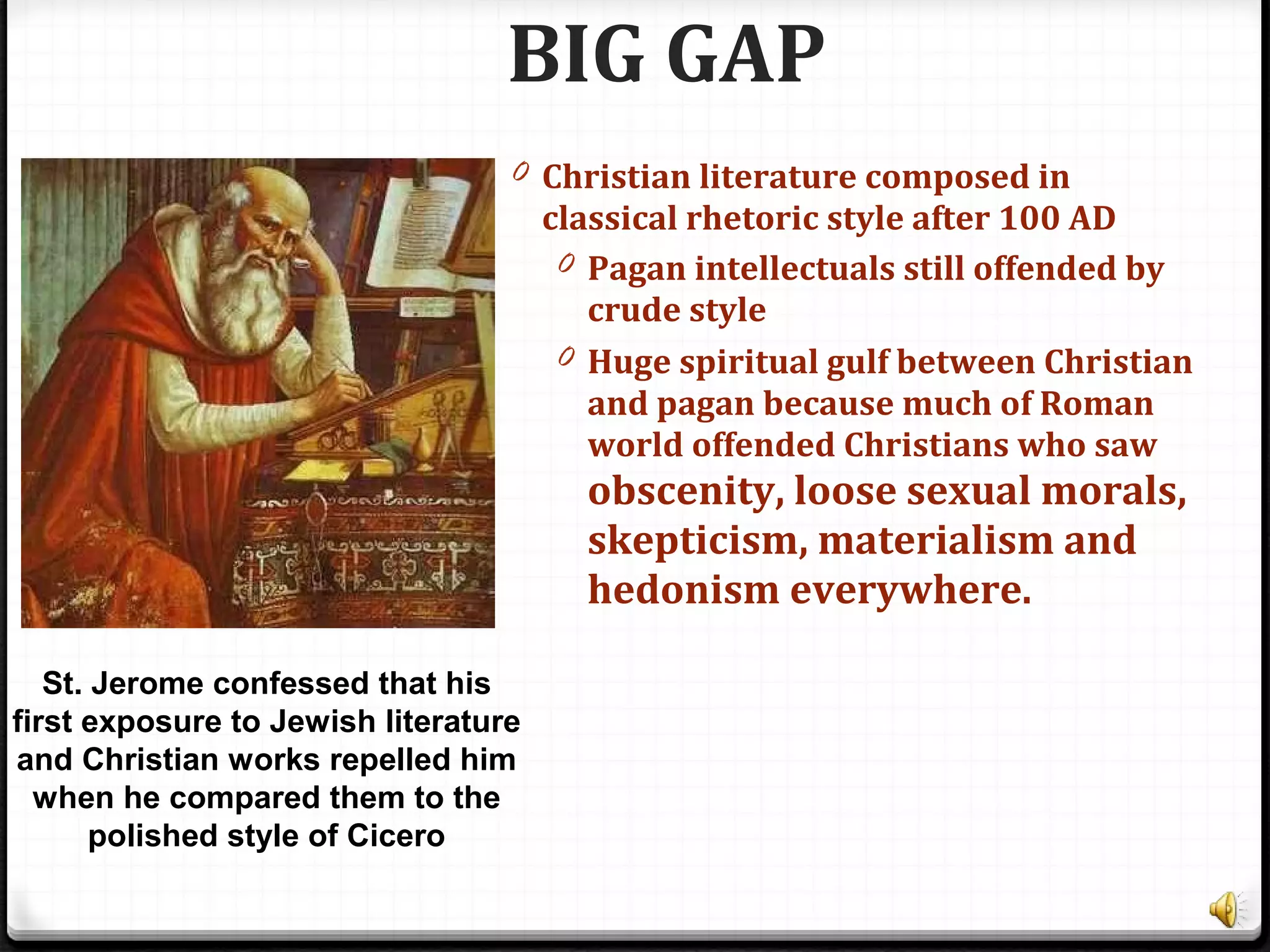
St. Jerome confessed that his
first exposure to Jewish literature
and Christian works repelled him
when he compared them to the
polished style of Cicero
WIDENING GAP
0 Many early Christians, including St. Paul,
advocated obedience to imperial and local
authorities
0 Began to gradually set up a state within
a state after reign of Nero and generally
came to reject the entire social and
cultural foundation of the empire
0 As a result, they came to be seen by the Roman
government as a threat to the existing order of
things
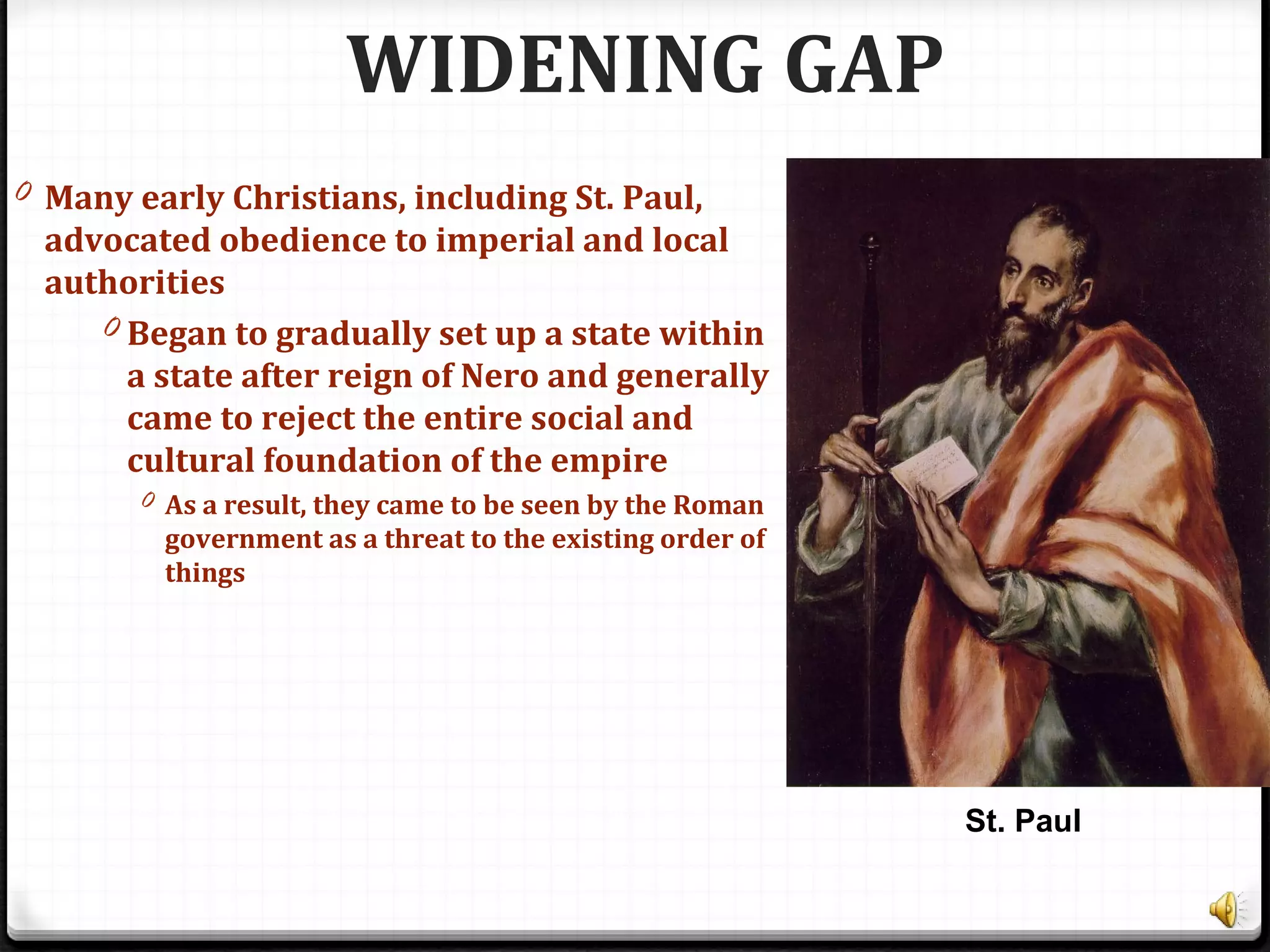
St. Paul
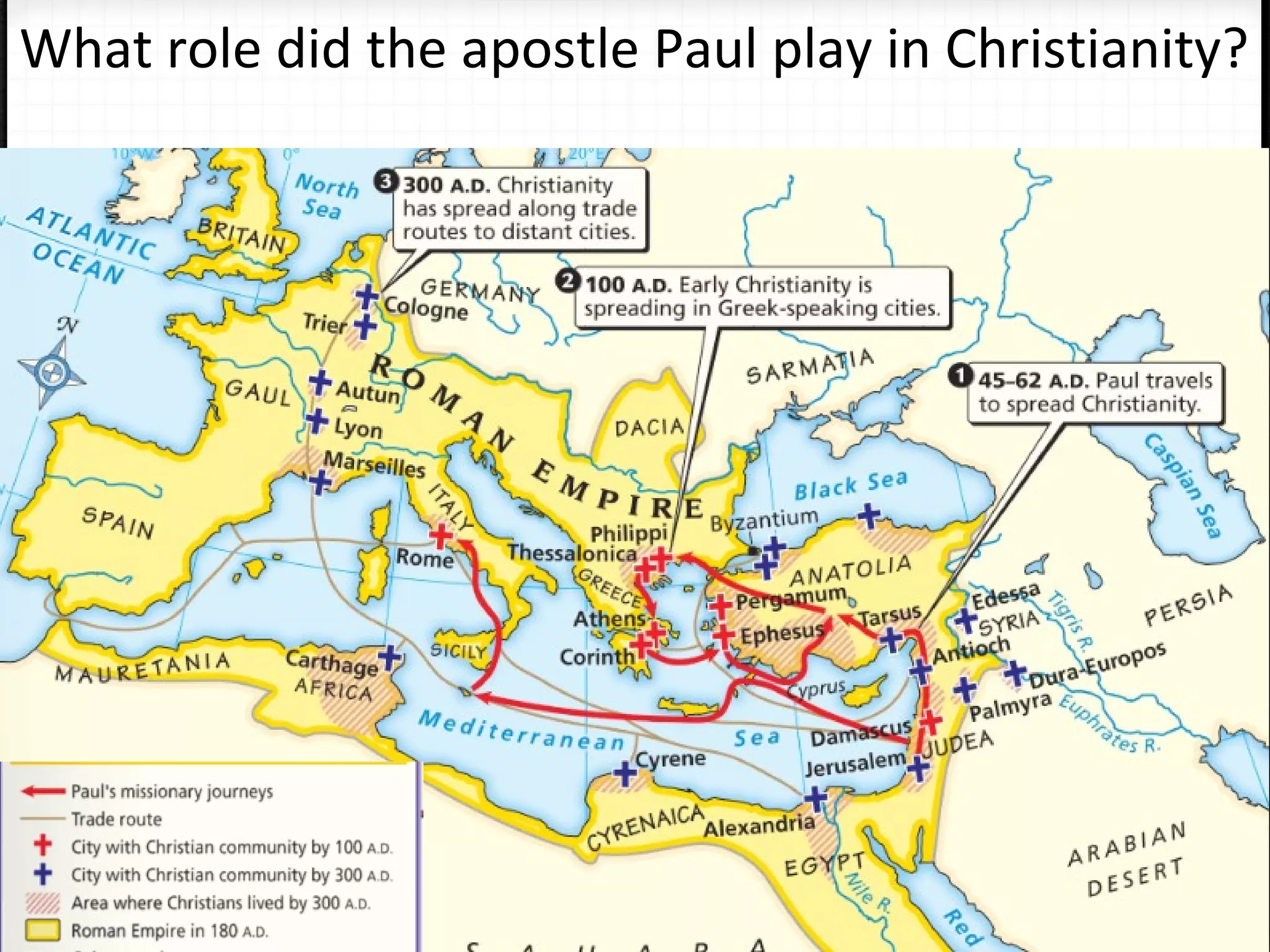
What role did the apostle Paul play in Christianity?
The Spread of Christianity
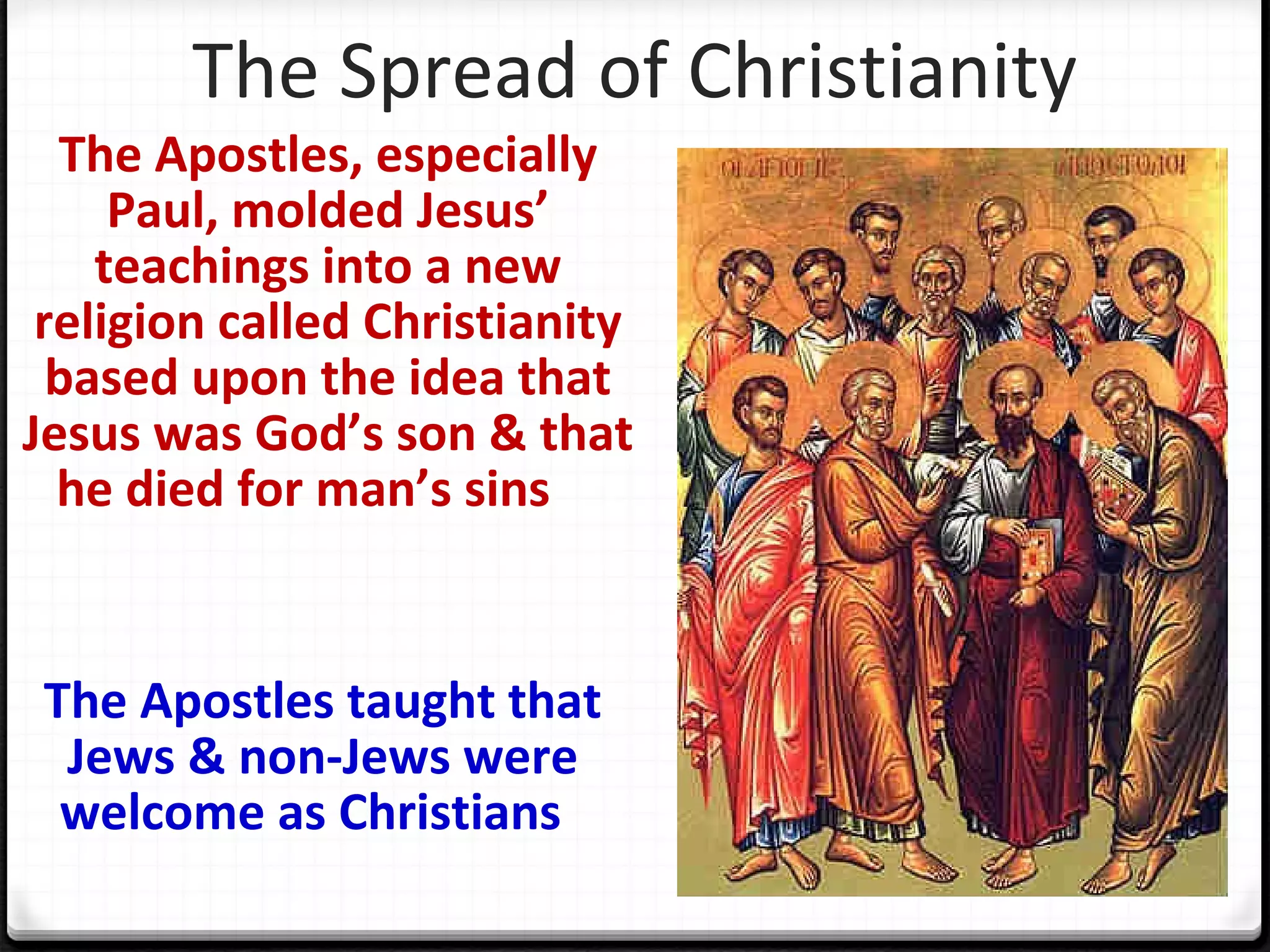
The Apostles, especially
Paul, molded Jesus’
teachings into a new
religion called Christianity
based upon the idea that
Jesus was God’s son & that
he died for man’s sins
The Apostles taught that
Jews & non-Jews were
welcome as Christians
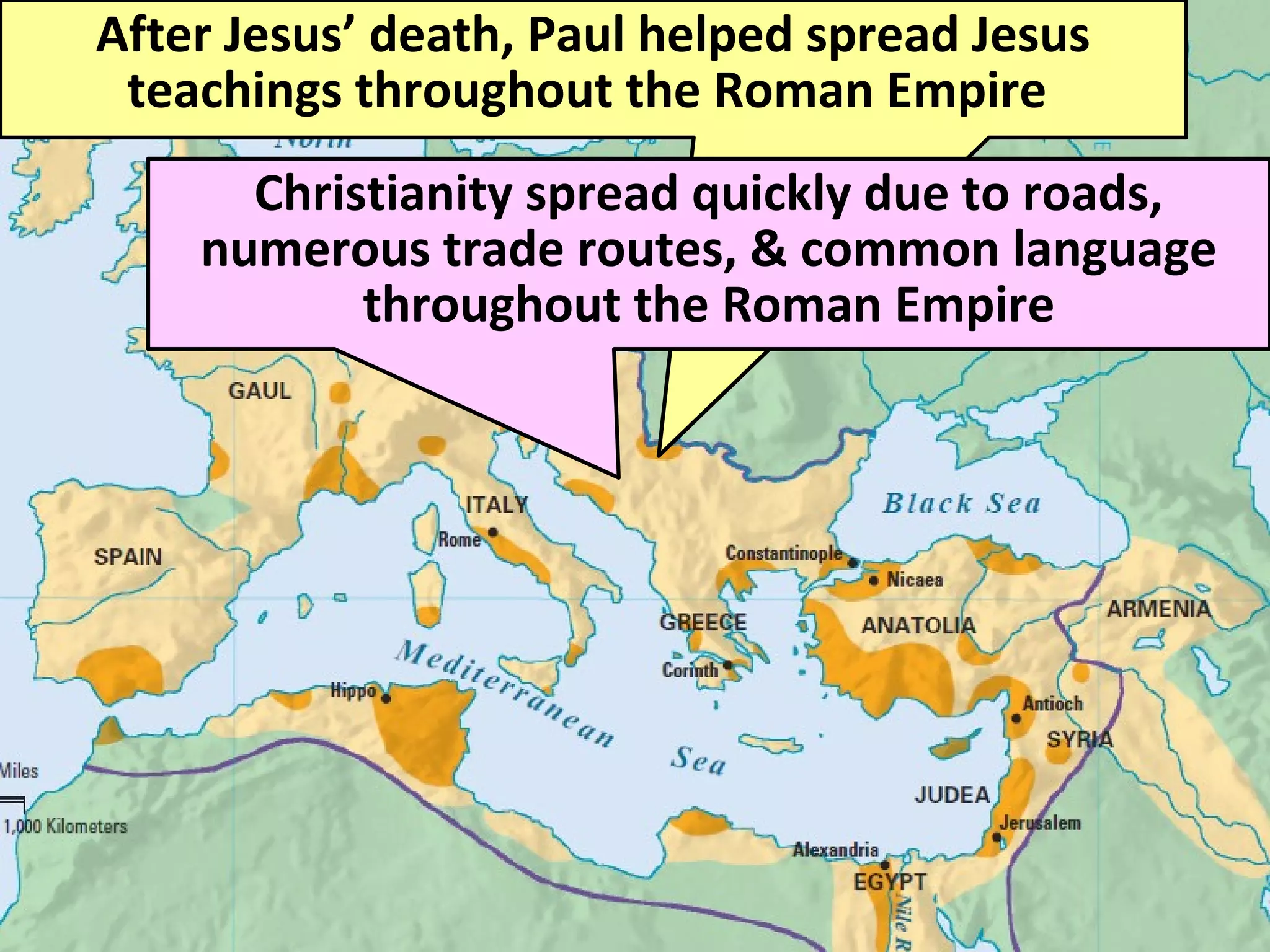
After Jesus’ death, Paul helped spread Jesus
teachings throughout the Roman Empire
Christianity spread quickly due to roads,
numerous trade routes, & common language
throughout the Roman Empire
CHRISTIANS AND THE FALL OF
THE EMPIRE
0 Christianity grew most rapidly as the empire declined
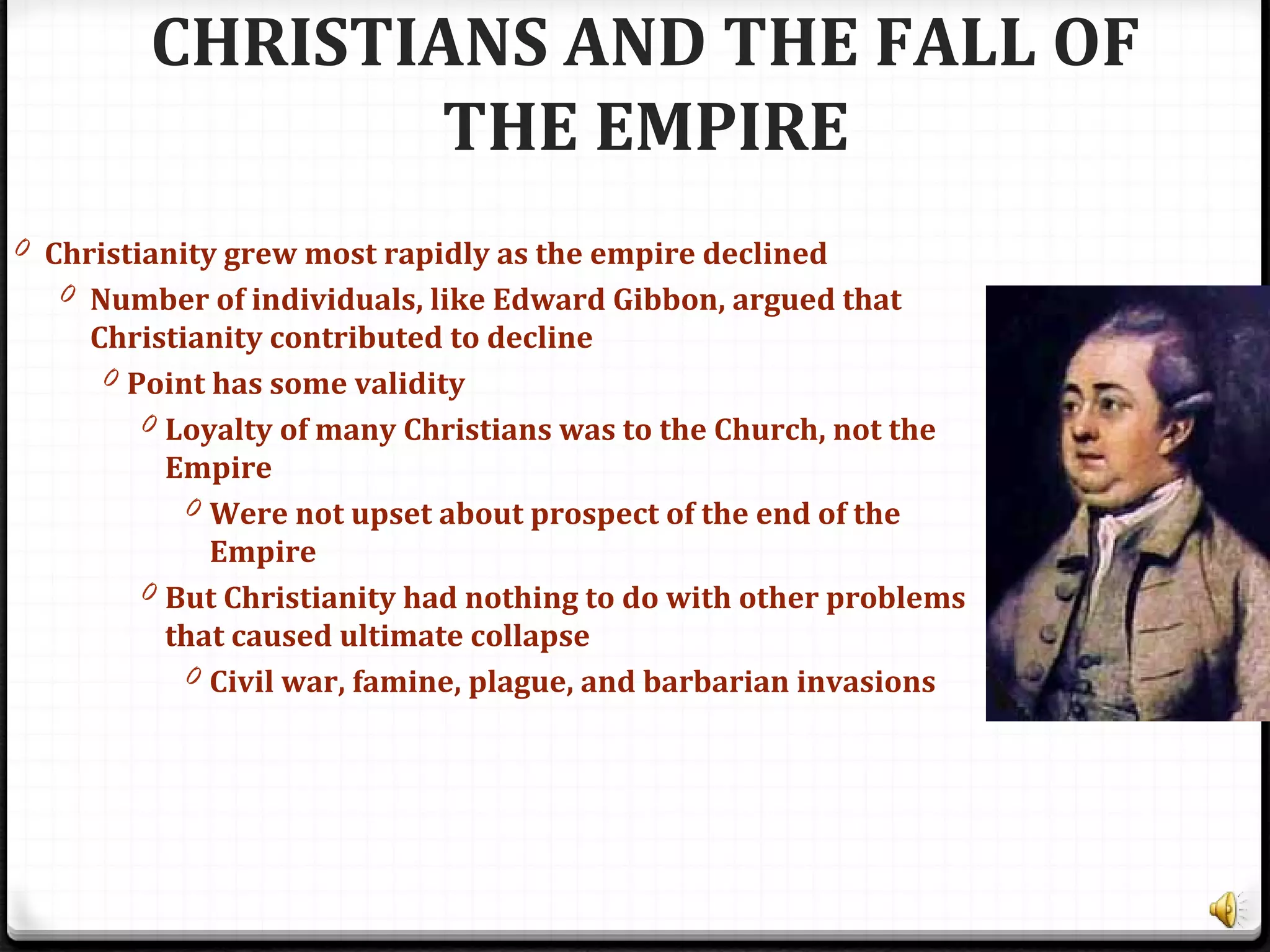
0 Number of individuals, like Edward Gibbon, argued that
Christianity contributed to decline
0 Point has some validity
0 Loyalty of many Christians was to the Church, not the
Empire
0 Were not upset about prospect of the end of the
Empire
0 But Christianity had nothing to do with other problems
that caused ultimate collapse
0 Civil war, famine, plague, and barbarian invasions
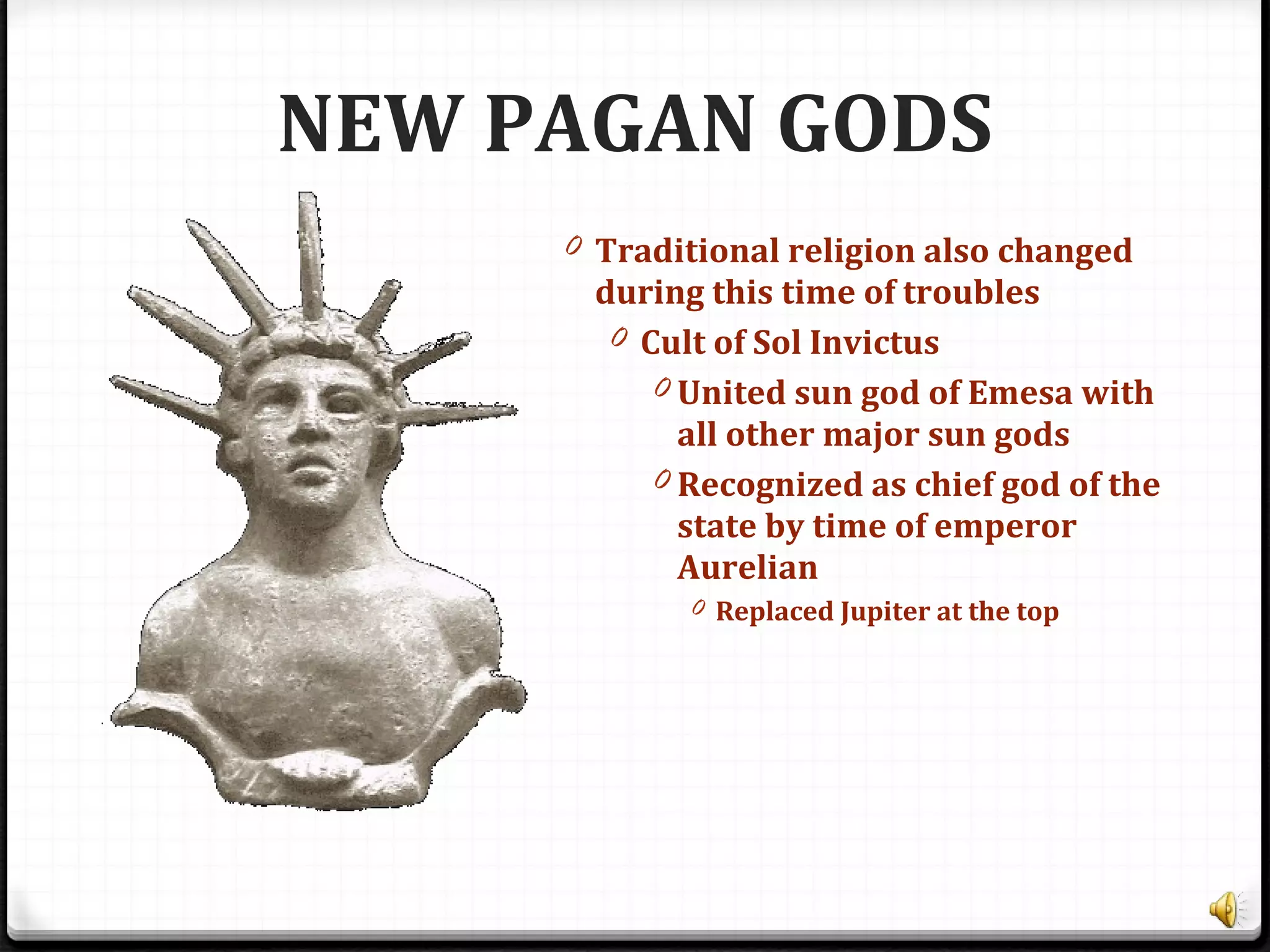
NEW PAGAN GODS
0 Traditional religion also changed
during this time of troubles
0 Cult of Sol Invictus
0 United sun god of Emesa with
all other major sun gods
0 Recognized as chief god of the
state by time of emperor
Aurelian
0 Replaced Jupiter at the top
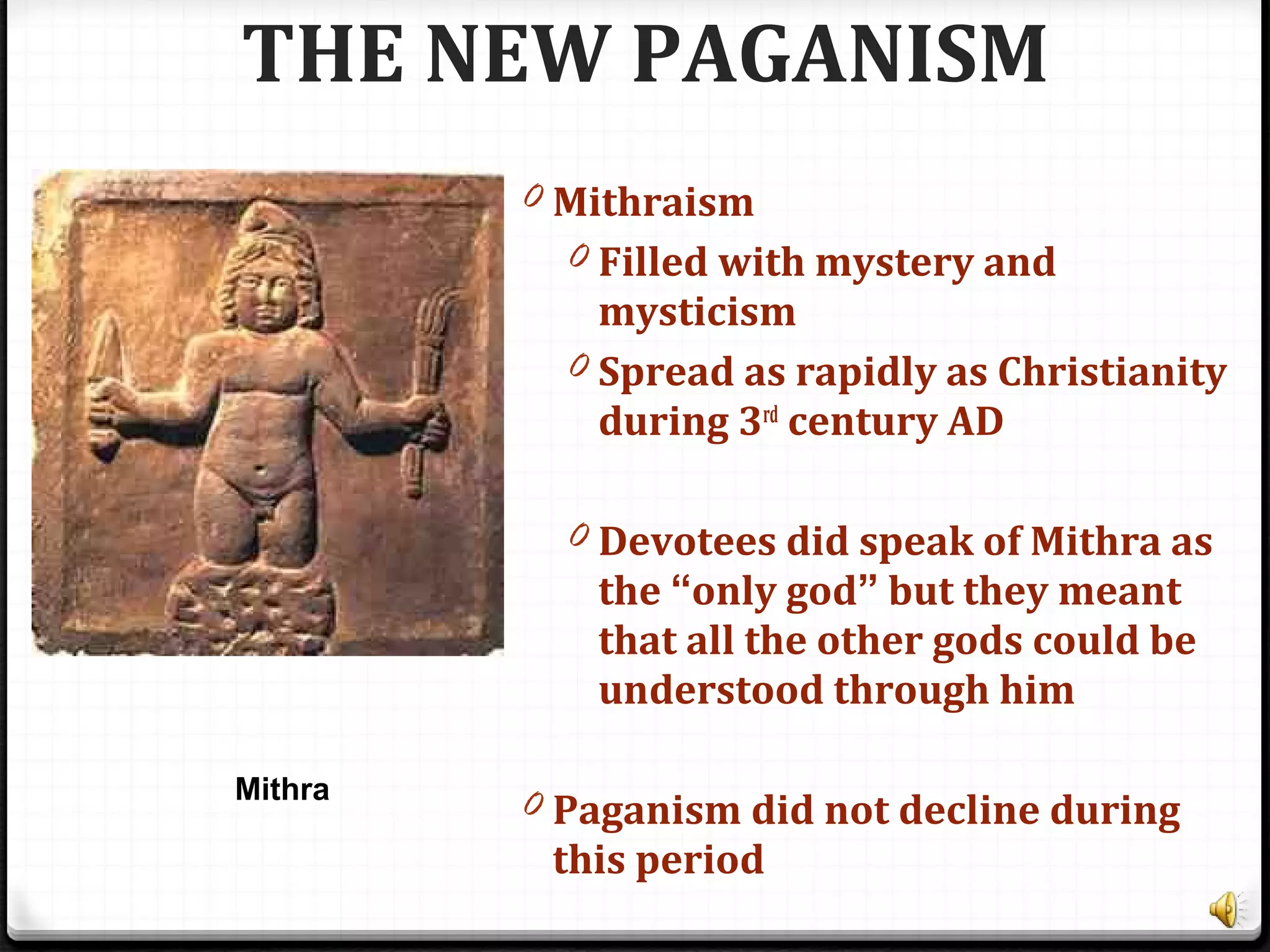
THE NEW PAGANISM
0 Mithraism
0 Filled with mystery and
mysticism
0 Spread as rapidly as Christianity
during 3rd
century AD
0 Devotees did speak of Mithra as
the “only god” but they meant
that all the other gods could be
understood through him
0 Paganism did not decline during
this period
Mithra
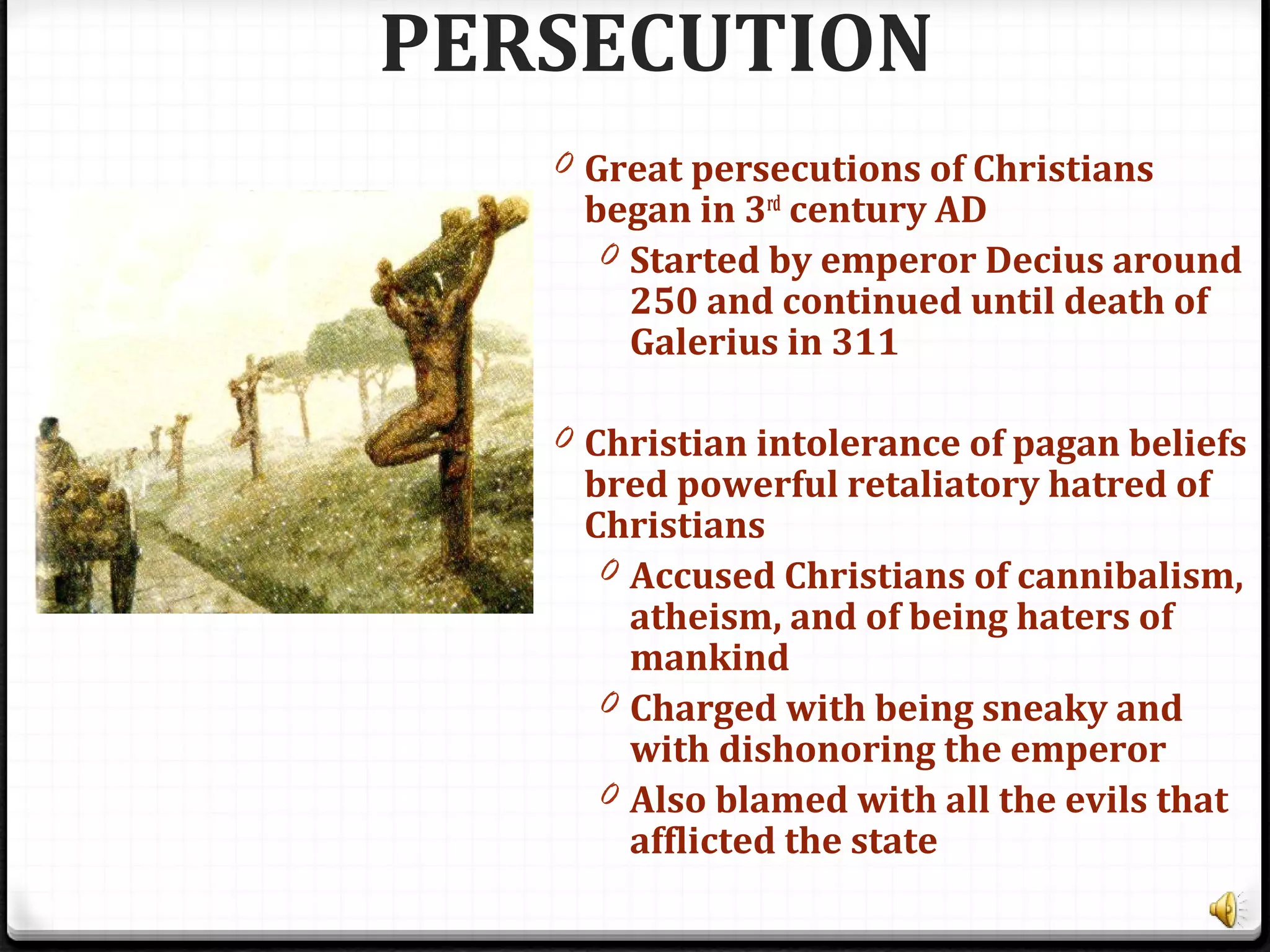
PERSECUTION
0 Great persecutions of Christians
began in 3rd
century AD
0 Started by emperor Decius around
250 and continued until death of
Galerius in 311
0 Christian intolerance of pagan beliefs
bred powerful retaliatory hatred of
Christians
0 Accused Christians of cannibalism,
atheism, and of being haters of
mankind
0 Charged with being sneaky and
with dishonoring the emperor
0 Also blamed with all the evils that
afflicted the state
INTELLECTUAL DEBATE
0 Pagan intellectuals began to attack
Christianity
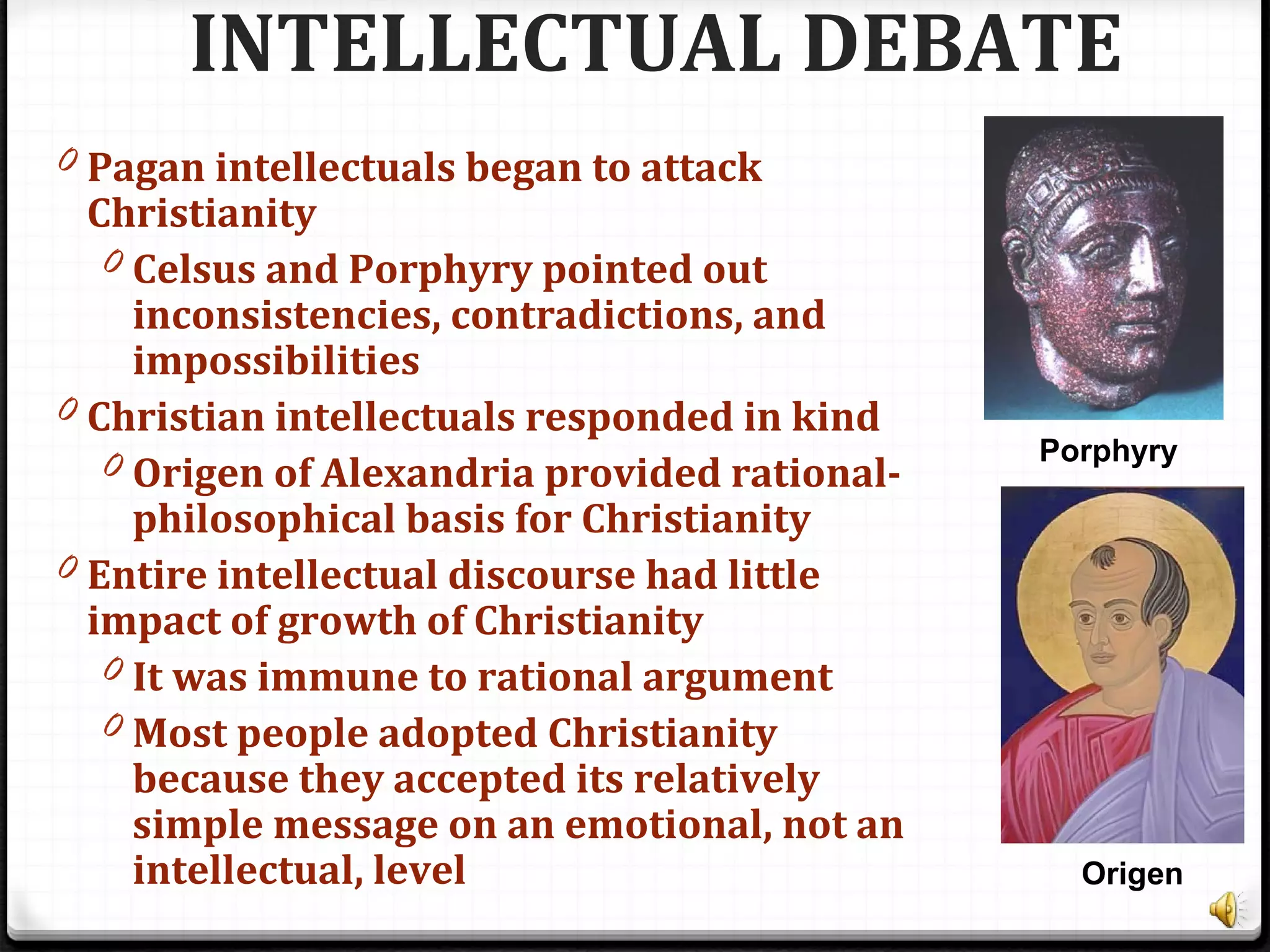
0 Celsus and Porphyry pointed out
inconsistencies, contradictions, and
impossibilities
0 Christian intellectuals responded in kind
0 Origen of Alexandria provided rational-
philosophical basis for Christianity
0 Entire intellectual discourse had little
impact of growth of Christianity
0 It was immune to rational argument
0 Most people adopted Christianity
because they accepted its relatively
simple message on an emotional, not an
intellectual, level
Porphyry
Origen
POPULAR HOSTILITY
0 Celsus and Porphyry saw
structure of Christian
Church as dangerous state
within a state.
0 Felt it caused divided
loyalties
0 Neither advocated
persecution of Christians
0 Strong popular aversion to
Christians continued
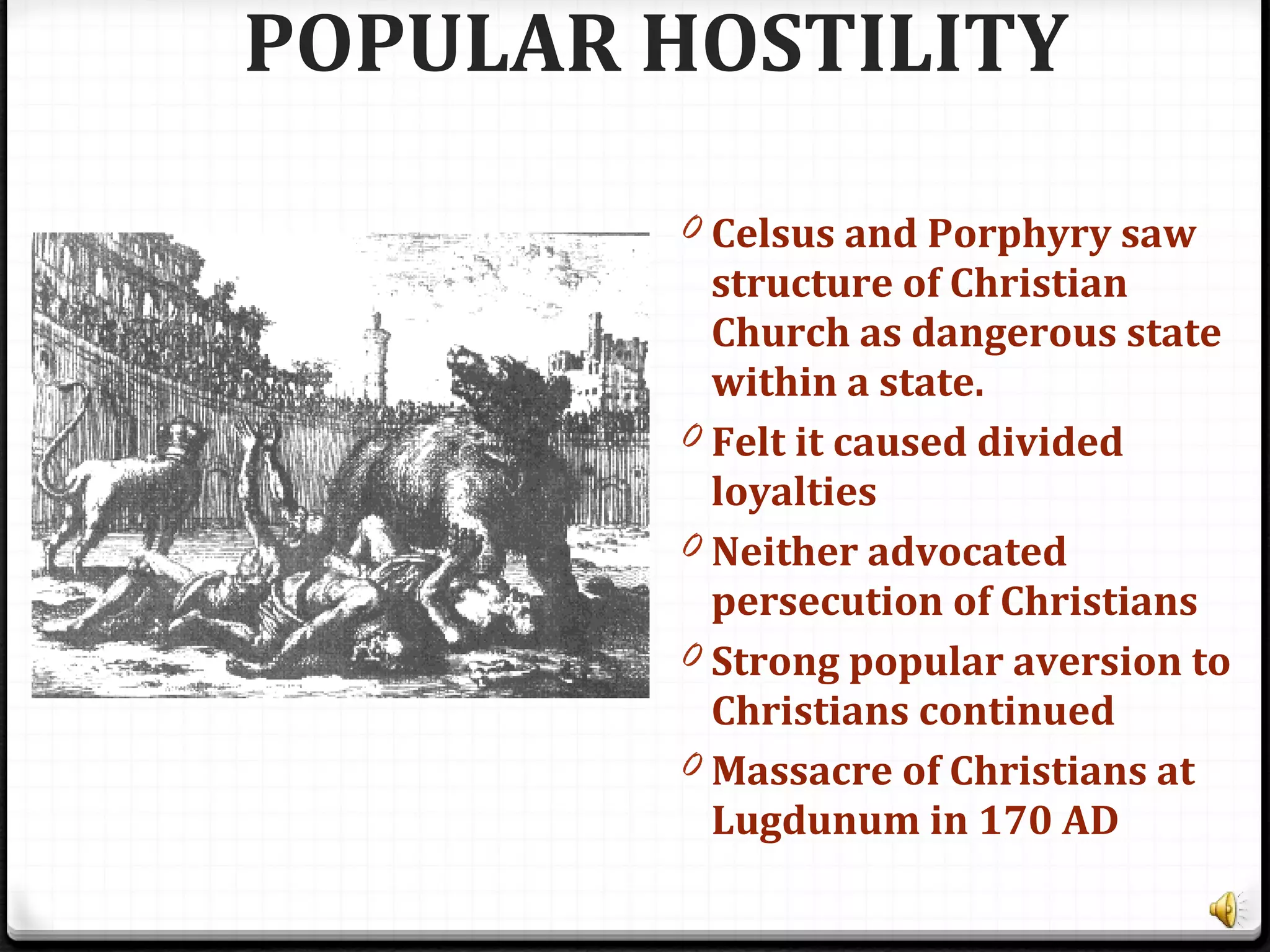
0 Massacre of Christians at
Lugdunum in 170 AD
MOTIVATION FOR PERSECUTIONS
0 Emperors like Trajan, Hadrian, and
Marcus Aurelian deplored the
ignorance and stubbornness of
Christians, but did not think they were
responsible for disasters that afflicted
the state
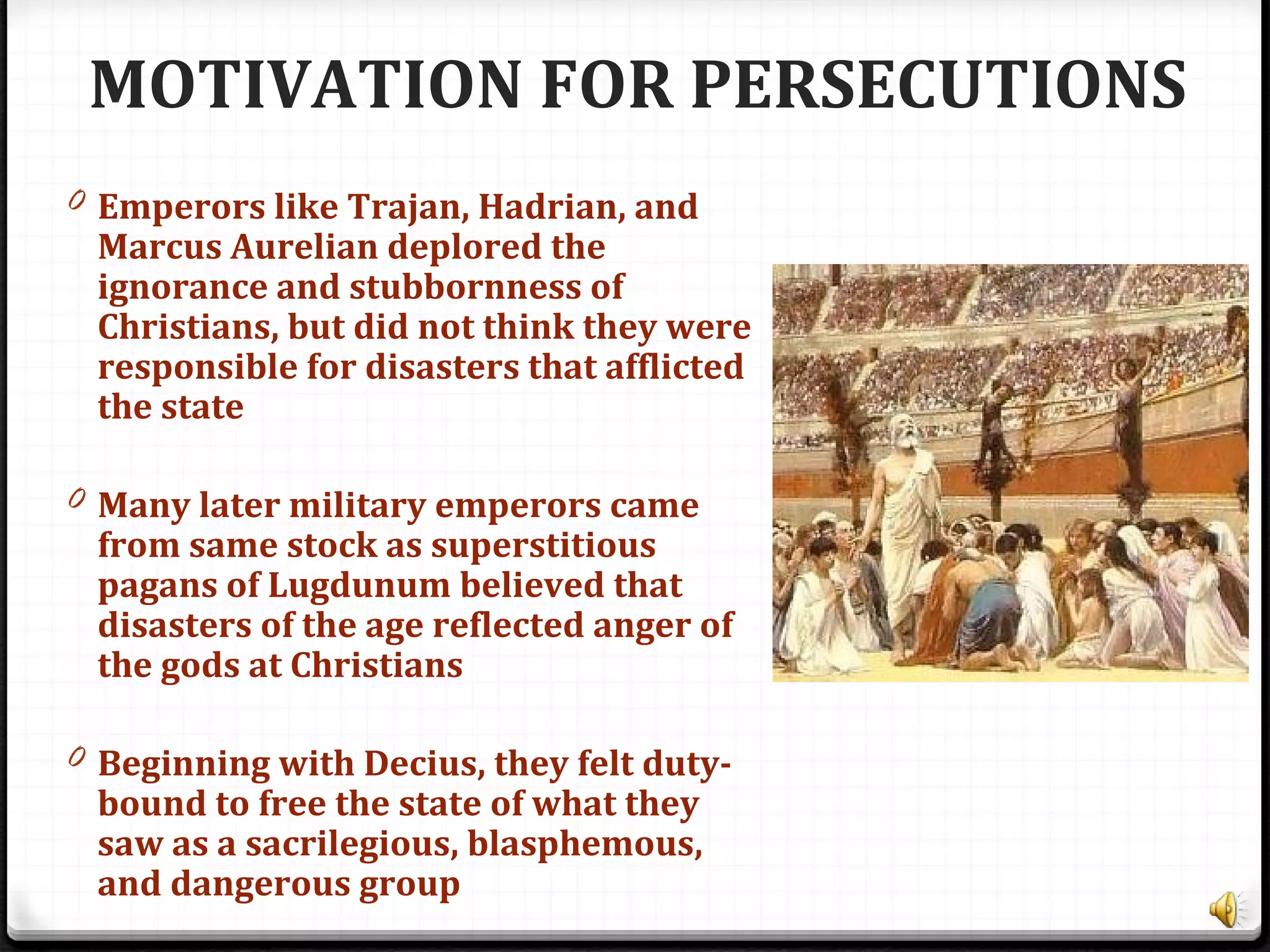
0 Many later military emperors came
from same stock as superstitious
pagans of Lugdunum believed that
disasters of the age reflected anger of
the gods at Christians
0 Beginning with Decius, they felt duty-
bound to free the state of what they
saw as a sacrilegious, blasphemous,
and dangerous group
REVERSAL OF FORTUNE
0 In the end, the persecutions did not
succeed in eradicating Christianity
0 Simply too many Christians and
some were in a position to
protect others
0 Persecutions also created
martyrs who inspired others
0 Came to an end with death of
Galerius and then Constantine
officially protected them
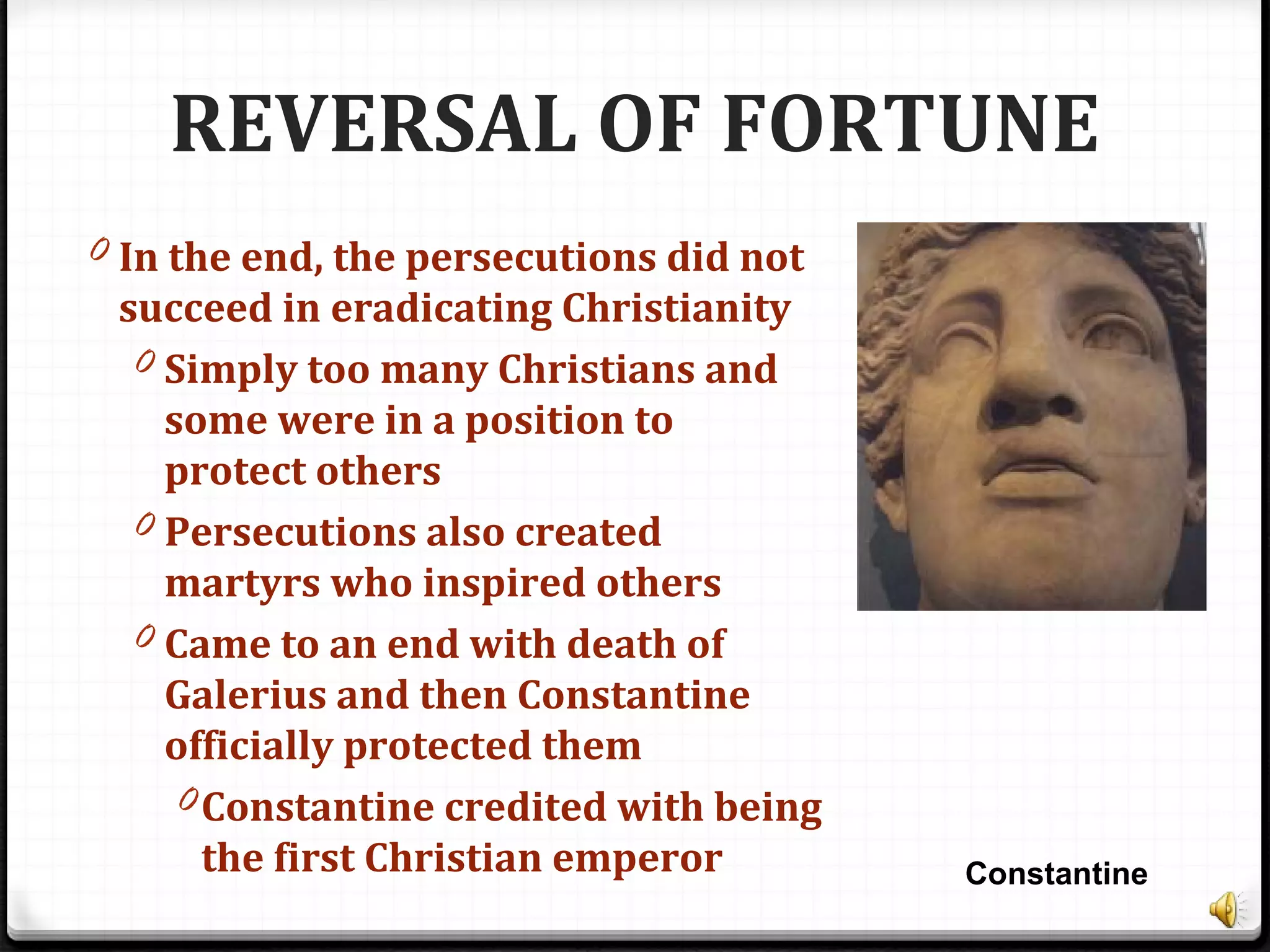
0Constantine credited with being
the first Christian emperor Constantine
JULIAN THE APOSTATE
0 Sons of Constantine
followed father’s policy
towards Christians
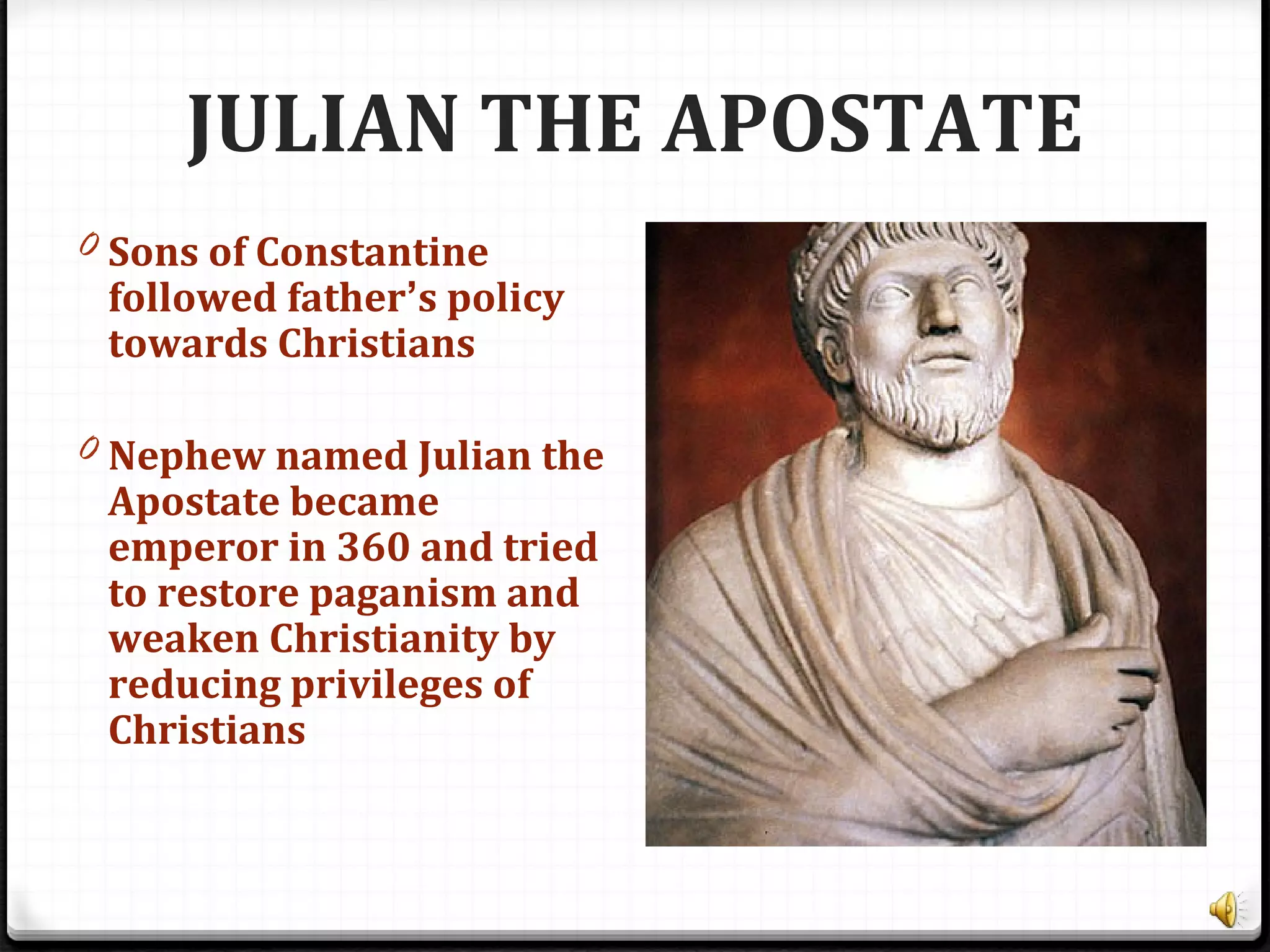
0 Nephew named Julian the
Apostate became
emperor in 360 and tried
to restore paganism and
weaken Christianity by
reducing privileges of
Christians
VICTORY
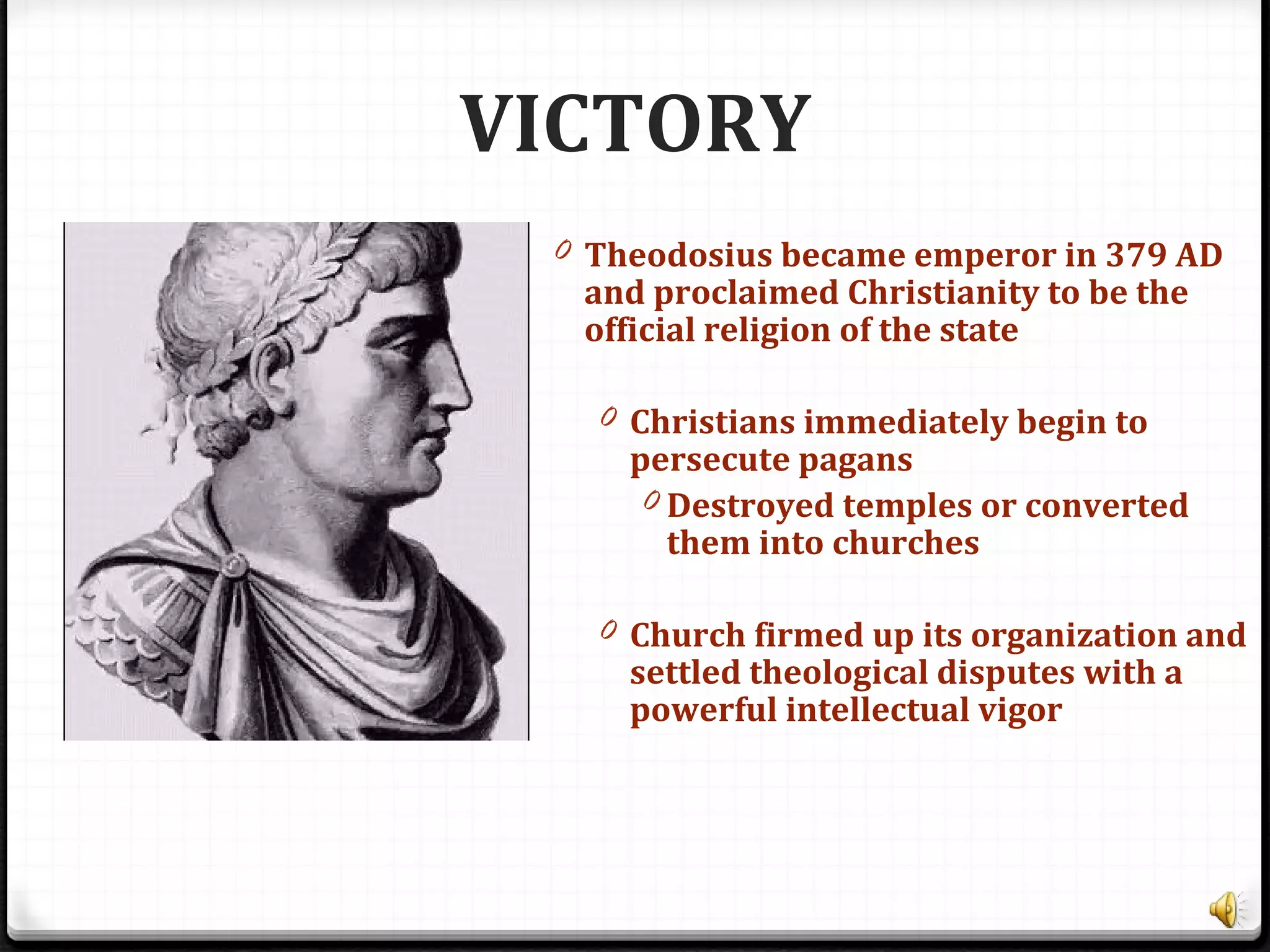
0 Theodosius became emperor in 379 AD
and proclaimed Christianity to be the
official religion of the state
0 Christians immediately begin to
persecute pagans
0 Destroyed temples or converted
them into churches
0 Church firmed up its organization and
settled theological disputes with a
powerful intellectual vigor
MIXED BLESSING FOR THE
EMPIRE
0 Many men of outstanding ability turned
away from public service and joined the
Church
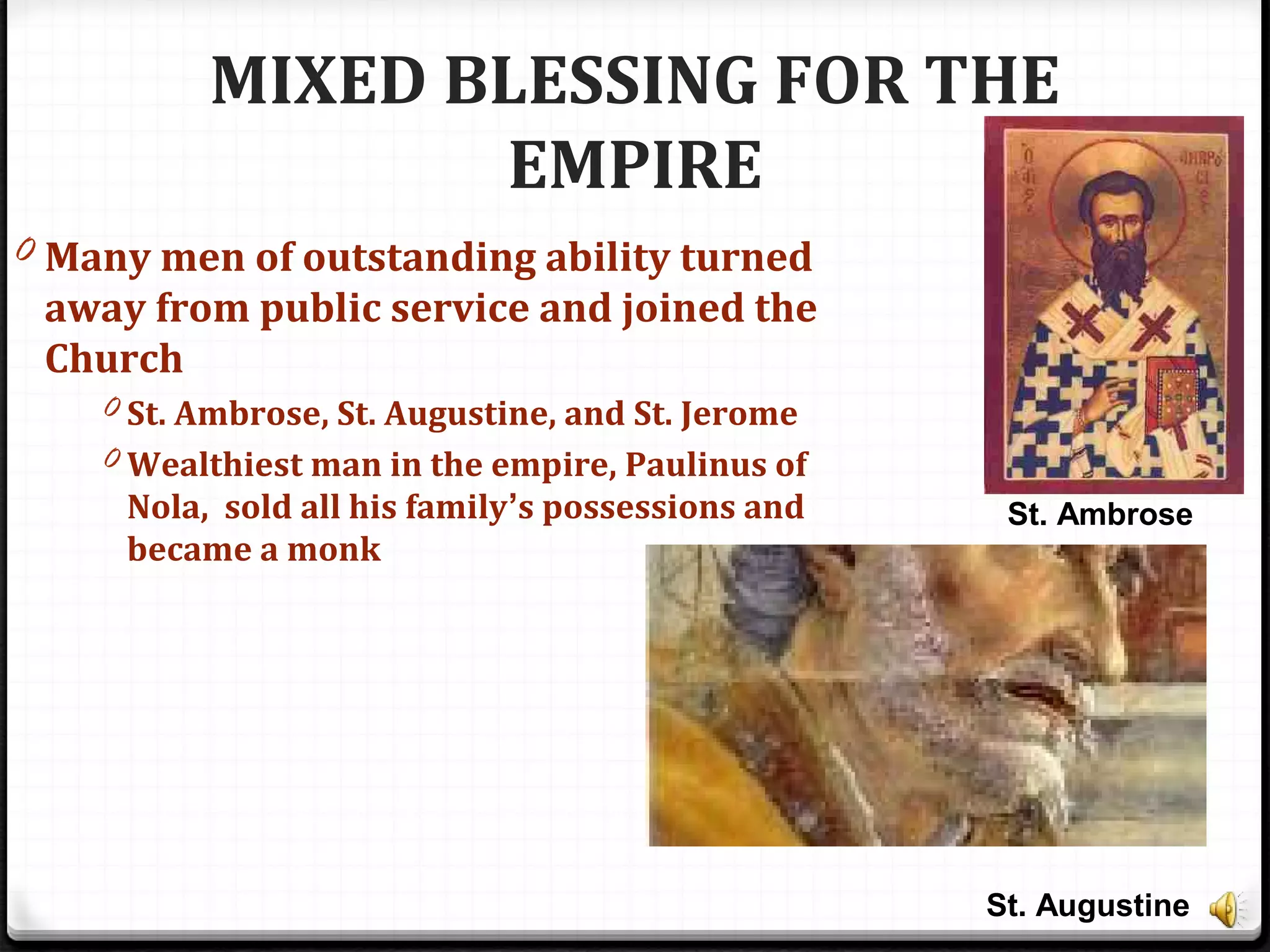
0 St. Ambrose, St. Augustine, and St. Jerome
0 Wealthiest man in the empire, Paulinus of
Nola, sold all his family’s possessions and
became a monk
St. Ambrose
St. Augustine
Works Cited
0 http://www.usu.edu/markdamen/1320hist&civ/chapters/
13xity.htm

Module One Readings Presentation

  • 1.
    Early Christianity ThisThis PowerPoinPowerPoin t hasaudiot has audio – Please– Please check thecheck the volume onvolume on youryour computercomputer’’ss speakersspeakers beforebefore moving tomoving to the nextthe next slide.slide.
  • 2.
    Content Goals andObjectives: Goal 1 – Christianity 0Trace and evaluate the impact of Christianity on medieval Europe. 0 Define the setting for Christianity during the period before and after the birth of Christ. 0 Map the spread of Christianity through Roman Empire during the first three centuries after the death of Jesus of Nazareth. 0 Summarize the early developments of the Christian church during the first three centuries after its creation. 0 Evaluate the contributions of Christian culture to the culture of medieval Europe.
  • 3.
    Main Idea 0 Anew religion called Christianity developed within the Roman Empire and gradually spread throughout Roman world.
  • 4.
    Religion in theRoman Empire Religion in Rome was polytheistic & based upon the Greek gods Romans worshiped the gods but people were not very emotional about their religion
  • 5.
    In 63 B.C.,the Romans conquered the Hebrew kingdom of Judea & allowed “Romanized Jews” (who showed respect & obeyed Roman laws) to govern Judea But, the Hebrews were monotheistic & many refused to pay respect to the Roman gods
  • 6.
    Many Hebrews beganto resist Roman rule & believed that God would send the Messiah to restore the kingdom to the Jews
  • 7.
    The Birth ofJesus & Beginning of Christianity Sometime between 6 & 4 B.C. in Judea, a Jew named Jesus was born; Many considered Jesus to be the Messiah At the age of 30, Jesus began preaching a unique version of Judaism that became known as Christianity
  • 8.
    EARLY CHRISTIANITY 0 Rootslie in Judaism, the teachings of John the Baptist, Jesus, and the apostles 0 Earliest converts were who wished to be considered Jews
  • 9.
    A NEW DIRECTION 0Christians began to emphasize their separateness 0 Christian leaders decided Gentiles who converted to Christianity did not have to become Jews in order to become Christians 0 Dangerous because Christianity was unapproved religion. 0 Roman government by the time of Nero or Domitian decided being Christian could be punishable by death
  • 10.
    GROWTH 0 Christianity strongestin Asia Minor and Greece 0 Also took hold in Rome and western provinces 0 Hellenistic religions helped pave the way for success of Christianity 0 Shared similarities with such cults as Isis made Christianity acceptable 0 Many found Christianity superior to Hellenistic cults 0 Jesus, a historical rather than a mythological figure 0 His teachings presented in the Gospels popular. 0 Books were elevated in tone and content but written in the language of the people and in a style that many educated people sneered at Cult of Isis held ritual purification rites and offered promise of an afterlife
  • 11.
    BIG GAP 0 Christianliterature composed in classical rhetoric style after 100 AD 0 Pagan intellectuals still offended by crude style 0 Huge spiritual gulf between Christian and pagan because much of Roman world offended Christians who saw obscenity, loose sexual morals, skepticism, materialism and hedonism everywhere. St. Jerome confessed that his first exposure to Jewish literature and Christian works repelled him when he compared them to the polished style of Cicero
  • 12.
    WIDENING GAP 0 Manyearly Christians, including St. Paul, advocated obedience to imperial and local authorities 0 Began to gradually set up a state within a state after reign of Nero and generally came to reject the entire social and cultural foundation of the empire 0 As a result, they came to be seen by the Roman government as a threat to the existing order of things St. Paul
  • 13.
    What role didthe apostle Paul play in Christianity?
  • 14.
    The Spread ofChristianity The Apostles, especially Paul, molded Jesus’ teachings into a new religion called Christianity based upon the idea that Jesus was God’s son & that he died for man’s sins The Apostles taught that Jews & non-Jews were welcome as Christians
  • 15.
    After Jesus’ death,Paul helped spread Jesus teachings throughout the Roman Empire Christianity spread quickly due to roads, numerous trade routes, & common language throughout the Roman Empire
  • 16.
    CHRISTIANS AND THEFALL OF THE EMPIRE 0 Christianity grew most rapidly as the empire declined 0 Number of individuals, like Edward Gibbon, argued that Christianity contributed to decline 0 Point has some validity 0 Loyalty of many Christians was to the Church, not the Empire 0 Were not upset about prospect of the end of the Empire 0 But Christianity had nothing to do with other problems that caused ultimate collapse 0 Civil war, famine, plague, and barbarian invasions
  • 17.
    NEW PAGAN GODS 0Traditional religion also changed during this time of troubles 0 Cult of Sol Invictus 0 United sun god of Emesa with all other major sun gods 0 Recognized as chief god of the state by time of emperor Aurelian 0 Replaced Jupiter at the top
  • 18.
    THE NEW PAGANISM 0Mithraism 0 Filled with mystery and mysticism 0 Spread as rapidly as Christianity during 3rd century AD 0 Devotees did speak of Mithra as the “only god” but they meant that all the other gods could be understood through him 0 Paganism did not decline during this period Mithra
  • 19.
    PERSECUTION 0 Great persecutionsof Christians began in 3rd century AD 0 Started by emperor Decius around 250 and continued until death of Galerius in 311 0 Christian intolerance of pagan beliefs bred powerful retaliatory hatred of Christians 0 Accused Christians of cannibalism, atheism, and of being haters of mankind 0 Charged with being sneaky and with dishonoring the emperor 0 Also blamed with all the evils that afflicted the state
  • 20.
    INTELLECTUAL DEBATE 0 Paganintellectuals began to attack Christianity 0 Celsus and Porphyry pointed out inconsistencies, contradictions, and impossibilities 0 Christian intellectuals responded in kind 0 Origen of Alexandria provided rational- philosophical basis for Christianity 0 Entire intellectual discourse had little impact of growth of Christianity 0 It was immune to rational argument 0 Most people adopted Christianity because they accepted its relatively simple message on an emotional, not an intellectual, level Porphyry Origen
  • 21.
    POPULAR HOSTILITY 0 Celsusand Porphyry saw structure of Christian Church as dangerous state within a state. 0 Felt it caused divided loyalties 0 Neither advocated persecution of Christians 0 Strong popular aversion to Christians continued 0 Massacre of Christians at Lugdunum in 170 AD
  • 22.
    MOTIVATION FOR PERSECUTIONS 0Emperors like Trajan, Hadrian, and Marcus Aurelian deplored the ignorance and stubbornness of Christians, but did not think they were responsible for disasters that afflicted the state 0 Many later military emperors came from same stock as superstitious pagans of Lugdunum believed that disasters of the age reflected anger of the gods at Christians 0 Beginning with Decius, they felt duty- bound to free the state of what they saw as a sacrilegious, blasphemous, and dangerous group
  • 23.
    REVERSAL OF FORTUNE 0In the end, the persecutions did not succeed in eradicating Christianity 0 Simply too many Christians and some were in a position to protect others 0 Persecutions also created martyrs who inspired others 0 Came to an end with death of Galerius and then Constantine officially protected them 0Constantine credited with being the first Christian emperor Constantine
  • 24.
    JULIAN THE APOSTATE 0Sons of Constantine followed father’s policy towards Christians 0 Nephew named Julian the Apostate became emperor in 360 and tried to restore paganism and weaken Christianity by reducing privileges of Christians
  • 25.
    VICTORY 0 Theodosius becameemperor in 379 AD and proclaimed Christianity to be the official religion of the state 0 Christians immediately begin to persecute pagans 0 Destroyed temples or converted them into churches 0 Church firmed up its organization and settled theological disputes with a powerful intellectual vigor
  • 26.
    MIXED BLESSING FORTHE EMPIRE 0 Many men of outstanding ability turned away from public service and joined the Church 0 St. Ambrose, St. Augustine, and St. Jerome 0 Wealthiest man in the empire, Paulinus of Nola, sold all his family’s possessions and became a monk St. Ambrose St. Augustine
  • 27.

Editor's Notes

  • #5 The religion of the ancient Romans was polytheistic (ideas borrowed from the Greek gods) Rulers were mostly tolerant of other religions; but they expected everyone who lived in the empire to respect the Roman gods as a sign of loyalty
  • #8 The Life and Teachings of Jesus Roman power spread to Judea, the home of the Jews, around 63 B.C. At first the Jewish kingdom remained independent, at least in name. Rome then took control of the Jewish kingdom in A.D. 6 and made it a province of the empire. A number of Jews, however, believed that they would once again be free. According to biblical tradition, God had promised that a savior known as the Messiah would arrive and restore the kingdom of the Jews. Roughly two decades after the beginning of Roman rule, many believed that such a savior had arrived. Jesus of Nazareth Although the exact date is uncertain, historians believe that sometime around 6 to 4 B.C., a Jew named Jesus was born in the town of Bethlehem in Judea. Jesus was raised in the village of Nazareth in northern Palestine. He was baptized by a prophet known as John the Baptist. As a young man, he took up the trade of carpentry. At the age of 30, Jesus began his public ministry. For the next three years, he preached, taught, did good works, and reportedly performed miracles. His teachings contained many ideas from Jewish tradition, such as monotheism, or belief in only one god, and the principles of the Ten Commandments. Jesus emphasized God’s personal relationship to each human being. He stressed the importance of people’s love for God, their neighbors, their enemies, and even themselves. He also taught that God would end wickedness in the world and would establish an eternal kingdom after death for people who sincerely repented their sins. (Refer to pages 286–287 for more about Christianity.) A Growing Movement Historical records of the time mention very little about Jesus. The main source of information about his teachings are the Gospels, the first four books of the New Testament of the Bible. Some of the Gospels are thought to have been written by one or more of Jesus’ disciples, or pupils. These 12 men later came to be called apostles. As Jesus preached from town to town, his fame grew. He attracted large crowds, and many people were touched by his message. Because Jesus ignored wealth and status, his message had special appeal to the poor. “
  • #15 Paul’s Mission One man, the apostle Paul, had enormous influence on Christianity’s development. Paul was a Jew who had never met Jesus and at first was an enemy of Christianity. While traveling to Damascus in Syria, he reportedly had a vision of Christ. He spent the rest of his life spreading and interpreting Christ’s teachings. The Pax Romana, which made travel and the exchange of ideas fairly safe, provided the ideal conditions for Christianity to spread. Common languages—Latin and Greek—allowed the message to be easily understood. Paul wrote influential letters, called Epistles, to groups of believers. In his teaching, Paul stressed that Jesus was the son of God who died for people’s sins. He also declared that Christianity should welcome all converts, Jew or Gentile (non-Jew). It was this universality that enabled Christianity to become more than just a local religion.