Faster IO through io uring_uring
Jens Axboe
Software Engineer, Facebook Kernel Recipes 2019, Sep 26th
2019
Facebook 3
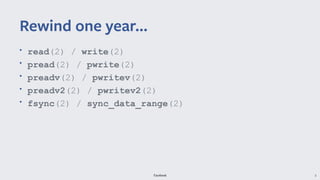
• read(2) / write(2)
• pread(2) / pwrite(2)
• preadv(2) / pwritev(2)
• preadv2(2) / pwritev2(2)
• fsync(2) / sync_data_range(2)
Rewind one year...
Facebook 4
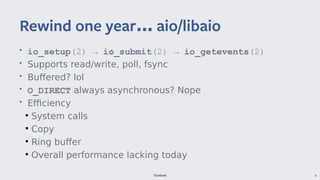
• io_setup(2) → io_submit(2) → io_getevents(2)
• Supports read/write, poll, fsync
• Buffered? lol
• O_DIRECT always asynchronous? Nope
• Efficiency
●
System calls
●
Copy
●
Ring buffer
●
Overall performance lacking today
Rewind one year aio/libaio… aio/libaio
Facebook 5
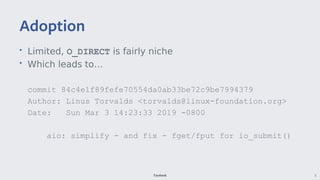
• Limited, O_DIRECT is fairly niche
• Which leads to…
commit 84c4e1f89fefe70554da0ab33be72c9be7994379
Author: Linus Torvalds <torvalds@linux-foundation.org>
Date: Sun Mar 3 14:23:33 2019 -0800
aio: simplify - and fix - fget/fput for io_submit()
Adoption
Facebook 6
• Support for missing features
●
Buffered async IO
●
Polled IO
●
New features that allow general overhead reduction
• API that doesn’t suck
• Efficient
●
Low latency
●
High IOPS
●
System call limiting
• Could aio be fixed?
What do we need - tldr
Facebook 7
• Yes, I know what it sounds like…
• Merged in v5.1-rc1
●
First posted January 8th
2019
●
Merged March 8th
2019
• So obviously Linus totally loves it
io uring_uring
Facebook 8
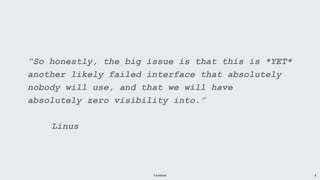
“So honestly, the big issue is that this is *YET*
another likely failed interface that absolutely
nobody will use, and that we will have
absolutely zero visibility into.”
Linus
Facebook 9
“It will probably have subtle and nasty bugs, not
just because nobody tests it, but because that's
how asynchronous code works - it's hard.”
Linus
Facebook 10
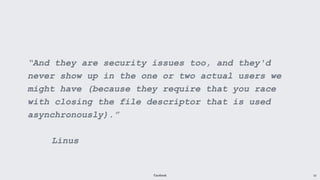
“And they are security issues too, and they'd
never show up in the one or two actual users we
might have (because they require that you race
with closing the file descriptor that is used
asynchronously).”
Linus
Facebook 11
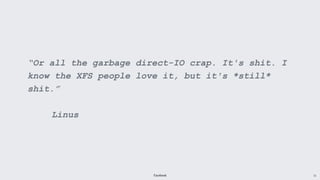
“Or all the garbage direct-IO crap. It's shit. I
know the XFS people love it, but it's *still*
shit.”
Linus
Facebook 12
Hopeless?
Facebook 13
“So the fundamental issue is that it needs to be
so good that I don't go "why isn't this *exactly*
the same as all the other failed clever
things we've done"?”
Linus
Facebook 14
• Yes, I know what it sounds like…
• Merged in v5.1-rc1
●
First posted January 8th
2019
●
Merged March 8th
2019
• So obviously Linus totally loves it
●
Deep down somewhere…
io uring_uring
Facebook 15
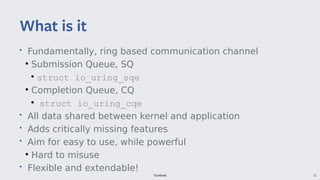
• Fundamentally, ring based communication channel
●
Submission Queue, SQ
●
struct io_uring_sqe
●
Completion Queue, CQ
●
struct io_uring_cqe
• All data shared between kernel and application
• Adds critically missing features
• Aim for easy to use, while powerful
●
Hard to misuse
• Flexible and extendable!
What is it
Facebook 16
• int io_uring_setup(u32 nentries, struct io_uring_params *p);
●
→ returns ring file descriptor
struct io_uring_params {
__u32 sq_entries;
__u32 cq_entries;
__u32 flags;
__u32 sq_thread_cpu;
__u32 sq_thread_idle;
__u32 features;
__u32 resv[4];
struct io_sqring_offsets sq_off;
struct io_cqring_offsets cq_off;
};
Ring setup
Facebook 17
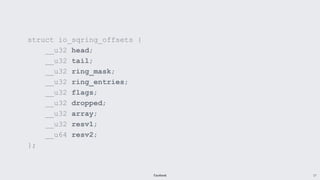
struct io_sqring_offsets {
__u32 head;
__u32 tail;
__u32 ring_mask;
__u32 ring_entries;
__u32 flags;
__u32 dropped;
__u32 array;
__u32 resv1;
__u64 resv2;
};
Facebook 18
#define IORING_OFF_SQ_RING 0ULL
#define IORING_OFF_CQ_RING 0x8000000ULL
#define IORING_OFF_SQES 0x10000000ULL
sq→ring_ptr = mmap(0, sq→ring_sz, PROT_READ | PROT_WRITE,
MAP_SHARED | MAP_POPULATE, ring_fd,
IORING_OFF_SQ_RING);
sq→khead = sq→ring_ptr + p→sq_off.head;
sq→ktail = sq→ring_ptr + p→sq_off.tail;
[…]
Ring access
Facebook 19
• head and tail indices free running
●
Integer wraps
●
Entry always head/tail masked with ring mask
• App produces SQ ring entries
●
Updates tail, kernel consumes at head
●
→array[] holds index into →sqes[]
●
Why not directly indexed?
• Kernel produces CQ ring entries
●
Updates tail, app consumes at head
●
→cqes[] indexed directly
Reading and writing rings
Facebook 20
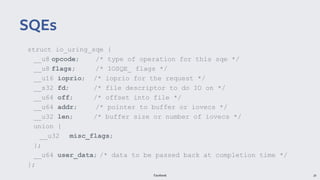
struct io_uring_sqe {
__u8 opcode; /* type of operation for this sqe */
__u8 flags; /* IOSQE_ flags */
__u16 ioprio; /* ioprio for the request */
__s32 fd; /* file descriptor to do IO on */
__u64 off; /* offset into file */
__u64 addr; /* pointer to buffer or iovecs */
__u32 len; /* buffer size or number of iovecs */
union {
__u32 misc_flags;
};
__u64 user_data; /* data to be passed back at completion time */
};
SQEs
Facebook 21
struct io_uring_sqe *sqe;
unsigned index, tail;
tail = ring->tail;
read_barrier();
/* SQ ring full */
if (tail + 1 == ring->head)
return FULL;
index = tail & ring->sq_ring_mask;
sqe = &ring->sqes[index];
/* fill in sqe here */
ring->array[index] = index;
write_barrier();
ring->tail = tail + 1;
write_barrier();
Filling in a new SQE
Facebook 22
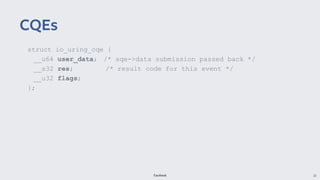
struct io_uring_cqe {
__u64 user_data; /* sqe->data submission passed back */
__s32 res; /* result code for this event */
__u32 flags;
};
CQEs
Facebook 23
struct io_uring_cqe *cqe;
unsigned head, index;
head = ring->head;
do {
read_barrier();
/* cq ring empty */
if (head == ring->tail)
break;
index = head & ring->cq_ring_mask;
cqe = &ring->cqes[index];
/* handle done IO */
head++;
} while (1);
ring->head = head;
write_barrier();
Finding completed CQE
Facebook 24
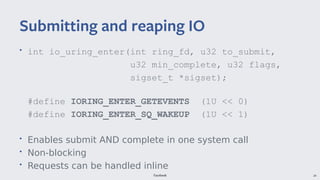
• int io_uring_enter(int ring_fd, u32 to_submit,
u32 min_complete, u32 flags,
sigset_t *sigset);
#define IORING_ENTER_GETEVENTS (1U << 0)
#define IORING_ENTER_SQ_WAKEUP (1U << 1)
• Enables submit AND complete in one system call
• Non-blocking
• Requests can be handled inline
Submitting and reaping IO
Facebook 25
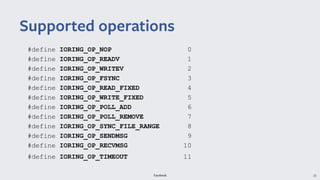
#define IORING_OP_NOP 0
#define IORING_OP_READV 1
#define IORING_OP_WRITEV 2
#define IORING_OP_FSYNC 3
#define IORING_OP_READ_FIXED 4
#define IORING_OP_WRITE_FIXED 5
#define IORING_OP_POLL_ADD 6
#define IORING_OP_POLL_REMOVE 7
#define IORING_OP_SYNC_FILE_RANGE 8
#define IORING_OP_SENDMSG 9
#define IORING_OP_RECVMSG 10
#define IORING_OP_TIMEOUT 11
Supported operations
Facebook 26
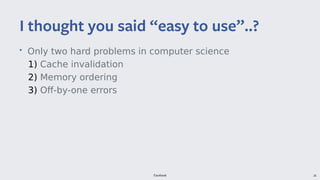
• Only two hard problems in computer science
1) Cache invalidation
2) Memory ordering
3) Off-by-one errors
I thought you said “easy to use”..?
Facebook 27
• Helpers for setup
liburing to the rescue
Facebook 28
static int setup_ring(struct submitter *s)
{
struct io_sq_ring *sring = &s->sq_ring;
struct io_cq_ring *cring = &s->cq_ring;
struct io_uring_params p;
int ret, fd;
void *ptr;
memset(&p, 0, sizeof(p));
fd = io_uring_setup(depth, &p);
if (fd < 0) {
perror("io_uring_setup");
return 1;
}
s->ring_fd = fd;
ptr = mmap(0, p.sq_off.array + p.sq_entries * sizeof(__u32),
PROT_READ | PROT_WRITE, MAP_SHARED | MAP_POPULATE, fd,
IORING_OFF_SQ_RING);
printf("sq_ring ptr = 0x%pn", ptr);
sring->head = ptr + p.sq_off.head;
sring->tail = ptr + p.sq_off.tail;
sring->ring_mask = ptr + p.sq_off.ring_mask;
sring->ring_entries = ptr + p.sq_off.ring_entries;
sring->flags = ptr + p.sq_off.flags;
sring->array = ptr + p.sq_off.array;
sq_ring_mask = *sring->ring_mask;
s->sqes = mmap(0, p.sq_entries * sizeof(struct io_uring_sqe),
PROT_READ | PROT_WRITE, MAP_SHARED | MAP_POPULATE, fd,
IORING_OFF_SQES);
printf("sqes ptr = 0x%pn", s->sqes);
ptr = mmap(0, p.cq_off.cqes + p.cq_entries * sizeof(struct io_uring_cqe),
PROT_READ | PROT_WRITE, MAP_SHARED | MAP_POPULATE, fd,
IORING_OFF_CQ_RING);
printf("cq_ring ptr = 0x%pn", ptr);
cring->head = ptr + p.cq_off.head;
cring->tail = ptr + p.cq_off.tail;
cring->ring_mask = ptr + p.cq_off.ring_mask;
cring->ring_entries = ptr + p.cq_off.ring_entries;
cring->cqes = ptr + p.cq_off.cqes;
cq_ring_mask = *cring->ring_mask;
return 0;
}
Facebook 29
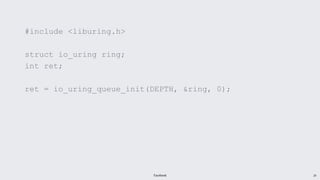
#include <liburing.h>
struct io_uring ring;
int ret;
ret = io_uring_queue_init(DEPTH, &ring, 0);
Facebook 30
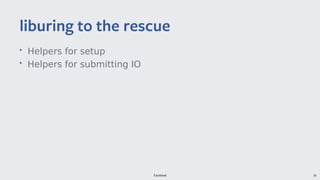
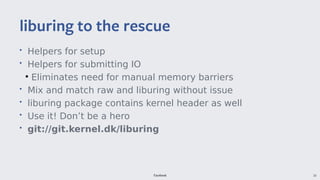
• Helpers for setup
• Helpers for submitting IO
liburing to the rescue
Facebook 31
static int prep_more_ios(struct submitter *s, int max_ios)
{
struct io_sq_ring *ring = &s->sq_ring;
unsigned index, tail, next_tail, prepped = 0;
next_tail = tail = *ring->tail;
do {
next_tail++;
read_barrier();
if (next_tail == *ring->head)
break;
index = tail & sq_ring_mask;
init_io(s, index);
ring->array[index] = index;
prepped++;
tail = next_tail;
} while (prepped < max_ios);
if (*ring->tail != tail) {
/* order tail store with writes to sqes above */
write_barrier();
*ring->tail = tail;
write_barrier();
}
return prepped;
}
Facebook 32
struct io_uring_sqe *sqe;
struct io_uring_cqe *cqe;
struct iovec iov;
sqe = io_uring_get_sqe(ring); ← previous example to here
iov.iov_base = some_addr;
iov.iov_len = some_len;
io_uring_prep_readv(sqe, ring->fd, &iov, 1 offset);
io_uring_submit(ring);
io_uring_wait_cqe(ring, &cqe);
[read cqe]
io_uring_cqe_seen(ring, cqe);
Facebook 33
• Helpers for setup
• Helpers for submitting IO
●
Eliminates need for manual memory barriers
• Mix and match raw and liburing without issue
• liburing package contains kernel header as well
• Use it! Don’t be a hero
• git://git.kernel.dk/liburing
liburing to the rescue
Facebook 34
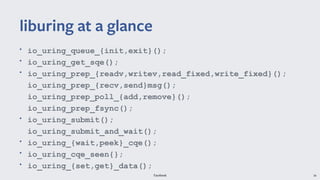
• io_uring_queue_{init,exit}();
• io_uring_get_sqe();
• io_uring_prep_{readv,writev,read_fixed,write_fixed}();
io_uring_prep_{recv,send}msg();
io_uring_prep_poll_{add,remove}();
io_uring_prep_fsync();
• io_uring_submit();
io_uring_submit_and_wait();
• io_uring_{wait,peek}_cqe();
• io_uring_cqe_seen{};
• io_uring_{set,get}_data();
liburing at a glance
Facebook 35
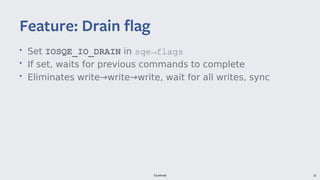
• Set IOSQE_IO_DRAIN in sqe→flags
• If set, waits for previous commands to complete
• Eliminates write→write→write, wait for all writes, sync
Feature: Drain flag
Facebook 36
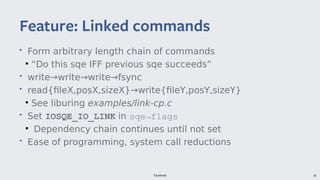
• Form arbitrary length chain of commands
●
“Do this sqe IFF previous sqe succeeds”
• write→write→write→fsync
• read{fileX,posX,sizeX}→write{fileY,posY,sizeY}
●
See liburing examples/link-cp.c
• Set IOSQE_IO_LINK in sqe→flags
●
Dependency chain continues until not set
• Ease of programming, system call reductions
Feature: Linked commands
Facebook 37
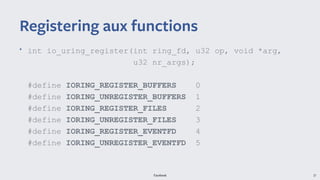
• int io_uring_register(int ring_fd, u32 op, void *arg,
u32 nr_args);
#define IORING_REGISTER_BUFFERS 0
#define IORING_UNREGISTER_BUFFERS 1
#define IORING_REGISTER_FILES 2
#define IORING_UNREGISTER_FILES 3
#define IORING_REGISTER_EVENTFD 4
#define IORING_UNREGISTER_EVENTFD 5
Registering aux functions
Facebook 38
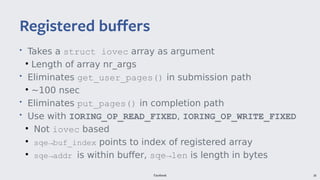
• Takes a struct iovec array as argument
●
Length of array nr_args
• Eliminates get_user_pages() in submission path
●
~100 nsec
• Eliminates put_pages() in completion path
• Use with IORING_OP_READ_FIXED, IORING_OP_WRITE_FIXED
●
Not iovec based
●
sqe→buf_index points to index of registered array
●
sqe→addr is within buffer, sqe→len is length in bytes
Registered buffers
Facebook 39
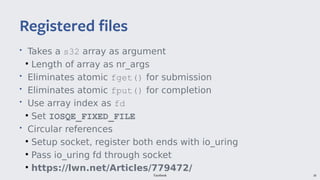
• Takes a s32 array as argument
●
Length of array as nr_args
• Eliminates atomic fget() for submission
• Eliminates atomic fput() for completion
• Use array index as fd
●
Set IOSQE_FIXED_FILE
• Circular references
●
Setup socket, register both ends with io_uring
●
Pass io_uring fd through socket
●
https://lwn.net/Articles/779472/
Registered files
Facebook 40
• Takes a s32 pointer as argument
●
nr_args ignored
• Allows completion notifications
Registered eventfd
Facebook 41
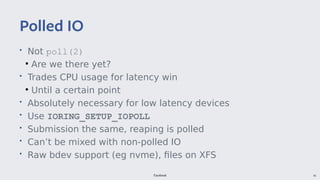
• Not poll(2)
●
Are we there yet?
• Trades CPU usage for latency win
●
Until a certain point
• Absolutely necessary for low latency devices
• Use IORING_SETUP_IOPOLL
• Submission the same, reaping is polled
• Can’t be mixed with non-polled IO
• Raw bdev support (eg nvme), files on XFS
Polled IO
Facebook 42
• Use IORING_SETUP_SQPOLL
●
IORING_SETUP_SQ_AFF
• Submission now offloaded, reaping is app polled
• Independent of IORING_SETUP_IOPOLL
• Busy loops for params→sq_thread_idle msec when idle
●
Sets sq_ring→flags |= IORING_SQ_NEED_WAKEUP
• Allows splitting submit / complete load onto separate cores
Polled IO submission
Facebook 43
NOP
Facebook 44
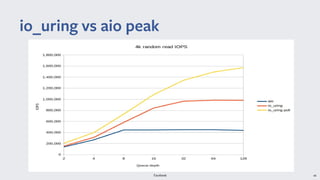
io uring vs aio peak_uring
Facebook 45
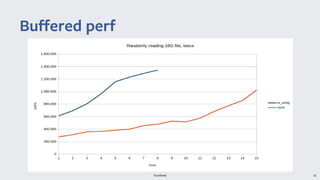
Buffered perf
Facebook 46
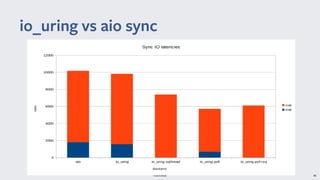
io uring vs aio sync_uring
Facebook 47
• Rust, C++ I/O executors
• Ceph (bluestore, new backend)
• libuv
• Postgres
• RocksDB (and MyRocks)
Adoption
Facebook 48
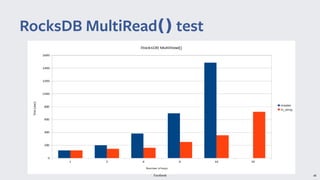
RocksDB MultiRead test() test
Facebook 49
• Rust, C++ I/O executors
• Ceph (bluestore, new backend)
• libuv
• Postgres
• RocksDB (and MyRocks)
• High performance cases
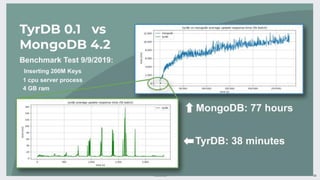
• TyrDB
Adoption
Facebook 50
Facebook 51
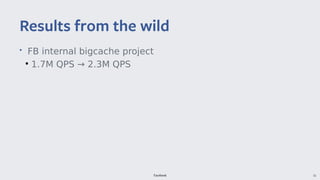
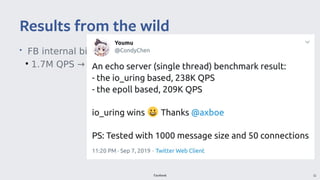
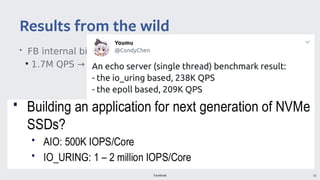
• FB internal bigcache project
●
1.7M QPS → 2.3M QPS
Results from the wild
Facebook 52
• FB internal bigcache project
●
1.7M QPS → 2.3M QPS
Results from the wild
Facebook 53
• FB internal bigcache project
●
1.7M QPS → 2.3M QPS
Results from the wild
Facebook 54
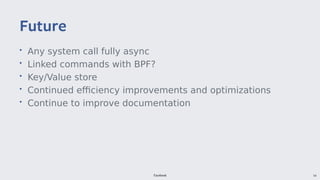
• Any system call fully async
• Linked commands with BPF?
• Key/Value store
• Continued efficiency improvements and optimizations
• Continue to improve documentation
Future
Facebook 55
• http://kernel.dk/io_uringuring.pdf
●
Definitive guide
• git://git.kernel.dk/fio
●
io_uring engine (engines/io_uring.c)
●
t/io_uring.c
• liburing has man pages (for system calls…)
●
Regression tests, example use cases
• https://lwn.net/Articles/776703/
●
Not fully current (Jan 15th
2019)
Resources

Kernel Recipes 2019 - Faster IO through io_uring

  • 2.
    Faster IO throughio uring_uring Jens Axboe Software Engineer, Facebook Kernel Recipes 2019, Sep 26th 2019
  • 3.
    Facebook 3 • read(2)/ write(2) • pread(2) / pwrite(2) • preadv(2) / pwritev(2) • preadv2(2) / pwritev2(2) • fsync(2) / sync_data_range(2) Rewind one year...
  • 4.
    Facebook 4 • io_setup(2)→ io_submit(2) → io_getevents(2) • Supports read/write, poll, fsync • Buffered? lol • O_DIRECT always asynchronous? Nope • Efficiency ● System calls ● Copy ● Ring buffer ● Overall performance lacking today Rewind one year aio/libaio… aio/libaio
  • 5.
    Facebook 5 • Limited,O_DIRECT is fairly niche • Which leads to… commit 84c4e1f89fefe70554da0ab33be72c9be7994379 Author: Linus Torvalds <torvalds@linux-foundation.org> Date: Sun Mar 3 14:23:33 2019 -0800 aio: simplify - and fix - fget/fput for io_submit() Adoption
  • 6.
    Facebook 6 • Supportfor missing features ● Buffered async IO ● Polled IO ● New features that allow general overhead reduction • API that doesn’t suck • Efficient ● Low latency ● High IOPS ● System call limiting • Could aio be fixed? What do we need - tldr
  • 7.
    Facebook 7 • Yes,I know what it sounds like… • Merged in v5.1-rc1 ● First posted January 8th 2019 ● Merged March 8th 2019 • So obviously Linus totally loves it io uring_uring
  • 8.
    Facebook 8 “So honestly,the big issue is that this is *YET* another likely failed interface that absolutely nobody will use, and that we will have absolutely zero visibility into.” Linus
  • 9.
    Facebook 9 “It willprobably have subtle and nasty bugs, not just because nobody tests it, but because that's how asynchronous code works - it's hard.” Linus
  • 10.
    Facebook 10 “And theyare security issues too, and they'd never show up in the one or two actual users we might have (because they require that you race with closing the file descriptor that is used asynchronously).” Linus
  • 11.
    Facebook 11 “Or allthe garbage direct-IO crap. It's shit. I know the XFS people love it, but it's *still* shit.” Linus
  • 12.
  • 13.
    Facebook 13 “So thefundamental issue is that it needs to be so good that I don't go "why isn't this *exactly* the same as all the other failed clever things we've done"?” Linus
  • 14.
    Facebook 14 • Yes,I know what it sounds like… • Merged in v5.1-rc1 ● First posted January 8th 2019 ● Merged March 8th 2019 • So obviously Linus totally loves it ● Deep down somewhere… io uring_uring
  • 15.
    Facebook 15 • Fundamentally,ring based communication channel ● Submission Queue, SQ ● struct io_uring_sqe ● Completion Queue, CQ ● struct io_uring_cqe • All data shared between kernel and application • Adds critically missing features • Aim for easy to use, while powerful ● Hard to misuse • Flexible and extendable! What is it
  • 16.
    Facebook 16 • intio_uring_setup(u32 nentries, struct io_uring_params *p); ● → returns ring file descriptor struct io_uring_params { __u32 sq_entries; __u32 cq_entries; __u32 flags; __u32 sq_thread_cpu; __u32 sq_thread_idle; __u32 features; __u32 resv[4]; struct io_sqring_offsets sq_off; struct io_cqring_offsets cq_off; }; Ring setup
  • 17.
    Facebook 17 struct io_sqring_offsets{ __u32 head; __u32 tail; __u32 ring_mask; __u32 ring_entries; __u32 flags; __u32 dropped; __u32 array; __u32 resv1; __u64 resv2; };
  • 18.
    Facebook 18 #define IORING_OFF_SQ_RING0ULL #define IORING_OFF_CQ_RING 0x8000000ULL #define IORING_OFF_SQES 0x10000000ULL sq→ring_ptr = mmap(0, sq→ring_sz, PROT_READ | PROT_WRITE, MAP_SHARED | MAP_POPULATE, ring_fd, IORING_OFF_SQ_RING); sq→khead = sq→ring_ptr + p→sq_off.head; sq→ktail = sq→ring_ptr + p→sq_off.tail; […] Ring access
  • 19.
    Facebook 19 • headand tail indices free running ● Integer wraps ● Entry always head/tail masked with ring mask • App produces SQ ring entries ● Updates tail, kernel consumes at head ● →array[] holds index into →sqes[] ● Why not directly indexed? • Kernel produces CQ ring entries ● Updates tail, app consumes at head ● →cqes[] indexed directly Reading and writing rings
  • 20.
    Facebook 20 struct io_uring_sqe{ __u8 opcode; /* type of operation for this sqe */ __u8 flags; /* IOSQE_ flags */ __u16 ioprio; /* ioprio for the request */ __s32 fd; /* file descriptor to do IO on */ __u64 off; /* offset into file */ __u64 addr; /* pointer to buffer or iovecs */ __u32 len; /* buffer size or number of iovecs */ union { __u32 misc_flags; }; __u64 user_data; /* data to be passed back at completion time */ }; SQEs
  • 21.
    Facebook 21 struct io_uring_sqe*sqe; unsigned index, tail; tail = ring->tail; read_barrier(); /* SQ ring full */ if (tail + 1 == ring->head) return FULL; index = tail & ring->sq_ring_mask; sqe = &ring->sqes[index]; /* fill in sqe here */ ring->array[index] = index; write_barrier(); ring->tail = tail + 1; write_barrier(); Filling in a new SQE
  • 22.
    Facebook 22 struct io_uring_cqe{ __u64 user_data; /* sqe->data submission passed back */ __s32 res; /* result code for this event */ __u32 flags; }; CQEs
  • 23.
    Facebook 23 struct io_uring_cqe*cqe; unsigned head, index; head = ring->head; do { read_barrier(); /* cq ring empty */ if (head == ring->tail) break; index = head & ring->cq_ring_mask; cqe = &ring->cqes[index]; /* handle done IO */ head++; } while (1); ring->head = head; write_barrier(); Finding completed CQE
  • 24.
    Facebook 24 • intio_uring_enter(int ring_fd, u32 to_submit, u32 min_complete, u32 flags, sigset_t *sigset); #define IORING_ENTER_GETEVENTS (1U << 0) #define IORING_ENTER_SQ_WAKEUP (1U << 1) • Enables submit AND complete in one system call • Non-blocking • Requests can be handled inline Submitting and reaping IO
  • 25.
    Facebook 25 #define IORING_OP_NOP0 #define IORING_OP_READV 1 #define IORING_OP_WRITEV 2 #define IORING_OP_FSYNC 3 #define IORING_OP_READ_FIXED 4 #define IORING_OP_WRITE_FIXED 5 #define IORING_OP_POLL_ADD 6 #define IORING_OP_POLL_REMOVE 7 #define IORING_OP_SYNC_FILE_RANGE 8 #define IORING_OP_SENDMSG 9 #define IORING_OP_RECVMSG 10 #define IORING_OP_TIMEOUT 11 Supported operations
  • 26.
    Facebook 26 • Onlytwo hard problems in computer science 1) Cache invalidation 2) Memory ordering 3) Off-by-one errors I thought you said “easy to use”..?
  • 27.
    Facebook 27 • Helpersfor setup liburing to the rescue
  • 28.
    Facebook 28 static intsetup_ring(struct submitter *s) { struct io_sq_ring *sring = &s->sq_ring; struct io_cq_ring *cring = &s->cq_ring; struct io_uring_params p; int ret, fd; void *ptr; memset(&p, 0, sizeof(p)); fd = io_uring_setup(depth, &p); if (fd < 0) { perror("io_uring_setup"); return 1; } s->ring_fd = fd; ptr = mmap(0, p.sq_off.array + p.sq_entries * sizeof(__u32), PROT_READ | PROT_WRITE, MAP_SHARED | MAP_POPULATE, fd, IORING_OFF_SQ_RING); printf("sq_ring ptr = 0x%pn", ptr); sring->head = ptr + p.sq_off.head; sring->tail = ptr + p.sq_off.tail; sring->ring_mask = ptr + p.sq_off.ring_mask; sring->ring_entries = ptr + p.sq_off.ring_entries; sring->flags = ptr + p.sq_off.flags; sring->array = ptr + p.sq_off.array; sq_ring_mask = *sring->ring_mask; s->sqes = mmap(0, p.sq_entries * sizeof(struct io_uring_sqe), PROT_READ | PROT_WRITE, MAP_SHARED | MAP_POPULATE, fd, IORING_OFF_SQES); printf("sqes ptr = 0x%pn", s->sqes); ptr = mmap(0, p.cq_off.cqes + p.cq_entries * sizeof(struct io_uring_cqe), PROT_READ | PROT_WRITE, MAP_SHARED | MAP_POPULATE, fd, IORING_OFF_CQ_RING); printf("cq_ring ptr = 0x%pn", ptr); cring->head = ptr + p.cq_off.head; cring->tail = ptr + p.cq_off.tail; cring->ring_mask = ptr + p.cq_off.ring_mask; cring->ring_entries = ptr + p.cq_off.ring_entries; cring->cqes = ptr + p.cq_off.cqes; cq_ring_mask = *cring->ring_mask; return 0; }
  • 29.
    Facebook 29 #include <liburing.h> structio_uring ring; int ret; ret = io_uring_queue_init(DEPTH, &ring, 0);
  • 30.
    Facebook 30 • Helpersfor setup • Helpers for submitting IO liburing to the rescue
  • 31.
    Facebook 31 static intprep_more_ios(struct submitter *s, int max_ios) { struct io_sq_ring *ring = &s->sq_ring; unsigned index, tail, next_tail, prepped = 0; next_tail = tail = *ring->tail; do { next_tail++; read_barrier(); if (next_tail == *ring->head) break; index = tail & sq_ring_mask; init_io(s, index); ring->array[index] = index; prepped++; tail = next_tail; } while (prepped < max_ios); if (*ring->tail != tail) { /* order tail store with writes to sqes above */ write_barrier(); *ring->tail = tail; write_barrier(); } return prepped; }
  • 32.
    Facebook 32 struct io_uring_sqe*sqe; struct io_uring_cqe *cqe; struct iovec iov; sqe = io_uring_get_sqe(ring); ← previous example to here iov.iov_base = some_addr; iov.iov_len = some_len; io_uring_prep_readv(sqe, ring->fd, &iov, 1 offset); io_uring_submit(ring); io_uring_wait_cqe(ring, &cqe); [read cqe] io_uring_cqe_seen(ring, cqe);
  • 33.
    Facebook 33 • Helpersfor setup • Helpers for submitting IO ● Eliminates need for manual memory barriers • Mix and match raw and liburing without issue • liburing package contains kernel header as well • Use it! Don’t be a hero • git://git.kernel.dk/liburing liburing to the rescue
  • 34.
    Facebook 34 • io_uring_queue_{init,exit}(); •io_uring_get_sqe(); • io_uring_prep_{readv,writev,read_fixed,write_fixed}(); io_uring_prep_{recv,send}msg(); io_uring_prep_poll_{add,remove}(); io_uring_prep_fsync(); • io_uring_submit(); io_uring_submit_and_wait(); • io_uring_{wait,peek}_cqe(); • io_uring_cqe_seen{}; • io_uring_{set,get}_data(); liburing at a glance
  • 35.
    Facebook 35 • SetIOSQE_IO_DRAIN in sqe→flags • If set, waits for previous commands to complete • Eliminates write→write→write, wait for all writes, sync Feature: Drain flag
  • 36.
    Facebook 36 • Formarbitrary length chain of commands ● “Do this sqe IFF previous sqe succeeds” • write→write→write→fsync • read{fileX,posX,sizeX}→write{fileY,posY,sizeY} ● See liburing examples/link-cp.c • Set IOSQE_IO_LINK in sqe→flags ● Dependency chain continues until not set • Ease of programming, system call reductions Feature: Linked commands
  • 37.
    Facebook 37 • intio_uring_register(int ring_fd, u32 op, void *arg, u32 nr_args); #define IORING_REGISTER_BUFFERS 0 #define IORING_UNREGISTER_BUFFERS 1 #define IORING_REGISTER_FILES 2 #define IORING_UNREGISTER_FILES 3 #define IORING_REGISTER_EVENTFD 4 #define IORING_UNREGISTER_EVENTFD 5 Registering aux functions
  • 38.
    Facebook 38 • Takesa struct iovec array as argument ● Length of array nr_args • Eliminates get_user_pages() in submission path ● ~100 nsec • Eliminates put_pages() in completion path • Use with IORING_OP_READ_FIXED, IORING_OP_WRITE_FIXED ● Not iovec based ● sqe→buf_index points to index of registered array ● sqe→addr is within buffer, sqe→len is length in bytes Registered buffers
  • 39.
    Facebook 39 • Takesa s32 array as argument ● Length of array as nr_args • Eliminates atomic fget() for submission • Eliminates atomic fput() for completion • Use array index as fd ● Set IOSQE_FIXED_FILE • Circular references ● Setup socket, register both ends with io_uring ● Pass io_uring fd through socket ● https://lwn.net/Articles/779472/ Registered files
  • 40.
    Facebook 40 • Takesa s32 pointer as argument ● nr_args ignored • Allows completion notifications Registered eventfd
  • 41.
    Facebook 41 • Notpoll(2) ● Are we there yet? • Trades CPU usage for latency win ● Until a certain point • Absolutely necessary for low latency devices • Use IORING_SETUP_IOPOLL • Submission the same, reaping is polled • Can’t be mixed with non-polled IO • Raw bdev support (eg nvme), files on XFS Polled IO
  • 42.
    Facebook 42 • UseIORING_SETUP_SQPOLL ● IORING_SETUP_SQ_AFF • Submission now offloaded, reaping is app polled • Independent of IORING_SETUP_IOPOLL • Busy loops for params→sq_thread_idle msec when idle ● Sets sq_ring→flags |= IORING_SQ_NEED_WAKEUP • Allows splitting submit / complete load onto separate cores Polled IO submission
  • 43.
  • 44.
    Facebook 44 io uringvs aio peak_uring
  • 45.
  • 46.
    Facebook 46 io uringvs aio sync_uring
  • 47.
    Facebook 47 • Rust,C++ I/O executors • Ceph (bluestore, new backend) • libuv • Postgres • RocksDB (and MyRocks) Adoption
  • 48.
  • 49.
    Facebook 49 • Rust,C++ I/O executors • Ceph (bluestore, new backend) • libuv • Postgres • RocksDB (and MyRocks) • High performance cases • TyrDB Adoption
  • 50.
  • 51.
    Facebook 51 • FBinternal bigcache project ● 1.7M QPS → 2.3M QPS Results from the wild
  • 52.
    Facebook 52 • FBinternal bigcache project ● 1.7M QPS → 2.3M QPS Results from the wild
  • 53.
    Facebook 53 • FBinternal bigcache project ● 1.7M QPS → 2.3M QPS Results from the wild
  • 54.
    Facebook 54 • Anysystem call fully async • Linked commands with BPF? • Key/Value store • Continued efficiency improvements and optimizations • Continue to improve documentation Future
  • 55.
    Facebook 55 • http://kernel.dk/io_uringuring.pdf ● Definitiveguide • git://git.kernel.dk/fio ● io_uring engine (engines/io_uring.c) ● t/io_uring.c • liburing has man pages (for system calls…) ● Regression tests, example use cases • https://lwn.net/Articles/776703/ ● Not fully current (Jan 15th 2019) Resources