INCENTIVESDRIVEN
TECHNOLOGY
DESIGN
ELENA SIMPERL
UNIVERSITY OF SOUTHAMPTON, UK

9/30/2013
2nd Qualinet Summer School

1

WITH SLIDES FROM ‘MAKING YOUR SEMANTIC APPLICATION ADDICTIVE:
INCENTIVIZING USERS’, TUTORIAL@WIMS2012 BY ELENA SIMPERL, ROBERTA
CUEL, AND MONIKA KACZMAREK
CROWDSOURCING:
PROBLEM SOLVING VIA
OPEN CALLS
"Simply defined, crowdsourcing represents the act of a
company or institution taking a function once performed by
employees and outsourcing it to an undefined (and generally
large) network of people in the form of an open call. This can
take the form of peer-production (when the job is performed
collaboratively), but is also often undertaken by sole
individuals. The crucial prerequisite is the use of the open
call format and the large network of potential laborers.“

9/30/2013
2nd Qualinet Summer School

2

[Howe, 2006]
9/30/2013
2nd Qualinet Summer School

3

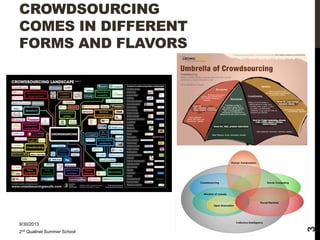
CROWDSOURCING
COMES IN DIFFERENT
FORMS AND FLAVORS
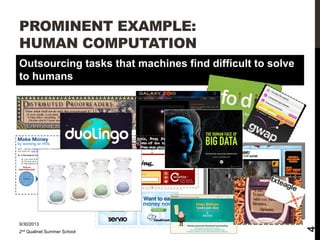
PROMINENT EXAMPLE:
HUMAN COMPUTATION

9/30/2013
2nd Qualinet Summer School

4

Outsourcing tasks that machines find difficult to solve
to humans
9/30/2013
2nd Qualinet Summer School

5

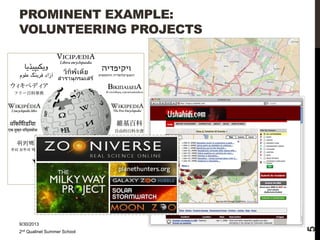
PROMINENT EXAMPLE:
VOLUNTEERING PROJECTS
9/30/2013
2nd Qualinet Summer School

6

PROMINENT EXAMPLE:
CHALLENGES
9/30/2013
2nd Qualinet Summer School

7

INCENTIVES
AND
MOTIVATION
SUCCESSFULL
CROWDSOURCING IS
DIFFICULT TO REPLICATE
• It crucially depends on
• Choosing the right
crowdsourcing approach
• Effectiveness, eficiency,
timeliness, (community
building)

• Understanding the behavior of
the crowd; and
• Aligning the goals of the
application and the incentives
it offers with the motivation of
the users
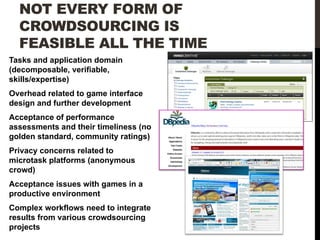
NOT EVERY FORM OF
CROWDSOURCING IS
FEASIBLE ALL THE TIME
Tasks and application domain
(decomposable, verifiable,
skills/expertise)
Overhead related to game interface
design and further development
Acceptance of performance
assessments and their timeliness (no
golden standard, community ratings)
Privacy concerns related to
microtask platforms (anonymous
crowd)
Acceptance issues with games in a
productive environment
Complex workflows need to integrate
results from various crowdsourcing
projects
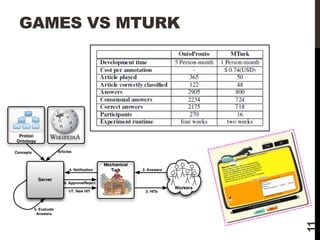
EXAMPLE: GAMES VS
MICROTAKS
•

Tasks leveraging common human skills, appealing to large
audiences
•

•

Selection of domain and task more constrained in games to
create typical UX
Tasks decomposed into smaller units of work to be solved
independently

•

Complex workflows

•

• Creating a casual game experience vs. patterns in microtasks
Quality assurance

•

Synchronous interaction in games
Levels of difficulty and near-real-time feedback in games
Many methods applied in both cases (redundancy, votes,
statistical techniques)
Different set of incentives and motivators

9/30/2013
2nd Qualinet Summer School

10

•
•
•
11

GAMES VS MTURK
UNDERSTANDING AND
ALIGNING INCENTIVES IS
ESSENTIAL
Motivation: driving force that
makes humans achieve their
goals

Incentives can be related to
both extrinsic and intrinsic
motivations.

Incentives: ‘rewards’ assigned
by an external ‘judge’ to a
performer for undertaking a
specific task

Extrinsic motivation if task is
considered boring, dangerous,
useless, socially undesirable,
dislikable by the performer.

• Common belief (among
economists): incentives can be
translated into a sum of money
for all practical purposes.

Intrinsic motivation is driven by
an interest or enjoyment in the
task itself.
INTRINSIC/EXTRINSIC
MOTIVATIONS ARE WELL-STUDIED
IN THE LITERATURE

[Kaufman, Schulze, Veit]
TYPES OF MOTIVATION –
PERSON VS ARTIFACT
Artifact Internal
(embedded in structure,
e.g., task, tools)

External
(additional to structure,
external re-inforcements)

Fun, joy, gaming,
interest, satisfaction,
self-actualization, self-reinforcement

Social appreciation,
reputation, love, trust,
social capital, community
support

Extrinsic
(additional to personal
predispositions, external
re-inforcements )

Usability, sociability,
design-for-fun, curiosity,
community-building
support

Material/financial capital,
money, rewards, prices,
medals, credit points

9/30/2013
2nd Qualinet Summer School

14

Person
Intrinsic
(predispositioned in
person, e.g., drives,
needs, desires)
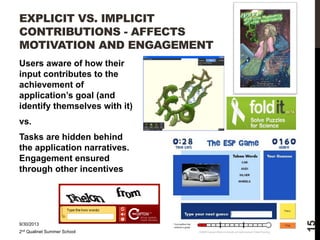
EXPLICIT VS. IMPLICIT
CONTRIBUTIONS - AFFECTS
MOTIVATION AND ENGAGEMENT
Users aware of how their
input contributes to the
achievement of
application’s goal (and
identify themselves with it)
vs.

9/30/2013
2nd Qualinet Summer School

15

Tasks are hidden behind
the application narratives.
Engagement ensured
through other incentives
WHY NOT JUST USE
EXTERNAL REWARDS?
Reward models often easier to study and
control then motivation
But

9/30/2013
2nd Qualinet Summer School

16

• It may require additional resources
• It assumes performance can be feasibly measured
• Different models to choose from: pay-per-time, payper-unit, winner-takes-it-all etc
• Not always easy to abstract from social aspects
(free-riding, social pressure)
• May undermine intrinsic motivation
MEASURING
PERFORMANCE CAN BE
CHALLENGING
WHO AND HOW

WHEN

•

Redundancy

•

Excluding spam and
obviously wrong answers

• Real-time constraints
in games

•

Voting and ratings by the
crowd

•

Assessment by the
requester

•

Where does the ground
truth come from and is it
needed

9/30/2013
2nd Qualinet Summer School

Note: improving recall of
algorithms

17

•

• Near-real-time
microtasks, see
Bernstein et al.
Crowds in Two
Seconds: Enabling
Realtime CrowdPowered Interfaces.
In Proc. UIST 2011.
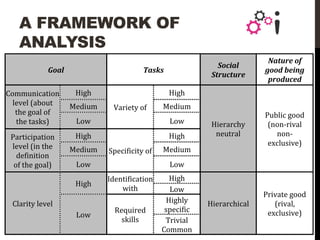
A FRAMEWORK OF
ANALYSIS
Goal

Communication
level (about
the goal of
the tasks)
Participation
level (in the
definition
of the goal)
Clarity level

High

Medium
Low

High

Medium
Low

High
Low

Tasks
Variety of

Specificity of

Identification
with
Required
skills

High

Medium
Low

High

Medium
Low

High
Low
Highly
specific
Trivial
Common

Social
Structure

Nature of
good being
produced

Hierarchy
neutral

Public good
(non-rival
nonexclusive)

Hierarchical

Private good
(rival,
exclusive)
9/30/2013
2nd Qualinet Summer School

19

EXAMPLE:
GAMES WITH A
PURPOSE
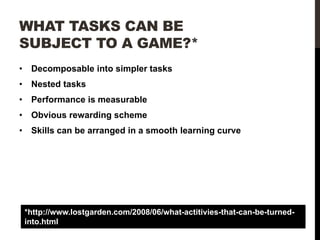
WHAT TASKS CAN BE
SUBJECT TO A GAME?*
•

Decomposable into simpler tasks

•

Nested tasks

•

Performance is measurable

•

Obvious rewarding scheme

•

Skills can be arranged in a smooth learning curve

*http://www.lostgarden.com/2008/06/what-actitivies-that-can-be-turnedinto.html
DIMENSIONS OF
GWAP DESIGN
WHAT IS THE PURPOSE OF THE GAME
•

Concrete specification of the task
•

•

Example: annotation of a set of 500,000 images using free labels,
controlled vocabulary etc
Where does the input data come from? How much noise can you
expect in the data?
•

Example: validating the results of algorithms; poor input data
hampers UX

HOW CAN IT BE TRANSLATED INTO DECOMPOSABLE TASKS
Repetitive tasks vs. player experience; see motivation

9/30/2013
2nd Qualinet Summer School

21

•
DIMENSIONS OF
GWAP DESIGN (2)
WHAT SUB-TASKS CAN YOU IDENTIFY
•

Number of interrelated steps in a casual game and
granularity of tasks

9/30/2013
2nd Qualinet Summer School

22

HOW DOES THE HUMAN READABLE DESCRIPTION OF THE
TASK LOOK LIKE
DIMENSIONS OF
GWAP DESIGN (3)
HOW TO YOU MEASURE PERFORMANCE
•

Redundancy (output-agreement games)

•

Consensus (input agreement, cf Tag-A-Tune)

•

Describer - guesser

WHAT DO USERS RECEIVE POINTS FOR, WHEN, AND HOW
MANY
•

Mechanism design

9/30/2013
2nd Qualinet Summer School

23

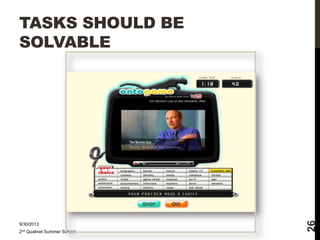
Note: tasks cannot be too difficult, otherwise the tasks feel
like work; they have to be interesting and intellectually
challenging, otherwise the game is boring; players should be
able to get better at it during the game.
SINGLE VS. MULTIPLAYER GAMES
Multi-player games
•
•
•
•

UX (player appreciate social contact and intellectual
challenge)
Consensus mechanism, less spam
Rapid feedback cycles
But: requires players’ matching functionality and enough
players in the system at the same time
•

•

Can be simulated using bots and (lots of) pre-recorded
rounds

Single-player games
•
•

Different quality assurance method (player receives reward
once correct answer is determined); or
Training data available to build initial profile

9/30/2013
2nd Qualinet Summer School

24

•
9/30/2013
2nd Qualinet Summer School

25

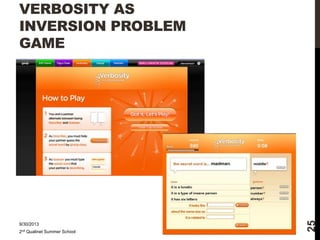
VERBOSITY AS
INVERSION PROBLEM
GAME
9/30/2013
2nd Qualinet Summer School

26

TASKS SHOULD BE
SOLVABLE
MECHANISM DESIGN
Area of game theory
•
•

•

Game designer defining the structure of the game
Game designer is interested in specific outcomes and
attempts to influence players’ behavior to achieve these
outcomes

Different reward models can be applied
•
•
•

Pay-per-item vs winner-takes-it-all
Competitions among individuals and teams
How to price contributions

•

These parameters will change the behavior of the users in the
system

9/30/2013
2nd Qualinet Summer School

27

•
DIMENSIONS OF
GWAP DESIGN (4)
HOW DO YOU TRANSLATE CROWD INPUTS INTO
VALIDATED ANSWERS
•

When are two answers the same

•

How many assignments per question

•

Player’s reliability, spam

HOW DO YOU ASSIGN CHALLENGES TO PLAYERS
Random vs based on previous performance

•

The same about players matching

9/30/2013
2nd Qualinet Summer School

28

•
9/30/2013
2nd Qualinet Summer School

29

EXAMPLE:
GAMIFICATION
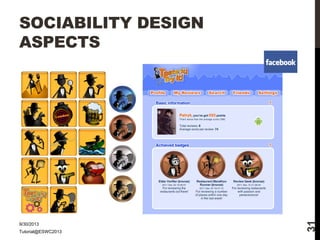
TASTE IT! TRY IT!
• Restaurant review Android app developed in the Insemtives project
• Uses Dbpedia concepts to generate structured reviews
• Uses mechanism design/gamification to configure incentives
• User study
•

2274 reviews by 180 reviewers referring to 900 restaurants, using 5667 Dbpedia concepts

2500
2000
1500
1000
500
0
CAFE

FASTFOOD

PUB

RESTAURANT

Numer of reviews
Number of semantic annotations (type of cuisine)
Number of semantic annotations (dishes)

9/30/2013
2nd Qualinet Summer School

30

https://play.google.com/store/apps/details?id=insemtives.android&hl=en
9/30/2013
Tutorial@ESWC2013

31

SOCIABILITY DESIGN
ASPECTS
MECHANISM DESIGN
EXPERIMENTS
Two experiments: 150 and 30 students
• Points vs. badges
• No information about others vs. information about others
(neighborhood, median, full leaderboard)

Findings

9/30/2013
Tutorial@ESWC2013

32

• Presenting information on performance of peers helps to increase
the number of reviews
• Within the treatments with badges individuals tend to contribute
more compared to treatments without assignment of badges
INTERPLAY OF INCENTIVES
AND MOTIVATION ACHIEVES
MAXIMAL RESULTS
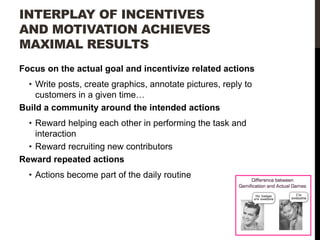
Focus on the actual goal and incentivize related actions
• Write posts, create graphics, annotate pictures, reply to
customers in a given time…
Build a community around the intended actions
• Reward helping each other in performing the task and
interaction
• Reward recruiting new contributors
Reward repeated actions
• Actions become part of the daily routine
EXAMPLE:
CROWDSOURCE
D ENTERPRIZE

9/30/2013
2nd Qualinet Summer School

34

ANIKET KITTUR ET AL. THE FUTURE OF
CROWD WORK. CSCW 2013.
THE FUTURE OF
CROWD WORK
Reputation system
for workers
More than financial
incentives
Recognize worker
potential (badges)
• Paid for their
expertise

9/30/2013
2nd Qualinet Summer School

35

Train less skilled
workers (tutoring
system)
9/30/2013
2nd Qualinet Summer School

36

CONCLUSIONS
CONCLUSIONS
• Designing crowdsourcing projects remains a challenge due to
• Multitude of approaches and their applicability to domains and
tasks
• Costs and expertise required to run user-centered application
design (in open environments)
• Limited insight into motivation and incentives of popular
platforms
• Factors relevant for the study and influence of user behavior
well-studied in social sciences and economics
• Can be applied as shown in the examples today to refine
incentive schemes and rewards
• Many other useful tools available (not covered in this tutorial)

9/30/2013
2nd Qualinet Summer School

37

• Machine learning for quality assessment
• HCI

Incentives-driven technology design

  • 1.
    INCENTIVESDRIVEN TECHNOLOGY DESIGN ELENA SIMPERL UNIVERSITY OFSOUTHAMPTON, UK 9/30/2013 2nd Qualinet Summer School 1 WITH SLIDES FROM ‘MAKING YOUR SEMANTIC APPLICATION ADDICTIVE: INCENTIVIZING USERS’, TUTORIAL@WIMS2012 BY ELENA SIMPERL, ROBERTA CUEL, AND MONIKA KACZMAREK
  • 2.
    CROWDSOURCING: PROBLEM SOLVING VIA OPENCALLS "Simply defined, crowdsourcing represents the act of a company or institution taking a function once performed by employees and outsourcing it to an undefined (and generally large) network of people in the form of an open call. This can take the form of peer-production (when the job is performed collaboratively), but is also often undertaken by sole individuals. The crucial prerequisite is the use of the open call format and the large network of potential laborers.“ 9/30/2013 2nd Qualinet Summer School 2 [Howe, 2006]
  • 3.
    9/30/2013 2nd Qualinet SummerSchool 3 CROWDSOURCING COMES IN DIFFERENT FORMS AND FLAVORS
  • 4.
    PROMINENT EXAMPLE: HUMAN COMPUTATION 9/30/2013 2ndQualinet Summer School 4 Outsourcing tasks that machines find difficult to solve to humans
  • 5.
    9/30/2013 2nd Qualinet SummerSchool 5 PROMINENT EXAMPLE: VOLUNTEERING PROJECTS
  • 6.
    9/30/2013 2nd Qualinet SummerSchool 6 PROMINENT EXAMPLE: CHALLENGES
  • 7.
    9/30/2013 2nd Qualinet SummerSchool 7 INCENTIVES AND MOTIVATION
  • 8.
    SUCCESSFULL CROWDSOURCING IS DIFFICULT TOREPLICATE • It crucially depends on • Choosing the right crowdsourcing approach • Effectiveness, eficiency, timeliness, (community building) • Understanding the behavior of the crowd; and • Aligning the goals of the application and the incentives it offers with the motivation of the users
  • 9.
    NOT EVERY FORMOF CROWDSOURCING IS FEASIBLE ALL THE TIME Tasks and application domain (decomposable, verifiable, skills/expertise) Overhead related to game interface design and further development Acceptance of performance assessments and their timeliness (no golden standard, community ratings) Privacy concerns related to microtask platforms (anonymous crowd) Acceptance issues with games in a productive environment Complex workflows need to integrate results from various crowdsourcing projects
  • 10.
    EXAMPLE: GAMES VS MICROTAKS • Tasksleveraging common human skills, appealing to large audiences • • Selection of domain and task more constrained in games to create typical UX Tasks decomposed into smaller units of work to be solved independently • Complex workflows • • Creating a casual game experience vs. patterns in microtasks Quality assurance • Synchronous interaction in games Levels of difficulty and near-real-time feedback in games Many methods applied in both cases (redundancy, votes, statistical techniques) Different set of incentives and motivators 9/30/2013 2nd Qualinet Summer School 10 • • •
  • 11.
  • 12.
    UNDERSTANDING AND ALIGNING INCENTIVESIS ESSENTIAL Motivation: driving force that makes humans achieve their goals Incentives can be related to both extrinsic and intrinsic motivations. Incentives: ‘rewards’ assigned by an external ‘judge’ to a performer for undertaking a specific task Extrinsic motivation if task is considered boring, dangerous, useless, socially undesirable, dislikable by the performer. • Common belief (among economists): incentives can be translated into a sum of money for all practical purposes. Intrinsic motivation is driven by an interest or enjoyment in the task itself.
  • 13.
    INTRINSIC/EXTRINSIC MOTIVATIONS ARE WELL-STUDIED INTHE LITERATURE [Kaufman, Schulze, Veit]
  • 14.
    TYPES OF MOTIVATION– PERSON VS ARTIFACT Artifact Internal (embedded in structure, e.g., task, tools) External (additional to structure, external re-inforcements) Fun, joy, gaming, interest, satisfaction, self-actualization, self-reinforcement Social appreciation, reputation, love, trust, social capital, community support Extrinsic (additional to personal predispositions, external re-inforcements ) Usability, sociability, design-for-fun, curiosity, community-building support Material/financial capital, money, rewards, prices, medals, credit points 9/30/2013 2nd Qualinet Summer School 14 Person Intrinsic (predispositioned in person, e.g., drives, needs, desires)
  • 15.
    EXPLICIT VS. IMPLICIT CONTRIBUTIONS- AFFECTS MOTIVATION AND ENGAGEMENT Users aware of how their input contributes to the achievement of application’s goal (and identify themselves with it) vs. 9/30/2013 2nd Qualinet Summer School 15 Tasks are hidden behind the application narratives. Engagement ensured through other incentives
  • 16.
    WHY NOT JUSTUSE EXTERNAL REWARDS? Reward models often easier to study and control then motivation But 9/30/2013 2nd Qualinet Summer School 16 • It may require additional resources • It assumes performance can be feasibly measured • Different models to choose from: pay-per-time, payper-unit, winner-takes-it-all etc • Not always easy to abstract from social aspects (free-riding, social pressure) • May undermine intrinsic motivation
  • 17.
    MEASURING PERFORMANCE CAN BE CHALLENGING WHOAND HOW WHEN • Redundancy • Excluding spam and obviously wrong answers • Real-time constraints in games • Voting and ratings by the crowd • Assessment by the requester • Where does the ground truth come from and is it needed 9/30/2013 2nd Qualinet Summer School Note: improving recall of algorithms 17 • • Near-real-time microtasks, see Bernstein et al. Crowds in Two Seconds: Enabling Realtime CrowdPowered Interfaces. In Proc. UIST 2011.
  • 18.
    A FRAMEWORK OF ANALYSIS Goal Communication level(about the goal of the tasks) Participation level (in the definition of the goal) Clarity level High Medium Low High Medium Low High Low Tasks Variety of Specificity of Identification with Required skills High Medium Low High Medium Low High Low Highly specific Trivial Common Social Structure Nature of good being produced Hierarchy neutral Public good (non-rival nonexclusive) Hierarchical Private good (rival, exclusive)
  • 19.
    9/30/2013 2nd Qualinet SummerSchool 19 EXAMPLE: GAMES WITH A PURPOSE
  • 20.
    WHAT TASKS CANBE SUBJECT TO A GAME?* • Decomposable into simpler tasks • Nested tasks • Performance is measurable • Obvious rewarding scheme • Skills can be arranged in a smooth learning curve *http://www.lostgarden.com/2008/06/what-actitivies-that-can-be-turnedinto.html
  • 21.
    DIMENSIONS OF GWAP DESIGN WHATIS THE PURPOSE OF THE GAME • Concrete specification of the task • • Example: annotation of a set of 500,000 images using free labels, controlled vocabulary etc Where does the input data come from? How much noise can you expect in the data? • Example: validating the results of algorithms; poor input data hampers UX HOW CAN IT BE TRANSLATED INTO DECOMPOSABLE TASKS Repetitive tasks vs. player experience; see motivation 9/30/2013 2nd Qualinet Summer School 21 •
  • 22.
    DIMENSIONS OF GWAP DESIGN(2) WHAT SUB-TASKS CAN YOU IDENTIFY • Number of interrelated steps in a casual game and granularity of tasks 9/30/2013 2nd Qualinet Summer School 22 HOW DOES THE HUMAN READABLE DESCRIPTION OF THE TASK LOOK LIKE
  • 23.
    DIMENSIONS OF GWAP DESIGN(3) HOW TO YOU MEASURE PERFORMANCE • Redundancy (output-agreement games) • Consensus (input agreement, cf Tag-A-Tune) • Describer - guesser WHAT DO USERS RECEIVE POINTS FOR, WHEN, AND HOW MANY • Mechanism design 9/30/2013 2nd Qualinet Summer School 23 Note: tasks cannot be too difficult, otherwise the tasks feel like work; they have to be interesting and intellectually challenging, otherwise the game is boring; players should be able to get better at it during the game.
  • 24.
    SINGLE VS. MULTIPLAYERGAMES Multi-player games • • • • UX (player appreciate social contact and intellectual challenge) Consensus mechanism, less spam Rapid feedback cycles But: requires players’ matching functionality and enough players in the system at the same time • • Can be simulated using bots and (lots of) pre-recorded rounds Single-player games • • Different quality assurance method (player receives reward once correct answer is determined); or Training data available to build initial profile 9/30/2013 2nd Qualinet Summer School 24 •
  • 25.
    9/30/2013 2nd Qualinet SummerSchool 25 VERBOSITY AS INVERSION PROBLEM GAME
  • 26.
    9/30/2013 2nd Qualinet SummerSchool 26 TASKS SHOULD BE SOLVABLE
  • 27.
    MECHANISM DESIGN Area ofgame theory • • • Game designer defining the structure of the game Game designer is interested in specific outcomes and attempts to influence players’ behavior to achieve these outcomes Different reward models can be applied • • • Pay-per-item vs winner-takes-it-all Competitions among individuals and teams How to price contributions • These parameters will change the behavior of the users in the system 9/30/2013 2nd Qualinet Summer School 27 •
  • 28.
    DIMENSIONS OF GWAP DESIGN(4) HOW DO YOU TRANSLATE CROWD INPUTS INTO VALIDATED ANSWERS • When are two answers the same • How many assignments per question • Player’s reliability, spam HOW DO YOU ASSIGN CHALLENGES TO PLAYERS Random vs based on previous performance • The same about players matching 9/30/2013 2nd Qualinet Summer School 28 •
  • 29.
    9/30/2013 2nd Qualinet SummerSchool 29 EXAMPLE: GAMIFICATION
  • 30.
    TASTE IT! TRYIT! • Restaurant review Android app developed in the Insemtives project • Uses Dbpedia concepts to generate structured reviews • Uses mechanism design/gamification to configure incentives • User study • 2274 reviews by 180 reviewers referring to 900 restaurants, using 5667 Dbpedia concepts 2500 2000 1500 1000 500 0 CAFE FASTFOOD PUB RESTAURANT Numer of reviews Number of semantic annotations (type of cuisine) Number of semantic annotations (dishes) 9/30/2013 2nd Qualinet Summer School 30 https://play.google.com/store/apps/details?id=insemtives.android&hl=en
  • 31.
  • 32.
    MECHANISM DESIGN EXPERIMENTS Two experiments:150 and 30 students • Points vs. badges • No information about others vs. information about others (neighborhood, median, full leaderboard) Findings 9/30/2013 Tutorial@ESWC2013 32 • Presenting information on performance of peers helps to increase the number of reviews • Within the treatments with badges individuals tend to contribute more compared to treatments without assignment of badges
  • 33.
    INTERPLAY OF INCENTIVES ANDMOTIVATION ACHIEVES MAXIMAL RESULTS Focus on the actual goal and incentivize related actions • Write posts, create graphics, annotate pictures, reply to customers in a given time… Build a community around the intended actions • Reward helping each other in performing the task and interaction • Reward recruiting new contributors Reward repeated actions • Actions become part of the daily routine
  • 34.
    EXAMPLE: CROWDSOURCE D ENTERPRIZE 9/30/2013 2nd QualinetSummer School 34 ANIKET KITTUR ET AL. THE FUTURE OF CROWD WORK. CSCW 2013.
  • 35.
    THE FUTURE OF CROWDWORK Reputation system for workers More than financial incentives Recognize worker potential (badges) • Paid for their expertise 9/30/2013 2nd Qualinet Summer School 35 Train less skilled workers (tutoring system)
  • 36.
    9/30/2013 2nd Qualinet SummerSchool 36 CONCLUSIONS
  • 37.
    CONCLUSIONS • Designing crowdsourcingprojects remains a challenge due to • Multitude of approaches and their applicability to domains and tasks • Costs and expertise required to run user-centered application design (in open environments) • Limited insight into motivation and incentives of popular platforms • Factors relevant for the study and influence of user behavior well-studied in social sciences and economics • Can be applied as shown in the examples today to refine incentive schemes and rewards • Many other useful tools available (not covered in this tutorial) 9/30/2013 2nd Qualinet Summer School 37 • Machine learning for quality assessment • HCI