Ten ways to make your semantic
       app addicted - REVISITED
                     Elena Simperl
             Tutorial at the ISWC2011, Bonn, Germany


10/24/2011                www.insemtives.eu            1
Executive summary
• Many aspects of semantic content authoring naturally rely
  on human contribution.

• Motivating users to contribute is essential for semantic
  technologies to reach critical mass and ensure sustainable
  growth.

• This tutorial is about
   – Methods and techniques to study incentives and motivators
     applicable to semantic content authoring scenarios.
   – How to implement the results of such studies through
     technology design, usability engineering, and game mechanics.


                            www.insemtives.eu                        2
Incentives and motivators

• Motivation is the driving     • Incentives can be related
  force that makes humans         to both extrinsic and
  achieve their goals.            intrinsic motivations.
• Incentives are ‘rewards’      • Extrinsic motivation if
  assigned by an external         task is considered boring,
  ‘judge’ to a performer for      dangerous, useless,
  undertaking a specific          socially undesirable,
  task.                           dislikable by the
   – Common belief (among         performer.
     economists): incentives    • Intrinsic motivation is
     can be translated into a
     sum of money for all         driven by an interest or
     practical purposes.          enjoyment in the task
                                  itself.
Examples of applications


            www.insemtives.eu   4
Extrinsic vs intrinsic motivations
• Successful volunteer crowdsourcing is difficult
  to predict or replicate.
  – Highly context-specific.
  – Not applicable to arbitrary tasks.
• Reward models often easier to study and
  control.*
  – Different models: pay-per-time, pay-per-unit, winner-
    takes-it-all…
  – Not always easy to abstract from social aspects (free-
    riding, social pressure…).
  – May undermine intrinsic motivation.
                          * in cases when performance can be reliably measured
Examples (ii)


Mason & Watts: Financial incentives and the performance of the crowds, HCOMP 2009.
Amazon‘s Mechanical Turk
  • Types of tasks: transcription, classification, and content
    generation, data collection, image tagging, website feedback,
    usability tests.*
  • Increasingly used by academia.
  • Vertical solutions built on top.
  • Research on extensions for complex tasks.


* http://behind-the-enemy-lines.blogspot.com/2010/10/what-tasks-are-posted-on-mechanical.html
Tasks amenable to crowdsourcing
• Tasks that are decomposable into simpler
  tasks that are easy to perform.
• Performance is measurable.
• No specific skills or expertise are required.
Patterns of tasks*
• Solving a task                   • Example: open-scale tasks
   – Generate answers                in Mturk
   – Find additional information      – Generate, then vote.
   – Improve, edit, fix               – Introduce random noise to
• Evaluating the results of a           identify potential issues in
                                        the second step
  task
   – Vote for accept/reject
                                                         Label                  Correct


                                                                 Vote answers
                                       Generate answer
   – Vote up/down to rank
     potentially correct answers
                                                         image                  or not?
   – Vote best/top-n results
• Flow control
   – Split the task
   – Aggregate partial results

 * „Managing Crowdsourced Human Computation“@WWW2011, Ipeirotis
Examples (iii)


            www.insemtives.eu   10
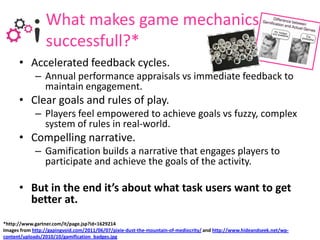
What makes game mechanics
                 successfull?*
      • Accelerated feedback cycles.
             – Annual performance appraisals vs immediate feedback to
               maintain engagement.
      • Clear goals and rules of play.
             – Players feel empowered to achieve goals vs fuzzy, complex
               system of rules in real-world.
      • Compelling narrative.
             – Gamification builds a narrative that engages players to
               participate and achieve the goals of the activity.

      • But in the end it’s about what task users want to get
        better at.
*http://www.gartner.com/it/page.jsp?id=1629214
Images from http://gapingvoid.com/2011/06/07/pixie-dust-the-mountain-of-mediocrity/ and http://www.hideandseek.net/wp-
content/uploads/2010/10/gamification_badges.jpg
Guidelines
      • Focus on the actual goal and incentivize related
        actions.
            – Write posts, create graphics, annotate pictures, reply
              to customers in a given time…
      • Build a community around the intended actions.
            – Reward helping each other in performing the task and
              interaction.
            – Reward recruiting new contributors.
      • Reward repeated actions.
            – Actions become part of the daily routine.


Image from http://t1.gstatic.com/images?q=tbn:ANd9GcSzWEQdtagJy6lxiR2focH2D01Wpz7dzAilDuPsWnL0i4GAHgnm_0hyw3upqw
What tasks can be gamified?*
    • Tasks that are decomposable into simpler
      tasks, nested tasks.
    • Performance is measurable.
    • Obvious rewarding scheme.
    • Skills can be arranged in a smooth learning
      curve.


*http://www.lostgarden.com/2008/06/what-actitivies-that-can-be-turned-into.html
Image from http://www.powwownow.co.uk/blog/wp-content/uploads/2011/06/gamification.jpeg
What is different about semantic
      systems?
• It‘s still about the context
  of the actual application.

• User engagement with
  semantic tasks in order to
   – Ensure knowledge is
     relevant and up-to-date.
   – People accept the new
     solution and understand its
     benefits.
   – Avoid cold-start problems.
   – Optimize maintenance
     costs.
Tasks in knowledge engineering
• Definition of vocabulary
• Conceptualization
   – Based on competency questions
   – Identifying instances, classes, attributes,
     relationships
• Documentation
   – Labeling and definitions.
   – Localization
• Evaluation and quality assurance
   – Matching conceptualization to documentation
• Alignment
• Validating the results of automatic methods
                                   www.insemtives.eu   15
http://www.ontogame.org
http://apps.facebook.com/ontogame


              16
OntoGame API
• API that provides several methods that are
  shared by the OntoGame games, such as:
   – Different agreement types (e.g. selection
     agreement).
   – Input matching (e.g. , majority).
   – Game modes (multi-player, single player).
   – Player reliability evaluation.
   – Player matching (e.g., finding the optimal
     partner to play).
   – Resource (i.e., data needed for games)
     management.
   – Creating semantic content.
• http://insemtives.svn.sourceforge.net/vie
  wvc/insemtives/generic-gaming-toolkit
  10/24/2011                       www.insemtives.eu   17
OntoGame games


10/24/2011            www.insemtives.eu   18
Case studies
• Methods applied
   –   Mechanism design.
   –   Participatory design.
   –   Games with a purpose.
   –   Crowdsourcing via MTurk.
• Semantic content
  authoring scenarios
   – Extending and populating
     an ontology.
   – Aligning two ontologies.
   – Annotation of text, media
     and Web APIs.
Lessons learned
• Approach is feasible for mainstream domains, where a
  (large-enough) knowledge corpus is available.
• Advertisement is important.
• Game design vs useful content.
   – Reusing well-kwown game paradigms.
   – Reusing game outcomes and integration in existing workflows
     and tools.

• But, the approach is per design less applicable because
   – Knowledge-intensive tasks that are not easily nestable.
   – Repetitive tasks  players‘ retention?

• Cost-benefit analysis.
Using Mechanical Turk for
    semantic content authoring
• Many design decisions similar to GWAPs.
  – But clear incentives structures.
  – How to reliably compare games and MTurk results?

• Automatic generation of HITs depending on the
  types of tasks and inputs.

• Integration in productive environments.
  – Protégé plug-in for managing and using crowdsourcing
    results.
Outline of the tutorial
Time      Presentation
14:00 –   Human contributions in semantic content authoring
14:45
14:45 –   Case study: motivating employees to annotate enterprise
15:30     content semantically at Telefonica
15:30 –   Coffee break
16:00
16:00 –   Case study: Crowdsourcing the annotation of dynamic Web
16:45     content at seekda
16:45 –   Case study: Content tagging at MoonZoo and
17:30     MyTinyPlanets
17:30 –   Ten ways to make your semantic app addicted - revisited
18:00                        www.insemtives.eu                  22
Realizing the Semantic Web by
 encouraging millions of end-users to
      create semantic content.
10/24/2011      www.insemtives.eu       23

INSEMTIVES Tutorial ISWC2011 - Session1

  • 1.
    Ten ways tomake your semantic app addicted - REVISITED Elena Simperl Tutorial at the ISWC2011, Bonn, Germany 10/24/2011 www.insemtives.eu 1
  • 2.
    Executive summary • Manyaspects of semantic content authoring naturally rely on human contribution. • Motivating users to contribute is essential for semantic technologies to reach critical mass and ensure sustainable growth. • This tutorial is about – Methods and techniques to study incentives and motivators applicable to semantic content authoring scenarios. – How to implement the results of such studies through technology design, usability engineering, and game mechanics. www.insemtives.eu 2
  • 3.
    Incentives and motivators •Motivation is the driving • Incentives can be related force that makes humans to both extrinsic and achieve their goals. intrinsic motivations. • Incentives are ‘rewards’ • Extrinsic motivation if assigned by an external task is considered boring, ‘judge’ to a performer for dangerous, useless, undertaking a specific socially undesirable, task. dislikable by the – Common belief (among performer. economists): incentives • Intrinsic motivation is can be translated into a sum of money for all driven by an interest or practical purposes. enjoyment in the task itself.
  • 4.
    Examples of applications www.insemtives.eu 4
  • 5.
    Extrinsic vs intrinsicmotivations • Successful volunteer crowdsourcing is difficult to predict or replicate. – Highly context-specific. – Not applicable to arbitrary tasks. • Reward models often easier to study and control.* – Different models: pay-per-time, pay-per-unit, winner- takes-it-all… – Not always easy to abstract from social aspects (free- riding, social pressure…). – May undermine intrinsic motivation. * in cases when performance can be reliably measured
  • 6.
    Examples (ii) Mason &Watts: Financial incentives and the performance of the crowds, HCOMP 2009.
  • 7.
    Amazon‘s Mechanical Turk • Types of tasks: transcription, classification, and content generation, data collection, image tagging, website feedback, usability tests.* • Increasingly used by academia. • Vertical solutions built on top. • Research on extensions for complex tasks. * http://behind-the-enemy-lines.blogspot.com/2010/10/what-tasks-are-posted-on-mechanical.html
  • 8.
    Tasks amenable tocrowdsourcing • Tasks that are decomposable into simpler tasks that are easy to perform. • Performance is measurable. • No specific skills or expertise are required.
  • 9.
    Patterns of tasks* •Solving a task • Example: open-scale tasks – Generate answers in Mturk – Find additional information – Generate, then vote. – Improve, edit, fix – Introduce random noise to • Evaluating the results of a identify potential issues in the second step task – Vote for accept/reject Label Correct Vote answers Generate answer – Vote up/down to rank potentially correct answers image or not? – Vote best/top-n results • Flow control – Split the task – Aggregate partial results * „Managing Crowdsourced Human Computation“@WWW2011, Ipeirotis
  • 10.
    Examples (iii) www.insemtives.eu 10
  • 11.
    What makes gamemechanics successfull?* • Accelerated feedback cycles. – Annual performance appraisals vs immediate feedback to maintain engagement. • Clear goals and rules of play. – Players feel empowered to achieve goals vs fuzzy, complex system of rules in real-world. • Compelling narrative. – Gamification builds a narrative that engages players to participate and achieve the goals of the activity. • But in the end it’s about what task users want to get better at. *http://www.gartner.com/it/page.jsp?id=1629214 Images from http://gapingvoid.com/2011/06/07/pixie-dust-the-mountain-of-mediocrity/ and http://www.hideandseek.net/wp- content/uploads/2010/10/gamification_badges.jpg
  • 12.
    Guidelines • Focus on the actual goal and incentivize related actions. – Write posts, create graphics, annotate pictures, reply to customers in a given time… • Build a community around the intended actions. – Reward helping each other in performing the task and interaction. – Reward recruiting new contributors. • Reward repeated actions. – Actions become part of the daily routine. Image from http://t1.gstatic.com/images?q=tbn:ANd9GcSzWEQdtagJy6lxiR2focH2D01Wpz7dzAilDuPsWnL0i4GAHgnm_0hyw3upqw
  • 13.
    What tasks canbe gamified?* • Tasks that are decomposable into simpler tasks, nested tasks. • Performance is measurable. • Obvious rewarding scheme. • Skills can be arranged in a smooth learning curve. *http://www.lostgarden.com/2008/06/what-actitivies-that-can-be-turned-into.html Image from http://www.powwownow.co.uk/blog/wp-content/uploads/2011/06/gamification.jpeg
  • 14.
    What is differentabout semantic systems? • It‘s still about the context of the actual application. • User engagement with semantic tasks in order to – Ensure knowledge is relevant and up-to-date. – People accept the new solution and understand its benefits. – Avoid cold-start problems. – Optimize maintenance costs.
  • 15.
    Tasks in knowledgeengineering • Definition of vocabulary • Conceptualization – Based on competency questions – Identifying instances, classes, attributes, relationships • Documentation – Labeling and definitions. – Localization • Evaluation and quality assurance – Matching conceptualization to documentation • Alignment • Validating the results of automatic methods www.insemtives.eu 15
  • 16.
  • 17.
    OntoGame API • APIthat provides several methods that are shared by the OntoGame games, such as: – Different agreement types (e.g. selection agreement). – Input matching (e.g. , majority). – Game modes (multi-player, single player). – Player reliability evaluation. – Player matching (e.g., finding the optimal partner to play). – Resource (i.e., data needed for games) management. – Creating semantic content. • http://insemtives.svn.sourceforge.net/vie wvc/insemtives/generic-gaming-toolkit 10/24/2011 www.insemtives.eu 17
  • 18.
    OntoGame games 10/24/2011 www.insemtives.eu 18
  • 19.
    Case studies • Methodsapplied – Mechanism design. – Participatory design. – Games with a purpose. – Crowdsourcing via MTurk. • Semantic content authoring scenarios – Extending and populating an ontology. – Aligning two ontologies. – Annotation of text, media and Web APIs.
  • 20.
    Lessons learned • Approachis feasible for mainstream domains, where a (large-enough) knowledge corpus is available. • Advertisement is important. • Game design vs useful content. – Reusing well-kwown game paradigms. – Reusing game outcomes and integration in existing workflows and tools. • But, the approach is per design less applicable because – Knowledge-intensive tasks that are not easily nestable. – Repetitive tasks  players‘ retention? • Cost-benefit analysis.
  • 21.
    Using Mechanical Turkfor semantic content authoring • Many design decisions similar to GWAPs. – But clear incentives structures. – How to reliably compare games and MTurk results? • Automatic generation of HITs depending on the types of tasks and inputs. • Integration in productive environments. – Protégé plug-in for managing and using crowdsourcing results.
  • 22.
    Outline of thetutorial Time Presentation 14:00 – Human contributions in semantic content authoring 14:45 14:45 – Case study: motivating employees to annotate enterprise 15:30 content semantically at Telefonica 15:30 – Coffee break 16:00 16:00 – Case study: Crowdsourcing the annotation of dynamic Web 16:45 content at seekda 16:45 – Case study: Content tagging at MoonZoo and 17:30 MyTinyPlanets 17:30 – Ten ways to make your semantic app addicted - revisited 18:00 www.insemtives.eu 22
  • 23.
    Realizing the SemanticWeb by encouraging millions of end-users to create semantic content. 10/24/2011 www.insemtives.eu 23