Strategies for Alternative
Online Assessments
Monica Ward School of Computing, Dublin City University
Overview
•Academic Integrity
•Checklist for alternative assessment
•Potential alternative assessments
•Alternative exam questions
•Smart Quizzes
•Tips
Academic Integrity
•Key requirement of any assessment
• Validity of exams
• Need to be fair to honest students
•Online, open-book, non-invigilated exams
• Academic integrity concerns
• Temptation for students
Strategies
•Move assessments from lower orders of Bloom’s taxonomy
• From knowledge (remember) and comprehension (understand)
• To application (apply) and analysis (analyse)
•Can be harder to set exams
•More challenging for students
•More authentic?
• In the real-world, students have access to information
• Need to be able to apply it
Strategies
•Another benefit
• Students can use usual digital tools
• Word processing, spreadsheets
• More real-world
• Students don’t usually write long-hand
• (Also more legible)
Checklist for alternative online assessments
•Align with the original learning outcomes?
•Require the same level of challenge as the original assessment?
•Minimise new computer and technical skills required in order to
complete the work?
•Help to mitigate risks should online submission not be possible
through Loop in the allocated time?
Strategies
•Need to consider
• Different modules
• Technical vs non-technical
• Show workings
• Essay type answers
• Different stages (1st
year vs masters)
• Difference expectations of learners
General approach
•Ask probing questions
• check to see if students can apply knowledge
• (rather than check their recall of information).
•Note:
• The students will know and have access to their notes
• interested in how they apply their knowledge.
Type 1
•Software Engineering Type Questions
• Set up a scenario
• Ask problem questions
• What approach would you recommend and why?”.
• “How would you implement this approach?”
Other probing questions
•What is most important/effective?
•Which method is best?
•How would you design a …?
•What changes would you make?
•What other information do you need?
•Could you explain your reason to us?
Smart Quizzes
• Question buckets
• Questions selected at random from a bucket of similar questions
• Example:
• What is the population of Albania/China/Kenya?
• What is 7 + 6/3 + 8/5+ 6?
• Randomised order of questions
• Harder for students to share answers
• Postpone feedback
• Until ALL students have finished
Smart Quizzes
•Multiple-Choice Questions (MCQs)
• With follow up text question
• Example:
• What is the standard deviation for avocado production for Chile if the
production values for the last X years are ….? (MCQ)
• What does this figure indicate about Chile’s avocado production?
Smart Quizzes
•Students have access to
• Calculators
• Other online tools and apps
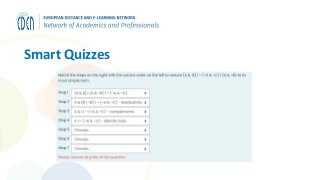
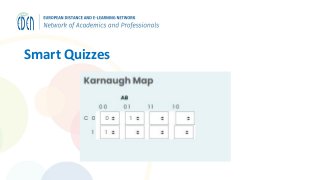
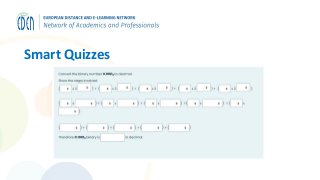
•Get them to fill out the workings with a step-by-step approach
•Force sequencing
•Time limit
Smart Quizzes
Smart Quizzes
Smart Quizzes
Academic Integrity
•Obviously a lot harder for non-invigilated exams
•Plagiarism detection software
•Harder for
• introductory level courses
• Programming and maths
•Smartly designed questions
• Check understanding
• Analysis of concepts
Tips to Remember
•Ask questions that ask students to apply their knowledge
•Relate it to project work
• Less chance of plagiarism
•Use different variants of the same question
• Semi-automated tools available
•Use different data sets (if relevant)
•Reserve the right to discuss with students after the exam
Positive Outcomes
•Encouraged academics to consider non-traditional assessments
• Videos
• Online meetings
• Interactive Orals
•Encouraged academics to re-consider assessments practices
•Digital transformations in education
• Moving a lot swifter

Strategies for Alternative Online Assessments

  • 1.
    Strategies for Alternative OnlineAssessments Monica Ward School of Computing, Dublin City University
  • 2.
    Overview •Academic Integrity •Checklist foralternative assessment •Potential alternative assessments •Alternative exam questions •Smart Quizzes •Tips
  • 3.
    Academic Integrity •Key requirementof any assessment • Validity of exams • Need to be fair to honest students •Online, open-book, non-invigilated exams • Academic integrity concerns • Temptation for students
  • 4.
    Strategies •Move assessments fromlower orders of Bloom’s taxonomy • From knowledge (remember) and comprehension (understand) • To application (apply) and analysis (analyse) •Can be harder to set exams •More challenging for students •More authentic? • In the real-world, students have access to information • Need to be able to apply it
  • 5.
    Strategies •Another benefit • Studentscan use usual digital tools • Word processing, spreadsheets • More real-world • Students don’t usually write long-hand • (Also more legible)
  • 6.
    Checklist for alternativeonline assessments •Align with the original learning outcomes? •Require the same level of challenge as the original assessment? •Minimise new computer and technical skills required in order to complete the work? •Help to mitigate risks should online submission not be possible through Loop in the allocated time?
  • 7.
    Strategies •Need to consider •Different modules • Technical vs non-technical • Show workings • Essay type answers • Different stages (1st year vs masters) • Difference expectations of learners
  • 8.
    General approach •Ask probingquestions • check to see if students can apply knowledge • (rather than check their recall of information). •Note: • The students will know and have access to their notes • interested in how they apply their knowledge.
  • 9.
    Type 1 •Software EngineeringType Questions • Set up a scenario • Ask problem questions • What approach would you recommend and why?”. • “How would you implement this approach?”
  • 10.
    Other probing questions •Whatis most important/effective? •Which method is best? •How would you design a …? •What changes would you make? •What other information do you need? •Could you explain your reason to us?
  • 11.
    Smart Quizzes • Questionbuckets • Questions selected at random from a bucket of similar questions • Example: • What is the population of Albania/China/Kenya? • What is 7 + 6/3 + 8/5+ 6? • Randomised order of questions • Harder for students to share answers • Postpone feedback • Until ALL students have finished
  • 12.
    Smart Quizzes •Multiple-Choice Questions(MCQs) • With follow up text question • Example: • What is the standard deviation for avocado production for Chile if the production values for the last X years are ….? (MCQ) • What does this figure indicate about Chile’s avocado production?
  • 13.
    Smart Quizzes •Students haveaccess to • Calculators • Other online tools and apps •Get them to fill out the workings with a step-by-step approach •Force sequencing •Time limit
  • 14.
  • 15.
  • 16.
  • 17.
    Academic Integrity •Obviously alot harder for non-invigilated exams •Plagiarism detection software •Harder for • introductory level courses • Programming and maths •Smartly designed questions • Check understanding • Analysis of concepts
  • 18.
    Tips to Remember •Askquestions that ask students to apply their knowledge •Relate it to project work • Less chance of plagiarism •Use different variants of the same question • Semi-automated tools available •Use different data sets (if relevant) •Reserve the right to discuss with students after the exam
  • 19.
    Positive Outcomes •Encouraged academicsto consider non-traditional assessments • Videos • Online meetings • Interactive Orals •Encouraged academics to re-consider assessments practices •Digital transformations in education • Moving a lot swifter