The Exciting World of Cornell Notes An AVID Strategy
Notes QuickWrite In your own words define the word ‘note’ Why should you take notes? To minimize your “rate of forgetting” Dr. Walter Pauk, Cornell University Reading Center Don’t take notes = Forget 60 % in 14 days Take some notes = Remember 60 % Take organized notes and do something with them= Remember 90-100% indefinitely!
Taking Notes When should you take notes? Notes are a record of your learning, so take them when: You listen to a lecture You read a text You watch a film You work in a group on an activity You need to recall information about what happened to you in a class, meeting, or activity--which means always!
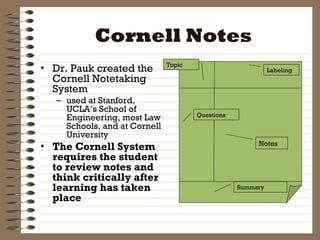
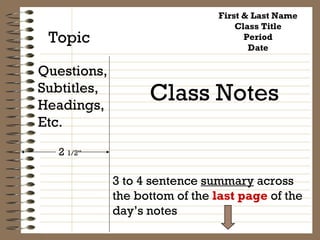
Cornell Notes Dr. Pauk created the Cornell Notetaking System used at Stanford, UCLA’s School of Engineering, most Law Schools, and at Cornell University The Cornell System requires the student to review notes and think critically after learning has taken place Questions Labeling Notes Summary Topic
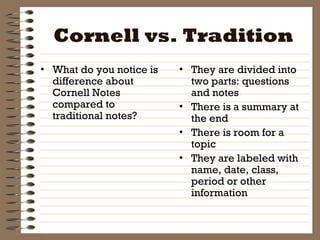
Cornell vs. Tradition What do you notice is difference about Cornell Notes compared to traditional notes? They are divided into two parts: questions and notes There is a summary at the end There is room for a topic They are labeled with name, date, class, period or other information
Part 1 & Part 2 Part 1 Fill out the section that includes: Name Class Period Date Part 2 Include the topic of the notes
Part 3 What are some good tips for taking the notes on the right (part 3)? Write only what is most important:  listen for repetition, change in pace or volume, numbering, explicit clues (“this is important,” or “on the test”);  watch for gestures, or clues to organization;  look for material being written down by instructor or shared in a visual manner
Part 3 What are some good tips for taking the notes on the right (part 3)? Write in your own words (paraphrase) Write using abbreviations (check a dictionary for these and create your own) Draw a figure or diagram Leave space where you think you might need to “fill in” info later Use bullets, arrows, and indenting to list key ideas Write legibly
Part 3 What are some good tips for taking the notes on the right (part 3)? Actively listen Maintain eye contact with the speaker, group, or presentation source Nod your head at appropriate times Frown when you do not understand Ask relevant questions Answer questions posed by the instructor Make a written record
Part 4  What types of questions should I place on the left side (part 4)? Questions which are answered in the notes on the right Questions you still need the answer to--ask a friend or the teacher after class Questions the teacher might ask on a test Higher level thinking questions
Part 4 What else could I place on the left side (part 4)? Key terms, vocabulary words, or dates Diagrams or figures Reference pages in a text Steps in a solution process Notes to myself about actions I need to take
Part 5 What are some good tips for completing the summary (part 5)? Summary is added at the end of ALL note pages on the subject (not at the end of each page) Summary added AFTER questions are finished
First & Last Name Class Title Period Date Topic Questions, Subtitles, Headings, Etc. Class Notes 2  1/2” 3 to 4 sentence  summary  across  the bottom of the  last page  of the day’s notes
Cornell Notes What are the steps to taking Cornell Notes? S et up your page Draw your margins Label clearly  T ake notes Use your best strategies A ctively listen, analyze, ask questions R eview, revise, reflect Look over notes and highlight, edit, or add info Write your questions and reflection

Intro to cornell notes

  • 1.
    The Exciting Worldof Cornell Notes An AVID Strategy
  • 2.
    Notes QuickWrite Inyour own words define the word ‘note’ Why should you take notes? To minimize your “rate of forgetting” Dr. Walter Pauk, Cornell University Reading Center Don’t take notes = Forget 60 % in 14 days Take some notes = Remember 60 % Take organized notes and do something with them= Remember 90-100% indefinitely!
  • 3.
    Taking Notes Whenshould you take notes? Notes are a record of your learning, so take them when: You listen to a lecture You read a text You watch a film You work in a group on an activity You need to recall information about what happened to you in a class, meeting, or activity--which means always!
  • 4.
    Cornell Notes Dr.Pauk created the Cornell Notetaking System used at Stanford, UCLA’s School of Engineering, most Law Schools, and at Cornell University The Cornell System requires the student to review notes and think critically after learning has taken place Questions Labeling Notes Summary Topic
  • 5.
    Cornell vs. TraditionWhat do you notice is difference about Cornell Notes compared to traditional notes? They are divided into two parts: questions and notes There is a summary at the end There is room for a topic They are labeled with name, date, class, period or other information
  • 6.
    Part 1 &Part 2 Part 1 Fill out the section that includes: Name Class Period Date Part 2 Include the topic of the notes
  • 7.
    Part 3 Whatare some good tips for taking the notes on the right (part 3)? Write only what is most important: listen for repetition, change in pace or volume, numbering, explicit clues (“this is important,” or “on the test”); watch for gestures, or clues to organization; look for material being written down by instructor or shared in a visual manner
  • 8.
    Part 3 Whatare some good tips for taking the notes on the right (part 3)? Write in your own words (paraphrase) Write using abbreviations (check a dictionary for these and create your own) Draw a figure or diagram Leave space where you think you might need to “fill in” info later Use bullets, arrows, and indenting to list key ideas Write legibly
  • 9.
    Part 3 Whatare some good tips for taking the notes on the right (part 3)? Actively listen Maintain eye contact with the speaker, group, or presentation source Nod your head at appropriate times Frown when you do not understand Ask relevant questions Answer questions posed by the instructor Make a written record
  • 10.
    Part 4 What types of questions should I place on the left side (part 4)? Questions which are answered in the notes on the right Questions you still need the answer to--ask a friend or the teacher after class Questions the teacher might ask on a test Higher level thinking questions
  • 11.
    Part 4 Whatelse could I place on the left side (part 4)? Key terms, vocabulary words, or dates Diagrams or figures Reference pages in a text Steps in a solution process Notes to myself about actions I need to take
  • 12.
    Part 5 Whatare some good tips for completing the summary (part 5)? Summary is added at the end of ALL note pages on the subject (not at the end of each page) Summary added AFTER questions are finished
  • 13.
    First & LastName Class Title Period Date Topic Questions, Subtitles, Headings, Etc. Class Notes 2 1/2” 3 to 4 sentence summary across the bottom of the last page of the day’s notes
  • 14.
    Cornell Notes Whatare the steps to taking Cornell Notes? S et up your page Draw your margins Label clearly T ake notes Use your best strategies A ctively listen, analyze, ask questions R eview, revise, reflect Look over notes and highlight, edit, or add info Write your questions and reflection