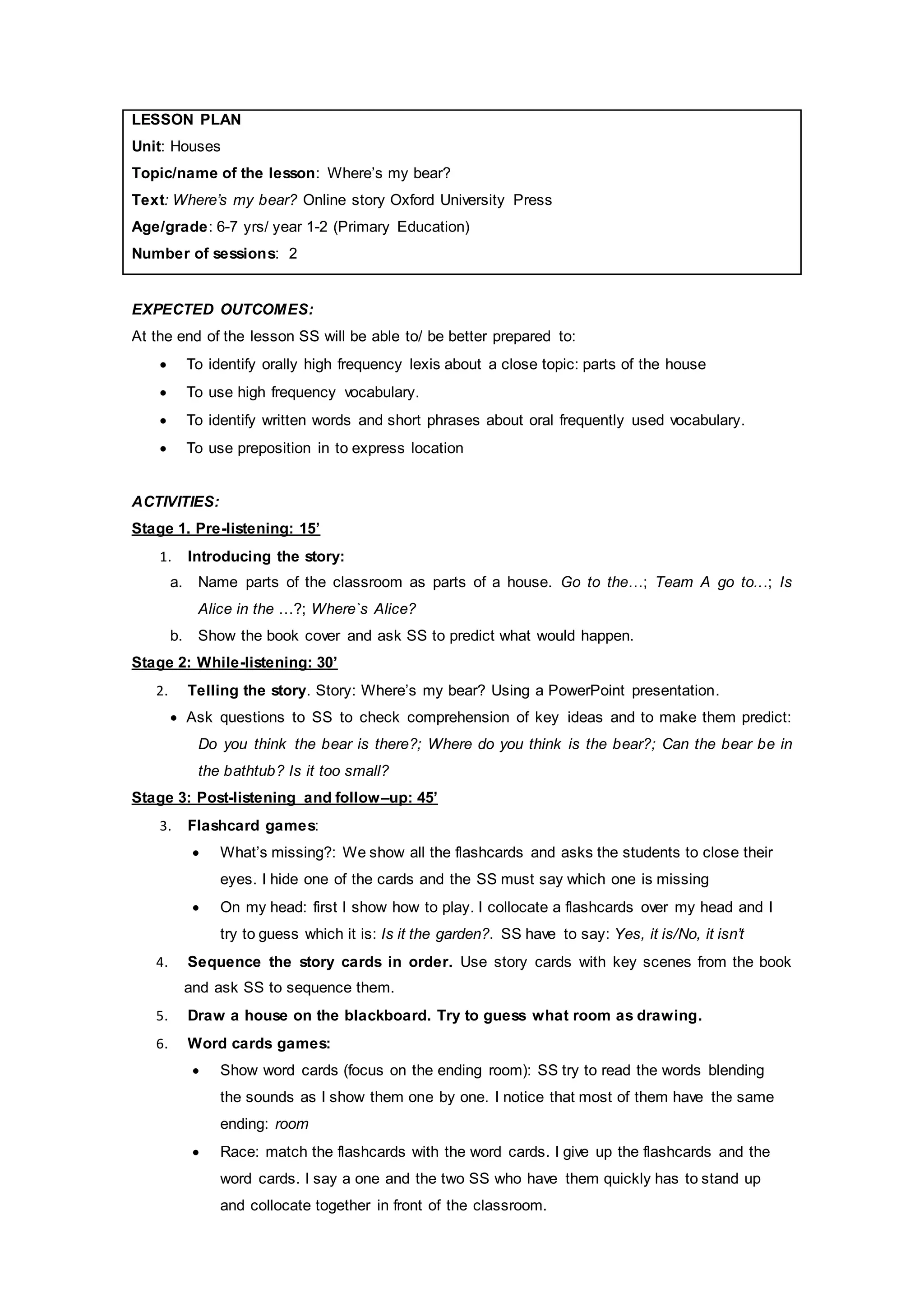
LESSON PLAN
Unit: Houses
Topic/name of the lesson: Where’s my bear?
Text: Where’s my bear? Online story Oxford University Press
Age/grade: 6-7 yrs/ year 1-2 (Primary Education)
Number of sessions: 2
EXPECTED OUTCOMES:
At the end of the lesson SS will be able to/ be better prepared to:
 To identify orally high frequency lexis about a close topic: parts of the house
 To use high frequency vocabulary.
 To identify written words and short phrases about oral frequently used vocabulary.
 To use preposition in to express location
ACTIVITIES:
Stage 1. Pre-listening: 15’
1. Introducing the story:
a. Name parts of the classroom as parts of a house. Go to the…; Team A go to...; Is
Alice in the …?; Where`s Alice?
b. Show the book cover and ask SS to predict what would happen.
Stage 2: While-listening: 30’
2. Telling the story. Story: Where’s my bear? Using a PowerPoint presentation.
 Ask questions to SS to check comprehension of key ideas and to make them predict:
Do you think the bear is there?; Where do you think is the bear?; Can the bear be in
the bathtub? Is it too small?
Stage 3: Post-listening and follow–up: 45’
3. Flashcard games:
 What’s missing?: We show all the flashcards and asks the students to close their
eyes. I hide one of the cards and the SS must say which one is missing
 On my head: first I show how to play. I collocate a flashcards over my head and I
try to guess which it is: Is it the garden?. SS have to say: Yes, it is/No, it isn’t
4. Sequence the story cards in order. Use story cards with key scenes from the book
and ask SS to sequence them.
5. Draw a house on the blackboard. Try to guess what room as drawing.
6. Word cards games:
 Show word cards (focus on the ending room): SS try to read the words blending
the sounds as I show them one by one. I notice that most of them have the same
ending: room
 Race: match the flashcards with the word cards. I give up the flashcards and the
word cards. I say a one and the two SS who have them quickly has to stand up
and collocate together in front of the classroom.
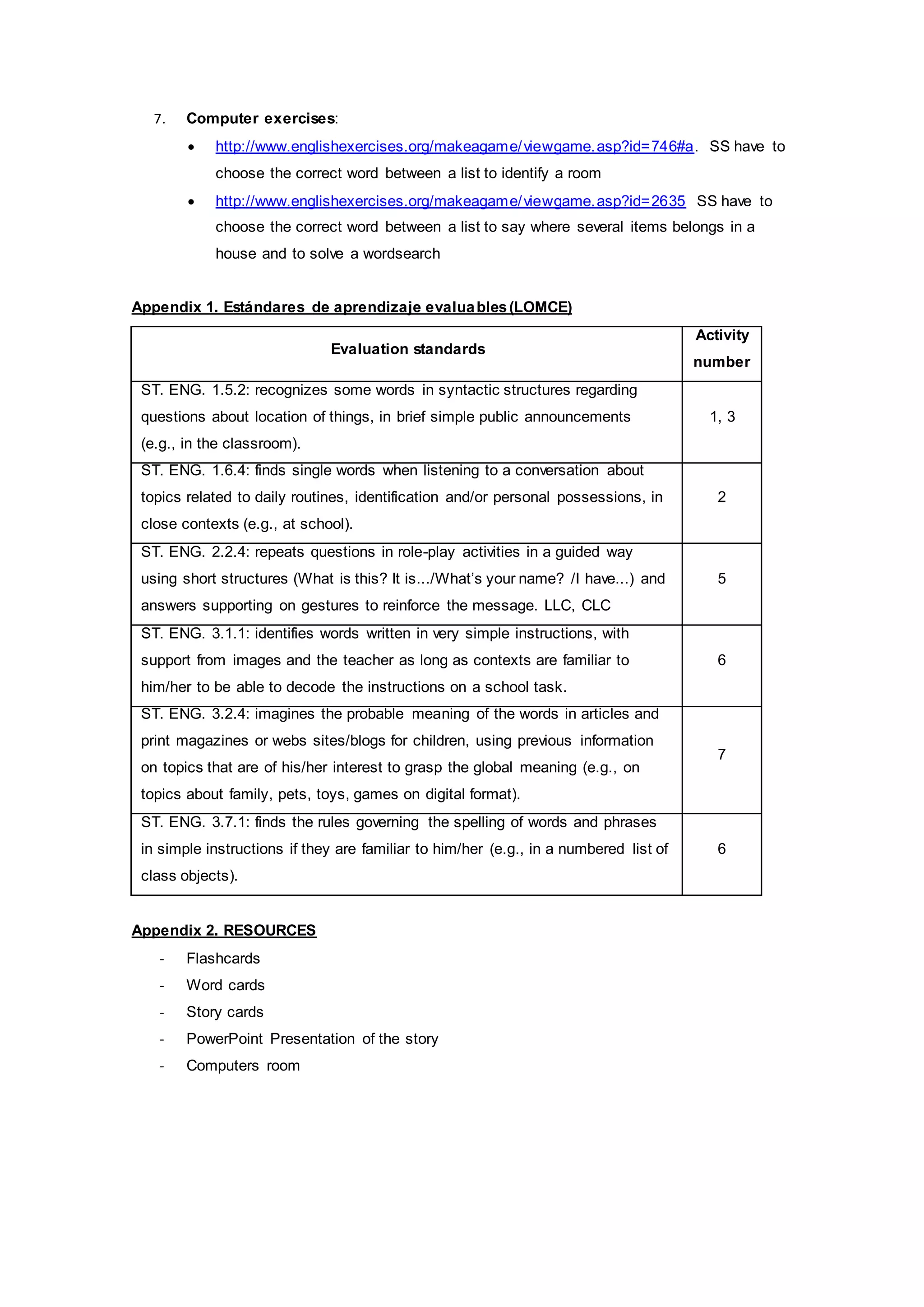
7. Computer exercises:
 http://www.englishexercises.org/makeagame/viewgame.asp?id=746#a. SS have to
choose the correct word between a list to identify a room
 http://www.englishexercises.org/makeagame/viewgame.asp?id=2635 SS have to
choose the correct word between a list to say where several items belongs in a
house and to solve a wordsearch
Appendix 1. Estándares de aprendizaje evaluables(LOMCE)
Evaluation standards
Activity
number
ST. ENG. 1.5.2: recognizes some words in syntactic structures regarding
questions about location of things, in brief simple public announcements
(e.g., in the classroom).
1, 3
ST. ENG. 1.6.4: finds single words when listening to a conversation about
topics related to daily routines, identification and/or personal possessions, in
close contexts (e.g., at school).
2
ST. ENG. 2.2.4: repeats questions in role-play activities in a guided way
using short structures (What is this? It is.../What’s your name? /I have...) and
answers supporting on gestures to reinforce the message. LLC, CLC
5
ST. ENG. 3.1.1: identifies words written in very simple instructions, with
support from images and the teacher as long as contexts are familiar to
him/her to be able to decode the instructions on a school task.
6
ST. ENG. 3.2.4: imagines the probable meaning of the words in articles and
print magazines or webs sites/blogs for children, using previous information
on topics that are of his/her interest to grasp the global meaning (e.g., on
topics about family, pets, toys, games on digital format).
7
ST. ENG. 3.7.1: finds the rules governing the spelling of words and phrases
in simple instructions if they are familiar to him/her (e.g., in a numbered list of
class objects).
6
Appendix 2. RESOURCES
- Flashcards
- Word cards
- Story cards
- PowerPoint Presentation of the story
- Computers room

Section5.lesson plan efl

  • 1.
    LESSON PLAN Unit: Houses Topic/nameof the lesson: Where’s my bear? Text: Where’s my bear? Online story Oxford University Press Age/grade: 6-7 yrs/ year 1-2 (Primary Education) Number of sessions: 2 EXPECTED OUTCOMES: At the end of the lesson SS will be able to/ be better prepared to:  To identify orally high frequency lexis about a close topic: parts of the house  To use high frequency vocabulary.  To identify written words and short phrases about oral frequently used vocabulary.  To use preposition in to express location ACTIVITIES: Stage 1. Pre-listening: 15’ 1. Introducing the story: a. Name parts of the classroom as parts of a house. Go to the…; Team A go to...; Is Alice in the …?; Where`s Alice? b. Show the book cover and ask SS to predict what would happen. Stage 2: While-listening: 30’ 2. Telling the story. Story: Where’s my bear? Using a PowerPoint presentation.  Ask questions to SS to check comprehension of key ideas and to make them predict: Do you think the bear is there?; Where do you think is the bear?; Can the bear be in the bathtub? Is it too small? Stage 3: Post-listening and follow–up: 45’ 3. Flashcard games:  What’s missing?: We show all the flashcards and asks the students to close their eyes. I hide one of the cards and the SS must say which one is missing  On my head: first I show how to play. I collocate a flashcards over my head and I try to guess which it is: Is it the garden?. SS have to say: Yes, it is/No, it isn’t 4. Sequence the story cards in order. Use story cards with key scenes from the book and ask SS to sequence them. 5. Draw a house on the blackboard. Try to guess what room as drawing. 6. Word cards games:  Show word cards (focus on the ending room): SS try to read the words blending the sounds as I show them one by one. I notice that most of them have the same ending: room  Race: match the flashcards with the word cards. I give up the flashcards and the word cards. I say a one and the two SS who have them quickly has to stand up and collocate together in front of the classroom.
  • 2.
    7. Computer exercises: http://www.englishexercises.org/makeagame/viewgame.asp?id=746#a. SS have to choose the correct word between a list to identify a room  http://www.englishexercises.org/makeagame/viewgame.asp?id=2635 SS have to choose the correct word between a list to say where several items belongs in a house and to solve a wordsearch Appendix 1. Estándares de aprendizaje evaluables(LOMCE) Evaluation standards Activity number ST. ENG. 1.5.2: recognizes some words in syntactic structures regarding questions about location of things, in brief simple public announcements (e.g., in the classroom). 1, 3 ST. ENG. 1.6.4: finds single words when listening to a conversation about topics related to daily routines, identification and/or personal possessions, in close contexts (e.g., at school). 2 ST. ENG. 2.2.4: repeats questions in role-play activities in a guided way using short structures (What is this? It is.../What’s your name? /I have...) and answers supporting on gestures to reinforce the message. LLC, CLC 5 ST. ENG. 3.1.1: identifies words written in very simple instructions, with support from images and the teacher as long as contexts are familiar to him/her to be able to decode the instructions on a school task. 6 ST. ENG. 3.2.4: imagines the probable meaning of the words in articles and print magazines or webs sites/blogs for children, using previous information on topics that are of his/her interest to grasp the global meaning (e.g., on topics about family, pets, toys, games on digital format). 7 ST. ENG. 3.7.1: finds the rules governing the spelling of words and phrases in simple instructions if they are familiar to him/her (e.g., in a numbered list of class objects). 6 Appendix 2. RESOURCES - Flashcards - Word cards - Story cards - PowerPoint Presentation of the story - Computers room