Benign Paroxysmal Positional
Vertigo
Dr. Deepa Shivnani
BPPV
• Dix and Hallpike 1952 – specific characteristics
• Vertigo
• Rotatory nystagmus
• Precipitated by head movement
• Latency of 1 - 5 seconds
• Accompanying nausea
• Fatigable in 15-30 seconds
• Adaptable
Dix MR, Hallpike CS. Pathology, symptoms and diagnosis of certain disorders of
the vestibular system. Proc R Soc Med.1952;45:341-354
C.S Hallpike
Definition
• Benign paroxysmal positional vertigo (BPPV) is
a disorder of the inner ear characterized by
episodes of vertigo triggered by changes in
head position.
• BPPV is thought to be caused by the presence
of endo lymphatic debris in one or more semi-
circular canals
• BPPV is termed “benign” because it is a
naturally resolving condition
• The average time to resolution of vertigo has
been observed to be 13 days, and maximum
time was about 35 days
• Despite its favorable prognosis, BPPV is not an
entirely benign condition, especially in the
elderly, in whom it is often unrecognized and
can lead to falls
• The posterior semicircular canal is involved in
approximately 94% of cases
• The lateral canal BPPV is next common
Was first described by Cipparrone and McClure
Two distinct subtypes
Geotropic
Apogeotropic
Cipparrone L et al.Nistagmografia e pathologica vestibulare periferica. Milano, Italie: V
Giornata Italiana di Nistagmografia Clinica;1985:6-53
McMclure JA.Horizontal canal BPPV. J Otolaryngol 1985; 14:30-35
Anterior canal BPPV is very rare
Risk Factors
• 18-39:yoga,running on pavement,working
underneath objects such as cars,ceiling
painters,aerobic exercises,jogging,running on
treadmill and swimming
• >40;head trauma,ear disorders(vestibular neuritis
or labyrinthitis)
• Certain positions are more likely to provoke
vertigo;lying back in bed,arising quickly,looking
up,reclining for dental or hair treatments
pathophysiology
• Caused by otoconia that falls in to the PSC or
LSC after detaching from the utricle
• Reason for detachment:increased age/trauma
and infections
• Schuknecht :basophillic deposits on the
cupula of the PSC causes BPPV
• Dix and hallpike :1952/head manuover to
produce the ipsidirectional torsional
nystagmus used to identify BPPV
Pathophysiology
Cupulolithiasis
• Schuknecht first described
cupulolithiasis
• Could not explain
 Adaptability
 Fatiguability
Schuknecht HF. Cupulolithiasis. Arch Otolaryngol 1969;90:765-778
Canalolithiasis
• McClure and Parnes
described
canalolithiasis
McClure JA et al. The mechanics of benign paroxysmal vertigo. J Otolaryngol 1979;8:151-158
Parnes LS et al. Particle repositioning maneuver for benign paroxymal postional vertigo. Ann
Otol Rhinol Laryngol 1993;102:325-331
• Self Limiting Disorder
• Resolves by itself within a few weeks to few
months in most cases
• BPPV of PSC typically characterised by
torsional nystagmus which has a duration of
less than one minute
• Always peripheral in origin
Nystagmus
• Latency – 5s to 20s
• Accompanied by sense of vertigo
• Gradual decrease in intensity (15s to 40s)
• Beats towards the undermost ear and is
direction-fixed
• Fatigable on repetition
Movement of
Otolith
Flow of
Endolymph
Deflection of
cupula in the
PSC
Excitation of
Vestibular
Nerve
Stimulation of
Maculo spinal
reflex
Maculo-Ocular
Reflex
Vertigo
Nystagmus
Positional Test
S/N Patient Sitting up S/N Patient Lying Down
1 Head Straight Ahead 1 Head Straight
2 Head Extended 2 Head Hanging
3 Head right side down 3 Head right side down
4 Head left side down 4 Head left side down
5 Head Flexed 5 Head 50 Deg below horizontal & 45 Deg
turned to the left
6 Head 30 Deg below horizontal & 45 Deg
turned to the right
Positioning tests
• Identify the canal involved
Dix-Hallpike test
Lateral position
Geotropic
Apogeotropic
BPPV Manoeuvres
S/N BPPV Variant Management
1 Posterior Canalolithiasis 1. Epley's manoeuvre
2 Posterior Cupololithiasis
1. Semont's Liberatory manoeuvre
2. Brand daroff’s Exercise
3
Horizontal
Canalolithiasis(Geotropic)
1. 360 Deg barbecue roll
2. Gufoni’s manoeuvre
4
Horizontal Cupololithiasis
(Apogeotropic)
1. Modified Gufoni ‘s manoeuvre
2. Modified Brand daroff’s Exercise
5 Anterior Canal Cupololithiasis
1. Reverse Epley's manoeuvre
2. Reverse Semont's (Liberatory)
manoeuvre
3. Crevitz manoeuvre
BPPV
Variant
Test Direction
of
nystagmus
Duration of
nystagmus
Treatment of
choice
Posterior
canalolithias
is
Dix-
Hallpike
test
Upbeat
torsional-
towards
affected
side
5-45 sec Epley’s
maneuver
Dix-Hallpike Test
Epley’s Maneuver
BPPV Variant Test Direction
of
nystagmus
Duration of
nystagmus
Treatment of
choice
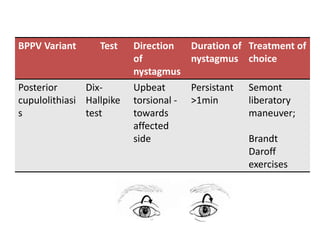
Posterior
cupulolithiasi
s
Dix-
Hallpike
test
Upbeat
torsional -
towards
affected
side
Persistant
>1min
Semont
liberatory
maneuver;
Brandt
Daroff
exercises
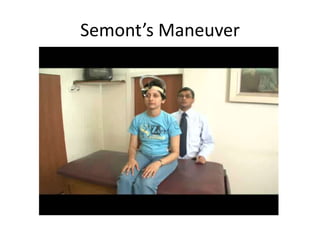
Semont’s Maneuver
Brandt-Daroff Exercises
BPPV Variant Test Direction
of
nystagmus
Duration of
nystagmus
Treatment of
choice
Horizontal
canalolithiasis
( geotropic)
Roll test Horizontal
towards
the ground
Sec to min 360 deg
barbecue roll
Gufoni
Maneuver
Roll Test
Barbecue Maneuver
Gufoni Maneuver
BPPV Variant Test Direction
of
nystagmus
Duration
of
nystagmus
Treatment
of choice
Horizontal
cupulolithiasis
(apogeotropic)
Roll test Horizontal
away from
the ground,
more
severe on
the
opposite
side
Sec to min Modified
Gufoni’s
maneuver
Modified
Brandt-
Daroff
exercises
Modified Gufoni Maneuver
Modified Brandt-Daroff Exercises
BPPV
Variant
Test Direction
of
nystagmus
Duration of
nystagmus
Treatment
of choice
Anterior canal
Cupulolithiasis
Dix Hallpike
test
Head hanging
Test
Vertical
downbeating
nystagmus
Sec to min Reverse Epley’s
Maneuver
Reverse
Semont’s
Maneuver
Crevitz
Maneuver
Dix Hallpike test
Head Hanging Test
Crevitz Maneuver
Treatment efficacy
• Patient has relief
OR
• Dix-Hallpike test negative
• Spontaneous remission in 6-12 months
• Recurrence in 15-45% in one year
Role of post-maneuver restrictions
• Not to lie down flat.(45 degree head up)
• Not to bend over, or look up or look down
• Avoid lying down on the affected side for a week
• Is it really necessary?
Cakir et al(2006). Efficacy of postural restrictions in treating benign paroxysmal positional
vertigo. Arch OHNS, 132,5, 501-505.
No more postural restrictions in posterior canal benign paroxysmal positional vertigo.
Otology & Neurotology, 2008;29:706-709.
Summary
• BPPV :most common type of peripheral
vertigo
• Aggrevates with head movements /positional
changes
• Associated with nause /vomitting and
classical torsional (psc) or horizontal (lsc)
nystagmus
• Diagnosis is by history and positional
/positioning testing
cont……….
• Management:different manuever for different
types of BPPV
• MEDICAL MANAGEMENT :not useful
• Surgical management :singular neurectomy
/plugging of PSC
• Usually resolves by its own.
THANK YOU……
ANY QUESTION?????

Bppv 16 06-2015

  • 1.
  • 2.
    BPPV • Dix andHallpike 1952 – specific characteristics • Vertigo • Rotatory nystagmus • Precipitated by head movement • Latency of 1 - 5 seconds • Accompanying nausea • Fatigable in 15-30 seconds • Adaptable Dix MR, Hallpike CS. Pathology, symptoms and diagnosis of certain disorders of the vestibular system. Proc R Soc Med.1952;45:341-354 C.S Hallpike
  • 3.
    Definition • Benign paroxysmalpositional vertigo (BPPV) is a disorder of the inner ear characterized by episodes of vertigo triggered by changes in head position. • BPPV is thought to be caused by the presence of endo lymphatic debris in one or more semi- circular canals
  • 4.
    • BPPV istermed “benign” because it is a naturally resolving condition • The average time to resolution of vertigo has been observed to be 13 days, and maximum time was about 35 days • Despite its favorable prognosis, BPPV is not an entirely benign condition, especially in the elderly, in whom it is often unrecognized and can lead to falls
  • 5.
    • The posteriorsemicircular canal is involved in approximately 94% of cases • The lateral canal BPPV is next common Was first described by Cipparrone and McClure Two distinct subtypes Geotropic Apogeotropic Cipparrone L et al.Nistagmografia e pathologica vestibulare periferica. Milano, Italie: V Giornata Italiana di Nistagmografia Clinica;1985:6-53 McMclure JA.Horizontal canal BPPV. J Otolaryngol 1985; 14:30-35 Anterior canal BPPV is very rare
  • 6.
    Risk Factors • 18-39:yoga,runningon pavement,working underneath objects such as cars,ceiling painters,aerobic exercises,jogging,running on treadmill and swimming • >40;head trauma,ear disorders(vestibular neuritis or labyrinthitis) • Certain positions are more likely to provoke vertigo;lying back in bed,arising quickly,looking up,reclining for dental or hair treatments
  • 7.
    pathophysiology • Caused byotoconia that falls in to the PSC or LSC after detaching from the utricle • Reason for detachment:increased age/trauma and infections • Schuknecht :basophillic deposits on the cupula of the PSC causes BPPV • Dix and hallpike :1952/head manuover to produce the ipsidirectional torsional nystagmus used to identify BPPV
  • 8.
    Pathophysiology Cupulolithiasis • Schuknecht firstdescribed cupulolithiasis • Could not explain  Adaptability  Fatiguability Schuknecht HF. Cupulolithiasis. Arch Otolaryngol 1969;90:765-778
  • 9.
    Canalolithiasis • McClure andParnes described canalolithiasis McClure JA et al. The mechanics of benign paroxysmal vertigo. J Otolaryngol 1979;8:151-158 Parnes LS et al. Particle repositioning maneuver for benign paroxymal postional vertigo. Ann Otol Rhinol Laryngol 1993;102:325-331
  • 10.
    • Self LimitingDisorder • Resolves by itself within a few weeks to few months in most cases • BPPV of PSC typically characterised by torsional nystagmus which has a duration of less than one minute • Always peripheral in origin
  • 11.
    Nystagmus • Latency –5s to 20s • Accompanied by sense of vertigo • Gradual decrease in intensity (15s to 40s) • Beats towards the undermost ear and is direction-fixed • Fatigable on repetition
  • 12.
    Movement of Otolith Flow of Endolymph Deflectionof cupula in the PSC Excitation of Vestibular Nerve Stimulation of Maculo spinal reflex Maculo-Ocular Reflex Vertigo Nystagmus
  • 13.
    Positional Test S/N PatientSitting up S/N Patient Lying Down 1 Head Straight Ahead 1 Head Straight 2 Head Extended 2 Head Hanging 3 Head right side down 3 Head right side down 4 Head left side down 4 Head left side down 5 Head Flexed 5 Head 50 Deg below horizontal & 45 Deg turned to the left 6 Head 30 Deg below horizontal & 45 Deg turned to the right
  • 14.
    Positioning tests • Identifythe canal involved Dix-Hallpike test Lateral position Geotropic Apogeotropic
  • 15.
    BPPV Manoeuvres S/N BPPVVariant Management 1 Posterior Canalolithiasis 1. Epley's manoeuvre 2 Posterior Cupololithiasis 1. Semont's Liberatory manoeuvre 2. Brand daroff’s Exercise 3 Horizontal Canalolithiasis(Geotropic) 1. 360 Deg barbecue roll 2. Gufoni’s manoeuvre 4 Horizontal Cupololithiasis (Apogeotropic) 1. Modified Gufoni ‘s manoeuvre 2. Modified Brand daroff’s Exercise 5 Anterior Canal Cupololithiasis 1. Reverse Epley's manoeuvre 2. Reverse Semont's (Liberatory) manoeuvre 3. Crevitz manoeuvre
  • 16.
    BPPV Variant Test Direction of nystagmus Duration of nystagmus Treatmentof choice Posterior canalolithias is Dix- Hallpike test Upbeat torsional- towards affected side 5-45 sec Epley’s maneuver
  • 17.
  • 18.
  • 19.
    BPPV Variant TestDirection of nystagmus Duration of nystagmus Treatment of choice Posterior cupulolithiasi s Dix- Hallpike test Upbeat torsional - towards affected side Persistant >1min Semont liberatory maneuver; Brandt Daroff exercises
  • 20.
  • 21.
  • 22.
    BPPV Variant TestDirection of nystagmus Duration of nystagmus Treatment of choice Horizontal canalolithiasis ( geotropic) Roll test Horizontal towards the ground Sec to min 360 deg barbecue roll Gufoni Maneuver
  • 23.
  • 24.
  • 25.
  • 26.
    BPPV Variant TestDirection of nystagmus Duration of nystagmus Treatment of choice Horizontal cupulolithiasis (apogeotropic) Roll test Horizontal away from the ground, more severe on the opposite side Sec to min Modified Gufoni’s maneuver Modified Brandt- Daroff exercises
  • 27.
  • 28.
  • 29.
    BPPV Variant Test Direction of nystagmus Duration of nystagmus Treatment ofchoice Anterior canal Cupulolithiasis Dix Hallpike test Head hanging Test Vertical downbeating nystagmus Sec to min Reverse Epley’s Maneuver Reverse Semont’s Maneuver Crevitz Maneuver
  • 30.
  • 31.
  • 32.
  • 33.
    Treatment efficacy • Patienthas relief OR • Dix-Hallpike test negative • Spontaneous remission in 6-12 months • Recurrence in 15-45% in one year
  • 34.
    Role of post-maneuverrestrictions • Not to lie down flat.(45 degree head up) • Not to bend over, or look up or look down • Avoid lying down on the affected side for a week • Is it really necessary? Cakir et al(2006). Efficacy of postural restrictions in treating benign paroxysmal positional vertigo. Arch OHNS, 132,5, 501-505. No more postural restrictions in posterior canal benign paroxysmal positional vertigo. Otology & Neurotology, 2008;29:706-709.
  • 35.
    Summary • BPPV :mostcommon type of peripheral vertigo • Aggrevates with head movements /positional changes • Associated with nause /vomitting and classical torsional (psc) or horizontal (lsc) nystagmus • Diagnosis is by history and positional /positioning testing
  • 36.
    cont………. • Management:different manueverfor different types of BPPV • MEDICAL MANAGEMENT :not useful • Surgical management :singular neurectomy /plugging of PSC • Usually resolves by its own.
  • 37.
  • 38.