Radiology in identification
Introduction
• The use of radiological identification of skeletal
structures fall into 3 main groups:
1. General grouping: to determine whether bone are
actually present, whether they are human or not, and
basic features such as age sex.
2. Comparison of 2 sets of radiographs :one set taken
for diagnostic or therapeutic purposes while the other
set taken at time of examination>
3. Detection of bone abnormality (by comparison or
single bone examination): fractures, bone deformity,
congenital defects or diseases
General grouping identification
Species identification:
• Serology
• Where as there are soft tissue fragments,
radiology may be more convenient than
dissection.
Bear paw mistaken for a human hand.
General grouping identification
Sex identification
• Differentiation of sex by skeletal radiology is unreliable
until after puberty.
• In general, the male skeleton is more robust and heavier,
with more prominent attachment for muscles and
tendons.
• With aging, there is a tendency for more degenerative
and hyperostotic changes in the male skeleton. Male long
bones are about 110% the length of female long bones.
General grouping identification
Sex identification: Pelvis
• Pelvis offers the most definitive traits of sexual differentiation.
1. The subpubic arch: (subpubic concavity) is narrow and triangular
with an inverted V-shape in the male and broad and with an inverted
U-shape in the female.
2. The pubic bone tends to be long and narrow in the male and broad
and rectangular in the female.
3. The sciatic notch is deep and narrow in the male, and is wide and
shallow in the female.
4. The preauricular sulcus (paraglenoid sulcus) when present is one of
the most dependable indicators of femaleness.
A: male pelvis and B: female pelvis, victims of the Air India disaster. Note the
differences in configuration and, especially, the preauricular sulcus (arrows) in the female.
A: male pelvis. B: female pelvis. Differential characteristics are
emphasized with
bold lines and arrows
General grouping identification
Sex identification: Pelvis
• Pelvis offers the most definitive traits of sexual differentiation.
5. The obturator foramina are large and oval or round in the
male, but small and triangular in the female.
6. The acetabular fossae are large and directed laterally in the
male, and are smaller and directed anterolaterally in the
female.
7. The ilial alae are high and vertical in the male, and broad
and laterally divergent in the female.
8. The sacrum in the male is narrow, has a relatively flattened
curve and has five or more segments. The female sacrum is
broad and short with five segments and an anterior
concavity.
General grouping identification
Sex identification: Pelvis
• Pelvis offers the most definitive traits of sexual
differentiation.
9. The pelvic inlet is triangular or heart-shaped in the male,
ovoid in the female.
10. The muscle markings are more prominent and rugged in
the male. The female bony pelvis tends to be smooth
and gracile.
11. Osteitis condensans ilii is a triangular area of increased
bony density on the ilial side of the sacroiliac joint,
usually bilateral, found almost exclusively in parous
women in the child-bearing years
Osteitis condensans ilii. A triangular area of increased density (arrowheads) on
the ilial side of the sacroiliac joint in women during the child-bearing years.
General grouping identification
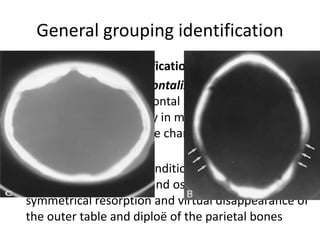
Sex identification: Skull
• Hyperostosis interna frontalis is an overgrowth of
the inner table of the frontal bone, often florid,
found almost exclusively in middle-aged or older
females and is a valuable characteristic for sex
determination .
• Parietal thinning is a condition of postmenopausal
females in which profound osteoporosis causes
symmetrical resorption and virtual disappearance of
the outer table and diploë of the parietal bones
General grouping identification
Sex identification: others
• Costal cartilage mineralization patterns
Schematic drawing of patterns of costal
cartilage ossification useful in determining
the sex of human remains.
A: typical male pattern;
B: male pattern initially involving
only the inferior margin of the costal cartilage;
C: typical female pattern;
D: uncommon pattern more often found in
females than males;
E: string of rounded ossifications believed
specific for elderly females.
General grouping identification
Sex identification: others
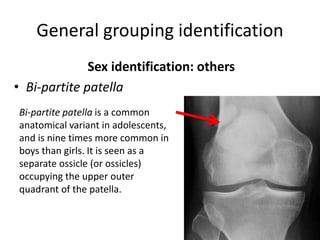
• Bi-partite patella
Bi-partite patella is a common
anatomical variant in adolescents,
and is nine times more common in
boys than girls. It is seen as a
separate ossicle (or ossicles)
occupying the upper outer
quadrant of the patella.
General grouping identification
Age identification: Ossification center appearance
Intra uterine
9th week IU: all cervical & thoracic vertebral bodies,
iliac wings, femoral, tibial and fibular shaft centers
21th – 25th week: calcaneus
24th – 28th week: talus
35th week: lower end of femur
39th week: proximal tibia
N.B. biological variations
General grouping identification
Age identification: Ossification center appearance
Extra uterine
• 1 year : head of humerus ,femur and tibia .
• 2 years : lower radius and tibia.
• 3 years ; Patella.
• 4 years ; upper fibula ,greater trochanter of femur.
• 5 years lower fibula
• 6 years ;head of radius ,lower ulna.calcanium
N.B. biological variations
• Below1 year as
ossific center of the
head of femur not
appeared.
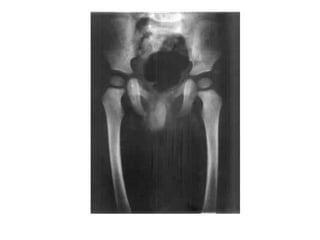
What is the age ?
• Above 2 years.
Ossific center of
lower radius
General grouping identification
Age identification: Epiphysial fusion
Long bones
Development and ossification of a long bone.
A : cartilagineous anlage
;B appearance of primary ossification center in shaft or diaphysis;
C: primary center begins reorganization into cortex, medulla, and (with perichondral
ossification) the metaphysis or growing end of the shaft;
D: appearance of (2) secondary ossification center
E: the differential between cortex and medulla is well established, epiphyseal development
continues with growth in length taking place at (3) the epiphyseal cartilagineous plate ;
F: the epiphyseal plates (4) have closed by ossification, growth has ceased; the bone has been
modeled into its adult shape and form with well-defined cortex (c) and medullary canal (m).
General grouping identification
Age identification: Epiphysial fusion
Cervical vertebra
Atlas: 2 halves of the arch unites posteriorly at the
age of 6 years
Axis : formed from 4 portions which unites
• Posteriorly at the age of 1.5 yrs
• Anteriorly at the age of 6 years
General grouping identification
Age identification: Epiphysial fusion
Long bones
Upper limb:
• Humerus:
1. Trochlea & capitulum together at 14 years
2. Trochlea & capitulum with the shaft at 15 years
3. Medial epicondyle at 16 years
4. Lateral epicondyle at 17
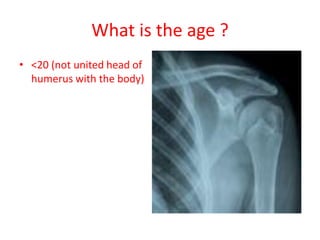
5. Upper end at 20 years
What is the age ?
• >20 years (united
head of humerus)
What is the age ?
• <20 (not united head of
humerus with the body)
General grouping identification
Age identification: Epiphysial fusion
Long bones
Upper limb:
• Radius, ulna and hand bones:
1. Upper end of radius at 16 years
2. Upper end of ulna at 17
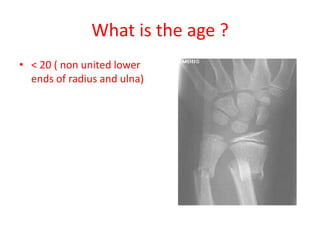
3. Lower end of radius and ulna at 20 years
4. Metacarpal and phalyngeal bones at 18 years
What is the age ?
• < 20 ( non united lower
ends of radius and ulna)
General grouping identification
Age identification: Epiphysial fusion
Long bones
Lower limb:
• Femur:
1. Lesser trochanter at 16 years
2. Greater trochanter at 17 years
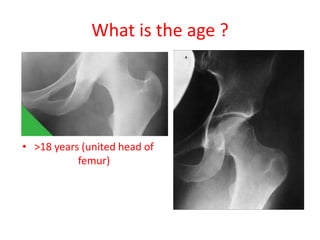
3. Upper end at 18 years
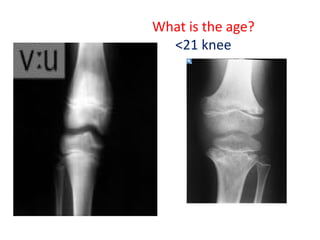
4. Lower end at 21 years
What is the age ?
• >18 years (united head of
femur)
What is the age?
<21 knee
What is the age?
>21 y
General grouping identification
Age identification: Epiphysial fusion
Long bones
Lower limb:
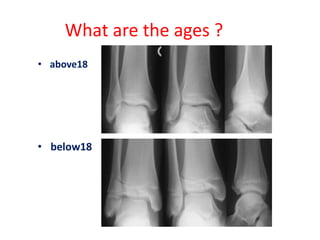
• Tibia and fibula:
1. Upper end at 21 years
2. Lower end at 18 years
• Metatarsal and phalyngeal bones:
At 18 years
What are the ages ?
• above18
• below18
General grouping identification
Age identification: Epiphysial fusion
Long bones
The final epiphysis to close is at the medial end of
the clavicle during the third decade of life
General grouping identification
Age identification: Epiphysial fusion
Long bones
• From about age 25 to 50, the anthropologists rely
heavily on the external appearance of the skull sutures
and the pubic symphysis, and these criteria do not lend
themselves readily to radiological evaluation.
General grouping identification
Age identification: progressive resorption and
remodeling
• Medullary cavity of upper humerus: reaches surgical
neck at fifth decade and by sixth and seventh decade
moves up to the epiphyseal line.
• At the proximal end of the femur, the cavity
advances (at the expense of trabecular bone) to the
level of the surgical neck during the fourth decade
and reaches the epiphyseal line between 61 and 74
yr.
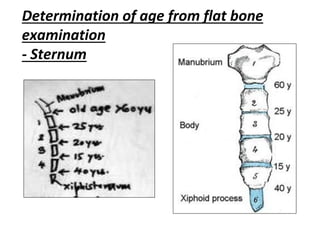
Determination of age from flat bone
examination
- Sternum
What is the age?
• < 15 y (non-
united
segments)
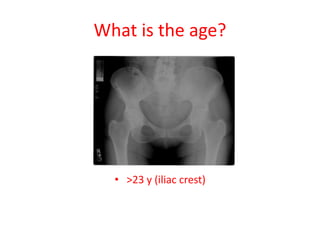
Age from hip bone examination:
• Two pubic rami of the hip (6y)
• Suture at the acetabulum (15y).
• Ischeal tuberosity with the ischium (21y).
• Iliac crest with the ilium (23y).
What is the age?
• >23 y (iliac crest)
>18 y (head of femur)<23 opened iliac crest >23 y (iliac crest)
Comparative identification
Cephalometric indices
• The essential process in visual matching is
the presence of 2 sets of radiograph.
1. Obtained from previous diagnostic episode.
2. Taken at the time of examination.
• The most helpful area is the skull.
Comparative identification
Cephalometric indices
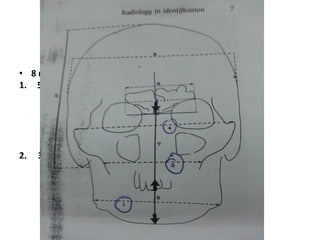
• 8 measurments used for the comparison:
1. 5 breadthes:
I. Bigonial
II. Bimaxillary
III. Bizygomatic
IV. Maximum cranial
V. Sinus
2. 3 heights:
I. Mastoid to apex
II. Total facial
III. Incisor height
Comparative identification
Frontal sinus radiology
• The frontal sinuses, especially, develop unique
scalloped margins with internal septae and
pseudoseptae.
• The frontal sinuses are as unique to the
individual as his fingerprints.
• Even identical twins will have different frontal
sinus patterns.
Comparative identification
Frontal sinus radiology
• Comparison of frontal sinus configuration is easy on
frontal view radiographs of the skull, even with
considerable variations in angulation or projection
between two radiographs.
• Elaborate systems of mensuration and classification of
the sinuses, have been proposed particularly by the
anthropologists, but such elaboration is not really
required.
• Simple “eyeball” comparison will suffice in virtually
every case.
Comparative identification
Frontal sinus radiology
• Frontal sinus are raiographes in 2 views:
1. Occipito-mental
2. Occipito-frontal
Comparative identification
Frontal sinus radiology
• Unfortunately, the frontal sinuses are susceptible
to severe fracturing and distortion in automobile
and aircraft crashes, and, sinuses may explode
inconditions of extreme sudden heat.
• Even fragments of frontal sinuses may contain
such distinctive patterns that comparative
identification is possible
Comparative identification
Frontal sinus radiology
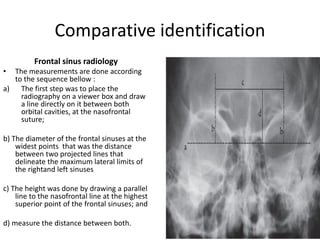
• The measurements are done according
to the sequence bellow :
a) The first step was to place the
radiography on a viewer box and draw
a line directly on it between both
orbital cavities, at the nasofrontal
suture;
b) The diameter of the frontal sinuses at the
widest points that was the distance
between two projected lines that
delineate the maximum lateral limits of
the rightand left sinuses
c) The height was done by drawing a parallel
line to the nasofrontal line at the highest
superior point of the frontal sinuses; and
d) measure the distance between both.
Comparative identification
Frontal sinus radiology
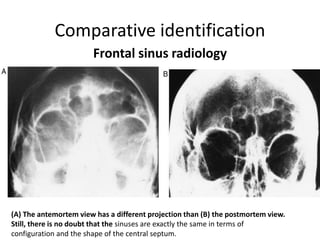
(A) The antemortem view has a different projection than (B) the postmortem view.
Still, there is no doubt that the sinuses are exactly the same in terms of
configuration and the shape of the central septum.
Comparative identification
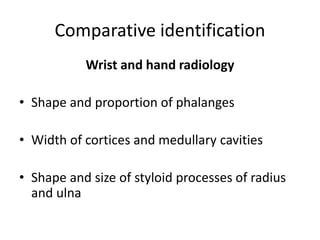
Wrist and hand radiology
• Shape and proportion of phalanges
• Width of cortices and medullary cavities
• Shape and size of styloid processes of radius
and ulna
Comparative identification
Chest
• The pattern of costal cartilage ossification
may be unique. Ossification of costal cartilage
is a dynamic progressive process and attempts
to match patterns over time lapses are fraught
with difficulty.
• Sternum, clavicle or scapula
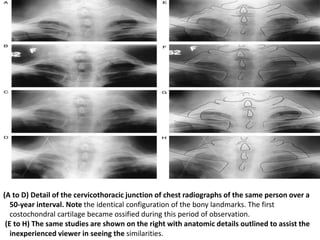
(A to D) Detail of the cervicothoracic junction of chest radiographs of the same person over a
50-year interval. Note the identical configuration of the bony landmarks. The first
costochondral cartilage became ossified during this period of observation.
(E to H) The same studies are shown on the right with anatomic details outlined to assist the
inexperienced viewer in seeing the similarities.
Detection of bone abnormality (by
comparison or single bone
examination)
• Anomalous or Unusual Development
• Disease
• Tumors
• Fracture and related sequelae
• Iatrogenic interference
• Harris lines
Detection of bone abnormality (by
comparison or single bone
examination)
• Anomalous or Unusual Development
The dorsal defect of the patella,
Detection of bone abnormality (by
comparison or single bone
examination)
Disease or Degeneration
• Judging from the literature, matching skeletal
remains by lesions secondary to a disease
process is rare.
• However degenerative changes are frequently
helpful or definitive.
Ante and post mortem CT for a case of paget disease of the
bone help in identification
Detection of bone abnormality (by
comparison or single bone
examination)
Bone tumors
• Bone tumors are relatively uncommon.
• In young persons, bone islands, nonossifying
fibromata, or osteochondromata might
sometime be found in a decedent.
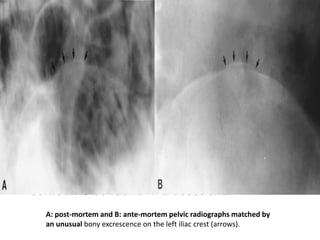
A: post-mortem and B: ante-mortem pelvic radiographs matched by
an unusual bony excrescence on the left iliac crest (arrows).
Detection of bone abnormality (by
comparison or single bone
examination)
Fracture and related sequelae
Old fractures with deformity, callus formation,
angulations, or other unique abnormalities
which can be compared on two films
separated in time form a vital part in
identification.
A: dried skeletal remains of a young adult male. B: slight deformity of the left clavicle from an old healed
fracture of the lateral third. C: close-up of left clavicle in corner of ante-mortem chest radiograph. Note the
irregular configuration and altered trabecular pattern related to the old healed fracture. D: with careful
positioning of the dried clavicle a radiograph, E: reproduces the findings seen in the clavicle on the chest
radiograph.
Detection of bone abnormality (by
comparison or single bone
examination)
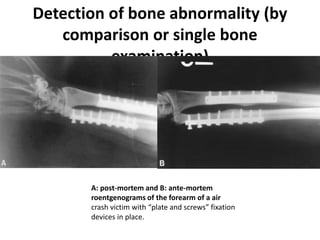
Iatrogenic Interference
• Doctors and dentists leave their indisputable
markers in some bodies and they are a
godsend for identification purposes.
A: post-mortem and B: ante-mortem
roentgenograms of the forearm of a air
crash victim with “plate and screws” fixation
devices in place.
Detection of bone abnormality (by
comparison or single bone
examination)
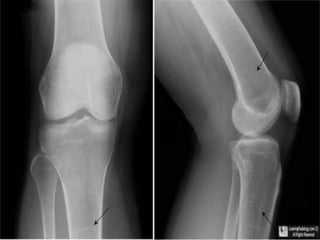
Harris’s lines
• Growth Arrest/Recovery Lines. Transverse dense lines
(black arrows) perpendicular to the long axis
of the bone in the metaphysis and migrate towards the
diaphysis with growth may indicate
a previous prolonged illness or debilitating state.
• Disappear after correction of the cause , so comparison
with previous x ray film must be close in time of
examination
radiology in identification.pdf

radiology in identification.pdf

  • 1.
  • 2.
    Introduction • The useof radiological identification of skeletal structures fall into 3 main groups: 1. General grouping: to determine whether bone are actually present, whether they are human or not, and basic features such as age sex. 2. Comparison of 2 sets of radiographs :one set taken for diagnostic or therapeutic purposes while the other set taken at time of examination> 3. Detection of bone abnormality (by comparison or single bone examination): fractures, bone deformity, congenital defects or diseases
  • 3.
    General grouping identification Speciesidentification: • Serology • Where as there are soft tissue fragments, radiology may be more convenient than dissection. Bear paw mistaken for a human hand.
  • 4.
    General grouping identification Sexidentification • Differentiation of sex by skeletal radiology is unreliable until after puberty. • In general, the male skeleton is more robust and heavier, with more prominent attachment for muscles and tendons. • With aging, there is a tendency for more degenerative and hyperostotic changes in the male skeleton. Male long bones are about 110% the length of female long bones.
  • 5.
    General grouping identification Sexidentification: Pelvis • Pelvis offers the most definitive traits of sexual differentiation. 1. The subpubic arch: (subpubic concavity) is narrow and triangular with an inverted V-shape in the male and broad and with an inverted U-shape in the female. 2. The pubic bone tends to be long and narrow in the male and broad and rectangular in the female. 3. The sciatic notch is deep and narrow in the male, and is wide and shallow in the female. 4. The preauricular sulcus (paraglenoid sulcus) when present is one of the most dependable indicators of femaleness. A: male pelvis and B: female pelvis, victims of the Air India disaster. Note the differences in configuration and, especially, the preauricular sulcus (arrows) in the female. A: male pelvis. B: female pelvis. Differential characteristics are emphasized with bold lines and arrows
  • 6.
    General grouping identification Sexidentification: Pelvis • Pelvis offers the most definitive traits of sexual differentiation. 5. The obturator foramina are large and oval or round in the male, but small and triangular in the female. 6. The acetabular fossae are large and directed laterally in the male, and are smaller and directed anterolaterally in the female. 7. The ilial alae are high and vertical in the male, and broad and laterally divergent in the female. 8. The sacrum in the male is narrow, has a relatively flattened curve and has five or more segments. The female sacrum is broad and short with five segments and an anterior concavity.
  • 7.
    General grouping identification Sexidentification: Pelvis • Pelvis offers the most definitive traits of sexual differentiation. 9. The pelvic inlet is triangular or heart-shaped in the male, ovoid in the female. 10. The muscle markings are more prominent and rugged in the male. The female bony pelvis tends to be smooth and gracile. 11. Osteitis condensans ilii is a triangular area of increased bony density on the ilial side of the sacroiliac joint, usually bilateral, found almost exclusively in parous women in the child-bearing years Osteitis condensans ilii. A triangular area of increased density (arrowheads) on the ilial side of the sacroiliac joint in women during the child-bearing years.
  • 8.
    General grouping identification Sexidentification: Skull • Hyperostosis interna frontalis is an overgrowth of the inner table of the frontal bone, often florid, found almost exclusively in middle-aged or older females and is a valuable characteristic for sex determination . • Parietal thinning is a condition of postmenopausal females in which profound osteoporosis causes symmetrical resorption and virtual disappearance of the outer table and diploë of the parietal bones
  • 9.
    General grouping identification Sexidentification: others • Costal cartilage mineralization patterns Schematic drawing of patterns of costal cartilage ossification useful in determining the sex of human remains. A: typical male pattern; B: male pattern initially involving only the inferior margin of the costal cartilage; C: typical female pattern; D: uncommon pattern more often found in females than males; E: string of rounded ossifications believed specific for elderly females.
  • 10.
    General grouping identification Sexidentification: others • Bi-partite patella Bi-partite patella is a common anatomical variant in adolescents, and is nine times more common in boys than girls. It is seen as a separate ossicle (or ossicles) occupying the upper outer quadrant of the patella.
  • 11.
    General grouping identification Ageidentification: Ossification center appearance Intra uterine 9th week IU: all cervical & thoracic vertebral bodies, iliac wings, femoral, tibial and fibular shaft centers 21th – 25th week: calcaneus 24th – 28th week: talus 35th week: lower end of femur 39th week: proximal tibia N.B. biological variations
  • 12.
    General grouping identification Ageidentification: Ossification center appearance Extra uterine • 1 year : head of humerus ,femur and tibia . • 2 years : lower radius and tibia. • 3 years ; Patella. • 4 years ; upper fibula ,greater trochanter of femur. • 5 years lower fibula • 6 years ;head of radius ,lower ulna.calcanium N.B. biological variations
  • 13.
    • Below1 yearas ossific center of the head of femur not appeared.
  • 15.
    What is theage ? • Above 2 years. Ossific center of lower radius
  • 16.
    General grouping identification Ageidentification: Epiphysial fusion Long bones Development and ossification of a long bone. A : cartilagineous anlage ;B appearance of primary ossification center in shaft or diaphysis; C: primary center begins reorganization into cortex, medulla, and (with perichondral ossification) the metaphysis or growing end of the shaft; D: appearance of (2) secondary ossification center E: the differential between cortex and medulla is well established, epiphyseal development continues with growth in length taking place at (3) the epiphyseal cartilagineous plate ; F: the epiphyseal plates (4) have closed by ossification, growth has ceased; the bone has been modeled into its adult shape and form with well-defined cortex (c) and medullary canal (m).
  • 17.
    General grouping identification Ageidentification: Epiphysial fusion Cervical vertebra Atlas: 2 halves of the arch unites posteriorly at the age of 6 years Axis : formed from 4 portions which unites • Posteriorly at the age of 1.5 yrs • Anteriorly at the age of 6 years
  • 18.
    General grouping identification Ageidentification: Epiphysial fusion Long bones Upper limb: • Humerus: 1. Trochlea & capitulum together at 14 years 2. Trochlea & capitulum with the shaft at 15 years 3. Medial epicondyle at 16 years 4. Lateral epicondyle at 17 5. Upper end at 20 years
  • 19.
    What is theage ? • >20 years (united head of humerus)
  • 20.
    What is theage ? • <20 (not united head of humerus with the body)
  • 21.
    General grouping identification Ageidentification: Epiphysial fusion Long bones Upper limb: • Radius, ulna and hand bones: 1. Upper end of radius at 16 years 2. Upper end of ulna at 17 3. Lower end of radius and ulna at 20 years 4. Metacarpal and phalyngeal bones at 18 years
  • 22.
    What is theage ? • < 20 ( non united lower ends of radius and ulna)
  • 23.
    General grouping identification Ageidentification: Epiphysial fusion Long bones Lower limb: • Femur: 1. Lesser trochanter at 16 years 2. Greater trochanter at 17 years 3. Upper end at 18 years 4. Lower end at 21 years
  • 24.
    What is theage ? • >18 years (united head of femur)
  • 25.
    What is theage? <21 knee
  • 26.
    What is theage? >21 y
  • 27.
    General grouping identification Ageidentification: Epiphysial fusion Long bones Lower limb: • Tibia and fibula: 1. Upper end at 21 years 2. Lower end at 18 years • Metatarsal and phalyngeal bones: At 18 years
  • 28.
    What are theages ? • above18 • below18
  • 29.
    General grouping identification Ageidentification: Epiphysial fusion Long bones The final epiphysis to close is at the medial end of the clavicle during the third decade of life
  • 30.
    General grouping identification Ageidentification: Epiphysial fusion Long bones • From about age 25 to 50, the anthropologists rely heavily on the external appearance of the skull sutures and the pubic symphysis, and these criteria do not lend themselves readily to radiological evaluation.
  • 31.
    General grouping identification Ageidentification: progressive resorption and remodeling • Medullary cavity of upper humerus: reaches surgical neck at fifth decade and by sixth and seventh decade moves up to the epiphyseal line. • At the proximal end of the femur, the cavity advances (at the expense of trabecular bone) to the level of the surgical neck during the fourth decade and reaches the epiphyseal line between 61 and 74 yr.
  • 32.
    Determination of agefrom flat bone examination - Sternum
  • 33.
    What is theage? • < 15 y (non- united segments)
  • 34.
    Age from hipbone examination: • Two pubic rami of the hip (6y) • Suture at the acetabulum (15y). • Ischeal tuberosity with the ischium (21y). • Iliac crest with the ilium (23y).
  • 35.
    What is theage? • >23 y (iliac crest)
  • 36.
    >18 y (headof femur)<23 opened iliac crest >23 y (iliac crest)
  • 37.
    Comparative identification Cephalometric indices •The essential process in visual matching is the presence of 2 sets of radiograph. 1. Obtained from previous diagnostic episode. 2. Taken at the time of examination. • The most helpful area is the skull.
  • 38.
    Comparative identification Cephalometric indices •8 measurments used for the comparison: 1. 5 breadthes: I. Bigonial II. Bimaxillary III. Bizygomatic IV. Maximum cranial V. Sinus 2. 3 heights: I. Mastoid to apex II. Total facial III. Incisor height
  • 39.
    Comparative identification Frontal sinusradiology • The frontal sinuses, especially, develop unique scalloped margins with internal septae and pseudoseptae. • The frontal sinuses are as unique to the individual as his fingerprints. • Even identical twins will have different frontal sinus patterns.
  • 40.
    Comparative identification Frontal sinusradiology • Comparison of frontal sinus configuration is easy on frontal view radiographs of the skull, even with considerable variations in angulation or projection between two radiographs. • Elaborate systems of mensuration and classification of the sinuses, have been proposed particularly by the anthropologists, but such elaboration is not really required. • Simple “eyeball” comparison will suffice in virtually every case.
  • 41.
    Comparative identification Frontal sinusradiology • Frontal sinus are raiographes in 2 views: 1. Occipito-mental 2. Occipito-frontal
  • 42.
    Comparative identification Frontal sinusradiology • Unfortunately, the frontal sinuses are susceptible to severe fracturing and distortion in automobile and aircraft crashes, and, sinuses may explode inconditions of extreme sudden heat. • Even fragments of frontal sinuses may contain such distinctive patterns that comparative identification is possible
  • 43.
    Comparative identification Frontal sinusradiology • The measurements are done according to the sequence bellow : a) The first step was to place the radiography on a viewer box and draw a line directly on it between both orbital cavities, at the nasofrontal suture; b) The diameter of the frontal sinuses at the widest points that was the distance between two projected lines that delineate the maximum lateral limits of the rightand left sinuses c) The height was done by drawing a parallel line to the nasofrontal line at the highest superior point of the frontal sinuses; and d) measure the distance between both.
  • 44.
    Comparative identification Frontal sinusradiology (A) The antemortem view has a different projection than (B) the postmortem view. Still, there is no doubt that the sinuses are exactly the same in terms of configuration and the shape of the central septum.
  • 45.
    Comparative identification Wrist andhand radiology • Shape and proportion of phalanges • Width of cortices and medullary cavities • Shape and size of styloid processes of radius and ulna
  • 46.
    Comparative identification Chest • Thepattern of costal cartilage ossification may be unique. Ossification of costal cartilage is a dynamic progressive process and attempts to match patterns over time lapses are fraught with difficulty. • Sternum, clavicle or scapula
  • 47.
    (A to D)Detail of the cervicothoracic junction of chest radiographs of the same person over a 50-year interval. Note the identical configuration of the bony landmarks. The first costochondral cartilage became ossified during this period of observation. (E to H) The same studies are shown on the right with anatomic details outlined to assist the inexperienced viewer in seeing the similarities.
  • 48.
    Detection of boneabnormality (by comparison or single bone examination) • Anomalous or Unusual Development • Disease • Tumors • Fracture and related sequelae • Iatrogenic interference • Harris lines
  • 49.
    Detection of boneabnormality (by comparison or single bone examination) • Anomalous or Unusual Development The dorsal defect of the patella,
  • 50.
    Detection of boneabnormality (by comparison or single bone examination) Disease or Degeneration • Judging from the literature, matching skeletal remains by lesions secondary to a disease process is rare. • However degenerative changes are frequently helpful or definitive. Ante and post mortem CT for a case of paget disease of the bone help in identification
  • 51.
    Detection of boneabnormality (by comparison or single bone examination) Bone tumors • Bone tumors are relatively uncommon. • In young persons, bone islands, nonossifying fibromata, or osteochondromata might sometime be found in a decedent. A: post-mortem and B: ante-mortem pelvic radiographs matched by an unusual bony excrescence on the left iliac crest (arrows).
  • 52.
    Detection of boneabnormality (by comparison or single bone examination) Fracture and related sequelae Old fractures with deformity, callus formation, angulations, or other unique abnormalities which can be compared on two films separated in time form a vital part in identification. A: dried skeletal remains of a young adult male. B: slight deformity of the left clavicle from an old healed fracture of the lateral third. C: close-up of left clavicle in corner of ante-mortem chest radiograph. Note the irregular configuration and altered trabecular pattern related to the old healed fracture. D: with careful positioning of the dried clavicle a radiograph, E: reproduces the findings seen in the clavicle on the chest radiograph.
  • 53.
    Detection of boneabnormality (by comparison or single bone examination) Iatrogenic Interference • Doctors and dentists leave their indisputable markers in some bodies and they are a godsend for identification purposes. A: post-mortem and B: ante-mortem roentgenograms of the forearm of a air crash victim with “plate and screws” fixation devices in place.
  • 54.
    Detection of boneabnormality (by comparison or single bone examination) Harris’s lines • Growth Arrest/Recovery Lines. Transverse dense lines (black arrows) perpendicular to the long axis of the bone in the metaphysis and migrate towards the diaphysis with growth may indicate a previous prolonged illness or debilitating state. • Disappear after correction of the cause , so comparison with previous x ray film must be close in time of examination