Dilip Barad
Maharaja Krishnakumarsinhji Bhavnagar University
Bhavnagar, Gujarat, India
dilipbarad@gmail.com
Introduction
• Covid-19 is the biggest lesson in the human history that calls for collective brain
storming and sustainable solutions. Therefore, the nature of knowledge must
evolve from narrow specializations to multidisciplinary because not too long we
would have avoided mutual dependence and multiple causations.
• Primarily, the job of higher education is to generate new knowledge and provide
fresh perspectives to the existing phenomenon like Covid-19 by investigating into
systematic inquires and collaborations.
• Past two decades have presented unprecedented change in the quality of life due
to the advents of technology, no matter who the person is, his/her life is being
daily shaped by Artificial Intelligence and Biotechnology.
• However, arts and humanities cannot be overlooked for their contributions in the
domain of man-making! In such a pertinent context, it is inevitably wise to look at
how multiple disciplines could engage in meaningful clusters and work on a Post
Covid-19 World to render some kind of plausible solutions, designs and systems.
• It is the interface of various domains of knowledge from history to computer
science, from art to management and from engineering to journalism that we
need to ponder upon.
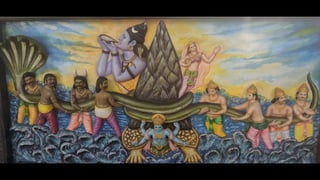
Samudra-manthan – the famous churning &
the unprecedented paradox of our time
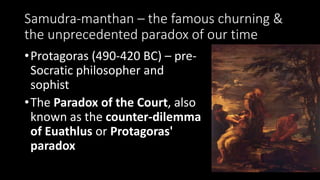
•Protagoras (490-420 BC) – pre-
Socratic philosopher and
sophist
•The Paradox of the Court, also
known as the counter-dilemma
of Euathlus or Protagoras'
paradox
Life After Covid-19 – unresolved mystery
• Protagoras - “If I win this case, Euthalos will have to pay
me what he owes me. If I do not win this case then
Euthalos will still have to pay me because, under our
agreement, he will then have won his first court case.”
• Euthalos, however, contested this claim, stating, “If I win
this case I will not have to pay Protagoras, as the court
would have declared his claim invalid. But If I do not win
this case, I still do not have to pay as I would then have
lost, not won, the case !”
Life after Covid-19 – the Riddle
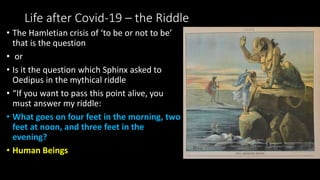
• The Hamletian crisis of ‘to be or not to be’
that is the question
• or
• Is it the question which Sphinx asked to
Oedipus in the mythical riddle
• “If you want to pass this point alive, you
must answer my riddle:
• What goes on four feet in the morning, two
feet at noon, and three feet in the
evening?
• Human Beings
Trolleyology – the ethical dilemma
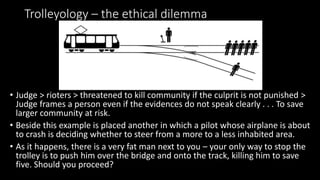
• Judge > rioters > threatened to kill community if the culprit is not punished >
Judge frames a person even if the evidences do not speak clearly . . . To save
larger community at risk.
• Beside this example is placed another in which a pilot whose airplane is about
to crash is deciding whether to steer from a more to a less inhabited area.
• As it happens, there is a very fat man next to you – your only way to stop the
trolley is to push him over the bridge and onto the track, killing him to save
five. Should you proceed?
Trolleyology – the ethical dilemma
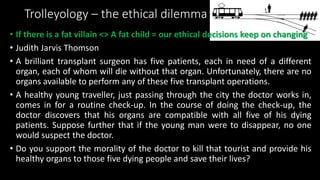
• If there is a fat villain <> A fat child = our ethical decisions keep on changing
• Judith Jarvis Thomson
• A brilliant transplant surgeon has five patients, each in need of a different
organ, each of whom will die without that organ. Unfortunately, there are no
organs available to perform any of these five transplant operations.
• A healthy young traveller, just passing through the city the doctor works in,
comes in for a routine check-up. In the course of doing the check-up, the
doctor discovers that his organs are compatible with all five of his dying
patients. Suppose further that if the young man were to disappear, no one
would suspect the doctor.
• Do you support the morality of the doctor to kill that tourist and provide his
healthy organs to those five dying people and save their lives?
Utilitarianism and Deontological ethics
• Utilitarianism is a part of consequentialist ethical
theories that promotes actions that maximize
happiness and well-being for the affected individuals.
• Deontological ethics or deontology is the normative
ethical theory that the morality of an action should be
based on whether that action itself is right or wrong
under a series of rules, rather than based on the
consequences of the action.
Ethics and Psychology
•Choices we have to make, and we shall, and we will.
•But it is not only ethical, it is also psychological
dilemma . . .
•The gender – the mood > looks at these ethical
questions in quite different way.
•‘Sacrifice’ – is so relative term > in political language
it becomes absolutely questionable.
•Who will drink the Halahal?
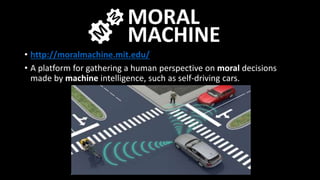
• http://moralmachine.mit.edu/
• A platform for gathering a human perspective on moral decisions
made by machine intelligence, such as self-driving cars.
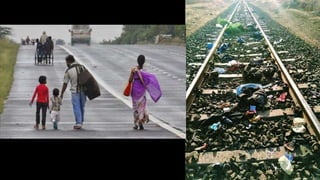
Lives vs Livelihood
•Whose lives and whose livelihood?
•Who will get the Amrit – the Elixir of life and
who will be forced to drink Halahal – the lethal
Poison?
•Health care and Economics
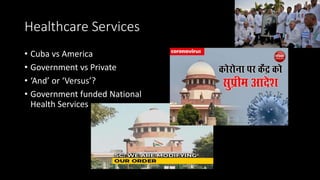
Healthcare Services
• Cuba vs America
• Government vs Private
• ‘And’ or ‘Versus’?
• Government funded National
Health Services
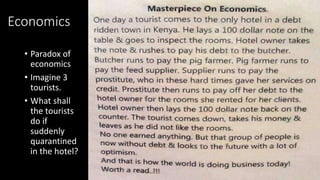
Economics
• Paradox of
economics
• Imagine 3
tourists.
• What shall
the tourists
do if
suddenly
quarantined
in the hotel?
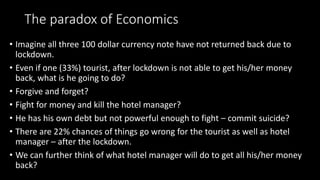
The paradox of Economics
• Imagine all three 100 dollar currency note have not returned back due to
lockdown.
• Even if one (33%) tourist, after lockdown is not able to get his/her money
back, what is he going to do?
• Forgive and forget?
• Fight for money and kill the hotel manager?
• He has his own debt but not powerful enough to fight – commit suicide?
• There are 22% chances of things go wrong for the tourist as well as hotel
manager – after the lockdown.
• We can further think of what hotel manager will do to get all his/her money
back?
Economy:
Search for a Role Model
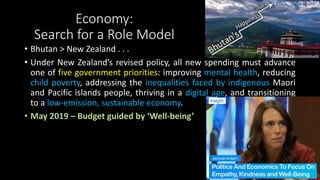
• Bhutan > New Zealand . . .
• Under New Zealand’s revised policy, all new spending must advance
one of five government priorities: improving mental health, reducing
child poverty, addressing the inequalities faced by indigenous Maori
and Pacific islands people, thriving in a digital age, and transitioning
to a low-emission, sustainable economy.
• May 2019 – Budget guided by ‘Well-being’
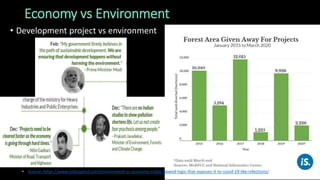
Economy vs Environment
• Development project vs environment
•
• Source: https://www.indiaspend.com/environment-vs-economy-indias-flawed-logic-that-exposes-it-to-covid-19-like-infections/
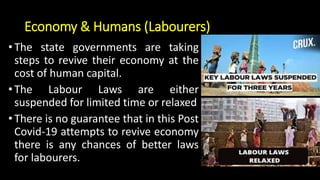
Economy & Humans (Labourers)
•The state governments are taking
steps to revive their economy at the
cost of human capital.
•The Labour Laws are either
suspended for limited time or relaxed
•There is no guarantee that in this Post
Covid-19 attempts to revive economy
there is any chances of better laws
for labourers.
Socialism vs Capitalism
• Corona virus does not discriminate on any grounds. Not even on the
grounds of whether the economic policies of the nation is socialist or
capitalist.
• However, what Corona Pandemic has revealed is the hollowness of
capitalism - private health care service.
• Worldwide, it is the socialist measures, the welfare state concept, the
federal government’s funds which are coming to save the day for the
humans.
• Forget about countries like India wherein even cash transfers to the bank
accounts of the poor are initiated, even in highly capitalist countries like
USA, the socialist measures are taken to sustain people’s livelihood
during lockdown.
• India’s purchase of PPE – the middlemen profiteering.
Agriculture
• If there was any sector which was fully functional and desperately required
during the corona lockdown, it was agriculture.
• Since the time of Industrialization, almost for a century, we have not given due
importance to this life-saving and sustaining sector.
• We have never taken farmers woes and worries on war footings.
• Our farmers depend a lot on rainy season and we do not have good rainy
season throughout the length & breath of our country.
• Water irrigation is not in proper condition.
• The cost of produce is earned more by the middlemen rather than going to
the farmers.
• And innumerable issues . . . . that led farmers to commit suicide. . .
Knowledge Society & Education System
• Of late we have been talking a lot of the role of digital
technologies in knowledge societies and education system.
• What we were not able to do – a necessary nudge – is done by
Covid-19.
• Today, in the lockdown, the physical book or libraries are of no
use.
• The repositories of eBooks, digital storage of journals, online
archives of reading resources are the only sources of knowledge.
• In education, the way ‘online remote teaching’ is zooming
around is sight seen never before.
Work culture
•The corporates, academics, governing bodies – all
meetings happen online.
•WFH – Work From Home was never ever practiced so
effectively.
•Judicial proceedings are taking place online.
•All intellectual works are done online.
•We have very quickly turned into digitally driven society
and adopted so fast to this work culture.
•We don’t know if this is the future . . . But we can say with
surety that at least 20 to 40% of work will be done on
digital platforms.
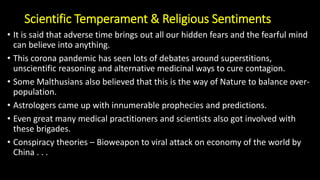
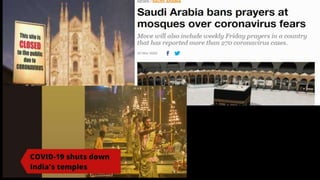
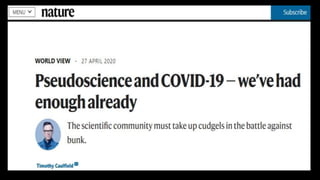
Scientific Temperament & Religious Sentiments
• It is said that adverse time brings out all our hidden fears and the fearful mind
can believe into anything.
• This corona pandemic has seen lots of debates around superstitions,
unscientific reasoning and alternative medicinal ways to cure contagion.
• Some Malthusians also believed that this is the way of Nature to balance over-
population.
• Astrologers came up with innumerable prophecies and predictions.
• Even great many medical practitioners and scientists also got involved with
these brigades.
• Conspiracy theories – Bioweapon to viral attack on economy of the world by
China . . .
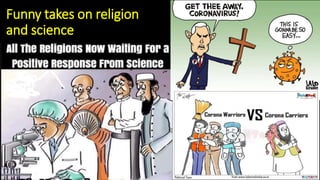
Funny takes on religion
and science
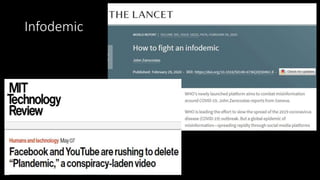
Infodemic
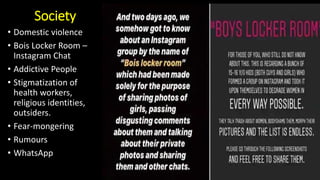
Society
• Domestic violence
• Bois Locker Room –
Instagram Chat
• Addictive People
• Stigmatization of
health workers,
religious identities,
outsiders.
• Fear-mongering
• Rumours
• WhatsApp
Language and Literature
• The entire discourse around Covid-19 took place in English
language.
• Indian regional languages assimilated many words without
translating them –
• Lockdown, Social distancing (physical distancing),
hotspot, quarantine, sanitizer, isolation ward, cluster
zone, red-orange-green zone, containment zone, mask,
infodemic and even pandemic / epidemic.
• Need to see how other languages have responded to the language
around corona – assimilated or better translated version?
Language and Literature
• The Aftermath of Covid-19 is going to see its metaphorical expression in
creative writings. It will be interesting to see how our creative minds reacts to
this pandemic.
• However, even in this time of lockdown, there was a lot of poetic creation.
• One of the best expressions came from UK’s Poet Laureate – Simon Armitage –
‘Lockdown’ wherein he connected the past with the present through mythical
technique.
• The performance of art – Play performed over Zoom, Poetry Mehfils on
Facebook and Instagram, Painting / Photography competition over digital
platforms – several new avenues for the artistic expression were manifested
during Covid-19 lockdown.
Yuval Noah Harari: the world after coronavirus
• Many short-term emergency measures will become a fixture of life.
That is the nature of emergencies. They fast-forward historical
processes. Decisions that in normal times could take years of
deliberation are passed in a matter of hours. Immature and even
dangerous technologies are pressed into service, because the risks of
doing nothing are bigger. Entire countries serve as guinea-pigs in large-
scale social experiments.
• In this time of crisis, we face two particularly important choices.
• The first is between totalitarian surveillance and citizen
empowerment.
• The second is between nationalist isolation and global solidarity.
Takeaways?
• National-Free health services of equally high quality for one and
all. There should be no discrimination in health services provided
to the rich and the poor, the powerful and the powerless, the
urban and the rural.
• To sustain an economy
• Agriculture shall be brought at the centre, instead of service or
manufacturing sectors
• Universal basic income (UBI) / Guaranteed minimum income (GMI)
• We cannot over-rely on capitalist model of economy. We need
strong measures to ensure basic facilities to the power. The
capitalism has made rich, more richer and poor, more poor.
Takeaways
• Agriculture – We know that without quality food we are not able to built
strong immunity.
• The way state/centre governments are thinking of inviting companies from
China to India – similar or greater concerns shall be displayed for agriculture
sector.
• All the laborers going back to their villages will sustain if agriculture sector is
going to absorb them.
• The prime focus of government policies shall be on irrigation and innovative
technologies in farming…
• Start-ups in agriculture shall be encouraged.
Takeaways. . .
• Technology driven work culture can save time, travel cost, reduce
carbon emission and in many ways helpful in maintaining necessary
social distancing so that the spread of such contagious viral diseases
can be curtailed. This is to be a part of our daily routine, even after
Covid-19.
• We need to develop scientific temperament wherein people do not
believe into anything without strong evidence and question
everything. Especially, religious groups.
• At the beginning of the 20th Century, George Bernard Shaw gave
three watch words – ‘Question! Examine! Test!’ – we need this
questioning spirit to be revived in post-Covid19 time. That’s the only
sure way to save people from Infodemic.
Takeaways
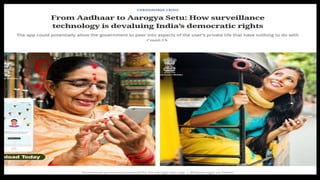
• From digital surveillance to data-giri – people have to be alert to
safeguard their privacy and data.
• Public health is important. However, the health data collected in the
apps shall be used only for and by medical practitioners and never
shared with any surveillance or state security agencies.
• It is now cliché to say that ‘Data is the new Oil’. Nevertheless,
governments shall ascertain the virtual security of the people by
making stringent cyber laws for people (not for the advantage to
governments to snoop around citizens).
• Democratically elected government is very crucial in the times of
pandemics.
•Life as such is not going to change After Covid-19.
We will come back to normalcy within short time.
However, if this is taken as an opportunity, we can
surely make this world a better place to live.
•We can have stronger democracy,
•We can have environment friendly lifestyle
supported by govt policies,
•We can have technology to make our lives easy
rather than used only to spy over citizens or turn
them into a data-commodity.
Lastly, the way languages assimilated English words & expressions, the
way poems like ‘Lockdown’ connects the ‘East’ (Meghaduta) and the
‘West’, the way artists from several continents come together over
digital platform to perform plays – is a clear message that
‘We Need to Stand Together – so that
the world is not
broken up into fragments
by narrow domestic walls
So that . . .words come out from the depth of truth
so that . . . tireless striving stretches its arms towards perfection …
so that . . . the clear stream of reason
has not lost its way into the
dreary desert sand of dead habit.
Wish you a better, more fulfilling and
satisfied life After Covid-19.
Thank you!
World After Covid-19: Multidisciplinary Ideas
References:
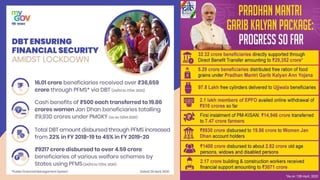
• @mygovindia. “Direct Benefit Transfer (DBT) is ensuring Financial Security amidst the COVID-19
Lockdown. #IndiaFightsCorona. Twitter. 8:13 PM - Apr 20, 2020.
https://twitter.com/mygovindia/status/1252246394410119181
• Altschuler, Glenn C. Trolleyology:A history of the "trolley problem” through experiment. 23 Jan
2014. Psychology Tody. https://www.psychologytoday.com/us/blog/is-america/201401/trolleyology
• Armitage, Simon. Lockdown. Lockdown: Simon Armitage writes poem about coronavirus outbreak.
The Gurdian. Lockdown: Simon Armitage writes poem about coronavirus outbreak. 21 March 2020.
https://www.theguardian.com/books/2020/mar/21/lockdown-simon-armitage-writes-poem-about-
coronavirus-outbreakhttps://www.nature.com/articles/d41586-020-01266-z
• Caulfield, Timothy. Pseudoscience and COVID-19 — we’ve had enough already. Nature. 27 April
2020. https://www.nature.com/articles/d41586-020-01266-z
• Feffer, John. The Black Death Killed Feudalism. What Does COVID-19 Mean for Capitalism? Foreign
Policy in Focus. 29 April 2020. https://fpif.org/the-black-death-killed-feudalism-what-does-covid-19-
mean-for-capitalism/
• Harari, Yuval Noah. The world after Corona Virus. The Financial Times. 20 March 2020.
https://www.ft.com/content/19d90308-6858-11ea-a3c9-1fe6fedcca75
• https://www.indiaspend.com/environment-vs-economy-indias-flawed-logic-that-exposes-it-to-
covid-19-like-infections/
References:
• Jha, Somesh. Covid-19 crisis: UP exempts biz from all but 4 labour laws for 3 years. Business Standard. 9 May
2020. https://www.business-standard.com/article/economy-policy/up-govt-to-exempt-businesses-from-all-
but-three-labour-laws-for-3-years-120050701531_1.html
• Ohlheiser, Abby. Facebook and YouTube are rushing to delete “Plandemic,” a conspiracy-laden video. MIT
Technology Review. 7 May 2020. https://www.technologyreview.com/2020/05/07/1001469/facebook-
youtube-plandemic-covid-misinformation/
• Rahwan, Iyad, Jean-Francois Bonnefon & Azim Shariff. Moral Machine. MIT Media Lab.
http://moralmachine.mit.edu/
• Sanghera, Tish , Disha Shetty. Environment Vs Economy: An Approach That Exposes India To COVID-19-Like
Infections. India Spend. 2 May 2020.
• Sinha, V.K. The Great Corona Paradox National Herald. 26 April 2020.
https://www.nationalheraldindia.com/opinion/the-great-corona-paradox
• Thomson, Judith Jarvis. The Trolley Problem. The Yale Law Journal. Vol. 94: 1395, 1985.
http://www.psy.vanderbilt.edu/courses/hon182/thomsontrolley.pdf
• Zarocostas, John. How to fight an Infodemic. The Lancet. 29 February 2020.
https://www.thelancet.com/journals/lancet/article/PIIS0140-6736(20)30461-X/fulltext

World After Covid-19: Multidisciplinary Ideas

  • 1.
    Dilip Barad Maharaja KrishnakumarsinhjiBhavnagar University Bhavnagar, Gujarat, India dilipbarad@gmail.com
  • 2.
    Introduction • Covid-19 isthe biggest lesson in the human history that calls for collective brain storming and sustainable solutions. Therefore, the nature of knowledge must evolve from narrow specializations to multidisciplinary because not too long we would have avoided mutual dependence and multiple causations. • Primarily, the job of higher education is to generate new knowledge and provide fresh perspectives to the existing phenomenon like Covid-19 by investigating into systematic inquires and collaborations. • Past two decades have presented unprecedented change in the quality of life due to the advents of technology, no matter who the person is, his/her life is being daily shaped by Artificial Intelligence and Biotechnology. • However, arts and humanities cannot be overlooked for their contributions in the domain of man-making! In such a pertinent context, it is inevitably wise to look at how multiple disciplines could engage in meaningful clusters and work on a Post Covid-19 World to render some kind of plausible solutions, designs and systems. • It is the interface of various domains of knowledge from history to computer science, from art to management and from engineering to journalism that we need to ponder upon.
  • 4.
    Samudra-manthan – thefamous churning & the unprecedented paradox of our time •Protagoras (490-420 BC) – pre- Socratic philosopher and sophist •The Paradox of the Court, also known as the counter-dilemma of Euathlus or Protagoras' paradox
  • 5.
    Life After Covid-19– unresolved mystery • Protagoras - “If I win this case, Euthalos will have to pay me what he owes me. If I do not win this case then Euthalos will still have to pay me because, under our agreement, he will then have won his first court case.” • Euthalos, however, contested this claim, stating, “If I win this case I will not have to pay Protagoras, as the court would have declared his claim invalid. But If I do not win this case, I still do not have to pay as I would then have lost, not won, the case !”
  • 6.
    Life after Covid-19– the Riddle • The Hamletian crisis of ‘to be or not to be’ that is the question • or • Is it the question which Sphinx asked to Oedipus in the mythical riddle • “If you want to pass this point alive, you must answer my riddle: • What goes on four feet in the morning, two feet at noon, and three feet in the evening? • Human Beings
  • 7.
    Trolleyology – theethical dilemma • Judge > rioters > threatened to kill community if the culprit is not punished > Judge frames a person even if the evidences do not speak clearly . . . To save larger community at risk. • Beside this example is placed another in which a pilot whose airplane is about to crash is deciding whether to steer from a more to a less inhabited area. • As it happens, there is a very fat man next to you – your only way to stop the trolley is to push him over the bridge and onto the track, killing him to save five. Should you proceed?
  • 8.
    Trolleyology – theethical dilemma • If there is a fat villain <> A fat child = our ethical decisions keep on changing • Judith Jarvis Thomson • A brilliant transplant surgeon has five patients, each in need of a different organ, each of whom will die without that organ. Unfortunately, there are no organs available to perform any of these five transplant operations. • A healthy young traveller, just passing through the city the doctor works in, comes in for a routine check-up. In the course of doing the check-up, the doctor discovers that his organs are compatible with all five of his dying patients. Suppose further that if the young man were to disappear, no one would suspect the doctor. • Do you support the morality of the doctor to kill that tourist and provide his healthy organs to those five dying people and save their lives?
  • 9.
    Utilitarianism and Deontologicalethics • Utilitarianism is a part of consequentialist ethical theories that promotes actions that maximize happiness and well-being for the affected individuals. • Deontological ethics or deontology is the normative ethical theory that the morality of an action should be based on whether that action itself is right or wrong under a series of rules, rather than based on the consequences of the action.
  • 10.
    Ethics and Psychology •Choiceswe have to make, and we shall, and we will. •But it is not only ethical, it is also psychological dilemma . . . •The gender – the mood > looks at these ethical questions in quite different way. •‘Sacrifice’ – is so relative term > in political language it becomes absolutely questionable. •Who will drink the Halahal?
  • 11.
    • http://moralmachine.mit.edu/ • Aplatform for gathering a human perspective on moral decisions made by machine intelligence, such as self-driving cars.
  • 13.
    Lives vs Livelihood •Whoselives and whose livelihood? •Who will get the Amrit – the Elixir of life and who will be forced to drink Halahal – the lethal Poison? •Health care and Economics
  • 14.
    Healthcare Services • Cubavs America • Government vs Private • ‘And’ or ‘Versus’? • Government funded National Health Services
  • 15.
    Economics • Paradox of economics •Imagine 3 tourists. • What shall the tourists do if suddenly quarantined in the hotel?
  • 16.
    The paradox ofEconomics • Imagine all three 100 dollar currency note have not returned back due to lockdown. • Even if one (33%) tourist, after lockdown is not able to get his/her money back, what is he going to do? • Forgive and forget? • Fight for money and kill the hotel manager? • He has his own debt but not powerful enough to fight – commit suicide? • There are 22% chances of things go wrong for the tourist as well as hotel manager – after the lockdown. • We can further think of what hotel manager will do to get all his/her money back?
  • 17.
    Economy: Search for aRole Model • Bhutan > New Zealand . . . • Under New Zealand’s revised policy, all new spending must advance one of five government priorities: improving mental health, reducing child poverty, addressing the inequalities faced by indigenous Maori and Pacific islands people, thriving in a digital age, and transitioning to a low-emission, sustainable economy. • May 2019 – Budget guided by ‘Well-being’
  • 18.
    Economy vs Environment •Development project vs environment • • Source: https://www.indiaspend.com/environment-vs-economy-indias-flawed-logic-that-exposes-it-to-covid-19-like-infections/
  • 19.
    Economy & Humans(Labourers) •The state governments are taking steps to revive their economy at the cost of human capital. •The Labour Laws are either suspended for limited time or relaxed •There is no guarantee that in this Post Covid-19 attempts to revive economy there is any chances of better laws for labourers.
  • 20.
    Socialism vs Capitalism •Corona virus does not discriminate on any grounds. Not even on the grounds of whether the economic policies of the nation is socialist or capitalist. • However, what Corona Pandemic has revealed is the hollowness of capitalism - private health care service. • Worldwide, it is the socialist measures, the welfare state concept, the federal government’s funds which are coming to save the day for the humans. • Forget about countries like India wherein even cash transfers to the bank accounts of the poor are initiated, even in highly capitalist countries like USA, the socialist measures are taken to sustain people’s livelihood during lockdown. • India’s purchase of PPE – the middlemen profiteering.
  • 23.
    Agriculture • If therewas any sector which was fully functional and desperately required during the corona lockdown, it was agriculture. • Since the time of Industrialization, almost for a century, we have not given due importance to this life-saving and sustaining sector. • We have never taken farmers woes and worries on war footings. • Our farmers depend a lot on rainy season and we do not have good rainy season throughout the length & breath of our country. • Water irrigation is not in proper condition. • The cost of produce is earned more by the middlemen rather than going to the farmers. • And innumerable issues . . . . that led farmers to commit suicide. . .
  • 24.
    Knowledge Society &Education System • Of late we have been talking a lot of the role of digital technologies in knowledge societies and education system. • What we were not able to do – a necessary nudge – is done by Covid-19. • Today, in the lockdown, the physical book or libraries are of no use. • The repositories of eBooks, digital storage of journals, online archives of reading resources are the only sources of knowledge. • In education, the way ‘online remote teaching’ is zooming around is sight seen never before.
  • 25.
    Work culture •The corporates,academics, governing bodies – all meetings happen online. •WFH – Work From Home was never ever practiced so effectively. •Judicial proceedings are taking place online. •All intellectual works are done online. •We have very quickly turned into digitally driven society and adopted so fast to this work culture. •We don’t know if this is the future . . . But we can say with surety that at least 20 to 40% of work will be done on digital platforms.
  • 26.
    Scientific Temperament &Religious Sentiments • It is said that adverse time brings out all our hidden fears and the fearful mind can believe into anything. • This corona pandemic has seen lots of debates around superstitions, unscientific reasoning and alternative medicinal ways to cure contagion. • Some Malthusians also believed that this is the way of Nature to balance over- population. • Astrologers came up with innumerable prophecies and predictions. • Even great many medical practitioners and scientists also got involved with these brigades. • Conspiracy theories – Bioweapon to viral attack on economy of the world by China . . .
  • 28.
    Funny takes onreligion and science
  • 30.
  • 31.
    Society • Domestic violence •Bois Locker Room – Instagram Chat • Addictive People • Stigmatization of health workers, religious identities, outsiders. • Fear-mongering • Rumours • WhatsApp
  • 32.
    Language and Literature •The entire discourse around Covid-19 took place in English language. • Indian regional languages assimilated many words without translating them – • Lockdown, Social distancing (physical distancing), hotspot, quarantine, sanitizer, isolation ward, cluster zone, red-orange-green zone, containment zone, mask, infodemic and even pandemic / epidemic. • Need to see how other languages have responded to the language around corona – assimilated or better translated version?
  • 33.
    Language and Literature •The Aftermath of Covid-19 is going to see its metaphorical expression in creative writings. It will be interesting to see how our creative minds reacts to this pandemic. • However, even in this time of lockdown, there was a lot of poetic creation. • One of the best expressions came from UK’s Poet Laureate – Simon Armitage – ‘Lockdown’ wherein he connected the past with the present through mythical technique. • The performance of art – Play performed over Zoom, Poetry Mehfils on Facebook and Instagram, Painting / Photography competition over digital platforms – several new avenues for the artistic expression were manifested during Covid-19 lockdown.
  • 34.
    Yuval Noah Harari:the world after coronavirus • Many short-term emergency measures will become a fixture of life. That is the nature of emergencies. They fast-forward historical processes. Decisions that in normal times could take years of deliberation are passed in a matter of hours. Immature and even dangerous technologies are pressed into service, because the risks of doing nothing are bigger. Entire countries serve as guinea-pigs in large- scale social experiments. • In this time of crisis, we face two particularly important choices. • The first is between totalitarian surveillance and citizen empowerment. • The second is between nationalist isolation and global solidarity.
  • 36.
    Takeaways? • National-Free healthservices of equally high quality for one and all. There should be no discrimination in health services provided to the rich and the poor, the powerful and the powerless, the urban and the rural. • To sustain an economy • Agriculture shall be brought at the centre, instead of service or manufacturing sectors • Universal basic income (UBI) / Guaranteed minimum income (GMI) • We cannot over-rely on capitalist model of economy. We need strong measures to ensure basic facilities to the power. The capitalism has made rich, more richer and poor, more poor.
  • 37.
    Takeaways • Agriculture –We know that without quality food we are not able to built strong immunity. • The way state/centre governments are thinking of inviting companies from China to India – similar or greater concerns shall be displayed for agriculture sector. • All the laborers going back to their villages will sustain if agriculture sector is going to absorb them. • The prime focus of government policies shall be on irrigation and innovative technologies in farming… • Start-ups in agriculture shall be encouraged.
  • 38.
    Takeaways. . . •Technology driven work culture can save time, travel cost, reduce carbon emission and in many ways helpful in maintaining necessary social distancing so that the spread of such contagious viral diseases can be curtailed. This is to be a part of our daily routine, even after Covid-19. • We need to develop scientific temperament wherein people do not believe into anything without strong evidence and question everything. Especially, religious groups. • At the beginning of the 20th Century, George Bernard Shaw gave three watch words – ‘Question! Examine! Test!’ – we need this questioning spirit to be revived in post-Covid19 time. That’s the only sure way to save people from Infodemic.
  • 39.
    Takeaways • From digitalsurveillance to data-giri – people have to be alert to safeguard their privacy and data. • Public health is important. However, the health data collected in the apps shall be used only for and by medical practitioners and never shared with any surveillance or state security agencies. • It is now cliché to say that ‘Data is the new Oil’. Nevertheless, governments shall ascertain the virtual security of the people by making stringent cyber laws for people (not for the advantage to governments to snoop around citizens). • Democratically elected government is very crucial in the times of pandemics.
  • 40.
    •Life as suchis not going to change After Covid-19. We will come back to normalcy within short time. However, if this is taken as an opportunity, we can surely make this world a better place to live. •We can have stronger democracy, •We can have environment friendly lifestyle supported by govt policies, •We can have technology to make our lives easy rather than used only to spy over citizens or turn them into a data-commodity.
  • 41.
    Lastly, the waylanguages assimilated English words & expressions, the way poems like ‘Lockdown’ connects the ‘East’ (Meghaduta) and the ‘West’, the way artists from several continents come together over digital platform to perform plays – is a clear message that ‘We Need to Stand Together – so that the world is not broken up into fragments by narrow domestic walls So that . . .words come out from the depth of truth so that . . . tireless striving stretches its arms towards perfection … so that . . . the clear stream of reason has not lost its way into the dreary desert sand of dead habit.
  • 42.
    Wish you abetter, more fulfilling and satisfied life After Covid-19. Thank you! World After Covid-19: Multidisciplinary Ideas
  • 43.
    References: • @mygovindia. “DirectBenefit Transfer (DBT) is ensuring Financial Security amidst the COVID-19 Lockdown. #IndiaFightsCorona. Twitter. 8:13 PM - Apr 20, 2020. https://twitter.com/mygovindia/status/1252246394410119181 • Altschuler, Glenn C. Trolleyology:A history of the "trolley problem” through experiment. 23 Jan 2014. Psychology Tody. https://www.psychologytoday.com/us/blog/is-america/201401/trolleyology • Armitage, Simon. Lockdown. Lockdown: Simon Armitage writes poem about coronavirus outbreak. The Gurdian. Lockdown: Simon Armitage writes poem about coronavirus outbreak. 21 March 2020. https://www.theguardian.com/books/2020/mar/21/lockdown-simon-armitage-writes-poem-about- coronavirus-outbreakhttps://www.nature.com/articles/d41586-020-01266-z • Caulfield, Timothy. Pseudoscience and COVID-19 — we’ve had enough already. Nature. 27 April 2020. https://www.nature.com/articles/d41586-020-01266-z • Feffer, John. The Black Death Killed Feudalism. What Does COVID-19 Mean for Capitalism? Foreign Policy in Focus. 29 April 2020. https://fpif.org/the-black-death-killed-feudalism-what-does-covid-19- mean-for-capitalism/ • Harari, Yuval Noah. The world after Corona Virus. The Financial Times. 20 March 2020. https://www.ft.com/content/19d90308-6858-11ea-a3c9-1fe6fedcca75 • https://www.indiaspend.com/environment-vs-economy-indias-flawed-logic-that-exposes-it-to- covid-19-like-infections/
  • 44.
    References: • Jha, Somesh.Covid-19 crisis: UP exempts biz from all but 4 labour laws for 3 years. Business Standard. 9 May 2020. https://www.business-standard.com/article/economy-policy/up-govt-to-exempt-businesses-from-all- but-three-labour-laws-for-3-years-120050701531_1.html • Ohlheiser, Abby. Facebook and YouTube are rushing to delete “Plandemic,” a conspiracy-laden video. MIT Technology Review. 7 May 2020. https://www.technologyreview.com/2020/05/07/1001469/facebook- youtube-plandemic-covid-misinformation/ • Rahwan, Iyad, Jean-Francois Bonnefon & Azim Shariff. Moral Machine. MIT Media Lab. http://moralmachine.mit.edu/ • Sanghera, Tish , Disha Shetty. Environment Vs Economy: An Approach That Exposes India To COVID-19-Like Infections. India Spend. 2 May 2020. • Sinha, V.K. The Great Corona Paradox National Herald. 26 April 2020. https://www.nationalheraldindia.com/opinion/the-great-corona-paradox • Thomson, Judith Jarvis. The Trolley Problem. The Yale Law Journal. Vol. 94: 1395, 1985. http://www.psy.vanderbilt.edu/courses/hon182/thomsontrolley.pdf • Zarocostas, John. How to fight an Infodemic. The Lancet. 29 February 2020. https://www.thelancet.com/journals/lancet/article/PIIS0140-6736(20)30461-X/fulltext

Editor's Notes

  • #5 Image - Democritus (center) and Protagoras (right) 17th-century painting by Salvator Rosa
  • #18 Bhutan 7 cases, 0 death, 5 recovered. New Zealand – flattened the Curve – 1500 cases, 21 deaths.