BY DAVID FLOYD
REACTION IN A CANDLE
• The reaction that occurs in a candle is combustion.
• Combustion is a reaction in which a substance reacts
with oxygen to form water and carbon dioxide.
• The wick maintains a constant flame so that the
combustion reaction can continue (Rohrig 5-6).
• C25H52(g) + 38O2(g) → 25CO2(g) + 26H2O(g)
http://www.candles.org/image
s/NCA_Illustration_01.jpg
CANDLE COMPOSITION
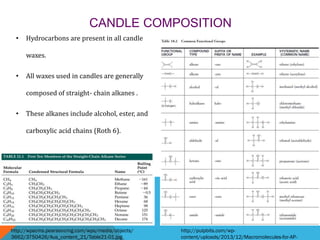
• Hydrocarbons are present in all candle
waxes.
• All waxes used in candles are generally
composed of straight- chain alkanes .
• These alkanes include alcohol, ester, and
carboxylic acid chains (Roth 6).
http://pulpbits.com/wp-
content/uploads/2013/12/Macromolecules-for-AP-
http://wpscms.pearsoncmg.com/wps/media/objects/
3662/3750426/Aus_content_21/Table21-01.jpg
MANY USES OF CANDLES
http://www.afranko.org/wp-
content/uploads/2013/11/def9fc951b95bf5391c3068948
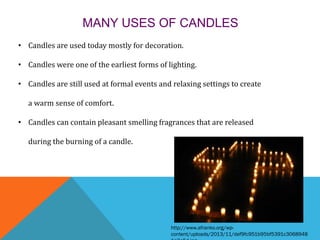
• Candles are used today mostly for decoration.
• Candles were one of the earliest forms of lighting.
• Candles are still used at formal events and relaxing settings to create
a warm sense of comfort.
• Candles can contain pleasant smelling fragrances that are released
during the burning of a candle.
The Wick of a Candle
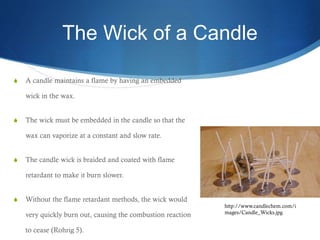
 A candle maintains a flame by having an embedded
wick in the wax.
 The wick must be embedded in the candle so that the
wax can vaporize at a constant and slow rate.
 The candle wick is braided and coated with flame
retardant to make it burn slower.
 Without the flame retardant methods, the wick would
very quickly burn out, causing the combustion reaction
to cease (Rohrig 5).
http://www.candlechem.com/i
mages/Candle_Wicks.jpg
The Wax of a Candle
http://www.housekeepinghere.com/
wp-
content/uploads/2011/01/melting-
candles-300x225.jpg
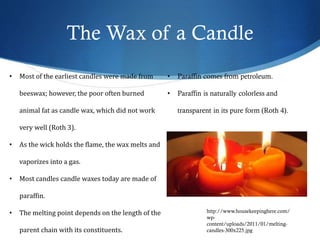
• Most of the earliest candles were made from
beeswax; however, the poor often burned
animal fat as candle wax, which did not work
very well (Roth 3).
• As the wick holds the flame, the wax melts and
vaporizes into a gas.
• Most candles candle waxes today are made of
paraffin.
• The melting point depends on the length of the
parent chain with its constituents.
• Paraffin comes from petroleum.
• Paraffin is naturally colorless and
transparent in its pure form (Roth 4).
The Flame of a Candle
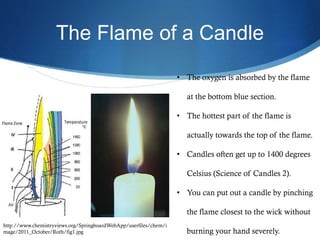
• The oxygen is absorbed by the flame
at the bottom blue section.
• The hottest part of the flame is
actually towards the top of the flame.
• Candles often get up to 1400 degrees
Celsius (Science of Candles 2).
• You can put out a candle by pinching
the flame closest to the wick without
burning your hand severely.
http://www.chemistryviews.org/SpringboardWebApp/userfiles/chem/i
mage/2011_October/Roth/fig1.jpg
Works Cited
 Rohrig, Brian. "The Captivating Chemistry of Candles."
ChemMatters (2007): 4-6. Print.
 Roth, Klaus, Prof., ed. Chemistry of the Christmas Candle.
Chemie in unsere Zeit/Wiley-VCH, 2 Nov. 2011. Web. 13
Apr. 2014.
<http://www.chemistryviews.org/details/ezine/1369631/
Chemistry_of_the_Christmas_Candle__Part_1.html>.
 "The Science of Candles." National Candle Association.
National Candle Association, 2014. Web. 8 Apr. 2014.
<http://www.candles.org/candlescience.html>.

Candle Chemistry powerpoint

  • 1.
  • 2.
    REACTION IN ACANDLE • The reaction that occurs in a candle is combustion. • Combustion is a reaction in which a substance reacts with oxygen to form water and carbon dioxide. • The wick maintains a constant flame so that the combustion reaction can continue (Rohrig 5-6). • C25H52(g) + 38O2(g) → 25CO2(g) + 26H2O(g) http://www.candles.org/image s/NCA_Illustration_01.jpg
  • 3.
    CANDLE COMPOSITION • Hydrocarbonsare present in all candle waxes. • All waxes used in candles are generally composed of straight- chain alkanes . • These alkanes include alcohol, ester, and carboxylic acid chains (Roth 6). http://pulpbits.com/wp- content/uploads/2013/12/Macromolecules-for-AP- http://wpscms.pearsoncmg.com/wps/media/objects/ 3662/3750426/Aus_content_21/Table21-01.jpg
  • 4.
    MANY USES OFCANDLES http://www.afranko.org/wp- content/uploads/2013/11/def9fc951b95bf5391c3068948 • Candles are used today mostly for decoration. • Candles were one of the earliest forms of lighting. • Candles are still used at formal events and relaxing settings to create a warm sense of comfort. • Candles can contain pleasant smelling fragrances that are released during the burning of a candle.
  • 5.
    The Wick ofa Candle  A candle maintains a flame by having an embedded wick in the wax.  The wick must be embedded in the candle so that the wax can vaporize at a constant and slow rate.  The candle wick is braided and coated with flame retardant to make it burn slower.  Without the flame retardant methods, the wick would very quickly burn out, causing the combustion reaction to cease (Rohrig 5). http://www.candlechem.com/i mages/Candle_Wicks.jpg
  • 6.
    The Wax ofa Candle http://www.housekeepinghere.com/ wp- content/uploads/2011/01/melting- candles-300x225.jpg • Most of the earliest candles were made from beeswax; however, the poor often burned animal fat as candle wax, which did not work very well (Roth 3). • As the wick holds the flame, the wax melts and vaporizes into a gas. • Most candles candle waxes today are made of paraffin. • The melting point depends on the length of the parent chain with its constituents. • Paraffin comes from petroleum. • Paraffin is naturally colorless and transparent in its pure form (Roth 4).
  • 7.
    The Flame ofa Candle • The oxygen is absorbed by the flame at the bottom blue section. • The hottest part of the flame is actually towards the top of the flame. • Candles often get up to 1400 degrees Celsius (Science of Candles 2). • You can put out a candle by pinching the flame closest to the wick without burning your hand severely. http://www.chemistryviews.org/SpringboardWebApp/userfiles/chem/i mage/2011_October/Roth/fig1.jpg
  • 8.
    Works Cited  Rohrig,Brian. "The Captivating Chemistry of Candles." ChemMatters (2007): 4-6. Print.  Roth, Klaus, Prof., ed. Chemistry of the Christmas Candle. Chemie in unsere Zeit/Wiley-VCH, 2 Nov. 2011. Web. 13 Apr. 2014. <http://www.chemistryviews.org/details/ezine/1369631/ Chemistry_of_the_Christmas_Candle__Part_1.html>.  "The Science of Candles." National Candle Association. National Candle Association, 2014. Web. 8 Apr. 2014. <http://www.candles.org/candlescience.html>.