By Group 7
Uswatun Khasanah
Gustin Sofiana
Ayu Dwi Payana
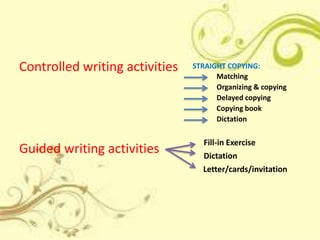
Controlled writing activities

Guided writing activities

STRAIGHT COPYING:
Matching
Organizing & copying
Delayed copying
Copying book
Dictation

Fill-in Exercise
Dictation
Letter/cards/invitation
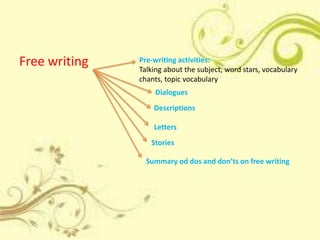
Free writing

Pre-writing activities:
Talking about the subject, word stars, vocabulary
chants, topic vocabulary
Dialogues
Descriptions
Letters
Stories
Summary od dos and don’ts on free writing
Writing is not always easy
Writing has certain characteristics which seem to make it difficult for
pupils to get grips with, especially for younger pupils:
 Using Body language, intonation, tone, eye contact
and others features will help to convey the meaning
 Exercises which reflect the pupil’s world help the gap
 Many children take a long time to master the skill of
writing
 The fact that writing in a foreign language is all too
often associated with ‘correcting errors’
Writing is a good thing
It is a useful, essential, integral and enjoyable part of the foreign
language lesson.
 It adds another physical dimension to the learning
process
 It lets pupils express their personalities
 Writing activities help to consolidate learning in the
other skill areas
 Particularly as pupils progress in the language, writing
activities allow for conscious development of language
 Writing id valuable in itself
How to Develop Writing Skills in Young
Learners
Instructions
• Make writing materials readily available
• Go for a walk with the child and make a list of
everything that is of one particular
color, perhaps the child's favorite color.
• Have the child draw a story in picture form on
a blank piece of paper
• Have the child choose two different words and
write a list of comparisons.
Controlled writing activities
o Writing activities go from being tightly
controlled to being completely free.
o In general, controlled and guided activities
are being done to practice the language
and concentration is on the language
itself.
o Free activities should allow for self
expression at however low a level, and
content is what matters most.
Straight Copying
 It is an activity which gives the
teacher the chance to reinforce
language that has been
presented orally or through
reading.
 It as a good idea to ask pupils
to read aloud quietly to
themselves when they are
copying the words because this
Matching
Straight copying: Ask pupils to match pictures
and text, or to choose which sentence they want
to write about the text.

Organising and copying
Copying can also be a good introduction to
structured writing. For example, completing the
letter with sentences provided
Delayed copying
•





For training short term memory
write a short, familiar sentence on the board
give the pupils a few to look at the sentence
then rub the sentence out
and see if the pupils can write it down

Copying book
 Pupils can copy new vocabulary, a little dialogue, something
you want them to remember
 Or Pupils should be free to copy things from the text
book, the notice board, and from other pupils
 Some pupils will copy whole stories
Dictation
For young learners, dictations should:
 Be short
 Be made up of sentences which be said in one
breath
 Have a purpose, and be connected to work
which has gone before or comes after
 Be read or said at normal speed
Guided writing activities
Fill-in exercises
 Fill-in exercises do not require much
active production of language, but
they do require understanding
 With children who have progressed
to level two, they can be used to
focus on specific language items
 Try to avoid exercises which have no
meaning at all
 Fill-in can be used for vocabulary
Dictation
Try to dictating only half a sentence, and asking
pupils to complete it in their own way.
You can either:
o Ask pupils to complete each sentence before you
read the beginning of the next sentence(encourage
quick writing)
o Or give them time to do the competition afterwards.
Letters/cards/invitation
Writing is a useful way of getting pupils to
write short meaningful piece of writing.
You can have pupils writing to each other
and ‘sending’ their letters via the
classroom postman
Free writing activities
• In free activities the language is the pupils
own language. The teacher should be the
initiator and helper
• The correcting should be done while the
pupils are still working on it. The aim is to
produce a piece of written work which is as
correct as you expect from that pupils
• Older pupils beyond the beginner level should
be encouraged to re-write their work, and the
result is on piece of writing. The teacher
should give as much help as possible as long
as the writing process. The pupils can either
re-write their work or not.
• Ideally each pupils should have a folder or a
ring binder of his or her own to keep all
written work in.
Pre-writing activities
Warm-up activities which are design to give them language, ideas and
encouragement before they settle done to the writing itself

 Talking about the subject
-

A short simple conversation about the subject
With the five to seven year olds, you might start them off by simply asking
a question, and write down some answers on the board

 Word stars
- first, put the key word on the blackboard
- put the class into groups and ask them to write down all the words they can
think about connected with the key words
- when all the groups have made their word stars, do one on the blackboard
for everyone
 Vocabulary charts
- Make a use of picture dictionaries
- Pupils might like to make a picture dictionary of their
own, using their own themes and ideas
- Or use a photograph, a story, a song, a piece of music
or a shared experience
 Topic vocabulary
- Vocabulary can also be built up by collecting related
words
- Use picture dictionaries, and use own dictionaries.
- Pupils do not have to remember all these words
Dialogues
The dialogue can be guided or they can
completely free. They can very short and to the
point, or they can be long and complicated.
a) Speech bubbles can be very useful for both
Simple dialogues: “hallo Susan”, “hallo Tom”
For setting the scene: “what’s for lunch?”
b) The dialogue result of pairwork based on
model dialogue
c) The dialogue result of pairwork on a given
situation
Description
• College
- A poster, a picture by sticking on
illustrations, text and other materials.
• Picture description
- When you first prepare a piece of written
work orally, then you must expect the
language to reflect this
Letters
• The first free letters could be little notes to other
pupils.
• They can also be written to the teacher, and these
letters should be answered without any comments
on the language
• For pupil who are beyond the beginner level, this
teacher-pupils correspondence may take the form
of a diary instead of a series of letters
• Establish contact with an English-speaking class or a
class in another country where they are also
learning English as a foreign language
Stories
• Writing groups stories is a good idea since the
actual writing can be shared, and re-writing is
not such a burden
• pupils do lots of pre-writing activities
• Give them help
• The final version of the writing should be on a
reading card
• Free writing covers a much wider
activities(poems, book reviews, etc.)
• Writing is the most visible of the skills
Other activities:
• Story Prompts
Story prompts present the beginning few
paragraphs of a story with the idea that the
children will pick up where the prompt left off
• Journal Writing
Journal writing is a way for children to
personally reflect on topics discussed in class.
Each student should have a notebook
specifically set aside for journal writing.
• Class book
If you are looking for a project that encourages
group work, consider developing a class book.
• Flat Stanley
Inspired by Jeff Brown's book "Flat Stanley," this
project idea encourages children to share ideas
with one another.
Summary of dos and don’ts on free
writing

•
•
•
•
•
•
•






DO
Concentrate first on content
Spend a lot of time on pre-writing work
Make sure that it springs naturally from other language work
Try to make sense of whatever the pupils have written and say something
positive about it
Encourage, but don’t insist on, re-writing
Display the material whenever possible
Keep all the pupil’s writings
DON’TS
Announce the subject out of the blue and expect pupils to be able to write
about it
Set an exercise as homework without any preparation
Correct all the mistakes you can find
Set work which is beyond the pupils’ language capacity
Thank you.
Questions???

English for Young Learners

  • 2.
    By Group 7 UswatunKhasanah Gustin Sofiana Ayu Dwi Payana
  • 3.
    Controlled writing activities Guidedwriting activities STRAIGHT COPYING: Matching Organizing & copying Delayed copying Copying book Dictation Fill-in Exercise Dictation Letter/cards/invitation
  • 4.
    Free writing Pre-writing activities: Talkingabout the subject, word stars, vocabulary chants, topic vocabulary Dialogues Descriptions Letters Stories Summary od dos and don’ts on free writing
  • 5.
    Writing is notalways easy Writing has certain characteristics which seem to make it difficult for pupils to get grips with, especially for younger pupils:  Using Body language, intonation, tone, eye contact and others features will help to convey the meaning  Exercises which reflect the pupil’s world help the gap  Many children take a long time to master the skill of writing  The fact that writing in a foreign language is all too often associated with ‘correcting errors’
  • 6.
    Writing is agood thing It is a useful, essential, integral and enjoyable part of the foreign language lesson.  It adds another physical dimension to the learning process  It lets pupils express their personalities  Writing activities help to consolidate learning in the other skill areas  Particularly as pupils progress in the language, writing activities allow for conscious development of language  Writing id valuable in itself
  • 7.
    How to DevelopWriting Skills in Young Learners Instructions • Make writing materials readily available • Go for a walk with the child and make a list of everything that is of one particular color, perhaps the child's favorite color. • Have the child draw a story in picture form on a blank piece of paper • Have the child choose two different words and write a list of comparisons.
  • 8.
    Controlled writing activities oWriting activities go from being tightly controlled to being completely free. o In general, controlled and guided activities are being done to practice the language and concentration is on the language itself. o Free activities should allow for self expression at however low a level, and content is what matters most.
  • 9.
    Straight Copying  Itis an activity which gives the teacher the chance to reinforce language that has been presented orally or through reading.  It as a good idea to ask pupils to read aloud quietly to themselves when they are copying the words because this
  • 10.
    Matching Straight copying: Askpupils to match pictures and text, or to choose which sentence they want to write about the text. Organising and copying Copying can also be a good introduction to structured writing. For example, completing the letter with sentences provided
  • 11.
    Delayed copying •     For trainingshort term memory write a short, familiar sentence on the board give the pupils a few to look at the sentence then rub the sentence out and see if the pupils can write it down Copying book  Pupils can copy new vocabulary, a little dialogue, something you want them to remember  Or Pupils should be free to copy things from the text book, the notice board, and from other pupils  Some pupils will copy whole stories
  • 12.
    Dictation For young learners,dictations should:  Be short  Be made up of sentences which be said in one breath  Have a purpose, and be connected to work which has gone before or comes after  Be read or said at normal speed
  • 13.
    Guided writing activities Fill-inexercises  Fill-in exercises do not require much active production of language, but they do require understanding  With children who have progressed to level two, they can be used to focus on specific language items  Try to avoid exercises which have no meaning at all  Fill-in can be used for vocabulary
  • 14.
    Dictation Try to dictatingonly half a sentence, and asking pupils to complete it in their own way. You can either: o Ask pupils to complete each sentence before you read the beginning of the next sentence(encourage quick writing) o Or give them time to do the competition afterwards.
  • 15.
    Letters/cards/invitation Writing is auseful way of getting pupils to write short meaningful piece of writing. You can have pupils writing to each other and ‘sending’ their letters via the classroom postman
  • 16.
    Free writing activities •In free activities the language is the pupils own language. The teacher should be the initiator and helper • The correcting should be done while the pupils are still working on it. The aim is to produce a piece of written work which is as correct as you expect from that pupils
  • 17.
    • Older pupilsbeyond the beginner level should be encouraged to re-write their work, and the result is on piece of writing. The teacher should give as much help as possible as long as the writing process. The pupils can either re-write their work or not. • Ideally each pupils should have a folder or a ring binder of his or her own to keep all written work in.
  • 18.
    Pre-writing activities Warm-up activitieswhich are design to give them language, ideas and encouragement before they settle done to the writing itself  Talking about the subject - A short simple conversation about the subject With the five to seven year olds, you might start them off by simply asking a question, and write down some answers on the board  Word stars - first, put the key word on the blackboard - put the class into groups and ask them to write down all the words they can think about connected with the key words - when all the groups have made their word stars, do one on the blackboard for everyone
  • 19.
     Vocabulary charts -Make a use of picture dictionaries - Pupils might like to make a picture dictionary of their own, using their own themes and ideas - Or use a photograph, a story, a song, a piece of music or a shared experience  Topic vocabulary - Vocabulary can also be built up by collecting related words - Use picture dictionaries, and use own dictionaries. - Pupils do not have to remember all these words
  • 20.
    Dialogues The dialogue canbe guided or they can completely free. They can very short and to the point, or they can be long and complicated. a) Speech bubbles can be very useful for both Simple dialogues: “hallo Susan”, “hallo Tom” For setting the scene: “what’s for lunch?” b) The dialogue result of pairwork based on model dialogue c) The dialogue result of pairwork on a given situation
  • 21.
    Description • College - Aposter, a picture by sticking on illustrations, text and other materials. • Picture description - When you first prepare a piece of written work orally, then you must expect the language to reflect this
  • 22.
    Letters • The firstfree letters could be little notes to other pupils. • They can also be written to the teacher, and these letters should be answered without any comments on the language • For pupil who are beyond the beginner level, this teacher-pupils correspondence may take the form of a diary instead of a series of letters • Establish contact with an English-speaking class or a class in another country where they are also learning English as a foreign language
  • 23.
    Stories • Writing groupsstories is a good idea since the actual writing can be shared, and re-writing is not such a burden • pupils do lots of pre-writing activities • Give them help • The final version of the writing should be on a reading card • Free writing covers a much wider activities(poems, book reviews, etc.) • Writing is the most visible of the skills
  • 24.
    Other activities: • StoryPrompts Story prompts present the beginning few paragraphs of a story with the idea that the children will pick up where the prompt left off • Journal Writing Journal writing is a way for children to personally reflect on topics discussed in class. Each student should have a notebook specifically set aside for journal writing.
  • 25.
    • Class book Ifyou are looking for a project that encourages group work, consider developing a class book. • Flat Stanley Inspired by Jeff Brown's book "Flat Stanley," this project idea encourages children to share ideas with one another.
  • 26.
    Summary of dosand don’ts on free writing  • • • • • • •      DO Concentrate first on content Spend a lot of time on pre-writing work Make sure that it springs naturally from other language work Try to make sense of whatever the pupils have written and say something positive about it Encourage, but don’t insist on, re-writing Display the material whenever possible Keep all the pupil’s writings DON’TS Announce the subject out of the blue and expect pupils to be able to write about it Set an exercise as homework without any preparation Correct all the mistakes you can find Set work which is beyond the pupils’ language capacity
  • 27.