Healing at the Speed of Time
Denise Dumont Bernier, P.T.
Area Manager- Maine
John Devine, D.O.
Center Medical Director- Scarborough
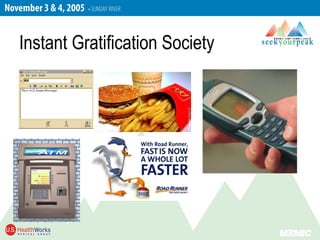
Instant Gratification Society
Healing Time Following an Injury
• How long should it take?
• What should I expect?
• When will they be back to work?
• What happens if they aggravate the injury?
• Why are they still in therapy?
• He still has pain?
• What can the employer do to help?
• Do I really want her back?
The slow to recover worker….
delayed recovery
• At any given point in time, 8 million workers are at
home/not working due to illness or injury
• The resulting paid leave costs employers more than
$1 billion dollars per year
(sick pay, salary continuation, workers’ compensation indemnity
benefits, and long-term and short-term disability benefits)
The slow to recover worker
….unnecessary issues
– Employers and Physicians communicating poorly about
injured and ill employee’s ability to work
– Employers failing to address external and motivational
issues, causing injured employees to stay out of work or on
light duty longer then medically necessary
– Physicians not seeing disability leave/ transitional duty as an
outcome for which they are partially responsible
– Injured Employees can contribute to their own delayed
recovery
The Normal Healing Process
• Acute/ Inflammatory Phase: Injury to 5 days
– Tissue disruption, platelet activation and white blood cells clean
bacteria, inflammation
– Redness, heat, swelling, pain, loss of function
• Subactute/ Fibroplastic Phase: Day 4 to several weeks
– Inflammation, pain subsides, can is still easily irritated
– Tissue Continuity is Restored (fibroblast migration, proliferation and
collagen synthesis)
• Maturation and Remodeling: Day 15-12 weeks
• Chronic: continued loss of function, scar tissue is only 70-
80% strong as original tissue
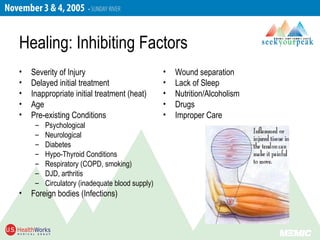
Healing: Inhibiting Factors
• Severity of Injury
• Delayed initial treatment
• Inappropriate initial treatment (heat)
• Age
• Pre-existing Conditions
– Psychological
– Neurological
– Diabetes
– Hypo-Thyroid Conditions
– Respiratory (COPD, smoking)
– DJD, arthritis
– Circulatory (inadequate blood supply)
• Foreign bodies (Infections)
• Wound separation
• Lack of Sleep
• Nutrition/Alcoholism
• Drugs
• Improper Care
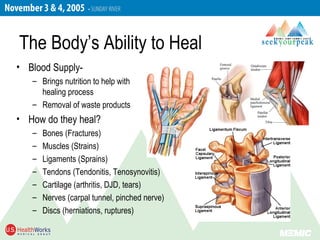
The Body’s Ability to Heal
• Blood Supply-
– Brings nutrition to help with
healing process
– Removal of waste products
• How do they heal?
– Bones (Fractures)
– Muscles (Strains)
– Ligaments (Sprains)
– Tendons (Tendonitis, Tenosynovitis)
– Cartilage (arthritis, DJD, tears)
– Nerves (carpal tunnel, pinched nerve)
– Discs (herniations, ruptures)
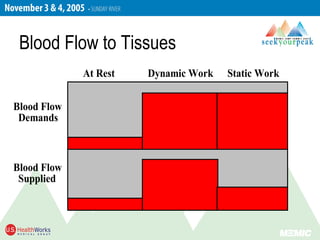
Blood Flow to Tissues
At Rest Dynamic Work Static Work
Blood Flow
Demands
Blood Flow
Supplied
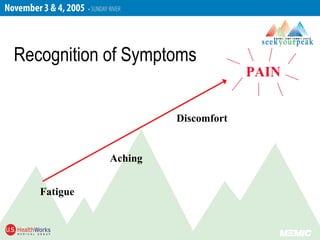
Recognition of Symptoms
Fatigue
Aching
Discomfort
PAIN
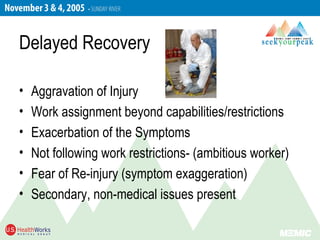
Delayed Recovery
• Aggravation of Injury
• Work assignment beyond capabilities/restrictions
• Exacerbation of the Symptoms
• Not following work restrictions- (ambitious worker)
• Fear of Re-injury (symptom exaggeration)
• Secondary, non-medical issues present
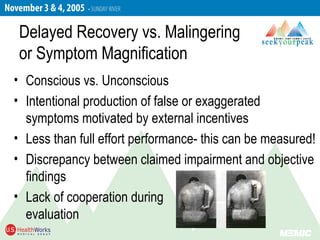
Delayed Recovery vs. Malingering
or Symptom Magnification
• Conscious vs. Unconscious
• Intentional production of false or exaggerated
symptoms motivated by external incentives
• Less than full effort performance- this can be measured!
• Discrepancy between claimed impairment and objective
findings
• Lack of cooperation during
evaluation
Survey: Employers and
Physicians failed to communicate
• When asked in a survey about the number of workers with work-
related injuries needing more than a couple of days off from work for
strictly medical reasons, occupational physicians placed the
percentage at 5-10% at most, based on their own clinical
experience.
• Nationally, 24% of WC cases have lost time.
• Therefore, 60 to 80% of these cases involve medically
unnecessary time off from work
Survey: specific non-medical reasonsSurvey: specific non-medical reasons
for keeping injured workers out offor keeping injured workers out of
work or on prolonged light duty...work or on prolonged light duty...
• Treating Physician unwilling to “force” a reluctant patient
back to restricted or full duty work
• Unfavorable state laws
• Treating Physician inexperienced regarding determination of the
proper restrictions on work activity
• Treating Physician lacks information about the physical demands of
the job required to issue appropriate work restrictions
• The employer has a policy against light duty work
• The employer unable to find a way to temporarily modify the job
• Treating Physician feels caught between the employer’s and the
employee’s version of events
• Conflict exists between the opinions of two Physicians
(Occupational Physician versus primary care Physician versus
“specialist”)
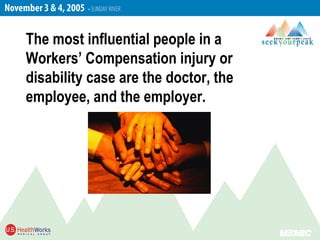
The most influential people in a
Workers’ Compensation injury or
disability case are the doctor, the
employee, and the employer.
The tone is set in those first few critical days;
often, the first appointment.
-Is there an appropriate response to the employee’s injury by all
parties?
-Is there an expectation for a quick return to work?
-Is there effective planning towards achieving a return to work?
Importance of the First Minutes
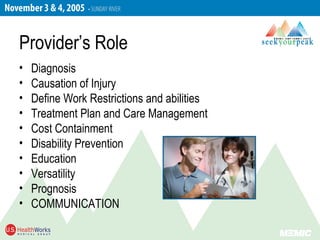
Provider’s Role
• Diagnosis
• Causation of Injury
• Define Work Restrictions and abilities
• Treatment Plan and Care Management
• Cost Containment
• Disability Prevention
• Education
• Versatility
• Prognosis
• COMMUNICATION
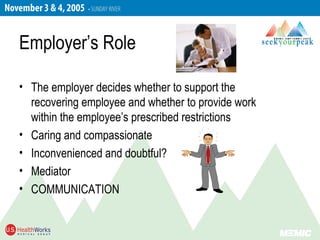
Employer’s Role
• The employer decides whether to support the
recovering employee and whether to provide work
within the employee’s prescribed restrictions
• Caring and compassionate
• Inconvenienced and doubtful?
• Mediator
• COMMUNICATION
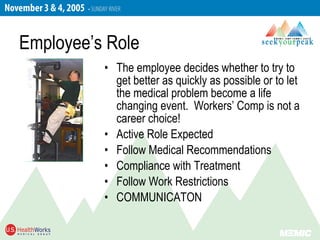
Employee’s Role
• The employee decides whether to try to
get better as quickly as possible or to let
the medical problem become a life
changing event. Workers’ Comp is not a
career choice!
• Active Role Expected
• Follow Medical Recommendations
• Compliance with Treatment
• Follow Work Restrictions
• COMMUNICATON
RETURN TO WORK AND
RECOVERY STARTS AT THE
FIRST MINUTE OF INJURY
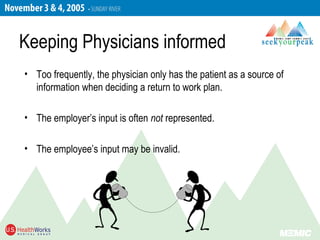
Keeping Physicians informed
• Too frequently, the physician only has the patient as a source of
information when deciding a return to work plan.
• The employer’s input is often not represented.
• The employee’s input may be invalid.
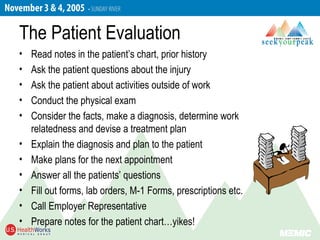
The Patient Evaluation
• Read notes in the patient’s chart, prior history
• Ask the patient questions about the injury
• Ask the patient about activities outside of work
• Conduct the physical exam
• Consider the facts, make a diagnosis, determine work
relatedness and devise a treatment plan
• Explain the diagnosis and plan to the patient
• Make plans for the next appointment
• Answer all the patients’ questions
• Fill out forms, lab orders, M-1 Forms, prescriptions etc.
• Call Employer Representative
• Prepare notes for the patient chart…yikes! 
Many physicians have no familiarity
with the workplace
or the routine practices used to keep injured
workers safe while working.
Occ Health Physicians are
more likely to understand
Workplace Familiarity
Impact of Lost Time on Employer
• Businesses look to increase the productivity and efficiency of
their workforce. Unscheduled absences cause workflow and
staffing disruption.
• Supervisors are impeded by the need to find and supervise
substitute workers. Mistakes, oversights, and delays frequently
occur. Quality and volume of work often suffers.
• Supervisors are challenged by injured workers’ needs
• Labor costs increase because of the additional wages paid to
replacement workers or the overtime paid to co-workers picking
up the extra load.
• These occurrences steadily drain the human and financial
resources of the company.
The self employed test
If the injured worker was the sole proprietor of a corner
grocery store, would he or she be able to
find a way to work safely?
The underlying question that needs to be answered is:
What are the external and/or motivational problems preventing
or discouraging the employee’s return to full duty?
(***Environmental problems are problems with the outside world,
not the employee. They can be logistical, mechanical, financial,
relational, social, cultural, legal, or political.)
The Obstacles
What are the specific, external, non-medical obstacles
preventing this worker from working today?
Patient unable to safely drive a car?
-Get him a ride!
Supervisor cannot figure out how to temporarily modify a job?
-Call the physician! Additionally, case managers, physical therapists, or vocational
rehabilitation counselors may also guide supervisors/HR to alternatives.
A Physician under the impression that a company has no transitional duty?
-Call to the employer!
Is the employee reluctant to return to work because he/she is
worried that her coworkers will ridicule for
not carrying his/her share of the workload?
Employees may stay home because they fear that their supervisor
will force them to work beyond their restrictions.
Some employers utilize a return to work advocate who can help the
employee feel better about returning to work, which in turn will
improve the employee’s attitude, if not the injury itself. The
Physician and employee will feel more confident in returning to
work if they know there is someone at work to appeal to if the
work restrictions are not respected.
The Obstacles
• When an employee seems unduly disabled by a relatively trivial
injury...
Examples
• Pending strike, shutdown or layoff?
• Several co-workers are on vacation and the remaining
employees are required to temporarily take up the slack.
• Performance issues
• Previously invisible workplace frictions may turn into a two-sided
passive-aggressive war of revenge.
• Many prolonged recoveries involve “difficult” supervisor-
employee relationships.
Making a mountain out of a molehill
Supervisors may drop the ball due to:
– Improper training.
– Inadequate support from the human
resources
– Doesn’t like the employee
– Inappropriate fears from “above” regarding
productivity.
Not always the injured employee.
• How compassionately has the supervisor/company responded
to the employees medical condition and the disruption in their
life and job?
• How effectively has the situation been managed?
• Is the employee or supervisor in need (of training, safety issues,
return to work policy, conflict resolution skills)?
• Has there been a breakdown in the relationship between the
supervisor and the employee, thereby defeating the employee’s
motivation?
Employers should routinely review their
Workers’ Compensation cases by
investigating the following:
Management’s lack of commitment to injury
prevention and absence management is a
critical part of why injuries and lost time occur.
Too frequently, the first time human resources
gets involved is when the situation has already
gone on for weeks or months
It takes time to establish
a healthy workplace culture.
Compassion for the injured or ill
employee
• Supervisors need to properly respond to the initial report.
• Practice the golden rule and treat the employee as they would like to
be treated.
• Express genuine concern.
• Report the injury promptly.
• Educate the employee about benefits.
• Direct where to go for medical care.
• Consider team meetings
Setting the claim on the right track in the beginning is the more
efficient way to control costs.
Employer as a return to work advocate
• Someone to help recovering employees when their
supervisors are not meeting their needs.
• A staff person in health and safety, risk management,
or human resources. A company nurse, or the
company’s Physician. A previously injured “Model
Patient” employee.
• If not available, the role may end up being played by
the union or the injured employee’s lawyer. [Gulp!]
Most employers or worker’s compensation networks
simply look for Physicians who are willing to treat
occupational injuries.
Evidence of training and experience in
disability management should be
sought after.
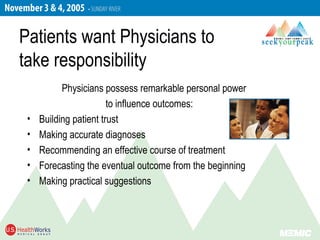
Patients want Physicians to
take responsibility
Physicians possess remarkable personal power
to influence outcomes:
• Building patient trust
• Making accurate diagnoses
• Recommending an effective course of treatment
• Forecasting the eventual outcome from the beginning
• Making practical suggestions
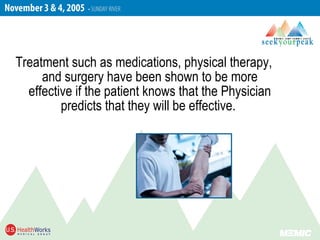
Treatment such as medications, physical therapy,
and surgery have been shown to be more
effective if the patient knows that the Physician
predicts that they will be effective.
Summary
• Many lost workdays are preventable. Accurate diagnosing and
effective treatments are not the solution to the 60 to 80% of lost-time
claims.
• Physicians who do not address quasi-medical and non-medical
factors that cause time off from work, are creating and prolonging
needless disability.
• Disability neurosis---the conviction of incapacity without
commensurate legitimate biological cause – is
frequently an iatrogenic (physician induced) disease.
Summary
• Preventing and mitigating disability is not generally taught in
medical school.
• Many Physicians are unaware that the
longer a worker is off from work, the
more likely they are to be permanently
disabled.
By the time the worker has been off work for twelve
weeks, he or she has only a 50% chance of ever
returning to work. 
Summary
• Workers’ compensation injury management is most effective when
Physicians accept their “beyond the medical” roles in injury
management.
• Communication between all parties reigns king! No one should be
operating in a vacuum.
• Physicians are able to make better decisions about returning
employees to work when the employer is an active participant in the
process.
• Employers need to develop more skill in improving injured workers’
motivation to recover by healing rifts within the workplace
environment.

MEMIC comp summit 2005

  • 1.
    Healing at theSpeed of Time Denise Dumont Bernier, P.T. Area Manager- Maine John Devine, D.O. Center Medical Director- Scarborough
  • 2.
  • 3.
    Healing Time Followingan Injury • How long should it take? • What should I expect? • When will they be back to work? • What happens if they aggravate the injury? • Why are they still in therapy? • He still has pain? • What can the employer do to help? • Do I really want her back?
  • 4.
    The slow torecover worker…. delayed recovery • At any given point in time, 8 million workers are at home/not working due to illness or injury • The resulting paid leave costs employers more than $1 billion dollars per year (sick pay, salary continuation, workers’ compensation indemnity benefits, and long-term and short-term disability benefits)
  • 5.
    The slow torecover worker ….unnecessary issues – Employers and Physicians communicating poorly about injured and ill employee’s ability to work – Employers failing to address external and motivational issues, causing injured employees to stay out of work or on light duty longer then medically necessary – Physicians not seeing disability leave/ transitional duty as an outcome for which they are partially responsible – Injured Employees can contribute to their own delayed recovery
  • 6.
    The Normal HealingProcess • Acute/ Inflammatory Phase: Injury to 5 days – Tissue disruption, platelet activation and white blood cells clean bacteria, inflammation – Redness, heat, swelling, pain, loss of function • Subactute/ Fibroplastic Phase: Day 4 to several weeks – Inflammation, pain subsides, can is still easily irritated – Tissue Continuity is Restored (fibroblast migration, proliferation and collagen synthesis) • Maturation and Remodeling: Day 15-12 weeks • Chronic: continued loss of function, scar tissue is only 70- 80% strong as original tissue
  • 7.
    Healing: Inhibiting Factors •Severity of Injury • Delayed initial treatment • Inappropriate initial treatment (heat) • Age • Pre-existing Conditions – Psychological – Neurological – Diabetes – Hypo-Thyroid Conditions – Respiratory (COPD, smoking) – DJD, arthritis – Circulatory (inadequate blood supply) • Foreign bodies (Infections) • Wound separation • Lack of Sleep • Nutrition/Alcoholism • Drugs • Improper Care
  • 8.
    The Body’s Abilityto Heal • Blood Supply- – Brings nutrition to help with healing process – Removal of waste products • How do they heal? – Bones (Fractures) – Muscles (Strains) – Ligaments (Sprains) – Tendons (Tendonitis, Tenosynovitis) – Cartilage (arthritis, DJD, tears) – Nerves (carpal tunnel, pinched nerve) – Discs (herniations, ruptures)
  • 9.
    Blood Flow toTissues At Rest Dynamic Work Static Work Blood Flow Demands Blood Flow Supplied
  • 10.
  • 11.
    Delayed Recovery • Aggravationof Injury • Work assignment beyond capabilities/restrictions • Exacerbation of the Symptoms • Not following work restrictions- (ambitious worker) • Fear of Re-injury (symptom exaggeration) • Secondary, non-medical issues present
  • 12.
    Delayed Recovery vs.Malingering or Symptom Magnification • Conscious vs. Unconscious • Intentional production of false or exaggerated symptoms motivated by external incentives • Less than full effort performance- this can be measured! • Discrepancy between claimed impairment and objective findings • Lack of cooperation during evaluation
  • 13.
    Survey: Employers and Physiciansfailed to communicate • When asked in a survey about the number of workers with work- related injuries needing more than a couple of days off from work for strictly medical reasons, occupational physicians placed the percentage at 5-10% at most, based on their own clinical experience. • Nationally, 24% of WC cases have lost time. • Therefore, 60 to 80% of these cases involve medically unnecessary time off from work
  • 14.
    Survey: specific non-medicalreasonsSurvey: specific non-medical reasons for keeping injured workers out offor keeping injured workers out of work or on prolonged light duty...work or on prolonged light duty... • Treating Physician unwilling to “force” a reluctant patient back to restricted or full duty work • Unfavorable state laws • Treating Physician inexperienced regarding determination of the proper restrictions on work activity • Treating Physician lacks information about the physical demands of the job required to issue appropriate work restrictions • The employer has a policy against light duty work • The employer unable to find a way to temporarily modify the job • Treating Physician feels caught between the employer’s and the employee’s version of events • Conflict exists between the opinions of two Physicians (Occupational Physician versus primary care Physician versus “specialist”)
  • 15.
    The most influentialpeople in a Workers’ Compensation injury or disability case are the doctor, the employee, and the employer.
  • 16.
    The tone isset in those first few critical days; often, the first appointment. -Is there an appropriate response to the employee’s injury by all parties? -Is there an expectation for a quick return to work? -Is there effective planning towards achieving a return to work? Importance of the First Minutes
  • 17.
    Provider’s Role • Diagnosis •Causation of Injury • Define Work Restrictions and abilities • Treatment Plan and Care Management • Cost Containment • Disability Prevention • Education • Versatility • Prognosis • COMMUNICATION
  • 18.
    Employer’s Role • Theemployer decides whether to support the recovering employee and whether to provide work within the employee’s prescribed restrictions • Caring and compassionate • Inconvenienced and doubtful? • Mediator • COMMUNICATION
  • 19.
    Employee’s Role • Theemployee decides whether to try to get better as quickly as possible or to let the medical problem become a life changing event. Workers’ Comp is not a career choice! • Active Role Expected • Follow Medical Recommendations • Compliance with Treatment • Follow Work Restrictions • COMMUNICATON
  • 20.
    RETURN TO WORKAND RECOVERY STARTS AT THE FIRST MINUTE OF INJURY
  • 21.
    Keeping Physicians informed •Too frequently, the physician only has the patient as a source of information when deciding a return to work plan. • The employer’s input is often not represented. • The employee’s input may be invalid.
  • 22.
    The Patient Evaluation •Read notes in the patient’s chart, prior history • Ask the patient questions about the injury • Ask the patient about activities outside of work • Conduct the physical exam • Consider the facts, make a diagnosis, determine work relatedness and devise a treatment plan • Explain the diagnosis and plan to the patient • Make plans for the next appointment • Answer all the patients’ questions • Fill out forms, lab orders, M-1 Forms, prescriptions etc. • Call Employer Representative • Prepare notes for the patient chart…yikes! 
  • 23.
    Many physicians haveno familiarity with the workplace or the routine practices used to keep injured workers safe while working. Occ Health Physicians are more likely to understand Workplace Familiarity
  • 24.
    Impact of LostTime on Employer • Businesses look to increase the productivity and efficiency of their workforce. Unscheduled absences cause workflow and staffing disruption. • Supervisors are impeded by the need to find and supervise substitute workers. Mistakes, oversights, and delays frequently occur. Quality and volume of work often suffers. • Supervisors are challenged by injured workers’ needs • Labor costs increase because of the additional wages paid to replacement workers or the overtime paid to co-workers picking up the extra load. • These occurrences steadily drain the human and financial resources of the company.
  • 25.
    The self employedtest If the injured worker was the sole proprietor of a corner grocery store, would he or she be able to find a way to work safely? The underlying question that needs to be answered is: What are the external and/or motivational problems preventing or discouraging the employee’s return to full duty? (***Environmental problems are problems with the outside world, not the employee. They can be logistical, mechanical, financial, relational, social, cultural, legal, or political.)
  • 26.
    The Obstacles What arethe specific, external, non-medical obstacles preventing this worker from working today? Patient unable to safely drive a car? -Get him a ride! Supervisor cannot figure out how to temporarily modify a job? -Call the physician! Additionally, case managers, physical therapists, or vocational rehabilitation counselors may also guide supervisors/HR to alternatives. A Physician under the impression that a company has no transitional duty? -Call to the employer!
  • 27.
    Is the employeereluctant to return to work because he/she is worried that her coworkers will ridicule for not carrying his/her share of the workload? Employees may stay home because they fear that their supervisor will force them to work beyond their restrictions. Some employers utilize a return to work advocate who can help the employee feel better about returning to work, which in turn will improve the employee’s attitude, if not the injury itself. The Physician and employee will feel more confident in returning to work if they know there is someone at work to appeal to if the work restrictions are not respected. The Obstacles
  • 28.
    • When anemployee seems unduly disabled by a relatively trivial injury... Examples • Pending strike, shutdown or layoff? • Several co-workers are on vacation and the remaining employees are required to temporarily take up the slack. • Performance issues • Previously invisible workplace frictions may turn into a two-sided passive-aggressive war of revenge. • Many prolonged recoveries involve “difficult” supervisor- employee relationships. Making a mountain out of a molehill
  • 29.
    Supervisors may dropthe ball due to: – Improper training. – Inadequate support from the human resources – Doesn’t like the employee – Inappropriate fears from “above” regarding productivity. Not always the injured employee.
  • 30.
    • How compassionatelyhas the supervisor/company responded to the employees medical condition and the disruption in their life and job? • How effectively has the situation been managed? • Is the employee or supervisor in need (of training, safety issues, return to work policy, conflict resolution skills)? • Has there been a breakdown in the relationship between the supervisor and the employee, thereby defeating the employee’s motivation? Employers should routinely review their Workers’ Compensation cases by investigating the following:
  • 31.
    Management’s lack ofcommitment to injury prevention and absence management is a critical part of why injuries and lost time occur. Too frequently, the first time human resources gets involved is when the situation has already gone on for weeks or months It takes time to establish a healthy workplace culture.
  • 32.
    Compassion for theinjured or ill employee • Supervisors need to properly respond to the initial report. • Practice the golden rule and treat the employee as they would like to be treated. • Express genuine concern. • Report the injury promptly. • Educate the employee about benefits. • Direct where to go for medical care. • Consider team meetings Setting the claim on the right track in the beginning is the more efficient way to control costs.
  • 33.
    Employer as areturn to work advocate • Someone to help recovering employees when their supervisors are not meeting their needs. • A staff person in health and safety, risk management, or human resources. A company nurse, or the company’s Physician. A previously injured “Model Patient” employee. • If not available, the role may end up being played by the union or the injured employee’s lawyer. [Gulp!]
  • 34.
    Most employers orworker’s compensation networks simply look for Physicians who are willing to treat occupational injuries. Evidence of training and experience in disability management should be sought after.
  • 35.
    Patients want Physiciansto take responsibility Physicians possess remarkable personal power to influence outcomes: • Building patient trust • Making accurate diagnoses • Recommending an effective course of treatment • Forecasting the eventual outcome from the beginning • Making practical suggestions
  • 36.
    Treatment such asmedications, physical therapy, and surgery have been shown to be more effective if the patient knows that the Physician predicts that they will be effective.
  • 37.
    Summary • Many lostworkdays are preventable. Accurate diagnosing and effective treatments are not the solution to the 60 to 80% of lost-time claims. • Physicians who do not address quasi-medical and non-medical factors that cause time off from work, are creating and prolonging needless disability. • Disability neurosis---the conviction of incapacity without commensurate legitimate biological cause – is frequently an iatrogenic (physician induced) disease.
  • 38.
    Summary • Preventing andmitigating disability is not generally taught in medical school. • Many Physicians are unaware that the longer a worker is off from work, the more likely they are to be permanently disabled. By the time the worker has been off work for twelve weeks, he or she has only a 50% chance of ever returning to work. 
  • 39.
    Summary • Workers’ compensationinjury management is most effective when Physicians accept their “beyond the medical” roles in injury management. • Communication between all parties reigns king! No one should be operating in a vacuum. • Physicians are able to make better decisions about returning employees to work when the employer is an active participant in the process. • Employers need to develop more skill in improving injured workers’ motivation to recover by healing rifts within the workplace environment.