

Part 1: Building the Pillars of
Microservices
Part 2: Containerization and
Orchestration (Kubernetes)
AGENDA
Part 1: Building the Pillars
01
The Journey to Microservices
02
Building the Pillars of Microservices
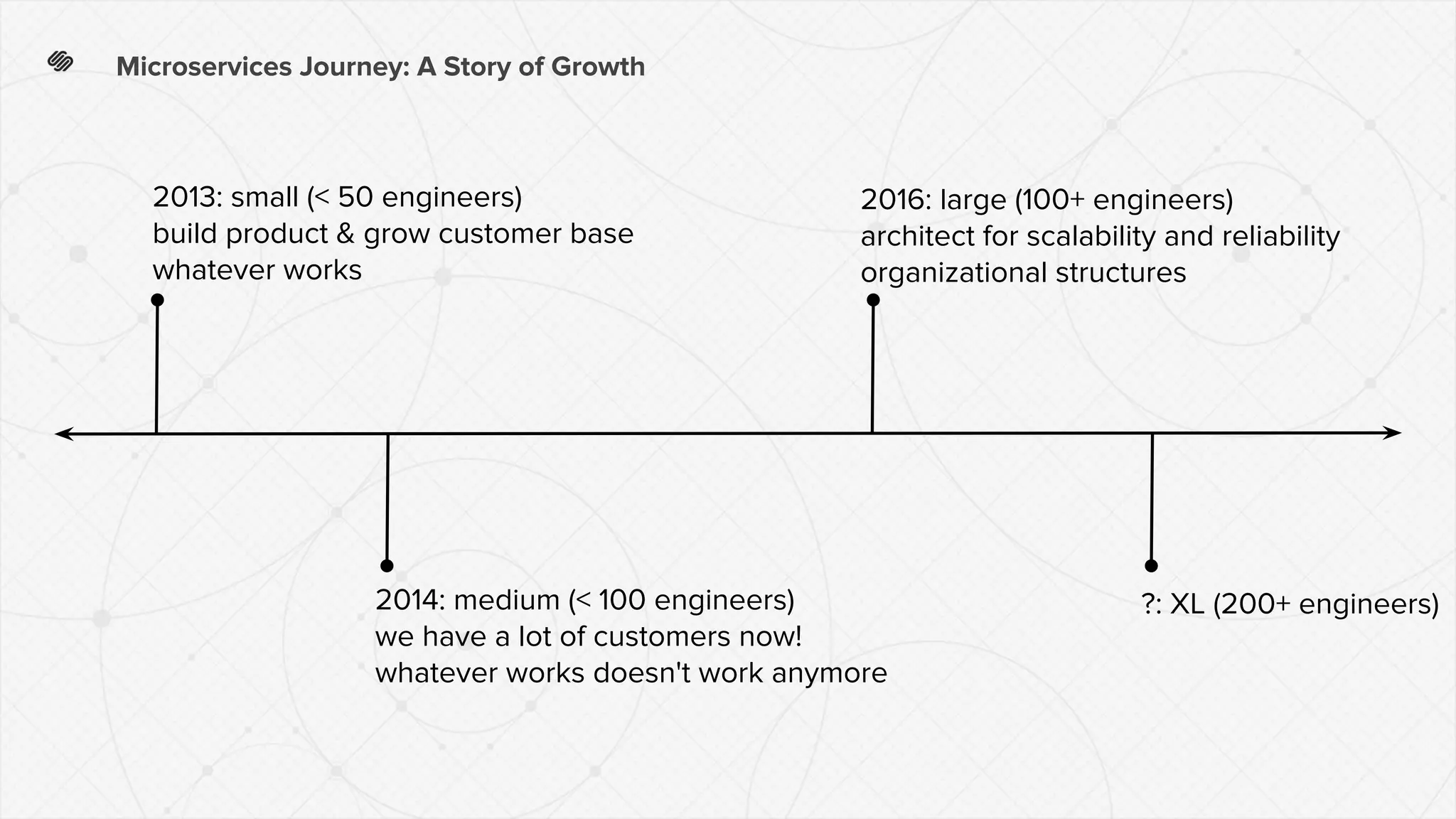
Microservices Journey: A Story of Growth
2013: small (< 50 engineers)
build product & grow customer base
whatever works
2014: medium (< 100 engineers)
we have a lot of customers now!
whatever works doesn't work anymore
2016: large (100+ engineers)
architect for scalability and reliability
organizational structures
?: XL (200+ engineers)
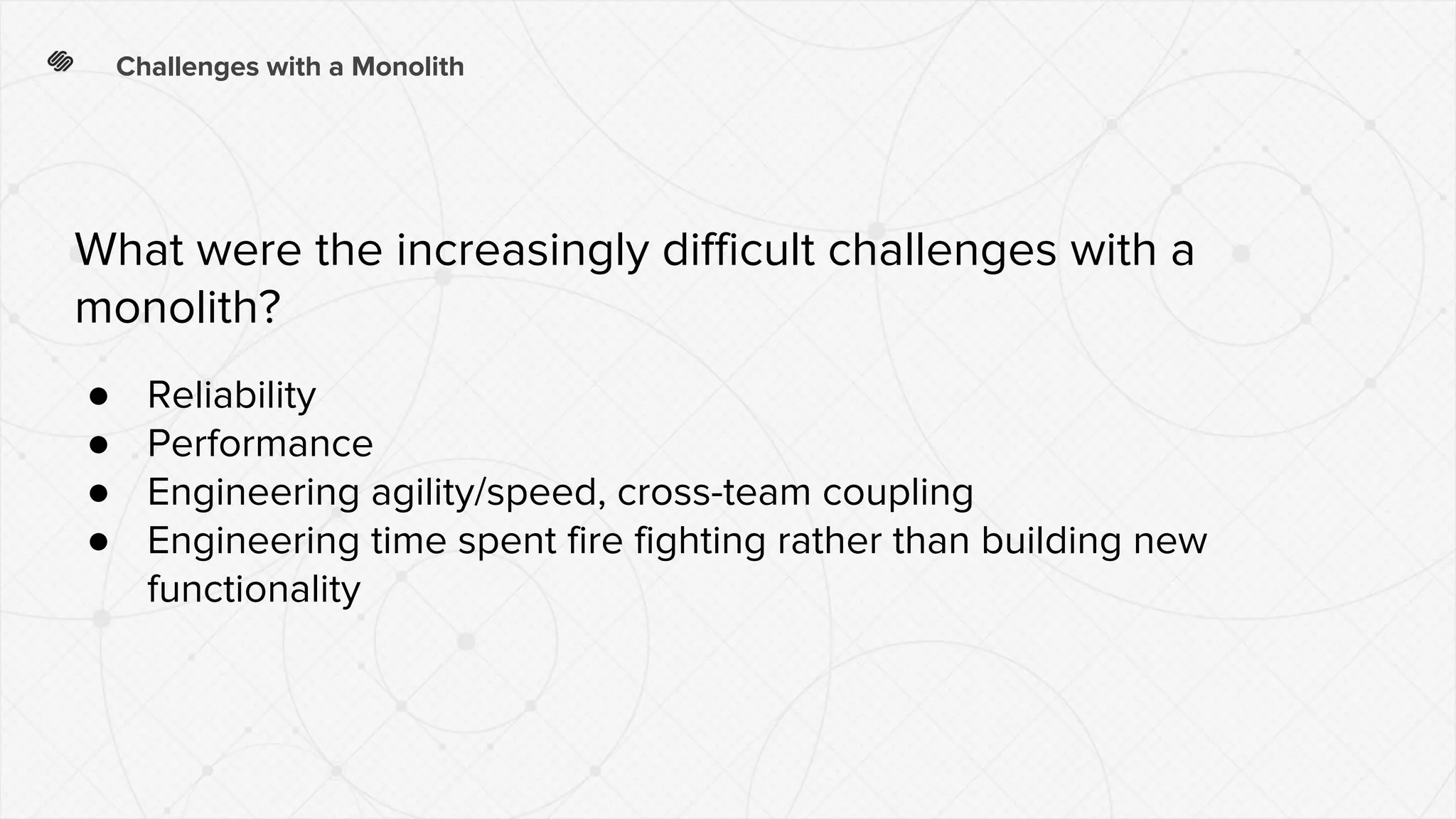
Challenges with a Monolith
● Reliability
● Performance
● Engineering agility/speed, cross-team coupling
● Engineering time spent fire fighting rather than building new
functionality
What were the increasingly difficult challenges with a
monolith?
https://www.squarespace.com/?gclid=<unique-id>
Challenges with a Monolith
Story of an Outage...During the Super Bowl
Challenges with a Monolith
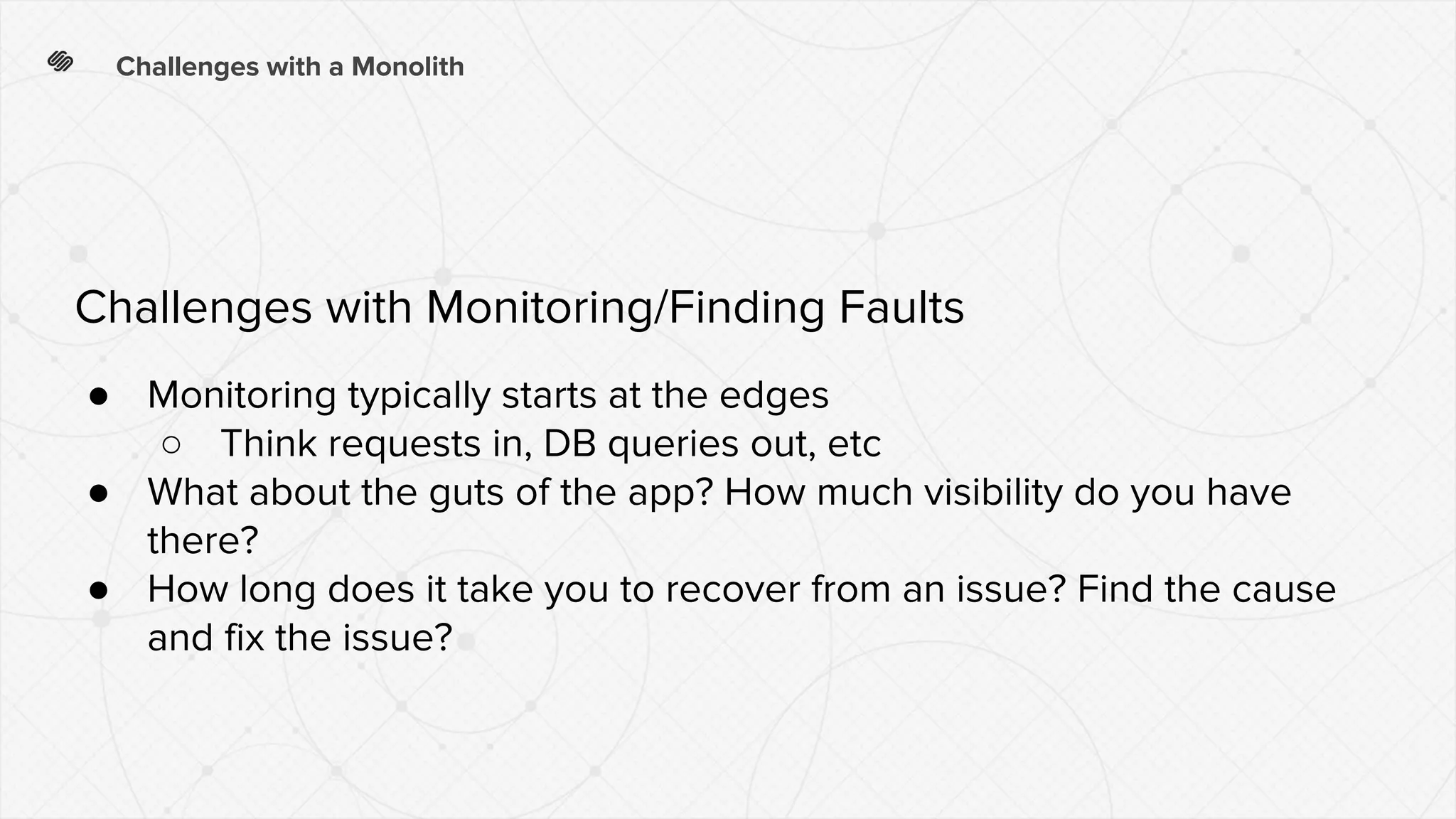
● Monitoring typically starts at the edges
○ Think requests in, DB queries out, etc
● What about the guts of the app? How much visibility do you have
there?
● How long does it take you to recover from an issue? Find the cause
and fix the issue?
Challenges with Monitoring/Finding Faults
The Journey to Microservices
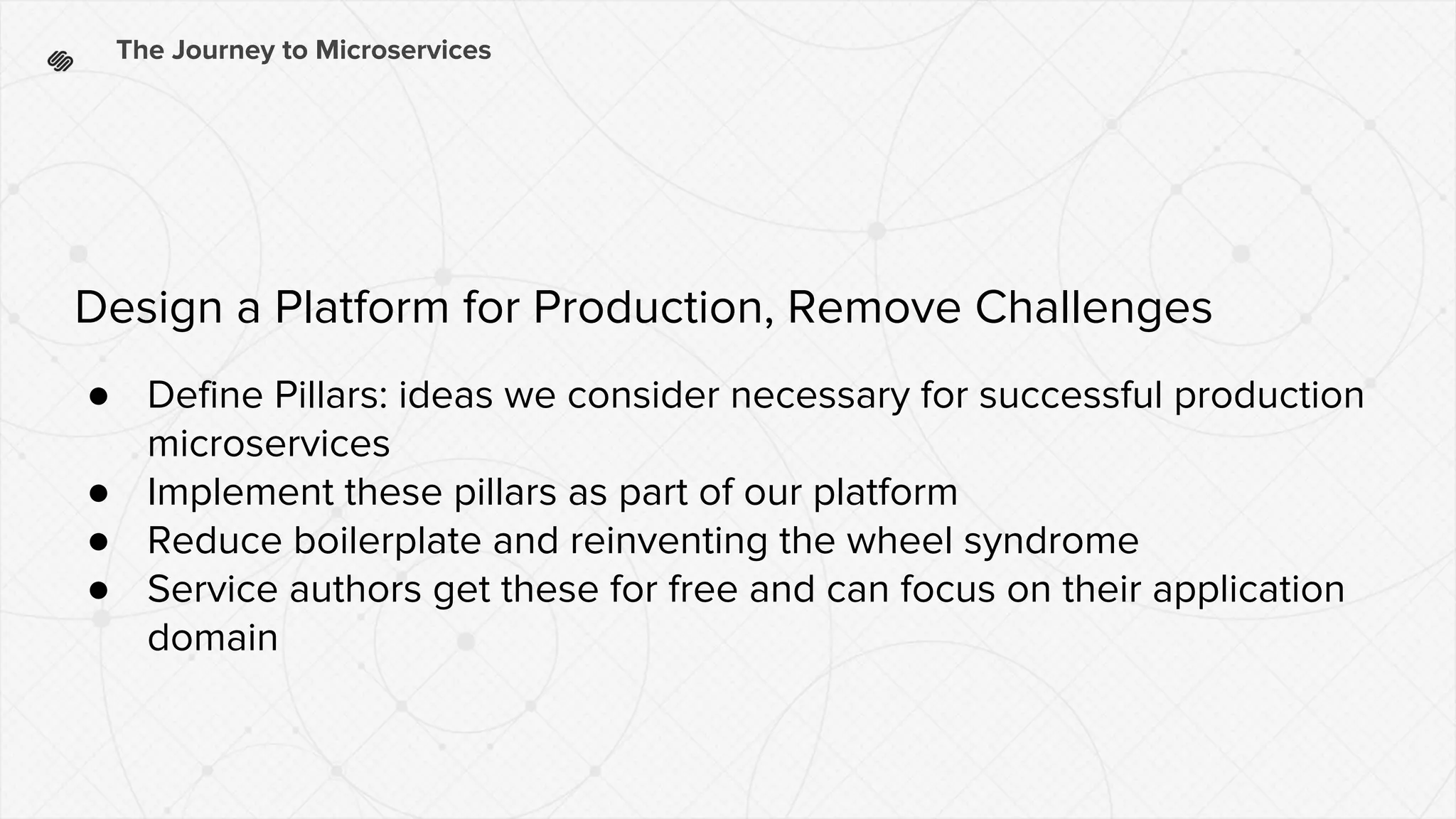
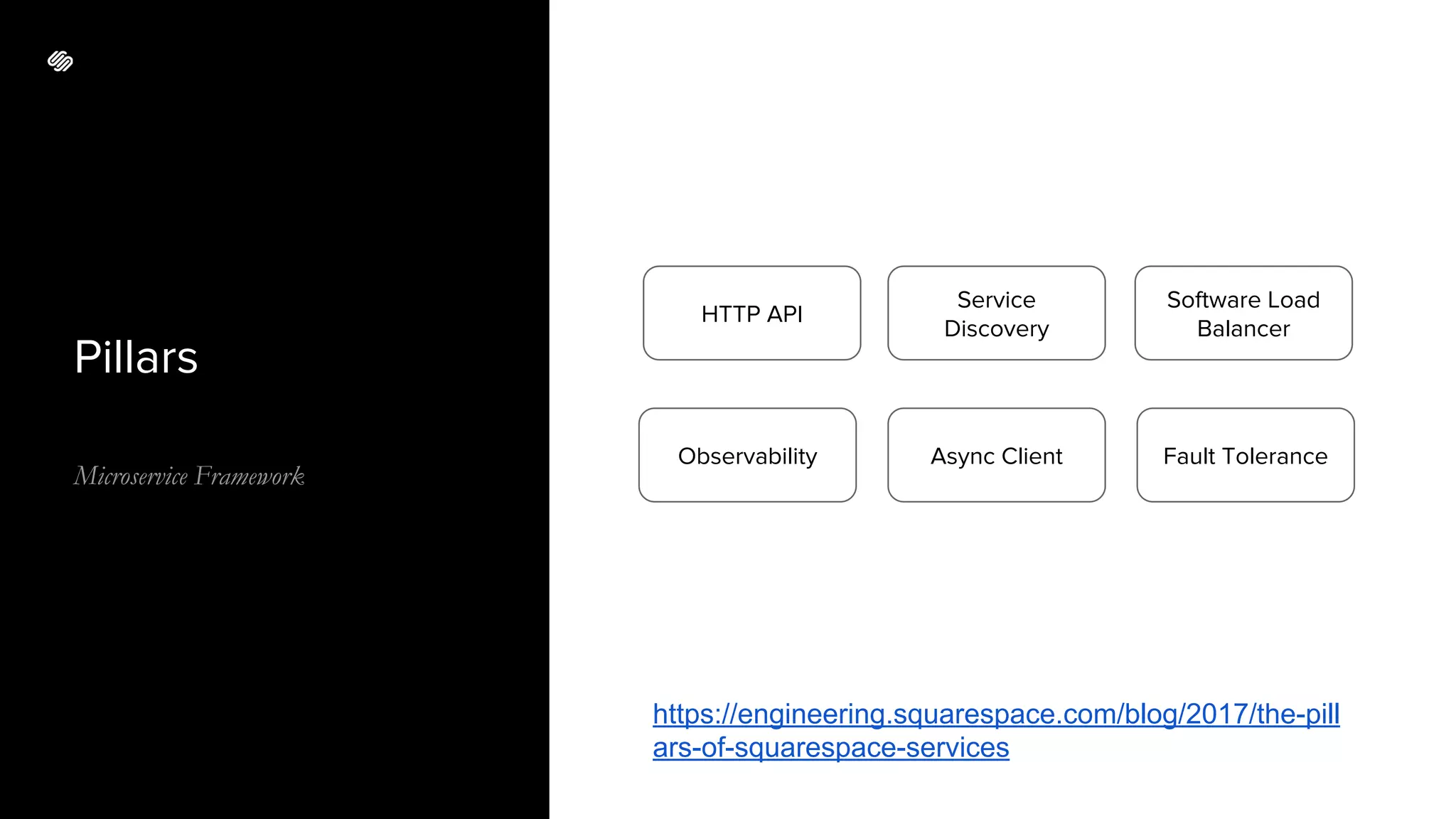
● Define Pillars: ideas we consider necessary for successful production
microservices
● Implement these pillars as part of our platform
● Reduce boilerplate and reinventing the wheel syndrome
● Service authors get these for free and can focus on their application
domain
Design a Platform for Production, Remove Challenges
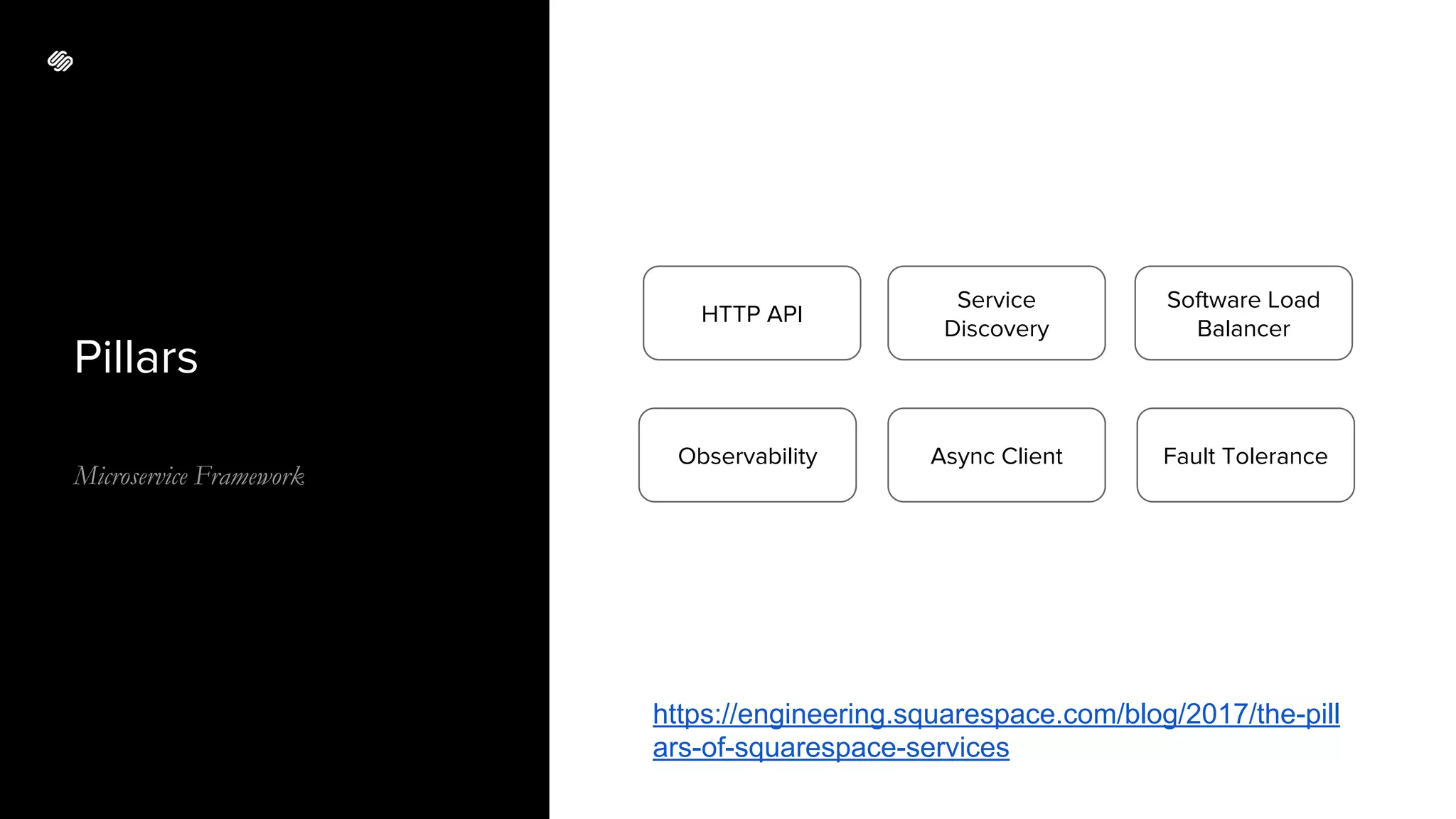
Pillars
Microservice Framework
HTTP API
Service
Discovery
Software Load
Balancer
Observability Async Client Fault Tolerance
https://engineering.squarespace.com/blog/2017/the-pill
ars-of-squarespace-services
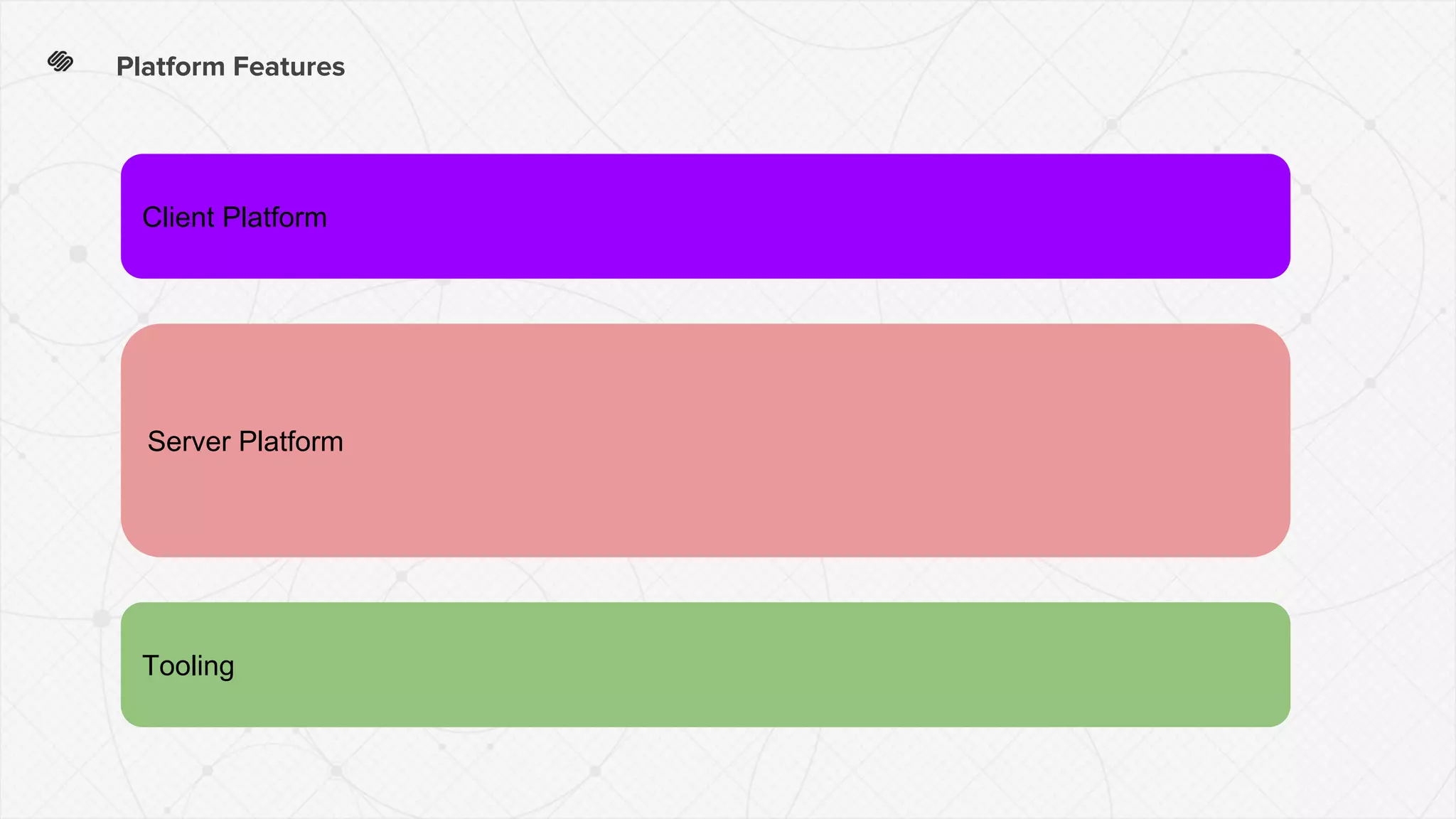
Platform Features
Service
Discovery
API
Documentation
Structured
Logging
Metrics &
Dashboards
Distributed
Tracing
Contextual
Information
Alert
Definitions
Standardized
Deployments
Healthchecks
Dynamic
Configuration
Client-Side Load
Balancing
Latency & Fault
Tolerance
Client-Side
Caching
HTTP Request
Builders
Code
Generation
Service
Dashboard
Traffic
Visualization
Server Platform
Client Platform
ToolingTooling
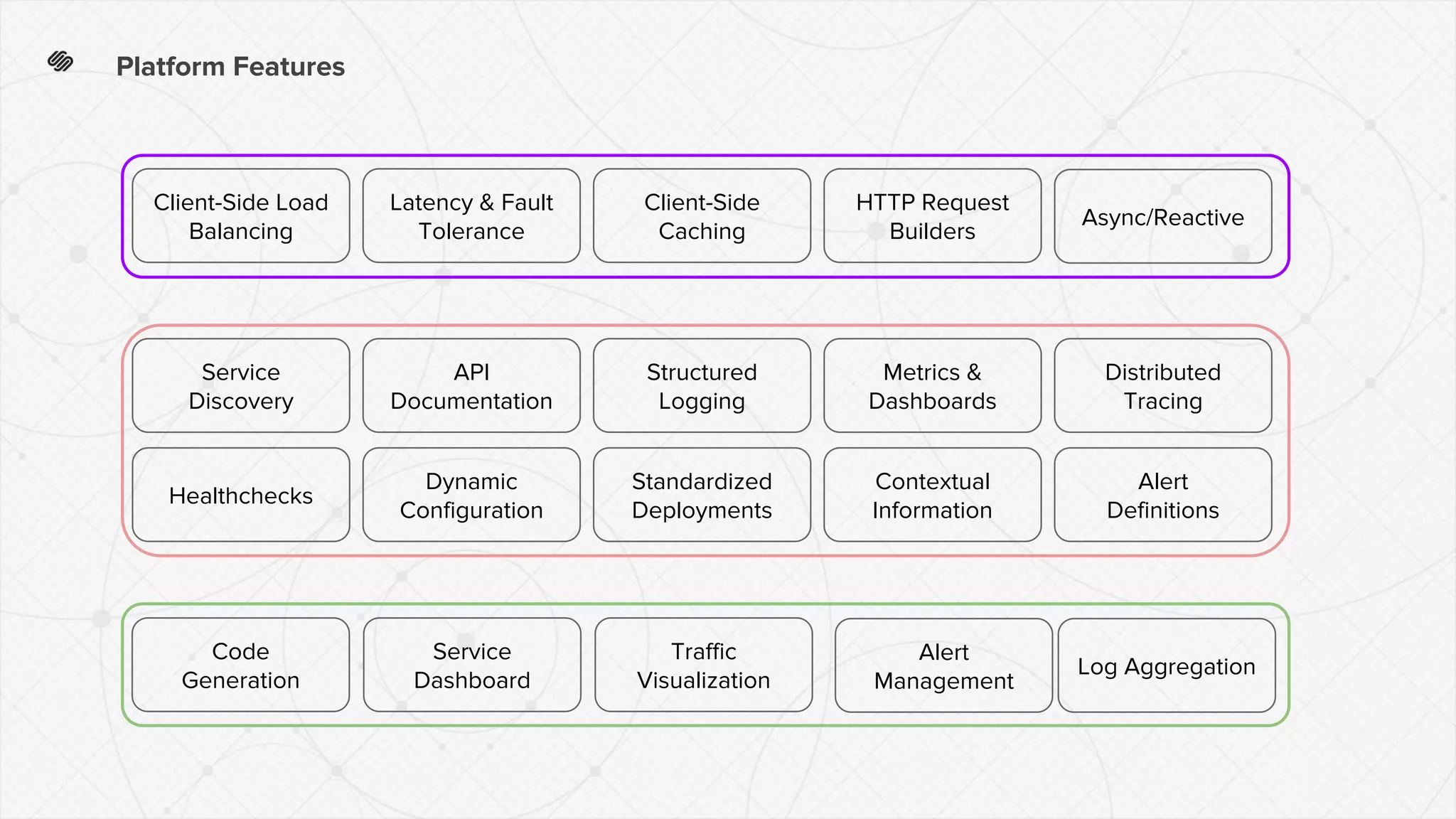
Platform Features
Service
Discovery
API
Documentation
Structured
Logging
Metrics &
Dashboards
Distributed
Tracing
Contextual
Information
Alert
Definitions
Standardized
Deployments
Healthchecks
Dynamic
Configuration
Client-Side Load
Balancing
Latency & Fault
Tolerance
Client-Side
Caching
HTTP Request
Builders
Code
Generation
Service
Dashboard
Traffic
Visualization
Async/Reactive
Alert
Management
Log Aggregation
Building the Pillars of Microservices
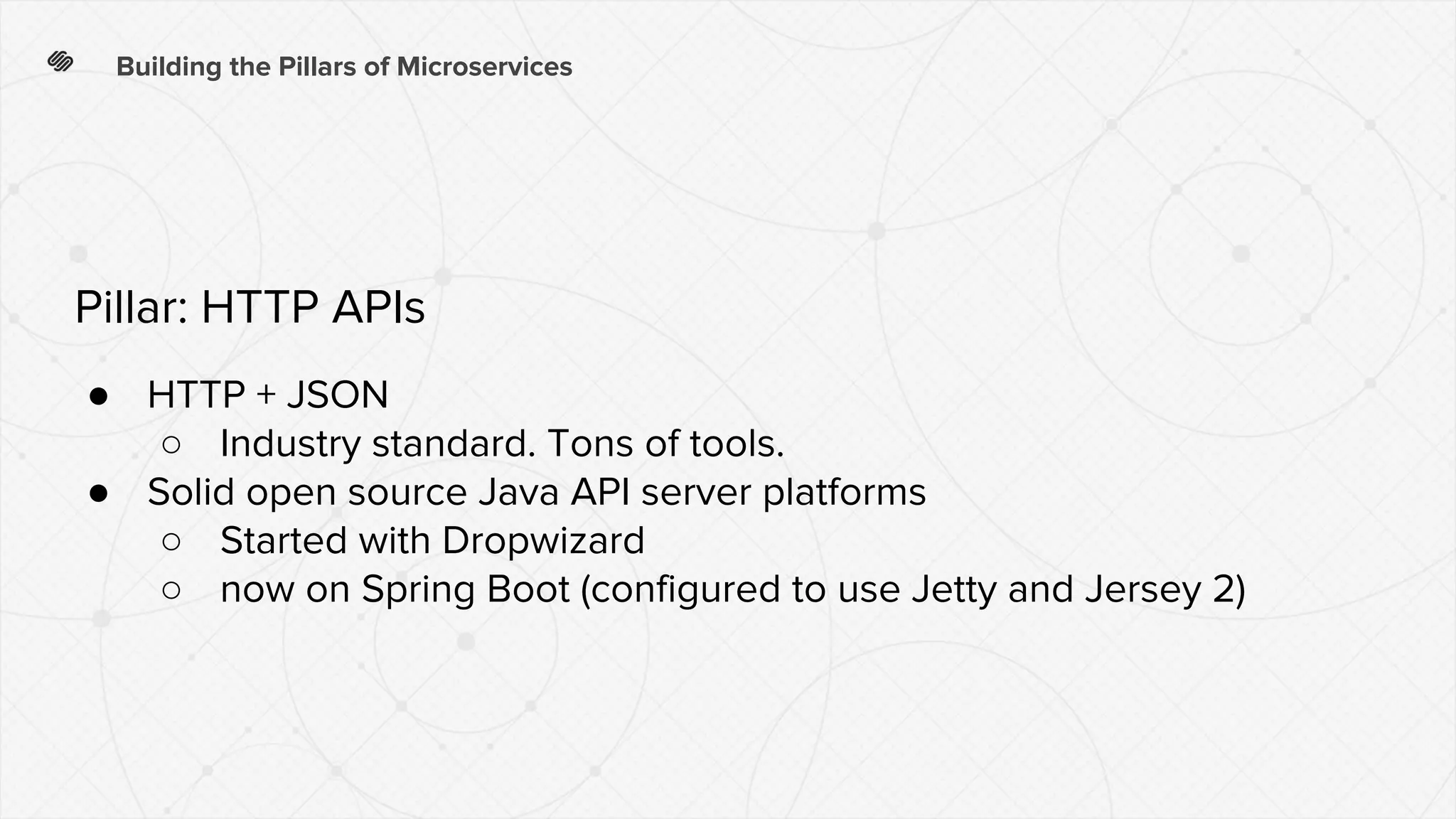
● HTTP + JSON
○ Industry standard. Tons of tools.
● Solid open source Java API server platforms
○ Started with Dropwizard
○ now on Spring Boot (configured to use Jetty and Jersey 2)
Pillar: HTTP APIs
Building the Pillars of Microservices
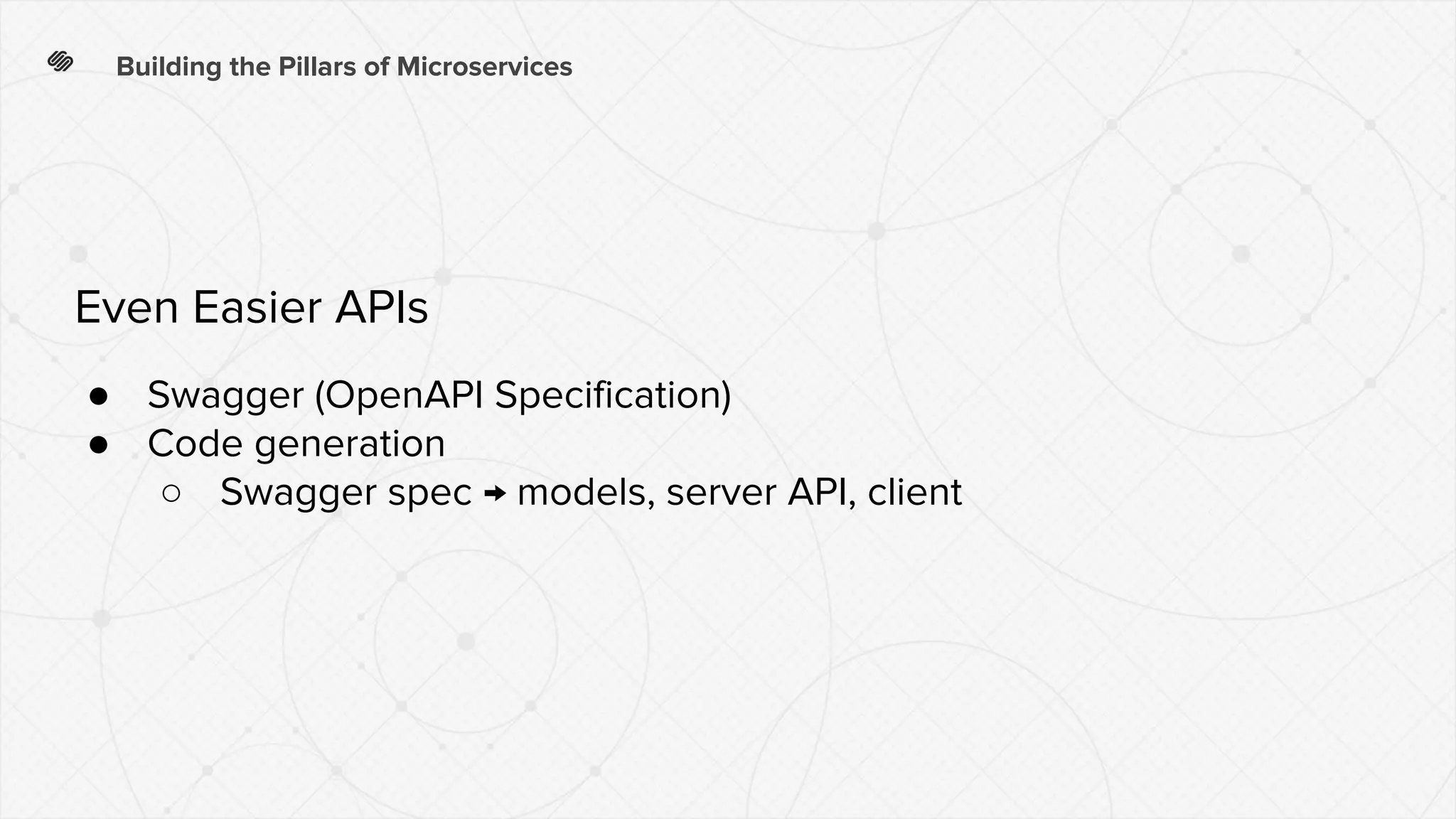
● Swagger (OpenAPI Specification)
● Code generation
○ Swagger spec → models, server API, client
Even Easier APIs
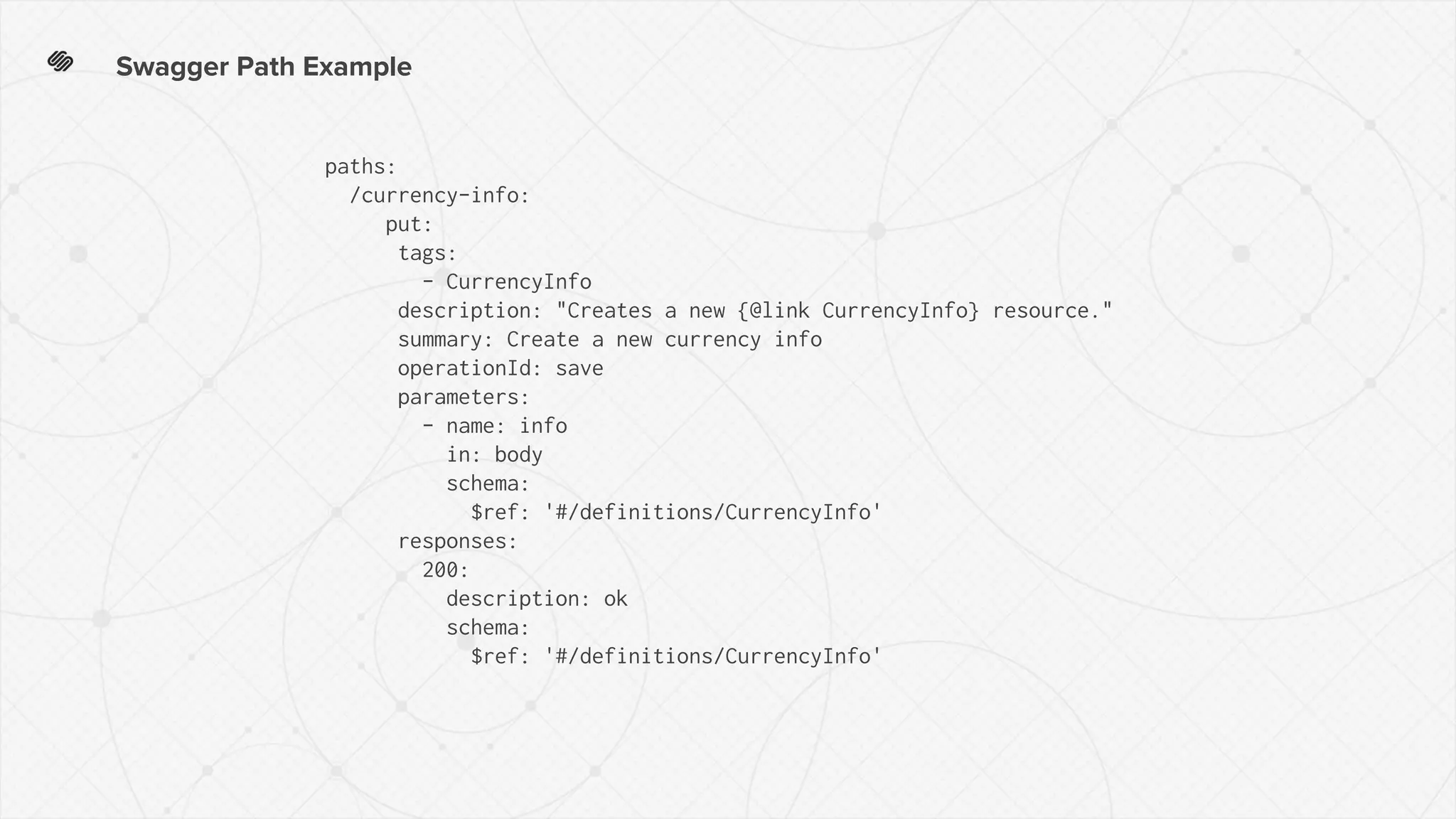
Swagger Path Example
paths:
/currency-info:
put:
tags:
- CurrencyInfo
description: "Creates a new {@link CurrencyInfo} resource."
summary: Create a new currency info
operationId: save
parameters:
- name: info
in: body
schema:
$ref: '#/definitions/CurrencyInfo'
responses:
200:
description: ok
schema:
$ref: '#/definitions/CurrencyInfo'
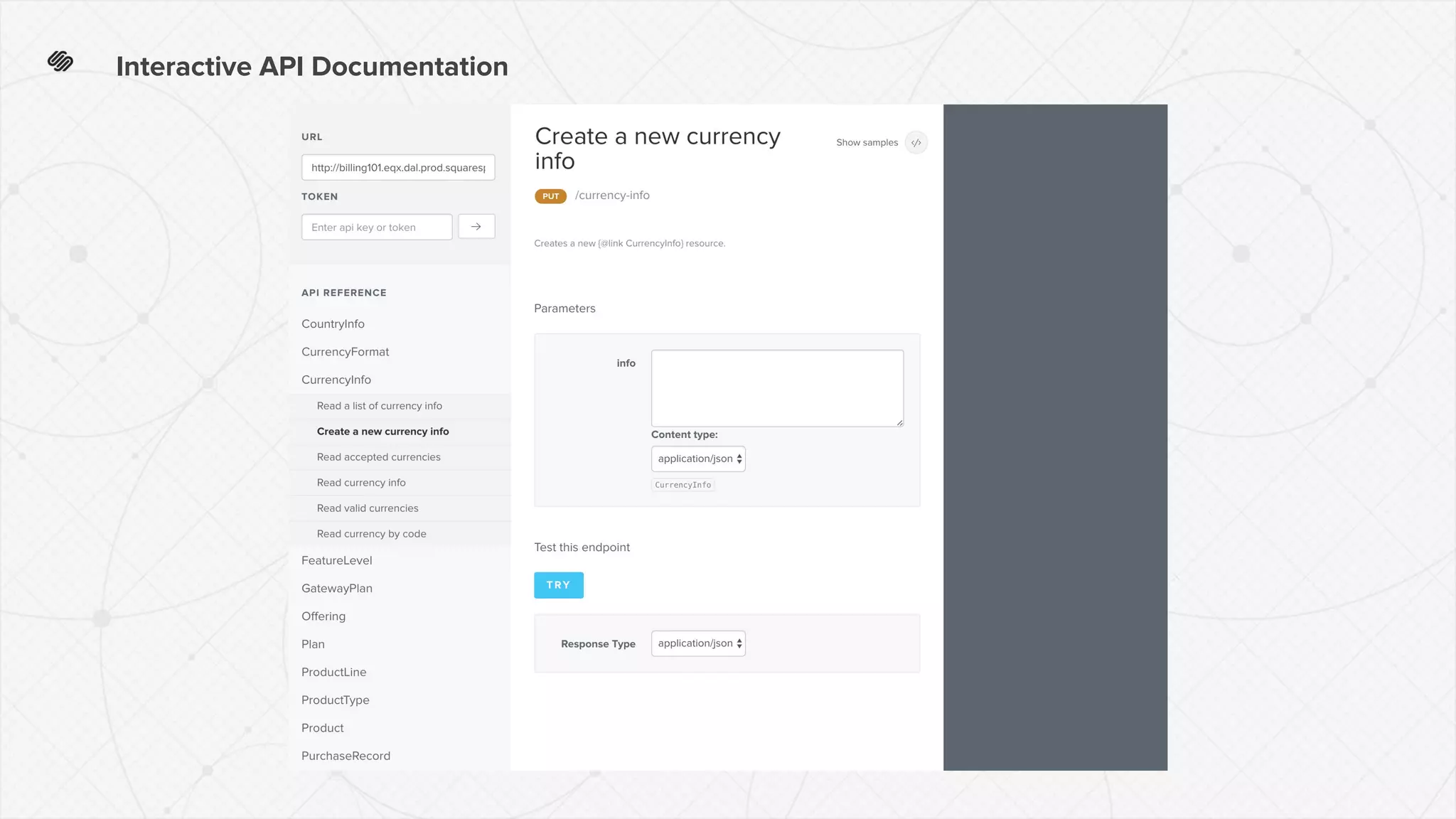
Interactive API Documentation
Building the Pillars of Microservices
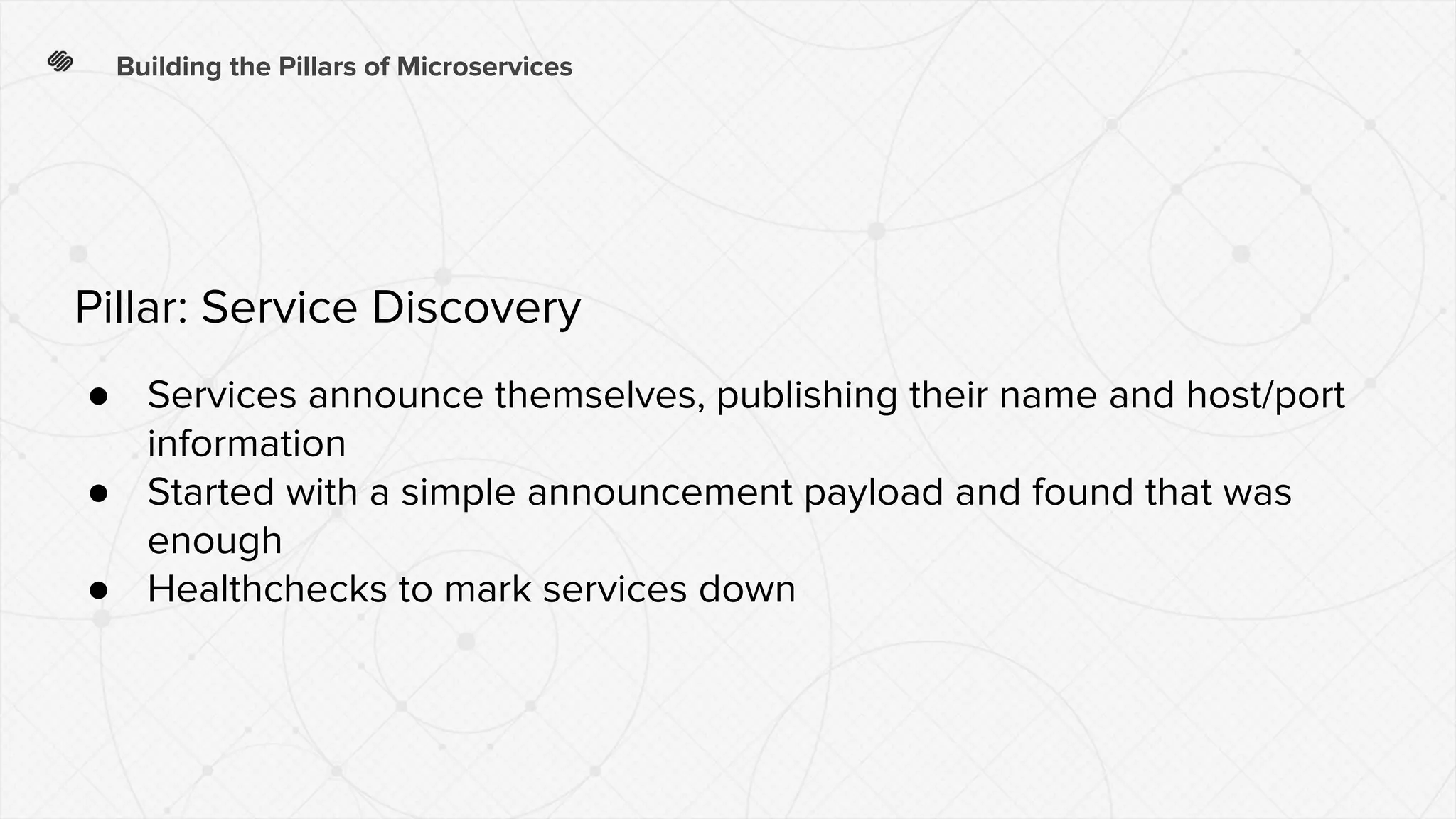
● Services announce themselves, publishing their name and host/port
information
● Started with a simple announcement payload and found that was
enough
● Healthchecks to mark services down
Pillar: Service Discovery
Building the Pillars of Microservices
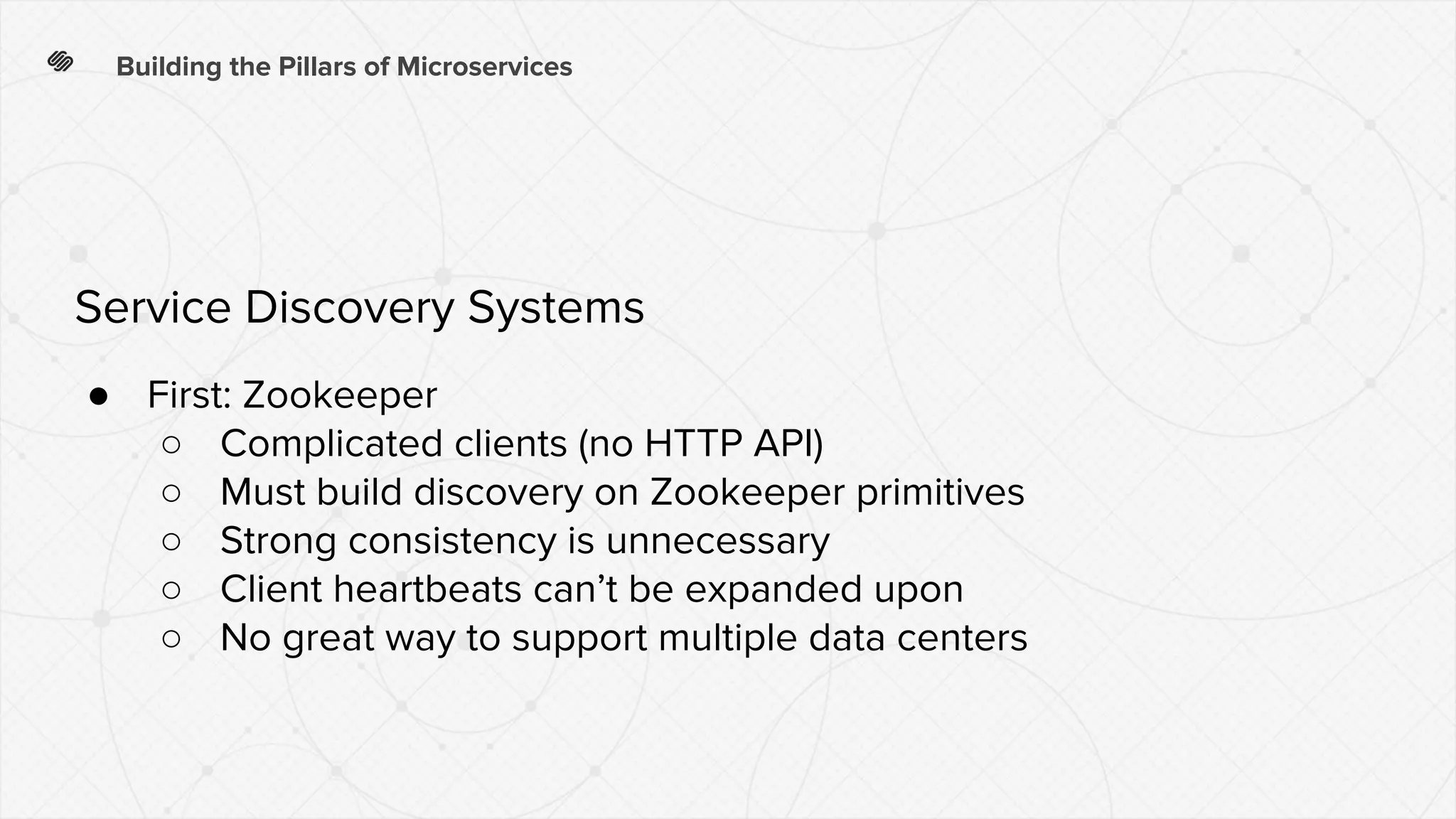
● First: Zookeeper
○ Complicated clients (no HTTP API)
○ Must build discovery on Zookeeper primitives
○ Strong consistency is unnecessary
○ Client heartbeats can’t be expanded upon
○ No great way to support multiple data centers
Service Discovery Systems
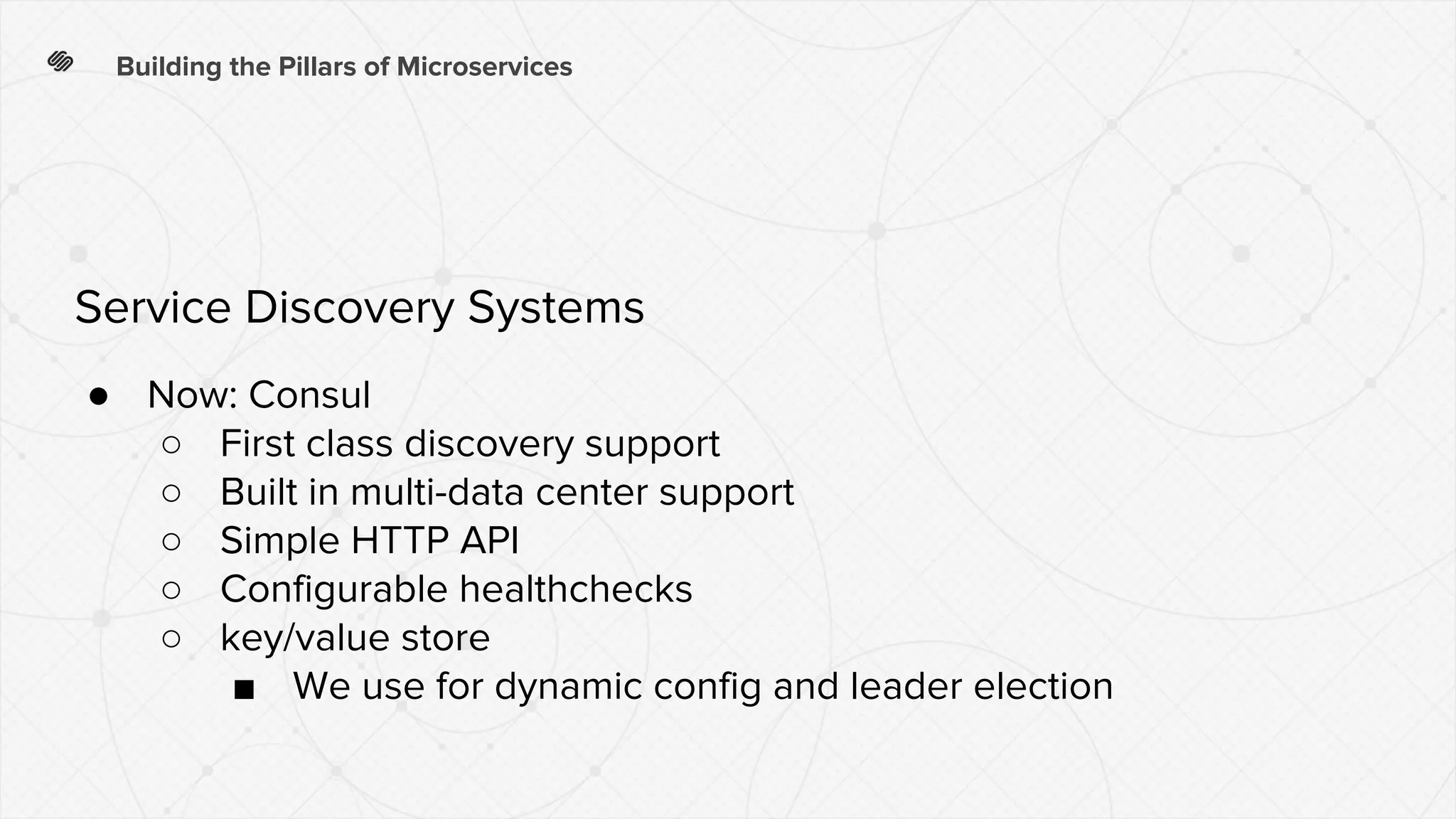
● Now: Consul
○ First class discovery support
○ Built in multi-data center support
○ Simple HTTP API
○ Configurable healthchecks
○ key/value store
■ We use for dynamic config and leader election
Building the Pillars of Microservices
Service Discovery Systems
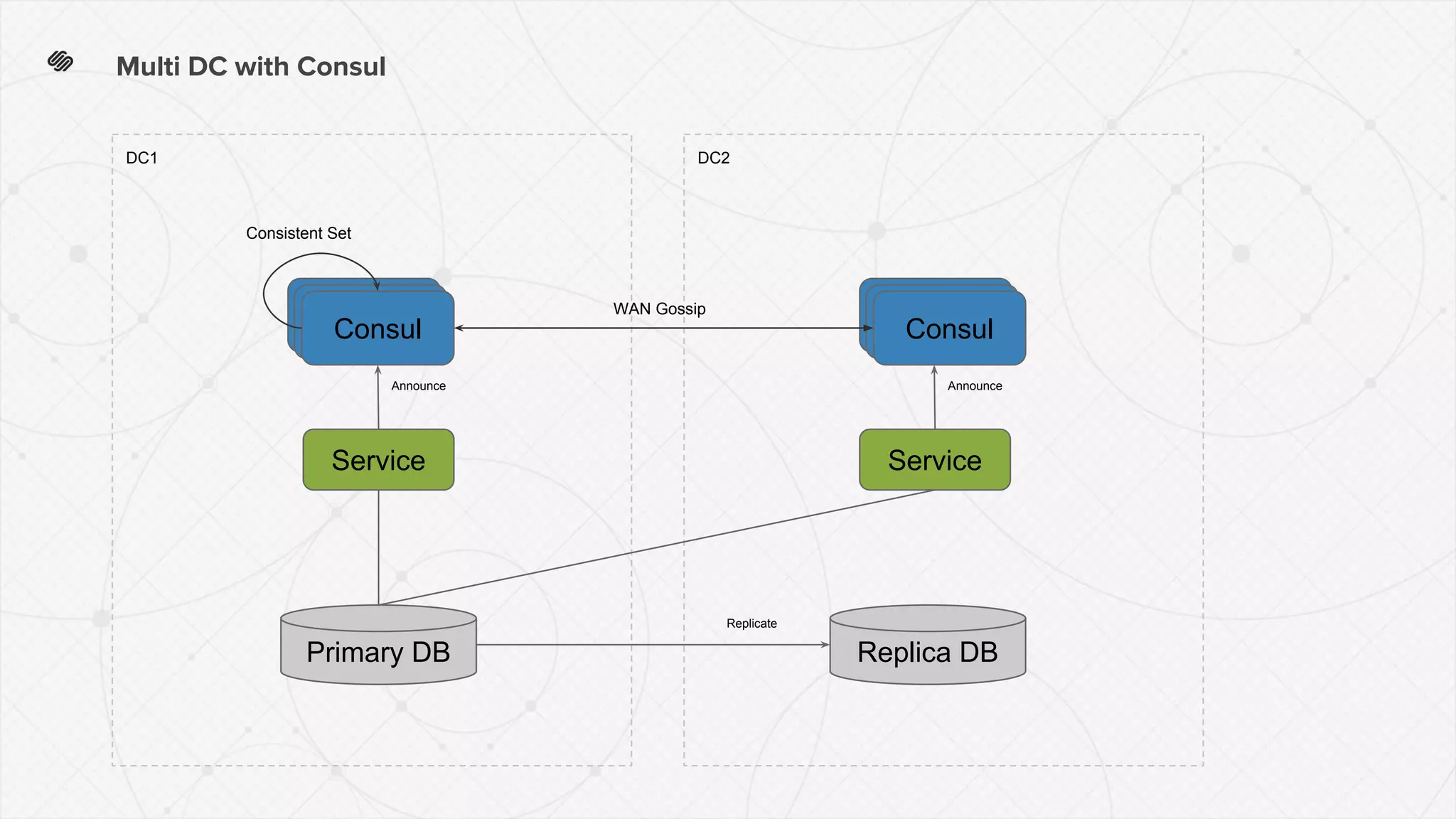
DC2DC1
Multi DC with Consul
ConsulConsulConsul ConsulConsulConsul
Service
Announce
Service
Announce
Primary DB Replica DB
Replicate
WAN Gossip
Consistent Set
DC2DC1
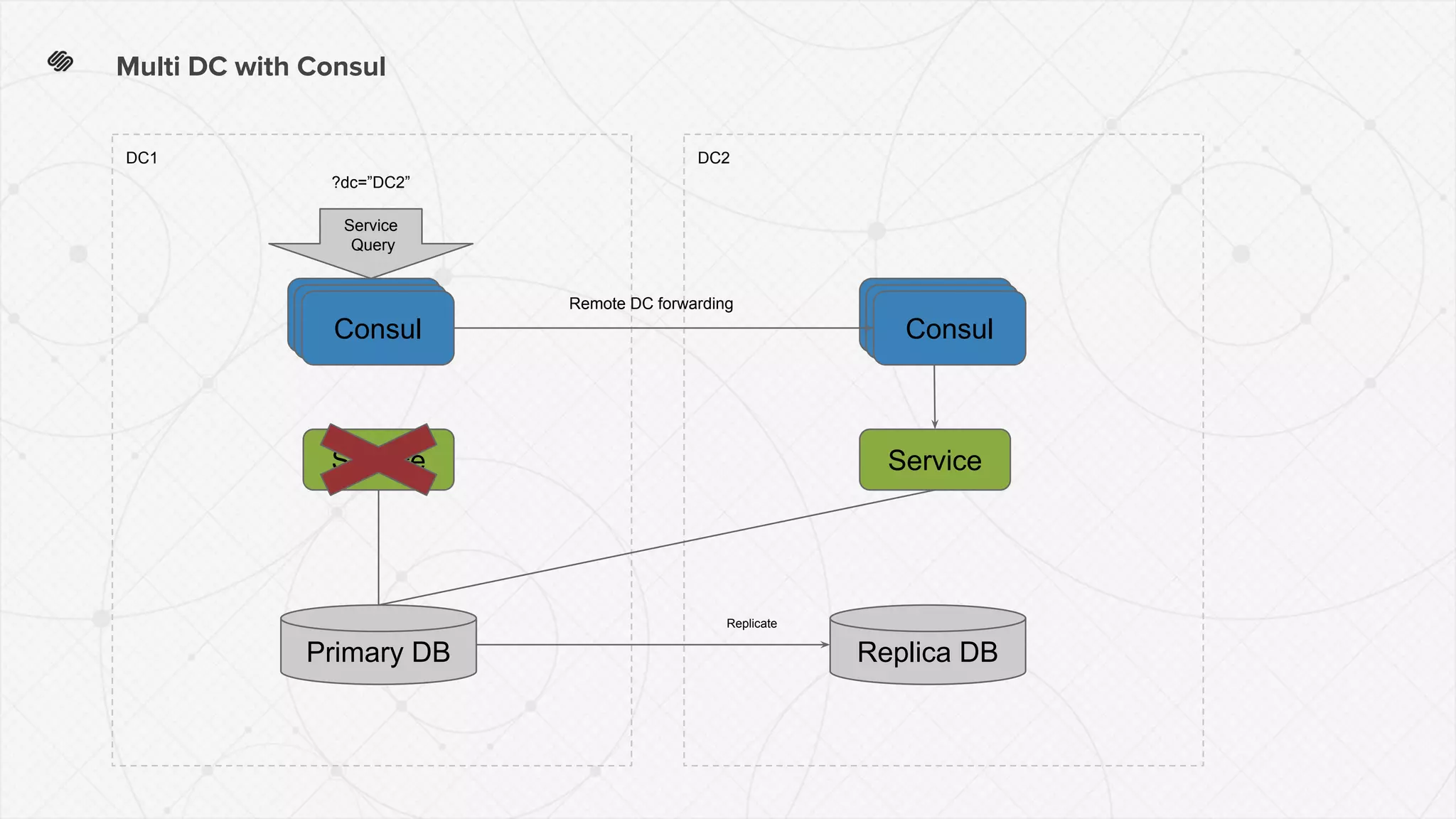
Multi DC with Consul
ConsulConsulConsul ConsulConsulConsul
Service Service
Primary DB Replica DB
Replicate
Service
Query
?dc=”DC2”
Remote DC forwarding
Building the Pillars of Microservices
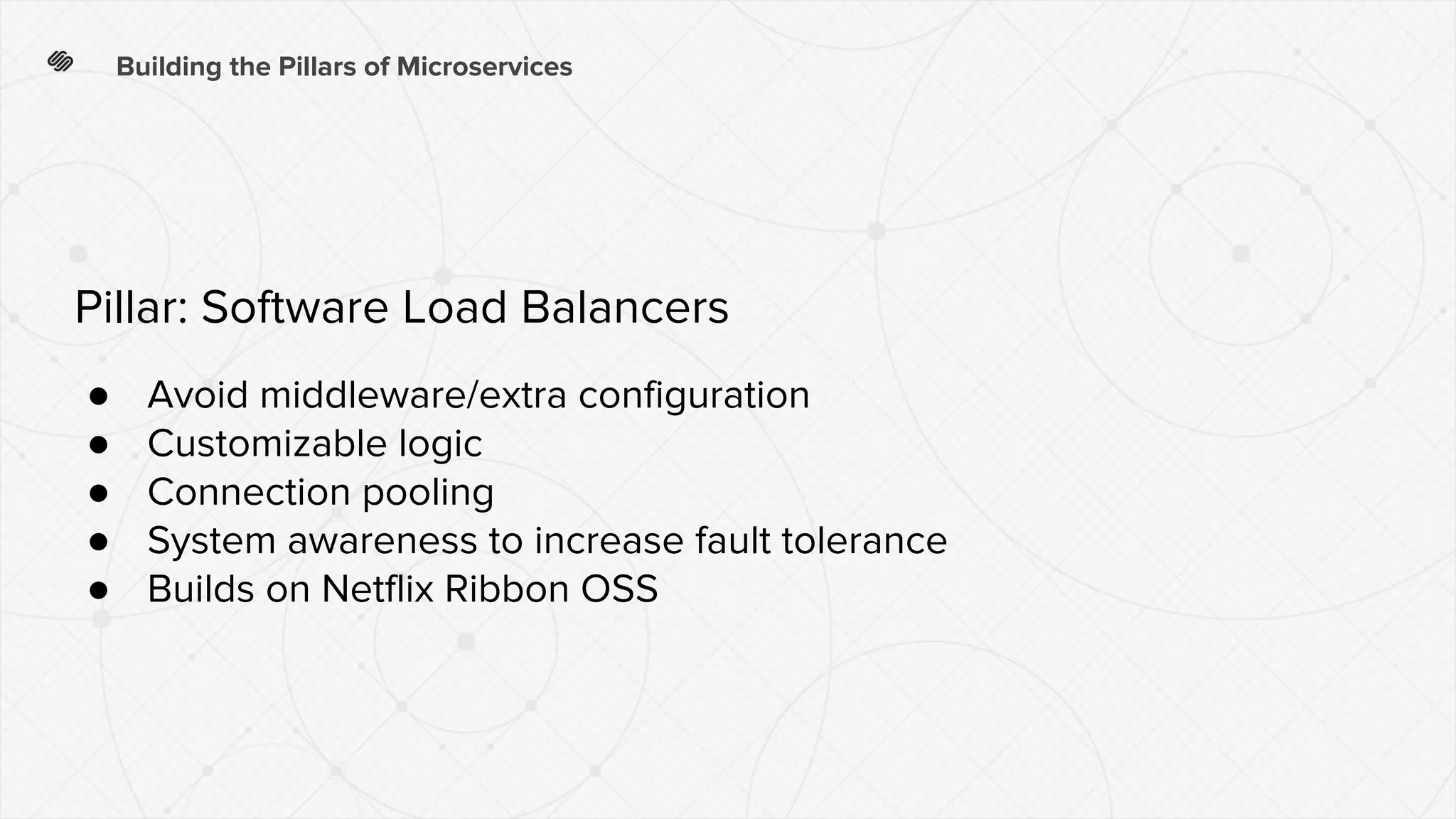
● Avoid middleware/extra configuration
● Customizable logic
● Connection pooling
● System awareness to increase fault tolerance
● Builds on Netflix Ribbon OSS
Pillar: Software Load Balancers
Building the Pillars of Microservices
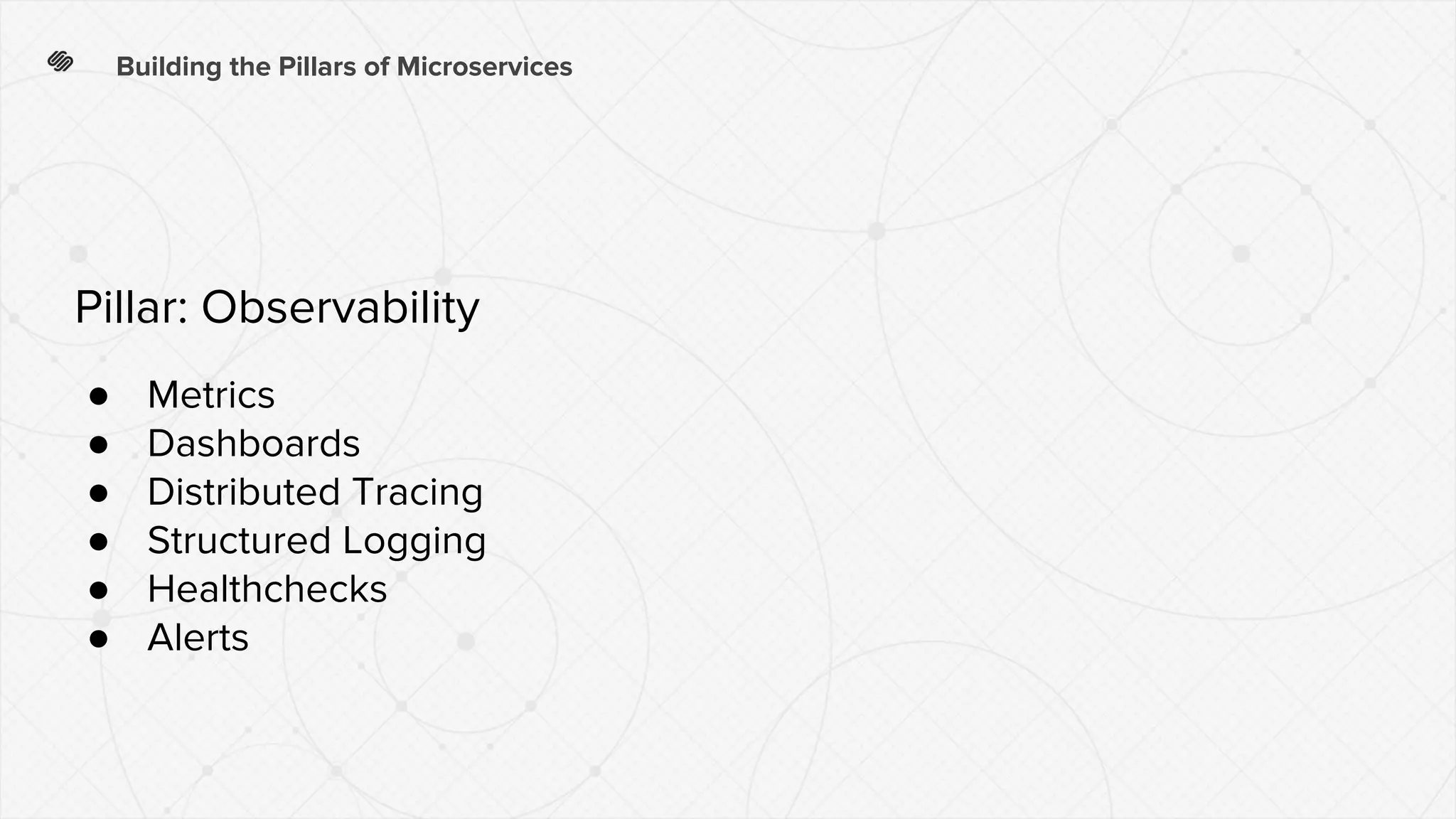
● Metrics
● Dashboards
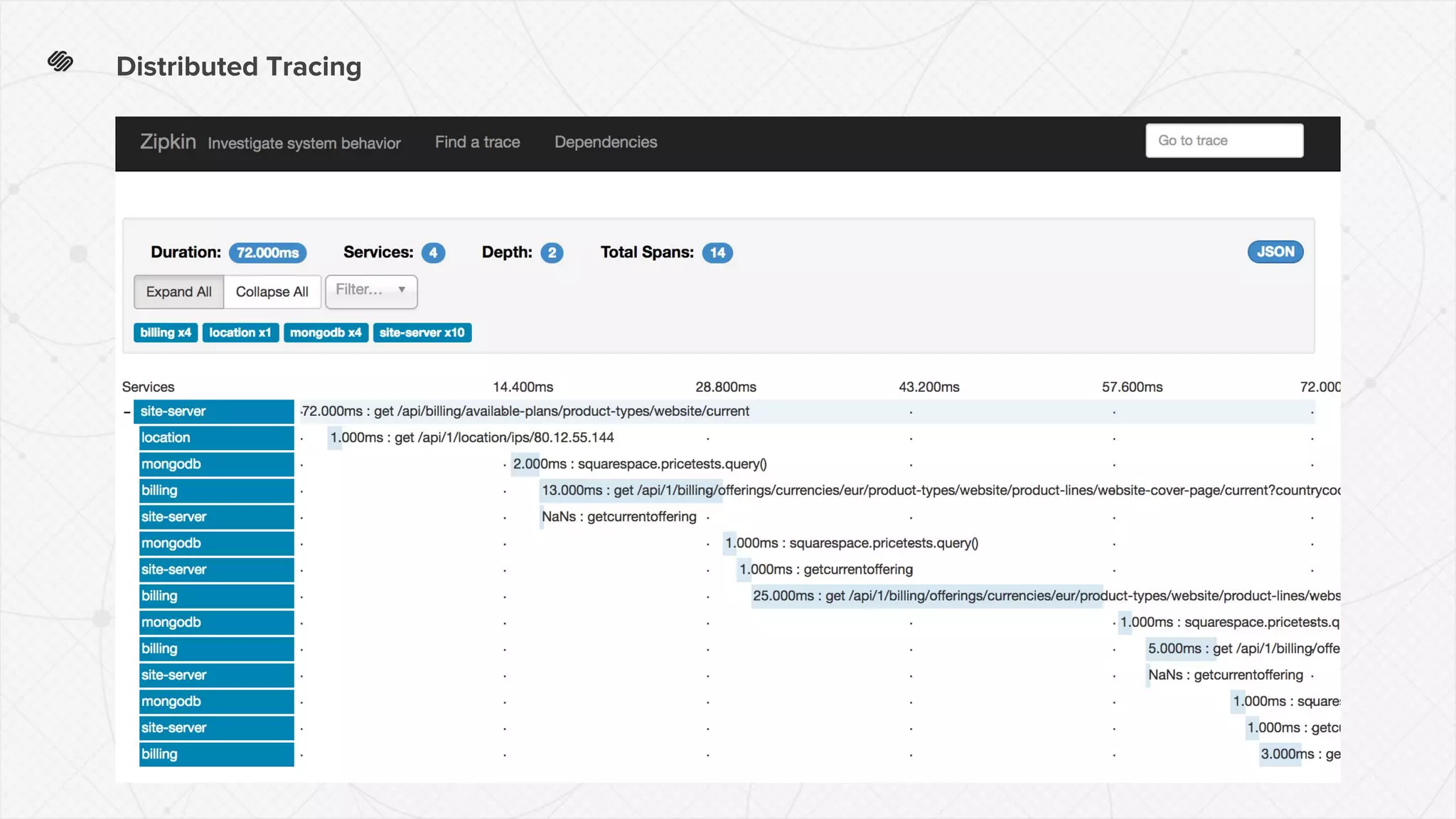
● Distributed Tracing
● Structured Logging
● Healthchecks
● Alerts
Pillar: Observability
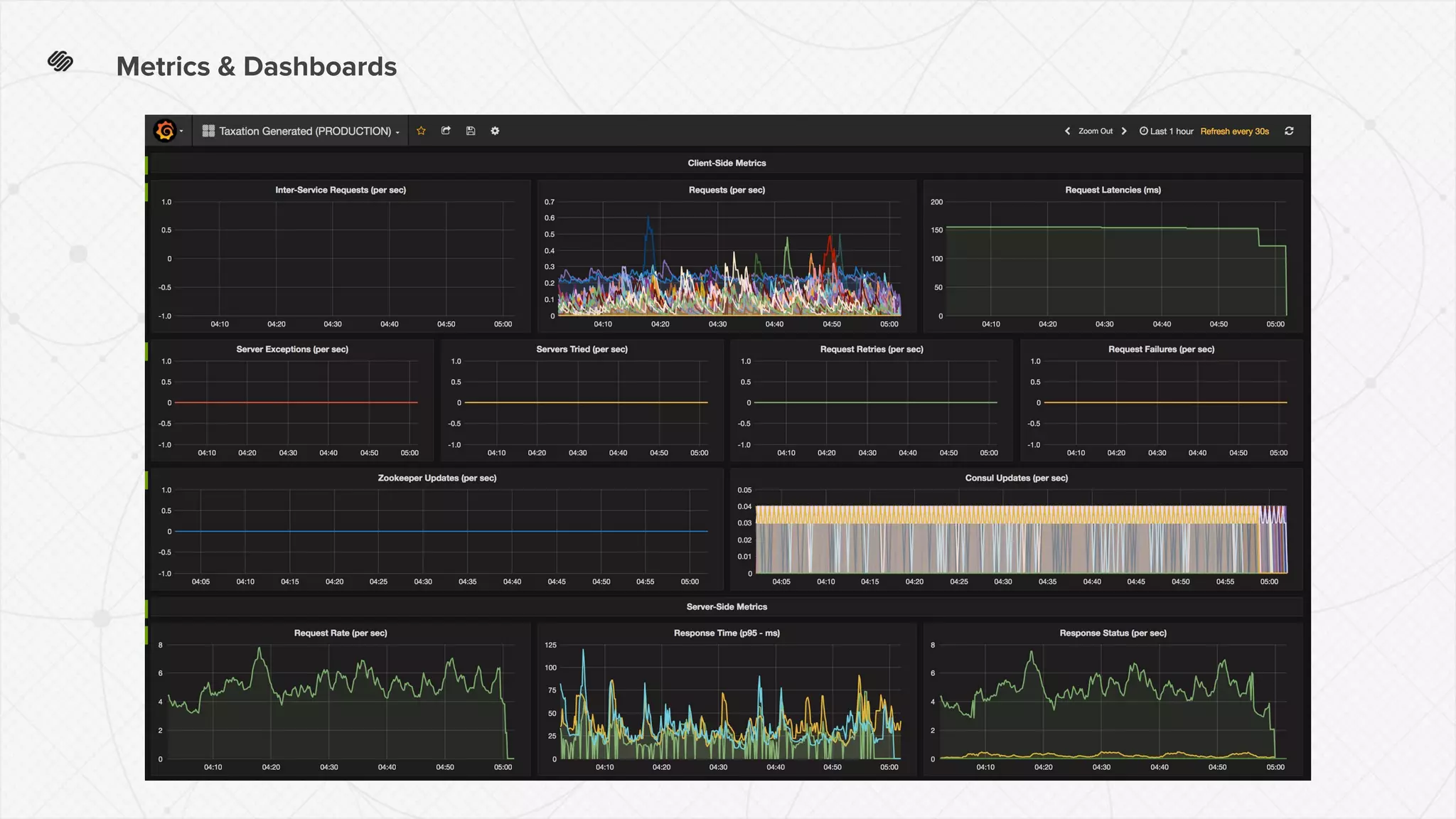
Metrics & Dashboards
Distributed Tracing
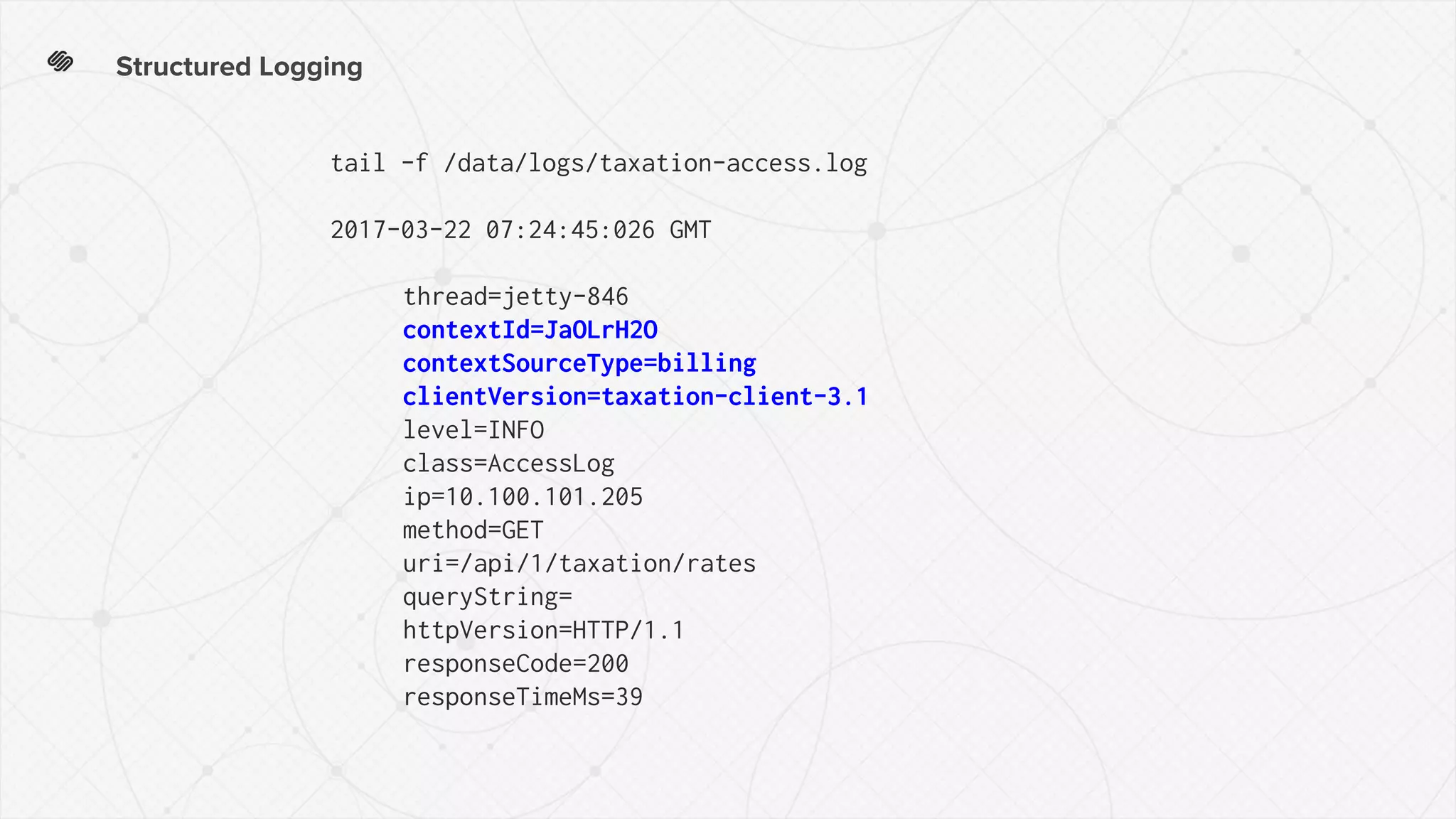
Structured Logging
tail -f /data/logs/taxation-access.log
2017-03-22 07:24:45:026 GMT
thread=jetty-846
contextId=JaOLrH2O
contextSourceType=billing
clientVersion=taxation-client-3.1
level=INFO
class=AccessLog
ip=10.100.101.205
method=GET
uri=/api/1/taxation/rates
queryString=
httpVersion=HTTP/1.1
responseCode=200
responseTimeMs=39
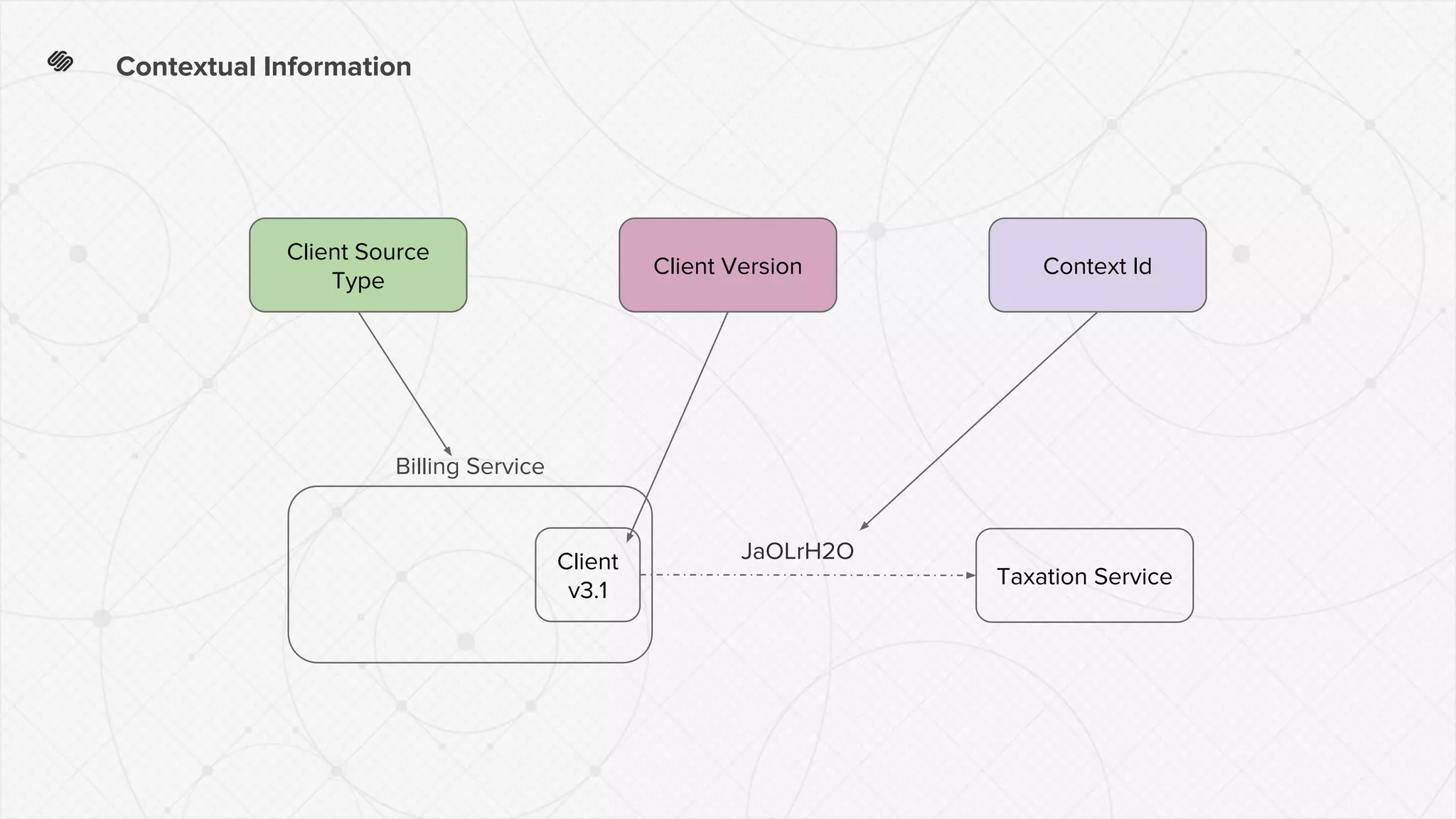
Contextual Information
Client
v3.1
Taxation Service
Billing Service
Context IdClient Version
Client Source
Type
JaOLrH2O
Building the Pillars of Microservices
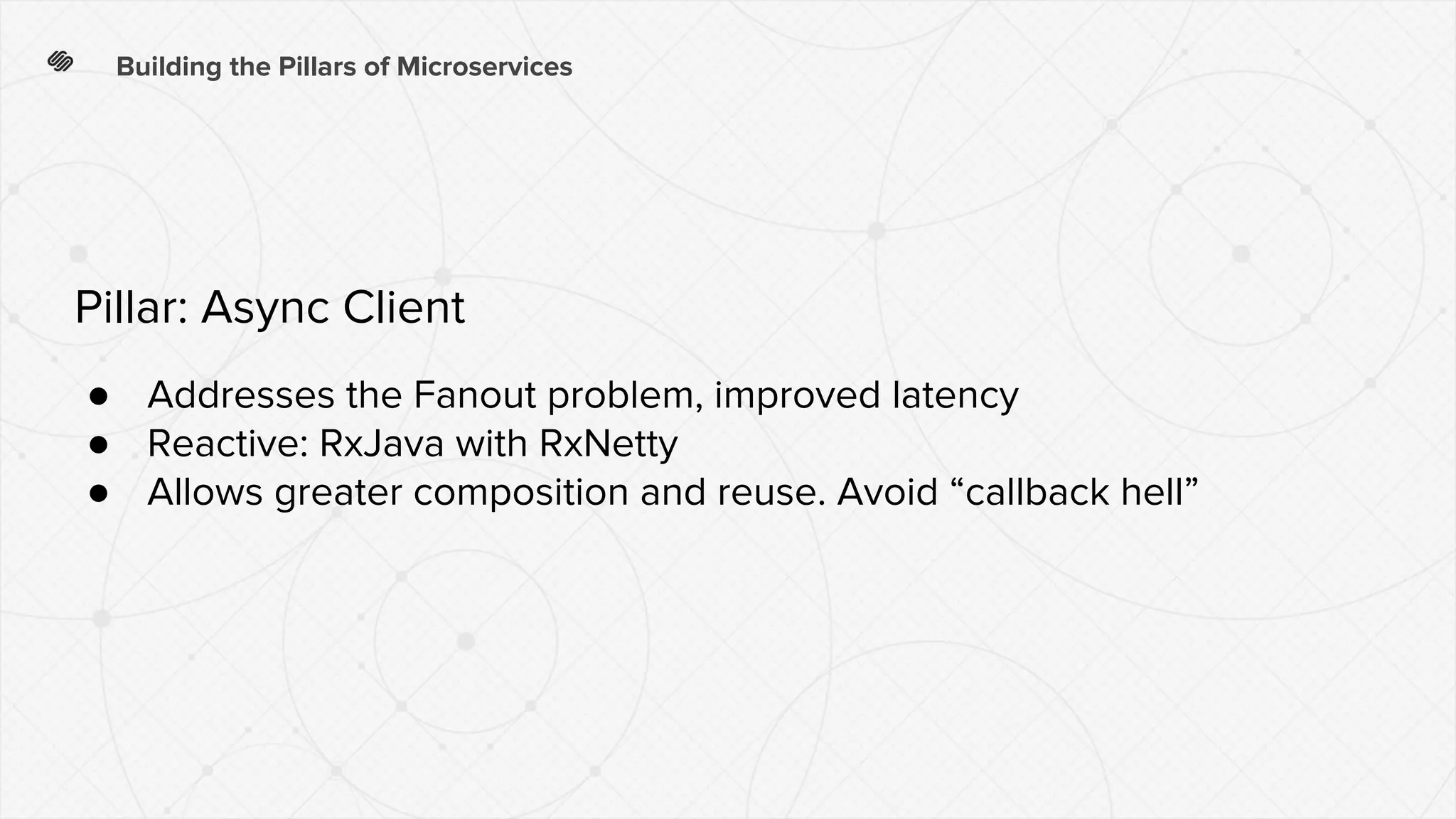
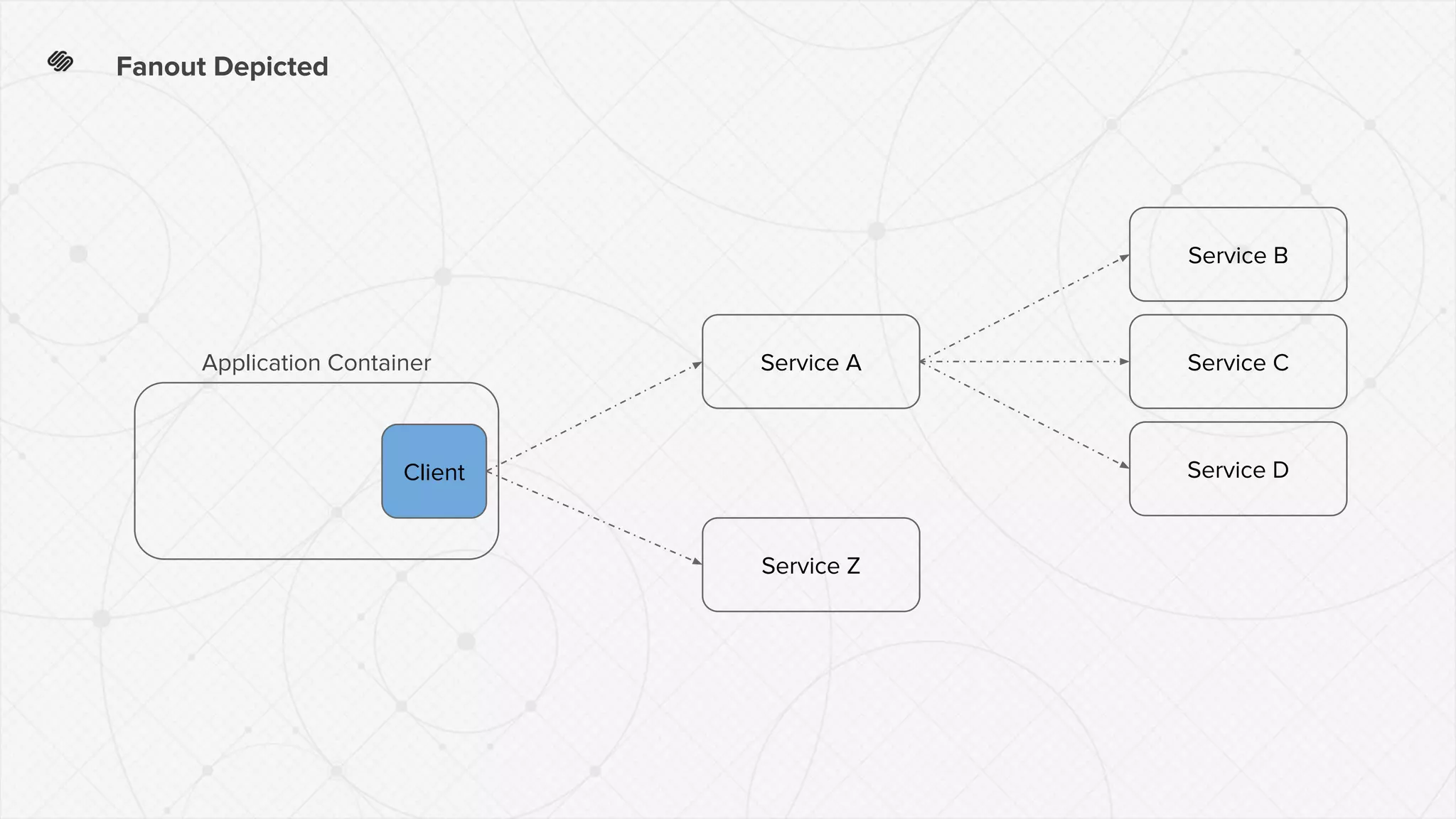
● Addresses the Fanout problem, improved latency
● Reactive: RxJava with RxNetty
● Allows greater composition and reuse. Avoid “callback hell”
Pillar: Async Client
Fanout Depicted
Client
Service A
Service Z
Application Container
Service B
Service C
Service D
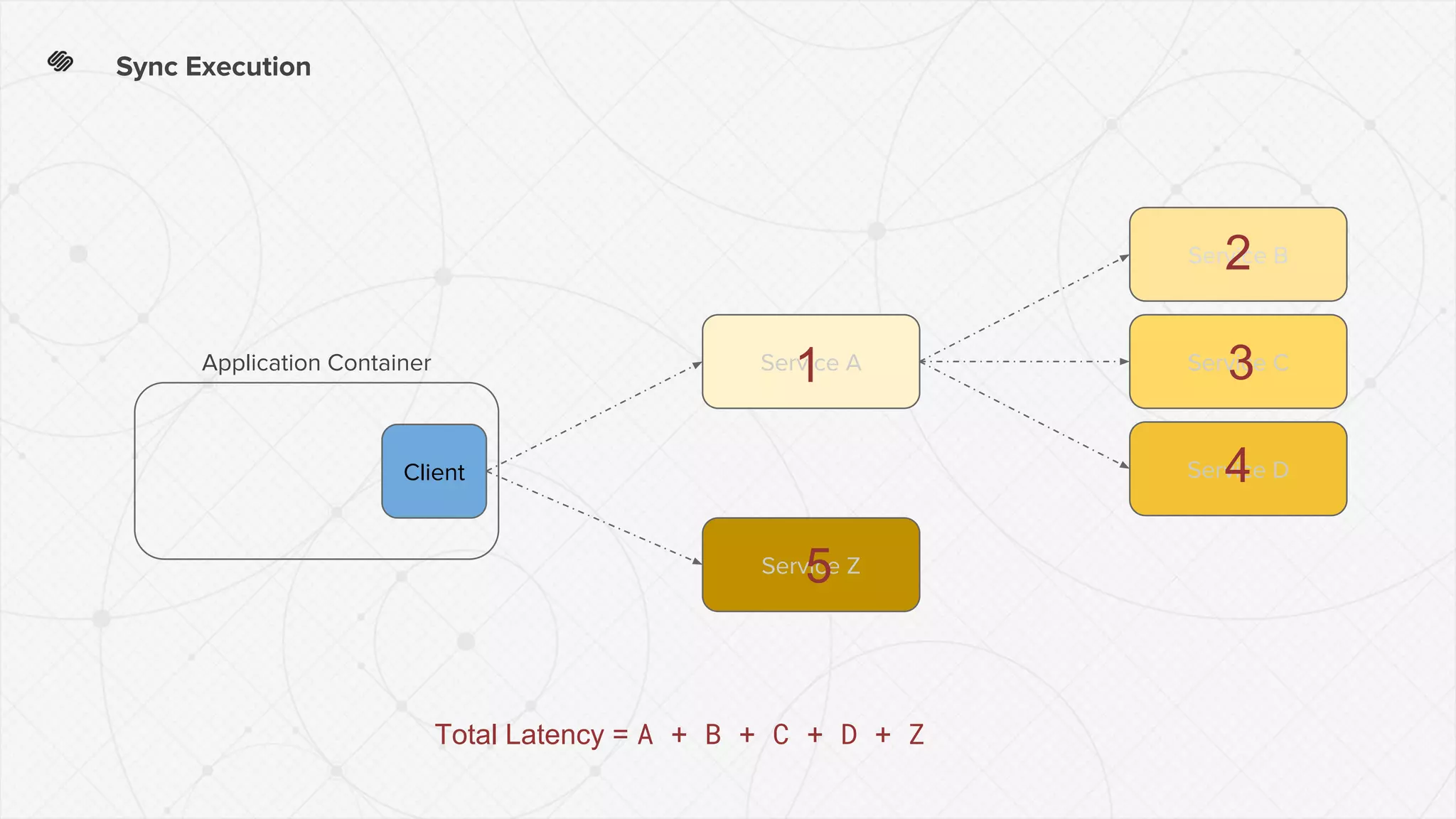
Sync Execution
Client
Service A
Service Z
Application Container
Service B
Service C
Service D
1
2
3
4
5
Total Latency = A + B + C + D + Z
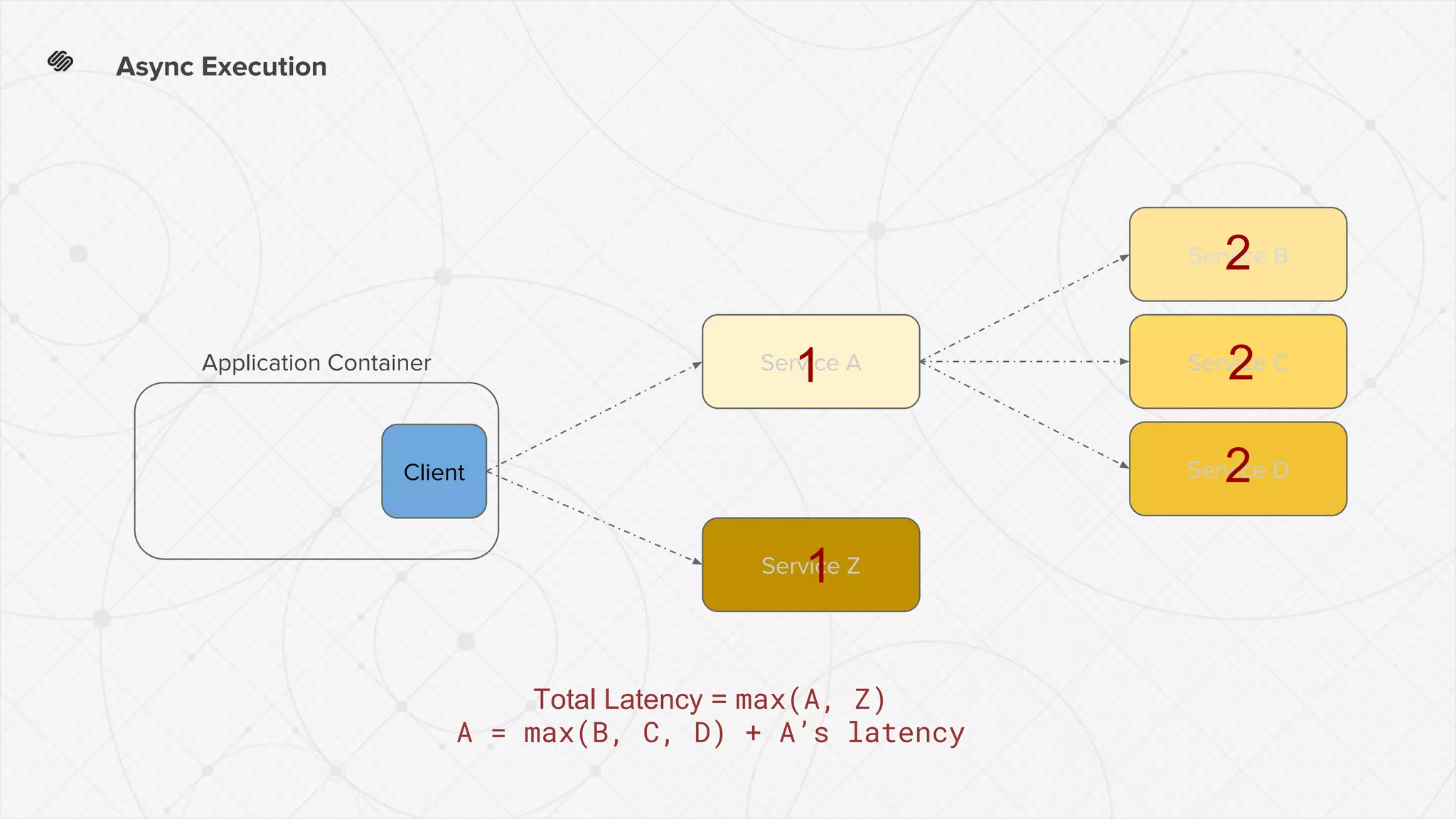
Async Execution
Client
Service A
Service Z
Application Container
Service B
Service C
Service D
1
2
2
2
1
Total Latency = max(A, Z)
A = max(B, C, D) + A’s latency
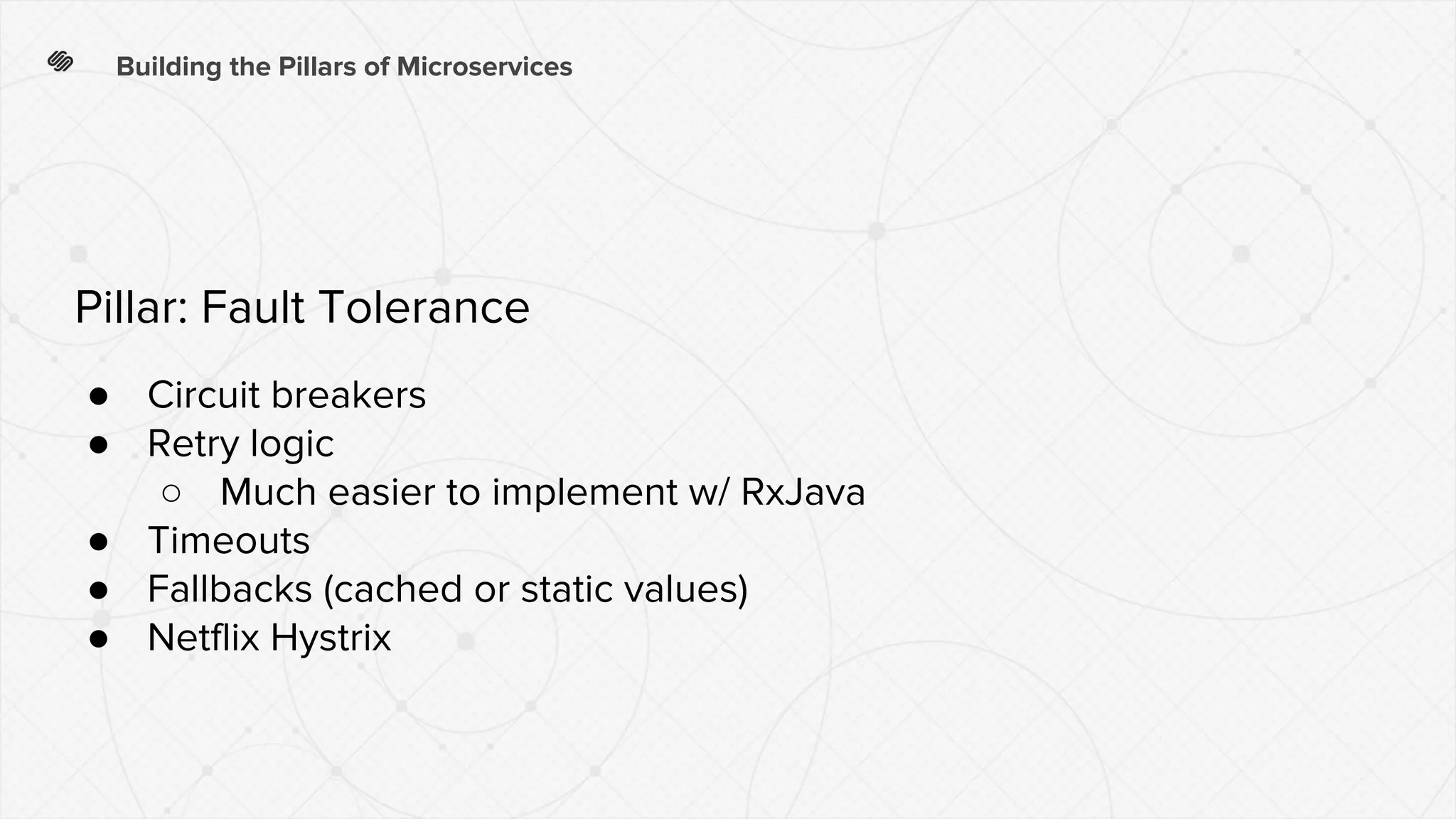
Building the Pillars of Microservices
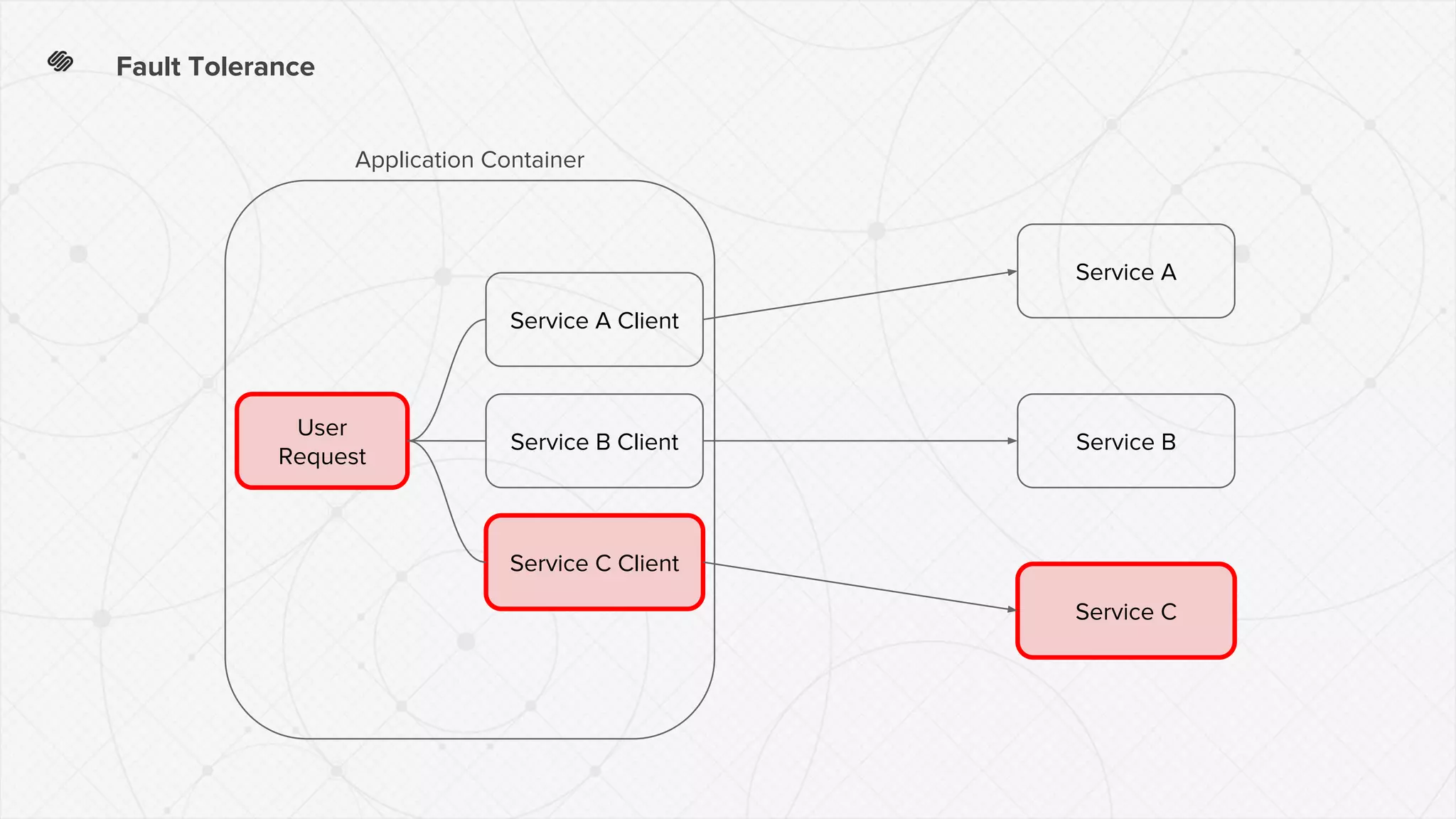
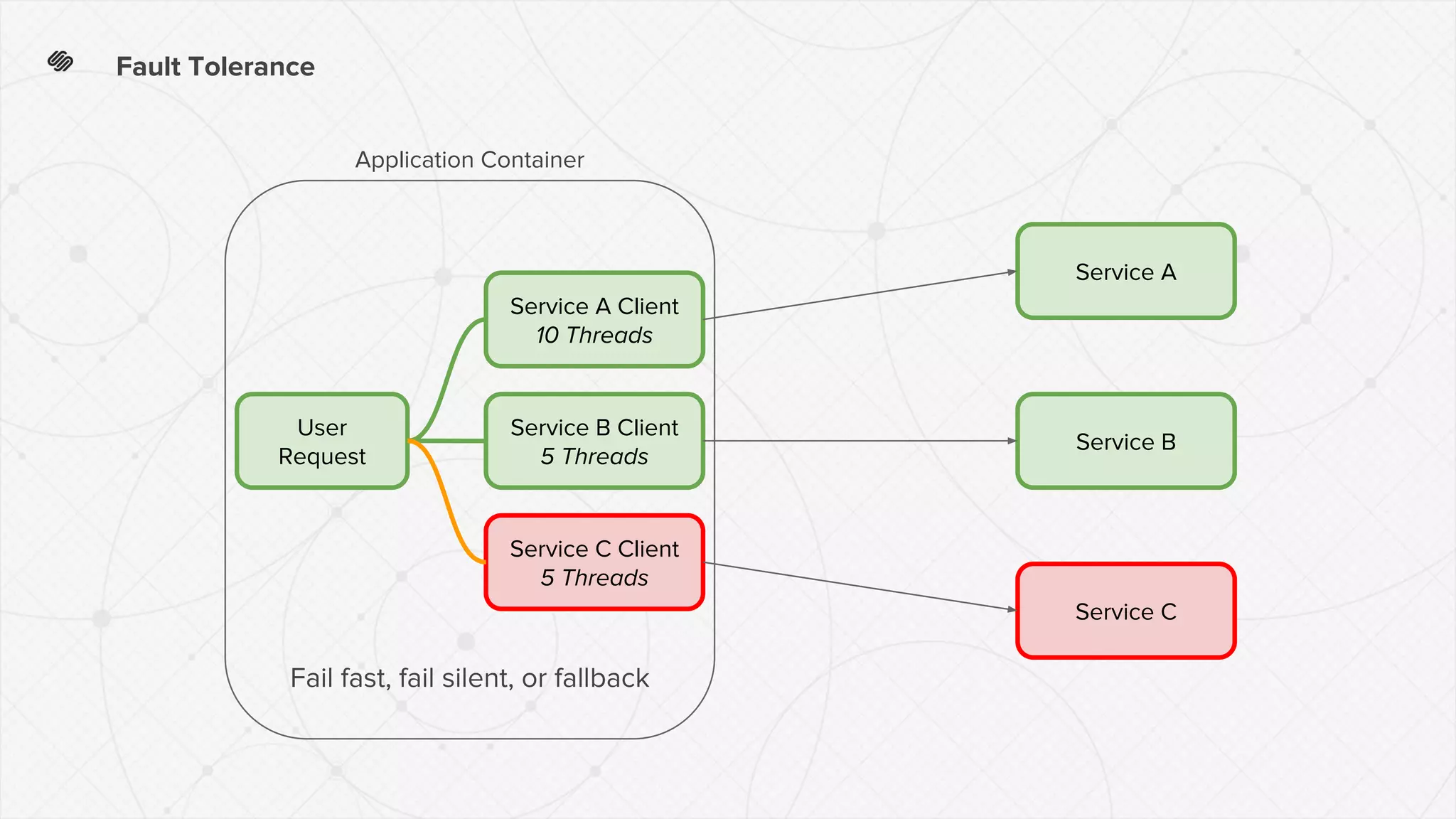
● Circuit breakers
● Retry logic
○ Much easier to implement w/ RxJava
● Timeouts
● Fallbacks (cached or static values)
● Netflix Hystrix
Pillar: Fault Tolerance
Fault Tolerance
Service B
Service A
Service C
Service A Client
Service B Client
Service C Client
User
Request
Application Container
Fault Tolerance
Service B
Service A
Service C
Service A Client
10 Threads
Service B Client
5 Threads
Service C Client
5 Threads
User
Request
Fail fast, fail silent, or fallback
Application Container
Pillars
Microservice Framework
HTTP API
Service
Discovery
Software Load
Balancer
Observability Async Client Fault Tolerance
https://engineering.squarespace.com/blog/2017/the-pill
ars-of-squarespace-services
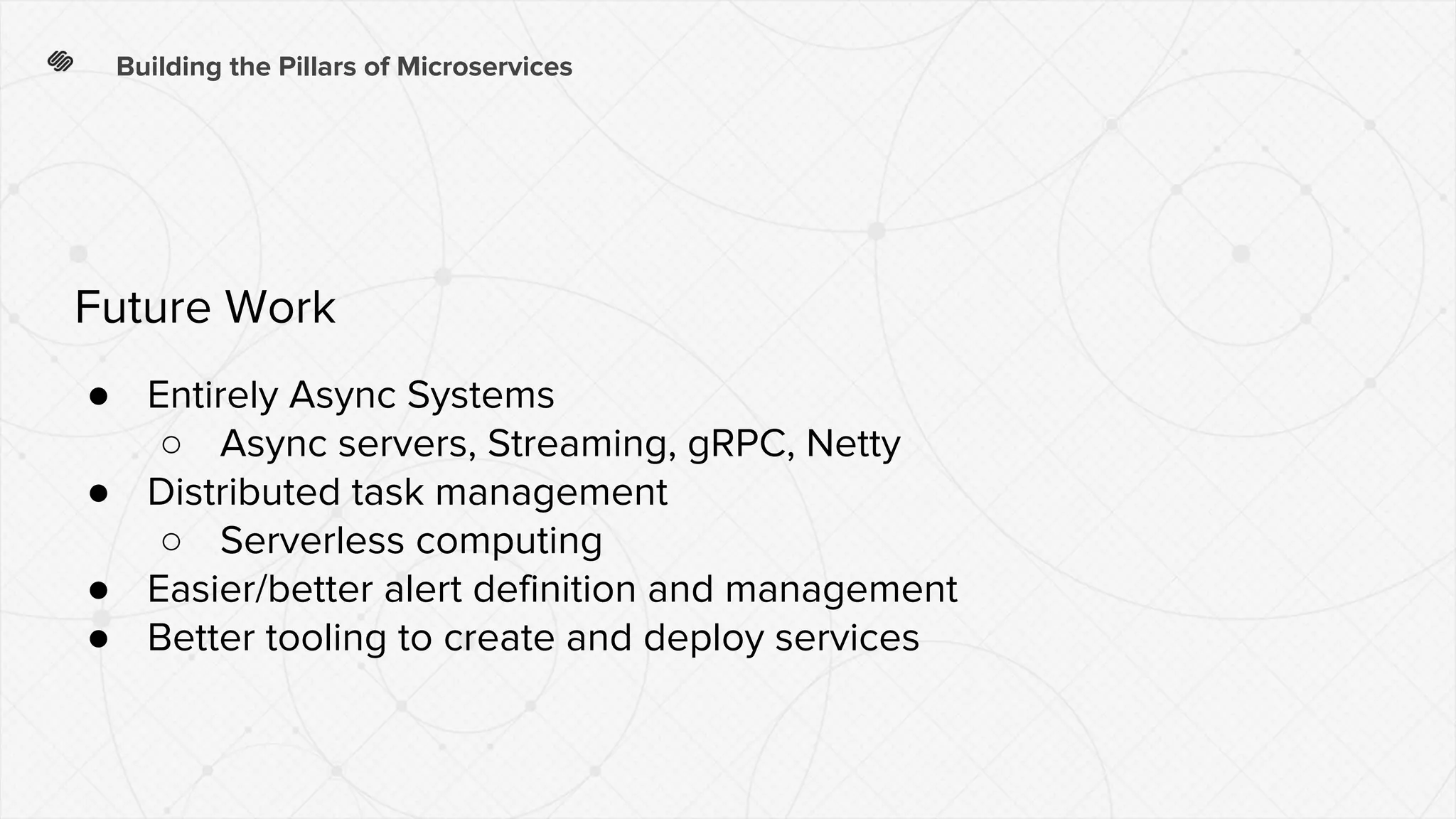
Building the Pillars of Microservices
● Entirely Async Systems
○ Async servers, Streaming, gRPC, Netty
● Distributed task management
○ Serverless computing
● Easier/better alert definition and management
● Better tooling to create and deploy services
Future Work
Part 2: Containerization & Kubernetes Orchestration
01
The problem with static infrastructure
02
Kubernetes in a datacenter?
03
Challenges
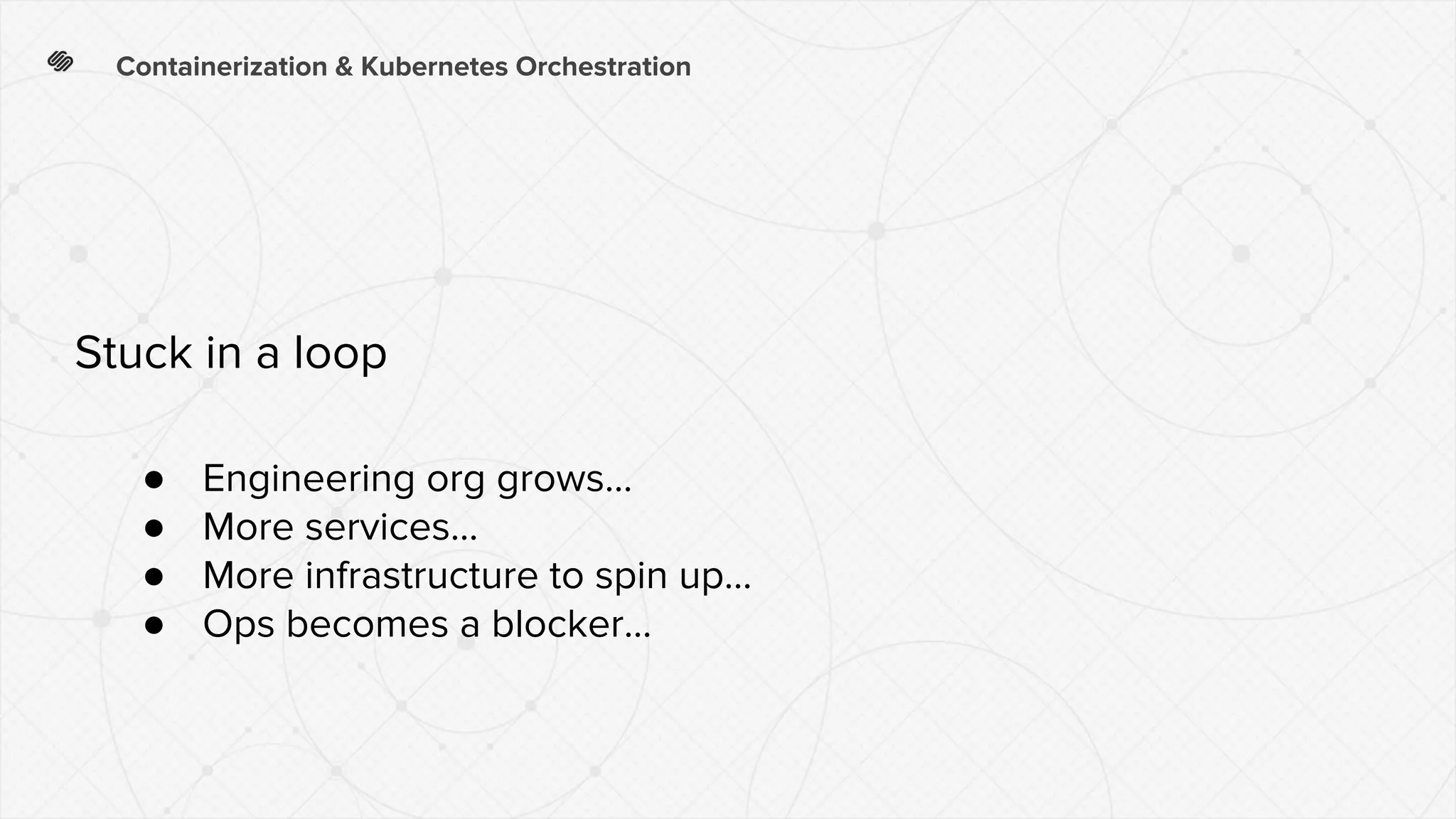
Containerization & Kubernetes Orchestration
● Engineering org grows...
● More services…
● More infrastructure to spin up…
● Ops becomes a blocker...
Stuck in a loop
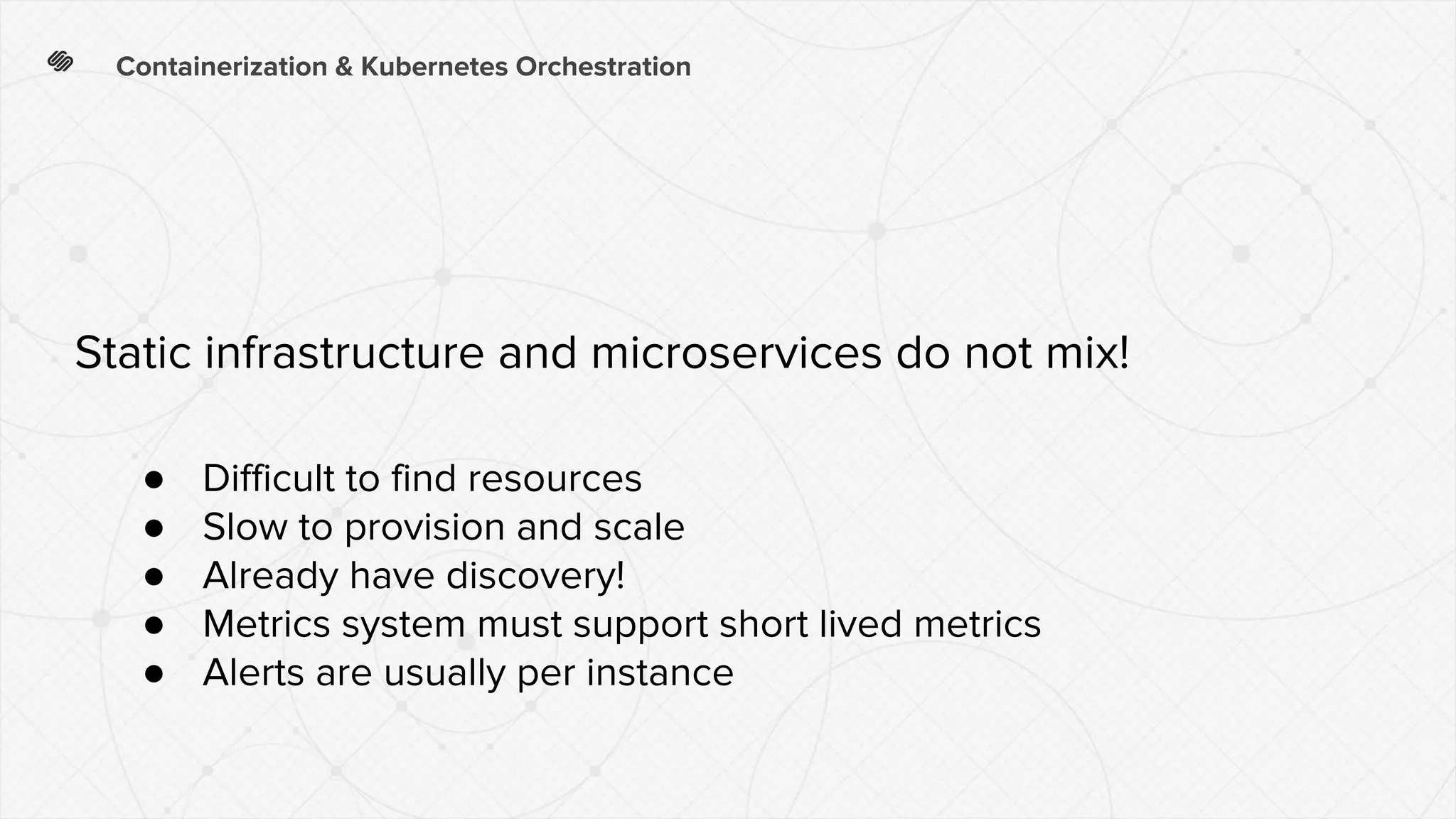
Containerization & Kubernetes Orchestration
● Difficult to find resources
● Slow to provision and scale
● Already have discovery!
● Metrics system must support short lived metrics
● Alerts are usually per instance
Static infrastructure and microservices do not mix!
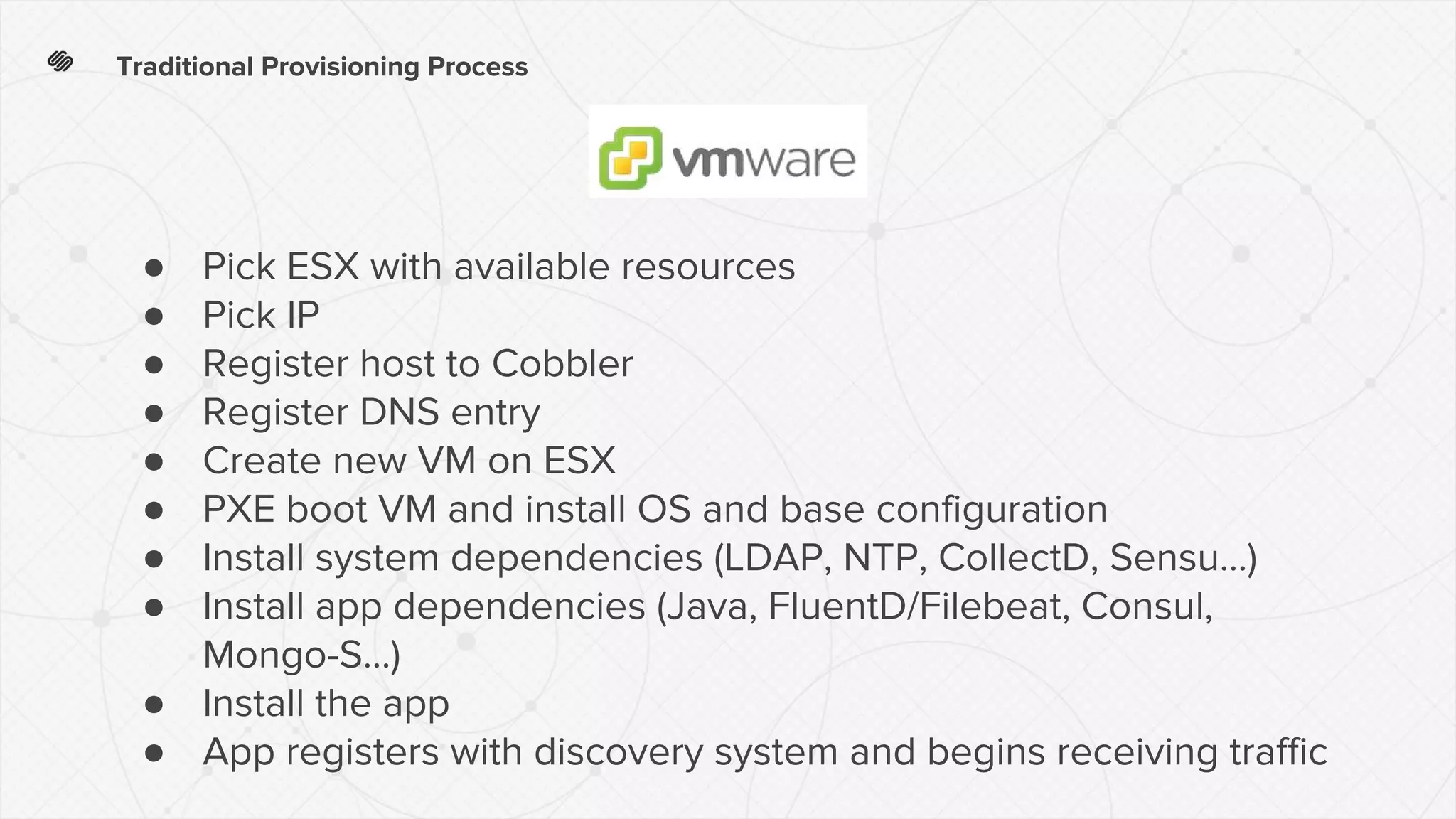
Traditional Provisioning Process
● Pick ESX with available resources
● Pick IP
● Register host to Cobbler
● Register DNS entry
● Create new VM on ESX
● PXE boot VM and install OS and base configuration
● Install system dependencies (LDAP, NTP, CollectD, Sensu…)
● Install app dependencies (Java, FluentD/Filebeat, Consul,
Mongo-S…)
● Install the app
● App registers with discovery system and begins receiving traffic
Kubernetes Provisioning Process
● kubectl apply -f app.yaml
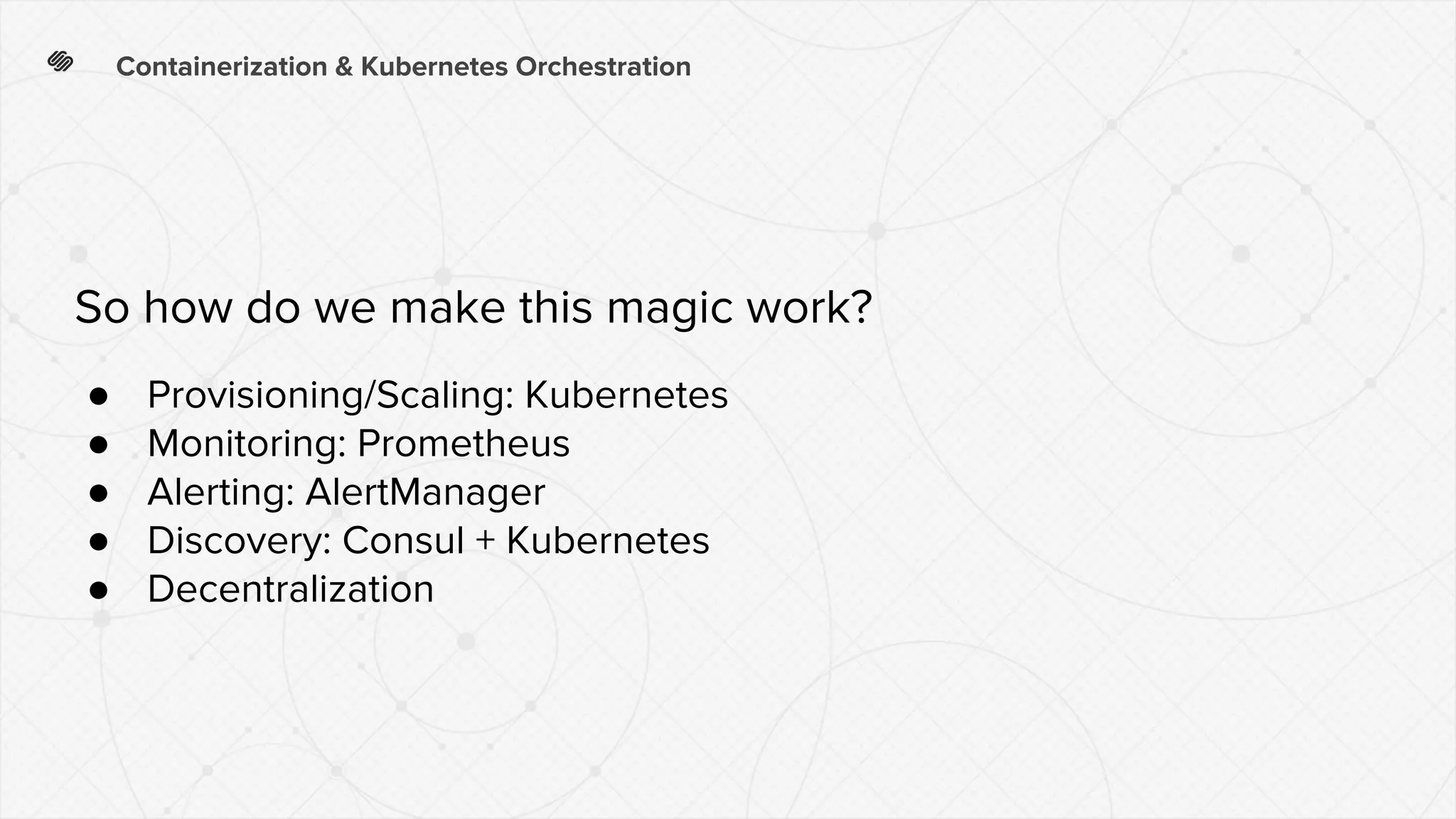
Containerization & Kubernetes Orchestration
● Provisioning/Scaling: Kubernetes
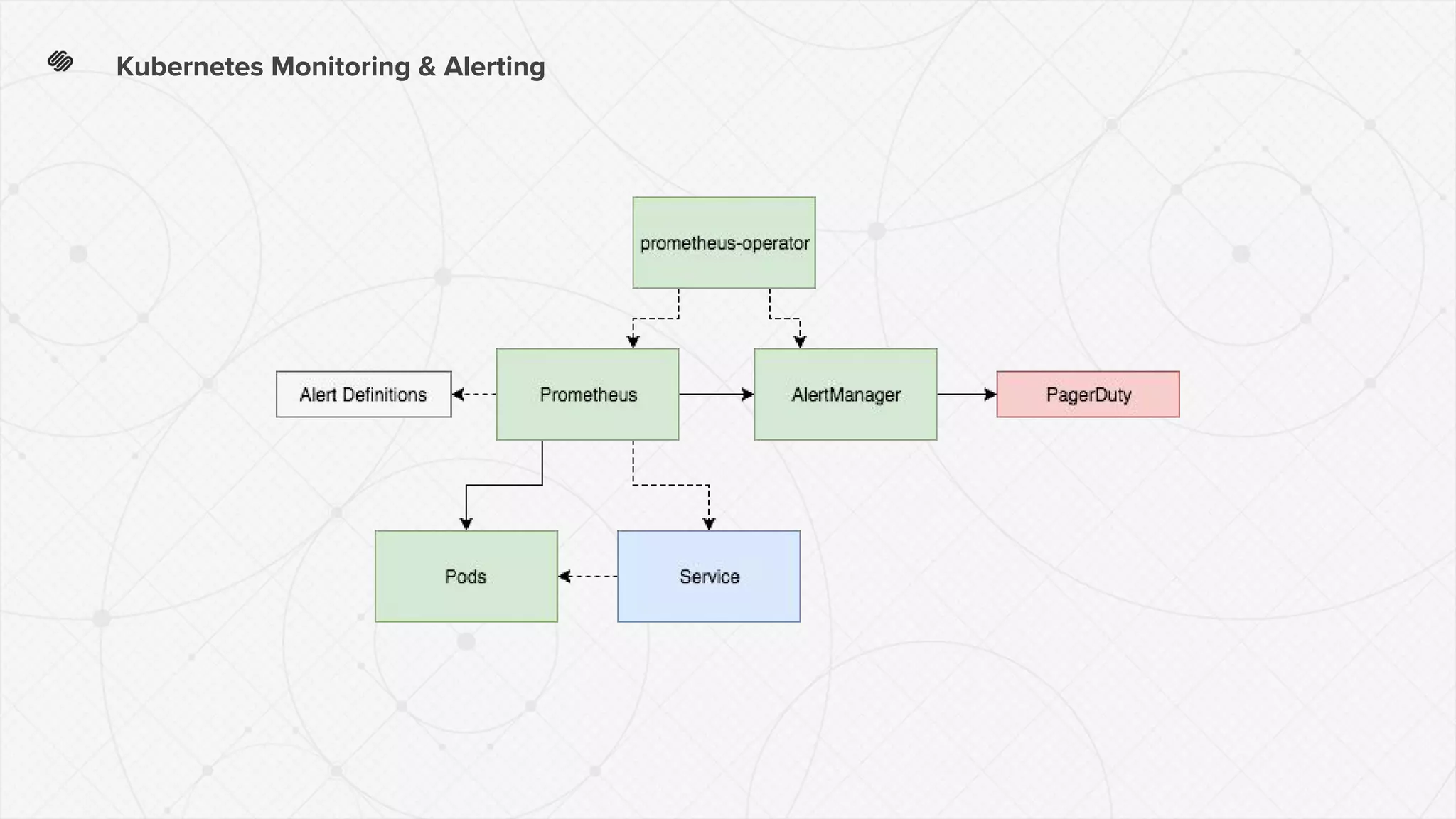
● Monitoring: Prometheus
● Alerting: AlertManager
● Discovery: Consul + Kubernetes
● Decentralization
So how do we make this magic work?
Kubernetes in a datacenter?
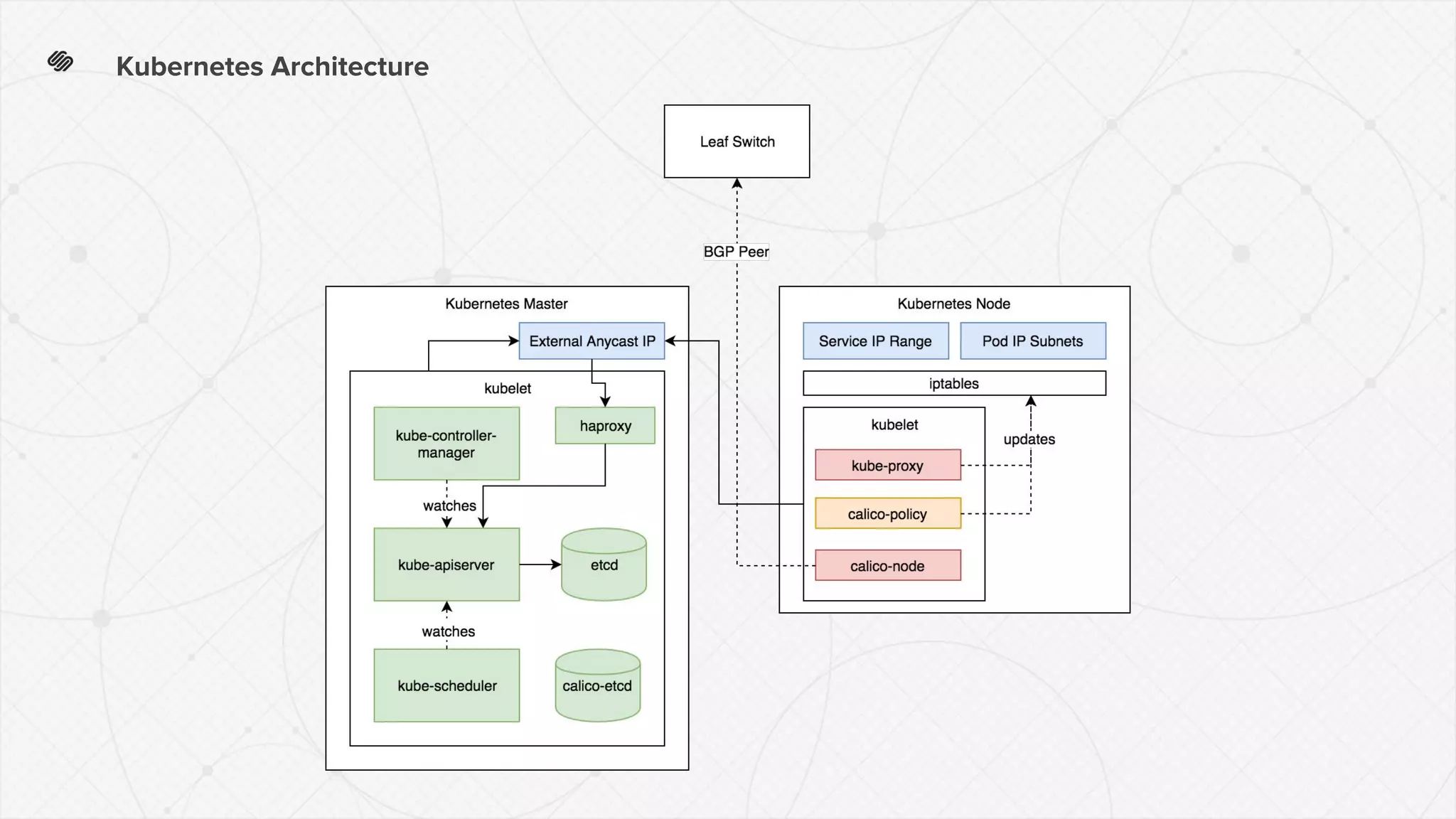
Kubernetes Architecture
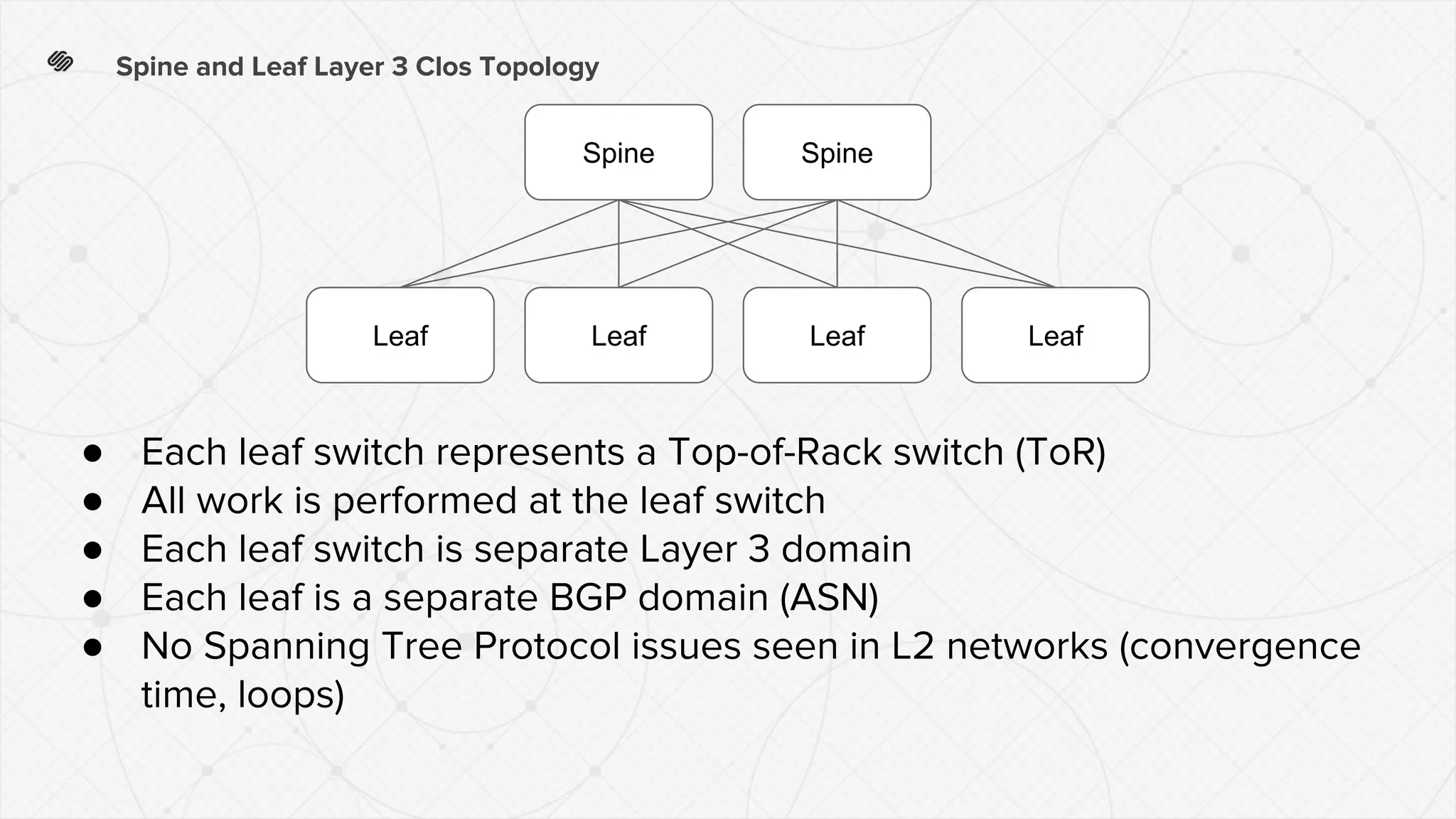
Spine and Leaf Layer 3 Clos Topology
● Each leaf switch represents a Top-of-Rack switch (ToR)
● All work is performed at the leaf switch
● Each leaf switch is separate Layer 3 domain
● Each leaf is a separate BGP domain (ASN)
● No Spanning Tree Protocol issues seen in L2 networks (convergence
time, loops)
Leaf Leaf Leaf Leaf
Spine Spine
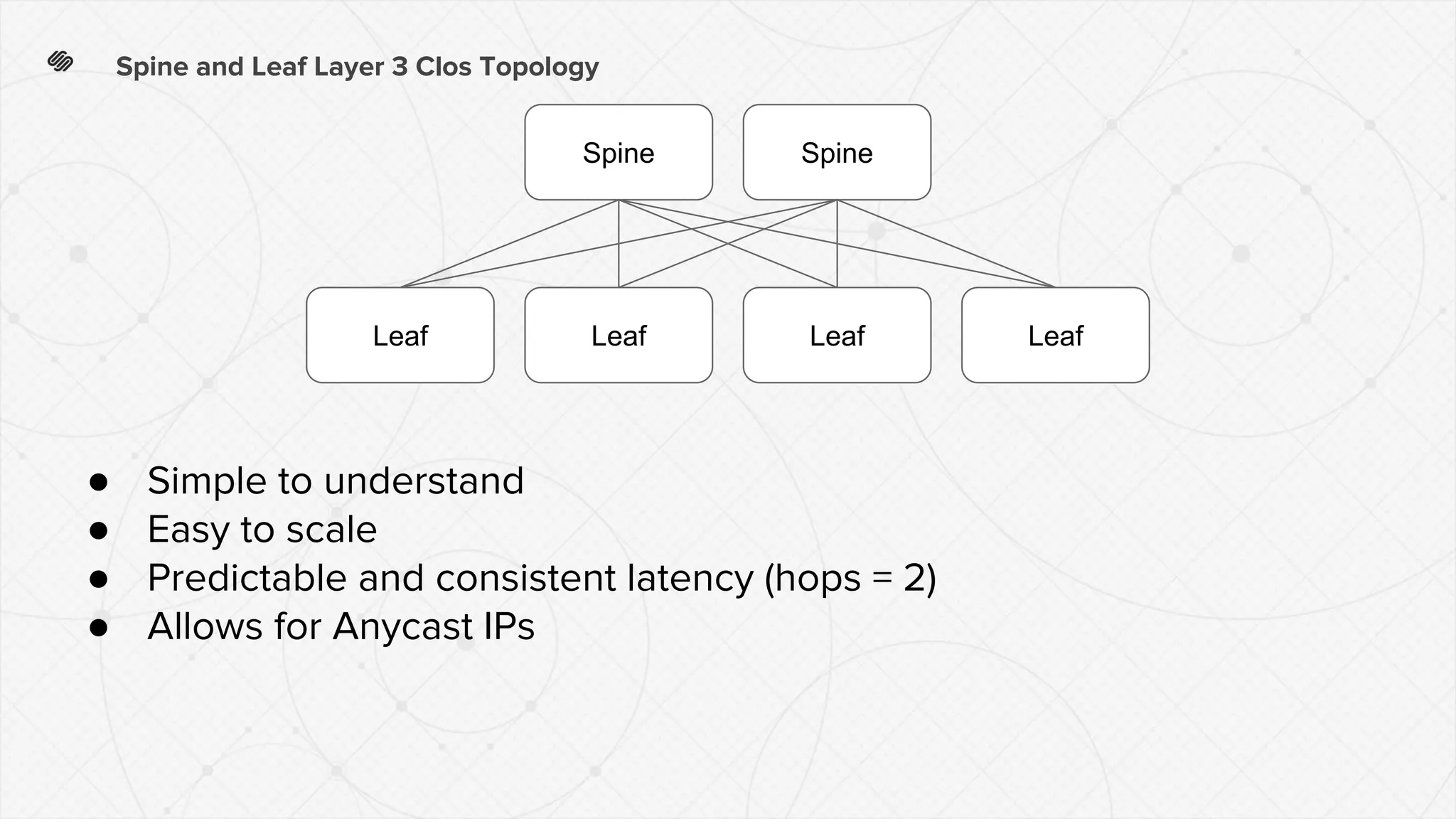
Spine and Leaf Layer 3 Clos Topology
● Simple to understand
● Easy to scale
● Predictable and consistent latency (hops = 2)
● Allows for Anycast IPs
Leaf Leaf Leaf Leaf
Spine Spine
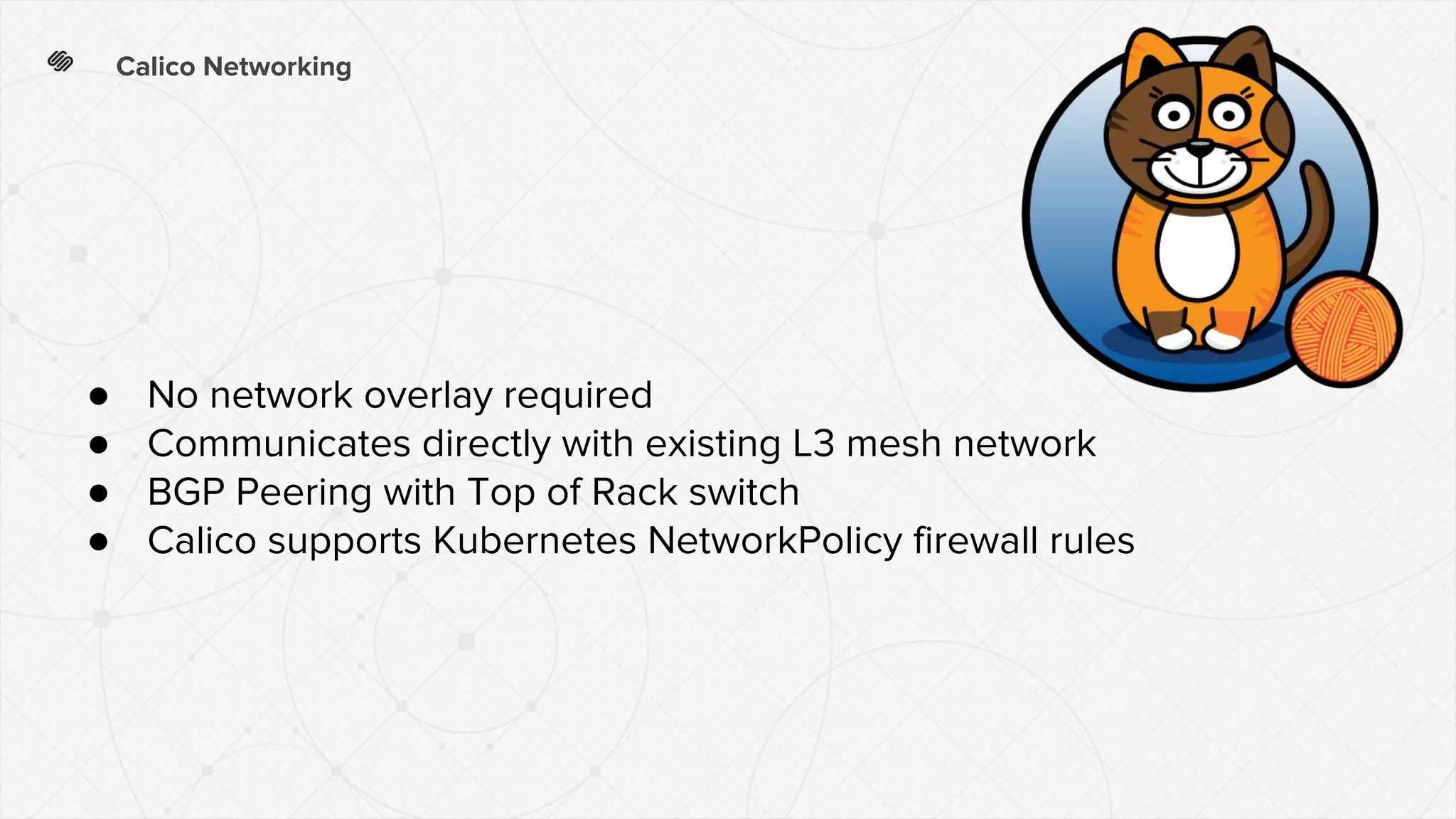
Calico Networking
● No network overlay required
● Communicates directly with existing L3 mesh network
● BGP Peering with Top of Rack switch
● Calico supports Kubernetes NetworkPolicy firewall rules
Monitoring
● Graphite does not scale well with ephemeral instances
● Easy to have combinatoric explosion of metrics
Traditional Monitoring & Alerting
● Application and system alerts are tightly coupled
● Difficult to create alerts on SLAs
● Difficult to route alerts
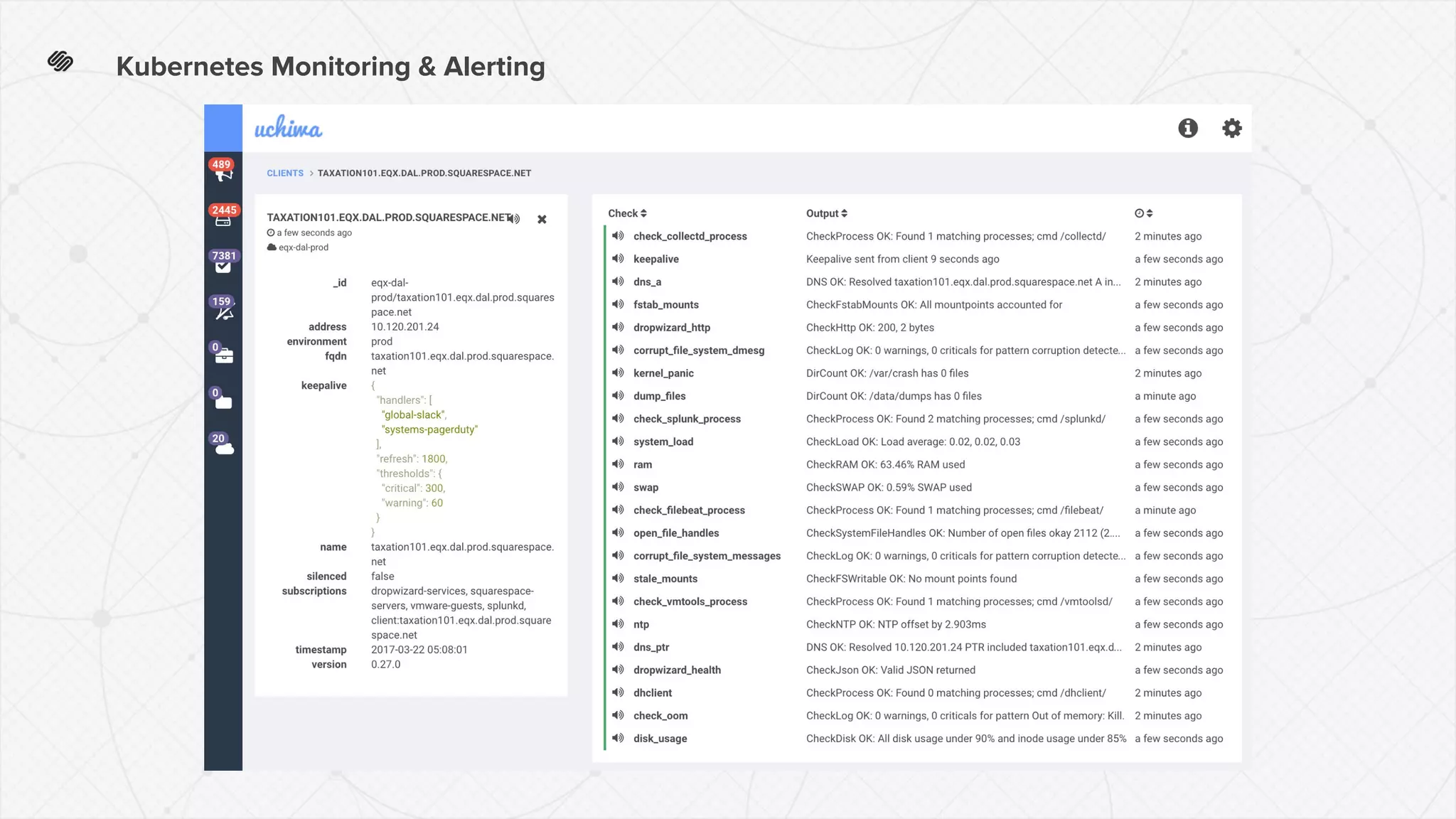
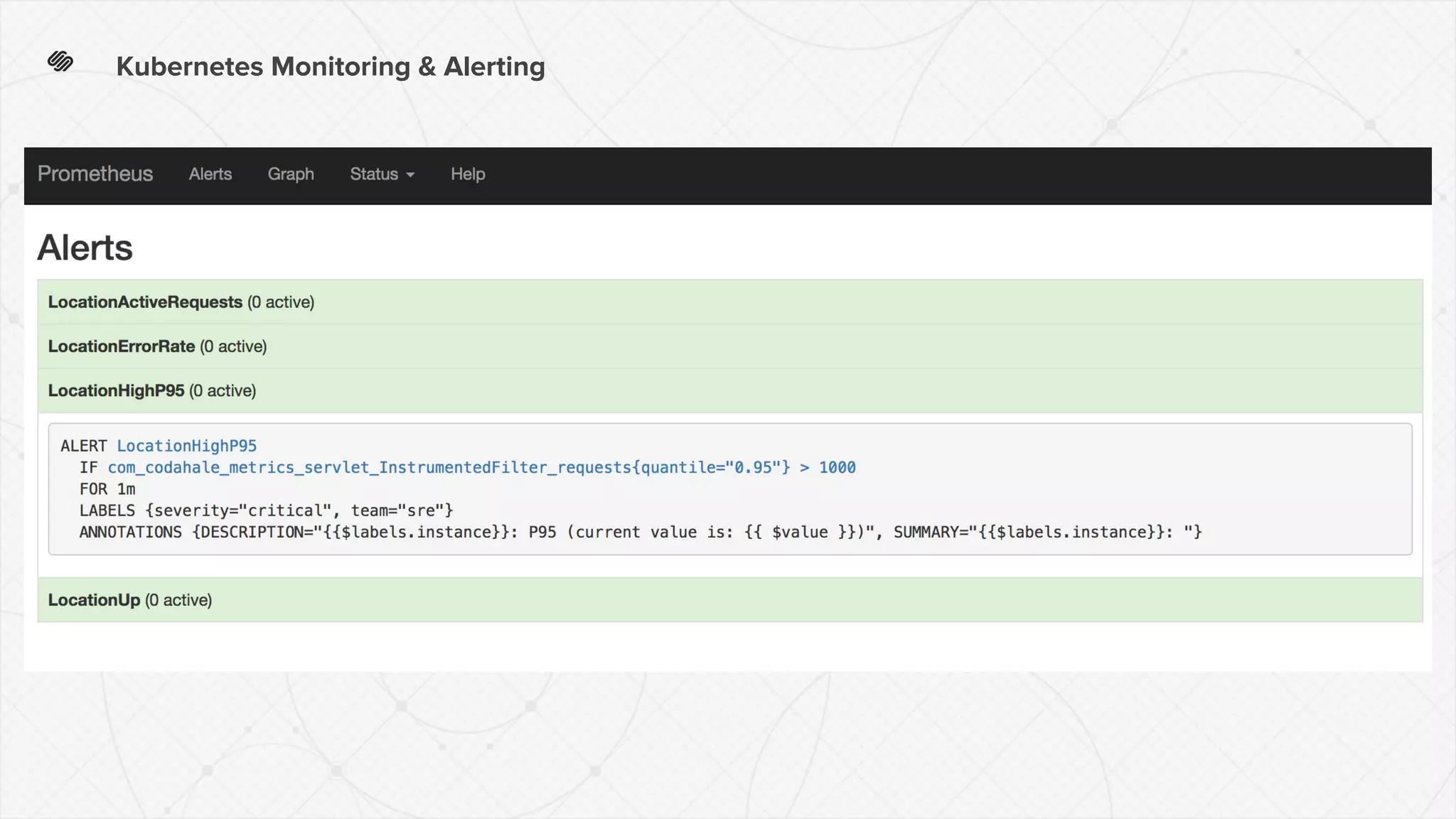
Kubernetes Monitoring & Alerting
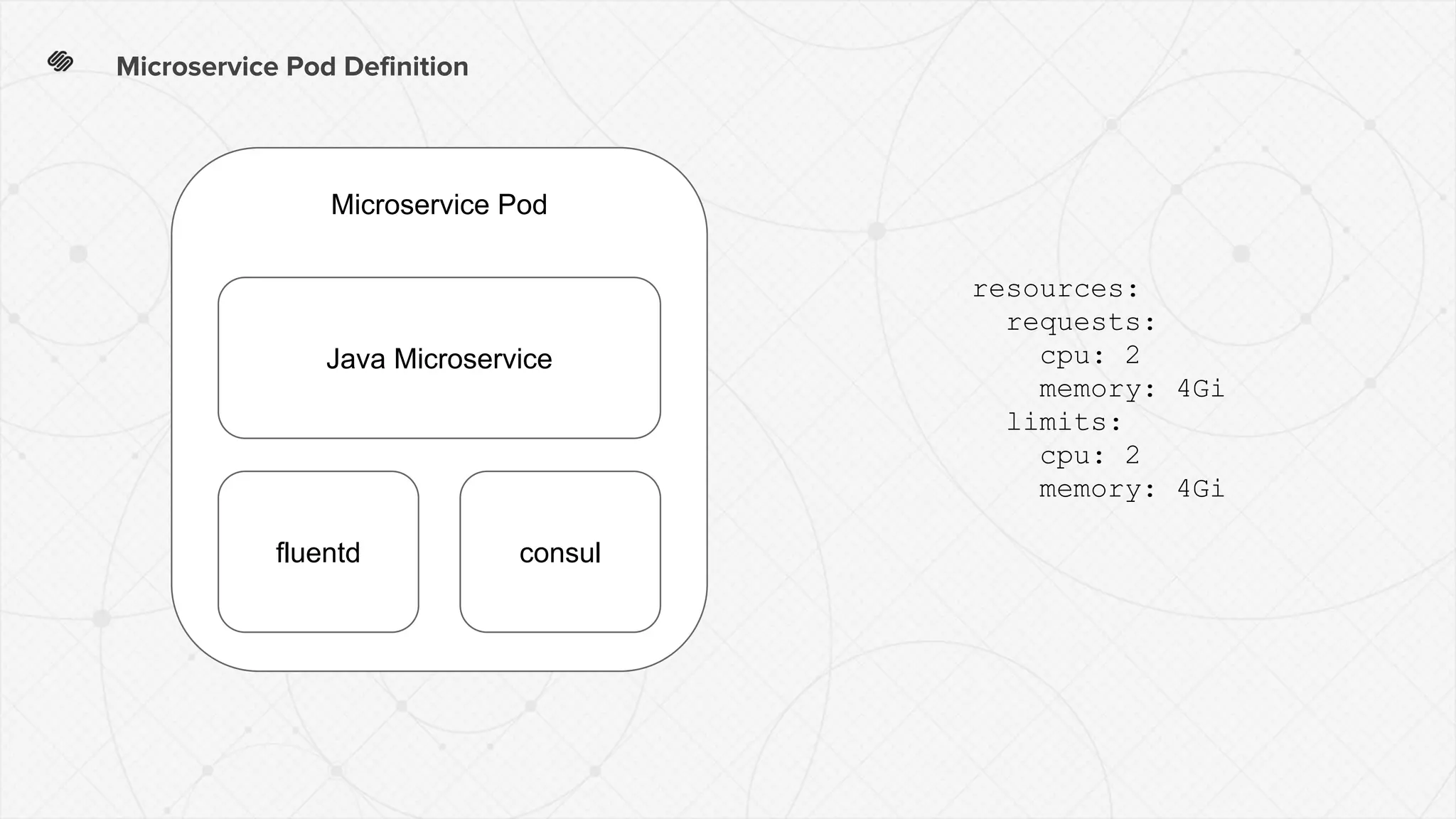
Microservice Pod Definition
resources:
requests:
cpu: 2
memory: 4Gi
limits:
cpu: 2
memory: 4Gi
Microservice Pod
Java Microservice
fluentd consul
Challenges
Microservice Pod Definition
resources:
requests:
cpu: 2
memory: 4Gi
limits:
cpu: 2
memory: 4Gi
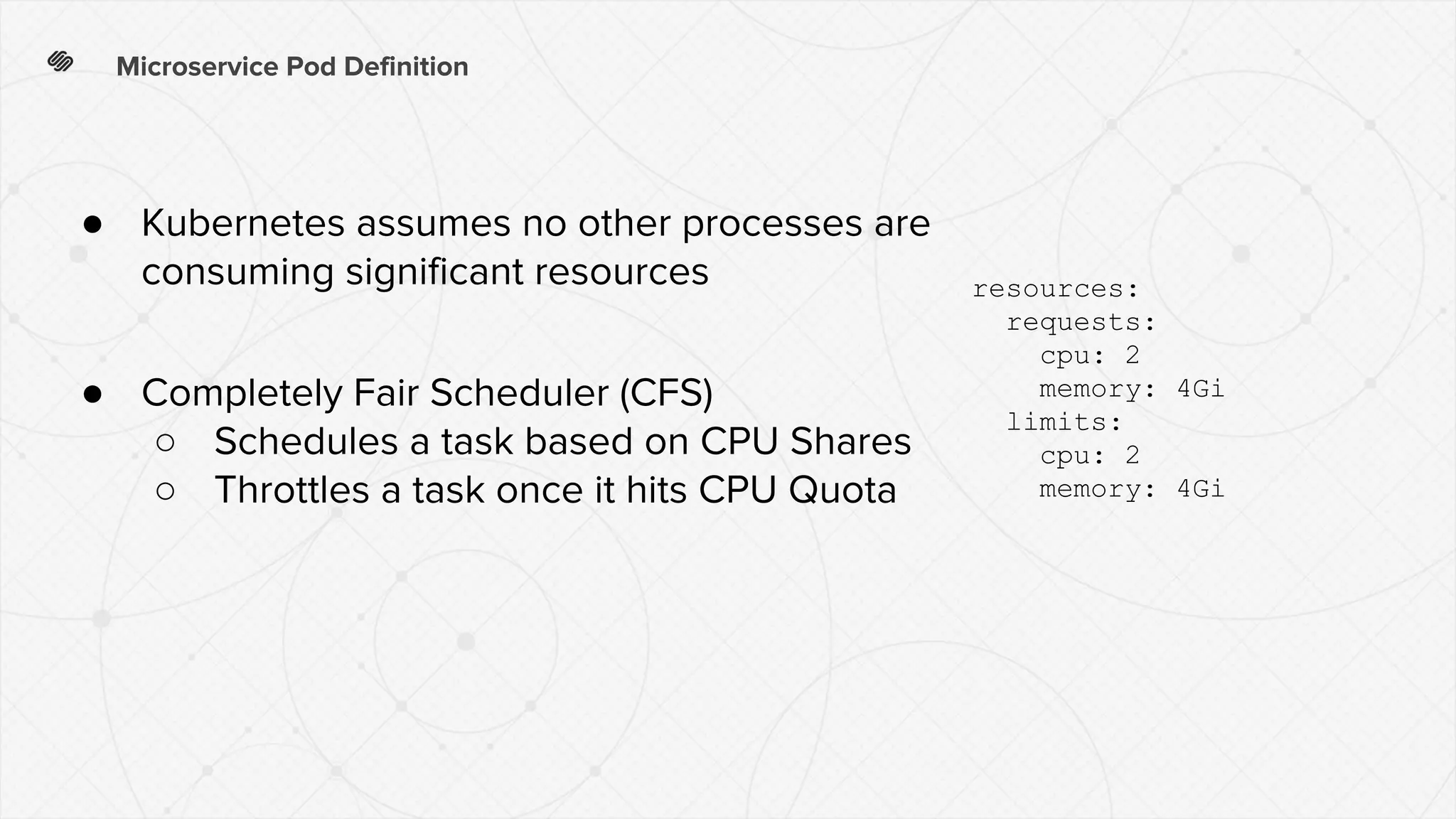
● Kubernetes assumes no other processes are
consuming significant resources
● Completely Fair Scheduler (CFS)
○ Schedules a task based on CPU Shares
○ Throttles a task once it hits CPU Quota
Microservice Pod Definition
resources:
requests:
cpu: 2
memory: 4Gi
limits:
cpu: 2
memory: 4Gi
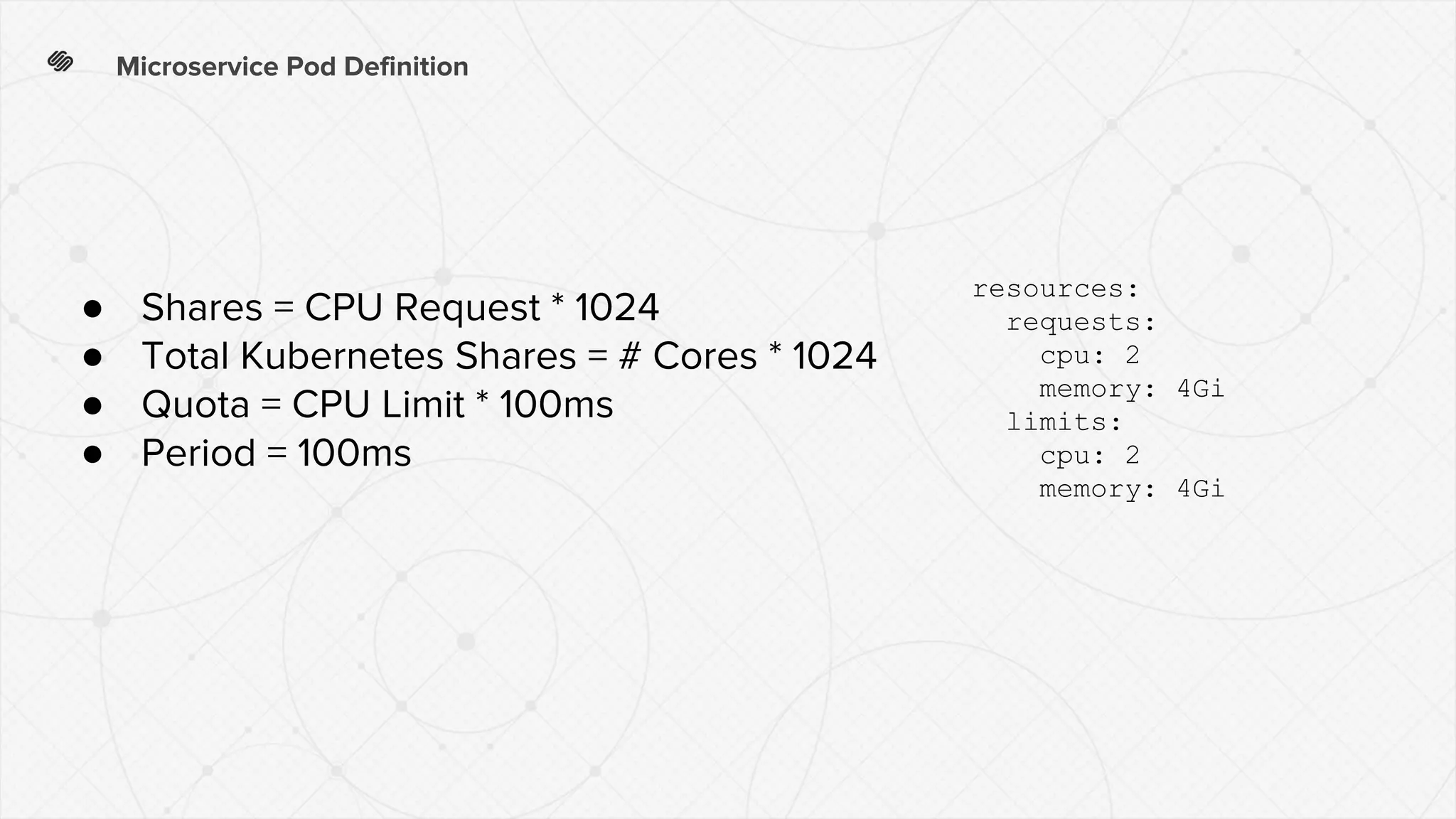
● Shares = CPU Request * 1024
● Total Kubernetes Shares = # Cores * 1024
● Quota = CPU Limit * 100ms
● Period = 100ms
Java in a Container
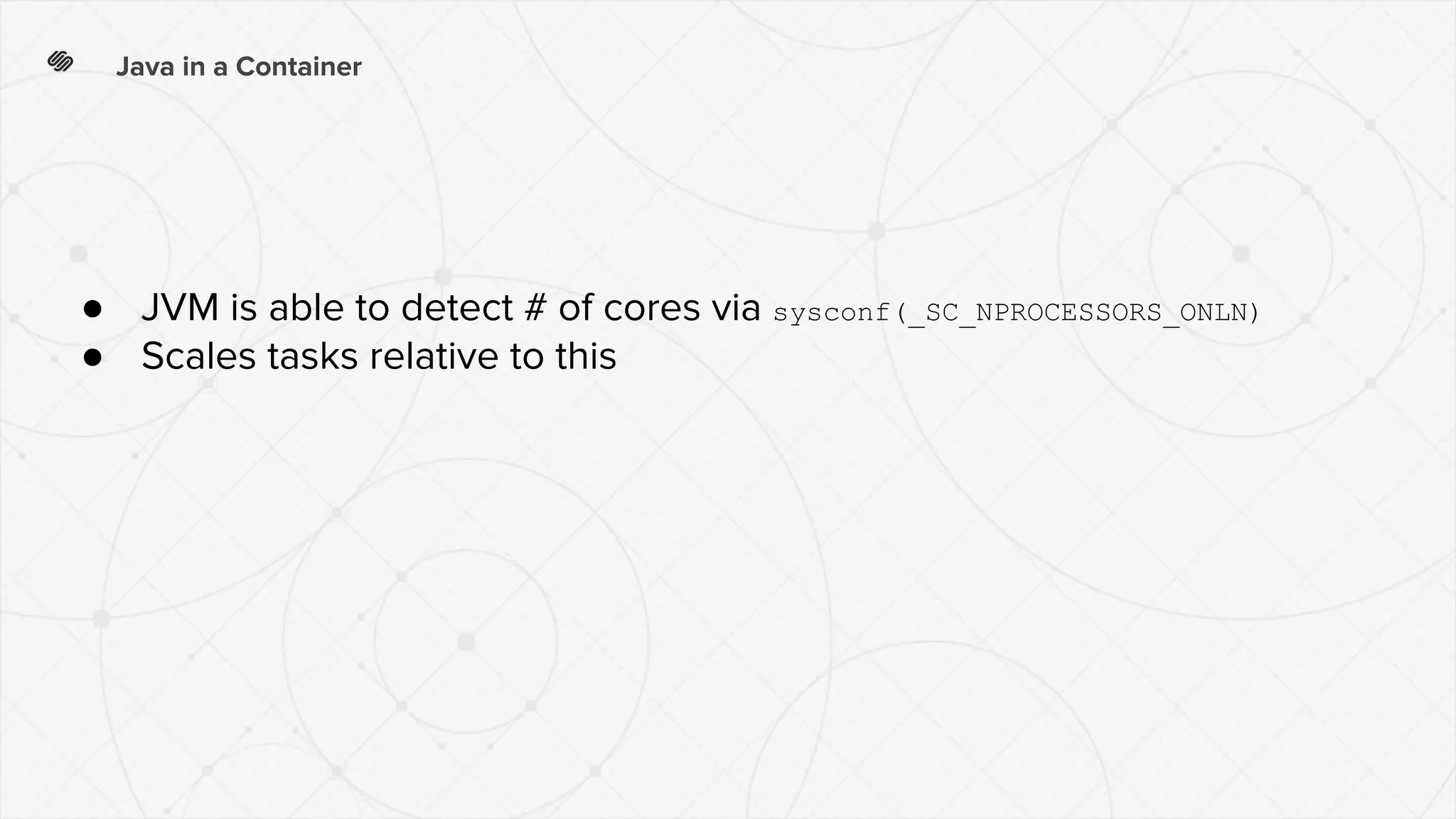
● JVM is able to detect # of cores via sysconf(_SC_NPROCESSORS_ONLN)
● Scales tasks relative to this
Java in a Container
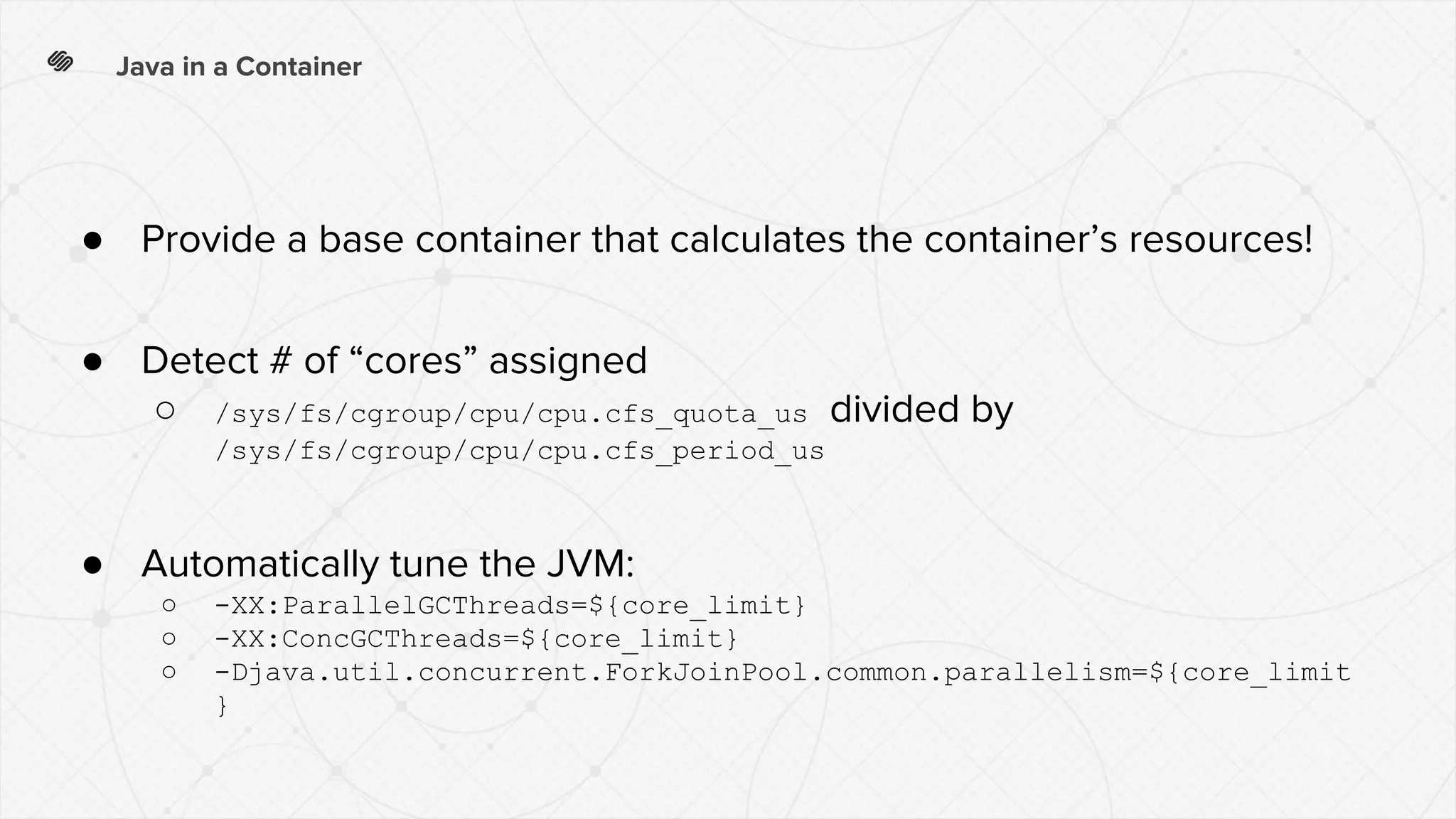
● Provide a base container that calculates the container’s resources!
● Detect # of “cores” assigned
○ /sys/fs/cgroup/cpu/cpu.cfs_quota_us divided by
/sys/fs/cgroup/cpu/cpu.cfs_period_us
● Automatically tune the JVM:
○ -XX:ParallelGCThreads=${core_limit}
○ -XX:ConcGCThreads=${core_limit}
○ -Djava.util.concurrent.ForkJoinPool.common.parallelism=${core_limit
}
Java in a Container
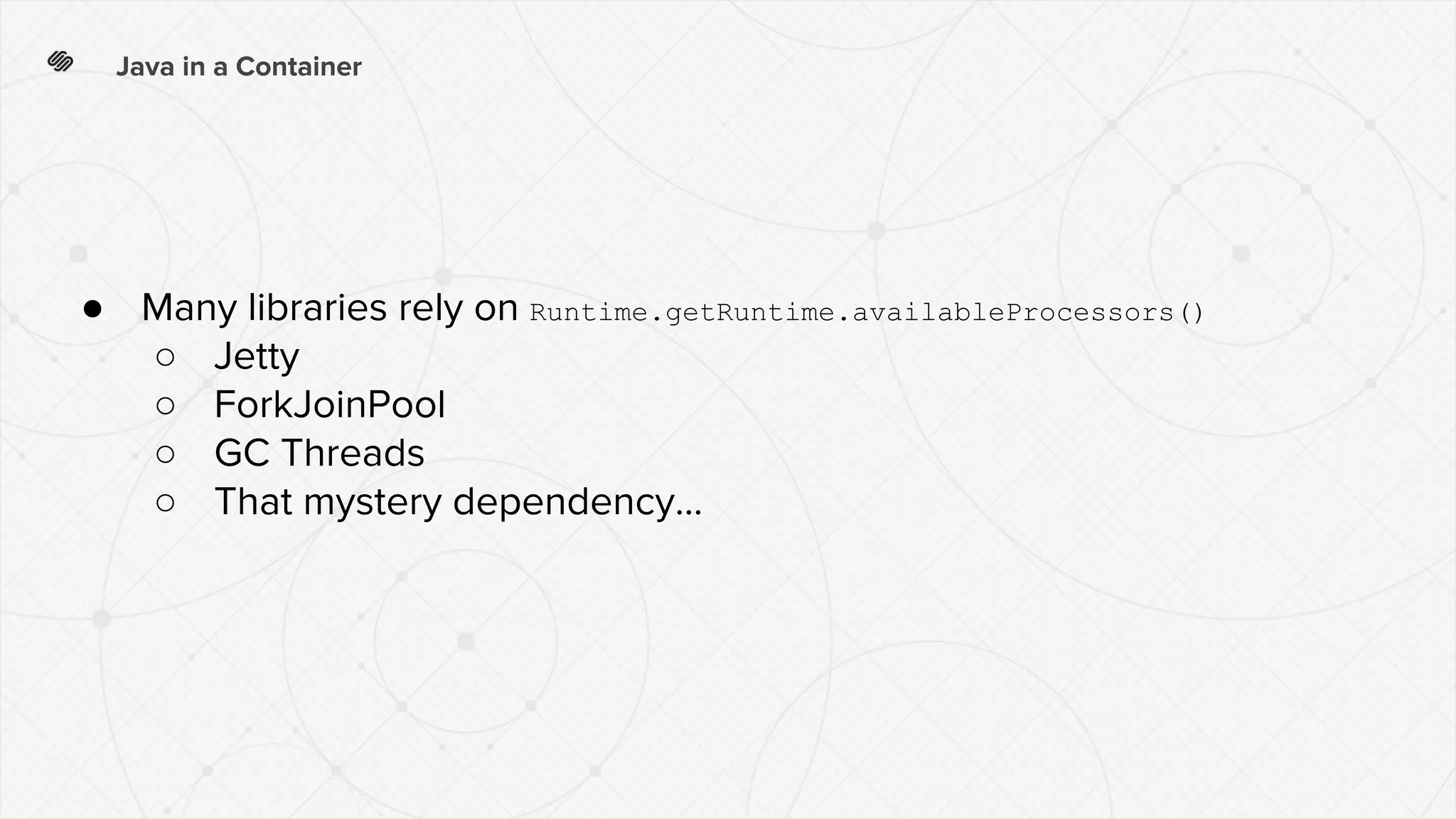
● Many libraries rely on Runtime.getRuntime.availableProcessors()
○ Jetty
○ ForkJoinPool
○ GC Threads
○ That mystery dependency...
Java in a Container
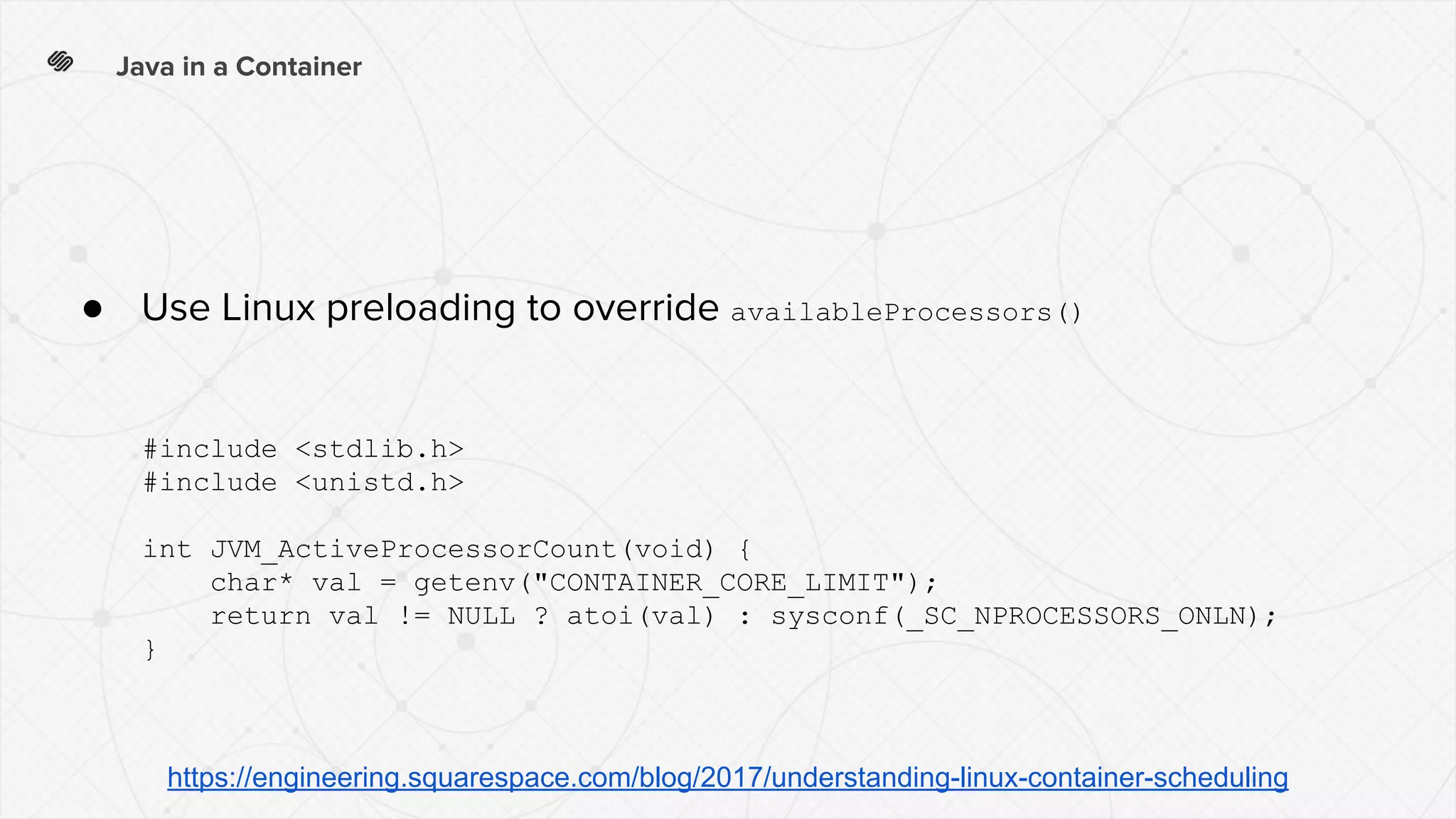
● Use Linux preloading to override availableProcessors()
#include <stdlib.h>
#include <unistd.h>
int JVM_ActiveProcessorCount(void) {
char* val = getenv("CONTAINER_CORE_LIMIT");
return val != NULL ? atoi(val) : sysconf(_SC_NPROCESSORS_ONLN);
}
https://engineering.squarespace.com/blog/2017/understanding-linux-container-scheduling
Communication With External Services
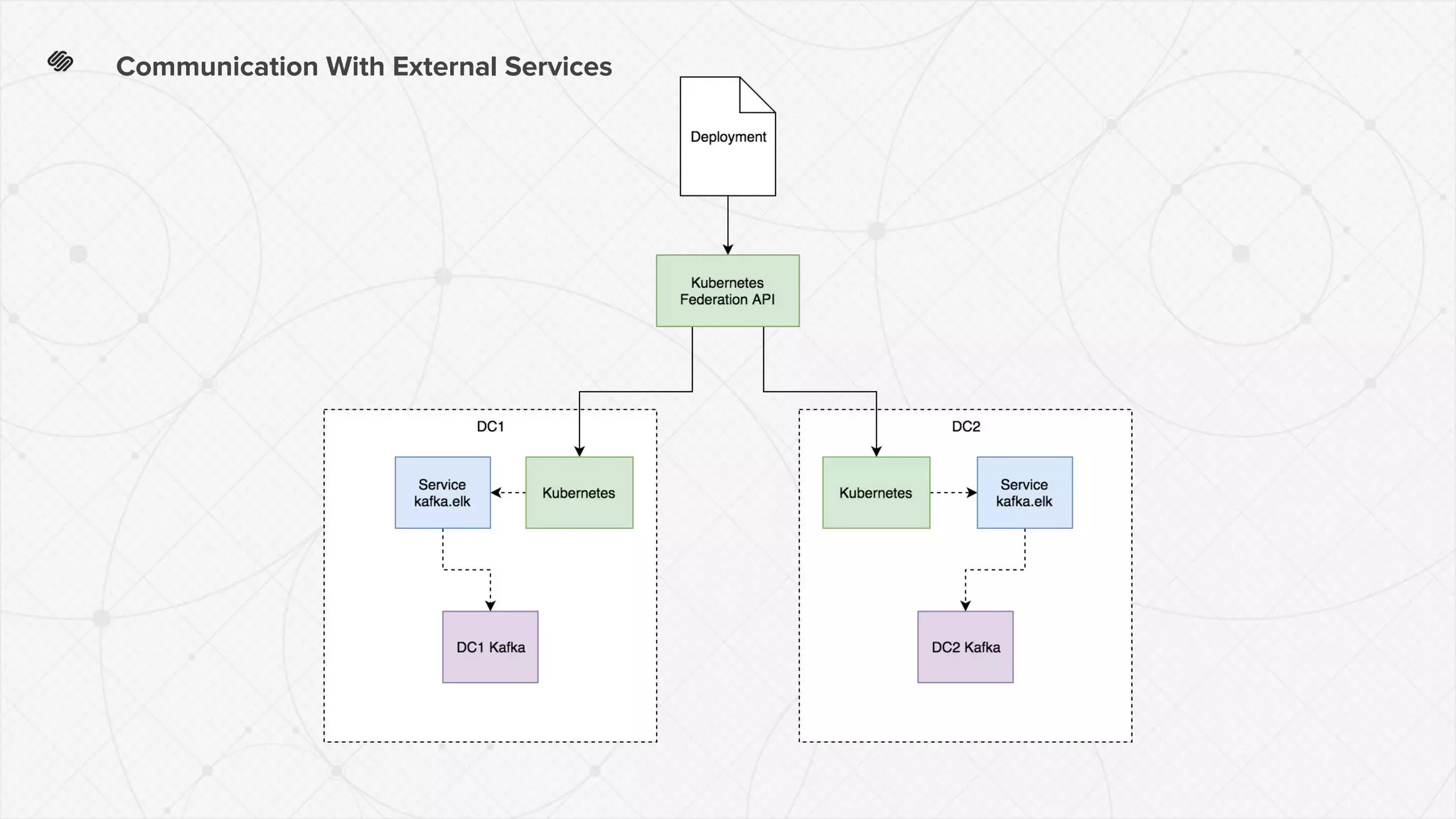
● Environment specific services should not be encoded in application
● Single deployment for all environments and datacenters
● Federation API expects same deployment
● Not all applications are using consul
Communication With External Services
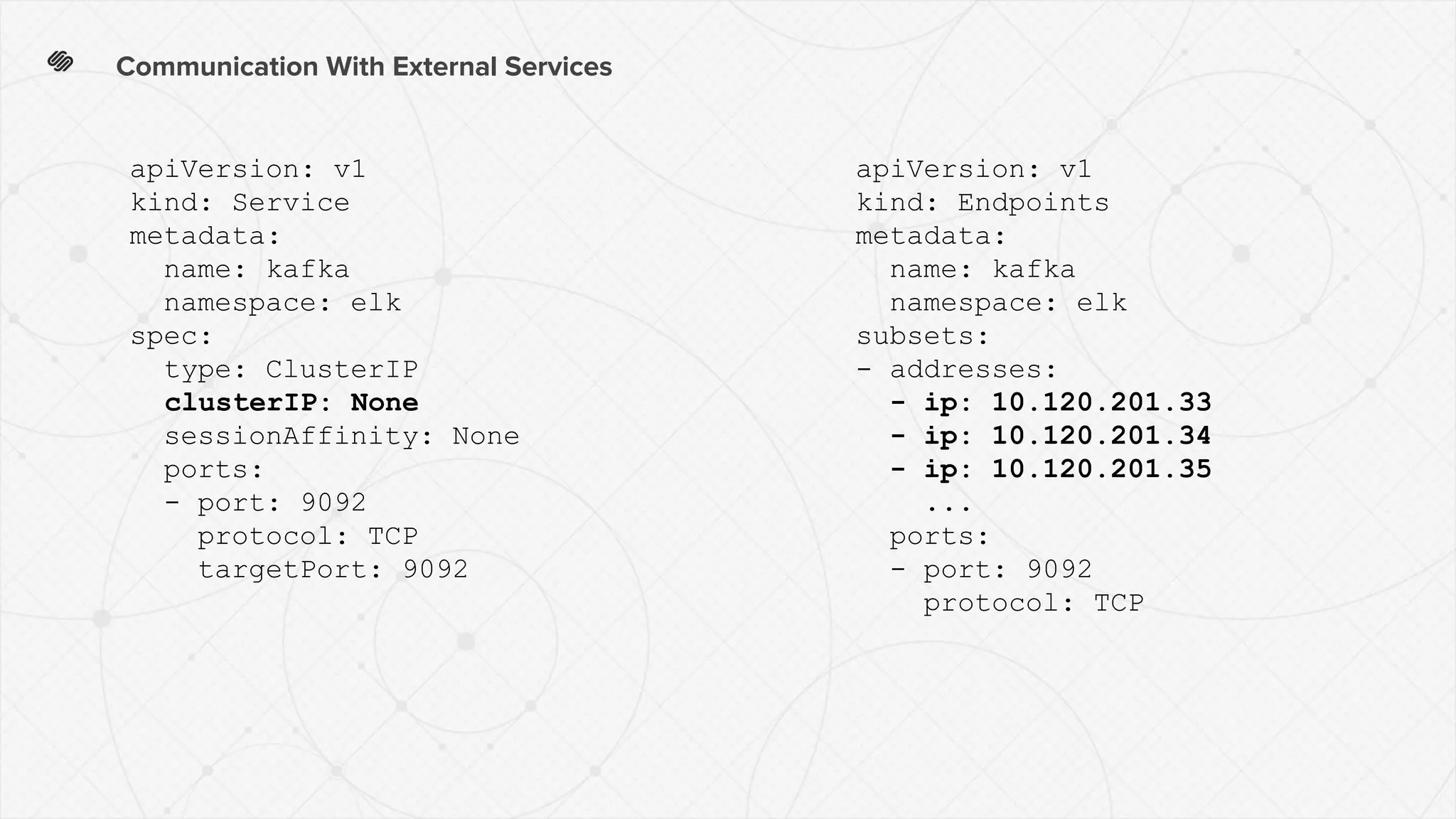
apiVersion: v1
kind: Service
metadata:
name: kafka
namespace: elk
spec:
type: ClusterIP
clusterIP: None
sessionAffinity: None
ports:
- port: 9092
protocol: TCP
targetPort: 9092
apiVersion: v1
kind: Endpoints
metadata:
name: kafka
namespace: elk
subsets:
- addresses:
- ip: 10.120.201.33
- ip: 10.120.201.34
- ip: 10.120.201.35
...
ports:
- port: 9092
protocol: TCP
So what’s left?
Future Work: Enforce Squarespace Standards
● Custom Admission Controller requires all services, deployments, etc.
meet certain standards
○ Resource requests/limits
○ Owner annotations
○ Service labels
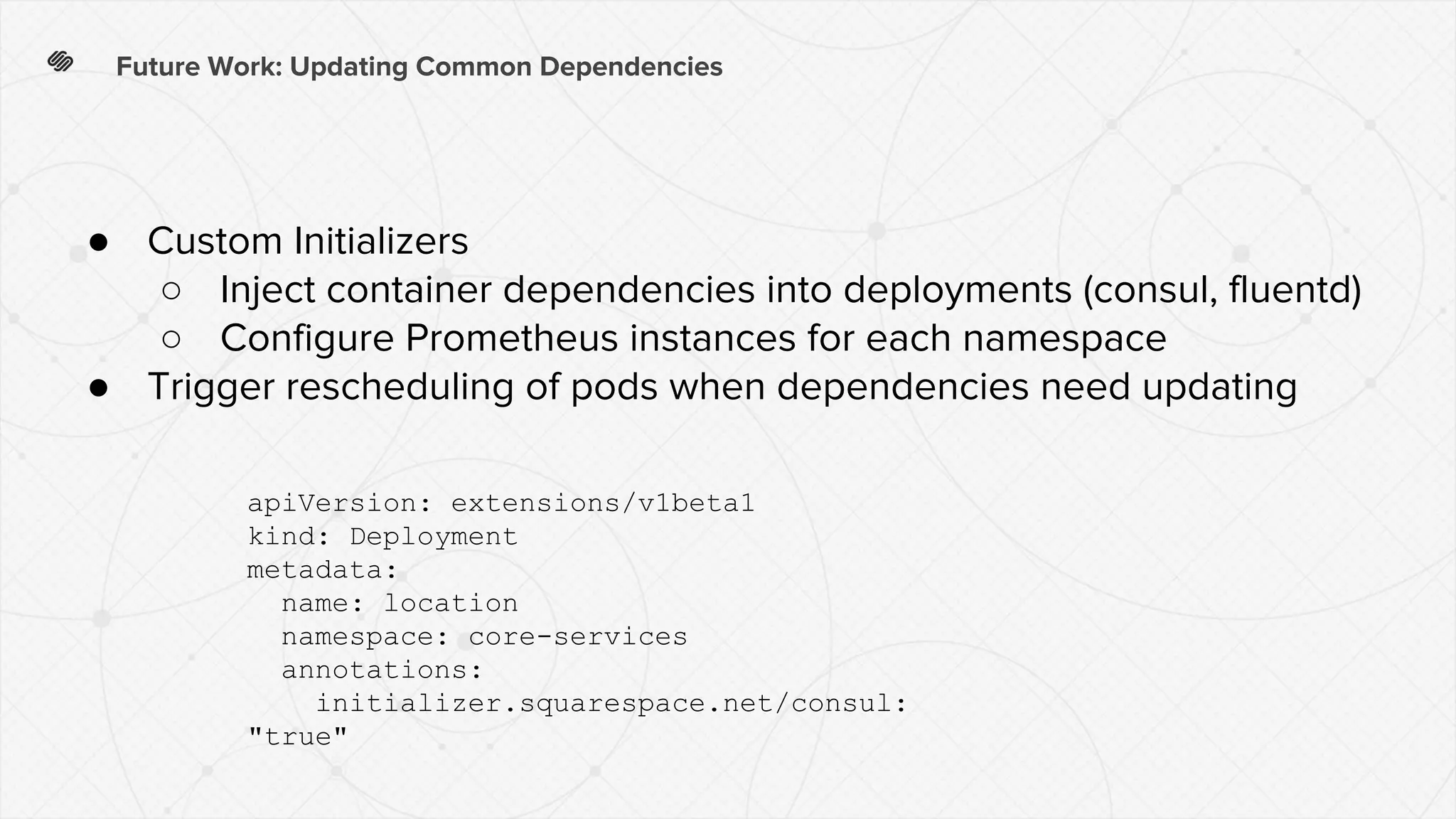
Future Work: Updating Common Dependencies
● Custom Initializers
○ Inject container dependencies into deployments (consul, fluentd)
○ Configure Prometheus instances for each namespace
● Trigger rescheduling of pods when dependencies need updating
apiVersion: extensions/v1beta1
kind: Deployment
metadata:
name: location
namespace: core-services
annotations:
initializer.squarespace.net/consul:
"true"
QUESTIONS
Thank you!
squarespace.com/careers
Doug Jones
@dougfjones
Kevin Lynch
@kevml

2017 Microservices Practitioner Virtual Summit: Microservices at Squarespace - Doug Jones and Kevin Lynch, Microservices Practitioner Virtual Summit 2017

  • 2.
    Part 1: Buildingthe Pillars of Microservices Part 2: Containerization and Orchestration (Kubernetes) AGENDA
  • 3.
    Part 1: Buildingthe Pillars 01 The Journey to Microservices 02 Building the Pillars of Microservices
  • 5.
    Microservices Journey: AStory of Growth 2013: small (< 50 engineers) build product & grow customer base whatever works 2014: medium (< 100 engineers) we have a lot of customers now! whatever works doesn't work anymore 2016: large (100+ engineers) architect for scalability and reliability organizational structures ?: XL (200+ engineers)
  • 6.
    Challenges with aMonolith ● Reliability ● Performance ● Engineering agility/speed, cross-team coupling ● Engineering time spent fire fighting rather than building new functionality What were the increasingly difficult challenges with a monolith?
  • 7.
    https://www.squarespace.com/?gclid=<unique-id> Challenges with aMonolith Story of an Outage...During the Super Bowl
  • 8.
    Challenges with aMonolith ● Monitoring typically starts at the edges ○ Think requests in, DB queries out, etc ● What about the guts of the app? How much visibility do you have there? ● How long does it take you to recover from an issue? Find the cause and fix the issue? Challenges with Monitoring/Finding Faults
  • 9.
    The Journey toMicroservices ● Define Pillars: ideas we consider necessary for successful production microservices ● Implement these pillars as part of our platform ● Reduce boilerplate and reinventing the wheel syndrome ● Service authors get these for free and can focus on their application domain Design a Platform for Production, Remove Challenges
  • 10.
    Pillars Microservice Framework HTTP API Service Discovery SoftwareLoad Balancer Observability Async Client Fault Tolerance https://engineering.squarespace.com/blog/2017/the-pill ars-of-squarespace-services
  • 11.
    Platform Features Service Discovery API Documentation Structured Logging Metrics & Dashboards Distributed Tracing Contextual Information Alert Definitions Standardized Deployments Healthchecks Dynamic Configuration Client-SideLoad Balancing Latency & Fault Tolerance Client-Side Caching HTTP Request Builders Code Generation Service Dashboard Traffic Visualization Server Platform Client Platform ToolingTooling
  • 12.
    Platform Features Service Discovery API Documentation Structured Logging Metrics & Dashboards Distributed Tracing Contextual Information Alert Definitions Standardized Deployments Healthchecks Dynamic Configuration Client-SideLoad Balancing Latency & Fault Tolerance Client-Side Caching HTTP Request Builders Code Generation Service Dashboard Traffic Visualization Async/Reactive Alert Management Log Aggregation
  • 13.
    Building the Pillarsof Microservices ● HTTP + JSON ○ Industry standard. Tons of tools. ● Solid open source Java API server platforms ○ Started with Dropwizard ○ now on Spring Boot (configured to use Jetty and Jersey 2) Pillar: HTTP APIs
  • 14.
    Building the Pillarsof Microservices ● Swagger (OpenAPI Specification) ● Code generation ○ Swagger spec → models, server API, client Even Easier APIs
  • 15.
    Swagger Path Example paths: /currency-info: put: tags: -CurrencyInfo description: "Creates a new {@link CurrencyInfo} resource." summary: Create a new currency info operationId: save parameters: - name: info in: body schema: $ref: '#/definitions/CurrencyInfo' responses: 200: description: ok schema: $ref: '#/definitions/CurrencyInfo'
  • 16.
  • 17.
    Building the Pillarsof Microservices ● Services announce themselves, publishing their name and host/port information ● Started with a simple announcement payload and found that was enough ● Healthchecks to mark services down Pillar: Service Discovery
  • 18.
    Building the Pillarsof Microservices ● First: Zookeeper ○ Complicated clients (no HTTP API) ○ Must build discovery on Zookeeper primitives ○ Strong consistency is unnecessary ○ Client heartbeats can’t be expanded upon ○ No great way to support multiple data centers Service Discovery Systems
  • 19.
    ● Now: Consul ○First class discovery support ○ Built in multi-data center support ○ Simple HTTP API ○ Configurable healthchecks ○ key/value store ■ We use for dynamic config and leader election Building the Pillars of Microservices Service Discovery Systems
  • 20.
    DC2DC1 Multi DC withConsul ConsulConsulConsul ConsulConsulConsul Service Announce Service Announce Primary DB Replica DB Replicate WAN Gossip Consistent Set
  • 21.
    DC2DC1 Multi DC withConsul ConsulConsulConsul ConsulConsulConsul Service Service Primary DB Replica DB Replicate Service Query ?dc=”DC2” Remote DC forwarding
  • 22.
    Building the Pillarsof Microservices ● Avoid middleware/extra configuration ● Customizable logic ● Connection pooling ● System awareness to increase fault tolerance ● Builds on Netflix Ribbon OSS Pillar: Software Load Balancers
  • 23.
    Building the Pillarsof Microservices ● Metrics ● Dashboards ● Distributed Tracing ● Structured Logging ● Healthchecks ● Alerts Pillar: Observability
  • 24.
  • 25.
  • 26.
    Structured Logging tail -f/data/logs/taxation-access.log 2017-03-22 07:24:45:026 GMT thread=jetty-846 contextId=JaOLrH2O contextSourceType=billing clientVersion=taxation-client-3.1 level=INFO class=AccessLog ip=10.100.101.205 method=GET uri=/api/1/taxation/rates queryString= httpVersion=HTTP/1.1 responseCode=200 responseTimeMs=39
  • 27.
    Contextual Information Client v3.1 Taxation Service BillingService Context IdClient Version Client Source Type JaOLrH2O
  • 28.
    Building the Pillarsof Microservices ● Addresses the Fanout problem, improved latency ● Reactive: RxJava with RxNetty ● Allows greater composition and reuse. Avoid “callback hell” Pillar: Async Client
  • 29.
    Fanout Depicted Client Service A ServiceZ Application Container Service B Service C Service D
  • 30.
    Sync Execution Client Service A ServiceZ Application Container Service B Service C Service D 1 2 3 4 5 Total Latency = A + B + C + D + Z
  • 31.
    Async Execution Client Service A ServiceZ Application Container Service B Service C Service D 1 2 2 2 1 Total Latency = max(A, Z) A = max(B, C, D) + A’s latency
  • 32.
    Building the Pillarsof Microservices ● Circuit breakers ● Retry logic ○ Much easier to implement w/ RxJava ● Timeouts ● Fallbacks (cached or static values) ● Netflix Hystrix Pillar: Fault Tolerance
  • 33.
    Fault Tolerance Service B ServiceA Service C Service A Client Service B Client Service C Client User Request Application Container
  • 34.
    Fault Tolerance Service B ServiceA Service C Service A Client 10 Threads Service B Client 5 Threads Service C Client 5 Threads User Request Fail fast, fail silent, or fallback Application Container
  • 35.
    Pillars Microservice Framework HTTP API Service Discovery SoftwareLoad Balancer Observability Async Client Fault Tolerance https://engineering.squarespace.com/blog/2017/the-pill ars-of-squarespace-services
  • 36.
    Building the Pillarsof Microservices ● Entirely Async Systems ○ Async servers, Streaming, gRPC, Netty ● Distributed task management ○ Serverless computing ● Easier/better alert definition and management ● Better tooling to create and deploy services Future Work
  • 37.
    Part 2: Containerization& Kubernetes Orchestration 01 The problem with static infrastructure 02 Kubernetes in a datacenter? 03 Challenges
  • 38.
    Containerization & KubernetesOrchestration ● Engineering org grows... ● More services… ● More infrastructure to spin up… ● Ops becomes a blocker... Stuck in a loop
  • 39.
    Containerization & KubernetesOrchestration ● Difficult to find resources ● Slow to provision and scale ● Already have discovery! ● Metrics system must support short lived metrics ● Alerts are usually per instance Static infrastructure and microservices do not mix!
  • 40.
    Traditional Provisioning Process ●Pick ESX with available resources ● Pick IP ● Register host to Cobbler ● Register DNS entry ● Create new VM on ESX ● PXE boot VM and install OS and base configuration ● Install system dependencies (LDAP, NTP, CollectD, Sensu…) ● Install app dependencies (Java, FluentD/Filebeat, Consul, Mongo-S…) ● Install the app ● App registers with discovery system and begins receiving traffic
  • 41.
    Kubernetes Provisioning Process ●kubectl apply -f app.yaml
  • 42.
    Containerization & KubernetesOrchestration ● Provisioning/Scaling: Kubernetes ● Monitoring: Prometheus ● Alerting: AlertManager ● Discovery: Consul + Kubernetes ● Decentralization So how do we make this magic work?
  • 43.
    Kubernetes in adatacenter?
  • 44.
  • 45.
    Spine and LeafLayer 3 Clos Topology ● Each leaf switch represents a Top-of-Rack switch (ToR) ● All work is performed at the leaf switch ● Each leaf switch is separate Layer 3 domain ● Each leaf is a separate BGP domain (ASN) ● No Spanning Tree Protocol issues seen in L2 networks (convergence time, loops) Leaf Leaf Leaf Leaf Spine Spine
  • 46.
    Spine and LeafLayer 3 Clos Topology ● Simple to understand ● Easy to scale ● Predictable and consistent latency (hops = 2) ● Allows for Anycast IPs Leaf Leaf Leaf Leaf Spine Spine
  • 47.
    Calico Networking ● Nonetwork overlay required ● Communicates directly with existing L3 mesh network ● BGP Peering with Top of Rack switch ● Calico supports Kubernetes NetworkPolicy firewall rules
  • 48.
  • 49.
    ● Graphite doesnot scale well with ephemeral instances ● Easy to have combinatoric explosion of metrics Traditional Monitoring & Alerting ● Application and system alerts are tightly coupled ● Difficult to create alerts on SLAs ● Difficult to route alerts
  • 50.
  • 51.
  • 52.
  • 53.
    Microservice Pod Definition resources: requests: cpu:2 memory: 4Gi limits: cpu: 2 memory: 4Gi Microservice Pod Java Microservice fluentd consul
  • 54.
  • 55.
    Microservice Pod Definition resources: requests: cpu:2 memory: 4Gi limits: cpu: 2 memory: 4Gi ● Kubernetes assumes no other processes are consuming significant resources ● Completely Fair Scheduler (CFS) ○ Schedules a task based on CPU Shares ○ Throttles a task once it hits CPU Quota
  • 56.
    Microservice Pod Definition resources: requests: cpu:2 memory: 4Gi limits: cpu: 2 memory: 4Gi ● Shares = CPU Request * 1024 ● Total Kubernetes Shares = # Cores * 1024 ● Quota = CPU Limit * 100ms ● Period = 100ms
  • 57.
    Java in aContainer ● JVM is able to detect # of cores via sysconf(_SC_NPROCESSORS_ONLN) ● Scales tasks relative to this
  • 58.
    Java in aContainer ● Provide a base container that calculates the container’s resources! ● Detect # of “cores” assigned ○ /sys/fs/cgroup/cpu/cpu.cfs_quota_us divided by /sys/fs/cgroup/cpu/cpu.cfs_period_us ● Automatically tune the JVM: ○ -XX:ParallelGCThreads=${core_limit} ○ -XX:ConcGCThreads=${core_limit} ○ -Djava.util.concurrent.ForkJoinPool.common.parallelism=${core_limit }
  • 59.
    Java in aContainer ● Many libraries rely on Runtime.getRuntime.availableProcessors() ○ Jetty ○ ForkJoinPool ○ GC Threads ○ That mystery dependency...
  • 60.
    Java in aContainer ● Use Linux preloading to override availableProcessors() #include <stdlib.h> #include <unistd.h> int JVM_ActiveProcessorCount(void) { char* val = getenv("CONTAINER_CORE_LIMIT"); return val != NULL ? atoi(val) : sysconf(_SC_NPROCESSORS_ONLN); } https://engineering.squarespace.com/blog/2017/understanding-linux-container-scheduling
  • 61.
    Communication With ExternalServices ● Environment specific services should not be encoded in application ● Single deployment for all environments and datacenters ● Federation API expects same deployment ● Not all applications are using consul
  • 62.
  • 63.
    Communication With ExternalServices apiVersion: v1 kind: Service metadata: name: kafka namespace: elk spec: type: ClusterIP clusterIP: None sessionAffinity: None ports: - port: 9092 protocol: TCP targetPort: 9092 apiVersion: v1 kind: Endpoints metadata: name: kafka namespace: elk subsets: - addresses: - ip: 10.120.201.33 - ip: 10.120.201.34 - ip: 10.120.201.35 ... ports: - port: 9092 protocol: TCP
  • 64.
  • 65.
    Future Work: EnforceSquarespace Standards ● Custom Admission Controller requires all services, deployments, etc. meet certain standards ○ Resource requests/limits ○ Owner annotations ○ Service labels
  • 66.
    Future Work: UpdatingCommon Dependencies ● Custom Initializers ○ Inject container dependencies into deployments (consul, fluentd) ○ Configure Prometheus instances for each namespace ● Trigger rescheduling of pods when dependencies need updating apiVersion: extensions/v1beta1 kind: Deployment metadata: name: location namespace: core-services annotations: initializer.squarespace.net/consul: "true"
  • 67.